ℹ️ Skipped - page is already crawled
| Filter | Status | Condition | Details |
|---|---|---|---|
| HTTP status | PASS | download_http_code = 200 | HTTP 200 |
| Age cutoff | PASS | download_stamp > now() - 6 MONTH | 0.3 months ago |
| History drop | PASS | isNull(history_drop_reason) | No drop reason |
| Spam/ban | PASS | fh_dont_index != 1 AND ml_spam_score = 0 | ml_spam_score=0 |
| Canonical | PASS | meta_canonical IS NULL OR = '' OR = src_unparsed | Not set |
| Property | Value | |||||||||||||||||||||||||||
|---|---|---|---|---|---|---|---|---|---|---|---|---|---|---|---|---|---|---|---|---|---|---|---|---|---|---|---|---|
| URL | https://www.historyonthenet.com/watergate-scandal-timeline | |||||||||||||||||||||||||||
| Last Crawled | 2026-04-16 10:47:16 (9 days ago) | |||||||||||||||||||||||||||
| First Indexed | 2018-11-27 15:12:20 (7 years ago) | |||||||||||||||||||||||||||
| HTTP Status Code | 200 | |||||||||||||||||||||||||||
| Content | ||||||||||||||||||||||||||||
| Meta Title | Watergate Scandal Timeline - History | |||||||||||||||||||||||||||
| Meta Description | A Complicated President There have been many scandals throughout American presidential history, but only one has ever brought down a presidency. To | |||||||||||||||||||||||||||
| Meta Canonical | null | |||||||||||||||||||||||||||
| Boilerpipe Text | Loading...
A Complicated President
There have been many scandals throughout American presidential history, but only one has ever brought down a presidency. To understand Watergate, it is helpful to have an understanding of the culture of the administration, and of the psyche of the man himself. Richard M. Nixon was a secretive man who did not tolerate criticism well, who engaged in numerous acts of duplicity, who kept lists of enemies, and who used the power of the presidency to seek petty acts of revenge on those enemies. As early as the 1968 campaign Nixon was scheming about Vietnam. Just as the Democrats were gaining in the polls following Johnson’s halting of the bombing of North Vietnam and news of a possible peace deal, Nixon set out to sabotage the Paris peace negotiations by privately assuring the South Vietnamese military rulers a better deal from him than they would get from Democratic candidate Hubert Humphrey. The South Vietnamese junta withdrew from the talks on the eve of the election, ending the peace initiative and helping Nixon to squeak out a marginal victory.
During Nixon’s first term he approved a secret bombing mission in Cambodia, without even consulting or informing congress, and he fought tooth and nail to prevent the New York Times from publishing the infamous Pentagon Papers (described below). Most striking, however, was Nixon’s strategy for how to deal with the enemies that he saw everywhere. Nixon sent Vice President Spiro Agnew on the circuit to blast the media, protestors, and intellectuals who criticized the Vietnam War and Nixon’s policies. Agnew spewed out alliterate insults such as “pusillanimous pussyfooters”, “nattering nabobs of negativism”, and “hopeless, hysterical hypochondriacs of history”. He once described a group of opponents as “an effete corps of impudent snobs who characterize themselves as intellectuals.”
The Washington “Plumbers”
But Nixon and his aides also discussed ways in which the President could use subterfuge to undermine his enemies and revenge perceived injustices. This became especially important to the President in 1972, when he was determined to win the election more comfortably than he had in 1968. Nixon had once approved the illegal break-in concept first floated by White House aide Tom Huston, even though Huston specifically told the president it was tantamount to burglary. However, FBI director J. Edgar Hoover refused to cooperate. (Hoover then died in May, 1972, and L. Patrick Gray was appointed acting director in his place). Nixon was especially infuriated by leaks in his administration, and none was bigger than that which became known as the Pentagon Papers, a sensitive Pentagon document that traced the often illicit history of America’s involvement in Vietnam. Nixon tried to block publication of the document, and lost. When Nixon discovered that military analyst Daniel Ellsberg had been the source of the leak, he told White House Counsel Charles Colson, “Do whatever has to be done to stop these leaks and prevent further unauthorized disclosures; I don’t want to be told why it can’t be done…I don’t want excuses; I want results. I want it done, whatever the cost.” Colson and yet another Nixon aide, John Erlichmann, created a group whose task it was to stop any further leaks. These White House Plumbers, as they came to be known, were tasked with finding a way to get revenge on Ellsberg. Two of the so-called plumbers were ex-CIA officer Howard Hunt, and ex-FBI agent G. Gordon Liddy. The plumbers tried to break into the office of Ellsberg’s psychiatrist in Los Angeles to get Ellsberg’s confidential treatment records, but the raid was completely botched. In addition to Hunt and Liddy, several other future Watergate burglars were part of this raid.
1972
The Watergate Break-In
June 16, 1972: In room 214 of the Watergate Hotel in Washington, D.C., seven men gathered to finalize their plans to break in to the Democratic National Committee’s (DNC) headquarters, located on the sixth floor of one of the Watergate complex’s six buildings. One of these men, G. Gordon Liddy, was a former FBI agent. Another, E. Howard Hunt, had retired from the CIA. James McCord would handle the bugging, Bernard Barker would photograph documents, and Virgilio Gonzalez would pick the locks. The remaining two, Eugenio Martinez and Frank Sturgis, would serve as lookouts. Several of these men were Cuban exiles who had met Hunt through their participation in the failed Bay of Pigs invasion back in 1961. Although the burglars would be caught in the act, many months would passbefore the enough details would emerge to create a picture of the events leading up to that night. These men had been hired by representatives of President Nixon’s administration to use illegal means to gather information that could prove useful to Nixon winning the 1972 election.
On June 17, 1972, Frank Wills, a security guard at the Watergate Complex, noticed tape covering the latch on the locks of several stairway doors in the complex , allowing them to be closed without locking. He removed the tape, and thought nothing of it. An hour later, he discovered that someone (McCord) had re-taped the locks. Wills called the police, who showed up in plainclothes in an unmarked car, allowing them to pass by the lookout without the alarm being sounded. The burglars then turned off their radio when they heard noise in an adjacent stairwell. The lookout saw several of the police officers outside on a terrace near the DNC offices, but when he alerted Liddy (Liddy and Hunt stayed in the hotel room, in two-way radio contact with the others), the ex-FBI agent was unable to reach them on the radio. Within minutes, the police arrested the 5 burglars. On their possession were wire-tapping equipment, two cameras, several dozen rolls of film, and a few thousand dollars in cash–$100 bills in sequential serial numbers (indicating the money had come directly from a bank, which could possibly be traced). Liddy and Hunt quickly vacated the premises, but the burglars also had two hotel room keys, one of which was for the room where Liddy and Hunt had stayed.
The five burglars were processed at the police station, where several of them gave fake names. Hunt hired a lawyer to quickly bail the men out, but he underestimated their bail amount. G. Gordon Liddy went to his office and commenced a shredding operation to eliminate any evidence of his involvement. Liddy worked for the Committee to Re-elect the President, sometimes referred to pejoratively as CREEP, and his involvement was a direct connection to President Nixon. McCord was the chief security officer at CREEP. Liddy and Hunt had also worked at the White House, which made the Nixon connection more serious. Meanwhile, a simple fingerprint check revealed the burglar’s true identities.
On Monday, June 19, 1972: The Washington Post reported, “One of the five men arrested early Saturday in the attempt to bug the Democratic National Committee headquarters is the salaried security coordinator for President Nixon’s re-election committee.” Shortly thereafter, it was revealed that a search warrant had been executed for the hotel rooms for which the burglars had keys, and that inside one of them were address books that listed Howard Hunt’s name or initials, and included the hand-written notation, “WH,” for White House. Official reaction was swift. From the White House, Nixon’s Press Secretary, Ron Zeigler, dismissed the incident as some sort of petty thievery attempt. John Mitchell, the head of CREEP, denied that the organization had any connection to the event. These public denials were lies. In fact, an elaborate cover-up was already under way. The charge that would stem from the cover-up, “obstruction of justice,” would eventually bring Nixon down.
The Connection to the Committee to Re-Elect the President (CREEP)
On August 1, 1972, a $25,000 cashiers check earmarked for the Nixon re-election campaign was found in the bank account of one of the Watergate burglars. Further investigation revealed that, in the months leading up to their arrests, more thousands had passed through their bank and credit card accounts, supporting the burglars’ travel, living expenses, and purchase,. Several donations (totaling $89,000) were made by individuals who thought they were making private donations to the President’s re-election committee. The donations were made in the form of cashier’s, certified, and personal checks, and all were made payable only to the Committee to Re-Elect the President. However, through a complicated fiduciary set-up, the money actually went into an account owned by a Miami company run by Watergate burglar Bernard Barker. On the backs of these checks was the official endorsement by the person who had the authority to do so, Committee Bookkeeper and Treasurer, Hugh Sloan. Thus a direct connection between the Watergate break-in and the Committee to Re-Elect the President had been established. When confronted and faced with the potential charge of federal bank fraud, Sloan revealed that he had given the checks to G. Gordon Liddy at the direction of Committee Deputy Director Jeb Magruder and Finance Director Maurice Stans. Liddy had then given the endorsed checks to Watergate burglar Bernard Barker, who then deposited the money in accounts located outside the U.S. and withdrew the money in the form of cashier’s checks and money orders in April and May. They did not know that banks kept records of these transactions.
Woodward, Bernstein & “Deep Throat”
Media coverage during 1972 was influential in keeping the Watergate story in the news, and in establishing the connection between the burglary and the Committee to Re-Elect the President. The most notable coverage came from Time, The New York Times, and especially from The Washington Post. Opinions vary, but the publicity these media outlets gave to Watergate likely resulted in more consequential political repercussions from the Congressional investigation. Most famous is the story of how Washington Post Reporters Bob Woodward and Carl Bernstein relied heavily on anonymous sources to reveal that knowledge of the break-in and subsequent attempt to cover it up had connections deep in the Justice Department, the FBI, the CIA, and even the White House.
Woodward and Bernstein’s most famous source was an individual they had nicknamed Deep Throat, a reference to a controversial pornography film of the time. Woodward claimed in his 1974 book, All The President’s Men, that the two would meet secretly at an underground parking garage just over the Key Bridge in Rosslyn, usually at 2:00 am, where Deep Throat helped him make the connections. Throughout the protracted investigation, Woodward would signal his source that he desired a meeting by placing a flowerpot with a red flag on the balcony of his apartment. If Deep Throat wanted a meeting, he would make special marks on page twenty of Woodward’s copy of The New York Times. The first meeting took place on June 20, 1972, only 3 days after the break-in. The identity of Deep Throat was the subject of intense speculation for more than 30 years before he was revealed to be the FBI’s #2, Mark Felt.
On September 15, 1972, Hunt, Liddy, and the 5 Watergate burglars were indicted by a federal grand jury.
On September 29, it was revealed that Attorney General & Nixon campaign chairman John Mitchell had controlled a secret Republican fund used to pay for spying on the Democrats. On October 10, the FBI reported that the break-in at the Watergate was part of a massive campaign of political spying and sabotage on behalf of the officials and heads of the Nixon re-election campaign. Despite these revelations, Nixon’s re-election was never seriously jeopardized, and on November 7 the President was re-elected in one of the biggest landslides ever in American political history.
1973
Watergate Burglars’ Trial Begins
On January 8, 1973, the five burglars plead guilty as their trial began. On January 30, just ten days after Richard Nixon’s second inauguration, Liddy and McCord were convicted on charges conspiracy, burglary, and wiretapping. Nixon had dodged a bullet in the months between the break-in and his re-election, but the Watergate Scandal did not die out after the burglars were tried.
White House Linked to Cover-Up
On February 28, 1973, Acting FBI Director L. Patrick Gray testified before the Senate Judiciary Committee regarding his nomination to replace J. Edgar Hoover. Committee chairman Sam Ervin, referencing newspaper articles, questioned Gray as to how the White House had gained access to FBI files related to the Watergate investigation. Gray stated he had given reports to White House counsel John Dean, that Dean had ordered him to give the White House daily updates on the FBI’s investigation, that he had discussed the investigation with Dean on many occasions, and that Dean had “probably lied” to FBI investigators about his role in the scandal. Subsequently, Gray was ordered not to talk about Watergate by Attorney General Richard G. Kleindienst. Gray’s nomination failed, and now White House counsel Dean was directly linked to the Watergate cover-up.
On March 19, 1973, convicted Watergate burglar and ex-CIA agent James McCord, still facing sentencing, wrote a letter to U.S. District Judge John Sirica. In the letter, McCord stated that he had been pressured to plead guilty and remain silent, that he had perjured himself during the trial, that the break-in was not a CIA operation, and that other, as yet unnamed government officials, were involved. Judge Sirica urged McCord to cooperate fully with the Senate Watergate Committee, which was about to begin its investigation. On March 23, as the burglars were sentenced, Dean hired an attorney and began to quietly cooperate with Watergate investigators. He did this without informing the President, and continued to work as Nixon’s Chief White House Counsel, a clear conflict of interest.
Senate Watergate Committee Begins Investigation
On March 25, 1973, Senate Watergate Committee lawyer Sam Dash told reporters that he had interviewed James McCord twice, and that McCord had “named names” and had begun “supplying a full and honest account” of the Watergate operation. Dash refused to give details, but promised that McCord would soon testify in public Senate hearings. Shortly after Dash’s press conference, the Los Angeles Times reported that two that McCord had named were White House Counsel John Dean, and Nixon campaign deputy director Jeb Magruder. The White House denied Dean’s involvement, but said nothing about Magruder. Republican sources on Capitol Hill ominously confirmed the story, with one stating that McCord’s allegations were “convincing”. When Dean’s lawyer learned of a follow-up story planned by the Washington Post, he threatened to sue the newspaper if they ran the story. The Postprinted the story anyway, along with the threat from Dean’s lawyer.
On March 28, 1973, James McCord testified before the Senate Watergate Committee in a closed 5-hour session. There were so many leaks to the press that committee leaders decided to conduct all future hearings in public session. The most significant leak was that fellow Watergate burglar G. Gordon Liddy had told McCord that the burglary and surveillance operation was approved by then-Nixon campaign chairman & Attorney General John Mitchell in February 1972, and that White House Special Counsel to the President Charles Colson knew about the Watergate operation in advance (Colson had just quit his post to return to private practice). The next day, Colson told a National Press Club audience “I had no involvement or no knowledge of the Watergate, direct or indirect.”On April 8, 1973, White House Counsel John Dean told White House Chief of Staff H.R. Haldeman that he planned to testify before the Senate Committee. Haldeman advised against it, saying, “Once the toothpaste is out of the tube, it’s going to be very hard to get it back in.” Dean compiled a list of 15 names, mostly lawyers, who could be indicted in the scandal, and showed then showed the list to White House counsel and Assistant to the President for Domestic Affairs, John Ehrlichman.
Washington Post Connects Break-In to the Cover-up
April 9, 1973: The New York Times reported that James McCord told the Senate Watergate Committee that the cash payoffs for the burglars came directly from the the Republican Committee to Re-Elect the President (CREEP). When trying to confirm whether or not the “slush fund” continued to operate after the arrests (presumably as payoffs to keep the burglars silent), a CREEP employee exploded over the phone to Bob Woodward. He was apparently emotionally distraught over how the ignorance of former CREEP official John Mitchell and others has undermined the presidency. Woodward then called Hugh Sloan, and, using information he had gotten out of the other CREEP official, wrangled out of the former CREEP Treasurer that about $70,000 in CREEP “slush fund” money was used to pay off the burglars. The Washington Post reporters now had linkage between the bugging and the cover-up.
On April 17, 1973, President Nixon made a brief statement before the White House Press Corps that his White House aides and staff would appear before the Senate Watergate Committee if asked. He announced his own ongoing investigation, and promised to reveal “major new developments” in the future. He stated, “Real progress has been made in finding the truth.” Nixon also said that his concerns about separation of powers had been resolved, and that any person in the executive branch who was indicted would be discharged; that no one would be given immunity from prosecution. Nixon concluded, “I condemn any attempts to cover up in this case, no matter who is involved.” After the president left the podium, the press corps proceeded to hammer Press Secretary Ron Ziegler about whether the President’s statement contradicted the position previously articulated. Finally, Ziegler said to the press, “This is the operative statement. The others are inoperative.” Later in the day, the White House issued an official statement saying that the President had no prior knowledge of the Watergate Affair.
On April 22, 1973, Nixon requested that White House Counsel John Dean write him a report about everything he knew about the Watergate matter, and he sent Dean to Camp David to write it. Dean suspected he was on the cusp of becoming the Watergate scapegoat, and so he went to Camp David, but did not write the report.
On April 24, Attorney General Richard Kleindienst met with President Nixon to inform the President that White House counsel John Dean had testified about the white House having ordered the break-in at the office of Pentagon Papers leaker Daniel Ellsberg’s psychiatrist. Because Ellsberg’s was then on trial over the Pentagon Papers business, Kleindienst said that this new information must be transmitted to to the trial judge. The Attorney General told Nixon, “We have to do it could be another goddamn cover-up, you know. We can’t have another cover-up, Mr. President.” Nixon replied, “I don’t want any cover-ups of anything.” They briefly discussed the possibility of immunity for Dean, but quickly ruled it out. Later in the day, in another conversation, the despondent President told Kleindienst, “What the hell, you know. People say impeach the President. Well, then they get [Vice President Spiro] Agnew. What the hell?” Kleindienst replied, “There’s not going to be anything like that, Mr. President.” These conversations and many others of relevance were recorded on an oval office tape machine, which would be a major component of the investigation. Nixon also learned that Dean had testified about acting FBI Director L. Patrick Gray’s involvement in destroying files from White House “Plumber” E. Howard Hunt’s safe. Nixon says that Gray has to go. Gray resigned on April 27.
Haldeman and Ehrlichman Implicated & Resign
Further leaks about Dean’s discussions with investigators next implicated John Ehrlichman (White House counsel and Assistant to the President for Domestic Affairs) and White House Chief of Staff H.R. Haldeman. On April 30, 1973, left with little choice, Nixon summoned the two men to Camp David and, in what’s been described as a very emotional meeting, asked for their resignations. Attorney General Kleindienst also resigned. Nixon also asked for the resignation of White House counsel Dean, whose Senate testimony had, and would continue to be so damaging. He then issued a public statement announcing their resignations.
Nixon’s 1st Primetime Address on Watergate (April 30, 1973)
Later that evening, the President took to the airwaves in his first primetime oval office address to the American people on Watergate. He explained that the resignations were not an admission of guilt, but were carried out in order to restore the confidence of the American people. Nixon announced that he had replaced Attorney General Kleindienst with Elliot Richardson, and that he had given him the authority to designate a special independent counsel to investigate Watergate. Nixon took responsibility for the behavior of CREEP, and said, “I will do everything in my power to ensure that the guilty are brought to justice and that such abuses are purged from our political processes in the years to come, long after I have left this office.” He then explained that, henceforth, he would return to the larger duties of his presidency.
Senate Watergate Committee Hearings Begin
The televised Senate Watergate Committee hearings began on May 17, 1973. The three major networks (ABC, CBS, NBC) agreed to rotate coverage, with each network broadcasting the proceedings every third day (until their completion on August 7). The witness list began with minor players from CREEP. On the fifth day, President Nixon again made a public statement about Watergate. He said, “I had no prior knowledge of the Watergate operation. I took no part in, nor was I aware of, any subsequent efforts that may have been made to cover up Watergate.” Nixon also affirmed that he would not use executive privilege to impede testimony or the presentation of evidence.”
On May 18, 1973, Watergate Burglar James McCord testified before the Senate Committee.
On May 19, 1973, Archibald Cox was appointed Special Prosecutor to oversee the investigation into possible presidential impropriety. He was sworn in on May 25.
On May 22, 1973, President Nixon issued a statement about the Watergate Investigations.
On June 3, 1973, Washington Post reporters Woodward and Bernstein wrote that John Dean planned on giving testimony to the effect that Nixon was deeply involved in the Watergate cover-up, and that Nixon had prior knowledge of the hush-money used to pay off various conspirators. Dean would also testify that Haldeman and Ehrlichman were present at these meetings where cover-up was discussed. On the veracity of Dean’s information, The Post reported a Justice Department source as having said, “[E]verything we have gotten from Dean that we were able to check out has turned out to be accurate.”
John Dean Testifies, Nixon Claims “Executive Privilege”
From June 25-29, 1973, former White House Counsel John Dean did indeed made these allegations. He began with a seven-hour opening statement in which he laid out his knowledge of the entire campaign of White House espionage. He also revealed that he believed Nixon had tape-recorded some of the oval office conversations regarding Watergate. Dean’s story held up well under cross examination. Ten days later, President Nixon announced that he would not testify before the Senate Watergate Committee, and he would not provide access to White House documents. Despite his earlier pronouncement, Nixon justified this decision as “executive privilege”.
The Nixon Tapes
On July 16, 1973, another former aide to the President, Alexander Butterfield, testified before the Senate Committee that there was an oval office recording system, that it was installed and operated by the Secret Service, and that Nixon probably had it installed to record things for posterity, for the Nixon Library. (A few days later, Nixon ordered that the taping system be turned off). The shocking revelation set off a chain reaction in which samples of these tapes were sought by both the Senate Committee and by Independent prosecutor Archibald Cox. Nixon, however, refused to turn over the tapes, again claiming executive privilege. The Senate Committee and Cox then issued subpoenas for the White House tapes.
Nixon again refused, and instead ordered Cox to drop his subpoena, but Cox would not. Eventually, the Supreme Court would decide the issue. Meanwhile, as former Aide John Ehrlichman testified before the Senate Committee and disputed Dean’s testimony, public opinion was split on whether or not John Dean or President Nixon was the more credible.
Nixon’s 2nd Primetime Address on Watergate (August 15, 1973)
On August 15, as the Senate Committee wrapped up the hearings, Nixon again addressed the nation in primetime about Watergate. The President said, “It has become clear that both the hearings themselves and some of the commentaries on them have become increasingly absorbed in an effort to implicate the President personally in the illegal activities that took place.” He reminded the American people that he had already taken “full responsibility” for the “abuses that occurred during my administration.” Nixon restated his innocence: “I state again to every one of you listening tonight these facts–I had no prior knowledge of the Watergate break-in; I neither took part in nor knew about any of the subsequent cover-up activities; I neither authorized nor encouraged subordinates to engage in illegal or improper campaign tactics. That was and that is the simple truth.”
The president went on to explain in detail how he did not know anything about the cover-up. Nixon justified his refusal to turn over the Oval Office recordings as “a much more important principle than what the tapes might prove about Watergate.” A president must be able to talk “openly and candidly with his advisers about issues and individuals” without having those conversations ever made public. These were “privileged” conversations, similar to but more important than those between a lawyer and his client or “a priest and a penitent.” The conversations on those tapes are “blunt and candid,” made without thought to any future public disclosure, and for future presidents and their advisers to know that their conversations and advice might one day be made public would cripple their ability to talk freely and offer unfettered opinions. “That is why I shall continue to oppose efforts which would set a precedent that would cripple all future presidents by inhibiting conversations between them and those they look to for advice.” Special prosecutor Cox and the Senate Committee asked the Supreme Court to decide the legal dispute over the tapes.
Spiro Agnew Resigns, Gerald R. Ford to Become Vice President
As the summer of 1973 gave way to fall, another event occurred that would have far-reaching effects on the nation’s presidential history. Vice President Spiro Agnew was under investigation by the U.S. Attorney’s office in Baltimore, Maryland, on charges of extortion, tax fraud, bribery, and conspiracy. In October, he was formally charged with having accepted bribes totaling more than $100,000 while serving as Maryland’s governor. To end the criminal proceedings quickly, a deal was reached. Agnew would plead no contest to a lesser charge of failing to report income to the IRS, on the condition that he resign the Vice Presidency. President Nixon sought advice from Congress on a replacement, resulting in the affable 13-term congressman from Michigan getting the nod, Gerald R. Ford. The U.S. Senate approved the nomination 92-3. The House confirmed by a vote of 397-35. On December 6, 1973, Ford took the oath of office as Vice President of the United States. The press, however, paid little notice. Watergate was all-consuming.
The “Saturday Night Massacre”
On October 19, 1973, Nixon, looking toward a solution to the tape dispute, offered what later came to known as the Stennis Compromise. U.S. Senator John C. Stennis (D-MS) would independently review the tapes and summarize them for the special prosecutor’s office. Cox refused the compromise. The next night, a Saturday, Nixon worked to have Cox removed. He contacted Attorney General Elliot Richardson and ordered him to fire Cox. Richardson refused and resigned in protest instead. Nixon then ordered Deputy Attorney General Ruckelshaus to fire Cox; he also refused and resigned in protest. Nixon then contacted the Solicitor General, Robert Bork, and ordered him, as acting head of the Justice Department in the wake of the previous resignations, to fire Cox. Bork reluctantly complied. The firing of Special Prosecutor Cox, and the flurry of high-profile Justice Department resignations over the weekend caused the press to dub this event, the “Saturday Night Massacre.”
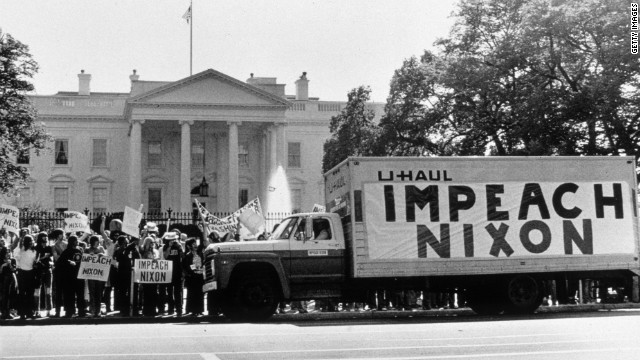
Congress was infuriated about the Saturday Night Massacre. Numerous resolutions to impeach him were introduced in the House. Nixon, feeling the pressure, agreed to release some of the tapes to District Judge Sirica. A few days later at a nationally televised press conference, Nixon also announced that he was instructing Acting Attorney General Bork to appoint a new Special Prosecutor for the Watergate matter. On November 1, The Justice Department appointed Leon Jaworski its new special prosecutor.
Nixon “I am not a crook” Remark
On November 17, 1973, the President gave another televised press conference, this time from the Contemporary Hotel in Disney World, where the President was attending the Annual Convention of the Associated Press Managing Editors Association. At the end of a lengthy response to a question about his personal finances, the President famously said, “And so, that is where the money came from. Let me just say this, and I want to say this to the television audience: I made my mistakes, but in all of my years of public life, I have never profited, never profited from public service–I have earned every cent. And in all of my years of public life, I have never obstructed justice. And I think, too, that I could say that in my years of public life, that I welcome this kind of examination, because people have got to know whether or not their President is a crook. Well, I am not a crook. I have earned everything I have got.”
The 18 1/2 Minute Tape Gap
On November 21, 1973, the White House reported that two of the subpoenaed tapes were missing, and that one that was dated just 3 days after the Watergate burglary contained an erasure of 18 1/2 minutes during a conversation between the President and H.R. Haldeman. Haldeman’s personal notes on the meeting indicate that the break-in was the subject under discussion. Nixon’s secretary, Rose Mary Woods, in initial testimony about the tape, said, “The buttons said on and off, forward and backward. I caught on to that fairly fast. I don’t think I’m so stupid as to erase what’s on a tape.” Later she tried to explain that she had accidentally re-recorded 5 minutes of the tape, while transcribing it, but only 5 minutes, not 18 1/2. She demonstrated how she probably had recorded over the tape with her foot on the transcription pedal located beneath her typewriter as she reached awkwardly for the phone. Suspicions arose that Nixon was destroying evidence.
1974
On February 6, 1974, the House voted to authorized the Judiciary Committee to investigate grounds for impeaching president Nixon.
On March 1, 1974, indictments were handed down for what the press dubs “the Watergate Seven”: Former Attorney General and Nixon campaign manager John N. Mitchell, former White House Chief of Staff H.R. Haldeman, former Nixon aide John Ehrlichman, former White House counsel Charles Colson, White House Aide to Haldeman Gordon C. Strachan, aide to Mitchell and CREEP counsel Robert Mardian, and CREEP counsel Kenneth Parkinson. Former White House Counsel John Dean had taken a plea bargain back in October. Nixon was named an “unindicted co-conspirator” by the grand jury.
On April 16, 1974, Special Prosecutor Jaworski issued subpoenas for sixty-four more Nixon tapes.
Nixon’s 3rd Primetime Watergate Address
On April 29, 1974, President Nixon addressed the nation responding to the House Judiciary Committee’s Subpoena for Additional Presidential Tape Recordings.
On April 30, 1974, the White House released edited transcripts of the Nixon tapes and promises 1,200 pages. The House Judiciary Committee insisted that the actual tapes be turned over. The public is shocked by the course language used in private by the President, even though the phrase “expletive deleted” is used in place of the actual words used.
On May 9, 1974, the House Judiciary Committee began impeachment hearings.
United States v. Nixon, Articles of Impeachment, and the “Smoking Gun” Tape
On July 24, 1974, the Supreme Court unanimously decided United States v. Nixon. The President’s argument was rejected. Nixon was ordered to turn over the tapes to investigators. He reluctantly complied. Meanwhile, the House Judiciary Committee pressed ahead. Between July 27 and 30, the Committee adopted three articles of impeachment against the president: Obstructing the Watergate investigation, Misuse of power and violating his oath of office, Failure to comply with House subpoenas. On August 5, in an effort to soften impact of the inevitable disclosure, Nixon voluntary made public three of the subpoenaed tapes. One of these would become known as the “Smoking Gun” tape, a conversation recorded six days after the Watergate break-in. In that tape, Nixon orders Haldeman to use the CIA to hold back the inquiry by the FBI. Haldeman introduces the topic as follows: “…the Democratic break-in thing, we’re back to the–in the, the problem area because the FBI is not under control, because Gray doesn’t exactly know how to control them, and they have… their investigation is now leading into some productive areas […] and it goes in some directions we don’t want it to go.”
After explaining how the money from CRP was traced to the burglars, Haldeman explained to Nixon the cover-up plan: “the way to handle this now is for us to have Walters [CIA] call Pat Gray [FBI] and just say, ‘Stay the hell out of this …this is ah, business here we don’t want you to go any further on it.'” President Nixon approved the plan, and he is given more information about the involvement of his campaign in the break-in, telling Haldeman: “All right, fine, I understand it all. We won’t second-guess Mitchell and the rest.” Returning to the use of the CIA to obstruct the FBI, he instructs Haldeman: “You call them in. Good. Good deal. Play it tough. That’s the way they play it and that’s the way we are going to play it.” The President of the United States was caught on tape, attempting to obstruct justice. Following this revelation, several Republican on the House Judiciary Committee who had voted against the articles of impeachment indicated they would vote for impeachment when the vote was taken in the full House.
President Nixon Resigns
On August 8, key Republican Senators informed the President that, once impeached, enough votes existed in the Senate to convict the President in the trial and remove him from office. That night, Richard Nixon addressed the nation from the Oval Office. He informed the American people that he no longer had a base of support in Congress. Therefore, he would not see the impeachment proceedings through to their conclusion. The nation needed a full-time president. In the interests of the nation, he would resign. The President said, “To continue to fight through the months ahead for my personal vindication would almost totally absorb the time and attention of both the President and the Congress in a period when our entire focus should be on the great issues of peace abroad and prosperity without inflation at home. Therefore, I shall resign the Presidency effective at noon tomorrow. Vice President Ford will be sworn in as President at that hour in this office.”
Nixon Departs, Gerald R. Ford Takes the Oath of Office
The next morning, President and Mrs. Nixon said their goodbyes to the White House staff in the East Room. The Nixons, accompanied by the Fords, walked across the White House lawn to Marine One, where the President turned and gave one last farewell. As the helicopter disappeared from view en route to Edwards, where the Nixons would depart for California, Gerald Ford returned to the East room and took the oath of office. Afterward, he said, “I have not sought this enormous responsibility, but I will not shirk it. Those who nominated and confirmed me as Vice President were my friends and are my friends. They were of both parties, elected by all the people and acting under the Constitution in their name. It is only fitting then that I should pledge to them and to you that I will be the President of all the people.” He also stated, “My fellow Americans, our long national nightmare is over. Our constitution works. Our great republic is a government of laws and not of men. Here, the people rule. But there is a higher power, by whatever name we honor Him. Who ordains not only righteousness but love, not only justice, but mercy…. Let us restore the golden rule to our political process and let brotherly love purge our hearts of suspicion and hate.”
This article is part of our larger selection of posts about American History. To learn more,
click here for our comprehensive guide to American History
.
Cite This Article
"Watergate Scandal Timeline" History on the Net
© 2000-2026, Salem Media.
April 16, 2026 <https://www.historyonthenet.com/watergate-scandal-timeline>
More Citation Information. | |||||||||||||||||||||||||||
| Markdown | [](https://www.historyonthenet.com/)
- [ANCIENT/MEDIEVAL HISTORY](https://www.historyonthenet.com/ancient-medieval-history-2)
- [Ancient/Medieval History Timeline](https://www.historyonthenet.com/ancient-medieval-history-timeline)
- [The Mayans](https://www.historyonthenet.com/category/mayans)
- [The Aztecs](https://www.historyonthenet.com/category/aztecs)
- [The Mongols](https://www.historyonthenet.com/category/mongols)
- [The Egyptians](https://www.historyonthenet.com/category/egyptians)
- [The Greeks](https://www.historyonthenet.com/category/greeks)
- [The Romans](https://www.historyonthenet.com/category/romans)
- [The Mesopotamians](https://www.historyonthenet.com/category/mesopotamians)
- [The Vikings](https://www.historyonthenet.com/category/vikings)
- [The Normans](https://www.historyonthenet.com/category/normans)
- [Medieval Life](https://www.historyonthenet.com/category/medieval-life)
- [The Tudors](https://www.historyonthenet.com/category/tudors)
- [The Stuarts](https://www.historyonthenet.com/category/stuarts)
- [AMERICAN HISTORY](https://www.historyonthenet.com/category/american-history)
- [American History Timeline](https://www.historyonthenet.com/america-history-timeline)
- [Revolution and Colonies](https://www.historyonthenet.com/category/revolution-and-colonies)
- [Revolutionary War](https://www.historyonthenet.com/category/revolutionary-war)
- [Antebellum Period](https://www.historyonthenet.com/category/antebellum-period)
- [Civil War](https://www.historyonthenet.com/category/civil-war)
- [American West and Native Americans](https://www.historyonthenet.com/category/american-west-native-americans)
- [Black History](https://www.historyonthenet.com/category/black-history)
- [Civil Rights Era](https://www.historyonthenet.com/category/civil-rights-era)
- [1900s to Present](https://www.historyonthenet.com/1900s-to-present)
- [20TH CENTURY](https://www.historyonthenet.com/20th-century)
- [20th Century Timeline Of World History: What Happened?](https://www.historyonthenet.com/20th-century-timeline)
- [The Titanic](https://www.historyonthenet.com/the-titanic)
- [World War One](https://www.historyonthenet.com/world-war-one)
- [Korean War](https://www.historyonthenet.com/korean-war-2)
- [Cold War](https://www.historyonthenet.com/cold-war)
- [Vietnam War](https://www.historyonthenet.com/vietnam-war)
- [WORLD WAR 2](https://www.historyonthenet.com/category/world-war-two)
- [World War Two Timeline From The Great War To Germany’s Surrender](https://www.historyonthenet.com/world-war-two-timeline)
- [Pearl Harbor](https://www.historyonthenet.com/category/world-war-two/pearl-harbor)
- [WW2 Weapons](https://www.historyonthenet.com/category/world-war-two/ww2-weapons)
- [Army Air Corps](https://www.historyonthenet.com/category/world-war-two/army-air-corps)
- [Tuskegee Airmen](https://www.historyonthenet.com/category/tuskegee-airmen)
- [WW2 Navies](https://www.historyonthenet.com/category/world-war-two/ww2-navies)
- [WW2 Armies](https://www.historyonthenet.com/category/world-war-two/ww2-armies)
- [D-Day](https://www.historyonthenet.com/d-day)
- [Nazi Germany](https://www.historyonthenet.com/category/world-war-two/nazi-germany)
- [Holocaust](https://www.historyonthenet.com/category/holocaust)
- [Podcasts](https://www.historyonthenet.com/podcasts)
- [Free Worksheets](https://www.historyonthenet.com/free-history-worksheets)
- [About Us](https://www.historyonthenet.com/about-us)
[](https://www.parthenonpodcast.com/history-unplugged-podcast/)
[PODCAST: HISTORY UNPLUGGED](https://www.historyonthenet.com/watergate-scandal-timeline)
J. Edgar Hoover’s 50-Year Career of Blackmail, Entrapment, and Taking Down Communist Spies
[](https://www.historyonthenet.com/)
- [ANCIENT/MEDIEVAL HISTORY](https://www.historyonthenet.com/ancient-medieval-history-2)
- [Ancient/Medieval History Timeline](https://www.historyonthenet.com/ancient-medieval-history-timeline)
- [The Mayans](https://www.historyonthenet.com/category/mayans)
- [The Aztecs](https://www.historyonthenet.com/category/aztecs)
- [The Mongols](https://www.historyonthenet.com/category/mongols)
- [The Egyptians](https://www.historyonthenet.com/category/egyptians)
- [The Greeks](https://www.historyonthenet.com/category/greeks)
- [The Romans](https://www.historyonthenet.com/category/romans)
- [The Mesopotamians](https://www.historyonthenet.com/category/mesopotamians)
- [The Vikings](https://www.historyonthenet.com/category/vikings)
- [The Normans](https://www.historyonthenet.com/category/normans)
- [Medieval Life](https://www.historyonthenet.com/category/medieval-life)
- [The Tudors](https://www.historyonthenet.com/category/tudors)
- [The Stuarts](https://www.historyonthenet.com/category/stuarts)
- [AMERICAN HISTORY](https://www.historyonthenet.com/category/american-history)
- [American History Timeline](https://www.historyonthenet.com/america-history-timeline)
- [Revolution and Colonies](https://www.historyonthenet.com/category/revolution-and-colonies)
- [Revolutionary War](https://www.historyonthenet.com/category/revolutionary-war)
- [Antebellum Period](https://www.historyonthenet.com/category/antebellum-period)
- [Civil War](https://www.historyonthenet.com/category/civil-war)
- [American West and Native Americans](https://www.historyonthenet.com/category/american-west-native-americans)
- [Black History](https://www.historyonthenet.com/category/black-history)
- [Civil Rights Era](https://www.historyonthenet.com/category/civil-rights-era)
- [1900s to Present](https://www.historyonthenet.com/1900s-to-present)
- [20TH CENTURY](https://www.historyonthenet.com/20th-century)
- [20th Century Timeline Of World History: What Happened?](https://www.historyonthenet.com/20th-century-timeline)
- [The Titanic](https://www.historyonthenet.com/the-titanic)
- [World War One](https://www.historyonthenet.com/world-war-one)
- [Korean War](https://www.historyonthenet.com/korean-war-2)
- [Cold War](https://www.historyonthenet.com/cold-war)
- [Vietnam War](https://www.historyonthenet.com/vietnam-war)
- [WORLD WAR 2](https://www.historyonthenet.com/category/world-war-two)
- [World War Two Timeline From The Great War To Germany’s Surrender](https://www.historyonthenet.com/world-war-two-timeline)
- [Pearl Harbor](https://www.historyonthenet.com/category/world-war-two/pearl-harbor)
- [WW2 Weapons](https://www.historyonthenet.com/category/world-war-two/ww2-weapons)
- [Army Air Corps](https://www.historyonthenet.com/category/world-war-two/army-air-corps)
- [Tuskegee Airmen](https://www.historyonthenet.com/category/tuskegee-airmen)
- [WW2 Navies](https://www.historyonthenet.com/category/world-war-two/ww2-navies)
- [WW2 Armies](https://www.historyonthenet.com/category/world-war-two/ww2-armies)
- [D-Day](https://www.historyonthenet.com/d-day)
- [Nazi Germany](https://www.historyonthenet.com/category/world-war-two/nazi-germany)
- [Holocaust](https://www.historyonthenet.com/category/holocaust)
- [Podcasts](https://www.historyonthenet.com/podcasts)
- [Free Worksheets](https://www.historyonthenet.com/free-history-worksheets)
- [About Us](https://www.historyonthenet.com/about-us)
[The Encyclopedia: One Book’s Quest to Hold the Sum of All Knowledge](https://www.historyonthenet.com/watergate-scandal-timeline)
[PODCAST: HISTORY UNPLUGGED](https://www.historyonthenet.com/watergate-scandal-timeline)

# Watergate Scandal Timeline
[History](https://www.historyonthenet.com/) » [US Presidents](https://www.historyonthenet.com/category/us-presidents) » Watergate Scandal Timeline
Loading...
### A Complicated President
There have been many scandals throughout American presidential history, but only one has ever brought down a presidency. To understand Watergate, it is helpful to have an understanding of the culture of the administration, and of the psyche of the man himself. Richard M. Nixon was a secretive man who did not tolerate criticism well, who engaged in numerous acts of duplicity, who kept lists of enemies, and who used the power of the presidency to seek petty acts of revenge on those enemies. As early as the 1968 campaign Nixon was scheming about Vietnam. Just as the Democrats were gaining in the polls following Johnson’s halting of the bombing of North Vietnam and news of a possible peace deal, Nixon set out to sabotage the Paris peace negotiations by privately assuring the South Vietnamese military rulers a better deal from him than they would get from Democratic candidate Hubert Humphrey. The South Vietnamese junta withdrew from the talks on the eve of the election, ending the peace initiative and helping Nixon to squeak out a marginal victory.
During Nixon’s first term he approved a secret bombing mission in Cambodia, without even consulting or informing congress, and he fought tooth and nail to prevent the New York Times from publishing the infamous Pentagon Papers (described below). Most striking, however, was Nixon’s strategy for how to deal with the enemies that he saw everywhere. Nixon sent Vice President Spiro Agnew on the circuit to blast the media, protestors, and intellectuals who criticized the Vietnam War and Nixon’s policies. Agnew spewed out alliterate insults such as “pusillanimous pussyfooters”, “nattering nabobs of negativism”, and “hopeless, hysterical hypochondriacs of history”. He once described a group of opponents as “an effete corps of impudent snobs who characterize themselves as intellectuals.”
Loading...
Loading...
###
### The Washington “Plumbers”
But Nixon and his aides also discussed ways in which the President could use subterfuge to undermine his enemies and revenge perceived injustices. This became especially important to the President in 1972, when he was determined to win the election more comfortably than he had in 1968. Nixon had once approved the illegal break-in concept first floated by White House aide Tom Huston, even though Huston specifically told the president it was tantamount to burglary. However, FBI director J. Edgar Hoover refused to cooperate. (Hoover then died in May, 1972, and L. Patrick Gray was appointed acting director in his place). Nixon was especially infuriated by leaks in his administration, and none was bigger than that which became known as the Pentagon Papers, a sensitive Pentagon document that traced the often illicit history of America’s involvement in Vietnam. Nixon tried to block publication of the document, and lost. When Nixon discovered that military analyst Daniel Ellsberg had been the source of the leak, he told White House Counsel Charles Colson, “Do whatever has to be done to stop these leaks and prevent further unauthorized disclosures; I don’t want to be told why it can’t be done…I don’t want excuses; I want results. I want it done, whatever the cost.” Colson and yet another Nixon aide, John Erlichmann, created a group whose task it was to stop any further leaks. These White House Plumbers, as they came to be known, were tasked with finding a way to get revenge on Ellsberg. Two of the so-called plumbers were ex-CIA officer Howard Hunt, and ex-FBI agent G. Gordon Liddy. The plumbers tried to break into the office of Ellsberg’s psychiatrist in Los Angeles to get Ellsberg’s confidential treatment records, but the raid was completely botched. In addition to Hunt and Liddy, several other future Watergate burglars were part of this raid.
##
## 1972
### The Watergate Break-In
June 16, 1972: In room 214 of the Watergate Hotel in Washington, D.C., seven men gathered to finalize their plans to break in to the Democratic National Committee’s (DNC) headquarters, located on the sixth floor of one of the Watergate complex’s six buildings. One of these men, G. Gordon Liddy, was a former FBI agent. Another, E. Howard Hunt, had retired from the CIA. James McCord would handle the bugging, Bernard Barker would photograph documents, and Virgilio Gonzalez would pick the locks. The remaining two, Eugenio Martinez and Frank Sturgis, would serve as lookouts. Several of these men were Cuban exiles who had met Hunt through their participation in the failed Bay of Pigs invasion back in 1961. Although the burglars would be caught in the act, many months would passbefore the enough details would emerge to create a picture of the events leading up to that night. These men had been hired by representatives of President Nixon’s administration to use illegal means to gather information that could prove useful to Nixon winning the 1972 election.
On June 17, 1972, Frank Wills, a security guard at the Watergate Complex, noticed tape covering the latch on the locks of several stairway doors in the complex , allowing them to be closed without locking. He removed the tape, and thought nothing of it. An hour later, he discovered that someone (McCord) had re-taped the locks. Wills called the police, who showed up in plainclothes in an unmarked car, allowing them to pass by the lookout without the alarm being sounded. The burglars then turned off their radio when they heard noise in an adjacent stairwell. The lookout saw several of the police officers outside on a terrace near the DNC offices, but when he alerted Liddy (Liddy and Hunt stayed in the hotel room, in two-way radio contact with the others), the ex-FBI agent was unable to reach them on the radio. Within minutes, the police arrested the 5 burglars. On their possession were wire-tapping equipment, two cameras, several dozen rolls of film, and a few thousand dollars in cash–\$100 bills in sequential serial numbers (indicating the money had come directly from a bank, which could possibly be traced). Liddy and Hunt quickly vacated the premises, but the burglars also had two hotel room keys, one of which was for the room where Liddy and Hunt had stayed.
The five burglars were processed at the police station, where several of them gave fake names. Hunt hired a lawyer to quickly bail the men out, but he underestimated their bail amount. G. Gordon Liddy went to his office and commenced a shredding operation to eliminate any evidence of his involvement. Liddy worked for the Committee to Re-elect the President, sometimes referred to pejoratively as CREEP, and his involvement was a direct connection to President Nixon. McCord was the chief security officer at CREEP. Liddy and Hunt had also worked at the White House, which made the Nixon connection more serious. Meanwhile, a simple fingerprint check revealed the burglar’s true identities.
On Monday, June 19, 1972: The Washington Post reported, “One of the five men arrested early Saturday in the attempt to bug the Democratic National Committee headquarters is the salaried security coordinator for President Nixon’s re-election committee.” Shortly thereafter, it was revealed that a search warrant had been executed for the hotel rooms for which the burglars had keys, and that inside one of them were address books that listed Howard Hunt’s name or initials, and included the hand-written notation, “WH,” for White House. Official reaction was swift. From the White House, Nixon’s Press Secretary, Ron Zeigler, dismissed the incident as some sort of petty thievery attempt. John Mitchell, the head of CREEP, denied that the organization had any connection to the event. These public denials were lies. In fact, an elaborate cover-up was already under way. The charge that would stem from the cover-up, “obstruction of justice,” would eventually bring Nixon down.
### The Connection to the Committee to Re-Elect the President (CREEP)
On August 1, 1972, a \$25,000 cashiers check earmarked for the Nixon re-election campaign was found in the bank account of one of the Watergate burglars. Further investigation revealed that, in the months leading up to their arrests, more thousands had passed through their bank and credit card accounts, supporting the burglars’ travel, living expenses, and purchase,. Several donations (totaling \$89,000) were made by individuals who thought they were making private donations to the President’s re-election committee. The donations were made in the form of cashier’s, certified, and personal checks, and all were made payable only to the Committee to Re-Elect the President. However, through a complicated fiduciary set-up, the money actually went into an account owned by a Miami company run by Watergate burglar Bernard Barker. On the backs of these checks was the official endorsement by the person who had the authority to do so, Committee Bookkeeper and Treasurer, Hugh Sloan. Thus a direct connection between the Watergate break-in and the Committee to Re-Elect the President had been established. When confronted and faced with the potential charge of federal bank fraud, Sloan revealed that he had given the checks to G. Gordon Liddy at the direction of Committee Deputy Director Jeb Magruder and Finance Director Maurice Stans. Liddy had then given the endorsed checks to Watergate burglar Bernard Barker, who then deposited the money in accounts located outside the U.S. and withdrew the money in the form of cashier’s checks and money orders in April and May. They did not know that banks kept records of these transactions.
###
### Woodward, Bernstein & “Deep Throat”
Media coverage during 1972 was influential in keeping the Watergate story in the news, and in establishing the connection between the burglary and the Committee to Re-Elect the President. The most notable coverage came from Time, The New York Times, and especially from The Washington Post. Opinions vary, but the publicity these media outlets gave to Watergate likely resulted in more consequential political repercussions from the Congressional investigation. Most famous is the story of how Washington Post Reporters Bob Woodward and Carl Bernstein relied heavily on anonymous sources to reveal that knowledge of the break-in and subsequent attempt to cover it up had connections deep in the Justice Department, the FBI, the CIA, and even the White House.
Woodward and Bernstein’s most famous source was an individual they had nicknamed Deep Throat, a reference to a controversial pornography film of the time. Woodward claimed in his 1974 book, All The President’s Men, that the two would meet secretly at an underground parking garage just over the Key Bridge in Rosslyn, usually at 2:00 am, where Deep Throat helped him make the connections. Throughout the protracted investigation, Woodward would signal his source that he desired a meeting by placing a flowerpot with a red flag on the balcony of his apartment. If Deep Throat wanted a meeting, he would make special marks on page twenty of Woodward’s copy of The New York Times. The first meeting took place on June 20, 1972, only 3 days after the break-in. The identity of Deep Throat was the subject of intense speculation for more than 30 years before he was revealed to be the FBI’s \#2, Mark Felt.
On September 15, 1972, Hunt, Liddy, and the 5 Watergate burglars were indicted by a federal grand jury.
On September 29, it was revealed that Attorney General & Nixon campaign chairman John Mitchell had controlled a secret Republican fund used to pay for spying on the Democrats. On October 10, the FBI reported that the break-in at the Watergate was part of a massive campaign of political spying and sabotage on behalf of the officials and heads of the Nixon re-election campaign. Despite these revelations, Nixon’s re-election was never seriously jeopardized, and on November 7 the President was re-elected in one of the biggest landslides ever in American political history.
##
## 1973
### Watergate Burglars’ Trial Begins
On January 8, 1973, the five burglars plead guilty as their trial began. On January 30, just ten days after Richard Nixon’s second inauguration, Liddy and McCord were convicted on charges conspiracy, burglary, and wiretapping. Nixon had dodged a bullet in the months between the break-in and his re-election, but the Watergate Scandal did not die out after the burglars were tried.
### White House Linked to Cover-Up
On February 28, 1973, Acting FBI Director L. Patrick Gray testified before the Senate Judiciary Committee regarding his nomination to replace J. Edgar Hoover. Committee chairman Sam Ervin, referencing newspaper articles, questioned Gray as to how the White House had gained access to FBI files related to the Watergate investigation. Gray stated he had given reports to White House counsel John Dean, that Dean had ordered him to give the White House daily updates on the FBI’s investigation, that he had discussed the investigation with Dean on many occasions, and that Dean had “probably lied” to FBI investigators about his role in the scandal. Subsequently, Gray was ordered not to talk about Watergate by Attorney General Richard G. Kleindienst. Gray’s nomination failed, and now White House counsel Dean was directly linked to the Watergate cover-up.
On March 19, 1973, convicted Watergate burglar and ex-CIA agent James McCord, still facing sentencing, wrote a letter to U.S. District Judge John Sirica. In the letter, McCord stated that he had been pressured to plead guilty and remain silent, that he had perjured himself during the trial, that the break-in was not a CIA operation, and that other, as yet unnamed government officials, were involved. Judge Sirica urged McCord to cooperate fully with the Senate Watergate Committee, which was about to begin its investigation. On March 23, as the burglars were sentenced, Dean hired an attorney and began to quietly cooperate with Watergate investigators. He did this without informing the President, and continued to work as Nixon’s Chief White House Counsel, a clear conflict of interest.
###
### Senate Watergate Committee Begins Investigation
On March 25, 1973, Senate Watergate Committee lawyer Sam Dash told reporters that he had interviewed James McCord twice, and that McCord had “named names” and had begun “supplying a full and honest account” of the Watergate operation. Dash refused to give details, but promised that McCord would soon testify in public Senate hearings. Shortly after Dash’s press conference, the Los Angeles Times reported that two that McCord had named were White House Counsel John Dean, and Nixon campaign deputy director Jeb Magruder. The White House denied Dean’s involvement, but said nothing about Magruder. Republican sources on Capitol Hill ominously confirmed the story, with one stating that McCord’s allegations were “convincing”. When Dean’s lawyer learned of a follow-up story planned by the Washington Post, he threatened to sue the newspaper if they ran the story. The Postprinted the story anyway, along with the threat from Dean’s lawyer.
On March 28, 1973, James McCord testified before the Senate Watergate Committee in a closed 5-hour session. There were so many leaks to the press that committee leaders decided to conduct all future hearings in public session. The most significant leak was that fellow Watergate burglar G. Gordon Liddy had told McCord that the burglary and surveillance operation was approved by then-Nixon campaign chairman & Attorney General John Mitchell in February 1972, and that White House Special Counsel to the President Charles Colson knew about the Watergate operation in advance (Colson had just quit his post to return to private practice). The next day, Colson told a National Press Club audience “I had no involvement or no knowledge of the Watergate, direct or indirect.”On April 8, 1973, White House Counsel John Dean told White House Chief of Staff H.R. Haldeman that he planned to testify before the Senate Committee. Haldeman advised against it, saying, “Once the toothpaste is out of the tube, it’s going to be very hard to get it back in.” Dean compiled a list of 15 names, mostly lawyers, who could be indicted in the scandal, and showed then showed the list to White House counsel and Assistant to the President for Domestic Affairs, John Ehrlichman.
###
### Washington Post Connects Break-In to the Cover-up
April 9, 1973: The New York Times reported that James McCord told the Senate Watergate Committee that the cash payoffs for the burglars came directly from the the Republican Committee to Re-Elect the President (CREEP). When trying to confirm whether or not the “slush fund” continued to operate after the arrests (presumably as payoffs to keep the burglars silent), a CREEP employee exploded over the phone to Bob Woodward. He was apparently emotionally distraught over how the ignorance of former CREEP official John Mitchell and others has undermined the presidency. Woodward then called Hugh Sloan, and, using information he had gotten out of the other CREEP official, wrangled out of the former CREEP Treasurer that about \$70,000 in CREEP “slush fund” money was used to pay off the burglars. The Washington Post reporters now had linkage between the bugging and the cover-up.
On April 17, 1973, President Nixon made a brief statement before the White House Press Corps that his White House aides and staff would appear before the Senate Watergate Committee if asked. He announced his own ongoing investigation, and promised to reveal “major new developments” in the future. He stated, “Real progress has been made in finding the truth.” Nixon also said that his concerns about separation of powers had been resolved, and that any person in the executive branch who was indicted would be discharged; that no one would be given immunity from prosecution. Nixon concluded, “I condemn any attempts to cover up in this case, no matter who is involved.” After the president left the podium, the press corps proceeded to hammer Press Secretary Ron Ziegler about whether the President’s statement contradicted the position previously articulated. Finally, Ziegler said to the press, “This is the operative statement. The others are inoperative.” Later in the day, the White House issued an official statement saying that the President had no prior knowledge of the Watergate Affair.
On April 22, 1973, Nixon requested that White House Counsel John Dean write him a report about everything he knew about the Watergate matter, and he sent Dean to Camp David to write it. Dean suspected he was on the cusp of becoming the Watergate scapegoat, and so he went to Camp David, but did not write the report.
On April 24, Attorney General Richard Kleindienst met with President Nixon to inform the President that White House counsel John Dean had testified about the white House having ordered the break-in at the office of Pentagon Papers leaker Daniel Ellsberg’s psychiatrist. Because Ellsberg’s was then on trial over the Pentagon Papers business, Kleindienst said that this new information must be transmitted to to the trial judge. The Attorney General told Nixon, “We have to do it could be another goddamn cover-up, you know. We can’t have another cover-up, Mr. President.” Nixon replied, “I don’t want any cover-ups of anything.” They briefly discussed the possibility of immunity for Dean, but quickly ruled it out. Later in the day, in another conversation, the despondent President told Kleindienst, “What the hell, you know. People say impeach the President. Well, then they get \[Vice President Spiro\] Agnew. What the hell?” Kleindienst replied, “There’s not going to be anything like that, Mr. President.” These conversations and many others of relevance were recorded on an oval office tape machine, which would be a major component of the investigation. Nixon also learned that Dean had testified about acting FBI Director L. Patrick Gray’s involvement in destroying files from White House “Plumber” E. Howard Hunt’s safe. Nixon says that Gray has to go. Gray resigned on April 27.
### Haldeman and Ehrlichman Implicated & Resign
Further leaks about Dean’s discussions with investigators next implicated John Ehrlichman (White House counsel and Assistant to the President for Domestic Affairs) and White House Chief of Staff H.R. Haldeman. On April 30, 1973, left with little choice, Nixon summoned the two men to Camp David and, in what’s been described as a very emotional meeting, asked for their resignations. Attorney General Kleindienst also resigned. Nixon also asked for the resignation of White House counsel Dean, whose Senate testimony had, and would continue to be so damaging. He then issued a public statement announcing their resignations.
### Nixon’s 1st Primetime Address on Watergate (April 30, 1973)
Later that evening, the President took to the airwaves in his first primetime oval office address to the American people on Watergate. He explained that the resignations were not an admission of guilt, but were carried out in order to restore the confidence of the American people. Nixon announced that he had replaced Attorney General Kleindienst with Elliot Richardson, and that he had given him the authority to designate a special independent counsel to investigate Watergate. Nixon took responsibility for the behavior of CREEP, and said, “I will do everything in my power to ensure that the guilty are brought to justice and that such abuses are purged from our political processes in the years to come, long after I have left this office.” He then explained that, henceforth, he would return to the larger duties of his presidency.
### Senate Watergate Committee Hearings Begin
The televised Senate Watergate Committee hearings began on May 17, 1973. The three major networks (ABC, CBS, NBC) agreed to rotate coverage, with each network broadcasting the proceedings every third day (until their completion on August 7). The witness list began with minor players from CREEP. On the fifth day, President Nixon again made a public statement about Watergate. He said, “I had no prior knowledge of the Watergate operation. I took no part in, nor was I aware of, any subsequent efforts that may have been made to cover up Watergate.” Nixon also affirmed that he would not use executive privilege to impede testimony or the presentation of evidence.”
On May 18, 1973, Watergate Burglar James McCord testified before the Senate Committee.
On May 19, 1973, Archibald Cox was appointed Special Prosecutor to oversee the investigation into possible presidential impropriety. He was sworn in on May 25.
On May 22, 1973, President Nixon issued a statement about the Watergate Investigations.
On June 3, 1973, Washington Post reporters Woodward and Bernstein wrote that John Dean planned on giving testimony to the effect that Nixon was deeply involved in the Watergate cover-up, and that Nixon had prior knowledge of the hush-money used to pay off various conspirators. Dean would also testify that Haldeman and Ehrlichman were present at these meetings where cover-up was discussed. On the veracity of Dean’s information, The Post reported a Justice Department source as having said, “\[E\]verything we have gotten from Dean that we were able to check out has turned out to be accurate.”
### John Dean Testifies, Nixon Claims “Executive Privilege”
From June 25-29, 1973, former White House Counsel John Dean did indeed made these allegations. He began with a seven-hour opening statement in which he laid out his knowledge of the entire campaign of White House espionage. He also revealed that he believed Nixon had tape-recorded some of the oval office conversations regarding Watergate. Dean’s story held up well under cross examination. Ten days later, President Nixon announced that he would not testify before the Senate Watergate Committee, and he would not provide access to White House documents. Despite his earlier pronouncement, Nixon justified this decision as “executive privilege”.
### The Nixon Tapes
On July 16, 1973, another former aide to the President, Alexander Butterfield, testified before the Senate Committee that there was an oval office recording system, that it was installed and operated by the Secret Service, and that Nixon probably had it installed to record things for posterity, for the Nixon Library. (A few days later, Nixon ordered that the taping system be turned off). The shocking revelation set off a chain reaction in which samples of these tapes were sought by both the Senate Committee and by Independent prosecutor Archibald Cox. Nixon, however, refused to turn over the tapes, again claiming executive privilege. The Senate Committee and Cox then issued subpoenas for the White House tapes.
Nixon again refused, and instead ordered Cox to drop his subpoena, but Cox would not. Eventually, the Supreme Court would decide the issue. Meanwhile, as former Aide John Ehrlichman testified before the Senate Committee and disputed Dean’s testimony, public opinion was split on whether or not John Dean or President Nixon was the more credible.
### Nixon’s 2nd Primetime Address on Watergate (August 15, 1973)
On August 15, as the Senate Committee wrapped up the hearings, Nixon again addressed the nation in primetime about Watergate. The President said, “It has become clear that both the hearings themselves and some of the commentaries on them have become increasingly absorbed in an effort to implicate the President personally in the illegal activities that took place.” He reminded the American people that he had already taken “full responsibility” for the “abuses that occurred during my administration.” Nixon restated his innocence: “I state again to every one of you listening tonight these facts–I had no prior knowledge of the Watergate break-in; I neither took part in nor knew about any of the subsequent cover-up activities; I neither authorized nor encouraged subordinates to engage in illegal or improper campaign tactics. That was and that is the simple truth.”
The president went on to explain in detail how he did not know anything about the cover-up. Nixon justified his refusal to turn over the Oval Office recordings as “a much more important principle than what the tapes might prove about Watergate.” A president must be able to talk “openly and candidly with his advisers about issues and individuals” without having those conversations ever made public. These were “privileged” conversations, similar to but more important than those between a lawyer and his client or “a priest and a penitent.” The conversations on those tapes are “blunt and candid,” made without thought to any future public disclosure, and for future presidents and their advisers to know that their conversations and advice might one day be made public would cripple their ability to talk freely and offer unfettered opinions. “That is why I shall continue to oppose efforts which would set a precedent that would cripple all future presidents by inhibiting conversations between them and those they look to for advice.” Special prosecutor Cox and the Senate Committee asked the Supreme Court to decide the legal dispute over the tapes.
### Spiro Agnew Resigns, Gerald R. Ford to Become Vice President
As the summer of 1973 gave way to fall, another event occurred that would have far-reaching effects on the nation’s presidential history. Vice President Spiro Agnew was under investigation by the U.S. Attorney’s office in Baltimore, Maryland, on charges of extortion, tax fraud, bribery, and conspiracy. In October, he was formally charged with having accepted bribes totaling more than \$100,000 while serving as Maryland’s governor. To end the criminal proceedings quickly, a deal was reached. Agnew would plead no contest to a lesser charge of failing to report income to the IRS, on the condition that he resign the Vice Presidency. President Nixon sought advice from Congress on a replacement, resulting in the affable 13-term congressman from Michigan getting the nod, Gerald R. Ford. The U.S. Senate approved the nomination 92-3. The House confirmed by a vote of 397-35. On December 6, 1973, Ford took the oath of office as Vice President of the United States. The press, however, paid little notice. Watergate was all-consuming.
### The “Saturday Night Massacre”
On October 19, 1973, Nixon, looking toward a solution to the tape dispute, offered what later came to known as the Stennis Compromise. U.S. Senator John C. Stennis (D-MS) would independently review the tapes and summarize them for the special prosecutor’s office. Cox refused the compromise. The next night, a Saturday, Nixon worked to have Cox removed. He contacted Attorney General Elliot Richardson and ordered him to fire Cox. Richardson refused and resigned in protest instead. Nixon then ordered Deputy Attorney General Ruckelshaus to fire Cox; he also refused and resigned in protest. Nixon then contacted the Solicitor General, Robert Bork, and ordered him, as acting head of the Justice Department in the wake of the previous resignations, to fire Cox. Bork reluctantly complied. The firing of Special Prosecutor Cox, and the flurry of high-profile Justice Department resignations over the weekend caused the press to dub this event, the “Saturday Night Massacre.”
Congress was infuriated about the Saturday Night Massacre. Numerous resolutions to impeach him were introduced in the House. Nixon, feeling the pressure, agreed to release some of the tapes to District Judge Sirica. A few days later at a nationally televised press conference, Nixon also announced that he was instructing Acting Attorney General Bork to appoint a new Special Prosecutor for the Watergate matter. On November 1, The Justice Department appointed Leon Jaworski its new special prosecutor.
### Nixon “I am not a crook” Remark
On November 17, 1973, the President gave another televised press conference, this time from the Contemporary Hotel in Disney World, where the President was attending the Annual Convention of the Associated Press Managing Editors Association. At the end of a lengthy response to a question about his personal finances, the President famously said, “And so, that is where the money came from. Let me just say this, and I want to say this to the television audience: I made my mistakes, but in all of my years of public life, I have never profited, never profited from public service–I have earned every cent. And in all of my years of public life, I have never obstructed justice. And I think, too, that I could say that in my years of public life, that I welcome this kind of examination, because people have got to know whether or not their President is a crook. Well, I am not a crook. I have earned everything I have got.”
### The 18 1/2 Minute Tape Gap
On November 21, 1973, the White House reported that two of the subpoenaed tapes were missing, and that one that was dated just 3 days after the Watergate burglary contained an erasure of 18 1/2 minutes during a conversation between the President and H.R. Haldeman. Haldeman’s personal notes on the meeting indicate that the break-in was the subject under discussion. Nixon’s secretary, Rose Mary Woods, in initial testimony about the tape, said, “The buttons said on and off, forward and backward. I caught on to that fairly fast. I don’t think I’m so stupid as to erase what’s on a tape.” Later she tried to explain that she had accidentally re-recorded 5 minutes of the tape, while transcribing it, but only 5 minutes, not 18 1/2. She demonstrated how she probably had recorded over the tape with her foot on the transcription pedal located beneath her typewriter as she reached awkwardly for the phone. Suspicions arose that Nixon was destroying evidence.
##
## 1974
On February 6, 1974, the House voted to authorized the Judiciary Committee to investigate grounds for impeaching president Nixon.
On March 1, 1974, indictments were handed down for what the press dubs “the Watergate Seven”: Former Attorney General and Nixon campaign manager John N. Mitchell, former White House Chief of Staff H.R. Haldeman, former Nixon aide John Ehrlichman, former White House counsel Charles Colson, White House Aide to Haldeman Gordon C. Strachan, aide to Mitchell and CREEP counsel Robert Mardian, and CREEP counsel Kenneth Parkinson. Former White House Counsel John Dean had taken a plea bargain back in October. Nixon was named an “unindicted co-conspirator” by the grand jury.
On April 16, 1974, Special Prosecutor Jaworski issued subpoenas for sixty-four more Nixon tapes.
### Nixon’s 3rd Primetime Watergate Address
On April 29, 1974, President Nixon addressed the nation responding to the House Judiciary Committee’s Subpoena for Additional Presidential Tape Recordings.
On April 30, 1974, the White House released edited transcripts of the Nixon tapes and promises 1,200 pages. The House Judiciary Committee insisted that the actual tapes be turned over. The public is shocked by the course language used in private by the President, even though the phrase “expletive deleted” is used in place of the actual words used.
On May 9, 1974, the House Judiciary Committee began impeachment hearings.
### United States v. Nixon, Articles of Impeachment, and the “Smoking Gun” Tape
On July 24, 1974, the Supreme Court unanimously decided United States v. Nixon. The President’s argument was rejected. Nixon was ordered to turn over the tapes to investigators. He reluctantly complied. Meanwhile, the House Judiciary Committee pressed ahead. Between July 27 and 30, the Committee adopted three articles of impeachment against the president: Obstructing the Watergate investigation, Misuse of power and violating his oath of office, Failure to comply with House subpoenas. On August 5, in an effort to soften impact of the inevitable disclosure, Nixon voluntary made public three of the subpoenaed tapes. One of these would become known as the “Smoking Gun” tape, a conversation recorded six days after the Watergate break-in. In that tape, Nixon orders Haldeman to use the CIA to hold back the inquiry by the FBI. Haldeman introduces the topic as follows: “…the Democratic break-in thing, we’re back to the–in the, the problem area because the FBI is not under control, because Gray doesn’t exactly know how to control them, and they have… their investigation is now leading into some productive areas \[…\] and it goes in some directions we don’t want it to go.”
After explaining how the money from CRP was traced to the burglars, Haldeman explained to Nixon the cover-up plan: “the way to handle this now is for us to have Walters \[CIA\] call Pat Gray \[FBI\] and just say, ‘Stay the hell out of this …this is ah, business here we don’t want you to go any further on it.'” President Nixon approved the plan, and he is given more information about the involvement of his campaign in the break-in, telling Haldeman: “All right, fine, I understand it all. We won’t second-guess Mitchell and the rest.” Returning to the use of the CIA to obstruct the FBI, he instructs Haldeman: “You call them in. Good. Good deal. Play it tough. That’s the way they play it and that’s the way we are going to play it.” The President of the United States was caught on tape, attempting to obstruct justice. Following this revelation, several Republican on the House Judiciary Committee who had voted against the articles of impeachment indicated they would vote for impeachment when the vote was taken in the full House.
### President Nixon Resigns
On August 8, key Republican Senators informed the President that, once impeached, enough votes existed in the Senate to convict the President in the trial and remove him from office. That night, Richard Nixon addressed the nation from the Oval Office. He informed the American people that he no longer had a base of support in Congress. Therefore, he would not see the impeachment proceedings through to their conclusion. The nation needed a full-time president. In the interests of the nation, he would resign. The President said, “To continue to fight through the months ahead for my personal vindication would almost totally absorb the time and attention of both the President and the Congress in a period when our entire focus should be on the great issues of peace abroad and prosperity without inflation at home. Therefore, I shall resign the Presidency effective at noon tomorrow. Vice President Ford will be sworn in as President at that hour in this office.”
### Nixon Departs, Gerald R. Ford Takes the Oath of Office
The next morning, President and Mrs. Nixon said their goodbyes to the White House staff in the East Room. The Nixons, accompanied by the Fords, walked across the White House lawn to Marine One, where the President turned and gave one last farewell. As the helicopter disappeared from view en route to Edwards, where the Nixons would depart for California, Gerald Ford returned to the East room and took the oath of office. Afterward, he said, “I have not sought this enormous responsibility, but I will not shirk it. Those who nominated and confirmed me as Vice President were my friends and are my friends. They were of both parties, elected by all the people and acting under the Constitution in their name. It is only fitting then that I should pledge to them and to you that I will be the President of all the people.” He also stated, “My fellow Americans, our long national nightmare is over. Our constitution works. Our great republic is a government of laws and not of men. Here, the people rule. But there is a higher power, by whatever name we honor Him. Who ordains not only righteousness but love, not only justice, but mercy…. Let us restore the golden rule to our political process and let brotherly love purge our hearts of suspicion and hate.”
*This article is part of our larger selection of posts about American History. To learn more,* [*click here for our comprehensive guide to American History*](https://www.historyonthenet.com/america-history-timeline)*.*
##### Cite This Article
"Watergate Scandal Timeline" History on the Net
© 2000-2026, Salem Media.
April 16, 2026 \<https://www.historyonthenet.com/watergate-scandal-timeline\>
[More Citation Information.](https://www.historyonthenet.com/how-to-cite-us)
#### TRENDING
- [How Much Can One Individual Alter History? More and Less...](https://www.historyonthenet.com/how-much-can-one-individual-alter-history-more-and-less-than-you-think)
- [Why Did Hitler Hate Jews? We Have Some Answers](https://www.historyonthenet.com/why-did-hitler-hate-jews)
- [Reasons Against Dropping the Atomic Bomb](https://www.historyonthenet.com/reasons-against-dropping-the-atomic-bomb)
- [Is Russia Communist Today? Find Out Here\!](https://www.historyonthenet.com/is-russia-communist)
- [Phonetic Alphabet: How Soldiers Communicated](https://www.historyonthenet.com/phonetic-alphabet-how-soldiers-communicated)
- [How Many Americans Died in WW2? Here Is A Breakdown](https://www.historyonthenet.com/how-many-americans-died-in-ww2)
Loading...
Loading...
[](https://www.historyonthenet.com/subscribe)
[](https://itunes.apple.com/us/podcast/history-unplugged-podcast-american-history-world-history/id1237796990?mt=2&ls=1)
[](https://open.spotify.com/show/21OMmk9irvOKI90yRudFKx?si=d3afdcc7b8974b5f)
Loading...
Loading...
- [About](https://www.historyonthenet.com/about-us-2)
- [Advertise](https://www.historyonthenet.com/advertise-with-us)
- [Facebook](https://www.facebook.com/profile.php?id=100094118751021&mibextid=ZbWKwL)
- [Instagram](https://www.instagram.com/historyonthenetwebsite/)
- [FAQ](https://www.historyonthenet.com/frequently-asked-questions)
- [Contact](https://www.historyonthenet.com/contact)
- [Sponsor Your Content](https://www.historyonthenet.com/sponsored-content)
- [Write For Us](https://www.historyonthenet.com/write-for-us)
- [Privacy Policy](https://salemmedia.com/privacy-policy/)
- [Terms of Use](https://salemmedia.com/terms-of-use/)
- [Facebook](https://www.facebook.com/profile.php?id=100094118751021&mibextid=ZbWKwL)
- [X](https://twitter.com/historyonthenet)
- [Instagram](https://www.instagram.com/historyonthenetwebsite/)
- [RSS](https://www.historyonthenet.com/feed)
© HistoryOnTheNet 2000-2025. All rights reserved. Site created in November 2000.
× | |||||||||||||||||||||||||||
| Readable Markdown | Loading...
### A Complicated President
There have been many scandals throughout American presidential history, but only one has ever brought down a presidency. To understand Watergate, it is helpful to have an understanding of the culture of the administration, and of the psyche of the man himself. Richard M. Nixon was a secretive man who did not tolerate criticism well, who engaged in numerous acts of duplicity, who kept lists of enemies, and who used the power of the presidency to seek petty acts of revenge on those enemies. As early as the 1968 campaign Nixon was scheming about Vietnam. Just as the Democrats were gaining in the polls following Johnson’s halting of the bombing of North Vietnam and news of a possible peace deal, Nixon set out to sabotage the Paris peace negotiations by privately assuring the South Vietnamese military rulers a better deal from him than they would get from Democratic candidate Hubert Humphrey. The South Vietnamese junta withdrew from the talks on the eve of the election, ending the peace initiative and helping Nixon to squeak out a marginal victory.
During Nixon’s first term he approved a secret bombing mission in Cambodia, without even consulting or informing congress, and he fought tooth and nail to prevent the New York Times from publishing the infamous Pentagon Papers (described below). Most striking, however, was Nixon’s strategy for how to deal with the enemies that he saw everywhere. Nixon sent Vice President Spiro Agnew on the circuit to blast the media, protestors, and intellectuals who criticized the Vietnam War and Nixon’s policies. Agnew spewed out alliterate insults such as “pusillanimous pussyfooters”, “nattering nabobs of negativism”, and “hopeless, hysterical hypochondriacs of history”. He once described a group of opponents as “an effete corps of impudent snobs who characterize themselves as intellectuals.”
### The Washington “Plumbers”
But Nixon and his aides also discussed ways in which the President could use subterfuge to undermine his enemies and revenge perceived injustices. This became especially important to the President in 1972, when he was determined to win the election more comfortably than he had in 1968. Nixon had once approved the illegal break-in concept first floated by White House aide Tom Huston, even though Huston specifically told the president it was tantamount to burglary. However, FBI director J. Edgar Hoover refused to cooperate. (Hoover then died in May, 1972, and L. Patrick Gray was appointed acting director in his place). Nixon was especially infuriated by leaks in his administration, and none was bigger than that which became known as the Pentagon Papers, a sensitive Pentagon document that traced the often illicit history of America’s involvement in Vietnam. Nixon tried to block publication of the document, and lost. When Nixon discovered that military analyst Daniel Ellsberg had been the source of the leak, he told White House Counsel Charles Colson, “Do whatever has to be done to stop these leaks and prevent further unauthorized disclosures; I don’t want to be told why it can’t be done…I don’t want excuses; I want results. I want it done, whatever the cost.” Colson and yet another Nixon aide, John Erlichmann, created a group whose task it was to stop any further leaks. These White House Plumbers, as they came to be known, were tasked with finding a way to get revenge on Ellsberg. Two of the so-called plumbers were ex-CIA officer Howard Hunt, and ex-FBI agent G. Gordon Liddy. The plumbers tried to break into the office of Ellsberg’s psychiatrist in Los Angeles to get Ellsberg’s confidential treatment records, but the raid was completely botched. In addition to Hunt and Liddy, several other future Watergate burglars were part of this raid.
## 1972
### The Watergate Break-In
June 16, 1972: In room 214 of the Watergate Hotel in Washington, D.C., seven men gathered to finalize their plans to break in to the Democratic National Committee’s (DNC) headquarters, located on the sixth floor of one of the Watergate complex’s six buildings. One of these men, G. Gordon Liddy, was a former FBI agent. Another, E. Howard Hunt, had retired from the CIA. James McCord would handle the bugging, Bernard Barker would photograph documents, and Virgilio Gonzalez would pick the locks. The remaining two, Eugenio Martinez and Frank Sturgis, would serve as lookouts. Several of these men were Cuban exiles who had met Hunt through their participation in the failed Bay of Pigs invasion back in 1961. Although the burglars would be caught in the act, many months would passbefore the enough details would emerge to create a picture of the events leading up to that night. These men had been hired by representatives of President Nixon’s administration to use illegal means to gather information that could prove useful to Nixon winning the 1972 election.
On June 17, 1972, Frank Wills, a security guard at the Watergate Complex, noticed tape covering the latch on the locks of several stairway doors in the complex , allowing them to be closed without locking. He removed the tape, and thought nothing of it. An hour later, he discovered that someone (McCord) had re-taped the locks. Wills called the police, who showed up in plainclothes in an unmarked car, allowing them to pass by the lookout without the alarm being sounded. The burglars then turned off their radio when they heard noise in an adjacent stairwell. The lookout saw several of the police officers outside on a terrace near the DNC offices, but when he alerted Liddy (Liddy and Hunt stayed in the hotel room, in two-way radio contact with the others), the ex-FBI agent was unable to reach them on the radio. Within minutes, the police arrested the 5 burglars. On their possession were wire-tapping equipment, two cameras, several dozen rolls of film, and a few thousand dollars in cash–\$100 bills in sequential serial numbers (indicating the money had come directly from a bank, which could possibly be traced). Liddy and Hunt quickly vacated the premises, but the burglars also had two hotel room keys, one of which was for the room where Liddy and Hunt had stayed.
The five burglars were processed at the police station, where several of them gave fake names. Hunt hired a lawyer to quickly bail the men out, but he underestimated their bail amount. G. Gordon Liddy went to his office and commenced a shredding operation to eliminate any evidence of his involvement. Liddy worked for the Committee to Re-elect the President, sometimes referred to pejoratively as CREEP, and his involvement was a direct connection to President Nixon. McCord was the chief security officer at CREEP. Liddy and Hunt had also worked at the White House, which made the Nixon connection more serious. Meanwhile, a simple fingerprint check revealed the burglar’s true identities.
On Monday, June 19, 1972: The Washington Post reported, “One of the five men arrested early Saturday in the attempt to bug the Democratic National Committee headquarters is the salaried security coordinator for President Nixon’s re-election committee.” Shortly thereafter, it was revealed that a search warrant had been executed for the hotel rooms for which the burglars had keys, and that inside one of them were address books that listed Howard Hunt’s name or initials, and included the hand-written notation, “WH,” for White House. Official reaction was swift. From the White House, Nixon’s Press Secretary, Ron Zeigler, dismissed the incident as some sort of petty thievery attempt. John Mitchell, the head of CREEP, denied that the organization had any connection to the event. These public denials were lies. In fact, an elaborate cover-up was already under way. The charge that would stem from the cover-up, “obstruction of justice,” would eventually bring Nixon down.
### The Connection to the Committee to Re-Elect the President (CREEP)
On August 1, 1972, a \$25,000 cashiers check earmarked for the Nixon re-election campaign was found in the bank account of one of the Watergate burglars. Further investigation revealed that, in the months leading up to their arrests, more thousands had passed through their bank and credit card accounts, supporting the burglars’ travel, living expenses, and purchase,. Several donations (totaling \$89,000) were made by individuals who thought they were making private donations to the President’s re-election committee. The donations were made in the form of cashier’s, certified, and personal checks, and all were made payable only to the Committee to Re-Elect the President. However, through a complicated fiduciary set-up, the money actually went into an account owned by a Miami company run by Watergate burglar Bernard Barker. On the backs of these checks was the official endorsement by the person who had the authority to do so, Committee Bookkeeper and Treasurer, Hugh Sloan. Thus a direct connection between the Watergate break-in and the Committee to Re-Elect the President had been established. When confronted and faced with the potential charge of federal bank fraud, Sloan revealed that he had given the checks to G. Gordon Liddy at the direction of Committee Deputy Director Jeb Magruder and Finance Director Maurice Stans. Liddy had then given the endorsed checks to Watergate burglar Bernard Barker, who then deposited the money in accounts located outside the U.S. and withdrew the money in the form of cashier’s checks and money orders in April and May. They did not know that banks kept records of these transactions.
### Woodward, Bernstein & “Deep Throat”
Media coverage during 1972 was influential in keeping the Watergate story in the news, and in establishing the connection between the burglary and the Committee to Re-Elect the President. The most notable coverage came from Time, The New York Times, and especially from The Washington Post. Opinions vary, but the publicity these media outlets gave to Watergate likely resulted in more consequential political repercussions from the Congressional investigation. Most famous is the story of how Washington Post Reporters Bob Woodward and Carl Bernstein relied heavily on anonymous sources to reveal that knowledge of the break-in and subsequent attempt to cover it up had connections deep in the Justice Department, the FBI, the CIA, and even the White House.
Woodward and Bernstein’s most famous source was an individual they had nicknamed Deep Throat, a reference to a controversial pornography film of the time. Woodward claimed in his 1974 book, All The President’s Men, that the two would meet secretly at an underground parking garage just over the Key Bridge in Rosslyn, usually at 2:00 am, where Deep Throat helped him make the connections. Throughout the protracted investigation, Woodward would signal his source that he desired a meeting by placing a flowerpot with a red flag on the balcony of his apartment. If Deep Throat wanted a meeting, he would make special marks on page twenty of Woodward’s copy of The New York Times. The first meeting took place on June 20, 1972, only 3 days after the break-in. The identity of Deep Throat was the subject of intense speculation for more than 30 years before he was revealed to be the FBI’s \#2, Mark Felt.
On September 15, 1972, Hunt, Liddy, and the 5 Watergate burglars were indicted by a federal grand jury.
On September 29, it was revealed that Attorney General & Nixon campaign chairman John Mitchell had controlled a secret Republican fund used to pay for spying on the Democrats. On October 10, the FBI reported that the break-in at the Watergate was part of a massive campaign of political spying and sabotage on behalf of the officials and heads of the Nixon re-election campaign. Despite these revelations, Nixon’s re-election was never seriously jeopardized, and on November 7 the President was re-elected in one of the biggest landslides ever in American political history.
## 1973
### Watergate Burglars’ Trial Begins
On January 8, 1973, the five burglars plead guilty as their trial began. On January 30, just ten days after Richard Nixon’s second inauguration, Liddy and McCord were convicted on charges conspiracy, burglary, and wiretapping. Nixon had dodged a bullet in the months between the break-in and his re-election, but the Watergate Scandal did not die out after the burglars were tried.
### White House Linked to Cover-Up
On February 28, 1973, Acting FBI Director L. Patrick Gray testified before the Senate Judiciary Committee regarding his nomination to replace J. Edgar Hoover. Committee chairman Sam Ervin, referencing newspaper articles, questioned Gray as to how the White House had gained access to FBI files related to the Watergate investigation. Gray stated he had given reports to White House counsel John Dean, that Dean had ordered him to give the White House daily updates on the FBI’s investigation, that he had discussed the investigation with Dean on many occasions, and that Dean had “probably lied” to FBI investigators about his role in the scandal. Subsequently, Gray was ordered not to talk about Watergate by Attorney General Richard G. Kleindienst. Gray’s nomination failed, and now White House counsel Dean was directly linked to the Watergate cover-up.
On March 19, 1973, convicted Watergate burglar and ex-CIA agent James McCord, still facing sentencing, wrote a letter to U.S. District Judge John Sirica. In the letter, McCord stated that he had been pressured to plead guilty and remain silent, that he had perjured himself during the trial, that the break-in was not a CIA operation, and that other, as yet unnamed government officials, were involved. Judge Sirica urged McCord to cooperate fully with the Senate Watergate Committee, which was about to begin its investigation. On March 23, as the burglars were sentenced, Dean hired an attorney and began to quietly cooperate with Watergate investigators. He did this without informing the President, and continued to work as Nixon’s Chief White House Counsel, a clear conflict of interest.
### Senate Watergate Committee Begins Investigation
On March 25, 1973, Senate Watergate Committee lawyer Sam Dash told reporters that he had interviewed James McCord twice, and that McCord had “named names” and had begun “supplying a full and honest account” of the Watergate operation. Dash refused to give details, but promised that McCord would soon testify in public Senate hearings. Shortly after Dash’s press conference, the Los Angeles Times reported that two that McCord had named were White House Counsel John Dean, and Nixon campaign deputy director Jeb Magruder. The White House denied Dean’s involvement, but said nothing about Magruder. Republican sources on Capitol Hill ominously confirmed the story, with one stating that McCord’s allegations were “convincing”. When Dean’s lawyer learned of a follow-up story planned by the Washington Post, he threatened to sue the newspaper if they ran the story. The Postprinted the story anyway, along with the threat from Dean’s lawyer.
On March 28, 1973, James McCord testified before the Senate Watergate Committee in a closed 5-hour session. There were so many leaks to the press that committee leaders decided to conduct all future hearings in public session. The most significant leak was that fellow Watergate burglar G. Gordon Liddy had told McCord that the burglary and surveillance operation was approved by then-Nixon campaign chairman & Attorney General John Mitchell in February 1972, and that White House Special Counsel to the President Charles Colson knew about the Watergate operation in advance (Colson had just quit his post to return to private practice). The next day, Colson told a National Press Club audience “I had no involvement or no knowledge of the Watergate, direct or indirect.”On April 8, 1973, White House Counsel John Dean told White House Chief of Staff H.R. Haldeman that he planned to testify before the Senate Committee. Haldeman advised against it, saying, “Once the toothpaste is out of the tube, it’s going to be very hard to get it back in.” Dean compiled a list of 15 names, mostly lawyers, who could be indicted in the scandal, and showed then showed the list to White House counsel and Assistant to the President for Domestic Affairs, John Ehrlichman.
### Washington Post Connects Break-In to the Cover-up
April 9, 1973: The New York Times reported that James McCord told the Senate Watergate Committee that the cash payoffs for the burglars came directly from the the Republican Committee to Re-Elect the President (CREEP). When trying to confirm whether or not the “slush fund” continued to operate after the arrests (presumably as payoffs to keep the burglars silent), a CREEP employee exploded over the phone to Bob Woodward. He was apparently emotionally distraught over how the ignorance of former CREEP official John Mitchell and others has undermined the presidency. Woodward then called Hugh Sloan, and, using information he had gotten out of the other CREEP official, wrangled out of the former CREEP Treasurer that about \$70,000 in CREEP “slush fund” money was used to pay off the burglars. The Washington Post reporters now had linkage between the bugging and the cover-up.
On April 17, 1973, President Nixon made a brief statement before the White House Press Corps that his White House aides and staff would appear before the Senate Watergate Committee if asked. He announced his own ongoing investigation, and promised to reveal “major new developments” in the future. He stated, “Real progress has been made in finding the truth.” Nixon also said that his concerns about separation of powers had been resolved, and that any person in the executive branch who was indicted would be discharged; that no one would be given immunity from prosecution. Nixon concluded, “I condemn any attempts to cover up in this case, no matter who is involved.” After the president left the podium, the press corps proceeded to hammer Press Secretary Ron Ziegler about whether the President’s statement contradicted the position previously articulated. Finally, Ziegler said to the press, “This is the operative statement. The others are inoperative.” Later in the day, the White House issued an official statement saying that the President had no prior knowledge of the Watergate Affair.
On April 22, 1973, Nixon requested that White House Counsel John Dean write him a report about everything he knew about the Watergate matter, and he sent Dean to Camp David to write it. Dean suspected he was on the cusp of becoming the Watergate scapegoat, and so he went to Camp David, but did not write the report.
On April 24, Attorney General Richard Kleindienst met with President Nixon to inform the President that White House counsel John Dean had testified about the white House having ordered the break-in at the office of Pentagon Papers leaker Daniel Ellsberg’s psychiatrist. Because Ellsberg’s was then on trial over the Pentagon Papers business, Kleindienst said that this new information must be transmitted to to the trial judge. The Attorney General told Nixon, “We have to do it could be another goddamn cover-up, you know. We can’t have another cover-up, Mr. President.” Nixon replied, “I don’t want any cover-ups of anything.” They briefly discussed the possibility of immunity for Dean, but quickly ruled it out. Later in the day, in another conversation, the despondent President told Kleindienst, “What the hell, you know. People say impeach the President. Well, then they get \[Vice President Spiro\] Agnew. What the hell?” Kleindienst replied, “There’s not going to be anything like that, Mr. President.” These conversations and many others of relevance were recorded on an oval office tape machine, which would be a major component of the investigation. Nixon also learned that Dean had testified about acting FBI Director L. Patrick Gray’s involvement in destroying files from White House “Plumber” E. Howard Hunt’s safe. Nixon says that Gray has to go. Gray resigned on April 27.
### Haldeman and Ehrlichman Implicated & Resign
Further leaks about Dean’s discussions with investigators next implicated John Ehrlichman (White House counsel and Assistant to the President for Domestic Affairs) and White House Chief of Staff H.R. Haldeman. On April 30, 1973, left with little choice, Nixon summoned the two men to Camp David and, in what’s been described as a very emotional meeting, asked for their resignations. Attorney General Kleindienst also resigned. Nixon also asked for the resignation of White House counsel Dean, whose Senate testimony had, and would continue to be so damaging. He then issued a public statement announcing their resignations.
### Nixon’s 1st Primetime Address on Watergate (April 30, 1973)
Later that evening, the President took to the airwaves in his first primetime oval office address to the American people on Watergate. He explained that the resignations were not an admission of guilt, but were carried out in order to restore the confidence of the American people. Nixon announced that he had replaced Attorney General Kleindienst with Elliot Richardson, and that he had given him the authority to designate a special independent counsel to investigate Watergate. Nixon took responsibility for the behavior of CREEP, and said, “I will do everything in my power to ensure that the guilty are brought to justice and that such abuses are purged from our political processes in the years to come, long after I have left this office.” He then explained that, henceforth, he would return to the larger duties of his presidency.
### Senate Watergate Committee Hearings Begin
The televised Senate Watergate Committee hearings began on May 17, 1973. The three major networks (ABC, CBS, NBC) agreed to rotate coverage, with each network broadcasting the proceedings every third day (until their completion on August 7). The witness list began with minor players from CREEP. On the fifth day, President Nixon again made a public statement about Watergate. He said, “I had no prior knowledge of the Watergate operation. I took no part in, nor was I aware of, any subsequent efforts that may have been made to cover up Watergate.” Nixon also affirmed that he would not use executive privilege to impede testimony or the presentation of evidence.”
On May 18, 1973, Watergate Burglar James McCord testified before the Senate Committee.
On May 19, 1973, Archibald Cox was appointed Special Prosecutor to oversee the investigation into possible presidential impropriety. He was sworn in on May 25.
On May 22, 1973, President Nixon issued a statement about the Watergate Investigations.
On June 3, 1973, Washington Post reporters Woodward and Bernstein wrote that John Dean planned on giving testimony to the effect that Nixon was deeply involved in the Watergate cover-up, and that Nixon had prior knowledge of the hush-money used to pay off various conspirators. Dean would also testify that Haldeman and Ehrlichman were present at these meetings where cover-up was discussed. On the veracity of Dean’s information, The Post reported a Justice Department source as having said, “\[E\]verything we have gotten from Dean that we were able to check out has turned out to be accurate.”
### John Dean Testifies, Nixon Claims “Executive Privilege”
From June 25-29, 1973, former White House Counsel John Dean did indeed made these allegations. He began with a seven-hour opening statement in which he laid out his knowledge of the entire campaign of White House espionage. He also revealed that he believed Nixon had tape-recorded some of the oval office conversations regarding Watergate. Dean’s story held up well under cross examination. Ten days later, President Nixon announced that he would not testify before the Senate Watergate Committee, and he would not provide access to White House documents. Despite his earlier pronouncement, Nixon justified this decision as “executive privilege”.
### The Nixon Tapes
On July 16, 1973, another former aide to the President, Alexander Butterfield, testified before the Senate Committee that there was an oval office recording system, that it was installed and operated by the Secret Service, and that Nixon probably had it installed to record things for posterity, for the Nixon Library. (A few days later, Nixon ordered that the taping system be turned off). The shocking revelation set off a chain reaction in which samples of these tapes were sought by both the Senate Committee and by Independent prosecutor Archibald Cox. Nixon, however, refused to turn over the tapes, again claiming executive privilege. The Senate Committee and Cox then issued subpoenas for the White House tapes.
Nixon again refused, and instead ordered Cox to drop his subpoena, but Cox would not. Eventually, the Supreme Court would decide the issue. Meanwhile, as former Aide John Ehrlichman testified before the Senate Committee and disputed Dean’s testimony, public opinion was split on whether or not John Dean or President Nixon was the more credible.
### Nixon’s 2nd Primetime Address on Watergate (August 15, 1973)
On August 15, as the Senate Committee wrapped up the hearings, Nixon again addressed the nation in primetime about Watergate. The President said, “It has become clear that both the hearings themselves and some of the commentaries on them have become increasingly absorbed in an effort to implicate the President personally in the illegal activities that took place.” He reminded the American people that he had already taken “full responsibility” for the “abuses that occurred during my administration.” Nixon restated his innocence: “I state again to every one of you listening tonight these facts–I had no prior knowledge of the Watergate break-in; I neither took part in nor knew about any of the subsequent cover-up activities; I neither authorized nor encouraged subordinates to engage in illegal or improper campaign tactics. That was and that is the simple truth.”
The president went on to explain in detail how he did not know anything about the cover-up. Nixon justified his refusal to turn over the Oval Office recordings as “a much more important principle than what the tapes might prove about Watergate.” A president must be able to talk “openly and candidly with his advisers about issues and individuals” without having those conversations ever made public. These were “privileged” conversations, similar to but more important than those between a lawyer and his client or “a priest and a penitent.” The conversations on those tapes are “blunt and candid,” made without thought to any future public disclosure, and for future presidents and their advisers to know that their conversations and advice might one day be made public would cripple their ability to talk freely and offer unfettered opinions. “That is why I shall continue to oppose efforts which would set a precedent that would cripple all future presidents by inhibiting conversations between them and those they look to for advice.” Special prosecutor Cox and the Senate Committee asked the Supreme Court to decide the legal dispute over the tapes.
### Spiro Agnew Resigns, Gerald R. Ford to Become Vice President
As the summer of 1973 gave way to fall, another event occurred that would have far-reaching effects on the nation’s presidential history. Vice President Spiro Agnew was under investigation by the U.S. Attorney’s office in Baltimore, Maryland, on charges of extortion, tax fraud, bribery, and conspiracy. In October, he was formally charged with having accepted bribes totaling more than \$100,000 while serving as Maryland’s governor. To end the criminal proceedings quickly, a deal was reached. Agnew would plead no contest to a lesser charge of failing to report income to the IRS, on the condition that he resign the Vice Presidency. President Nixon sought advice from Congress on a replacement, resulting in the affable 13-term congressman from Michigan getting the nod, Gerald R. Ford. The U.S. Senate approved the nomination 92-3. The House confirmed by a vote of 397-35. On December 6, 1973, Ford took the oath of office as Vice President of the United States. The press, however, paid little notice. Watergate was all-consuming.
### The “Saturday Night Massacre”
On October 19, 1973, Nixon, looking toward a solution to the tape dispute, offered what later came to known as the Stennis Compromise. U.S. Senator John C. Stennis (D-MS) would independently review the tapes and summarize them for the special prosecutor’s office. Cox refused the compromise. The next night, a Saturday, Nixon worked to have Cox removed. He contacted Attorney General Elliot Richardson and ordered him to fire Cox. Richardson refused and resigned in protest instead. Nixon then ordered Deputy Attorney General Ruckelshaus to fire Cox; he also refused and resigned in protest. Nixon then contacted the Solicitor General, Robert Bork, and ordered him, as acting head of the Justice Department in the wake of the previous resignations, to fire Cox. Bork reluctantly complied. The firing of Special Prosecutor Cox, and the flurry of high-profile Justice Department resignations over the weekend caused the press to dub this event, the “Saturday Night Massacre.”
Congress was infuriated about the Saturday Night Massacre. Numerous resolutions to impeach him were introduced in the House. Nixon, feeling the pressure, agreed to release some of the tapes to District Judge Sirica. A few days later at a nationally televised press conference, Nixon also announced that he was instructing Acting Attorney General Bork to appoint a new Special Prosecutor for the Watergate matter. On November 1, The Justice Department appointed Leon Jaworski its new special prosecutor.
### Nixon “I am not a crook” Remark
On November 17, 1973, the President gave another televised press conference, this time from the Contemporary Hotel in Disney World, where the President was attending the Annual Convention of the Associated Press Managing Editors Association. At the end of a lengthy response to a question about his personal finances, the President famously said, “And so, that is where the money came from. Let me just say this, and I want to say this to the television audience: I made my mistakes, but in all of my years of public life, I have never profited, never profited from public service–I have earned every cent. And in all of my years of public life, I have never obstructed justice. And I think, too, that I could say that in my years of public life, that I welcome this kind of examination, because people have got to know whether or not their President is a crook. Well, I am not a crook. I have earned everything I have got.”
### The 18 1/2 Minute Tape Gap
On November 21, 1973, the White House reported that two of the subpoenaed tapes were missing, and that one that was dated just 3 days after the Watergate burglary contained an erasure of 18 1/2 minutes during a conversation between the President and H.R. Haldeman. Haldeman’s personal notes on the meeting indicate that the break-in was the subject under discussion. Nixon’s secretary, Rose Mary Woods, in initial testimony about the tape, said, “The buttons said on and off, forward and backward. I caught on to that fairly fast. I don’t think I’m so stupid as to erase what’s on a tape.” Later she tried to explain that she had accidentally re-recorded 5 minutes of the tape, while transcribing it, but only 5 minutes, not 18 1/2. She demonstrated how she probably had recorded over the tape with her foot on the transcription pedal located beneath her typewriter as she reached awkwardly for the phone. Suspicions arose that Nixon was destroying evidence.
## 1974
On February 6, 1974, the House voted to authorized the Judiciary Committee to investigate grounds for impeaching president Nixon.
On March 1, 1974, indictments were handed down for what the press dubs “the Watergate Seven”: Former Attorney General and Nixon campaign manager John N. Mitchell, former White House Chief of Staff H.R. Haldeman, former Nixon aide John Ehrlichman, former White House counsel Charles Colson, White House Aide to Haldeman Gordon C. Strachan, aide to Mitchell and CREEP counsel Robert Mardian, and CREEP counsel Kenneth Parkinson. Former White House Counsel John Dean had taken a plea bargain back in October. Nixon was named an “unindicted co-conspirator” by the grand jury.
On April 16, 1974, Special Prosecutor Jaworski issued subpoenas for sixty-four more Nixon tapes.
### Nixon’s 3rd Primetime Watergate Address
On April 29, 1974, President Nixon addressed the nation responding to the House Judiciary Committee’s Subpoena for Additional Presidential Tape Recordings.
On April 30, 1974, the White House released edited transcripts of the Nixon tapes and promises 1,200 pages. The House Judiciary Committee insisted that the actual tapes be turned over. The public is shocked by the course language used in private by the President, even though the phrase “expletive deleted” is used in place of the actual words used.
On May 9, 1974, the House Judiciary Committee began impeachment hearings.
### United States v. Nixon, Articles of Impeachment, and the “Smoking Gun” Tape
On July 24, 1974, the Supreme Court unanimously decided United States v. Nixon. The President’s argument was rejected. Nixon was ordered to turn over the tapes to investigators. He reluctantly complied. Meanwhile, the House Judiciary Committee pressed ahead. Between July 27 and 30, the Committee adopted three articles of impeachment against the president: Obstructing the Watergate investigation, Misuse of power and violating his oath of office, Failure to comply with House subpoenas. On August 5, in an effort to soften impact of the inevitable disclosure, Nixon voluntary made public three of the subpoenaed tapes. One of these would become known as the “Smoking Gun” tape, a conversation recorded six days after the Watergate break-in. In that tape, Nixon orders Haldeman to use the CIA to hold back the inquiry by the FBI. Haldeman introduces the topic as follows: “…the Democratic break-in thing, we’re back to the–in the, the problem area because the FBI is not under control, because Gray doesn’t exactly know how to control them, and they have… their investigation is now leading into some productive areas \[…\] and it goes in some directions we don’t want it to go.”
After explaining how the money from CRP was traced to the burglars, Haldeman explained to Nixon the cover-up plan: “the way to handle this now is for us to have Walters \[CIA\] call Pat Gray \[FBI\] and just say, ‘Stay the hell out of this …this is ah, business here we don’t want you to go any further on it.'” President Nixon approved the plan, and he is given more information about the involvement of his campaign in the break-in, telling Haldeman: “All right, fine, I understand it all. We won’t second-guess Mitchell and the rest.” Returning to the use of the CIA to obstruct the FBI, he instructs Haldeman: “You call them in. Good. Good deal. Play it tough. That’s the way they play it and that’s the way we are going to play it.” The President of the United States was caught on tape, attempting to obstruct justice. Following this revelation, several Republican on the House Judiciary Committee who had voted against the articles of impeachment indicated they would vote for impeachment when the vote was taken in the full House.
### President Nixon Resigns
On August 8, key Republican Senators informed the President that, once impeached, enough votes existed in the Senate to convict the President in the trial and remove him from office. That night, Richard Nixon addressed the nation from the Oval Office. He informed the American people that he no longer had a base of support in Congress. Therefore, he would not see the impeachment proceedings through to their conclusion. The nation needed a full-time president. In the interests of the nation, he would resign. The President said, “To continue to fight through the months ahead for my personal vindication would almost totally absorb the time and attention of both the President and the Congress in a period when our entire focus should be on the great issues of peace abroad and prosperity without inflation at home. Therefore, I shall resign the Presidency effective at noon tomorrow. Vice President Ford will be sworn in as President at that hour in this office.”
### Nixon Departs, Gerald R. Ford Takes the Oath of Office
The next morning, President and Mrs. Nixon said their goodbyes to the White House staff in the East Room. The Nixons, accompanied by the Fords, walked across the White House lawn to Marine One, where the President turned and gave one last farewell. As the helicopter disappeared from view en route to Edwards, where the Nixons would depart for California, Gerald Ford returned to the East room and took the oath of office. Afterward, he said, “I have not sought this enormous responsibility, but I will not shirk it. Those who nominated and confirmed me as Vice President were my friends and are my friends. They were of both parties, elected by all the people and acting under the Constitution in their name. It is only fitting then that I should pledge to them and to you that I will be the President of all the people.” He also stated, “My fellow Americans, our long national nightmare is over. Our constitution works. Our great republic is a government of laws and not of men. Here, the people rule. But there is a higher power, by whatever name we honor Him. Who ordains not only righteousness but love, not only justice, but mercy…. Let us restore the golden rule to our political process and let brotherly love purge our hearts of suspicion and hate.”
*This article is part of our larger selection of posts about American History. To learn more,* [*click here for our comprehensive guide to American History*](https://www.historyonthenet.com/america-history-timeline)*.*
##### Cite This Article
"Watergate Scandal Timeline" History on the Net
© 2000-2026, Salem Media.
April 16, 2026 \<https://www.historyonthenet.com/watergate-scandal-timeline\>
[More Citation Information.](https://www.historyonthenet.com/how-to-cite-us) | |||||||||||||||||||||||||||
| ML Classification | ||||||||||||||||||||||||||||
| ML Categories |
Raw JSON{
"/Law_and_Government": 386,
"/People_and_Society": 332,
"/Law_and_Government/Government": 277,
"/People_and_Society/Social_Sciences": 230,
"/People_and_Society/Social_Sciences/Political_Science": 205,
"/Law_and_Government/Government/Executive_Branch": 204,
"/Reference": 167,
"/Reference/Humanities": 118,
"/Reference/Humanities/History": 118
} | |||||||||||||||||||||||||||
| ML Page Types |
Raw JSON{
"/Article": 991,
"/Article/Story": 779
} | |||||||||||||||||||||||||||
| ML Intent Types |
Raw JSON{
"Informational": 999
} | |||||||||||||||||||||||||||
| Content Metadata | ||||||||||||||||||||||||||||
| Language | en-us | |||||||||||||||||||||||||||
| Author | Scott Rank | |||||||||||||||||||||||||||
| Publish Time | 2017-07-26 12:35:00 (8 years ago) | |||||||||||||||||||||||||||
| Original Publish Time | 2017-07-26 12:35:00 (8 years ago) | |||||||||||||||||||||||||||
| Republished | No | |||||||||||||||||||||||||||
| Word Count (Total) | 6,534 | |||||||||||||||||||||||||||
| Word Count (Content) | 6,158 | |||||||||||||||||||||||||||
| Links | ||||||||||||||||||||||||||||
| External Links | 11 | |||||||||||||||||||||||||||
| Internal Links | 63 | |||||||||||||||||||||||||||
| Technical SEO | ||||||||||||||||||||||||||||
| Meta Nofollow | No | |||||||||||||||||||||||||||
| Meta Noarchive | No | |||||||||||||||||||||||||||
| JS Rendered | No | |||||||||||||||||||||||||||
| Redirect Target | null | |||||||||||||||||||||||||||
| Performance | ||||||||||||||||||||||||||||
| Download Time (ms) | 784 | |||||||||||||||||||||||||||
| TTFB (ms) | 767 | |||||||||||||||||||||||||||
| Download Size (bytes) | 51,390 | |||||||||||||||||||||||||||
| Shard | 58 (laksa) | |||||||||||||||||||||||||||
| Root Hash | 15622507887743686458 | |||||||||||||||||||||||||||
| Unparsed URL | com,historyonthenet!www,/watergate-scandal-timeline s443 | |||||||||||||||||||||||||||