ℹ️ Skipped - page is already crawled
| Filter | Status | Condition | Details |
|---|---|---|---|
| HTTP status | PASS | download_http_code = 200 | HTTP 200 |
| Age cutoff | PASS | download_stamp > now() - 6 MONTH | 0.6 months ago |
| History drop | PASS | isNull(history_drop_reason) | No drop reason |
| Spam/ban | PASS | fh_dont_index != 1 AND ml_spam_score = 0 | ml_spam_score=0 |
| Canonical | PASS | meta_canonical IS NULL OR = '' OR = src_unparsed | Not set |
| Property | Value |
|---|---|
| URL | https://www.healthdirect.gov.au/coughs-and-colds-in-children |
| Last Crawled | 2026-04-01 07:05:31 (18 days ago) |
| First Indexed | 2021-10-12 07:29:59 (4 years ago) |
| HTTP Status Code | 200 |
| Meta Title | Coughs and colds in children - treatment, prevention, causes | healthdirect |
| Meta Description | Most coughs and colds in children are caused by viruses. Find out how to treat your child and prevent them from developing and spreading a cold. |
| Meta Canonical | null |
| Boilerpipe Text | Key facts
Most coughs and colds in children are caused by viral infections.
Cold viruses are spread easily through droplets from the nose and mouth of infected people.
Cold viruses can cause a runny nose, sore throat, cough and tiredness.
The best treatment for a cold virus is to rest at home so your child's immune system can fight the virus.
Cough syrups and cold medicines are not recommended for children.
On this page
What is the 'common cold'?
What are the symptoms of a cold?
What causes coughs and colds in children?
When should I take my child to see a doctor for a cough or a cold?
How are coughs and colds diagnosed?
How are coughs and colds treated?
How can I prevent my child from getting a cough or cold?
What complications are linked to coughs and colds?
Resources and support
Related information on Australian websites
What is the 'common cold'?
The common cold
is an infection caused by a
virus
. There are many different viruses that can cause colds.
Colds are very common. Healthy preschool children often catch at least 6 colds per year.
Children are more likely to catch a cold than adults because their immune system is still developing. Sometimes, after recovering from a virus, your child may get sick with a different virus. It can sometimes seem like they are ‘always sick'. Most children catch fewer cold viruses as they get older.
What are the symptoms of a cold?
CHECK YOUR SYMPTOMS
— Use the
Symptom Checker
and find out if you need to seek medical help.
What causes coughs and colds in children?
Most cough and cold symptoms are caused by viruses. Viruses are easily spread from person to person through droplets from the mouth and nose. These can be spread through coughing and sneezing.
Colds are not caused by:
getting cold or wet
going out with wet hair or bare feet
In some cases, cold symptoms can be caused by other conditions. These include:
bronchiolitis
(younger children) or
bronchitis
(older children)
laryngitis
whooping cough
pneumonia
asthma
croup
COVID-19
Some of these conditions can be treated easily at home, but others may need treatment from your doctor.
When should I take my child to see a doctor for a cough or a cold?
If you think your child is having trouble breathing, call triple zero (000) immediately or go to your nearest emergency department.
You should speak with your doctor if:
your child is under 3 months old
their symptoms are very unpleasant or getting worse
you are concerned about your child
your child's symptoms do not improve after 48 hours
your child has a cough that continues for more than a few weeks after their illness
they refuse to drink or have an icy pole for over 6 hours
your child is urinating much less
they have a high fever
These symptoms may mean your child's illness is severe or is caused by something other than a cold virus.
Seek medical attention immediately if your child:
is having trouble breathing
is breathing much faster than usual
has 'sucking in' of the skin around their throat, just above their breast bone or between or under their ribs when breathing in
has pale or bluish skin or lips
You should also seek urgent medical help if your child has:
a rash that does not turn skin coloured when pressed
a headache or a stiff neck
a high fever
These are signs of
meningococcal disease
,
which is a medical emergency. If you are worried that your child may have meningococcal disease, go to your nearest emergency department or call 000 for an ambulance.
FIND A HEALTH SERVICE
— The
Service Finder
can help you find doctors, pharmacies, hospitals and other health services.
How are coughs and colds diagnosed?
In most cases, your doctor can diagnose a cold by examining your child and asking you a few questions.
In some cases, your doctor may refer your child for tests, such as a swab to
test for COVID-19
.
ASK YOUR DOCTOR
— Preparing for an appointment? Use the
Question Builder
for general tips on what to ask your GP or specialist.
How are coughs and colds treated?
Most coughs and colds are caused by viruses and get better on their own within a week.
The best treatment for most coughs and colds is rest.
If your child is unwell, keep them at home to rest and recover. This way, their immune system can fight the virus.
Keeping fluids up
Making sure your child drinks plenty of fluids will:
help ease a sore throat
keep them hydrated if they have a fever, vomiting or diarrhoea
Managing runny noses
Saline nose drops or spray can help thin mucus and make it easier to blow out.
Medicines
Paracetamol or ibuprofen can be used to ease the pain of a sore throat or headache. The strengths of these
over-the-counter medicines
differ, so be sure to check the dose instructions on the pack. Give your child medicines only as directed.
For children older than 12 months of age, honey can help ease their cough. Give your child a teaspoon or 2 of honey before bed.
There are some medicines you should
not
give to your child, such as:
decongestants
cough syrups
These medicines have not been shown to help children recover from coughs and colds and may be harmful to them.
Sedating antihistamines should not be used in children under 6 years old to treat colds or coughs, as they can cause serious harm.
Vitamins
Vitamin supplements are not necessary if your child has a cold. You may wish to speak to your doctor if you are concerned or want more information.
Special diets
You may have heard that special diets, or 'feeding a fever' and 'starving a cold' can treat colds or coughs. There is no evidence to support this.
Antibiotics
Antibiotics are only used to treat bacterial infections. Most coughs are caused by cold viruses, so
antibiotics
will not help your child get better any faster.
How can I prevent my child from getting a cough or cold?
It's not possible to prevent all coughs and colds. But there are things you can do to reduce the chance of your kids getting sick.
These include:
hand washing
often, especially after coughing, sneezing or blowing your nose
coughing or sneezing into your elbow
avoiding sharing utensils and cups with others
using tissues instead of hankies and throwing them out straight away after use
Eating a
balanced diet
and getting enough sleep will also help keep your children healthy.
Keeping your child home from school and other activities when they are sick with a cold can stop them spreading their illness to others.
Some children continue to cough for many weeks after a cold — this is known as a post-viral cough. If your child has a cough but is otherwise well, check with your doctor if they can attend school.
Learn more about
school exclusion periods
.
What complications are linked to coughs and colds?
Most coughs and colds pass quickly with no medical treatment needed and no complications.
In some cases, your child may develop a bacterial infection after being sick with a cold virus. A bacterial infection may need treatment with antibiotics.
Resources and support
You can also call the healthdirect helpline on 1800 022 222 (known as NURSE-ON-CALL in Victoria). A registered nurse is available to speak with 24 hours a day, 7 days a week.
For information in a language other than English, you can visit the Royal Children's Hospital website.
You can also:
find the nearest
GP service that is open now
request a
video call
with a maternal child health nurse through Pregnancy Birth and Baby |
| Markdown | [](https://www.healthdirect.gov.au/)
Sign in
- [Join](https://www.healthdirect.gov.au/account/join)
- [Sign in](https://www.healthdirect.gov.au/account/signin)
Menu
# Healthdirect Free Australian health advice you can count on.
Join
Sign in
Medical problem? Call 1800 022 222. If you need urgent medical help, call triple zero immediately
healthdirect Australia is a free service where you can talk to a nurse or doctor who can help you know what to do.
- [Home](https://www.healthdirect.gov.au/)
- Health topics A-Z
- [Conditions](https://www.healthdirect.gov.au/health-topics/conditions) [Gastroenteritis](https://www.healthdirect.gov.au/gastroenteritis) [Skin Conditions](https://www.healthdirect.gov.au/skin-conditions) [Whooping Cough](https://www.healthdirect.gov.au/whooping-cough)
- [Symptoms](https://www.healthdirect.gov.au/health-topics/symptoms) [Abdominal Pain](https://www.healthdirect.gov.au/abdominal-pain) [Bites and Stings](https://www.healthdirect.gov.au/bites-and-stings) [Diarrhoea](https://www.healthdirect.gov.au/diarrhoea)
- [Procedures](https://www.healthdirect.gov.au/health-topics/procedures) [Colonoscopy](https://www.healthdirect.gov.au/colonoscopy) [Grommets](https://www.healthdirect.gov.au/grommets) [Liposuction](https://www.healthdirect.gov.au/liposuction) [Tubal ligation](https://www.healthdirect.gov.au/tubal-ligation)
- [Life stages](https://www.healthdirect.gov.au/life-stages) [Babies and toddlers](https://www.healthdirect.gov.au/babies-and-toddlers-health) [Kids](https://www.healthdirect.gov.au/kids-health) [Seniors](https://www.healthdirect.gov.au/seniors-health)
- [All topics](https://www.healthdirect.gov.au/health-topics) [A](https://www.healthdirect.gov.au/health-topics/A) [B](https://www.healthdirect.gov.au/health-topics/B) [C](https://www.healthdirect.gov.au/health-topics/C) [D](https://www.healthdirect.gov.au/health-topics/D) [E](https://www.healthdirect.gov.au/health-topics/E) [F](https://www.healthdirect.gov.au/health-topics/F) [G](https://www.healthdirect.gov.au/health-topics/G) [H](https://www.healthdirect.gov.au/health-topics/H) [I](https://www.healthdirect.gov.au/health-topics/I) [J](https://www.healthdirect.gov.au/health-topics/J) [K](https://www.healthdirect.gov.au/health-topics/K) [L](https://www.healthdirect.gov.au/health-topics/L) [M](https://www.healthdirect.gov.au/health-topics/M) [N](https://www.healthdirect.gov.au/health-topics/N) [O](https://www.healthdirect.gov.au/health-topics/O) [P](https://www.healthdirect.gov.au/health-topics/P) [Q](https://www.healthdirect.gov.au/health-topics/Q) [R](https://www.healthdirect.gov.au/health-topics/R) [S](https://www.healthdirect.gov.au/health-topics/S) [T](https://www.healthdirect.gov.au/health-topics/T) [U](https://www.healthdirect.gov.au/health-topics/U) [V](https://www.healthdirect.gov.au/health-topics/V) [W](https://www.healthdirect.gov.au/health-topics/W) [X](https://www.healthdirect.gov.au/health-topics/X) [Y](https://www.healthdirect.gov.au/health-topics/Y) [Z](https://www.healthdirect.gov.au/health-topics/Z)
- [Medicines](https://www.healthdirect.gov.au/medicines)
- [Symptom checker](https://www.healthdirect.gov.au/symptom-checker)
- [Service finder](https://www.healthdirect.gov.au/australian-health-services)
Menu
Close
- [Home](https://www.healthdirect.gov.au/)
- [Health topics A-Z](https://www.healthdirect.gov.au/coughs-and-colds-in-children)
- [Conditions](https://www.healthdirect.gov.au/health-topics/conditions)
- [Symptoms](https://www.healthdirect.gov.au/health-topics/symptoms)
- [Procedures](https://www.healthdirect.gov.au/health-topics/procedures)
- [Life stages](https://www.healthdirect.gov.au/life-stages)
- [All topics](https://www.healthdirect.gov.au/health-topics)
- [Medicines](https://www.healthdirect.gov.au/medicines)
- [Symptom checker](https://www.healthdirect.gov.au/symptom-checker)
- [Service finder](https://www.healthdirect.gov.au/australian-health-services)
[beginning of content]()
# Coughs and colds in children
*10-minute read*
Print
Share
[share via Facebook](https://www.facebook.com/sharer/sharer.php?u=https://www.healthdirect.gov.au/coughs-and-colds-in-children "Share this page on Facebook")
share via Email
Save
[Listen](https://app-oc.readspeaker.com/cgi-bin/rsent?customerid=8207&lang=en_au&readid=mainContentArticleText&url=https://www.healthdirect.gov.au/coughs-and-colds-in-children "Listen to this page using ReadSpeaker")
## Key facts
- Most coughs and colds in children are caused by viral infections.
- Cold viruses are spread easily through droplets from the nose and mouth of infected people.
- Cold viruses can cause a runny nose, sore throat, cough and tiredness.
- The best treatment for a cold virus is to rest at home so your child's immune system can fight the virus.
- Cough syrups and cold medicines are not recommended for children.
## On this page
- [What is the 'common cold'?](https://www.healthdirect.gov.au/coughs-and-colds-in-children#what-is)
- [What are the symptoms of a cold?](https://www.healthdirect.gov.au/coughs-and-colds-in-children#symptoms)
- [What causes coughs and colds in children?](https://www.healthdirect.gov.au/coughs-and-colds-in-children#causes)
- [When should I take my child to see a doctor for a cough or a cold?](https://www.healthdirect.gov.au/coughs-and-colds-in-children#doctor)
- [How are coughs and colds diagnosed?](https://www.healthdirect.gov.au/coughs-and-colds-in-children#diagnosed)
- [How are coughs and colds treated?](https://www.healthdirect.gov.au/coughs-and-colds-in-children#treated)
- [How can I prevent my child from getting a cough or cold?](https://www.healthdirect.gov.au/coughs-and-colds-in-children#prevent)
- [What complications are linked to coughs and colds?](https://www.healthdirect.gov.au/coughs-and-colds-in-children#complications)
- [Resources and support](https://www.healthdirect.gov.au/coughs-and-colds-in-children#resources)
- [Related information on Australian websites](https://www.healthdirect.gov.au/coughs-and-colds-in-children#searchGeneralResults)
## What is the 'common cold'?
[The common cold](https://www.healthdirect.gov.au/colds) is an infection caused by a [virus](https://www.healthdirect.gov.au/viral-infections). There are many different viruses that can cause colds.
Colds are very common. Healthy preschool children often catch at least 6 colds per year.
Children are more likely to catch a cold than adults because their immune system is still developing. Sometimes, after recovering from a virus, your child may get sick with a different virus. It can sometimes seem like they are ‘always sick'. Most children catch fewer cold viruses as they get older.
## What are the symptoms of a cold?
Colds usually cause symptoms such as:
- blocked or runny nose
- [sore throat](https://www.healthdirect.gov.au/sore-throat)
- [coughing](https://www.healthdirect.gov.au/cough)
- [sneezing](https://www.healthdirect.gov.au/sneezing)
- tiredness
Less common symptoms include:
- [fever](https://www.healthdirect.gov.au/fever-and-high-temperature-in-children) (high temperature)
- [rash](https://www.pregnancybirthbaby.org.au/common-childhood-rashes)
- [vomiting](https://www.pregnancybirthbaby.org.au/vomiting-in-children)
- [diarrhoea](https://www.healthdirect.gov.au/diarrhoea)
[](https://www.healthdirect.gov.au/cold-or-flu-infographic)
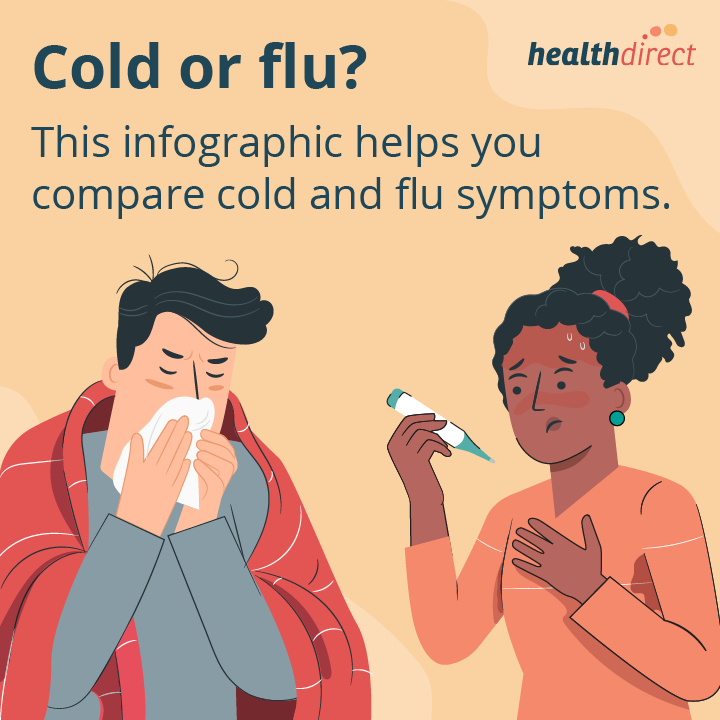
For information on comparing [cold and flu symptoms](https://www.healthdirect.gov.au/cold-or-flu-infographic).
[**CHECK YOUR SYMPTOMS** — Use the **Symptom Checker** and find out if you need to seek medical help.](https://www.healthdirect.gov.au/symptom-checker)
## What causes coughs and colds in children?
Most cough and cold symptoms are caused by viruses. Viruses are easily spread from person to person through droplets from the mouth and nose. These can be spread through coughing and sneezing.
Colds are not caused by:
- getting cold or wet
- going out with wet hair or bare feet
In some cases, cold symptoms can be caused by other conditions. These include:
- [bronchiolitis](https://www.healthdirect.gov.au/bronchiolitis) (younger children) or [bronchitis](https://www.healthdirect.gov.au/bronchitis) (older children)
- [laryngitis](https://www.healthdirect.gov.au/laryngitis)
- [whooping cough](https://www.healthdirect.gov.au/whooping-cough)
- [pneumonia](https://www.healthdirect.gov.au/pneumonia)
- [asthma](https://www.healthdirect.gov.au/asthma)
- [croup](https://www.healthdirect.gov.au/croup)
- [COVID-19](https://www.healthdirect.gov.au/covid-19)
Some of these conditions can be treated easily at home, but others may need treatment from your doctor.
## When should I take my child to see a doctor for a cough or a cold?
**If you think your child is having trouble breathing, call triple zero (000) immediately or go to your nearest emergency department.**
You should speak with your doctor if:
- your child is under 3 months old
- their symptoms are very unpleasant or getting worse
- you are concerned about your child
- your child's symptoms do not improve after 48 hours
- your child has a cough that continues for more than a few weeks after their illness
- they refuse to drink or have an icy pole for over 6 hours
- your child is urinating much less
- they have a high fever
These symptoms may mean your child's illness is severe or is caused by something other than a cold virus.
Seek medical attention immediately if your child:
- is having trouble breathing
- is breathing much faster than usual
- has 'sucking in' of the skin around their throat, just above their breast bone or between or under their ribs when breathing in
- has pale or bluish skin or lips
You should also seek urgent medical help if your child has:
- a rash that does not turn skin coloured when pressed
- a headache or a stiff neck
- a high fever
These are signs of [meningococcal disease](https://www.healthdirect.gov.au/meningococcal-disease), **which is a medical emergency. If you are worried that your child may have meningococcal disease, go to your nearest emergency department or call 000 for an ambulance.**
[**FIND A HEALTH SERVICE** — The **Service Finder** can help you find doctors, pharmacies, hospitals and other health services.](https://www.healthdirect.gov.au/australian-health-services)
## How are coughs and colds diagnosed?
In most cases, your doctor can diagnose a cold by examining your child and asking you a few questions.
In some cases, your doctor may refer your child for tests, such as a swab to [test for COVID-19](https://www.healthdirect.gov.au/covid-19/testing).
[**ASK YOUR DOCTOR** — Preparing for an appointment? Use the **Question Builder** for general tips on what to ask your GP or specialist.](https://www.healthdirect.gov.au/question-builder)
## How are coughs and colds treated?
Most coughs and colds are caused by viruses and get better on their own within a week.
The best treatment for most coughs and colds is rest.
If your child is unwell, keep them at home to rest and recover. This way, their immune system can fight the virus.
### Keeping fluids up
Making sure your child drinks plenty of fluids will:
- help ease a sore throat
- keep them hydrated if they have a fever, vomiting or diarrhoea
### Managing runny noses
Saline nose drops or spray can help thin mucus and make it easier to blow out.
### Medicines
Paracetamol or ibuprofen can be used to ease the pain of a sore throat or headache. The strengths of these [over-the-counter medicines](https://www.healthdirect.gov.au/medicines-for-colds-flu-and-covid-19-for-children) differ, so be sure to check the dose instructions on the pack. Give your child medicines only as directed.
For children older than 12 months of age, honey can help ease their cough. Give your child a teaspoon or 2 of honey before bed.
There are some medicines you should **not** give to your child, such as:
- decongestants
- cough syrups
These medicines have not been shown to help children recover from coughs and colds and may be harmful to them.
**Sedating antihistamines should not be used in children under 6 years old to treat colds or coughs, as they can cause serious harm.**
### Vitamins
Vitamin supplements are not necessary if your child has a cold. You may wish to speak to your doctor if you are concerned or want more information.
### Special diets
You may have heard that special diets, or 'feeding a fever' and 'starving a cold' can treat colds or coughs. There is no evidence to support this.
### Antibiotics
Antibiotics are only used to treat bacterial infections. Most coughs are caused by cold viruses, so [antibiotics](https://www.healthdirect.gov.au/antibiotics) will not help your child get better any faster.
## How can I prevent my child from getting a cough or cold?
It's not possible to prevent all coughs and colds. But there are things you can do to reduce the chance of your kids getting sick.
These include:
- [hand washing](https://www.healthdirect.gov.au/hand-washing) often, especially after coughing, sneezing or blowing your nose
- coughing or sneezing into your elbow
- avoiding sharing utensils and cups with others
- using tissues instead of hankies and throwing them out straight away after use
Eating a [balanced diet](https://www.pregnancybirthbaby.org.au/healthy-eating-for-your-child) and getting enough sleep will also help keep your children healthy.
Keeping your child home from school and other activities when they are sick with a cold can stop them spreading their illness to others.
Some children continue to cough for many weeks after a cold — this is known as a post-viral cough. If your child has a cough but is otherwise well, check with your doctor if they can attend school.
Learn more about [school exclusion periods](https://www.healthdirect.gov.au/school-exclusion-periods).
## What complications are linked to coughs and colds?
Most coughs and colds pass quickly with no medical treatment needed and no complications.
In some cases, your child may develop a bacterial infection after being sick with a cold virus. A bacterial infection may need treatment with antibiotics.
## Resources and support
You can also call the healthdirect helpline on 1800 022 222 (known as NURSE-ON-CALL in Victoria). A registered nurse is available to speak with 24 hours a day, 7 days a week.
For information in a language other than English, you can visit the Royal Children's Hospital website.
You can also:
- find the nearest [GP service that is open now](https://www.healthdirect.gov.au/australian-health-services)
- request a [video call](https://www.pregnancybirthbaby.org.au/) with a maternal child health nurse through Pregnancy Birth and Baby
#### Sources:
Therapeutic good administration *[(First-generation oral sedating antihistamines - do not use in children)](https://www.tga.gov.au/news/safety-updates/first-generation-oral-sedating-antihistamines-do-not-use-children "First-generation oral sedating antihistamines - do not use in children")*, Therapeutic Goods Administration *[(About pholcodine cough medicines cancelled by the TGA and recalled from pharmacies for safety reasons)](https://www.tga.gov.au/safety/information-about-specific-safety-alerts-and-recalls/about-pholcodine-cough-medicines-cancelled-tga-and-recalled-pharmacies-safety-reasons "About pholcodine cough medicines cancelled by the TGA and recalled from pharmacies for safety reasons")*, Royal Children's Hospital *[(Cough fact sheet)](https://www.rch.org.au/kidsinfo/fact_sheets/Cough/ "Cough fact sheet")*, Royal Children’s Hospital Melbourne *[(Cough)](https://www.rch.org.au/clinicalguide/guideline_index/cough/ "Cough")*, Royal Children's Hospital *[(Viral illnesses)](https://www.rch.org.au/kidsinfo/fact_sheets/viral_illnesses/ "Viral illnesses")*, Royal Children's Hospital *[(Meningococcal infection)](https://www.rch.org.au/kidsinfo/fact_sheets/Meningococcal_infection/ "Meningococcal infection")*, The Royal Children\\u2019s Hospital Melbourne *[(Asthma)](https://www.rch.org.au/kidsinfo/fact_sheets/asthma/ "Asthma")*, The Royal Children's Hospital Melbourne *[(Coronavirus COVID-19)](https://www.rch.org.au/kidsinfo/fact_sheets/Coronavirus_COVID-19/ "Coronavirus COVID-19")*, SA Health *[(Common cold)](https://www.sahealth.sa.gov.au/wps/wcm/connect/7d567303-0549-40a4-af5b-c9f6d5283172/YGW+Common+cold_v1.1++%2820210331%29_FINAL.pdf?MOD=AJPERES&CACHEID=ROOTWORKSPACE-7d567303-0549-40a4-af5b-c9f6d5283172-nKQSwOQ "Common cold")*
Learn more here about the [development and quality assurance of healthdirect content](https://www.healthdirect.gov.au/about-our-content).
Last reviewed: November 2023
[Back To Top](https://www.healthdirect.gov.au/coughs-and-colds-in-children#backToTop)
## Related pages
- [Colds](https://www.healthdirect.gov.au/colds "Colds")
- [Rhinovirus](https://www.healthdirect.gov.au/rhinovirus "Rhinovirus")
## Search our site for
- [Cough](https://www.healthdirect.gov.au/search-results/Cough "Search results for: Cough")
- [Coronavirus (COVID-19)](https://www.healthdirect.gov.au/search-results/Coronavirus%20\(COVID-19\) "Search results for: Coronavirus (COVID-19)")
- [Influenza](https://www.healthdirect.gov.au/search-results/Influenza "Search results for: Influenza")
- [Childhood Illnesses](https://www.healthdirect.gov.au/search-results/Childhood%20Illnesses "Search results for: Childhood Illnesses")
- [Nasal Congestion](https://www.healthdirect.gov.au/search-results/Nasal%20Congestion "Search results for: Nasal Congestion")
- [Sore Throat](https://www.healthdirect.gov.au/search-results/Sore%20Throat "Search results for: Sore Throat")
- [Respiratory System](https://www.healthdirect.gov.au/search-results/Respiratory%20System "Search results for: Respiratory System")
- [Cough and cold medicines](https://www.healthdirect.gov.au/search-results/Cough%20and%20cold%20medicines "Search results for: Cough and cold medicines")
- [Cough suppressants](https://www.healthdirect.gov.au/search-results/Cough%20suppressants "Search results for: Cough suppressants")
- [Post-Nasal Drip](https://www.healthdirect.gov.au/search-results/Post-Nasal%20Drip "Search results for: Post-Nasal Drip")
## Need more information?
These trusted information partners have more on this topic.
General search results
Results for medical professionals
Top results
[Whooping cough: babies, children & teens \| Raising Children Network Whooping cough starts like a cold, followed by a cough with a whooping sound. Immunisation protects children, but see a GP if your child develops symptoms. *Read more on raisingchildren.net.au website* ](https://raisingchildren.net.au/guides/a-z-health-reference/whooping-cough)
[Fever in Children - Rahma Health A fever is a temperature over 38 degrees celsius. *Read more on Rahma Health website* ](https://rahma.health/childrens-health/fever-in-children/)
[Glandular fever: children & teenagers \| Raising Children Network Glandular fever is a viral illness that mostly affects older children and teenagers. Symptoms include sore throat, fatigue and swollen neck glands. See a GP. *Read more on raisingchildren.net.au website* ](https://raisingchildren.net.au/guides/a-z-health-reference/glandular-fever)
[High temperature or fever in children \| Raising Children Network Fever is a body temperature higher than 38°C. Fever in children is a sign of illness. Here’s what to do when your child has a high temperature. *Read more on raisingchildren.net.au website* ](https://raisingchildren.net.au/guides/a-z-health-reference/fever)
[Hay fever in children and teenagers \| Raising Children Network Hay fever is an allergic reaction. Hay fever symptoms include a runny nose, itchy eyes and sneezing. A GP can advise you about hay fever treatment for kids. *Read more on raisingchildren.net.au website* ](https://raisingchildren.net.au/guides/a-z-health-reference/hay-fever)
[Kids Health Info : Fever in children *Read more on Royal Children's Hospital website* ](https://www.rch.org.au/kidsinfo/fact_sheets/Fever_in_children/)
[Dry coughs - myDr.com.au A dry cough is non-productive and irritating, and sometimes causes a tickly throat. Find out what products are available for a dry cough. *Read more on myDoctor website* ](https://mydr.com.au/pharmacy-care/dry-coughs/)
[Cough: productive or 'wet' cough - myDr.com.au A productive or 'wet' cough brings up mucus or phlegm. Find out the causes and when to see the doctor. *Read more on myDoctor website* ](https://mydr.com.au/respiratory-health/cough-productive-or-wet-cough/)
[Cough: productive or 'wet' cough treatments - myDr.com.au Treatment for a productive or wet cough: find out about different treatments and what not to do. *Read more on myDoctor website* ](https://mydr.com.au/respiratory-health/cough-productive-or-wet-cough-treatments/)
[Chesty coughs - myDr.com.au When you have a chesty cough (wet, productive or phlegmy) your chest feels heavy and you may cough up mucus or phlegm. Find out what products are available for a chesty cough. *Read more on myDoctor website* ](https://mydr.com.au/respiratory-health/chesty-coughs/)
Show more
Top results
Show more
## Disclaimer
Healthdirect Australia is not responsible for the content and advertising on the external website you are now entering.
[OK]()
## Related pages
- [Colds](https://www.healthdirect.gov.au/colds "Colds")
- [Rhinovirus](https://www.healthdirect.gov.au/rhinovirus "Rhinovirus")
## Search our site for
- [Cough](https://www.healthdirect.gov.au/search-results/Cough "Search results for: Cough")
- [Coronavirus (COVID-19)](https://www.healthdirect.gov.au/search-results/Coronavirus%20\(COVID-19\) "Search results for: Coronavirus (COVID-19)")
- [Influenza](https://www.healthdirect.gov.au/search-results/Influenza "Search results for: Influenza")
- [Childhood Illnesses](https://www.healthdirect.gov.au/search-results/Childhood%20Illnesses "Search results for: Childhood Illnesses")
- [Nasal Congestion](https://www.healthdirect.gov.au/search-results/Nasal%20Congestion "Search results for: Nasal Congestion")
- [Sore Throat](https://www.healthdirect.gov.au/search-results/Sore%20Throat "Search results for: Sore Throat")
- [Respiratory System](https://www.healthdirect.gov.au/search-results/Respiratory%20System "Search results for: Respiratory System")
- [Cough and cold medicines](https://www.healthdirect.gov.au/search-results/Cough%20and%20cold%20medicines "Search results for: Cough and cold medicines")
- [Cough suppressants](https://www.healthdirect.gov.au/search-results/Cough%20suppressants "Search results for: Cough suppressants")
- [Post-Nasal Drip](https://www.healthdirect.gov.au/search-results/Post-Nasal%20Drip "Search results for: Post-Nasal Drip")
## Symptom checker
**Worried about your health?**
Select a symptom, answer some questions, get advice
[Start Your Symptom Check](https://www.healthdirect.gov.au/symptom-checker "Check symptoms")
[Check your symptoms](https://www.healthdirect.gov.au/symptom-checker/tool?symptom=GNRC) [Find a health service](https://www.healthdirect.gov.au/australian-health-services)
# Healthdirect 24hr 7 days a week hotline
24 hour health advice you can count on
[1800 022 222](tel:1800022222)
# Government Accredited with over 140 information partners

We are a government-funded service, providing quality, approved health information and advice
[](https://www.health.gov.au/) [](https://www.health.act.gov.au/) [](https://www.health.nsw.gov.au/) [](https://health.nt.gov.au/) [](https://www.health.qld.gov.au/) [](https://www.sahealth.sa.gov.au/) [](https://www.health.tas.gov.au/) [](https://www2.health.vic.gov.au/) [](https://ww2.health.wa.gov.au/)
## About
- [How we can help](https://www.healthdirect.gov.au/how-healthdirect-can-help-you)
- [Our mobile app](https://www.healthdirect.gov.au/health-app)
- [Linking to us](https://about.healthdirect.gov.au/linking-to-us)
- [Information partners](https://www.healthdirect.gov.au/information-partners)
- [Register your service](https://www.healthdirect.gov.au/register-with-nhsd)
- [Terms of use](https://www.healthdirect.gov.au/terms-of-use)
- [Privacy](https://www.healthdirect.gov.au/privacy-policy)
- [How we use AI](https://www.healthdirect.gov.au/artificial-intelligence-transparency-statement)
- [Contact us](https://www.healthdirect.gov.au/contact-us)
- [About us](https://about.healthdirect.gov.au/)
## Discover
- [Blog](https://www.healthdirect.gov.au/blog)
- [BMI calculator](https://www.healthdirect.gov.au/bmi-calculator)
- [Health apps](https://www.healthdirect.gov.au/health-and-wellbeing-apps)
- [Medicines](https://www.healthdirect.gov.au/medicines)
- [Service finder](https://www.healthdirect.gov.au/australian-health-services)
- [Symptom checker](https://www.healthdirect.gov.au/symptom-checker)
- [Question builder](https://www.healthdirect.gov.au/question-builder)
## Resources in your language
- [Arabic عربى](https://www.healthdirect.gov.au/ar/resources-in-arabic)
- [বাংলা Bengali](https://www.healthdirect.gov.au/bn/resources-in-bengali)
- [简体中文 Chinese Simplified](https://www.healthdirect.gov.au/zh-hans/resources-in-chinese-simplified)
- [繁體中文 Chinese Traditional](https://www.healthdirect.gov.au/zh-hant/resources-in-chinese-traditional)
- [Tiếng Việt Vietnamese](https://www.healthdirect.gov.au/vi/resources-in-vietnamese)
[](https://itunes.apple.com/au/app/healthdirect-check-symptoms/id1021494621?ls=1&mt=8) [](https://play.google.com/store/apps/details?id=au.org.healthdirect.healthdirectapp)
Healthdirect Australia is dedicated to providing safe, effective and person-centred advice, supported by rigorous [clinical governance](https://about.healthdirect.gov.au/end-to-end-service-delivery) and transparent [quality and safety processes](https://www.healthdirect.gov.au/quality-and-safety-of-healthdirects-triage-service-statement).
This site is protected by reCAPTCHA and the Google [Privacy Policy](https://policies.google.com/privacy) and [Terms of Service](https://policies.google.com/terms) apply.
Healthdirect Australia acknowledges the Traditional Owners of Country throughout Australia and their continuing connection to land, sea and community. We pay our respects to the Traditional Owners and to Elders both past and present.
© 2026 Healthdirect Australia Limited
## Support for this browser is being discontinued
Support for this browser is being discontinued for this site
- Internet Explorer 11 and lower
We currently support Microsoft Edge, Chrome, Firefox and Safari. For more information, please visit the links below:
- [Chrome by Google](https://www.google.com.au/chrome/)
- [Firefox by Mozilla](https://www.mozilla.org/en-US/firefox/new)
- [Microsoft Edge](https://www.microsoft.com/en-us/edge)
- [Safari by Apple](https://support.apple.com/en_AU/downloads/safari)
You are welcome to continue browsing this site with this browser. Some features, tools or interaction may not work correctly.
Continue
 |
| Readable Markdown | ## Key facts
- Most coughs and colds in children are caused by viral infections.
- Cold viruses are spread easily through droplets from the nose and mouth of infected people.
- Cold viruses can cause a runny nose, sore throat, cough and tiredness.
- The best treatment for a cold virus is to rest at home so your child's immune system can fight the virus.
- Cough syrups and cold medicines are not recommended for children.
## On this page
- [What is the 'common cold'?](https://www.healthdirect.gov.au/coughs-and-colds-in-children#what-is)
- [What are the symptoms of a cold?](https://www.healthdirect.gov.au/coughs-and-colds-in-children#symptoms)
- [What causes coughs and colds in children?](https://www.healthdirect.gov.au/coughs-and-colds-in-children#causes)
- [When should I take my child to see a doctor for a cough or a cold?](https://www.healthdirect.gov.au/coughs-and-colds-in-children#doctor)
- [How are coughs and colds diagnosed?](https://www.healthdirect.gov.au/coughs-and-colds-in-children#diagnosed)
- [How are coughs and colds treated?](https://www.healthdirect.gov.au/coughs-and-colds-in-children#treated)
- [How can I prevent my child from getting a cough or cold?](https://www.healthdirect.gov.au/coughs-and-colds-in-children#prevent)
- [What complications are linked to coughs and colds?](https://www.healthdirect.gov.au/coughs-and-colds-in-children#complications)
- [Resources and support](https://www.healthdirect.gov.au/coughs-and-colds-in-children#resources)
- [Related information on Australian websites](https://www.healthdirect.gov.au/coughs-and-colds-in-children#searchGeneralResults)
## What is the 'common cold'?
[The common cold](https://www.healthdirect.gov.au/colds) is an infection caused by a [virus](https://www.healthdirect.gov.au/viral-infections). There are many different viruses that can cause colds.
Colds are very common. Healthy preschool children often catch at least 6 colds per year.
Children are more likely to catch a cold than adults because their immune system is still developing. Sometimes, after recovering from a virus, your child may get sick with a different virus. It can sometimes seem like they are ‘always sick'. Most children catch fewer cold viruses as they get older.
## What are the symptoms of a cold?
[**CHECK YOUR SYMPTOMS** — Use the **Symptom Checker** and find out if you need to seek medical help.](https://www.healthdirect.gov.au/symptom-checker)
## What causes coughs and colds in children?
Most cough and cold symptoms are caused by viruses. Viruses are easily spread from person to person through droplets from the mouth and nose. These can be spread through coughing and sneezing.
Colds are not caused by:
- getting cold or wet
- going out with wet hair or bare feet
In some cases, cold symptoms can be caused by other conditions. These include:
- [bronchiolitis](https://www.healthdirect.gov.au/bronchiolitis) (younger children) or [bronchitis](https://www.healthdirect.gov.au/bronchitis) (older children)
- [laryngitis](https://www.healthdirect.gov.au/laryngitis)
- [whooping cough](https://www.healthdirect.gov.au/whooping-cough)
- [pneumonia](https://www.healthdirect.gov.au/pneumonia)
- [asthma](https://www.healthdirect.gov.au/asthma)
- [croup](https://www.healthdirect.gov.au/croup)
- [COVID-19](https://www.healthdirect.gov.au/covid-19)
Some of these conditions can be treated easily at home, but others may need treatment from your doctor.
## When should I take my child to see a doctor for a cough or a cold?
**If you think your child is having trouble breathing, call triple zero (000) immediately or go to your nearest emergency department.**
You should speak with your doctor if:
- your child is under 3 months old
- their symptoms are very unpleasant or getting worse
- you are concerned about your child
- your child's symptoms do not improve after 48 hours
- your child has a cough that continues for more than a few weeks after their illness
- they refuse to drink or have an icy pole for over 6 hours
- your child is urinating much less
- they have a high fever
These symptoms may mean your child's illness is severe or is caused by something other than a cold virus.
Seek medical attention immediately if your child:
- is having trouble breathing
- is breathing much faster than usual
- has 'sucking in' of the skin around their throat, just above their breast bone or between or under their ribs when breathing in
- has pale or bluish skin or lips
You should also seek urgent medical help if your child has:
- a rash that does not turn skin coloured when pressed
- a headache or a stiff neck
- a high fever
These are signs of [meningococcal disease](https://www.healthdirect.gov.au/meningococcal-disease), **which is a medical emergency. If you are worried that your child may have meningococcal disease, go to your nearest emergency department or call 000 for an ambulance.**
[**FIND A HEALTH SERVICE** — The **Service Finder** can help you find doctors, pharmacies, hospitals and other health services.](https://www.healthdirect.gov.au/australian-health-services)
## How are coughs and colds diagnosed?
In most cases, your doctor can diagnose a cold by examining your child and asking you a few questions.
In some cases, your doctor may refer your child for tests, such as a swab to [test for COVID-19](https://www.healthdirect.gov.au/covid-19/testing).
[**ASK YOUR DOCTOR** — Preparing for an appointment? Use the **Question Builder** for general tips on what to ask your GP or specialist.](https://www.healthdirect.gov.au/question-builder)
## How are coughs and colds treated?
Most coughs and colds are caused by viruses and get better on their own within a week.
The best treatment for most coughs and colds is rest.
If your child is unwell, keep them at home to rest and recover. This way, their immune system can fight the virus.
### Keeping fluids up
Making sure your child drinks plenty of fluids will:
- help ease a sore throat
- keep them hydrated if they have a fever, vomiting or diarrhoea
### Managing runny noses
Saline nose drops or spray can help thin mucus and make it easier to blow out.
### Medicines
Paracetamol or ibuprofen can be used to ease the pain of a sore throat or headache. The strengths of these [over-the-counter medicines](https://www.healthdirect.gov.au/medicines-for-colds-flu-and-covid-19-for-children) differ, so be sure to check the dose instructions on the pack. Give your child medicines only as directed.
For children older than 12 months of age, honey can help ease their cough. Give your child a teaspoon or 2 of honey before bed.
There are some medicines you should **not** give to your child, such as:
- decongestants
- cough syrups
These medicines have not been shown to help children recover from coughs and colds and may be harmful to them.
**Sedating antihistamines should not be used in children under 6 years old to treat colds or coughs, as they can cause serious harm.**
### Vitamins
Vitamin supplements are not necessary if your child has a cold. You may wish to speak to your doctor if you are concerned or want more information.
### Special diets
You may have heard that special diets, or 'feeding a fever' and 'starving a cold' can treat colds or coughs. There is no evidence to support this.
### Antibiotics
Antibiotics are only used to treat bacterial infections. Most coughs are caused by cold viruses, so [antibiotics](https://www.healthdirect.gov.au/antibiotics) will not help your child get better any faster.
## How can I prevent my child from getting a cough or cold?
It's not possible to prevent all coughs and colds. But there are things you can do to reduce the chance of your kids getting sick.
These include:
- [hand washing](https://www.healthdirect.gov.au/hand-washing) often, especially after coughing, sneezing or blowing your nose
- coughing or sneezing into your elbow
- avoiding sharing utensils and cups with others
- using tissues instead of hankies and throwing them out straight away after use
Eating a [balanced diet](https://www.pregnancybirthbaby.org.au/healthy-eating-for-your-child) and getting enough sleep will also help keep your children healthy.
Keeping your child home from school and other activities when they are sick with a cold can stop them spreading their illness to others.
Some children continue to cough for many weeks after a cold — this is known as a post-viral cough. If your child has a cough but is otherwise well, check with your doctor if they can attend school.
Learn more about [school exclusion periods](https://www.healthdirect.gov.au/school-exclusion-periods).
## What complications are linked to coughs and colds?
Most coughs and colds pass quickly with no medical treatment needed and no complications.
In some cases, your child may develop a bacterial infection after being sick with a cold virus. A bacterial infection may need treatment with antibiotics.
## Resources and support
You can also call the healthdirect helpline on 1800 022 222 (known as NURSE-ON-CALL in Victoria). A registered nurse is available to speak with 24 hours a day, 7 days a week.
For information in a language other than English, you can visit the Royal Children's Hospital website.
You can also:
- find the nearest [GP service that is open now](https://www.healthdirect.gov.au/australian-health-services)
- request a [video call](https://www.pregnancybirthbaby.org.au/) with a maternal child health nurse through Pregnancy Birth and Baby |
| Shard | 187 (laksa) |
| Root Hash | 11476440364350543187 |
| Unparsed URL | au,gov,healthdirect!www,/coughs-and-colds-in-children s443 |