ℹ️ Skipped - page is already crawled
| Filter | Status | Condition | Details |
|---|---|---|---|
| HTTP status | PASS | download_http_code = 200 | HTTP 200 |
| Age cutoff | PASS | download_stamp > now() - 6 MONTH | 0 months ago |
| History drop | PASS | isNull(history_drop_reason) | No drop reason |
| Spam/ban | PASS | fh_dont_index != 1 AND ml_spam_score = 0 | ml_spam_score=0 |
| Canonical | PASS | meta_canonical IS NULL OR = '' OR = src_unparsed | Not set |
| Property | Value |
|---|---|
| URL | https://www.healthdata.org/news-events/insights-blog/acting-data/gun-violence-united-states-outlier |
| Last Crawled | 2026-04-19 06:00:32 (1 day ago) |
| First Indexed | 2023-07-20 18:10:26 (2 years ago) |
| HTTP Status Code | 200 |
| Meta Title | On gun violence, the United States is an outlier | Institute for Health Metrics and Evaluation |
| Meta Description | When we look exclusively at high-income countries and territories with populations of 10 million or more, the US ranks first for its high levels of gun violence. |
| Meta Canonical | null |
| Boilerpipe Text | When we look exclusively at high-income countries and territories with populations of 10 million or more, the US ranks first.
Rates of firearm homicides among high-income countries with populations over 10 million, 2021
Source: Scott Glenn, IHME
Age-adjusted firearm homicide rates in the US are 19 times greater than they are in France, and 77 times greater than in Germany. The US has 33 times the rate of firearm homicide seen in Australia.
The trend continues for percentage of child deaths caused by firearms. Including physical violence, suicide, and unintentional injury, gun violence accounts for over 8% of deaths in the US among those under age 20, a figure that stands far above peer countries. When excluding infants, who have higher rates of death from neonatal causes, that number jumps to 15%.
Percentage of childhood deaths caused by firearms among high-income countries with populations over 10 million, 2021
Source: Scott Glenn, IHME
Within the US, gun violence varies widely. Age-adjusted firearm homicide rates range from a high of 14.4 per 100,000 in Washington, DC, to a low of 1.1 per 100,000 in New Hampshire. Washington, DC’s rate is similar to those of Brazil and Jamaica, which rank ninth and tenth globally. New Hampshire’s rate is similar to that of Chile. Even though New Hampshire has the lowest rates of age-adjusted firearm homicides in the US, its rate is still three times greater than the highest rate in Europe – Cyprus, with 0.36 deaths per 100,000.
Washington, DC has the highest rate of deaths from gun violence in the United States
Source: Scott Glenn, IHME
Washington, DC, accounts for the greatest percentage of child deaths by firearm, where 13.8% of those who die under age 20 are victims of gun violence. When excluding infant deaths, that becomes nearly a third. Illinois and Louisiana also stand out, with 11.3% of child deaths being attributed to firearms. Meanwhile, Hawaii, Rhode Island, and Massachusetts come in at the bottom of the list, each with less than 4% of children being killed by guns.
Since 2000, the share of all childhood deaths caused by gun violence in the US has increased by about 33%, with the largest portion consistently due to physical violence, followed by suicide, and the smallest share caused by unintentional firearm injuries.
Percentage of childhood deaths caused by gun violence, 2000 and 2021
Source: Scott Glenn, IHME
Taking a global view that includes countries of all income levels and population sizes, the ten nations with the highest age-adjusted rates of firearm homicides are:
Venezuela
El Salvador
Mexico
Bahamas
Honduras
Trinidad and Tobago
Colombia
Guatemala
Brazil
Jamaica
Research has found high levels of homicides in these countries are associated with drug cartels, the illegal trade in firearms from the US, and firearms flowing to civilians after conflicts end, as summarized in the
Global Burden of Disease study
.
Numerous studies have highlighted promising policies to reduce gun violence. In the US,
research published in JAMA
found an association between laws strengthening background checks or requiring permits to purchase firearms with reductions in rates of firearm homicides.
Following the Port Arthur massacre in 1996 in Australia, the Australian National Firearms Agreement restricted the use of firearms by civilians. This legislation has been credited with ending mass shootings and reducing firearm suicides in Australia according to
a study
published in JAMA.
In South Africa, rates of violent deaths dropped after the passage of the Firearms Control Act of 2000,
according to research published in The South African Medical Journal
.
In Brazil, São Paulo reduced firearm homicides through firearm buy-back programs, enforcement of firearm control legislation passed in 2003, and improvements in policing,
as made evident in research published in SciElo.
Additional Resources:
The New York Times |
America’s gun problem
CNN |
How US gun culture stacks up with the world
Vox |
America’s gun violence epidemic, in one chart |
| Markdown | [Skip to main content](https://www.healthdata.org/news-events/insights-blog/acting-data/gun-violence-united-states-outlier#main-content)
Institute for Health Metrics and Evaluation
- [Contact us](https://www.healthdata.org/about/contact-us)
- [Research library](https://www.healthdata.org/search-research "See all of IHME's research library")
- [Data catalog](https://ghdx.healthdata.org/ "Visit the Global Health Data Exchange: a catalog of the world's health data")
- [Give now](https://www.healthdata.org/about/giving-ihme)
## Main navigation
- Research and analysis
- [*Research and analysis overview*](https://www.healthdata.org/research-analysis)
- Health topics
- [*Air pollution*](https://www.healthdata.org/research-analysis/health-topics/air-pollution)
- [*Alcohol use*](https://www.healthdata.org/research-analysis/health-topics/alcohol-use)
- [*Antimicrobial resistance (AMR)*](https://www.healthdata.org/research-analysis/health-topics/antimicrobial-resistance-amr)
- [*Burden of Proof*](https://www.healthdata.org/research-analysis/health-topics/burden-proof)
- [*Child health*](https://www.healthdata.org/research-analysis/health-topics/child-health)
- [*All topics*](https://www.healthdata.org/research-analysis/health-topics)
- Global Burden of Disease (GBD) study
- [*GBD home*](https://www.healthdata.org/research-analysis/gbd)
- [*GBD Collaborator Network*](https://www.healthdata.org/research-analysis/gbd/collaborator-network)
- [*GBD Learning Center*](https://www.healthdata.org/research-analysis/gbd/learning)
- Health by location
- [*Country profiles*](https://www.healthdata.org/research-analysis/health-by-location/profiles)
- [*US health*](https://www.healthdata.org/research-analysis/health-by-location/united-states)
- Health policy and planning
- [*Health financing*](https://www.healthdata.org/research-analysis/health-financing)
- [*Health forecasting*](https://www.healthdata.org/research-analysis/health-policy-planning/health-forecasting)
- [*Program and policy evaluations*](https://www.healthdata.org/research-analysis/evaluations)
- [*Population*](https://www.healthdata.org/research-analysis/population)
- [*Program in Cardiovascular Health Metrics*](https://www.healthdata.org/research-analysis/cardiovascular-health)
- [*Explore all publications*](https://www.healthdata.org/search-research?f%5B0%5D=content_type%3Ascientific_publication)
- Data tools and practices
- [*Data tools and practices overview*](https://www.healthdata.org/data-tools-practices)
- Explore our data tools
- [*Data sources catalog*](https://www.healthdata.org/data-tools-practices/data-sources)
- [*Interactive data visuals*](https://www.healthdata.org/data-tools-practices/interactive-data-visuals)
- [*Verbal autopsy tool*](https://www.healthdata.org/data-tools-practices/verbal-autopsy)
- Data practices
- [*Data access*](https://www.healthdata.org/data-tools-practices/data-access)
- [*Data transparency*](https://www.healthdata.org/Data-tools-practices/data-practices/data-transparency)
- [*Data use agreement*](https://www.healthdata.org/Data-tools-practices/data-practices/ihme-free-charge-non-commercial-user-agreement)
- [*How we collect data*](https://www.healthdata.org/data-tools-practices/data-collection)
- [*Terms and conditions*](https://www.healthdata.org/data-tools-practices/data-practices/terms-and-conditions)
- [*Data for the private sector*](https://www.healthdata.org/data-tools-practices/data-private-sector)
- News and events
- [*Newsroom*](https://www.healthdata.org/news-events)
- [*Blog*](https://www.healthdata.org/news-events/insights-blog)
- Media
- [*News releases*](https://www.healthdata.org/news-events/all-news-releases)
- [*IHME in the news*](https://www.healthdata.org/news-events/media-mentions)
- [*Global Health Insights Podcast*](https://www.healthdata.org/news-events/podcasts)
- [*Videos*](https://www.healthdata.org/news-events/videos)
- [*Events*](https://www.healthdata.org/news-events/events)
- About us
- About IHME
- [*Who we are*](https://www.healthdata.org/about)
- [*Vision, mission, values, and principles*](https://www.healthdata.org/about/mission-and-vision)
- [*Our people*](https://www.healthdata.org/about/people)
- [*Governance*](https://www.healthdata.org/about/governance)
- Work with us
- [*Careers*](https://www.healthdata.org/about/careers)
- [*Benefits*](https://www.healthdata.org/about/careers/benefits)
- [*How we hire*](https://www.healthdata.org/about-us/careers/how-we-hire)
- [*Job openings*](https://www.healthdata.org/about/careers/job-openings)
- Awarding innovative research
- [*GBD Emerging Researcher*](https://www.healthdata.org/about/awards/GBD-emerging-researcher-award)
- [*Roux Prize*](https://www.healthdata.org/about/awards/roux-prize)
- [*Partnerships*](https://www.healthdata.org/about/partnerships)
- [*Contact us*](https://www.healthdata.org/about/contact-us)
- [*Give now*](https://www.healthdata.org/about/giving-ihme)
Search
Menu

## Breadcrumb
1. [Home](https://www.healthdata.org/)
2. [Newsroom](https://www.healthdata.org/news-events)
3. [Insights blog](https://www.healthdata.org/news-events/insights-blog)
4. [Acting on Data](https://www.healthdata.org/news-events/insights-blog/acting-on-data)
# On gun violence, the United States is an outlier
Published October 31, 2023

## Key takeaways:
- Age-adjusted firearm homicide rates in the US are 33 times greater than in Australia and 77 times greater than in Germany.
- Gun violence accounts for over 8% of deaths in the US among those under age 20.
- Age-adjusted rates of firearm homicide are highest in Washington, DC and lowest in New Hampshire.
# Authors

## Katherine Leach-Kemon
Senior Content Strategist

## Rebecca Sirull
Communications Officer

## Scott Glenn
Data Specialist
# Topics
- [Health policy](https://www.healthdata.org/search?f%5B0%5D=global_topics%3A4420)
- [Injuries](https://www.healthdata.org/search?f%5B0%5D=global_topics%3A4427)
- [US Health](https://www.healthdata.org/search?f%5B0%5D=global_topics%3A4448)
Highlight
The US ranks first for rates of firearm homicides among high-income countries with populations over 10 million.
Share
*Originally published March 25, 2021. Last updated October 31, 2023.*
Among 65 high-income countries and territories, the United States stands out for its high levels of gun violence. The US ranks seventh out of 65 for homicides by firearm (age-adjusted). Puerto Rico and the US Virgin Islands, two US territories, rank first and fourth on that list. Firearm injuries tend to be more frequent in places where people have easy access to firearms, [according to findings from the 2018 Global Burden of Disease study published in the Journal of the American Medical Association](https://jamanetwork.com/journals/jama/fullarticle/2698492) (JAMA).
When we look exclusively at high-income countries and territories with populations of 10 million or more, the US ranks first.
##### Rates of firearm homicides among high-income countries with populations over 10 million, 2021

Source: Scott Glenn, IHME
Age-adjusted firearm homicide rates in the US are 19 times greater than they are in France, and 77 times greater than in Germany. The US has 33 times the rate of firearm homicide seen in Australia.
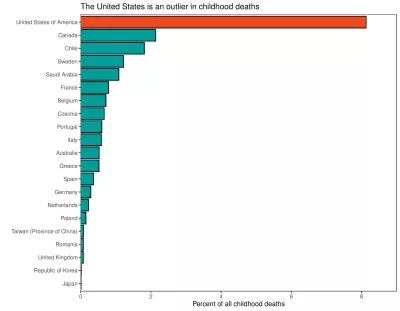
The trend continues for percentage of child deaths caused by firearms. Including physical violence, suicide, and unintentional injury, gun violence accounts for over 8% of deaths in the US among those under age 20, a figure that stands far above peer countries. When excluding infants, who have higher rates of death from neonatal causes, that number jumps to 15%.
##### Percentage of childhood deaths caused by firearms among high-income countries with populations over 10 million, 2021
Source: Scott Glenn, IHME
Within the US, gun violence varies widely. Age-adjusted firearm homicide rates range from a high of 14.4 per 100,000 in Washington, DC, to a low of 1.1 per 100,000 in New Hampshire. Washington, DC’s rate is similar to those of Brazil and Jamaica, which rank ninth and tenth globally. New Hampshire’s rate is similar to that of Chile. Even though New Hampshire has the lowest rates of age-adjusted firearm homicides in the US, its rate is still three times greater than the highest rate in Europe – Cyprus, with 0.36 deaths per 100,000.
##### Washington, DC has the highest rate of deaths from gun violence in the United States

Source: Scott Glenn, IHME
Washington, DC, accounts for the greatest percentage of child deaths by firearm, where 13.8% of those who die under age 20 are victims of gun violence. When excluding infant deaths, that becomes nearly a third. Illinois and Louisiana also stand out, with 11.3% of child deaths being attributed to firearms. Meanwhile, Hawaii, Rhode Island, and Massachusetts come in at the bottom of the list, each with less than 4% of children being killed by guns.
Since 2000, the share of all childhood deaths caused by gun violence in the US has increased by about 33%, with the largest portion consistently due to physical violence, followed by suicide, and the smallest share caused by unintentional firearm injuries.
##### Percentage of childhood deaths caused by gun violence, 2000 and 2021

Source: Scott Glenn, IHME
Taking a global view that includes countries of all income levels and population sizes, the ten nations with the highest age-adjusted rates of firearm homicides are:
1. Venezuela
2. El Salvador
3. Mexico
4. Bahamas
5. Honduras
6. Trinidad and Tobago
7. Colombia
8. Guatemala
9. Brazil
10. Jamaica
Research has found high levels of homicides in these countries are associated with drug cartels, the illegal trade in firearms from the US, and firearms flowing to civilians after conflicts end, as summarized in the [Global Burden of Disease study](https://jamanetwork.com/journals/jama/fullarticle/2698492).
Numerous studies have highlighted promising policies to reduce gun violence. In the US, [research published in JAMA](https://jamanetwork.com/journals/jamainternalmedicine/article-abstract/2582989?utm_campaign=articlePDF&utm_medium=articlePDFlink&utm_source=articlePDF&utm_content=jama.2018.10060) found an association between laws strengthening background checks or requiring permits to purchase firearms with reductions in rates of firearm homicides.
Following the Port Arthur massacre in 1996 in Australia, the Australian National Firearms Agreement restricted the use of firearms by civilians. This legislation has been credited with ending mass shootings and reducing firearm suicides in Australia according to [a study](https://jamanetwork.com/journals/jama/fullarticle/2530362?utm_campaign=articlePDF&utm_medium=articlePDFlink&utm_source=articlePDF&utm_content=jama.2018.10060) published in JAMA.
In South Africa, rates of violent deaths dropped after the passage of the Firearms Control Act of 2000, [according to research published in The South African Medical Journal](http://www.samj.org.za/index.php/samj/article/view/10379).
In Brazil, São Paulo reduced firearm homicides through firearm buy-back programs, enforcement of firearm control legislation passed in 2003, and improvements in policing, [as made evident in research published in SciElo.](http://www.scielo.br/scielo.php?script=sci_arttext&pid=S1415-790X2017000500142&tlng=pt)
**Additional Resources:**
- The New York Times \| [America’s gun problem](https://www.nytimes.com/2022/05/26/briefing/guns-america-shooting-deaths.html?referringSource=articleShare)
- CNN \| [How US gun culture stacks up with the world](https://www.cnn.com/2021/11/26/world/us-gun-culture-world-comparison-intl-cmd/index.html)
- Vox \| [America’s gun violence epidemic, in one chart](https://www.vox.com/policy-and-politics/23141964/america-gun-violence-epidemic-chart)
[Back to top](https://www.healthdata.org/news-events/insights-blog/acting-data/gun-violence-united-states-outlier#main-content "Go to top of page")
## Related
Scientific Publication
#### [Cause-specific years of life lost attributable to non-optimal body mass index by county, sex, race, and ethnicity in the USA, 2000-2019: a systematic analysis of health disparities](https://www.healthdata.org/research-analysis/library/cause-specific-years-life-lost-attributable-non-optimal-body-mass-index)
Farah Mouhanna, Ethan Kahn, Laura Dwyer-Lindgren, Chris Schmidt, Theresa McHugh, Mathew Baumann, Katya Kelly, Wichada La Motte-Kerr, Rebecca Cogen, Xiaochen Dai, Emmanuela Gakidou, Cesar Montalvo, Zhuochen Li, Mike Celone, Nikki DeCleene, Christopher J.L. Murray, Ali Mokdad
March 18, 2026
Scientific Publication
#### [Estimating the costs of informal care for individuals with brain health disorders from 2000 to 2021: a modelling study](https://www.healthdata.org/research-analysis/library/estimating-costs-informal-care-individuals-brain-health-disorders-2000)
Amy Lastuka, Angela Apeagyei (Micah), Joseph Dieleman, AJ Mitchell, Ian Cogswell, Jeremy Dalos, Golsum Tsakalos, Andrei Oros, Serena Santoni, Nicholas Steel, Kayla Taylor
February 24, 2026
Video
#### [World Health Summit – GBD 2023 panel discussion: Translating evidence to agendas for health systems](https://www.healthdata.org/news-events/newsroom/videos/world-health-summit-gbd-2023-panel-discussion-translating-evidence)
Last updated
December 12, 2025
Scientific Publication
#### [Lancet Commission on Health Systems Performance Assessment](https://www.healthdata.org/research-analysis/library/lancet-commission-health-systems-performance-assessment)
Julio Frenk, Christopher J.L. Murray
December 1, 2025
## Subscribe to our newsletter
Institute for Health Metrics and Evaluation
Hans Rosling Center for Population Health
3980 15th Ave NE, Seattle WA 98195
UW Campus Box \#351615
Phone: \+1 (206) 897-2800
Fax: \+1 (206) 897-2899
[Twitter](https://x.com/ihme_uw)
[LinkedIn](https://www.linkedin.com/company/institute-for-health-metrics-and-evaluation)
[YouTube](https://www.youtube.com/channel/UCB8o7jtGPgaYYWRyotiyBMw)
[Facebook](http://www.facebook.com/IHMEUW)
[Send comments via email](https://www.healthdata.org/cdn-cgi/l/email-protection#791011141c39111c18150d111d180d1857160b1e)
Most popular pages
- [Antimicrobial resistance (AMR)](https://www.healthdata.org/research-analysis/health-topics/antimicrobial-resistance-amr)
- [Country profiles](https://www.healthdata.org/research-analysis/health-by-location/profiles)
- [Data sources](https://www.healthdata.org/data-tools-practices/data-sources)
- [Data tools and practices](https://www.healthdata.org/data-tools-practices)
- [Global Burden of Disease (GBD)](https://www.healthdata.org/research-analysis/gbd)
- [Global Burden of Disease 2023: Findings from the GBD 2023 study](https://www.healthdata.org/research-analysis/library/global-burden-disease-2023-findings-gbd-2023-study)
- [GBD Collaborator Network](https://www.healthdata.org/research-analysis/gbd/collaborator-network)
- [GBD Compare](https://www.healthdata.org/data-tools-practices/interactive-visuals/gbd-compare)
- [GBD Data](https://www.healthdata.org/research-analysis/gbd-data)
- [GBD Publications](https://www.healthdata.org/research-analysis/gbd-publications)
- [GBD Results](https://www.healthdata.org/data-tools-practices/interactive-visuals/gbd-results)
- [Interactive data visuals](https://www.healthdata.org/data-tools-practices/interactive-data-visuals)
- [Mental health](https://www.healthdata.org/research-analysis/health-topics/mental-health)
- [Research and analysis](https://www.healthdata.org/research-analysis)
[About us](https://www.healthdata.org/about)
- [Awards](https://www.healthdata.org/about/awards)
- [Careers](https://www.healthdata.org/about/careers)
- [Contact us](https://www.healthdata.org/about/contact-us)
- [Mission and vision](https://www.healthdata.org/about/mission-and-vision)
- [Our history](https://www.healthdata.org/about/history)
- [Our people](https://www.healthdata.org/about/people)

- [Privacy policy](https://www.washington.edu/online/privacy)
- [Terms and conditions](https://www.healthdata.org/data-tools-practices/data-practices/terms-and-conditions) |
| Readable Markdown | When we look exclusively at high-income countries and territories with populations of 10 million or more, the US ranks first.
##### Rates of firearm homicides among high-income countries with populations over 10 million, 2021

Source: Scott Glenn, IHME
Age-adjusted firearm homicide rates in the US are 19 times greater than they are in France, and 77 times greater than in Germany. The US has 33 times the rate of firearm homicide seen in Australia.
The trend continues for percentage of child deaths caused by firearms. Including physical violence, suicide, and unintentional injury, gun violence accounts for over 8% of deaths in the US among those under age 20, a figure that stands far above peer countries. When excluding infants, who have higher rates of death from neonatal causes, that number jumps to 15%.
##### Percentage of childhood deaths caused by firearms among high-income countries with populations over 10 million, 2021

Source: Scott Glenn, IHME
Within the US, gun violence varies widely. Age-adjusted firearm homicide rates range from a high of 14.4 per 100,000 in Washington, DC, to a low of 1.1 per 100,000 in New Hampshire. Washington, DC’s rate is similar to those of Brazil and Jamaica, which rank ninth and tenth globally. New Hampshire’s rate is similar to that of Chile. Even though New Hampshire has the lowest rates of age-adjusted firearm homicides in the US, its rate is still three times greater than the highest rate in Europe – Cyprus, with 0.36 deaths per 100,000.
##### Washington, DC has the highest rate of deaths from gun violence in the United States

Source: Scott Glenn, IHME
Washington, DC, accounts for the greatest percentage of child deaths by firearm, where 13.8% of those who die under age 20 are victims of gun violence. When excluding infant deaths, that becomes nearly a third. Illinois and Louisiana also stand out, with 11.3% of child deaths being attributed to firearms. Meanwhile, Hawaii, Rhode Island, and Massachusetts come in at the bottom of the list, each with less than 4% of children being killed by guns.
Since 2000, the share of all childhood deaths caused by gun violence in the US has increased by about 33%, with the largest portion consistently due to physical violence, followed by suicide, and the smallest share caused by unintentional firearm injuries.
##### Percentage of childhood deaths caused by gun violence, 2000 and 2021

Source: Scott Glenn, IHME
Taking a global view that includes countries of all income levels and population sizes, the ten nations with the highest age-adjusted rates of firearm homicides are:
1. Venezuela
2. El Salvador
3. Mexico
4. Bahamas
5. Honduras
6. Trinidad and Tobago
7. Colombia
8. Guatemala
9. Brazil
10. Jamaica
Research has found high levels of homicides in these countries are associated with drug cartels, the illegal trade in firearms from the US, and firearms flowing to civilians after conflicts end, as summarized in the [Global Burden of Disease study](https://jamanetwork.com/journals/jama/fullarticle/2698492).
Numerous studies have highlighted promising policies to reduce gun violence. In the US, [research published in JAMA](https://jamanetwork.com/journals/jamainternalmedicine/article-abstract/2582989?utm_campaign=articlePDF&utm_medium=articlePDFlink&utm_source=articlePDF&utm_content=jama.2018.10060) found an association between laws strengthening background checks or requiring permits to purchase firearms with reductions in rates of firearm homicides.
Following the Port Arthur massacre in 1996 in Australia, the Australian National Firearms Agreement restricted the use of firearms by civilians. This legislation has been credited with ending mass shootings and reducing firearm suicides in Australia according to [a study](https://jamanetwork.com/journals/jama/fullarticle/2530362?utm_campaign=articlePDF&utm_medium=articlePDFlink&utm_source=articlePDF&utm_content=jama.2018.10060) published in JAMA.
In South Africa, rates of violent deaths dropped after the passage of the Firearms Control Act of 2000, [according to research published in The South African Medical Journal](http://www.samj.org.za/index.php/samj/article/view/10379).
In Brazil, São Paulo reduced firearm homicides through firearm buy-back programs, enforcement of firearm control legislation passed in 2003, and improvements in policing, [as made evident in research published in SciElo.](http://www.scielo.br/scielo.php?script=sci_arttext&pid=S1415-790X2017000500142&tlng=pt)
**Additional Resources:**
- The New York Times \| [America’s gun problem](https://www.nytimes.com/2022/05/26/briefing/guns-america-shooting-deaths.html?referringSource=articleShare)
- CNN \| [How US gun culture stacks up with the world](https://www.cnn.com/2021/11/26/world/us-gun-culture-world-comparison-intl-cmd/index.html)
- Vox \| [America’s gun violence epidemic, in one chart](https://www.vox.com/policy-and-politics/23141964/america-gun-violence-epidemic-chart) |
| Shard | 88 (laksa) |
| Root Hash | 2118094125325629688 |
| Unparsed URL | org,healthdata!www,/news-events/insights-blog/acting-data/gun-violence-united-states-outlier s443 |