ℹ️ Skipped - page is already crawled
| Filter | Status | Condition | Details |
|---|---|---|---|
| HTTP status | PASS | download_http_code = 200 | HTTP 200 |
| Age cutoff | PASS | download_stamp > now() - 6 MONTH | 0.1 months ago |
| History drop | PASS | isNull(history_drop_reason) | No drop reason |
| Spam/ban | PASS | fh_dont_index != 1 AND ml_spam_score = 0 | ml_spam_score=0 |
| Canonical | PASS | meta_canonical IS NULL OR = '' OR = src_unparsed | Not set |
| Property | Value |
|---|---|
| URL | https://www.healthcentral.com/condition/heart-attack-signs-symptoms |
| Last Crawled | 2026-04-06 16:32:46 (2 days ago) |
| First Indexed | 2020-05-13 21:48:34 (5 years ago) |
| HTTP Status Code | 200 |
| Meta Title | What are the Signs and Symptoms of a Heart Attack? |
| Meta Description | Symptoms of a heart attack vary depending on a number of different factors, and may include chest pain, shortness of breath, and more. |
| Meta Canonical | null |
| Boilerpipe Text | Basics
Types
Symptoms
Heart Attack in Women vs. Men
You don't need us to tell you that heart attacks are life-threatening health emergencies. What you may not know, though, is that spotting one isn't necessarily as easy as you might think. Heart attacks are complicated, and the symptoms can vary dramatically from person to person, and also
between men and women
. And sometimes certain symptoms, like nausea, may not seem all that serious at all. That's why it critical for every person to know all the signs and symptoms of heart attack so that if one occurs, you can get help as quickly as possible. Let’s take a look at the different ways your heart may tell you it’s in trouble.
Basics
What Is a Heart Attack, Anyway?
First, a brief refresher course on your heart’s anatomy and what happens during an attack. Pumping oxygen- and nutrient-rich blood to every cell in your body is your heart's main job. As it does this, blood flows through a system of arteries, veins, and capillaries known as your blood vessels; your heart even has its own arteries, called the coronary arteries.
When all is working as it should, blood will flow unobstructed, and you’ll probably not give it a second thought. But things can go wrong. Your heart’s arteries can become clogged by plaque—a mix of cholesterol, fatty substances and other materials—that builds up during a process called
atherosclerosis
.
This eventually leads to
coronary artery disease
(CAD), a type of
heart disease
diagnosed in more than 80% of people who have a
heart attack
. One danger is that the plaque can rupture, or break apart. This causes your body’s self-defense system to form a protective clot around the damage. This does more harm than good. The clot blocks the flow of blood, which starves your heart of oxygen. When that happens, the cells in your heart begin to die. This is what's known as a heart attack, a potentially deadly medical emergency that accounts for roughly seven million emergency room visits in the U.S. each year.
Types
Technically, there is only one "kind" of heart attack—the kind that damages heart muscle. But this damage can occur in a number of different ways. They include:
Complete blockage.
An artery becomes completely blocked so that no blood can reach the heart. This is the far more dangerous type of heart attack, because permanent damage to the heart can develop quickly.
Partial blockage.
Nearly two-thirds of heart attacks are caused by a partial blockage of the artery. While the heart does receive some blood, it requires more than it’s getting. This type of attack will damage your heart, just not as quickly as one caused by a complete blockage.
Coronary artery spasms.
This is when your arteries spasm and dangerously narrow, causing a partial or complete blockage of the heart’s blood supply, which leads to heart attack. It’s not common, but it does sometimes happen, often with cocaine use.
Any one of these types of heart attacks can cause a range of symptoms, from chest pain to shortness of breath—or even cause no symptoms at all. These so-called
silent heart attacks
may seem like the ultimate oxymoron, but in fact about 20% of all heart attacks have either no obvious symptoms, or ones that are so mild and vague that they get brushed off as a strained chest muscle, the flu, or even a bad case of indigestion, according to the Centers for Disease Control (CDC). You won't know you've had a silent heart attack until you see your doc for a routine visit or for symptoms you didn't realize could be heart-related (more on these below).
Symptoms
What Are the Symptoms of a Heart Attack?
Despite the differences in severity, most heart attacks cause similar symptoms—though there are no hard and fast rules for what those symptoms will be. What you experience can vary and be influenced by your age, sex, and type of heart attack you have. Here are the ones to know about:
Chest Pain (Angina)
For both men and women, the most common symptom of a heart attack is some type of discomfort in the chest. You may experience a crushing pain, like an elephant sitting on your chest. Or you may feel squeezing or the sensation of pressure in your chest.
People with coronary artery disease, a frequent precursor to heart attack, are likely already familiar with the on-again, off-again chest pain caused by limited blood and oxygen to the heart. Officially called angina, that pain often goes away with rest, and it doesn’t lead to permanent damage of your heart muscle.
During a heart attack, however,
rest does not ease the pain
. The pain may last for only a few minutes, or it may continue for much longer. (But please note: Heart attacks can occur without chest pain. In fact, up to nearly half of all people report no experience of angina. This is particularly true for people with
diabetes
, who often have nerve damage and therefore may be less sensitive to this pain—and are therefore more at risk of having a silent heart attack.)
Upper Body Pain
Whether or not you feel pain in your chest, you may experience discomfort elsewhere in your upper body, often in this order:
In your left shoulder
Radiating down your left arm
In your neck,
jaw
, and back as well as eventually in your right shoulder and arm
This pain is not sharp but rather gives off an aching sensation of heaviness or even numbness. Why? The reasons are not fully understood, but it’s likely because of the way your brain and nerves are wired. When a heart attack occurs, your heart sends signals to the brain, which then sends out a message—pain!—to nearby parts of the body that have nerves connected to network that's in your heart.
Shortness of Breath
This can come on suddenly, even while you’re at rest. Why? Because your arteries are blocked and your heart can’t get all of the oxygen it needs. Your heart also may not be able to pump enough blood through your lungs quickly enough to be oxygenated. Shortness of breath may also be caused when fluid backs up in the lungs (when your heart can't pump properly, that fluid has to go somewhere.) When this occurs, your breathing will become more difficult when lying down than when you sit up because of the way that the fluid collects in your lungs.
Cold Sweat
This can occur if your blood pressure drops during a heart attack. Combined with chest discomfort, a reduced BP may trigger your nervous system to respond with a drenching sweat. Your skin also may become cold and clammy.
Nausea and Vomiting
Doctors aren't exactly sure why this occurs, but it's possible that a heart attack stimulates your vagus nerve, which runs from the brain down through the chest and into the abdomen. An overstimulated vagus nerve can make you feel woozy.
Lightheadedness or Dizziness
There are several possible reasons for these symptoms, including a drop in blood pressure, decreased blood flow to your brain due to the blockage causing your heart attack,
heart failure
or damage to your heart’s valves that occur during a heart attack, and problems with your heart’s ability to maintain its proper rhythm.
Fatigue
Reduced blood flow to the heart can lead to
fatigue
that may come on suddenly, or build and worsen over time. Despite the fatigue, you may have trouble sleeping because it's hard to sleep when you're in pain and struggling to breathe comfortably.
Heart Attack in Women vs. Men
Heart Attack Symptoms in Women vs. Men
For both men and women, the most common symptom of a heart attack will be chest pain—but women experience it far less frequently than men do. In fact, women are nearly 50% more likely to experience a heart attack
without
chest pain than their male counterparts.
That's because
men are more likely to have a sudden and complete, or near complete, blockage
of their arteries, called a
plaque eruption
. In these cases, there's usually a rupture in the plaque, which triggers a blood clot to form. That obstruction causes chest pain by quickly shutting off the heart’s oxygen supply.
Women, on the other hand, tend to experience plaque erosion instead of rupture, which can cause clots to form more slowly.
These smaller clots also don't generally entirely interrupt blood flow either. The result? Women, especially those under 50, are less likely than men to have those very obvious and dramatic chest-clutching symptoms.
The causes of plaque erosion are not well understood, but they do seem to lead to what doctors call “atypical” symptoms. These include:
Fatigue
Nausea
Vomiting
These symptoms may occur alongside chest pain, but you may experience them even if you have no chest pain at all.
Starting around age 65 to 70, women’s heart attacks—and, therefore, their heart attack symptoms—start to resemble those of men more closely. That’s likely because they no longer have the protective effect of estrogen, a hormone that women have in abundance prior to
menopause
but which drops significantly during menopause. Experts believe that estrogen helps to explain why women, on average, have heart attacks about 10 years later than men.
Women’s often vague symptoms may come and go in the days, weeks, or even months before the heart attack finally occurs. This may help explain why more women than men die of heart attacks. Because these symptoms often don’t appear to present an immediate threat, women may not associate them with
heart disease
or realize they’re harbingers of a heart attack.
The result: Women, on average, wait nearly 60 hours before seeking care. That’s four times longer than the average man waits.
Also, doctors may take longer to figure out that a woman’s shortness of breath, nausea, or other vague symptoms are signs a heart attack is underway. And in heart attack care, there’s a common refrain: Time is muscle, meaning that the faster treatment begins, the more heart muscle your medical team will be able to save.
Such differences between men and women don’t only have immediate consequences in the emergency room. According to the American Heart Association, women are also more likely to develop heart failure and have a
stroke
within five years following their first heart attack.
The lesson here:
Atypical symptoms, even if they’re vague, require immediate attention
, particularly if
you have significant risks of a heart attack
. Take these symptoms seriously and get them evaluated quickly.
But really the bottom line is always this: If you're worried you're having attack, even if you're not sure, don’t wait another moment: Call 911.
The two share some common symptoms, which may include chest pain, shortness of breath, sweating, and a racing heart. Symptoms usually last 20 to 30 minutes. Heart attack symptoms generally last longer and get worse over time. If you’re young and healthy and have had panic attacks previously, you likely are not having a heart attack. But if you’re not sure, play it safe and call 911.
This article was originally published May 13, 2020 and most recently updated November 25, 2024.
© 2026 HealthCentral LLC. All rights reserved. |
| Markdown | [HealthCentral Home](https://www.healthcentral.com/)
- Communities
Back to main menu \| Communities
- [Alopecia](https://www.healthcentral.com/community/alopecia)
- [Alzheimer’s Disease](https://www.healthcentral.com/community/alzheimers-disease)
- [Asthma](https://www.healthcentral.com/community/asthma)
- [Atrial Fibrillation](https://www.healthcentral.com/community/atrial-fibrillation)
- [ATTR-CM](https://www.healthcentral.com/community/transthyretin-cardiac-amyloidosis)
- [Axial Spondyloarthritis](https://www.healthcentral.com/community/axial-spondyloarthritis)
- [Bipolar Disorder](https://www.healthcentral.com/community/bipolar-disorder)
- [Breast Cancer](https://www.healthcentral.com/community/breast-cancer)
- [Chronic Hives](https://www.healthcentral.com/community/chronic-hives)
- [Chronic Kidney Disease](https://www.healthcentral.com/community/chronic-kidney-disease)
- [COPD](https://www.healthcentral.com/community/copd)
- [Long COVID](https://www.healthcentral.com/community/coronavirus)
- [Crohn’s Disease](https://www.healthcentral.com/community/crohns-disease)
- [Depression](https://www.healthcentral.com/community/depression)
- [Diabetic Macular Edema](https://www.healthcentral.com/community/diabetic-macular-edema)
- [Eczema](https://www.healthcentral.com/community/eczema)
- [Endometriosis](https://www.healthcentral.com/community/endometriosis)
- [Food Allergies](https://www.healthcentral.com/community/food-allergies)
- [Hepatitis C](https://www.healthcentral.com/community/hepatitis-c)
- [Hidradenitis Suppurativa](https://www.healthcentral.com/community/hidradenitis-suppurativa)
- [Hypertrophic Cardiomyopathy](https://www.healthcentral.com/community/hypertrophic-cardiomyopathy)
- [IgA Nephropathy](https://www.healthcentral.com/community/iga-nephropathy)
- [Menopause](https://www.healthcentral.com/community/menopause)
- [Migraine](https://www.healthcentral.com/community/migraine)
- [Multiple Sclerosis](https://www.healthcentral.com/community/multiple-sclerosis)
- [Obesity](https://www.healthcentral.com/community/obesity)
- [Osteoporosis](https://www.healthcentral.com/community/osteoporosis)
- [Parkinson’s Disease](https://www.healthcentral.com/community/parkinsons-disease)
- [Paroxysmal Nocturnal Hemoglobinuria](https://www.healthcentral.com/community/paroxysmal-nocturnal-hemoglobinuria)
- [Psoriasis](https://www.healthcentral.com/community/psoriasis)
- [Psoriatic Arthritis](https://www.healthcentral.com/community/psoriatic-arthritis)
- [Rheumatoid Arthritis](https://www.healthcentral.com/community/rheumatoid-arthritis)
- [Skin Cancer](https://www.healthcentral.com/community/skin-cancer)
- [Spinal Muscular Atrophy](https://www.healthcentral.com/community/spinal-muscular-atrophy)
- [Thyroid Eye Disease](https://www.healthcentral.com/community/thyroid-eye-disease)
- [Type 1 Diabetes](https://www.healthcentral.com/community/type-1-diabetes)
- [Type 2 Diabetes](https://www.healthcentral.com/community/type-2-diabetes)
- [Ulcerative Colitis](https://www.healthcentral.com/community/ulcerative-colitis)
- [Uterine Fibroids](https://www.healthcentral.com/community/uterine-fibroids)
- [Wet AMD](https://www.healthcentral.com/community/wet-amd)
[VIEW ALL COMMUNITIES](https://www.healthcentral.com/communities)
- Resources
Back to main menu \| Resources
Index A-Z
- [Conditions](https://www.healthcentral.com/conditions)
- [Drugs](https://www.healthcentral.com/drugs)
- [Calculators](https://www.healthcentral.com/calculators)
Health Centers
- [Digestive Health](https://www.healthcentral.com/category/digestive-health)
- [Women’s Health](https://www.healthcentral.com/category/womens-health)
- [Men’s Health](https://www.healthcentral.com/category/mens-health)
- [Diet + Nutrition](https://www.healthcentral.com/category/food-and-nutrition)
- [Chronic Health](https://www.healthcentral.com/category/chronic-health)
- [View All](https://www.healthcentral.com/health-centers)
Self-Assessments
- [Bipolar Treatment Quiz](https://www.healthcentral.com/quiz/is-my-bipolar-treatment-working)
- [Chronic Migraine Quiz](https://www.healthcentral.com/assessment/how-severe-is-your-chronic-migraine)
- [Eczema Quiz](https://www.healthcentral.com/article/how-well-are-you-managing-your-eczema)
- [High Cholesterol Quiz](https://www.healthcentral.com/assessment/is-your-high-cholesterol-putting-your-health-in-danger)
- [MS Progression Quiz](https://www.healthcentral.com/quiz/is-your-ms-getting-worse)
- [View All](https://www.healthcentral.com/quizzes)
Guides
- [T1D Self-Care Guide](https://www.healthcentral.com/experience/your-self-care-guide-for-type-1-diabetes)
- [UC Self-Care Guide](https://www.healthcentral.com/experience/ulcerative-colitis-self-care-guide)
- [Multicultural Guide to HS](https://www.healthcentral.com/experience/healthnicity-a-multicultural-guide-to-managing-hs)
- [Caregiver’s Guide to PsO in Kids](https://www.healthcentral.com/experience/caregivers-guide-to-managing-psoriasis-in-kids)
- [AS Self-Care Guide](https://www.healthcentral.com/experience/advanced-ankylosing-spondylitis-self-care-guide)
- [View All](https://www.healthcentral.com/guides)
- Explore
Back to main menu \| Explore
Trending
- [IBD and the Environment](https://www.healthcentral.com/condition/inflammatory-bowel-disease/ibd-on-rise-is-everyday-environment-to-blame)
- [Radon and Lung Cancer](https://www.healthcentral.com/condition/lung-cancer/special-report-what-everyone-needs-to-know-about-radon-exposure-and-lung-cancer)
- [Your Body on Inflammation](https://www.healthcentral.com/experience/this-is-your-body-on-inflammation)
- [Reversing Diabetes](https://www.healthcentral.com/condition/diabetes/reversing-diabetes)
Special Reports
- [Chronic at Work](https://www.healthcentral.com/collection/chronic-at-work)
- [The Great Weight Rethink](https://www.healthcentral.com/condition/obesity/the-great-weight-rethink)
- [Medical Gaslighting](https://www.healthcentral.com/chronic-health/medical-gaslighting-survival-guide)
- [Cost of Being Chronic](https://www.healthcentral.com/chronic-health/the-cost-of-being-chronic)
Video Series
- [My Chronic Life: Multiple Sclerosis](https://www.healthcentral.com/condition/multiple-sclerosis/my-chronic-life-a-voice-for-ms)
- [My Chronic Life: AS](https://www.healthcentral.com/gallery/video/my-chronic-life-shifting-gears)
- [Really Honest Answers About UC](https://www.healthcentral.com/gallery/video/really-honest-answers-ulcerative-colitis-cj-cabrera)
- [Collective Conversations About EBC](https://www.healthcentral.com/condition/breast-cancer/collective-conversations-about-early-stage-breast-cancer)
- [View All](https://www.healthcentral.com/videos)
Featured Collections
- [ATTR-CM: Every Minute Counts](https://www.healthcentral.com/collection/attr-cm-every-minute-counts)
- [News](https://www.healthcentral.com/news)
- [Search](https://www.healthcentral.com/search)
**0**
Login
- [Heart Attack](https://www.healthcentral.com/category/heart-attack)
- [Overview](https://www.healthcentral.com/condition/heart-attack)
- [Arrhythmias](https://www.healthcentral.com/condition/arrhythmias)
- [Blood Tests](https://www.healthcentral.com/condition/heart-attack/blood-tests-heart-attack-diagnosis)
- [Causes](https://www.healthcentral.com/condition/heart-attack-causes)
- [EKG](https://www.healthcentral.com/condition/heart-attack/how-far-back-can-an-ekg-detect-a-heart-attack)
- [Heart Attack vs. Heart Failure](https://www.healthcentral.com/condition/heart-attack/heart-attack-vs-heart-failure)
- [Heart Rate](https://www.healthcentral.com/condition/heart-attack/heart-rate-during-heart-attack)
- [Mini Heart Attack](https://www.healthcentral.com/condition/heart-attack/mini-heart-attack)
- [Silent Heart Attack](https://www.healthcentral.com/condition/heart-attack/silent-heart-attack)
Medically Reviewed
# Heart Attack Signs and Symptoms
Men and women often have different kinds of heart attacks (that feel different, too). Learn to recognize the signs—and when to call for help.
Updated Nov 25, 2024
By
[Matt McMillen](https://www.healthcentral.com/author/matt-mcmillen)
Medical Reviewer[Yasmine S. Ali, M.D.](https://www.healthcentral.com/author/yasmine-ali)


Our Experts:
Guy Mintz, M.D.; Michael Goyfman M.D., MPH; Dennis Bruemmer, M.D., Ph.D.

Guy Mintz, M.D.
Director of Cardiovascular Health & Lipidology Sandra Atlas Bass Heart Hospital Manhasset, NY

Michael Goyfman M.D., MPH
Director of Clinical Cardiology Long Island Jewish Forest Hills Queens, NY

Dennis Bruemmer, M.D., Ph.D.
Director of Center for Cardiometabolic Health, Sydell and Arnold Miller Family Heart, Vascular & Thoracic Institute Cleveland Clinic Cleveland, OH
###### Jump To
- [Basics](https://www.healthcentral.com/condition/heart-attack-signs-symptoms#basics)
- [Types](https://www.healthcentral.com/condition/heart-attack-signs-symptoms#types)
- [Symptoms](https://www.healthcentral.com/condition/heart-attack-signs-symptoms#symptoms)
- [Heart Attack in Women vs. Men](https://www.healthcentral.com/condition/heart-attack-signs-symptoms#heart-attack-in-women-vs-men)
You don't need us to tell you that heart attacks are life-threatening health emergencies. What you may not know, though, is that spotting one isn't necessarily as easy as you might think. Heart attacks are complicated, and the symptoms can vary dramatically from person to person, and also [between men and women](https://www.healthcentral.com/condition/heart-attack/male-vs-female-heart-attack-symptoms). And sometimes certain symptoms, like nausea, may not seem all that serious at all. That's why it critical for every person to know all the signs and symptoms of heart attack so that if one occurs, you can get help as quickly as possible. Let’s take a look at the different ways your heart may tell you it’s in trouble.
Basics
## What Is a Heart Attack, Anyway?
First, a brief refresher course on your heart’s anatomy and what happens during an attack. Pumping oxygen- and nutrient-rich blood to every cell in your body is your heart's main job. As it does this, blood flows through a system of arteries, veins, and capillaries known as your blood vessels; your heart even has its own arteries, called the coronary arteries.
When all is working as it should, blood will flow unobstructed, and you’ll probably not give it a second thought. But things can go wrong. Your heart’s arteries can become clogged by plaque—a mix of cholesterol, fatty substances and other materials—that builds up during a process called [atherosclerosis](https://www.healthcentral.com/condition/atherosclerosis).
This eventually leads to [**coronary artery disease**](https://www.healthcentral.com/condition/coronary-artery-disease-cad) (CAD), a type of [heart disease](https://www.healthcentral.com/category/heart-disease) diagnosed in more than 80% of people who have a [heart attack](https://www.healthcentral.com/condition/heart-attack). One danger is that the plaque can rupture, or break apart. This causes your body’s self-defense system to form a protective clot around the damage. This does more harm than good. The clot blocks the flow of blood, which starves your heart of oxygen. When that happens, the cells in your heart begin to die. This is what's known as a heart attack, a potentially deadly medical emergency that accounts for roughly seven million emergency room visits in the U.S. each year.
[Get the Full Story on Heart Attacks](https://www.healthcentral.com/condition/heart-attack)
Types
## What Are the Types of Heart Attack?
Technically, there is only one "kind" of heart attack—the kind that damages heart muscle. But this damage can occur in a number of different ways. They include:
- **Complete blockage.** An artery becomes completely blocked so that no blood can reach the heart. This is the far more dangerous type of heart attack, because permanent damage to the heart can develop quickly.
- **Partial blockage.** Nearly two-thirds of heart attacks are caused by a partial blockage of the artery. While the heart does receive some blood, it requires more than it’s getting. This type of attack will damage your heart, just not as quickly as one caused by a complete blockage.
- **Coronary artery spasms.** This is when your arteries spasm and dangerously narrow, causing a partial or complete blockage of the heart’s blood supply, which leads to heart attack. It’s not common, but it does sometimes happen, often with cocaine use.
Any one of these types of heart attacks can cause a range of symptoms, from chest pain to shortness of breath—or even cause no symptoms at all. These so-called [**silent heart attacks**](https://www.healthcentral.com/condition/heart-attack/silent-heart-attack) may seem like the ultimate oxymoron, but in fact about 20% of all heart attacks have either no obvious symptoms, or ones that are so mild and vague that they get brushed off as a strained chest muscle, the flu, or even a bad case of indigestion, according to the Centers for Disease Control (CDC). You won't know you've had a silent heart attack until you see your doc for a routine visit or for symptoms you didn't realize could be heart-related (more on these below).
Symptoms
## What Are the Symptoms of a Heart Attack?
[Getty Images/elenabs (illustrations)](https://www.gettyimages.com/detail/illustration/heart-attack-signs-and-warnings-royalty-free-illustration/693696364)
Share Image
- [Share via 7fsqHFm9VqCEGWKzrMCC7C-pinterest](https://www.pinterest.com/pin/create/button/?description=Heart%20Attack%20Symptoms&media=https%3A%2F%2Fimages.ctfassets.net%2Fyixw23k2v6vo%2F1zHg2tRmYiERtbCa7RGBxR%2F60058d965124b5ff27dad58688b6f526%2Flarge-GettyImages-693696364-ha-men-women.jpg%3Ffit%3Dthumb%26w%3D328%26h%3D219&url=https%3A%2F%2Fwww.healthcentral.com%2Fcondition%2Fheart-attack-signs-symptoms%3Fap%3Dsocs)
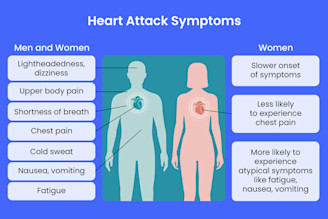
Despite the differences in severity, most heart attacks cause similar symptoms—though there are no hard and fast rules for what those symptoms will be. What you experience can vary and be influenced by your age, sex, and type of heart attack you have. Here are the ones to know about:
#### Sign up for our weekly Heart Health Newsletter.
Your [privacy](https://www.healthcentralcorp.com/privacy-policy%20) is important to us.

### Chest Pain (Angina)
For both men and women, the most common symptom of a heart attack is some type of discomfort in the chest. You may experience a crushing pain, like an elephant sitting on your chest. Or you may feel squeezing or the sensation of pressure in your chest.
People with coronary artery disease, a frequent precursor to heart attack, are likely already familiar with the on-again, off-again chest pain caused by limited blood and oxygen to the heart. Officially called angina, that pain often goes away with rest, and it doesn’t lead to permanent damage of your heart muscle.
During a heart attack, however, **rest does not ease the pain**. The pain may last for only a few minutes, or it may continue for much longer. (But please note: Heart attacks can occur without chest pain. In fact, up to nearly half of all people report no experience of angina. This is particularly true for people with [diabetes](https://www.healthcentral.com/condition/diabetes), who often have nerve damage and therefore may be less sensitive to this pain—and are therefore more at risk of having a silent heart attack.)
### Upper Body Pain
Whether or not you feel pain in your chest, you may experience discomfort elsewhere in your upper body, often in this order:
- In your left shoulder
- Radiating down your left arm
- In your neck, [jaw](https://www.healthcentral.com/article/jaw-pain-could-be-sign-of-serious-heart-condition), and back as well as eventually in your right shoulder and arm
This pain is not sharp but rather gives off an aching sensation of heaviness or even numbness. Why? The reasons are not fully understood, but it’s likely because of the way your brain and nerves are wired. When a heart attack occurs, your heart sends signals to the brain, which then sends out a message—pain!—to nearby parts of the body that have nerves connected to network that's in your heart.
### Shortness of Breath
This can come on suddenly, even while you’re at rest. Why? Because your arteries are blocked and your heart can’t get all of the oxygen it needs. Your heart also may not be able to pump enough blood through your lungs quickly enough to be oxygenated. Shortness of breath may also be caused when fluid backs up in the lungs (when your heart can't pump properly, that fluid has to go somewhere.) When this occurs, your breathing will become more difficult when lying down than when you sit up because of the way that the fluid collects in your lungs.
### Cold Sweat
This can occur if your blood pressure drops during a heart attack. Combined with chest discomfort, a reduced BP may trigger your nervous system to respond with a drenching sweat. Your skin also may become cold and clammy.
### Nausea and Vomiting
Doctors aren't exactly sure why this occurs, but it's possible that a heart attack stimulates your vagus nerve, which runs from the brain down through the chest and into the abdomen. An overstimulated vagus nerve can make you feel woozy.
### Lightheadedness or Dizziness
There are several possible reasons for these symptoms, including a drop in blood pressure, decreased blood flow to your brain due to the blockage causing your heart attack, [heart failure](https://www.healthcentral.com/condition/heart-failure) or damage to your heart’s valves that occur during a heart attack, and problems with your heart’s ability to maintain its proper rhythm.
### Fatigue
Reduced blood flow to the heart can lead to [fatigue](https://www.healthcentral.com/condition/heart-disease/fatigue-and-heart-disease) that may come on suddenly, or build and worsen over time. Despite the fatigue, you may have trouble sleeping because it's hard to sleep when you're in pain and struggling to breathe comfortably.
[What Does a Heart Attack Feel Like? Warning signs aren't always what you think. Here's what can happen during a heart attack.](https://www.healthcentral.com/webstories/heart-attack-feel-like/index.html)
Heart Attack in Women vs. Men
## Heart Attack Symptoms in Women vs. Men
For both men and women, the most common symptom of a heart attack will be chest pain—but women experience it far less frequently than men do. In fact, women are nearly 50% more likely to experience a heart attack *without* chest pain than their male counterparts.
That's because **men are more likely to have a sudden and complete, or near complete, blockage** of their arteries, called a **plaque eruption**. In these cases, there's usually a rupture in the plaque, which triggers a blood clot to form. That obstruction causes chest pain by quickly shutting off the heart’s oxygen supply.
**Women, on the other hand, tend to experience plaque erosion instead of rupture, which can cause clots to form more slowly.** These smaller clots also don't generally entirely interrupt blood flow either. The result? Women, especially those under 50, are less likely than men to have those very obvious and dramatic chest-clutching symptoms.
The causes of plaque erosion are not well understood, but they do seem to lead to what doctors call “atypical” symptoms. These include:
- Fatigue
- Nausea
- Vomiting
These symptoms may occur alongside chest pain, but you may experience them even if you have no chest pain at all.
Starting around age 65 to 70, women’s heart attacks—and, therefore, their heart attack symptoms—start to resemble those of men more closely. That’s likely because they no longer have the protective effect of estrogen, a hormone that women have in abundance prior to [menopause](https://www.healthcentral.com/condition/menopause) but which drops significantly during menopause. Experts believe that estrogen helps to explain why women, on average, have heart attacks about 10 years later than men.
Women’s often vague symptoms may come and go in the days, weeks, or even months before the heart attack finally occurs. This may help explain why more women than men die of heart attacks. Because these symptoms often don’t appear to present an immediate threat, women may not associate them with [heart disease](https://www.healthcentral.com/condition/heart-disease) or realize they’re harbingers of a heart attack.
The result: Women, on average, wait nearly 60 hours before seeking care. That’s four times longer than the average man waits.
Also, doctors may take longer to figure out that a woman’s shortness of breath, nausea, or other vague symptoms are signs a heart attack is underway. And in heart attack care, there’s a common refrain: Time is muscle, meaning that the faster treatment begins, the more heart muscle your medical team will be able to save.
Such differences between men and women don’t only have immediate consequences in the emergency room. According to the American Heart Association, women are also more likely to develop heart failure and have a [stroke](https://www.healthcentral.com/condition/stroke) within five years following their first heart attack.
The lesson here: **Atypical symptoms, even if they’re vague, require immediate attention**, particularly if [you have significant risks of a heart attack](https://www.healthcentral.com/condition/heart-attack-causes). Take these symptoms seriously and get them evaluated quickly.
But really the bottom line is always this: If you're worried you're having attack, even if you're not sure, don’t wait another moment: Call 911.
Heart Attack Signs and Symptoms
Frequently Asked Questions
How do I tell the difference between a panic attack and heart attack?
The two share some common symptoms, which may include chest pain, shortness of breath, sweating, and a racing heart. Symptoms usually last 20 to 30 minutes. Heart attack symptoms generally last longer and get worse over time. If you’re young and healthy and have had panic attacks previously, you likely are not having a heart attack. But if you’re not sure, play it safe and call 911.
There are so many symptoms! How can I be sure it’s a heart attack?
It’s your doctor’s job to be sure. It’s your job to get help. Don’t waste time trying to diagnose yourself, search the Internet, or explain away symptoms. Just get to the hospital (with someone else driving). Or call for an ambulance. Don’t delay.
What should I do while waiting for the ambulance?
It sounds impossible, but do your best to remain calm. This will help lower your blood pressure and heart rate, which in turn will reduce the stress on your already vulnerable heart.
If I go to the hospital with vague symptoms, how will they know it’s a heart attack?
Know your risk factors, and make sure the medical team knows you have them. Are you a smoker? Do you have diabetes? Are heart attacks and heart disease common in your family? Say something. Don’t wait for a doctor to ask you.
This article was originally published May 13, 2020 and most recently updated November 25, 2024.
© 2026 HealthCentral LLC. All rights reserved.
Sources
- **About Heart Attack (1):** Morrow, David Andrew, MD (editor). (2017). *Myocardial Infarction: A Companion to Braunwald's Heart Disease*. (textbook)
- **About Heart Attack (2):** Lilly, Leonard S. (2016): *Pathophysiology of Heart Disease*. (textbook) shop.lww.com/Pathophysiology-of-Heart-Disease/p/9781451192759
- **About Heart Attack (3):** American Heart Association. (2016). “About Heart Attack.” [heart.org/en/health-topics/heart-attack/about-heart-attacks](https://www.heart.org/en/health-topics/heart-attack/about-heart-attacks)
- **Heart Attack Symptoms (1):** Mayo Clinic. (2022). “Heart attack.” [mayoclinic.org/diseases-conditions/heart-attack/symptoms-causes/syc-20373106](https://www.mayoclinic.org/diseases-conditions/heart-attack/symptoms-causes/syc-20373106)
- **Heart Attack Symptoms (2):** *Merck Manual*. (2024). “Acute Coronary Syndromes (Heart Attack; Myocardial Infarction; Unstable Angina).” [merckmanuals.com/home/heart-and-blood-vessel-disorders/coronary-artery-disease/acute-coronary-syndromes-heart-attack-myocardial-infarction-unstable-angina](https://www.merckmanuals.com/home/heart-and-blood-vessel-disorders/coronary-artery-disease/acute-coronary-syndromes-heart-attack-myocardial-infarction-unstable-angina)
- **Prevalence of Silent Heart Attacks:** Centers for Disease Control. (2024). “Heart Disease Statistics.” https://www.cdc.gov/heart-disease/data-research/facts-stats/index.html\#:~:text=Coronary%20heart%20disease%20is%20the,3
- **Heart Attack Symptoms in Women (1):** *Circulation*. (2016). “Acute Myocardial Infarction in Women.” [ahajournals.org/doi/full/10.1161/CIR.0000000000000351](https://www.ahajournals.org/doi/full/10.1161/CIR.0000000000000351)
- **Heart Attack Symptoms in Women (2):** American Heart Association. (2022). Heart Attack Symptoms in Women. [heart.org/en/health-topics/heart-attack/warning-signs-of-a-heart-attack/heart-attack-symptoms-in-women](https://www.heart.org/en/health-topics/heart-attack/warning-signs-of-a-heart-attack/heart-attack-symptoms-in-women)
- **Heart Attack Symptoms in Women (3):** Harvard Medical School. (2016). “The heart attack gender gap.” [health.harvard.edu/heart-health/the-heart-attack-gender-gap](https://www.health.harvard.edu/heart-health/the-heart-attack-gender-gap)
Copy Link
Share
- [Share via 7fsqHFm9VqCEGWKzrMCC7C-facebook](https://www.facebook.com/sharer.php?u=https%3A%2F%2Fwww.healthcentral.com%2Fcondition%2Fheart-attack-signs-symptoms%3Fap%3Dsocs"e=Heart%20Attack%20Signs%20and%20Symptoms)
- [Share via 7fsqHFm9VqCEGWKzrMCC7C-pinterest](https://www.pinterest.com/pin/create/button/?description=undefined&media=&url=https%3A%2F%2Fwww.healthcentral.com%2Fcondition%2Fheart-attack-signs-symptoms%3Fap%3Dsocs)
- [Share via 7fsqHFm9VqCEGWKzrMCC7C-twitter](https://twitter.com/share?url=https%3A%2F%2Fwww.healthcentral.com%2Fcondition%2Fheart-attack-signs-symptoms%3Fap%3Dsocs&via=HealthCentral&text=Heart%20Attack%20Signs%20and%20Symptoms&hashtags=HealthCentral&related=healthcentral,health_tips,thebodydotcom,wellsphere)
- [Share via 7fsqHFm9VqCEGWKzrMCC7C-mail](mailto:?body=I%20saw%20this%20on%20HealthCentral%2C%20and%20thought%20you%20might%20want%20to%20see%20it%2C%20too%3A%0A%0AHeart%20Attack%20Signs%20and%20Symptoms%20%20%0A%20%20%0Ahttps%3A%2F%2Fwww.healthcentral.com%2Fcondition%2Fheart-attack-signs-symptoms%3Fap%3Dsocs%0A%20%20%0AAt%20HealthCentral%2C%20chronic%20meets%20community.%20We%E2%80%99re%20here%20to%20help%20you%20live%20your%20best%20life.%20Visit%20us%20and%20sign%20up%20for%20our%20free%20newsletter%20at%20HealthCentral.com.)
Print
[Our Review Process](https://www.healthcentral.com/medical-review-board)
[Yasmine S. Ali, M.D., Medical Reviewer:](https://www.healthcentral.com/author/yasmine-ali)
Yasmine S. Ali, M.D., is a cardiologist and medical writer based in Tennessee. She is President of LastSky Writing, LLC, and is Assistant Clinical Professor of Medicine at Vanderbilt University School of Medicine.

#### More Like This
[Heart Disease Is It Heartburn or a Heart Attack? Medically Reviewed](https://www.healthcentral.com/condition/heart-attack/heartburn-vs-heart-attack)
[Heart Attack Heart Attack Symptoms You Should Always Take Seriously Medically Reviewed](https://www.healthcentral.com/slideshow/heart-attack-symptoms-you-should-always-take-seriously)
[Heart Attack Is Jaw Pain Really a Symptom of Heart Attack? Medically Reviewed](https://www.healthcentral.com/article/jaw-pain-could-be-sign-of-serious-heart-condition)
[Heart Disease What Are the Symptoms of Heart Attack in Women? Medically Reviewed For Members](https://www.healthcentral.com/article/what-are-the-symptoms-of-heart-attack-in-women)

#### More Like This
[Heart Disease Is It Heartburn or a Heart Attack? Medically Reviewed](https://www.healthcentral.com/condition/heart-attack/heartburn-vs-heart-attack)
[Heart Attack Heart Attack Symptoms You Should Always Take Seriously Medically Reviewed](https://www.healthcentral.com/slideshow/heart-attack-symptoms-you-should-always-take-seriously)
[Heart Attack Is Jaw Pain Really a Symptom of Heart Attack? Medically Reviewed](https://www.healthcentral.com/article/jaw-pain-could-be-sign-of-serious-heart-condition)
[Heart Disease What Are the Symptoms of Heart Attack in Women? Medically Reviewed For Members](https://www.healthcentral.com/article/what-are-the-symptoms-of-heart-attack-in-women)
#### Emails That Keep You Healthy\!
[Newsletters](https://www.healthcentral.com/newsletter)
#### Follow Us\!
- [Share via footer-instagram](https://www.instagram.com/chronicillnessIRL)
- [Share via footer-facebook](https://www.facebook.com/HealthCentral/#?v=app_369284823108595)
- [Share via footer-pinterest](https://www.pinterest.com/HealthCentral)
- [Share via footer-youtube](https://www.youtube.com/user/HealthCentral)
##### About
- [About Us](https://www.healthcentral.com/about)
- [Contact Us](https://www.healthcentral.com/contact)
- [Editorial Policy](https://www.healthcentral.com/editorial-policy)
- [Medical Review Board](https://www.healthcentral.com/medical-review-board)
- [Something Original](https://www.healthcentralcorp.com/#lab)
- [Advertise With Us](https://www.healthcentralcorp.com/content/advertise-us)
- [Sitemap](https://www.healthcentral.com/sitemap)
- [Our Other Sites](https://www.healthcentralcorp.com/#brands)
##### Legal and Compliance
- [Advertising Policy](https://www.healthcentralcorp.com/advertising-policy)
- [Do Not Sell My Info](https://jupiter.healthcentral.com/preferences/)
- [Privacy Policy](https://www.healthcentralcorp.com/privacy-policy)
- [Terms of Use](https://www.healthcentralcorp.com/terms-of-use)
- [Community Guidelines](https://www.healthcentral.com/community-guidelines)
- [AACI-Accredited Trusted Medical Website](https://aacihealthcare.com/certificates/c335-2024-trust-us/)
© 2026 HealthCentral LLC. All rights reserved. Our website content is for educational purposes only. HealthCentral LLC does not provide personal medical advice, diagnosis, or treatment. [Read our Disclaimer](https://www.healthcentral.com/disclaimer)
Ask HealthCentral |
| Readable Markdown | - [Basics](https://www.healthcentral.com/condition/heart-attack-signs-symptoms#basics)
- [Types](https://www.healthcentral.com/condition/heart-attack-signs-symptoms#types)
- [Symptoms](https://www.healthcentral.com/condition/heart-attack-signs-symptoms#symptoms)
- [Heart Attack in Women vs. Men](https://www.healthcentral.com/condition/heart-attack-signs-symptoms#heart-attack-in-women-vs-men)
You don't need us to tell you that heart attacks are life-threatening health emergencies. What you may not know, though, is that spotting one isn't necessarily as easy as you might think. Heart attacks are complicated, and the symptoms can vary dramatically from person to person, and also [between men and women](https://www.healthcentral.com/condition/heart-attack/male-vs-female-heart-attack-symptoms). And sometimes certain symptoms, like nausea, may not seem all that serious at all. That's why it critical for every person to know all the signs and symptoms of heart attack so that if one occurs, you can get help as quickly as possible. Let’s take a look at the different ways your heart may tell you it’s in trouble.
Basics
## What Is a Heart Attack, Anyway?
First, a brief refresher course on your heart’s anatomy and what happens during an attack. Pumping oxygen- and nutrient-rich blood to every cell in your body is your heart's main job. As it does this, blood flows through a system of arteries, veins, and capillaries known as your blood vessels; your heart even has its own arteries, called the coronary arteries.
When all is working as it should, blood will flow unobstructed, and you’ll probably not give it a second thought. But things can go wrong. Your heart’s arteries can become clogged by plaque—a mix of cholesterol, fatty substances and other materials—that builds up during a process called [atherosclerosis](https://www.healthcentral.com/condition/atherosclerosis).
This eventually leads to [**coronary artery disease**](https://www.healthcentral.com/condition/coronary-artery-disease-cad) (CAD), a type of [heart disease](https://www.healthcentral.com/category/heart-disease) diagnosed in more than 80% of people who have a [heart attack](https://www.healthcentral.com/condition/heart-attack). One danger is that the plaque can rupture, or break apart. This causes your body’s self-defense system to form a protective clot around the damage. This does more harm than good. The clot blocks the flow of blood, which starves your heart of oxygen. When that happens, the cells in your heart begin to die. This is what's known as a heart attack, a potentially deadly medical emergency that accounts for roughly seven million emergency room visits in the U.S. each year.
Types
Technically, there is only one "kind" of heart attack—the kind that damages heart muscle. But this damage can occur in a number of different ways. They include:
- **Complete blockage.** An artery becomes completely blocked so that no blood can reach the heart. This is the far more dangerous type of heart attack, because permanent damage to the heart can develop quickly.
- **Partial blockage.** Nearly two-thirds of heart attacks are caused by a partial blockage of the artery. While the heart does receive some blood, it requires more than it’s getting. This type of attack will damage your heart, just not as quickly as one caused by a complete blockage.
- **Coronary artery spasms.** This is when your arteries spasm and dangerously narrow, causing a partial or complete blockage of the heart’s blood supply, which leads to heart attack. It’s not common, but it does sometimes happen, often with cocaine use.
Any one of these types of heart attacks can cause a range of symptoms, from chest pain to shortness of breath—or even cause no symptoms at all. These so-called [**silent heart attacks**](https://www.healthcentral.com/condition/heart-attack/silent-heart-attack) may seem like the ultimate oxymoron, but in fact about 20% of all heart attacks have either no obvious symptoms, or ones that are so mild and vague that they get brushed off as a strained chest muscle, the flu, or even a bad case of indigestion, according to the Centers for Disease Control (CDC). You won't know you've had a silent heart attack until you see your doc for a routine visit or for symptoms you didn't realize could be heart-related (more on these below).
Symptoms
## What Are the Symptoms of a Heart Attack?

Despite the differences in severity, most heart attacks cause similar symptoms—though there are no hard and fast rules for what those symptoms will be. What you experience can vary and be influenced by your age, sex, and type of heart attack you have. Here are the ones to know about:
### Chest Pain (Angina)
For both men and women, the most common symptom of a heart attack is some type of discomfort in the chest. You may experience a crushing pain, like an elephant sitting on your chest. Or you may feel squeezing or the sensation of pressure in your chest.
People with coronary artery disease, a frequent precursor to heart attack, are likely already familiar with the on-again, off-again chest pain caused by limited blood and oxygen to the heart. Officially called angina, that pain often goes away with rest, and it doesn’t lead to permanent damage of your heart muscle.
During a heart attack, however, **rest does not ease the pain**. The pain may last for only a few minutes, or it may continue for much longer. (But please note: Heart attacks can occur without chest pain. In fact, up to nearly half of all people report no experience of angina. This is particularly true for people with [diabetes](https://www.healthcentral.com/condition/diabetes), who often have nerve damage and therefore may be less sensitive to this pain—and are therefore more at risk of having a silent heart attack.)
### Upper Body Pain
Whether or not you feel pain in your chest, you may experience discomfort elsewhere in your upper body, often in this order:
- In your left shoulder
- Radiating down your left arm
- In your neck, [jaw](https://www.healthcentral.com/article/jaw-pain-could-be-sign-of-serious-heart-condition), and back as well as eventually in your right shoulder and arm
This pain is not sharp but rather gives off an aching sensation of heaviness or even numbness. Why? The reasons are not fully understood, but it’s likely because of the way your brain and nerves are wired. When a heart attack occurs, your heart sends signals to the brain, which then sends out a message—pain!—to nearby parts of the body that have nerves connected to network that's in your heart.
### Shortness of Breath
This can come on suddenly, even while you’re at rest. Why? Because your arteries are blocked and your heart can’t get all of the oxygen it needs. Your heart also may not be able to pump enough blood through your lungs quickly enough to be oxygenated. Shortness of breath may also be caused when fluid backs up in the lungs (when your heart can't pump properly, that fluid has to go somewhere.) When this occurs, your breathing will become more difficult when lying down than when you sit up because of the way that the fluid collects in your lungs.
### Cold Sweat
This can occur if your blood pressure drops during a heart attack. Combined with chest discomfort, a reduced BP may trigger your nervous system to respond with a drenching sweat. Your skin also may become cold and clammy.
### Nausea and Vomiting
Doctors aren't exactly sure why this occurs, but it's possible that a heart attack stimulates your vagus nerve, which runs from the brain down through the chest and into the abdomen. An overstimulated vagus nerve can make you feel woozy.
### Lightheadedness or Dizziness
There are several possible reasons for these symptoms, including a drop in blood pressure, decreased blood flow to your brain due to the blockage causing your heart attack, [heart failure](https://www.healthcentral.com/condition/heart-failure) or damage to your heart’s valves that occur during a heart attack, and problems with your heart’s ability to maintain its proper rhythm.
### Fatigue
Reduced blood flow to the heart can lead to [fatigue](https://www.healthcentral.com/condition/heart-disease/fatigue-and-heart-disease) that may come on suddenly, or build and worsen over time. Despite the fatigue, you may have trouble sleeping because it's hard to sleep when you're in pain and struggling to breathe comfortably.
Heart Attack in Women vs. Men
## Heart Attack Symptoms in Women vs. Men
For both men and women, the most common symptom of a heart attack will be chest pain—but women experience it far less frequently than men do. In fact, women are nearly 50% more likely to experience a heart attack *without* chest pain than their male counterparts.
That's because **men are more likely to have a sudden and complete, or near complete, blockage** of their arteries, called a **plaque eruption**. In these cases, there's usually a rupture in the plaque, which triggers a blood clot to form. That obstruction causes chest pain by quickly shutting off the heart’s oxygen supply.
**Women, on the other hand, tend to experience plaque erosion instead of rupture, which can cause clots to form more slowly.** These smaller clots also don't generally entirely interrupt blood flow either. The result? Women, especially those under 50, are less likely than men to have those very obvious and dramatic chest-clutching symptoms.
The causes of plaque erosion are not well understood, but they do seem to lead to what doctors call “atypical” symptoms. These include:
- Fatigue
- Nausea
- Vomiting
These symptoms may occur alongside chest pain, but you may experience them even if you have no chest pain at all.
Starting around age 65 to 70, women’s heart attacks—and, therefore, their heart attack symptoms—start to resemble those of men more closely. That’s likely because they no longer have the protective effect of estrogen, a hormone that women have in abundance prior to [menopause](https://www.healthcentral.com/condition/menopause) but which drops significantly during menopause. Experts believe that estrogen helps to explain why women, on average, have heart attacks about 10 years later than men.
Women’s often vague symptoms may come and go in the days, weeks, or even months before the heart attack finally occurs. This may help explain why more women than men die of heart attacks. Because these symptoms often don’t appear to present an immediate threat, women may not associate them with [heart disease](https://www.healthcentral.com/condition/heart-disease) or realize they’re harbingers of a heart attack.
The result: Women, on average, wait nearly 60 hours before seeking care. That’s four times longer than the average man waits.
Also, doctors may take longer to figure out that a woman’s shortness of breath, nausea, or other vague symptoms are signs a heart attack is underway. And in heart attack care, there’s a common refrain: Time is muscle, meaning that the faster treatment begins, the more heart muscle your medical team will be able to save.
Such differences between men and women don’t only have immediate consequences in the emergency room. According to the American Heart Association, women are also more likely to develop heart failure and have a [stroke](https://www.healthcentral.com/condition/stroke) within five years following their first heart attack.
The lesson here: **Atypical symptoms, even if they’re vague, require immediate attention**, particularly if [you have significant risks of a heart attack](https://www.healthcentral.com/condition/heart-attack-causes). Take these symptoms seriously and get them evaluated quickly.
But really the bottom line is always this: If you're worried you're having attack, even if you're not sure, don’t wait another moment: Call 911.
The two share some common symptoms, which may include chest pain, shortness of breath, sweating, and a racing heart. Symptoms usually last 20 to 30 minutes. Heart attack symptoms generally last longer and get worse over time. If you’re young and healthy and have had panic attacks previously, you likely are not having a heart attack. But if you’re not sure, play it safe and call 911.
This article was originally published May 13, 2020 and most recently updated November 25, 2024.
© 2026 HealthCentral LLC. All rights reserved. |
| Shard | 58 (laksa) |
| Root Hash | 12870066951298225258 |
| Unparsed URL | com,healthcentral!www,/condition/heart-attack-signs-symptoms s443 |