ℹ️ Skipped - page is already crawled
| Filter | Status | Condition | Details |
|---|---|---|---|
| HTTP status | PASS | download_http_code = 200 | HTTP 200 |
| Age cutoff | PASS | download_stamp > now() - 6 MONTH | 0.8 months ago |
| History drop | PASS | isNull(history_drop_reason) | No drop reason |
| Spam/ban | PASS | fh_dont_index != 1 AND ml_spam_score = 0 | ml_spam_score=0 |
| Canonical | PASS | meta_canonical IS NULL OR = '' OR = src_unparsed | Not set |
| Property | Value | |||||||||
|---|---|---|---|---|---|---|---|---|---|---|
| URL | https://www.health.harvard.edu/mind-and-mood/overcoming-anxiety | |||||||||
| Last Crawled | 2026-04-01 21:42:49 (24 days ago) | |||||||||
| First Indexed | 2018-04-22 10:16:35 (8 years ago) | |||||||||
| HTTP Status Code | 200 | |||||||||
| Content | ||||||||||
| Meta Title | Overcoming anxiety - Harvard Health | |||||||||
| Meta Description | Idleness in retirement, financial worries, and health issues are the leading causes of anxiety among older men. However, the condition is highly treatable with therapy, medication, and simple lifestyle changes. | |||||||||
| Meta Canonical | null | |||||||||
| Boilerpipe Text | The condition tends to strike many older adults, but there are ways to counter its paralyzing effects.
More and more, do you find yourself fighting feelings of worry? Do you feel increasingly anxious and tense? Do you obsess about things that may or may not happen? If so, you may be one of the millions who suffer from anxiety.
Anxiety can develop from many uncontrollable factors, such as genetics, personality, and life events, but the main issue for many older men is that they have too much time on their hands, according to Dr. Cornelia Cremens, a psychiatrist with Harvard-affiliated Massachusetts General Hospital.
"Men are used to working, being active, and having goals they want to accomplish. It keeps their body and mind engaged," she says.
"But when they retire and life slows down, they are not prepared for that kind of dramatic shift. This idleness can trigger anxiety because they feel they have lost their purpose and focus."
How anxiety affects you
Other life-changing events also can increase anxiety, such as financial stress, health issues like heart attacks or injuries that affect mobility, or the death of a spouse or friend. Sometimes certain situations, like large social settings or noisy or unfamiliar environments, can cause anxiety.
You might also be interested in...
If you suffer from symptoms of an anxiety disorder, there is hope. The field of anxiety treatment continues to evolve. You don't have to just "live with it" anymore.
Anxiety and Stress Disorders, a Special Health Report from Harvard Medical School, reveals today's most effective treatments—including natural approaches, evidence-based therapies, and medications that work differently than older drugs.
You deserve to live without constant worry and fear. Take control of your anxiety and order Anxiety and Stress Disorders today!
Learn More
"Anxiety is highly treatable, but men may not want to talk about it and feel they can take care of the problem themselves," says Dr. Cremens. "But men should not take their situation lightly, as anxiety can have a lasting impact on their life."
People with anxiety can have an array of symptoms that may linger off and on for days, weeks, or even months. You may experience one of more of the following:
restlessness
being easily fatigued
trouble concentrating
irritability
difficulty falling or staying asleep.
Anxiety also can trigger panic attacks, marked by a rapid heart rate, excessive sweating, and trouble breathing. The symptoms often subside after a while or if you remove yourself from the stressful environment or situation. Anxiety can make it harder to maintain a healthy lifestyle, too. You may be less motivated to exercise and more likely to increase your intake of high-fat and high-sugar foods and alcohol.
Treatments and therapies
Consult with your doctor if you have any of the trademark signs and symptoms. He or she can diagnose anxiety and whether it may be related to a health problem. Otherwise, there are many treatment options, such as cognitive behavioral therapy (CBT), medication, or a combination of both.
You may be interested in...
Depression is more than a passing bout of sadness or dejection, or feeling down in the dumps. It can leave you feeling continuously burdened and can sap the joy out of once-pleasurable activities. In Understanding Depression, find out how effective treatment can lighten your mood, strengthen your connections with loved ones, allow you to find satisfaction in interests and hobbies, and make you feel more like yourself again.
Learn More
CBT helps identify and then neutralize thoughts that may trigger anxiety. Medication often relieves symptoms. The most common choices are antidepressants, anti-anxiety drugs, and beta blockers.
The common antidepressants for anxiety are selective serotonin reuptake inhibitors (SSRIs), such as fluoxetine (Prozac), sertraline (Zoloft), and paroxetine (Paxil). However, antidepressants can take several weeks to work and can actually worsen anxiety in the first few weeks of use, according to a study published online Aug. 24, 2016, by Nature.
Beta blockers, such as atenolol (Tenormin) and propranolol (Inderal), can control rapid heartbeat, shaking, and trembling in anxious situations.
Short-term use of benzodiazepines like lorazepam (Ativan) and clonazepam (Klonopin) help reduce the symptoms of extreme fear and worry and can be a bridge to longer term therapy. The FDA requires all benzodiazepines to carry the strongest warning regarding the risks of dependency, addiction, or withdrawal symptoms. The FDA also emphasized the importance of not combining a benzodiazepine drug with an opioid because it can stop a person's breathing.
Consult with your doctor about whether any of these medications may be right for you.
You may be interested in...
Now you can tap into advice from Harvard Medical School experts to uncover how your brain changes as you age and discover the best ways to keep your mind and memory strong.
Improving Memory is a fascinating look at how your mind works, paired with the best ways to protect your memory. You’ll discover:
Steps you can take now to reduce your risk of dementia, the normal limitation of short-term memory that has nothing to do with memory loss, why aging isn’t always the culprit behind memory loss, 9 key differences between normal memory lapses and signs of dementia, 17 ways to improve memory and protect your brain, and more!
LEARN MORE
What else you can do
You can further manage anxiety through lifestyle changes. Here are some suggestions from Dr. Cornelia Cremens:
Set up daily goals to accomplish.
"Men are so goal-oriented that when tasks are done they are anxious about what to do next." Daily goals can be as simple as doing a household chore or calling a friend. "Write it down and cross it off when completed. This can keep your mind satisfied."
Get out there.
Make an effort to interact with people on at least a weekly basis. Volunteer for a cause, join a social club or athletic league, or learn a new sport or skill.
Address financial concerns.
If your anxiety centers on money worries like outliving your retirement funds, see a financial planner to organize your expenses and plan for the future. "Having a strategy in place can help men feel more comfortable as well as address any concerns."
Do more relaxation activities.
Incorporate mind-body training like yoga, qigong, and meditation. "Anything that slows your body and mind can help manage anxiety and keep it from building up."
Image: gpointstudio/Getty Images | |||||||||
| Markdown | 
[Skip to main content](https://www.health.harvard.edu/mind-and-mood/overcoming-anxiety#main-content)
[Harvard Health Publishing ](https://www.health.harvard.edu/)
[Harvard Health Publishing](https://www.health.harvard.edu/)
[HarvardHealthOnline+](https://www.health.harvard.edu/hho-plus?utm_source=site&utm_medium=web&utm_campaign=top_button)
Search
[Customer Service](https://www.health.harvard.edu/customer-service) [Content Licensing](https://www.health.harvard.edu/licensing) [About Us](https://www.health.harvard.edu/about-us)
[Log In](https://www.health.harvard.edu/login)
Open mobile menu
[Free HealthBeat Signup](https://www.health.harvard.edu/healthbeat)
Shop
[Subscriptions](https://www.health.harvard.edu/subscribe) [Special Health Reports](https://www.health.harvard.edu/special-health-reports) [Online Courses](https://www.harvardhealthonlinelearning.com/catalog)
[Pay Subscription Bill](https://www.health.harvard.edu/pay-bill)
[Common Conditions](https://www.health.harvard.edu/category/common-conditions) [Staying Healthy](https://www.health.harvard.edu/category/staying-healthy) [Resources](https://www.health.harvard.edu/resources) [Blog](https://www.health.harvard.edu/blog) [COVID-19 Updates](https://www.health.harvard.edu/diseases-and-conditions/coronavirus-resource-center)
Close menu
[HarvardHealthOnline+](https://www.health.harvard.edu/hho-plus?utm_source=site&utm_medium=web&utm_campaign=mobile_button)
## Main Content
- [Common Conditions](https://www.health.harvard.edu/category/common-conditions)
- [Staying Healthy](https://www.health.harvard.edu/category/staying-healthy)
- [Resources](https://www.health.harvard.edu/resources)
- [Blog](https://www.health.harvard.edu/blog)
## Helpful Links
- [Customer Service](https://www.health.harvard.edu/customer-service)
- [About Us](https://www.health.harvard.edu/about-us)
- [Content Licensing](https://www.health.harvard.edu/licensing)
- [Free Healthbeat Signup](https://www.health.harvard.edu/healthbeat)
- [Subscriptions](https://www.health.harvard.edu/subscribe)
- [Special Health Reports](https://www.health.harvard.edu/special-health-reports)
- [Online Courses](https://www.harvardhealthonlinelearning.com/)
- [Pay Subscription Bill](https://www.health.harvard.edu/pay-bill)
Close
Recent Articles
[ Understanding food noise - and how to turn down the volume](https://www.health.harvard.edu/diet-and-nutrition/understanding-food-noise-and-how-to-turn-down-the-volume)
[ Remedies for motion sickness: What works?](https://www.health.harvard.edu/preventive-care/remedies-for-motion-sickness-what-works)
[ 4 keys to a heart-healthy diet](https://www.health.harvard.edu/heart-health/4-keys-to-a-heart-healthy-diet)
[ Understanding exercise heart rate zones](https://www.health.harvard.edu/exercise-and-fitness/understanding-exercise-heart-rate-zones)
[ Resistant starch: Can you make the carbs you eat a little healthier?](https://www.health.harvard.edu/diet-and-nutrition/resistant-starch-can-you-make-the-carbs-you-eat-a-little-healthier)
[ Harvard study: A couple of daily cups of coffee or tea linked to lower dementia risk](https://www.health.harvard.edu/diet-and-nutrition/harvard-study-a-couple-of-daily-cups-of-coffee-or-tea-linked-to-lower-dementia-risk)
[ Does everyone benefit from cutting saturated fat in their diet?](https://www.health.harvard.edu/heart-health/does-everyone-benefit-from-cutting-saturated-fat-in-their-diet)
[ How to treat shoulder impingement](https://www.health.harvard.edu/bones-and-joints/how-to-treat-shoulder-impingement)
[ Beyond protein: 6 other nutrients that help prevent muscle loss](https://www.health.harvard.edu/diet-and-nutrition/beyond-protein-6-other-nutrients-that-help-prevent-muscle-loss)
[ Advancements in knee replacement: More precise and personalized](https://www.health.harvard.edu/bones-and-joints/advancements-in-knee-replacement-more-precise-and-personalized)
1 / 10
[Mind & Mood](https://www.health.harvard.edu/topics/mind-and-mood)
# Overcoming anxiety
September 27, 2020
Share
[Share this page to Facebook](https://www.facebook.com/sharer/sharer.php?u=https%3A%2F%2Fwww.health.harvard.edu%2Fmind-and-mood%2Fovercoming-anxiety&display=popup)
[Share this page to X](https://twitter.com/intent/tweet?original_referer=https%3A%2F%2Fwww.health.harvard.edu%2Fmind-and-mood%2Fovercoming-anxiety&text=Overcoming%20anxiety%20-%20Harvard%20Health&tw_p=tweetbutton&url=https%3A%2F%2Fwww.health.harvard.edu%2Fmind-and-mood%2Fovercoming-anxiety)
[Share this page via Email](<mailto:?subject=Great health news for you from the experts at Harvard&body=Check out this link from Harvard Health: Overcoming anxiety - https://www.health.harvard.edu/mind-and-mood/overcoming-anxiety>)
Copy this page to clipboard
Print This Page
Click to Print
## *The condition tends to strike many older adults, but there are ways to counter its paralyzing effects.*

More and more, do you find yourself fighting feelings of worry? Do you feel increasingly anxious and tense? Do you obsess about things that may or may not happen? If so, you may be one of the millions who suffer from anxiety.
Anxiety can develop from many uncontrollable factors, such as genetics, personality, and life events, but the main issue for many older men is that they have too much time on their hands, according to Dr. Cornelia Cremens, a psychiatrist with Harvard-affiliated Massachusetts General Hospital.
"Men are used to working, being active, and having goals they want to accomplish. It keeps their body and mind engaged," she says.
"But when they retire and life slows down, they are not prepared for that kind of dramatic shift. This idleness can trigger anxiety because they feel they have lost their purpose and focus."
### How anxiety affects you
Other life-changing events also can increase anxiety, such as financial stress, health issues like heart attacks or injuries that affect mobility, or the death of a spouse or friend. Sometimes certain situations, like large social settings or noisy or unfamiliar environments, can cause anxiety.
You might also be interested in...
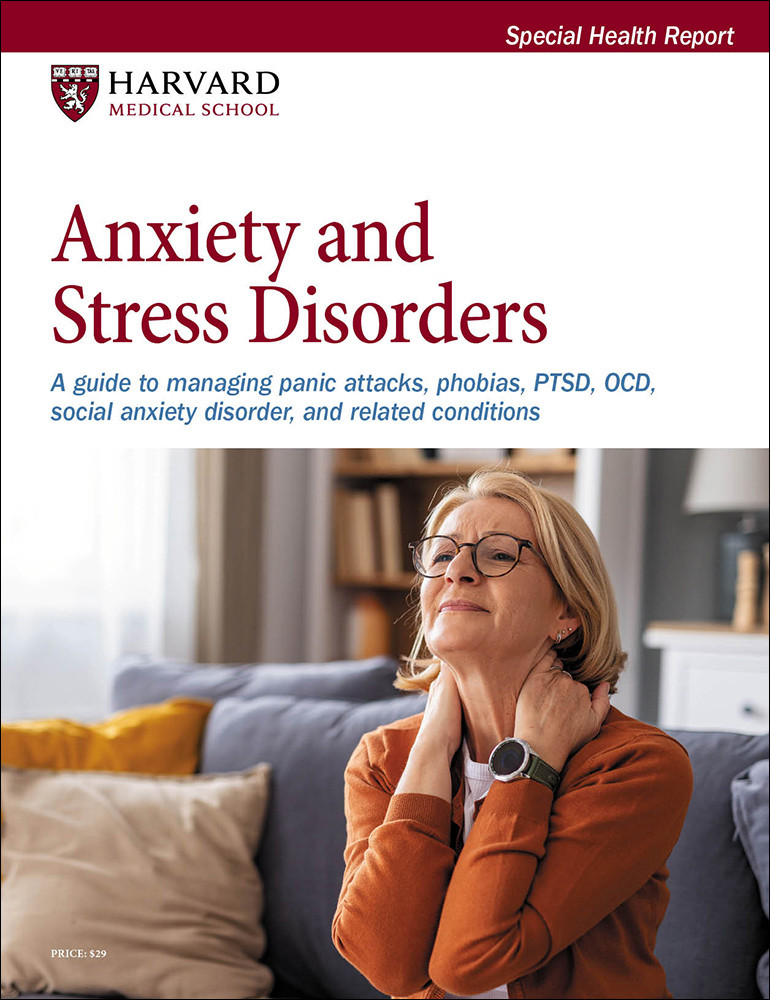
## Anxiety and Stress Disorders: A guide to managing panic attacks, phobias, PTSD, OCD, social anxiety disorder, and related conditions
If you suffer from symptoms of an anxiety disorder, there is hope. The field of anxiety treatment continues to evolve. You don't have to just "live with it" anymore. Anxiety and Stress Disorders, a Special Health Report from Harvard Medical School, reveals today's most effective treatments—including natural approaches, evidence-based therapies, and medications that work differently than older drugs. You deserve to live without constant worry and fear. Take control of your anxiety and order Anxiety and Stress Disorders today\!
[Learn More](https://servedbyadbutler.com/redirect.spark?MID=186626&plid=2650436&setID=812675&channelID=0&CID=862911&banID=524410391&PID=0&textadID=0&tc=1&rnd=5600504072&scheduleID=3723386&adSize=0x0&matches=%5B%22anxiety%22%5D&mt=1775079770797565&spr=1&referrer=https%3A%2F%2Fwww.health.harvard.edu%2Fmind-and-mood%2Fovercoming-anxiety&request_uuid=d0294aad-e0c8-4054-a688-f8deead746a7&hc=684190a4a52362b044042adc794164e14b2d40e7&location=)
"Anxiety is highly treatable, but men may not want to talk about it and feel they can take care of the problem themselves," says Dr. Cremens. "But men should not take their situation lightly, as anxiety can have a lasting impact on their life."
People with anxiety can have an array of symptoms that may linger off and on for days, weeks, or even months. You may experience one of more of the following:
- restlessness
- being easily fatigued
- trouble concentrating
- irritability
- difficulty falling or staying asleep.
Anxiety also can trigger panic attacks, marked by a rapid heart rate, excessive sweating, and trouble breathing. The symptoms often subside after a while or if you remove yourself from the stressful environment or situation. Anxiety can make it harder to maintain a healthy lifestyle, too. You may be less motivated to exercise and more likely to increase your intake of high-fat and high-sugar foods and alcohol.
### Treatments and therapies
Consult with your doctor if you have any of the trademark signs and symptoms. He or she can diagnose anxiety and whether it may be related to a health problem. Otherwise, there are many treatment options, such as cognitive behavioral therapy (CBT), medication, or a combination of both.
You may be interested in...

## Understanding Depression
Depression is more than a passing bout of sadness or dejection, or feeling down in the dumps. It can leave you feeling continuously burdened and can sap the joy out of once-pleasurable activities. In Understanding Depression, find out how effective treatment can lighten your mood, strengthen your connections with loved ones, allow you to find satisfaction in interests and hobbies, and make you feel more like yourself again.
[Learn More](https://servedbyadbutler.com/redirect.spark?MID=186626&plid=2650436&setID=812675&channelID=0&CID=862911&banID=523844620&PID=0&textadID=0&tc=1&rnd=5600504072&scheduleID=3357412&adSize=0x0&matches=%5B%22anxiety%22%5D&mt=1775079770797762&spr=1&referrer=https%3A%2F%2Fwww.health.harvard.edu%2Fmind-and-mood%2Fovercoming-anxiety&request_uuid=d0294aad-e0c8-4054-a688-f8deead746a7&hc=c7184b7460df939bf3b0451b5f2e55d584b2b1ee&location=)
CBT helps identify and then neutralize thoughts that may trigger anxiety. Medication often relieves symptoms. The most common choices are antidepressants, anti-anxiety drugs, and beta blockers.
The common antidepressants for anxiety are selective serotonin reuptake inhibitors (SSRIs), such as fluoxetine (Prozac), sertraline (Zoloft), and paroxetine (Paxil). However, antidepressants can take several weeks to work and can actually worsen anxiety in the first few weeks of use, according to a study published online Aug. 24, 2016, by Nature.
Beta blockers, such as atenolol (Tenormin) and propranolol (Inderal), can control rapid heartbeat, shaking, and trembling in anxious situations.
Short-term use of benzodiazepines like lorazepam (Ativan) and clonazepam (Klonopin) help reduce the symptoms of extreme fear and worry and can be a bridge to longer term therapy. The FDA requires all benzodiazepines to carry the strongest warning regarding the risks of dependency, addiction, or withdrawal symptoms. The FDA also emphasized the importance of not combining a benzodiazepine drug with an opioid because it can stop a person's breathing.
Consult with your doctor about whether any of these medications may be right for you.
You may be interested in...

## Improving Memory
Now you can tap into advice from Harvard Medical School experts to uncover how your brain changes as you age and discover the best ways to keep your mind and memory strong. Improving Memory is a fascinating look at how your mind works, paired with the best ways to protect your memory. You’ll discover: Steps you can take now to reduce your risk of dementia, the normal limitation of short-term memory that has nothing to do with memory loss, why aging isn’t always the culprit behind memory loss, 9 key differences between normal memory lapses and signs of dementia, 17 ways to improve memory and protect your brain, and more\!
[LEARN MORE](https://servedbyadbutler.com/redirect.spark?MID=186626&plid=2650436&setID=812675&channelID=0&CID=862911&banID=524387919&PID=0&textadID=0&tc=1&rnd=5600504072&scheduleID=3708161&adSize=0x0&matches=%5B%22mind%22%5D&mt=1775079770797907&spr=1&referrer=https%3A%2F%2Fwww.health.harvard.edu%2Fmind-and-mood%2Fovercoming-anxiety&request_uuid=d0294aad-e0c8-4054-a688-f8deead746a7&hc=e5d6df2c404ad201185d7bafd238c0baa70dadb0&location=)
| |
|---|
| **What else you can do** You can further manage anxiety through lifestyle changes. Here are some suggestions from Dr. Cornelia Cremens: **Set up daily goals to accomplish.** "Men are so goal-oriented that when tasks are done they are anxious about what to do next." Daily goals can be as simple as doing a household chore or calling a friend. "Write it down and cross it off when completed. This can keep your mind satisfied." **Get out there.** Make an effort to interact with people on at least a weekly basis. Volunteer for a cause, join a social club or athletic league, or learn a new sport or skill. **Address financial concerns.** If your anxiety centers on money worries like outliving your retirement funds, see a financial planner to organize your expenses and plan for the future. "Having a strategy in place can help men feel more comfortable as well as address any concerns." **Do more relaxation activities.** Incorporate mind-body training like yoga, qigong, and meditation. "Anything that slows your body and mind can help manage anxiety and keep it from building up." |
**Image: gpointstudio/Getty Images**
Share
[Share this page to Facebook](https://www.facebook.com/sharer/sharer.php?u=https%3A%2F%2Fwww.health.harvard.edu%2Fmind-and-mood%2Fovercoming-anxiety&display=popup)
[Share this page to X](https://twitter.com/intent/tweet?original_referer=https%3A%2F%2Fwww.health.harvard.edu%2Fmind-and-mood%2Fovercoming-anxiety&text=Overcoming%20anxiety%20-%20Harvard%20Health&tw_p=tweetbutton&url=https%3A%2F%2Fwww.health.harvard.edu%2Fmind-and-mood%2Fovercoming-anxiety)
[Share this page via Email](<mailto:?subject=Great health news for you from the experts at Harvard&body=Check out this link from Harvard Health: Overcoming anxiety - https://www.health.harvard.edu/mind-and-mood/overcoming-anxiety>)
Copy this page to clipboard
Print This Page
Click to Print
## Disclaimer:
As a service to our readers, Harvard Health Publishing provides access to our library of archived content. Please note the date of last review or update on all articles.
No content on this site, regardless of date, should ever be used as a substitute for direct medical advice from your doctor or other qualified clinician.
Recent Articles
[ Understanding food noise - and how to turn down the volume](https://www.health.harvard.edu/diet-and-nutrition/understanding-food-noise-and-how-to-turn-down-the-volume)
[ Remedies for motion sickness: What works?](https://www.health.harvard.edu/preventive-care/remedies-for-motion-sickness-what-works)
[ 4 keys to a heart-healthy diet](https://www.health.harvard.edu/heart-health/4-keys-to-a-heart-healthy-diet)
[ Understanding exercise heart rate zones](https://www.health.harvard.edu/exercise-and-fitness/understanding-exercise-heart-rate-zones)
[ Resistant starch: Can you make the carbs you eat a little healthier?](https://www.health.harvard.edu/diet-and-nutrition/resistant-starch-can-you-make-the-carbs-you-eat-a-little-healthier)
[ Harvard study: A couple of daily cups of coffee or tea linked to lower dementia risk](https://www.health.harvard.edu/diet-and-nutrition/harvard-study-a-couple-of-daily-cups-of-coffee-or-tea-linked-to-lower-dementia-risk)
[ Does everyone benefit from cutting saturated fat in their diet?](https://www.health.harvard.edu/heart-health/does-everyone-benefit-from-cutting-saturated-fat-in-their-diet)
[ How to treat shoulder impingement](https://www.health.harvard.edu/bones-and-joints/how-to-treat-shoulder-impingement)
[ Beyond protein: 6 other nutrients that help prevent muscle loss](https://www.health.harvard.edu/diet-and-nutrition/beyond-protein-6-other-nutrients-that-help-prevent-muscle-loss)
[ Advancements in knee replacement: More precise and personalized](https://www.health.harvard.edu/bones-and-joints/advancements-in-knee-replacement-more-precise-and-personalized)
1 / 10
## Related Topics
[ Heart Health Psychological distress common in heart attack survivors](https://www.health.harvard.edu/heart-health/psychological-distress-common-in-heart-attack-survivors)
[ Mind & Mood Advancing age and mental health disorders](https://www.health.harvard.edu/mind-and-mood/advancing-age-and-mental-health-disorders)
[ Pain Sleeping better when you have pain](https://www.health.harvard.edu/pain/sleeping-better-when-you-have-pain)
[Anxiety](https://www.health.harvard.edu/topics/anxiety) [Men's Health](https://www.health.harvard.edu/topics/mens-health)
## Free Healthbeat Signup
Get the latest in health news delivered to your inbox\!
[Sign Up](https://www.health.harvard.edu/healthbeat)
## Footer
[Harvard Health Publishing ](https://www.health.harvard.edu/)
[Facebook](https://www.facebook.com/HarvardHealthPublications)
[X (formerly known as Twitter)](https://x.com/harvardhealth)
[Linkedin](https://www.linkedin.com/company/harvard-health-publications/)
[YouTube](https://www.youtube.com/channel/UC-jj29vMMB1ulz_uEU5kUrA)
### My Account
- [Customer Service](https://www.health.harvard.edu/customer-service)
- [Log in](https://www.health.harvard.edu/login)
### Order Now
- [Online Learning Courses](https://www.harvardhealthonlinelearning.com/)
- [Digital Subscriptions](https://www.health.harvard.edu/subscribe)
- [Special Health Reports](https://www.health.harvard.edu/special-health-reports)
- [Print Subscriptions](https://www.health.harvard.edu/newsletters)
### More
- [About Us](https://www.health.harvard.edu/about-us)
- [Permissions](https://www.health.harvard.edu/permissions)
- [Content Licensing](https://www.health.harvard.edu/licensing)
- [Topics](https://www.health.harvard.edu/topics)
- [Trademark Notice](https://trademark.harvard.edu/pages/trademark-notice)
© 2026 [Harvard Health Publishing®](https://trademark.harvard.edu/pages/trademark-notice) of The President and Fellows of Harvard College
[Do not sell my personal information](https://www.health.harvard.edu/privacy-policy#california-residents) \| [Privacy Policy and Terms of Use](https://www.health.harvard.edu/privacy-policy)
[Scroll To Top](https://www.health.harvard.edu/mind-and-mood/overcoming-anxiety#app)
Close

Thanks for visiting. Don't miss your FREE gift.
Don’t miss out on your 25% off promo code and BONUS GIFT worth \$29.95.
Sign up to get tips for living a healthy lifestyle, with ways to lessen **digestion** problems…keep **inflammation** under control…learn simple exercises to improve your **balance**…understand your options for **cataract** treatment…all delivered to your email box FREE.
Close
## Receive 25% off your first purchase and a FREE BONUS Gift just for signing up for HEALTHbeat\!

Sign up for HEALTHBeat and receive trusted health information delivered right to your inbox.
As a way of introducing you to the expertise of Harvard Medical School, enjoy 25% off our health special reports, online courses, and more. And as a bonus, also receive a FREE GIFT worth \$14.95\!.
No purchase necessary. Just enter your email address and click the red button. You’ll receive a confirmation email from us along with a link to your 25% coupon and your bonus gift.
Close

Stay on top of latest health news from Harvard Medical School.
Plus get a FREE on-line course **Inflammation and Diet: How food can lower disease risk**. No purchase necessary.
Close

Stay on top of latest health news from Harvard Medical School.
Plus get a FREE on-line course **Inflammation and Diet: How food can lower disease risk**. No purchase necessary.
 | |||||||||
| Readable Markdown | ## *The condition tends to strike many older adults, but there are ways to counter its paralyzing effects.*

More and more, do you find yourself fighting feelings of worry? Do you feel increasingly anxious and tense? Do you obsess about things that may or may not happen? If so, you may be one of the millions who suffer from anxiety.
Anxiety can develop from many uncontrollable factors, such as genetics, personality, and life events, but the main issue for many older men is that they have too much time on their hands, according to Dr. Cornelia Cremens, a psychiatrist with Harvard-affiliated Massachusetts General Hospital.
"Men are used to working, being active, and having goals they want to accomplish. It keeps their body and mind engaged," she says.
"But when they retire and life slows down, they are not prepared for that kind of dramatic shift. This idleness can trigger anxiety because they feel they have lost their purpose and focus."
### How anxiety affects you
Other life-changing events also can increase anxiety, such as financial stress, health issues like heart attacks or injuries that affect mobility, or the death of a spouse or friend. Sometimes certain situations, like large social settings or noisy or unfamiliar environments, can cause anxiety.
You might also be interested in...

If you suffer from symptoms of an anxiety disorder, there is hope. The field of anxiety treatment continues to evolve. You don't have to just "live with it" anymore. Anxiety and Stress Disorders, a Special Health Report from Harvard Medical School, reveals today's most effective treatments—including natural approaches, evidence-based therapies, and medications that work differently than older drugs. You deserve to live without constant worry and fear. Take control of your anxiety and order Anxiety and Stress Disorders today\!
[Learn More](https://servedbyadbutler.com/redirect.spark?MID=186626&plid=2650436&setID=812675&channelID=0&CID=862911&banID=524410391&PID=0&textadID=0&tc=1&rnd=5600504072&scheduleID=3723386&adSize=0x0&matches=%5B%22anxiety%22%5D&mt=1775079770797565&spr=1&referrer=https%3A%2F%2Fwww.health.harvard.edu%2Fmind-and-mood%2Fovercoming-anxiety&request_uuid=d0294aad-e0c8-4054-a688-f8deead746a7&hc=684190a4a52362b044042adc794164e14b2d40e7&location=)
"Anxiety is highly treatable, but men may not want to talk about it and feel they can take care of the problem themselves," says Dr. Cremens. "But men should not take their situation lightly, as anxiety can have a lasting impact on their life."
People with anxiety can have an array of symptoms that may linger off and on for days, weeks, or even months. You may experience one of more of the following:
- restlessness
- being easily fatigued
- trouble concentrating
- irritability
- difficulty falling or staying asleep.
Anxiety also can trigger panic attacks, marked by a rapid heart rate, excessive sweating, and trouble breathing. The symptoms often subside after a while or if you remove yourself from the stressful environment or situation. Anxiety can make it harder to maintain a healthy lifestyle, too. You may be less motivated to exercise and more likely to increase your intake of high-fat and high-sugar foods and alcohol.
### Treatments and therapies
Consult with your doctor if you have any of the trademark signs and symptoms. He or she can diagnose anxiety and whether it may be related to a health problem. Otherwise, there are many treatment options, such as cognitive behavioral therapy (CBT), medication, or a combination of both.
You may be interested in...

Depression is more than a passing bout of sadness or dejection, or feeling down in the dumps. It can leave you feeling continuously burdened and can sap the joy out of once-pleasurable activities. In Understanding Depression, find out how effective treatment can lighten your mood, strengthen your connections with loved ones, allow you to find satisfaction in interests and hobbies, and make you feel more like yourself again.
[Learn More](https://servedbyadbutler.com/redirect.spark?MID=186626&plid=2650436&setID=812675&channelID=0&CID=862911&banID=523844620&PID=0&textadID=0&tc=1&rnd=5600504072&scheduleID=3357412&adSize=0x0&matches=%5B%22anxiety%22%5D&mt=1775079770797762&spr=1&referrer=https%3A%2F%2Fwww.health.harvard.edu%2Fmind-and-mood%2Fovercoming-anxiety&request_uuid=d0294aad-e0c8-4054-a688-f8deead746a7&hc=c7184b7460df939bf3b0451b5f2e55d584b2b1ee&location=)
CBT helps identify and then neutralize thoughts that may trigger anxiety. Medication often relieves symptoms. The most common choices are antidepressants, anti-anxiety drugs, and beta blockers.
The common antidepressants for anxiety are selective serotonin reuptake inhibitors (SSRIs), such as fluoxetine (Prozac), sertraline (Zoloft), and paroxetine (Paxil). However, antidepressants can take several weeks to work and can actually worsen anxiety in the first few weeks of use, according to a study published online Aug. 24, 2016, by Nature.
Beta blockers, such as atenolol (Tenormin) and propranolol (Inderal), can control rapid heartbeat, shaking, and trembling in anxious situations.
Short-term use of benzodiazepines like lorazepam (Ativan) and clonazepam (Klonopin) help reduce the symptoms of extreme fear and worry and can be a bridge to longer term therapy. The FDA requires all benzodiazepines to carry the strongest warning regarding the risks of dependency, addiction, or withdrawal symptoms. The FDA also emphasized the importance of not combining a benzodiazepine drug with an opioid because it can stop a person's breathing.
Consult with your doctor about whether any of these medications may be right for you.
You may be interested in...

Now you can tap into advice from Harvard Medical School experts to uncover how your brain changes as you age and discover the best ways to keep your mind and memory strong. Improving Memory is a fascinating look at how your mind works, paired with the best ways to protect your memory. You’ll discover: Steps you can take now to reduce your risk of dementia, the normal limitation of short-term memory that has nothing to do with memory loss, why aging isn’t always the culprit behind memory loss, 9 key differences between normal memory lapses and signs of dementia, 17 ways to improve memory and protect your brain, and more\!
[LEARN MORE](https://servedbyadbutler.com/redirect.spark?MID=186626&plid=2650436&setID=812675&channelID=0&CID=862911&banID=524387919&PID=0&textadID=0&tc=1&rnd=5600504072&scheduleID=3708161&adSize=0x0&matches=%5B%22mind%22%5D&mt=1775079770797907&spr=1&referrer=https%3A%2F%2Fwww.health.harvard.edu%2Fmind-and-mood%2Fovercoming-anxiety&request_uuid=d0294aad-e0c8-4054-a688-f8deead746a7&hc=e5d6df2c404ad201185d7bafd238c0baa70dadb0&location=)
#### **What else you can do**
You can further manage anxiety through lifestyle changes. Here are some suggestions from Dr. Cornelia Cremens:
- **Set up daily goals to accomplish.** "Men are so goal-oriented that when tasks are done they are anxious about what to do next." Daily goals can be as simple as doing a household chore or calling a friend. "Write it down and cross it off when completed. This can keep your mind satisfied."
- **Get out there.** Make an effort to interact with people on at least a weekly basis. Volunteer for a cause, join a social club or athletic league, or learn a new sport or skill.
- **Address financial concerns.** If your anxiety centers on money worries like outliving your retirement funds, see a financial planner to organize your expenses and plan for the future. "Having a strategy in place can help men feel more comfortable as well as address any concerns."
- **Do more relaxation activities.** Incorporate mind-body training like yoga, qigong, and meditation. "Anything that slows your body and mind can help manage anxiety and keep it from building up."
**Image: gpointstudio/Getty Images** | |||||||||
| ML Classification | ||||||||||
| ML Categories |
Raw JSON{
"/Health": 997,
"/Health/Mental_Health": 985,
"/Health/Mental_Health/Anxiety_and_Stress": 906
} | |||||||||
| ML Page Types |
Raw JSON{
"/Article": 998,
"/Article/How_to": 566
} | |||||||||
| ML Intent Types |
Raw JSON{
"Informational": 998,
"Commercial": 102
} | |||||||||
| Content Metadata | ||||||||||
| Language | en | |||||||||
| Author | null | |||||||||
| Publish Time | 2017-01-01 05:00:00 (9 years ago) | |||||||||
| Original Publish Time | 2017-01-01 05:00:00 (9 years ago) | |||||||||
| Republished | No | |||||||||
| Word Count (Total) | 1,865 | |||||||||
| Word Count (Content) | 1,055 | |||||||||
| Links | ||||||||||
| External Links | 12 | |||||||||
| Internal Links | 38 | |||||||||
| Technical SEO | ||||||||||
| Meta Nofollow | No | |||||||||
| Meta Noarchive | No | |||||||||
| JS Rendered | Yes | |||||||||
| Redirect Target | null | |||||||||
| Performance | ||||||||||
| Download Time (ms) | 201 | |||||||||
| TTFB (ms) | 185 | |||||||||
| Download Size (bytes) | 54,453 | |||||||||
| Shard | 102 (laksa) | |||||||||
| Root Hash | 2971912334127662702 | |||||||||
| Unparsed URL | edu,harvard!health,www,/mind-and-mood/overcoming-anxiety s443 | |||||||||