ℹ️ Skipped - page is already crawled
| Filter | Status | Condition | Details |
|---|---|---|---|
| HTTP status | PASS | download_http_code = 200 | HTTP 200 |
| Age cutoff | PASS | download_stamp > now() - 6 MONTH | 2.4 months ago |
| History drop | PASS | isNull(history_drop_reason) | No drop reason |
| Spam/ban | PASS | fh_dont_index != 1 AND ml_spam_score = 0 | ml_spam_score=0 |
| Canonical | PASS | meta_canonical IS NULL OR = '' OR = src_unparsed | Not set |
| Property | Value |
|---|---|
| URL | https://www.health.harvard.edu/diseases-and-conditions/ways-to-regain-your-sense-of-smell |
| Last Crawled | 2026-02-07 00:18:05 (2 months ago) |
| First Indexed | not set |
| HTTP Status Code | 200 |
| Meta Title | Ways to regain your sense of smell - Harvard Health |
| Meta Description | People who lose their sense of smell due to a virus or another cause are advised to begin smell retraining therapy as soon as possible. The therapy involves sniffing a wide variety of odor-generating elements, such as lemons or oranges, peanut butter, or eucalyptus. |
| Meta Canonical | null |
| Boilerpipe Text | Your smell sense gives you a superpower. Without moving a muscle or opening your eyes, it helps you detect danger, store or trigger memories, discern flavors, or get a rush of feel-good chemicals during a meal. So you can imagine that losing your sense of smell (a problem doctors call anosmia) can be devastating. Many millions of people have been experiencing it as a common side effect of COVID-19. Other conditions also can lead to anosmia.
When it occurs, you need to try to regain the sense as soon as possible. "The longer you go without it, the less likely you are to recover it," says Dr. Neil Bhattacharyya, an ear, nose, and throat specialist (otolaryngologist) at Harvard-affiliated Massachusetts Eye and Ear.
Why did you lose it?
Your sense of smell is made possible by your olfactory system. This includes thousands of sensory cells in the nasal cavity that detect odors (entering through the nose or mouth) and send information to the brain via olfactory nerves. If the olfactory nerves become inflamed or damaged, they may not function properly, and you may lose your sense of smell.
Causes of anosmia include nasal polyps, sinus problems, head trauma, chemotherapy side effects, brain tumors, neurological conditions such as Parkinson's disease, or viral infections such as COVID-19.
Why might a viral infection affect smell sense? "Some viruses infect the olfactory nerves or the cells near them, attack them, and damage them," Dr. Bhattacharyya says. "It could also be that inflammation surrounding the nerves causes damage."
Consequences of smell loss
Anosmia has serious consequences. It shuts down your ability to sniff out hazardous odors, and it also steals much of your ability to taste and appreciate food. Loss of taste occurs because your olfactory sensory cells are responsible for most of your perception of flavor. (By comparison, the taste buds in your tongue detect whether a food is sweet, salty, sour, bitter, or savory.)
When everything tastes like cardboard, you lose the pleasure of eating. "It hurts your quality of life," Dr. Bhattacharyya says. "I have a patient whose wife is an exceptionally good cook. When he first lost his smell and taste senses, he ate less, lost 50 pounds, and became depressed. Now he's underweight."
Will you get it back?
If you have anosmia from a chronic neurological problem, such as Parkinson's disease, Dr. Bhattacharyya says the chances of recovering your smell sense aren't great. If the anosmia is due to a temporary condition, such as COVID-19, the chances are better that your smell sense will return within a few months, though it's not guaranteed.
For example, a study conducted by Dr. Bhattacharyya and his colleagues, published online June 2, 2023, by
Laryngoscope
, found that about 21 million Americans reported losing smell and taste from COVID in 2021, and almost 30% said they still hadn't fully regained the senses approximately 12-to-18 months later.
But there's hope: Dr. Bhattacharyya says the sense of smell is neuroplastic, meaning it sometimes regenerates.
Smell retraining
If you've lost your sense of smell, don't wait around for it to come back. "We used to tell people to wait six months before they came to see us about it," Dr. Bhattacharyya says. "But now we want you to begin smell retraining therapy as soon as possible to activate the body's recovery process."
Smell retraining therapy is simply a matter of sniffing a wide variety of odor-generating elements. About six to 10 different types of scents will do, such as lemons or oranges, flowery perfumes, peanut butter, eucalyptus, rosemary, cinnamon, pine, peppermint, or cloves. You can use materials that you have at home or buy a smell retraining kit online (commonly found on Amazon.com) for about $15 to $35.
"Once or twice a day, smell each scent for 30 seconds to two minutes. As you do, think about what you're smelling, and try to recall moments when you've smelled this before. For example, cut open an orange, inhale its aroma, and think about another time when you savored a fresh, delicious orange," Dr. Bhattacharyya says. "That triggers odor particle recognition. It's deeply seated in the brain, but you have to stimulate it to re-establish function. You're retraining the brain."
Try this therapy every day for at least four weeks, Dr. Bhattacharrya suggests. If smell sense doesn't return, see an otolaryngologist to rule out underlying conditions that may be causing anosmia. Treating an underlying condition may restore your sense of smell. And if you can smell again, you'll be able to taste and enjoy food again, and restore your quality of life.
Image: © Westend61/Getty Images |
| Markdown | 
[Harvard Health Publishing ](https://www.health.harvard.edu/)
[Harvard Health Publishing](https://www.health.harvard.edu/)
[HarvardHealthOnline+](https://www.health.harvard.edu/hho-plus?utm_source=site&utm_medium=web&utm_campaign=top_button)
Search
[Customer Service](https://www.health.harvard.edu/customer-service) [Content Licensing](https://www.health.harvard.edu/licensing) [About Us](https://www.health.harvard.edu/about-us)
[Log In](https://www.health.harvard.edu/login)
Open mobile menu
[Free HealthBeat Signup](https://www.health.harvard.edu/healthbeat)
Shop
[Subscriptions](https://www.health.harvard.edu/subscribe) [Special Health Reports](https://www.health.harvard.edu/special-health-reports) [Online Courses](https://www.harvardhealthonlinelearning.com/catalog)
[Pay Subscription Bill](https://www.health.harvard.edu/pay-bill)
[Common Conditions](https://www.health.harvard.edu/category/common-conditions) [Staying Healthy](https://www.health.harvard.edu/category/staying-healthy) [Resources](https://www.health.harvard.edu/resources) [Blog](https://www.health.harvard.edu/blog) [COVID-19 Updates](https://www.health.harvard.edu/diseases-and-conditions/coronavirus-resource-center)
Close menu
[HarvardHealthOnline+](https://www.health.harvard.edu/hho-plus?utm_source=site&utm_medium=web&utm_campaign=mobile_button)
## Main Content
- [Common Conditions](https://www.health.harvard.edu/category/common-conditions)
- [Staying Healthy](https://www.health.harvard.edu/category/staying-healthy)
- [Resources](https://www.health.harvard.edu/resources)
- [Blog](https://www.health.harvard.edu/blog)
## Helpful Links
- [Customer Service](https://www.health.harvard.edu/customer-service)
- [About Us](https://www.health.harvard.edu/about-us)
- [Content Licensing](https://www.health.harvard.edu/licensing)
- [Free Healthbeat Signup](https://www.health.harvard.edu/healthbeat)
- [Subscriptions](https://www.health.harvard.edu/subscribe)
- [Special Health Reports](https://www.health.harvard.edu/special-health-reports)
- [Online Courses](https://www.harvardhealthonlinelearning.com/)
- [Pay Subscription Bill](https://www.health.harvard.edu/pay-bill)
Close
Recent Articles
[ Trying to lose weight? Be careful not to lose muscle](https://www.health.harvard.edu/staying-healthy/trying-to-lose-weight-be-careful-not-to-lose-muscle)
[ Is your skin problem actually an autoimmune condition?](https://www.health.harvard.edu/diseases-and-conditions/is-your-skin-problem-actually-an-autoimmune-condition)
[ People with diabetes face higher risk of hearing loss](https://www.health.harvard.edu/diseases-and-conditions/people-with-diabetes-face-higher-risk-of-hearing-loss)
[ Antibiotic-free fixes for recurrent UTIs](https://www.health.harvard.edu/womens-health/antibiotic-free-fixes-for-recurrent-utis)
[ Musculoskeletal syndrome of menopause: When menopause makes you ache all over](https://www.health.harvard.edu/womens-health/musculoskeletal-syndrome-of-menopause-when-menopause-makes-you-ache-all-over)
[ When can older women stop getting mammograms?](https://www.health.harvard.edu/womens-health/when-can-older-women-stop-getting-mammograms)
[ To lose weight, especially harmful belly fat, combine diet and exercise](https://www.health.harvard.edu/staying-healthy/to-lose-weight-especially-harmful-belly-fat-combine-diet-and-exercise)
[ Can men hold off on treating recurring prostate cancer?](https://www.health.harvard.edu/blog/can-men-hold-off-on-treating-recurring-prostate-cancer-202512193108)
[ The 7 types of rest and why we need them all](https://www.health.harvard.edu/mind-and-mood/the-7-types-of-rest-and-why-we-need-them-all)
[ What are the early warning signs of cervical cancer?](https://www.health.harvard.edu/cancer/what-are-the-early-warning-signs-of-cervical-cancer)
1 / 10
[Diseases & Conditions](https://www.health.harvard.edu/topics/diseases-and-conditions)
# Ways to regain your sense of smell
## Sniffing peanut butter, peppermint, and other strong scents may help you retrain your brain and restore your sense of smell.
September 1, 2023
By [Heidi Godman](https://www.health.harvard.edu/authors/heidi-godman), Managing Director
- Reviewed by [Anthony L. Komaroff, MD](https://www.health.harvard.edu/authors/anthony-l-komaroff-md), Editor in Chief, *Harvard Health Letter;* Editorial Advisory Board Member, Harvard Health Publishing
Share
[Share this page to Facebook](https://www.facebook.com/sharer/sharer.php?u=https%3A%2F%2Fwww.health.harvard.edu%2Fdiseases-and-conditions%2Fways-to-regain-your-sense-of-smell&display=popup)
[Share this page to X](https://twitter.com/intent/tweet?original_referer=https%3A%2F%2Fwww.health.harvard.edu%2Fdiseases-and-conditions%2Fways-to-regain-your-sense-of-smell&text=Ways%20to%20regain%20your%20sense%20of%20smell%20-%20Harvard%20Health&tw_p=tweetbutton&url=https%3A%2F%2Fwww.health.harvard.edu%2Fdiseases-and-conditions%2Fways-to-regain-your-sense-of-smell)
[Share this page via Email](<mailto:?subject=Great health news for you from the experts at Harvard&body=Check out this link from Harvard Health: Ways to regain your sense of smell - https://www.health.harvard.edu/diseases-and-conditions/ways-to-regain-your-sense-of-smell>)
Copy this page to clipboard
Print This Page
Click to Print

Your smell sense gives you a superpower. Without moving a muscle or opening your eyes, it helps you detect danger, store or trigger memories, discern flavors, or get a rush of feel-good chemicals during a meal. So you can imagine that losing your sense of smell (a problem doctors call anosmia) can be devastating. Many millions of people have been experiencing it as a common side effect of COVID-19. Other conditions also can lead to anosmia.
When it occurs, you need to try to regain the sense as soon as possible. "The longer you go without it, the less likely you are to recover it," says Dr. Neil Bhattacharyya, an ear, nose, and throat specialist (otolaryngologist) at Harvard-affiliated Massachusetts Eye and Ear.
## Why did you lose it?
Your sense of smell is made possible by your olfactory system. This includes thousands of sensory cells in the nasal cavity that detect odors (entering through the nose or mouth) and send information to the brain via olfactory nerves. If the olfactory nerves become inflamed or damaged, they may not function properly, and you may lose your sense of smell.
Causes of anosmia include nasal polyps, sinus problems, head trauma, chemotherapy side effects, brain tumors, neurological conditions such as Parkinson's disease, or viral infections such as COVID-19.
Why might a viral infection affect smell sense? "Some viruses infect the olfactory nerves or the cells near them, attack them, and damage them," Dr. Bhattacharyya says. "It could also be that inflammation surrounding the nerves causes damage."
## Consequences of smell loss
Anosmia has serious consequences. It shuts down your ability to sniff out hazardous odors, and it also steals much of your ability to taste and appreciate food. Loss of taste occurs because your olfactory sensory cells are responsible for most of your perception of flavor. (By comparison, the taste buds in your tongue detect whether a food is sweet, salty, sour, bitter, or savory.)
When everything tastes like cardboard, you lose the pleasure of eating. "It hurts your quality of life," Dr. Bhattacharyya says. "I have a patient whose wife is an exceptionally good cook. When he first lost his smell and taste senses, he ate less, lost 50 pounds, and became depressed. Now he's underweight."
## Will you get it back?
If you have anosmia from a chronic neurological problem, such as Parkinson's disease, Dr. Bhattacharyya says the chances of recovering your smell sense aren't great. If the anosmia is due to a temporary condition, such as COVID-19, the chances are better that your smell sense will return within a few months, though it's not guaranteed.
For example, a study conducted by Dr. Bhattacharyya and his colleagues, published online June 2, 2023, by *Laryngoscope*, found that about 21 million Americans reported losing smell and taste from COVID in 2021, and almost 30% said they still hadn't fully regained the senses approximately 12-to-18 months later.
But there's hope: Dr. Bhattacharyya says the sense of smell is neuroplastic, meaning it sometimes regenerates.
## Smell retraining
If you've lost your sense of smell, don't wait around for it to come back. "We used to tell people to wait six months before they came to see us about it," Dr. Bhattacharyya says. "But now we want you to begin smell retraining therapy as soon as possible to activate the body's recovery process."
Smell retraining therapy is simply a matter of sniffing a wide variety of odor-generating elements. About six to 10 different types of scents will do, such as lemons or oranges, flowery perfumes, peanut butter, eucalyptus, rosemary, cinnamon, pine, peppermint, or cloves. You can use materials that you have at home or buy a smell retraining kit online (commonly found on Amazon.com) for about \$15 to \$35.
"Once or twice a day, smell each scent for 30 seconds to two minutes. As you do, think about what you're smelling, and try to recall moments when you've smelled this before. For example, cut open an orange, inhale its aroma, and think about another time when you savored a fresh, delicious orange," Dr. Bhattacharyya says. "That triggers odor particle recognition. It's deeply seated in the brain, but you have to stimulate it to re-establish function. You're retraining the brain."
Try this therapy every day for at least four weeks, Dr. Bhattacharrya suggests. If smell sense doesn't return, see an otolaryngologist to rule out underlying conditions that may be causing anosmia. Treating an underlying condition may restore your sense of smell. And if you can smell again, you'll be able to taste and enjoy food again, and restore your quality of life.
**Image: © Westend61/Getty Images**
## About the Author

Heidi Godman, Managing Director
Heidi Godman directs all news gathering for Harvard Health Publishing, and also directs the curation and production of HHP's four monthly subscription publications (the Harvard Health Letter, Harvard Heart Letter, Harvard Men's Health Watch, and Harvard Women's Health … [See Full Bio](https://www.health.harvard.edu/authors/heidi-godman)
[View all posts by Heidi Godman](https://www.health.harvard.edu/authors/heidi-godman)
## About the Reviewer

Anthony L. Komaroff, MD, Editor in Chief, *Harvard Health Letter;* Editorial Advisory Board Member, Harvard Health Publishing
Dr. Anthony L. Komaroff is the Steven P. SimcoxPatrick A. Clifford/James H. Higby Distinguished Professor of Medicine at Harvard Medical School, senior physician at Brigham and Women’s Hospital in Boston, and editor in chief of the … [See Full Bio](https://www.health.harvard.edu/authors/anthony-l-komaroff-md)
[View all posts by Anthony L. Komaroff, MD](https://www.health.harvard.edu/authors/anthony-l-komaroff-md)
Share
[Share this page to Facebook](https://www.facebook.com/sharer/sharer.php?u=https%3A%2F%2Fwww.health.harvard.edu%2Fdiseases-and-conditions%2Fways-to-regain-your-sense-of-smell&display=popup)
[Share this page to X](https://twitter.com/intent/tweet?original_referer=https%3A%2F%2Fwww.health.harvard.edu%2Fdiseases-and-conditions%2Fways-to-regain-your-sense-of-smell&text=Ways%20to%20regain%20your%20sense%20of%20smell%20-%20Harvard%20Health&tw_p=tweetbutton&url=https%3A%2F%2Fwww.health.harvard.edu%2Fdiseases-and-conditions%2Fways-to-regain-your-sense-of-smell)
[Share this page via Email](<mailto:?subject=Great health news for you from the experts at Harvard&body=Check out this link from Harvard Health: Ways to regain your sense of smell - https://www.health.harvard.edu/diseases-and-conditions/ways-to-regain-your-sense-of-smell>)
Copy this page to clipboard
Print This Page
Click to Print
## Disclaimer:
As a service to our readers, Harvard Health Publishing provides access to our library of archived content. Please note the date of last review or update on all articles.
No content on this site, regardless of date, should ever be used as a substitute for direct medical advice from your doctor or other qualified clinician.
Recent Articles
[ Trying to lose weight? Be careful not to lose muscle](https://www.health.harvard.edu/staying-healthy/trying-to-lose-weight-be-careful-not-to-lose-muscle)
[ Is your skin problem actually an autoimmune condition?](https://www.health.harvard.edu/diseases-and-conditions/is-your-skin-problem-actually-an-autoimmune-condition)
[ People with diabetes face higher risk of hearing loss](https://www.health.harvard.edu/diseases-and-conditions/people-with-diabetes-face-higher-risk-of-hearing-loss)
[ Antibiotic-free fixes for recurrent UTIs](https://www.health.harvard.edu/womens-health/antibiotic-free-fixes-for-recurrent-utis)
[ Musculoskeletal syndrome of menopause: When menopause makes you ache all over](https://www.health.harvard.edu/womens-health/musculoskeletal-syndrome-of-menopause-when-menopause-makes-you-ache-all-over)
[ When can older women stop getting mammograms?](https://www.health.harvard.edu/womens-health/when-can-older-women-stop-getting-mammograms)
[ To lose weight, especially harmful belly fat, combine diet and exercise](https://www.health.harvard.edu/staying-healthy/to-lose-weight-especially-harmful-belly-fat-combine-diet-and-exercise)
[ Can men hold off on treating recurring prostate cancer?](https://www.health.harvard.edu/blog/can-men-hold-off-on-treating-recurring-prostate-cancer-202512193108)
[ The 7 types of rest and why we need them all](https://www.health.harvard.edu/mind-and-mood/the-7-types-of-rest-and-why-we-need-them-all)
[ What are the early warning signs of cervical cancer?](https://www.health.harvard.edu/cancer/what-are-the-early-warning-signs-of-cervical-cancer)
1 / 10
## Related Topics
[ Diseases & Conditions When are nosebleeds a problem?](https://www.health.harvard.edu/diseases-and-conditions/when-are-nosebleeds-a-problem)
[ Diseases & Conditions Why do I choke on my saliva?](https://www.health.harvard.edu/diseases-and-conditions/why-do-i-choke-on-my-saliva)
[ Staying Healthy Think fast: How does your face protect you?](https://www.health.harvard.edu/blog/think-fast-how-does-your-face-protect-you-202307312959)
[Nose](https://www.health.harvard.edu/topics/nose)
You might also be interested in…
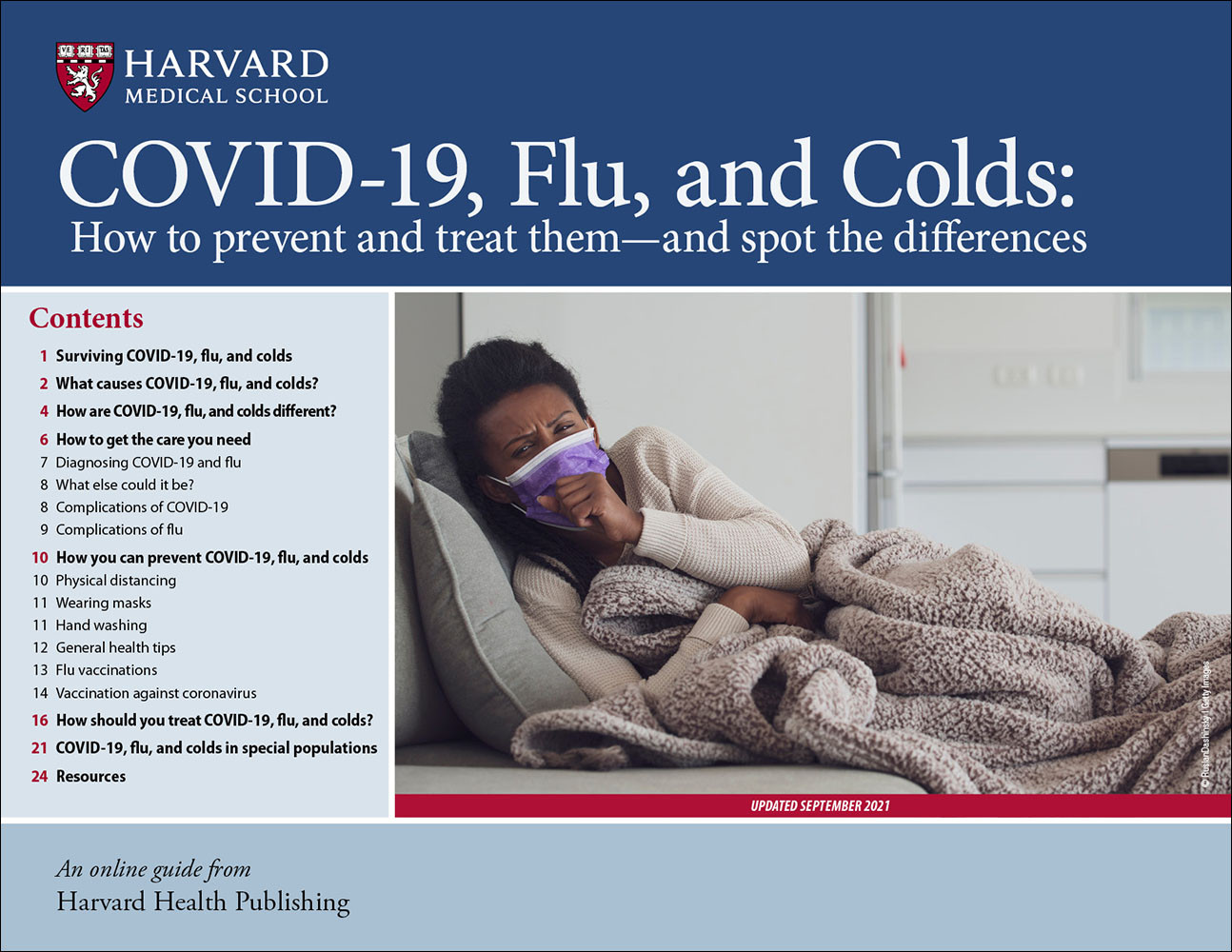
## COVID-19, Flu, and Colds: How to prevent and treat them — and spot the differences
Any given year, we’ll collectively come down with one billion colds and up to 45 million cases of flu, while the number of new cases of COVID-19 keeps rising. In this guide you will learn how to avoid getting any of these three viral infections, and, if you do get sick, what you can do to feel better. You’ll also learn when your condition is serious enough to call a doctor. The report also provides specific information about high-risk groups for whom COVID and the flu can be very serious.
[Read More](https://www.health.harvard.edu/diseases-and-conditions/covid-19-flu-and-colds?utm_source=site&utm_medium=web&utm_campaign=cross-sell)
## Free Healthbeat Signup
Get the latest in health news delivered to your inbox\!
[Sign Up](https://www.health.harvard.edu/healthbeat)
## Footer
[Harvard Health Publishing ](https://www.health.harvard.edu/)
[Facebook](https://www.facebook.com/HarvardHealthPublications)
[X (formerly known as Twitter)](https://x.com/harvardhealth)
[Linkedin](https://www.linkedin.com/company/harvard-health-publications/)
[YouTube](https://www.youtube.com/channel/UC-jj29vMMB1ulz_uEU5kUrA)
### My Account
- [Customer Service](https://www.health.harvard.edu/customer-service)
- [Log in](https://www.health.harvard.edu/login)
### Order Now
- [Online Learning Courses](https://www.harvardhealthonlinelearning.com/)
- [Digital Subscriptions](https://www.health.harvard.edu/subscribe)
- [Special Health Reports](https://www.health.harvard.edu/special-health-reports)
- [Print Subscriptions](https://www.health.harvard.edu/newsletters)
### More
- [About Us](https://www.health.harvard.edu/about-us)
- [Permissions](https://www.health.harvard.edu/permissions)
- [Content Licensing](https://www.health.harvard.edu/licensing)
- [Topics](https://www.health.harvard.edu/topics)
- [Trademark Notice](https://trademark.harvard.edu/pages/trademark-notice)
© 2026 [Harvard Health Publishing®](https://trademark.harvard.edu/pages/trademark-notice) of The President and Fellows of Harvard College
[Do not sell my personal information](https://www.health.harvard.edu/privacy-policy#california-residents) \| [Privacy Policy and Terms of Use](https://www.health.harvard.edu/privacy-policy)
[Scroll To Top](https://www.health.harvard.edu/diseases-and-conditions/ways-to-regain-your-sense-of-smell#app)
Close

Thanks for visiting. Don't miss your FREE gift.
**25 Gut Health Hacks is yours absolutely FREE when you sign up to receive health information from Harvard Medical School.**
Sign up to get tips for living a healthy lifestyle, with ways to lessen **digestion** problems…keep **inflammation** under control…learn simple exercises to improve your **balance**…understand your options for **cataract** treatment…all delivered to your email box FREE.
Close

Health Alerts from Harvard Medical School
**And a FREE copy of the new report 25 Gut Health Hacks\!**
Sign up to receive HealthBeat emails from Harvard Health Publishing and get helpful tips and guidance for ways to lessen digestion problems… keep inflammation under control… learn simple exercises to improve your balance… understand your options for cataract treatment… all delivered to your email inbox FREE. PLUS, you'll get the latest news on medical advances and breakthroughs from Harvard Medical School experts, and special offers on content from Harvard Health Publishing.
Close

Stay on top of latest health news from Harvard Medical School.
Plus, get a FREE copy of **25 Gut Health Hacks**.
Close

Stay on top of latest health news from Harvard Medical School.
Plus, get a FREE copy of **25 Gut Health Hacks**.
 |
| Readable Markdown | 
Your smell sense gives you a superpower. Without moving a muscle or opening your eyes, it helps you detect danger, store or trigger memories, discern flavors, or get a rush of feel-good chemicals during a meal. So you can imagine that losing your sense of smell (a problem doctors call anosmia) can be devastating. Many millions of people have been experiencing it as a common side effect of COVID-19. Other conditions also can lead to anosmia.
When it occurs, you need to try to regain the sense as soon as possible. "The longer you go without it, the less likely you are to recover it," says Dr. Neil Bhattacharyya, an ear, nose, and throat specialist (otolaryngologist) at Harvard-affiliated Massachusetts Eye and Ear.
## Why did you lose it?
Your sense of smell is made possible by your olfactory system. This includes thousands of sensory cells in the nasal cavity that detect odors (entering through the nose or mouth) and send information to the brain via olfactory nerves. If the olfactory nerves become inflamed or damaged, they may not function properly, and you may lose your sense of smell.
Causes of anosmia include nasal polyps, sinus problems, head trauma, chemotherapy side effects, brain tumors, neurological conditions such as Parkinson's disease, or viral infections such as COVID-19.
Why might a viral infection affect smell sense? "Some viruses infect the olfactory nerves or the cells near them, attack them, and damage them," Dr. Bhattacharyya says. "It could also be that inflammation surrounding the nerves causes damage."
## Consequences of smell loss
Anosmia has serious consequences. It shuts down your ability to sniff out hazardous odors, and it also steals much of your ability to taste and appreciate food. Loss of taste occurs because your olfactory sensory cells are responsible for most of your perception of flavor. (By comparison, the taste buds in your tongue detect whether a food is sweet, salty, sour, bitter, or savory.)
When everything tastes like cardboard, you lose the pleasure of eating. "It hurts your quality of life," Dr. Bhattacharyya says. "I have a patient whose wife is an exceptionally good cook. When he first lost his smell and taste senses, he ate less, lost 50 pounds, and became depressed. Now he's underweight."
## Will you get it back?
If you have anosmia from a chronic neurological problem, such as Parkinson's disease, Dr. Bhattacharyya says the chances of recovering your smell sense aren't great. If the anosmia is due to a temporary condition, such as COVID-19, the chances are better that your smell sense will return within a few months, though it's not guaranteed.
For example, a study conducted by Dr. Bhattacharyya and his colleagues, published online June 2, 2023, by *Laryngoscope*, found that about 21 million Americans reported losing smell and taste from COVID in 2021, and almost 30% said they still hadn't fully regained the senses approximately 12-to-18 months later.
But there's hope: Dr. Bhattacharyya says the sense of smell is neuroplastic, meaning it sometimes regenerates.
## Smell retraining
If you've lost your sense of smell, don't wait around for it to come back. "We used to tell people to wait six months before they came to see us about it," Dr. Bhattacharyya says. "But now we want you to begin smell retraining therapy as soon as possible to activate the body's recovery process."
Smell retraining therapy is simply a matter of sniffing a wide variety of odor-generating elements. About six to 10 different types of scents will do, such as lemons or oranges, flowery perfumes, peanut butter, eucalyptus, rosemary, cinnamon, pine, peppermint, or cloves. You can use materials that you have at home or buy a smell retraining kit online (commonly found on Amazon.com) for about \$15 to \$35.
"Once or twice a day, smell each scent for 30 seconds to two minutes. As you do, think about what you're smelling, and try to recall moments when you've smelled this before. For example, cut open an orange, inhale its aroma, and think about another time when you savored a fresh, delicious orange," Dr. Bhattacharyya says. "That triggers odor particle recognition. It's deeply seated in the brain, but you have to stimulate it to re-establish function. You're retraining the brain."
Try this therapy every day for at least four weeks, Dr. Bhattacharrya suggests. If smell sense doesn't return, see an otolaryngologist to rule out underlying conditions that may be causing anosmia. Treating an underlying condition may restore your sense of smell. And if you can smell again, you'll be able to taste and enjoy food again, and restore your quality of life.
**Image: © Westend61/Getty Images** |
| Shard | 102 (laksa) |
| Root Hash | 2971912334127662702 |
| Unparsed URL | edu,harvard!health,www,/diseases-and-conditions/ways-to-regain-your-sense-of-smell s443 |