ℹ️ Skipped - page is already crawled
| Filter | Status | Condition | Details |
|---|---|---|---|
| HTTP status | PASS | download_http_code = 200 | HTTP 200 |
| Age cutoff | PASS | download_stamp > now() - 6 MONTH | 2.6 months ago |
| History drop | PASS | isNull(history_drop_reason) | No drop reason |
| Spam/ban | PASS | fh_dont_index != 1 AND ml_spam_score = 0 | ml_spam_score=0 |
| Canonical | PASS | meta_canonical IS NULL OR = '' OR = src_unparsed | Not set |
| Property | Value |
|---|---|
| URL | https://www.health.harvard.edu/blog/coping-with-the-loss-of-sense-of-smell-and-taste-2020101921141 |
| Last Crawled | 2026-02-01 05:34:16 (2 months ago) |
| First Indexed | 2020-10-19 14:42:01 (5 years ago) |
| HTTP Status Code | 200 |
| Meta Title | Coping with the loss of smell and taste - Harvard Health |
| Meta Description | A majority of people with mild or moderate COVID-19 have reported problems with their sense of smell, and a similar percentage reported changes in taste perception. The loss of these senses may be temporary, but it can take as long as a year for them to return, and some people ... |
| Meta Canonical | null |
| Boilerpipe Text | As I cut a slice of lemon for my tea one morning last March, I found that I could not detect the familiar zing of citrus. Nor, it turned out, could I taste the peach jam on my toast. Overnight, my senses of smell and taste seemed to have disappeared. In the days prior to that I'd had body aches and chills, which I ascribed to a late-winter cold — nothing, I thought, an analgesic and some down time couldn't take care of. But later that day I saw a newspaper article about the loss of smell and taste in patients with
COVID-19
, and I realized that I'd likely caught the virus. While I was fortunate enough to eventually recover from it without a trip to the hospital or worse, months after testing negative for COVID, my senses of both smell and taste are still not fully recovered.
In this, I know, I'm hardly alone. According to
US News and World Report
, 86% of patients with mild to moderate COVID-19 — over six million people, all told — reported problems with their sense of smell, while a similar percentage had changes in taste perception. (Taste and smell work together to create the perception of flavor.) This is in addition to the 13.3 million Americans diagnosed with
anosmia
— a medical term for the loss of smell — related to other respiratory viruses, head injuries, and other causes. For many of us, improvement has been slow.
Loss of smell affects our health and quality of life
Our senses — smell, vision, hearing, taste, and touch — are bridges that connect us to the world we live in, to life itself. Knock out two of the five bridges, and 40% of our sensory input is gone. Senses add richness and texture to everyday life; they are intricately tied in with our emotions. The loss of smell or taste might not seem as drastic as the shortness of breath or debilitating fatigue that many other people have experienced post-COVID, yet the
impact can still be quite demoralizing
. You can no longer smell the familiar scent of your loved ones, or taste your favorite dish. Author and poet
Diane Ackerman
describes these special tastes and smells as "the heady succulence of life" itself.
The loss of smell and taste can also affect our health, causing poor appetite and undesired weight loss. No longer able to enjoy food, patients with anosmia may no longer eat enough, or skip meals altogether. It can even pose an existential threat, by putting us at risk in detecting fires, gas leaks, or spoiled food.
All these impacts help explain why recent
studies
have linked post-COVID anosmia to depression and anxiety. The jury is still out on whether this has to do with the loss of smell or taste per se — or with the impact of the virus on the central nervous system. One thing we know for sure, however: mood and sense of smell are intricately related. The 5,000-plus members of the Facebook group for post-COVID anosmia sufferers can attest to that. Feelings expressed in their posts run the gamut from mere wistfulness to full-blown grief.
How to get smell and taste back: Recovering from the loss
The good news is that olfactory neurons are capable of regeneration. The bad news is that not everyone will return to his or her pre-COVID level of functioning. And, sadly, some of us might never regain our sense of smell or taste at all. According to some experts, patients with post-viral loss of smell have roughly a 60% to 80% chance of regaining some of their smell function within a year. Since the sense of smell usually diminishes due to age, the recovery could take longer and be less than complete for older adults.
Savor what you can experience and engage the mind
To reawaken the olfactory nerves, most specialists recommend
smell training,
a daily routine of sniffing essential oils such as lemon, eucalyptus, cloves, rose, and others. If you suffer from olfactory loss, don't be discouraged if some of the essences smell different from what you expected: distortions associated with the loss of smell (troposmia) are not uncommon.
The principle of
mindfulness
plays an important role here. If you cannot smell the essence at all, try and remember the smell; in other words, engage your mind in evoking the sensation. When eating, if you cannot taste the full range of flavors of a dish, pay attention to the basic ones — sweet, bitter, sour, salty, or umami — as well as to the food's texture and the sensation on your palate. This will help you focus on what you still
can
taste, rather than on what you cannot. When I eat dark chocolate, for example, I can taste only the bitter and the sweet; for the flavor of the cacao bean, I still have to rely on my memory.
The old adage, "What doesn't kill me makes me stronger," acquires a fresh meaning when applied to the losses associated with COVID-19. These losses challenge us to become more mindful and self-aware, and ultimately, more resilient. We must also learn to be patient and appreciate incremental bits of progress. The other day, for the first time in months, I caught a whiff of citrus in my tea. Lemon never smelled so sweet.
Tips and coping strategies
In my practice with patients with post-COVID losses, and in my own recovery, I have found the following coping strategies helpful.
Acknowledge your feelings about the loss.
Consult with an ear, nose, and throat specialist for guidance.
Consider adjusting your cooking in favor of spicier foods.
Maintain hope for recovery.
Cultivate a sense of gratitude: you have survived a potentially lethal disease.
For additional help, see a counselor or join a support group.
Image: wilpunt/Getty Images |
| Markdown | 
[Harvard Health Publishing ](https://www.health.harvard.edu/)
[Harvard Health Publishing](https://www.health.harvard.edu/)
[HarvardHealthOnline+](https://www.health.harvard.edu/hho-plus?utm_source=site&utm_medium=web&utm_campaign=top_button)
Search
[Customer Service](https://www.health.harvard.edu/customer-service) [Content Licensing](https://www.health.harvard.edu/licensing) [About Us](https://www.health.harvard.edu/about-us)
[Log In](https://www.health.harvard.edu/login)
Open mobile menu
[Free HealthBeat Signup](https://www.health.harvard.edu/healthbeat)
Shop
[Subscriptions](https://www.health.harvard.edu/subscribe) [Special Health Reports](https://www.health.harvard.edu/special-health-reports) [Online Courses](https://www.harvardhealthonlinelearning.com/catalog)
[Pay Subscription Bill](https://www.health.harvard.edu/pay-bill)
[Common Conditions](https://www.health.harvard.edu/category/common-conditions) [Staying Healthy](https://www.health.harvard.edu/category/staying-healthy) [Resources](https://www.health.harvard.edu/resources) [Blog](https://www.health.harvard.edu/blog) [COVID-19 Updates](https://www.health.harvard.edu/diseases-and-conditions/coronavirus-resource-center)
Close menu
[HarvardHealthOnline+](https://www.health.harvard.edu/hho-plus?utm_source=site&utm_medium=web&utm_campaign=mobile_button)
## Main Content
- [Common Conditions](https://www.health.harvard.edu/category/common-conditions)
- [Staying Healthy](https://www.health.harvard.edu/category/staying-healthy)
- [Resources](https://www.health.harvard.edu/resources)
- [Blog](https://www.health.harvard.edu/blog)
## Helpful Links
- [Customer Service](https://www.health.harvard.edu/customer-service)
- [About Us](https://www.health.harvard.edu/about-us)
- [Content Licensing](https://www.health.harvard.edu/licensing)
- [Free Healthbeat Signup](https://www.health.harvard.edu/healthbeat)
- [Subscriptions](https://www.health.harvard.edu/subscribe)
- [Special Health Reports](https://www.health.harvard.edu/special-health-reports)
- [Online Courses](https://www.harvardhealthonlinelearning.com/)
- [Pay Subscription Bill](https://www.health.harvard.edu/pay-bill)
Close
Recent Articles
[ Trying to lose weight? Be careful not to lose muscle](https://www.health.harvard.edu/staying-healthy/trying-to-lose-weight-be-careful-not-to-lose-muscle)
[ Is your skin problem actually an autoimmune condition?](https://www.health.harvard.edu/diseases-and-conditions/is-your-skin-problem-actually-an-autoimmune-condition)
[ People with diabetes face higher risk of hearing loss](https://www.health.harvard.edu/diseases-and-conditions/people-with-diabetes-face-higher-risk-of-hearing-loss)
[ Antibiotic-free fixes for recurrent UTIs](https://www.health.harvard.edu/womens-health/antibiotic-free-fixes-for-recurrent-utis)
[ Musculoskeletal syndrome of menopause: When menopause makes you ache all over](https://www.health.harvard.edu/womens-health/musculoskeletal-syndrome-of-menopause-when-menopause-makes-you-ache-all-over)
[ When can older women stop getting mammograms?](https://www.health.harvard.edu/womens-health/when-can-older-women-stop-getting-mammograms)
[ To lose weight, especially harmful belly fat, combine diet and exercise](https://www.health.harvard.edu/staying-healthy/to-lose-weight-especially-harmful-belly-fat-combine-diet-and-exercise)
[ Can men hold off on treating recurring prostate cancer?](https://www.health.harvard.edu/blog/can-men-hold-off-on-treating-recurring-prostate-cancer-202512193108)
[ The 7 types of rest and why we need them all](https://www.health.harvard.edu/mind-and-mood/the-7-types-of-rest-and-why-we-need-them-all)
[ What are the early warning signs of cervical cancer?](https://www.health.harvard.edu/cancer/what-are-the-early-warning-signs-of-cervical-cancer)
/
[COVID-19](https://www.health.harvard.edu/topics/covid-19)
# Coping with the loss of smell and taste
October 19, 2020
By [Leo Newhouse, LICSW](https://www.health.harvard.edu/authors/leo-newhouse-licsw), Contributor
Share
[Share this page to Facebook](https://www.facebook.com/sharer/sharer.php?u=https%3A%2F%2Fwww.health.harvard.edu%2Fblog%2Fcoping-with-the-loss-of-sense-of-smell-and-taste-2020101921141&display=popup)
[Share this page to X](https://twitter.com/intent/tweet?original_referer=https%3A%2F%2Fwww.health.harvard.edu%2Fblog%2Fcoping-with-the-loss-of-sense-of-smell-and-taste-2020101921141&text=Coping%20with%20the%20loss%20of%20smell%20and%20taste%20-%20Harvard%20Health&tw_p=tweetbutton&url=https%3A%2F%2Fwww.health.harvard.edu%2Fblog%2Fcoping-with-the-loss-of-sense-of-smell-and-taste-2020101921141)
[Share this page via Email](<mailto:?subject=Great health news for you from the experts at Harvard&body=Check out this link from Harvard Health: Coping with the loss of smell and taste - https://www.health.harvard.edu/blog/coping-with-the-loss-of-sense-of-smell-and-taste-2020101921141>)
Copy this page to clipboard
Print This Page
Click to Print

As I cut a slice of lemon for my tea one morning last March, I found that I could not detect the familiar zing of citrus. Nor, it turned out, could I taste the peach jam on my toast. Overnight, my senses of smell and taste seemed to have disappeared. In the days prior to that I'd had body aches and chills, which I ascribed to a late-winter cold — nothing, I thought, an analgesic and some down time couldn't take care of. But later that day I saw a newspaper article about the loss of smell and taste in patients with [COVID-19](https://www.health.harvard.edu/diseases-and-conditions/coronavirus-resource-center), and I realized that I'd likely caught the virus. While I was fortunate enough to eventually recover from it without a trip to the hospital or worse, months after testing negative for COVID, my senses of both smell and taste are still not fully recovered.
In this, I know, I'm hardly alone. According to *US News and World Report*, 86% of patients with mild to moderate COVID-19 — over six million people, all told — reported problems with their sense of smell, while a similar percentage had changes in taste perception. (Taste and smell work together to create the perception of flavor.) This is in addition to the 13.3 million Americans diagnosed with [anosmia](https://www.nidcd.nih.gov/health/smell-disorders) — a medical term for the loss of smell — related to other respiratory viruses, head injuries, and other causes. For many of us, improvement has been slow.
## Loss of smell affects our health and quality of life
Our senses — smell, vision, hearing, taste, and touch — are bridges that connect us to the world we live in, to life itself. Knock out two of the five bridges, and 40% of our sensory input is gone. Senses add richness and texture to everyday life; they are intricately tied in with our emotions. The loss of smell or taste might not seem as drastic as the shortness of breath or debilitating fatigue that many other people have experienced post-COVID, yet the [impact can still be quite demoralizing](https://www.nytimes.com/2020/09/06/opinion/coronavirus-covid-symptoms-taste.html). You can no longer smell the familiar scent of your loved ones, or taste your favorite dish. Author and poet [Diane Ackerman](http://www.dianeackerman.com/a-natural-history-of-the-senses-by-diane-ackerman) describes these special tastes and smells as "the heady succulence of life" itself.
The loss of smell and taste can also affect our health, causing poor appetite and undesired weight loss. No longer able to enjoy food, patients with anosmia may no longer eat enough, or skip meals altogether. It can even pose an existential threat, by putting us at risk in detecting fires, gas leaks, or spoiled food.
All these impacts help explain why recent [studies](https://onlinelibrary.wiley.com/doi/10.1002/lary.28964) have linked post-COVID anosmia to depression and anxiety. The jury is still out on whether this has to do with the loss of smell or taste per se — or with the impact of the virus on the central nervous system. One thing we know for sure, however: mood and sense of smell are intricately related. The 5,000-plus members of the Facebook group for post-COVID anosmia sufferers can attest to that. Feelings expressed in their posts run the gamut from mere wistfulness to full-blown grief.
## How to get smell and taste back: Recovering from the loss
The good news is that olfactory neurons are capable of regeneration. The bad news is that not everyone will return to his or her pre-COVID level of functioning. And, sadly, some of us might never regain our sense of smell or taste at all. According to some experts, patients with post-viral loss of smell have roughly a 60% to 80% chance of regaining some of their smell function within a year. Since the sense of smell usually diminishes due to age, the recovery could take longer and be less than complete for older adults.
## Savor what you can experience and engage the mind
To reawaken the olfactory nerves, most specialists recommend [smell training,](https://www.health.harvard.edu/diseases-and-conditions/smell-training-can-help-fix-distortions-caused-by-viruses) a daily routine of sniffing essential oils such as lemon, eucalyptus, cloves, rose, and others. If you suffer from olfactory loss, don't be discouraged if some of the essences smell different from what you expected: distortions associated with the loss of smell (troposmia) are not uncommon.
The principle of [mindfulness](https://www.health.harvard.edu/blog/evoking-calm-practicing-mindfulness-in-daily-life-helps-202110142617) plays an important role here. If you cannot smell the essence at all, try and remember the smell; in other words, engage your mind in evoking the sensation. When eating, if you cannot taste the full range of flavors of a dish, pay attention to the basic ones — sweet, bitter, sour, salty, or umami — as well as to the food's texture and the sensation on your palate. This will help you focus on what you still *can* taste, rather than on what you cannot. When I eat dark chocolate, for example, I can taste only the bitter and the sweet; for the flavor of the cacao bean, I still have to rely on my memory.
The old adage, "What doesn't kill me makes me stronger," acquires a fresh meaning when applied to the losses associated with COVID-19. These losses challenge us to become more mindful and self-aware, and ultimately, more resilient. We must also learn to be patient and appreciate incremental bits of progress. The other day, for the first time in months, I caught a whiff of citrus in my tea. Lemon never smelled so sweet.
## Tips and coping strategies
In my practice with patients with post-COVID losses, and in my own recovery, I have found the following coping strategies helpful.
- Acknowledge your feelings about the loss.
- Consult with an ear, nose, and throat specialist for guidance.
- Consider adjusting your cooking in favor of spicier foods.
- Maintain hope for recovery.
- Cultivate a sense of gratitude: you have survived a potentially lethal disease.
- For additional help, see a counselor or join a support group.
**Image: wilpunt/Getty Images**
## About the Author

Leo Newhouse, LICSW, Contributor
Leo Newhouse, LICSW, is a Senior Social Worker in Neurology at Beth Israel Deaconess Medical Center (BIDMC). In this capacity, he works with patients and families coping with life-limiting illness, aging, and loss. In his spare … [See Full Bio](https://www.health.harvard.edu/authors/leo-newhouse-licsw)
[View all posts by Leo Newhouse, LICSW](https://www.health.harvard.edu/authors/leo-newhouse-licsw)
Share
[Share this page to Facebook](https://www.facebook.com/sharer/sharer.php?u=https%3A%2F%2Fwww.health.harvard.edu%2Fblog%2Fcoping-with-the-loss-of-sense-of-smell-and-taste-2020101921141&display=popup)
[Share this page to X](https://twitter.com/intent/tweet?original_referer=https%3A%2F%2Fwww.health.harvard.edu%2Fblog%2Fcoping-with-the-loss-of-sense-of-smell-and-taste-2020101921141&text=Coping%20with%20the%20loss%20of%20smell%20and%20taste%20-%20Harvard%20Health&tw_p=tweetbutton&url=https%3A%2F%2Fwww.health.harvard.edu%2Fblog%2Fcoping-with-the-loss-of-sense-of-smell-and-taste-2020101921141)
[Share this page via Email](<mailto:?subject=Great health news for you from the experts at Harvard&body=Check out this link from Harvard Health: Coping with the loss of smell and taste - https://www.health.harvard.edu/blog/coping-with-the-loss-of-sense-of-smell-and-taste-2020101921141>)
Copy this page to clipboard
Print This Page
Click to Print
## Disclaimer:
As a service to our readers, Harvard Health Publishing provides access to our library of archived content. Please note the date of last review or update on all articles.
No content on this site, regardless of date, should ever be used as a substitute for direct medical advice from your doctor or other qualified clinician.
Recent Articles
[ Trying to lose weight? Be careful not to lose muscle](https://www.health.harvard.edu/staying-healthy/trying-to-lose-weight-be-careful-not-to-lose-muscle)
[ Is your skin problem actually an autoimmune condition?](https://www.health.harvard.edu/diseases-and-conditions/is-your-skin-problem-actually-an-autoimmune-condition)
[ People with diabetes face higher risk of hearing loss](https://www.health.harvard.edu/diseases-and-conditions/people-with-diabetes-face-higher-risk-of-hearing-loss)
[ Antibiotic-free fixes for recurrent UTIs](https://www.health.harvard.edu/womens-health/antibiotic-free-fixes-for-recurrent-utis)
[ Musculoskeletal syndrome of menopause: When menopause makes you ache all over](https://www.health.harvard.edu/womens-health/musculoskeletal-syndrome-of-menopause-when-menopause-makes-you-ache-all-over)
[ When can older women stop getting mammograms?](https://www.health.harvard.edu/womens-health/when-can-older-women-stop-getting-mammograms)
[ To lose weight, especially harmful belly fat, combine diet and exercise](https://www.health.harvard.edu/staying-healthy/to-lose-weight-especially-harmful-belly-fat-combine-diet-and-exercise)
[ Can men hold off on treating recurring prostate cancer?](https://www.health.harvard.edu/blog/can-men-hold-off-on-treating-recurring-prostate-cancer-202512193108)
[ The 7 types of rest and why we need them all](https://www.health.harvard.edu/mind-and-mood/the-7-types-of-rest-and-why-we-need-them-all)
[ What are the early warning signs of cervical cancer?](https://www.health.harvard.edu/cancer/what-are-the-early-warning-signs-of-cervical-cancer)
/
You might also be interested in…
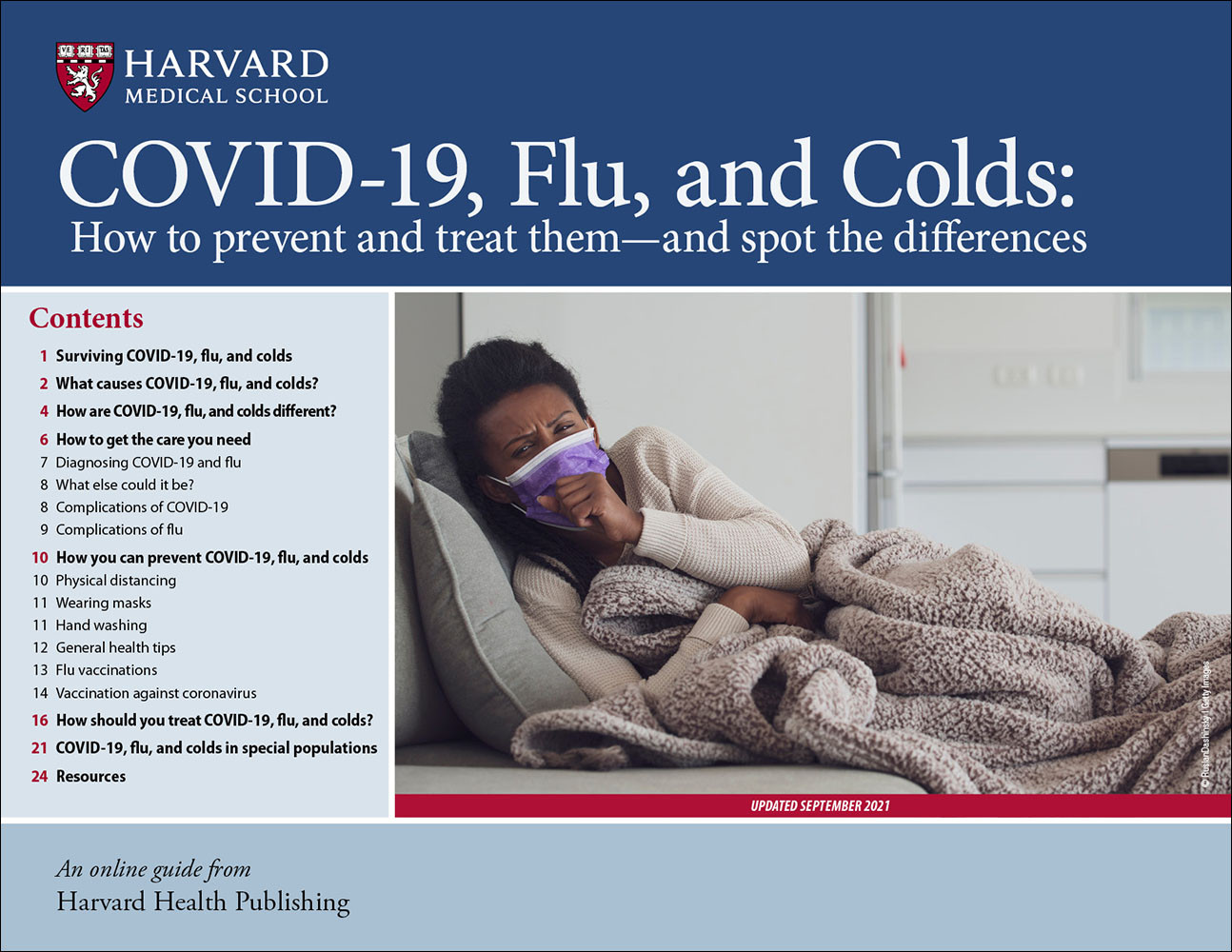
## COVID-19, Flu, and Colds: How to prevent and treat them — and spot the differences
Any given year, we’ll collectively come down with one billion colds and up to 45 million cases of flu, while the number of new cases of COVID-19 keeps rising. In this guide you will learn how to avoid getting any of these three viral infections, and, if you do get sick, what you can do to feel better. You’ll also learn when your condition is serious enough to call a doctor. The report also provides specific information about high-risk groups for whom COVID and the flu can be very serious.
[Read More](https://www.health.harvard.edu/diseases-and-conditions/covid-19-flu-and-colds?utm_source=site&utm_medium=web&utm_campaign=cross-sell)
## Free Healthbeat Signup
Get the latest in health news delivered to your inbox\!
[Sign Up](https://www.health.harvard.edu/healthbeat)
## Footer
[Harvard Health Publishing ](https://www.health.harvard.edu/)
[Facebook](https://www.facebook.com/HarvardHealthPublications)
[X (formerly known as Twitter)](https://x.com/harvardhealth)
[Linkedin](https://www.linkedin.com/company/harvard-health-publications/)
[YouTube](https://www.youtube.com/channel/UC-jj29vMMB1ulz_uEU5kUrA)
### My Account
- [Customer Service](https://www.health.harvard.edu/customer-service)
- [Log in](https://www.health.harvard.edu/login)
### Order Now
- [Online Learning Courses](https://www.harvardhealthonlinelearning.com/)
- [Digital Subscriptions](https://www.health.harvard.edu/subscribe)
- [Special Health Reports](https://www.health.harvard.edu/special-health-reports)
- [Print Subscriptions](https://www.health.harvard.edu/newsletters)
### More
- [About Us](https://www.health.harvard.edu/about-us)
- [Permissions](https://www.health.harvard.edu/permissions)
- [Content Licensing](https://www.health.harvard.edu/licensing)
- [Topics](https://www.health.harvard.edu/topics)
- [Trademark Notice](https://trademark.harvard.edu/pages/trademark-notice)
© 2026 [Harvard Health Publishing®](https://trademark.harvard.edu/pages/trademark-notice) of The President and Fellows of Harvard College
[Do not sell my personal information](https://www.health.harvard.edu/privacy-policy#california-residents) \| [Privacy Policy and Terms of Use](https://www.health.harvard.edu/privacy-policy)
[Scroll To Top](https://www.health.harvard.edu/blog/coping-with-the-loss-of-sense-of-smell-and-taste-2020101921141#app)
Close

Thanks for visiting. Don't miss your FREE gift.
**25 Gut Health Hacks is yours absolutely FREE when you sign up to receive health information from Harvard Medical School.**
Sign up to get tips for living a healthy lifestyle, with ways to lessen **digestion** problems…keep **inflammation** under control…learn simple exercises to improve your **balance**…understand your options for **cataract** treatment…all delivered to your email box FREE.
Close

Health Alerts from Harvard Medical School
**And a FREE copy of the new report 25 Gut Health Hacks\!**
Sign up to receive HealthBeat emails from Harvard Health Publishing and get helpful tips and guidance for ways to lessen digestion problems… keep inflammation under control… learn simple exercises to improve your balance… understand your options for cataract treatment… all delivered to your email inbox FREE. PLUS, you'll get the latest news on medical advances and breakthroughs from Harvard Medical School experts, and special offers on content from Harvard Health Publishing.
Close

Stay on top of latest health news from Harvard Medical School.
Plus, get a FREE copy of **25 Gut Health Hacks**.
Close

Stay on top of latest health news from Harvard Medical School.
Plus, get a FREE copy of **25 Gut Health Hacks**.
 |
| Readable Markdown | 
As I cut a slice of lemon for my tea one morning last March, I found that I could not detect the familiar zing of citrus. Nor, it turned out, could I taste the peach jam on my toast. Overnight, my senses of smell and taste seemed to have disappeared. In the days prior to that I'd had body aches and chills, which I ascribed to a late-winter cold — nothing, I thought, an analgesic and some down time couldn't take care of. But later that day I saw a newspaper article about the loss of smell and taste in patients with [COVID-19](https://www.health.harvard.edu/diseases-and-conditions/coronavirus-resource-center), and I realized that I'd likely caught the virus. While I was fortunate enough to eventually recover from it without a trip to the hospital or worse, months after testing negative for COVID, my senses of both smell and taste are still not fully recovered.
In this, I know, I'm hardly alone. According to *US News and World Report*, 86% of patients with mild to moderate COVID-19 — over six million people, all told — reported problems with their sense of smell, while a similar percentage had changes in taste perception. (Taste and smell work together to create the perception of flavor.) This is in addition to the 13.3 million Americans diagnosed with [anosmia](https://www.nidcd.nih.gov/health/smell-disorders) — a medical term for the loss of smell — related to other respiratory viruses, head injuries, and other causes. For many of us, improvement has been slow.
## Loss of smell affects our health and quality of life
Our senses — smell, vision, hearing, taste, and touch — are bridges that connect us to the world we live in, to life itself. Knock out two of the five bridges, and 40% of our sensory input is gone. Senses add richness and texture to everyday life; they are intricately tied in with our emotions. The loss of smell or taste might not seem as drastic as the shortness of breath or debilitating fatigue that many other people have experienced post-COVID, yet the [impact can still be quite demoralizing](https://www.nytimes.com/2020/09/06/opinion/coronavirus-covid-symptoms-taste.html). You can no longer smell the familiar scent of your loved ones, or taste your favorite dish. Author and poet [Diane Ackerman](http://www.dianeackerman.com/a-natural-history-of-the-senses-by-diane-ackerman) describes these special tastes and smells as "the heady succulence of life" itself.
The loss of smell and taste can also affect our health, causing poor appetite and undesired weight loss. No longer able to enjoy food, patients with anosmia may no longer eat enough, or skip meals altogether. It can even pose an existential threat, by putting us at risk in detecting fires, gas leaks, or spoiled food.
All these impacts help explain why recent [studies](https://onlinelibrary.wiley.com/doi/10.1002/lary.28964) have linked post-COVID anosmia to depression and anxiety. The jury is still out on whether this has to do with the loss of smell or taste per se — or with the impact of the virus on the central nervous system. One thing we know for sure, however: mood and sense of smell are intricately related. The 5,000-plus members of the Facebook group for post-COVID anosmia sufferers can attest to that. Feelings expressed in their posts run the gamut from mere wistfulness to full-blown grief.
## How to get smell and taste back: Recovering from the loss
The good news is that olfactory neurons are capable of regeneration. The bad news is that not everyone will return to his or her pre-COVID level of functioning. And, sadly, some of us might never regain our sense of smell or taste at all. According to some experts, patients with post-viral loss of smell have roughly a 60% to 80% chance of regaining some of their smell function within a year. Since the sense of smell usually diminishes due to age, the recovery could take longer and be less than complete for older adults.
## Savor what you can experience and engage the mind
To reawaken the olfactory nerves, most specialists recommend [smell training,](https://www.health.harvard.edu/diseases-and-conditions/smell-training-can-help-fix-distortions-caused-by-viruses) a daily routine of sniffing essential oils such as lemon, eucalyptus, cloves, rose, and others. If you suffer from olfactory loss, don't be discouraged if some of the essences smell different from what you expected: distortions associated with the loss of smell (troposmia) are not uncommon.
The principle of [mindfulness](https://www.health.harvard.edu/blog/evoking-calm-practicing-mindfulness-in-daily-life-helps-202110142617) plays an important role here. If you cannot smell the essence at all, try and remember the smell; in other words, engage your mind in evoking the sensation. When eating, if you cannot taste the full range of flavors of a dish, pay attention to the basic ones — sweet, bitter, sour, salty, or umami — as well as to the food's texture and the sensation on your palate. This will help you focus on what you still *can* taste, rather than on what you cannot. When I eat dark chocolate, for example, I can taste only the bitter and the sweet; for the flavor of the cacao bean, I still have to rely on my memory.
The old adage, "What doesn't kill me makes me stronger," acquires a fresh meaning when applied to the losses associated with COVID-19. These losses challenge us to become more mindful and self-aware, and ultimately, more resilient. We must also learn to be patient and appreciate incremental bits of progress. The other day, for the first time in months, I caught a whiff of citrus in my tea. Lemon never smelled so sweet.
## Tips and coping strategies
In my practice with patients with post-COVID losses, and in my own recovery, I have found the following coping strategies helpful.
- Acknowledge your feelings about the loss.
- Consult with an ear, nose, and throat specialist for guidance.
- Consider adjusting your cooking in favor of spicier foods.
- Maintain hope for recovery.
- Cultivate a sense of gratitude: you have survived a potentially lethal disease.
- For additional help, see a counselor or join a support group.
**Image: wilpunt/Getty Images** |
| Shard | 102 (laksa) |
| Root Hash | 2971912334127662702 |
| Unparsed URL | edu,harvard!health,www,/blog/coping-with-the-loss-of-sense-of-smell-and-taste-2020101921141 s443 |