ℹ️ Skipped - page is already crawled
| Filter | Status | Condition | Details |
|---|---|---|---|
| HTTP status | PASS | download_http_code = 200 | HTTP 200 |
| Age cutoff | PASS | download_stamp > now() - 6 MONTH | 0.1 months ago |
| History drop | PASS | isNull(history_drop_reason) | No drop reason |
| Spam/ban | PASS | fh_dont_index != 1 AND ml_spam_score = 0 | ml_spam_score=0 |
| Canonical | PASS | meta_canonical IS NULL OR = '' OR = src_unparsed | Not set |
| Property | Value |
|---|---|
| URL | https://www.geeksforgeeks.org/maths/trigonometric-identities/ |
| Last Crawled | 2026-04-13 04:06:19 (3 days ago) |
| First Indexed | 2025-06-16 02:44:29 (10 months ago) |
| HTTP Status Code | 200 |
| Meta Title | Trigonometric Identities - GeeksforGeeks |
| Meta Description | Your All-in-One Learning Portal: GeeksforGeeks is a comprehensive educational platform that empowers learners across domains-spanning computer science and programming, school education, upskilling, commerce, software tools, competitive exams, and more., Your All-in-One Learning Portal. It contains well written, well thought and well explained computer science and programming articles, quizzes and practice/competitive programming/company interview Questions. |
| Meta Canonical | null |
| Boilerpipe Text | Last Updated :
10 Feb, 2026
Trigonometric identities are equations involving
trigonometric functions
that hold true for all values of the variables where the functions are defined.
They describe the relationships among sine, cosine, tangent, and the other trigonometric functions.
Fundamental tools for simplifying expressions, proving formulas, and solving trigonometric equations.
Widely used in fields like geometry, engineering, and physics.
Previous
Pause
Next
2 / 6
These are useful whenever trigonometric functions are involved in an expression or an equation. The six basic
trigonometric ratios
are sine, cosine, tangent, cosecant, secant, and cotangent. All these trigonometric ratios are defined using the sides of the right triangle, such as the adjacent side, the opposite side, and the hypotenuse.
List of Trigonometric Identities
There are a lot of identities in the study of
Trigonometry
, which involve all the trigonometric ratios. These identities are used to solve various problems throughout the academic landscape as well as the real life. Let us learn all the fundamental and advanced trigonometric identities.
Reciprocal Trigonometric Identities
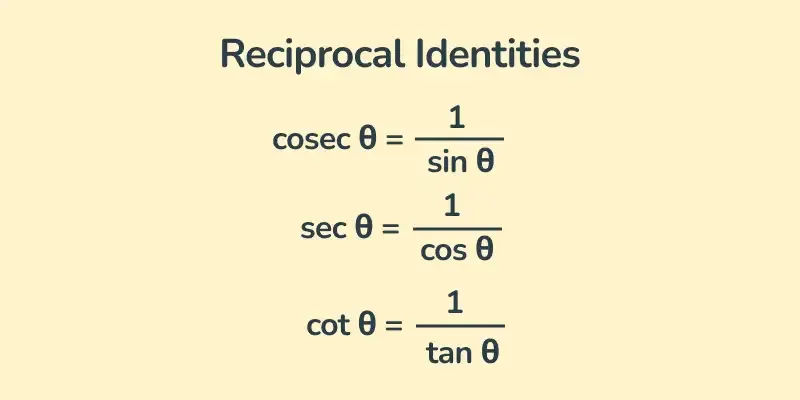
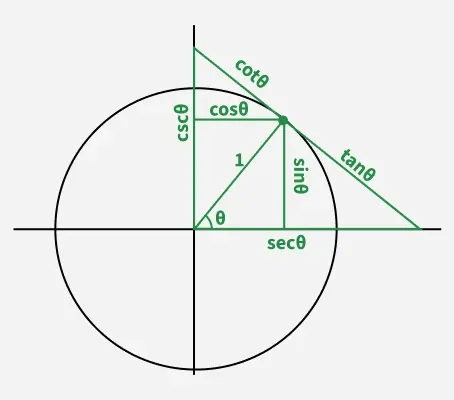
In all trigonometric ratios, there is a reciprocal relation between a pair of ratios, which is given as follows:
sin θ = 1/cosec θ
cosec θ = 1/sin θ
cos θ = 1/sec θ
sec θ = 1/cos θ
tan θ = 1/cot θ
cot θ = 1/tan θ
Pythagorean Trigonometric Identities
Pythagorean Trigonometric Identities
are based on the right-triangle theorem or
Pythagoras' theorem
, and are as follows:
sin
2
θ + cos
2
θ = 1
1 + tan
2
θ = sec
2
θ
cosec
2
θ = 1 + cot
2
θ
Trigonometric Ratio Identities
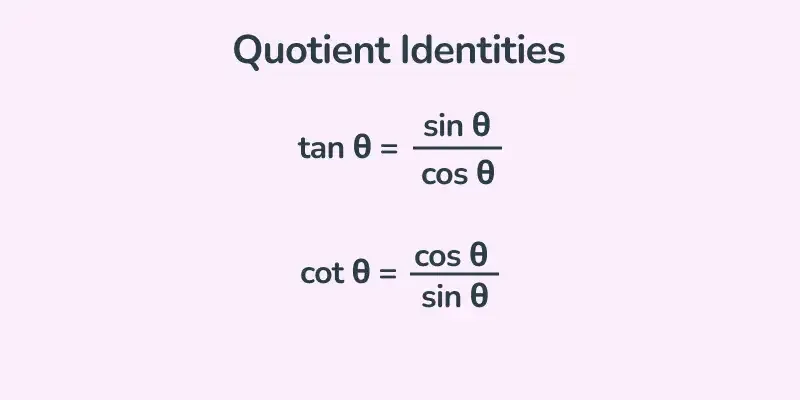
As tan and cot are defined as the ratio of sin and cos, which is given by the following identities:
tan θ = sin θ/cos θ
cot θ = cos θ/sin θ
Trigonometric Identities of Opposite Angles
In trigonometry, angles measured in the clockwise direction are measured in negative parity, and all trigonometric ratios defined for negative parity of angle are defined as follows:
sin (-θ) = -sin θ
cos (-θ) = cos θ
tan (-θ) = -tan θ
cot (-θ) = -cot θ
sec (-θ) = sec θ
cosec (-θ) = -cosec θ
Complementary Angles Identities
Complementary angles
are a pair of angles whose measures add up to 90°. Now, the trigonometric identities for complementary angles are as follows:
sin (90° – θ) = cos θ
cos (90° – θ) = sin θ
tan (90° – θ) = cot θ
cot (90° – θ) = tan θ
sec (90° – θ) = cosec θ
cosec (90° – θ) = sec θ
Supplementary Angles Identities
Supplementary angles
are a pair of angles whose measures add up to 180°. Now, the trigonometric identities for supplementary angles are:
sin (180°- θ) = sinθ
cos (180°- θ) = -cos θ
cosec (180°- θ) = cosec θ
sec (180°- θ)= -sec θ
tan (180°- θ) = -tan θ
cot (180°- θ) = -cot θ
Periodicity of Trigonometric Function
Trigonometric functions such
as sin, cos, tan, cot, sec, and cosec are all periodic and have different periodicities. The following identities for the trigonometric ratios explain their periodicity.
sin (n × 360° + θ) = sin θ
sin (2nπ + θ) = sin θ
cos (n × 360° + θ) = cos θ
cos (2nπ + θ) = cos θ
tan (n × 180° + θ) = tan θ
tan (nπ + θ) = tan θ
cosec (n × 360° + θ) = cosec θ
cosec (2nπ + θ) = cosec θ
sec (n × 360° + θ) = sec θ
sec (2nπ + θ) = sec θ
cot (n × 180° + θ) = cot θ
cot (nπ + θ) = cot θ
Where, n ∈
Z,
(Z = set of all integers)
Note:
sin, cos, cosec, and sec have a period of 360° or 2π radians, and for tan and cot period is 180° or π radians.
Sum and Difference Identities
Trigonometric identities for the
Sum and Difference of angles
include formulas such as sin(A+B), cos(A-B), tan(A+B), etc.
sin (A+B) = sin A cos B + cos A sin B
sin (A-B) = sin A cos B - cos A sin B
cos (A+B) = cos A cos B - sin A sin B
cos (A-B) = cos A cos B + sin A sin B
tan (A+B) = (tan A + tan B)/(1 - tan A tan B)
tan (A-B) = (tan A - tan B)/(1 + tan A tan B)
Note:
Identities for sin (A+B), sin (A-B), cos (A+B), and cos (A-B) are called Ptolemy’s Identities.
Double Angle Identities
Using the trigonometric identities of the sum of angles, we can find a new identity, which is called the
Double Angle Identities
. To find these identities, we can put A = B in the sum of angle identities. For example,
a we know, sin (A+B) = sin A cos B + cos A sin B
Substitute A = B = θ on both sides here, and we get:
sin (θ + θ) = sinθ cosθ + cosθ sinθ
sin 2θ = 2 sinθ cosθ
Similarly,
cos 2θ = cos
2
θ - sin
2
θ = 2 cos
2
θ - 1 = 1 - 2sin
2
θ
tan 2θ = (2tanθ)/(1 - tan
2
θ)
Half-Angle Formulas
Using double-angle formulas,
half-angle formulas
can be calculated. To calculate the angle formula, replace θ with θ/2, then,
s
i
n
θ
2
=
±
1
−
c
o
s
θ
2
sin \frac{\theta}{2} = \pm\sqrt{\frac{1-cos \theta}{2}}
cos
θ
2
=
±
1
+
cos
θ
2
\cos \frac{\theta}{2} = \pm \sqrt{\frac{1 + \cos \theta}{2}}
tan
θ
2
=
±
1
−
cos
θ
1
+
cos
θ
=
sin
θ
1
+
cos
θ
=
1
−
cos
θ
sin
θ
\tan \frac{\theta}{2} = \pm \sqrt{\frac{1 - \cos \theta}{1 + \cos \theta}}
= \frac{\sin \theta}{1 + \cos \theta}
= \frac{1 - \cos \theta}{\sin \theta}
Other than the above-mentioned identities, there are some more half-angle identities, which are as follows:
sin
θ
=
2
tan
θ
2
1
+
tan
2
θ
2
\sin \theta = \dfrac{2 \tan \tfrac{\theta}{2}}{1 + \tan^2 \tfrac{\theta}{2}}
cos
θ
=
1
−
tan
2
θ
2
1
+
tan
2
θ
2
\cos \theta = \dfrac{1 - \tan^2 \tfrac{\theta}{2}}{1 + \tan^2 \tfrac{\theta}{2}}
tan
θ
=
2
tan
θ
2
1
−
tan
2
θ
2
\tan \theta = \dfrac{2 \tan \tfrac{\theta}{2}}{1 - \tan^2 \tfrac{\theta}{2}}
Product-Sum Identities
The following identities state the relationship between the sum of two trigonometric ratios with the product of two trigonometric ratios.
sin
A
+
sin
B
=
2
sin
A
+
B
2
cos
A
−
B
2
\sin A + \sin B = 2 \sin \frac{A + B}{2} \cos \frac{A - B}{2}
cos
A
+
cos
B
=
2
cos
A
+
B
2
cos
A
−
B
2
\cos A + \cos B = 2 \cos \frac{A + B}{2} \cos \frac{A - B}{2}
sin
A
−
sin
B
=
2
cos
A
+
B
2
sin
A
−
B
2
\sin A - \sin B = 2 \cos \frac{A + B}{2} \sin \frac{A - B}{2}
cos
A
−
cos
B
=
−
2
sin
A
+
B
2
sin
A
−
B
2
\cos A - \cos B = -2 \sin \frac{A + B}{2} \sin \frac{A - B}{2}
Products Identities
Product Identities are formed when we add two of the sum and difference of angle identities, and are as follows:
sin
A
cos
B
=
sin
(
A
+
B
)
+
sin
(
A
−
B
)
2
\sin A \cos B = \frac{\sin (A + B) + \sin (A - B)}{2}
cos
A
cos
B
=
cos
(
A
+
B
)
+
cos
(
A
−
B
)
2
\cos A \cos B = \frac{\cos (A + B) + \cos (A - B)}{2}
sin
A
sin
B
=
cos
(
A
−
B
)
−
cos
(
A
+
B
)
2
\sin A \sin B = \frac{\cos (A - B) - \cos (A + B)}{2}
Triple Angle Formulas
Other than double and half-angle formulas, there are identities for trigonometric ratios that are defined for triple angles. These
triple-angle identities
are as follows:
sin
3
θ
=
3
sin
θ
−
4
sin
3
θ
\sin 3\theta = 3 \sin \theta - 4 \sin^3 \theta
cos
3
θ
=
4
cos
3
θ
−
3
cos
θ
\cos 3\theta = 4 \cos^3 \theta - 3 \cos \theta
tan
3
θ
=
3
tan
θ
−
tan
3
θ
1
−
3
tan
2
θ
\tan 3\theta = \frac{3 \tan \theta - \tan^3 \theta}{1 - 3 \tan^2 \theta}
Proof of the Trigonometric Identities
For any acute angle θ, prove that
tanθ = sinθ/cosθ
cotθ = cosθ/sinθ
tanθ . cotθ = 1
sin
2
θ + cos
2
θ = 1
1 + tan
2
θ = sec
2
θ
1 + cot
2
θ = cosec
2
θ
Proof:
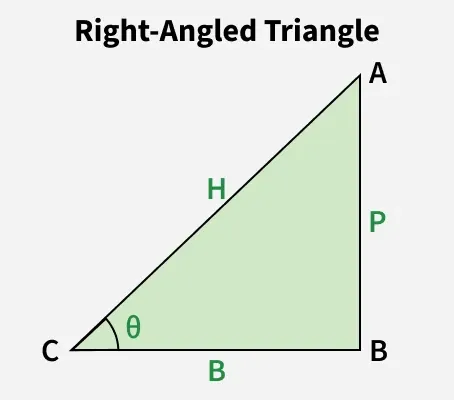
Consider a right-angled △ABC in which ∠B = 90°
Let AB = x units, BC = y units and AC = r units.
Then,
(1)
tanθ = P/B = y/x = (y/r) / (x/r)
∴ tanθ = sinθ/cosθ
(2)
cotθ = B/P = x/y = (x/r) / (y/r)
∴ cotθ = cosθ/sinθ
(3)
tanθ . cotθ = (sinθ/cosθ) . (cosθ/sinθ)
tanθ . cotθ = 1
Then, by Pythagoras' theorem, we have x
2
+ y
2
= r
2
.
Now,
(4)
sin
2
θ + cos
2
θ = (y/r)
2
+ (x/r)
2
= ( y
2
/r
2
+ x
2
/r
2
)
= (x
2
+ y
2
)/r
2
= r
2
/r
2
= 1 [x
2
+ y
2
= r
2
]
sin
2
θ + cos
2
θ = 1
(5)
1 + tan
2
θ = 1 + (y/x)
2
= 1 + y
2
/x
2
= (y
2
+ x
2
)/x
2
= r
2
/x
2
[x
2
+ y
2
= r
2
]
(r/x)
2
= sec
2
θ
∴ 1 + tan
2
θ = sec
2
θ.
(6)
1 + cot
2
θ = 1 + (x/y)
2
= 1 + x
2
/y
2
= (x
2
+ y
2
)/y
2
= r
2
/y
2
[x
2
+ y
2
= r
2
]
(r
2
/y
2
) = cosec
2
θ
∴ 1 + cot
2
θ = cosec
2
θ
Related Articles:
Practice Quiz -
Trigonometry Quiz
Trigonometric Table
Trigonometry Practice Questions Easy
Trigonometry Practice Questions Medium
Trigonometry Practice Questions Hard
Summarizing Trigonometric Identities
Important Trigonometric Identities |
| Markdown | [](https://www.geeksforgeeks.org/)

- Sign In
- [Courses]()
- [Tutorials]()
- [Interview Prep]()
- [Number System and Arithmetic](https://www.geeksforgeeks.org/engineering-mathematics/number-theory/)
- [Algebra](https://www.geeksforgeeks.org/maths/algebra/)
- [Set Theory](https://www.geeksforgeeks.org/maths/set-theory/)
- [Probability](https://www.geeksforgeeks.org/maths/probability-in-maths/)
- [Statistics](https://www.geeksforgeeks.org/maths/statistics/)
- [Geometry](https://www.geeksforgeeks.org/maths/geometry/)
- [Calculus](https://www.geeksforgeeks.org/maths/math-calculus/)
- [Logarithms](https://www.geeksforgeeks.org/maths/logarithms/)
- [Mensuration](https://www.geeksforgeeks.org/maths/mensuration/)
- [Matrices](https://www.geeksforgeeks.org/engineering-mathematics/matrices/)
# Trigonometric Identities
Last Updated : 10 Feb, 2026
Trigonometric identities are equations involving [trigonometric functions](https://www.geeksforgeeks.org/maths/trigonometric-functions/) that hold true for all values of the variables where the functions are defined.
- They describe the relationships among sine, cosine, tangent, and the other trigonometric functions.
- Fundamental tools for simplifying expressions, proving formulas, and solving trigonometric equations.
- Widely used in fields like geometry, engineering, and physics.




2 / 6
These are useful whenever trigonometric functions are involved in an expression or an equation. The six basic [trigonometric ratios](https://www.geeksforgeeks.org/maths/trigonometric-ratios/) are sine, cosine, tangent, cosecant, secant, and cotangent. All these trigonometric ratios are defined using the sides of the right triangle, such as the adjacent side, the opposite side, and the hypotenuse.
## List of Trigonometric Identities
There are a lot of identities in the study of [Trigonometry](https://www.geeksforgeeks.org/maths/trigonometry-formulas/), which involve all the trigonometric ratios. These identities are used to solve various problems throughout the academic landscape as well as the real life. Let us learn all the fundamental and advanced trigonometric identities.
### ****Reciprocal Trigonometric Identities****
In all trigonometric ratios, there is a reciprocal relation between a pair of ratios, which is given as follows:
> - sin θ = 1/cosec θ
> - cosec θ = 1/sin θ
> - cos θ = 1/sec θ
> - sec θ = 1/cos θ
> - tan θ = 1/cot θ
> - cot θ = 1/tan θ
### Pythagorean Trigonometric Identities
[Pythagorean Trigonometric Identities](https://www.geeksforgeeks.org/maths/pythagorean-identities/) are based on the right-triangle theorem or [Pythagoras' theorem](https://www.geeksforgeeks.org/maths/pythagoras-theorem/), and are as follows:
> - sin2 θ + cos2 θ = 1
> - 1 + tan2 θ = sec2 θ
> - cosec2 θ = 1 + cot2 θ
### Trigonometric Ratio Identities
As tan and cot are defined as the ratio of sin and cos, which is given by the following identities:
> - tan θ = sin θ/cos θ
> - cot θ = cos θ/sin θ
### Trigonometric Identities of Opposite Angles
In trigonometry, angles measured in the clockwise direction are measured in negative parity, and all trigonometric ratios defined for negative parity of angle are defined as follows:
> - sin (-θ) = -sin θ
> - cos (-θ) = cos θ
> - tan (-θ) = -tan θ
> - cot (-θ) = -cot θ
> - sec (-θ) = sec θ
> - cosec (-θ) = -cosec θ
### Complementary Angles Identities
[Complementary angles](https://www.geeksforgeeks.org/maths/complementary-angles/) are a pair of angles whose measures add up to 90°. Now, the trigonometric identities for complementary angles are as follows:
> - sin (90° – θ) = cos θ
> - cos (90° – θ) = sin θ
> - tan (90° – θ) = cot θ
> - cot (90° – θ) = tan θ
> - sec (90° – θ) = cosec θ
> - cosec (90° – θ) = sec θ
### Supplementary Angles Identities
[Supplementary angles](https://www.geeksforgeeks.org/maths/supplementary-angles/) are a pair of angles whose measures add up to 180°. Now, the trigonometric identities for supplementary angles are:
> - sin (180°- θ) = sinθ
> - cos (180°- θ) = -cos θ
> - cosec (180°- θ) = cosec θ
> - sec (180°- θ)= -sec θ
> - tan (180°- θ) = -tan θ
> - cot (180°- θ) = -cot θ
### Periodicity of Trigonometric Function
Trigonometric functions suchas sin, cos, tan, cot, sec, and cosec are all periodic and have different periodicities. The following identities for the trigonometric ratios explain their periodicity.
> - sin (n × 360° + θ) = sin θ
> - sin (2nπ + θ) = sin θ
> - cos (n × 360° + θ) = cos θ
> - cos (2nπ + θ) = cos θ
> - tan (n × 180° + θ) = tan θ
> - tan (nπ + θ) = tan θ
> - cosec (n × 360° + θ) = cosec θ
> - cosec (2nπ + θ) = cosec θ
> - sec (n × 360° + θ) = sec θ
> - sec (2nπ + θ) = sec θ
> - cot (n × 180° + θ) = cot θ
> - cot (nπ + θ) = cot θ
>
> Where, n ∈ ****Z,**** (Z = set of all integers)
>
> ****Note:**** sin, cos, cosec, and sec have a period of 360° or 2π radians, and for tan and cot period is 180° or π radians.
### Sum and Difference Identities
Trigonometric identities for the [Sum and Difference of angles](https://www.geeksforgeeks.org/maths/sum-and-difference-identities/) include formulas such as sin(A+B), cos(A-B), tan(A+B), etc.
> - sin (A+B) = sin A cos B + cos A sin B
> - sin (A-B) = sin A cos B - cos A sin B
> - cos (A+B) = cos A cos B - sin A sin B
> - cos (A-B) = cos A cos B + sin A sin B
> - tan (A+B) = (tan A + tan B)/(1 - tan A tan B)
> - tan (A-B) = (tan A - tan B)/(1 + tan A tan B)
****Note:**** Identities for sin (A+B), sin (A-B), cos (A+B), and cos (A-B) are called Ptolemy’s Identities.
### Double Angle Identities
Using the trigonometric identities of the sum of angles, we can find a new identity, which is called the [Double Angle Identities](https://www.geeksforgeeks.org/maths/double-angle-formulas/). To find these identities, we can put A = B in the sum of angle identities. For example,
> a we know, sin (A+B) = sin A cos B + cos A sin B
>
> Substitute A = B = θ on both sides here, and we get:
>
> sin (θ + θ) = sinθ cosθ + cosθ sinθ
>
> - sin 2θ = 2 sinθ cosθ
>
> Similarly,
>
> - cos 2θ = cos2θ - sin 2θ = 2 cos 2 θ - 1 = 1 - 2sin 2 θ
> - tan 2θ = (2tanθ)/(1 - tan2θ)
### Half-Angle Formulas
Using double-angle formulas, [half-angle formulas](https://www.geeksforgeeks.org/maths/half-angle-formula/) can be calculated. To calculate the angle formula, replace θ with θ/2, then,
> - s
>
> i
>
> n
>
> θ
>
> 2
>
> \=
>
> ±
>
> 1
>
> −
>
> c
>
> o
>
> s
>
> θ
>
> 2
>
> sin \\frac{\\theta}{2} = \\pm\\sqrt{\\frac{1-cos \\theta}{2}}
>
> sin2θ\=
>
> ±
>
> 21−cosθ
>
>
>
> - cos
>
>
>
> θ
>
> 2
>
> \=
>
> ±
>
> 1
>
> \+
>
> cos
>
>
>
> θ
>
> 2
>
> \\cos \\frac{\\theta}{2} = \\pm \\sqrt{\\frac{1 + \\cos \\theta}{2}}
>
> cos2θ\=
>
> ±
>
> 21\+cosθ
>
>
>
> - tan
>
>
>
> θ
>
> 2
>
> \=
>
> ±
>
> 1
>
> −
>
> cos
>
>
>
> θ
>
> 1
>
> \+
>
> cos
>
>
>
> θ
>
> \=
>
> sin
>
>
>
> θ
>
> 1
>
> \+
>
> cos
>
>
>
> θ
>
> \=
>
> 1
>
> −
>
> cos
>
>
>
> θ
>
> sin
>
>
>
> θ
>
> \\tan \\frac{\\theta}{2} = \\pm \\sqrt{\\frac{1 - \\cos \\theta}{1 + \\cos \\theta}} = \\frac{\\sin \\theta}{1 + \\cos \\theta} = \\frac{1 - \\cos \\theta}{\\sin \\theta}
>
> tan2θ\=
>
> ±
>
> 1\+cosθ1−cosθ
>
>
>
> \=
>
> 1\+cosθsinθ\=sinθ1−cosθ
Other than the above-mentioned identities, there are some more half-angle identities, which are as follows:
> - sin
>
>
>
> θ
>
> \=
>
> 2
>
> tan
>
>
>
> θ
>
> 2
>
> 1
>
> \+
>
> tan
>
>
>
> 2
>
> θ
>
> 2
>
> \\sin \\theta = \\dfrac{2 \\tan \\tfrac{\\theta}{2}}{1 + \\tan^2 \\tfrac{\\theta}{2}}
>
> sinθ\=1\+tan22θ2tan2θ
>
> - cos
>
>
>
> θ
>
> \=
>
> 1
>
> −
>
> tan
>
>
>
> 2
>
> θ
>
> 2
>
> 1
>
> \+
>
> tan
>
>
>
> 2
>
> θ
>
> 2
>
> \\cos \\theta = \\dfrac{1 - \\tan^2 \\tfrac{\\theta}{2}}{1 + \\tan^2 \\tfrac{\\theta}{2}}
>
> cosθ\=1\+tan22θ1−tan22θ
>
> - tan
>
>
>
> θ
>
> \=
>
> 2
>
> tan
>
>
>
> θ
>
> 2
>
> 1
>
> −
>
> tan
>
>
>
> 2
>
> θ
>
> 2
>
> \\tan \\theta = \\dfrac{2 \\tan \\tfrac{\\theta}{2}}{1 - \\tan^2 \\tfrac{\\theta}{2}}
>
> tanθ\=1−tan22θ2tan2θ
### Product-Sum Identities
The following identities state the relationship between the sum of two trigonometric ratios with the product of two trigonometric ratios.
> - sin
>
>
>
> A
>
> \+
>
> sin
>
>
>
> B
>
> \=
>
> 2
>
> sin
>
>
>
> A
>
> \+
>
> B
>
> 2
>
> cos
>
>
>
> A
>
> −
>
> B
>
> 2
>
> \\sin A + \\sin B = 2 \\sin \\frac{A + B}{2} \\cos \\frac{A - B}{2}
>
> sinA\+sinB\=2sin2A\+Bcos2A−B
>
> - cos
>
>
>
> A
>
> \+
>
> cos
>
>
>
> B
>
> \=
>
> 2
>
> cos
>
>
>
> A
>
> \+
>
> B
>
> 2
>
> cos
>
>
>
> A
>
> −
>
> B
>
> 2
>
> \\cos A + \\cos B = 2 \\cos \\frac{A + B}{2} \\cos \\frac{A - B}{2}
>
> cosA\+cosB\=2cos2A\+Bcos2A−B
>
> - sin
>
>
>
> A
>
> −
>
> sin
>
>
>
> B
>
> \=
>
> 2
>
> cos
>
>
>
> A
>
> \+
>
> B
>
> 2
>
> sin
>
>
>
> A
>
> −
>
> B
>
> 2
>
> \\sin A - \\sin B = 2 \\cos \\frac{A + B}{2} \\sin \\frac{A - B}{2}
>
> sinA−sinB\=2cos2A\+Bsin2A−B
>
> - cos
>
>
>
> A
>
> −
>
> cos
>
>
>
> B
>
> \=
>
> −
>
> 2
>
> sin
>
>
>
> A
>
> \+
>
> B
>
> 2
>
> sin
>
>
>
> A
>
> −
>
> B
>
> 2
>
> \\cos A - \\cos B = -2 \\sin \\frac{A + B}{2} \\sin \\frac{A - B}{2}
>
> cosA−cosB\=−2sin2A\+Bsin2A−B
### Products Identities
Product Identities are formed when we add two of the sum and difference of angle identities, and are as follows:
> - sin
>
>
>
> A
>
> cos
>
>
>
> B
>
> \=
>
> sin
>
>
>
> (
>
> A
>
> \+
>
> B
>
> )
>
> \+
>
> sin
>
>
>
> (
>
> A
>
> −
>
> B
>
> )
>
> 2
>
> \\sin A \\cos B = \\frac{\\sin (A + B) + \\sin (A - B)}{2}
>
> sinAcosB\=2sin(A\+B)\+sin(A−B)
>
> - cos
>
>
>
> A
>
> cos
>
>
>
> B
>
> \=
>
> cos
>
>
>
> (
>
> A
>
> \+
>
> B
>
> )
>
> \+
>
> cos
>
>
>
> (
>
> A
>
> −
>
> B
>
> )
>
> 2
>
> \\cos A \\cos B = \\frac{\\cos (A + B) + \\cos (A - B)}{2}
>
> cosAcosB\=2cos(A\+B)\+cos(A−B)
>
> - sin
>
>
>
> A
>
> sin
>
>
>
> B
>
> \=
>
> cos
>
>
>
> (
>
> A
>
> −
>
> B
>
> )
>
> −
>
> cos
>
>
>
> (
>
> A
>
> \+
>
> B
>
> )
>
> 2
>
> \\sin A \\sin B = \\frac{\\cos (A - B) - \\cos (A + B)}{2}
>
> sinAsinB\=2cos(A−B)−cos(A\+B)
### Triple Angle Formulas
Other than double and half-angle formulas, there are identities for trigonometric ratios that are defined for triple angles. These [triple-angle identities](https://www.geeksforgeeks.org/maths/triple-angle-formulas/) are as follows:
> - sin
>
>
>
> 3
>
> θ
>
> \=
>
> 3
>
> sin
>
>
>
> θ
>
> −
>
> 4
>
> sin
>
>
>
> 3
>
> θ
>
> \\sin 3\\theta = 3 \\sin \\theta - 4 \\sin^3 \\theta
>
> sin3θ\=3sinθ−4sin3θ
>
> - cos
>
>
>
> 3
>
> θ
>
> \=
>
> 4
>
> cos
>
>
>
> 3
>
> θ
>
> −
>
> 3
>
> cos
>
>
>
> θ
>
> \\cos 3\\theta = 4 \\cos^3 \\theta - 3 \\cos \\theta
>
> cos3θ\=4cos3θ−3cosθ
>
> - tan
>
>
>
> 3
>
> θ
>
> \=
>
> 3
>
> tan
>
>
>
> θ
>
> −
>
> tan
>
>
>
> 3
>
> θ
>
> 1
>
> −
>
> 3
>
> tan
>
>
>
> 2
>
> θ
>
> \\tan 3\\theta = \\frac{3 \\tan \\theta - \\tan^3 \\theta}{1 - 3 \\tan^2 \\theta}
>
> tan3θ\=1−3tan2θ3tanθ−tan3θ
## ****Proof of the Trigonometric Identities****
For any acute angle θ, prove that
> 1. tanθ = sinθ/cosθ
> 2. cotθ = cosθ/sinθ
> 3. tanθ . cotθ = 1
> 4. sin2θ + cos2θ = 1
> 5. 1 + tan2θ = sec2θ
> 6. 1 + cot2θ = cosec2θ
****Proof:****
> Consider a right-angled △ABC in which ∠B = 90°
>
> Let AB = x units, BC = y units and AC = r units.
>
> 
>
> Then,
>
> ****(1)**** tanθ = P/B = y/x = (y/r) / (x/r)
>
> ∴ tanθ = sinθ/cosθ
>
> ****(2)**** cotθ = B/P = x/y = (x/r) / (y/r)
>
> ∴ cotθ = cosθ/sinθ
>
> ****(3)**** tanθ . cotθ = (sinθ/cosθ) . (cosθ/sinθ)
>
> tanθ . cotθ = 1
>
> Then, by Pythagoras' theorem, we have x2 + y2 \= r2.
>
> Now,
>
> ****(4)**** sin2θ + cos2θ = (y/r)2 + (x/r)2 \= ( y2/r2 + x2/r2)
>
> \= (x2 \+ y2)/r2 = r2/r2 \= 1 \[x2\+ y2 = r2\]
>
> sin2θ + cos2θ = 1
>
> ****(5)**** 1 + tan2θ = 1 + (y/x)2 \= 1 + y2/x2 = (y2 \+ x2)/x2 \= r2/x2 \[x2 \+ y2 \= r2\]
>
> (r/x)2 \= sec2θ
>
> ∴ 1 + tan2θ = sec2θ.
>
> ****(6)**** 1 + cot2θ = 1 + (x/y)2 \= 1 + x2/y2 = (x2 \+ y2)/y2 \= r2/y2 \[x2 \+ y2 \= r2\]
>
> (r2/y2) = cosec2θ
>
> ∴ 1 + cot2θ = cosec2θ
### Related Articles:
> - ****Practice Quiz -**** [Trigonometry Quiz](https://www.geeksforgeeks.org/quizzes/trigonometry-quiz-questions-with-solutions/)
> - [Trigonometric Table](https://www.geeksforgeeks.org/maths/trigonometry-table/)
> - [Trigonometry Practice Questions Easy](https://www.geeksforgeeks.org/maths/trigonometry-questions-easy/)
> - [Trigonometry Practice Questions Medium](https://www.geeksforgeeks.org/maths/trigonometry-practice-questions-medium/)
> - [Trigonometry Practice Questions Hard](https://www.geeksforgeeks.org/maths/trigonometry-practice-questions-hard/)
## Summarizing Trigonometric Identities

Important Trigonometric Identities
Suggested Quiz

10 Questions
If sec A + tan A = x, then the value of sec A − tan A is
- A
1/x
- B
x
- C
1/x2
- D
x2
If sin θ + cos θ = √2, then sin3θ + cos3θ is equal to:
- A
3√2/2
- B
√2
- C
√2/2
- D
2
Find the value of sin6 𝛉 + cos6 𝛉 in terms of cos2θ.
- A
1 4 ( 1 − 3 sin 2 2 θ ) \\frac{1}{4}(1 - 3\\sin^2 2\\theta) 41(1−3sin22θ)
- B
1 4 ( 1 − 3 cos 2 2 θ ) \\frac{1}{4}(1 - 3\\cos^2 2\\theta) 41(1−3cos22θ)
- C
1 \+ 3 4 cos 2 2 θ 1 + \\frac{3}{4} \\cos^2 2\\theta 1\+43cos22θ
- D
1 − 3 8 cos 2 2 θ 1 - \\frac{3}{8} \\cos^2 2\\theta 1−83cos22θ
Value of tan 75°
- A
2 + √3
- B
1 + √3
- C
2 - √3
- D
1 - √3
sin 2 A − sin 2 B sin A cos A − sin B cos B \= ? \\frac{\\sin ^2 A-\\sin ^2 B}{\\sin A \\cos A-\\sin B \\cos B}=? sinAcosA−sinBcosBsin2A−sin2B\=?
- A
tan (A - B)
- B
tan (A + B)
- C
cot (A - B)
- D
cot (A + B)
The sum of the solutions x∈R of the equation 3 cos 2 x \+ cos 3 2 x cos 6 x − sin 6 x \= x 3 − x 2 \+ 6 \\frac{3\\cos 2x + \\cos^3 2x} {\\cos 6x −\\sin 6x} = x^3 − x^2 + 6 cos6x−sin6x3cos2x\+cos32x\=x3−x2\+6 is: \[JEE Main 2024 29 January Evening Shift\]
- A
3
- B
1
- C
0
- D
\-1
If sin A \+ sin B \= C , cos A \+ cos B \= D , t h e n t h e v a l u e o f sin ( A \+ B ) \= \\sin A+\\sin B=C, \\cos A+\\cos B=D, then \\ the \\ value \\ of \\sin (A+B)= sinA\+sinB\=C,cosA\+cosB\=D,then the value ofsin(A\+B)\=
- A
CD
- B
C D C 2 \+ D 2 \\frac{C D}{C^2+D^2} C2\+D2CD
- C
C 2 \+ D 2 2 C D \\frac{C^2+D^2}{2 C D} 2CDC2\+D2
- D
2 C D C 2 \+ D 2 \\frac{2 C D}{C^2+D^2} C2\+D22CD
If x + 1/x = 2 cos θ, then x3 \+ 1/x3 =
- A
cos 3θ
- B
2 cos 3θ
- C
(1/2) cos 3θ
- D
(1/3) cos 3θ
If y=(1 + tan A)(1 - tan B) where A - B = π/4, then (y+1)y+1 is equal to
- A
9
- B
4
- C
27
- D
81
If equal to a sin2 x + b cos2 x = c, b sin2 y + a cos2 y = d, and a tan x = b tan y, then what is a2/b2 ?
- A
( b − c ) ( d − b ) ( a − d ) ( c − a ) \\frac{(b-c)(d-b)}{(a-d)(c-a)} (a−d)(c−a)(b−c)(d−b)
- B
( a − d ) ( c − a ) ( b − c ) ( d − b ) \\frac{(a-d)(c-a)}{(b-c)(d-b)} (b−c)(d−b)(a−d)(c−a)
- C
( d − a ) ( c − a ) ( b − c ) ( d − b ) \\frac{(d-a)(c-a)}{(b-c)(d-b)} (b−c)(d−b)(d−a)(c−a)
- D
( b − c ) ( b − d ) ( a − c ) ( a − d ) \\frac{(b-c)(b-d)}{(a-c)(a-d)} (a−c)(a−d)(b−c)(b−d)

Quiz Completed Successfully
Your Score :0/10
Accuracy :0%
Login to View Explanation
**1**/10
\< Previous
Next \>
Comment
[P](https://www.geeksforgeeks.org/user/portalpirate/)
[portalpirate](https://www.geeksforgeeks.org/user/portalpirate/)
11
Article Tags:
Article Tags:
[Mathematics](https://www.geeksforgeeks.org/category/school-learning/maths/)
[School Learning](https://www.geeksforgeeks.org/category/school-learning/)
[Class 10](https://www.geeksforgeeks.org/category/school-learning/class-10/)
[Algebra](https://www.geeksforgeeks.org/tag/algebra/)
[Trigonometry](https://www.geeksforgeeks.org/tag/trigonometry-height-and-distances/)
[Maths-Class-10](https://www.geeksforgeeks.org/tag/maths-class-10/)
[\+2 More]()
### Explore
[](https://www.geeksforgeeks.org/)

Corporate & Communications Address:
A-143, 7th Floor, Sovereign Corporate Tower, Sector- 136, Noida, Uttar Pradesh (201305)

Registered Address:
K 061, Tower K, Gulshan Vivante Apartment, Sector 137, Noida, Gautam Buddh Nagar, Uttar Pradesh, 201305
[](https://geeksforgeeksapp.page.link/gfg-app)[](https://geeksforgeeksapp.page.link/gfg-app)
- Company
- [About Us](https://www.geeksforgeeks.org/about/)
- [Legal](https://www.geeksforgeeks.org/legal/)
- [Privacy Policy](https://www.geeksforgeeks.org/legal/privacy-policy/)
- [Contact Us](https://www.geeksforgeeks.org/about/contact-us/)
- [Advertise with us](https://www.geeksforgeeks.org/advertise-with-us/)
- [GFG Corporate Solution](https://www.geeksforgeeks.org/gfg-corporate-solution/)
- [Campus Training Program](https://www.geeksforgeeks.org/campus-training-program/)
- Explore
- [POTD](https://www.geeksforgeeks.org/problem-of-the-day)
- [Job-A-Thon](https://practice.geeksforgeeks.org/events/rec/job-a-thon/)
- [Blogs](https://www.geeksforgeeks.org/category/blogs/?type=recent)
- [Nation Skill Up](https://www.geeksforgeeks.org/nation-skill-up/)
- Tutorials
- [Programming Languages](https://www.geeksforgeeks.org/computer-science-fundamentals/programming-language-tutorials/)
- [DSA](https://www.geeksforgeeks.org/dsa/dsa-tutorial-learn-data-structures-and-algorithms/)
- [Web Technology](https://www.geeksforgeeks.org/web-tech/web-technology/)
- [AI, ML & Data Science](https://www.geeksforgeeks.org/machine-learning/ai-ml-and-data-science-tutorial-learn-ai-ml-and-data-science/)
- [DevOps](https://www.geeksforgeeks.org/devops/devops-tutorial/)
- [CS Core Subjects](https://www.geeksforgeeks.org/gate/gate-exam-tutorial/)
- [Interview Preparation](https://www.geeksforgeeks.org/aptitude/interview-corner/)
- [Software and Tools](https://www.geeksforgeeks.org/websites-apps/software-and-tools-a-to-z-list/)
- Courses
- [ML and Data Science](https://www.geeksforgeeks.org/courses/category/machine-learning-data-science)
- [DSA and Placements](https://www.geeksforgeeks.org/courses/category/dsa-placements)
- [Web Development](https://www.geeksforgeeks.org/courses/category/development-testing)
- [Programming Languages](https://www.geeksforgeeks.org/courses/category/programming-languages)
- [DevOps & Cloud](https://www.geeksforgeeks.org/courses/category/cloud-devops)
- [GATE](https://www.geeksforgeeks.org/courses/category/gate)
- [Trending Technologies](https://www.geeksforgeeks.org/courses/category/trending-technologies/)
- Videos
- [DSA](https://www.geeksforgeeks.org/videos/category/sde-sheet/)
- [Python](https://www.geeksforgeeks.org/videos/category/python/)
- [Java](https://www.geeksforgeeks.org/videos/category/java-w6y5f4/)
- [C++](https://www.geeksforgeeks.org/videos/category/c/)
- [Web Development](https://www.geeksforgeeks.org/videos/category/web-development/)
- [Data Science](https://www.geeksforgeeks.org/videos/category/data-science/)
- [CS Subjects](https://www.geeksforgeeks.org/videos/category/cs-subjects/)
- Preparation Corner
- [Interview Corner](https://www.geeksforgeeks.org/interview-prep/interview-corner/)
- [Aptitude](https://www.geeksforgeeks.org/aptitude/aptitude-questions-and-answers/)
- [Puzzles](https://www.geeksforgeeks.org/aptitude/puzzles/)
- [GfG 160](https://www.geeksforgeeks.org/courses/gfg-160-series)
- [System Design](https://www.geeksforgeeks.org/system-design/system-design-tutorial/)
[@GeeksforGeeks, Sanchhaya Education Private Limited](https://www.geeksforgeeks.org/), [All rights reserved](https://www.geeksforgeeks.org/copyright-information/)
![]() |
| Readable Markdown | Last Updated : 10 Feb, 2026
Trigonometric identities are equations involving [trigonometric functions](https://www.geeksforgeeks.org/maths/trigonometric-functions/) that hold true for all values of the variables where the functions are defined.
- They describe the relationships among sine, cosine, tangent, and the other trigonometric functions.
- Fundamental tools for simplifying expressions, proving formulas, and solving trigonometric equations.
- Widely used in fields like geometry, engineering, and physics.






2 / 6
These are useful whenever trigonometric functions are involved in an expression or an equation. The six basic [trigonometric ratios](https://www.geeksforgeeks.org/maths/trigonometric-ratios/) are sine, cosine, tangent, cosecant, secant, and cotangent. All these trigonometric ratios are defined using the sides of the right triangle, such as the adjacent side, the opposite side, and the hypotenuse.
## List of Trigonometric Identities
There are a lot of identities in the study of [Trigonometry](https://www.geeksforgeeks.org/maths/trigonometry-formulas/), which involve all the trigonometric ratios. These identities are used to solve various problems throughout the academic landscape as well as the real life. Let us learn all the fundamental and advanced trigonometric identities.
### ****Reciprocal Trigonometric Identities****
In all trigonometric ratios, there is a reciprocal relation between a pair of ratios, which is given as follows:
> - sin θ = 1/cosec θ
> - cosec θ = 1/sin θ
> - cos θ = 1/sec θ
> - sec θ = 1/cos θ
> - tan θ = 1/cot θ
> - cot θ = 1/tan θ

### Pythagorean Trigonometric Identities
[Pythagorean Trigonometric Identities](https://www.geeksforgeeks.org/maths/pythagorean-identities/) are based on the right-triangle theorem or [Pythagoras' theorem](https://www.geeksforgeeks.org/maths/pythagoras-theorem/), and are as follows:
> - sin2 θ + cos2 θ = 1
> - 1 + tan2 θ = sec2 θ
> - cosec2 θ = 1 + cot2 θ
### Trigonometric Ratio Identities
As tan and cot are defined as the ratio of sin and cos, which is given by the following identities:
> - tan θ = sin θ/cos θ
> - cot θ = cos θ/sin θ
### Trigonometric Identities of Opposite Angles
In trigonometry, angles measured in the clockwise direction are measured in negative parity, and all trigonometric ratios defined for negative parity of angle are defined as follows:
> - sin (-θ) = -sin θ
> - cos (-θ) = cos θ
> - tan (-θ) = -tan θ
> - cot (-θ) = -cot θ
> - sec (-θ) = sec θ
> - cosec (-θ) = -cosec θ
### Complementary Angles Identities
[Complementary angles](https://www.geeksforgeeks.org/maths/complementary-angles/) are a pair of angles whose measures add up to 90°. Now, the trigonometric identities for complementary angles are as follows:
> - sin (90° – θ) = cos θ
> - cos (90° – θ) = sin θ
> - tan (90° – θ) = cot θ
> - cot (90° – θ) = tan θ
> - sec (90° – θ) = cosec θ
> - cosec (90° – θ) = sec θ
### Supplementary Angles Identities
[Supplementary angles](https://www.geeksforgeeks.org/maths/supplementary-angles/) are a pair of angles whose measures add up to 180°. Now, the trigonometric identities for supplementary angles are:
> - sin (180°- θ) = sinθ
> - cos (180°- θ) = -cos θ
> - cosec (180°- θ) = cosec θ
> - sec (180°- θ)= -sec θ
> - tan (180°- θ) = -tan θ
> - cot (180°- θ) = -cot θ
### Periodicity of Trigonometric Function
Trigonometric functions suchas sin, cos, tan, cot, sec, and cosec are all periodic and have different periodicities. The following identities for the trigonometric ratios explain their periodicity.
> - sin (n × 360° + θ) = sin θ
> - sin (2nπ + θ) = sin θ
> - cos (n × 360° + θ) = cos θ
> - cos (2nπ + θ) = cos θ
> - tan (n × 180° + θ) = tan θ
> - tan (nπ + θ) = tan θ
> - cosec (n × 360° + θ) = cosec θ
> - cosec (2nπ + θ) = cosec θ
> - sec (n × 360° + θ) = sec θ
> - sec (2nπ + θ) = sec θ
> - cot (n × 180° + θ) = cot θ
> - cot (nπ + θ) = cot θ
>
> Where, n ∈ ****Z,**** (Z = set of all integers)
>
> ****Note:**** sin, cos, cosec, and sec have a period of 360° or 2π radians, and for tan and cot period is 180° or π radians.
### Sum and Difference Identities
Trigonometric identities for the [Sum and Difference of angles](https://www.geeksforgeeks.org/maths/sum-and-difference-identities/) include formulas such as sin(A+B), cos(A-B), tan(A+B), etc.
> - sin (A+B) = sin A cos B + cos A sin B
> - sin (A-B) = sin A cos B - cos A sin B
> - cos (A+B) = cos A cos B - sin A sin B
> - cos (A-B) = cos A cos B + sin A sin B
> - tan (A+B) = (tan A + tan B)/(1 - tan A tan B)
> - tan (A-B) = (tan A - tan B)/(1 + tan A tan B)
****Note:**** Identities for sin (A+B), sin (A-B), cos (A+B), and cos (A-B) are called Ptolemy’s Identities.
### Double Angle Identities
Using the trigonometric identities of the sum of angles, we can find a new identity, which is called the [Double Angle Identities](https://www.geeksforgeeks.org/maths/double-angle-formulas/). To find these identities, we can put A = B in the sum of angle identities. For example,
> a we know, sin (A+B) = sin A cos B + cos A sin B
>
> Substitute A = B = θ on both sides here, and we get:
>
> sin (θ + θ) = sinθ cosθ + cosθ sinθ
>
> - sin 2θ = 2 sinθ cosθ
>
> Similarly,
>
> - cos 2θ = cos2θ - sin 2θ = 2 cos 2 θ - 1 = 1 - 2sin 2 θ
> - tan 2θ = (2tanθ)/(1 - tan2θ)
### Half-Angle Formulas
Using double-angle formulas, [half-angle formulas](https://www.geeksforgeeks.org/maths/half-angle-formula/) can be calculated. To calculate the angle formula, replace θ with θ/2, then,
> - s
>
> i
>
> n
>
> θ
>
> 2
>
> \=
>
> ±
>
> 1
>
> −
>
> c
>
> o
>
> s
>
> θ
>
> 2
>
> sin \\frac{\\theta}{2} = \\pm\\sqrt{\\frac{1-cos \\theta}{2}}
>
> - cos
>
>
>
> θ
>
> 2
>
> \=
>
> ±
>
> 1
>
> \+
>
> cos
>
>
>
> θ
>
> 2
>
> \\cos \\frac{\\theta}{2} = \\pm \\sqrt{\\frac{1 + \\cos \\theta}{2}}
>
> - tan
>
>
>
> θ
>
> 2
>
> \=
>
> ±
>
> 1
>
> −
>
> cos
>
>
>
> θ
>
> 1
>
> \+
>
> cos
>
>
>
> θ
>
> \=
>
> sin
>
>
>
> θ
>
> 1
>
> \+
>
> cos
>
>
>
> θ
>
> \=
>
> 1
>
> −
>
> cos
>
>
>
> θ
>
> sin
>
>
>
> θ
>
> \\tan \\frac{\\theta}{2} = \\pm \\sqrt{\\frac{1 - \\cos \\theta}{1 + \\cos \\theta}} = \\frac{\\sin \\theta}{1 + \\cos \\theta} = \\frac{1 - \\cos \\theta}{\\sin \\theta}
Other than the above-mentioned identities, there are some more half-angle identities, which are as follows:
> - sin
>
>
>
> θ
>
> \=
>
> 2
>
> tan
>
>
>
> θ
>
> 2
>
> 1
>
> \+
>
> tan
>
>
>
> 2
>
> θ
>
> 2
>
> \\sin \\theta = \\dfrac{2 \\tan \\tfrac{\\theta}{2}}{1 + \\tan^2 \\tfrac{\\theta}{2}}
>
> - cos
>
>
>
> θ
>
> \=
>
> 1
>
> −
>
> tan
>
>
>
> 2
>
> θ
>
> 2
>
> 1
>
> \+
>
> tan
>
>
>
> 2
>
> θ
>
> 2
>
> \\cos \\theta = \\dfrac{1 - \\tan^2 \\tfrac{\\theta}{2}}{1 + \\tan^2 \\tfrac{\\theta}{2}}
>
> - tan
>
>
>
> θ
>
> \=
>
> 2
>
> tan
>
>
>
> θ
>
> 2
>
> 1
>
> −
>
> tan
>
>
>
> 2
>
> θ
>
> 2
>
> \\tan \\theta = \\dfrac{2 \\tan \\tfrac{\\theta}{2}}{1 - \\tan^2 \\tfrac{\\theta}{2}}
### Product-Sum Identities
The following identities state the relationship between the sum of two trigonometric ratios with the product of two trigonometric ratios.
> - sin
>
>
>
> A
>
> \+
>
> sin
>
>
>
> B
>
> \=
>
> 2
>
> sin
>
>
>
> A
>
> \+
>
> B
>
> 2
>
> cos
>
>
>
> A
>
> −
>
> B
>
> 2
>
> \\sin A + \\sin B = 2 \\sin \\frac{A + B}{2} \\cos \\frac{A - B}{2}
>
> - cos
>
>
>
> A
>
> \+
>
> cos
>
>
>
> B
>
> \=
>
> 2
>
> cos
>
>
>
> A
>
> \+
>
> B
>
> 2
>
> cos
>
>
>
> A
>
> −
>
> B
>
> 2
>
> \\cos A + \\cos B = 2 \\cos \\frac{A + B}{2} \\cos \\frac{A - B}{2}
>
> - sin
>
>
>
> A
>
> −
>
> sin
>
>
>
> B
>
> \=
>
> 2
>
> cos
>
>
>
> A
>
> \+
>
> B
>
> 2
>
> sin
>
>
>
> A
>
> −
>
> B
>
> 2
>
> \\sin A - \\sin B = 2 \\cos \\frac{A + B}{2} \\sin \\frac{A - B}{2}
>
> - cos
>
>
>
> A
>
> −
>
> cos
>
>
>
> B
>
> \=
>
> −
>
> 2
>
> sin
>
>
>
> A
>
> \+
>
> B
>
> 2
>
> sin
>
>
>
> A
>
> −
>
> B
>
> 2
>
> \\cos A - \\cos B = -2 \\sin \\frac{A + B}{2} \\sin \\frac{A - B}{2}
### Products Identities
Product Identities are formed when we add two of the sum and difference of angle identities, and are as follows:
> - sin
>
>
>
> A
>
> cos
>
>
>
> B
>
> \=
>
> sin
>
>
>
> (
>
> A
>
> \+
>
> B
>
> )
>
> \+
>
> sin
>
>
>
> (
>
> A
>
> −
>
> B
>
> )
>
> 2
>
> \\sin A \\cos B = \\frac{\\sin (A + B) + \\sin (A - B)}{2}
>
> - cos
>
>
>
> A
>
> cos
>
>
>
> B
>
> \=
>
> cos
>
>
>
> (
>
> A
>
> \+
>
> B
>
> )
>
> \+
>
> cos
>
>
>
> (
>
> A
>
> −
>
> B
>
> )
>
> 2
>
> \\cos A \\cos B = \\frac{\\cos (A + B) + \\cos (A - B)}{2}
>
> - sin
>
>
>
> A
>
> sin
>
>
>
> B
>
> \=
>
> cos
>
>
>
> (
>
> A
>
> −
>
> B
>
> )
>
> −
>
> cos
>
>
>
> (
>
> A
>
> \+
>
> B
>
> )
>
> 2
>
> \\sin A \\sin B = \\frac{\\cos (A - B) - \\cos (A + B)}{2}
### Triple Angle Formulas
Other than double and half-angle formulas, there are identities for trigonometric ratios that are defined for triple angles. These [triple-angle identities](https://www.geeksforgeeks.org/maths/triple-angle-formulas/) are as follows:
> - sin
>
>
>
> 3
>
> θ
>
> \=
>
> 3
>
> sin
>
>
>
> θ
>
> −
>
> 4
>
> sin
>
>
>
> 3
>
> θ
>
> \\sin 3\\theta = 3 \\sin \\theta - 4 \\sin^3 \\theta
>
> - cos
>
>
>
> 3
>
> θ
>
> \=
>
> 4
>
> cos
>
>
>
> 3
>
> θ
>
> −
>
> 3
>
> cos
>
>
>
> θ
>
> \\cos 3\\theta = 4 \\cos^3 \\theta - 3 \\cos \\theta
>
> - tan
>
>
>
> 3
>
> θ
>
> \=
>
> 3
>
> tan
>
>
>
> θ
>
> −
>
> tan
>
>
>
> 3
>
> θ
>
> 1
>
> −
>
> 3
>
> tan
>
>
>
> 2
>
> θ
>
> \\tan 3\\theta = \\frac{3 \\tan \\theta - \\tan^3 \\theta}{1 - 3 \\tan^2 \\theta}
## ****Proof of the Trigonometric Identities****
For any acute angle θ, prove that
> 1. tanθ = sinθ/cosθ
> 2. cotθ = cosθ/sinθ
> 3. tanθ . cotθ = 1
> 4. sin2θ + cos2θ = 1
> 5. 1 + tan2θ = sec2θ
> 6. 1 + cot2θ = cosec2θ
****Proof:****
> Consider a right-angled △ABC in which ∠B = 90°
>
> Let AB = x units, BC = y units and AC = r units.
>
> 
>
> Then,
>
> ****(1)**** tanθ = P/B = y/x = (y/r) / (x/r)
>
> ∴ tanθ = sinθ/cosθ
>
> ****(2)**** cotθ = B/P = x/y = (x/r) / (y/r)
>
> ∴ cotθ = cosθ/sinθ
>
> ****(3)**** tanθ . cotθ = (sinθ/cosθ) . (cosθ/sinθ)
>
> tanθ . cotθ = 1
>
> Then, by Pythagoras' theorem, we have x2 + y2 \= r2.
>
> Now,
>
> ****(4)**** sin2θ + cos2θ = (y/r)2 + (x/r)2 \= ( y2/r2 + x2/r2)
>
> \= (x2 \+ y2)/r2 = r2/r2 \= 1 \[x2\+ y2 = r2\]
>
> sin2θ + cos2θ = 1
>
> ****(5)**** 1 + tan2θ = 1 + (y/x)2 \= 1 + y2/x2 = (y2 \+ x2)/x2 \= r2/x2 \[x2 \+ y2 \= r2\]
>
> (r/x)2 \= sec2θ
>
> ∴ 1 + tan2θ = sec2θ.
>
> ****(6)**** 1 + cot2θ = 1 + (x/y)2 \= 1 + x2/y2 = (x2 \+ y2)/y2 \= r2/y2 \[x2 \+ y2 \= r2\]
>
> (r2/y2) = cosec2θ
>
> ∴ 1 + cot2θ = cosec2θ
### Related Articles:
> - ****Practice Quiz -**** [Trigonometry Quiz](https://www.geeksforgeeks.org/quizzes/trigonometry-quiz-questions-with-solutions/)
> - [Trigonometric Table](https://www.geeksforgeeks.org/maths/trigonometry-table/)
> - [Trigonometry Practice Questions Easy](https://www.geeksforgeeks.org/maths/trigonometry-questions-easy/)
> - [Trigonometry Practice Questions Medium](https://www.geeksforgeeks.org/maths/trigonometry-practice-questions-medium/)
> - [Trigonometry Practice Questions Hard](https://www.geeksforgeeks.org/maths/trigonometry-practice-questions-hard/)
## Summarizing Trigonometric Identities

Important Trigonometric Identities |
| Shard | 103 (laksa) |
| Root Hash | 12046344915360636903 |
| Unparsed URL | org,geeksforgeeks!www,/maths/trigonometric-identities/ s443 |