ℹ️ Skipped - page is already crawled
| Filter | Status | Condition | Details |
|---|---|---|---|
| HTTP status | PASS | download_http_code = 200 | HTTP 200 |
| Age cutoff | PASS | download_stamp > now() - 6 MONTH | 0.1 months ago |
| History drop | PASS | isNull(history_drop_reason) | No drop reason |
| Spam/ban | PASS | fh_dont_index != 1 AND ml_spam_score = 0 | ml_spam_score=0 |
| Canonical | PASS | meta_canonical IS NULL OR = '' OR = src_unparsed | Not set |
| Property | Value |
|---|---|
| URL | https://www.fws.gov/story/guide-fishing-first-time |
| Last Crawled | 2026-04-07 11:24:22 (2 days ago) |
| First Indexed | 2023-05-24 02:33:30 (2 years ago) |
| HTTP Status Code | 200 |
| Meta Title | A Guide to Fishing for the First Time | U.S. Fish & Wildlife Service |
| Meta Description | Fishing can be a great way to spend time outside with family and friends. Whether you’re revisiting something you haven’t done in years or you’re wanting to try it for the first time, don’t feel overwhelmed! These basics will get you started fishing responsibly! |
| Meta Canonical | null |
| Boilerpipe Text | Responsible Fishing Tips for New Anglers
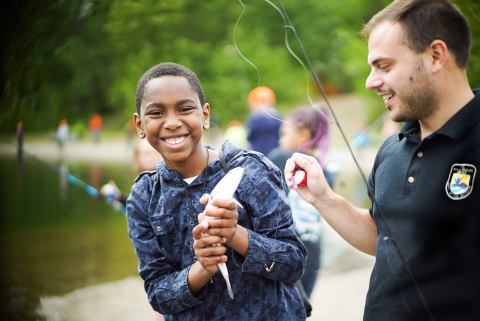
Fishing can be a great way to spend time outside with family and friends. Whether you’re revisiting something you haven’t done in years or you’re wanting to try it for the first time, don’t feel overwhelmed! These basics will get you started fishing responsibly!
Checklist for Fishing in Fresh Water:
A state fishing license
(depending on your age)
A fishing rod and reel
4- to 12-pound-test monofilament fishing line
A package of fishing weights
Fishhooks (Number 6–10 size)
A plastic or cork bobber
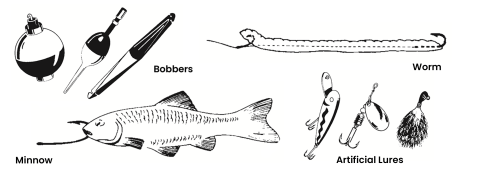
A selection of live bait or fishing lures (Be sure to check with local regulations. Some areas prohibit certain types of bait.)
Rubber fishing net and rubber glove
You’ll find everything you need at a fishing tackle or sporting goods store. While you’re in the store, pick up a copy of your state’s fishing laws (or regulations), which will tell you the types of fish, the minimum size limit, and the number of fish you can catch in one day.
PRO-TIP: Some libraries, state agencies, national fish hatcheries, and national wildlife refuges even offer tackle loaner programs for families and beginning anglers. Call around in your area to see what’s available!
Choosing and Setting Up Your First Fishing Rod
Many outdoor retailers sell kits that include everything you need (and a special excise tax ensures that a portion of the sales gets funneled back into conservation!) Choose a fishing rod that you can hold comfortably in one hand. Two of the most common used for beginners are a closed spin casting reel and an open-bail spinning reel.
Closed Spin-Casting Reels
use a rod with a pistol-like grip and a reel that’s mounted on the top of the rod’s handle. Line is released using a push button on the reel. This is the easiest rod and reel for beginners.
Open-Bail Spinning Reels
use a rod with a straight handle and a reel that’s mounted under the handle. Line is released using your index finger.
Setting Up Your Hook, Line, and Sinker
Now you are ready to set up your rod with hook, line, and sinker.
Tie on a fishhook. (Check out an easy beginners' knot below.)
Attach 1 or 2 sinkers, 6 to 12 inches above the hook. This weight will keep your bait or lure down in the water and will help swing it away from shore.
A bobber lets you know when fish are biting, because it moves up and down in the water as fish nibble at the bait. Most bobbers attach to fishing line with a spring clip and move up and down the line easily, depending on how deep you want to fish the bait.
Tying an Improved Clinch Knot:
Step 1: Pass line through the hook eye and, with the loose end, make 5 turns around the standing line. Insert the loose end of the line between the eye and the first loop formed.
Step 2: Bring the loose end through the large second loop formed. Wet the line and tighten the knot slowly.
How to Tie Fishing Knots
Learning to Cast
Once you’ve picked out all your gear, it’s time to practice. To practice your cast, remove the hook and tie on an rubber weight called a casting plug. Next, find an open area away from other people where you can practice casting.
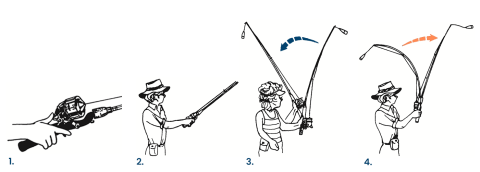
A closed spin-casting reel has a button that you push with your thumb to release the line.
Grasp the rod’s pistol grip with one hand. Push the reel’s thumb button down and hold it in.
Face the target area with body turned at a slight angle, about a quarter turn. Aim the rod tip toward the target, about level with your eyes.
Swiftly and smoothly, bend your arm at the elbow, raising your hand with the rod until it almost reaches eye level.
When the rod is almost straight up and down move your forearm forward with a slight wrist movement. When the rod reaches eye level, release the thumb button.
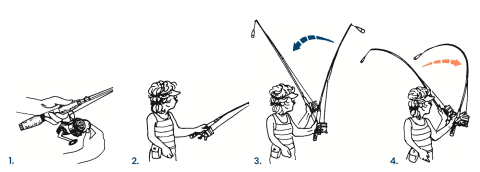
With an open-bail spinning reel, you use your finger to release the line.
Grasp the rod’s handle, placing the reel “stem” that attaches the reel to the rod between your middle fingers. Place your thumb on top of the handle and extend your forefinger to touch the spool cover. With the other hand, rotate the reel spool until the line roller is directly beneath your extended index finger. Pick up line in front of the roller with your index finger and open the reel’s bail with your other hand.
Face the target area with body turned at a slight angle — about a quarter turn. The arm holding the rod handle should be closest to the target. Aim the rod tip toward the target at about eye level.
Swiftly and smoothly, using just one motion, bend your casting arm at the elbow and raise your forearm so that your hand is almost at eye level.
When the rod is almost straight up and down move your forearm forward with a slight wrist movement. When the rod reaches eye level, straighten your forefinger to release the line.
How did you do? If the plug landed close in front of you, you released the line too late. If the plug went more or less straight up, you released the line too soon.
Catch and Release
Respecting the catch is an important conservation ethic. Fish should never be wasted. If you catch a fish that is under the legal or minimum size or that you do not want to keep, release it quickly. Here are three tips to make sure the fish you release has the best chance at surviving.
Keep fish as wet as possible. Fish have a natural mucus layer that protects them in the water. Wet your hands or use wet rubberized gloves and a rubber net to handle the fish.
Minimize airtime. Keep fish underwater as long as possible while removing the hook, getting ready for a photo, or preparing to release.
If the fish has swallowed the hook, do not tear the hook out. Simply cut the line as close to the mouth as possible.
You can revive a fish by gently moving it back and forth in the water so that water runs through its gills. When it begins to move around and can swim normally, let it go.
Safety First!
Fish with a companion who can offer help in an emergency
Be careful when handling sharp hooks
Don’t cast near other people, and always look around before making a cast.
Wear a Coast Guard-approved personal flotation device or life vest when wading or in a boat.
Practicing Conservation
A good angler respects our natural resources and wants to conserve them for others to enjoy. Always carry out what you brought in and never leave behind plastic containers or packaging. Fishing line is very dangerous to birds and other wildlife, so pick up and recycle. To protect the water from
, never move fish or plants from one water body to another or release unused live bait into the water.
Learn more about protecting the water.
Go Fish!
There are many
places to fish
including many
national wildlife refuges and national fish hatcheries
!
Look for a weedy or rocky area where the water is several feet deep. Look for areas where the bottom changes in some way — from sand to gravel or from sand to mud. Stay quiet and avoid disturbing the water or you may scare fish away. Cast the bait as far from shore as you can and watch the bobber. When a fish has the bait, it will probably try to swim away, pulling the bobber under the water. When that happens, raise the tip of the rod quickly to set the hook and reel your catch in.
Learn more about fish species you may see
!
This was adapted from the “fishing is fun for everyone” brochure made possible by a partnership between the U.S. Fish & Wildlife Service, the American Sportfishing Association, and National Fishing and Boating Week.
https://www.fws.gov/program/wildlife-and-sport-fish-restoration |
| Markdown | [Skip to main content](https://www.fws.gov/story/guide-fishing-first-time#main-content)

An official website of the United States government
Here’s how you know
Here’s how you know

**Official websites use .gov**
A **.gov** website belongs to an official government organization in the United States.

**Secure .gov websites use HTTPS**
A **lock** ( Locked padlock icon) or **https://** means you’ve safely connected to the .gov website. Share sensitive information only on official, secure websites.
[](https://www.fws.gov/ "FWS Home")
[U.S. Fish & Wildlife Service](https://www.fws.gov/ "FWS Home")
Toggle navigation
## Utility (Top) navigation
- [About Us](https://www.fws.gov/carp/about) Forward
[Back](https://www.fws.gov/story/guide-fishing-first-time)
- [About Us](https://www.fws.gov/carp/about)
- [Mission & Vision](https://www.fws.gov/carp/about/mission-and-vision)
- [Leadership](https://www.fws.gov/carp/about/leadership)
- [Our Organization](https://www.fws.gov/carp/about/programs)
- [Our Facilities](https://www.fws.gov/carp/our-facilities)
- [Regions](https://www.fws.gov/carp/about/regions)
- [Laws & Regulations](https://www.fws.gov/carp/laws) Forward
[Back](https://www.fws.gov/story/guide-fishing-first-time)
- [Laws & Regulations](https://www.fws.gov/carp/laws)
- [Laws, Agreements & Treaties](https://www.fws.gov/carp/library/categories/laws)
- [Hunting Regulations](https://www.fws.gov/carp/refuges/hunting/rules-regulations-and-improved-access)
- [FWS Federal Register Documents](https://www.fws.gov/carp/federal-register)
- [Library](https://www.fws.gov/carp/library/collections) Forward
[Back](https://www.fws.gov/story/guide-fishing-first-time)
- [Library](https://www.fws.gov/carp/library)
- [Categories](https://www.fws.gov/carp/library/categories)
- [Collections](https://www.fws.gov/carp/library/collections)
- [Home](https://www.fws.gov/)
- [Services](https://www.fws.gov/services "Access services provided by FWS") Forward
[Back](https://www.fws.gov/story/guide-fishing-first-time)
- [Services](https://www.fws.gov/services "Access the landing page for services provided by FWS")
- [Duck Stamps](https://www.fws.gov/service/duck-stamps) Forward
[Back](https://www.fws.gov/story/guide-fishing-first-time)
- [Duck Stamps](https://www.fws.gov/service/duck-stamps)
- [Buy a Duck Stamp or E-Stamp](https://www.fws.gov/service/buy-duck-stamp-or-e-stamp)
- [Buy a Junior Duck Stamp](https://www.fws.gov/service/buy-junior-duck-stamp)
- [State Agencies Apply to E-Stamp](https://www.fws.gov/service/apply-join-e-stamp-program-state-wildlife-agencies-only)
- [Fish Stocking](https://www.fws.gov/service/fish-stocking)
- [Importing & Exporting](https://www.fws.gov/service/importing-and-exporting)
- [Consultation & Technical Assistance](https://www.fws.gov/service/consultation-and-technical-assistance) Forward
[Back](https://www.fws.gov/story/guide-fishing-first-time)
- [Consultation & Technical Assistance](https://www.fws.gov/service/consultation-and-technical-assistance)
- [ESA Section 7 Consultation](https://www.fws.gov/service/section-7-consultations)
- [Habitat Conservation Planning (HCPs)](https://www.fws.gov/service/habitat-conservation-plans)
- [Candidate Conservation Agreements](https://www.fws.gov/service/candidate-conservation-agreements)
- [Conservation Banking](https://www.fws.gov/service/conservation-banking)
- [Conservation Benefit Agreements](https://www.fws.gov/service/conservation-benefit-agreements)
- [Coastal Barrier Resources Act Project Consultation](https://www.fws.gov/service/coastal-barrier-resources-act-project-consultation)
- [Coastal Barrier Resources System Property Documentation](https://www.fws.gov/service/coastal-barrier-resources-system-property-documentation)
- [Financial Assistance](https://www.fws.gov/service/financial-assistance)
- [Species Management](https://www.fws.gov/service/species-management)
- [Investigational New Animal Drugs (INADS)](https://www.fws.gov/service/investigational-new-animal-drugs-inads)
- [Permits](https://www.fws.gov/service/permits)
- [Search All Services](https://www.fws.gov/service/search)
[](https://www.fws.gov/service/duck-stamps)
[Duck Stamps](https://www.fws.gov/service/duck-stamps)
[One of the easiest ways that anyone can support bird habitat conservation is by buying duck stamps.](https://www.fws.gov/service/duck-stamps)
- [Species](https://www.fws.gov/species) Forward
[Back](https://www.fws.gov/story/guide-fishing-first-time)
- [Species](https://www.fws.gov/species)
- [Explore Taxonomic Tree](https://www.fws.gov/explore-taxonomic-tree)
- [Find a Species](https://www.fws.gov/species/search)
[](https://www.fws.gov/story/coolest-mammals-earth)
[Interest story](https://www.fws.gov/story/coolest-mammals-earth)
[Bats: “The Coolest Mammals on Earth”](https://www.fws.gov/story/coolest-mammals-earth)
- [Visit Us](https://www.fws.gov/visit-us) Forward
[Back](https://www.fws.gov/story/guide-fishing-first-time)
- [Visit Us](https://www.fws.gov/visit-us)
- [Events](https://www.fws.gov/events)
- [National Fish Hatcheries](https://www.fws.gov/program/national-fish-hatchery-system "National Fish Hatchery System")
- [National Wildlife Refuges](https://www.fws.gov/program/national-wildlife-refuge-system "National Wildlife Refuge System")
- [Outdoor Recreation](https://www.fws.gov/activities)
- [Recreation Passes](https://www.fws.gov/service/federal-recreational-lands-passes)
- [Locations](https://www.fws.gov/locations)
[](https://www.fws.gov/activity/auto-tour)
[Scenic Drives](https://www.fws.gov/activity/auto-tour)
[Tour routes of great scenic drives on National Wildlife Refuges.](https://www.fws.gov/activity/auto-tour)
- [Get Involved](https://www.fws.gov/get-involved) Forward
[Back](https://www.fws.gov/story/guide-fishing-first-time)
- [Get Involved](https://www.fws.gov/get-involved)
- [Careers and Internships](https://www.fws.gov/careers)
- [Volunteering](https://www.fws.gov/volunteer-opportunity)
- [Friends Partnerships](https://www.fws.gov/program/friends-partnerships)
- [Learning Opportunities](https://www.fws.gov/training)
- [Education Programs](https://www.fws.gov/education-programs)
- [Events](https://www.fws.gov/events)
- [Partnerships](https://www.fws.gov/partner) Forward
[Back](https://www.fws.gov/story/guide-fishing-first-time)
- [Partnerships](https://www.fws.gov/partner)
- [Partnership Categories](https://www.fws.gov/partner/categories)
- [Partner List](https://www.fws.gov/partner/search)
[](https://www.fws.gov/volunteer-opportunity)
[Volunteer](https://www.fws.gov/volunteer-opportunity)
[Search for volunteer opportunities around the country](https://www.fws.gov/volunteer-opportunity)
- [Newsroom](https://www.fws.gov/news) Forward
[Back](https://www.fws.gov/story/guide-fishing-first-time)
- [Newsroom](https://www.fws.gov/news)
- [Press Releases](https://www.fws.gov/press-release)
- [Congressional Testimony](https://www.fws.gov/testimony)
- [Media Contacts](https://www.fws.gov/media-contacts)
[](https://www.fws.gov/news/wildlife-wonders)
[Wild Things](https://www.fws.gov/news/wildlife-wonders)
[News about wonderful wild things and places](https://www.fws.gov/news/wildlife-wonders)
- [Initiatives](https://www.fws.gov/initiatives) Forward
[Back](https://www.fws.gov/story/guide-fishing-first-time)
- [Initiatives](https://www.fws.gov/initiatives)
- [Combating Wildlife Trafficking](https://www.fws.gov/initiative/combating-wildlife-trafficking)
- [Director's Priorities](https://www.fws.gov/initiative/directors-priorities)
- [Climate Change](https://www.fws.gov/initiative/climate-change)
- [Fishing](https://www.fws.gov/initiative/fishing)
- [Invasive Species](https://www.fws.gov/initiative/invasive-species)
- [Pollinators](https://www.fws.gov/initiative/pollinators)
- [Protecting Wildlife](https://www.fws.gov/initiative/protecting-wildlife)
[](https://www.fws.gov/initiative/protecting-wildlife)
[Protecting Wildlife](https://www.fws.gov/initiative/protecting-wildlife)
[Working with others to conserve, protect, and enhance fish, wildlife, plants, and their habitats.](https://www.fws.gov/initiative/protecting-wildlife)
- [I want to](https://www.fws.gov/) Forward
[Back](https://www.fws.gov/story/guide-fishing-first-time)
- I Want To
- [Report Wildlife Crime](https://www.fws.gov/wildlife-crime-tips "Report wildlife trafficking or other wildlife crime to our tip line")
- [Do Business with FWS](https://www.fws.gov/program/contracting "info on contracting with FWS")
- [Volunteer](https://www.fws.gov/volunteer-opportunity)
- [Find a Job or Internship](https://www.fws.gov/careers)
- [Visit a Refuge](https://www.fws.gov/visit-us/refuges)
- [Buy a Duck Stamp](https://www.fws.gov/service/buy-duck-stamp-or-e-stamp)
- [Apply for a Permit](https://www.fws.gov/service/permits "Apply for a Permit or License")
- [Find Funding](https://www.fws.gov/service/financial-assistance)
- [Find Training](https://www.fws.gov/training)
[](https://www.fws.gov/jobs)
[Wild work](https://www.fws.gov/jobs)
[Search employment opportunities with USFWS](https://www.fws.gov/jobs)
## Search
×
# A Guide to Fishing for the First Time

[Image Details](https://www.fws.gov/media/rbff-fish-under-water)
Responsible Fishing Tips for New Anglers
### Fishing can be a great way to spend time outside with family and friends. Whether you’re revisiting something you haven’t done in years or you’re wanting to try it for the first time, don’t feel overwhelmed! These basics will get you started fishing responsibly\!
[Image Details](https://www.fws.gov/media/anchorage-youth-fishing-program)
### **Checklist for Fishing in Fresh Water:**
- [A state fishing license](https://www.takemefishing.org/get-a-fishing-license/) (depending on your age)
- A fishing rod and reel
- 4- to 12-pound-test monofilament fishing line
- A package of fishing weights
- Fishhooks (Number 6–10 size)
- A plastic or cork bobber
- A selection of live bait or fishing lures (Be sure to check with local regulations. Some areas prohibit certain types of bait.)
- Rubber fishing net and rubber glove
You’ll find everything you need at a fishing tackle or sporting goods store. While you’re in the store, pick up a copy of your state’s fishing laws (or regulations), which will tell you the types of fish, the minimum size limit, and the number of fish you can catch in one day.
**PRO-TIP: Some libraries, state agencies, national fish hatcheries, and national wildlife refuges even offer tackle loaner programs for families and beginning anglers. Call around in your area to see what’s available\!**
### **Choosing and Setting Up Your First Fishing Rod**

[Image Details](https://www.fws.gov/media/common-rod-and-reel-options)
Many outdoor retailers sell kits that include everything you need (and a special excise tax ensures that a portion of the sales gets funneled back into conservation!) Choose a fishing rod that you can hold comfortably in one hand. Two of the most common used for beginners are a closed spin casting reel and an open-bail spinning reel.
**Closed Spin-Casting Reels** use a rod with a pistol-like grip and a reel that’s mounted on the top of the rod’s handle. Line is released using a push button on the reel. This is the easiest rod and reel for beginners.
**Open-Bail Spinning Reels** use a rod with a straight handle and a reel that’s mounted under the handle. Line is released using your index finger.
### **Setting Up Your Hook, Line, and Sinker**
[Image Details](https://www.fws.gov/media/common-fishing-tackle-items)
Now you are ready to set up your rod with hook, line, and sinker.
1. Tie on a fishhook. (Check out an easy beginners' knot below.)
2. Attach 1 or 2 sinkers, 6 to 12 inches above the hook. This weight will keep your bait or lure down in the water and will help swing it away from shore.
3. A bobber lets you know when fish are biting, because it moves up and down in the water as fish nibble at the bait. Most bobbers attach to fishing line with a spring clip and move up and down the line easily, depending on how deep you want to fish the bait.
#### **Tying an Improved Clinch Knot:**

[Image Details](https://www.fws.gov/media/improved-clinch-knot)
Step 1: Pass line through the hook eye and, with the loose end, make 5 turns around the standing line. Insert the loose end of the line between the eye and the first loop formed.
Step 2: Bring the loose end through the large second loop formed. Wet the line and tighten the knot slowly.
[How to Tie Fishing Knots](https://www.takemefishing.org/how-to-fish/how-tie-fishing-knots/)
### **Learning to Cast**
Once you’ve picked out all your gear, it’s time to practice. To practice your cast, remove the hook and tie on an rubber weight called a casting plug. Next, find an open area away from other people where you can practice casting.
[Image Details](https://www.fws.gov/media/casting-closed-spin-casting-reel)
**A closed spin-casting reel has a button that you push with your thumb to release the line.**
1. Grasp the rod’s pistol grip with one hand. Push the reel’s thumb button down and hold it in.
2. Face the target area with body turned at a slight angle, about a quarter turn. Aim the rod tip toward the target, about level with your eyes.
3. Swiftly and smoothly, bend your arm at the elbow, raising your hand with the rod until it almost reaches eye level.
4. When the rod is almost straight up and down move your forearm forward with a slight wrist movement. When the rod reaches eye level, release the thumb button.
**With an open-bail spinning reel, you use your finger to release the line.**
[Image Details](https://www.fws.gov/media/casting-open-bail-spinning-reel)
1. Grasp the rod’s handle, placing the reel “stem” that attaches the reel to the rod between your middle fingers. Place your thumb on top of the handle and extend your forefinger to touch the spool cover. With the other hand, rotate the reel spool until the line roller is directly beneath your extended index finger. Pick up line in front of the roller with your index finger and open the reel’s bail with your other hand.
2. Face the target area with body turned at a slight angle — about a quarter turn. The arm holding the rod handle should be closest to the target. Aim the rod tip toward the target at about eye level.
3. Swiftly and smoothly, using just one motion, bend your casting arm at the elbow and raise your forearm so that your hand is almost at eye level.
4. When the rod is almost straight up and down move your forearm forward with a slight wrist movement. When the rod reaches eye level, straighten your forefinger to release the line.
How did you do? If the plug landed close in front of you, you released the line too late. If the plug went more or less straight up, you released the line too soon.
### **Catch and Release**
[Image Details](https://www.fws.gov/media/cutthroat-trout)
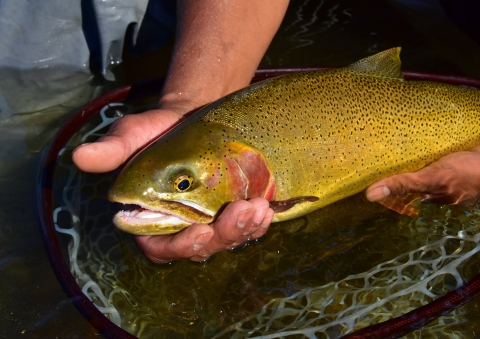
Respecting the catch is an important conservation ethic. Fish should never be wasted. If you catch a fish that is under the legal or minimum size or that you do not want to keep, release it quickly. Here are three tips to make sure the fish you release has the best chance at surviving.
- Keep fish as wet as possible. Fish have a natural mucus layer that protects them in the water. Wet your hands or use wet rubberized gloves and a rubber net to handle the fish.
- Minimize airtime. Keep fish underwater as long as possible while removing the hook, getting ready for a photo, or preparing to release.
- If the fish has swallowed the hook, do not tear the hook out. Simply cut the line as close to the mouth as possible.
- You can revive a fish by gently moving it back and forth in the water so that water runs through its gills. When it begins to move around and can swim normally, let it go.
[Catch and Release Tips](https://www.takemefishing.org/how-to-fish/how-to-catch-fish/how-to-release-a-fish/)
### **Safety First\!**
- Fish with a companion who can offer help in an emergency
- Be careful when handling sharp hooks
- Don’t cast near other people, and always look around before making a cast.
- Wear a Coast Guard-approved personal flotation device or life vest when wading or in a boat.
[Image Details](https://www.fws.gov/media/canada-goose-entangled-cheney-lake-anchorage-alaska)
### **Practicing Conservation**
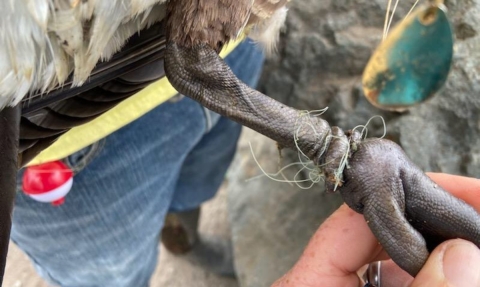
A good angler respects our natural resources and wants to conserve them for others to enjoy. Always carry out what you brought in and never leave behind plastic containers or packaging. Fishing line is very dangerous to birds and other wildlife, so pick up and recycle. To protect the water from invasive species **invasive species**
An invasive species is any plant or animal that has spread or been introduced into a new area where they are, or could, cause harm to the environment, economy, or human, animal, or plant health. Their unwelcome presence can destroy ecosystems and cost millions of dollars.
[Learn more about invasive species](https://www.fws.gov/glossary/invasive-species) , never move fish or plants from one water body to another or release unused live bait into the water.
[Learn more about protecting the water.](https://www.fws.gov/story/five-ways-protect-our-waters)
### **Go Fish\!**
There are many [places to fish](https://www.takemefishing.org/where-to-fish-and-boat/) including many [national wildlife refuges and national fish hatcheries](https://www.fws.gov/fishing/map)\!
Look for a weedy or rocky area where the water is several feet deep. Look for areas where the bottom changes in some way — from sand to gravel or from sand to mud. Stay quiet and avoid disturbing the water or you may scare fish away. Cast the bait as far from shore as you can and watch the bobber. When a fish has the bait, it will probably try to swim away, pulling the bobber under the water. When that happens, raise the tip of the rod quickly to set the hook and reel your catch in.
[Learn more about fish species you may see](https://www.fws.gov/story/expert-tips-hook-perfect-fish)\!
*This was adapted from the “fishing is fun for everyone” brochure made possible by a partnership between the U.S. Fish & Wildlife Service, the American Sportfishing Association, and National Fishing and Boating Week. [https://www.fws.gov/program/wildlife-and-sport-fish-restoration](https://www.fws.gov/program/wildlife-and-sport-fish-restoration)*
### Story Tags
Fishing
Habitat conservation
Recreation
Water conservation
### Recreational Activities
[Fishing](https://www.fws.gov/activity/fishing)
### Edited By
[Holly Richards](https://www.fws.gov/staff-profile/holly-richards)
[Recreation](https://www.fws.gov/news/recreation)
### Related Stories
[](https://www.fws.gov/story/clean-drain-dry)
[](https://www.fws.gov/story/clean-drain-dry)
[Recreation](https://www.fws.gov/story/clean-drain-dry)
[Clean, Drain, Dry](https://www.fws.gov/story/clean-drain-dry)
[Oct 7, 2021](https://www.fws.gov/story/clean-drain-dry)
[](https://www.fws.gov/story/face-fishing-younger-more-diverse-and-supporting-conservation-billions)
[](https://www.fws.gov/story/face-fishing-younger-more-diverse-and-supporting-conservation-billions)
[Recreation](https://www.fws.gov/story/face-fishing-younger-more-diverse-and-supporting-conservation-billions)
[The Face of Fishing: Younger, More Diverse, and Supporting Conservation by the Billions](https://www.fws.gov/story/face-fishing-younger-more-diverse-and-supporting-conservation-billions)
[Aug 18, 2021](https://www.fws.gov/story/face-fishing-younger-more-diverse-and-supporting-conservation-billions)
### Latest Stories
[](https://www.fws.gov/rivers/story/2026-04/our-nations-nature-1)
[](https://www.fws.gov/rivers/story/2026-04/our-nations-nature-1)
[Wildlife Wonders](https://www.fws.gov/rivers/story/2026-04/our-nations-nature-1)
[Our nation's nature](https://www.fws.gov/rivers/story/2026-04/our-nations-nature-1)
[Apr 6, 2026](https://www.fws.gov/rivers/story/2026-04/our-nations-nature-1)
[](https://www.fws.gov/rivers/story/2026-04/birds-keep-flags-company-bosque-del-apache-national-wildlife-refuge)
[](https://www.fws.gov/rivers/story/2026-04/birds-keep-flags-company-bosque-del-apache-national-wildlife-refuge)
[History and Culture](https://www.fws.gov/rivers/story/2026-04/birds-keep-flags-company-bosque-del-apache-national-wildlife-refuge)
[Birds Keep Flags Company at Bosque del Apache National Wildlife Refuge](https://www.fws.gov/rivers/story/2026-04/birds-keep-flags-company-bosque-del-apache-national-wildlife-refuge)
[Apr 6, 2026](https://www.fws.gov/rivers/story/2026-04/birds-keep-flags-company-bosque-del-apache-national-wildlife-refuge)
[](https://www.fws.gov/story/2026-04/hunt-unit-san-diego-nwr-has-closed-season)
[](https://www.fws.gov/story/2026-04/hunt-unit-san-diego-nwr-has-closed-season)
[Land Management](https://www.fws.gov/story/2026-04/hunt-unit-san-diego-nwr-has-closed-season)
[Hunt Unit at San Diego NWR has CLOSED for the season](https://www.fws.gov/story/2026-04/hunt-unit-san-diego-nwr-has-closed-season)
[Apr 5, 2026](https://www.fws.gov/story/2026-04/hunt-unit-san-diego-nwr-has-closed-season)

Working with others to conserve, protect and enhance fish, wildlife, plants and their habitats for the continuing benefit of the American people.
## Footer Menu - Employment
- [Careers & Internships](https://www.fws.gov/careers)
- [Contracting](https://www.fws.gov/program/contracting)
## Footer Menu - Site Links
- [Leadership](https://www.fws.gov/about/leadership)
- [Frequently Asked Questions](https://www.fws.gov/frequently-asked-questions "Questions from the customer service call center")
- [Contact FWS](https://www.fws.gov/contact-us)
## Footer Menu - Legal
- [Accessibility](https://www.fws.gov/help/accessibility)
- [Freedom of Information Act](https://www.fws.gov/program/fws-freedom-information-act-foia)
- [Notices](https://www.fws.gov/notices)
- [Privacy Policy](https://www.doi.gov/privacy)
- [Disclaimers](https://www.fws.gov/disclaimer)
- [Information Quality](https://www.fws.gov/program/information-quality)
- [Vulnerability Disclosure Policy](https://www.fws.gov/vulnerability-disclosure-policy)
## Footer Menu - External Links
- [DOI](https://www.doi.gov/)
- [USA.GOV](https://www.usa.gov/) |
| Readable Markdown | Responsible Fishing Tips for New Anglers
### Fishing can be a great way to spend time outside with family and friends. Whether you’re revisiting something you haven’t done in years or you’re wanting to try it for the first time, don’t feel overwhelmed! These basics will get you started fishing responsibly\!
### **Checklist for Fishing in Fresh Water:**
- [A state fishing license](https://www.takemefishing.org/get-a-fishing-license/) (depending on your age)
- A fishing rod and reel
- 4- to 12-pound-test monofilament fishing line
- A package of fishing weights
- Fishhooks (Number 6–10 size)
- A plastic or cork bobber
- A selection of live bait or fishing lures (Be sure to check with local regulations. Some areas prohibit certain types of bait.)
- Rubber fishing net and rubber glove
You’ll find everything you need at a fishing tackle or sporting goods store. While you’re in the store, pick up a copy of your state’s fishing laws (or regulations), which will tell you the types of fish, the minimum size limit, and the number of fish you can catch in one day.
**PRO-TIP: Some libraries, state agencies, national fish hatcheries, and national wildlife refuges even offer tackle loaner programs for families and beginning anglers. Call around in your area to see what’s available\!**
### **Choosing and Setting Up Your First Fishing Rod**
Many outdoor retailers sell kits that include everything you need (and a special excise tax ensures that a portion of the sales gets funneled back into conservation!) Choose a fishing rod that you can hold comfortably in one hand. Two of the most common used for beginners are a closed spin casting reel and an open-bail spinning reel.
**Closed Spin-Casting Reels** use a rod with a pistol-like grip and a reel that’s mounted on the top of the rod’s handle. Line is released using a push button on the reel. This is the easiest rod and reel for beginners.
**Open-Bail Spinning Reels** use a rod with a straight handle and a reel that’s mounted under the handle. Line is released using your index finger.
### **Setting Up Your Hook, Line, and Sinker**
Now you are ready to set up your rod with hook, line, and sinker.
1. Tie on a fishhook. (Check out an easy beginners' knot below.)
2. Attach 1 or 2 sinkers, 6 to 12 inches above the hook. This weight will keep your bait or lure down in the water and will help swing it away from shore.
3. A bobber lets you know when fish are biting, because it moves up and down in the water as fish nibble at the bait. Most bobbers attach to fishing line with a spring clip and move up and down the line easily, depending on how deep you want to fish the bait.
#### **Tying an Improved Clinch Knot:**
Step 1: Pass line through the hook eye and, with the loose end, make 5 turns around the standing line. Insert the loose end of the line between the eye and the first loop formed.
Step 2: Bring the loose end through the large second loop formed. Wet the line and tighten the knot slowly.
[How to Tie Fishing Knots](https://www.takemefishing.org/how-to-fish/how-tie-fishing-knots/)
### **Learning to Cast**
Once you’ve picked out all your gear, it’s time to practice. To practice your cast, remove the hook and tie on an rubber weight called a casting plug. Next, find an open area away from other people where you can practice casting.
**A closed spin-casting reel has a button that you push with your thumb to release the line.**
1. Grasp the rod’s pistol grip with one hand. Push the reel’s thumb button down and hold it in.
2. Face the target area with body turned at a slight angle, about a quarter turn. Aim the rod tip toward the target, about level with your eyes.
3. Swiftly and smoothly, bend your arm at the elbow, raising your hand with the rod until it almost reaches eye level.
4. When the rod is almost straight up and down move your forearm forward with a slight wrist movement. When the rod reaches eye level, release the thumb button.
**With an open-bail spinning reel, you use your finger to release the line.**
1. Grasp the rod’s handle, placing the reel “stem” that attaches the reel to the rod between your middle fingers. Place your thumb on top of the handle and extend your forefinger to touch the spool cover. With the other hand, rotate the reel spool until the line roller is directly beneath your extended index finger. Pick up line in front of the roller with your index finger and open the reel’s bail with your other hand.
2. Face the target area with body turned at a slight angle — about a quarter turn. The arm holding the rod handle should be closest to the target. Aim the rod tip toward the target at about eye level.
3. Swiftly and smoothly, using just one motion, bend your casting arm at the elbow and raise your forearm so that your hand is almost at eye level.
4. When the rod is almost straight up and down move your forearm forward with a slight wrist movement. When the rod reaches eye level, straighten your forefinger to release the line.
How did you do? If the plug landed close in front of you, you released the line too late. If the plug went more or less straight up, you released the line too soon.
### **Catch and Release**
Respecting the catch is an important conservation ethic. Fish should never be wasted. If you catch a fish that is under the legal or minimum size or that you do not want to keep, release it quickly. Here are three tips to make sure the fish you release has the best chance at surviving.
- Keep fish as wet as possible. Fish have a natural mucus layer that protects them in the water. Wet your hands or use wet rubberized gloves and a rubber net to handle the fish.
- Minimize airtime. Keep fish underwater as long as possible while removing the hook, getting ready for a photo, or preparing to release.
- If the fish has swallowed the hook, do not tear the hook out. Simply cut the line as close to the mouth as possible.
- You can revive a fish by gently moving it back and forth in the water so that water runs through its gills. When it begins to move around and can swim normally, let it go.
### **Safety First\!**
- Fish with a companion who can offer help in an emergency
- Be careful when handling sharp hooks
- Don’t cast near other people, and always look around before making a cast.
- Wear a Coast Guard-approved personal flotation device or life vest when wading or in a boat.
### **Practicing Conservation**
A good angler respects our natural resources and wants to conserve them for others to enjoy. Always carry out what you brought in and never leave behind plastic containers or packaging. Fishing line is very dangerous to birds and other wildlife, so pick up and recycle. To protect the water from , never move fish or plants from one water body to another or release unused live bait into the water.
[Learn more about protecting the water.](https://www.fws.gov/story/five-ways-protect-our-waters)
### **Go Fish\!**
There are many [places to fish](https://www.takemefishing.org/where-to-fish-and-boat/) including many [national wildlife refuges and national fish hatcheries](https://www.fws.gov/fishing/map)\!
Look for a weedy or rocky area where the water is several feet deep. Look for areas where the bottom changes in some way — from sand to gravel or from sand to mud. Stay quiet and avoid disturbing the water or you may scare fish away. Cast the bait as far from shore as you can and watch the bobber. When a fish has the bait, it will probably try to swim away, pulling the bobber under the water. When that happens, raise the tip of the rod quickly to set the hook and reel your catch in.
[Learn more about fish species you may see](https://www.fws.gov/story/expert-tips-hook-perfect-fish)\!
*This was adapted from the “fishing is fun for everyone” brochure made possible by a partnership between the U.S. Fish & Wildlife Service, the American Sportfishing Association, and National Fishing and Boating Week. <https://www.fws.gov/program/wildlife-and-sport-fish-restoration>* |
| Shard | 28 (laksa) |
| Root Hash | 4150809272669985828 |
| Unparsed URL | gov,fws!www,/story/guide-fishing-first-time s443 |