ℹ️ Skipped - page is already crawled
| Filter | Status | Condition | Details |
|---|---|---|---|
| HTTP status | PASS | download_http_code = 200 | HTTP 200 |
| Age cutoff | PASS | download_stamp > now() - 6 MONTH | 0.1 months ago |
| History drop | PASS | isNull(history_drop_reason) | No drop reason |
| Spam/ban | PASS | fh_dont_index != 1 AND ml_spam_score = 0 | ml_spam_score=0 |
| Canonical | PASS | meta_canonical IS NULL OR = '' OR = src_unparsed | Not set |
| Property | Value |
|---|---|
| URL | https://www.filmsite.org/youn.html |
| Last Crawled | 2026-04-09 18:01:57 (1 day ago) |
| First Indexed | 2013-08-08 18:00:51 (12 years ago) |
| HTTP Status Code | 200 |
| Meta Title | Young Frankenstein (1974) |
| Meta Description | null |
| Meta Canonical | null |
| Boilerpipe Text | Background
Young
Frankenstein
(1974) is one of writer-producer-director Mel
Brooks' best films - a nostalgic, hilarious spoof-tribute to classic
horror films (with its authentic black and white cinematography
and production design/set decoration), and in particular, of Mary
Wollstonecraft Shelley's classic novel about corpse revival by
a God-aspiring mad scientist. This film had everything -
slapstick, farce, dirty (or ribald), bawdy humor and irreverent
satire. Many of Brooks' films were filled with physical gags, terrible
puns, one-liners, and shattered taboos. Old-style wipes, fades
to black and iris shots were numerous throughout.
It was one of a number of Brooks' spoof-parody films
beginning in the late 1960s that lampooned various genre films, tropes,
formats and conventions. This one came way before absurdist spoofs
like
Airplane! (1980)
and
The Naked Gun: From the Files
of Police Squad! (1988)
. All
of Brooks' best films were anarchic comedies that skewered their
source material while still maintaining a basic reverence:
The Producers (1967)
- Brooks' first hit
and cinematic debut - about show business, musicals, and Broadway
culture, including an incisive critique of Hitler and the Nazis
Blazing Saddles (1974)
-
released just before YF, a westerns spoof with stereotypical characters:
a saloon seductress, a washed-up gunslinger, corrupt government
land speculators, and a black sheriff - and much more
Silent Movie (1976)
- a spoof of Hollywood
and silent films, with Brooks portraying Mel Funn - a down and
out film director who attempted to pitch his new script and recruit
celebrity stars to participate
High Anxiety (1977)
-
a parody of Hitchcock's suspense-thrillers (e.g.,
Spellbound
(1945)
,
Vertigo (1958)
,
and
The
Birds (1963)
), with a subplot
involving an innocent, wrongfully-accused man
History Of The World: Part I (1981)
- an
anthology film composed of a series of historical vignettes or
set-pieces spanning from the Stone Age, through the Old Testament
Biblical period, to the Roman Empire and Spanish Inquisition to
the French Revolution; it included sub-genre spoofs of "sword
and sandal"
epics and "costume dramas"
Spaceballs (1987)
- a parody of sci-fi films,
in particular the
Star Wars
franchise
(trilogy),
and other sci-fi classics such as
Star
Trek
,
Alien
, and
Planet
of the Apes
Robin Hood: Men In Tights (1993)
- a spoof
of traditional Robin Hood medieval tales, specifically Kevin Costner’s
awful
Robin Hood: Prince Of Thieves (1991)
Dracula: Dead And Loving It (1995)
- an
attempt to parody
Dracula
horror films (especially
Dracula
(1931)
) and Bram Stoker's 1897 novel
Dracula
(and
Coppola's film
Bram
Stoker's Dracula (1992)
), starring
Leslie Nielsen as the Count
Later, co-writer and actor Gene Wilder attempted his own Old Dark House
genre spoof,
Haunted Honeymoon (1986)
.
Brooks' horror spoof mostly
parodied the 'original trilogy' of
Frankenstein
films from 1931
to 1939, although there six Universal films that prominently featured
the Monster:
Frankenstein (1931)
,
starring Colin Clive as mad scientist Dr. Henry Frankenstein, Boris
Karloff as the Monster, and Dwight Frye as the sadistic hunchback
Fritz (the Igor character)
Bride of Frankenstein (1935)
,
a sequel reprising Colin Clive as mad scientist Dr. Henry Frankenstein,
Ernst Thesiger as crazed Dr. Pretorius, Karloff again as the Monster,
Dwight Frye as Pretorius' assistant Karl, and Elsa Lanchester as
the Monster's 'Bride'
Son of Frankenstein (1939)
, a second sequel
starring Basil Rathbone as Dr. Henry Frankenstein's orphaned scientist
son Baron Wolf von Frankenstein, Karloff as the Monster, Bela Lugosi
as bearded and hunchbacked Ygor - the ex-assistant of Henry, and
Lionel Atwill as Inspector Krogh, the village’s chief of
police
The Ghost of Frankenstein (1942)
, starring
Sir Cedric Hardwicke as Dr. Ludwig Frankenstein (the second son
of Henry and brother of the Baron Wolf von Frankenstein), Lionel
Atwill as Ludwig's mad scientist colleague Dr. Theodore Bohmer
(Henry Frankenstein's mentor), and Lon Chaney Jr. replacing Karloff
as The Monster, and Bela Lugosi reprising his role as the crazed
Ygor
Frankenstein Meets the Wolfman (1943)
, starring
Patric Knowles as mad scientist Dr. Frank Mannering, Ilona Massey
as Baroness Elsa Frankenstein, and Bela Lugosi in his first appearance
as the Monster, while this time, Lon Chaney Jr. portrayed The Wolf
Man (Lawrence Talbot)
House of Frankenstein (1944)
, starring Boris
Karloff as mad scientist Dr. Gustav Niemann, J. Carrol Naish as
his hunchbacked companion Daniel (a version of Fritz, Karl, and
Ygor), and stunt man Glenn Strange debuting as the Monster
It was shot in
the same castle and with the same props and lab equipment (created
and loaned by property manager Ken Strickfaden) as the original James
Whale horror film
Frankenstein (1931)
.
Kenneth Mars' character, Police Inspector Hans Wilhelm
Friederich Kemp, had mannerisms and a mechanical arm/hand that resembled
Peter Sellers' Dr. Strangelove character from
Dr.
Strangelove, Or... (1964)
, Lionel Atwill's local police
Inspector Krogh character with a mechanical wooden arm in
Son
of Frankenstein (1939),
and Bruce Campbell's chainsaw
arm in the
Evil Dead
franchise.
Although the low-comedy film had two Academy Awards
nominations (that didn't win), Best Adapted Screenplay (for Mel Brooks
and star Gene Wilder) and Best Sound, two deserving cast members,
Gene Wilder and Madeline Kahn, were un-nominated, as was the wonderfully
crisp black-and-white cinematography by Gerald Hirschfeld. It was the
fourth
highest-grossing film of 1974 at $86.3 million (domestic),
with a production budget of only $2.8 million. [Note: The top 3 films
of 1974 were Brooks' own
Blazing Saddles (1974)
at
$119.5 million,
The Towering Inferno (1974)
at $115 million,
and
The Trial of Billy Jack (1974)
at $89 million.]
It was released about the same time as the Italian-produced,
originally X-rated and 3-D
Flesh
for Frankenstein (1974) (aka Andy Warhol's Frankenstein)
, a
gory send-up horror film directed by Paul Morrissey. The decadent,
campy and grotesque film starred Udo Keir as Baron von Frankenstein.
As happened with Brooks'
earlier work
The
Producers (1968)
(on Broadway from 2001-2007), this film was
adapted into a Broadway musical in 2007 (through 2009), with a cast
including Roger Bart (as Frederick "Frahnkensteen")
and TV's
Will & Grace's
Megan Mullally as his fiancee
Elizabeth.
Plot Synopsis
The film's title credits were viewed above a view of
an ancient dark castle on a jagged peaked outcropping, with lightning
and thunder striking during a rainstorm, as the concrete block letters
YOUNG FRANKENSTEIN appeared. The camera slowly panned left across
the castle's courtyard, and came to rest outside an ornate window
illuminated by an indoor candle.
As a clock gonged twelve o'clock midnight (it actually
struck 13 times), the camera moved to a fireplace and before it,
a massive wooden coffin set on a table. The top of the casket was
inscribed with engraved, raised letters: BARON VON FRANKENSTEIN,
with two family insignias on either side. On the last gong, the coffin
lid popped open, revealing the skeletal, dressed-up remains of the
esteemed baron in
rigor
mortis
:
there was a toothy skull, and two gnarly, bony hands clinging to
a flat metal box. Two disembodied hands reached
in to seize the box, but the baron's grip held tight and the box
snapped back to his chest. On the third attempt, the box was released.
An iris closed in on the scene.
The next sequence was introduced by a linked opening
iris. Young brain neuro-surgeon and
frizzy-haired med-school professor Dr. Frederick
Frankenstein (Gene Wilder) was lecturing at an American medical school
in Baltimore, to an arena-shaped classroom of white-coated young
students - it was the first dialogue in the film:
If we look at the base of a brain which has just
been removed from a skull, there's very little of the midbrain
that we can actually see. Yet, as I demonstrated in my lecture
last week, if the under aspects of the temporal lobes are gently
pulled apart, the upper portion of the stem of the brain can be
seen. This so-called brainstem consists of the midbrain, a rounded
protrusion called the pons, and a stalk tapering downwards called
the medulla oblongata which passes out of the skull through the
foramen magnum and becomes, of course, the spinal cord.
In the back of the room, an unidentified, bespectacled
elderly man entered. He was grasping the metal box in front of him
- the one wrestled from the Baron, before he went to search for a
vacant seat. After drawing a sketch of brain components on the blackboard,
Dr. Frankenstein asked for questions from the students, and one persistent
student (Danny Goldman) rose and asked:
I have one question, Dr Frankenstein.
The Doctor was
in denial about
his actual heritage as "the
grandson
of the famous
Dr. Victor Frankenstein who went into graveyards, dug up freshly
buried corpses and transformed dead components into..." [Note:
In actual fact, Dr. Frederick Frankenstein would have to be, at the
least, Victor's
great-great-great-great
grandson.]
He defiantly corrected the student about the pronunciation
of his name (and would continue to do so throughout the film), to disassociate
himself from his family name:
"That's Fronk-en-steen...My name, it's pronounced
'Fronk-en-steen'!"
Incensed and briefly losing his composure, Dr. Frankenstein
said he wanted to be remembered by his own "small contributions to
science." He referred to his "accidental relationship" to his famous
ancestor, and called him "a famous cuckoo." He
rang a gong to start a demonstration of the difference between
reflexive
and
voluntary
nerve
impulses.
A skinny, emaciated, and elderly subject in a white
surgical gown, named Mr. Hilltop (Liam Dunn), was wheeled on a gurney
through double doors into the classroom by two orderlies (John Dennis).
After the man was instructed to "hop" off the table, the
subject was instructed to raise and lower his left knee, to provide
an example of "voluntary"
nerve impulses. In contrast, "reflex" movements were made "independently
of the will." Frankenstein suddenly turned on the vulnerable patient
and threatened to jab him in the groin with his knee, as he shouted: "You
filthy, rotten, yellow son of a bitch." Naturally, Mr. Hilltop
reacted - he flinched and doubled forward to protect himself, causing
a pleased response on Frankenstein's face.
The manic doctor then proposed: "What if we
block
the
nerve impulse by simply applying local pressure." A metal bicycle
clamp was attached to the back of the patient's head "at the
swelling on the posterior nerve roots" for five or six seconds.
After the pause, Frankenstein again jabbed his knee toward the patient
and actually struck the man's groin as he shouted: "Why, you
mother-grabbing bastard!" - this time, the patient did not
flinch, although he groaned to himself in intense pain. Frankenstein
intoned: "All communication
is shut off. In spite of our mechanical magnificence, if
it were not for this continuous stream of motor impulses, we would
collapse
like a bunch of broccoli." The removal of the
clamp caused the patient to collapse in major pain as predicted,
and the class appreciatively applauded. The doctor whispered to one
of his orderlies as Hilltop was wheeled away: "Give him an extra
dollar."
Frankenstein stated his strong theoretical belief that
regeneration or reanimation of dead nerve tissue was impossible:
In conclusion, it should be noted... .that any more
than common injury to the nerve root is always serious. Because
once a nerve fiber is severed, there is no way, in heaven or on
earth, to regenerate life back into it.
A second question from the same student challenged
the doctor's theory: "Isn't it true that Darwin preserved a piece
of vermicelli in a glass case until, by some extraordinary means,
it actually began to move with a
voluntary
motion?" The admonishing
Frankenstein insisted on being precise - and then asserted: "You
have to remember that a worm, with very few exceptions, is not a
human being." The student pressed Frankenstein about the basis of
his grandfather's work - the reanimation of dead tissue (as evidenced
by more modern medical advancements with heart and kidney transplants),
but the doctor denied being even curious or intrigued about his grandfather's
experiments in "bringing back to life what was once dead":
My grandfather was a very sick man...You are talking
about the non-sensical ravings of a lunatic mind. Dead is dead!...Hearts
and kidneys are Tinkertoys. I'm talking about the central nervous
system....I am a scientist, not a philosopher! You have more chance
of reanimating this scalpel than you have of mending a broken nervous
system....My grandfather's work was doo-doo! I am not interested
in death! The only thing that concerns me is the preservation of
life
!
To emphasize his point, Frankenstein had grabbed a
scalpel instrument from his tray and emphatically jabbed it downwards
- directly into his right thigh. Wild applause erupted as the class
was dismissed and students filed out.
The man with the metal box approached Dr. Frankenstein
in the front of the room - and was reprimanded for again mispronouncing
his name. He introduced himself as Herr Gerhardt Falkstein
(Richard Haydn), a solicitor: "I have travelled 5,000 miles
to bring you the will of your great-grandfather. Baron Beaufort von
Frankenstein."
Frankenstein had inherited the Transylvanian ancestral
estate of his grandfather, and was required to travel to Europe to
inspect the property.
A slow wipe-right introduced the next scene set on
the platform of the Baltimore train station. Dr. Frankenstein was
bid goodbye by his spoiled and untouchable socialite fiancee Elizabeth
(Madeline Kahn), and was reluctant to have him leave: "Oh,
my sweet darling. Oh, my dearest love. I'll count the hours that
you're away." But she refused a kiss on the lips: "I'm
going to that party at Nana and Nicky's later. I don't wanna smear
my lipstick."
But she still vowed that she was passionately in love with him: "You've
got it, mister...I'm yours, all of me. What else can I say?" When
he reached to touch her hair, she again shrieked: "The hair!
The hair! Just been set." She also cautioned him about wrinkling
her taffeta dress or ruining her nails. She feared that physical
contact with the infamous doctor would literally tarnish her appearance.
As the train departed, they touched elbows (a substitute for a kiss),
and he threw her an invisible kiss. As the train pulled away, Elizabeth
was enveloped in an enormous cloud of white steam. Dr. Frankenstein
traveled to his first stop of New York City, and had to listen to a
couple's argument in the train compartment before he disembarked.
A spinning transition found him on another train in
Europe taking him to Transylvania, where a couple
had the exact same argument as before, but now in German. As the
train pulled into the station, Frankenstein was perplexed - he threw
open his window and asked a shoe-shine boy: "Pardon
me, boy. Is this the Transylvania Station?" When told it was
- and that he was on Track 29, the boy then reverted to perfect English: "Oh,
can I give you a shine?"
Standing alone on the desolate,
fog-shrouded platform in the town of Transylvania, the doctor heard
ominous footsteps ("Whoooooosh
- thump")
coming toward him and a voice asking: "Dr. Frankenstein?" Thunder
cracked as the face of a short, hunch-backed, black-hooded, cloaked
figure with askew bug eyes, named Igor (Marty Feldman), appeared only
a few inches away from his own face. They each corrected pronunciations
of their names:
Dr. Frankenstein: "It's pronounced 'Fronk-en-steen'."
Igor: "Do you also say Frodorick?"
Dr. Frankenstein: "No. Frederick."
Igor: "Well, why isn't it Frodorick Fronk-en-steen?"
Dr. Frankenstein: 'It isn't. It's Frederick Fronk-en-steen."
Igor: "I see."
Dr. Frankenstein: "You must be lgor."
Igor: "No. It's pronounced I-gor. [Eye-gor]"
Igor had been sent by Herr Falkstein to pick him up
and deliver him to the castle. He explained: "My grandfather
used to work for your grandfather...Of course, the rates have gone
up." After giving Igor a pat
on his hunch-back, Dr. Frankenstein suggested a medical solution: "You
know, I don't mean to embarrass you, but I'm a rather brilliant surgeon.
Perhaps I could help you with that hump." Igor responded: "What
hump?" Igor
grabbed the doctor's light-weight attache case, leaving Frankenstein
to carry his own heavy luggage bag. Using a cane to bend over and
descend only five steps, Igor commanded as he limped: "
Walk
this way" -
and offered his short cane to the doctor to navigate the same steps.
A two-horse cart was parked
nearby, where Igor climbed into the driver's seat. Dr. Frankenstein
discovered a voluptuous, dim-witted peasant female named Inga (Teri
Garr) lying on piles of hay inside the cart. She had been assigned
as his "laboratory
assistant, temporarily."
Lying back and literally rolling left and right (as she sang a children's
song), she innocently asked, with a heavy Swedish accent: "Would
you like to have a roll in ze hay? It's fun."
After a wipe-right and wipe-left, as they proceeded
through foggy woods to the Baron's castle high on a jagged mountain
peak, Inga cuddled closely to Frankenstein after
hearing a clash of lightning and the howls of a creature (uncredited
Mel Brooks). She noted: "Werewolf." He asked: "Were-wolf?"
- and Igor replied using the same syntax: "There wolf." He
also pointed out: "There
castle." He also gestured: "There it is - Home!"
Inside the castle's courtyard, Igor stood at heavy
wooden doors with two gigantic, circular wrought-iron knockers, flanked
by two flaming sconces or torches. He knocked three times with the
right knocker, causing three loud echoing booms, at the same time
as Inga (with her low bodice revealing the tops of her breasts) was
assisted down from the hay cart by Dr. Frankenstein. Holding her
waist and looking back at Igor, he exclaimed:
Dr. Frankenstein: "What knockers!"
Inga: (grinning widely)
"Ohh, thank you, Doctor."
Inside the creaking doors, a fire was raging in the
fireplace as the severe-looking, hag-like, elderly housekeeper Frau
Blucher (Cloris Leachman) emerged, sporting a hair-bun and a prominent
mole on the right side of her chin. [Note: Her character was a strong
parody of housekeeper Mrs. Danvers (Judith Anderson) in Alfred Hitchcock's
Rebecca
(1940)
.]
The forbidding woman introduced herself:
I am Frau Blucher.
Thunder and lightning crackled, and the terrified horses
reared up and loudly neighed and whinnied. Igor steadied the frightened
animals. As Dr. Frankenstein introduced Inga to Frau Blucher, the
terror-stricken horses once again whinnied. [Note:
It was one of the film's running gags that the horses whinnied whenever
her name was mentioned.] The group was brought into the cavernous
reception hall with an elaborate chandelier. With a three part unlit
candelabra held in her outstretched hand, Frau Blucher urged the
guests to follow her up a majestic
stone staircase against the wall that led to the upstairs. Hunched
over and struggling, Igor followed with the luggage. She warned: "Stay
close to the candles. The staircase can be treacherous." |
| Markdown | [ Filmsite: written by Tim Dirks](https://www.filmsite.org/)
- [Facebook](https://www.facebook.com/filmsite.org/ "Facebook")
- [LinkedIn](https://www.linkedin.com/company/filmsite "LinkedIn")
- [Twitter](https://twitter.com/_Filmsite "Twitter")
- [Email](mailto:filmsite@gmail.com "email")
- [GREATEST FILMS](https://www.filmsite.org/greatlists.html)
- [Greatest Films: Overview](https://www.filmsite.org/greatlists.html)
- [100 Greatest Films](https://www.filmsite.org/momentsindx.html)
- [101-200 Greatest Films](https://www.filmsite.org/momentsindx200.html)
- [201-300 Greatest Films](https://www.filmsite.org/momentsindx300.html)
- [200 Greatest Films - By Decade](https://www.filmsite.org/200films.html)
- [300 Greatest Films - By Decade](https://www.filmsite.org/300films.html)
- [Greatest Films - By Year](https://www.filmsite.org/greatestfilms-byyear.html)
- [Greatest Films - By Genre Type](https://www.filmsite.org/greatestfilms-bygenre.html)
- [Top 100 Box Office of All-Time](https://www.filmsite.org/boxoffice.html)
- [Top Films of All-Time](https://www.filmsite.org/greatfilmssummary.html)
- [Greatest Film Series-Franchises](https://www.filmsite.org/series-introduction.html)
- [Greatest Films - Selection Criteria](https://www.filmsite.org/criteria.html)
- [Most Influential Films](https://www.filmsite.org/mostinfluentialfilms.html)
- [Greatest American Movies - AFI](https://www.filmsite.org/afiseries.html)
- [Other Lists of Great Films](https://www.filmsite.org/greatlists2.html)
- [REVIEWS](https://www.filmsite.org/filmreviews-overview.html)
- [Film Reviews: Overview](https://www.filmsite.org/filmreviews-overview.html)
- [All Film Reviews](https://www.filmsite.org/allfilms.html)
- [Film Reviews - Illustrated - By Scene](https://www.filmsite.org/scenes-alltitles1.html)
- [Greatest Film Reviews - By Decade](https://www.filmsite.org/allfilms2.html)
- [Film Reviews - Most Popular](https://www.filmsite.org/allfilms3.html)
- [Film Reviews - Greatest Films](https://www.filmsite.org/momentsindx.html)
- [Film Terms - Glossary](https://www.filmsite.org/filmterms.html)
- [Film Viewing - Tips](https://www.filmsite.org/filmview.html)
- [Movie Trivia Quizzes](https://www.filmsite.org/movie-trivia.html)
- [Film References](https://www.filmsite.org/references.html)
- [THE BEST](https://www.filmsite.org/best-overview.html)
- ["Greatest" and "Best" Compilations](https://www.filmsite.org/bestscenes.html)
- [Best Genre-Type Films]()
- [Bond Films - Best to Worst](https://www.filmsite.org/bondfilms-ranked.html)
- ['Chick Flicks'](https://www.filmsite.org/chickflicks.html)
- [Guy Movies](https://www.filmsite.org/guy-movies.html)
- [Three Great Horror Franchises](https://www.filmsite.org/horrorfilmfranchises.html)
- [Sexiest Films of All-Time](https://www.filmsite.org/sexiestfilms.html)
- [Greatest Zombie Films](https://www.filmsite.org/zombiefilms.html)
- [Top Film Franchises-Series](https://www.filmsite.org/series-boxoffice.html)
- [Movie Title Screens](https://www.filmsite.org/movietitlescreens.html)
- [Best Film Editing Sequences](https://www.filmsite.org/bestfilmediting.html)
- [Plot Twists, Spoilers, Surprise Endings](https://www.filmsite.org/greattwists.html)
- [Best Film Speeches & Monologues](https://www.filmsite.org/bestspeeches.html)
- [James Bond Films](https://www.filmsite.org/series-jamesbond0.html)
- [Great Bond Girls](https://www.filmsite.org/bondgirls.html)
- [Film Noir - Greatest Femmes Fatales](https://www.filmsite.org/femmesfatales.html)
- [50 States: Most Authentic Films](https://www.filmsite.org/50states-films.html)
- [Greatest Movie Props of All-Time](https://www.filmsite.org/movieprops.html)
- [Robots in Film](https://www.filmsite.org/robotsinfilm.html)
- [HISTORY](https://www.filmsite.org/filmhistory-overview.html)
- [Film History: Overview](https://www.filmsite.org/filmhistory-overview.html)
- [Film History - By Decade](https://www.filmsite.org/filmh.html)
- [Film History Milestones - By Year](https://www.filmsite.org/milestones.html)
- [Great Films - By Year](https://www.filmsite.org/greatestfilms-byyear.html)
- [Box Office Greats]()
- [Top 100 Blockbusters](https://www.filmsite.org/boxoffice.html)
- [Top 100 Films of All-Time](https://www.filmsite.org/boxoffice3.html)
- [Top Box-Office Hits - By Decade/Year](https://www.filmsite.org/boxoffice2.html)
- [Top Summer Blockbusters of All-Time](https://www.filmsite.org/summerblockbusters.html)
- [Biggest Box Office Bombs & Flops](https://www.filmsite.org/greatestflops.html)
- [Sex in Cinema - Comprehensive History](https://www.filmsite.org/sexinfilms-index.html)
- [Most Controversial Films](https://www.filmsite.org/controversialfilms.html)
- [Visual & Special Effects Milestones](https://www.filmsite.org/visualeffects.html)
- [Movie Title Screens: Film Franchises](https://www.filmsite.org/series-titles-intro.html)
- [Greatest Movie Props in Film History](https://www.filmsite.org/movieprops.html)
- [Great Christmas Movies](https://www.filmsite.org/christmasmovies.html)
- [GENRES](https://www.filmsite.org/filmgenres.html)
- [Main Film Genres](https://www.filmsite.org/genres.html)
- [Action](https://www.filmsite.org/actionfilms.html)
- [Adventure](https://www.filmsite.org/adventurefilms.html)
- [Comedy](https://www.filmsite.org/comedyfilms.html)
- [Crime-Gangster](https://www.filmsite.org/crimefilms.html)
- [Drama](https://www.filmsite.org/dramafilms.html)
- [Epics-Historical](https://www.filmsite.org/epicsfilms.html)
- [Horror](https://www.filmsite.org/horrorfilms.html)
- [Musicals-Dance](https://www.filmsite.org/musicalfilms.html)
- [Science Fiction](https://www.filmsite.org/sci-fifilms.html)
- [War](https://www.filmsite.org/warfilms.html)
- [Westerns](https://www.filmsite.org/westernfilms.html)
- [Film Sub-Genres](https://www.filmsite.org/subgenres.html)
- [Biopics](https://www.filmsite.org/biopics.html)
- [Chick Flicks](https://www.filmsite.org/chickflicks.html)
- [Courtroom Dramas](https://www.filmsite.org/greatcourtroomdramas.html)
- [Detective-Mystery](https://www.filmsite.org/mysteryfilms.html)
- [Disaster](https://www.filmsite.org/disasterfilms.html)
- [Fantasy](https://www.filmsite.org/fantasyfilms.html)
- [Film Noir](https://www.filmsite.org/filmnoir.html)
- [Guy Films](https://www.filmsite.org/guy-movies.html)
- [Melodramas](https://www.filmsite.org/melodramafilms.html)
- [Road Films](https://www.filmsite.org/roadfilms.html)
- [Romance](https://www.filmsite.org/romancefilms.html)
- [Sports](https://www.filmsite.org/sportsfilms.html)
- [Super-Heroes](https://www.filmsite.org/superheroesonfilm.html)
- [Supernatural](https://www.filmsite.org/supernatfilms.html)
- [Thrillers-Suspense](https://www.filmsite.org/thrillerfilms.html)
- [Zombies](https://www.filmsite.org/zombiefilms.html)
- [Other Major Film Categories](https://www.filmsite.org/genres2.html)
- [Animated](https://www.filmsite.org/animatedfilms.html)
- [British-UK](https://www.filmsite.org/ukfilms.html)
- [Children/Family](https://www.filmsite.org/childrensfilms.html)
- [Classic](https://www.filmsite.org/classicsfilms.html)
- [Cult](https://www.filmsite.org/cultfilms.html)
- [Documentary](https://www.filmsite.org/docfilms.html)
- [Serial](https://www.filmsite.org/serialfilms.html)
- [Sexual-Erotic](https://www.filmsite.org/sexualfilms.html)
- [Silent](https://www.filmsite.org/silentfilms.html)
- [Sub-Genres Types (and Hybrids)](https://www.filmsite.org/subgenres2.html)
- [All-Time Highest-Grossing by Genre](https://www.filmsite.org/highestgrossingbygenre.html)
- [Summary of Top Films by Genre](https://www.filmsite.org/greatfilmssummary2.html)
- [Top 100 Films By Genre Type](https://www.filmsite.org/top100filmsbygenre.html)
- [100 Greatest Films by Genre]()
- [Greatest Action Films](https://www.filmsite.org/greatestactionfilms.html)
- [Greatest Adventure Films](https://www.filmsite.org/greatestadventurefilms.html)
- [Greatest Comedy Films](https://www.filmsite.org/greatestcomedyfilms.html)
- [Greatest Crime & Gangster Films](https://www.filmsite.org/greatestcrimefilms.html)
- [Greatest Cult Films](https://www.filmsite.org/greatestcultfilms.html)
- [Greatest Drama Films](https://www.filmsite.org/greatestdramafilms.html)
- [Greatest Epics-Historical Films](https://www.filmsite.org/greatestepicsfilms.html)
- [Greatest Fantasy Films](https://www.filmsite.org/greatestfantasyfilms.html)
- [Greatest Film Noirs](https://www.filmsite.org/bestfilmnoirs.html)
- [Greatest Horror Films](https://www.filmsite.org/greatesthorrorfilms.html)
- [Greatest Musical-Dance Films](https://www.filmsite.org/greatestmusicalfilms.html)
- [Greatest Romance Films](https://www.filmsite.org/greatestromancefilms.html)
- [Greatest Sci-Fi Films](https://www.filmsite.org/bestsciencefictionfilms.html)
- [Greatest Sports Films](https://www.filmsite.org/greatestsportsfilms.html)
- [Greatest Thriller-Suspense Films](https://www.filmsite.org/greatestthrillerfilms.html)
- [Greatest War Films](https://www.filmsite.org/greatestwarfilms.html)
- [Greatest Westerns Films](https://www.filmsite.org/greatestwesternfilms.html)
- [AFI's Top 10 Film Genres](https://www.filmsite.org/afi10topten.html)
- [Best Picture Genre Biases](https://www.filmsite.org/bestpics2.html)
- [SCENES](https://www.filmsite.org/scenes-overview.html)
- [Scenes: Overview](https://www.filmsite.org/scenes-overview.html)
- [Scenes: Compilations](https://www.filmsite.org/scenes.html)
- [Greatest Scenes: Compilations]()
- [Greatest Chases](https://www.filmsite.org/filmchases.html)
- [Greatest Crowds](https://www.filmsite.org/filmcrowds.html)
- [Greatest Deaths](https://www.filmsite.org/bestdeaths.html)
- [Greatest Disasters](https://www.filmsite.org/filmdisasters.html)
- [Greatest Entrances](https://www.filmsite.org/entrances.html)
- [Funniest Scenes](https://www.filmsite.org/funniestscenes.html)
- [Scariest Scenes](https://www.filmsite.org/scariestscenes.html)
- [Sexual - Erotic Scenes](https://www.filmsite.org/sexinfilms0.html)
- [Film Kisses of All-Time](https://www.filmsite.org/filmkisses.html)
- [Greatest Music: Song & Dance](https://www.filmsite.org/greatmusicalsongs.html)
- [Greatest Tearjerkers](https://www.filmsite.org/tearjerkers.html)
- [What's a Great Film Scene?](https://www.filmsite.org/scenesintro.html)
- [Film Reviews (Illustrated) - By Scene](https://www.filmsite.org/scenes-alltitles1.html)
- [Scenes Mini-Quiz](https://www.filmsite.org/scenesquiz.html)
- [100 Greatest Film Scenes](https://www.filmsite.org/scenes100.html)
- [100 Most Iconic Movie Images](https://www.filmsite.org/iconicfilmscenes.html)
- [100 Scariest Movie Images of All-Time](https://www.filmsite.org/scaryfilmimages.html)
- [100 Great Movie Moments (Ebert)](https://www.filmsite.org/100greatscenes.html)
- [50 Greatest Moments (TV Guide)](https://www.filmsite.org/tvguidemoments1.html)
- [Sex in Cinema - Scenes](https://www.filmsite.org/sexinfilms-index.html)
- [OSCARS](https://www.filmsite.org/oscars.html)
- [Academy Awards: Overview](https://www.filmsite.org/oscars-overview.html)
- [Academy Awards: By Decade and Year](https://www.filmsite.org/oscars30.html)
- [Top Award Winners: Summary](https://www.filmsite.org/oscars2.html)
- [Best Picture](https://www.filmsite.org/bestpics.html)
- [Best Picture: Movie Title Screens](https://www.filmsite.org/titles-bestpics.html)
- [Best Picture - Milestones](https://www.filmsite.org/bestpicsmilestones.html)
- [Best Picture - Genre Biases](https://www.filmsite.org/bestpics2.html)
- [Best Director](https://www.filmsite.org/bestdirs.html)
- [Best Actor](https://www.filmsite.org/bestactor.html)
- [Best Actress](https://www.filmsite.org/bestactress.html)
- [Best Supporting Actor](https://www.filmsite.org/bestsuppactor.html)
- [Best Supporting Actress](https://www.filmsite.org/bestsuppactress.html)
- [Best Screenplay/Writer](https://www.filmsite.org/bestscreenplays.html)
- [Mistakes and Omissions](https://www.filmsite.org/noawards.html)
- [Snubbed by Oscar](https://www.filmsite.org/noawards2.html)
- [Worst Oscar Awards](https://www.filmsite.org/worstoscars.html)
- [QUOTES](https://www.filmsite.org/greatfilmquotes.html)
- [Great Quotes: Overview](https://www.filmsite.org/greatfilmquotes.html)
- [Top 100 Greatest Film Quotes](https://www.filmsite.org/top100filmquotes.html)
- [Great Film Quotes: By Decade](https://www.filmsite.org/quotes.html)
- [Best Film Speeches & Monologues](https://www.filmsite.org/bestspeeches.html)
- [50 Great Movie Quotes](https://www.filmsite.org/greatquotes.html)
- [Most Popular Movie Quotes](https://www.filmsite.org/greatquotes2.html)
- [Top 10 Most Famous Quotes](https://www.filmsite.org/topquotes.html)
- [Top 10 Best Lines Ever](https://www.filmsite.org/topquotes2.html)
- [Top 10 Comedy Movie Lines](https://www.filmsite.org/topquotes3.html)
- [Top 10 Worst Quotes](https://www.filmsite.org/worstquotes.html)
- [Greatest Film Misquotes](https://www.filmsite.org/moments0.html)
- [Great Opening Film Lines](https://www.filmsite.org/greatfirstlines.html)
- [Great Last Film Lines](https://www.filmsite.org/greatlastlines.html)
- [Funniest Movie Quotes](https://www.filmsite.org/funniestquotes.html)
- [Greatest Brief Film Quotes](https://www.filmsite.org/briefquotes.html)
- [Film Taglines](https://www.filmsite.org/taglines.html)
- [DIRECTORS & STARS](https://www.filmsite.org/filmstarsanddirectors.html)
- [Directors/Stars: Overview](https://www.filmsite.org/filmstarsanddirectors.html)
- [50 Greatest Actors/Actresses](https://www.filmsite.org/100greatfilmstars.html)
- [Greatest Stars: Roles & Films](https://www.filmsite.org/grroles.html)
- [Greatest Film Characters of All-Time](https://www.filmsite.org/greatfilmcharacters.html)
- [Greatest Film Star Legends](https://www.filmsite.org/afilegends.html)
- [Sexy Hollywood Bombshells](https://www.filmsite.org/bombshells.html)
- [Greatest Film Directors](https://www.filmsite.org/directors.html)
- [More Great Film Directors](https://www.filmsite.org/moredirectors.html)
- [Film Director Cameos](https://www.filmsite.org/directorcameos.html)
- [Stanley Kubrick's Greatest Films](https://www.filmsite.org/kubrickfilms.html)
- [Alfred Hitchcock's Greatest Films](https://www.filmsite.org/hitchcockfilms.html)
- [Hitchcock's Film Cameos](https://www.filmsite.org/hitchcockcameos.html)
- [Hitchcock's MacGuffins](https://www.filmsite.org/hitchcockmacguffins.html)
| |
|---|
|  |
| Young Frankenstein (1974) |
| **Pages:** ([1](https://www.filmsite.org/youn.html)) ([2](https://www.filmsite.org/youn2.html)) ([3](https://www.filmsite.org/youn3.html)) |
| **Background** 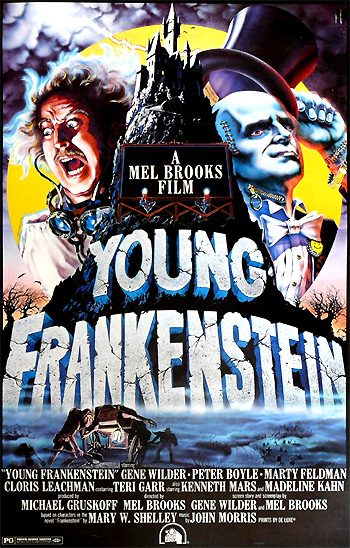  **Young Frankenstein** (1974) is one of writer-producer-director Mel Brooks' best films - a nostalgic, hilarious spoof-tribute to classic horror films (with its authentic black and white cinematography and production design/set decoration), and in particular, of Mary Wollstonecraft Shelley's classic novel about corpse revival by a God-aspiring mad scientist. This film had everything - slapstick, farce, dirty (or ribald), bawdy humor and irreverent satire. Many of Brooks' films were filled with physical gags, terrible puns, one-liners, and shattered taboos. Old-style wipes, fades to black and iris shots were numerous throughout. It was one of a number of Brooks' spoof-parody films beginning in the late 1960s that lampooned various genre films, tropes, formats and conventions. This one came way before absurdist spoofs like *[Airplane! (1980)](https://www.filmsite.org/airplane.html)* and *The Naked Gun: From the Files of Police Squad! (1988)*. All of Brooks' best films were anarchic comedies that skewered their source material while still maintaining a basic reverence: *The Producers (1967)* - Brooks' first hit and cinematic debut - about show business, musicals, and Broadway culture, including an incisive critique of Hitler and the Nazis [*Blazing Saddles (1974)*](https://www.filmsite.org/blaz.html) - released just before YF, a westerns spoof with stereotypical characters: a saloon seductress, a washed-up gunslinger, corrupt government land speculators, and a black sheriff - and much more *Silent Movie (1976)* - a spoof of Hollywood and silent films, with Brooks portraying Mel Funn - a down and out film director who attempted to pitch his new script and recruit celebrity stars to participate *High Anxiety (1977)* \- a parody of Hitchcock's suspense-thrillers (e.g., *Spellbound (1945)*, *[Vertigo (1958)](https://www.filmsite.org/vert.html),* and [*The Birds (1963)*](https://www.filmsite.org/bird.html)), with a subplot involving an innocent, wrongfully-accused man *History Of The World: Part I (1981)* - an anthology film composed of a series of historical vignettes or set-pieces spanning from the Stone Age, through the Old Testament Biblical period, to the Roman Empire and Spanish Inquisition to the French Revolution; it included sub-genre spoofs of "sword and sandal" epics and "costume dramas" *Spaceballs (1987)* - a parody of sci-fi films, in particular the *[Star Wars](https://www.filmsite.org/series-starwars4.html)* [franchise](https://www.filmsite.org/series-starwars4.html) (trilogy), and other sci-fi classics such as [*Star Trek*](https://www.filmsite.org/series-startrek.html), [*Alien*](https://www.filmsite.org/series-alien.html), and [*Planet of the Apes*](https://www.filmsite.org/planetofapes.html) *Robin Hood: Men In Tights (1993)* - a spoof of traditional Robin Hood medieval tales, specifically Kevin Costner’s awful *Robin Hood: Prince Of Thieves (1991)* *Dracula: Dead And Loving It (1995)* - an attempt to parody *Dracula* horror films (especially [*Dracula (1931)*](https://www.filmsite.org/drac.html)) and Bram Stoker's 1897 novel *Dracula* (and Coppola's film *Bram Stoker's Dracula (1992)*), starring Leslie Nielsen as the Count Later, co-writer and actor Gene Wilder attempted his own Old Dark House genre spoof, *Haunted Honeymoon (1986)*. Brooks' horror spoof mostly parodied the 'original trilogy' of *Frankenstein* films from 1931 to 1939, although there six Universal films that prominently featured the Monster: *[Frankenstein (1931)](https://www.filmsite.org/fran.html)*, starring Colin Clive as mad scientist Dr. Henry Frankenstein, Boris Karloff as the Monster, and Dwight Frye as the sadistic hunchback Fritz (the Igor character) *[Bride of Frankenstein (1935)](https://www.filmsite.org/bride.html)*, a sequel reprising Colin Clive as mad scientist Dr. Henry Frankenstein, Ernst Thesiger as crazed Dr. Pretorius, Karloff again as the Monster, Dwight Frye as Pretorius' assistant Karl, and Elsa Lanchester as the Monster's 'Bride' *Son of Frankenstein (1939)*, a second sequel starring Basil Rathbone as Dr. Henry Frankenstein's orphaned scientist son Baron Wolf von Frankenstein, Karloff as the Monster, Bela Lugosi as bearded and hunchbacked Ygor - the ex-assistant of Henry, and Lionel Atwill as Inspector Krogh, the village’s chief of police *The Ghost of Frankenstein (1942)*, starring Sir Cedric Hardwicke as Dr. Ludwig Frankenstein (the second son of Henry and brother of the Baron Wolf von Frankenstein), Lionel Atwill as Ludwig's mad scientist colleague Dr. Theodore Bohmer (Henry Frankenstein's mentor), and Lon Chaney Jr. replacing Karloff as The Monster, and Bela Lugosi reprising his role as the crazed Ygor *Frankenstein Meets the Wolfman (1943)*, starring Patric Knowles as mad scientist Dr. Frank Mannering, Ilona Massey as Baroness Elsa Frankenstein, and Bela Lugosi in his first appearance as the Monster, while this time, Lon Chaney Jr. portrayed The Wolf Man (Lawrence Talbot) *House of Frankenstein (1944)*, starring Boris Karloff as mad scientist Dr. Gustav Niemann, J. Carrol Naish as his hunchbacked companion Daniel (a version of Fritz, Karl, and Ygor), and stunt man Glenn Strange debuting as the Monster It was shot in the same castle and with the same props and lab equipment (created and loaned by property manager Ken Strickfaden) as the original James Whale horror film [*Frankenstein (1931)*](https://www.filmsite.org/fran.html). Kenneth Mars' character, Police Inspector Hans Wilhelm Friederich Kemp, had mannerisms and a mechanical arm/hand that resembled Peter Sellers' Dr. Strangelove character from [*Dr. Strangelove, Or... (1964)*](https://www.filmsite.org/drst.html), Lionel Atwill's local police Inspector Krogh character with a mechanical wooden arm in *Son of Frankenstein (1939),* and Bruce Campbell's chainsaw arm in the [*Evil Dead*](https://www.filmsite.org/series-evildead.html) franchise. Although the low-comedy film had two Academy Awards nominations (that didn't win), Best Adapted Screenplay (for Mel Brooks and star Gene Wilder) and Best Sound, two deserving cast members, Gene Wilder and Madeline Kahn, were un-nominated, as was the wonderfully crisp black-and-white cinematography by Gerald Hirschfeld. It was the *fourth* highest-grossing film of 1974 at \$86.3 million (domestic), with a production budget of only \$2.8 million. \[Note: The top 3 films of 1974 were Brooks' own *[Blazing Saddles (1974)](https://www.filmsite.org/blaz.html)* at \$119.5 million, *The Towering Inferno (1974)* at \$115 million, and *The Trial of Billy Jack (1974)* at \$89 million.\] It was released about the same time as the Italian-produced, originally X-rated and 3-D *Flesh for Frankenstein (1974) (aka Andy Warhol's Frankenstein)*, a gory send-up horror film directed by Paul Morrissey. The decadent, campy and grotesque film starred Udo Keir as Baron von Frankenstein. As happened with Brooks' earlier work *[The Producers (1968)](https://www.filmsite.org/prod.html)* (on Broadway from 2001-2007), this film was adapted into a Broadway musical in 2007 (through 2009), with a cast including Roger Bart (as Frederick "Frahnkensteen") and TV's *Will & Grace's* Megan Mullally as his fiancee Elizabeth. **Plot Synopsis** The film's title credits were viewed above a view of an ancient dark castle on a jagged peaked outcropping, with lightning and thunder striking during a rainstorm, as the concrete block letters YOUNG FRANKENSTEIN appeared. The camera slowly panned left across the castle's courtyard, and came to rest outside an ornate window illuminated by an indoor candle. As a clock gonged twelve o'clock midnight (it actually struck 13 times), the camera moved to a fireplace and before it, a massive wooden coffin set on a table. The top of the casket was inscribed with engraved, raised letters: BARON VON FRANKENSTEIN, with two family insignias on either side. On the last gong, the coffin lid popped open, revealing the skeletal, dressed-up remains of the esteemed baron in *rigor mortis*: there was a toothy skull, and two gnarly, bony hands clinging to a flat metal box. Two disembodied hands reached in to seize the box, but the baron's grip held tight and the box snapped back to his chest. On the third attempt, the box was released. An iris closed in on the scene. The next sequence was introduced by a linked opening iris. Young brain neuro-surgeon and frizzy-haired med-school professor Dr. Frederick Frankenstein (Gene Wilder) was lecturing at an American medical school in Baltimore, to an arena-shaped classroom of white-coated young students - it was the first dialogue in the film: If we look at the base of a brain which has just been removed from a skull, there's very little of the midbrain that we can actually see. Yet, as I demonstrated in my lecture last week, if the under aspects of the temporal lobes are gently pulled apart, the upper portion of the stem of the brain can be seen. This so-called brainstem consists of the midbrain, a rounded protrusion called the pons, and a stalk tapering downwards called the medulla oblongata which passes out of the skull through the foramen magnum and becomes, of course, the spinal cord. In the back of the room, an unidentified, bespectacled elderly man entered. He was grasping the metal box in front of him - the one wrestled from the Baron, before he went to search for a vacant seat. After drawing a sketch of brain components on the blackboard, Dr. Frankenstein asked for questions from the students, and one persistent student (Danny Goldman) rose and asked: I have one question, Dr Frankenstein. The Doctor wasin denial about his actual heritage as "the *grandson* of the famous Dr. Victor Frankenstein who went into graveyards, dug up freshly buried corpses and transformed dead components into..." \[Note: In actual fact, Dr. Frederick Frankenstein would have to be, at the least, Victor's *great-great-great-great* grandson.\] He defiantly corrected the student about the pronunciation of his name (and would continue to do so throughout the film), to disassociate himself from his family name: "That's Fronk-en-steen...My name, it's pronounced 'Fronk-en-steen'!" Incensed and briefly losing his composure, Dr. Frankenstein said he wanted to be remembered by his own "small contributions to science." He referred to his "accidental relationship" to his famous ancestor, and called him "a famous cuckoo." He rang a gong to start a demonstration of the difference between *reflexive* and *voluntary* nerve impulses. A skinny, emaciated, and elderly subject in a white surgical gown, named Mr. Hilltop (Liam Dunn), was wheeled on a gurney through double doors into the classroom by two orderlies (John Dennis). After the man was instructed to "hop" off the table, the subject was instructed to raise and lower his left knee, to provide an example of "voluntary" nerve impulses. In contrast, "reflex" movements were made "independently of the will." Frankenstein suddenly turned on the vulnerable patient and threatened to jab him in the groin with his knee, as he shouted: "You filthy, rotten, yellow son of a bitch." Naturally, Mr. Hilltop reacted - he flinched and doubled forward to protect himself, causing a pleased response on Frankenstein's face. The manic doctor then proposed: "What if we *block* the nerve impulse by simply applying local pressure." A metal bicycle clamp was attached to the back of the patient's head "at the swelling on the posterior nerve roots" for five or six seconds. After the pause, Frankenstein again jabbed his knee toward the patient and actually struck the man's groin as he shouted: "Why, you mother-grabbing bastard!" - this time, the patient did not flinch, although he groaned to himself in intense pain. Frankenstein intoned: "All communication is shut off. In spite of our mechanical magnificence, if it were not for this continuous stream of motor impulses, we would *collapse* like a bunch of broccoli." The removal of the clamp caused the patient to collapse in major pain as predicted, and the class appreciatively applauded. The doctor whispered to one of his orderlies as Hilltop was wheeled away: "Give him an extra dollar." Frankenstein stated his strong theoretical belief that regeneration or reanimation of dead nerve tissue was impossible: In conclusion, it should be noted... .that any more than common injury to the nerve root is always serious. Because once a nerve fiber is severed, there is no way, in heaven or on earth, to regenerate life back into it. A second question from the same student challenged the doctor's theory: "Isn't it true that Darwin preserved a piece of vermicelli in a glass case until, by some extraordinary means, it actually began to move with a *voluntary* motion?" The admonishing Frankenstein insisted on being precise - and then asserted: "You have to remember that a worm, with very few exceptions, is not a human being." The student pressed Frankenstein about the basis of his grandfather's work - the reanimation of dead tissue (as evidenced by more modern medical advancements with heart and kidney transplants), but the doctor denied being even curious or intrigued about his grandfather's experiments in "bringing back to life what was once dead": My grandfather was a very sick man...You are talking about the non-sensical ravings of a lunatic mind. Dead is dead!...Hearts and kidneys are Tinkertoys. I'm talking about the central nervous system....I am a scientist, not a philosopher! You have more chance of reanimating this scalpel than you have of mending a broken nervous system....My grandfather's work was doo-doo! I am not interested in death! The only thing that concerns me is the preservation of *life*\! To emphasize his point, Frankenstein had grabbed a scalpel instrument from his tray and emphatically jabbed it downwards - directly into his right thigh. Wild applause erupted as the class was dismissed and students filed out. The man with the metal box approached Dr. Frankenstein in the front of the room - and was reprimanded for again mispronouncing his name. He introduced himself as Herr Gerhardt Falkstein (Richard Haydn), a solicitor: "I have travelled 5,000 miles to bring you the will of your great-grandfather. Baron Beaufort von Frankenstein." Frankenstein had inherited the Transylvanian ancestral estate of his grandfather, and was required to travel to Europe to inspect the property. A slow wipe-right introduced the next scene set on the platform of the Baltimore train station. Dr. Frankenstein was bid goodbye by his spoiled and untouchable socialite fiancee Elizabeth (Madeline Kahn), and was reluctant to have him leave: "Oh, my sweet darling. Oh, my dearest love. I'll count the hours that you're away." But she refused a kiss on the lips: "I'm going to that party at Nana and Nicky's later. I don't wanna smear my lipstick." But she still vowed that she was passionately in love with him: "You've got it, mister...I'm yours, all of me. What else can I say?" When he reached to touch her hair, she again shrieked: "The hair! The hair! Just been set." She also cautioned him about wrinkling her taffeta dress or ruining her nails. She feared that physical contact with the infamous doctor would literally tarnish her appearance. As the train departed, they touched elbows (a substitute for a kiss), and he threw her an invisible kiss. As the train pulled away, Elizabeth was enveloped in an enormous cloud of white steam. Dr. Frankenstein traveled to his first stop of New York City, and had to listen to a couple's argument in the train compartment before he disembarked. A spinning transition found him on another train in Europe taking him to Transylvania, where a couple had the exact same argument as before, but now in German. As the train pulled into the station, Frankenstein was perplexed - he threw open his window and asked a shoe-shine boy: "Pardon me, boy. Is this the Transylvania Station?" When told it was - and that he was on Track 29, the boy then reverted to perfect English: "Oh, can I give you a shine?" Standing alone on the desolate, fog-shrouded platform in the town of Transylvania, the doctor heard ominous footsteps ("Whoooooosh - thump") coming toward him and a voice asking: "Dr. Frankenstein?" Thunder cracked as the face of a short, hunch-backed, black-hooded, cloaked figure with askew bug eyes, named Igor (Marty Feldman), appeared only a few inches away from his own face. They each corrected pronunciations of their names: Dr. Frankenstein: "It's pronounced 'Fronk-en-steen'." Igor: "Do you also say Frodorick?" Dr. Frankenstein: "No. Frederick." Igor: "Well, why isn't it Frodorick Fronk-en-steen?" Dr. Frankenstein: 'It isn't. It's Frederick Fronk-en-steen." Igor: "I see." Dr. Frankenstein: "You must be lgor." Igor: "No. It's pronounced I-gor. \[Eye-gor\]" Igor had been sent by Herr Falkstein to pick him up and deliver him to the castle. He explained: "My grandfather used to work for your grandfather...Of course, the rates have gone up." After giving Igor a pat on his hunch-back, Dr. Frankenstein suggested a medical solution: "You know, I don't mean to embarrass you, but I'm a rather brilliant surgeon. Perhaps I could help you with that hump." Igor responded: "What hump?" Igor grabbed the doctor's light-weight attache case, leaving Frankenstein to carry his own heavy luggage bag. Using a cane to bend over and descend only five steps, Igor commanded as he limped: "*Walk* this way" - and offered his short cane to the doctor to navigate the same steps. A two-horse cart was parked nearby, where Igor climbed into the driver's seat. Dr. Frankenstein discovered a voluptuous, dim-witted peasant female named Inga (Teri Garr) lying on piles of hay inside the cart. She had been assigned as his "laboratory assistant, temporarily." Lying back and literally rolling left and right (as she sang a children's song), she innocently asked, with a heavy Swedish accent: "Would you like to have a roll in ze hay? It's fun." After a wipe-right and wipe-left, as they proceeded through foggy woods to the Baron's castle high on a jagged mountain peak, Inga cuddled closely to Frankenstein after hearing a clash of lightning and the howls of a creature (uncredited Mel Brooks). She noted: "Werewolf." He asked: "Were-wolf?" - and Igor replied using the same syntax: "There wolf." He also pointed out: "There castle." He also gestured: "There it is - Home!" Inside the castle's courtyard, Igor stood at heavy wooden doors with two gigantic, circular wrought-iron knockers, flanked by two flaming sconces or torches. He knocked three times with the right knocker, causing three loud echoing booms, at the same time as Inga (with her low bodice revealing the tops of her breasts) was assisted down from the hay cart by Dr. Frankenstein. Holding her waist and looking back at Igor, he exclaimed: Dr. Frankenstein: "What knockers!" Inga: (grinning widely) "Ohh, thank you, Doctor." Inside the creaking doors, a fire was raging in the fireplace as the severe-looking, hag-like, elderly housekeeper Frau Blucher (Cloris Leachman) emerged, sporting a hair-bun and a prominent mole on the right side of her chin. \[Note: Her character was a strong parody of housekeeper Mrs. Danvers (Judith Anderson) in Alfred Hitchcock's *[Rebecca (1940)](https://www.filmsite.org/rebec.html)*.\] The forbidding woman introduced herself: I am Frau Blucher. Thunder and lightning crackled, and the terrified horses reared up and loudly neighed and whinnied. Igor steadied the frightened animals. As Dr. Frankenstein introduced Inga to Frau Blucher, the terror-stricken horses once again whinnied. \[Note: It was one of the film's running gags that the horses whinnied whenever her name was mentioned.\] The group was brought into the cavernous reception hall with an elaborate chandelier. With a three part unlit candelabra held in her outstretched hand, Frau Blucher urged the guests to follow her up a majestic stone staircase against the wall that led to the upstairs. Hunched over and struggling, Igor followed with the luggage. She warned: "Stay close to the candles. The staircase can be treacherous." |
***
 [](https://www.filmsite.org/youn2.html)
***
- [GREATEST FILMS](https://www.filmsite.org/greatlists.html)
- [REVIEWS](https://www.filmsite.org/filmreviews-overview.html)
- [THE BEST](https://www.filmsite.org/best-overview.html)
- [HISTORY](https://www.filmsite.org/filmhistory-overview.html)
- [GENRES](https://www.filmsite.org/filmgenres.html)
- [SCENES](https://www.filmsite.org/scenes-overview.html)
- [OSCARS](https://www.filmsite.org/oscars.html)
- [QUOTES](https://www.filmsite.org/greatfilmquotes.html)
- [DIRECTORS & STARS](https://www.filmsite.org/filmstarsanddirectors.html)
- [Filmsite Home](https://www.filmsite.org/index.html)
- [About & Contact](https://www.filmsite.org/films.html)
- [Sitemap](https://www.filmsite.org/sitemap.html)
- [FAQ](https://www.filmsite.org/faq.html)
- [Reference](https://www.filmsite.org/references.html)
- [Privacy Policy](https://www.filmsite.org/privacy-filmsite.html)
- [Terms of Use](https://www.filmsite.org/termsofuse-filmsite.html)
Copyright © 1996-2026 Filmsite LLC. All rights reserved. |
| Readable Markdown | null |
| Shard | 133 (laksa) |
| Root Hash | 8065521992420658333 |
| Unparsed URL | org,filmsite!www,/youn.html s443 |