ℹ️ Skipped - page is already crawled
| Filter | Status | Condition | Details |
|---|---|---|---|
| HTTP status | PASS | download_http_code = 200 | HTTP 200 |
| Age cutoff | PASS | download_stamp > now() - 6 MONTH | 0.3 months ago |
| History drop | PASS | isNull(history_drop_reason) | No drop reason |
| Spam/ban | PASS | fh_dont_index != 1 AND ml_spam_score = 0 | ml_spam_score=0 |
| Canonical | PASS | meta_canonical IS NULL OR = '' OR = src_unparsed | Not set |
| Property | Value |
|---|---|
| URL | https://www.exakthealth.com/en-US/blog/run-smarter-10-tips-to-prevent-running-injuries |
| Last Crawled | 2026-04-16 15:25:40 (8 days ago) |
| First Indexed | 2024-08-27 04:13:58 (1 year ago) |
| HTTP Status Code | 200 |
| Content | |
| Meta Title | Run smarter — 10 tips to prevent running injuries |
| Meta Description | We know — runners live to run. But sometimes, our bodies struggle to keep pace. Here's how to prevent injuries from derailing your training. |
| Meta Canonical | null |
| Boilerpipe Text | Studies
show that more than 26.1% of recreational runners experience running-related injuries.
So, how can you avoid being part of the injured runner's club? Here are 10 tips to help you stay injury-free.
How runners can avoid injuries
Although preventing all injuries is impossible, there are a few screws you can turn to give your body the best environment to keep running and reduce your chances of getting an injury.
Top 10 strategies for preventing running injuries
1
Strength training
Makes your body more robust and improves your movement patterns
2
Stretching
Maintains joint mobility and helps you relax after a run
3
Warm-ups
Preps your body for the quick, forceful movements in running
4
Training load
Gradual changes ensure your body has enough time to adapt to new loads
5
Recovery days
Allow your body to repair and strengthen
6
Sleep
Affects all areas of health, including your body's ability to restore itself after exercise
7
Diet
Provides the building blocks your body needs to rebuild and recover after a run
8
Running shoes
Helps you move better and reduce impact
9
Running style
Can be adjusted to distribute the running forces more evenly
10
A fluid plan
Allows you to better manage training loads
1. Strength training
The rumor that "runners don't need strength training" persists. But it's just not true.
Trained leg and upper body muscles provide strength and stability during runs. At the same time, it strengthens your tendons, ligaments, and bones to help prevent overuse injuries.
In addition to injury prevention,
studies
have shown strength training can also improve running form.
Strength training will also help you continuously improve your running performance because movement sequences can be completed more efficiently or better with more muscle strength.
There's strong evidence that regular strength training can help prevent overuse injuries in runners.
Our advice is
Add regular strength training sessions into your training week. We've previously discussed
how to best schedule your running and strength training workouts
to avoid overloading your body.
Try out the strength training workouts in the
Exakt Health app
for inspiration. If you tell the App when you want to run, it automatically creates an optimal schedule for your strength training workouts.
2. Stretching
Stretching is a very controversial topic within the literature. It can be divided into static stretching (where you hold the position) and dynamic stretching where you move in and out of positions of stretch.
Stretching pre-running
Against widespread belief,
studies
have shown that static stretching before running does not reduce a runner's risk of injury. An important factor in stretching is the duration of the holds. Static stretches held for longer than 60 seconds may also reduce your performance.
So if you want to include static stretching as a part of your warm-up routine, you should hold them for shorter periods (e.g., 30 seconds).
In contrast, although running-specific research is still lacking, dynamic stretching has been shown to improve sports performance and help prevent injuries across a wide variety of running sports.
Stretching after running
Studies
have shown that static stretching after running does not positively affect a runner's recovery and doesn’t reduce the intensity of muscle soreness after a hard workout or race.
However, it is essential to note that static stretching after a run
does not harm you either
. On the contrary, it can help improve joint mobility and allow the runner to relax. And as psychological factors are crucial in injury prevention, nothing speaks against static stretching on your rest days if you enjoy it.
Dynamic stretches are more important for injury prevention. Do static stretches after your run or on your rest days if you feel they benefit you.
Our advice is
Use dynamic stretches as part of your warm-up
; Do 6-8 exercises to move your joints through their full range of motion, e.g., a
forward lunge
with upper body movements.
If you do static stretches before your run, use shorter holds, e.g., 30 seconds, and follow them up with dynamic stretches.
Do static stretches after your run or on your rest days if you feel they benefit you. Find examples of
calf stretches for runners here
.
3. Warm-ups
It is vital to warm up before running. While warming up, you are waking up your nervous system and getting your muscles ready for the quick reactions that running requires from your body.
Warm-ups mainly prevent acute running injuries like
muscle tears
and
ankle sprains
.
The harder your training session, the more important it is to warm up properly.
Our advice is
Warm up to the point where your body temperature rises slightly, and you begin to sweat.
Include dynamic stretching exercises in the warm-up.
Your warm-up intensity should match your training session's; e.g., a warm-up before a sprint session should include explosive movements or accelerations.
The warm-up should last 10-15 minutes until you feel ready to perform.
4. Change training gradually
Your body adapts to training slowly. While cardiovascular fitness (heart and lungs) might improve quickly, it takes your muscles, tendons, ligaments, and joints a while to catch up and grow stronger.
If you increase your mileage too quickly, your body doesn't get enough time to repair and adapt, which may lead to overuse injuries.
Research shows, to avoid injury, your weekly mileage should increase by no more than 10% when your longest run is 5 miles or more.
However, you can grow your mileage more quickly if your longest run is less than 5 miles and your body is coping well.
One of the best ways to prevent overuse injuries is to track your training and avoid sudden increases in distance and intensity.
Our advice is
Keep track of your weekly running miles
to ensure you don’t increase it too quickly.
Listen to your body
and build your mileage more slowly if you feel tired or fatigued.
5. Rest days
Full days off running and strength training are essential to your training success. Let us explain why.
When we exercise, we sustain micro-injuries in all parts of our body (muscles, tendons, bones, ligaments, etc.). If given enough recovery time, our bodies repair these micro-injuries and make us stronger and more robust.
Rest is vital for recovery. Full recovery can often take 8 to 72 hours or longer.
If you do another hard training session before your body has fully recovered, you risk developing an
overuse injury
.
Your required recovery time will depend on the following:
Terrain:
Hill running works the body much harder than running on the flat.
Workout intensity:
If a training session is more intense, the effect on the body will be more significant, and you'll need more recovery time.
Your fitness:
When you're new to running or strength training (or you've had a long break from exercise), the training effects will be more significant, and your body will recover slower.
Other activities:
You may need more recovery when you do other activities (like strength training or walking long distances for your job) that work the same body part (e.g., your legs). These activities add to how much your body needs to repair.
Recovery days may not be very exciting, but they are essential for running injury prevention.
Our advice is
Respect your recovery days
; They are just as important as your training days.
Want help with scheduling your training? If you tell the
Exakt Health app
how many days you want to run,
it will automatically create an optimal schedule
for your strength and mobility workouts.
6. Sleep
Recent research
shows that sleeping for 7 hours or fewer per night increases your risk of developing musculoskeletal pain or getting a sports injury. Poor sleep lasting for 14 days or longer increases your injury risk by 1.7 times.
When it comes to sleep, both the quality and volume matter.
Our advice is
Take steps to help you fall asleep and stay asleep
, e.g., go to bed at the same time, don't use a phone or laptop before you go to bed, and ensure your room is dark.
If you can’t sleep more in one go,
napping during the day
has also
been shown
to improve sports performance.
7. Diet
Not eating enough calories or the right combination of nutrients can increase your risk of getting overuse injuries and reduce your running performance.
Your body can only repair and strengthen itself if you provide the building blocks it needs.
Our advice is
Speaking to a professional
like a dietitian or sports nutritionist is always the best choice to get a good overview of how to support your body in the best way for your specific training schedule.
8. Running shoes
With running shoes, finding the right shoes for you and your foot type is very important. There are many different ways in which a shoe can support your foot — it's all about finding the right one for you and your body.
The good news is that you likely don’t have to consult an expert to find the best shoe.
Research has shown that simply selecting a shoe that feels comfortable when running automatically reduces your injury risk.
Generally, running shoes should be replaced between 300-500 miles, as they lose their cushioning and stability after this mileage. If you also use your shoes for walking and other activities, you may have to replace them sooner.
Our advice is
Choose shoes that
feel comfortable
when you run and
replace them regularly
.
9. Running style
When it comes to different running styles,
studies have identified
two factors that can help prevent running injuries:
Reducing overstride
—
Overstriding
is when a runner lands with their foot far out in front of their body, causing a breaking force that increases the strain on the body).
Increasing your cadence
(the total number of steps you take per minute) to around 170 steps per minute — By giving more steps, you reduce the time you spend in contact with the ground, which reduces the force on your body.
In general, including strength training in your workout routine will also improve your running economy and give you a better and more ergonomic running style.
Our advice is
Assess your running style and adjust it only if needed.
Include regular strength training sessions in your training schedule.
Find more tips on assessing and
adjusting running form for injury prevention
here.
10. Have a plan but also listen to your body
A training plan is essential to progress (not doing too little) and avoid running injuries (not doing too much). But it is also necessary to listen to your body and take breaks when it tells you to do so.
Sticking to your plan when your body tells you to take a break usually causes trouble.
Your body usually gives you early warnings when something isn't working as it should. And we're not just talking about feeling pain while running. If you feel unwell, tired, or physically weak, you should give your body a break no matter what your training plan for that day says.
Running when you're unwell or fatigued would, in any case, be counterproductive.
Our advice is
Have a realistic training plan.
Adapt your plan when your body tells you it needs more recovery or just isn’t feeling well.
Adaptations could include resting completely, cross-training, doing a restorative yoga session, etc.
Exchanging high-intensity workouts for recovery sessions when you are tired isn't cheating! On the contrary, it's one of the best ways to prevent running injuries.
The
Exakt Health app
makes it easy to adjust your schedule on the fly. Quickly switch your planned workouts for the day or set a more permanent weekly schedule that fits with your life.
More training tips |
| Markdown | Run Training & Physical Therapy
[Home](https://www.exakthealth.com/en-US)
[Our plans](https://www.exakthealth.com/en-US/plans)
[Exakt blog](https://www.exakthealth.com/en-US/blog)
[Exakt Elite](https://www.exakthealth.com/en-US/exakt-elite)
[About us](https://www.exakthealth.com/en-US/about-us)
[Pricing](https://www.exakthealth.com/en-US/pricing)
[Get the App](https://geni.us/exakt-website-TOP-US?locale=en-US)
[Get the App](https://geni.us/exakt-website-TOP-US?locale=en-US)
10 min
# Run smarter — 10 tips to prevent running injuries




Sabrina Burkart
Jul 4, 2025
Medically reviewed by
[Maryke Louw](https://www.exakthealth.com/en-US/medical-review-team)
We know — runners live to run. But sometimes, our bodies struggle to keep pace. Here's how to prevent injuries from derailing your training.
[Studies](https://pubmed.ncbi.nlm.nih.gov/34478518/) show that more than 26.1% of recreational runners experience running-related injuries.
So, how can you avoid being part of the injured runner's club? Here are 10 tips to help you stay injury-free.


Run strong and injury-free
[Get the Exakt App](https://geni.us/exakt-blog-US?locale=en-US)


## How runners can avoid injuries
Although preventing all injuries is impossible, there are a few screws you can turn to give your body the best environment to keep running and reduce your chances of getting an injury.
## Top 10 strategies for preventing running injuries
1
Strength training
Makes your body more robust and improves your movement patterns
2
Stretching
Maintains joint mobility and helps you relax after a run
3
Warm-ups
Preps your body for the quick, forceful movements in running
4
Training load
Gradual changes ensure your body has enough time to adapt to new loads
5
Recovery days
Allow your body to repair and strengthen
6
Sleep
Affects all areas of health, including your body's ability to restore itself after exercise
7
Diet
Provides the building blocks your body needs to rebuild and recover after a run
8
Running shoes
Helps you move better and reduce impact
9
Running style
Can be adjusted to distribute the running forces more evenly
10
A fluid plan
Allows you to better manage training loads
## 1\. Strength training
The rumor that "runners don't need strength training" persists. But it's just not true.
### Trained leg and upper body muscles provide strength and stability during runs. At the same time, it strengthens your tendons, ligaments, and bones to help prevent overuse injuries.
In addition to injury prevention, [studies](https://pubmed.ncbi.nlm.nih.gov/12165692/) have shown strength training can also improve running form.
Strength training will also help you continuously improve your running performance because movement sequences can be completed more efficiently or better with more muscle strength.


There's strong evidence that regular strength training can help prevent overuse injuries in runners.
### Our advice is
Add regular strength training sessions into your training week. We've previously discussed [how to best schedule your running and strength training workouts](https://www.exakthealth.com/en-US/blog/balancing-your-strength-training-and-running-schedule) to avoid overloading your body.
Try out the strength training workouts in the [Exakt Health app](https://geni.us/exakt-blog-US) for inspiration. If you tell the App when you want to run, it automatically creates an optimal schedule for your strength training workouts.


Evidence-based strength training for runners
[Get the Exakt App](https://geni.us/exakt-blog-US?locale=en-US)


## 2\. Stretching
Stretching is a very controversial topic within the literature. It can be divided into static stretching (where you hold the position) and dynamic stretching where you move in and out of positions of stretch.
### Stretching pre-running
Against widespread belief, [studies](https://www.cochranelibrary.com/cdsr/doi/10.1002/14651858.CD001256.pub2/abstract) have shown that static stretching before running does not reduce a runner's risk of injury. An important factor in stretching is the duration of the holds. Static stretches held for longer than 60 seconds may also reduce your performance.
So if you want to include static stretching as a part of your warm-up routine, you should hold them for shorter periods (e.g., 30 seconds).
### In contrast, although running-specific research is still lacking, dynamic stretching has been shown to improve sports performance and help prevent injuries across a wide variety of running sports.
### Stretching after running
[Studies](https://pubmed.ncbi.nlm.nih.gov/27912252/) have shown that static stretching after running does not positively affect a runner's recovery and doesn’t reduce the intensity of muscle soreness after a hard workout or race.
However, it is essential to note that static stretching after a run [does not harm you either](https://pubmed.ncbi.nlm.nih.gov/11696209/). On the contrary, it can help improve joint mobility and allow the runner to relax. And as psychological factors are crucial in injury prevention, nothing speaks against static stretching on your rest days if you enjoy it.


Dynamic stretches are more important for injury prevention. Do static stretches after your run or on your rest days if you feel they benefit you.
### Our advice is
- **Use dynamic stretches as part of your warm-up**; Do 6-8 exercises to move your joints through their full range of motion, e.g., a [forward lunge](https://www.exakthealth.com/en-US/blog/take-a-step-forward-with-your-lunges-a-guide-to-proper-form-and-variations-for-runners) with upper body movements.
- If you do static stretches before your run, use shorter holds, e.g., 30 seconds, and follow them up with dynamic stretches.
- Do static stretches after your run or on your rest days if you feel they benefit you. Find examples of [calf stretches for runners here](https://www.exakthealth.com/en-US/blog/the-best-calf-stretches-runners-can-do).
## 3\. Warm-ups
It is vital to warm up before running. While warming up, you are waking up your nervous system and getting your muscles ready for the quick reactions that running requires from your body.
Warm-ups mainly prevent acute running injuries like [muscle tears](https://www.exakthealth.com/en-US/blog/how-do-muscle-strains-heal) and [ankle sprains](https://www.exakthealth.com/en-US/blog/ankle-sprains-the-types-causes-and-best-treatments).


The harder your training session, the more important it is to warm up properly.
### Our advice is
- Warm up to the point where your body temperature rises slightly, and you begin to sweat.
- Include dynamic stretching exercises in the warm-up.
- Your warm-up intensity should match your training session's; e.g., a warm-up before a sprint session should include explosive movements or accelerations.
- The warm-up should last 10-15 minutes until you feel ready to perform.


Stay up to date with our newsletter
[Subscribe to newsletter](https://geni.us/NL_Signup_BlogENUS?locale=en-US)


## 4\. Change training gradually
Your body adapts to training slowly. While cardiovascular fitness (heart and lungs) might improve quickly, it takes your muscles, tendons, ligaments, and joints a while to catch up and grow stronger.
### If you increase your mileage too quickly, your body doesn't get enough time to repair and adapt, which may lead to overuse injuries.
Research shows, to avoid injury, your weekly mileage should increase by no more than 10% when your longest run is 5 miles or more.
However, you can grow your mileage more quickly if your longest run is less than 5 miles and your body is coping well.


One of the best ways to prevent overuse injuries is to track your training and avoid sudden increases in distance and intensity.
### Our advice is
- **Keep track of your weekly running miles** to ensure you don’t increase it too quickly.
- **Listen to your body** and build your mileage more slowly if you feel tired or fatigued.
## 5\. Rest days
Full days off running and strength training are essential to your training success. Let us explain why.
When we exercise, we sustain micro-injuries in all parts of our body (muscles, tendons, bones, ligaments, etc.). If given enough recovery time, our bodies repair these micro-injuries and make us stronger and more robust.
### Rest is vital for recovery. Full recovery can often take 8 to 72 hours or longer.
If you do another hard training session before your body has fully recovered, you risk developing an [overuse injury](https://www.exakthealth.com/en-US/blog/unraveling-overuse-injuries-in-runners-identifying-and-responding-to-early-warning-signs).

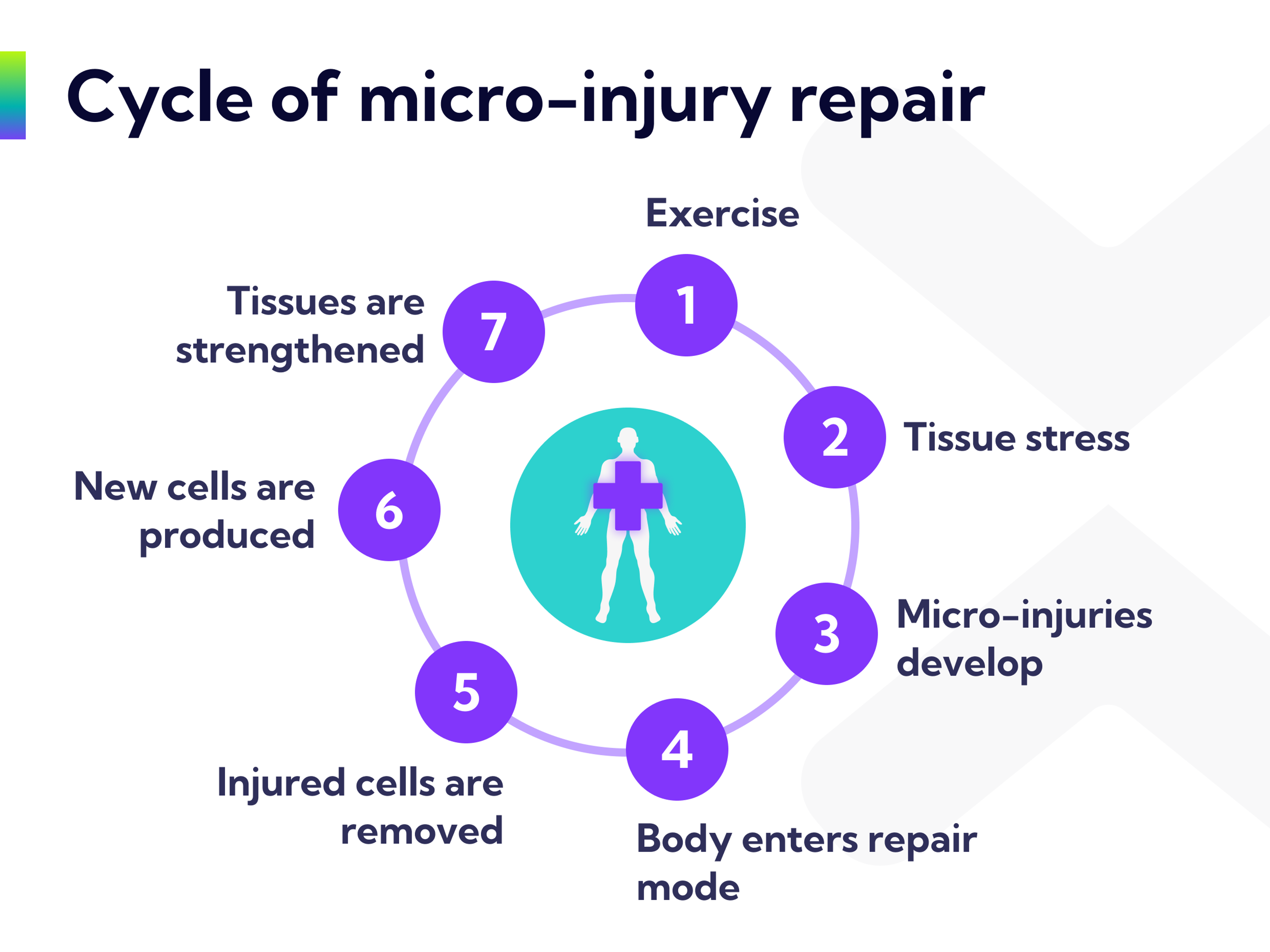
Your required recovery time will depend on the following:
1. **Terrain:** Hill running works the body much harder than running on the flat.
2. **Workout intensity:** If a training session is more intense, the effect on the body will be more significant, and you'll need more recovery time.
3. **Your fitness:** When you're new to running or strength training (or you've had a long break from exercise), the training effects will be more significant, and your body will recover slower.
4. **Other activities:** You may need more recovery when you do other activities (like strength training or walking long distances for your job) that work the same body part (e.g., your legs). These activities add to how much your body needs to repair.


Recovery days may not be very exciting, but they are essential for running injury prevention.
### Our advice is
**Respect your recovery days**; They are just as important as your training days.
Want help with scheduling your training? If you tell the [Exakt Health app](https://geni.us/exakt-blog-US) how many days you want to run, **it will automatically create an optimal schedule** for your strength and mobility workouts.


Evidence-based training plans for runners
[Get the Exakt App](https://geni.us/exakt-blog-US?locale=en-US)


## 6\. Sleep
[Recent research](https://pubmed.ncbi.nlm.nih.gov/34099605/) shows that sleeping for 7 hours or fewer per night increases your risk of developing musculoskeletal pain or getting a sports injury. Poor sleep lasting for 14 days or longer increases your injury risk by 1.7 times.
### When it comes to sleep, both the quality and volume matter.
### Our advice is
- **Take steps to help you fall asleep and stay asleep**, e.g., go to bed at the same time, don't use a phone or laptop before you go to bed, and ensure your room is dark.
- If you can’t sleep more in one go, **napping during the day** has also [been shown](https://link.springer.com/article/10.1007/s40279-017-0832-x) to improve sports performance.


## 7\. Diet
Not eating enough calories or the right combination of nutrients can increase your risk of getting overuse injuries and reduce your running performance.
### Your body can only repair and strengthen itself if you provide the building blocks it needs.
### Our advice is
**Speaking to a professional** like a dietitian or sports nutritionist is always the best choice to get a good overview of how to support your body in the best way for your specific training schedule.


## 8\. Running shoes
With running shoes, finding the right shoes for you and your foot type is very important. There are many different ways in which a shoe can support your foot — it's all about finding the right one for you and your body.
The good news is that you likely don’t have to consult an expert to find the best shoe.
### Research has shown that simply selecting a shoe that feels comfortable when running automatically reduces your injury risk.
Generally, running shoes should be replaced between 300-500 miles, as they lose their cushioning and stability after this mileage. If you also use your shoes for walking and other activities, you may have to replace them sooner.
### Our advice is
Choose shoes that **feel comfortable** when you run and **replace them regularly**.


## 9\. Running style
When it comes to different running styles, [studies have identified](https://pubmed.ncbi.nlm.nih.gov/30193080/) two factors that can help prevent running injuries:
- **Reducing overstride** — [Overstriding](https://www.exakthealth.com/en-US/blog/running-form-mistakes-that-lead-to-injury-tips-and-fixes#what-is-overstride) is when a runner lands with their foot far out in front of their body, causing a breaking force that increases the strain on the body).
- **Increasing your cadence** (the total number of steps you take per minute) to around 170 steps per minute — By giving more steps, you reduce the time you spend in contact with the ground, which reduces the force on your body.
In general, including strength training in your workout routine will also improve your running economy and give you a better and more ergonomic running style.
### Our advice is
- Assess your running style and adjust it only if needed.
- Include regular strength training sessions in your training schedule.
Find more tips on assessing and [adjusting running form for injury prevention](https://www.exakthealth.com/en-US/blog/running-form-mistakes-that-lead-to-injury-tips-and-fixes) here.


## 10\. Have a plan but also listen to your body
A training plan is essential to progress (not doing too little) and avoid running injuries (not doing too much). But it is also necessary to listen to your body and take breaks when it tells you to do so.
### Sticking to your plan when your body tells you to take a break usually causes trouble.
Your body usually gives you early warnings when something isn't working as it should. And we're not just talking about feeling pain while running. If you feel unwell, tired, or physically weak, you should give your body a break no matter what your training plan for that day says.
Running when you're unwell or fatigued would, in any case, be counterproductive.
### Our advice is
- Have a realistic training plan.
- Adapt your plan when your body tells you it needs more recovery or just isn’t feeling well.
- Adaptations could include resting completely, cross-training, doing a restorative yoga session, etc.


Exchanging high-intensity workouts for recovery sessions when you are tired isn't cheating! On the contrary, it's one of the best ways to prevent running injuries.
The [Exakt Health app](https://geni.us/exakt-blog-US) makes it easy to adjust your schedule on the fly. Quickly switch your planned workouts for the day or set a more permanent weekly schedule that fits with your life.


Flexible training plans for runners
[Get the Exakt App](https://geni.us/exakt-blog-US?locale=en-US)


More training tips
Tags


Sabrina Burkart
[Sabrina Burkart](https://www.linkedin.com/in/sabrina-burkart-5b9a6b1b4) studied sports science at the University of Vienna and physiotherapy at the FH Campus Wien. She gained practical experience as a physiotherapist with the Austrian youth women's national handball team, among others.
More about injury prevention


Stay up to date with our newsletter


More about injury prevention
- [ ](https://www.exakthealth.com/en-US/blog/unraveling-overuse-injuries-in-runners-identifying-and-responding-to-early-warning-signs)
[Preventing overuse injuries: How to run without getting hurt](https://www.exakthealth.com/en-US/blog/unraveling-overuse-injuries-in-runners-identifying-and-responding-to-early-warning-signs)


Kim Van Deventer
Nov 18, 2022
- [ ](https://www.exakthealth.com/en-US/blog/bodyweight-squats-benefits-common-mistakes-and-progressions)
[Bodyweight squats: Benefits, common mistakes, and progressions](https://www.exakthealth.com/en-US/blog/bodyweight-squats-benefits-common-mistakes-and-progressions)


Sabrina Burkart
Nov 30, 2022
- [ ](https://www.exakthealth.com/en-US/blog/take-a-step-forward-with-your-lunges-a-guide-to-proper-form-and-variations-for-runners)
[Master the forward lunge: Proper form, variations, and common mistakes](https://www.exakthealth.com/en-US/blog/take-a-step-forward-with-your-lunges-a-guide-to-proper-form-and-variations-for-runners)


Sabrina Burkart
Jun 13, 2023
- [ ](https://www.exakthealth.com/en-US/blog/the-best-calf-stretches-runners-can-do)
[The best calf stretches runners can do - Why, how, and common pitfalls to avoid](https://www.exakthealth.com/en-US/blog/the-best-calf-stretches-runners-can-do)


Maryke Louw
Aug 26, 2023
- [ ](https://www.exakthealth.com/en-US/blog/running-form-mistakes-that-lead-to-injury-tips-and-fixes)
[Perfect your running form — common mistakes that lead to injury](https://www.exakthealth.com/en-US/blog/running-form-mistakes-that-lead-to-injury-tips-and-fixes)


Maryke Louw
Jun 13, 2023
- [ ](https://www.exakthealth.com/en-US/blog/balancing-your-strength-training-and-running-schedule)
[Balancing your strength training and running schedule](https://www.exakthealth.com/en-US/blog/balancing-your-strength-training-and-running-schedule)


Maryke Louw
Aug 21, 2024


- [Home](https://www.exakthealth.com/en-US)
- [Our plans](https://www.exakthealth.com/en-US/plans)
- [Exakt blog](https://www.exakthealth.com/en-US/blog)
- [Exakt Elite](https://www.exakthealth.com/en-US/exakt-elite)
- [About Us](https://www.exakthealth.com/en-US/about-us)
- [App](https://www.exakthealth.com/en-US/download-app)
- [Pricing](https://www.exakthealth.com/en-US/pricing)
- [References](https://www.exakthealth.com/en-US/references)
- [FAQ](https://www.exakthealth.com/en-US/faq)
- [Newsletter](https://638125f1.sibforms.com/serve/MUIFACLbmwAw3S9genLyOLonSU7gW5dJqPYN1UXidkB7KBOsDgMxUBuEhYeHNuN8i4J65CF4OMzOuWoH1O075hx1fUx28jlTLKjorf5aaW5DLWIZ_Juzr8anHOSGwELa7O2E3jZjSdhUaZBj6oowb2kNi3s_L2vvDED2hEEu4t7A2V_A1ZJxWjH3RNJiXRjPqJYPhRgRnOZ_LlZ2)
- [Privacy policy](https://www.exakthealth.com/en-US/privacy-policy)
- [Terms](https://www.exakthealth.com/en-US/terms)
- [Update cookie settings](https://www.exakthealth.com/en-US/blog/run-smarter-10-tips-to-prevent-running-injuries)
- [Cookie policy](https://www.exakthealth.com/en-US/cookie-policy)
- [Imprint](https://www.exakthealth.com/en-US/imprint)
- [Contact](https://www.exakthealth.com/en-US/contact)
- [ ](https://www.instagram.com/exakthealth_en/)
- [ ](https://www.youtube.com/@exakthealth_en)
- [ ](https://www.linkedin.com/company/exakt-running/)
- [ ](https://de.pinterest.com/exaktRunningEN/)
- [ ](https://www.facebook.com/ExaktRunningEN/)
- [ ](http://eepurl.com/ikneLj)
Copyright © 2025 Exakt Health |
| Readable Markdown | null |
| ML Classification | |
| ML Categories | null |
| ML Page Types | null |
| ML Intent Types | null |
| Content Metadata | |
| Language | en-us |
| Author | null |
| Publish Time | not set |
| Original Publish Time | 2024-08-27 04:13:58 (1 year ago) |
| Republished | No |
| Word Count (Total) | 2,291 |
| Word Count (Content) | 1,952 |
| Links | |
| External Links | 27 |
| Internal Links | 26 |
| Technical SEO | |
| Meta Nofollow | No |
| Meta Noarchive | No |
| JS Rendered | No |
| Redirect Target | null |
| Performance | |
| Download Time (ms) | 577 |
| TTFB (ms) | 556 |
| Download Size (bytes) | 118,222 |
| Shard | 24 (laksa) |
| Root Hash | 7853121077958445624 |
| Unparsed URL | com,exakthealth!www,/en-US/blog/run-smarter-10-tips-to-prevent-running-injuries s443 |