ℹ️ Skipped - page is already crawled
| Filter | Status | Condition | Details |
|---|---|---|---|
| HTTP status | PASS | download_http_code = 200 | HTTP 200 |
| Age cutoff | PASS | download_stamp > now() - 6 MONTH | 0.2 months ago |
| History drop | PASS | isNull(history_drop_reason) | No drop reason |
| Spam/ban | PASS | fh_dont_index != 1 AND ml_spam_score = 0 | ml_spam_score=0 |
| Canonical | PASS | meta_canonical IS NULL OR = '' OR = src_unparsed | Not set |
| Property | Value |
|---|---|
| URL | https://www.earth.com/news/black-hole-gw190412-detected-escaping-collision-at-112000-mph/ |
| Last Crawled | 2026-04-09 01:54:09 (5 days ago) |
| First Indexed | 2026-03-15 18:55:54 (29 days ago) |
| HTTP Status Code | 200 |
| Meta Title | Black hole seen escaping after a collision for the first time - Earth.com |
| Meta Description | Black hole GW190412 has been caught speeding away from its birth site at about 112,000 miles per hour (180,000 kilometers per hour). |
| Meta Canonical | null |
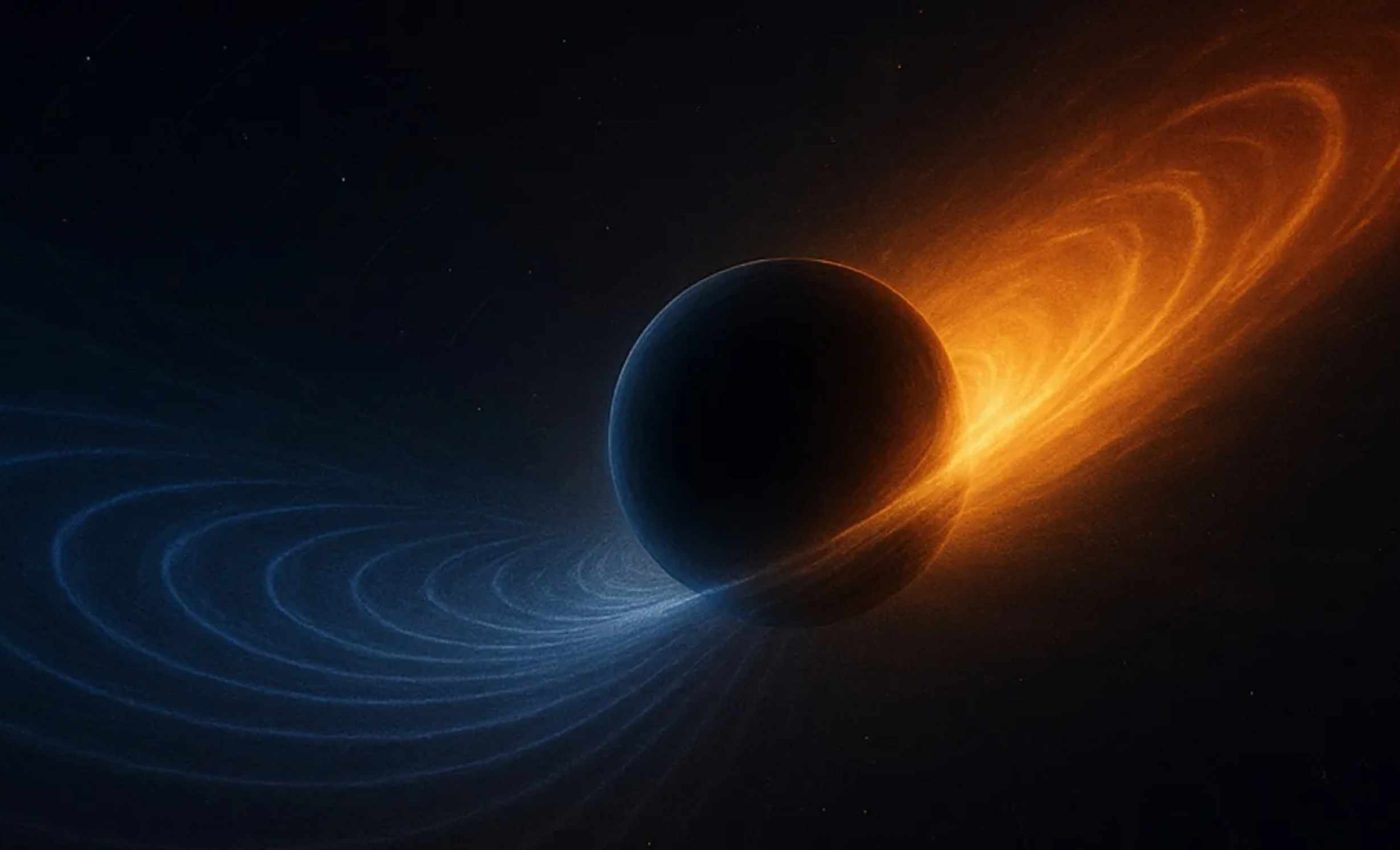
| Boilerpipe Text | A newborn black hole has been caught speeding away from its birth site at about 112,000 miles per hour (180,000 kilometers per hour). For the first time, scientists have also been able to trace its escape route.
The measurement used
ripples in spacetime
to recover both speed and direction, a complete recoil portrait from one cosmic event.
The signal came from GW190412, a merger of two unequal-mass black holes recorded by the global detector network.
The work centers on a single question with big consequences: How hard does a merged black hole get pushed, and where does it go?
How a black hole gets a kick
Juan Calderon-Bustillo at the University of Santiago de Compostela (
USC
) led the study. His team showed that black hole recoil is a direction in space we can actually map.
Black-hole recoil, a kick from uneven wave emissions, happens because
gravitational waves
do not leave in perfect balance. When more momentum goes one way, the remnant gets nudged the other way.
“However, this orchestra is special: audiences located in different positions around it will record different combinations of instruments, which allows them to understand where exactly they are around it,” explained Calderon-Bustillo.
It’s a fitting description for a universe that plays its deepest music through gravity itself, where distance and direction are written in invisible vibrations rather than light.
What the GW190412 signal reveals
The team used the event’s richer structure, including higher-order modes, weaker components beyond the dominant quadrupole signal.
Those extra pieces vary with viewing angle, which lets scientists infer how the remnant moved relative to us.
They also referenced orbital angular momentum, the direction perpendicular to the orbit plane. Pinning down how the recoil lined up with that axis turns a messy chirp into a 3D motion track.
GW190412 was special because its masses were very different. That asymmetry boosted the weaker modes and unlocked the geometry needed for a directional
measurement
.
Speed and direction matter
GW190412’s speed surpasses 31 miles per second (50 kilometers per second), which is fast enough to leave a tight stellar neighborhood.
That means a kicked black hole can be evicted from its birthplace and stop merging again in that same environment.
A
globular cluster
– a dense spherical swarm of old stars – has a typical escape speed below that threshold. So a kick like this likely ejects the remnant from such a cluster, changing how many repeat mergers those clusters can host.
Recoil direction adds another layer. If the kick points into thinner gas, any aftereffects dim. If it plows through thicker material, the trail might briefly shine. Mapping that vector tells us where to look.
How the team studied GW190412
This result stands on years of groundwork that showed kicks are not just theory but observable in the waves themselves. Earlier work established how to pull kick clues from waveform structure by exploiting subdominant components.
Back in 2018, Calderon-Bustillo and collaborators laid out a way to estimate a component of the kick with current detectors, showing when such a measurement becomes possible.
Gravitational waves
– tiny ripples in spacetime traveling at light speed – have turned silent collisions into measurable signals. Each detection hands over mass, spin, and distance and now, for the right events, a remnant’s motion.
The first detection arrived in 2015. Since then, detectors have logged many
black hole
mergers across the sky. With higher sensitivity, more signals will carry the extra detail needed to read recoil direction.
The team noted that the result shows just how powerful gravitational waves have become as tools for mapping the universe. They reveal not only what happened in a black hole merger but how the remnant moved through space.
What scientists will look for next
If a kicked remnant barrels through gas, it could light up briefly. An active galactic nucleus – a bright disk around a supermassive black hole – is one natural place for that to happen.
Recoils through such disks may leave flashes that line up in time with the wave event. A candidate example already exists: a short-lived optical brightening potentially linked to a black hole merger in an
active galactic nucleus
.
That case hinted at a several hundred mile-per-second kick and showed how wave and light data might meet.
Direction matters for follow up. If the kick points toward us, the flare might be brighter or longer. If it goes sideways or away, the flare might be faint or missed.
Lessons from GW190412
Unequal masses made the weaker modes stand out in GW190412, and that was the key. Without those extra features, the signal would not carry enough angular information to fix a direction.
The team also tied the motion to the black-hole recoil direction relative to Earth and the system’s geometry. That complete picture turns a one-dimensional speed into a navigational map.
Future runs will bring more asymmetric mergers with clear higher-order modes. Each such event could add a point to a growing map of remnant motions across environments.
Better measurements will test how often kicks eject
black holes
from clusters, dwarf galaxies, or gas disks. That will refine how we think about building bigger black holes over cosmic time.
The study is published in
Nature Astronomy
.
Image credit: Galician Institute of High Energy Physics.
—–
Like what you read?
Subscribe to our newsletter
for engaging articles, exclusive content, and the latest updates.
Check us out on
EarthSnap
, a free app brought to you by
Eric Ralls
and Earth.com.
—– |
| Markdown | 
[](https://www.earth.com/)

[Subscribe](https://www.earth.com/subscribe/)
[](https://www.earth.com/)
news

videos

images

earthpedia

[take action](https://www.earth.com/take-action-save-earth/)
[earthsnap](https://www.earth.com/earthsnap/)

[Subscribe](https://www.earth.com/subscribe/)
03-15-2026
# Astronomers spot a massive object crossing the galaxy at nearly 620 miles per second
By[Adrian Villellas](https://www.earth.com/author/adrian-villellas/)
Earth.com staff writer
[](https://www.google.com/preferences/source?q=earth.com "Preferred Source")
[](https://www.facebook.com/sharer/sharer.php?u=https%3A%2F%2Fwww.earth.com%2Fnews%2Fblack-hole-gw190412-detected-escaping-collision-at-112000-mph%2F "Share on Facebook")[](https://www.linkedin.com/shareArticle?url=https%3A%2F%2Fwww.earth.com%2Fnews%2Fblack-hole-gw190412-detected-escaping-collision-at-112000-mph%2F&text=Astronomers%20spot%20a%20massive%20object%20crossing%20the%20galaxy%20at%20nearly%20620%20miles%20per%20second "Share on LinkedIn")[](https://x.com/intent/tweet?text=Astronomers%20spot%20a%20massive%20object%20crossing%20the%20galaxy%20at%20nearly%20620%20miles%20per%20second%3A%20https%3A%2F%2Fwww.earth.com%2Fnews%2Fblack-hole-gw190412-detected-escaping-collision-at-112000-mph%2F "Share on X")[](https://api.whatsapp.com/send?text=Astronomers%20spot%20a%20massive%20object%20crossing%20the%20galaxy%20at%20nearly%20620%20miles%20per%20second%3A%20https%3A%2F%2Fwww.earth.com%2Fnews%2Fblack-hole-gw190412-detected-escaping-collision-at-112000-mph%2F "Share on WhatsApp")[](https://bsky.app/intent/compose?text=Astronomers%20spot%20a%20massive%20object%20crossing%20the%20galaxy%20at%20nearly%20620%20miles%20per%20second%3A%20https%3A%2F%2Fwww.earth.com%2Fnews%2Fblack-hole-gw190412-detected-escaping-collision-at-112000-mph%2F "Share on Bluesky")
[Follow Earth on Google](https://profile.google.com/cp/Cg0vZy8xMWxkN3Y2N3lu)
A newborn black hole has been caught speeding away from its birth site at about 112,000 miles per hour (180,000 kilometers per hour). For the first time, scientists have also been able to trace its escape route.
The measurement used [ripples in spacetime](https://www.earth.com/news/gravitational-waves-dark-matter-big-bang-breakthrough/) to recover both speed and direction, a complete recoil portrait from one cosmic event.
[](https://earthsnap.onelink.me/3u5Q/ags2loc4)
The signal came from GW190412, a merger of two unequal-mass black holes recorded by the global detector network.
The work centers on a single question with big consequences: How hard does a merged black hole get pushed, and where does it go?
## How a black hole gets a kick
Juan Calderon-Bustillo at the University of Santiago de Compostela ([USC](https://www.usc.gal/en)) led the study. His team showed that black hole recoil is a direction in space we can actually map.
Black-hole recoil, a kick from uneven wave emissions, happens because [gravitational waves](https://www.earth.com/news/quantum-particles-solution-gravitational-wave-mystery-bose-einstein-condensate/) do not leave in perfect balance. When more momentum goes one way, the remnant gets nudged the other way.
“However, this orchestra is special: audiences located in different positions around it will record different combinations of instruments, which allows them to understand where exactly they are around it,” explained Calderon-Bustillo.
It’s a fitting description for a universe that plays its deepest music through gravity itself, where distance and direction are written in invisible vibrations rather than light.
## What the GW190412 signal reveals
The team used the event’s richer structure, including higher-order modes, weaker components beyond the dominant quadrupole signal.
Those extra pieces vary with viewing angle, which lets scientists infer how the remnant moved relative to us.
They also referenced orbital angular momentum, the direction perpendicular to the orbit plane. Pinning down how the recoil lined up with that axis turns a messy chirp into a 3D motion track.
GW190412 was special because its masses were very different. That asymmetry boosted the weaker modes and unlocked the geometry needed for a directional [measurement](https://journals.aps.org/prd/abstract/10.1103/PhysRevD.102.043015).
## Speed and direction matter
GW190412’s speed surpasses 31 miles per second (50 kilometers per second), which is fast enough to leave a tight stellar neighborhood.
That means a kicked black hole can be evicted from its birthplace and stop merging again in that same environment.
A [globular cluster](https://www.earth.com/news/intermediate-mass-black-holes-survive-and-thrive-in-giant-star-clusters/) – a dense spherical swarm of old stars – has a typical escape speed below that threshold. So a kick like this likely ejects the remnant from such a cluster, changing how many repeat mergers those clusters can host.
Recoil direction adds another layer. If the kick points into thinner gas, any aftereffects dim. If it plows through thicker material, the trail might briefly shine. Mapping that vector tells us where to look.
## How the team studied GW190412
This result stands on years of groundwork that showed kicks are not just theory but observable in the waves themselves. Earlier work established how to pull kick clues from waveform structure by exploiting subdominant components.
Back in 2018, Calderon-Bustillo and collaborators laid out a way to estimate a component of the kick with current detectors, showing when such a measurement becomes possible.
[Gravitational waves](https://www.earth.com/news/black-holes-are-not-the-secret-source-of-dark-matter/) – tiny ripples in spacetime traveling at light speed – have turned silent collisions into measurable signals. Each detection hands over mass, spin, and distance and now, for the right events, a remnant’s motion.
The first detection arrived in 2015. Since then, detectors have logged many [black hole](https://www.earth.com/news/colossal-black-hole-found-in-our-galaxy-is-33-times-the-suns-mass/) mergers across the sky. With higher sensitivity, more signals will carry the extra detail needed to read recoil direction.
The team noted that the result shows just how powerful gravitational waves have become as tools for mapping the universe. They reveal not only what happened in a black hole merger but how the remnant moved through space.
## What scientists will look for next
If a kicked remnant barrels through gas, it could light up briefly. An active galactic nucleus – a bright disk around a supermassive black hole – is one natural place for that to happen.
Recoils through such disks may leave flashes that line up in time with the wave event. A candidate example already exists: a short-lived optical brightening potentially linked to a black hole merger in an [active galactic nucleus](https://www.earth.com/news/galaxy-with-an-ultra-bright-core-is-concealing-a-secret/).
That case hinted at a several hundred mile-per-second kick and showed how wave and light data might meet.
Direction matters for follow up. If the kick points toward us, the flare might be brighter or longer. If it goes sideways or away, the flare might be faint or missed.
## Lessons from GW190412
Unequal masses made the weaker modes stand out in GW190412, and that was the key. Without those extra features, the signal would not carry enough angular information to fix a direction.
The team also tied the motion to the black-hole recoil direction relative to Earth and the system’s geometry. That complete picture turns a one-dimensional speed into a navigational map.
Future runs will bring more asymmetric mergers with clear higher-order modes. Each such event could add a point to a growing map of remnant motions across environments.
Better measurements will test how often kicks eject [black holes](https://www.earth.com/news/milky-ways-black-hole-formed-through-a-merger/) from clusters, dwarf galaxies, or gas disks. That will refine how we think about building bigger black holes over cosmic time.
The study is published in [*Nature Astronomy*](https://www.nature.com/articles/s41550-025-02632-5).
Image credit: Galician Institute of High Energy Physics.
—–
Like what you read? [Subscribe to our newsletter](https://www.earth.com/subscribe/) for engaging articles, exclusive content, and the latest updates.
Check us out on [EarthSnap](https://www.earth.com/earthsnap/), a free app brought to you by [Eric Ralls](https://www.earth.com/author/eralls/) and Earth.com.
—–
RELATED NEWS
[](https://www.earth.com/news/global-ocean-heat-temperature-reached-all-time-high-records-in-2025/)
04-08-2026
[Earth's ocean temperatures reached all-time high levels in 2025, with no end in sight](https://www.earth.com/news/global-ocean-heat-temperature-reached-all-time-high-records-in-2025/)
[](https://www.earth.com/news/disturbing-warning-issued-day-zero-drought-extreme-water-scarcity-in-us/)
04-08-2026
[Scientists issue a disturbing warning over 'Day Zero Drought' timelines in the US and globally](https://www.earth.com/news/disturbing-warning-issued-day-zero-drought-extreme-water-scarcity-in-us/)
[](https://www.earth.com/news/chimpanzees-use-medicinal-plants-to-heal-their-own-wounds-and-help-friends/)
04-08-2026
[Chimpanzees use medicinal plants found in forests to heal their own wounds and also help their friends](https://www.earth.com/news/chimpanzees-use-medicinal-plants-to-heal-their-own-wounds-and-help-friends/)
[](https://www.earth.com/news/fungus-that-rots-trees-from-the-inside-out-may-be-hiding-methane-climate-problem/)
04-08-2026
[Fungus that rots trees from the inside out may be hiding a climate problem](https://www.earth.com/news/fungus-that-rots-trees-from-the-inside-out-may-be-hiding-methane-climate-problem/)
[](https://www.earth.com/news/new-nasa-analysis-reveals-an-unexpected-surprise-about-jupiters-true-shape-size/)
04-08-2026
[New NASA analysis reveals an unexpected surprise about Jupiter's true shape and size](https://www.earth.com/news/new-nasa-analysis-reveals-an-unexpected-surprise-about-jupiters-true-shape-size/)
[](https://www.earth.com/news/fungus-and-bacterium-can-join-forces-and-cause-much-more-aggressive-infection/)
04-08-2026
[Common fungus and bacterium can join forces and cause a much more aggressive infection, according to a new study](https://www.earth.com/news/fungus-and-bacterium-can-join-forces-and-cause-much-more-aggressive-infection/)
[](https://www.earth.com/news/5000-year-old-rock-carving-in-the-sinai-tells-a-brutal-story-that-it-is-captivating-archaeologists/)
04-08-2026
[5,000-year-old rock carving in the Sinai tells a brutal story that it is captivating archaeologists](https://www.earth.com/news/5000-year-old-rock-carving-in-the-sinai-tells-a-brutal-story-that-it-is-captivating-archaeologists/)
[](https://www.earth.com/news/bees-handle-extreme-heat-better-when-theyre-not-alone/)
04-08-2026
[Bees handle extreme heat better when they’re not alone](https://www.earth.com/news/bees-handle-extreme-heat-better-when-theyre-not-alone/)
[](https://www.earth.com/news/nasa-captures-young-star-hd-61005-blowing-bubbles-never-seen-before/)
04-08-2026
[NASA captures a young star doing something never before witnessed](https://www.earth.com/news/nasa-captures-young-star-hd-61005-blowing-bubbles-never-seen-before/)
[](https://www.earth.com/news/skeleton-of-paleolithic-teenager-buried-28000-years-ago-suggests-brutal-death/)
04-08-2026
[What researchers have just discovered in the skeleton of a Paleolithic teenager buried 28,000 years ago suggests a very brutal death](https://www.earth.com/news/skeleton-of-paleolithic-teenager-buried-28000-years-ago-suggests-brutal-death/)
[](https://www.earth.com/news/crocodile-resembling-greyhound-dog-galahadosuchus-jonesi-lived-215-million-years-ago/)
04-08-2026
[Crocodile resembling a greyhound dog lived on Earth roughly 215 million years ago](https://www.earth.com/news/crocodile-resembling-greyhound-dog-galahadosuchus-jonesi-lived-215-million-years-ago/)
[](https://www.earth.com/news/skeletons-seated-burials-discovered-inside-a-circular-pit-dijon-france-unexplained/)
04-08-2026
[Skeleton discovered in France was buried in a sitting position inside a circular pit, with no clear explanation](https://www.earth.com/news/skeletons-seated-burials-discovered-inside-a-circular-pit-dijon-france-unexplained/)
- [home](https://www.earth.com/)
- [news](https://www.earth.com/news/)
- [news-category/science](https://www.earth.com/news-category/science/)
News coming your way
The biggest news about our planet delivered to you each day

SUBSCRIBE

[About Us](https://www.earth.com/about/)
[Privacy Policy](https://www.earth.com/privacy-policy/)
[Terms of Service](https://www.earth.com/terms-of-service/)
[Site Map](https://www.earth.com/sitemap_index.xml)
[Staff](https://www.earth.com/staff/)
EARTH.COM
[News](https://www.earth.com/news/)
[Videos](https://www.earth.com/video/)
[Images](https://www.earth.com/image/)
[Earthpedia](https://www.earth.com/earthpedia/)
[Take action](https://www.earth.com/take-action-save-earth/)
EARTHPEDIA
[Articles](https://www.earth.com/earthpedia-articles/)
[Animals Encyclopedia](https://www.earth.com/animal-encyclopedia/)
[Endangered Animals](https://www.earth.com/endangered-species-category/endangered-animals/)
[Plants Encyclopedia](https://www.earth.com/plant-encyclopedia/)
[Endangered Plants](https://www.earth.com/endangered-species-category/endangered-plants/)
EARTH NEWS
[Breaking News](https://www.earth.com/news-category/breaking-news/)
[Environment](https://www.earth.com/news-category/environment/)
[Lifestyle](https://www.earth.com/news-category/lifestyle/)
[Animals](https://www.earth.com/news-category/animals/)
[Plants](https://www.earth.com/news-category/plants/)
Earthsnap
[Get the app](https://www.earth.com/earthsnap/)
[Privacy Policy](https://www.earth.com/earthsnap-inc-privacy-policy/)
[Terms of service](https://www.earth.com/earthsnap-inc-terms-of-service/)
GET IN TOUCH
[](https://www.facebook.com/earth.com/)
[](https://www.instagram.com/earthdotcom/)
[](https://x.com/earthdotcom)
[](https://www.pinterest.com/earthdotcom/)
[Contact Us](https://www.earth.com/contact/)
© 2026 Earth.com
All rights reserved |
| Readable Markdown | A newborn black hole has been caught speeding away from its birth site at about 112,000 miles per hour (180,000 kilometers per hour). For the first time, scientists have also been able to trace its escape route.
The measurement used [ripples in spacetime](https://www.earth.com/news/gravitational-waves-dark-matter-big-bang-breakthrough/) to recover both speed and direction, a complete recoil portrait from one cosmic event.
[](https://earthsnap.onelink.me/3u5Q/ags2loc4)
The signal came from GW190412, a merger of two unequal-mass black holes recorded by the global detector network.
The work centers on a single question with big consequences: How hard does a merged black hole get pushed, and where does it go?
## How a black hole gets a kick
Juan Calderon-Bustillo at the University of Santiago de Compostela ([USC](https://www.usc.gal/en)) led the study. His team showed that black hole recoil is a direction in space we can actually map.
Black-hole recoil, a kick from uneven wave emissions, happens because [gravitational waves](https://www.earth.com/news/quantum-particles-solution-gravitational-wave-mystery-bose-einstein-condensate/) do not leave in perfect balance. When more momentum goes one way, the remnant gets nudged the other way.
“However, this orchestra is special: audiences located in different positions around it will record different combinations of instruments, which allows them to understand where exactly they are around it,” explained Calderon-Bustillo.
It’s a fitting description for a universe that plays its deepest music through gravity itself, where distance and direction are written in invisible vibrations rather than light.
## What the GW190412 signal reveals
The team used the event’s richer structure, including higher-order modes, weaker components beyond the dominant quadrupole signal.
Those extra pieces vary with viewing angle, which lets scientists infer how the remnant moved relative to us.
They also referenced orbital angular momentum, the direction perpendicular to the orbit plane. Pinning down how the recoil lined up with that axis turns a messy chirp into a 3D motion track.
GW190412 was special because its masses were very different. That asymmetry boosted the weaker modes and unlocked the geometry needed for a directional [measurement](https://journals.aps.org/prd/abstract/10.1103/PhysRevD.102.043015).
## Speed and direction matter
GW190412’s speed surpasses 31 miles per second (50 kilometers per second), which is fast enough to leave a tight stellar neighborhood.
That means a kicked black hole can be evicted from its birthplace and stop merging again in that same environment.
A [globular cluster](https://www.earth.com/news/intermediate-mass-black-holes-survive-and-thrive-in-giant-star-clusters/) – a dense spherical swarm of old stars – has a typical escape speed below that threshold. So a kick like this likely ejects the remnant from such a cluster, changing how many repeat mergers those clusters can host.
Recoil direction adds another layer. If the kick points into thinner gas, any aftereffects dim. If it plows through thicker material, the trail might briefly shine. Mapping that vector tells us where to look.
## How the team studied GW190412
This result stands on years of groundwork that showed kicks are not just theory but observable in the waves themselves. Earlier work established how to pull kick clues from waveform structure by exploiting subdominant components.
Back in 2018, Calderon-Bustillo and collaborators laid out a way to estimate a component of the kick with current detectors, showing when such a measurement becomes possible.
[Gravitational waves](https://www.earth.com/news/black-holes-are-not-the-secret-source-of-dark-matter/) – tiny ripples in spacetime traveling at light speed – have turned silent collisions into measurable signals. Each detection hands over mass, spin, and distance and now, for the right events, a remnant’s motion.
The first detection arrived in 2015. Since then, detectors have logged many [black hole](https://www.earth.com/news/colossal-black-hole-found-in-our-galaxy-is-33-times-the-suns-mass/) mergers across the sky. With higher sensitivity, more signals will carry the extra detail needed to read recoil direction.
The team noted that the result shows just how powerful gravitational waves have become as tools for mapping the universe. They reveal not only what happened in a black hole merger but how the remnant moved through space.
## What scientists will look for next
If a kicked remnant barrels through gas, it could light up briefly. An active galactic nucleus – a bright disk around a supermassive black hole – is one natural place for that to happen.
Recoils through such disks may leave flashes that line up in time with the wave event. A candidate example already exists: a short-lived optical brightening potentially linked to a black hole merger in an [active galactic nucleus](https://www.earth.com/news/galaxy-with-an-ultra-bright-core-is-concealing-a-secret/).
That case hinted at a several hundred mile-per-second kick and showed how wave and light data might meet.
Direction matters for follow up. If the kick points toward us, the flare might be brighter or longer. If it goes sideways or away, the flare might be faint or missed.
## Lessons from GW190412
Unequal masses made the weaker modes stand out in GW190412, and that was the key. Without those extra features, the signal would not carry enough angular information to fix a direction.
The team also tied the motion to the black-hole recoil direction relative to Earth and the system’s geometry. That complete picture turns a one-dimensional speed into a navigational map.
Future runs will bring more asymmetric mergers with clear higher-order modes. Each such event could add a point to a growing map of remnant motions across environments.
Better measurements will test how often kicks eject [black holes](https://www.earth.com/news/milky-ways-black-hole-formed-through-a-merger/) from clusters, dwarf galaxies, or gas disks. That will refine how we think about building bigger black holes over cosmic time.
The study is published in [*Nature Astronomy*](https://www.nature.com/articles/s41550-025-02632-5).
Image credit: Galician Institute of High Energy Physics.
—–
Like what you read? [Subscribe to our newsletter](https://www.earth.com/subscribe/) for engaging articles, exclusive content, and the latest updates.
Check us out on [EarthSnap](https://www.earth.com/earthsnap/), a free app brought to you by [Eric Ralls](https://www.earth.com/author/eralls/) and Earth.com.
—– |
| Shard | 164 (laksa) |
| Root Hash | 17140435057403335764 |
| Unparsed URL | com,earth!www,/news/black-hole-gw190412-detected-escaping-collision-at-112000-mph/ s443 |