ℹ️ Skipped - page is already crawled
| Filter | Status | Condition | Details |
|---|---|---|---|
| HTTP status | PASS | download_http_code = 200 | HTTP 200 |
| Age cutoff | PASS | download_stamp > now() - 6 MONTH | 0 months ago |
| History drop | PASS | isNull(history_drop_reason) | No drop reason |
| Spam/ban | PASS | fh_dont_index != 1 AND ml_spam_score = 0 | ml_spam_score=0 |
| Canonical | PASS | meta_canonical IS NULL OR = '' OR = src_unparsed | Not set |
| Property | Value |
|---|---|
| URL | https://www.datacamp.com/tutorial/introduction-to-convolutional-neural-networks-cnns |
| Last Crawled | 2026-04-21 17:45:07 (4 hours ago) |
| First Indexed | 2023-11-16 17:46:07 (2 years ago) |
| HTTP Status Code | 200 |
| Meta Title | What Is a CNN? Introduction to Convolutional Neural Networks | DataCamp |
| Meta Description | A guide to understanding CNNs, their impact on image analysis, and some key strategies to combat overfitting for robust CNN vs deep learning applications. |
| Meta Canonical | null |
| Boilerpipe Text | Convolutional neural networks power some of today's most impressive AI capabilities, from facial recognition on smartphones to tumor detection in medical imaging.
In this tutorial, I cover what CNNs are, how they work, their key components, strategies to combat overfitting, and the most popular frameworks for building them.
To get hands-on with deep learning, check out DataCamp's
Introduction to Deep Learning in Python
course.
TL;DR
A convolutional neural network (CNN) is a
deep learning
architecture designed for tasks like image classification, object detection, and segmentation.
CNNs have four key components: convolutional layers (feature extraction), activation functions like ReLU (non-linearity), pooling layers (dimensionality reduction), and fully connected layers (classification).
Their design is inspired by the hierarchical structure of the human visual cortex.
Overfitting is a major challenge; techniques like dropout, batch normalization, data augmentation, and early stopping help mitigate it.
TensorFlow, PyTorch, and Keras are the most popular frameworks for building CNNs.
A Convolutional Neural Network (CNN), also known as ConvNet, is a specialized type of
deep learning
algorithm mainly designed for tasks that necessitate object recognition, including image classification, detection, and segmentation. CNNs are employed in a variety of practical scenarios, such as autonomous vehicles, security camera systems, and others.
The importance of CNNs
There are several reasons why CNNs are important in the modern world, as highlighted below:
CNNs are distinguished from classic machine learning algorithms such as
SVMs
and
decision trees
by their ability to autonomously extract features at a large scale, bypassing the need for manual feature engineering and thereby enhancing efficiency.
The convolutional layers grant CNNs their translation-invariant characteristics, empowering them to identify and extract patterns and features from data irrespective of variations in position, orientation, scale, or translation.
A variety of pre-trained CNN architectures, including VGG-16, ResNet50, Inceptionv3, and EfficientNet, have demonstrated top-tier performance. These models can be adapted to new tasks with relatively little data through a process known as
fine-tuning
.
Beyond image classification tasks, CNNs are versatile and can be applied to a range of other domains, such as natural language processing, time series analysis, and speech recognition.
Inspiration Behind CNN and Parallels With The Human Visual System
Convolutional neural networks were inspired by the layered architecture of the human visual cortex, and below are some key similarities and differences:
Illustration of the correspondence between the areas associated with the primary visual cortex and the layers in a convolutional neural network (
source
)
Hierarchical architecture:
Both CNNs and the visual cortex have a hierarchical structure, with simple features extracted in early layers and more complex features built up in deeper layers. This allows increasingly sophisticated representations of visual inputs.
Local connectivity:
Neurons in the visual cortex only connect to a local region of the input, not the entire visual field. Similarly, the neurons in a CNN layer are only connected to a local region of the input volume through the convolution operation. This local connectivity enables efficiency.
Translation invariance:
Visual cortex neurons can detect features regardless of their location in the visual field. Pooling layers in a CNN provide a degree of translation invariance by summarizing local features.
Multiple feature maps:
At each stage of visual processing, there are many different feature maps extracted. CNNs mimic this through multiple filter maps in each convolution layer.
Non-linearity:
Neurons in the visual cortex exhibit non-linear response properties. CNNs achieve non-linearity through activation functions like ReLU applied after each convolution.
CNNs mimic the human visual system but are simpler, lacking its complex feedback mechanisms and relying on supervised learning rather than unsupervised, driving advances in computer vision despite these differences.
Key Components of a CNN
The convolutional neural network is made of four main parts.
But how do CNNs Learn with those parts?
They help the CNNs mimic how the human brain operates to recognize patterns and features in images:
Convolutional layers
Rectified Linear Unit (ReLU for short)
Pooling layers
Fully connected layers
This section dives into the definition of each one of these components through the following example of classifying a handwritten digit.
Architecture of the CNNs applied to digit recognition (
source
)
Convolution layers
This is the first building block of a CNN. As the name suggests, the main mathematical task performed is called convolution, which is the application of a sliding window function to a matrix of pixels representing an image. The sliding function applied to the matrix is called kernel or filter, and both can be used interchangeably.
In the convolution layer, several filters of equal size are applied, and each filter is used to recognize a specific pattern from the image, such as the curving of the digits, the edges, the whole shape of the digits, and more.
Put simply, in the convolution layer, we use small grids (called filters or kernels) that move over the image. Each small grid is like a mini magnifying glass that looks for specific patterns in the photo, like lines, curves, or shapes. As it moves across the photo, it creates a new grid that highlights where it found these patterns.
For example, one filter might be good at finding straight lines, another might find curves, and so on. By using several different filters, the CNN can get a good idea of all the different patterns that make up the image.
Let’s consider this 32x32 grayscale image of a handwritten digit. The values in the matrix are given for illustration purposes.
Illustration of the input image and its pixel representation
Also, let’s consider the kernel used for the convolution. It is a matrix with a dimension of 3x3. The weights of each element of the kernel is represented in the grid. Zero weights are represented in the black grids and ones in the white grid.
Do we have to manually find these weights?
In real life, the weights of the kernels are determined during the training process of the neural network.
Using these two matrices, we can perform the convolution operation by applying the dot product, and work as follows:
Apply the kernel matrix from the top-left corner to the right.
Perform element-wise multiplication.
Sum the values of the products.
The resulting value corresponds to the first value (top-left corner) in the convoluted matrix.
Move the kernel down with respect to the size of the sliding window.
Repeat steps 1 to 5 until the image matrix is fully covered.
The dimension of the convoluted matrix depends on the size of the sliding window. The higher the sliding window, the smaller the dimension.
Application of the convolution task using a stride of 1 with 3x3 kernel
Another name associated with the kernel in the literature is feature detector because the weights can be fine-tuned to detect specific features in the input image.
For instance:
Averaging neighboring pixels kernel can be used to blur the input image.
Subtracting neighboring kernel is used to perform edge detection.
The more convolution layers the network has, the better the layer is at detecting more abstract features.
Activation function
A
ReLU activation function
is applied after each convolution operation. This function helps the network learn non-linear relationships between the features in the image, hence making the network more robust for identifying different patterns. It also helps to mitigate the vanishing gradient problems.
Pooling layer
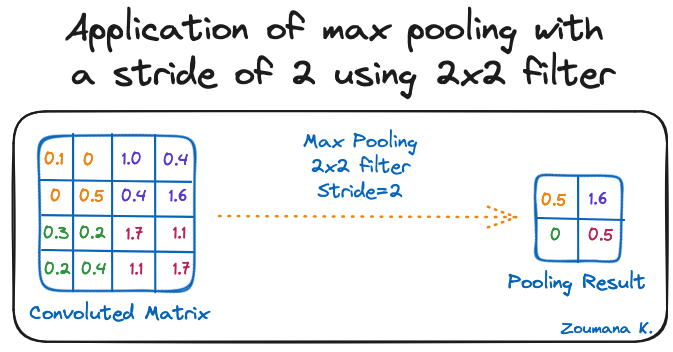
The goal of the pooling layer is to pull the most significant features from the convoluted matrix. This is done by applying some aggregation operations, which reduce the dimension of the feature map (convoluted matrix), hence reducing the memory used while training the network. Pooling is also relevant for mitigating overfitting.
The most common aggregation functions that can be applied are:
Max pooling, which is the maximum value of the feature map
Sum pooling corresponds to the sum of all the values of the feature map
Average pooling is the average of all the values.
Below is an illustration of each of the previous example:
Application of max pooling with a stride of 2 using 2x2 filter
Also, the dimension of the feature map becomes smaller as the pooling function is applied.
The last pooling layer flattens its feature map so that it can be processed by the fully connected layer.
Fully connected layers
These layers are in the last layer of the convolutional neural network, and their inputs correspond to the flattened one-dimensional matrix generated by the last pooling layer. ReLU activations functions are applied to them for non-linearity.
Finally, a softmax prediction layer is used to generate probability values for each of the possible output labels, and the final label predicted is the one with the highest probability score.
Overfitting and Regularization in CNNs
Overfitting
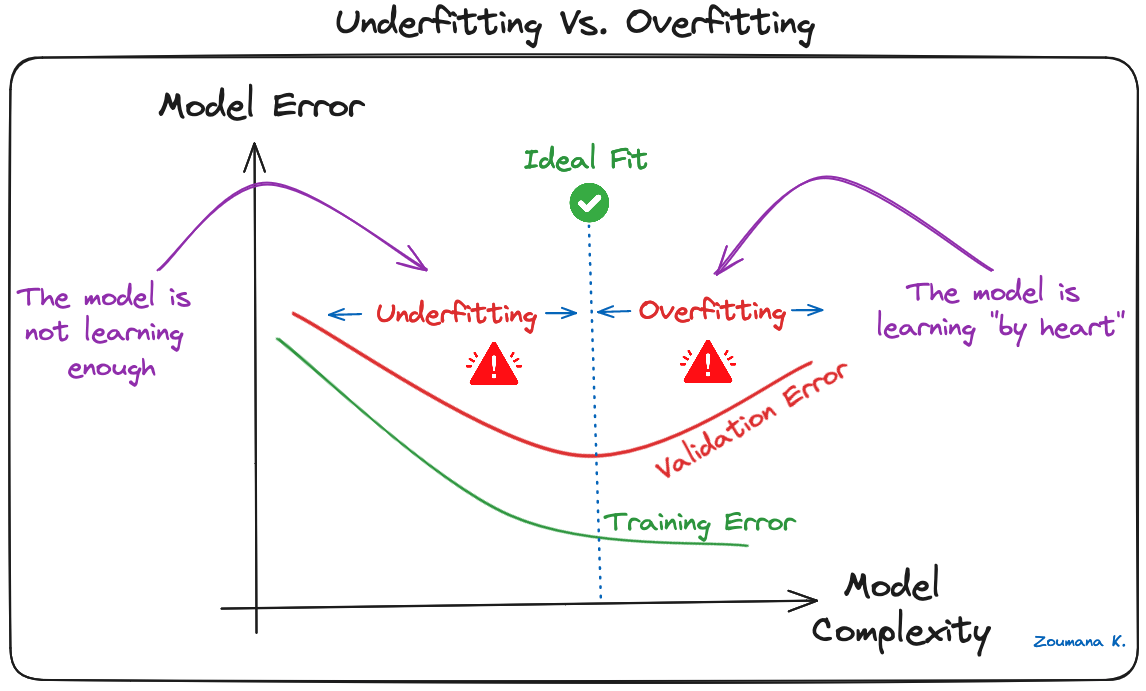
is a common challenge in machine learning models and CNN deep learning projects. It happens when the model learns the training data too well (“learning by heart”), including its noise and outliers. Such a learning leads to a model that performs well on the training data but badly on new, unseen data.
This can be observed when the model achieves significantly higher accuracy on training data compared to validation or testing data, and a graphical illustration is given below:
Underfitting Vs. Overfitting
Deep learning models, especially Convolutional Neural Networks (CNNs), are particularly susceptible to overfitting due to their capacity for high complexity and their ability to learn detailed patterns in large-scale data.
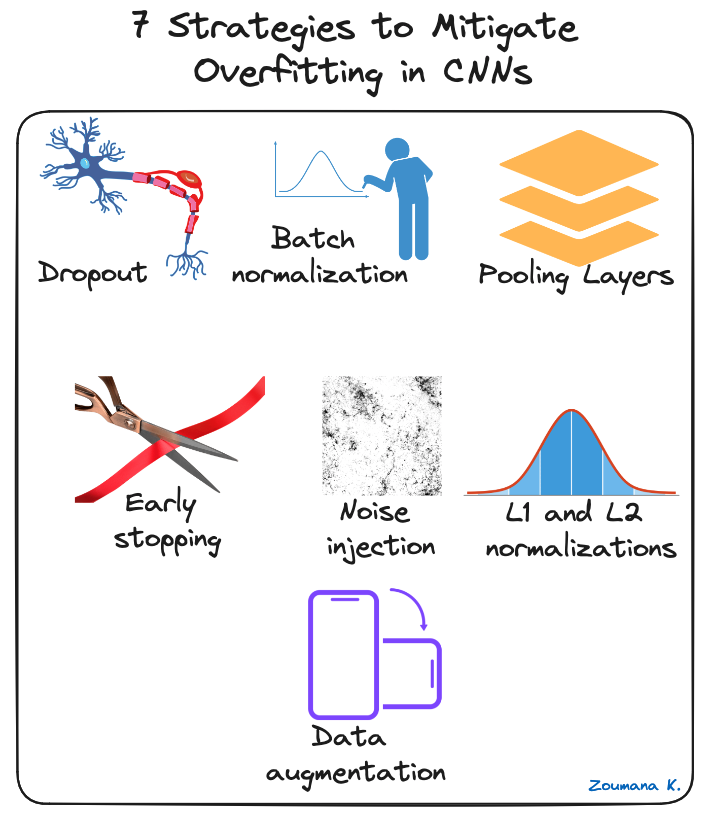
Several regularization techniques can be applied to mitigate overfitting in CNNs, and some are illustrated below:
7 strategies to mitigate overfitting in CNNs
Dropout
:
This consists of randomly dropping some neurons during the training process, which forces the remaining neurons to learn new features from the input data.
Batch normalization:
The overfitting is reduced to some extent by normalizing the input layer by adjusting and scaling the activations. This approach is also used to speed up and stabilize the training process.
Pooling Layers:
This can be used to reduce the spatial dimensions of the input image to provide the model with an abstracted form of representation, hence reducing the chance of overfitting.
Early stopping:
This consists of consistently monitoring the model’s performance on validation data during the training process and stopping the training whenever the validation error does not improve anymore.
Noise injection:
This process consists of adding noise to the inputs or the outputs of hidden layers during the training to make the model more robust and prevent it from a weak generalization.
L1 and L2 regularization:
Both L1 and L2 are used to add a penalty to the loss function based on the size of weights. More specifically, L1 encourages the weights to be sparse, leading to better feature selection. On the other hand, L2 (also called weight decay) encourages the weights to be small, preventing them from having too much influence on the predictions.
Data augmentation:
This is the process of artificially increasing the size and diversity of the training dataset by applying random transformations like rotation, scaling, flipping, or cropping to the input images.
Practical Applications of CNNs
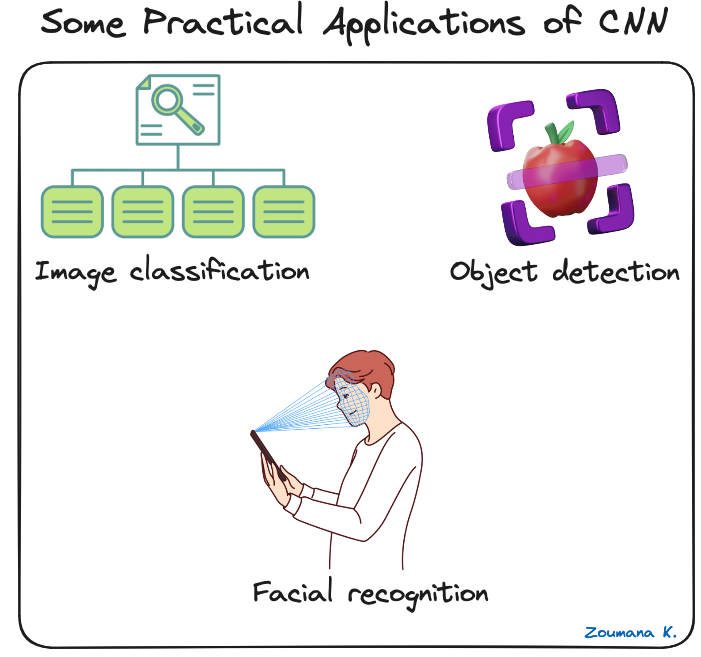
Convolutional Neural Networks have revolutionized the field of computer vision, leading to significant advancements in many real-world applications. Below are a few examples of how they are applied.
Some practical applications of CNNs
Image classification:
Convolutional neural networks are used for image categorization, where images are assigned to predefined categories. One use of such a scenario is automatic photo organization in social media platforms.
Object detection
:
CNNs are able to identify and locate multiple objects within an image. This capability is crucial in multiple scenarios of shelf scanning in retail to identify out-of-stock items.
Facial recognition:
this is also one of the main industries of application of CNNs. For instance, this technology can be embedded into security systems for efficient control of access based on facial features.
For a more hands-on implementation, our
Convolutional Neural Networks (CNN) with TensorFlow Tutorial
teaches how to construct and implement CNNs in Python with TensorFlow 2.
Popular CNN Architectures
Over the years, researchers have developed increasingly powerful CNN architectures. Here are some of the most influential ones:
LeNet-5 (1998):
One of the first CNNs, designed for handwritten digit recognition.
AlexNet (2012):
Won the ImageNet competition and popularized deep CNNs with GPU training.
VGGNet (2014):
Demonstrated that deeper networks with small 3x3 filters improve accuracy.
GoogLeNet/Inception (2014):
Introduced inception modules with parallel filter sizes for multi-scale feature extraction.
ResNet (2015):
Introduced skip connections, enabling training of networks with 100+ layers.
EfficientNet (2019):
Used compound scaling to balance network depth, width, and resolution.
ConvNeXt (2022):
A modernized CNN design that competes with Vision Transformers.
While Vision Transformers (ViTs) have emerged as strong alternatives since 2020, CNNs remain widely used due to their efficiency, lower data requirements, and maturity in production environments.
Deep Learning Frameworks for CNNs
The rapid growth of deep learning is mainly due to powerful frameworks like Tensorflow, Pytorch, and Keras, which make it easier to train convolutional neural networks and other deep learning models.
Let’s have a brief overview of each framework.
TensorFlow
TensorFlow is an open-source deep learning framework developed by Google and released in 2015. It offers a range of tools for machine learning development and deployment. Our
Introduction to Deep Neural Networks
provides a complete guide to understanding deep neural networks and their significance in the modern deep learning world of artificial intelligence, along with real-world implementations in TensorFlow.
Keras
Keras is a high-level neural network framework in Python that enables rapid experimentation and development. It's open-source and serves as TensorFlow's official high-level API (since version 2.0), streamlining model development in the TensorFlow ecosystem. Our course,
Image Processing with Keras in Python
, teaches how to conduct image analysis using Keras with Python by constructing, training, and evaluating convolutional neural networks.
PyTorch
Released by Meta (formerly Facebook) AI Research in 2017, PyTorch is a general-purpose deep learning framework known for its dynamic computational graph, Pythonic syntax, and strong research community. If you are interested in diving into natural language processing, our
NLP with PyTorch: A Comprehensive Guide
is a great starting point.
Each project is different, so the decision really depends on what characteristics are most important for a given use case. To help make better decisions, the following table provides a brief comparison of these frameworks, highlighting their unique features.
Tensorflow
Pytorch
Keras
API Level
Both
(High and Low)
Low
High
Architecture
Not easy to use
Pythonic, intuitive syntax
Simple, concise, readable
Datasets
Large datasets, high performance
Large datasets, high performance
Smaller datasets
Debugging
Difficult to conduct debugging
Good debugging capabilities
Simple network, so debugging is not often needed
Pretrained models?
Yes
Yes
Yes
Popularity
Second most popular of the three
Most widely used for research and increasingly for production
Integrated into TensorFlow as its official high-level API
Speed
Fast, high-performance
Fast, high-performance
Same as TensorFlow (runs on TF backend)
Written in
C++, CUDA, Python
C++, Python
Python
Comparative table between Tensorflow, Pytorch and Keras (
source
)
Conclusion
This article has provided a complete overview of what a CNN in deep learning is, along with their crucial role in image recognition and classification tasks.
It started by highlighting the inspiration drawn from the human visual system for the design of CNNs and then explored the key components that allow these networks to learn and make predictions.
The issue of overfitting was acknowledged as a significant challenge to CNNs' generalization capability. To mitigate this, a variety of relevant strategies to mitigate overfitting and improve CNNs overall performance were outlined.
Finally, some major deep learning CNN frameworks have been mentioned, along with the unique features of each one and how they compare to each other.
Eager to dive further into the world of AI, and machine learning? Take your expertise to the next level by enrolling in the
Deep Learning with PyTorch
course today. |
| Markdown | [ Last chance! **50% off** DataCamp Premium Sale ends in 2d10h14m47s Buy Now](https://www.datacamp.com/promo/flash-sale-apr-26)
[Skip to main content](https://www.datacamp.com/tutorial/introduction-to-convolutional-neural-networks-cnns#main)
EN
[English](https://www.datacamp.com/tutorial/introduction-to-convolutional-neural-networks-cnns)[Español](https://www.datacamp.com/es/tutorial/introduction-to-convolutional-neural-networks-cnns)[Português](https://www.datacamp.com/pt/tutorial/introduction-to-convolutional-neural-networks-cnns)[DeutschBeta](https://www.datacamp.com/de/tutorial/introduction-to-convolutional-neural-networks-cnns)[FrançaisBeta](https://www.datacamp.com/fr/tutorial/introduction-to-convolutional-neural-networks-cnns)[ItalianoBeta](https://www.datacamp.com/it/tutorial/introduction-to-convolutional-neural-networks-cnns)[TürkçeBeta](https://www.datacamp.com/tr/tutorial/introduction-to-convolutional-neural-networks-cnns)[Bahasa IndonesiaBeta](https://www.datacamp.com/id/tutorial/introduction-to-convolutional-neural-networks-cnns)[Tiếng ViệtBeta](https://www.datacamp.com/vi/tutorial/introduction-to-convolutional-neural-networks-cnns)[NederlandsBeta](https://www.datacamp.com/nl/tutorial/introduction-to-convolutional-neural-networks-cnns)[हिन्दीBeta](https://www.datacamp.com/hi/tutorial/introduction-to-convolutional-neural-networks-cnns)[日本語Beta](https://www.datacamp.com/ja/tutorial/introduction-to-convolutional-neural-networks-cnns)[한국어Beta](https://www.datacamp.com/ko/tutorial/introduction-to-convolutional-neural-networks-cnns)[PolskiBeta](https://www.datacamp.com/pl/tutorial/introduction-to-convolutional-neural-networks-cnns)[RomânăBeta](https://www.datacamp.com/ro/tutorial/introduction-to-convolutional-neural-networks-cnns)[РусскийBeta](https://www.datacamp.com/ru/tutorial/introduction-to-convolutional-neural-networks-cnns)[SvenskaBeta](https://www.datacamp.com/sv/tutorial/introduction-to-convolutional-neural-networks-cnns)[ไทยBeta](https://www.datacamp.com/th/tutorial/introduction-to-convolutional-neural-networks-cnns)[中文(简体)Beta](https://www.datacamp.com/zh/tutorial/introduction-to-convolutional-neural-networks-cnns)
***
[More Information](https://support.datacamp.com/hc/en-us/articles/21821832799255-Languages-Available-on-DataCamp)
[Found an Error?]()
[Log in](https://www.datacamp.com/users/sign_in?redirect=%2Ftutorial%2Fintroduction-to-convolutional-neural-networks-cnns)[Get Started](https://www.datacamp.com/users/sign_up?redirect=%2Ftutorial%2Fintroduction-to-convolutional-neural-networks-cnns)
Tutorials
[Blogs](https://www.datacamp.com/blog)
[Tutorials](https://www.datacamp.com/tutorial)
[docs](https://www.datacamp.com/doc)
[Podcasts](https://www.datacamp.com/podcast)
[Cheat Sheets](https://www.datacamp.com/cheat-sheet)
[code-alongs](https://www.datacamp.com/code-along)
[Newsletter](https://dcthemedian.substack.com/)
Category
Category
Technologies
Discover content by tools and technology
[AI Agents](https://www.datacamp.com/tutorial/category/ai-agents)[AI News](https://www.datacamp.com/tutorial/category/ai-news)[Artificial Intelligence](https://www.datacamp.com/tutorial/category/ai)[AWS](https://www.datacamp.com/tutorial/category/aws)[Azure](https://www.datacamp.com/tutorial/category/microsoft-azure)[Business Intelligence](https://www.datacamp.com/tutorial/category/learn-business-intelligence)[ChatGPT](https://www.datacamp.com/tutorial/category/chatgpt)[Databricks](https://www.datacamp.com/tutorial/category/databricks)[dbt](https://www.datacamp.com/tutorial/category/dbt)[Docker](https://www.datacamp.com/tutorial/category/docker)[Excel](https://www.datacamp.com/tutorial/category/excel)[Generative AI](https://www.datacamp.com/tutorial/category/generative-ai)[Git](https://www.datacamp.com/tutorial/category/git)[Google Cloud Platform](https://www.datacamp.com/tutorial/category/google-cloud-platform)[Hugging Face](https://www.datacamp.com/tutorial/category/Hugging-Face)[Java](https://www.datacamp.com/tutorial/category/java)[Julia](https://www.datacamp.com/tutorial/category/julia)[Kafka](https://www.datacamp.com/tutorial/category/apache-kafka)[Kubernetes](https://www.datacamp.com/tutorial/category/kubernetes)[Large Language Models](https://www.datacamp.com/tutorial/category/large-language-models)[MongoDB](https://www.datacamp.com/tutorial/category/mongodb)[MySQL](https://www.datacamp.com/tutorial/category/mysql)[NoSQL](https://www.datacamp.com/tutorial/category/nosql)[OpenAI](https://www.datacamp.com/tutorial/category/OpenAI)[PostgreSQL](https://www.datacamp.com/tutorial/category/postgresql)[Power BI](https://www.datacamp.com/tutorial/category/power-bi)[PySpark](https://www.datacamp.com/tutorial/category/pyspark)[Python](https://www.datacamp.com/tutorial/category/python)[R](https://www.datacamp.com/tutorial/category/r-programming)[Scala](https://www.datacamp.com/tutorial/category/scala)[Snowflake](https://www.datacamp.com/tutorial/category/snowflake)[Spreadsheets](https://www.datacamp.com/tutorial/category/spreadsheets)[SQL](https://www.datacamp.com/tutorial/category/sql)[SQLite](https://www.datacamp.com/tutorial/category/sqlite)[Tableau](https://www.datacamp.com/tutorial/category/tableau)
Category
Topics
Discover content by data science topics
[AI for Business](https://www.datacamp.com/tutorial/category/ai-for-business)[Big Data](https://www.datacamp.com/tutorial/category/big-data)[Career Services](https://www.datacamp.com/tutorial/category/career-services)[Cloud](https://www.datacamp.com/tutorial/category/cloud)[Data Analysis](https://www.datacamp.com/tutorial/category/data-analysis)[Data Engineering](https://www.datacamp.com/tutorial/category/data-engineering)[Data Literacy](https://www.datacamp.com/tutorial/category/data-literacy)[Data Science](https://www.datacamp.com/tutorial/category/data-science)[Data Visualization](https://www.datacamp.com/tutorial/category/data-visualization)[DataLab](https://www.datacamp.com/tutorial/category/datalab)[Deep Learning](https://www.datacamp.com/tutorial/category/deep-learning)[Machine Learning](https://www.datacamp.com/tutorial/category/machine-learning)[MLOps](https://www.datacamp.com/tutorial/category/mlops)[Natural Language Processing](https://www.datacamp.com/tutorial/category/natural-language-processing)[Vector Databases](https://www.datacamp.com/tutorial/category/vector-databases)
[Browse Courses](https://www.datacamp.com/courses-all)
category
1. [Home](https://www.datacamp.com/)
2. [Tutorials](https://www.datacamp.com/tutorial)
3. [Deep Learning](https://www.datacamp.com/tutorial/category/deep-learning)
# What Are Convolutional Neural Networks? A Complete CNN Guide
A complete guide to understanding CNNs, their impact on image analysis, and some key strategies to combat overfitting for robust CNN vs deep learning applications.
Contents
Updated Mar 26, 2026 · 14 min read
Contents
- [TL;DR](https://www.datacamp.com/tutorial/introduction-to-convolutional-neural-networks-cnns#tl;dr-<li>a)
- [What is a Convolutional Neural Network (CNN)?](https://www.datacamp.com/tutorial/introduction-to-convolutional-neural-networks-cnns#what-is-a-convolutional-neural-network-\(cnn\)?-aconv)
- [The importance of CNNs](https://www.datacamp.com/tutorial/introduction-to-convolutional-neural-networks-cnns#the-importance-of-cnns-there)
- [Inspiration Behind CNN and Parallels With The Human Visual System](https://www.datacamp.com/tutorial/introduction-to-convolutional-neural-networks-cnns#inspiration-behind-cnn-and-parallels-with-the-human-visual-system-convo)
- [Key Components of a CNN](https://www.datacamp.com/tutorial/introduction-to-convolutional-neural-networks-cnns#key-components-of-a-cnn-theco)
- [Convolution layers](https://www.datacamp.com/tutorial/introduction-to-convolutional-neural-networks-cnns#convolution-layers-thisi)
- [Activation function](https://www.datacamp.com/tutorial/introduction-to-convolutional-neural-networks-cnns#activation-function-a<ahr)
- [Pooling layer](https://www.datacamp.com/tutorial/introduction-to-convolutional-neural-networks-cnns#pooling-layer-thego)
- [Fully connected layers](https://www.datacamp.com/tutorial/introduction-to-convolutional-neural-networks-cnns#fully-connected-layers-these)
- [Overfitting and Regularization in CNNs](https://www.datacamp.com/tutorial/introduction-to-convolutional-neural-networks-cnns#overfitting-and-regularization-in-cnns-<ahre)
- [Practical Applications of CNNs](https://www.datacamp.com/tutorial/introduction-to-convolutional-neural-networks-cnns#practical-applications-of-cnns-convo)
- [Popular CNN Architectures](https://www.datacamp.com/tutorial/introduction-to-convolutional-neural-networks-cnns#popular-cnn-architectures-overt)
- [Deep Learning Frameworks for CNNs](https://www.datacamp.com/tutorial/introduction-to-convolutional-neural-networks-cnns#deep-learning-frameworks-for-cnns-thera)
- [TensorFlow](https://www.datacamp.com/tutorial/introduction-to-convolutional-neural-networks-cnns#tensorflow-tenso)
- [Keras](https://www.datacamp.com/tutorial/introduction-to-convolutional-neural-networks-cnns#keras-keras)
- [PyTorch](https://www.datacamp.com/tutorial/introduction-to-convolutional-neural-networks-cnns#pytorch-relea)
- [Conclusion](https://www.datacamp.com/tutorial/introduction-to-convolutional-neural-networks-cnns#conclusion-thisa)
- [CNN FAQs](https://www.datacamp.com/tutorial/introduction-to-convolutional-neural-networks-cnns#faq)
## Training more people?
Get your team access to the full DataCamp for business platform.
[For Business](https://www.datacamp.com/business)For a bespoke solution [book a demo](https://www.datacamp.com/business/demo-2).
Convolutional neural networks power some of today's most impressive AI capabilities, from facial recognition on smartphones to tumor detection in medical imaging.
In this tutorial, I cover what CNNs are, how they work, their key components, strategies to combat overfitting, and the most popular frameworks for building them.
To get hands-on with deep learning, check out DataCamp's [Introduction to Deep Learning in Python](https://www.datacamp.com/courses/introduction-to-deep-learning-in-python) course.
## TL;DR
- A convolutional neural network (CNN) is a [deep learning](https://www.datacamp.com/tutorial/tutorial-deep-learning-tutorial) architecture designed for tasks like image classification, object detection, and segmentation.
- CNNs have four key components: convolutional layers (feature extraction), activation functions like ReLU (non-linearity), pooling layers (dimensionality reduction), and fully connected layers (classification).
- Their design is inspired by the hierarchical structure of the human visual cortex.
- Overfitting is a major challenge; techniques like dropout, batch normalization, data augmentation, and early stopping help mitigate it.
- TensorFlow, PyTorch, and Keras are the most popular frameworks for building CNNs.
## What is a Convolutional Neural Network (CNN)?
A Convolutional Neural Network (CNN), also known as ConvNet, is a specialized type of [deep learning](https://www.datacamp.com/tutorial/tutorial-deep-learning-tutorial) algorithm mainly designed for tasks that necessitate object recognition, including image classification, detection, and segmentation. CNNs are employed in a variety of practical scenarios, such as autonomous vehicles, security camera systems, and others.
## Develop AI Applications
Learn to build AI applications using the OpenAI API.
[Start Upskilling For Free](https://www.datacamp.com/tracks/developing-ai-applications)
### The importance of CNNs
There are several reasons why CNNs are important in the modern world, as highlighted below:
- CNNs are distinguished from classic machine learning algorithms such as [SVMs](https://www.datacamp.com/tutorial/svm-classification-scikit-learn-python) and [decision trees](https://www.datacamp.com/tutorial/decision-tree-classification-python) by their ability to autonomously extract features at a large scale, bypassing the need for manual feature engineering and thereby enhancing efficiency.
- The convolutional layers grant CNNs their translation-invariant characteristics, empowering them to identify and extract patterns and features from data irrespective of variations in position, orientation, scale, or translation.
- A variety of pre-trained CNN architectures, including VGG-16, ResNet50, Inceptionv3, and EfficientNet, have demonstrated top-tier performance. These models can be adapted to new tasks with relatively little data through a process known as [fine-tuning](https://www.datacamp.com/tutorial/transfer-learning).
- Beyond image classification tasks, CNNs are versatile and can be applied to a range of other domains, such as natural language processing, time series analysis, and speech recognition.
## Inspiration Behind CNN and Parallels With The Human Visual System
Convolutional neural networks were inspired by the layered architecture of the human visual cortex, and below are some key similarities and differences:
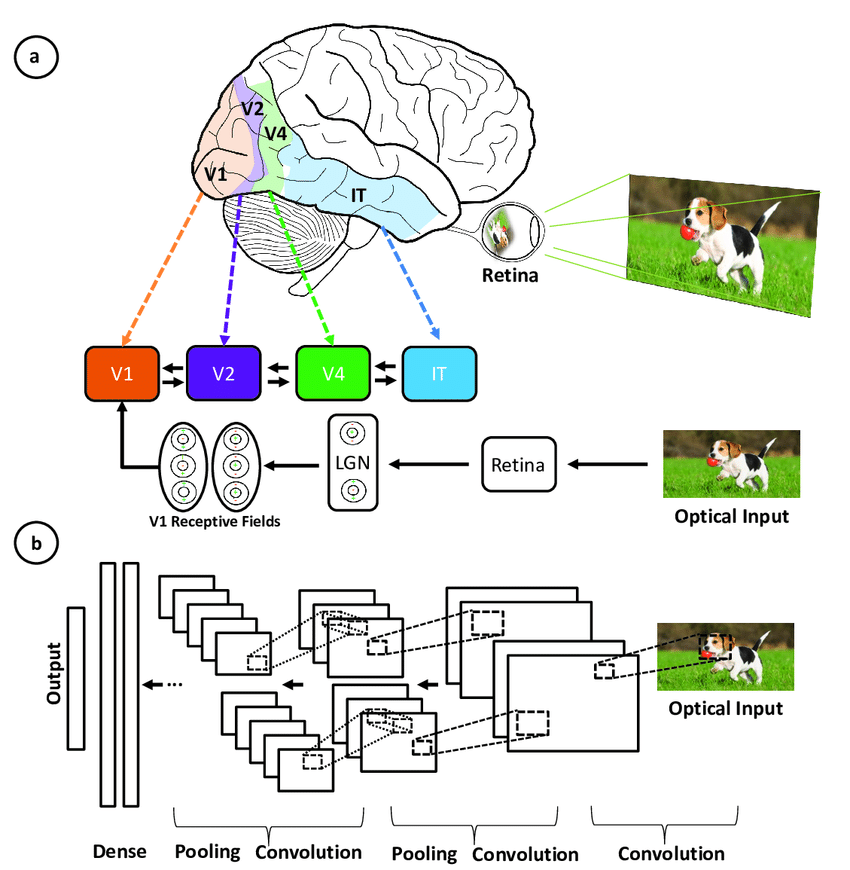
*Illustration of the correspondence between the areas associated with the primary visual cortex and the layers in a convolutional neural network ([source](https://www.researchgate.net/figure/2-Illustration-of-the-corrispondence-between-the-areas-associated-with-the-primary_fig7_317679065))*
- **Hierarchical architecture:** Both CNNs and the visual cortex have a hierarchical structure, with simple features extracted in early layers and more complex features built up in deeper layers. This allows increasingly sophisticated representations of visual inputs.
- **Local connectivity:** Neurons in the visual cortex only connect to a local region of the input, not the entire visual field. Similarly, the neurons in a CNN layer are only connected to a local region of the input volume through the convolution operation. This local connectivity enables efficiency.
- **Translation invariance:** Visual cortex neurons can detect features regardless of their location in the visual field. Pooling layers in a CNN provide a degree of translation invariance by summarizing local features.
- **Multiple feature maps:** At each stage of visual processing, there are many different feature maps extracted. CNNs mimic this through multiple filter maps in each convolution layer.
- **Non-linearity:** Neurons in the visual cortex exhibit non-linear response properties. CNNs achieve non-linearity through activation functions like ReLU applied after each convolution.
CNNs mimic the human visual system but are simpler, lacking its complex feedback mechanisms and relying on supervised learning rather than unsupervised, driving advances in computer vision despite these differences.
## Key Components of a CNN
The convolutional neural network is made of four main parts.
But how do CNNs Learn with those parts?
They help the CNNs mimic how the human brain operates to recognize patterns and features in images:
- Convolutional layers
- Rectified Linear Unit (ReLU for short)
- Pooling layers
- Fully connected layers
This section dives into the definition of each one of these components through the following example of classifying a handwritten digit.
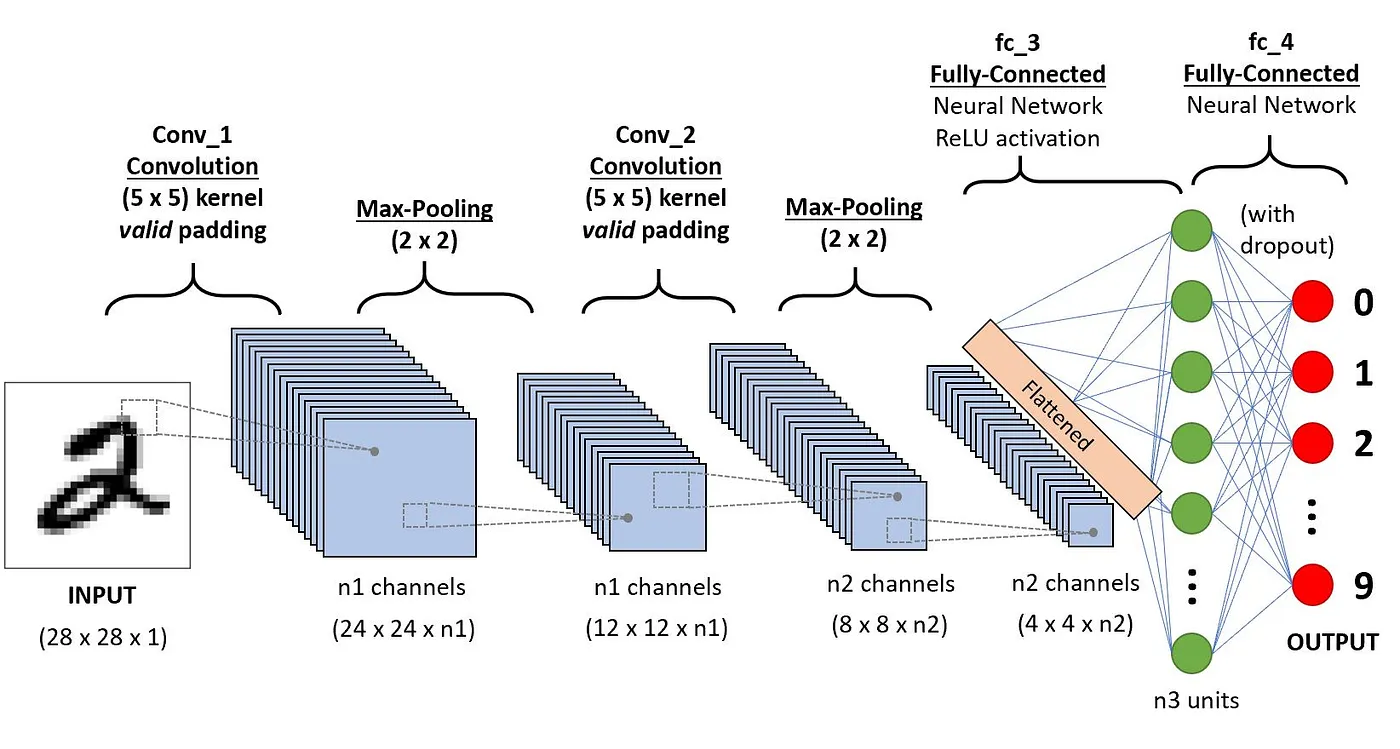
*Architecture of the CNNs applied to digit recognition ([source](https://towardsdatascience.com/a-comprehensive-guide-to-convolutional-neural-networks-the-eli5-way-3bd2b1164a53))*
### Convolution layers
This is the first building block of a CNN. As the name suggests, the main mathematical task performed is called convolution, which is the application of a sliding window function to a matrix of pixels representing an image. The sliding function applied to the matrix is called kernel or filter, and both can be used interchangeably.
In the convolution layer, several filters of equal size are applied, and each filter is used to recognize a specific pattern from the image, such as the curving of the digits, the edges, the whole shape of the digits, and more.
Put simply, in the convolution layer, we use small grids (called filters or kernels) that move over the image. Each small grid is like a mini magnifying glass that looks for specific patterns in the photo, like lines, curves, or shapes. As it moves across the photo, it creates a new grid that highlights where it found these patterns.
For example, one filter might be good at finding straight lines, another might find curves, and so on. By using several different filters, the CNN can get a good idea of all the different patterns that make up the image.
Let’s consider this 32x32 grayscale image of a handwritten digit. The values in the matrix are given for illustration purposes.
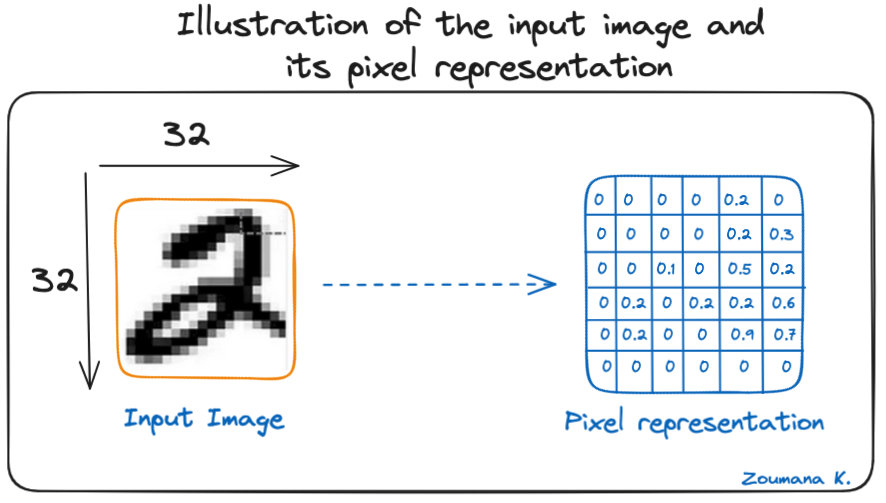
*Illustration of the input image and its pixel representation*
Also, let’s consider the kernel used for the convolution. It is a matrix with a dimension of 3x3. The weights of each element of the kernel is represented in the grid. Zero weights are represented in the black grids and ones in the white grid.
**Do we have to manually find these weights?**
In real life, the weights of the kernels are determined during the training process of the neural network.
Using these two matrices, we can perform the convolution operation by applying the dot product, and work as follows:
1. Apply the kernel matrix from the top-left corner to the right.
2. Perform element-wise multiplication.
3. Sum the values of the products.
4. The resulting value corresponds to the first value (top-left corner) in the convoluted matrix.
5. Move the kernel down with respect to the size of the sliding window.
6. Repeat steps 1 to 5 until the image matrix is fully covered.
The dimension of the convoluted matrix depends on the size of the sliding window. The higher the sliding window, the smaller the dimension.
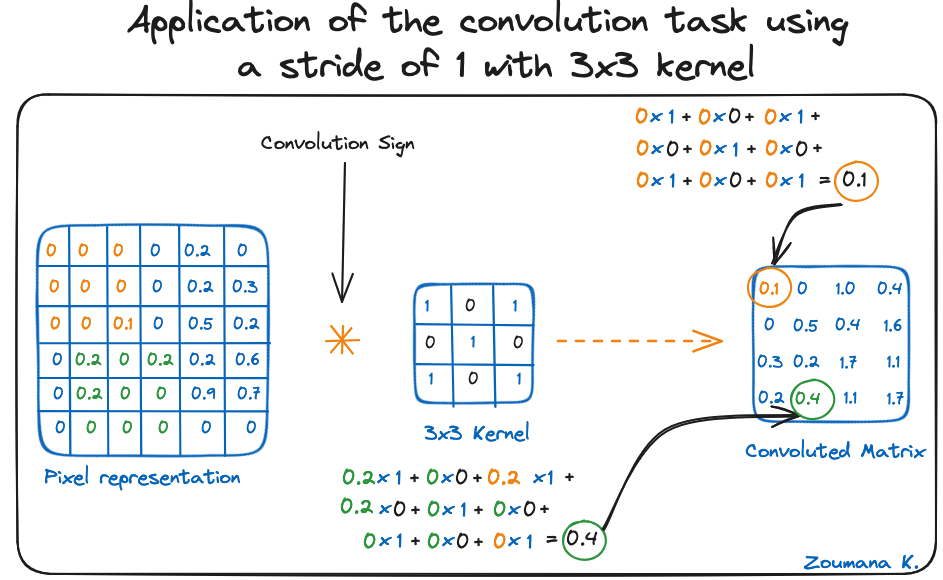
*Application of the convolution task using a stride of 1 with 3x3 kernel*
Another name associated with the kernel in the literature is feature detector because the weights can be fine-tuned to detect specific features in the input image.
For instance:
- Averaging neighboring pixels kernel can be used to blur the input image.
- Subtracting neighboring kernel is used to perform edge detection.
The more convolution layers the network has, the better the layer is at detecting more abstract features.
### Activation function
A [ReLU activation function](https://www.datacamp.com/tutorial/introduction-to-activation-functions-in-neural-networks) is applied after each convolution operation. This function helps the network learn non-linear relationships between the features in the image, hence making the network more robust for identifying different patterns. It also helps to mitigate the vanishing gradient problems.
### Pooling layer
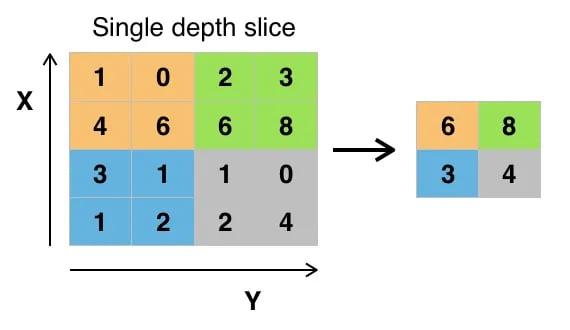
The goal of the pooling layer is to pull the most significant features from the convoluted matrix. This is done by applying some aggregation operations, which reduce the dimension of the feature map (convoluted matrix), hence reducing the memory used while training the network. Pooling is also relevant for mitigating overfitting.
The most common aggregation functions that can be applied are:
- Max pooling, which is the maximum value of the feature map
- Sum pooling corresponds to the sum of all the values of the feature map
- Average pooling is the average of all the values.
Below is an illustration of each of the previous example:
*Application of max pooling with a stride of 2 using 2x2 filter*
Also, the dimension of the feature map becomes smaller as the pooling function is applied.
The last pooling layer flattens its feature map so that it can be processed by the fully connected layer.
### Fully connected layers
These layers are in the last layer of the convolutional neural network, and their inputs correspond to the flattened one-dimensional matrix generated by the last pooling layer. ReLU activations functions are applied to them for non-linearity.
Finally, a softmax prediction layer is used to generate probability values for each of the possible output labels, and the final label predicted is the one with the highest probability score.
## Overfitting and Regularization in CNNs
[Overfitting](https://www.datacamp.com/tutorial/towards-preventing-overfitting-regularization) is a common challenge in machine learning models and CNN deep learning projects. It happens when the model learns the training data too well (“learning by heart”), including its noise and outliers. Such a learning leads to a model that performs well on the training data but badly on new, unseen data.
This can be observed when the model achieves significantly higher accuracy on training data compared to validation or testing data, and a graphical illustration is given below:
*Underfitting Vs. Overfitting*
Deep learning models, especially Convolutional Neural Networks (CNNs), are particularly susceptible to overfitting due to their capacity for high complexity and their ability to learn detailed patterns in large-scale data.
Several regularization techniques can be applied to mitigate overfitting in CNNs, and some are illustrated below:
*7 strategies to mitigate overfitting in CNNs*
- **[Dropout](https://www.datacamp.com/tutorial/dropout-regularization-using-pytorch-guide):** This consists of randomly dropping some neurons during the training process, which forces the remaining neurons to learn new features from the input data.
- **Batch normalization:** The overfitting is reduced to some extent by normalizing the input layer by adjusting and scaling the activations. This approach is also used to speed up and stabilize the training process.
- **Pooling Layers:** This can be used to reduce the spatial dimensions of the input image to provide the model with an abstracted form of representation, hence reducing the chance of overfitting.
- **Early stopping:** This consists of consistently monitoring the model’s performance on validation data during the training process and stopping the training whenever the validation error does not improve anymore.
- **Noise injection:** This process consists of adding noise to the inputs or the outputs of hidden layers during the training to make the model more robust and prevent it from a weak generalization.
- **L1 and L2 regularization:** Both L1 and L2 are used to add a penalty to the loss function based on the size of weights. More specifically, L1 encourages the weights to be sparse, leading to better feature selection. On the other hand, L2 (also called weight decay) encourages the weights to be small, preventing them from having too much influence on the predictions.
- **Data augmentation:** This is the process of artificially increasing the size and diversity of the training dataset by applying random transformations like rotation, scaling, flipping, or cropping to the input images.
## Practical Applications of CNNs
Convolutional Neural Networks have revolutionized the field of computer vision, leading to significant advancements in many real-world applications. Below are a few examples of how they are applied.
*Some practical applications of CNNs*
- **Image classification:** Convolutional neural networks are used for image categorization, where images are assigned to predefined categories. One use of such a scenario is automatic photo organization in social media platforms.
- **[Object detection](https://www.datacamp.com/tutorial/object-detection-guide):** CNNs are able to identify and locate multiple objects within an image. This capability is crucial in multiple scenarios of shelf scanning in retail to identify out-of-stock items.
- **Facial recognition:** this is also one of the main industries of application of CNNs. For instance, this technology can be embedded into security systems for efficient control of access based on facial features.
For a more hands-on implementation, our [Convolutional Neural Networks (CNN) with TensorFlow Tutorial](https://www.datacamp.com/tutorial/cnn-tensorflow-python) teaches how to construct and implement CNNs in Python with TensorFlow 2.
## Popular CNN Architectures
Over the years, researchers have developed increasingly powerful CNN architectures. Here are some of the most influential ones:
- **LeNet-5 (1998):** One of the first CNNs, designed for handwritten digit recognition.
- **AlexNet (2012):** Won the ImageNet competition and popularized deep CNNs with GPU training.
- **VGGNet (2014):** Demonstrated that deeper networks with small 3x3 filters improve accuracy.
- **GoogLeNet/Inception (2014):** Introduced inception modules with parallel filter sizes for multi-scale feature extraction.
- **ResNet (2015):** Introduced skip connections, enabling training of networks with 100+ layers.
- **EfficientNet (2019):** Used compound scaling to balance network depth, width, and resolution.
- **ConvNeXt (2022):** A modernized CNN design that competes with Vision Transformers.
While Vision Transformers (ViTs) have emerged as strong alternatives since 2020, CNNs remain widely used due to their efficiency, lower data requirements, and maturity in production environments.
## Deep Learning Frameworks for CNNs
The rapid growth of deep learning is mainly due to powerful frameworks like Tensorflow, Pytorch, and Keras, which make it easier to train convolutional neural networks and other deep learning models.
Let’s have a brief overview of each framework.
### TensorFlow
TensorFlow is an open-source deep learning framework developed by Google and released in 2015. It offers a range of tools for machine learning development and deployment. Our [Introduction to Deep Neural Networks](https://www.datacamp.com/tutorial/introduction-to-deep-neural-networks) provides a complete guide to understanding deep neural networks and their significance in the modern deep learning world of artificial intelligence, along with real-world implementations in TensorFlow.
### Keras
Keras is a high-level neural network framework in Python that enables rapid experimentation and development. It's open-source and serves as TensorFlow's official high-level API (since version 2.0), streamlining model development in the TensorFlow ecosystem. Our course, [Image Processing with Keras in Python](https://www.datacamp.com/courses/image-processing-with-keras-in-python), teaches how to conduct image analysis using Keras with Python by constructing, training, and evaluating convolutional neural networks.
### PyTorch
Released by Meta (formerly Facebook) AI Research in 2017, PyTorch is a general-purpose deep learning framework known for its dynamic computational graph, Pythonic syntax, and strong research community. If you are interested in diving into natural language processing, our [NLP with PyTorch: A Comprehensive Guide](https://www.datacamp.com/tutorial/nlp-with-pytorch-a-comprehensive-guide) is a great starting point.
Each project is different, so the decision really depends on what characteristics are most important for a given use case. To help make better decisions, the following table provides a brief comparison of these frameworks, highlighting their unique features.
| | | | |
|---|---|---|---|
| | **Tensorflow** | **Pytorch** | **Keras** |
| **API Level** | Both(High and Low) | Low | High |
| **Architecture** | Not easy to use | Pythonic, intuitive syntax | Simple, concise, readable |
| **Datasets** | Large datasets, high performance | Large datasets, high performance | Smaller datasets |
| **Debugging** | Difficult to conduct debugging | Good debugging capabilities | Simple network, so debugging is not often needed |
| **Pretrained models?** | Yes | Yes | Yes |
| **Popularity** | Second most popular of the three | Most widely used for research and increasingly for production | Integrated into TensorFlow as its official high-level API |
| **Speed** | Fast, high-performance | Fast, high-performance | Same as TensorFlow (runs on TF backend) |
| **Written in** | C++, CUDA, Python | C++, Python | Python |
*Comparative table between Tensorflow, Pytorch and Keras ([source](https://www.datacamp.com/tutorial/pytorch-vs-tensorflow-vs-keras))*
## Conclusion
This article has provided a complete overview of what a CNN in deep learning is, along with their crucial role in image recognition and classification tasks.
It started by highlighting the inspiration drawn from the human visual system for the design of CNNs and then explored the key components that allow these networks to learn and make predictions.
The issue of overfitting was acknowledged as a significant challenge to CNNs' generalization capability. To mitigate this, a variety of relevant strategies to mitigate overfitting and improve CNNs overall performance were outlined.
Finally, some major deep learning CNN frameworks have been mentioned, along with the unique features of each one and how they compare to each other.
Eager to dive further into the world of AI, and machine learning? Take your expertise to the next level by enrolling in the [Deep Learning with PyTorch](https://www.datacamp.com/courses/deep-learning-with-pytorch) course today.
## Earn a Top AI Certification
Demonstrate you can effectively and responsibly use AI.
[Get Certified, Get Hired](https://www.datacamp.com/certification/ai-fundamentals)
***
Author
[Zoumana Keita](https://www.datacamp.com/portfolio/keitazoumana)
A multi-talented data scientist who enjoys sharing his knowledge and giving back to others, Zoumana is a YouTube content creator and a top tech writer on Medium. He finds joy in speaking, coding, and teaching . Zoumana holds two master’s degrees. The first one in computer science with a focus in Machine Learning from Paris, France, and the second one in Data Science from Texas Tech University in the US. His career path started as a Software Developer at Groupe OPEN in France, before moving on to IBM as a Machine Learning Consultant, where he developed end-to-end AI solutions for insurance companies. Zoumana joined Axionable, the first Sustainable AI startup based in Paris and Montreal. There, he served as a Data Scientist and implemented AI products, mostly NLP use cases, for clients from France, Montreal, Singapore, and Switzerland. Additionally, 5% of his time was dedicated to Research and Development. As of now, he is working as a Senior Data Scientist at IFC-the world Bank Group.
## CNN FAQs
### What is the difference between a CNN and a regular neural network?
A regular (fully connected) neural network connects every neuron to every neuron in the next layer, which becomes computationally expensive with image data. A CNN uses **convolutional layers** that apply small filters to local regions of the input, dramatically reducing the number of parameters while preserving spatial relationships. This makes CNNs far more efficient and effective for image-related tasks.
### What are the most common CNN architectures?
The most influential CNN architectures include **LeNet-5** (1998), **AlexNet** (2012), **VGGNet** (2014), **ResNet** (2015), and **EfficientNet** (2019). More recently, **ConvNeXt** (2022) modernized the CNN approach to compete with Vision Transformers. Each architecture introduced key innovations such as skip connections (ResNet) or compound scaling (EfficientNet).
### Are CNNs still relevant in 2026?
Yes, CNNs remain highly relevant in 2026. While Vision Transformers (ViTs) have gained popularity for some tasks, CNNs are still preferred in many production settings due to their **computational efficiency**, strong performance with limited training data, and well-established deployment pipelines. Modern architectures like ConvNeXt show that CNNs can match transformer performance when using updated training techniques.
### How do I choose between TensorFlow, PyTorch, and Keras for building CNNs?
**PyTorch** is the most popular choice for research and rapid prototyping due to its Pythonic syntax and dynamic computation graphs. **TensorFlow** excels in production deployment with tools like TensorFlow Serving and TensorFlow Lite for mobile. **Keras**, now integrated as TensorFlow's official high-level API, is ideal for beginners who want to build and train CNNs with minimal code.
### What is the purpose of pooling layers in a CNN?
Pooling layers reduce the spatial dimensions (height and width) of feature maps while retaining the most important information. This serves three purposes: it **reduces computational cost** by decreasing the number of parameters, provides a degree of **translation invariance** (the ability to recognize features regardless of their exact position), and helps **prevent overfitting** by providing an abstracted representation of the input.
Topics
[Deep Learning](https://www.datacamp.com/tutorial/category/deep-learning)
***
[Zoumana Keita](https://www.datacamp.com/portfolio/keitazoumana) A data scientist who likes to write and share knowledge with the data and IA community
***
Topics
[Deep Learning](https://www.datacamp.com/tutorial/category/deep-learning)

[What are Neural Networks?](https://www.datacamp.com/blog/what-are-neural-networks)
[Convolutional Neural Networks in Python with Keras](https://www.datacamp.com/tutorial/convolutional-neural-networks-python)

[Convolutional Neural Networks (CNN) with TensorFlow Tutorial](https://www.datacamp.com/tutorial/cnn-tensorflow-python)

[Introduction to Deep Neural Networks](https://www.datacamp.com/tutorial/introduction-to-deep-neural-networks)
[PyTorch CNN Tutorial: Build and Train Convolutional Neural Networks in Python](https://www.datacamp.com/tutorial/pytorch-cnn-tutorial)
[Multilayer Perceptrons in Machine Learning: A Comprehensive Guide](https://www.datacamp.com/tutorial/multilayer-perceptrons-in-machine-learning)
Start Your Deep Learning Journey Today\!
Course
### [Introduction to Deep Learning in Python](https://www.datacamp.com/courses/introduction-to-deep-learning-in-python)
4 hr
262\.3K
Learn the fundamentals of neural networks and how to build deep learning models using Keras 2.0 in Python.
[See Details](https://www.datacamp.com/courses/introduction-to-deep-learning-in-python)
[Start Course](https://www.datacamp.com/users/sign_up?redirect=%2Fcourses%2Fintroduction-to-deep-learning-in-python%2Fcontinue)
Course
### [Introduction to Deep Learning with Keras](https://www.datacamp.com/courses/introduction-to-deep-learning-with-keras)
4 hr
45\.3K
Learn to start developing deep learning models with Keras.
[See Details](https://www.datacamp.com/courses/introduction-to-deep-learning-with-keras)
[Start Course](https://www.datacamp.com/users/sign_up?redirect=%2Fcourses%2Fintroduction-to-deep-learning-with-keras%2Fcontinue)
Course
### [Introduction to Deep Learning with PyTorch](https://www.datacamp.com/courses/introduction-to-deep-learning-with-pytorch)
4 hr
81\.3K
Learn how to build your first neural network, adjust hyperparameters, and tackle classification and regression problems in PyTorch.
[See Details](https://www.datacamp.com/courses/introduction-to-deep-learning-with-pytorch)
[Start Course](https://www.datacamp.com/users/sign_up?redirect=%2Fcourses%2Fintroduction-to-deep-learning-with-pytorch%2Fcontinue)
[See More](https://www.datacamp.com/courses-all)
Related
[blogWhat are Neural Networks?](https://www.datacamp.com/blog/what-are-neural-networks)
NNs are brain-inspired computational models used in machine learning to recognize patterns & make decisions.
Abid Ali Awan
7 min
[TutorialConvolutional Neural Networks in Python with Keras](https://www.datacamp.com/tutorial/convolutional-neural-networks-python)
In this tutorial, you’ll learn how to implement Convolutional Neural Networks (CNNs) in Python with Keras, and how to overcome overfitting with dropout.
Aditya Sharma
[TutorialConvolutional Neural Networks (CNN) with TensorFlow Tutorial](https://www.datacamp.com/tutorial/cnn-tensorflow-python)
Learn how to construct and implement Convolutional Neural Networks (CNNs) in Python with Tensorflow Framework 2
Zoumana Keita

[TutorialIntroduction to Deep Neural Networks](https://www.datacamp.com/tutorial/introduction-to-deep-neural-networks)
Understanding deep neural networks and their significance in the modern deep learning world of artificial intelligence
[](https://www.datacamp.com/portfolio/bharathk1297)
Bharath K
[TutorialPyTorch CNN Tutorial: Build and Train Convolutional Neural Networks in Python](https://www.datacamp.com/tutorial/pytorch-cnn-tutorial)
Learn how to construct and implement Convolutional Neural Networks (CNNs) in Python with PyTorch.
Javier Canales Luna
[TutorialMultilayer Perceptrons in Machine Learning: A Comprehensive Guide](https://www.datacamp.com/tutorial/multilayer-perceptrons-in-machine-learning)
Learn how multilayer perceptrons work in deep learning. Understand layers, activation functions, backpropagation, and SGD with practical guidance.
[](https://www.datacamp.com/portfolio/cjsejal)
Sejal Jaiswal
[See More](https://www.datacamp.com/tutorial/category/deep-learning)
[See More](https://www.datacamp.com/tutorial/category/deep-learning)
## Grow your data skills with DataCamp for Mobile
Make progress on the go with our mobile courses and daily 5-minute coding challenges.
[Download on the App Store](https://datacamp.onelink.me/xztQ/45dozwue?deep_link_sub1=%7B%22src_url%22%3A%22https%3A%2F%2Fwww.datacamp.com%2Ftutorial%2Fintroduction-to-convolutional-neural-networks-cnns%22%7D)[Get it on Google Play](https://datacamp.onelink.me/xztQ/go2f19ij?deep_link_sub1=%7B%22src_url%22%3A%22https%3A%2F%2Fwww.datacamp.com%2Ftutorial%2Fintroduction-to-convolutional-neural-networks-cnns%22%7D)
**Learn**
[Learn Python](https://www.datacamp.com/blog/how-to-learn-python-expert-guide)[Learn AI](https://www.datacamp.com/blog/how-to-learn-ai)[Learn Power BI](https://www.datacamp.com/learn/power-bi)[Learn Data Engineering](https://www.datacamp.com/category/data-engineering)[Assessments](https://www.datacamp.com/signal)[Career Tracks](https://www.datacamp.com/tracks/career)[Skill Tracks](https://www.datacamp.com/tracks/skill)[Courses](https://www.datacamp.com/courses-all)[Data Science Roadmap](https://www.datacamp.com/blog/data-science-roadmap)
**Data Courses**
[Python Courses](https://www.datacamp.com/category/python)[R Courses](https://www.datacamp.com/category/r)[SQL Courses](https://www.datacamp.com/category/sql)[Power BI Courses](https://www.datacamp.com/category/power-bi)[Tableau Courses](https://www.datacamp.com/category/tableau)[Alteryx Courses](https://www.datacamp.com/category/alteryx)[Azure Courses](https://www.datacamp.com/category/azure)[AWS Courses](https://www.datacamp.com/category/aws)[Google Cloud Courses](https://www.datacamp.com/category/google-cloud)[Google Sheets Courses](https://www.datacamp.com/category/google-sheets)[Excel Courses](https://www.datacamp.com/category/excel)[AI Courses](https://www.datacamp.com/category/artificial-intelligence)[Data Analysis Courses](https://www.datacamp.com/category/data-analysis)[Data Visualization Courses](https://www.datacamp.com/category/data-visualization)[Machine Learning Courses](https://www.datacamp.com/category/machine-learning)[Data Engineering Courses](https://www.datacamp.com/category/data-engineering)[Probability & Statistics Courses](https://www.datacamp.com/category/probability-and-statistics)
**DataLab**
[Get Started](https://www.datacamp.com/datalab)[Pricing](https://www.datacamp.com/datalab/pricing)[Security](https://www.datacamp.com/datalab/security)[Documentation](https://datalab-docs.datacamp.com/)
**Certification**
[Certifications](https://www.datacamp.com/certification)[Data Scientist](https://www.datacamp.com/certification/data-scientist)[Data Analyst](https://www.datacamp.com/certification/data-analyst)[Data Engineer](https://www.datacamp.com/certification/data-engineer)[SQL Associate](https://www.datacamp.com/certification/sql-associate)[Power BI Data Analyst](https://www.datacamp.com/certification/data-analyst-in-power-bi)[Tableau Certified Data Analyst](https://www.datacamp.com/certification/data-analyst-in-tableau)[Azure Fundamentals](https://www.datacamp.com/certification/azure-fundamentals)[AI Fundamentals](https://www.datacamp.com/certification/ai-fundamentals)
**Resources**
[Resource Center](https://www.datacamp.com/resources)[Upcoming Events](https://www.datacamp.com/webinars)[Blog](https://www.datacamp.com/blog)[Code-Alongs](https://www.datacamp.com/code-along)[Tutorials](https://www.datacamp.com/tutorial)[Docs](https://www.datacamp.com/doc)[Open Source](https://www.datacamp.com/open-source)[RDocumentation](https://www.rdocumentation.org/)[Book a Demo with DataCamp for Business](https://www.datacamp.com/business/demo)[Data Portfolio](https://www.datacamp.com/data-portfolio)
**Plans**
[Pricing](https://www.datacamp.com/pricing)[For Students](https://www.datacamp.com/pricing/student)[For Business](https://www.datacamp.com/business)[For Universities](https://www.datacamp.com/universities)[Discounts, Promos & Sales](https://www.datacamp.com/promo)[Expense DataCamp](https://www.datacamp.com/expense)[DataCamp Donates](https://www.datacamp.com/donates)
**For Business**
[Business Pricing](https://www.datacamp.com/business/compare-plans)[Teams Plan](https://www.datacamp.com/business/learn-teams)[Data & AI Unlimited Plan](https://www.datacamp.com/business/data-unlimited)[Customer Stories](https://www.datacamp.com/business/customer-stories)[Partner Program](https://www.datacamp.com/business/partner-program)
**About**
[About Us](https://www.datacamp.com/about)[Learner Stories](https://www.datacamp.com/stories)[Careers](https://www.datacamp.com/careers)[Become an Instructor](https://www.datacamp.com/learn/create)[Press](https://www.datacamp.com/press)[Leadership](https://www.datacamp.com/about/leadership)[Contact Us](https://support.datacamp.com/hc/en-us/articles/360021185634)[DataCamp Español](https://www.datacamp.com/es)[DataCamp Português](https://www.datacamp.com/pt)[DataCamp Deutsch](https://www.datacamp.com/de)[DataCamp Français](https://www.datacamp.com/fr)
**Support**
[Help Center](https://support.datacamp.com/hc/en-us)[Become an Affiliate](https://www.datacamp.com/affiliates)
[Facebook](https://www.facebook.com/datacampinc/)
[Twitter](https://twitter.com/datacamp)
[LinkedIn](https://www.linkedin.com/school/datacampinc/)
[YouTube](https://www.youtube.com/channel/UC79Gv3mYp6zKiSwYemEik9A)
[Instagram](https://www.instagram.com/datacamp/)
[Privacy Policy](https://www.datacamp.com/privacy-policy)[Cookie Notice](https://www.datacamp.com/cookie-notice)[Do Not Sell My Personal Information](https://www.datacamp.com/do-not-sell-my-personal-information)[Accessibility](https://www.datacamp.com/accessibility)[Security](https://www.datacamp.com/security)[Terms of Use](https://www.datacamp.com/terms-of-use)
© 2026 DataCamp, Inc. All Rights Reserved. |
| Readable Markdown | Convolutional neural networks power some of today's most impressive AI capabilities, from facial recognition on smartphones to tumor detection in medical imaging. In this tutorial, I cover what CNNs are, how they work, their key components, strategies to combat overfitting, and the most popular frameworks for building them. To get hands-on with deep learning, check out DataCamp's [Introduction to Deep Learning in Python](https://www.datacamp.com/courses/introduction-to-deep-learning-in-python) course. TL;DR A convolutional neural network (CNN) is a [deep learning](https://www.datacamp.com/tutorial/tutorial-deep-learning-tutorial) architecture designed for tasks like image classification, object detection, and segmentation. CNNs have four key components: convolutional layers (feature extraction), activation functions like ReLU (non-linearity), pooling layers (dimensionality reduction), and fully connected layers (classification). Their design is inspired by the hierarchical structure of the human visual cortex. Overfitting is a major challenge; techniques like dropout, batch normalization, data augmentation, and early stopping help mitigate it. TensorFlow, PyTorch, and Keras are the most popular frameworks for building CNNs. A Convolutional Neural Network (CNN), also known as ConvNet, is a specialized type of [deep learning](https://www.datacamp.com/tutorial/tutorial-deep-learning-tutorial) algorithm mainly designed for tasks that necessitate object recognition, including image classification, detection, and segmentation. CNNs are employed in a variety of practical scenarios, such as autonomous vehicles, security camera systems, and others.
The importance of CNNs There are several reasons why CNNs are important in the modern world, as highlighted below: CNNs are distinguished from classic machine learning algorithms such as [SVMs](https://www.datacamp.com/tutorial/svm-classification-scikit-learn-python) and [decision trees](https://www.datacamp.com/tutorial/decision-tree-classification-python) by their ability to autonomously extract features at a large scale, bypassing the need for manual feature engineering and thereby enhancing efficiency. The convolutional layers grant CNNs their translation-invariant characteristics, empowering them to identify and extract patterns and features from data irrespective of variations in position, orientation, scale, or translation. A variety of pre-trained CNN architectures, including VGG-16, ResNet50, Inceptionv3, and EfficientNet, have demonstrated top-tier performance. These models can be adapted to new tasks with relatively little data through a process known as [fine-tuning](https://www.datacamp.com/tutorial/transfer-learning). Beyond image classification tasks, CNNs are versatile and can be applied to a range of other domains, such as natural language processing, time series analysis, and speech recognition. Inspiration Behind CNN and Parallels With The Human Visual System Convolutional neural networks were inspired by the layered architecture of the human visual cortex, and below are some key similarities and differences:  *Illustration of the correspondence between the areas associated with the primary visual cortex and the layers in a convolutional neural network ([source](https://www.researchgate.net/figure/2-Illustration-of-the-corrispondence-between-the-areas-associated-with-the-primary_fig7_317679065))* **Hierarchical architecture:** Both CNNs and the visual cortex have a hierarchical structure, with simple features extracted in early layers and more complex features built up in deeper layers. This allows increasingly sophisticated representations of visual inputs. **Local connectivity:** Neurons in the visual cortex only connect to a local region of the input, not the entire visual field. Similarly, the neurons in a CNN layer are only connected to a local region of the input volume through the convolution operation. This local connectivity enables efficiency. **Translation invariance:** Visual cortex neurons can detect features regardless of their location in the visual field. Pooling layers in a CNN provide a degree of translation invariance by summarizing local features. **Multiple feature maps:** At each stage of visual processing, there are many different feature maps extracted. CNNs mimic this through multiple filter maps in each convolution layer. **Non-linearity:** Neurons in the visual cortex exhibit non-linear response properties. CNNs achieve non-linearity through activation functions like ReLU applied after each convolution. CNNs mimic the human visual system but are simpler, lacking its complex feedback mechanisms and relying on supervised learning rather than unsupervised, driving advances in computer vision despite these differences. Key Components of a CNN The convolutional neural network is made of four main parts. But how do CNNs Learn with those parts? They help the CNNs mimic how the human brain operates to recognize patterns and features in images: Convolutional layers Rectified Linear Unit (ReLU for short) Pooling layers Fully connected layers This section dives into the definition of each one of these components through the following example of classifying a handwritten digit.  *Architecture of the CNNs applied to digit recognition ([source](https://towardsdatascience.com/a-comprehensive-guide-to-convolutional-neural-networks-the-eli5-way-3bd2b1164a53))* Convolution layers This is the first building block of a CNN. As the name suggests, the main mathematical task performed is called convolution, which is the application of a sliding window function to a matrix of pixels representing an image. The sliding function applied to the matrix is called kernel or filter, and both can be used interchangeably. In the convolution layer, several filters of equal size are applied, and each filter is used to recognize a specific pattern from the image, such as the curving of the digits, the edges, the whole shape of the digits, and more. Put simply, in the convolution layer, we use small grids (called filters or kernels) that move over the image. Each small grid is like a mini magnifying glass that looks for specific patterns in the photo, like lines, curves, or shapes. As it moves across the photo, it creates a new grid that highlights where it found these patterns. For example, one filter might be good at finding straight lines, another might find curves, and so on. By using several different filters, the CNN can get a good idea of all the different patterns that make up the image. Let’s consider this 32x32 grayscale image of a handwritten digit. The values in the matrix are given for illustration purposes.  *Illustration of the input image and its pixel representation* Also, let’s consider the kernel used for the convolution. It is a matrix with a dimension of 3x3. The weights of each element of the kernel is represented in the grid. Zero weights are represented in the black grids and ones in the white grid. **Do we have to manually find these weights?** In real life, the weights of the kernels are determined during the training process of the neural network. Using these two matrices, we can perform the convolution operation by applying the dot product, and work as follows: Apply the kernel matrix from the top-left corner to the right. Perform element-wise multiplication. Sum the values of the products. The resulting value corresponds to the first value (top-left corner) in the convoluted matrix. Move the kernel down with respect to the size of the sliding window. Repeat steps 1 to 5 until the image matrix is fully covered. The dimension of the convoluted matrix depends on the size of the sliding window. The higher the sliding window, the smaller the dimension.  *Application of the convolution task using a stride of 1 with 3x3 kernel* Another name associated with the kernel in the literature is feature detector because the weights can be fine-tuned to detect specific features in the input image. For instance: Averaging neighboring pixels kernel can be used to blur the input image. Subtracting neighboring kernel is used to perform edge detection. The more convolution layers the network has, the better the layer is at detecting more abstract features. Activation function A [ReLU activation function](https://www.datacamp.com/tutorial/introduction-to-activation-functions-in-neural-networks) is applied after each convolution operation. This function helps the network learn non-linear relationships between the features in the image, hence making the network more robust for identifying different patterns. It also helps to mitigate the vanishing gradient problems. Pooling layer The goal of the pooling layer is to pull the most significant features from the convoluted matrix. This is done by applying some aggregation operations, which reduce the dimension of the feature map (convoluted matrix), hence reducing the memory used while training the network. Pooling is also relevant for mitigating overfitting. The most common aggregation functions that can be applied are: Max pooling, which is the maximum value of the feature map Sum pooling corresponds to the sum of all the values of the feature map Average pooling is the average of all the values. Below is an illustration of each of the previous example:  *Application of max pooling with a stride of 2 using 2x2 filter* Also, the dimension of the feature map becomes smaller as the pooling function is applied. The last pooling layer flattens its feature map so that it can be processed by the fully connected layer. Fully connected layers These layers are in the last layer of the convolutional neural network, and their inputs correspond to the flattened one-dimensional matrix generated by the last pooling layer. ReLU activations functions are applied to them for non-linearity. Finally, a softmax prediction layer is used to generate probability values for each of the possible output labels, and the final label predicted is the one with the highest probability score. Overfitting and Regularization in CNNs [Overfitting](https://www.datacamp.com/tutorial/towards-preventing-overfitting-regularization) is a common challenge in machine learning models and CNN deep learning projects. It happens when the model learns the training data too well (“learning by heart”), including its noise and outliers. Such a learning leads to a model that performs well on the training data but badly on new, unseen data. This can be observed when the model achieves significantly higher accuracy on training data compared to validation or testing data, and a graphical illustration is given below:  *Underfitting Vs. Overfitting* Deep learning models, especially Convolutional Neural Networks (CNNs), are particularly susceptible to overfitting due to their capacity for high complexity and their ability to learn detailed patterns in large-scale data. Several regularization techniques can be applied to mitigate overfitting in CNNs, and some are illustrated below:  *7 strategies to mitigate overfitting in CNNs* **[Dropout](https://www.datacamp.com/tutorial/dropout-regularization-using-pytorch-guide):** This consists of randomly dropping some neurons during the training process, which forces the remaining neurons to learn new features from the input data. **Batch normalization:** The overfitting is reduced to some extent by normalizing the input layer by adjusting and scaling the activations. This approach is also used to speed up and stabilize the training process. **Pooling Layers:** This can be used to reduce the spatial dimensions of the input image to provide the model with an abstracted form of representation, hence reducing the chance of overfitting. **Early stopping:** This consists of consistently monitoring the model’s performance on validation data during the training process and stopping the training whenever the validation error does not improve anymore. **Noise injection:** This process consists of adding noise to the inputs or the outputs of hidden layers during the training to make the model more robust and prevent it from a weak generalization. **L1 and L2 regularization:** Both L1 and L2 are used to add a penalty to the loss function based on the size of weights. More specifically, L1 encourages the weights to be sparse, leading to better feature selection. On the other hand, L2 (also called weight decay) encourages the weights to be small, preventing them from having too much influence on the predictions. **Data augmentation:** This is the process of artificially increasing the size and diversity of the training dataset by applying random transformations like rotation, scaling, flipping, or cropping to the input images. Practical Applications of CNNs Convolutional Neural Networks have revolutionized the field of computer vision, leading to significant advancements in many real-world applications. Below are a few examples of how they are applied.  *Some practical applications of CNNs* **Image classification:** Convolutional neural networks are used for image categorization, where images are assigned to predefined categories. One use of such a scenario is automatic photo organization in social media platforms. **[Object detection](https://www.datacamp.com/tutorial/object-detection-guide):** CNNs are able to identify and locate multiple objects within an image. This capability is crucial in multiple scenarios of shelf scanning in retail to identify out-of-stock items. **Facial recognition:** this is also one of the main industries of application of CNNs. For instance, this technology can be embedded into security systems for efficient control of access based on facial features. For a more hands-on implementation, our [Convolutional Neural Networks (CNN) with TensorFlow Tutorial](https://www.datacamp.com/tutorial/cnn-tensorflow-python) teaches how to construct and implement CNNs in Python with TensorFlow 2. Popular CNN Architectures Over the years, researchers have developed increasingly powerful CNN architectures. Here are some of the most influential ones: **LeNet-5 (1998):** One of the first CNNs, designed for handwritten digit recognition. **AlexNet (2012):** Won the ImageNet competition and popularized deep CNNs with GPU training. **VGGNet (2014):** Demonstrated that deeper networks with small 3x3 filters improve accuracy. **GoogLeNet/Inception (2014):** Introduced inception modules with parallel filter sizes for multi-scale feature extraction. **ResNet (2015):** Introduced skip connections, enabling training of networks with 100+ layers. **EfficientNet (2019):** Used compound scaling to balance network depth, width, and resolution. **ConvNeXt (2022):** A modernized CNN design that competes with Vision Transformers. While Vision Transformers (ViTs) have emerged as strong alternatives since 2020, CNNs remain widely used due to their efficiency, lower data requirements, and maturity in production environments. Deep Learning Frameworks for CNNs The rapid growth of deep learning is mainly due to powerful frameworks like Tensorflow, Pytorch, and Keras, which make it easier to train convolutional neural networks and other deep learning models. Let’s have a brief overview of each framework. TensorFlow TensorFlow is an open-source deep learning framework developed by Google and released in 2015. It offers a range of tools for machine learning development and deployment. Our [Introduction to Deep Neural Networks](https://www.datacamp.com/tutorial/introduction-to-deep-neural-networks) provides a complete guide to understanding deep neural networks and their significance in the modern deep learning world of artificial intelligence, along with real-world implementations in TensorFlow. Keras Keras is a high-level neural network framework in Python that enables rapid experimentation and development. It's open-source and serves as TensorFlow's official high-level API (since version 2.0), streamlining model development in the TensorFlow ecosystem. Our course, [Image Processing with Keras in Python](https://www.datacamp.com/courses/image-processing-with-keras-in-python), teaches how to conduct image analysis using Keras with Python by constructing, training, and evaluating convolutional neural networks. PyTorch Released by Meta (formerly Facebook) AI Research in 2017, PyTorch is a general-purpose deep learning framework known for its dynamic computational graph, Pythonic syntax, and strong research community. If you are interested in diving into natural language processing, our [NLP with PyTorch: A Comprehensive Guide](https://www.datacamp.com/tutorial/nlp-with-pytorch-a-comprehensive-guide) is a great starting point. Each project is different, so the decision really depends on what characteristics are most important for a given use case. To help make better decisions, the following table provides a brief comparison of these frameworks, highlighting their unique features. **Tensorflow** **Pytorch** **Keras** **API Level** Both(High and Low) Low High **Architecture** Not easy to use Pythonic, intuitive syntax Simple, concise, readable **Datasets** Large datasets, high performance Large datasets, high performance Smaller datasets **Debugging** Difficult to conduct debugging Good debugging capabilities Simple network, so debugging is not often needed **Pretrained models?** Yes Yes Yes **Popularity** Second most popular of the three Most widely used for research and increasingly for production Integrated into TensorFlow as its official high-level API **Speed** Fast, high-performance Fast, high-performance Same as TensorFlow (runs on TF backend) **Written in** C++, CUDA, Python C++, Python Python *Comparative table between Tensorflow, Pytorch and Keras ([source](https://www.datacamp.com/tutorial/pytorch-vs-tensorflow-vs-keras))* Conclusion This article has provided a complete overview of what a CNN in deep learning is, along with their crucial role in image recognition and classification tasks. It started by highlighting the inspiration drawn from the human visual system for the design of CNNs and then explored the key components that allow these networks to learn and make predictions. The issue of overfitting was acknowledged as a significant challenge to CNNs' generalization capability. To mitigate this, a variety of relevant strategies to mitigate overfitting and improve CNNs overall performance were outlined. Finally, some major deep learning CNN frameworks have been mentioned, along with the unique features of each one and how they compare to each other. Eager to dive further into the world of AI, and machine learning? Take your expertise to the next level by enrolling in the [Deep Learning with PyTorch](https://www.datacamp.com/courses/deep-learning-with-pytorch) course today. |
| Shard | 136 (laksa) |
| Root Hash | 7979813049800185936 |
| Unparsed URL | com,datacamp!www,/tutorial/introduction-to-convolutional-neural-networks-cnns s443 |