ℹ️ Skipped - page is already crawled
| Filter | Status | Condition | Details |
|---|---|---|---|
| HTTP status | PASS | download_http_code = 200 | HTTP 200 |
| Age cutoff | PASS | download_stamp > now() - 6 MONTH | 0.1 months ago |
| History drop | PASS | isNull(history_drop_reason) | No drop reason |
| Spam/ban | PASS | fh_dont_index != 1 AND ml_spam_score = 0 | ml_spam_score=0 |
| Canonical | PASS | meta_canonical IS NULL OR = '' OR = src_unparsed | Not set |
| Property | Value | ||||||||||||||||||
|---|---|---|---|---|---|---|---|---|---|---|---|---|---|---|---|---|---|---|---|
| URL | https://www.datacamp.com/blog/top-python-interview-questions-and-answers | ||||||||||||||||||
| Last Crawled | 2026-04-19 16:55:44 (3 days ago) | ||||||||||||||||||
| First Indexed | 2022-11-29 19:07:14 (3 years ago) | ||||||||||||||||||
| HTTP Status Code | 200 | ||||||||||||||||||
| Content | |||||||||||||||||||
| Meta Title | The 41 Top Python Interview Questions & Answers For 2026 | DataCamp | ||||||||||||||||||
| Meta Description | Master 41 Python interview questions for 2026 with code examples. Covers basics, OOP, data science, AI/ML, and FAANG-style coding challenges. | ||||||||||||||||||
| Meta Canonical | null | ||||||||||||||||||
| Boilerpipe Text | Python continues to dominate the tech industry as one of the most versatile and in-demand programming languages. Whether you're preparing for a technical interview or looking to sharpen your coding skills, mastering Python is essential. Interviews often involve solving challenges and explaining complex functionalities in Python.
This guide provides a comprehensive list of the most common and advanced Python interview questions. Practicing these questions will equip data professionals, developers, and software engineers with the skills needed to excel in technical interviews and advance their careers.
TL;DR
Master Python fundamentals: data types, comprehensions, OOP concepts like
__init__()
, and the GIL
Practice coding challenges: string manipulation, array algorithms, and dynamic programming problems
Know data science libraries: NumPy, pandas, and scikit-learn for ML interviews
Understand modern Python: async/await, type hints, decorators, and context managers
Prepare for AI/ML questions: LLMs, RAG, prompt engineering, and transformer architectures
Study FAANG-style problems: stock profit optimization, Pythagorean triplets, and coin change algorithms
Basic Python Interview Questions
These are some of the questions you might encounter during an entry-level Python interview.
1. What is Python, and list some of its key features.
Python is a versatile, high-level programming language known for its easy-to-read syntax and broad applications. Here are some of Python’s key features:
Simple and Readable Syntax
: Python’s syntax is clear and straightforward, making it accessible for beginners and efficient for experienced developers.
Interpreted Language
: Python executes code line by line, which helps in debugging and testing.
Dynamic Typing
: Python does not require explicit data type declarations, allowing more flexibility.
Extensive Libraries and Frameworks
: Libraries like NumPy, Pandas, and Django expand Python’s functionality for specialized tasks in data science, web development, and more.
Cross-Platform Compatibility
: Python can run on different operating systems, including Windows, macOS, and Linux.
2. What are Python lists and tuples?
Lists and tuples are fundamental Python data structures with distinct characteristics and use cases.
List:
Mutable:
Elements can be changed after creation.
Memory Usage:
Consumes more memory.
Performance:
Slower iteration compared to tuples but better for insertion and deletion operations.
Methods:
Offers various built-in methods for manipulation.
Example:
a_list
=
[
"Data"
,
"Camp"
,
"Tutorial"
]
a_list
.
append
(
"Session"
)
print
(
a_list
)
# Output: ['Data', 'Camp', 'Tutorial', 'Session']
Tuple:
Immutable:
Elements cannot be changed after creation.
Memory Usage:
Consumes less memory.
Performance:
Faster iteration compared to lists but lacks the flexibility of lists.
Methods:
Limited built-in methods.
Example:
a_tuple
=
(
"Data"
,
"Camp"
,
"Tutorial"
)
print
(
a_tuple
)
# Output: ('Data', 'Camp', 'Tutorial')
Learn more in our
Python Lists tutorial
.
3. What is __init__() in Python?
The
__init__()
method is known as a constructor in object-oriented programming (OOP) terminology. It is used to initialize an object's state when it is created. This method is automatically called when a new instance of a class is instantiated.
Purpose:
Assign values to object properties.
Perform any initialization operations.
Example
:
We have created a
book_shop
class and added the constructor and
book()
function. The constructor will store the book title name and the
book()
function will print the book name.
To test our code we have initialized the
b
object with “Sandman” and executed the
book()
function.
class
book_shop
:
# constructor
def
__init__
(
self
,
title
)
:
self
.
title
=
title
# Sample method
def
book
(
self
)
:
print
(
'The title of the book is'
,
self
.
title
)
b
=
book_shop
(
'Sandman'
)
b
.
book
(
)
# The title of the book is Sandman
4. What is the difference between a mutable data type and an immutable data type?
Mutable data types:
Definition:
Mutable data types are those that can be modified after their creation.
Examples:
List, Dictionary, Set.
Characteristics:
Elements can be added, removed, or changed.
Use Case:
Suitable for collections of items where frequent updates are needed.
Example:
# List Example
a_list
=
[
1
,
2
,
3
]
a_list
.
append
(
4
)
print
(
a_list
)
# Output: [1, 2, 3, 4]
# Dictionary Example
a_dict
=
{
'a'
:
1
,
'b'
:
2
}
a_dict
[
'c'
]
=
3
print
(
a_dict
)
# Output: {'a': 1, 'b': 2, 'c': 3}
Immutable data types:
Definition:
Immutable data types are those that cannot be modified after their creation.
Examples:
Numeric (int, float), String, Tuple.
Characteristics:
Elements cannot be changed once set; any operation that appears to modify an immutable object will create a new object.
Example:
# Numeric Example
a_num
=
10
a_num
=
20
# Creates a new integer object
print
(
a_num
)
# Output: 20
# String Example
a_str
=
"hello"
a_str
=
"world"
# Creates a new string object
print
(
a_str
)
# Output: world
# Tuple Example
a_tuple
=
(
1
,
2
,
3
)
# a_tuple[0] = 4 # This will raise a TypeError
print
(
a_tuple
)
# Output: (1, 2, 3)
5. Explain list, dictionary, and tuple comprehension with an example.
List
List comprehension offers one-liner syntax to create a new list based on the values of the existing list. You can use a
for
loop to replicate the same thing, but it will require you to write multiple lines, and sometimes it can get complex.
List comprehension eases the creation of the list based on existing iterable.
my_list
=
[
i
for
i
in
range
(
1
,
10
)
]
my_list
# [1, 2, 3, 4, 5, 6, 7, 8, 9]
Dictionary
Similar to a List comprehension, you can create a dictionary based on an existing table with a single line of code. You need to enclose the operation with curly brackets
{}
.
# Creating a dictionary using dictionary comprehension
my_dict
=
{
i
:
i
**
2
for
i
in
range
(
1
,
10
)
}
# Output the dictionary
my_dict
{
1
:
1
,
2
:
4
,
3
:
9
,
4
:
16
,
5
:
25
,
6
:
36
,
7
:
49
,
8
:
64
,
9
:
81
}
Tuple
Unlike lists and dictionaries, there is no special “tuple comprehension.”
When you use parentheses with a comprehension, Python actually creates a
generator expression
, not a tuple. To get a tuple, you must either convert the generator with
tuple()
or define a tuple literal directly.
# Generator expression (not a tuple)
my_gen
=
(
i
for
i
in
range
(
1
,
10
)
)
my_gen
# <generator object <genexpr> ...>
# Converting generator to tuple
my_tuple
=
tuple
(
i
for
i
in
range
(
1
,
10
)
)
my_tuple
# (1, 2, 3, 4, 5, 6, 7, 8, 9)
# Or simply define a tuple directly
literal_tuple
=
(
1
,
2
,
3
)
literal_tuple
# (1, 2, 3)
You can learn more about it in our
Python Tuples tutorial
.
6. What is the Global Interpreter Lock (GIL) in Python, and why is it important?
The Global Interpreter Lock (GIL) is a mutex in CPython (the reference Python implementation) that ensures only one native thread executes Python bytecode at a time. It simplifies memory management by protecting internal data structures like reference counts, but it also restricts true parallelism in CPU-bound tasks, making multithreading less effective for computational workloads. However, it works well for I/O-bound tasks, where threads spend time waiting on network, file, or database operations.
Note
:
Python 3.13 introduced an experimental no-GIL build (PEP 703), and Python 3.14 adds documented free-threaded support. Some C extensions and libraries may not yet be fully compatible.
Here are some of the questions you might encounter during an intermediate-level Python interview.
7. Can you e
xplain common searching and graph traversal algorithms in Python?
Python has a number of different powerful algorithms for searching and graph traversal, and each one deals with different data structures and solves different problems. I'll explain them here:
Binary Search
: If you need to quickly find an item in a sorted list,
binary search
is your go-to. It works by repeatedly dividing the search range in half until the target is found.
AVL Tree
: An
AVL tree
keeps things balanced, which is a big advantage if you’re frequently inserting or deleting items in a tree. This self-balancing binary search tree structure keeps searches fast by making sure the tree never gets too skewed.
Breadth-First Search (BFS)
:
BFS
is all about exploring a graph level by level. It’s especially useful if you’re trying to find the shortest path in an unweighted graph since it checks all possible moves from each node before going deeper.
Depth-First Search (DFS)
:
DFS
takes a different approach by exploring as far as it can down each branch before backtracking. It’s great for tasks like maze-solving or tree traversal.
A* Algorithm
: The
A* algorithm
is a bit more advanced and combines the best of both BFS and DFS by using heuristics to find the shortest path efficiently. It’s commonly used in pathfinding for maps and games.
8. What is a KeyError in Python, and how can you handle it?
A
KeyError
in Python occurs when you try to access a key that doesn’t exist in a dictionary. This error is raised because Python expects every key you look up to be present in the dictionary, and when it isn’t, it throws a
KeyError
.
For example, if you have a dictionary of student scores and try to access a student who isn’t in the dictionary, you’ll get a
KeyError
. To handle this error, you have a few options:
Use the .get() method
: This method returns
None
(or a specified default value) instead of throwing an error if the key isn’t found.
Use a try-except block
: Wrapping your code in
try-except
allows you to catch the
KeyError
and handle it gracefully.
Check for the key with in:
You can check if a key exists in the dictionary using
if key in dictionary
before trying to access it.
To learn more, read our full tutorial:
Python KeyError Exceptions and How to Fix Them
.
9. How does Python handle memory management, and what role does garbage collection play?
Python manages memory allocation and deallocation automatically using a private heap, where all objects and data structures are stored. The memory management process is handled by Python’s memory manager, which optimizes memory usage, and the garbage collector, which deals with unused or unreferenced objects to free up memory.
Garbage collection in Python
uses reference counting as well as a cyclic garbage collector to detect and collect unused data. When an object has no more references, it becomes eligible for garbage collection. The
gc
module in Python allows you to interact with the garbage collector directly, providing functions to enable or disable garbage collection, as well as to perform manual collection.
10. What is the difference between shallow copy and deep copy in Python, and when would you use each?
In Python, shallow and deep copies are used to duplicate objects, but they handle nested structures differently.
Shallow Copy
: A shallow copy creates a new object but inserts references to the objects found in the original. So, if the original object contains other mutable objects (like lists within lists), the shallow copy will reference the same inner objects. This can lead to unexpected changes if you modify one of those inner objects in either the original or copied structure. You can create a shallow copy using the
copy()
method or the
copy
module’s
copy()
function.
Deep Copy
: A deep copy creates a new object and recursively copies all objects found within the original. This means that even nested structures get duplicated, so changes in one copy don’t affect the other. To create a deep copy, you can use the
copy
module’s
deepcopy()
function.
Example Usage
: A shallow copy is suitable when the object contains only immutable items or when you want changes in nested structures to reflect in both copies. A deep copy is ideal when working with complex, nested objects where you want a completely independent duplicate. Read our
Python Copy List: What You Should Know
tutorial to learn more. This tutorial includes a whole section on the difference between shallow copy and deep copy.
11. How can you use Python’s collections module to simplify common tasks?
The
collections
module in Python provides specialized data structures like
defaultdict
,
Counter
,
deque
, and
OrderedDict
to simplify various tasks. For instance,
Counter
is ideal for counting elements in an iterable, while
defaultdict
can initialize dictionary values without explicit checks.
Example:
from
collections
import
Counter
data
=
[
'a'
,
'b'
,
'c'
,
'a'
,
'b'
,
'a'
]
count
=
Counter
(
data
)
print
(
count
)
# Output: Counter({'a': 3, 'b': 2, 'c': 1})
Advanced Python Interview Questions
These interview questions are for more experienced Python practitioners.
12. What is monkey patching in Python?
Monkey patching in Python is a dynamic technique that can change the behavior of the code at run-time. In short, you can modify a class or module at run-time.
Example
:
Let’s learn monkey patching with an example.
We have created a class
monkey
with a
patch()
function. We have also created a
monk_p
function outside the class.
We will now replace the
patch
with the
monk_p
function by assigning
monkey.patch
to
monk_p
.
In the end, we will test the modification by creating the object using the
monkey
class and running the
patch()
function.
Instead of displaying
patch() is being called
, it has displayed
monk_p() is being called
.
class
monkey
:
def
patch
(
self
)
:
print
(
"patch() is being called"
)
def
monk_p
(
self
)
:
print
(
"monk_p() is being called"
)
# replacing address of "patch" with "monk_p"
monkey
.
patch
=
monk_p
obj
=
monkey
(
)
obj
.
patch
(
)
# monk_p() is being called
Caution
:
Use these sparingly; monkey patching can make your code harder to read and may surprise others working with your code or tests.
13. What is the Python “with” statement designed for?
The
with
statement is used for exception handling to make code cleaner and simpler. It is generally used for the management of common resources like creating, editing, and saving a file.
Example
:
Instead of writing multiple lines of open, try, finally, and close, you can create and write a text file using the
with
statement. It is simple.
# using with statement
with
open
(
'myfile.txt'
,
'w'
)
as
file
:
file
.
write
(
'DataCamp Black Friday Sale!!!'
)
14. Why use else in try/except construct in Python?
try:
and
except:
are commonly known for exceptional handling in Python, so where does
else:
come in handy?
else:
will be triggered when no exception is raised.
Example
:
Let’s learn more about
else:
with a couple of examples.
On the first try, we entered
2
as the numerator and
d
as the denominator. Which is incorrect, and
except:
was triggered with “Invalid input!”.
On the second try, we entered
2
as the numerator and
1
as the denominator and got the result
2
. No exception was raised, so it triggered the
else:
printing the message
Division is successful.
try
:
num1
=
int
(
input
(
'Enter Numerator: '
)
)
num2
=
int
(
input
(
'Enter Denominator: '
)
)
division
=
num1
/
num2
print
(
f'Result is:
{
division
}
'
)
except
:
print
(
'Invalid input!'
)
else
:
print
(
'Division is successful.'
)
## Try 1 ##
# Enter Numerator: 2
# Enter Denominator: d
# Invalid input!
## Try 2 ##
# Enter Numerator: 2
# Enter Denominator: 1
# Result is: 2.0
# Division is successful.
Take the
Python Fundamentals
skill track to gain the foundational skills you need to become a Python programmer.
15. What are decorators in Python?
Decorators in Python are a design pattern that allows you to add new functionality to an existing object without modifying its structure. They are commonly used to extend the behavior of functions or methods. You can read more about
how to use Python decorators
in a separate guide.
Example:
import
functools
def
my_decorator
(
func
)
:
@functools
.
wraps
(
func
)
# preserves __name__, __doc__, etc.
def
wrapper
(
*
args
,
**
kwargs
)
:
print
(
"Something is happening before the function is called."
)
result
=
func
(
*
args
,
**
kwargs
)
print
(
"Something is happening after the function is called."
)
return
result
return
wrapper
@my_decorator
def
say_hello
(
)
:
print
(
"Hello!"
)
say_hello
(
)
# Output:
# Something is happening before the function is called.
# Hello!
# Something is happening after the function is called.
16. What are context managers in Python, and how are they implemented?
Context managers in Python are used to manage resources, ensuring that they are properly acquired and released. The most common use of context managers is the
with
statement.
Example:
class
FileManager
:
def
__init__
(
self
,
filename
,
mode
)
:
self
.
filename
=
filename
self
.
mode
=
mode
def
__enter__
(
self
)
:
self
.
file
=
open
(
self
.
filename
,
self
.
mode
)
return
self
.
file
def
__exit__
(
self
,
exc_type
,
exc_value
,
traceback
)
:
self
.
file
.
close
(
)
with
FileManager
(
'test.txt'
,
'w'
)
as
f
:
f
.
write
(
'Hello, world!'
)
In this example, the
FileManager
class is a context manager that ensures the file is properly closed after it is used within the
with
statement.
17. What are metaclasses in Python, and how do they differ from regular classes?
Metaclasses are classes of classes. They define how classes behave and are created. While regular classes create objects, metaclasses create classes. By using metaclasses, you can modify class definitions, enforce rules, or add functionality during class creation.
Example:
class
Meta
(
type
)
:
def
__new__
(
cls
,
name
,
bases
,
dct
)
:
print
(
f"Creating class
{
name
}
"
)
return
super
(
)
.
__new__
(
cls
,
name
,
bases
,
dct
)
class
MyClass
(
metaclass
=
Meta
)
:
pass
# Output: Creating class MyClass
Python Data Science Interview Questions
For those focused more on data science applications of Python, these are some questions you may encounter.
18. What are the advantages of NumPy over regular Python lists?
There are several advantages of NumPy over regular Python lists, such as:
Memory
:
NumPy arrays are more memory-efficient than Python lists because they store elements of the same type in contiguous blocks. (Exact memory use depends on element type and system, but you can check with
sys.getsizeof
or
array.nbytes
.)
Speed
:
NumPy uses optimized C implementations, so operations on large arrays are much faster than with lists.
Versatility
:
NumPy supports vectorized operations (e.g., addition, multiplication) and provides many built-in mathematical functions that Python lists don’t support.
19. What is the difference between merge, join, and concatenate?
Merge
Merge two DataFrames named series objects using the unique column identifier.
It requires two DataFrame, a common column in both DataFrame, and “how” you want to join them together. You can left, right, outer, inner, and cross join two data DataFrames. By default, it is an inner join.
pd
.
merge
(
df1
,
df2
,
how
=
'outer'
,
on
=
'Id'
)
Join
Join the DataFrames
using the unique index. It requires an optional
on
argument that can be a column or multiple column names. By default, the join function performs a left join.
df1
.
join
(
df2
)
Concatenate
Concatenate
joins two or multiple DataFrames along a particular axis (rows or columns). It doesn't require an
on
argument.
pd
.
concat
(
df1
,
df2
)
join()
: combines two DataFrames by index.
merge()
: combines two DataFrames by the column or columns you specify.
concat()
: combines two or more DataFrames vertically or horizontally.
20. How do you identify and deal with missing values?
Identifying missing values
We can identify missing values in the DataFrame by using the
isnull()
function and then applying
sum()
.
Isnull()
will return boolean values, and the sum will give you the number of missing values in each column.
In the example, we have created a dictionary of lists and converted it into a pandas DataFrame. After that, we used
isnull().sum()
to get the number of missing values in each column.
import
pandas
as
pd
import
numpy
as
np
# dictionary of lists
dict
=
{
'id'
:
[
1
,
4
,
np
.
nan
,
9
]
,
'Age'
:
[
30
,
45
,
np
.
nan
,
np
.
nan
]
,
'Score'
:
[
np
.
nan
,
140
,
180
,
198
]
}
# creating a DataFrame
df
=
pd
.
DataFrame
(
dict
)
df
.
isnull
(
)
.
sum
(
)
# id 1
# Age 2
# Score 1
Dealing with missing values
There are various
ways of dealing with missing values in Python
.
Drop the entire row or the columns if it consists of missing values using
dropna()
. This method is not recommended, as you will lose important information.
Fill the missing values with the constant, average, backward fill, and forward fill using the
fillna()
function.
Replace missing values with a constant String, Integer, or Float using the
replace()
function.
Fill in the missing values using an interpolation method.
Note
: make sure you are working with a larger dataset while using the
dropna()
function.
# drop missing values
df
.
dropna
(
axis
=
0
,
how
=
'any'
)
#fillna
df
.
fillna
(
method
=
'bfill'
)
#replace null values with -999
df
.
replace
(
to_replace
=
np
.
nan
,
value
=
-
999
)
# Interpolate
df
.
interpolate
(
method
=
'linear'
,
limit_direction
=
'forward'
)
Become a professional data scientist by taking the
Associate Data Scientist in Python
career track.It includes 25 courses and six projects to help you learn all the fundamentals of data science with the help of Python libraries.
21. Which all Python libraries have you used for visualization?
Data visualization is the most important part of data analysis. You get to see your data in action, and it helps you find hidden patterns.
The most popular Python data visualization libraries are:
Matplotlib
Seaborn
Plotly
Bokeh
In Python, we generally use
Matplotlib
and
seaborn
to display all types of data visualization. With a few lines of code, you can use it to display scatter plot, line plot, box plot, bar chart, and many more.
For interactive and more complex applications, we use
Plotly
. You can use it to create colorful interactive graphs with a few lines of code. You can zoom, apply animation, and even add control functions. Plotly provides more than 40 unique types of charts, and we can even use them to create a web application or dashboard.
Bokeh
is used for detailed graphics with a high level of interactivity across large datasets.
22. How would you normalize or standardize a dataset in Python?
Normalization scales data to a specific range, usually [0, 1], while standardization transforms it to have a mean of 0 and a standard deviation of 1. Both techniques are essential for preparing data for machine learning models.
Example:
from
sklearn
.
preprocessing
import
MinMaxScaler
,
StandardScaler
import
numpy
as
np
data
=
np
.
array
(
[
[
1
,
2
]
,
[
3
,
4
]
,
[
5
,
6
]
]
)
# Normalize
normalizer
=
MinMaxScaler
(
)
normalized
=
normalizer
.
fit_transform
(
data
)
print
(
normalized
)
# Standardize
scaler
=
StandardScaler
(
)
standardized
=
scaler
.
fit_transform
(
data
)
print
(
standardized
)
Python Coding Interview Questions
If you have a Python coding interview coming up, preparing questions similar to these can help you impress the interviewer.
23. How can you replace string space with a given character in Python?
It is a simple string manipulation challenge. You have to replace the space with a specific character.
Example 1
: A user has provided the string
l vey u
and the character
o
, and the output will be
loveyou
.
Example 2
: A user has provided the string
D t C mpBl ckFrid yS le
and the character
a
, and the output will be
DataCampBlackFridaySale
.
The simplest way is to use the built-in
str.replace()
method to directly replace spaces with the given character.
def
str_replace
(
text
,
ch
)
:
return
text
.
replace
(
" "
,
ch
)
text
=
"D t C mpBl ckFrid yS le"
ch
=
"a"
str_replace
(
text
,
ch
)
# 'DataCampBlackFridaySale'
24. Given a positive integer num, write a function that returns True if num is a perfect square else False.
This has a relatively straightforward solution. You can check if the number has a perfect square root by:
Using
math.isqrt(num)
to get the integer square root exactly.
Squaring it and checking if it equals the original number.
Returning the result as a boolean.
Test 1
We have provided number 10 to the
valid_square()
function:
By taking the integer square root of the number, we get 3.
Then, take the square of 3 and get 9.
9 is not equal to the number, so the function will return False.
Test 2
We have provided number 36 to the
valid_square()
function:
By taking the integer square root of the number, we get 6.
Then, take the square of 6 and get 36.
36 is equal to the number, so the function will return True.
import
math
def
valid_square
(
num
)
:
if
num
<
0
:
return
False
square
=
math
.
isqrt
(
num
)
return
square
*
square
==
num
valid_square
(
10
)
# False
valid_square
(
36
)
# True
25. Given an integer n, return the number of trailing zeroes in n factorial n!
To pass this challenge, you have to first calculate n factorial (n!) and then calculate the number of training zeros.
Finding factorial
In the first step, we will use a while loop to iterate over the n factorial and stop when the n is equal to 1.
Calculating trailing zeros
In the second step, we will calculate the trailing zero, not the total number of zeros. There is a huge difference.
7
!
=
5040
The seven factorials have a total of two zeros and only one trailing zero, so our solution should return 1.
Convert the factorial number to a string.
Read it back and apply for a loop.
If the number is 0, add +1 to the result, otherwise break the loop.
Returns the result.
The solution is elegant but requires attention to detail.
def
factorial_trailing_zeros
(
n
)
:
fact
=
n
while
n
>
1
:
fact
*=
n
-
1
n
-=
1
result
=
0
for
i
in
str
(
fact
)
[
:
:
-
1
]
:
if
i
==
"0"
:
result
+=
1
else
:
break
return
result
factorial_trailing_zeros
(
10
)
# 2
factorial_trailing_zeros
(
18
)
# 3
Take the essential
practicing coding interview questions
course to prepare for your next coding interviews in Python.
26. Can the String Be Split into Dictionary Words?
You are provided with a large string and a dictionary of the words. You have to find if the input string can be segmented into words using the dictionary or not.
Image by Author
The solution is reasonably straightforward. You have to segment a large string at each point and check if the string can be segmented to the words in the dictionary.
Run the loop using the length of the large string.
We will create two substrings.
The first substring will check each point in the large string from
s[0:i]
.
If the first substring is not in the dictionary, it will return False.
If the first substring is in the dictionary, it will create the second substring using
s[i:]
.
If the second substring is in the dictionary or the second substring is of zero length, then return True. Recursively call
can_segment_str()
with the second substring and return True if it can be segmented.
To make the solution efficient for longer strings, we add
memoization
so substrings are not recomputed again and again.
def
can_segment_str
(
s
,
dictionary
,
memo
=
None
)
:
if
memo
is
None
:
memo
=
{
}
if
s
in
memo
:
return
memo
[
s
]
if
not
s
:
return
True
for
i
in
range
(
1
,
len
(
s
)
+
1
)
:
first_str
=
s
[
0
:
i
]
if
first_str
in
dictionary
:
second_str
=
s
[
i
:
]
if
(
not
second_str
or
second_str
in
dictionary
or
can_segment_str
(
second_str
,
dictionary
,
memo
)
)
:
memo
[
s
]
=
True
return
True
memo
[
s
]
=
False
return
False
s
=
"datacamp"
dictionary
=
[
"data"
,
"camp"
,
"cam"
,
"lack"
]
can_segment_str
(
s
,
dictionary
)
# True
27. Can you remove duplicates from a sorted array?
Given an integer sorted array in increasing order, remove duplicates so each unique element appears only once. Because Python lists don’t change length in-place for this problem, place the results in the first k positions of the same array and return k (the new length). Only the first k elements are valid after the call; elements beyond k are stale.
Image from
LeetCode
Example 1
: input array is [1,1,2,2], the function should return 2.
Example 2
: input array is [1,1,2,3,3], the function should return 3.
Solution
:
Run a loop from index 1 to the end. Compare the current element with the previous unique element; when different, write it at
insertIndex
and increment
insertIndex
. Return
insertIndex
.
Return
insertIndex
as it is the k.
This question is relatively straightforward once you know how. If you put more time into understanding the statement, you can easily come up with a solution.
def
removeDuplicates
(
array
)
:
size
=
len
(
array
)
if
size
==
0
:
return
0
insertIndex
=
1
for
i
in
range
(
1
,
size
)
:
if
array
[
i
-
1
]
!=
array
[
i
]
:
array
[
insertIndex
]
=
array
[
i
]
insertIndex
+=
1
return
insertIndex
array_1
=
[
1
,
2
,
2
,
3
,
3
,
4
]
k1
=
removeDuplicates
(
array_1
)
# 4; array_1[:k1] -> [1, 2, 3, 4]
array_2
=
[
1
,
1
,
3
,
4
,
5
,
6
,
6
]
k2
=
removeDuplicates
(
array_2
)
# 5; array_2[:k2] -> [1, 3, 4, 5, 6]
28. Can you find the missing number in the array?
You have been provided with the list of positive integers from 1 to n. All the numbers from 1 to n are present except x, and you must find x.
Example
:
4
5
3
2
8
1
6
n = 8
missing number = 7
This question is a simple math problem.
Find the sum of all elements in the list.
By using arithmetic series sum formula, we will find the expected sum of the first n numbers.
Return the difference between the expected sum and the sum of the elements.
def
find_missing
(
input_list
)
:
sum_of_elements
=
sum
(
input_list
)
# There is exactly 1 number missing
n
=
len
(
input_list
)
+
1
actual_sum
=
(
n
*
(
n
+
1
)
)
/
2
return
int
(
actual_sum
-
sum_of_elements
)
list_1
=
[
1
,
5
,
6
,
3
,
4
]
find_missing
(
list_1
)
# 2
29. Write a Python function to determine if a given string is a palindrome.
A string is a palindrome if it reads the same forward and backward.
Example:
def
is_palindrome
(
s
)
:
s
=
''
.
join
(
e
for
e
in
s
if
e
.
isalnum
(
)
)
.
lower
(
)
# Remove non-alphanumeric and convert to lowercase
return
s
==
s
[
:
:
-
1
]
print
(
is_palindrome
(
"A man, a plan, a canal: Panama"
)
)
# Output: True
print
(
is_palindrome
(
"hello"
)
)
# Output: False
Python Interview Questions for Facebook, Amazon, Apple, Netflix, and Google
Below, we’ve picked out some of the questions you might expect from the most sought-after roles in the industries, those at Meta, Amazon, Google, and the like.
Facebook/Meta Python interview questions
The exact questions you’ll encounter at Meta depend largely on the role. However, you might expect some of the following:
30. Can you find the maximum single sell profit?
You are provided with the list of stock prices, and you have to return the buy and sell price to make the highest profit.
Note
: We have to make maximum profit from a single buy/sell, and if we can’t make a profit, we have to reduce our losses.
Example 1
: stock_price = [8, 4, 12, 9, 20, 1], buy = 4, and sell = 20. Maximizing the profit.
Example 2
: stock_price = [8, 6, 5, 4, 3, 2, 1], buy = 6, and sell = 5. Minimizing the loss.
Solution
:
We will calculate the global profit by subtracting global sell (the first element in the list) from current buy (the second element in the list).
Run the loop for the range of 1 to the length of the list.
Within the loop, calculate the current profit using list elements and current buy value.
If the current profit is greater than the global profit, change the global profit with the current profit and global sell to the i element of the list.
If the current buy is greater than the current element of the list, change the current buy with the current element of the list.
In the end, we will return global buy and sell value. To get global buy value, we will subtract global sell from global profit.
The question is a bit tricky, and you can come up with your unique algorithm to solve the problems.
def
buy_sell_stock_prices
(
stock_prices
)
:
current_buy
=
stock_prices
[
0
]
global_sell
=
stock_prices
[
1
]
global_profit
=
global_sell
-
current_buy
for
i
in
range
(
1
,
len
(
stock_prices
)
)
:
current_profit
=
stock_prices
[
i
]
-
current_buy
if
current_profit
>
global_profit
:
global_profit
=
current_profit
global_sell
=
stock_prices
[
i
]
if
current_buy
>
stock_prices
[
i
]
:
current_buy
=
stock_prices
[
i
]
return
global_sell
-
global_profit
,
global_sell
stock_prices_1
=
[
10
,
9
,
16
,
17
,
19
,
23
]
buy_sell_stock_prices
(
stock_prices_1
)
# (9, 23)
stock_prices_2
=
[
8
,
6
,
5
,
4
,
3
,
2
,
1
]
buy_sell_stock_prices
(
stock_prices_2
)
# (6, 5)
Amazon Python interview questions
Amazon Python interview questions can vary greatly but could include:
31. Can you find a Pythagorean triplet in an array?
Write a function that returns
True
if there is a Pythagorean triplet that satisfies a2+ b2 = c2.
Example
:
Input
Output
[3, 1, 4, 6, 5]
True
[10, 4, 6, 12, 5]
False
Solution
:
Square all the elements in the array.
Sort the array in increasing order.
Run two loops. The outer loop starts from the last index of the array to 1, and the inner loop starts from (
outer_loop_index - 1
) to the start.
Create
set()
to store the elements between outer loop index and inner loop index.
Check if there is a number present in the set which is equal to
(array[outerLoopIndex] – array[innerLoopIndex])
. If yes, return
True
, else
False
.
def
checkTriplet
(
array
)
:
n
=
len
(
array
)
for
i
in
range
(
n
)
:
array
[
i
]
=
array
[
i
]
**
2
array
.
sort
(
)
for
i
in
range
(
n
-
1
,
1
,
-
1
)
:
s
=
set
(
)
for
j
in
range
(
i
-
1
,
-
1
,
-
1
)
:
if
(
array
[
i
]
-
array
[
j
]
)
in
s
:
return
True
s
.
add
(
array
[
j
]
)
return
False
arr
=
[
3
,
2
,
4
,
6
,
5
]
checkTriplet
(
arr
)
# True
32. How many ways can you make change with coins and a total amount?
We need to create a function that takes a list of coin denominations and a total amount and returns the number of ways we can make the change.
In the example, we have provided coin denominations
[1, 2, 5]
and the total amount of
5
. In return, we get
four
ways to make the change.
Image by Author
Solution
:
We will create the list of size
amount + 1
. Additional space is added to store the solution for a zero amount.
We will initiate a solution list with
solution[0] = 1
.
We will run two loops. The outer loop iterates over the denominations, and the inner loop runs from the current denomination value to
amount + 1
.
The results of different denominations are stored in the array
solution
.
solution[i] = solution[i] + solution[i - den]
.
The process will be repeated for all the elements in the denomination list, and at the last
element of the solution list, we will have our number.
def
solve_coin_change
(
denominations
,
amount
)
:
solution
=
[
0
]
*
(
amount
+
1
)
solution
[
0
]
=
1
for
den
in
denominations
:
for
i
in
range
(
den
,
amount
+
1
)
:
solution
[
i
]
+=
solution
[
i
-
den
]
return
solution
[
amount
]
denominations
=
[
1
,
2
,
5
]
amount
=
5
solve_coin_change
(
denominations
,
amount
)
# 4
Google Python interview questions
As with the other companies mentioned, Google Python interview questions will depend on the role and level of experience. However, some common questions include:
33. Define a lambda function, an iterator, and a generator in Python.
The Lambda function is also known as an anonymous function. You can add any number of parameters but with only one statement.
An iterator is an object that we can use to iterate over iterable objects like lists, dictionaries, tuples, and sets.
The generator is a function similar to a normal function, but it generates a value using the yield keyword instead of return. If the function body contains yield, it automatically becomes a generator.
Read more about
Python iterators and generators
in our full tutorial.
34. Given an array arr[], find the maximum j – i such that arr[j] > arr[i]
This question is quite straightforward but requires special attention to detail. We are provided with an array of positive integers. We have to find the maximum difference between j-i where array[j] > array[i].
Examples
:
Input: [20, 70, 40, 50, 12, 38, 98], Output: 6 (j = 6, i = 0)
Input: [10, 3, 2, 4, 5, 6, 7, 8, 18, 0], Output: 8 ( j = 8, i = 0)
Solution
:
Calculate the length of the array and initiate max difference with -1.
Run two loops. The outer loop picks elements from the left, and the inner loop compares the picked elements with elements starting from the right side.
Stop the inner loop when the element is greater than the picked element and keep updating the maximum difference using j - I.
def
max_index_diff
(
array
)
:
n
=
len
(
array
)
max_diff
=
-
1
for
i
in
range
(
0
,
n
)
:
j
=
n
-
1
while
(
j
>
i
)
:
if
array
[
j
]
>
array
[
i
]
and
max_diff
<
(
j
-
i
)
:
max_diff
=
j
-
i
j
-=
1
return
max_diff
array_1
=
[
20
,
70
,
40
,
50
,
12
,
38
,
98
]
max_index_diff
(
array_1
)
# 6
35. How would you use the ternary operators in Python?
Ternary operators are also known as conditional expressions. They are operators that evaluate expression based on conditions being True and False.
You can write conditional expressions in a single line instead of writing using multiple lines of if-else statements. It allows you to write clean and compact code.
For example, we can convert nested if-else statements into one line, as shown below.
If-else statement
score
=
75
if
score
<
70
:
if
score
<
50
:
print
(
'Fail'
)
else
:
print
(
'Merit'
)
else
:
print
(
'Distinction'
)
# Distinction
Nested Ternary Operator
print
(
'Fail'
if
score
<
50
else
'Merit'
if
score
<
70
else
'Distinction'
)
# Distinction
36. How would you implement an LRU Cache in Python?
Python provides a built-in
functools.lru_cache
decorator to implement an LRU (Least Recently Used) cache. Alternatively, you can create one manually using the
OrderedDict
from
collections
.
Example using
functools
:
from
functools
import
lru_cache
@lru_cache
(
maxsize
=
3
)
def
add
(
a
,
b
)
:
return
a
+
b
print
(
add
(
1
,
2
)
)
# Calculates and caches result
print
(
add
(
1
,
2
)
)
# Retrieves result from cache
Python AI and Machine Learning Interview Questions
With the rapid growth of AI and large language models (LLMs), Python interviews increasingly include questions about modern AI/ML concepts. Here are key questions you should prepare for in 2026.
37. What is a Large Language Model (LLM), and how would you use one in Python?
A Large Language Model (LLM) is a deep learning model trained on massive text datasets to understand and generate human-like text. Popular LLMs include GPT-5, Claude, Llama, and Gemini. In Python, you can interact with LLMs through APIs or run them locally.
Example using OpenAI's API:
from
openai
import
OpenAI
client
=
OpenAI
(
api_key
=
"your-api-key"
)
response
=
client
.
chat
.
completions
.
create
(
model
=
"gpt-4"
,
messages
=
[
{
"role"
:
"system"
,
"content"
:
"You are a helpful assistant."
}
,
{
"role"
:
"user"
,
"content"
:
"Explain Python decorators in simple terms."
}
]
)
print
(
response
.
choices
[
0
]
.
message
.
content
)
Learn more in our
How to Build LLM Applications with LangChain
tutorial.
38. What is RAG (Retrieval-Augmented Generation), and why is it important?
RAG combines retrieval systems with generative AI to produce more accurate, grounded responses. Instead of relying solely on the LLM's training data, RAG retrieves relevant documents from a knowledge base and uses them as context for generation.
Key components of a RAG system:
Document Store
: A vector database (like Pinecone, Chroma, or FAISS) storing embedded documents
Retriever
: Finds relevant documents based on query similarity
Generator
: An LLM that produces responses using retrieved context
Example RAG workflow:
from
langchain
.
vectorstores
import
Chroma
from
langchain
.
embeddings
import
OpenAIEmbeddings
from
langchain
.
chat_models
import
ChatOpenAI
from
langchain
.
chains
import
RetrievalQA
# Create vector store from documents
embeddings
=
OpenAIEmbeddings
(
)
vectorstore
=
Chroma
.
from_documents
(
documents
,
embeddings
)
# Create RAG chain
llm
=
ChatOpenAI
(
model
=
"gpt-4"
)
qa_chain
=
RetrievalQA
.
from_chain_type
(
llm
=
llm
,
retriever
=
vectorstore
.
as_retriever
(
)
)
# Query the system
result
=
qa_chain
.
invoke
(
"What are Python best practices?"
)
print
(
result
)
Read our guide on
How to Improve RAG Performance
for advanced techniques.
39. How do you handle async/await in Python for AI applications?
Asynchronous programming is essential for AI applications that make multiple API calls or handle concurrent requests. Python's
asyncio
module enables non-blocking I/O operations.
Example: Concurrent LLM API calls:
import
asyncio
from
openai
import
AsyncOpenAI
client
=
AsyncOpenAI
(
)
async
def
get_completion
(
prompt
:
str
)
-
>
str
:
response
=
await
client
.
chat
.
completions
.
create
(
model
=
"gpt-4"
,
messages
=
[
{
"role"
:
"user"
,
"content"
:
prompt
}
]
)
return
response
.
choices
[
0
]
.
message
.
content
async
def
process_multiple_prompts
(
prompts
:
list
[
str
]
)
-
>
list
[
str
]
:
tasks
=
[
get_completion
(
prompt
)
for
prompt
in
prompts
]
return
await
asyncio
.
gather
(
*
tasks
)
# Run concurrent requests
prompts
=
[
"Explain Python lists"
,
"Explain Python dicts"
,
"Explain Python sets"
]
results
=
asyncio
.
run
(
process_multiple_prompts
(
prompts
)
)
for
result
in
results
:
print
(
result
)
Dive deeper with our
Python Async Programming Guide
.
40. What are embeddings, and how are they used in machine learning?
Embeddings are dense vector representations of data (text, images, etc.) that capture semantic meaning. Similar items have similar embeddings, enabling tasks like semantic search, clustering, and recommendation systems.
Example: Creating text embeddings:
from
sentence_transformers
import
SentenceTransformer
import
numpy
as
np
# Load embedding model
model
=
SentenceTransformer
(
'all-MiniLM-L6-v2'
)
# Create embeddings
sentences
=
[
"Python is a programming language"
,
"JavaScript is used for web development"
,
"Python is great for data science"
]
embeddings
=
model
.
encode
(
sentences
)
# Calculate similarity
def
cosine_similarity
(
a
,
b
)
:
return
np
.
dot
(
a
,
b
)
/
(
np
.
linalg
.
norm
(
a
)
*
np
.
linalg
.
norm
(
b
)
)
# Python sentences are more similar to each other
print
(
f"Similarity 0-2:
{
cosine_similarity
(
embeddings
[
0
]
,
embeddings
[
2
]
)
:
.3f
}
"
)
# Higher
print
(
f"Similarity 0-1:
{
cosine_similarity
(
embeddings
[
0
]
,
embeddings
[
1
]
)
:
.3f
}
"
)
# Lower
41. How would you build an AI agent in Python?
AI agents are autonomous systems that can perceive their environment, make decisions, and take actions to achieve goals. Modern AI agents often combine LLMs with tools and memory.
Key components of an AI agent:
LLM Core
: The reasoning engine that processes inputs and decides actions
Tools
: Functions the agent can call (web search, code execution, APIs)
Memory
: Short-term (conversation) and long-term (vector store) memory
Planning
: Breaking complex tasks into subtasks
Example using LangChain:
from
langchain
.
agents
import
create_openai_functions_agent
,
AgentExecutor
from
langchain
.
chat_models
import
ChatOpenAI
from
langchain
.
tools
import
Tool
from
langchain
import
hub
# Define tools
def
search_database
(
query
:
str
)
-
>
str
:
return
f"Results for:
{
query
}
"
tools
=
[
Tool
(
name
=
"DatabaseSearch"
,
func
=
search_database
,
description
=
"Search the company database for information"
)
]
# Create agent
llm
=
ChatOpenAI
(
model
=
"gpt-4"
)
prompt
=
hub
.
pull
(
"hwchase17/openai-functions-agent"
)
agent
=
create_openai_functions_agent
(
llm
,
tools
,
prompt
)
agent_executor
=
AgentExecutor
(
agent
=
agent
,
tools
=
tools
)
# Run agent
result
=
agent_executor
.
invoke
(
{
"input"
:
"Find sales data for Q4"
}
)
print
(
result
[
"output"
]
)
Learn more in our
Building LangChain Agents
tutorial.
Upskilling Your Team with Python
While Python interview preparation is essential for job seekers and hiring managers, it’s equally important for businesses to invest in continuous Python training for their teams. In an era where automation, data analysis, and software development are pivotal, ensuring that your employees have strong Python skills can be a transformative factor for your company's success.
If you’re a team leader or business owner looking to ensure your whole team is proficient in Python,
DataCamp for Business
offers tailored training programs that can help your employees master Python skills, from the basics to advanced concepts. We can provide:
Targeted learning paths
: Customizable to your team’s current skill level and specific business needs.
Hands-on practice
: Real-world projects and coding exercises that reinforce learning and improve retention.
Progress tracking
: Tools to monitor and assess your team’s progress, ensuring they achieve their learning goals.
Investing in Python upskilling through platforms like DataCamp not only enhances your team’s capabilities but also gives your business a strategic edge, enabling you to innovate, stay competitive, and deliver impactful results. Connect with our team and
request a demo today
.
Final Thoughts
Mastering Python interview questions is crucial for anyone aiming to excel in technical interviews, whether they are aspiring data professionals, developers, or software engineers. This guide has provided an overview of common Python interview questions, ranging from basic to advanced levels, as well as coding challenges and specific questions from top tech companies.
By practicing these questions and understanding their solutions, you can significantly enhance your problem-solving skills and technical knowledge, making you well-prepared to pass the technical and coding stages of your interviews.
Pursuing top
Python certifications
and engaging in continuous learning through courses and projects will further bolster your expertise and career prospects in the tech industry.If you need to brush up on your skills, be sure to complete our
Associate Data Scientist in Python
career track.
For those preparing for AI and machine learning roles, our
Python Machine Learning Tutorial
provides hands-on practice with scikit-learn and other essential libraries. | ||||||||||||||||||
| Markdown | [ Last chance! **50% off** DataCamp Premium Sale ends in 5d22h21m01s Buy Now](https://www.datacamp.com/promo/flash-sale-apr-26)
[Skip to main content](https://www.datacamp.com/blog/top-python-interview-questions-and-answers#main)
EN
[English](https://www.datacamp.com/blog/top-python-interview-questions-and-answers)[Español](https://www.datacamp.com/es/blog/top-python-interview-questions-and-answers)[Português](https://www.datacamp.com/pt/blog/top-python-interview-questions-and-answers)[DeutschBeta](https://www.datacamp.com/de/blog/top-python-interview-questions-and-answers)[FrançaisBeta](https://www.datacamp.com/fr/blog/top-python-interview-questions-and-answers)[ItalianoBeta](https://www.datacamp.com/it/blog/top-python-interview-questions-and-answers)[TürkçeBeta](https://www.datacamp.com/tr/blog/top-python-interview-questions-and-answers)[Bahasa IndonesiaBeta](https://www.datacamp.com/id/blog/top-python-interview-questions-and-answers)[Tiếng ViệtBeta](https://www.datacamp.com/vi/blog/top-python-interview-questions-and-answers)[NederlandsBeta](https://www.datacamp.com/nl/blog/top-python-interview-questions-and-answers)[हिन्दीBeta](https://www.datacamp.com/hi/blog/top-python-interview-questions-and-answers)[日本語Beta](https://www.datacamp.com/ja/blog/top-python-interview-questions-and-answers)[한국어Beta](https://www.datacamp.com/ko/blog/top-python-interview-questions-and-answers)[PolskiBeta](https://www.datacamp.com/pl/blog/top-python-interview-questions-and-answers)[RomânăBeta](https://www.datacamp.com/ro/blog/top-python-interview-questions-and-answers)[РусскийBeta](https://www.datacamp.com/ru/blog/top-python-interview-questions-and-answers)[SvenskaBeta](https://www.datacamp.com/sv/blog/top-python-interview-questions-and-answers)[ไทยBeta](https://www.datacamp.com/th/blog/top-python-interview-questions-and-answers)[中文(简体)Beta](https://www.datacamp.com/zh/blog/top-python-interview-questions-and-answers)
***
[More Information](https://support.datacamp.com/hc/en-us/articles/21821832799255-Languages-Available-on-DataCamp)
[Found an Error?]()
[Log in](https://www.datacamp.com/users/sign_in?redirect=%2Fblog%2Ftop-python-interview-questions-and-answers)[Get Started](https://www.datacamp.com/users/sign_up?redirect=%2Fblog%2Ftop-python-interview-questions-and-answers)
blogs
[Blogs](https://www.datacamp.com/blog)
[Tutorials](https://www.datacamp.com/tutorial)
[docs](https://www.datacamp.com/doc)
[Podcasts](https://www.datacamp.com/podcast)
[Cheat Sheets](https://www.datacamp.com/cheat-sheet)
[code-alongs](https://www.datacamp.com/code-along)
[Newsletter](https://dcthemedian.substack.com/)
Category
Category
About DataCamp
Latest news about our products and team
[Certification](https://www.datacamp.com/blog/category/certification)[DataCamp Classrooms](https://www.datacamp.com/blog/category/datacamp-classrooms)[DataCamp Donates](https://www.datacamp.com/blog/category/datacamp-donates)[For Business](https://www.datacamp.com/blog/category/for-business)[Learner Stories](https://www.datacamp.com/blog/category/learner-stories)[Life at DataCamp](https://www.datacamp.com/blog/category/life-at-datacamp)[Product News](https://www.datacamp.com/blog/category/product-news)
Category
Industries
Learn about how data is applied by industry leaders
[Enterprise Solutions](https://www.datacamp.com/blog/category/data-literacy-enterprise-solutions)
Category
Roles
How different roles contribute to data.
[Data Leader](https://www.datacamp.com/blog/category/best-practices-for-data-leaders)[L\&D](https://www.datacamp.com/blog/category/best-practices-for-learning-and-development-professionals)
Category
Technologies
Discover content by tools and technology
[AI Agents](https://www.datacamp.com/blog/category/ai-agents)[AI News](https://www.datacamp.com/blog/category/ai-news)[Airflow](https://www.datacamp.com/blog/category/apache-airflow)[Alteryx](https://www.datacamp.com/blog/category/alteryx)[Artificial Intelligence](https://www.datacamp.com/blog/category/ai)[AWS](https://www.datacamp.com/blog/category/aws)[Azure](https://www.datacamp.com/blog/category/microsoft-azure)[Business Intelligence](https://www.datacamp.com/blog/category/learn-business-intelligence)[ChatGPT](https://www.datacamp.com/blog/category/chatgpt)[Databricks](https://www.datacamp.com/blog/category/databricks)[dbt](https://www.datacamp.com/blog/category/dbt)[Docker](https://www.datacamp.com/blog/category/docker)[Excel](https://www.datacamp.com/blog/category/excel)[Flink](https://www.datacamp.com/blog/category/apache-flink)[Generative AI](https://www.datacamp.com/blog/category/generative-ai)[Git](https://www.datacamp.com/blog/category/git)[Google Cloud Platform](https://www.datacamp.com/blog/category/google-cloud-platform)[Hadoop](https://www.datacamp.com/blog/category/apache-hadoop)[Java](https://www.datacamp.com/blog/category/java)[Julia](https://www.datacamp.com/blog/category/julia)[Kafka](https://www.datacamp.com/blog/category/apache-kafka)[Kubernetes](https://www.datacamp.com/blog/category/kubernetes)[Large Language Models](https://www.datacamp.com/blog/category/large-language-models)[MongoDB](https://www.datacamp.com/blog/category/mongodb)[MySQL](https://www.datacamp.com/blog/category/mysql)[NoSQL](https://www.datacamp.com/blog/category/nosql)[OpenAI](https://www.datacamp.com/blog/category/OpenAI)[PostgreSQL](https://www.datacamp.com/blog/category/postgresql)[Power BI](https://www.datacamp.com/blog/category/power-bi)[PySpark](https://www.datacamp.com/blog/category/pyspark)[Python](https://www.datacamp.com/blog/category/python)[R](https://www.datacamp.com/blog/category/r-programming)[Scala](https://www.datacamp.com/blog/category/scala)[Sigma](https://www.datacamp.com/blog/category/sigma)[Snowflake](https://www.datacamp.com/blog/category/snowflake)[Spreadsheets](https://www.datacamp.com/blog/category/spreadsheets)[SQL](https://www.datacamp.com/blog/category/sql)[SQLite](https://www.datacamp.com/blog/category/sqlite)[Tableau](https://www.datacamp.com/blog/category/tableau)
Category
Topics
Discover content by data science topics
[AI for Business](https://www.datacamp.com/blog/category/ai-for-business)[Big Data](https://www.datacamp.com/blog/category/big-data)[Career Development](https://www.datacamp.com/blog/category/career-development)[Career Services](https://www.datacamp.com/blog/category/career-services)[Cloud](https://www.datacamp.com/blog/category/cloud)[Data Analysis](https://www.datacamp.com/blog/category/data-analysis)[Data Engineering](https://www.datacamp.com/blog/category/data-engineering)[Data Governance](https://www.datacamp.com/blog/category/data-governance)[Data Literacy](https://www.datacamp.com/blog/category/data-literacy)[Data Science](https://www.datacamp.com/blog/category/data-science)[Data Skills and Training](https://www.datacamp.com/blog/category/data-skills-and-training)[Data Storytelling](https://www.datacamp.com/blog/category/data-storytelling)[Data Transformation](https://www.datacamp.com/blog/category/data-transformation)[Data Visualization](https://www.datacamp.com/blog/category/data-visualization)[DataCamp Product](https://www.datacamp.com/blog/category/datacamp-product)[DataLab](https://www.datacamp.com/blog/category/datalab)[Deep Learning](https://www.datacamp.com/blog/category/deep-learning)[Machine Learning](https://www.datacamp.com/blog/category/machine-learning)[MLOps](https://www.datacamp.com/blog/category/mlops)[Thought Leadership](https://www.datacamp.com/blog/category/thought-leadership)
[Browse Courses](https://www.datacamp.com/courses-all)
category
1. [Home](https://www.datacamp.com/)
2. [Blog](https://www.datacamp.com/blog)
3. [Python](https://www.datacamp.com/blog/category/python)
# The 41 Top Python Interview Questions & Answers For 2026
Master 41 Python interview questions for 2026 with code examples. Covers basics, OOP, data science, AI/ML, and FAANG-style coding challenges.
Contents
Updated Feb 20, 2026 · 15 min read
Contents
- [TL;DR](https://www.datacamp.com/blog/top-python-interview-questions-and-answers#tl;dr-%0A<li>)
- [Basic Python Interview Questions](https://www.datacamp.com/blog/top-python-interview-questions-and-answers#basic-python-interview-questions-these)
- [1\. What is Python, and list some of its key features.](https://www.datacamp.com/blog/top-python-interview-questions-and-answers#1.-what-is-python,-and-list-some-of-its-key-features.-pytho)
- [2\. What are Python lists and tuples?](https://www.datacamp.com/blog/top-python-interview-questions-and-answers#2.-what-are-python-lists-and-tuples?-lists)
- [3\. What is \_\_init\_\_() in Python?](https://www.datacamp.com/blog/top-python-interview-questions-and-answers#3.-what-is-__init__\(\)-in-python?-the<c)
- [4\. What is the difference between a mutable data type and an immutable data type?](https://www.datacamp.com/blog/top-python-interview-questions-and-answers#4.-what-is-the-difference-between-a-mutable-data-type-and-an-immutable-data-type?-mutab)
- [5\. Explain list, dictionary, and tuple comprehension with an example.](https://www.datacamp.com/blog/top-python-interview-questions-and-answers#5.-explain-list,-dictionary,-and-tuple-comprehension-with-an-example.-list)
- [6\. What is the Global Interpreter Lock (GIL) in Python, and why is it important?](https://www.datacamp.com/blog/top-python-interview-questions-and-answers#6.-what-is-the-global-interpreter-lock-\(gil\)-in-python,-and-why-is-it-important?-<span)
- [Intermediate Python Interview Questions](https://www.datacamp.com/blog/top-python-interview-questions-and-answers#intermediate-python-interview-questions-herea)
- [7\. Can you explain common searching and graph traversal algorithms in Python?](https://www.datacamp.com/blog/top-python-interview-questions-and-answers#7.-can-you-explain-common-searching-and-graph-traversal-algorithms-in-python?-pytho)
- [8\. What is a KeyError in Python, and how can you handle it?](https://www.datacamp.com/blog/top-python-interview-questions-and-answers#8.-what-is-a-keyerror-in-python,-and-how-can-you-handle-it?-a<cod)
- [9\. How does Python handle memory management, and what role does garbage collection play?](https://www.datacamp.com/blog/top-python-interview-questions-and-answers#9.-how-does-python-handle-memory-management,-and-what-role-does-garbage-collection-play?-pytho)
- [10\. What is the difference between shallow copy and deep copy in Python, and when would you use each?](https://www.datacamp.com/blog/top-python-interview-questions-and-answers#10.-what-is-the-difference-between-shallow-copy-and-deep-copy-in-python,-and-when-would-you-use-each?-inpyt)
- [11\. How can you use Python’s collections module to simplify common tasks?](https://www.datacamp.com/blog/top-python-interview-questions-and-answers#11.-how-can-you-use-python%E2%80%99s-collections-module-to-simplify-common-tasks?-the<c)
- [Advanced Python Interview Questions](https://www.datacamp.com/blog/top-python-interview-questions-and-answers#advanced-python-interview-questions-these)
- [12\. What is monkey patching in Python?](https://www.datacamp.com/blog/top-python-interview-questions-and-answers#12.-what-is-monkey-patching-in-python?-monke)
- [13\. What is the Python “with” statement designed for?](https://www.datacamp.com/blog/top-python-interview-questions-and-answers#13.-what-is-the-python-%E2%80%9Cwith%E2%80%9D-statement-designed-for?-the<c)
- [14\. Why use else in try/except construct in Python?](https://www.datacamp.com/blog/top-python-interview-questions-and-answers#14.-why-use-else-in-try/except-construct-in-python?-<code)
- [15\. What are decorators in Python?](https://www.datacamp.com/blog/top-python-interview-questions-and-answers#15.-what-are-decorators-in-python?%C2%A0-decor)
- [16\. What are context managers in Python, and how are they implemented?](https://www.datacamp.com/blog/top-python-interview-questions-and-answers#16.-what-are-context-managers-in-python,-and-how-are-they-implemented?-conte)
- [17\. What are metaclasses in Python, and how do they differ from regular classes?](https://www.datacamp.com/blog/top-python-interview-questions-and-answers#17.-what-are-metaclasses-in-python,-and-how-do-they-differ-from-regular-classes?-metac)
- [Python Data Science Interview Questions](https://www.datacamp.com/blog/top-python-interview-questions-and-answers#python-data-science-interview-questions-forth)
- [18\. What are the advantages of NumPy over regular Python lists?](https://www.datacamp.com/blog/top-python-interview-questions-and-answers#18.-what-are-the-advantages-of-numpy-over-regular-python-lists?-there)
- [19\. What is the difference between merge, join, and concatenate?](https://www.datacamp.com/blog/top-python-interview-questions-and-answers#19.-what-is-the-difference-between-merge,-join,-and-concatenate?-merge)
- [20\. How do you identify and deal with missing values?](https://www.datacamp.com/blog/top-python-interview-questions-and-answers#20.-how-do-you-identify-and-deal-with-missing-values?-ident)
- [21\. Which all Python libraries have you used for visualization?](https://www.datacamp.com/blog/top-python-interview-questions-and-answers#21.-which-all-python-libraries-have-you-used-for-visualization?%C2%A0-datav)
- [22\. How would you normalize or standardize a dataset in Python?](https://www.datacamp.com/blog/top-python-interview-questions-and-answers#22.-how-would-you-normalize-or-standardize-a-dataset-in-python?-norma)
- [Python Coding Interview Questions](https://www.datacamp.com/blog/top-python-interview-questions-and-answers#python-coding-interview-questions-ifyou)
- [23\. How can you replace string space with a given character in Python?](https://www.datacamp.com/blog/top-python-interview-questions-and-answers#23.-how-can-you-replace-string-space-with-a-given-character-in-python?-itisa)
- [24\. Given a positive integer num, write a function that returns True if num is a perfect square else False.](https://www.datacamp.com/blog/top-python-interview-questions-and-answers#24.%C2%A0given-a-positive-integer-num,-write-a-function-that-returns-true-if-num-is-a-perfect-square-else-false.-<span)
- [25\. Given an integer n, return the number of trailing zeroes in n factorial n\!](https://www.datacamp.com/blog/top-python-interview-questions-and-answers#25.-given-an-integer-n,-return-the-number-of-trailing-zeroes-in-n-factorial-n!-topas)
- [26\. Can the String Be Split into Dictionary Words?](https://www.datacamp.com/blog/top-python-interview-questions-and-answers#26.-can-the-string-be-split-into-dictionary-words?-<stro)
- [27\. Can you remove duplicates from a sorted array?](https://www.datacamp.com/blog/top-python-interview-questions-and-answers#27.-can-you-remove-duplicates-from-a-sorted-array?-<stro)
- [28\. Can you find the missing number in the array?](https://www.datacamp.com/blog/top-python-interview-questions-and-answers#28.-can-you-find-the-missing-number-in-the-array?-youha)
- [29\. Write a Python function to determine if a given string is a palindrome.](https://www.datacamp.com/blog/top-python-interview-questions-and-answers#29.-write-a-python-function-to-determine-if-a-given-string-is-a-palindrome.-astri)
- [Python Interview Questions for Facebook, Amazon, Apple, Netflix, and Google](https://www.datacamp.com/blog/top-python-interview-questions-and-answers#python-interview-questions-for-facebook,-amazon,-apple,-netflix,-and-google-below)
- [30\. Can you find the maximum single sell profit?](https://www.datacamp.com/blog/top-python-interview-questions-and-answers#30.-can-you-find-the-maximum-single-sell-profit?-youar)
- [31\. Can you find a Pythagorean triplet in an array?](https://www.datacamp.com/blog/top-python-interview-questions-and-answers#31.-can-you-find-a-pythagorean-triplet-in-an-array?-write)
- [32\. How many ways can you make change with coins and a total amount?](https://www.datacamp.com/blog/top-python-interview-questions-and-answers#32.-how-many-ways-can-you-make-change-with-coins-and-a-total-amount?-<span)
- [33\. Define a lambda function, an iterator, and a generator in Python.](https://www.datacamp.com/blog/top-python-interview-questions-and-answers#33.-define-a-lambda-function,-an-iterator,-and-a-generator-in-python.-thela)
- [34\. Given an array arr\[\], find the maximum j – i such that arr\[j\] \> arr\[i\]](https://www.datacamp.com/blog/top-python-interview-questions-and-answers#34.-given-an-array-arr[],-find-the-maximum-j-%E2%80%93-i-such-that-arr[j]->-arr[i]-thisq)
- [35\. How would you use the ternary operators in Python?](https://www.datacamp.com/blog/top-python-interview-questions-and-answers#35.-how-would-you-use-the-ternary-operators-in-python?-terna)
- [36\. How would you implement an LRU Cache in Python?](https://www.datacamp.com/blog/top-python-interview-questions-and-answers#36.-how-would-you-implement-an-lru-cache-in-python?-pytho)
- [Python AI and Machine Learning Interview Questions](https://www.datacamp.com/blog/top-python-interview-questions-and-answers#python-ai-and-machine-learning-interview-questions-witht)
- [37\. What is a Large Language Model (LLM), and how would you use one in Python?](https://www.datacamp.com/blog/top-python-interview-questions-and-answers#37.-what-is-a-large-language-model-\(llm\),-and-how-would-you-use-one-in-python?-alarg)
- [38\. What is RAG (Retrieval-Augmented Generation), and why is it important?](https://www.datacamp.com/blog/top-python-interview-questions-and-answers#38.-what-is-rag-\(retrieval-augmented-generation\),-and-why-is-it-important?-ragco)
- [39\. How do you handle async/await in Python for AI applications?](https://www.datacamp.com/blog/top-python-interview-questions-and-answers#39.-how-do-you-handle-async/await-in-python-for-ai-applications?-async)
- [40\. What are embeddings, and how are they used in machine learning?](https://www.datacamp.com/blog/top-python-interview-questions-and-answers#40.-what-are-embeddings,-and-how-are-they-used-in-machine-learning?-embed)
- [41\. How would you build an AI agent in Python?](https://www.datacamp.com/blog/top-python-interview-questions-and-answers#41.-how-would-you-build-an-ai-agent-in-python?-aiage)
- [Upskilling Your Team with Python](https://www.datacamp.com/blog/top-python-interview-questions-and-answers#upskilling-your-team-with-python-while)
- [Final Thoughts](https://www.datacamp.com/blog/top-python-interview-questions-and-answers#final-thoughts-maste)
- [Python Interview FAQs](https://www.datacamp.com/blog/top-python-interview-questions-and-answers#faq)
## Training more people?
Get your team access to the full DataCamp for business platform.
[For Business](https://www.datacamp.com/business)For a bespoke solution [book a demo](https://www.datacamp.com/business/demo-2).

Python continues to dominate the tech industry as one of the most versatile and in-demand programming languages. Whether you're preparing for a technical interview or looking to sharpen your coding skills, mastering Python is essential. Interviews often involve solving challenges and explaining complex functionalities in Python.
This guide provides a comprehensive list of the most common and advanced Python interview questions. Practicing these questions will equip data professionals, developers, and software engineers with the skills needed to excel in technical interviews and advance their careers.
## TL;DR
- Master Python fundamentals: data types, comprehensions, OOP concepts like `__init__()`, and the GIL
- Practice coding challenges: string manipulation, array algorithms, and dynamic programming problems
- Know data science libraries: NumPy, pandas, and scikit-learn for ML interviews
- Understand modern Python: async/await, type hints, decorators, and context managers
- Prepare for AI/ML questions: LLMs, RAG, prompt engineering, and transformer architectures
- Study FAANG-style problems: stock profit optimization, Pythagorean triplets, and coin change algorithms
## Earn a Top Data Certification
Advance your career with industry-leading certifications.
[Accelerate My Career](https://www.datacamp.com/certification)
## Basic Python Interview Questions
These are some of the questions you might encounter during an entry-level Python interview.
### 1\. What is Python, and list some of its key features.
Python is a versatile, high-level programming language known for its easy-to-read syntax and broad applications. Here are some of Python’s key features:
- **Simple and Readable Syntax**: Python’s syntax is clear and straightforward, making it accessible for beginners and efficient for experienced developers.
- **Interpreted Language**: Python executes code line by line, which helps in debugging and testing.
- **Dynamic Typing**: Python does not require explicit data type declarations, allowing more flexibility.
- **Extensive Libraries and Frameworks**: Libraries like NumPy, Pandas, and Django expand Python’s functionality for specialized tasks in data science, web development, and more.
- **Cross-Platform Compatibility**: Python can run on different operating systems, including Windows, macOS, and Linux.
### 2\. What are Python lists and tuples?
Lists and tuples are fundamental Python data structures with distinct characteristics and use cases.
**List:**
- **Mutable:** Elements can be changed after creation.
- **Memory Usage:** Consumes more memory.
- **Performance:** Slower iteration compared to tuples but better for insertion and deletion operations.
- **Methods:** Offers various built-in methods for manipulation.
**Example:**
```
Powered By
```
**Tuple:**
- **Immutable:** Elements cannot be changed after creation.
- **Memory Usage:** Consumes less memory.
- **Performance:** Faster iteration compared to lists but lacks the flexibility of lists.
- **Methods:** Limited built-in methods.
**Example:**
```
Powered By
```
Learn more in our [Python Lists tutorial](https://www.datacamp.com/tutorial/python-list-function).
### 3\. What is \_\_init\_\_() in Python?
The `__init__()` method is known as a constructor in object-oriented programming (OOP) terminology. It is used to initialize an object's state when it is created. This method is automatically called when a new instance of a class is instantiated.
**Purpose:**
- Assign values to object properties.
- Perform any initialization operations.
**Example**:
We have created a `book_shop` class and added the constructor and `book()` function. The constructor will store the book title name and the `book()` function will print the book name.
To test our code we have initialized the `b` object with “Sandman” and executed the `book()` function.
```
Powered By
```
### 4\. What is the difference between a mutable data type and an immutable data type?
#### Mutable data types:
- **Definition:** Mutable data types are those that can be modified after their creation.
- **Examples:** List, Dictionary, Set.
- **Characteristics:** Elements can be added, removed, or changed.
- **Use Case:** Suitable for collections of items where frequent updates are needed.
**Example:**
```
Powered By
```
#### **Immutable data types:**
- **Definition:** Immutable data types are those that cannot be modified after their creation.
- **Examples:** Numeric (int, float), String, Tuple.
- **Characteristics:** Elements cannot be changed once set; any operation that appears to modify an immutable object will create a new object.
**Example:**
```
Powered By
```
### 5\. Explain list, dictionary, and tuple comprehension with an example.
#### List
List comprehension offers one-liner syntax to create a new list based on the values of the existing list. You can use a `for` loop to replicate the same thing, but it will require you to write multiple lines, and sometimes it can get complex.
List comprehension eases the creation of the list based on existing iterable.
```
Powered By
```
#### Dictionary
Similar to a List comprehension, you can create a dictionary based on an existing table with a single line of code. You need to enclose the operation with curly brackets `{}`.
```
Powered By
```
#### Tuple
Unlike lists and dictionaries, there is no special “tuple comprehension.”
**When you use parentheses with a comprehension, Python actually creates a generator expression, not a tuple. To get a tuple, you must either convert the generator with `tuple()` or define a tuple literal directly.**
```
Powered By
```
You can learn more about it in our [Python Tuples tutorial](https://www.datacamp.com/tutorial/python-tuples).
### 6\. What is the Global Interpreter Lock (GIL) in Python, and why is it important?
The Global Interpreter Lock (GIL) is a mutex in CPython (the reference Python implementation) that ensures only one native thread executes Python bytecode at a time. It simplifies memory management by protecting internal data structures like reference counts, but it also restricts true parallelism in CPU-bound tasks, making multithreading less effective for computational workloads. However, it works well for I/O-bound tasks, where threads spend time waiting on network, file, or database operations.
Note**: Python 3.13 introduced an experimental no-GIL build (PEP 703), and Python 3.14 adds documented free-threaded support. Some C extensions and libraries may not yet be fully compatible.**
## Intermediate Python Interview Questions
Here are some of the questions you might encounter during an intermediate-level Python interview.
### 7\. Can you e**xplain common searching and graph traversal algorithms in Python?**
Python has a number of different powerful algorithms for searching and graph traversal, and each one deals with different data structures and solves different problems. I'll explain them here:
- **Binary Search**: If you need to quickly find an item in a sorted list, [binary search](https://www.datacamp.com/tutorial/binary-search-python) is your go-to. It works by repeatedly dividing the search range in half until the target is found.
- **AVL Tree**: An [AVL tree](https://www.datacamp.com/tutorial/avl-tree) keeps things balanced, which is a big advantage if you’re frequently inserting or deleting items in a tree. This self-balancing binary search tree structure keeps searches fast by making sure the tree never gets too skewed.
- **Breadth-First Search (BFS)**: [BFS](https://www.datacamp.com/tutorial/breadth-first-search-in-python) is all about exploring a graph level by level. It’s especially useful if you’re trying to find the shortest path in an unweighted graph since it checks all possible moves from each node before going deeper.
- **Depth-First Search (DFS)**: [DFS](https://www.datacamp.com/tutorial/depth-first-search-in-python) takes a different approach by exploring as far as it can down each branch before backtracking. It’s great for tasks like maze-solving or tree traversal.
- **A\* Algorithm**: The [A\* algorithm](https://www.datacamp.com/tutorial/a-star-algorithm) is a bit more advanced and combines the best of both BFS and DFS by using heuristics to find the shortest path efficiently. It’s commonly used in pathfinding for maps and games.
### 8\. What is a KeyError in Python, and how can you handle it?
A `KeyError` in Python occurs when you try to access a key that doesn’t exist in a dictionary. This error is raised because Python expects every key you look up to be present in the dictionary, and when it isn’t, it throws a `KeyError`.
For example, if you have a dictionary of student scores and try to access a student who isn’t in the dictionary, you’ll get a `KeyError`. To handle this error, you have a few options:
- **Use the .get() method**: This method returns `None` (or a specified default value) instead of throwing an error if the key isn’t found.
- **Use a try-except block**: Wrapping your code in `try-except` allows you to catch the `KeyError` and handle it gracefully.
- **Check for the key with in:** You can check if a key exists in the dictionary using `if key in dictionary` before trying to access it.
To learn more, read our full tutorial: [Python KeyError Exceptions and How to Fix Them](https://www.datacamp.com/tutorial/python-keyerror).
### 9\. How does Python handle memory management, and what role does garbage collection play?
Python manages memory allocation and deallocation automatically using a private heap, where all objects and data structures are stored. The memory management process is handled by Python’s memory manager, which optimizes memory usage, and the garbage collector, which deals with unused or unreferenced objects to free up memory.
[Garbage collection in Python](https://www.datacamp.com/tutorial/python-garbage-collection) uses reference counting as well as a cyclic garbage collector to detect and collect unused data. When an object has no more references, it becomes eligible for garbage collection. The `gc` module in Python allows you to interact with the garbage collector directly, providing functions to enable or disable garbage collection, as well as to perform manual collection.
### 10\. What is the difference between shallow copy and deep copy in Python, and when would you use each?
In Python, shallow and deep copies are used to duplicate objects, but they handle nested structures differently.
- **Shallow Copy**: A shallow copy creates a new object but inserts references to the objects found in the original. So, if the original object contains other mutable objects (like lists within lists), the shallow copy will reference the same inner objects. This can lead to unexpected changes if you modify one of those inner objects in either the original or copied structure. You can create a shallow copy using the `copy()` method or the `copy` module’s `copy()` function.
- **Deep Copy**: A deep copy creates a new object and recursively copies all objects found within the original. This means that even nested structures get duplicated, so changes in one copy don’t affect the other. To create a deep copy, you can use the `copy` module’s `deepcopy()` function.
**Example Usage**: A shallow copy is suitable when the object contains only immutable items or when you want changes in nested structures to reflect in both copies. A deep copy is ideal when working with complex, nested objects where you want a completely independent duplicate. Read our [Python Copy List: What You Should Know](https://www.datacamp.com/tutorial/python-copy-list) tutorial to learn more. This tutorial includes a whole section on the difference between shallow copy and deep copy.
### 11\. How can you use Python’s collections module to simplify common tasks?
The `collections` module in Python provides specialized data structures like `defaultdict`, `Counter`, `deque`, and `OrderedDict` to simplify various tasks. For instance, `Counter` is ideal for counting elements in an iterable, while `defaultdict` can initialize dictionary values without explicit checks.
Example:
```
Powered By
```
## Advanced Python Interview Questions
These interview questions are for more experienced Python practitioners.
### 12\. What is monkey patching in Python?
Monkey patching in Python is a dynamic technique that can change the behavior of the code at run-time. In short, you can modify a class or module at run-time.
**Example**:
Let’s learn monkey patching with an example.
1. We have created a class `monkey` with a `patch()` function. We have also created a `monk_p` function outside the class.
2. We will now replace the `patch` with the `monk_p`function by assigning `monkey.patch` to `monk_p`.
3. In the end, we will test the modification by creating the object using the `monkey` class and running the `patch()` function.
Instead of displaying `patch() is being called`, it has displayed `monk_p() is being called`.
```
Powered By
```
**Caution****: Use these sparingly; monkey patching can make your code harder to read and may surprise others working with your code or tests.**
### 13\. What is the Python “with” statement designed for?
The `with` statement is used for exception handling to make code cleaner and simpler. It is generally used for the management of common resources like creating, editing, and saving a file.
**Example**:
Instead of writing multiple lines of open, try, finally, and close, you can create and write a text file using the `with` statement. It is simple.
```
Powered By
```
### 14\. Why use else in try/except construct in Python?
`try:` and `except:` are commonly known for exceptional handling in Python, so where does `else:` come in handy? `else:` will be triggered when no exception is raised.
**Example**:
Let’s learn more about `else:` with a couple of examples.
1. On the first try, we entered `2` as the numerator and `d` as the denominator. Which is incorrect, and `except:` was triggered with “Invalid input!”.
2. On the second try, we entered `2` as the numerator and `1` as the denominator and got the result `2`. No exception was raised, so it triggered the `else:` printing the message `Division is successful.`
```
Powered By
```
Take the [Python Fundamentals](https://www.datacamp.com/tracks/python-fundamentals) skill track to gain the foundational skills you need to become a Python programmer.
### 15\. What are decorators in Python?
Decorators in Python are a design pattern that allows you to add new functionality to an existing object without modifying its structure. They are commonly used to extend the behavior of functions or methods. You can read more about [how to use Python decorators](https://www.datacamp.com/tutorial/decorators-python) in a separate guide.
**Example:**
```
Powered By
```
### **16\. What are context managers in Python, and how are they implemented?**
Context managers in Python are used to manage resources, ensuring that they are properly acquired and released. The most common use of context managers is the `with` statement.
**Example:**
```
Powered By
```
In this example, the `FileManager` class is a context manager that ensures the file is properly closed after it is used within the `with` statement.
### 17\. What are metaclasses in Python, and how do they differ from regular classes?
Metaclasses are classes of classes. They define how classes behave and are created. While regular classes create objects, metaclasses create classes. By using metaclasses, you can modify class definitions, enforce rules, or add functionality during class creation.
Example:
```
Powered By
```
## Python Data Science Interview Questions
For those focused more on data science applications of Python, these are some questions you may encounter.
### 18\. What are the advantages of NumPy over regular Python lists?
There are several advantages of NumPy over regular Python lists, such as:
- **Memory**: NumPy arrays are more memory-efficient than Python lists because they store elements of the same type in contiguous blocks. (Exact memory use depends on element type and system, but you can check with `sys.getsizeof` or `array.nbytes`.)
- **Speed**: NumPy uses optimized C implementations, so operations on large arrays are much faster than with lists.
- **Versatility****: NumPy supports vectorized operations (e.g., addition, multiplication) and provides many built-in mathematical functions that Python lists don’t support.**
### 19\. What is the difference between merge, join, and concatenate?
#### Merge
Merge two DataFrames named series objects using the unique column identifier.
It requires two DataFrame, a common column in both DataFrame, and “how” you want to join them together. You can left, right, outer, inner, and cross join two data DataFrames. By default, it is an inner join.
```
pd.merge(df1, df2, how='outer', on='Id')Powered By
```
#### Join
[Join the DataFrames](https://www.datacamp.com/tutorial/joining-dataframes-pandas) using the unique index. It requires an optional `on` argument that can be a column or multiple column names. By default, the join function performs a left join.
```
df1.join(df2)Powered By
```
#### Concatenate
[Concatenate](https://www.datacamp.com/tutorial/python-concatenate-strings) joins two or multiple DataFrames along a particular axis (rows or columns). It doesn't require an `on` argument.
```
pd.concat(df1,df2)Powered By
```
- **join()**: combines two DataFrames by index.
- **merge()**: combines two DataFrames by the column or columns you specify.
- **concat()**: combines two or more DataFrames vertically or horizontally.
### 20\. How do you identify and deal with missing values?
#### Identifying missing values
We can identify missing values in the DataFrame by using the `isnull()` function and then applying `sum()`. `Isnull()` will return boolean values, and the sum will give you the number of missing values in each column.
In the example, we have created a dictionary of lists and converted it into a pandas DataFrame. After that, we used `isnull().sum()` to get the number of missing values in each column.
```
Powered By
```
#### Dealing with missing values
There are various [ways of dealing with missing values in Python](https://www.datacamp.com/tutorial/python-nan-missing-values-in-python).
1. Drop the entire row or the columns if it consists of missing values using `dropna()`. This method is not recommended, as you will lose important information.
2. Fill the missing values with the constant, average, backward fill, and forward fill using the `fillna()` function.
3. Replace missing values with a constant String, Integer, or Float using the `replace()` function.
4. Fill in the missing values using an interpolation method.
**Note**: make sure you are working with a larger dataset while using the `dropna()` function.
```
Powered By
```
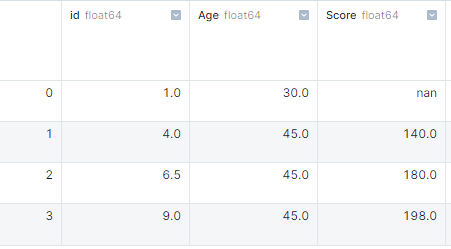
Become a professional data scientist by taking the [Associate Data Scientist in Python](https://www.datacamp.com/tracks/associate-data-scientist-in-python) career track.It includes 25 courses and six projects to help you learn all the fundamentals of data science with the help of Python libraries.
### 21\. Which all Python libraries have you used for visualization?
Data visualization is the most important part of data analysis. You get to see your data in action, and it helps you find hidden patterns.
The most popular Python data visualization libraries are:
1. Matplotlib
2. Seaborn
3. Plotly
4. Bokeh
In Python, we generally use **Matplotlib** and **seaborn** to display all types of data visualization. With a few lines of code, you can use it to display scatter plot, line plot, box plot, bar chart, and many more.
For interactive and more complex applications, we use **Plotly**. You can use it to create colorful interactive graphs with a few lines of code. You can zoom, apply animation, and even add control functions. Plotly provides more than 40 unique types of charts, and we can even use them to create a web application or dashboard.
**Bokeh** is used for detailed graphics with a high level of interactivity across large datasets.
### 22\. How would you normalize or standardize a dataset in Python?
Normalization scales data to a specific range, usually \[0, 1\], while standardization transforms it to have a mean of 0 and a standard deviation of 1. Both techniques are essential for preparing data for machine learning models.
Example:
```
Powered By
```
## Python Coding Interview Questions
If you have a Python coding interview coming up, preparing questions similar to these can help you impress the interviewer.
### 23\. How can you replace string space with a given character in Python?
It is a simple string manipulation challenge. You have to replace the space with a specific character.
**Example 1**: A user has provided the string `l vey u` and the character `o`, and the output will be `loveyou`.
**Example 2**: A user has provided the string `D t C mpBl ckFrid yS le` and the character `a`, and the output will be `DataCampBlackFridaySale`.
**The simplest way is to use the built-in `str.replace()` method to directly replace spaces with the given character.**
```
Powered By
```
### 24\. Given a positive integer num, write a function that returns True if num is a perfect square else False.
This has a relatively straightforward solution. You can check if the number has a perfect square root by:
- Using `math.isqrt(num)` to get the integer square root exactly.
- Squaring it and checking if it equals the original number.
- Returning the result as a boolean.
#### Test 1
We have provided number 10 to the `valid_square()` function:
1. By taking the integer square root of the number, we get 3.
2. Then, take the square of 3 and get 9.
3. 9 is not equal to the number, so the function will return False.
#### Test 2
We have provided number 36 to the `valid_square()` function:
1. By taking the integer square root of the number, we get 6.
2. Then, take the square of 6 and get 36.
3. 36 is equal to the number, so the function will return True.
```
Powered By
```
### 25\. Given an integer n, return the number of trailing zeroes in n factorial n\!
To pass this challenge, you have to first calculate n factorial (n!) and then calculate the number of training zeros.
#### Finding factorial
In the first step, we will use a while loop to iterate over the n factorial and stop when the n is equal to 1.
#### Calculating trailing zeros
In the second step, we will calculate the trailing zero, not the total number of zeros. There is a huge difference.
```
7! = 5040Powered By
```
The seven factorials have a total of two zeros and only one trailing zero, so our solution should return 1.
1. Convert the factorial number to a string.
2. Read it back and apply for a loop.
3. If the number is 0, add +1 to the result, otherwise break the loop.
4. Returns the result.
The solution is elegant but requires attention to detail.
```
Powered By
```
Take the essential [practicing coding interview questions](https://www.datacamp.com/courses/practicing-coding-interview-questions-in-python?hl=GB) course to prepare for your next coding interviews in Python.
### 26\. Can the String Be Split into Dictionary Words?
**You are provided with a large string and a dictionary of the words. You have to find if the input string can be segmented into words using the dictionary or not.**
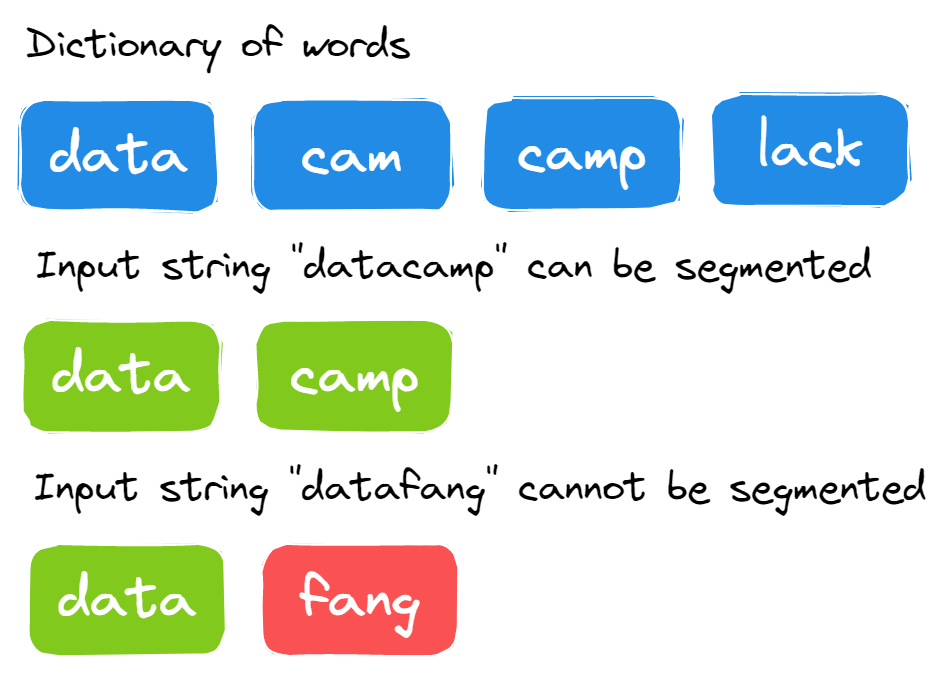
Image by Author
The solution is reasonably straightforward. You have to segment a large string at each point and check if the string can be segmented to the words in the dictionary.
1. Run the loop using the length of the large string.
2. We will create two substrings.
3. The first substring will check each point in the large string from `s[0:i]`.
4. If the first substring is not in the dictionary, it will return False.
5. If the first substring is in the dictionary, it will create the second substring using `s[i:]`.
6. If the second substring is in the dictionary or the second substring is of zero length, then return True. Recursively call `can_segment_str()` with the second substring and return True if it can be segmented.
7. To make the solution efficient for longer strings, we add memoization so substrings are not recomputed again and again.
```
Powered By
```
### 27\. Can you remove duplicates from a sorted array?
**Given an integer sorted array in increasing order, remove duplicates so each unique element appears only once. Because Python lists don’t change length in-place for this problem, place the results in the first k positions of the same array and return k (the new length). Only the first k elements are valid after the call; elements beyond k are stale.**
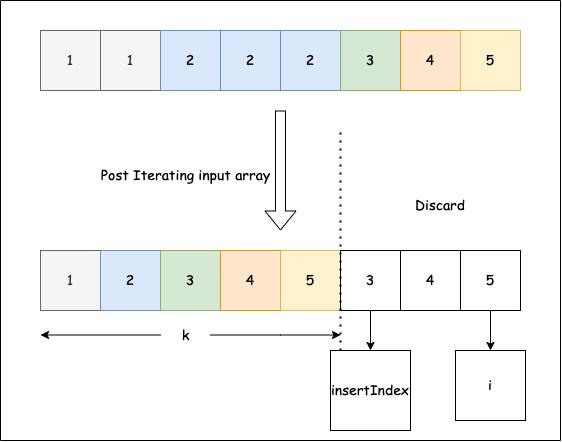
Image from [LeetCode](https://leetcode.com/problems/remove-duplicates-from-sorted-array/solution/)
**Example 1**: input array is \[1,1,2,2\], the function should return 2.
**Example 2**: input array is \[1,1,2,3,3\], the function should return 3.
Solution:
1. Run a loop from index 1 to the end. Compare the current element with the previous unique element; when different, write it at `insertIndex` and increment `insertIndex`. Return `insertIndex`.
2. Return `insertIndex` as it is the k.
This question is relatively straightforward once you know how. If you put more time into understanding the statement, you can easily come up with a solution.
```
Powered By
```
### 28\. Can you find the missing number in the array?
You have been provided with the list of positive integers from 1 to n. All the numbers from 1 to n are present except x, and you must find x.
**Example**:
| | | | | | | |
|---|---|---|---|---|---|---|
| 4 | 5 | 3 | 2 | 8 | 1 | 6 |
- n = 8
- missing number = 7
This question is a simple math problem.
1. Find the sum of all elements in the list.
2. By using arithmetic series sum formula, we will find the expected sum of the first n numbers.
3. Return the difference between the expected sum and the sum of the elements.
```
Powered By
```
### 29\. Write a Python function to determine if a given string is a palindrome.
A string is a palindrome if it reads the same forward and backward.
Example:
```
Powered By
```
## Python Interview Questions for Facebook, Amazon, Apple, Netflix, and Google
Below, we’ve picked out some of the questions you might expect from the most sought-after roles in the industries, those at Meta, Amazon, Google, and the like.
#### Facebook/Meta Python interview questions
The exact questions you’ll encounter at Meta depend largely on the role. However, you might expect some of the following:
### 30\. Can you find the maximum single sell profit?
You are provided with the list of stock prices, and you have to return the buy and sell price to make the highest profit.
**Note**: We have to make maximum profit from a single buy/sell, and if we can’t make a profit, we have to reduce our losses.
**Example 1**: stock\_price = \[8, 4, 12, 9, 20, 1\], buy = 4, and sell = 20. Maximizing the profit.
**Example 2**: stock\_price = \[8, 6, 5, 4, 3, 2, 1\], buy = 6, and sell = 5. Minimizing the loss.
**Solution**:
1. We will calculate the global profit by subtracting global sell (the first element in the list) from current buy (the second element in the list).
2. Run the loop for the range of 1 to the length of the list.
3. Within the loop, calculate the current profit using list elements and current buy value.
4. If the current profit is greater than the global profit, change the global profit with the current profit and global sell to the i element of the list.
5. If the current buy is greater than the current element of the list, change the current buy with the current element of the list.
6. In the end, we will return global buy and sell value. To get global buy value, we will subtract global sell from global profit.
The question is a bit tricky, and you can come up with your unique algorithm to solve the problems.
```
Powered By
```
#### Amazon Python interview questions
Amazon Python interview questions can vary greatly but could include:
### 31\. Can you find a Pythagorean triplet in an array?
Write a function that returns `True` if there is a Pythagorean triplet that satisfies a2+ b2 = c2.
**Example**:
| | |
|---|---|
| **Input** | **Output** |
| \[3, 1, 4, 6, 5\] | True |
| \[10, 4, 6, 12, 5\] | False |
**Solution**:
1. Square all the elements in the array.
2. Sort the array in increasing order.
3. Run two loops. The outer loop starts from the last index of the array to 1, and the inner loop starts from (`outer_loop_index - 1`) to the start.
4. Create `set()` to store the elements between outer loop index and inner loop index.
5. Check if there is a number present in the set which is equal to `(array[outerLoopIndex] – array[innerLoopIndex])`. If yes, return `True`, else `False`.
```
Powered By
```
### 32\. How many ways can you make change with coins and a total amount?
We need to create a function that takes a list of coin denominations and a total amount and returns the number of ways we can make the change.
**In the example, we have provided coin denominations \[1, 2, 5\] and the total amount of 5. In return, we get four ways to make the change.**
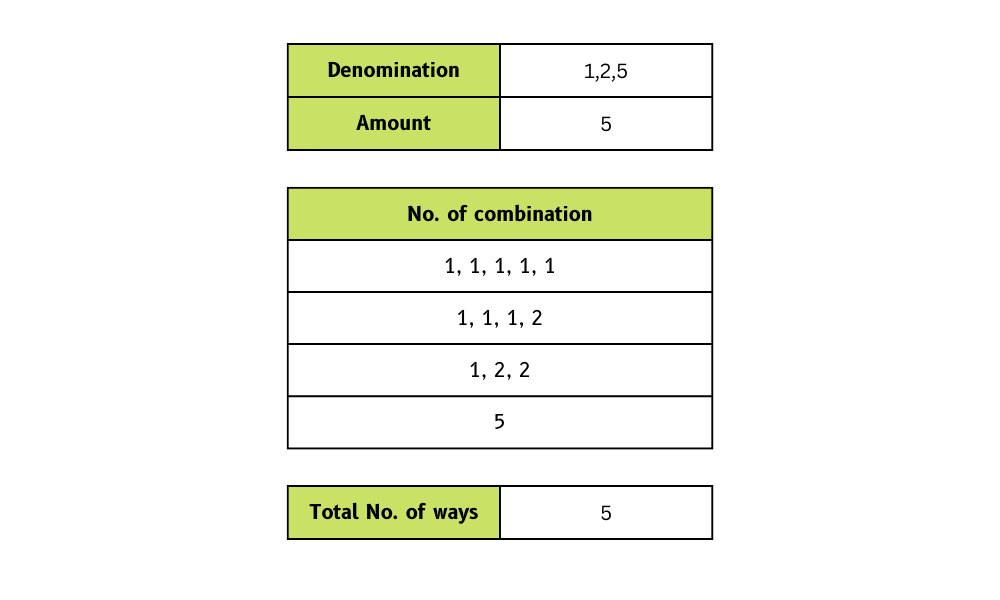
Image by Author
**Solution**:
1. We will create the list of size `amount + 1`. Additional space is added to store the solution for a zero amount.
2. We will initiate a solution list with `solution[0] = 1.`
3. We will run two loops. The outer loop iterates over the denominations, and the inner loop runs from the current denomination value to `amount + 1.`
4. The results of different denominations are stored in the array solution. `solution[i] = solution[i] + solution[i - den]`.
**The process will be repeated for all the elements in the denomination list, and at the last element of the solution list, we will have our number.**
```
Powered By
```
#### Google Python interview questions
As with the other companies mentioned, Google Python interview questions will depend on the role and level of experience. However, some common questions include:
### 33\. Define a lambda function, an iterator, and a generator in Python.
The Lambda function is also known as an anonymous function. You can add any number of parameters but with only one statement.
An iterator is an object that we can use to iterate over iterable objects like lists, dictionaries, tuples, and sets.
The generator is a function similar to a normal function, but it generates a value using the yield keyword instead of return. If the function body contains yield, it automatically becomes a generator.
Read more about [Python iterators and generators](https://www.datacamp.com/tutorial/python-iterators-generators-tutorial) in our full tutorial.
### 34\. Given an array arr\[\], find the maximum j – i such that arr\[j\] \> arr\[i\]
This question is quite straightforward but requires special attention to detail. We are provided with an array of positive integers. We have to find the maximum difference between j-i where array\[j\] \> array\[i\].
**Examples**:
1. Input: \[20, 70, 40, 50, 12, 38, 98\], Output: 6 (j = 6, i = 0)
2. Input: \[10, 3, 2, 4, 5, 6, 7, 8, 18, 0\], Output: 8 ( j = 8, i = 0)
**Solution**:
1. Calculate the length of the array and initiate max difference with -1.
2. Run two loops. The outer loop picks elements from the left, and the inner loop compares the picked elements with elements starting from the right side.
3. Stop the inner loop when the element is greater than the picked element and keep updating the maximum difference using j - I.
```
Powered By
```
### 35\. How would you use the ternary operators in Python?
Ternary operators are also known as conditional expressions. They are operators that evaluate expression based on conditions being True and False.
You can write conditional expressions in a single line instead of writing using multiple lines of if-else statements. It allows you to write clean and compact code.
For example, we can convert nested if-else statements into one line, as shown below.
If-else statement
```
Powered By
```
Nested Ternary Operator
```
Powered By
```
### **36\. How would you implement an LRU Cache in Python?**
Python provides a built-in `functools.lru_cache` decorator to implement an LRU (Least Recently Used) cache. Alternatively, you can create one manually using the `OrderedDict` from `collections`.
Example using `functools`:
```
Powered By
```
## Python AI and Machine Learning Interview Questions
With the rapid growth of AI and large language models (LLMs), Python interviews increasingly include questions about modern AI/ML concepts. Here are key questions you should prepare for in 2026.
### 37\. What is a Large Language Model (LLM), and how would you use one in Python?
A Large Language Model (LLM) is a deep learning model trained on massive text datasets to understand and generate human-like text. Popular LLMs include GPT-5, Claude, Llama, and Gemini. In Python, you can interact with LLMs through APIs or run them locally.
**Example using OpenAI's API:**
```
Powered By
```
Learn more in our [How to Build LLM Applications with LangChain](https://www.datacamp.com/tutorial/how-to-build-llm-applications-with-langchain) tutorial.
### 38\. What is RAG (Retrieval-Augmented Generation), and why is it important?
RAG combines retrieval systems with generative AI to produce more accurate, grounded responses. Instead of relying solely on the LLM's training data, RAG retrieves relevant documents from a knowledge base and uses them as context for generation.
**Key components of a RAG system:**
- **Document Store**: A vector database (like Pinecone, Chroma, or FAISS) storing embedded documents
- **Retriever**: Finds relevant documents based on query similarity
- **Generator**: An LLM that produces responses using retrieved context
**Example RAG workflow:**
```
Powered By
```
Read our guide on [How to Improve RAG Performance](https://www.datacamp.com/tutorial/how-to-improve-rag-performance-5-key-techniques-with-examples) for advanced techniques.
### 39\. How do you handle async/await in Python for AI applications?
Asynchronous programming is essential for AI applications that make multiple API calls or handle concurrent requests. Python's `asyncio` module enables non-blocking I/O operations.
**Example: Concurrent LLM API calls:**
```
Powered By
```
Dive deeper with our [Python Async Programming Guide](https://www.datacamp.com/tutorial/python-async-programming).
### 40\. What are embeddings, and how are they used in machine learning?
Embeddings are dense vector representations of data (text, images, etc.) that capture semantic meaning. Similar items have similar embeddings, enabling tasks like semantic search, clustering, and recommendation systems.
**Example: Creating text embeddings:**
```
Powered By
```
### 41\. How would you build an AI agent in Python?
AI agents are autonomous systems that can perceive their environment, make decisions, and take actions to achieve goals. Modern AI agents often combine LLMs with tools and memory.
**Key components of an AI agent:**
- **LLM Core**: The reasoning engine that processes inputs and decides actions
- **Tools**: Functions the agent can call (web search, code execution, APIs)
- **Memory**: Short-term (conversation) and long-term (vector store) memory
- **Planning**: Breaking complex tasks into subtasks
**Example using LangChain:**
```
Powered By
```
Learn more in our [Building LangChain Agents](https://www.datacamp.com/tutorial/building-langchain-agents-to-automate-tasks-in-python) tutorial.
## **Upskilling Your Team with Python**
While Python interview preparation is essential for job seekers and hiring managers, it’s equally important for businesses to invest in continuous Python training for their teams. In an era where automation, data analysis, and software development are pivotal, ensuring that your employees have strong Python skills can be a transformative factor for your company's success.
If you’re a team leader or business owner looking to ensure your whole team is proficient in Python, [DataCamp for Business](https://www.datacamp.com/business) offers tailored training programs that can help your employees master Python skills, from the basics to advanced concepts. We can provide:
- **Targeted learning paths**: Customizable to your team’s current skill level and specific business needs.
- **Hands-on practice**: Real-world projects and coding exercises that reinforce learning and improve retention.
- **Progress tracking**: Tools to monitor and assess your team’s progress, ensuring they achieve their learning goals.
Investing in Python upskilling through platforms like DataCamp not only enhances your team’s capabilities but also gives your business a strategic edge, enabling you to innovate, stay competitive, and deliver impactful results. Connect with our team and [request a demo today](https://www.datacamp.com/business/demo).
## Boost Your Team's Python Proficiency
Train your team in Python with DataCamp for Business. Comprehensive training, hands-on projects, and detailed performance metrics for your business.
[Request a Demo Today\!](https://www.datacamp.com/business/demo)
## Final Thoughts
Mastering Python interview questions is crucial for anyone aiming to excel in technical interviews, whether they are aspiring data professionals, developers, or software engineers. This guide has provided an overview of common Python interview questions, ranging from basic to advanced levels, as well as coding challenges and specific questions from top tech companies.
By practicing these questions and understanding their solutions, you can significantly enhance your problem-solving skills and technical knowledge, making you well-prepared to pass the technical and coding stages of your interviews.
Pursuing top [Python certifications](https://www.datacamp.com/blog/best-python-certifications) and engaging in continuous learning through courses and projects will further bolster your expertise and career prospects in the tech industry.If you need to brush up on your skills, be sure to complete our [Associate Data Scientist in Python](https://www.datacamp.com/tracks/associate-data-scientist-in-python) career track.
For those preparing for AI and machine learning roles, our [Python Machine Learning Tutorial](https://www.datacamp.com/tutorial/machine-learning-python) provides hands-on practice with scikit-learn and other essential libraries.
## Python Interview FAQs
### How do I prepare for a Python interview?
You need to revise Python syntax, functions, classes, data types, algorithms, data structures, and exceptional handling. Furthermore, you need to read technical tutorials, review example projects, cheat sheets, and mock questions, and solve coding challenges to pass the interview stage.
You need to prepare for general Python questions on native functionality, job-specific questions (data engineer, data scientist, backend developer), and timed code-based questions. You can practice [machine learning Python questions](https://www.datacamp.com/courses/practicing-machine-learning-interview-questions-in-python?hl=GB) and [statistics Python interview questions](https://www.datacamp.com/courses/practicing-statistics-interview-questions-in-python) with DataCamp.
### How do you stand out in a Python coding interview?
You must show the ability to write clean production-ready code, understand job-specific Python libraries, tools, and algorithms, and come up with unique solutions for complex problems. You can all do that by practicing coding challenges or working on an open-source project.
You can also stand out by creating a portfolio of Python-based projects on GitHub and personal websites.
### What is Lambda in Python?
A lambda function is also known as an anonymous function, a Python function without a name. It can take any number of arguments but evaluates and returns only one expression.
**Syntax**:
```
lambda arguments : expressionPowered By
```
**Example**:
```
Powered By
```
### What are the five main uses of Python?
1. Developing websites and software
2. Scripting and utility software
3. Desktop applications
4. Data analysis
5. Machine learning
### Is map faster than for loop?
“map” is faster than “for loop” if you are applying the function to every item of an iterable.
### Are there FREE resources to prepare for Python interviews?
Yes! If you are a university teacher or student, you can use [DataCamp Classrooms](https://www.datacamp.com/universities) to get our entire course catalog for FREE.
### What Python topics should I focus on for AI/ML interviews in 2026?
For AI/ML interviews in 2026, focus on: LLM concepts (transformers, attention mechanisms, fine-tuning vs prompting), RAG (Retrieval-Augmented Generation) systems, vector databases and embeddings, Python async programming for API calls, and frameworks like LangChain, Hugging Face, and PyTorch. You should also understand prompt engineering techniques and how to evaluate ML models.
Topics
[Python](https://www.datacamp.com/blog/category/python)
[Career Services](https://www.datacamp.com/blog/category/career-services)
***
[Abid Ali Awan](https://www.datacamp.com/portfolio/kingabzpro)Certified data scientist, passionate about building ML apps, blogging on data science, and editing.
***
Topics
[Python](https://www.datacamp.com/blog/category/python)
[Career Services](https://www.datacamp.com/blog/category/career-services)
[Top 24 Programming Interview Questions For 2026](https://www.datacamp.com/blog/top-programming-interview-questions)
[Top 40 Software Engineer Interview Questions in 2026](https://www.datacamp.com/blog/software-engineer-interview-questions)
[The Top 39 Data Engineering Interview Questions and Answers in 2026](https://www.datacamp.com/blog/top-21-data-engineering-interview-questions-and-answers)
[Top 36 PySpark Interview Questions and Answers for 2026](https://www.datacamp.com/blog/pyspark-interview-questions)

[Top 35 Machine Learning Interview Questions For 2026](https://www.datacamp.com/blog/top-machine-learning-interview-questions)
[Top 40 DevOps Interview Questions for 2026 (With Expert Answers)](https://www.datacamp.com/blog/devops-interview-questions)
Related
[blogTop 24 Programming Interview Questions For 2026](https://www.datacamp.com/blog/top-programming-interview-questions)
Discover essential programming interview questions with Python examples for job seekers, final-year students, and data professionals.
[](https://www.datacamp.com/portfolio/jcanalesluna)
Javier Canales Luna
14 min
[blogTop 40 Software Engineer Interview Questions in 2026](https://www.datacamp.com/blog/software-engineer-interview-questions)
Master the technical interview process with these essential questions covering algorithms, system design, and behavioral scenarios. Get expert answers, code examples, and proven preparation strategies.

Dario Radečić
15 min
[blogThe Top 39 Data Engineering Interview Questions and Answers in 2026](https://www.datacamp.com/blog/top-21-data-engineering-interview-questions-and-answers)
Ace your next interview with this compilation of data engineer interview questions and answers, helping you prepare for different stages, from HR screening to in-depth technical evaluations, including Python and SQL questions.
[](https://www.datacamp.com/portfolio/kingabzpro)
Abid Ali Awan
15 min
[blogTop 36 PySpark Interview Questions and Answers for 2026](https://www.datacamp.com/blog/pyspark-interview-questions)
This article provides a comprehensive guide to PySpark interview questions and answers, covering topics from foundational concepts to advanced techniques and optimization strategies.
[](https://www.datacamp.com/portfolio/meugeinzaug)
Maria Eugenia Inzaugarat
15 min

[blogTop 35 Machine Learning Interview Questions For 2026](https://www.datacamp.com/blog/top-machine-learning-interview-questions)
Prepare for your interview with this comprehensive guide to machine learning questions, covering everything from basic concepts and algorithms to advanced and role-specific topics.
[](https://www.datacamp.com/portfolio/kingabzpro)
Abid Ali Awan
15 min
[blogTop 40 DevOps Interview Questions for 2026 (With Expert Answers)](https://www.datacamp.com/blog/devops-interview-questions)
A practical guide to DevOps interview questions, grounded in experience, packed with examples, and designed to help you stand out.

Patrick Brus
15 min
[See More](https://www.datacamp.com/blog/category/python)
[See More](https://www.datacamp.com/blog/category/python)
## Grow your data skills with DataCamp for Mobile
Make progress on the go with our mobile courses and daily 5-minute coding challenges.
[Download on the App Store](https://datacamp.onelink.me/xztQ/45dozwue?deep_link_sub1=%7B%22src_url%22%3A%22https%3A%2F%2Fwww.datacamp.com%2Fblog%2Ftop-python-interview-questions-and-answers%22%7D)[Get it on Google Play](https://datacamp.onelink.me/xztQ/go2f19ij?deep_link_sub1=%7B%22src_url%22%3A%22https%3A%2F%2Fwww.datacamp.com%2Fblog%2Ftop-python-interview-questions-and-answers%22%7D)
**Learn**
[Learn Python](https://www.datacamp.com/blog/how-to-learn-python-expert-guide)[Learn AI](https://www.datacamp.com/blog/how-to-learn-ai)[Learn Power BI](https://www.datacamp.com/learn/power-bi)[Learn Data Engineering](https://www.datacamp.com/category/data-engineering)[Assessments](https://www.datacamp.com/signal)[Career Tracks](https://www.datacamp.com/tracks/career)[Skill Tracks](https://www.datacamp.com/tracks/skill)[Courses](https://www.datacamp.com/courses-all)[Data Science Roadmap](https://www.datacamp.com/blog/data-science-roadmap)
**Data Courses**
[Python Courses](https://www.datacamp.com/category/python)[R Courses](https://www.datacamp.com/category/r)[SQL Courses](https://www.datacamp.com/category/sql)[Power BI Courses](https://www.datacamp.com/category/power-bi)[Tableau Courses](https://www.datacamp.com/category/tableau)[Alteryx Courses](https://www.datacamp.com/category/alteryx)[Azure Courses](https://www.datacamp.com/category/azure)[AWS Courses](https://www.datacamp.com/category/aws)[Google Cloud Courses](https://www.datacamp.com/category/google-cloud)[Google Sheets Courses](https://www.datacamp.com/category/google-sheets)[Excel Courses](https://www.datacamp.com/category/excel)[AI Courses](https://www.datacamp.com/category/artificial-intelligence)[Data Analysis Courses](https://www.datacamp.com/category/data-analysis)[Data Visualization Courses](https://www.datacamp.com/category/data-visualization)[Machine Learning Courses](https://www.datacamp.com/category/machine-learning)[Data Engineering Courses](https://www.datacamp.com/category/data-engineering)[Probability & Statistics Courses](https://www.datacamp.com/category/probability-and-statistics)
**DataLab**
[Get Started](https://www.datacamp.com/datalab)[Pricing](https://www.datacamp.com/datalab/pricing)[Security](https://www.datacamp.com/datalab/security)[Documentation](https://datalab-docs.datacamp.com/)
**Certification**
[Certifications](https://www.datacamp.com/certification)[Data Scientist](https://www.datacamp.com/certification/data-scientist)[Data Analyst](https://www.datacamp.com/certification/data-analyst)[Data Engineer](https://www.datacamp.com/certification/data-engineer)[SQL Associate](https://www.datacamp.com/certification/sql-associate)[Power BI Data Analyst](https://www.datacamp.com/certification/data-analyst-in-power-bi)[Tableau Certified Data Analyst](https://www.datacamp.com/certification/data-analyst-in-tableau)[Azure Fundamentals](https://www.datacamp.com/certification/azure-fundamentals)[AI Fundamentals](https://www.datacamp.com/certification/ai-fundamentals)
**Resources**
[Resource Center](https://www.datacamp.com/resources)[Upcoming Events](https://www.datacamp.com/webinars)[Blog](https://www.datacamp.com/blog)[Code-Alongs](https://www.datacamp.com/code-along)[Tutorials](https://www.datacamp.com/tutorial)[Docs](https://www.datacamp.com/doc)[Open Source](https://www.datacamp.com/open-source)[RDocumentation](https://www.rdocumentation.org/)[Book a Demo with DataCamp for Business](https://www.datacamp.com/business/demo)[Data Portfolio](https://www.datacamp.com/data-portfolio)
**Plans**
[Pricing](https://www.datacamp.com/pricing)[For Students](https://www.datacamp.com/pricing/student)[For Business](https://www.datacamp.com/business)[For Universities](https://www.datacamp.com/universities)[Discounts, Promos & Sales](https://www.datacamp.com/promo)[Expense DataCamp](https://www.datacamp.com/expense)[DataCamp Donates](https://www.datacamp.com/donates)
**For Business**
[Business Pricing](https://www.datacamp.com/business/compare-plans)[Teams Plan](https://www.datacamp.com/business/learn-teams)[Data & AI Unlimited Plan](https://www.datacamp.com/business/data-unlimited)[Customer Stories](https://www.datacamp.com/business/customer-stories)[Partner Program](https://www.datacamp.com/business/partner-program)
**About**
[About Us](https://www.datacamp.com/about)[Learner Stories](https://www.datacamp.com/stories)[Careers](https://www.datacamp.com/careers)[Become an Instructor](https://www.datacamp.com/learn/create)[Press](https://www.datacamp.com/press)[Leadership](https://www.datacamp.com/about/leadership)[Contact Us](https://support.datacamp.com/hc/en-us/articles/360021185634)[DataCamp Español](https://www.datacamp.com/es)[DataCamp Português](https://www.datacamp.com/pt)[DataCamp Deutsch](https://www.datacamp.com/de)[DataCamp Français](https://www.datacamp.com/fr)
**Support**
[Help Center](https://support.datacamp.com/hc/en-us)[Become an Affiliate](https://www.datacamp.com/affiliates)
[Facebook](https://www.facebook.com/datacampinc/)
[Twitter](https://twitter.com/datacamp)
[LinkedIn](https://www.linkedin.com/school/datacampinc/)
[YouTube](https://www.youtube.com/channel/UC79Gv3mYp6zKiSwYemEik9A)
[Instagram](https://www.instagram.com/datacamp/)
[Privacy Policy](https://www.datacamp.com/privacy-policy)[Cookie Notice](https://www.datacamp.com/cookie-notice)[Do Not Sell My Personal Information](https://www.datacamp.com/do-not-sell-my-personal-information)[Accessibility](https://www.datacamp.com/accessibility)[Security](https://www.datacamp.com/security)[Terms of Use](https://www.datacamp.com/terms-of-use)
© 2026 DataCamp, Inc. All Rights Reserved. | ||||||||||||||||||
| Readable Markdown | Python continues to dominate the tech industry as one of the most versatile and in-demand programming languages. Whether you're preparing for a technical interview or looking to sharpen your coding skills, mastering Python is essential. Interviews often involve solving challenges and explaining complex functionalities in Python. This guide provides a comprehensive list of the most common and advanced Python interview questions. Practicing these questions will equip data professionals, developers, and software engineers with the skills needed to excel in technical interviews and advance their careers. TL;DR Master Python fundamentals: data types, comprehensions, OOP concepts like `__init__()`, and the GIL Practice coding challenges: string manipulation, array algorithms, and dynamic programming problems Know data science libraries: NumPy, pandas, and scikit-learn for ML interviews Understand modern Python: async/await, type hints, decorators, and context managers Prepare for AI/ML questions: LLMs, RAG, prompt engineering, and transformer architectures Study FAANG-style problems: stock profit optimization, Pythagorean triplets, and coin change algorithms
Basic Python Interview Questions These are some of the questions you might encounter during an entry-level Python interview. 1\. What is Python, and list some of its key features. Python is a versatile, high-level programming language known for its easy-to-read syntax and broad applications. Here are some of Python’s key features: **Simple and Readable Syntax**: Python’s syntax is clear and straightforward, making it accessible for beginners and efficient for experienced developers. **Interpreted Language**: Python executes code line by line, which helps in debugging and testing. **Dynamic Typing**: Python does not require explicit data type declarations, allowing more flexibility. **Extensive Libraries and Frameworks**: Libraries like NumPy, Pandas, and Django expand Python’s functionality for specialized tasks in data science, web development, and more. **Cross-Platform Compatibility**: Python can run on different operating systems, including Windows, macOS, and Linux. 2\. What are Python lists and tuples? Lists and tuples are fundamental Python data structures with distinct characteristics and use cases. **List:** **Mutable:** Elements can be changed after creation. **Memory Usage:** Consumes more memory. **Performance:** Slower iteration compared to tuples but better for insertion and deletion operations. **Methods:** Offers various built-in methods for manipulation. **Example:** **Tuple:** **Immutable:** Elements cannot be changed after creation. **Memory Usage:** Consumes less memory. **Performance:** Faster iteration compared to lists but lacks the flexibility of lists. **Methods:** Limited built-in methods. **Example:** Learn more in our [Python Lists tutorial](https://www.datacamp.com/tutorial/python-list-function). 3\. What is \_\_init\_\_() in Python? The `__init__()` method is known as a constructor in object-oriented programming (OOP) terminology. It is used to initialize an object's state when it is created. This method is automatically called when a new instance of a class is instantiated. **Purpose:** Assign values to object properties. Perform any initialization operations. **Example**: We have created a `book_shop` class and added the constructor and `book()` function. The constructor will store the book title name and the `book()` function will print the book name. To test our code we have initialized the `b` object with “Sandman” and executed the `book()` function. 4\. What is the difference between a mutable data type and an immutable data type? Mutable data types: **Definition:** Mutable data types are those that can be modified after their creation. **Examples:** List, Dictionary, Set. **Characteristics:** Elements can be added, removed, or changed. **Use Case:** Suitable for collections of items where frequent updates are needed. **Example:** **Immutable data types:** **Definition:** Immutable data types are those that cannot be modified after their creation. **Examples:** Numeric (int, float), String, Tuple. **Characteristics:** Elements cannot be changed once set; any operation that appears to modify an immutable object will create a new object. **Example:** 5\. Explain list, dictionary, and tuple comprehension with an example. List List comprehension offers one-liner syntax to create a new list based on the values of the existing list. You can use a `for` loop to replicate the same thing, but it will require you to write multiple lines, and sometimes it can get complex. List comprehension eases the creation of the list based on existing iterable. Dictionary Similar to a List comprehension, you can create a dictionary based on an existing table with a single line of code. You need to enclose the operation with curly brackets `{}`. Tuple Unlike lists and dictionaries, there is no special “tuple comprehension.” **When you use parentheses with a comprehension, Python actually creates a generator expression, not a tuple. To get a tuple, you must either convert the generator with `tuple()` or define a tuple literal directly.** You can learn more about it in our [Python Tuples tutorial](https://www.datacamp.com/tutorial/python-tuples). 6\. What is the Global Interpreter Lock (GIL) in Python, and why is it important? The Global Interpreter Lock (GIL) is a mutex in CPython (the reference Python implementation) that ensures only one native thread executes Python bytecode at a time. It simplifies memory management by protecting internal data structures like reference counts, but it also restricts true parallelism in CPU-bound tasks, making multithreading less effective for computational workloads. However, it works well for I/O-bound tasks, where threads spend time waiting on network, file, or database operations. Note**: Python 3.13 introduced an experimental no-GIL build (PEP 703), and Python 3.14 adds documented free-threaded support. Some C extensions and libraries may not yet be fully compatible.** Here are some of the questions you might encounter during an intermediate-level Python interview. 7\. Can you e**xplain common searching and graph traversal algorithms in Python?** Python has a number of different powerful algorithms for searching and graph traversal, and each one deals with different data structures and solves different problems. I'll explain them here: **Binary Search**: If you need to quickly find an item in a sorted list, [binary search](https://www.datacamp.com/tutorial/binary-search-python) is your go-to. It works by repeatedly dividing the search range in half until the target is found. **AVL Tree**: An [AVL tree](https://www.datacamp.com/tutorial/avl-tree) keeps things balanced, which is a big advantage if you’re frequently inserting or deleting items in a tree. This self-balancing binary search tree structure keeps searches fast by making sure the tree never gets too skewed. **Breadth-First Search (BFS)**: [BFS](https://www.datacamp.com/tutorial/breadth-first-search-in-python) is all about exploring a graph level by level. It’s especially useful if you’re trying to find the shortest path in an unweighted graph since it checks all possible moves from each node before going deeper. **Depth-First Search (DFS)**: [DFS](https://www.datacamp.com/tutorial/depth-first-search-in-python) takes a different approach by exploring as far as it can down each branch before backtracking. It’s great for tasks like maze-solving or tree traversal. **A\* Algorithm**: The [A\* algorithm](https://www.datacamp.com/tutorial/a-star-algorithm) is a bit more advanced and combines the best of both BFS and DFS by using heuristics to find the shortest path efficiently. It’s commonly used in pathfinding for maps and games. 8\. What is a KeyError in Python, and how can you handle it? A `KeyError` in Python occurs when you try to access a key that doesn’t exist in a dictionary. This error is raised because Python expects every key you look up to be present in the dictionary, and when it isn’t, it throws a `KeyError`. For example, if you have a dictionary of student scores and try to access a student who isn’t in the dictionary, you’ll get a `KeyError`. To handle this error, you have a few options: **Use the .get() method**: This method returns `None` (or a specified default value) instead of throwing an error if the key isn’t found. **Use a try-except block**: Wrapping your code in `try-except` allows you to catch the `KeyError` and handle it gracefully. **Check for the key with in:** You can check if a key exists in the dictionary using `if key in dictionary` before trying to access it. To learn more, read our full tutorial: [Python KeyError Exceptions and How to Fix Them](https://www.datacamp.com/tutorial/python-keyerror). 9\. How does Python handle memory management, and what role does garbage collection play? Python manages memory allocation and deallocation automatically using a private heap, where all objects and data structures are stored. The memory management process is handled by Python’s memory manager, which optimizes memory usage, and the garbage collector, which deals with unused or unreferenced objects to free up memory. [Garbage collection in Python](https://www.datacamp.com/tutorial/python-garbage-collection) uses reference counting as well as a cyclic garbage collector to detect and collect unused data. When an object has no more references, it becomes eligible for garbage collection. The `gc` module in Python allows you to interact with the garbage collector directly, providing functions to enable or disable garbage collection, as well as to perform manual collection. 10\. What is the difference between shallow copy and deep copy in Python, and when would you use each? In Python, shallow and deep copies are used to duplicate objects, but they handle nested structures differently. **Shallow Copy**: A shallow copy creates a new object but inserts references to the objects found in the original. So, if the original object contains other mutable objects (like lists within lists), the shallow copy will reference the same inner objects. This can lead to unexpected changes if you modify one of those inner objects in either the original or copied structure. You can create a shallow copy using the `copy()` method or the `copy` module’s `copy()` function. **Deep Copy**: A deep copy creates a new object and recursively copies all objects found within the original. This means that even nested structures get duplicated, so changes in one copy don’t affect the other. To create a deep copy, you can use the `copy` module’s `deepcopy()` function. **Example Usage**: A shallow copy is suitable when the object contains only immutable items or when you want changes in nested structures to reflect in both copies. A deep copy is ideal when working with complex, nested objects where you want a completely independent duplicate. Read our [Python Copy List: What You Should Know](https://www.datacamp.com/tutorial/python-copy-list) tutorial to learn more. This tutorial includes a whole section on the difference between shallow copy and deep copy. 11\. How can you use Python’s collections module to simplify common tasks? The `collections` module in Python provides specialized data structures like `defaultdict`, `Counter`, `deque`, and `OrderedDict` to simplify various tasks. For instance, `Counter` is ideal for counting elements in an iterable, while `defaultdict` can initialize dictionary values without explicit checks. Example: Advanced Python Interview Questions These interview questions are for more experienced Python practitioners. 12\. What is monkey patching in Python? Monkey patching in Python is a dynamic technique that can change the behavior of the code at run-time. In short, you can modify a class or module at run-time. **Example**: Let’s learn monkey patching with an example. We have created a class `monkey` with a `patch()` function. We have also created a `monk_p` function outside the class. We will now replace the `patch` with the `monk_p`function by assigning `monkey.patch` to `monk_p`. In the end, we will test the modification by creating the object using the `monkey` class and running the `patch()` function. Instead of displaying `patch() is being called`, it has displayed `monk_p() is being called`. **Caution****: Use these sparingly; monkey patching can make your code harder to read and may surprise others working with your code or tests.** 13\. What is the Python “with” statement designed for? The `with` statement is used for exception handling to make code cleaner and simpler. It is generally used for the management of common resources like creating, editing, and saving a file. **Example**: Instead of writing multiple lines of open, try, finally, and close, you can create and write a text file using the `with` statement. It is simple. 14\. Why use else in try/except construct in Python? `try:` and `except:` are commonly known for exceptional handling in Python, so where does `else:` come in handy? `else:` will be triggered when no exception is raised. **Example**: Let’s learn more about `else:` with a couple of examples. On the first try, we entered `2` as the numerator and `d` as the denominator. Which is incorrect, and `except:` was triggered with “Invalid input!”. On the second try, we entered `2` as the numerator and `1` as the denominator and got the result `2`. No exception was raised, so it triggered the `else:` printing the message `Division is successful.` Take the [Python Fundamentals](https://www.datacamp.com/tracks/python-fundamentals) skill track to gain the foundational skills you need to become a Python programmer. 15\. What are decorators in Python? Decorators in Python are a design pattern that allows you to add new functionality to an existing object without modifying its structure. They are commonly used to extend the behavior of functions or methods. You can read more about [how to use Python decorators](https://www.datacamp.com/tutorial/decorators-python) in a separate guide. **Example:** **16\. What are context managers in Python, and how are they implemented?** Context managers in Python are used to manage resources, ensuring that they are properly acquired and released. The most common use of context managers is the `with` statement. **Example:** In this example, the `FileManager` class is a context manager that ensures the file is properly closed after it is used within the `with` statement. 17\. What are metaclasses in Python, and how do they differ from regular classes? Metaclasses are classes of classes. They define how classes behave and are created. While regular classes create objects, metaclasses create classes. By using metaclasses, you can modify class definitions, enforce rules, or add functionality during class creation. Example: Python Data Science Interview Questions For those focused more on data science applications of Python, these are some questions you may encounter. 18\. What are the advantages of NumPy over regular Python lists? There are several advantages of NumPy over regular Python lists, such as: **Memory**: NumPy arrays are more memory-efficient than Python lists because they store elements of the same type in contiguous blocks. (Exact memory use depends on element type and system, but you can check with `sys.getsizeof` or `array.nbytes`.) **Speed**: NumPy uses optimized C implementations, so operations on large arrays are much faster than with lists. **Versatility****: NumPy supports vectorized operations (e.g., addition, multiplication) and provides many built-in mathematical functions that Python lists don’t support.** 19\. What is the difference between merge, join, and concatenate? Merge Merge two DataFrames named series objects using the unique column identifier. It requires two DataFrame, a common column in both DataFrame, and “how” you want to join them together. You can left, right, outer, inner, and cross join two data DataFrames. By default, it is an inner join. Join [Join the DataFrames](https://www.datacamp.com/tutorial/joining-dataframes-pandas) using the unique index. It requires an optional `on` argument that can be a column or multiple column names. By default, the join function performs a left join. Concatenate [Concatenate](https://www.datacamp.com/tutorial/python-concatenate-strings) joins two or multiple DataFrames along a particular axis (rows or columns). It doesn't require an `on` argument. **join()**: combines two DataFrames by index. **merge()**: combines two DataFrames by the column or columns you specify. **concat()**: combines two or more DataFrames vertically or horizontally. 20\. How do you identify and deal with missing values? Identifying missing values We can identify missing values in the DataFrame by using the `isnull()` function and then applying `sum()`. `Isnull()` will return boolean values, and the sum will give you the number of missing values in each column. In the example, we have created a dictionary of lists and converted it into a pandas DataFrame. After that, we used `isnull().sum()` to get the number of missing values in each column. Dealing with missing values There are various [ways of dealing with missing values in Python](https://www.datacamp.com/tutorial/python-nan-missing-values-in-python). Drop the entire row or the columns if it consists of missing values using `dropna()`. This method is not recommended, as you will lose important information. Fill the missing values with the constant, average, backward fill, and forward fill using the `fillna()` function. Replace missing values with a constant String, Integer, or Float using the `replace()` function. Fill in the missing values using an interpolation method. **Note**: make sure you are working with a larger dataset while using the `dropna()` function.  Become a professional data scientist by taking the [Associate Data Scientist in Python](https://www.datacamp.com/tracks/associate-data-scientist-in-python) career track.It includes 25 courses and six projects to help you learn all the fundamentals of data science with the help of Python libraries. 21\. Which all Python libraries have you used for visualization? Data visualization is the most important part of data analysis. You get to see your data in action, and it helps you find hidden patterns. The most popular Python data visualization libraries are: Matplotlib Seaborn Plotly Bokeh In Python, we generally use **Matplotlib** and **seaborn** to display all types of data visualization. With a few lines of code, you can use it to display scatter plot, line plot, box plot, bar chart, and many more. For interactive and more complex applications, we use **Plotly**. You can use it to create colorful interactive graphs with a few lines of code. You can zoom, apply animation, and even add control functions. Plotly provides more than 40 unique types of charts, and we can even use them to create a web application or dashboard. **Bokeh** is used for detailed graphics with a high level of interactivity across large datasets. 22\. How would you normalize or standardize a dataset in Python? Normalization scales data to a specific range, usually \[0, 1\], while standardization transforms it to have a mean of 0 and a standard deviation of 1. Both techniques are essential for preparing data for machine learning models. Example: Python Coding Interview Questions If you have a Python coding interview coming up, preparing questions similar to these can help you impress the interviewer. 23\. How can you replace string space with a given character in Python? It is a simple string manipulation challenge. You have to replace the space with a specific character. **Example 1**: A user has provided the string `l vey u` and the character `o`, and the output will be `loveyou`. **Example 2**: A user has provided the string `D t C mpBl ckFrid yS le` and the character `a`, and the output will be `DataCampBlackFridaySale`. **The simplest way is to use the built-in `str.replace()` method to directly replace spaces with the given character.** 24\. Given a positive integer num, write a function that returns True if num is a perfect square else False. This has a relatively straightforward solution. You can check if the number has a perfect square root by: Using `math.isqrt(num)` to get the integer square root exactly. Squaring it and checking if it equals the original number. Returning the result as a boolean. Test 1 We have provided number 10 to the `valid_square()` function: By taking the integer square root of the number, we get 3. Then, take the square of 3 and get 9. 9 is not equal to the number, so the function will return False. Test 2 We have provided number 36 to the `valid_square()` function: By taking the integer square root of the number, we get 6. Then, take the square of 6 and get 36. 36 is equal to the number, so the function will return True. 25\. Given an integer n, return the number of trailing zeroes in n factorial n\! To pass this challenge, you have to first calculate n factorial (n!) and then calculate the number of training zeros. Finding factorial In the first step, we will use a while loop to iterate over the n factorial and stop when the n is equal to 1. Calculating trailing zeros In the second step, we will calculate the trailing zero, not the total number of zeros. There is a huge difference. The seven factorials have a total of two zeros and only one trailing zero, so our solution should return 1. Convert the factorial number to a string. Read it back and apply for a loop. If the number is 0, add +1 to the result, otherwise break the loop. Returns the result. The solution is elegant but requires attention to detail. Take the essential [practicing coding interview questions](https://www.datacamp.com/courses/practicing-coding-interview-questions-in-python?hl=GB) course to prepare for your next coding interviews in Python. 26\. Can the String Be Split into Dictionary Words? **You are provided with a large string and a dictionary of the words. You have to find if the input string can be segmented into words using the dictionary or not.**  Image by Author The solution is reasonably straightforward. You have to segment a large string at each point and check if the string can be segmented to the words in the dictionary. Run the loop using the length of the large string. We will create two substrings. The first substring will check each point in the large string from `s[0:i]`. If the first substring is not in the dictionary, it will return False. If the first substring is in the dictionary, it will create the second substring using `s[i:]`. If the second substring is in the dictionary or the second substring is of zero length, then return True. Recursively call `can_segment_str()` with the second substring and return True if it can be segmented. To make the solution efficient for longer strings, we add memoization so substrings are not recomputed again and again. 27\. Can you remove duplicates from a sorted array? **Given an integer sorted array in increasing order, remove duplicates so each unique element appears only once. Because Python lists don’t change length in-place for this problem, place the results in the first k positions of the same array and return k (the new length). Only the first k elements are valid after the call; elements beyond k are stale.**  Image from [LeetCode](https://leetcode.com/problems/remove-duplicates-from-sorted-array/solution/) **Example 1**: input array is \[1,1,2,2\], the function should return 2. **Example 2**: input array is \[1,1,2,3,3\], the function should return 3. Solution: Run a loop from index 1 to the end. Compare the current element with the previous unique element; when different, write it at `insertIndex` and increment `insertIndex`. Return `insertIndex`. Return `insertIndex` as it is the k. This question is relatively straightforward once you know how. If you put more time into understanding the statement, you can easily come up with a solution. 28\. Can you find the missing number in the array? You have been provided with the list of positive integers from 1 to n. All the numbers from 1 to n are present except x, and you must find x. **Example**: 4 5 3 2 8 1 6 n = 8 missing number = 7 This question is a simple math problem. Find the sum of all elements in the list. By using arithmetic series sum formula, we will find the expected sum of the first n numbers. Return the difference between the expected sum and the sum of the elements. 29\. Write a Python function to determine if a given string is a palindrome. A string is a palindrome if it reads the same forward and backward. Example: Python Interview Questions for Facebook, Amazon, Apple, Netflix, and Google Below, we’ve picked out some of the questions you might expect from the most sought-after roles in the industries, those at Meta, Amazon, Google, and the like. Facebook/Meta Python interview questions The exact questions you’ll encounter at Meta depend largely on the role. However, you might expect some of the following: 30\. Can you find the maximum single sell profit? You are provided with the list of stock prices, and you have to return the buy and sell price to make the highest profit. **Note**: We have to make maximum profit from a single buy/sell, and if we can’t make a profit, we have to reduce our losses. **Example 1**: stock\_price = \[8, 4, 12, 9, 20, 1\], buy = 4, and sell = 20. Maximizing the profit. **Example 2**: stock\_price = \[8, 6, 5, 4, 3, 2, 1\], buy = 6, and sell = 5. Minimizing the loss. **Solution**: We will calculate the global profit by subtracting global sell (the first element in the list) from current buy (the second element in the list). Run the loop for the range of 1 to the length of the list. Within the loop, calculate the current profit using list elements and current buy value. If the current profit is greater than the global profit, change the global profit with the current profit and global sell to the i element of the list. If the current buy is greater than the current element of the list, change the current buy with the current element of the list. In the end, we will return global buy and sell value. To get global buy value, we will subtract global sell from global profit. The question is a bit tricky, and you can come up with your unique algorithm to solve the problems. Amazon Python interview questions Amazon Python interview questions can vary greatly but could include: 31\. Can you find a Pythagorean triplet in an array? Write a function that returns `True` if there is a Pythagorean triplet that satisfies a2+ b2 = c2. **Example**: **Input** **Output** \[3, 1, 4, 6, 5\] True \[10, 4, 6, 12, 5\] False **Solution**: Square all the elements in the array. Sort the array in increasing order. Run two loops. The outer loop starts from the last index of the array to 1, and the inner loop starts from (`outer_loop_index - 1`) to the start. Create `set()` to store the elements between outer loop index and inner loop index. Check if there is a number present in the set which is equal to `(array[outerLoopIndex] – array[innerLoopIndex])`. If yes, return `True`, else `False`. 32\. How many ways can you make change with coins and a total amount? We need to create a function that takes a list of coin denominations and a total amount and returns the number of ways we can make the change. **In the example, we have provided coin denominations \[1, 2, 5\] and the total amount of 5. In return, we get four ways to make the change.**  Image by Author **Solution**: We will create the list of size `amount + 1`. Additional space is added to store the solution for a zero amount. We will initiate a solution list with `solution[0] = 1.` We will run two loops. The outer loop iterates over the denominations, and the inner loop runs from the current denomination value to `amount + 1.` The results of different denominations are stored in the array solution. `solution[i] = solution[i] + solution[i - den]`. **The process will be repeated for all the elements in the denomination list, and at the last element of the solution list, we will have our number.** Google Python interview questions As with the other companies mentioned, Google Python interview questions will depend on the role and level of experience. However, some common questions include: 33\. Define a lambda function, an iterator, and a generator in Python. The Lambda function is also known as an anonymous function. You can add any number of parameters but with only one statement. An iterator is an object that we can use to iterate over iterable objects like lists, dictionaries, tuples, and sets. The generator is a function similar to a normal function, but it generates a value using the yield keyword instead of return. If the function body contains yield, it automatically becomes a generator. Read more about [Python iterators and generators](https://www.datacamp.com/tutorial/python-iterators-generators-tutorial) in our full tutorial. 34\. Given an array arr\[\], find the maximum j – i such that arr\[j\] \> arr\[i\] This question is quite straightforward but requires special attention to detail. We are provided with an array of positive integers. We have to find the maximum difference between j-i where array\[j\] \> array\[i\]. **Examples**: Input: \[20, 70, 40, 50, 12, 38, 98\], Output: 6 (j = 6, i = 0) Input: \[10, 3, 2, 4, 5, 6, 7, 8, 18, 0\], Output: 8 ( j = 8, i = 0) **Solution**: Calculate the length of the array and initiate max difference with -1. Run two loops. The outer loop picks elements from the left, and the inner loop compares the picked elements with elements starting from the right side. Stop the inner loop when the element is greater than the picked element and keep updating the maximum difference using j - I. 35\. How would you use the ternary operators in Python? Ternary operators are also known as conditional expressions. They are operators that evaluate expression based on conditions being True and False. You can write conditional expressions in a single line instead of writing using multiple lines of if-else statements. It allows you to write clean and compact code. For example, we can convert nested if-else statements into one line, as shown below. If-else statement Nested Ternary Operator **36\. How would you implement an LRU Cache in Python?** Python provides a built-in `functools.lru_cache` decorator to implement an LRU (Least Recently Used) cache. Alternatively, you can create one manually using the `OrderedDict` from `collections`. Example using `functools`: Python AI and Machine Learning Interview Questions With the rapid growth of AI and large language models (LLMs), Python interviews increasingly include questions about modern AI/ML concepts. Here are key questions you should prepare for in 2026. 37\. What is a Large Language Model (LLM), and how would you use one in Python? A Large Language Model (LLM) is a deep learning model trained on massive text datasets to understand and generate human-like text. Popular LLMs include GPT-5, Claude, Llama, and Gemini. In Python, you can interact with LLMs through APIs or run them locally. **Example using OpenAI's API:** Learn more in our [How to Build LLM Applications with LangChain](https://www.datacamp.com/tutorial/how-to-build-llm-applications-with-langchain) tutorial. 38\. What is RAG (Retrieval-Augmented Generation), and why is it important? RAG combines retrieval systems with generative AI to produce more accurate, grounded responses. Instead of relying solely on the LLM's training data, RAG retrieves relevant documents from a knowledge base and uses them as context for generation. **Key components of a RAG system:** **Document Store**: A vector database (like Pinecone, Chroma, or FAISS) storing embedded documents **Retriever**: Finds relevant documents based on query similarity **Generator**: An LLM that produces responses using retrieved context **Example RAG workflow:** Read our guide on [How to Improve RAG Performance](https://www.datacamp.com/tutorial/how-to-improve-rag-performance-5-key-techniques-with-examples) for advanced techniques. 39\. How do you handle async/await in Python for AI applications? Asynchronous programming is essential for AI applications that make multiple API calls or handle concurrent requests. Python's `asyncio` module enables non-blocking I/O operations. **Example: Concurrent LLM API calls:** Dive deeper with our [Python Async Programming Guide](https://www.datacamp.com/tutorial/python-async-programming). 40\. What are embeddings, and how are they used in machine learning? Embeddings are dense vector representations of data (text, images, etc.) that capture semantic meaning. Similar items have similar embeddings, enabling tasks like semantic search, clustering, and recommendation systems. **Example: Creating text embeddings:** 41\. How would you build an AI agent in Python? AI agents are autonomous systems that can perceive their environment, make decisions, and take actions to achieve goals. Modern AI agents often combine LLMs with tools and memory. **Key components of an AI agent:** **LLM Core**: The reasoning engine that processes inputs and decides actions **Tools**: Functions the agent can call (web search, code execution, APIs) **Memory**: Short-term (conversation) and long-term (vector store) memory **Planning**: Breaking complex tasks into subtasks **Example using LangChain:** Learn more in our [Building LangChain Agents](https://www.datacamp.com/tutorial/building-langchain-agents-to-automate-tasks-in-python) tutorial. **Upskilling Your Team with Python** While Python interview preparation is essential for job seekers and hiring managers, it’s equally important for businesses to invest in continuous Python training for their teams. In an era where automation, data analysis, and software development are pivotal, ensuring that your employees have strong Python skills can be a transformative factor for your company's success. If you’re a team leader or business owner looking to ensure your whole team is proficient in Python, [DataCamp for Business](https://www.datacamp.com/business) offers tailored training programs that can help your employees master Python skills, from the basics to advanced concepts. We can provide: **Targeted learning paths**: Customizable to your team’s current skill level and specific business needs. **Hands-on practice**: Real-world projects and coding exercises that reinforce learning and improve retention. **Progress tracking**: Tools to monitor and assess your team’s progress, ensuring they achieve their learning goals. Investing in Python upskilling through platforms like DataCamp not only enhances your team’s capabilities but also gives your business a strategic edge, enabling you to innovate, stay competitive, and deliver impactful results. Connect with our team and [request a demo today](https://www.datacamp.com/business/demo).
Final Thoughts Mastering Python interview questions is crucial for anyone aiming to excel in technical interviews, whether they are aspiring data professionals, developers, or software engineers. This guide has provided an overview of common Python interview questions, ranging from basic to advanced levels, as well as coding challenges and specific questions from top tech companies. By practicing these questions and understanding their solutions, you can significantly enhance your problem-solving skills and technical knowledge, making you well-prepared to pass the technical and coding stages of your interviews. Pursuing top [Python certifications](https://www.datacamp.com/blog/best-python-certifications) and engaging in continuous learning through courses and projects will further bolster your expertise and career prospects in the tech industry.If you need to brush up on your skills, be sure to complete our [Associate Data Scientist in Python](https://www.datacamp.com/tracks/associate-data-scientist-in-python) career track. For those preparing for AI and machine learning roles, our [Python Machine Learning Tutorial](https://www.datacamp.com/tutorial/machine-learning-python) provides hands-on practice with scikit-learn and other essential libraries. | ||||||||||||||||||
| ML Classification | |||||||||||||||||||
| ML Categories |
Raw JSON{
"/Computers_and_Electronics": 853,
"/Computers_and_Electronics/Programming": 820,
"/Computers_and_Electronics/Programming/Scripting_Languages": 777,
"/Jobs_and_Education": 589,
"/Jobs_and_Education/Jobs": 354,
"/Jobs_and_Education/Jobs/Career_Resources_and_Planning": 310
} | ||||||||||||||||||
| ML Page Types |
Raw JSON{
"/Article": 987,
"/Article/Tutorial_or_Guide": 665
} | ||||||||||||||||||
| ML Intent Types |
Raw JSON{
"Informational": 984
} | ||||||||||||||||||
| Content Metadata | |||||||||||||||||||
| Language | en | ||||||||||||||||||
| Author | Abid Ali Awan | ||||||||||||||||||
| Publish Time | not set | ||||||||||||||||||
| Original Publish Time | 2022-11-29 19:07:14 (3 years ago) | ||||||||||||||||||
| Republished | No | ||||||||||||||||||
| Word Count (Total) | 10,212 | ||||||||||||||||||
| Word Count (Content) | 8,343 | ||||||||||||||||||
| Links | |||||||||||||||||||
| External Links | 11 | ||||||||||||||||||
| Internal Links | 217 | ||||||||||||||||||
| Technical SEO | |||||||||||||||||||
| Meta Nofollow | No | ||||||||||||||||||
| Meta Noarchive | No | ||||||||||||||||||
| JS Rendered | Yes | ||||||||||||||||||
| Redirect Target | null | ||||||||||||||||||
| Performance | |||||||||||||||||||
| Download Time (ms) | 66 | ||||||||||||||||||
| TTFB (ms) | 42 | ||||||||||||||||||
| Download Size (bytes) | 106,667 | ||||||||||||||||||
| Shard | 136 (laksa) | ||||||||||||||||||
| Root Hash | 7979813049800185936 | ||||||||||||||||||
| Unparsed URL | com,datacamp!www,/blog/top-python-interview-questions-and-answers s443 | ||||||||||||||||||