ℹ️ Skipped - page is already crawled
| Filter | Status | Condition | Details |
|---|---|---|---|
| HTTP status | PASS | download_http_code = 200 | HTTP 200 |
| Age cutoff | PASS | download_stamp > now() - 6 MONTH | 0 months ago |
| History drop | PASS | isNull(history_drop_reason) | No drop reason |
| Spam/ban | PASS | fh_dont_index != 1 AND ml_spam_score = 0 | ml_spam_score=0 |
| Canonical | PASS | meta_canonical IS NULL OR = '' OR = src_unparsed | Not set |
| Property | Value |
|---|---|
| URL | https://www.climatecentral.org/climate-matters/2026-warming-winter-olympics |
| Last Crawled | 2026-04-13 18:06:20 (14 hours ago) |
| First Indexed | 2026-01-21 12:44:48 (2 months ago) |
| HTTP Status Code | 200 |
| Meta Title | Milano Cortina 2026: Warming Winter Olympics | Climate Central |
| Meta Description | The 2026 Winter Olympics start on February 6 in Milan and Cortina d'Ampezzo, Italy — in a much warmer climate than when the Winter Games were first held there in 1956. |
| Meta Canonical | null |
| Boilerpipe Text | en
es
Climate Matters
•
January 21, 2026
•
Reuse this content
KEY FACTS
The 2026 Winter Olympics start on February 6 in Milan and Cortina d'Ampezzo, Italy. The Paralympic Winter Games will follow a month later.
In the 70 years since Cortina first held the Winter Games in 1956, February temperatures in the northern Italian town have warmed 6.4°F (3.6°C).
These warming trends have led to fewer freezes. Cortina d’Ampezzo now sees 41 (19%) fewer freezing days annually than when the Games were first held there in 1956.
Milan and Cortina aren’t alone. All of the other cities to host the Winter Olympics since 1950 have warmed since then — threatening the reliability, safety, and fairness of outdoor winter sports competitions.
The number of reliable host locations is dwindling as the planet warms. A recent study found that, out of 93 potential host sites, only 52 would have reliable conditions for the Winter Olympics in the 2050s.
Due to being held in March, the Paralympic Winter Games face even greater risks — with only 22 (out of 93) climate-reliable locations in the 2050s.
Download data
“I don’t think we’re going to see a Winter Olympic Games in Utah in 2034.”
-Rocky Anderson, Former Mayor of Salt Lake City
Click to download
this ready-to-air video,
The Giant "Snow Cooler": Storing Snow to Save the Ski Industry
. This fully produced news story can be used by media outlets at no cost for broadcasts, streaming, and digital stories.
Click here
for other available packages.
Winter Olympics in a warming world
The
2026 Winter Olympics
kick off on February 6, followed by the Winter Paralympic Games on March 6. The Games will take place throughout Northern Italy, with most indoor events in Milan and most outdoor events centered around Cortina d'Ampezzo.
As the planet heats up, warmer winters threaten the reliability of the cold temperatures and abundant snow required for the Winter Olympics and other outdoor winter sports competitions.
Despite taking place in the high-altitude Italian Alps, centered around the town of Cortina, the 2026 Olympics will also require more than
3 million cubic yards of artificial snow
.
With artificial snow becoming a
regular part
of winter sports, the challenge of ensuring adequate conditions highlights the central role that the weather plays in the Winter Olympics and Paralympics — especially for the reliability and safety of outdoor competitions.
Click the downloadable graphic: February Temperatures (1956-2025)
Hotter host cities
Cortina d’Ampezzo first hosted the Winter Olympic Games in 1956. In the 70 years since, February temperatures there have warmed 6.4°F (3.6°C).
Rapid warming has pushed February average temperatures closer to the thawing point: 27.1°F during 2016-2025, compared with 19.3°F during 1956-1965.
Studies show that average
February snow depth in Cortina has decreased
with warming — by
about 15 centimeters (6 inches)
from 1971-2019.
February temperatures in Milan, which will host indoor ice sports including figure skating and ice hockey, warmed 5.8°F (3.2°C) over the same period.
The 2026 host cities aren’t alone. All of the cities to host the Winter Olympics since 1950 have warmed since then — by 4.8°F (2.7°C) on average, according to
earlier analysis
from Climate Central.
Click the downloadable graphic: March Temperatures (1976-2025)
In the 50 years since the first Winter Paralympic Games was held in 1976, March temperatures in Cortina and Milan have warmed 4.6°F (2.5°C) and 3.9°F (2.1°C), respectively.
Click the downloadable graphic: Freezing Days in Cortina d’Ampezzo
Fewer freezes — even in the Italian Alps
These warming trends have led to fewer freezes. During the decade following the 1956 Games, Cortina saw an average of 214 days when temperatures dipped below freezing each year.
That number dropped to 173 days with freezing temperatures during the last decade (2016-2025). That’s 41 (19%) fewer days annually than when the Games were first held in Cortina in 1956.
These warming trends can affect conditions during competitions. Without cold enough temperatures and sufficient snow on the ground, Olympic athletes may experience conditions like rain, wet snow, or low snow coverage.
Resistant and hard surfaces are required for elite competition to ensure fair and safe conditions for athletes. If surfaces cannot refreeze, the risk of injuries increases and athletes later in the start list are likely to experience less favorable conditions.
Click the downloadable graphic: Climate Reliability of Host Cities
Fewer reliable Winter Olympics host cities
The future of the Winter Olympics — and the reliability, safety, and fairness of many outdoor winter sports competitions — is uncertain in a warming climate.
A
2024 study
assessed how climate change could impact Winter Olympics and Paralympics conditions at 93 previous and potential future host locations. The study focused on two key conditions influencing the reliability of safe and fair outdoor snow sports competitions: the probability of minimum daily temperatures at or below freezing, and the probability of minimum acceptable snow depths (at least 30 centimeters deep).
Of the 93 potential host cities, 87 (or 94%) are currently rated as having reliable climate conditions for the Winter Olympics. But that count is set to decline sharply in the years ahead.
By the 2050s, only 52 (or 56%) of the 93 potential Winter Olympics host cities would have reliable climate conditions in a mid-range future warming scenario that assumes global pledged commitments to reduce carbon pollution are met (RCP4.5 and SSP2-4.5).
Dwindling prospects for the Paralympics
The
same study
found that the Winter Paralympic Games could face even higher climate risks. Since 1992, the Paralympic Games have been held approximately one month after the Olympic Games in the same location — typically in March, when temperatures are warmer and the probability of rain instead of snow is higher than in February.
Projected
shorter Northern Hemisphere winters
by 2100 could put outdoor competitions in March even closer to spring thaw, raising concerns over reliable, safe and fair conditions for athletes competing in the Winter Paralympic Games.
Of the 93 potential host cities, 49 (or 53%) of those sites are currently rated as having reliable conditions for the Winter Paralympic Games.
By the 2050s, only 22 (or 24%) of the 93 potential host cities for the Paralympic Winter Games will still have reliable conditions by the 2050s in a mid-range future warming scenario.
In a high-emissions scenario, the ability to hold the Paralympic Games in March is almost eliminated by the 2080s, when just four of the 93 potential hosts will have reliable climate conditions.
Competing with climate change: Snowboarding, skiing, bobsledding, and more
The first Winter Olympics was held in 1924. At that time, almost all events were held outdoors. But by the 1980s, sports like ice hockey, figure skating, speed skating, and curling were
moved indoors
to refrigerated ice rinks.
For some of the most popular events that have remained outdoors, continued warming raises difficulties for athletes in competing and preparing for the Olympics. Indeed, 94% of the elite athletes and coaches surveyed in
a 2022 study
were concerned that climate change will negatively impact the future of their sport.
Here are some ways that climate change is already affecting a few of the 16 official Winter Olympics sports:
Olympic snowboarding
consists of some timed race events, as well as those like the halfpipe and slopestyle, where competitors are judged on the breadth, originality, and quality of their tricks. For snowboarders, snow availability impacts not only the Games themselves but viable training locations. Athletes are having to “
chase the snow
” – abandoning their training grounds in search of areas with more abundant and reliable snow.
Alpine skiing
, or downhill skiing, combines both speed and technique as athletes race against the clock through marked gates.
The average ski season in the U.S. has already
shortened by up to a week
relative to 1960–1979. Professional alpine ski events like the
PwC Tremblant World Cup
and the
Kandahar World Cup
have recently suffered cancellations due to warm temperatures and lack of snow.
Olympic bobsledding
is a high-speed race on an outdoor ice track. Each sled completes four timed runs, and the fastest total combined time determines the winner. Ideal bobsled conditions require temperatures that are freezing or below. Although Olympic bobsledding takes place outdoors, many tracks require
constant refrigeration
in order to maintain those temperatures. While necessary to prevent melting, refrigeration creates frost which can
make the track slower
, presenting fairness concerns for athletes.
LOCAL STORY ANGLES
What’s the forecast for the 2026 Games?
Long-range forecasts are predicting the location of the 2026 Games to have a
50-60% chance
of above average temperatures in February and a
60-70% chance
in March.
How will climate change affect winter conditions in different regions?
The Intergovernmental Panel on Climate Change (IPCC)’s
interactive atlas
allows users to explore the future of winter conditions across the globe by region. Check out this
dashboard
from Eurac Research containing snow depth trends for areas in the European Alps from 1971-2019.
How are the Olympics addressing climate change?
Milano Cortina 2026
provides a general summary of the upcoming games, including its
sustainability
initiatives. The International Olympic Committee
announced
in 2020 that the Olympic Games and Olympic Winter Games will be “climate positive” from 2030.
How are local businesses, including outdoor retail shops, manufacturers, and recreation centers like ski areas responding to climate change?
Check the economic impact of outdoor recreation on your state’s gross domestic product with the
Bureau of Economic Analysis
. The Outdoor Industry Association also publishes
data
on jobs and consumer spending at a state level. Climate change has also
consolidated
the ski industry in some regions, shuttering smaller resorts. Learn what
ski areas
and the
winter outdoor industry
in your region are doing to cut their carbon emissions.
CONTACT EXPERTS
Daniel Scott, PhD
Professor
Department of Geography and Environmental Management, University of Waterloo
Relevant expertise:
Climate change and tourism/recreation, climate change impacts and adaptation
Contact:
daniel.scott@uwaterloo.ca
FIND EXPERTS
Submit a request
to
SciLine
from the American Association for the Advancement of Science or to the
Climate Data Concierge
from Columbia University. These free services rapidly connect journalists to relevant scientific experts.
Browse maps
of
climate experts and services
at regional NOAA, USDA, and Department of the Interior offices.
Explore
databases
such as
500 Women Scientists
,
BIPOC Climate and Energy Justice PhDs
, and
Diverse Sources
to find and amplify diverse expert voices.
Reach out
to your
State Climate Office
or the nearest
Land-Grant University
to connect with scientists, educators, and extension staff in your local area.
METHODOLOGY
Average February temperatures (aligning with the 2026 Winter Olympics: February 6-22) and average March temperatures (aligning with the 2026 Winter Paralympic Games: March 6-15) for the main 2026 host locations (Milan and Cortina d’Ampezzo, Italy) were calculated using
ECMWF ERA5
reanalysis gridded temperature data. Data was extracted from the grid cells containing the two host locations. Trends in February and March average temperatures at each site were computed using linear regression. This represents the change in mean conditions over the period 1956-2025 (years since Cortina d’Ampezzo first hosted the Winter Olympics) and 1976-2025 (years since the first Winter Paralympic Games were held).
The average annual number of freezing days (days with at least one hour of temperatures at/below 32°F) in Cortina d’Ampezzo (the main location for outdoor snow sports during the 2026 Games) were calculated for the 1956-1965 and 2016-2025 decades.
Climate Matters
© 2026 by
Climate Central
is licensed under
CC BY 4.0
This license grants permission to use, distribute, and reproduce all text, graphics, and multimedia content published on this page in any medium, provided that Climate Central is credited per the
CC BY 4.0
license.
Permission to use data and other materials published on this page is granted for non-commercial uses, commercial news purposes, and educational purposes as governed by Climate Central's
Terms of Use
. |
| Markdown | [](https://www.climatecentral.org/ "homepage")
- About Us
[About us](https://www.climatecentral.org/what-we-do)[Programs](https://www.climatecentral.org/programs)[Team](https://www.climatecentral.org/what-we-do/people)[Press releases](https://www.climatecentral.org/press-releases)[Impact](https://www.climatecentral.org/impact-stories)
- Our Work
Attribution
Climate Matters
Climate Services
Sea Level Rise
[Attribution Science and Climate FingerprintsAttribution researches the influence of climate change on local weather and impacts.](https://www.climatecentral.org/attribution-science)
[Attribution ResourcesReal-time tools, visuals, and other resources to quantify the role of climate change in weather events.](https://www.climatecentral.org/attribution-resources)
[AlertsWe issues alerts in many instances when the Climate Shift Index identifies a notable extreme weather event around the world that was made more likely by human-caused climate change.](https://www.climatecentral.org/climate-shift-index-alert)
[Climate Shift IndexRevealing the influence of climate change on daily local weather including air temperature, ocean temperature, and tropical cyclones](https://www.climatecentral.org/climate-shift-index)
[Climate MattersClimate Matters is a reporting resource program that helps meteorologists and journalists report on climate impacts and solutions in ways that are local, immediate, and personal — grounded in the latest science.](https://www.climatecentral.org/climate-matters)
[Explore LatestExplore our most recent weekly releases](https://www.climatecentral.org/resources?type=Climate+Matters&tab=content)
[Find Data SetsExplore the data sets behind the Climate Matters analysis](https://www.climatecentral.org/resources?type=Data&tab=content)
[Climate ServicesClimate Services delivers and supports the use of actionable, trustworthy climate information products that are responsive to user needs.](https://www.climatecentral.org/climate-services)
[U.S. Billion-Dollar Weather and Climate DisastersThe U.S. Billion-Dollar Disasters product will provide detailed insights into the nation's costliest weather and climate extremes (1980-present) through a suite of interactive tools, reports, and online data visualizations.](https://www.climatecentral.org/climate-services/billion-dollar-disasters)
[The Monthly Climate BriefInsights for informed decisions.](https://www.climatecentral.org/climate-briefings)
[Data productsClimate Central’s products to evaluate risk exposure to their assets and communities.](https://www.climatecentral.org/data-products)
[Sea Level RiseClimate Central’s Program on Sea Level Rise strives to provide accurate, clear and granular information about sea level rise and coastal flood hazards both locally and globally, today and tomorrow.](https://www.climatecentral.org/sea-level-rise)
[Explore User GuidesSee how other professionals use Coastal Risk Finder in their work](https://app.climatecentral.org/coastal-risk-finder/government-official)
[Explore toolsExplore our tools that shows the impacts of sea level and coastal flood risks](https://www.climatecentral.org/resources?page=1&tab=tools&search=Sea%20Level)
- Interactives
Climate Trends & Topics
Weather & Climate
Coastal Risks and Resilience
[Local Climate InformationClimate change is global. But the impacts are local. Explore your local climate story here](https://www.climatecentral.org/climate-local)
[Interactive data visualizationsExplore our data visualizations with Observable](https://app.climatecentral.org/dataviz)
[Air TemperatureThe Climate Shift Index® indicates how climate change has altered the frequency of daily temperatures in any location around the world, every day. It’s grounded in peer-reviewed attribution science and was launched by Climate Central in 2022.](https://csi.climatecentral.org/)
[Ocean temperatureThe Climate Shift Index: Ocean quantifies the influence of climate change on sea surface temperatures. It’s grounded in peer-reviewed attribution science and was launched by Climate Central in 2024.](https://csi.climatecentral.org/ocean?utm_source=climate-matters&utm_medium=cm&utm_campaign=2024-07-30-rapid-ocean-warming)
[Tropical Cyclone IntensityClimate change is warming oceans worldwide, and that added heat is fueling stronger hurricanes. The Climate Shift Index: Tropical Cyclones (Tropical Cyclone CSI), launched in 2025, uses the Climate Shift Index: Ocean and new peer-reviewed methods to show how much climate change has added to the strength of a storm’s winds.](https://www.climatecentral.org/tropical-cyclones)
[Coastal Risk FinderExplore local flood projections, impacts, and solutions for your community.](https://app.climatecentral.org/coastal-risk-finder)
[FloodVision RiskViewerView and download photorealistic visualizations of flood risk from sea level rise and storm surge events in locations along the East and Gulf Coasts.](https://www.climatecentral.org/tools/floodvision-riskviewer)
- Topics
[Climate Change: Key Facts](https://www.climatecentral.org/topic/climate-change-key-facts)[Extreme Weather Toolkits](https://www.climatecentral.org/topic/extreme-weather-toolkits)[Children & Schools](https://www.climatecentral.org/topic/children-and-schools)[Health](https://www.climatecentral.org/topic/health)[Solutions](https://www.climatecentral.org/topic/solutions)
- Connect
[Sign up for our content](https://www.climatecentral.org/list-signup)[Follow us on social media](https://www.climatecentral.org/contact#follow-us-on-social-media)[Contact Us](https://www.climatecentral.org/contact)
- [Resources](https://www.climatecentral.org/resources)
- Open search box
- [Donate](https://www.climatecentral.org/donate)
[Donate](https://www.climatecentral.org/donate)
Open search box
en
es
Climate Matters•January 21, 2026•[Reuse this content](https://www.climatecentral.org/climate-matters/2026-warming-winter-olympics#cm-license)
# Milano Cortina 2026: Warming Winter Olympics
[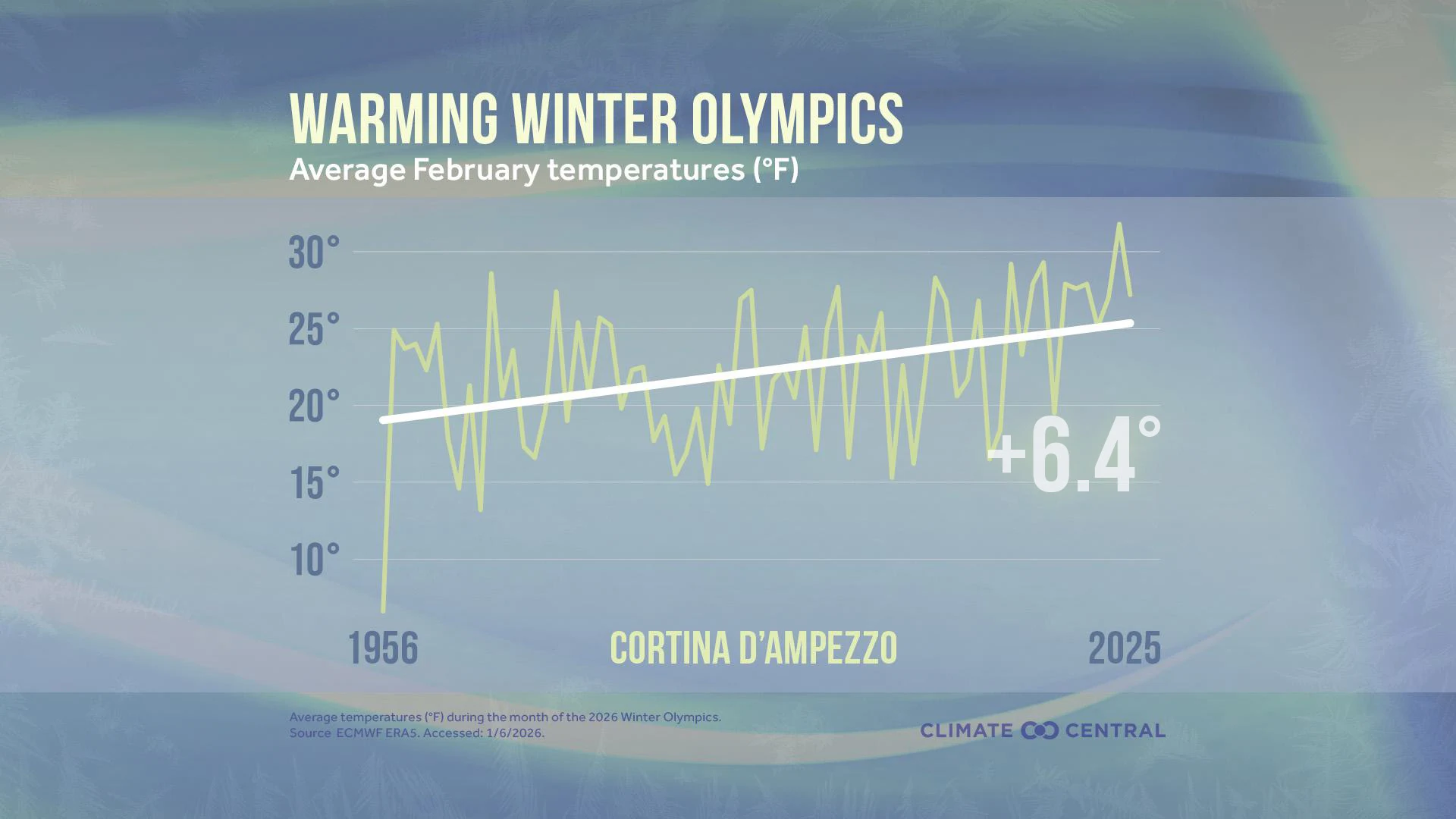 Click to download custom graphics Click the downloadable graphic: February Temperatures (1956-2025)](https://www.climatecentral.org/graphic/2026-warming-winter-olympics?graphicSet=February+Temperatures,+%C2%B0F+\(1956-2025\)&location=Cortina&lang=en)
[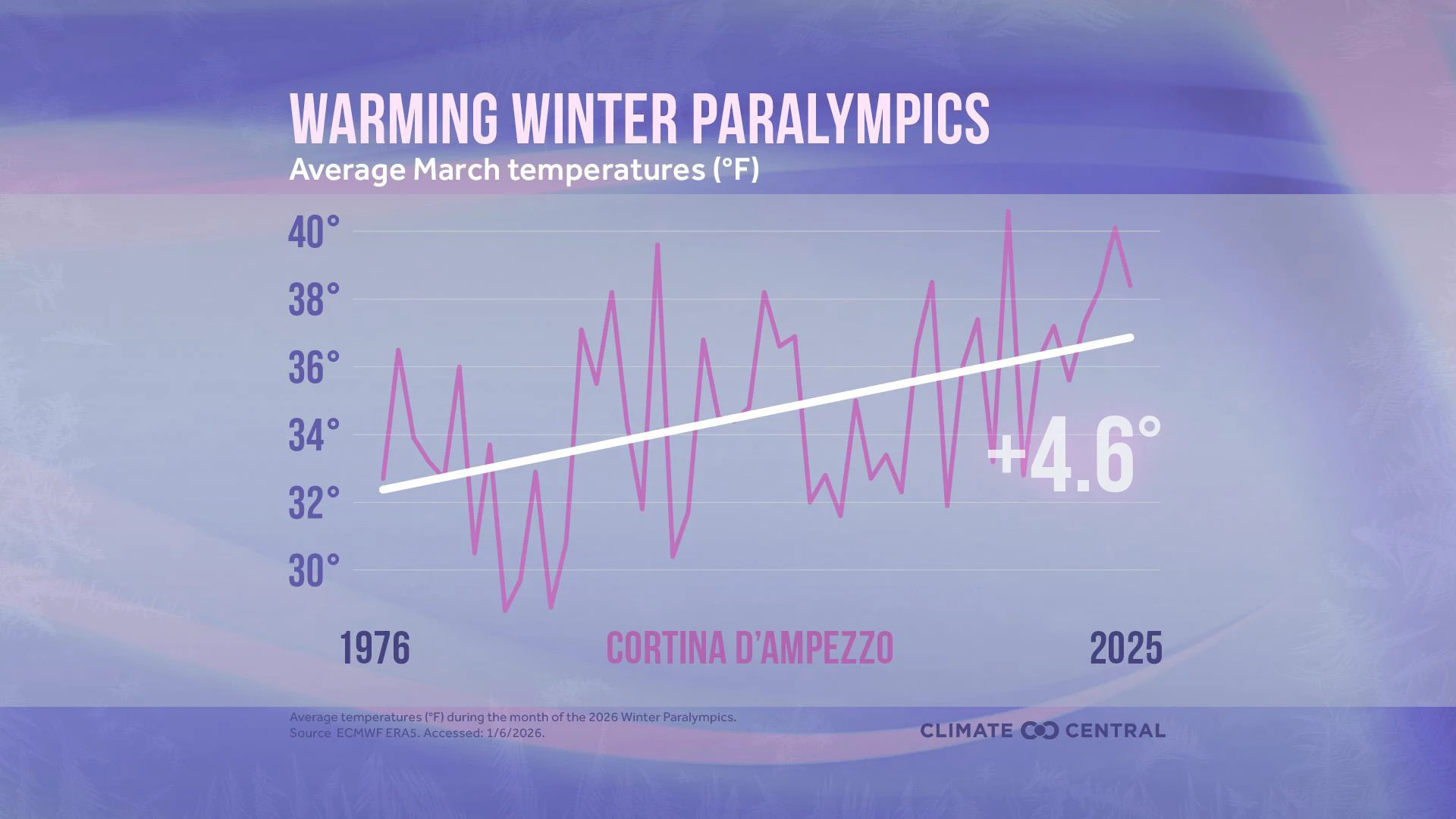 Click to download custom graphics Click the downloadable graphic: March Temperatures (1976-2025)](https://www.climatecentral.org/graphic/2026-warming-winter-olympics?graphicSet=March+Temperatures,+%C2%B0F+\(1976-2025\)&location=Cortina&lang=en)
[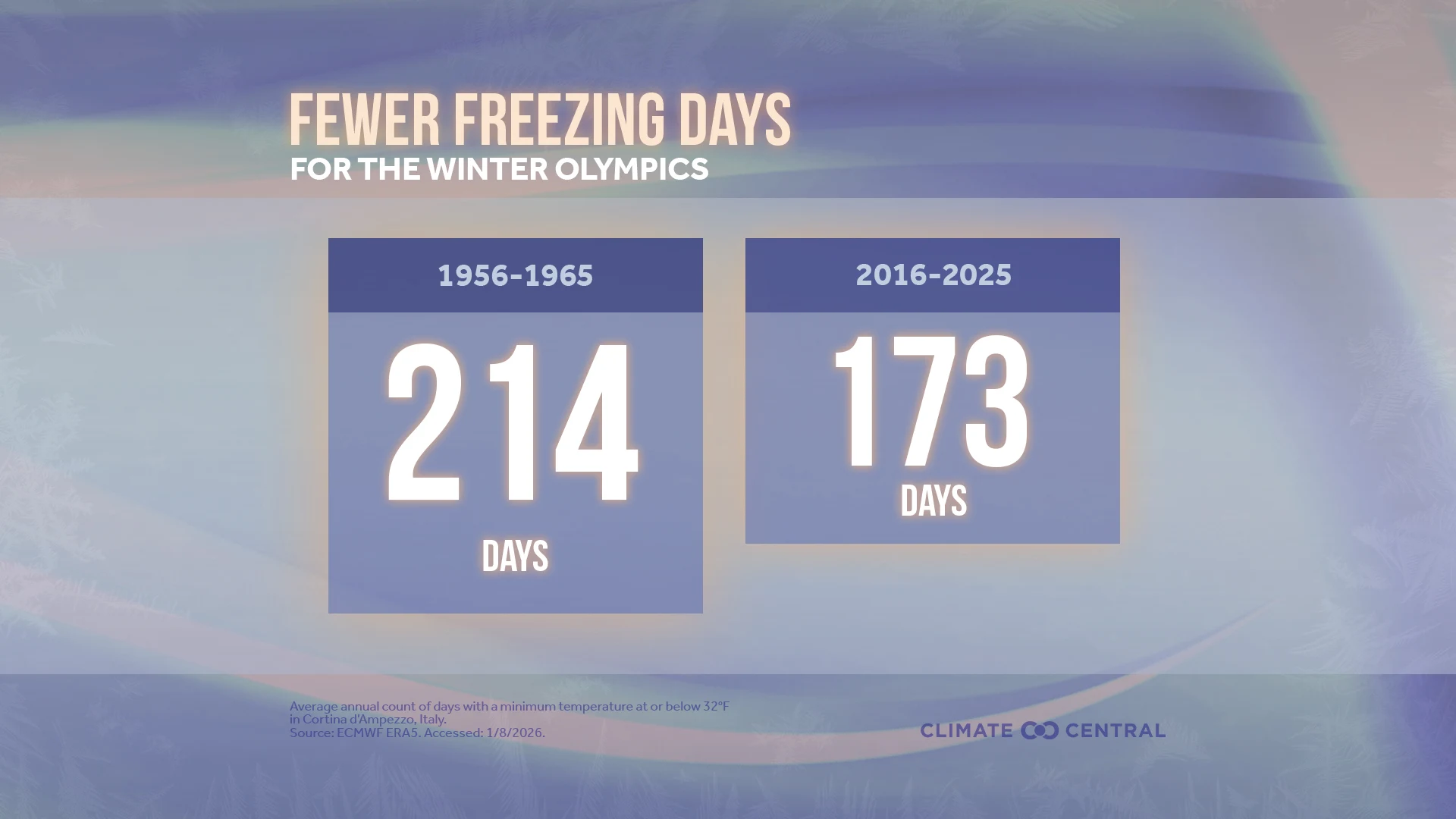 Click to download custom graphics Click the downloadable graphic: Freezing Days in Cortina d’Ampezzo](https://www.climatecentral.org/graphic/2026-warming-winter-olympics?graphicSet=Freezing+Days+in+Cortina+d%E2%80%99Ampezzo&location=global&lang=en)
[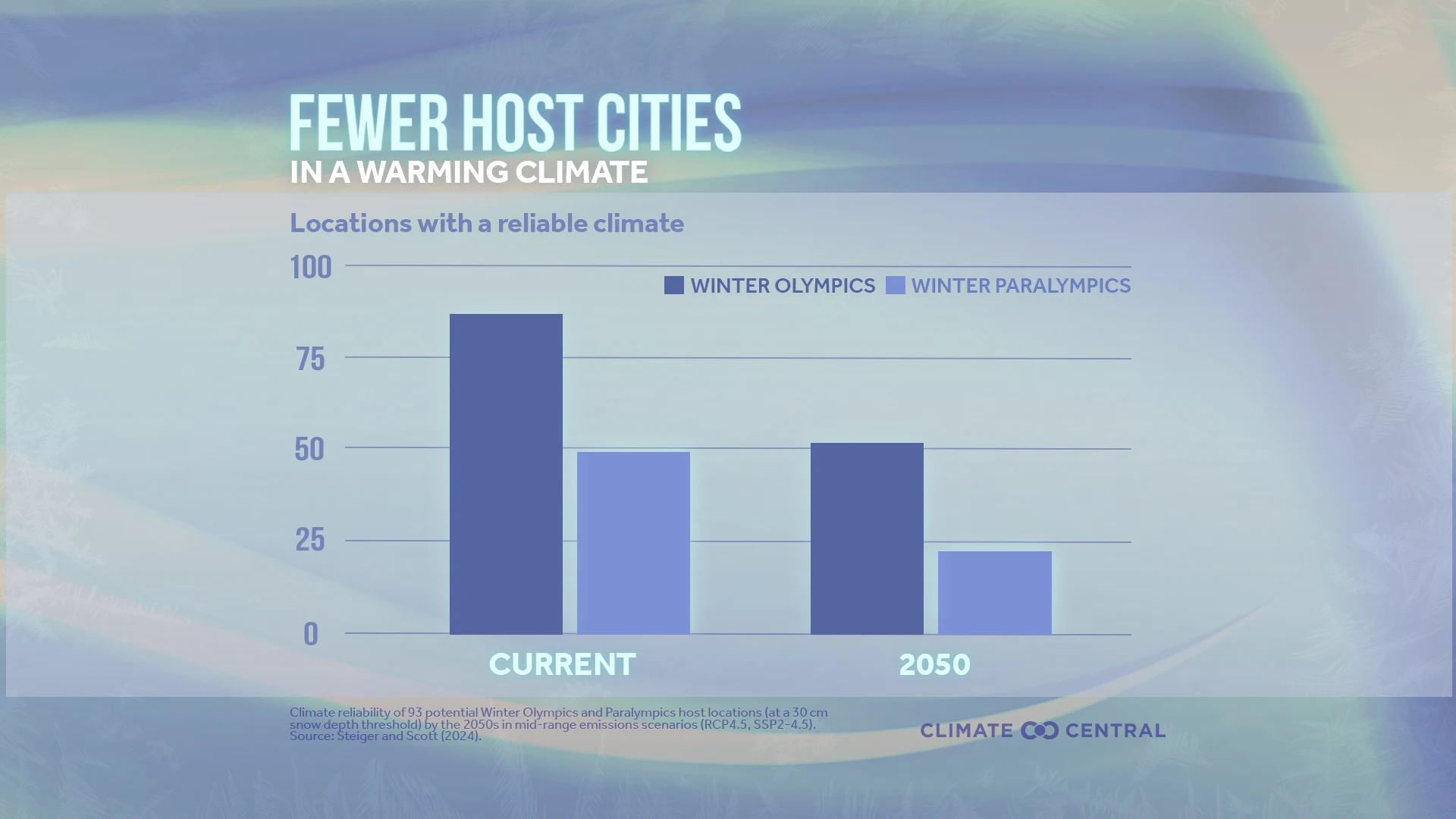 Click to download custom graphics Click the downloadable graphic: Climate Reliability of Host Cities](https://www.climatecentral.org/graphic/2026-warming-winter-olympics?graphicSet=Climate+Reliability+of+Host+Cities&location=global&lang=en)
[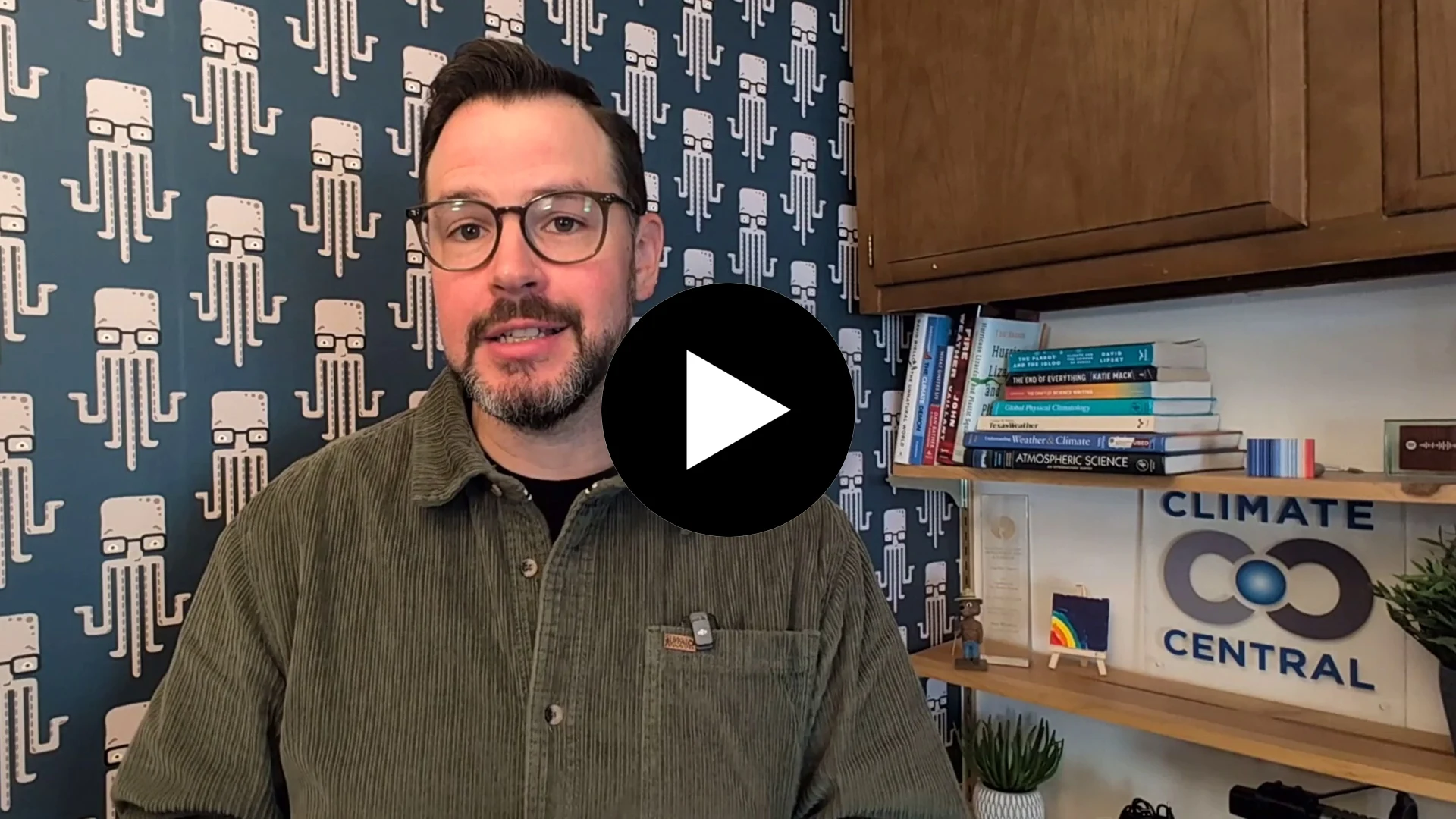 Click to download custom graphics Click the downloadable video: Warming Winter Olympics: Shel Winkley, Meteorlogist](https://www.climatecentral.org/graphic/2026-warming-winter-olympics?graphicSet=Winter+Olympics+Video&location=global&lang=en)
### KEY FACTS
- The 2026 Winter Olympics start on February 6 in Milan and Cortina d'Ampezzo, Italy. The Paralympic Winter Games will follow a month later.
- In the 70 years since Cortina first held the Winter Games in 1956, February temperatures in the northern Italian town have warmed 6.4°F (3.6°C).
- These warming trends have led to fewer freezes. Cortina d’Ampezzo now sees 41 (19%) fewer freezing days annually than when the Games were first held there in 1956.
- Milan and Cortina aren’t alone. All of the other cities to host the Winter Olympics since 1950 have warmed since then — threatening the reliability, safety, and fairness of outdoor winter sports competitions.
- The number of reliable host locations is dwindling as the planet warms. A recent study found that, out of 93 potential host sites, only 52 would have reliable conditions for the Winter Olympics in the 2050s.
- Due to being held in March, the Paralympic Winter Games face even greater risks — with only 22 (out of 93) climate-reliable locations in the 2050s.
### [**Download data**](https://climatecentral-web-assets.s3.us-east-1.amazonaws.com/2026WinterOlympics/2026WinterOlympics_DataDownload.xlsx)
[](https://youtu.be/k-mF-xzLsjU)
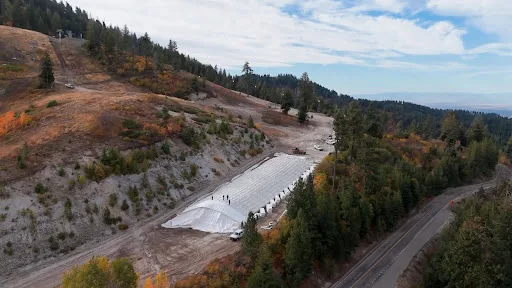
| **“I don’t think we’re going to see a Winter Olympic Games in Utah in 2034.” \-Rocky Anderson, Former Mayor of Salt Lake City**[Click to download](https://app.cimediacloud.com/r/V62kv6sf8hDh) this ready-to-air video, *The Giant "Snow Cooler": Storing Snow to Save the Ski Industry*. This fully produced news story can be used by media outlets at no cost for broadcasts, streaming, and digital stories. [Click here](https://app.cimediacloud.com/mediaboxes/ea923819d2264619956d28f7d48dee8d) for other available packages. |
|---|
#### Winter Olympics in a warming world
The [2026 Winter Olympics](https://www.olympics.com/en/milano-cortina-2026) kick off on February 6, followed by the Winter Paralympic Games on March 6. The Games will take place throughout Northern Italy, with most indoor events in Milan and most outdoor events centered around Cortina d'Ampezzo.
As the planet heats up, warmer winters threaten the reliability of the cold temperatures and abundant snow required for the Winter Olympics and other outdoor winter sports competitions.
Despite taking place in the high-altitude Italian Alps, centered around the town of Cortina, the 2026 Olympics will also require more than [3 million cubic yards of artificial snow](https://iol.co.za/sport/2025-12-01-milano-cortina-2026-winter-olympics-needs-artificial-snow-despite-altitude/).
With artificial snow becoming a [regular part](https://www.olympics.com/ioc/news/snow-climate-change-and-the-olympic-winter-games) of winter sports, the challenge of ensuring adequate conditions highlights the central role that the weather plays in the Winter Olympics and Paralympics — especially for the reliability and safety of outdoor competitions.
[ Click the downloadable graphic: February Temperatures (1956-2025)](https://www.climatecentral.org/graphic/2026-warming-winter-olympics?graphicSet=February+Temperatures,+%C2%B0F+\(1956-2025\)&location=Cortina&lang=en)
#### Hotter host cities
Cortina d’Ampezzo first hosted the Winter Olympic Games in 1956. In the 70 years since, February temperatures there have warmed 6.4°F (3.6°C).
- Rapid warming has pushed February average temperatures closer to the thawing point: 27.1°F during 2016-2025, compared with 19.3°F during 1956-1965.
- Studies show that average [February snow depth in Cortina has decreased](https://tc.copernicus.org/articles/15/1343/2021/tc-15-1343-2021.html) with warming — by [about 15 centimeters (6 inches)](https://clirsnow.netlify.app/dash-results/dash-past#mean-snow-depth-february) from 1971-2019.
February temperatures in Milan, which will host indoor ice sports including figure skating and ice hockey, warmed 5.8°F (3.2°C) over the same period.
The 2026 host cities aren’t alone. All of the cities to host the Winter Olympics since 1950 have warmed since then — by 4.8°F (2.7°C) on average, according to [earlier analysis](https://www.climatecentral.org/climate-matters/warming-winter-olympics) from Climate Central.
[ Click the downloadable graphic: March Temperatures (1976-2025)](https://www.climatecentral.org/graphic/2026-warming-winter-olympics?graphicSet=March+Temperatures,+%C2%B0F+\(1976-2025\)&location=Cortina&lang=en)
In the 50 years since the first Winter Paralympic Games was held in 1976, March temperatures in Cortina and Milan have warmed 4.6°F (2.5°C) and 3.9°F (2.1°C), respectively.
[ Click the downloadable graphic: Freezing Days in Cortina d’Ampezzo](https://www.climatecentral.org/graphic/2026-warming-winter-olympics?graphicSet=Freezing+Days+in+Cortina+d%E2%80%99Ampezzo&location=global&lang=en)
#### Fewer freezes — even in the Italian Alps
These warming trends have led to fewer freezes. During the decade following the 1956 Games, Cortina saw an average of 214 days when temperatures dipped below freezing each year.
That number dropped to 173 days with freezing temperatures during the last decade (2016-2025). That’s 41 (19%) fewer days annually than when the Games were first held in Cortina in 1956.
These warming trends can affect conditions during competitions. Without cold enough temperatures and sufficient snow on the ground, Olympic athletes may experience conditions like rain, wet snow, or low snow coverage.
Resistant and hard surfaces are required for elite competition to ensure fair and safe conditions for athletes. If surfaces cannot refreeze, the risk of injuries increases and athletes later in the start list are likely to experience less favorable conditions.
[ Click the downloadable graphic: Climate Reliability of Host Cities](https://www.climatecentral.org/graphic/2026-warming-winter-olympics?graphicSet=Climate+Reliability+of+Host+Cities&location=global&lang=en)
#### Fewer reliable Winter Olympics host cities
The future of the Winter Olympics — and the reliability, safety, and fairness of many outdoor winter sports competitions — is uncertain in a warming climate.
A [2024 study](https://www.tandfonline.com/doi/full/10.1080/13683500.2024.2403133?scroll=top&needAccess=true#abstract) assessed how climate change could impact Winter Olympics and Paralympics conditions at 93 previous and potential future host locations. The study focused on two key conditions influencing the reliability of safe and fair outdoor snow sports competitions: the probability of minimum daily temperatures at or below freezing, and the probability of minimum acceptable snow depths (at least 30 centimeters deep).
- Of the 93 potential host cities, 87 (or 94%) are currently rated as having reliable climate conditions for the Winter Olympics. But that count is set to decline sharply in the years ahead.
- By the 2050s, only 52 (or 56%) of the 93 potential Winter Olympics host cities would have reliable climate conditions in a mid-range future warming scenario that assumes global pledged commitments to reduce carbon pollution are met (RCP4.5 and SSP2-4.5).
#### Dwindling prospects for the Paralympics
The [same study](https://www.tandfonline.com/doi/full/10.1080/13683500.2024.2403133?scroll=top&needAccess=true#abstract) found that the Winter Paralympic Games could face even higher climate risks. Since 1992, the Paralympic Games have been held approximately one month after the Olympic Games in the same location — typically in March, when temperatures are warmer and the probability of rain instead of snow is higher than in February.
Projected [shorter Northern Hemisphere winters](https://agupubs.onlinelibrary.wiley.com/doi/10.1029/2020GL091753) by 2100 could put outdoor competitions in March even closer to spring thaw, raising concerns over reliable, safe and fair conditions for athletes competing in the Winter Paralympic Games.
- Of the 93 potential host cities, 49 (or 53%) of those sites are currently rated as having reliable conditions for the Winter Paralympic Games.
- By the 2050s, only 22 (or 24%) of the 93 potential host cities for the Paralympic Winter Games will still have reliable conditions by the 2050s in a mid-range future warming scenario.
- In a high-emissions scenario, the ability to hold the Paralympic Games in March is almost eliminated by the 2080s, when just four of the 93 potential hosts will have reliable climate conditions.
#### Competing with climate change: Snowboarding, skiing, bobsledding, and more
The first Winter Olympics was held in 1924. At that time, almost all events were held outdoors. But by the 1980s, sports like ice hockey, figure skating, speed skating, and curling were [moved indoors](https://www.globalhub.pitt.edu/blog/winter-olympics-and-climate-change) to refrigerated ice rinks.
For some of the most popular events that have remained outdoors, continued warming raises difficulties for athletes in competing and preparing for the Olympics. Indeed, 94% of the elite athletes and coaches surveyed in [a 2022 study](https://www.tandfonline.com/doi/full/10.1080/13683500.2021.2023480) were concerned that climate change will negatively impact the future of their sport.
Here are some ways that climate change is already affecting a few of the 16 official Winter Olympics sports:
- [**Olympic snowboarding**](https://www.olympics.com/en/sports/snowboard/) consists of some timed race events, as well as those like the halfpipe and slopestyle, where competitors are judged on the breadth, originality, and quality of their tricks. For snowboarders, snow availability impacts not only the Games themselves but viable training locations. Athletes are having to “[chase the snow](https://apnews.com/article/climate-change-olympics-skiing-snow-ski-mountaineering-winter-ab8d7eb676fbf96e7732a82c76e94a2d)” – abandoning their training grounds in search of areas with more abundant and reliable snow.
- [**Alpine skiing**](https://www.olympics.com/en/sports/alpine-skiing/), or downhill skiing, combines both speed and technique as athletes race against the clock through marked gates.The average ski season in the U.S. has already [shortened by up to a week](https://www.tandfonline.com/doi/full/10.1080/13683500.2024.2314700) relative to 1960–1979. Professional alpine ski events like the [PwC Tremblant World Cup](https://coupedumonde.tremblant.ca/en/cancellation-2024-tremblant-pwc-world-cup/) and the [Kandahar World Cup](https://www.espn.com/olympics/skiing/story/_/id/35419643/lack-snow-cancels-upcoming-world-cup-ski-races-germany) have recently suffered cancellations due to warm temperatures and lack of snow.
- [**Olympic bobsledding**](https://www.olympics.com/en/sports/bobsleigh/) is a high-speed race on an outdoor ice track. Each sled completes four timed runs, and the fastest total combined time determines the winner. Ideal bobsled conditions require temperatures that are freezing or below. Although Olympic bobsledding takes place outdoors, many tracks require [constant refrigeration](https://townlift.com/2024/10/utah-olympic-parks-bobsled-track-starts-ice-making/#:~:text=An%20on-site%20refrigeration%20plant%20pumps%20a%20specialized,working%20in%20sections%20to%20layer%20the%20ice.) in order to maintain those temperatures. While necessary to prevent melting, refrigeration creates frost which can [make the track slower](https://www.accuweather.com/en/weather-news/q-and-a-bobsled-expert-explains-how-weather-affects-sliding-events-at-the-winter-olympics/352372), presenting fairness concerns for athletes.
### LOCAL STORY ANGLES
#### What’s the forecast for the 2026 Games?
Long-range forecasts are predicting the location of the 2026 Games to have a [50-60% chance](https://charts.ecmwf.int/products/seasonal_system5_standard_2mtm?area=GLOB&base_time=202601010000&stats=tsum&valid_time=202602010000) of above average temperatures in February and a [60-70% chance](https://charts.ecmwf.int/products/seasonal_system5_standard_2mtm?area=GLOB&base_time=202601010000&stats=tsum&valid_time=202603040000) in March.
#### How will climate change affect winter conditions in different regions?
The Intergovernmental Panel on Climate Change (IPCC)’s [interactive atlas](https://interactive-atlas.ipcc.ch/permalink/6c4WMpIw) allows users to explore the future of winter conditions across the globe by region. Check out this [dashboard](https://clirsnow.netlify.app/dash-results/dash-past#station-time-series) from Eurac Research containing snow depth trends for areas in the European Alps from 1971-2019.
#### How are the Olympics addressing climate change?
[Milano Cortina 2026](https://www.olympics.com/ioc/milano-cortina-2026) provides a general summary of the upcoming games, including its [sustainability](https://www.olympics.com/ioc/sustainability) initiatives. The International Olympic Committee [announced](https://olympics.com/ioc/news/olympic-games-to-become-climate-positive-from-2030) in 2020 that the Olympic Games and Olympic Winter Games will be “climate positive” from 2030.
#### How are local businesses, including outdoor retail shops, manufacturers, and recreation centers like ski areas responding to climate change?
Check the economic impact of outdoor recreation on your state’s gross domestic product with the [Bureau of Economic Analysis](https://www.bea.gov/data/special-topics/outdoor-recreation). The Outdoor Industry Association also publishes [data](https://outdoorindustry.org/advocacy/) on jobs and consumer spending at a state level. Climate change has also [consolidated](https://www.tandfonline.com/doi/full/10.1080/13683500.2017.1410110) the ski industry in some regions, shuttering smaller resorts. Learn what [ski areas](https://www.nsaa.org/NSAA/Sustainability/Climate_Change/NSAA/Sustainability/Climate_Change.aspx?hkey=a9a435c0-411c-4d11-86e3-00b15bdefaae) and the [winter outdoor industry](https://snowsports.org/climateunited/) in your region are doing to cut their carbon emissions.
### CONTACT EXPERTS
**Daniel Scott, PhD** Professor
Department of Geography and Environmental Management, University of Waterloo
**Relevant expertise:** Climate change and tourism/recreation, climate change impacts and adaptation
**Contact:** [daniel.scott@uwaterloo.ca](mailto:daniel.scott@uwaterloo.ca)
### FIND EXPERTS
***Submit a request*** to [SciLine](https://www.sciline.org/i-need-an-expert-now/) from the American Association for the Advancement of Science or to the [Climate Data Concierge](https://concierge.iri.columbia.edu/) from Columbia University. These free services rapidly connect journalists to relevant scientific experts.
***Browse maps*** of [climate experts and services](https://toolkit.climate.gov/help/partners) at regional NOAA, USDA, and Department of the Interior offices.
***Explore*** ***databases*** such as [500 Women Scientists](https://gage.500womenscientists.org/), [BIPOC Climate and Energy Justice PhDs](https://www.climate.donorsofcolor.org/bipoc-phds), and [Diverse Sources](https://diversesources.org/) to find and amplify diverse expert voices.
***Reach out*** to your [State Climate Office](https://stateclimate.org/state_programs/) or the nearest [Land-Grant University](https://nifa.usda.gov/land-grant-colleges-and-universities-partner-website-directory) to connect with scientists, educators, and extension staff in your local area.
### METHODOLOGY
Average February temperatures (aligning with the 2026 Winter Olympics: February 6-22) and average March temperatures (aligning with the 2026 Winter Paralympic Games: March 6-15) for the main 2026 host locations (Milan and Cortina d’Ampezzo, Italy) were calculated using [ECMWF ERA5](https://www.ecmwf.int/en/forecasts/dataset/ecmwf-reanalysis-v5) reanalysis gridded temperature data. Data was extracted from the grid cells containing the two host locations. Trends in February and March average temperatures at each site were computed using linear regression. This represents the change in mean conditions over the period 1956-2025 (years since Cortina d’Ampezzo first hosted the Winter Olympics) and 1976-2025 (years since the first Winter Paralympic Games were held).
The average annual number of freezing days (days with at least one hour of temperatures at/below 32°F) in Cortina d’Ampezzo (the main location for outdoor snow sports during the 2026 Games) were calculated for the 1956-1965 and 2016-2025 decades.
[Climate Matters](https://www.climatecentral.org/climate-matters) © 2026 by [Climate Central](https://www.climatecentral.org/) is licensed under [CC BY 4.0](https://creativecommons.org/licenses/by/4.0/)
This license grants permission to use, distribute, and reproduce all text, graphics, and multimedia content published on this page in any medium, provided that Climate Central is credited per the [CC BY 4.0](https://creativecommons.org/licenses/by/4.0/) license.
Permission to use data and other materials published on this page is granted for non-commercial uses, commercial news purposes, and educational purposes as governed by Climate Central's [Terms of Use](https://www.climatecentral.org/what-we-do/legal).
### Custom email signup
Get updates, media alerts, and climate reporting resources
[Sign up](https://www.climatecentral.org/list-signup)
### Support our work
There are lots of ways to help fund Climate Central today
[Learn more](https://www.climatecentral.org/donate)

- [Contact Us](https://www.climatecentral.org/contact)
- [Careers](https://www.climatecentral.org/what-we-do/jobs)
- [Donate](https://www.climatecentral.org/donate)
- [Financials](https://www.climatecentral.org/financials)
- [Instagram](https://www.instagram.com/climatecentral/?hl=en)
- [Facebook](https://www.facebook.com/climatecentral)
- [X](https://twitter.com/ClimateCentral)
- [YouTube](https://www.youtube.com/channel/UCYDMc5bimX8L-C8XebruFzg)
- [LinkedIn](https://www.linkedin.com/company/climate-central)
- [Bluesky](https://bsky.app/profile/did:plc:rvso2itxklrx7kn5qrwtkuy6)
Copyright © 2025 Climate Central
Registered 501(c)(3). EIN: 26-1797336
- [Terms of use](https://www.climatecentral.org/what-we-do/legal)
- [Privacy policy](https://www.climatecentral.org/privacy-policy)
- [Editorial independence](https://www.climatecentral.org/editorial-independence-policy)
[](https://www.contentful.com/)
## Related Resources
[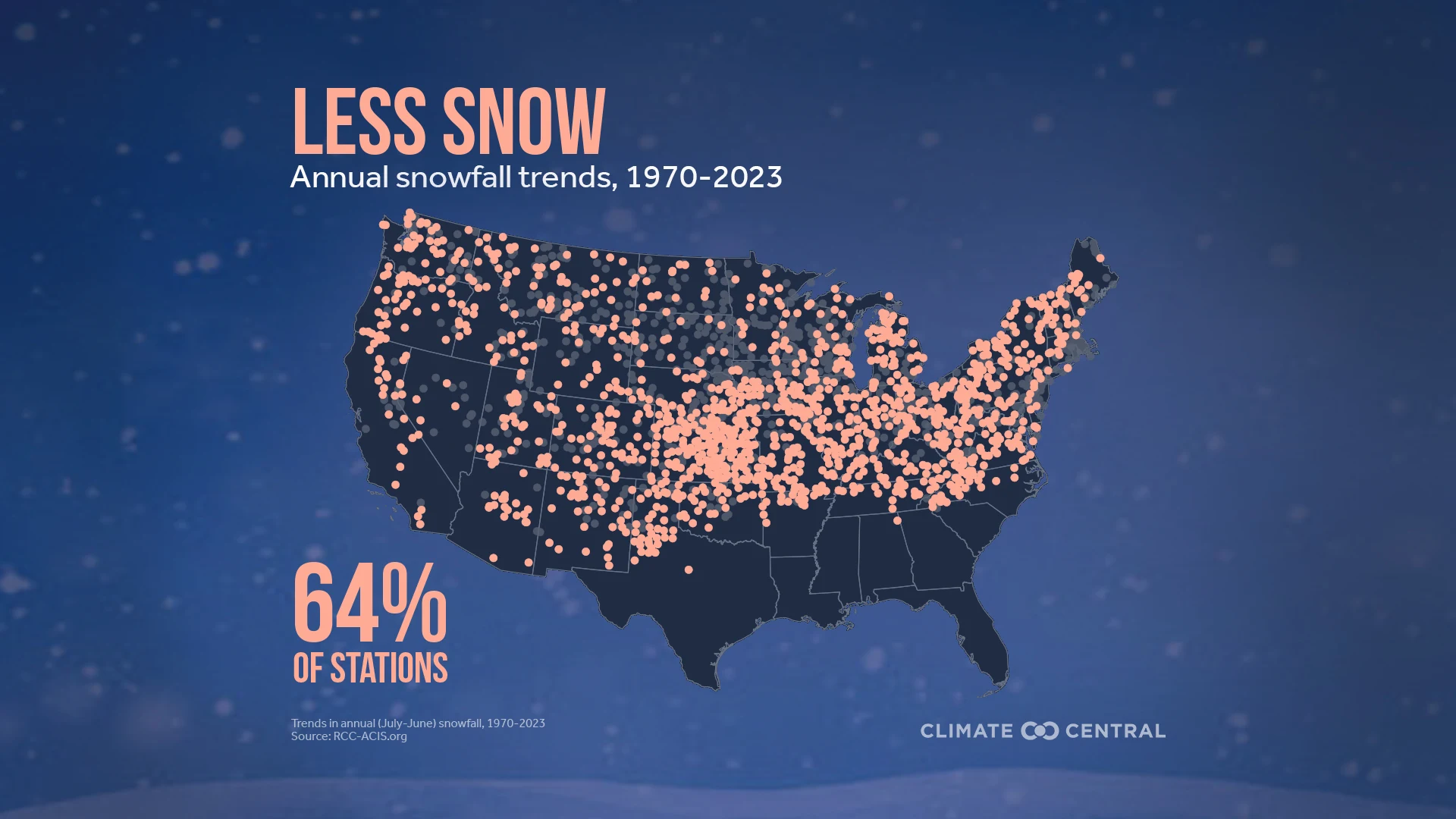 Climate Matters Snowfall Trends Snow keeps our planet cooler, feeds water supplies, and underpins regional economies and cultures. Here’s how snow is changing across the U.S. with our warming climate.](https://www.climatecentral.org/climate-matters/snowfall-trends-2024)
[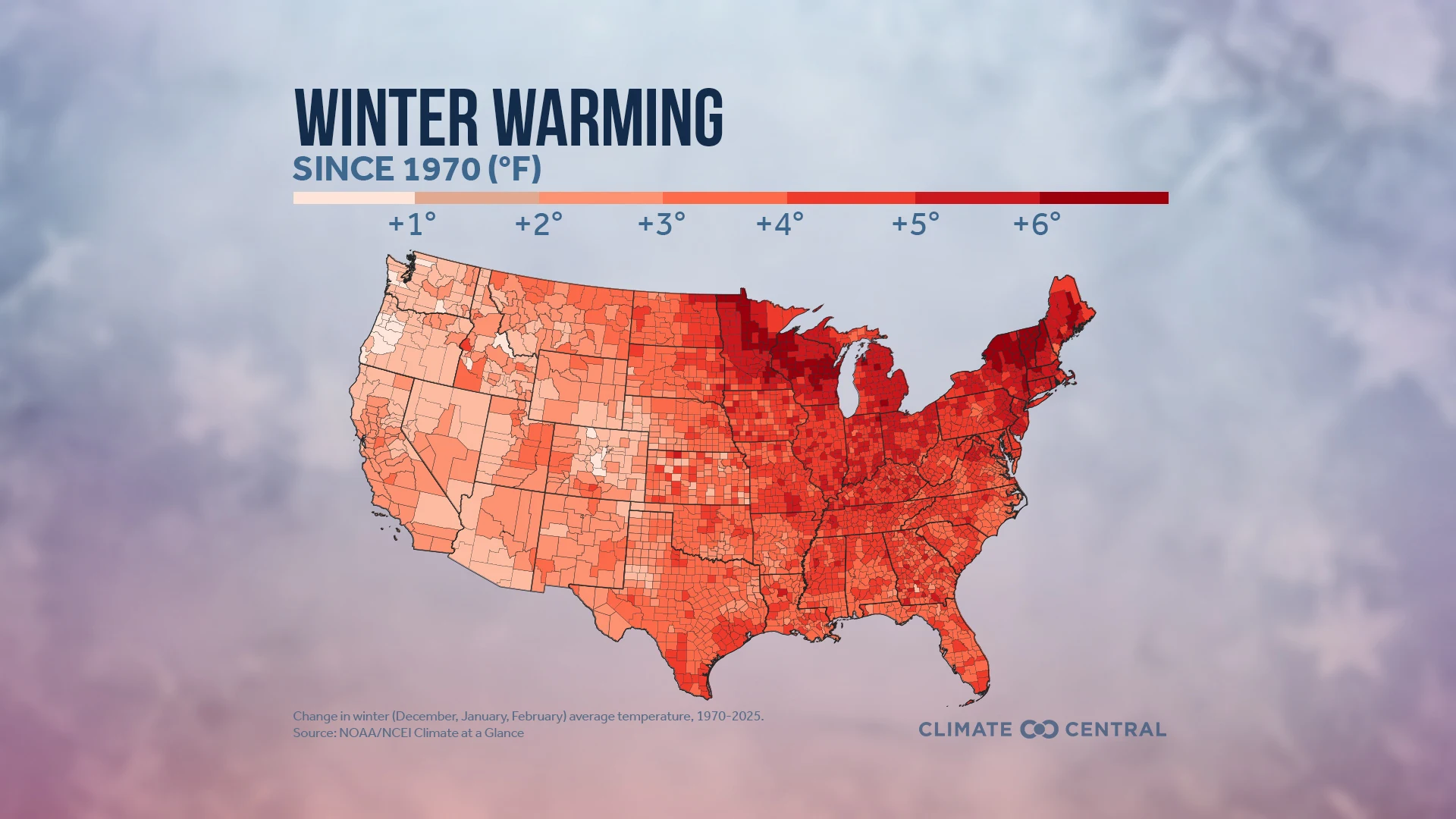 Climate Matters 2025 Winter Package Winters have warmed by 3.9°F on average across 239 U.S. cities since 1970. Warmer, shorter winters have lingering effects on health, water supplies, and agriculture throughout the year.](https://www.climatecentral.org/climate-matters/2025-winter-package)
[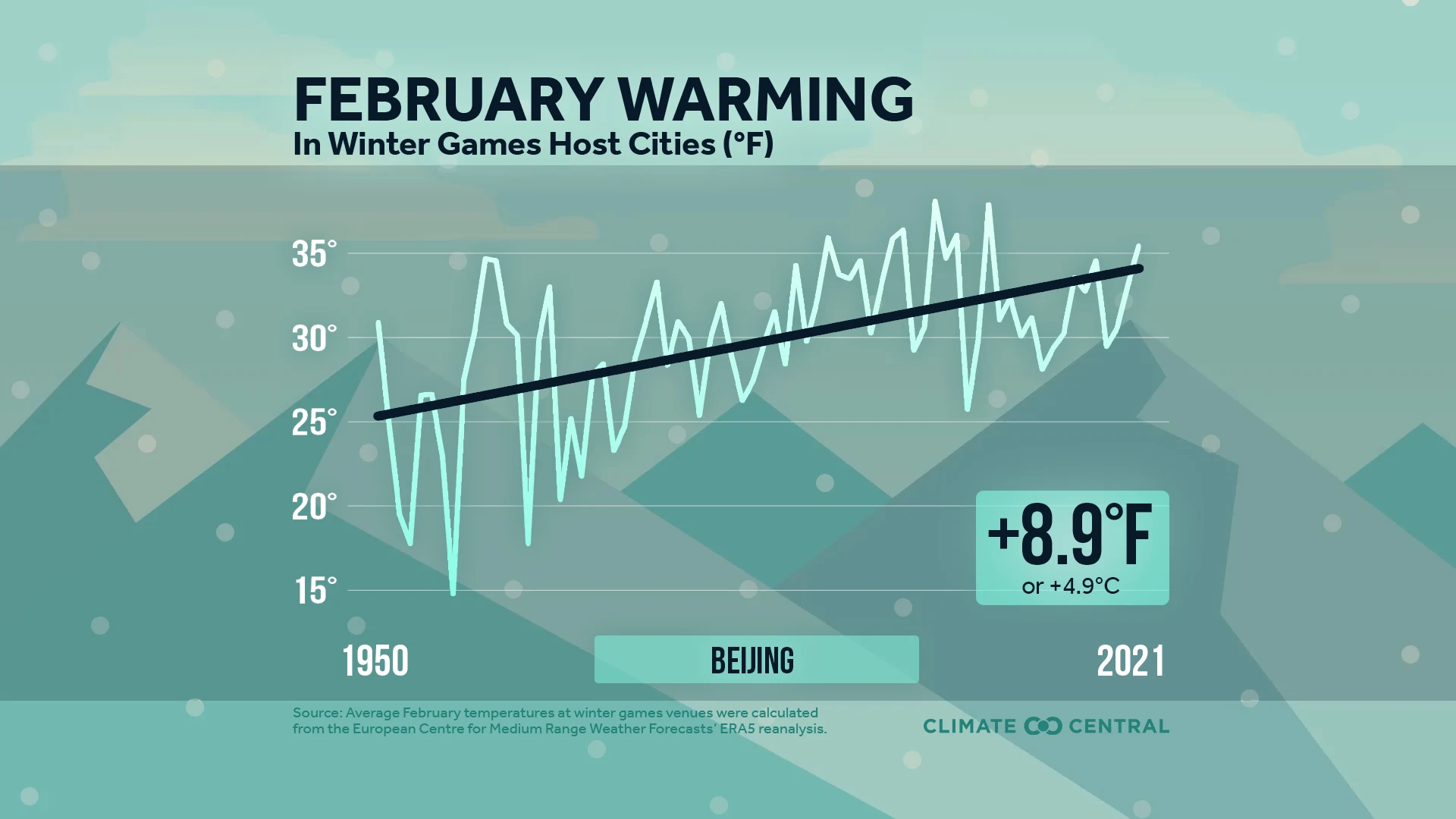 Climate Matters Warming Winter Olympics As the 2022 Winter Olympic Games begin in Beijing, we look at the historical warming trends and future suitability of previous host cities in a warming world.](https://www.climatecentral.org/climate-matters/warming-winter-olympics) |
| Readable Markdown | enes
Climate Matters•January 21, 2026•[Reuse this content](https://www.climatecentral.org/climate-matters/2026-warming-winter-olympics#cm-license)
### KEY FACTS
- The 2026 Winter Olympics start on February 6 in Milan and Cortina d'Ampezzo, Italy. The Paralympic Winter Games will follow a month later.
- In the 70 years since Cortina first held the Winter Games in 1956, February temperatures in the northern Italian town have warmed 6.4°F (3.6°C).
- These warming trends have led to fewer freezes. Cortina d’Ampezzo now sees 41 (19%) fewer freezing days annually than when the Games were first held there in 1956.
- Milan and Cortina aren’t alone. All of the other cities to host the Winter Olympics since 1950 have warmed since then — threatening the reliability, safety, and fairness of outdoor winter sports competitions.
- The number of reliable host locations is dwindling as the planet warms. A recent study found that, out of 93 potential host sites, only 52 would have reliable conditions for the Winter Olympics in the 2050s.
- Due to being held in March, the Paralympic Winter Games face even greater risks — with only 22 (out of 93) climate-reliable locations in the 2050s.
### [**Download data**](https://climatecentral-web-assets.s3.us-east-1.amazonaws.com/2026WinterOlympics/2026WinterOlympics_DataDownload.xlsx)
[](https://youtu.be/k-mF-xzLsjU)
| **“I don’t think we’re going to see a Winter Olympic Games in Utah in 2034.” \-Rocky Anderson, Former Mayor of Salt Lake City**[Click to download](https://app.cimediacloud.com/r/V62kv6sf8hDh) this ready-to-air video, *The Giant "Snow Cooler": Storing Snow to Save the Ski Industry*. This fully produced news story can be used by media outlets at no cost for broadcasts, streaming, and digital stories. [Click here](https://app.cimediacloud.com/mediaboxes/ea923819d2264619956d28f7d48dee8d) for other available packages. |
|---|
#### Winter Olympics in a warming world
The [2026 Winter Olympics](https://www.olympics.com/en/milano-cortina-2026) kick off on February 6, followed by the Winter Paralympic Games on March 6. The Games will take place throughout Northern Italy, with most indoor events in Milan and most outdoor events centered around Cortina d'Ampezzo.
As the planet heats up, warmer winters threaten the reliability of the cold temperatures and abundant snow required for the Winter Olympics and other outdoor winter sports competitions.
Despite taking place in the high-altitude Italian Alps, centered around the town of Cortina, the 2026 Olympics will also require more than [3 million cubic yards of artificial snow](https://iol.co.za/sport/2025-12-01-milano-cortina-2026-winter-olympics-needs-artificial-snow-despite-altitude/).
With artificial snow becoming a [regular part](https://www.olympics.com/ioc/news/snow-climate-change-and-the-olympic-winter-games) of winter sports, the challenge of ensuring adequate conditions highlights the central role that the weather plays in the Winter Olympics and Paralympics — especially for the reliability and safety of outdoor competitions.
[ Click the downloadable graphic: February Temperatures (1956-2025)](https://www.climatecentral.org/graphic/2026-warming-winter-olympics?graphicSet=February+Temperatures,+%C2%B0F+\(1956-2025\)&location=Cortina&lang=en)
#### Hotter host cities
Cortina d’Ampezzo first hosted the Winter Olympic Games in 1956. In the 70 years since, February temperatures there have warmed 6.4°F (3.6°C).
- Rapid warming has pushed February average temperatures closer to the thawing point: 27.1°F during 2016-2025, compared with 19.3°F during 1956-1965.
- Studies show that average [February snow depth in Cortina has decreased](https://tc.copernicus.org/articles/15/1343/2021/tc-15-1343-2021.html) with warming — by [about 15 centimeters (6 inches)](https://clirsnow.netlify.app/dash-results/dash-past#mean-snow-depth-february) from 1971-2019.
February temperatures in Milan, which will host indoor ice sports including figure skating and ice hockey, warmed 5.8°F (3.2°C) over the same period.
The 2026 host cities aren’t alone. All of the cities to host the Winter Olympics since 1950 have warmed since then — by 4.8°F (2.7°C) on average, according to [earlier analysis](https://www.climatecentral.org/climate-matters/warming-winter-olympics) from Climate Central.
[ Click the downloadable graphic: March Temperatures (1976-2025)](https://www.climatecentral.org/graphic/2026-warming-winter-olympics?graphicSet=March+Temperatures,+%C2%B0F+\(1976-2025\)&location=Cortina&lang=en)
In the 50 years since the first Winter Paralympic Games was held in 1976, March temperatures in Cortina and Milan have warmed 4.6°F (2.5°C) and 3.9°F (2.1°C), respectively.
[ Click the downloadable graphic: Freezing Days in Cortina d’Ampezzo](https://www.climatecentral.org/graphic/2026-warming-winter-olympics?graphicSet=Freezing+Days+in+Cortina+d%E2%80%99Ampezzo&location=global&lang=en)
#### Fewer freezes — even in the Italian Alps
These warming trends have led to fewer freezes. During the decade following the 1956 Games, Cortina saw an average of 214 days when temperatures dipped below freezing each year.
That number dropped to 173 days with freezing temperatures during the last decade (2016-2025). That’s 41 (19%) fewer days annually than when the Games were first held in Cortina in 1956.
These warming trends can affect conditions during competitions. Without cold enough temperatures and sufficient snow on the ground, Olympic athletes may experience conditions like rain, wet snow, or low snow coverage.
Resistant and hard surfaces are required for elite competition to ensure fair and safe conditions for athletes. If surfaces cannot refreeze, the risk of injuries increases and athletes later in the start list are likely to experience less favorable conditions.
[ Click the downloadable graphic: Climate Reliability of Host Cities](https://www.climatecentral.org/graphic/2026-warming-winter-olympics?graphicSet=Climate+Reliability+of+Host+Cities&location=global&lang=en)
#### Fewer reliable Winter Olympics host cities
The future of the Winter Olympics — and the reliability, safety, and fairness of many outdoor winter sports competitions — is uncertain in a warming climate.
A [2024 study](https://www.tandfonline.com/doi/full/10.1080/13683500.2024.2403133?scroll=top&needAccess=true#abstract) assessed how climate change could impact Winter Olympics and Paralympics conditions at 93 previous and potential future host locations. The study focused on two key conditions influencing the reliability of safe and fair outdoor snow sports competitions: the probability of minimum daily temperatures at or below freezing, and the probability of minimum acceptable snow depths (at least 30 centimeters deep).
- Of the 93 potential host cities, 87 (or 94%) are currently rated as having reliable climate conditions for the Winter Olympics. But that count is set to decline sharply in the years ahead.
- By the 2050s, only 52 (or 56%) of the 93 potential Winter Olympics host cities would have reliable climate conditions in a mid-range future warming scenario that assumes global pledged commitments to reduce carbon pollution are met (RCP4.5 and SSP2-4.5).
#### Dwindling prospects for the Paralympics
The [same study](https://www.tandfonline.com/doi/full/10.1080/13683500.2024.2403133?scroll=top&needAccess=true#abstract) found that the Winter Paralympic Games could face even higher climate risks. Since 1992, the Paralympic Games have been held approximately one month after the Olympic Games in the same location — typically in March, when temperatures are warmer and the probability of rain instead of snow is higher than in February.
Projected [shorter Northern Hemisphere winters](https://agupubs.onlinelibrary.wiley.com/doi/10.1029/2020GL091753) by 2100 could put outdoor competitions in March even closer to spring thaw, raising concerns over reliable, safe and fair conditions for athletes competing in the Winter Paralympic Games.
- Of the 93 potential host cities, 49 (or 53%) of those sites are currently rated as having reliable conditions for the Winter Paralympic Games.
- By the 2050s, only 22 (or 24%) of the 93 potential host cities for the Paralympic Winter Games will still have reliable conditions by the 2050s in a mid-range future warming scenario.
- In a high-emissions scenario, the ability to hold the Paralympic Games in March is almost eliminated by the 2080s, when just four of the 93 potential hosts will have reliable climate conditions.
#### Competing with climate change: Snowboarding, skiing, bobsledding, and more
The first Winter Olympics was held in 1924. At that time, almost all events were held outdoors. But by the 1980s, sports like ice hockey, figure skating, speed skating, and curling were [moved indoors](https://www.globalhub.pitt.edu/blog/winter-olympics-and-climate-change) to refrigerated ice rinks.
For some of the most popular events that have remained outdoors, continued warming raises difficulties for athletes in competing and preparing for the Olympics. Indeed, 94% of the elite athletes and coaches surveyed in [a 2022 study](https://www.tandfonline.com/doi/full/10.1080/13683500.2021.2023480) were concerned that climate change will negatively impact the future of their sport.
Here are some ways that climate change is already affecting a few of the 16 official Winter Olympics sports:
- [**Olympic snowboarding**](https://www.olympics.com/en/sports/snowboard/) consists of some timed race events, as well as those like the halfpipe and slopestyle, where competitors are judged on the breadth, originality, and quality of their tricks. For snowboarders, snow availability impacts not only the Games themselves but viable training locations. Athletes are having to “[chase the snow](https://apnews.com/article/climate-change-olympics-skiing-snow-ski-mountaineering-winter-ab8d7eb676fbf96e7732a82c76e94a2d)” – abandoning their training grounds in search of areas with more abundant and reliable snow.
- [**Alpine skiing**](https://www.olympics.com/en/sports/alpine-skiing/), or downhill skiing, combines both speed and technique as athletes race against the clock through marked gates.The average ski season in the U.S. has already [shortened by up to a week](https://www.tandfonline.com/doi/full/10.1080/13683500.2024.2314700) relative to 1960–1979. Professional alpine ski events like the [PwC Tremblant World Cup](https://coupedumonde.tremblant.ca/en/cancellation-2024-tremblant-pwc-world-cup/) and the [Kandahar World Cup](https://www.espn.com/olympics/skiing/story/_/id/35419643/lack-snow-cancels-upcoming-world-cup-ski-races-germany) have recently suffered cancellations due to warm temperatures and lack of snow.
- [**Olympic bobsledding**](https://www.olympics.com/en/sports/bobsleigh/) is a high-speed race on an outdoor ice track. Each sled completes four timed runs, and the fastest total combined time determines the winner. Ideal bobsled conditions require temperatures that are freezing or below. Although Olympic bobsledding takes place outdoors, many tracks require [constant refrigeration](https://townlift.com/2024/10/utah-olympic-parks-bobsled-track-starts-ice-making/#:~:text=An%20on-site%20refrigeration%20plant%20pumps%20a%20specialized,working%20in%20sections%20to%20layer%20the%20ice.) in order to maintain those temperatures. While necessary to prevent melting, refrigeration creates frost which can [make the track slower](https://www.accuweather.com/en/weather-news/q-and-a-bobsled-expert-explains-how-weather-affects-sliding-events-at-the-winter-olympics/352372), presenting fairness concerns for athletes.
### LOCAL STORY ANGLES
#### What’s the forecast for the 2026 Games?
Long-range forecasts are predicting the location of the 2026 Games to have a [50-60% chance](https://charts.ecmwf.int/products/seasonal_system5_standard_2mtm?area=GLOB&base_time=202601010000&stats=tsum&valid_time=202602010000) of above average temperatures in February and a [60-70% chance](https://charts.ecmwf.int/products/seasonal_system5_standard_2mtm?area=GLOB&base_time=202601010000&stats=tsum&valid_time=202603040000) in March.
#### How will climate change affect winter conditions in different regions?
The Intergovernmental Panel on Climate Change (IPCC)’s [interactive atlas](https://interactive-atlas.ipcc.ch/permalink/6c4WMpIw) allows users to explore the future of winter conditions across the globe by region. Check out this [dashboard](https://clirsnow.netlify.app/dash-results/dash-past#station-time-series) from Eurac Research containing snow depth trends for areas in the European Alps from 1971-2019.
#### How are the Olympics addressing climate change?
[Milano Cortina 2026](https://www.olympics.com/ioc/milano-cortina-2026) provides a general summary of the upcoming games, including its [sustainability](https://www.olympics.com/ioc/sustainability) initiatives. The International Olympic Committee [announced](https://olympics.com/ioc/news/olympic-games-to-become-climate-positive-from-2030) in 2020 that the Olympic Games and Olympic Winter Games will be “climate positive” from 2030.
#### How are local businesses, including outdoor retail shops, manufacturers, and recreation centers like ski areas responding to climate change?
Check the economic impact of outdoor recreation on your state’s gross domestic product with the [Bureau of Economic Analysis](https://www.bea.gov/data/special-topics/outdoor-recreation). The Outdoor Industry Association also publishes [data](https://outdoorindustry.org/advocacy/) on jobs and consumer spending at a state level. Climate change has also [consolidated](https://www.tandfonline.com/doi/full/10.1080/13683500.2017.1410110) the ski industry in some regions, shuttering smaller resorts. Learn what [ski areas](https://www.nsaa.org/NSAA/Sustainability/Climate_Change/NSAA/Sustainability/Climate_Change.aspx?hkey=a9a435c0-411c-4d11-86e3-00b15bdefaae) and the [winter outdoor industry](https://snowsports.org/climateunited/) in your region are doing to cut their carbon emissions.
### CONTACT EXPERTS
**Daniel Scott, PhD** Professor
Department of Geography and Environmental Management, University of Waterloo
**Relevant expertise:** Climate change and tourism/recreation, climate change impacts and adaptation
**Contact:** [daniel.scott@uwaterloo.ca](mailto:daniel.scott@uwaterloo.ca)
### FIND EXPERTS
***Submit a request*** to [SciLine](https://www.sciline.org/i-need-an-expert-now/) from the American Association for the Advancement of Science or to the [Climate Data Concierge](https://concierge.iri.columbia.edu/) from Columbia University. These free services rapidly connect journalists to relevant scientific experts.
***Browse maps*** of [climate experts and services](https://toolkit.climate.gov/help/partners) at regional NOAA, USDA, and Department of the Interior offices.
***Explore*** ***databases*** such as [500 Women Scientists](https://gage.500womenscientists.org/), [BIPOC Climate and Energy Justice PhDs](https://www.climate.donorsofcolor.org/bipoc-phds), and [Diverse Sources](https://diversesources.org/) to find and amplify diverse expert voices.
***Reach out*** to your [State Climate Office](https://stateclimate.org/state_programs/) or the nearest [Land-Grant University](https://nifa.usda.gov/land-grant-colleges-and-universities-partner-website-directory) to connect with scientists, educators, and extension staff in your local area.
### METHODOLOGY
Average February temperatures (aligning with the 2026 Winter Olympics: February 6-22) and average March temperatures (aligning with the 2026 Winter Paralympic Games: March 6-15) for the main 2026 host locations (Milan and Cortina d’Ampezzo, Italy) were calculated using [ECMWF ERA5](https://www.ecmwf.int/en/forecasts/dataset/ecmwf-reanalysis-v5) reanalysis gridded temperature data. Data was extracted from the grid cells containing the two host locations. Trends in February and March average temperatures at each site were computed using linear regression. This represents the change in mean conditions over the period 1956-2025 (years since Cortina d’Ampezzo first hosted the Winter Olympics) and 1976-2025 (years since the first Winter Paralympic Games were held).
The average annual number of freezing days (days with at least one hour of temperatures at/below 32°F) in Cortina d’Ampezzo (the main location for outdoor snow sports during the 2026 Games) were calculated for the 1956-1965 and 2016-2025 decades.
[Climate Matters](https://www.climatecentral.org/climate-matters) © 2026 by [Climate Central](https://www.climatecentral.org/) is licensed under [CC BY 4.0](https://creativecommons.org/licenses/by/4.0/)
This license grants permission to use, distribute, and reproduce all text, graphics, and multimedia content published on this page in any medium, provided that Climate Central is credited per the [CC BY 4.0](https://creativecommons.org/licenses/by/4.0/) license.
Permission to use data and other materials published on this page is granted for non-commercial uses, commercial news purposes, and educational purposes as governed by Climate Central's [Terms of Use](https://www.climatecentral.org/what-we-do/legal). |
| Shard | 127 (laksa) |
| Root Hash | 1433908275095867327 |
| Unparsed URL | org,climatecentral!www,/climate-matters/2026-warming-winter-olympics s443 |