ℹ️ Skipped - page is already crawled
| Filter | Status | Condition | Details |
|---|---|---|---|
| HTTP status | PASS | download_http_code = 200 | HTTP 200 |
| Age cutoff | PASS | download_stamp > now() - 6 MONTH | 0.1 months ago |
| History drop | PASS | isNull(history_drop_reason) | No drop reason |
| Spam/ban | PASS | fh_dont_index != 1 AND ml_spam_score = 0 | ml_spam_score=0 |
| Canonical | PASS | meta_canonical IS NULL OR = '' OR = src_unparsed | Not set |
| Property | Value |
|---|---|
| URL | https://www.brookings.edu/articles/trade-war-and-the-dollar-anchor/ |
| Last Crawled | 2026-04-09 00:57:56 (2 days ago) |
| First Indexed | 2025-09-25 03:24:02 (6 months ago) |
| HTTP Status Code | 200 |
| Meta Title | Trade war and the dollar anchor | Brookings |
| Meta Description | null |
| Meta Canonical | null |
| Boilerpipe Text | Research
BPEA | Fall 2025
September 24, 2025
Shutterstock / SergeyP
4 min read
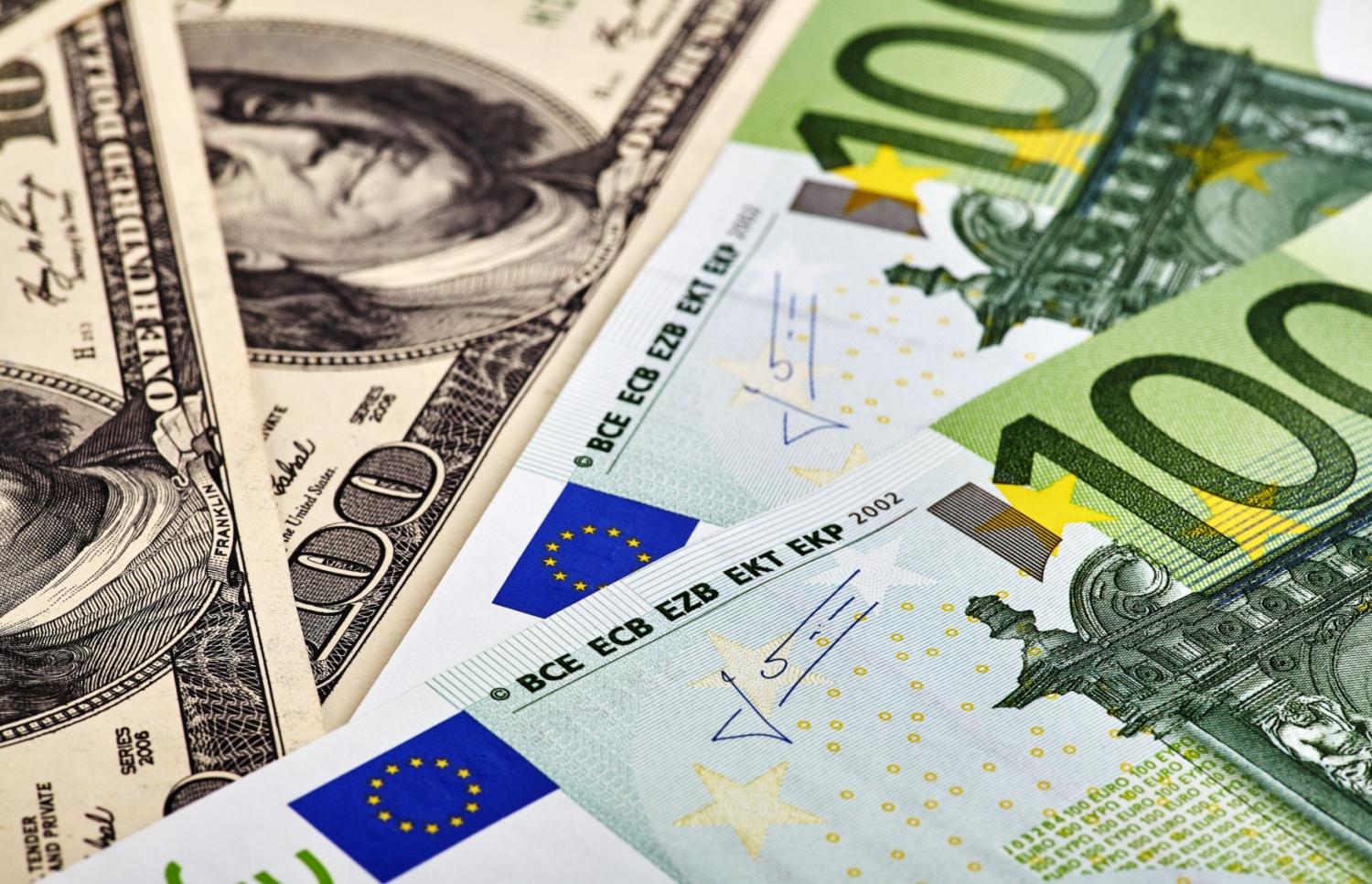
Rising tariffs and the United States’ retreat from international trade may threaten the dollar’s status as the world’s safe haven and anchor currency along with the benefits that flow from that status, including lower U.S. interest rates and robust investment from abroad, suggests a paper discussed at the Brookings Papers on Economic Activity (BPEA) conference on September 25.
“The dollar’s position as the world monetary system’s anchor currency, the relatively low yields on U.S. government debt, U.S. firms’ ability to borrow cheaply in world financial markets, and the ability of the United States to attract a disproportionate share of international investments, all hinge on the dollar’s safe-haven property—its tendency to appreciate in times of global stress,” write the authors, Tarek A. Hassan of Boston University, Thomas M. Mertens of the Federal Reserve Bank of San Francisco, Jingye Wang of Renmin University of China, and Tony Zhang of Arizona State University.
The paper presents a quantitative model, the first of its kind, that examines the potential effects of rising tariffs on the international monetary system. Since World War II, the dollar has been the principal currency used to settle international transactions. Smaller economies in particular have pegged their currencies to the dollar as a buffer against global financial turmoil. The dollar’s safe-haven status allows U.S. companies to borrow at relatively low rates from foreign investors and thus invest more and pay higher wages than would otherwise be the case.
“Inhibiting trade flows to and from the United States through tariffs or other means, weakens the force underpinning the dollar’s special role,” the authors write. “… This loss of its safe-haven status leads to a rise in U.S. interest rates, a drop in the world-market value of U.S. firms, capital outflows, and lower U.S. wages. … Without free trade, the U.S. dollar-centric system may collapse entirely or shift to another target currency.”
U.S. tariffs announced on April 2 and modified in subsequent announcements, along with retaliatory tariffs imposed by foreign governments, amount to symmetric tariffs of roughly 17%, Hassan said in an interview with The Brookings Institution. The model suggests a tipping point of 26% that would either cause the demise of exchange-rate management or a shift to another anchor currency, likely the euro, he said.
“We’re probably still a bit away from the tipping point but the fundamental insight stands,” Hassan said. “The dollar’s status depends on the degree that the U.S. engages with the rest of the world.”
“Our model’s predictions since President Trump’s April 2 Liberation Day announcement imposing tariffs on virtually all countries have borne out pretty well,” he added. (Stock prices and the value of the dollar fell sharply after the announcement and long-term interest rates rose.) “U.S. stock prices have recovered in dollar terms but not relative to stocks in the rest of the world—particularly if you account for the fact that the dollar has massively depreciated,” he said.
CITATION
Hassan, Tarek A., Thomas M. Mertens, Jingye Wang, and Tony Zhang. 2025. “Trade War and the Dollar Anchor.” BPEA Conference Draft, Fall.
Acknowledgements and disclosures
The Brookings Institution is committed to quality, independence, and impact.
We are supported by a
diverse array of funders
. In line with our
values and policies
, each Brookings publication represents the sole views of its author(s). |
| Markdown | - [Experts](https://www.brookings.edu/experts/)
- [Events](https://www.brookings.edu/events/)
- [Research Programs](https://www.brookings.edu/research-programs/)
- [Research & Commentary](https://www.brookings.edu/research-commentary/)
- [Newsletters](https://www.brookings.edu/newsletters/)
- [For Media](https://www.brookings.edu/for-media/)
- [About Us](https://www.brookings.edu/about-us/)
- [Leadership](https://www.brookings.edu/about-us/leadership/)
- [Careers](https://www.brookings.edu/careers/)
- [Our Commitments](https://www.brookings.edu/about-us/#commitments)
- [Our Finances](https://www.brookings.edu/about-us/finances/)
- [Diversity, Equity, and Inclusion](https://www.brookings.edu/dei-report-2025/)
- [BI Press](https://www.brookings.edu/all-books/brookings-institution-press/)
- [Donate](https://www.brookings.edu/support-brookings/)
[Home](https://www.brookings.edu/)
- [Iran](https://www.brookings.edu/regions/middle-east-north-africa/iran/)
- [Taxes](https://www.brookings.edu/topics/federal-fiscal-tax-policy/)
- [Immigration](https://www.brookings.edu/topics/immigration-5/)
- [Housing](https://www.brookings.edu/topics/housing/)
- [Tariffs and Trade](https://www.brookings.edu/tags/tariffs/)
- [Topics](https://www.brookings.edu/topics/)
- [ Business & Workforce](https://www.brookings.edu/topics/business-industry/)
- [ Cities & Communities](https://www.brookings.edu/topics/cities-communities/)
- [ Climate & Energy](https://www.brookings.edu/topics/climate-energy/)
- [ Defense & Security](https://www.brookings.edu/topics/national-security/)
- [ Education](https://www.brookings.edu/topics/education-2/)
- [ Global Economy & Development](https://www.brookings.edu/topics/global-inequality/)
- [ Health Care](https://www.brookings.edu/topics/health-care-2/)
- [ International Affairs](https://www.brookings.edu/topics/international-affairs/)
- [ Society & Culture](https://www.brookings.edu/topics/social-issues/)
- [ Technology & Information](https://www.brookings.edu/topics/technology-innovation/)
- [ U.S. Economy](https://www.brookings.edu/topics/u-s-economy/)
- [ U.S. Government & Politics](https://www.brookings.edu/topics/u-s-politics-government/)
- [Regions](https://www.brookings.edu/regions/)
- [ Africa](https://www.brookings.edu/regions/africa/)
- [ Asia & the Pacific](https://www.brookings.edu/regions/asia-the-pacific/)
- [ Europe & Eurasia](https://www.brookings.edu/regions/europe-eurasia/)
- [ Latin America & the Caribbean](https://www.brookings.edu/regions/latin-america-the-caribbean/)
- [ Middle East & North Africa](https://www.brookings.edu/regions/middle-east-north-africa/)
- [ North America](https://www.brookings.edu/regions/north-america/)
[Search](https://www.brookings.edu/articles/trade-war-and-the-dollar-anchor/#overlay-search)
[Home](https://www.brookings.edu/)
- [Iran](https://www.brookings.edu/regions/middle-east-north-africa/iran/)
- [Taxes](https://www.brookings.edu/topics/federal-fiscal-tax-policy/)
- [Immigration](https://www.brookings.edu/topics/immigration-5/)
- [Tariffs](https://www.brookings.edu/tags/tariffs/)
- [Housing](https://www.brookings.edu/topics/housing/)
- [All Topics](https://www.brookings.edu/topics/)
- [All Regions](https://www.brookings.edu/regions/)
- [Experts](https://www.brookings.edu/experts/)
- [Events](https://www.brookings.edu/events/)
- [Research Programs](https://www.brookings.edu/research-programs/)
- [About Us](https://www.brookings.edu/about-us/)
- [Research & Commentary](https://www.brookings.edu/research-commentary/)
- [Newsletters](https://www.brookings.edu/newsletters/)
- [Careers](https://www.brookings.edu/careers/)
- [For Media](https://www.brookings.edu/for-media/)
[Home](https://www.brookings.edu/)
#### Trade war and the dollar anchor
- [Downloads](https://www.brookings.edu/articles/trade-war-and-the-dollar-anchor/)
Downloads
- [Download the conference draft](https://www.brookings.edu/wp-content/uploads/2025/09/2_Hassan-et-al_unembargoed.pdf)
- [See More](https://www.brookings.edu/articles/trade-war-and-the-dollar-anchor/)
- [Contact](https://www.brookings.edu/articles/trade-war-and-the-dollar-anchor/)
- [Share](https://www.brookings.edu/articles/trade-war-and-the-dollar-anchor/)
- Share
- [Bluesky Streamline Icon: https://streamlinehq.com](https://bsky.app/intent/compose?text=Trade+war+and+the+dollar+anchor%20https%3A%2F%2Fwww.brookings.edu%2Farticles%2Ftrade-war-and-the-dollar-anchor%2F%3Fb%3D1)
[Search](https://www.brookings.edu/articles/trade-war-and-the-dollar-anchor/#overlay-search)
[Sections](https://www.brookings.edu/articles/trade-war-and-the-dollar-anchor/)
Sections
- [Downloads](https://www.brookings.edu/articles/trade-war-and-the-dollar-anchor/)
Downloads
- [Download the conference draft](https://www.brookings.edu/wp-content/uploads/2025/09/2_Hassan-et-al_unembargoed.pdf)
- [See More](https://www.brookings.edu/articles/trade-war-and-the-dollar-anchor/)
- [Contact](https://www.brookings.edu/articles/trade-war-and-the-dollar-anchor/)
##### Contact
Economic Studies Media Office
[esmedia@brookings.edu](mailto:esmedia@brookings.edu)
- [Share](https://www.brookings.edu/articles/trade-war-and-the-dollar-anchor/)
- Share
- [Bluesky Streamline Icon: https://streamlinehq.com](https://bsky.app/intent/compose?text=Trade+war+and+the+dollar+anchor%20https%3A%2F%2Fwww.brookings.edu%2Farticles%2Ftrade-war-and-the-dollar-anchor%2F%3Fb%3D1)
Research
BPEA \| Fall 2025
# Trade war and the dollar anchor
##### [Tarek A. Hassan](https://www.tarekhassan.net/), [](https://www.tarekhassan.net/) [Tarek A. Hassan](https://www.tarekhassan.net/) Professor of Economics \- Boston University [Thomas M. Mertens](https://www.frbsf.org/our-people/economists/thomas-mertens/), [](https://www.frbsf.org/our-people/economists/thomas-mertens/) [Thomas M. Mertens](https://www.frbsf.org/our-people/economists/thomas-mertens/) Vice President \- Federal Reserve Bank of San Francisco [Jingye Wang](https://www.brookings.edu/articles/trade-war-and-the-dollar-anchor/), and []() Jingye Wang Assistant Professor \- Renmin University of China [Tony Zhang](https://sites.google.com/view/tzhang0/home) [](https://sites.google.com/view/tzhang0/home) [Tony Zhang](https://sites.google.com/view/tzhang0/home) Visiting Associate Professor \- Arizona State University
September 24, 2025
Shutterstock / SergeyP
- 4 min read
- [Bluesky Streamline Icon: https://streamlinehq.com](https://bsky.app/intent/compose?text=Trade+war+and+the+dollar+anchor%20https%3A%2F%2Fwww.brookings.edu%2Farticles%2Ftrade-war-and-the-dollar-anchor%2F%3Fb%3D1)
Print
Sections
Toggle section navigation
Sections
Downloads
- [Download the conference draft](https://www.brookings.edu/wp-content/uploads/2025/09/2_Hassan-et-al_unembargoed.pdf)
- [See More](https://www.brookings.edu/articles/trade-war-and-the-dollar-anchor/)
##### Contact
Economic Studies Media Office
[esmedia@brookings.edu](mailto:esmedia@brookings.edu)
Print
[Brookings Papers on Economic Activity](https://www.brookings.edu/projects/brookings-papers-on-economic-activity/)
[Read more from](https://www.brookings.edu/articles/trade-war-and-the-dollar-anchor/) Brookings Papers on Economic Activity
##### More On
[Global Economy & Development](https://www.brookings.edu/topics/global-inequality/)
Sub-Topics
[Global Trade](https://www.brookings.edu/topics/global-trade/)
[Monetary Policy](https://www.brookings.edu/topics/monetary-policy/) [U.S. Economy](https://www.brookings.edu/topics/u-s-economy/)
Sub-Topics
[U.S. Trade Policy](https://www.brookings.edu/topics/u-s-trade-policy/)
Program
[Economic Studies](https://www.brookings.edu/programs/economic-studies/)
Project
[Brookings Papers on Economic Activity](https://www.brookings.edu/projects/brookings-papers-on-economic-activity/)
**Editor's note:**
The paper summarized here is part of the fall 2025 edition of the [Brookings Papers on Economic Activity](https://www.brookings.edu/bpea), the leading conference series and journal in economics for timely, cutting-edge research about real-world policy issues. Research findings are presented in a clear and accessible style to maximize their impact on economic understanding and policymaking. The editors are Brookings Nonresident Senior Fellows [Janice Eberly](https://www.brookings.edu/people/janice-c-eberly/) and [Jón Steinsson](https://www.brookings.edu/people/jon-steinsson/).
**[See the fall 2025 BPEA event page to watch paper presentations and read summaries of all the papers from this edition.](https://www.brookings.edu/events/bpea-fall-2025-conference/)** Submit a proposal to present at a future BPEA conference [here](https://www.brookings.edu/bpea-for-authors/).
Rising tariffs and the United States’ retreat from international trade may threaten the dollar’s status as the world’s safe haven and anchor currency along with the benefits that flow from that status, including lower U.S. interest rates and robust investment from abroad, suggests a paper discussed at the Brookings Papers on Economic Activity (BPEA) conference on September 25.
“The dollar’s position as the world monetary system’s anchor currency, the relatively low yields on U.S. government debt, U.S. firms’ ability to borrow cheaply in world financial markets, and the ability of the United States to attract a disproportionate share of international investments, all hinge on the dollar’s safe-haven property—its tendency to appreciate in times of global stress,” write the authors, Tarek A. Hassan of Boston University, Thomas M. Mertens of the Federal Reserve Bank of San Francisco, Jingye Wang of Renmin University of China, and Tony Zhang of Arizona State University.
The paper presents a quantitative model, the first of its kind, that examines the potential effects of rising tariffs on the international monetary system. Since World War II, the dollar has been the principal currency used to settle international transactions. Smaller economies in particular have pegged their currencies to the dollar as a buffer against global financial turmoil. The dollar’s safe-haven status allows U.S. companies to borrow at relatively low rates from foreign investors and thus invest more and pay higher wages than would otherwise be the case.
“Inhibiting trade flows to and from the United States through tariffs or other means, weakens the force underpinning the dollar’s special role,” the authors write. “… This loss of its safe-haven status leads to a rise in U.S. interest rates, a drop in the world-market value of U.S. firms, capital outflows, and lower U.S. wages. … Without free trade, the U.S. dollar-centric system may collapse entirely or shift to another target currency.”
U.S. tariffs announced on April 2 and modified in subsequent announcements, along with retaliatory tariffs imposed by foreign governments, amount to symmetric tariffs of roughly 17%, Hassan said in an interview with The Brookings Institution. The model suggests a tipping point of 26% that would either cause the demise of exchange-rate management or a shift to another anchor currency, likely the euro, he said.
Figure 1
- [Bluesky Streamline Icon: https://streamlinehq.com](https://bsky.app/intent/compose?text=Trade+war+and+the+euro+anchor%20https%3A%2F%2Fwww.brookings.edu%2Finteractive%2Ftrade-war-and-the-euro-anchor%2F%3Fr%3D1833040%26b%3D1)
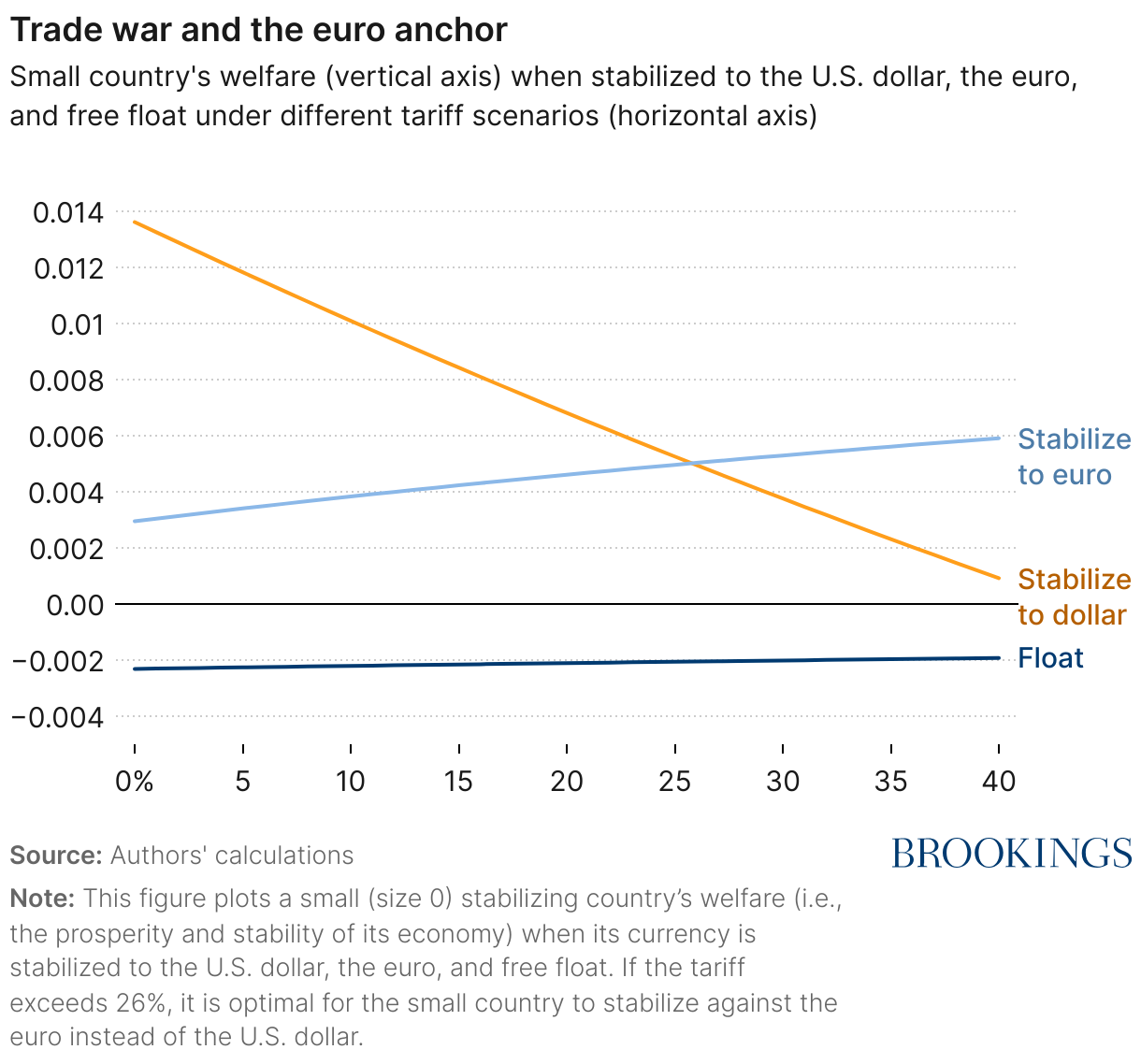

“We’re probably still a bit away from the tipping point but the fundamental insight stands,” Hassan said. “The dollar’s status depends on the degree that the U.S. engages with the rest of the world.”
“Our model’s predictions since President Trump’s April 2 Liberation Day announcement imposing tariffs on virtually all countries have borne out pretty well,” he added. (Stock prices and the value of the dollar fell sharply after the announcement and long-term interest rates rose.) “U.S. stock prices have recovered in dollar terms but not relative to stocks in the rest of the world—particularly if you account for the fact that the dollar has massively depreciated,” he said.
[Download the conference draft](https://www.brookings.edu/wp-content/uploads/2025/09/2_Hassan-et-al_unembargoed.pdf)
Authors
[](https://www.tarekhassan.net/)
[Tarek A. Hassan](https://www.tarekhassan.net/) Professor of Economics \- Boston University
[](https://www.frbsf.org/our-people/economists/thomas-mertens/)
[Thomas M. Mertens](https://www.frbsf.org/our-people/economists/thomas-mertens/) Vice President \- Federal Reserve Bank of San Francisco
[]()
Jingye Wang Assistant Professor \- Renmin University of China
[](https://sites.google.com/view/tzhang0/home)
[Tony Zhang](https://sites.google.com/view/tzhang0/home) Visiting Associate Professor \- Arizona State University
### CITATION
Hassan, Tarek A., Thomas M. Mertens, Jingye Wang, and Tony Zhang. 2025. “Trade War and the Dollar Anchor.” BPEA Conference Draft, Fall.
- [Acknowledgements and disclosures](https://www.brookings.edu/articles/trade-war-and-the-dollar-anchor/)
The views expressed here are solely those of the authors and do not necessarily represent those of the Federal Reserve Bank of San Francisco or the Federal Reserve System.
David Skidmore authored the summary language for this paper. Chris Miller assisted with data visualization.
**The Brookings Institution is committed to quality, independence, and impact.** We are supported by a [diverse array of funders](https://www.brookings.edu/about-us/annual-report/). In line with our [values and policies](https://www.brookings.edu/about-us/research-independence-and-integrity-policies/), each Brookings publication represents the sole views of its author(s).
More On
- [Global Economy & Development](https://www.brookings.edu/articles/trade-war-and-the-dollar-anchor/)
Sub-Topics
[Global Trade](https://www.brookings.edu/topics/global-trade/)
- [U.S. Economy](https://www.brookings.edu/articles/trade-war-and-the-dollar-anchor/)
Sub-Topics
[U.S. Trade Policy](https://www.brookings.edu/topics/u-s-trade-policy/)
Program
[Economic Studies](https://www.brookings.edu/programs/economic-studies/)
Project
[Brookings Papers on Economic Activity](https://www.brookings.edu/projects/brookings-papers-on-economic-activity/)
[Beyond trade: Issues in a Trump-Xi summit](https://www.brookings.edu/articles/beyond-trade-issues-in-a-trump-xi-summit/)
[Global Trade](https://www.brookings.edu/topics/global-trade/)
Beyond trade: Issues in a Trump-Xi summit
Wu Xinbo
March 27, 2026
[Tariffs in 2025: Short-run impacts on the US economy](https://www.brookings.edu/articles/tariffs-in-2025-short-run-impacts-on-the-us-economy/)
[U.S. Trade Policy](https://www.brookings.edu/topics/u-s-trade-policy/)
Tariffs in 2025: Short-run impacts on the US economy
Pablo Fajgelbaum, Amit Khandelwal
March 25, 2026
[A new opening for WTO reform](https://www.brookings.edu/articles/a-new-opening-for-wto-reform/)
[Global Trade](https://www.brookings.edu/topics/global-trade/)
A new opening for WTO reform
Dan Esty, Mari Pangestu
March 25, 2026
Get the latest from Brookings
- [twitter](https://twitter.com/BrookingsInst)
- [facebook](https://www.facebook.com/brookings)
- [linkedin](https://www.linkedin.com/company/the-brookings-institution)
- [youtube](https://www.youtube.com/user/BrookingsInstitution)
- [instagram](https://www.instagram.com/brookingsinst/)
Brookings equips decisionmakers with nonpartisan research and policy strategies to create a more prosperous and secure country and world.
[Donate](https://www.brookings.edu/support-brookings/)
- [Research Programs](https://www.brookings.edu/research-programs/)
- [Governance Studies](https://www.brookings.edu/programs/governance-studies/)
- [Economic Studies](https://www.brookings.edu/programs/economic-studies/)
- [Foreign Policy](https://www.brookings.edu/programs/foreign-policy/)
- [Global Economy and Development](https://www.brookings.edu/programs/global-economy-and-development/)
- [Brookings Metro](https://www.brookings.edu/programs/brookings-metro/)
- [About Us](https://www.brookings.edu/about-us/)
- [Leadership](https://www.brookings.edu/about-us/leadership/)
- [Careers](https://www.brookings.edu/careers/)
- [Brookings Institution Press](https://www.brookings.edu/all-books/brookings-institution-press/)
- [Contact Brookings](https://www.brookings.edu/contact-brookings/)
- [Cookie Preferences]()
- [Research & Commentary](https://www.brookings.edu/research-commentary/)
- [Experts](https://www.brookings.edu/experts/)
- [Events](https://www.brookings.edu/events/)
- [Books](https://www.brookings.edu/all-books/)
- [Podcasts](https://www.brookings.edu/podcasts/)
- [Newsletters](https://www.brookings.edu/newsletters/)
- [Privacy Policy, Updated August 2024](https://www.brookings.edu/brookings-institution-privacy-policy/)
- [Terms of Use, Updated August 2024](https://www.brookings.edu/terms-of-use/)
Copyright 2026 The Brookings Institution
 |
| Readable Markdown | Research
BPEA \| Fall 2025
#####
September 24, 2025

Shutterstock / SergeyP
- 4 min read
Rising tariffs and the United States’ retreat from international trade may threaten the dollar’s status as the world’s safe haven and anchor currency along with the benefits that flow from that status, including lower U.S. interest rates and robust investment from abroad, suggests a paper discussed at the Brookings Papers on Economic Activity (BPEA) conference on September 25.
“The dollar’s position as the world monetary system’s anchor currency, the relatively low yields on U.S. government debt, U.S. firms’ ability to borrow cheaply in world financial markets, and the ability of the United States to attract a disproportionate share of international investments, all hinge on the dollar’s safe-haven property—its tendency to appreciate in times of global stress,” write the authors, Tarek A. Hassan of Boston University, Thomas M. Mertens of the Federal Reserve Bank of San Francisco, Jingye Wang of Renmin University of China, and Tony Zhang of Arizona State University.
The paper presents a quantitative model, the first of its kind, that examines the potential effects of rising tariffs on the international monetary system. Since World War II, the dollar has been the principal currency used to settle international transactions. Smaller economies in particular have pegged their currencies to the dollar as a buffer against global financial turmoil. The dollar’s safe-haven status allows U.S. companies to borrow at relatively low rates from foreign investors and thus invest more and pay higher wages than would otherwise be the case.
“Inhibiting trade flows to and from the United States through tariffs or other means, weakens the force underpinning the dollar’s special role,” the authors write. “… This loss of its safe-haven status leads to a rise in U.S. interest rates, a drop in the world-market value of U.S. firms, capital outflows, and lower U.S. wages. … Without free trade, the U.S. dollar-centric system may collapse entirely or shift to another target currency.”
U.S. tariffs announced on April 2 and modified in subsequent announcements, along with retaliatory tariffs imposed by foreign governments, amount to symmetric tariffs of roughly 17%, Hassan said in an interview with The Brookings Institution. The model suggests a tipping point of 26% that would either cause the demise of exchange-rate management or a shift to another anchor currency, likely the euro, he said.
“We’re probably still a bit away from the tipping point but the fundamental insight stands,” Hassan said. “The dollar’s status depends on the degree that the U.S. engages with the rest of the world.”
“Our model’s predictions since President Trump’s April 2 Liberation Day announcement imposing tariffs on virtually all countries have borne out pretty well,” he added. (Stock prices and the value of the dollar fell sharply after the announcement and long-term interest rates rose.) “U.S. stock prices have recovered in dollar terms but not relative to stocks in the rest of the world—particularly if you account for the fact that the dollar has massively depreciated,” he said.
### CITATION
Hassan, Tarek A., Thomas M. Mertens, Jingye Wang, and Tony Zhang. 2025. “Trade War and the Dollar Anchor.” BPEA Conference Draft, Fall.
- [Acknowledgements and disclosures](https://www.brookings.edu/articles/trade-war-and-the-dollar-anchor/)
**The Brookings Institution is committed to quality, independence, and impact.** We are supported by a [diverse array of funders](https://www.brookings.edu/about-us/annual-report/). In line with our [values and policies](https://www.brookings.edu/about-us/research-independence-and-integrity-policies/), each Brookings publication represents the sole views of its author(s). |
| Shard | 55 (laksa) |
| Root Hash | 11646626373533845055 |
| Unparsed URL | edu,brookings!www,/articles/trade-war-and-the-dollar-anchor/ s443 |