ℹ️ Skipped - page is already crawled
| Filter | Status | Condition | Details |
|---|---|---|---|
| HTTP status | PASS | download_http_code = 200 | HTTP 200 |
| Age cutoff | PASS | download_stamp > now() - 6 MONTH | 0.4 months ago |
| History drop | PASS | isNull(history_drop_reason) | No drop reason |
| Spam/ban | PASS | fh_dont_index != 1 AND ml_spam_score = 0 | ml_spam_score=0 |
| Canonical | PASS | meta_canonical IS NULL OR = '' OR = src_unparsed | Not set |
| Property | Value | |||||||||
|---|---|---|---|---|---|---|---|---|---|---|
| URL | https://www.brookings.edu/articles/tracking-regulatory-changes-in-the-second-trump-administration/ | |||||||||
| Last Crawled | 2026-04-16 13:55:26 (11 days ago) | |||||||||
| First Indexed | 2025-01-22 17:05:05 (1 year ago) | |||||||||
| HTTP Status Code | 200 | |||||||||
| Content | ||||||||||
| Meta Title | Tracking regulatory changes in the second Trump administration | Brookings | |||||||||
| Meta Description | How much regulation is happening under the Trump administration? This tracker helps you monitor a selection of delayed, repealed, and new rules, notable guidance and policy implementations, and important court battles covering energy, health, labor, and more. | |||||||||
| Meta Canonical | null | |||||||||
| Boilerpipe Text | Research
March 31, 2026
U.S. President Donald Trump signs an executive order, in the Oval Office, at the White House in Washington, D.C., U.S. February 14, 2025. REUTERS/Nathan Howard
3 min read
Editor's note:
The regulatory tracker was last updated on March 31, 2026. Rules are up to date as of March 30, 2026.
As the Trump administration returns to office for a second term with renewed deregulatory ambitions, the executive branch and its agencies are implementing significant policy changes. The Brookings Center on Regulation and Markets Regulatory Tracker (“Reg Tracker”) provides background information and status updates on a curated selection of significant regulatory and deregulatory changes made by the Trump administration. This tracker allows you to monitor a curated selection of new, delayed, and repealed rules, notable guidance and policy revocations, executive actions, and important court battles across key policy areas such as environmental, health, labor, and more.
The Reg Tracker focuses on major regulatory changes implemented under the current Trump administration. Entries we tracked during the Biden administration and during President Trump’s first term can be accessed through the “Biden” or “Trump Term 1” archive checkboxes, respectively.
For a more thorough explanation of the Reg Tracker, including an explanation of how entries are selected, an overview of the rulemaking process, and guidance on how to use the Reg Tracker’s interactive features,
click here
.
For regular updates from the Reg Tracker and new research from the Center on Regulation and Markets, subscribe to our newsletter.
Subscribe to the Reg Tracker newsletter
This tracker monitors a curated selection of regulatory activity developed by experts in the
Center on Regulation and Markets
at Brookings. If you have questions or suggestions related to what regulatory activity is or isn’t included, or feedback on the usability of the tracker itself, we’d love to hear from you! Email
RegCenter@brookings.edu
.
The Brookings Institution is committed to quality, independence, and impact.
We are supported by a
diverse array of funders
. In line with our
values and policies
, each Brookings publication represents the sole views of its author(s). | |||||||||
| Markdown | - [Experts](https://www.brookings.edu/experts/)
- [Events](https://www.brookings.edu/events/)
- [Research Programs](https://www.brookings.edu/research-programs/)
- [Research & Commentary](https://www.brookings.edu/research-commentary/)
- [Newsletters](https://www.brookings.edu/newsletters/)
- [For Media](https://www.brookings.edu/for-media/)
- [About Us](https://www.brookings.edu/about-us/)
- [Leadership](https://www.brookings.edu/about-us/leadership/)
- [Careers](https://www.brookings.edu/careers/)
- [Our Commitments](https://www.brookings.edu/about-us/#commitments)
- [Our Finances](https://www.brookings.edu/about-us/finances/)
- [Diversity, Equity, and Inclusion](https://www.brookings.edu/dei-report-2025/)
- [BI Press](https://www.brookings.edu/all-books/brookings-institution-press/)
- [Donate](https://www.brookings.edu/support-brookings/)
[Home](https://www.brookings.edu/)
- [Iran](https://www.brookings.edu/regions/middle-east-north-africa/iran/)
- [Taxes](https://www.brookings.edu/topics/federal-fiscal-tax-policy/)
- [Immigration](https://www.brookings.edu/topics/immigration-5/)
- [Housing](https://www.brookings.edu/topics/housing/)
- [Tariffs and Trade](https://www.brookings.edu/tags/tariffs/)
- [Topics](https://www.brookings.edu/topics/)
- [ Business & Workforce](https://www.brookings.edu/topics/business-industry/)
- [ Cities & Communities](https://www.brookings.edu/topics/cities-communities/)
- [ Climate & Energy](https://www.brookings.edu/topics/climate-energy/)
- [ Defense & Security](https://www.brookings.edu/topics/national-security/)
- [ Education](https://www.brookings.edu/topics/education-2/)
- [ Global Economy & Development](https://www.brookings.edu/topics/global-inequality/)
- [ Health Care](https://www.brookings.edu/topics/health-care-2/)
- [ International Affairs](https://www.brookings.edu/topics/international-affairs/)
- [ Society & Culture](https://www.brookings.edu/topics/social-issues/)
- [ Technology & Information](https://www.brookings.edu/topics/technology-innovation/)
- [ U.S. Economy](https://www.brookings.edu/topics/u-s-economy/)
- [ U.S. Government & Politics](https://www.brookings.edu/topics/u-s-politics-government/)
- [Regions](https://www.brookings.edu/regions/)
- [ Africa](https://www.brookings.edu/regions/africa/)
- [ Asia & the Pacific](https://www.brookings.edu/regions/asia-the-pacific/)
- [ Europe & Eurasia](https://www.brookings.edu/regions/europe-eurasia/)
- [ Latin America & the Caribbean](https://www.brookings.edu/regions/latin-america-the-caribbean/)
- [ Middle East & North Africa](https://www.brookings.edu/regions/middle-east-north-africa/)
- [ North America](https://www.brookings.edu/regions/north-america/)
[Search](https://www.brookings.edu/articles/tracking-regulatory-changes-in-the-second-trump-administration/#overlay-search)
[Home](https://www.brookings.edu/)
- [Iran](https://www.brookings.edu/regions/middle-east-north-africa/iran/)
- [Taxes](https://www.brookings.edu/topics/federal-fiscal-tax-policy/)
- [Immigration](https://www.brookings.edu/topics/immigration-5/)
- [Tariffs](https://www.brookings.edu/tags/tariffs/)
- [Housing](https://www.brookings.edu/topics/housing/)
- [All Topics](https://www.brookings.edu/topics/)
- [All Regions](https://www.brookings.edu/regions/)
- [Experts](https://www.brookings.edu/experts/)
- [Events](https://www.brookings.edu/events/)
- [Research Programs](https://www.brookings.edu/research-programs/)
- [About Us](https://www.brookings.edu/about-us/)
- [Research & Commentary](https://www.brookings.edu/research-commentary/)
- [Newsletters](https://www.brookings.edu/newsletters/)
- [Careers](https://www.brookings.edu/careers/)
- [For Media](https://www.brookings.edu/for-media/)
[Home](https://www.brookings.edu/)
#### Tracking regulatory changes in the second Trump administration
- [Share](https://www.brookings.edu/articles/tracking-regulatory-changes-in-the-second-trump-administration/)
- Share
- [Bluesky Streamline Icon: https://streamlinehq.com](https://bsky.app/intent/compose?text=Tracking+regulatory+changes+in+the+second+Trump+administration%20https%3A%2F%2Fwww.brookings.edu%2Farticles%2Ftracking-regulatory-changes-in-the-second-trump-administration%2F%3Fb%3D1)
[Search](https://www.brookings.edu/articles/tracking-regulatory-changes-in-the-second-trump-administration/#overlay-search)
[Sections](https://www.brookings.edu/articles/tracking-regulatory-changes-in-the-second-trump-administration/)
Sections
- [Share](https://www.brookings.edu/articles/tracking-regulatory-changes-in-the-second-trump-administration/)
- Share
- [Bluesky Streamline Icon: https://streamlinehq.com](https://bsky.app/intent/compose?text=Tracking+regulatory+changes+in+the+second+Trump+administration%20https%3A%2F%2Fwww.brookings.edu%2Farticles%2Ftracking-regulatory-changes-in-the-second-trump-administration%2F%3Fb%3D1)
Research
# Tracking regulatory changes in the second Trump administration
March 31, 2026
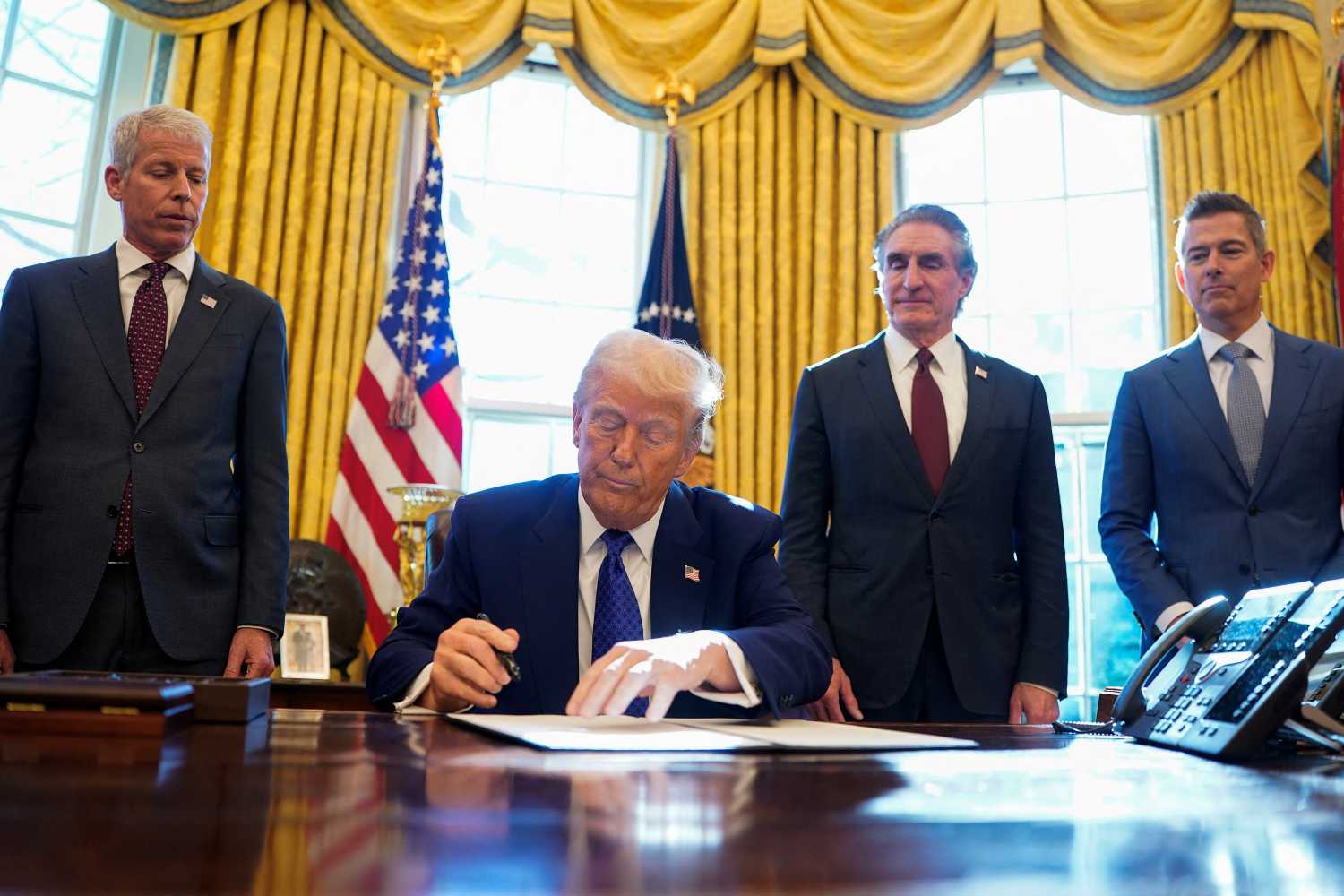
U.S. President Donald Trump signs an executive order, in the Oval Office, at the White House in Washington, D.C., U.S. February 14, 2025. REUTERS/Nathan Howard
- 3 min read
- [Bluesky Streamline Icon: https://streamlinehq.com](https://bsky.app/intent/compose?text=Tracking+regulatory+changes+in+the+second+Trump+administration%20https%3A%2F%2Fwww.brookings.edu%2Farticles%2Ftracking-regulatory-changes-in-the-second-trump-administration%2F%3Fb%3D1)
Print
Sections
Toggle section navigation
Sections
Print
##### More On
[U.S. Economy](https://www.brookings.edu/topics/u-s-economy/)
Sub-Topics
[Regulatory Policy](https://www.brookings.edu/topics/regulatory-policy/)
[U.S. Government & Politics](https://www.brookings.edu/topics/u-s-politics-government/)
Program
[Economic Studies](https://www.brookings.edu/programs/economic-studies/)
Center
[Center on Regulation and Markets](https://www.brookings.edu/centers/center-on-regulation-and-markets/)
**Editor's note:**
*The regulatory tracker was last updated on March 31, 2026. Rules are up to date as of March 30, 2026.*
As the Trump administration returns to office for a second term with renewed deregulatory ambitions, the executive branch and its agencies are implementing significant policy changes. The Brookings Center on Regulation and Markets Regulatory Tracker (“Reg Tracker”) provides background information and status updates on a curated selection of significant regulatory and deregulatory changes made by the Trump administration. This tracker allows you to monitor a curated selection of new, delayed, and repealed rules, notable guidance and policy revocations, executive actions, and important court battles across key policy areas such as environmental, health, labor, and more.
The Reg Tracker focuses on major regulatory changes implemented under the current Trump administration. Entries we tracked during the Biden administration and during President Trump’s first term can be accessed through the “Biden” or “Trump Term 1” archive checkboxes, respectively.
**For a more thorough explanation of the Reg Tracker, including an explanation of how entries are selected, an overview of the rulemaking process, and guidance on how to use the Reg Tracker’s interactive features,** [**click here**](https://www.brookings.edu/articles/explaining-the-brookings-regulatory-tracker/)**.** For regular updates from the Reg Tracker and new research from the Center on Regulation and Markets, subscribe to our newsletter.
[Subscribe to the Reg Tracker newsletter](https://connect.brookings.edu/regulatory-changes-in-the-biden-era)
Filters
Clear
Include Archives:
Trump Term 1
Biden
Name
Nature of Action
Category(s)
Agency(s)
Current Status
Last Updated
- \+
–
Ban on noncompete clauses
Rulemaking - Overturning Biden
Labor
FTC
Court-blocked
3/30/2026
1. [1/19/2023](https://www.federalregister.gov/documents/2023/01/19/2023-00414/non-compete-clause-rule)
[5/7/2024](https://www.federalregister.gov/documents/2024/05/07/2024-09171/non-compete-clause-rule)
[9/4/2024](https://www.federalregister.gov/documents/2024/05/07/2024-09171/non-compete-clause-rule)
?
Ban on noncompete clauses
A rule to allow workers more freedom to choose their employers.
### Background
Noncompete clauses in employment contracts prevent workers from moving to a competing firm in the same industry. Nearly [one-fifth](https://www.hamiltonproject.org/wp-content/uploads/2023/01/reforming_noncompetes_support_workers_marx_policy_proposal.pdf) of all workers in the US are affected by noncompete clauses. Companies justify noncompete clauses by arguing that they are necessary to protect their trade secrets and investments in training workers. Employees under noncompete clauses are [25 percentage points](https://www.brookings.edu/articles/non-compete-contracts-potential-justifications-and-the-relevant-evidence/) more likely to hold trade secrets; however, more than half of employees under noncompete clauses do not hold trade secrets. Additionally, the [FTC argues](https://www.ftc.gov/system/files/ftc_gov/pdf/noncompete_nprm_fact_sheet.pdf) that there are alternative ways to protect trade secrets without using noncompete clauses. Some also argue that without noncompete clauses companies would be [less willing to invest in training](https://www.brookings.edu/articles/non-compete-contracts-potential-justifications-and-the-relevant-evidence/) their workers. While [some](https://journals.sagepub.com/doi/abs/10.1177/0019793919826060) [evidence](https://papers.ssrn.com/sol3/papers.cfm?abstract_id=3040393) supports this claim, others counter that there exist [alternative ways](https://www.brookings.edu/articles/non-compete-contracts-potential-justifications-and-the-relevant-evidence/) to protect firms' investments in workers without harming competition, suppressing workers' wages, and limiting workers' freedom to choose their employers.
### Impact
This [rule](https://www.federalregister.gov/documents/2024/05/07/2024-09171/non-compete-clause-rule) from the FTC [bans](https://www.ftc.gov/system/files/ftc_gov/pdf/noncompete_nprm_fact_sheet.pdf) employers from entering noncompete clauses with their workers. This includes both employees and independent contractors. The rule would also void any existing noncompete clause and require employers to inform their workers that such clauses or no longer valid. The FTC [estimates](https://www.federalregister.gov/d/2024-09171/p-1594) that the final rule will increase workers' total earnings by \$400 to \$488 billion over ten years (at current ten-year discounted value).
### Litigation
[A number of business groups](https://www.cnn.com/2024/04/25/success/ftc-noncompete-ban-lawsuit/index.html), including the [U.S. Chamber of Commerce](https://www.reuters.com/legal/us-ban-worker-noncompete-agreements-faces-lawsuit-major-business-group-2024-04-24/) and the Business Roundtable, filed lawsuits against the Federal Trade Commission (FTC) claiming that the FTC does not have the authority to regulate noncompete clauses. *This lawsuit resulted in a [temporary block](https://www.washingtonpost.com/business/2024/07/03/judge-injunction-ftc-noncompete-rule/) and then a [subsequent nationwide injunction](https://www.washingtonpost.com/business/2024/08/20/noncompete-ban-injunction-texas/), issued by a U.S. District Court for the Northern District of Texas.* The FTC [filed](https://www.jdsupra.com/legalnews/legal-showdown-continues-ftc-appeals-4313874/) an appeal in the Fifth Circuit Court of Appeals on October 18, 2024, for the Texas District Court's ruling. In addition, the U.S. District Court for the Middle District of Florida [issued a preliminary injunction](https://law.justia.com/cases/federal/district-courts/florida/flmdce/5:2024cv00316/429196/59/) and halted the FTC's enforcement of this rule for the plaintiff only. The FTC [requested](https://www.jdsupra.com/legalnews/legal-showdown-continues-ftc-appeals-4313874/) an appeal from the Eleventh Circuit Court of Appeals for this ruling. These rulings stand in contrast to a [similar challenge](https://news.bloomberglaw.com/antitrust/ftc-noncompete-case-in-pennsylvania-continues-despite-texas-loss) that was rejected in Pennsylvania. In September 2025, the Federal Trade Commission [moved to dismiss appeals](https://www.ftc.gov/news-events/news/press-releases/2025/09/federal-trade-commission-files-accede-vacatur-non-compete-clause-rule) in lawsuits against this rule, allowing the rule to be struck down.
### Notes
2. \-
[2/12/2026](https://www.federalregister.gov/documents/2026/02/12/2026-02866/revision-of-the-negative-option-rule-withdrawal-of-the-cars-rule-removal-of-the-non-compete-rule-to)
[2/12/2026](https://www.federalregister.gov/documents/2026/02/12/2026-02866/revision-of-the-negative-option-rule-withdrawal-of-the-cars-rule-removal-of-the-non-compete-rule-to)
?
Trump 2.0 rule aligning regulations with court decisions
A rule to remove the noncompete clause rule to conform to federal court decisions.
### Background
After the noncompete rule was issued, several [lawsuits](https://www.federalregister.gov/d/2026-02866/p-33) were filed against the rule, which resulted in courts finding that the rule was unlawful. On September 5, 2025, the Federal Trade Commission (FTC) [voted](https://www.federalregister.gov/d/2026-02866/p-38) to dismiss its appeals in two cases, allowing the rule to be struck down.
### Impact
On February 12, 2026, the FTC released a [final rule](https://www.federalregister.gov/documents/2026/02/12/2026-02866/revision-of-the-negative-option-rule-withdrawal-of-the-cars-rule-removal-of-the-non-compete-rule-to) to remove the noncompete rule and restore regulations to their prior status.
### Litigation
### Notes
- \+
–
Civil servant reclassification rules
Rulemaking - Overturning Biden
Other
OPM
In effect
3/30/2026
1. [9/18/2023](https://www.federalregister.gov/documents/2023/09/18/2023-19806/upholding-civil-service-protections-and-merit-system-principles)
[4/9/2024](https://www.federalregister.gov/documents/2024/04/09/2024-06815/upholding-civil-service-protections-and-merit-system-principles)
[5/9/2024](https://www.federalregister.gov/documents/2024/04/09/2024-06815/upholding-civil-service-protections-and-merit-system-principles)
?
Civil servant reclassification rules
A rule to protect civil servants from job reclassification.
### Background
On October 21, 2020, the Trump administration released the "[Executive Order on Creating Schedule F in the Excepted Service](https://trumpwhitehouse.archives.gov/presidential-actions/executive-order-creating-schedule-f-excepted-service/)." This executive order directed agencies to reclassify civil servants in the [competitive service](https://www.fedsmith.com/2014/11/28/federal-job-classifications-competitive-vs-excepted/) with policy-related jobs to a new class of workers called Schedule F, in the excepted service. Civil service laws [ensure](https://help.usajobs.gov/working-in-government/service) competitive service applicants and employees receive fair treatment in the hiring process and provide [procedural protections](https://protectdemocracy.org/work/biden-admin-response-schedule-f/) against removal and discrimination. Excepted service positions are not covered by the same worker protections and competitive hiring; therefore, this executive order would have [exempted](https://www.govexec.com/workforce/2024/04/opm-issues-final-rule-schedule-f-protections/395463/) many civil servants from worker protections, making them easier to remove. President Biden later revoked this executive order with [Executive Order 14003: Protecting the Federal Workforce](https://www.federalregister.gov/documents/2021/01/27/2021-01924/protecting-the-federal-workforce).
### Impact
In response to Trump's [Schedule F executive order](https://trumpwhitehouse.archives.gov/presidential-actions/executive-order-creating-schedule-f-excepted-service/), the Biden administration finalized a [rule](https://www.federalregister.gov/documents/2024/04/09/2024-06815/upholding-civil-service-protections-and-merit-system-principles) to prevent potential future reclassification of the competitive service roles, which currently covers 2.2 million civil servants. This rule clarifies that an employee's civil service protections cannot be involuntarily removed due to a reclassification from the competitive service to the excepted service. It also provides procedures for reclassifying individuals from the competitive service to the excepted service, or vice versa. Finally, the rule confirms the interpretation that excepted service was intended for noncareer political appointees and not civil servants. The Biden administration [expects](https://www.govexec.com/workforce/2024/04/opm-issues-final-rule-schedule-f-protections/395463/) that this rule will make it difficult for a future administration to roll back civil servant protections.
### Litigation
### Notes
2. [4/23/2025](https://www.federalregister.gov/documents/2025/04/23/2025-06904/improving-performance-accountability-and-responsiveness-in-the-civil-service)
[2/6/2026](https://www.federalregister.gov/documents/2026/02/06/2026-02375/improving-performance-accountability-and-responsiveness-in-the-civil-service)
[3/9/2026](https://www.federalregister.gov/documents/2026/02/06/2026-02375/improving-performance-accountability-and-responsiveness-in-the-civil-service)
?
Trump 2.0 rescission
A rule to lower the barrier to reclassify civil servants.
### Background
On January 20, 2025, President Trump released Executive Order (EO) 14171 ("[Restoring Accountability to Policy-Influencing Positions Within the Federal Workforce](https://www.federalregister.gov/documents/2025/01/31/2025-02095/restoring-accountability-to-policy-influencing-positions-within-the-federal-workforce)"), which reinstated Trump's initial [Schedule F EO](https://trumpwhitehouse.archives.gov/presidential-actions/executive-order-creating-schedule-f-excepted-service/), with some changes (see entry "Reinstating Schedule F"). This EO renames "Schedule F" into "Schedule Policy/Career." This EO also directed the Office of Personnel Management (OPM) to rescind and replace President Biden's April 2024 rule (see above rule) that provides civil servants protections from removal and discrimination.
### Impact
On April 23, 2025, the Trump administration's OPM [released](https://www.federalregister.gov/documents/2025/04/23/2025-06904/improving-performance-accountability-and-responsiveness-in-the-civil-service) a notice of proposed rulemaking to rescind the regulatory changes made by the Biden administration to protect civil servants from reclassification and implement EO 14171. This rule would make it easier for civil servants to be removed without the opportunity for appeal, effectively transferring these positions to be at-will employment. This rule was [finalized](https://www.federalregister.gov/documents/2026/02/06/2026-02375/improving-performance-accountability-and-responsiveness-in-the-civil-service) on February 6, 2026, and went into effect on March 9, 2026.
### Litigation
### Notes
- \+
–
Click to cancel negative option rule
Rulemaking - Overturning Biden
Other
FTC
In effect
3/30/2026
1. [4/24/2023](https://www.federalregister.gov/documents/2023/04/24/2023-07035/negative-option-rule)
[11/15/2024](https://www.federalregister.gov/documents/2024/11/15/2024-25534/negative-option-rule)
[1/14/2025](https://www.federalregister.gov/documents/2024/11/15/2024-25534/negative-option-rule)
?
Click to cancel negative option rule
A rule to combat deceptive practices in negative option offers.
### Background
[Negative option offers](https://www.brookings.edu/articles/tracking-regulatory-changes-in-the-second-trump-administration/%22https://www.ftc.gov/sites/default/files/documents/reports/negative-options-federal-trade-commission-workshop-analyzing-negative-option-marketing-report-staff/p064202negativeoptionreport.pdf%22) are a form of marketing that contains a term or condition that allows sellers to interpret a customer's lack of action as an acceptance of an offer. There are four types of negative option offers: (1) prenotification plans, (2) continuity plans, (3) automatic renewals, and (4) free trials. Prenotification plans provide periodic notices offering goods to participating consumers, then send those goods if the consumers take no action to decline the offer. Continuity plans involve periodic shipments of goods or provisions of services that continue unless the consumer cancels the agreement. Sellers of automatic renewal plans automatically renew consumers' subscriptions when they expire. Lastly, sellers can offer a free trial for consumers to receive goods or services for a limited time, and when the trial period ends, the sellers automatically charge the consumer for the service. [The current Negative Option Rule](https://www.brookings.edu/articles/tracking-regulatory-changes-in-the-second-trump-administration/%22https://www.federalregister.gov/d/2023-07035/p-15%22), published in 1973, only covers prenotification plans.
### Impact
On November 15, 2024, the Federal Trade Commission (FTC) [finalized a rule](https://www.federalregister.gov/documents/2024/11/15/2024-25534/negative-option-rule) to amend the current Negative Option Rule to combat unfair or deceptive practices by sellers of negative option offers. The proposed rule would require sellers to incorporate a "click to cancel" option for consumers, making it easier for consumers to cancel any unwanted products or services. The proposed rule would also require sellers to issue an annual reminder to consumers signed up for negative option marketing, except for programs involving physical goods. Under the finalized rule, sellers would be allowed to pitch additional offers if a consumer initiates a cancellation but must receive the consumer's consent before making such pitches. The FTC [says](https://www.ftc.gov/system/files/ftc_gov/pdf/NegOptions-1page.pdf) that this rule will ensure consumers understand and agree to what they are buying.
### Litigation
Following this rule's publication, businesses and industry groups [petitioned](https://www.federalregister.gov/d/2026-02866/p-10) four circuit courts to review this rule, which was later consolidated into the U.S. Court of Appeals for the Eighth Circuit. The petitioners argued that this rule violated section 18 and 22 of the Federal Trade Commissions (FTC) Act because it did not meet the specificity and prevalence requirements of section 18 and because the FTC did not issue a preliminary regulatory analysis. *On July 8, 2025, the Eighth Circuit Court of Appeals [vacated](https://law.justia.com/cases/federal/appellate-courts/ca8/24-3388/24-3388-2025-07-08.html) this rule, citing that the FTC [did not issue](https://www.federalregister.gov/d/2026-02866/p-16) a sufficient preliminary regulatory analysis.*
### Notes
2. \-
[2/12/2026](https://www.federalregister.gov/documents/2026/02/12/2026-02866/revision-of-the-negative-option-rule-withdrawal-of-the-cars-rule-removal-of-the-non-compete-rule-to)
[2/12/2026](https://www.federalregister.gov/documents/2026/02/12/2026-02866/revision-of-the-negative-option-rule-withdrawal-of-the-cars-rule-removal-of-the-non-compete-rule-to)
?
Trump 2.0 rule to align regulations with court rulings
A rule to align negative option regulations with court rulings.
### Background
Following a ruling by the U.S. Court of Appeals for the Eighth Circuit, the Biden administration's negative option rule was [vacated](https://www.federalregister.gov/d/2026-02866/p-16) because the preliminary regulatory analysis conducted was "procedurally insufficient."
### Impact
On February 12, 2026, the Trump administration promulgated a [final rule](https://www.federalregister.gov/documents/2026/02/12/2026-02866/revision-of-the-negative-option-rule-withdrawal-of-the-cars-rule-removal-of-the-non-compete-rule-to) to restore regulations to their form prior to the 2024 Biden rule. This rule reestablishes the rule "[Use of Prenotification Negative Option Plans](https://www.ftc.gov/legal-library/browse/rules/use-prenotification-negative-option-plans)."
### Litigation
### Notes
- \+
–
Rescinding the greenhouse gas endangerment finding and vehicle emissions standards
Rulemaking - Trump new
Environment
EPA
Finalized
3/30/2026
1. [8/1/2025](https://www.federalregister.gov/documents/2025/08/01/2025-14572/reconsideration-of-2009-endangerment-finding-and-greenhouse-gas-vehicle-standards)
[2/18/2026](https://www.federalregister.gov/documents/2026/02/18/2026-03157/rescission-of-the-greenhouse-gas-endangerment-finding-and-motor-vehicle-greenhouse-gas-emission)
[4/20/2026](https://www.federalregister.gov/documents/2026/02/18/2026-03157/rescission-of-the-greenhouse-gas-endangerment-finding-and-motor-vehicle-greenhouse-gas-emission)
?
Rescinding the greenhouse gas endangerment finding and vehicle emissions standards
A rule to remove vehicle emissions standards by rescinding the finding that greenhouse gas emissions endanger public health and welfare.
### Background
In 2009, the Environmental Protection Agency (EPA) [issued a finding](https://www.federalregister.gov/documents/2009/12/15/E9-29537/endangerment-and-cause-or-contribute-findings-for-greenhouse-gases-under-section-202a-of-the-clean) that climate change caused by greenhouse gas (GHG) emissions endangers public health and welfare. This endangerment finding obligated the EPA to set standards for GHG emission from new motor vehicles under section 202(a) of the Clean Air Act (CAA). The finding was based on a body of major scientific assessments by the U.S. Global Climate Research Program, the Intergovernmental Panel on Climate Change, and the National Research Council. It followed the Supreme Court's ruling in [Massachusetts v. EPA (2007)](https://supreme.justia.com/cases/federal/us/549/497/), which held that GHGs fit the CAA definition of "air pollution" and required the EPA to determine whether they endanger public health or welfare.
### Impact
On August 1, 2025, the EPA [proposed a rule](https://www.federalregister.gov/documents/2025/08/01/2025-14572/reconsideration-of-2009-endangerment-finding-and-greenhouse-gas-vehicle-standards) to rescind the 2009 endangerment finding and repeal all GHG emissions standards for light-, medium-, and heavy-duty vehicles under section 202(a) of the CAA. The proposal argues that section 202(a) only gives the EPA the right to regulate local and regional air pollutants, not GHGs that contribute to global climate change. The EPA also contends that recent developments cast doubt on scientific findings about the danger of climate change. To support this claim, the rule cites an August 1, 2025, [report](https://www.federalregister.gov/documents/2025/08/01/2025-14519/notice-of-availability-a-critical-review-of-impacts-of-greenhouse-gas-emissions-on-the-us-climate) by the Department of Energy (DoE) which has drawn [criticism](https://www.science.org/content/article/contrarian-climate-assessment-u-s-government-draws-swift-pushback) from scientists claiming it mischaracterizes their work. Since 2009, the endangerment finding has underpinned authority for additional [CAA regulatory actions](https://www.hklaw.com/en/insights/publications/2025/08/up-in-the-air-epa-opens-comment-on-repealing-endangerment-finding), including standards for GHG emissions from power plants, aircraft, and oil and gas facilities. The EPA has [stated](https://www.federalregister.gov/d/2025-14572/p-154) that if the endangerment finding were rescinded, the agency intends to "initiate separate rulemakings that will address any overlapping issues." This rule was [finalized](https://www.federalregister.gov/documents/2026/02/18/2026-03157/rescission-of-the-greenhouse-gas-endangerment-finding-and-motor-vehicle-greenhouse-gas-emission) on February 18, 2026, and goes into effect on April 20, 2026.
### Litigation
### Notes
- \+
–
Diversity Immigrant Visa Program rule
Rulemaking - Trump new
Immigration
DOS
Finalized
3/30/2026
1. \-
[6/5/2019](https://www.federalregister.gov/documents/2019/06/05/2019-11762/visas-diversity-immigrants)
[6/5/2019](https://www.federalregister.gov/documents/2019/06/05/2019-11762/visas-diversity-immigrants)
?
Diversity Immigrant Visa Program rule
A rule to require a valid passport for registration in the Diversity Immigrant Visa Program.
### Background
The [Diversity Immigrant Visa Program](https://www.americanimmigrationcouncil.org/fact-sheet/diversity-visa-system-fact-sheet/) (diversity visa program) was established through the Immigration Act of 1990 to promote immigration from countries underrepresented in the U.S. This program uses a lottery system to allocate 55,000 visas each year. Annually, there are an [estimated 14 million applicants](https://www.federalregister.gov/d/2019-11762/p-9) for the diversity visa program.
### Impact
On June 5, 2019, the Trump administration promulgated an interim final rule to require applicants to have a valid passport earlier in the process. This rule [requires](https://www.federalregister.gov/d/2019-11762/p-11) applicants to have a valid passport prior to applying for the program, regardless of whether the individual was chosen in the lottery.
### Litigation
*In February 2022, a federal court in the District of Columbia [vacated](https://www.law.georgetown.edu/icap/wp-content/uploads/sites/32/2022/02/EB-v-Dept-of-State-opinion.pdf) this rule, citing that the Trump administration unlawfully failed to adhere to the notice-and-comment procedures outlined in the Administrative Procedure Act.*
### Notes
2. [8/5/2025](https://www.federalregister.gov/documents/2025/08/05/2025-14784/visas-enhancing-vetting-and-combatting-fraud-in-the-diversity-immigrant-visa-program)
[3/11/2026](https://www.federalregister.gov/documents/2026/03/11/2026-04737/visas-enhancing-vetting-and-combatting-fraud-in-the-diversity-immigrant-visa-program)
[4/10/2026](https://www.federalregister.gov/documents/2026/03/11/2026-04737/visas-enhancing-vetting-and-combatting-fraud-in-the-diversity-immigrant-visa-program)
?
"Enhancing vetting and combatting fraud in the Diversity Immigrant Visa Program"
A rule to "improve the integrity and combat fraud" in the Diversity Immigrant Visa Program by requiring a valid passport for registration in the program.
### Background
The number of diversity visa lottery applications [dropped by half](https://www.americanimmigrationcouncil.org/blog/trump-reinstates-immigration-policies/) after implementation of the 2019 rule. However, since the rule was vacated in 2022, the Department of State has [claimed](https://www.federalregister.gov/documents/2025/08/05/2025-14784/visas-enhancing-vetting-and-combatting-fraud-in-the-diversity-immigrant-visa-program#p-17) "significant numbers of fraudulent entries for the program each year," where individual entries have been submitted by an unknown third party.
### Impact
On August 5, 2025, the Trump administration proposed a [rule](https://www.federalregister.gov/documents/2025/08/05/2025-14784/visas-enhancing-vetting-and-combatting-fraud-in-the-diversity-immigrant-visa-program) to require applicants in the diversity visa program to have a valid passport at the time of applying for the diversity visa lottery. This rule would also replace the word "sex" with "gender" in the implementing regulations, pursuant to [Executive Order 14168](https://www.federalregister.gov/documents/2025/01/30/2025-02090/defending-women-from-gender-ideology-extremism-and-restoring-biological-truth-to-the-federal), "Defending Women from Gender Ideology Extremism and Restoring Biological Truth to the Federal Government." This rule was [finalized](https://www.federalregister.gov/documents/2026/03/11/2026-04737/visas-enhancing-vetting-and-combatting-fraud-in-the-diversity-immigrant-visa-program) on March 11, 2026.
### Litigation
### Notes
- \+
–
Employment authorization for asylum applicants rule
Rulemaking - Trump new
Immigration
DHS
In rulemaking
3/30/2026
1. [2/23/2026](https://www.federalregister.gov/documents/2026/02/23/2026-03595/employment-authorization-reform-for-asylum-applicants)
\-
\-
?
Employment authorization for asylum applicants rule
A rule to tighten restrictions on employment authorization for asylum-seekers.
### Background
Under federal law, asylum seekers-people who enter the United States and claim fear of persecution in their home country-may [apply for work authorization](https://www.federalregister.gov/d/2026-03595/p-460) while their asylum case is pending. This permission to work is known as an Employment Authorization Document, or EAD. [Since 1994](https://www.federalregister.gov/d/2026-03595/p-244), asylum applicants have had to wait 180 days after requesting asylum before becoming eligible for an EAD, a rule designed to deter people from filing meritless asylum claims solely to obtain work authorization. U.S. Citizenship and Immigration Services (USCIS), an agency within the Department of Homeland Security (DHS), is responsible for adjudicating both asylum applications and EAD requests. Over the past decade, asylum filings have surged dramatically, pushing USCIS's pending caseload [past 1.5 million applications](https://www.federalregister.gov/d/2026-03595/p-360) and average processing times well beyond the 180-day statutory target-creating a massive backlog that DHS argues has itself become a magnet for frivolous filings, since applicants can obtain work authorization years before their asylum case is decided.
### Impact
On February 23, 2026, the DHS [proposed a rule](https://www.federalregister.gov/documents/2026/02/23/2026-03595/employment-authorization-reform-for-asylum-applicants) to tighten restrictions on EAD eligibility. This rule would extend the waiting period from 180 to 365 days and pause acceptance of new EAD applications entirely when average asylum processing times exceed 180 days. The rule would also add new eligibility bars for applicants who entered the country illegally or have certain criminal histories, and require biometric screening for all EAD applicants.
### Litigation
### Notes
- \+
–
Housing regulatory barriers executive order
Executive order - Trump new
Housing
White House
In effect
3/30/2026
1. [An executive order from President Trump March 13, 2026](https://www.federalregister.gov/documents/2026/03/18/2026-05388/removing-regulatory-barriers-to-affordable-home-construction)
?
Housing regulatory barriers executive order
An executive order to remove regulatory barriers to affordable home construction.
### Background
The United States has faced ongoing challenges with housing affordability, driven in large part by a shortage of [new home construction](https://www.brookings.edu/articles/americas-housing-affordability-crisis-and-the-decline-of-housing-supply/). Federal, state, and local regulations-including environmental permitting, energy efficiency mandates, and approval processes-can add significant time and cost to building new homes. Key federal actors include the Army Corps of Engineers and Environmental Protection Agency (EPA), which regulate development near wetlands and waterways; the Department of Housing and Urban Development (HUD), which administers housing finance programs; the Federal Housing Finance Agency (FHFA), which oversees mortgage lending standards; and the Departments of Energy and Agriculture, which set efficiency standards for federally financed housing.
### Impact
On March 13, 2026, President Trump signed [Executive Order 14394](https://www.federalregister.gov/documents/2026/03/18/2026-05388/removing-regulatory-barriers-to-affordable-home-construction), which directs agencies to review and roll back regulations the Administration views as "unduly burdensome," while also encouraging states and localities to adopt permitting reforms and directing new investment incentives toward homebuilding in federally designated Opportunity Zones.
### Litigation
### Notes
- \+
–
Implementing changes to the Higher Education Act under the One Big Beautiful Bill Act (OBBBA)
Rulemaking - Trump new
Education
ED
In rulemaking
3/30/2026
1. [1/30/2026](https://www.federalregister.gov/documents/2026/01/30/2026-01912/reimagining-and-improving-student-education)
\-
\-
?
Implementing changes to the Higher Education Act under the One Big Beautiful Bill Act (OBBBA)
A rule to implement changes made to student loans under the One Big Beautiful Bill Act.
### Background
The OBBBA, signed into law on July 4, 2025, made [several statutory changes](https://www.brookings.edu/articles/how-obbba-reshapes-student-lending/) to federal student loan programs and related provisions in Title IV of the Higher Education Act of 1965. The 2025 law established a lifetime borrowing limit, ended Graduate PLUS Loans and unlimited Parent PLUS borrowing, raised limits for professional degree students, created total borrowing caps for grad students, professional students, and parents, and cut loan amounts for part-time students.
### Impact
On January 30, 2026, the Department of Education [proposed](https://www.federalregister.gov/documents/2026/01/30/2026-01912/reimagining-and-improving-student-education) a rule aimed at "reimagining and improving student education." This rule, if finalized, implements changes to the Direct Loan Program outlined in OBBBA, including eliminating new Grad PLUS loans and replacing it with annual loan caps for graduate and professional students. It would also [implement](https://www.federalregister.gov/d/2026-01912/p-10) new loan repayment plans for new borrowers, the "Repayment Assistance Plan" and the "Tiered Standard" repayment plan. Under the proposed rule, borrowers in default can have a [second opportunity](https://www.acainternational.org/news/u-s-education-department-issues-reimagining-and-improving-student-education-rulemaking/) to rehabilitate their loans and return to good standing, unlike the previous limit of one opportunity.
### Litigation
### Notes
- \+
–
Pharmacy benefit manager fee disclosure rule
Rulemaking - Trump new
Health
DOL
In rulemaking
3/30/2026
1. [1/30/2026](https://www.federalregister.gov/documents/2026/01/30/2026-01907/improving-transparency-into-pharmacy-benefit-manager-fee-disclosure)
\-
\-
?
Pharmacy benefit manager fee disclosure rule
A rule to require pharmacy benefit managers and brokers serving group health plans to disclose all compensation they receive.
### Background
Pharmacy Benefit Managers (PBMs) manage prescription drug benefits for self-insured group health plans covered by the Employee Retirement Income Security Act (ERISA), among other health plans. They do so by developing formularies, negotiating manufacturer rebates, establishing pharmacy networks, and processing claims. PBMs generate revenue in several ways-including [spread pricing](https://www.brookings.edu/articles/a-brief-look-at-current-debates-about-pharmacy-benefit-managers/), rebate retention, and copay claw-backs-that some health plan fiduciaries have historically struggled to identify and evaluate. Section 408(b)(2) of ERISA requires that service arrangements with plans be "reasonable," and existing regulations impose disclosure obligations on brokers and consultants to group health plans, but neither framework explicitly covers PBMs as direct service providers. [Executive Order 14273](https://www.federalregister.gov/documents/2025/04/18/2025-06837/lowering-drug-prices-by-once-again-putting-americans-first) (April 2025) directed the Department to close this gap by proposing regulations requiring greater transparency into PBM compensation.
### Impact
On January 30, 2026, the Department of Labor [proposed a rule](https://www.federalregister.gov/documents/2026/01/30/2026-01907/improving-transparency-into-pharmacy-benefit-manager-fee-disclosure) to require PBMs and affiliated brokers or consultants serving group health plans to disclose all forms of direct and indirect compensation for their services. The proposed rule also includes provisions that are designed to ensure that health plan fiduciaries can verify the accuracy of the disclosures.
### Litigation
### Notes
- \+
–
Single Family Housing Guaranteed Loan Program rule
Rulemaking
Housing
USDA
Finalized
3/30/2026
1. [8/4/2022](https://www.federalregister.gov/documents/2022/08/04/2022-16637/single-family-housing-guaranteed-loan-program)
[3/19/2026](https://www.federalregister.gov/documents/2026/03/19/2026-05387/single-family-housing-guaranteed-loan-program)
[6/17/2026](https://www.federalregister.gov/documents/2026/03/19/2026-05387/single-family-housing-guaranteed-loan-program)
?
Single Family Housing Guaranteed Loan Program rule
A rule to allow delegated lenders to use automated systems to make and guarantee rural housing loans after closing.
### Background
The [Single Family Housing Guaranteed Loan Program](https://www.fdic.gov/resources/bankers/affordable-mortgage-lending-center/guide/part-1-docs/single-family-housing-guaranteed-loan-program.pdf) (SFHGLP) offers approved lenders a 90% loan guarantee to lower their risk when providing loans to low- and moderate-income rural households. Applicants must [meet](https://www.rd.usda.gov/programs-services/single-family-housing-programs/single-family-housing-guaranteed-loan-program#overview) income eligibility requirements, be a U.S. citizen, U.S. non-citizen national, or Qualified Alien, and agree to occupy the dwelling as their primary residence.
### Impact
On March 19, 2026, the Department of Agriculture (USDA) [finalized a rule](https://www.federalregister.gov/documents/2026/03/19/2026-05387/single-family-housing-guaranteed-loan-program) to shift loan approval from the USDA to qualified delegated lenders, allowing them to use automated systems to independently process and finalize loans with minimal USDA involvement. The rule [aims](https://www.federalregister.gov/documents/2026/03/19/2026-05387/single-family-housing-guaranteed-loan-program#p-19) to streamline processing, reduce administrative burden, and speed up service for rural borrowers.
### Litigation
### Notes
- \+
–
Security Bars rule for asylum seekers
Rulemaking - Delaying Trump
COVID-19
Immigration
DHS, DOJ
Delayed
1/10/2026
1. [7/9/2020](https://www.federalregister.gov/documents/2020/07/09/2020-14758/security-bars-and-processing)
[12/23/2020](https://www.federalregister.gov/documents/2020/12/23/2020-28436/security-bars-and-processing)
[12/31/2025](https://www.federalregister.gov/documents/2025/12/30/2025-23970/security-bars-and-processing-confirmation-of-effective-date-partial-withdrawal)
?
Security Bars rule for asylum seekers
A rule restricting asylum access for individuals from countries with contagious disease outbreaks.
### Background
On December 23, 2020, the Department of Homeland Security and Department of Justice (henceforth collectively referred to as "the Departments") collectively [finalized a rule](https://www.federalregister.gov/documents/2020/12/23/2020-28436/security-bars-and-processing) restricting asylum access on the pretext of public health concerns.
### Impact
The rule would allow classifying asylum seekers coming from a place where a contagious disease is prevalent as a [threat to US national security](https://bipartisanpolicy.org/blog/proposed-dhs-and-doj-rule-seeks-to-further-restrict-asylum-access-beyond-the-covid-19-pandemic/). Accordingly, it would allow the Departments to [ban asylum or withdraw witholding of removal](https://www.americanimmigrationcouncil.org/advocacy/comment-security-bars-and-processing-regulation) of any individual who passed through a country with a COVID-19 outbreak.
### Litigation
### Notes
This rule's effective date was [delayed](https://www.federalregister.gov/documents/2022/12/28/2022-28121/security-bars-and-processing-delay-of-effective-date) to December 31, 2024, in December 2022. *The rule's effective date was [further delayed](https://www.federalregister.gov/documents/2024/12/27/2024-30774/security-bars-and-processing-delay-of-effective-date) to December 31, 2025. On December 30, 2025, the second Trump administration [issued a final rule](https://www.federalregister.gov/documents/2025/12/30/2025-23970/security-bars-and-processing-confirmation-of-effective-date-partial-withdrawal) confirming the effective date of this rule to be December 31, 2025.* The rule removes amendatory instructions for the Security Bars Final Rule that conflict with subsequent amendments or risk causing confusion.
- \+
–
Child Care and Development Fund rules
Rulemaking - Overturning Biden
Children, Youth, and Families
HHS
In rulemaking
1/10/2026
1. [7/13/2023](https://www.federalregister.gov/documents/2023/07/13/2023-14290/improving-child-care-access-affordability-and-stability-in-the-child-care-and-development-fund-ccdf)
[3/1/2024](https://www.federalregister.gov/documents/2024/03/01/2024-04139/improving-child-care-access-affordability-and-stability-in-the-child-care-and-development-fund-ccdf)
[4/30/2024](https://www.federalregister.gov/documents/2024/03/01/2024-04139/improving-child-care-access-affordability-and-stability-in-the-child-care-and-development-fund-ccdf)
?
Child Care and Development Fund rules
A rule to update and streamline the Child Care and Development Fund
### Background
Child care expenses can be a significant financial burden for low-income families' budgets, sometimes forcing parents to exit the labor force or reduce spending on basic costs such as food or housing. In addition, child care services [face](https://www.federalregister.gov/d/2024-04139/p-49) severe underinvestment, leading to constricted choice and high costs for families. The [Child Care and Development Fund](https://www2.ed.gov/about/inits/ed/non-public-education/other-federal-programs/hhs.html) (CCDF) supports low-income families with child care expenses and aims to increase child care quality for all children by providing funding to the child care industry.
### Impact
This [rule](https://www.federalregister.gov/documents/2024/03/01/2024-04139/improving-child-care-access-affordability-and-stability-in-the-child-care-and-development-fund-ccdf) will reduce families' child care costs on child care by limiting co-payments to 7% of household income and streamline agencies' ability to eliminate copays for vulnerable families, such as those under 150% of the federal poverty line. The rule will also expand the supply of childcare services by adequately compensating providers in a timely manner. The HHS [estimates](https://www.hhs.gov/about/news/2024/02/29/biden-harris-administration-announces-new-rule-reduce-costs-more-than-100000-families-receiving-child-care-subsidies.html) this rule will lower child care costs for 100,000 children.
### Litigation
### Notes
2. [1/5/2026](https://www.federalregister.gov/documents/2026/01/05/2025-24272/restoring-flexibility-in-the-child-care-and-development-fund-ccdf)
\-
\-
?
Trump 2.0 rescission
A rule to rescind 4 requirements of the 2024 rule.
### Background
The [Child Care and Development Block Grant Act of 1990](https://www.govinfo.gov/content/pkg/USCODE-2023-title42/pdf/USCODE-2023-title42-chap105-subchapII-B-sec9857.pdf), along with section 418 of the Social Security Act, authorizes the CCDF. In federal fiscal year (FFY) 2025, CCDF funding amounted to \$12.30 billion awarded to states, territories, and tribes. In 2024, the Biden administration [finalized a rule](https://www.federalregister.gov/documents/2024/03/01/2024-04139/improving-child-care-access-affordability-and-stability-in-the-child-care-and-development-fund-ccdf) to "improve child care access, affordability, and stability in the CCDF."
### Impact
On January 5, 2026, the Trump administration [proposed a rule](https://www.federalregister.gov/documents/2026/01/05/2025-24272/restoring-flexibility-in-the-child-care-and-development-fund-ccdf) to rescind 4 key provisions of the [March 2024 rule](https://www.federalregister.gov/documents/2024/03/01/2024-04139/improving-child-care-access-affordability-and-stability-in-the-child-care-and-development-fund-ccdf). These provisions included [limiting](https://www.federalregister.gov/d/2025-24272/p-20) family co-payments to 7% of income, [requiring](https://www.federalregister.gov/d/2025-24272/p-21) some services to be delivered through grants or contracts, [necessitating](https://www.federalregister.gov/d/2025-24272/p-22) child care provider payment in advance or at the beginning of the delivery of service, and [requiring](https://www.federalregister.gov/d/2025-24272/p-23) payments to be based on a child's enrollment rather than attendance.
### Litigation
### Notes
- \+
–
Reproductive health services for veterans
Rulemaking - Overturning Biden
Health
VA
Finalized
1/10/2026
1. \-
[9/9/2022](https://www.federalregister.gov/documents/2022/09/09/2022-19239/reproductive-health-services)
[9/9/2022](https://www.federalregister.gov/documents/2022/09/09/2022-19239/reproductive-health-services)
?
Reproductive health services for veterans
A rule to provide abortion counseling and abortions for veterans
### Background
In June 2022, the Supreme Court decision, [Dobbs v. Jackson Women's Health Organization](https://www.supremecourt.gov/opinions/21pdf/19-1392_6j37.pdf), allowed states to enforce abortion bans and restrictions on care. The Department of Veterans Affairs (VA) provides veterans' health insurance through its medical benefits package and provides health insurance to spouses, dependents, and survivors of veterans who meet certain service-connected disability requirements through the [Civilian Health and Medical Program of the Department of Veterans Affairs](https://www.va.gov/resources/getting-care-through-champva/) (CHAMPVA). These programs have [exclusions](https://www.federalregister.gov/d/2022-19239/p-34) for abortion care except in cases when the life of a veteran or their relatives and dependents is at stake if the fetus were carried to term.
### Impact
The VA issued an [interim final rule](https://www.federalregister.gov/documents/2022/09/09/2022-19239/reproductive-health-services) on September 9, 2022, to amend its regulations to remove an exclusion for abortion counseling and create exceptions to the exclusion of abortions in the VA's medical benefits package. The VA also expanded access to abortion counseling and abortions for beneficiaries of the CHAMPVA program. These [changes](https://www.federalregister.gov/d/2022-19239/p-9) allow veterans to receive abortions, if deemed by a medical professional to be necessary when the life or health of a pregnant beneficiary would be endangered if the pregnancy were carried to term or if the pregnancy was the result of rape or incest.
### Litigation
### Notes
In March 2024, the Biden administration [finalized](https://www.federalregister.gov/documents/2024/03/04/2024-04275/reproductive-health-services) this rule without changes.
2. [8/4/2025](https://www.federalregister.gov/documents/2025/08/04/2025-14687/reproductive-health-services)
[12/31/2025](https://www.federalregister.gov/documents/2025/12/31/2025-24061/reproductive-health-services)
[1/30/2026](https://www.federalregister.gov/documents/2025/12/31/2025-24061/reproductive-health-services)
?
Trump rescission
A rule to exclude abortions and abortion counseling from VA medical benefits packages.
### Background
Before September 2022, the VA [did not provide abortion services](https://www.federalregister.gov/d/2025-14687/p-8), classifying them as "not needed" medical care. That changed with a rule issued by the Biden administration in September 2022 (see above rule). Under the updated policy, the VA's medical benefits package and CHAMPVA program began covering abortions when deemed medically necessary by a health care provider.
### Impact
On August 4, 2025, the Trump administration [proposed a rule](https://www.federalregister.gov/documents/2025/08/04/2025-14687/reproductive-health-services) to overturn the Biden-era changes to the VA medical benefits package and the CHAMPVA program. If finalized, this rule would eliminate abortion counseling and coverage from veterans' and their families' medical benefits. Coverage would revert to the pre-September 2022 policy, limited to only life-threatening circumstances, including treatment for ectopic pregnancies and miscarriages. This rule was [finalized](https://www.federalregister.gov/documents/2025/12/31/2025-24061/reproductive-health-services) on December 31, 2025.
### Litigation
### Notes
- \+
–
Weighted selection for H-1B petitions
Rulemaking - Trump new
Immigration
DHS
Finalized
1/10/2026
1. [9/24/2025](https://www.federalregister.gov/documents/2025/09/24/2025-18473/weighted-selection-process-for-registrants-and-petitioners-seeking-to-file-cap-subject-h-1b)
[12/29/2025](https://www.federalregister.gov/documents/2025/12/29/2025-23853/weighted-selection-process-for-registrants-and-petitioners-seeking-to-file-cap-subject-h-1b)
[2/27/2026](https://www.federalregister.gov/documents/2025/12/29/2025-23853/weighted-selection-process-for-registrants-and-petitioners-seeking-to-file-cap-subject-h-1b)
?
Weighted selection for H-1B petitions
A rule to establish a new H-1B visa process favoring higher-skilled, better-paid workers.
### Background
The H-1B visa program was [created](https://immigrationhistory.org/item/immigration-act-of-1990/) by Congress in 1990 to provide temporary work visas to highly educated foreign workers. Visa [approvals](https://www.pewresearch.org/short-reads/2025/03/04/what-we-know-about-the-us-h-1b-visa-program/) are valid for three years and can be extended for a maximum of six years. Since 2005, the cap for new visa [approvals](https://www.pewresearch.org/short-reads/2025/03/04/what-we-know-about-the-us-h-1b-visa-program/) has been set at 85,000 per year, of which 20,000 per year are reserved for workers with graduate degrees from U.S. institutions. To implement this cap, the U.S. uses a lottery to select H-1B petitioners at random.
### Impact
On September 24, 2025, the Trump administration released a [proposed rule](https://www.federalregister.gov/documents/2025/09/24/2025-18473/weighted-selection-process-for-registrants-and-petitioners-seeking-to-file-cap-subject-h-1b) to implement a weighted selection process for H-1B petitioners. Under this proposed rule, petitioners would be required to fill out wage information in addition to basic biographic information for each candidate. The selection process would be modified under this proposed rule to include more entries in the lottery pool for higher wage levels, thus [shifting the odds](https://ogletree.com/insights-resources/blog-posts/dhs-proposes-a-weighted-selection-process-for-cap-subject-h-1b-petitions/) in favor of the highest-paid foreign workers. This rule was [finalized](https://www.federalregister.gov/documents/2025/12/29/2025-23853/weighted-selection-process-for-registrants-and-petitioners-seeking-to-file-cap-subject-h-1b) on December 29, 2025.
### Litigation
### Notes
- \+
–
"Rule of many" hiring
Rulemaking
Other
OPM
In effect
1/10/2026
1. [7/21/2023](https://www.federalregister.gov/documents/2023/07/21/2023-15374/recruitment-and-selection-through-competitive-examination-and-employment-in-the-excepted-service)
[9/8/2025](https://www.federalregister.gov/documents/2025/09/08/2025-17125/reinvigorating-merit-based-hiring-through-candidate-ranking-in-the-competitive-and-excepted-service)
[11/7/2025](https://www.federalregister.gov/documents/2025/09/08/2025-17125/reinvigorating-merit-based-hiring-through-candidate-ranking-in-the-competitive-and-excepted-service)
?
"Rule of many" hiring
A rule to allow agencies to consider a wider range of candidates in hiring.
### Background
In federal hiring, agencies have traditionally used the "[rule of three](https://www.mspb.gov/studies/studies/The_Rule_of_Three_in_Federal_Hiring_Boon_or_Bane_253660.pdf)," which requires hiring managers for the civil service to choose among the top three candidates to fill a position. The National Defense Authorization Act for Fiscal Year 2019 (NDAA) [authorized changes](https://www.federalregister.gov/d/2023-15374/p-26) to the selection of candidates for civil service, including eliminating the rule of three and replacing it with the "rule of many." This hiring rule lets agencies choose from a "sufficient number" of names, using a cut-off score or other mechanism established by the Office of Personnel Management (OPM).
### Impact
On September 8, 2025, the Trump administration [finalized a rule](https://www.federalregister.gov/documents/2025/09/08/2025-17125/reinvigorating-merit-based-hiring-through-candidate-ranking-in-the-competitive-and-excepted-service) first [proposed](https://www.federalregister.gov/documents/2023/07/21/2023-15374/recruitment-and-selection-through-competitive-examination-and-employment-in-the-excepted-service) by the Biden administration to implement the "rule of many" in hiring for civil servants. The change allows agencies to select from top-ranked applicants using one of four [methods](https://content.govdelivery.com/attachments/USOPM/2025/09/05/file_attachments/3380000/Rule%20of%20Many%20Fact%20Sheet%20FINAL%20\(004\).pdf): a "cut-off score based on job analysis data," a "cut-off score based on business necessity," "a set number of top-ranked applicants," or "a percentage of top-ranked applicants." The OPM [stated](https://content.govdelivery.com/attachments/USOPM/2025/09/05/file_attachments/3380000/Rule%20of%20Many%20Fact%20Sheet%20FINAL%20\(004\).pdf) that this rule will "create greater hiring flexibility and improved workforce quality," and "promote a more efficient, effective, and equitable hiring system."
### Litigation
### Notes
- \+
–
Restricting gender-affirming care for minors
Rulemaking - Trump new
Health
HHS
In rulemaking
1/10/2026
1. [12/19/2025](https://www.federalregister.gov/documents/2025/12/19/2025-23465/medicare-and-medicaid-programs-hospital-condition-of-participation-prohibiting-sex-rejecting)
\-
\-
?
Restricting gender-affirming care for minors
A rule to revise requirements for Medicare- and Medicaid-certified hospitals, banning them from performing gender-affirming care.
### Background
On January 28, 2025, President Trump signed the executive order (EO) "[Protecting Children from Chemical and Surgical Mutilation](https://www.federalregister.gov/documents/2025/02/03/2025-02194/protecting-children-from-chemical-and-surgical-mutilation)." This EO directs the secretary of the Department of Health and Human Services (HHS) to make regulatory actions to end gender-affirming care for minors.
### Impact
On December 19, 2025, the Trump administration [proposed a rule](https://www.federalregister.gov/documents/2025/12/19/2025-23465/medicare-and-medicaid-programs-hospital-condition-of-participation-prohibiting-sex-rejecting) to prohibit hospitals that participate in the Medicare and Medicaid programs from performing gender-affirming care on minors, including pharmaceutical and surgical interventionsThis rule does not ban the use of gender-affirming psychotherapy for minors.
### Litigation
### Notes
- \+
–
National AI policy executive order
Executive order - Trump new
Technology
White House
In effect
1/10/2026
1. [An executive order from President Trump December 11, 2025](https://www.federalregister.gov/documents/2025/12/16/2025-23092/ensuring-a-national-policy-framework-for-artificial-intelligence)
?
National AI policy executive order
An executive order to unite AI regulations under a national AI policy.
### Background
Several states have pursued their own AI policies absent federal actions on AI regulation. For example, California has released its own law, [SB 53](https://legiscan.com/CA/text/SB53/id/3270002), that regulates foundational AI model developers. This law and others create a patchwork of AI regulations that could potentially hinder innovation. The Trump administration has aimed [to remove barriers to American leadership in AI](https://www.federalregister.gov/documents/2025/01/31/2025-02172/removing-barriers-to-american-leadership-in-artificial-intelligence), which include avoiding a patchwork AI regulatory system.
### Impact
On December 11, 2025, President Trump signed an [executive order](https://www.federalregister.gov/documents/2025/12/16/2025-23092/ensuring-a-national-policy-framework-for-artificial-intelligence) to "ensure a national policy framework for artificial intelligence." This executive order establishes an AI litigation task force that is responsible for challenging state AI laws inconsistent with the Trump administrations priorities. Further, the order also advances consideration of federal standards for reporting, disclosure, and consumer protection, while preserving state authority in areas such as child safety, infrastructure, and government use of AI. In addition, it directs the development of legislative recommendations to establish a uniform federal AI framework that would preempt conflicting state laws while maintaining appropriate state roles in defined policy areas.
### Litigation
### Notes
- \+
–
Space modernization rule
Rulemaking - Trump new
Technology
FCC
In rulemaking
1/10/2026
1. [12/5/2025](https://www.federalregister.gov/documents/2025/12/05/2025-22019/space-modernization-for-the-21st-century)
\-
\-
?
Space modernization rule
A rule to overhaul the Federal Communication Commission's (FCC's) space and earth station licensing framework.
### Background
Space licensing is the process by which the FCC authorizes satellite and earth station operations and the use of radio spectrum to ensure communications services operate in the public interest and without harmful interference. The FCCs framework was [developed](https://www.federalregister.gov/d/2025-22019/p-28) in an era dominated by a small number of geostationary satellite systems and relied on detailed, prescriptive rules. As the space industry has expanded and diversified, with more private operators and increasing complexity, these legacy processes have been strained, prompting renewed focus on modernizing space licensing to reflect todays space economy.
### Impact
On December 5, 2025, the FCC [proposed a rule](https://www.federalregister.gov/documents/2025/12/05/2025-22019/space-modernization-for-the-21st-century) to modernize space licensing processes. The proposed rule would establish a "[licensing assembly line](https://www.federalregister.gov/d/2025-22019/p-62)" to optimize and expedite space and earth station applications. This process [would involve](https://www.hklaw.com/en/insights/publications/2025/11/fcc-rulemaking-on-space-station-licensing-and-spectrum-sharing) a streamlined, three-step workflow covering targeted application submission, FCC review with public input, and final approval. In addition, this rule proposes modernizing earth station licensing by creating a new category for immovable earth stations, moving toward nationwide, non-site licensing, reducing potentially burdensome requirements, and extending most earth and space station license terms to 20 years.
### Litigation
### Notes
- \+
–
Major sources of hazardous air pollutants under Section 112 of the Clean Air Act
Rulemaking - Overturning Biden
Environment
EPA
In effect
1/10/2026
1. [7/16/2019](https://www.federalregister.gov/documents/2019/07/26/2019-14252/reclassification-of-major-sources-as-area-sources-under-section-112-of-the-clean-air-act)
[11/19/2020](https://www.federalregister.gov/documents/2020/11/19/2020-22044/reclassification-of-major-sources-as-area-sources-under-section-112-of-the-clean-air-act)
[1/19/2021](https://www.federalregister.gov/documents/2020/11/19/2020-22044/reclassification-of-major-sources-as-area-sources-under-section-112-of-the-clean-air-act)
?
Major sources of hazardous air pollutants under Section 112 of the Clean Air Act
A rule to reclassify "major sources" as "area sources" under Section 112 of the Clean Air Act.
### Background
The [National Emissions Standards for Hazardous Air Pollutants](https://www.epa.gov/stationary-sources-air-pollution/national-emission-standards-hazardous-air-pollutants-neshap-8) (NESHAP), established under Section 112 of the Clean Air Act, regulates emissions of hazardous air pollutants (HAP) from stationary sources (e.g., factories and refineries) to protect public health and the environment. Section 112 distinguishes between "major sources" and "area sources" based on the quantity of HAP emitted: major sources emit 10 tons per year or more of any single HAP or 25 tons per year or more of combined HAP and are therefore subject to more stringent regulatory requirements than area sources, which emit smaller amounts.
### Impact
On November 19, 2020, the Environmental Protection Agency (EPA) [finalized a rule](https://www.federalregister.gov/documents/2020/11/19/2020-22044/reclassification-of-major-sources-as-area-sources-under-section-112-of-the-clean-air-act) to implement a plain language reading of the major source and area source definitions in Section 112 of the CAA. This allows any major source to be reclassified to an area source at any time upon reducing its potential to emit HAP to below the major source thresholds. The EPA estimates that this rule will lead to \$90.6 million (in 2017 dollars) in cost savings by reducing administrative burdens.
### Litigation
### Notes
2. [9/27/2023](https://www.federalregister.gov/documents/2023/09/27/2023-21041/review-of-final-rule-reclassification-of-major-sources-as-area-sources-under-section-112-of-the)
[9/10/2024](https://www.federalregister.gov/documents/2024/09/10/2024-20074/review-of-final-rule-reclassification-of-major-sources-as-area-sources-under-section-112-of-the)
[9/10/2024](https://www.federalregister.gov/documents/2024/09/10/2024-20074/review-of-final-rule-reclassification-of-major-sources-as-area-sources-under-section-112-of-the)
?
Biden rule
A rule to establish requirements for HAP source reclassification.
### Background
Given the strict regulatory requirements for major sources of HAP emissions, EPA policy has historically allowed some of the sources to reclassify as area sources. This would lower their regulatory requirements but also require them to reduce emissions below established thresholds.
### Impact
On September 10, 2024, the Biden administration [released a final rule](https://www.federalregister.gov/documents/2024/09/10/2024-20074/review-of-final-rule-reclassification-of-major-sources-as-area-sources-under-section-112-of-the) to amend the NESHAP general provisions, establishing new requirements for major sources of HAP seeking to reclassify as area sources. Under the rule, reclassification is conditioned on preventing emissions backsliding. To reclassify, a source must either continue operating the emissions controls required under the major source standard, comply with any reclassification-specific control requirements included in NESHAP, or install and operate alternative controls that a permitting authority has approved as providing equivalent protection.
### Litigation
### Notes
*On May 1, 2025, the U.S. Senate passed [S.J. Res. 31](https://www.congress.gov/bill/119th-congress/senate-joint-resolution/31) disapproving of this rule under the Congressional Review Act. Later, on May 22, 2025, the House of Representatives passed the joint resolution of disapproval, and President Trump signed the provision into law on June 20, 2025. This rule was nullified under the joint resolution of disapproval.*
3. \-
[1/2/2026](https://www.federalregister.gov/documents/2026/01/02/2025-24202/congressional-review-act-revocation-of-2024-review-of-final-rule-reclassification-of-major-sources)
[1/2/2026](https://www.federalregister.gov/documents/2026/01/02/2025-24202/congressional-review-act-revocation-of-2024-review-of-final-rule-reclassification-of-major-sources)
?
Affirming the CRA resolution
A rule to affirm a CRA resolution of disapproval nullifying the 2024 rule and reset regulations back to the 2020 rule.
### Background
On June 20, 2025, President Trump signed [S.J. Res. 31](https://www.congress.gov/bill/119th-congress/senate-joint-resolution/31), which nullified the [2024 rule](https://www.federalregister.gov/documents/2024/09/10/2024-20074/review-of-final-rule-reclassification-of-major-sources-as-area-sources-under-section-112-of-the). Under the Congressional Review Act (CRA), this rule is no longer in effect and will be treated as though it was never in effect.
### Impact
On January 2, 2026, the EPA finalized a [rule](https://www.federalregister.gov/documents/2026/01/02/2025-24202/congressional-review-act-revocation-of-2024-review-of-final-rule-reclassification-of-major-sources) to reset the Section 112 of the CAA regulations to its prior form, the 2020 rule from the first Trump administration (see rule above). This rule now allows major sources of HAP under the NESHAP program to reclassify as an area source given it reduces its potential to emit HAP below the major source thresholds.
### Litigation
### Notes
- \+
–
Waters of the U.S. (WOTUS)
Rulemaking
Environment
EPA, DOD
In rulemaking
11/25/2025
1. [4/21/2014](https://www.federalregister.gov/documents/2014/04/21/2014-07142/definition-of-waters-of-the-united-states-under-the-clean-water-act)
[6/29/2015](https://www.federalregister.gov/documents/2015/06/29/2015-13435/clean-water-rule-definition-of-waters-of-the-united-states)
[8/28/2015](https://www.federalregister.gov/documents/2015/06/29/2015-13435/clean-water-rule-definition-of-waters-of-the-united-states)
?
Waters of the U.S. (WOTUS)
A rule expanding which bodies of water fall under federal jurisdiction and thus are protected under the Clean Water Act.
### Background
The Clean Water Act is the most consequential law governing water pollution in the United States. Its goal is to improve the chemical and biological composition of the nation’s wetlands to be sustainable. [First enacted in 1948 but taking its modern form in 1972](https://www.epa.gov/laws-regulations/history-clean-water-act), the Clean Water Act [prohibits polluting](https://www.perc.org/2020/01/28/the-new-navigable-waters-protection-rule-explained/#:~:text=Under%20federal%20law,%20the%20Clean,the%20Army%20Corps%20of%20Engineers.) in “navigable waters,” or “waters of the United States,” unless permitted by the Environmental Protection Agency (EPA) or the Army Corps of Engineers. [The act allows these agencies to define the term waters of the United States.](https://www.epa.gov/wotus/about-waters-united-states)
### Impact
One of the Obama administration's most controversial environmental rules, the ["waters of the United States" (WOTUS) rule](https://www.federalregister.gov/documents/2014/04/21/2014-07142/definition-of-waters-of-the-united-states-under-the-clean-water-act) sought to clarify what "navigable waters" would mean under the Clean Water Act. The term was interpreted to include tributaries and bodies of water adjacent to federal waters, including wetlands, ponds, and lakes, which critics argued was jurisdictional overreach. This would have increased the total number of wetlands that were under federal jurisdiction, and thus protected under the Clean Water Act, by [an estimated 2.8-4.6%](https://www.epa.gov/sites/default/files/2015-06/documents/508-final_clean_water_rule_economic_analysis_5-20-15.pdf). [Environmental groups](https://www.usatoday.com/story/news/politics/2019/09/12/epa-repeals-obama-era-waters-u-s-rule-criticized-overreach/2301997001/) estimated this rule would have improved drinking water for 100 million Americans, protected 3,000 watersheds in the western U.S., and helped protect some 75 endangered species.
### Litigation
Thirteen states sued to block the rule, and a judge in the U.S. District Court for North Dakota issued a [preliminary injunction](https://www.agri-pulse.com/ext/resources/pdfs/w/o/t/t/a/WOTUSNorthDakota.pdf) in August 2015, hours before the rule was to take effect. On October 9, 2015, the Sixth Circuit Court of Appeals issued a [nationwide stay](https://www.opn.ca6.uscourts.gov/opinions.pdf/15a0246p-06.pdf), which blocked implementation of the rule. On February 22, 2016, a three-judge panel of the Sixth Circuit Court [stated](https://www.opn.ca6.uscourts.gov/opinions.pdf/16a0045p-06.pdf) that it had jurisdiction to review challenges to the WOTUS rule, citing courts' historically expansive interpretation of [section 1369 of the Clean Water Act](https://www.law.cornell.edu/uscode/text/33/1369), which describes the law's judicial review provisions. In response, the National Association of Manufacturers appealed to Supreme Court, arguing that the Sixth Circuit Court lacked jurisdiction. On January 22, 2018, the Supreme Court issued a [unanimous ruling](https://www.supremecourt.gov/opinions/17pdf/16-299_8nk0.pdf) that lawsuits to challenge the WOTUS rule must be filed in federal district courts rather than federal courts of appeals, voiding the Sixth Circuit's claim of jurisdiction, and throwing into doubt the future of its nationwide stay.
### Notes
Following the Supreme Court's decision, the Army Corps of Engineers and EPA [delayed the effective date](https://www.federalregister.gov/documents/2018/02/06/2018-02429/definition-of-waters-of-the-united-states-addition-of-an-applicability-date-to-2015-clean-water-rule) of the WOTUS rule to February 6, 2020. *This rule was subsequently [rescinded](https://www.federalregister.gov/documents/2019/10/22/2019-20550/definition-of-waters-of-the-united-states-recodification-of-pre-existing-rules) on December 23, 2019, before it would have gone into effect (below).*
2. [7/27/2017](https://www.federalregister.gov/documents/2017/07/27/2017-13997/definition-of-waters-of-the-united-states-recodification-of-pre-existing-rules)
[10/22/2019](https://www.federalregister.gov/documents/2019/10/22/2019-20550/definition-of-waters-of-the-united-states-recodification-of-pre-existing-rules)
[12/23/2019](https://www.federalregister.gov/documents/2019/10/22/2019-20550/definition-of-waters-of-the-united-states-recodification-of-pre-existing-rules)
?
Trump's rescission
Rescission of Waters of the U.S. rule by the Trump administration.
### Background
On February 28, 2017, President Trump issued Executive Order 13778, which directed the EPA and Army Corps of Engineers to “review and potentially revise” the WOTUS rule. The agencies implemented the executive order by first repealing the WOTUS rule, then proposing a new rule. [A proposal to formally rescind the WOTUS rule](https://www.federalregister.gov/documents/2017/07/27/2017-13997/definition-of-waters-of-the-united-states-recodification-of-pre-existing-rules) was issued on July 27, 2017. On September 12, 2019, EPA [announced](https://www.epa.gov/newsreleases/epa-us-army-repeal-2015-rule-defining-waters-united-states-ending-regulatory-patchwork) the repeal of the 2015 WOTUS rule, which [took effect](https://www.federalregister.gov/documents/2019/10/22/2019-20550/definition-of-waters-of-the-united-states-recodification-of-pre-existing-rules) on December 23, 2019.
### Impact
This rolled back the expanded definition of “WOTUS” proposed under the Obama administration. With this repeal, the agencies implemented the pre-2015 regulations governing WOTUS. Then-EPA Administrator Andrew Wheeler in his announcement of the repeal [said](https://www.epa.gov/newsreleases/epa-us-army-repeal-2015-rule-defining-waters-united-states-ending-regulatory-patchwork) that this repeal sets the stage for “a new WOTUS definition that will provide greater regulatory certainty for farmers, landowners, home builders, and developers nationwide.”
### Litigation
### Notes
3. [12/28/2018](https://www.federalregister.gov/documents/2018/12/28/2018-28296/revised-definition-of-waters-of-the-united-states)
[4/21/2020](https://www.federalregister.gov/documents/2020/04/21/2020-02500/the-navigable-waters-protection-rule-definition-of-waters-of-the-united-states)
[6/22/2020](https://www.federalregister.gov/documents/2020/04/21/2020-02500/the-navigable-waters-protection-rule-definition-of-waters-of-the-united-states)
?
Trump's new rule
A Trump-era rule reducing the total bodies of water are protected under the Clean Water Act.
### Background
On December 11, 2018, the Environment Protection Agency and the Department of Army (“the agencies”) [proposed a rule](https://www.epa.gov/sites/default/files/2018-12/documents/wotus_2040-af75_nprm_frn_2018-12-11_prepublication2_1.pdf) revising the definition of “waters of the United States” (WOTUS) to clarify federal authority under the Clean Water Act. This action is part of the second step in a two-step process directed by [Executive Order 13778](https://www.federalregister.gov/documents/2017/03/03/2017-04353/restoring-the-rule-of-law-federalism-and-economic-growth-by-reviewing-the-waters-of-the-united), which calls for a substantive reevaluation and revision of the “Waters of the United States” rule. The agencies held several public meetings on the new rule proposal before the [final rule](https://www.federalregister.gov/documents/2020/04/21/2020-02500/the-navigable-waters-protection-rule-definition-of-waters-of-the-united-states) went into effect on June 22, 2020.
### Impact
The proposed rule narrows the definition of WOTUS, reducing the number of federally protected bodies of water. It identifies six categories of water that would be considered WOTUS: traditional navigable waters, tributaries, certain ditches, certain lakes and ponds, impoundments, and adjacent wetlands that physically touch other jurisdictional waters. Wetlands that are separated from tributaries by land, dikes or other features were not included in this definition. Ephemeral waters that only flow after rain events would also be excluded from protection. [According to the agencies](https://legacy-assets.eenews.net/open_files/assets/2018/12/11/document_gw_05.pdf), this would exclude at least 18 percent of streams and 51 percent of wetlands nationwide from federal protection. [While many farmers and ranchers supported this rule, environmental groups opposed it.](https://www.agri-pulse.com/articles/11740-farm-groups-cheer-enviros-slam-new-wotus-proposal)
### Litigation
*On August 30, 2021, a federal judge in the U.S. District Court for the District of Arizona [vacated this rule](https://www.lawweekcolorado.com/article/federal-judge-invalidates-controversial-trump-clean-water-act-rule/).* This rule interprets “navigable waters” in a manner largely consistent with Justice Scalia’s [opinion](https://supreme.justia.com/cases/federal/us/547/04-1034/opinion.pdf) in [Rapanos v. United States (2006)](https://supreme.justia.com/cases/federal/us/547/04-1034/index.pdf), which Executive Order 13778 had recommended. Scalia argued that “navigable waters” should only include navigable waters “in fact,” though the district court held a more expansive view of this term. In 2020, indigenous tribes, labor groups, and environmental groups [sued](https://earthjustice.org/news/press/2020/tribes-labor-and-environmental-advocates-file-lawsuit-as-the-trump-administration-finalizes-wotus) the Trump administration’s EPA over this new rule. Some of these lawsuits [were dropped](https://news.bloomberglaw.com/environment-and-energy/environmental-groups-drop-lawsuit-over-trump-era-water-rule) in 2021 after the rule was vacated and the Biden administration acted to permanently rescind it (below).
### Notes
An EPA fact sheet outlining the new WOTUS definition can be found [here](https://www.epa.gov/sites/default/files/2018-12/documents/factsheet_-_wotus_revision_overview_12.10_1.pdf). On December 7, 2021, the Biden administration proposed a new WOTUS rule to overturn this Trump-era rule (below).
4. [12/7/2021](https://www.federalregister.gov/documents/2021/12/07/2021-25601/revised-definition-of-waters-of-the-united-states)
[1/18/2023](https://www.federalregister.gov/documents/2023/01/18/2022-28595/revised-definition-of-waters-of-the-united-states)
[3/20/2023](https://www.federalregister.gov/documents/2023/01/18/2022-28595/revised-definition-of-waters-of-the-united-states)
?
Rescission of the Trump rule
A Biden-era rescission of the Trump-era rule that will expand the total bodies of water that are protected under the Clean Water Act.
### Background
On January 20, 2021, President Biden signed [Executive Order 13990](https://bidenwhitehouse.archives.gov/briefing-room/presidential-actions/2021/01/20/executive-order-protecting-public-health-and-environment-and-restoring-science-to-tackle-climate-crisis/), “Protecting Public Health and the Environment and Restoring Science to Tackle the Climate Crisis.” This executive order directs EPA and the Army Corps of Engineers (“the agencies”) to re-evaluate the Trump-era WOTUS rule. Although the Trump-era rule was [vacated](https://news.bloomberglaw.com/environment-and-energy/litigation-confusion-to-follow-overturning-of-trump-water-rule) by a district court in August 2021, on December 7, 2021, the agencies [proposed a rule](https://www.federalregister.gov/documents/2021/12/07/2021-25601/revised-definition-of-waters-of-the-united-states) to permanently rescind the Trump-era WOTUS rule. This new rule went into effect on March 20, 2023.
### Impact
This final rule officially rescinds the (now-vacated) Trump-era WOTUS rule, thus returning WOTUS regulations to pre-2015 standards. The rule redefines “waters of the United States” to include traditional navigable waters, the territorial seas, interstate waters, as well as impoundments of these waters, their tributaries, and a wide set of adjacent wetlands. It also includes lakes, ponds, streams, and other wetlands that either form a “significant nexus” with these waters, or are “relatively permanent.” Once effective, these waters would officially fall under federal jurisdiction and, thus, would be protected by the Clean Water Act, which prohibits polluting them without a permit. Hundreds of thousands of streams and other waterways will be protected.
### Litigation
[Litigation over this rule](https://www.epa.gov/wotus/definition-waters-united-states-rule-status-and-litigation-update) has produced a patchwork of injunctions and limitations. *On March 19, 2023, a federal judge in [Texas preliminarily enjoined the rule](https://subscriber.politicopro.com/eenews/f/eenews/?id=00000186-ff00-d959-adcf-ffc273a80000) in Idaho and Texas, and on April 12, 2023, a North Dakota judge extended similar relief to 24 additional states. In May 2023, the Sixth Circuit Court of Appeals granted Kentucky and several business groups a stay, suspending the rule's effect there until September 23, 2024, when the stay was lifted and the amended rule once again became operative in Kentucky, subject to other ongoing injunctions.* Meanwhile, on May 25, 2023, the U.S. Supreme Court's decision in [Sackett v. EPA](https://www.supremecourt.gov/opinions/22pdf/21-454_4g15.pdf) rejected the "significant nexus" test embraced by the 2023 rule and held that only relatively permanent waters and wetlands with a continuous surface connection to such waters fall within the Clean Water Act, narrowing the scope of federal jurisdiction.
### Notes
On April 6, 2022, President Biden [vetoed a bill](https://www.cnn.com/2023/04/06/politics/biden-veto-waters-of-the-united-states/index.html#:~:text=President%20Joe%20Biden%20on%20Thursday,what%20is%20a%20navigable%20waterway.v) that would have rescinded this rule.
5. [11/20/2025](https://www.federalregister.gov/documents/2025/11/20/2025-20402/updated-definition-of-waters-of-the-united-states)
\-
\-
?
Trump 2.0 rule
A rule to update and narrow the definition of WOTUS.
### Background
Following the Supreme Court's 2023 decision in [Sackett v. EPA](https://www.supremecourt.gov/opinions/22pdf/21-454_4g15.pdf), which clarified and narrowed the types of waters that may be regulated as WOTUS, EPA and the Army Corps issued a 2023 "[conforming rule](https://www.federalregister.gov/documents/2023/09/08/2023-18929/revised-definition-of-waters-of-the-united-states-conforming)" to align existing regulations with the Court's ruling. After implementation, the agencies received extensive feedback from stakeholders describing difficulties in applying the amended definition and identifying areas where the regulations remained unclear or raised implementation challenges.
### Impact
On November 20, 2025, the Trump administration released a [proposed rule](https://www.federalregister.gov/documents/2025/11/20/2025-20402/updated-definition-of-waters-of-the-united-states) to narrow the definition of WOTUS to conform with the Supreme Court's decision in Sackett v. EPA. Specifically, this rule would [eliminate](https://www.federalregister.gov/d/2025-20402/p-263) "interstate waters" as an independent category of jurisdiction, revise the scope of relatively permanent waters and continuous surface connections, and updating exclusions for ditches, prior converted cropland, groundwater, and waste treatment plants. The rule also proposes a new, clearer regulatory definition for terms such as "relatively permanent" and "continuous surface connection" to reduce confusion over what is and is not federally regulated.
### Litigation
### Notes
- \+
–
Expanding conservation in the Alaskan National Petroleum Reserve
Rulemaking - Biden new
Environment
DOI
In rulemaking
11/25/2025
1. [9/8/2023](https://www.federalregister.gov/documents/2023/09/08/2023-18990/management-and-protection-of-the-national-petroleum-reserve-in-alaska)
[5/7/2024](https://www.federalregister.gov/documents/2024/05/07/2024-08585/management-and-protection-of-the-national-petroleum-reserve-in-alaska)
[6/6/2024](https://www.federalregister.gov/documents/2024/05/07/2024-08585/management-and-protection-of-the-national-petroleum-reserve-in-alaska)
?
Expanding conservation in the Alaskan National Petroleum Reserve
A rule to update the framework for managing the Alaskan National Petroleum Reserve’s surface resources.
### Background
The DOI is [responsible](https://www.doi.gov/pressreleases/biden-harris-administration-takes-major-steps-protect-arctic-lands-and-wildlife-alaska) for managing the National Petroleum Reserve in Alaska (NPR-A) under the Naval Petroleum Reserves Production Act and is responsible for balancing environmental protection with oil and gas exploration and extraction. Within the NPR-A, there are five Special Areas which are designated areas protected from oil and gas leasing for their "[subsistence, recreational, fish and wildlife, historical, and scenic values](https://www.federalregister.gov/d/2023-18990/p-134)." Simultaneously, the NPR-A has seen [increasing](https://www.americanprogress.org/article/bidens-opportunity-to-protect-the-western-arctic-in-the-wake-of-the-willow-project/) threats to its natural ecosystems and Native communities due to climate change and oil and gas leases.
### Impact
This proposed [rule](https://www.federalregister.gov/documents/2023/09/08/2023-18990/management-and-protection-of-the-national-petroleum-reserve-in-alaska) would amend the current framework for managing the NPR-A to ensure the maximum protection of Special Areas and subsistence activities of Native communities in the reserve. This rule would also require the Bureau of Land Management (BLM) to review and address the changing conditions of the NPR-A and its Special Areas every 5 years and update Special Area designations to ensure the protection of additional resource values. This rule will [not](https://www.federalregister.gov/d/2023-18990/p-195) affect or cancel existing oil and gas leases on the NPR-A. This rule was [finalized](https://www.federalregister.gov/documents/2024/05/07/2024-08585/management-and-protection-of-the-national-petroleum-reserve-in-alaska) on May 7, 2024.
### Litigation
On July 3, 2024, the state of Alaska [filed a lawsuit](https://www.reuters.com/legal/alaska-sues-challenge-new-npr-a-oil-gas-leasing-rules-2024-07-04/) challenging this rule. In addition, two oil and gas companies and ConocoPhillips Alaska Inc. [filed separate lawsuits](https://news.bloomberglaw.com/environment-and-energy/alaska-sues-interior-to-reopen-national-petroleum-reserve-to-oil) challenging this rule.
### Notes
2. [6/3/2025](https://www.federalregister.gov/documents/2025/06/03/2025-10058/rescission-of-the-management-and-protection-of-the-national-petroleum-reserve-in-alaska-regulations)
[11/17/2025](https://www.federalregister.gov/documents/2025/11/17/2025-19982/rescission-of-the-management-and-protection-of-the-national-petroleum-reserve-in-alaska-regulations)
[12/17/2025](https://www.federalregister.gov/documents/2025/11/17/2025-19982/rescission-of-the-management-and-protection-of-the-national-petroleum-reserve-in-alaska-regulations)
?
Trump 2.0 rescission
A rule to rescind the Biden administration’s framework for managing the NPR-A that expanded conservation.
### Background
On January 20, 2025, the Trump administration released two executive orders: EO 14153 ("[Unleashing Alaska's Extraordinary Resource Potential](https://www.federalregister.gov/documents/2025/01/29/2025-01955/unleashing-alaskas-extraordinary-resource-potential)") and EO 14154 ("[Unleashing American Energy](https://www.federalregister.gov/documents/2025/01/29/2025-01956/unleashing-american-energy)"). EO 14153 aimed to [increase](https://www.federalregister.gov/d/2025-01955/p-6) the "development and production of the natural resources located on both Federal and State lands within Alaska." This EO also directs the [recission of the 2024 Biden administration's rule](https://www.federalregister.gov/d/2025-01955/p-21) on the NPR-A (above). This aligns with the broader [energy policy](https://www.federalregister.gov/d/2025-01956/p-4) of the second Trump administration that emphasizes the maximization of natural resource extraction, as outlined in EO 14154.
### Impact
On June 3, 2025, the Trump administration's BLM [proposed a rule](https://www.federalregister.gov/documents/2025/06/03/2025-10058/rescission-of-the-management-and-protection-of-the-national-petroleum-reserve-in-alaska-regulations) to rescind the Biden administration's update to the framework for managing the NPR-A that expanded conservation, resetting the regulation to its prior status quo under a [rule promulgated in 1977](https://www.federalregister.gov/citation/42-FR-28721). The Trump administration's BLM [states](https://www.federalregister.gov/d/2025-10058/p-23) that the Biden administration's rule "imposes restrictions on oil and gas activities in a manner that is inconsistent with the \[Naval Petroleum Reserves Production Act (NPRPA)\]" that implements the NPR-A and is inconsistent with the Trump administration's policy priorities. This rule was [finalized](https://www.federalregister.gov/documents/2025/11/17/2025-19982/rescission-of-the-management-and-protection-of-the-national-petroleum-reserve-in-alaska-regulations) on November 17, 2025.
### Litigation
### Notes
- \+
–
Delaying the TikTok ban
Executive order - Trump new
Technology
White House
In effect
11/25/2025
1. [Executive order from President Trump January 20, 2025](https://www.whitehouse.gov/presidential-actions/2025/01/application-of-protecting-americans-from-foreign-adversary-controlled-applications-act-to-tiktok/)
?
Delaying the TikTok ban
An executive order to delay the implementation of the forced sale-or-ban of TikTok.
### Background
During his first term, President Trump issued Executive Orders (EOs) [13873](https://www.govinfo.gov/content/pkg/FR-2019-05-17/pdf/2019-10538.pdf) and [13942](https://www.federalregister.gov/documents/2020/08/11/2020-17699/addressing-the-threat-posed-by-tiktok-and-taking-additional-steps-to-address-the-national-emergency), which declared a national emergency in the information and communication technology and services (ICTS) supply chain and directed the Secretary of Commerce to restrict TikTok's operations in the U.S. These EOs were later [struck down](https://crsreports.congress.gov/product/pdf/LSB/LSB10940) in court. In addition, under Trump's first term, the [Committee on Foreign Investment in the United States](https://home.treasury.gov/policy-issues/international/the-committee-on-foreign-investment-in-the-united-states-cfius) (CFIUS) launched an investigation into the acquisition of musical.ly, TikTok's predecessor, by ByteDance. CFIUS referred the transaction to Trump, which resulted in his order to ByteDance to divest any asset or property used to enable the use of TikTok in the U.S. This was [challenged in court](https://crsreports.congress.gov/product/pdf/LSB/LSB10940), but the case is currently held in abeyance at the request of both parties. The Protecting Americans from Foreign Adversary Controlled Applications Act (PAFACAA), signed into law as a part of [Public Law 118-50](https://www.congress.gov/118/plaws/publ50/PLAW-118publ50.pdf), made it unlawful for companies in the U.S. to provide services to, distribute, maintain, or update TikTok, unless ByteDance, the Chinese company that owns TikTok, divests its ownership of the social media application by January 19, 2025. This law was [challenged](https://www.npr.org/2025/01/17/nx-s1-5258396/supreme-court-upholds-tiktok-ban) in court by ByteDance and TikTok but was upheld by both the [U.S. Court of Appeals for the D.C. Circuit](https://www.npr.org/2024/12/06/nx-s1-5220219/u-s-court-of-appeals-has-upheld-a-law-that-would-force-the-sale-of-tiktok) and the [Supreme Court](https://www.supremecourt.gov/opinions/24pdf/24-656_ca7d.pdf).
### Impact
On January 20, 2025, Trump issued an EO, "[Application of Protecting Americans from Foreign Adversary Controlled Applications Act to TikTok](https://www.whitehouse.gov/presidential-actions/2025/01/application-of-protecting-americans-from-foreign-adversary-controlled-applications-act-to-tiktok/)," that ordered the attorney general to not take any action on behalf of the U.S. to enforce the PAFACAA for 75 days while his administration determines the appropriate course of action. This EO directs the attorney general to refrain from imposing penalties or enforcing the Act, which allows entities to distribute, maintain, or update TikTok. The order is retroactive to January 19, the day that the PAFACAA took effect.
### Litigation
It is unclear whether Trump has the power to halt enforcement of a federal law. If this order faces legal challenges, it is possible that this EO will be overruled as some [lawmakers and legal experts](https://www.nytimes.com/2025/01/20/technology/trump-tiktok-ban-delay-executive-order.html) have expressed concerns about its legality.
### Notes
The Trump administration has since issued three subsequent [executive orders](https://www.federalregister.gov/documents/2025/09/23/2025-18482/further-extending-the-tiktok-enforcement-delay) delaying the TikTok ban's enforcement until December 16, 2025. On September 25, 2025, President Trump signed an [executive order](https://www.federalregister.gov/documents/2025/09/30/2025-19139/saving-tiktok-while-protecting-national-security) that allows TikTok to remain active in the U.S. under the requirements of the PAFACAA. This order [approves of a deal](https://www.whitehouse.gov/fact-sheets/2025/09/fact-sheet-president-donald-j-trump-saves-tiktok-while-protecting-national-security/) that is considered a "qualified divestiture," where TikTok will be owned by majority U.S. investors, Bytedance will hold less than 20% of the stock required by law, and Oracle-a leading technology company-will provide security monitoring for U.S. operations of TikTok.
- \+
–
Limiting the Public Service Loan Forgiveness program
Rulemaking - Trump new
Education
ED
Finalized
11/25/2025
1. [8/18/2025](https://www.federalregister.gov/documents/2025/08/18/2025-15665/william-d-ford-federal-direct-loan-direct-loan-program)
[10/31/2025](https://www.federalregister.gov/documents/2025/10/31/2025-19729/william-d-ford-federal-direct-loan-direct-loan-program)
[7/1/2026](https://www.federalregister.gov/documents/2025/10/31/2025-19729/william-d-ford-federal-direct-loan-direct-loan-program)
?
Limiting the Public Service Loan Forgiveness program
A rule to prevent the Public Service Loan Forgiveness program from being provided to organizations have a "substantial illegal purpose."
### Background
The Public Service Loan Forgiveness (PSLF) program is a student loan program that allows individuals working in public service (employed by either non-profit or government organizations) to cancel the remaining balance of their loans after making 10 years of monthly payments under a qualifying repayment plan. It was established by the [College Cost Reduction Act of 2007](https://www.govinfo.gov/content/pkg/PLAW-110publ84/pdf/PLAW-110publ84.pdf).
### Impact
On August 18, 2025, the Department of Education (ED) issued a [proposed rule](https://www.federalregister.gov/documents/2025/08/18/2025-15665/william-d-ford-federal-direct-loan-direct-loan-program) to amend the PSLF implementing regulations to prohibit the program from being used by individuals employed by organizations that "engage in activities that have a substantial illegal purpose." This rule would give the education secretary the role of determining whether a qualifying employer has engaged in activities with a substantial illegal purpose. The rule would [exclude](https://www.govexec.com/pay-benefits/2025/08/new-education-rule-could-end-public-service-loan-forgiveness-some-and-open-wealth-questions/407567/) employers found to have aided in the violation of trafficking laws or engaged in gender-affirming care for minors, and includes definitions for "[illegal discrimination](https://www.federalregister.gov/d/2025-15665/p-124)." This rule was [finalized](https://www.federalregister.gov/documents/2025/10/31/2025-19729/william-d-ford-federal-direct-loan-direct-loan-program) on October 31, 2025, and is set to take effect on July 1, 2026.
### Litigation
### Notes
- \+
–
Blocking state safeguards against medical debt credit reporting
Rulemaking - Overturning Biden
Finance
Health
CFPB
In effect
11/25/2025
1. \-
[10/28/2025](https://www.federalregister.gov/documents/2025/10/28/2025-19671/fair-credit-reporting-act-preemption-of-state-laws)
[10/28/2025](https://www.federalregister.gov/documents/2025/10/28/2025-19671/fair-credit-reporting-act-preemption-of-state-laws)
?
Blocking state safeguards against medical debt credit reporting
A rule to preempt state laws that protect consumers' credit reports from medical debt.
### Background
The Fair Credit Reporting Act (FCRA) of 1970, which [sets requirements](https://www.federalregister.gov/d/2025-19671/p-6) for the creation and use of consumer reports, includes a clause which says that no prohibition may be imposed under state laws. On July 11, 2022, the Biden administration released an [interpretive rule](https://www.federalregister.gov/documents/2022/07/11/2022-14150/the-fair-credit-reporting-acts-limited-preemption-of-state-laws) clarifying that states could prohibit the use of medical debt for credit reporting. As a result, sixteen states now [prohibit](https://unduemedicaldebt.org/state-protections-on-credit-reporting-and-financial-assistance/) the use of medical debt on consumers’ credit reports, including New York and Delaware. On May 12, 2025, the Consumer Financial Protection Bureau (CFPB) [withdrew](https://www.federalregister.gov/documents/2025/05/12/2025-08286/interpretive-rules-policy-statements-and-advisory-opinions-withdrawal) the Biden administration’s interpretive rule.
### Impact
On October 28, 2025, the Trump administration released an [interpretive rule](https://www.federalregister.gov/documents/2025/10/28/2025-19671/fair-credit-reporting-act-preemption-of-state-laws) to clarify that the FCRA preempts states' ability to ban the use of medical debt for credit reporting. This returns the interpretation of the FCRA to before the 2022 interpretive rule. While this rule is expected to have a [limited impact](https://www.consumerfinanceinsights.com/2025/11/02/cfpb-issues-rule-that-fcra-preempts-state-measures-barring-medical-debt/), because the three major credit reporting agencies-Equifax, Experian, and TransUnion-already do not report medical debt under \$500, consumers with major medical debt will likely see it affect their credit scores.
### Litigation
### Notes
- \+
–
Ending the automatic extension of employment authorization documents for certain noncitizens
Rulemaking - Trump new
Immigration
DHS
In effect
11/25/2025
1. \-
[10/30/2025](https://www.federalregister.gov/documents/2025/10/30/2025-19702/removal-of-the-automatic-extension-of-employment-authorization-documents)
[10/30/2025](https://www.federalregister.gov/documents/2025/10/30/2025-19702/removal-of-the-automatic-extension-of-employment-authorization-documents)
?
Ending the automatic extension of employment authorization documents for certain noncitizens
A rule to end the practice of automatically extending employment authorization documents for certain noncitizens.
### Background
An [Employment Authorization Document](https://www.uscis.gov/green-card/green-card-processes-and-procedures/employment-authorization-document) (EAD) is a secure card issued by U.S. Citizenship and Immigration Services (USCIS) to noncitizens who must apply for permission to work in the United States. Under prior regulations, many EAD holders received [automatic extensions](https://www.federalregister.gov/d/2025-19702/p-240) of their work authorization by filing a renewal application, allowing them to keep working for up to 540 days after their card expired while USCIS completed its review. During these extensions, employers could rely on an expired EAD together with a receipt notice as proof of continued eligibility, even though USCIS had not yet finished verifying the individual's ongoing eligibility, conducting security vetting, or resolving any derogatory information.
### Impact
On October 30, 2025, the Department of Homeland Security (DHS) released [an interim final rule](https://www.federalregister.gov/documents/2025/10/30/2025-19702/removal-of-the-automatic-extension-of-employment-authorization-documents) to rescind the practice of automatically extending the validity of EADs when a renewal application is filed. As a result, a renewal filing no longer provides any temporary extension of work authorization-an individual's authorization now expires the day after the date printed on the EAD unless USCIS has approved the renewal. Employers may no longer accept an expired EAD with a receipt notice as proof of continued authorization. The rule therefore shifts the system from one that permitted continued employment during processing to one that requires USCIS to complete adjudication and security vetting before renewed employment authorization can begin.
### Litigation
### Notes
- \+
–
Foster care executive order
Executive order - Trump new
Children, Youth, and Families
White House
In effect
11/25/2025
1. [An executive order from President Trump November 13, 2025](https://www.federalregister.gov/documents/2025/11/19/2025-20406/fostering-the-future-for-american-children-and-families)
?
Foster care executive order
An executive order to equip young people leaving foster care with the tools to become successful adults.
### Background
[Approximately](https://nfyi.org/statement-on-fostering-the-future-executive-order/) one in five young people who age out of the foster care system will experience homelessness, and by 24, only half will have a job, reflecting the difficulty many young people face when aging out the foster care system.
### Impact
On November 13, 2025, President Trump signed an [executive order](https://www.federalregister.gov/documents/2025/11/19/2025-20406/fostering-the-future-for-american-children-and-families) to improve the transition into adulthood for young people leaving the foster care system. It launches the ["Fostering the Future" initiative](https://www.federalregister.gov/d/2025-20406/p-10), which aims to partner with agencies, private organizations, academic institutions, and nonprofits to create new education and employment opportunities for individuals transitioning out of foster care. The executive order also [directs](https://www.federalregister.gov/d/2025-20406/p-5) the secretary of the Department of Health and Human Services (HHS) to update all applicable regulations, policies, and practices to improve data collection and publication of child welfare data and improve retention rates and recruitment of caregivers, for example by using artificial intelligence.
### Litigation
### Notes
- \+
–
Small business lending data rule
Rulemaking - Overturning Biden
Finance
CFPB
In rulemaking
11/25/2025
1. [10/8/2021](https://www.federalregister.gov/documents/2021/10/08/2021-19274/small-business-lending-data-collection-under-the-equal-credit-opportunity-act-regulation-b)
[5/31/2023](https://www.federalregister.gov/documents/2023/05/31/2023-07230/small-business-lending-under-the-equal-credit-opportunity-act-regulation-b)
[8/29/2023](https://www.federalregister.gov/documents/2023/05/31/2023-07230/small-business-lending-under-the-equal-credit-opportunity-act-regulation-b)
?
Small business lending data rule
A rule to expand the data collected on small business lending.
### Background
Section 1071 of the Dodd-Frank Act of 2010 [amended](https://www.federalregister.gov/d/2021-19274/p-13) the Equal Credit Opportunity Act to require financial institutions to collect and report data on applications for credit by small businesses, including those owned by women or minorities. This section's purpose was to facilitate enforcement of fair lending laws and allow communities, governments, and creditors to identify needs and opportunities for women-owned, minority-owned, and small businesses.
### Impact
On May 31, 2023, the Consumer Financial Protection Bureau (CFPB) [finalized a rule](https://www.federalregister.gov/documents/2023/05/31/2023-07230/small-business-lending-under-the-equal-credit-opportunity-act-regulation-b) to require financial institutions to collect and report more data on small businesses, including those that are owned by women or minorities. Under this rule, a "[small business](https://www.federalregister.gov/d/2023-07230/p-24)" is a business that collected \$5 million or less in gross annual revenue for its preceding fiscal year. The rule also outlines CFPB's treatment of privacy interests and data disclosure; protects certain demographic information from being accessed by underwriters; establishes recordkeeping obligations; and sets out enforcement mechanisms.
### Litigation
Several lenders sued to block this rule in the Southern District of Texas, prompting the court to [issue a preliminary injunction](https://files.consumerfinance.gov/f/documents/cfpb_pi_order_texas_bankers.pdf) on July 31, 2023, halting implementation and enforcement of this rule and pausing compliance for the plaintiffs until the Supreme Court Resolved CFPB v. Community Financial Services Association of America (CFPB v. CFSA). After additional parties intervened, the court [expanded](https://www.federalregister.gov/d/2024-14396/p-17) the injunction nationwide on October 23, 2023. The pause remained in effect until May 16, 2024, when the Supreme Court reversed the Fifth Circuit's decision in CFPB v. CFSA.
### Notes
2. [11/13/2025](https://www.federalregister.gov/documents/2025/11/13/2025-19865/small-business-lending-under-the-equal-credit-opportunity-act-regulation-b)
\-
\-
?
Trump rescission
A rule to reconsider provisions of the 2023 rule.
### Background
The [2023 final rule](https://www.federalregister.gov/documents/2023/05/31/2023-07230/small-business-lending-under-the-equal-credit-opportunity-act-regulation-b) (see above) that expanded the data collection for small business lending was challenged in several courts, and the compliance dates were extended in a [June 2025 interim final rule](https://www.federalregister.gov/documents/2025/06/18/2025-11244/small-business-lending-under-the-equal-credit-opportunity-act-regulation-b-extension-of-compliance). This interim final rule [extended](https://www.federalregister.gov/d/2025-19865/p-28) compliance dates by approximately one year and was [confirmed](https://www.federalregister.gov/documents/2025/10/02/2025-19370/small-business-lending-under-the-equal-credit-opportunity-act-regulation-b-extension-of-compliance) in a later rule on October 2, 2025.
### Impact
On November 13, 2025, the CFPB [released a proposed rule](https://www.federalregister.gov/documents/2025/11/13/2025-19865/small-business-lending-under-the-equal-credit-opportunity-act-regulation-b) to reconsider provisions in the 2023 final rule. This rule shrinks the scope of [covered financial institutions](https://www.federalregister.gov/d/2025-19865/p-56), focusing on large core lenders, and [redefines](https://www.federalregister.gov/d/2025-19865/p-57) small businesses as businesses that earned \$1 million or less in the previous fiscal year. This rule proposes extending compliance dates to January 1, 2028. The CFPB is also proposing to [focus](https://www.federalregister.gov/d/2025-19865/p-59) on the data points outlined in section 1071 of the Dodd-Frank Act, including data on women-owned, minority-owned, and small businesses.
### Litigation
### Notes
- \+
–
Use of biometric data in citizenship and immigration services
Rulemaking - Trump new
Immigration
DHS
In rulemaking
11/25/2025
1. [11/3/2025](https://www.federalregister.gov/documents/2025/11/03/2025-19747/collection-and-use-of-biometrics-by-us-citizenship-and-immigration-services)
\-
\-
?
Use of biometric data in citizenship and immigration services
A rule to expand the collection and use of biometric information in citizenship and immigration services.
### Background
The Department of Homeland Security's (DHS's) [current biometric regulations](https://www.federalregister.gov/d/2025-19747/p-239) govern when the Department may collect fingerprints, photographs, DNA, and other identifiers, and they include age-based limits, procedures for scheduling appointments, and rules for when previously collected biometric information may be reused. These provisions were developed over time in response to earlier technological and operational conditions. Federal immigration law requires the U.S. Citizenship and Immigration Services (USCIS) to verify identity and review criminal and national-security information before granting many immigration benefits, making biometric information a tool in eligibility determinations.
### Impact
On November 3, 2025, the DHS [proposed a rule](https://www.federalregister.gov/documents/2025/11/03/2025-19747/collection-and-use-of-biometrics-by-us-citizenship-and-immigration-services) to significantly [expand](https://ogletree.com/insights-resources/blog-posts/dhs-proposes-expanded-biometrics-requirements-for-immigration-purposes/) its authority to collect biometrics from nearly all noncitizens interacting with the immigration system, removing age limits and allowing collection during immigration enforcement actions and entry or exit screening. It would also consolidate and strengthen requirements for attending data-collection appointments and defining when DHS may reuse previously collected biometrics.
### Litigation
### Notes
- \+
–
Phasedown of hydrofluorocarbons (HFCs)
Rulemaking
Environment
EPA
In rulemaking
10/20/2025
1. [5/19/2021](https://www.federalregister.gov/documents/2021/05/19/2021-09545/phasedown-of-hydrofluorocarbons-establishing-the-allowance-allocation-and-trading-program-under-the)
[10/5/2021](https://www.federalregister.gov/documents/2021/10/05/2021-21030/phasedown-of-hydrofluorocarbons-establishing-the-allowance-allocation-and-trading-program-under-the)
[11/4/2021](https://www.federalregister.gov/documents/2021/10/05/2021-21030/phasedown-of-hydrofluorocarbons-establishing-the-allowance-allocation-and-trading-program-under-the)
?
Phasedown of hydrofluorocarbons (HFCs)
A rule establishing a cap-and-trade system to phase down hydrofluorocarbons over 15 years.
### Background
The American Innovation and Manufacturing Act was passed on December 27, 2020. This law gave EPA the authority to phase down hydrofluorocarbons, a potent greenhouse gas often used in cooling and refrigeration products, [to 15 percent of 2021 levels by 2036](https://www.federalregister.gov/documents/2021/10/05/2021-21030/phasedown-of-hydrofluorocarbons-establishing-the-allowance-allocation-and-trading-program-under-the). This rule was created to achieve this goal.
### Impact
Through this [phasedown of hydrofluorocarbons (HFCs) rule](https://www.federalregister.gov/documents/2021/10/05/2021-21030/phasedown-of-hydrofluorocarbons-establishing-the-allowance-allocation-and-trading-program-under-the), EPA establishes an allowance allocation and trading program. [Under this program](https://www.epa.gov/system/files/documents/2021-11/hfc-allocation-rule-set-aside-fact-sheet_0.pdf), entities, including manufacturers, energy producers and distributors, and any other corporations that use HFCs, will be given a certain quantity of HFCs they may produce and a certain quantity they may consume. These allowances may be traded between entities. Allowances for the 2022 calendar year were issued on October 1, 2021 and do not roll over into the following year. The impact of this rule is estimated to be equivalent to [cutting CO2 emissions by 4.5 billion metric tons by 2050](https://news.bloomberglaw.com/environment-and-energy/big-deal-rule-slashing-climate-pollutants-finalized-by-epa). This program follows the [Acid Rain Program](https://www.epa.gov/acidrain/acid-rain-program) (which regulated sulfur dioxide and nitrogen oxides) as one of the first nationally implemented cap-and-trade systems in the United States.
### Litigation
Air conditioning companies, refrigeration companies, and building product companies [have sued](https://news.bloomberglaw.com/environment-and-energy/judges-probe-limits-of-epa-authority-in-hydrofluorocarbon-rule) EPA over this rule. They claim that by phasing down hydrofluorocarbons, costs for wholesalers of their products will increase which, in turn, will be passed on to consumers. They also argue that the agency lacks the authority to take this action under the American Innovation and Manufacturing Act. On November 18, 2022, the DC Circuit Court heard oral arguments for this case.
### Notes
Read more about this rule, including the phase-out schedule, [on the EPA’s website](https://www.brookings.edu/articles/tracking-regulatory-changes-in-the-second-trump-administration/Read%20more%20about%20this%20rule,%20including%20the%20phase-out%20schedule,%20on%20the%20EPA%E2%80%99s%20website.).
2. [11/3/2022](https://www.federalregister.gov/documents/2022/11/03/2022-23269/phasedown-of-hydrofluorocarbons-allowance-allocation-methodology-for-2024-and-later-years)
[7/20/2023](https://www.federalregister.gov/documents/2023/07/20/2023-14312/phasedown-of-hydrofluorocarbons-allowance-allocation-methodology-for-2024-and-later-years)
[9/18/2023](https://www.federalregister.gov/documents/2023/07/20/2023-14312/phasedown-of-hydrofluorocarbons-allowance-allocation-methodology-for-2024-and-later-years)
?
Allowance allocation methodology
A rule providing additional details on EPA's plan to phasedown hydrofluorocarbons.
### Background
On November 3, 2022, EPA published a [proposed rule](https://www.federalregister.gov/documents/2022/11/03/2022-23269/phasedown-of-hydrofluorocarbons-allowance-allocation-methodology-for-2024-and-later-years) providing additional details of how it will phase down hydrofluorocarbons in the years 2024-2028.
### Impact
[This rule](https://www.federalregister.gov/documents/2023/07/20/2023-14312/phasedown-of-hydrofluorocarbons-allowance-allocation-methodology-for-2024-and-later-years) establishes a methodology for issuing production and consumption allowances to companies that produce hydrofluorocarbons in calendar years 2024-2028. The rule also clarifies some reporting requirements for production facilities that emit HFCs, adjusts the HFC consumption baseline based on recent data, and confirms that companies may begin trading HFC allocations as soon as the system is implemented. By issuing these technical requirements, EPA indicates that it intends to continue to phase down HFCs without delay, despite recent lawsuits.
### Litigation
### Notes
3. [12/15/2022](https://www.federalregister.gov/documents/2022/12/15/2022-26981/phasedown-of-hydrofluorocarbons-restrictions-on-the-use-of-certain-hydrofluorocarbons-under)
[10/24/2023](https://www.federalregister.gov/documents/2023/10/24/2023-22529/phasedown-of-hydrofluorocarbons-restrictions-on-the-use-of-certain-hydrofluorocarbons-under-the)
[12/26/2023](https://www.federalregister.gov/documents/2023/10/24/2023-22529/phasedown-of-hydrofluorocarbons-restrictions-on-the-use-of-certain-hydrofluorocarbons-under-the)
?
Restrictions of use under the American Innovation and Manufacturing Act
A rule to restrict the use of HFCs in the refigeration, air conditioning, and heat pump, foam, and aerosol sectors.
### Background
The American Innovation and Manufacturing Act of 2020 (AIM Act) [authorizes](https://www.federalregister.gov/d/2023-22529/p-160) the EPA to address HFCs through three main ways: phasing down HFC production through an allowance allocation program (see the first related rule), promulgating regulations to maximize reclamation and minimize releases of HFCs from equipment, and facilitating sector-based transitions to next-generation technologies. In addition, the AIM Act [includes provisions](https://www.federalregister.gov/d/2023-22529/p-162) to allow the public to petition the EPA to initiate rulemakings to restrict the use of HFCs in sectors or subsectors where HFCs are used.
### Impact
In response to several petitions granted on October 7, 2021, and September 19, 2022, the EPA [finalized a rule](https://www.federalregister.gov/documents/2023/10/24/2023-22529/phasedown-of-hydrofluorocarbons-restrictions-on-the-use-of-certain-hydrofluorocarbons-under-the) to expand the restrictions on HFC use on October 24, 2023. The EPA's rule [restricts](https://www.federalregister.gov/d/2023-22529/p-166) the use of HFCs with high global warming potential (GWP) in the refrigeration, air conditioning, and heat pump, foam, and aerosol sectors. The EPA is also prohibiting the manufacture, import, or installation of certain equipment across 40 subsectors, based on overall GWP limits or restrictions of use on specific HFCs. Applicable parties must comply with these restrictions beginning between January 1, 2025, and January 1, 2028, depending on the subsector. The rule also establishes a process for submitting petitions and establishes recordkeeping and reporting requirements.
### Litigation
### Notes
4. [10/3/2025](https://www.federalregister.gov/documents/2025/10/03/2025-19438/phasedown-of-hydrofluorocarbons-reconsideration-of-certain-regulatory-requirements-promulgated-under)
\-
\-
?
Reconsidering restrictions
A rule to ease restrictions on HFCs under the American Innovation and Manufacturing Act of 2020.
### Background
On October 24, 2023, the Biden administration [finalized a rule](https://www.federalregister.gov/documents/2023/10/24/2023-22529/phasedown-of-hydrofluorocarbons-restrictions-on-the-use-of-certain-hydrofluorocarbons-under-the) to expand restrictions on HFCs (see above rule). In response, the EPA [received](https://www.federalregister.gov/d/2025-19438/p-80) four petitions to reconsider this rule. The EPA also received petitions to reconsider the compliance dates and/or GWP limits finalized in this rule.
### Impact
On October 3, 2025, the Trump administration [proposed a rule](https://www.federalregister.gov/documents/2025/10/03/2025-19438/phasedown-of-hydrofluorocarbons-reconsideration-of-certain-regulatory-requirements-promulgated-under) to roll back HFC limitations in key sectors. In particular, this rule would relax certain technical requirements for refrigerated transport and extend compliance dates for specific [chillers](https://waterchillers.com/blog/how-does-a-chiller-work/) and laboratory equipment to 2028 or 2030. It would raise GWP limits for remote condensers (a separate cooling system from the refrigerated space), supermarket systems, and cold storage warehouses, allowing continued use of higher-GWP refrigerants through 2031 before imposing stricter limits in 2032.
### Litigation
### Notes
- \+
–
Menthol cigarette ban
Rulemaking - Biden new
Health
FDA, HHS
Rescinded
10/20/2025
1. [5/4/2022](https://www.federalregister.gov/documents/2022/05/04/2022-08994/tobacco-product-standard-for-menthol-in-cigarettes)
[7/25/2025](https://www.reginfo.gov/public/do/eAgendaViewRule?pubId=202504&RIN=0910-AI60)
\-
?
Menthol cigarette ban
A rule banning menthol flavoring in cigarettes.
### Background
In 2009, Congress passed the [Family Smoking Prevention and Tobacco Control Act](https://www.congress.gov/bill/111th-congress/house-bill/1256), which banned all flavoring in cigarettes, except menthol or tobacco. The Food and Drug Administration (FDA) published this [proposed rule](https://www.federalregister.gov/documents/2022/05/04/2022-08994/tobacco-product-standard-for-menthol-in-cigarettes) on May 4, 2022, using its authority under that Act.
### Impact
This [proposed rule](https://www.federalregister.gov/documents/2022/05/04/2022-08994/tobacco-product-standard-for-menthol-in-cigarettes) would eliminate the exception for menthol in the Family Smoking Prevention and Tobacco Control Act, banning it from all cigarette sales. Menthol makes smoking easier and more addictive, thereby worsening its health effects. The FDA [estimates](https://www.fda.gov/about-fda/economic-impact-analyses-fda-regulations/tobacco-product-standard-menthol-cigarettes-proposed-rule-preliminary-regulatory-impact-analysis) that "there are over 18.5 million menthol cigarette smokers ages 12 and older," and this rule would make cigarettes less appealing to new and existing smokers, especially young smokers. Harvard's School of Public Health called this proposed rule a "[win for public health](https://www.hsph.harvard.edu/news/hsph-in-the-news/fda-ban-menthol-cigarettes-flavored-cigars/)." Menthol cigarettes are disproportionately used by Black smokers - [85% of Black smokers](https://www.ncbi.nlm.nih.gov/pmc/articles/PMC7542641/) had a preference for them, as opposed to 29% for White smokers. The [NAACP](https://naacp.org/articles/naacp-writes-letter-urging-fda-ban-menthol-flavored-cigarettes-and-flavored-cigar-products) [and](https://www.nytimes.com/2022/05/11/opinion/cigarettes-tobacco-black-americans.html) [others](https://www.nbcnews.com/think/opinion/fda-ban-menthol-cigarettes-time-especially-black-america-rcna40982) have characterized this rule as a positive step towards health equity. Critics have pointed out that such a ban may lead to increased black marketing, [revenue loss](https://taxfoundation.org/fda-ban-flavored-cigars/), and [increased criminalization and incarceration](https://filtermag.org/menthol-cigarette-ban/) affecting communities of color, although the FDA has [stated](https://www.fda.gov/news-events/press-announcements/fda-proposes-rules-prohibiting-menthol-cigarettes-and-flavored-cigars-prevent-youth-initiation) that it will not enforce this ban on individual consumers.
### Litigation
### Notes
*On July 25, 2025, the Trump administration [withdrew](https://www.reginfo.gov/public/do/eAgendaViewRule?pubId=202504&RIN=0910-AI60) this rule.*
2. [5/4/2022](https://www.federalregister.gov/documents/2022/05/04/2022-08993/tobacco-product-standard-for-characterizing-flavors-in-cigars)
[7/25/2025](https://www.reginfo.gov/public/do/eAgendaViewRule?pubId=202504&RIN=0910-AI28)
\-
?
Cigar flavoring standards
A rule banning any non-tobacco flavor in cigars.
### Background
Following a 2009 ban on flavors in cigarettes (above), smokers who preferred flavors switched to cigars, and flavored cigar smoking [increased](https://www.fda.gov/news-events/press-announcements/fda-commits-evidence-based-actions-aimed-saving-lives-and-preventing-future-generations-smokers) "dramatically." In response, the FDA [proposed](https://www.federalregister.gov/documents/2022/05/04/2022-08993/tobacco-product-standard-for-characterizing-flavors-in-cigars) this rule on May 4, 2022.
### Impact
[This rule](https://www.federalregister.gov/documents/2022/05/04/2022-08993/tobacco-product-standard-for-characterizing-flavors-in-cigars) would eliminate all non-tobacco flavors in cigars. The FDA [estimates](https://www.fda.gov/about-fda/economic-impact-analyses-fda-regulations/tobacco-product-standard-characterizing-flavors-cigars-proposed-rule-preliminary-regulatory-impact) that "over half a million youth" use flavored cigars, and that more young people were trying cigars for the first time than cigarettes. According to the [FDA's findings from research](https://www.federalregister.gov/documents/2022/05/04/2022-08993/tobacco-product-standard-for-characterizing-flavors-in-cigars), flavored tobacco products are more appealing to young people, and so a flavored cigar ban would reduce cigar smoking, addiction, and associated health problems. The FDA argues this would advance health equity for vulnerable communities, with cigar smoking especially [high among Black youth](https://www.fda.gov/media/158013/download). However, the National Black Chamber of Commerce has [opposed](https://www.einnews.com/pr_news/587240701/the-nbcc-opposes-flavored-cigar-ban-based-on-economic-social-damage-perpetuation-of-injustice) this ban on grounds of economic and social harm.
### Litigation
### Notes
*The Trump administration [withdrew](https://www.reginfo.gov/public/do/eAgendaViewRule?pubId=202504&RIN=0910-AI28) this rule on July 25, 2025.*
- \+
–
Ending the de minimis trade exemption
Executive order - Trump new
Trade
White House
In effect
10/20/2025
1. [An executive order from President Trump July 30, 2025](https://www.federalregister.gov/documents/2025/08/05/2025-14897/suspending-duty-free-de-minimis-treatment-for-all-countries)
?
Ending the de minimis trade exemption
An executive order to eliminate tariff exemptions for small imports.
### Background
In the U.S., the de minimis trade rule [allows](https://www.usitc.gov/publications/332/executive_briefings/ebot_serletis_u.s._section_321_imports_surge.pdf) companies to import goods under \$800 free of tariffs and taxes and with minimal inspection and processing. This rule's threshold was raised from \$200 to \$800 in 2016 with the passing of the Trade Facilitation and Trade Enforcement Act, signed into law by former President Obama. This threshold has been overwhelmingly used by e-commerce sites, with goods mostly coming from China (around two-thirds of all de minimis imports came from China in 2018-21).
### Impact
On July 30, 2025, President Trump signed [an executive order](https://www.federalregister.gov/documents/2025/08/05/2025-14897/suspending-duty-free-de-minimis-treatment-for-all-countries) to end the duty-free de minimis trade exemption globally, applying tariffs to shipments under \$800. New tariff rates for these goods would depend on the exporting country (see [this tracker](https://www.nytimes.com/interactive/2025/07/28/business/economy/trump-tariff-tracker.html) for the most up-to-date tariff rates). The order has a [few exemptions](https://www.whitecase.com/insight-alert/united-states-suspend-customs-de-minimis-entry-most-shipments-august-29-2025) around donations, [personal items from travel](https://www.whitehouse.gov/fact-sheets/2025/07/fact-sheet-president-donald-j-trump-is-protecting-the-united-states-national-security-and-economy-by-suspending-the-de-minimis-exemption-for-commercial-shipments-globally/), and media (e.g., photographs). The order also creates an exemption and new duty rates for shipments delivered via the international postal network.
### Litigation
### Notes
- \+
–
\$100,000 H-1B visa fee
Executive order - Trump new
Immigration
White House
In effect
10/20/2025
1. [A proclamation from President Trump September 19, 2025](https://www.federalregister.gov/documents/2025/09/24/2025-18601/restriction-on-entry-of-certain-nonimmigrant-workers)
?
\$100,000 H-1B visa fee
A proclamation to impose a \$100,000 fee on H-1B visa petitions
### Background
The H-1B visa program was [created](https://immigrationhistory.org/item/immigration-act-of-1990/) by Congress in 1990 to provide temporary work visas to highly educated foreign workers. Visa [approvals](https://www.pewresearch.org/short-reads/2025/03/04/what-we-know-about-the-us-h-1b-visa-program/) are valid for three years and can be extended for a maximum of six years. Since 2005, the cap for new visa [approvals](https://www.pewresearch.org/short-reads/2025/03/04/what-we-know-about-the-us-h-1b-visa-program/) has been set at 85,000 per year, of which 20,000 per year are reserved for workers with graduate degrees from U.S. institutions. Applications for continued employment are not subject to the cap, and universities, colleges, and certain non-profit employers are also exempt. In 2024, nearly 400,000 H-1B visas were approved, of which 141,000 were new applications and 258,000 were renewals. Nearly 65% of H-1B recipients [work](https://www.americanimmigrationcouncil.org/blog/trump-100000-fee-h1b-visa/) in computer-related jobs, and over 70% of recipients are Indian citizens. In 2024, 57% of recipients [held](https://www.pewresearch.org/short-reads/2025/03/04/what-we-know-about-the-us-h-1b-visa-program/) at least a master's degree.
### Impact
On September 19, 2025, President Trump issued a [proclamation](https://www.whitehouse.gov/presidential-actions/2025/09/restriction-on-entry-of-certain-nonimmigrant-workers/) ordering the Department of State (DOS) to require employers to pay a \$100,000 fee for H-1B petitions effective September 21, 2025. According to an FAQ page published by the DOS, the fee will only [apply](https://www.state.gov/h-1b-faq) to new H-1B petitions, not renewals. The proclamation leaves many questions [unclear](https://www.employmentlawworldview.com/understanding-the-new-100000-h-1b-fee-and-its-effect-on-u-s-employers/), including whether "new" petitions subject to the fee include changes of employer or changes from a different visa status. Prior to the change, H-1B visas [cost](https://www.americanimmigrationcouncil.org/blog/trump-100000-fee-h1b-visa/) employers \$2,000 to \$5,000 per petition. The new fee dramatically [increases](https://www.americanimmigrationcouncil.org/blog/100000-h1b-fee-unaffordable-companies/) the cost of hiring foreign workers and will likely be prohibitive for smaller businesses.
### Litigation
On October 16, 2025, the U.S. Chamber of Commerce [filed](https://www.uschamber.com/assets/documents/25-10-16-Chamber-of-Commerce-H1B-Complaint.pdf) a lawsuit against the Trump administration, arguing that the proclamation violates the Immigration and Nationality Act, which requires H-1B visa fees to be based on the cost of processing the petitions.
### Notes
- \+
–
Net Neutrality
Rulemaking - Overturning Trump
Telecom
FCC
Court-blocked
9/26/2025
1. [7/1/2014](https://www.federalregister.gov/documents/2014/07/01/2014-14859/protecting-and-promoting-the-open-internet)
[4/13/2015](https://www.federalregister.gov/documents/2015/04/13/2015-07841/protecting-and-promoting-the-open-internet)
[6/11/2018](https://www.federalregister.gov/documents/2018/05/11/2018-10063/restoring-internet-freedom)
?
Net Neutrality
A rule regulating internet service providers as "common carriers" under Title II of the Communications Act of 1934.
### Background
[Net Neutrality](https://www.brookings.edu/blog/unpacked/2017/09/15/what-is-the-open-internet-rule/) is the principle that internet service providers must not discriminate or charge differentially by user, content, or website. In December 2010, the Federal Communications Commission (FCC) issued the [Open Internet Order](https://apps.fcc.gov/edocs_public/attachmatch/FCC-10-201A1_Rcd.pdf), a set of regulations intending to move toward the establishment of Net Neutrality.
Verizon challenged the order, and January 14, 2014, the D.C. Circuit Court [ruled](https://www.cadc.uscourts.gov/internet/opinions.nsf/3AF8B4D938CDEEA685257C6000532062/$file/11-1355-1474943.pdf) that the FCC could only enforce the Open Internet Order on "common carriers" as defined under Title II of the [Communications Act of 1934](https://transition.fcc.gov/Reports/1934new.pdf) (at the time, internet service providers were classified under Title I). On May 15, 2014, the FCC issued a [notice of proposed rulemaking](https://apps.fcc.gov/edocs_public/attachmatch/FCC-14-61A1.pdf) seeking comment on whether internet service providers should be reclassified as "common carriers," which would *de facto* preserve Net Neutrality. During the 90-day notice and comment period, the FCC received more than [3\.7 million comments](https://www.nbcnews.com/tech/internet/final-count-fcc-received-3-7-million-comments-over-net-n205366), the [vast majority](https://www.nbcnews.com/tech/internet/99-percent-comments-fcc-favor-net-neutrality-study-n195236) of which were in support of Net Neutrality, crashing the FCC's servers.
On November 10, 2014, President Obama [urged the FCC](https://www.nytimes.com/2014/11/11/technology/obama-net-neutrality-fcc.html) to protect Net Neutrality by reclassifying internet service under Title II. On February 26, 2015, the FCC [voted 3-2](https://apps.fcc.gov/edocs_public/attachmatch/DOC-332260A1.pdf) to reclassify internet service providers as common carriers, thereby preserving Net Neutrality. The rule was [finalized](https://www.federalregister.gov/documents/2015/04/13/2015-07841/protecting-and-promoting-the-open-internet) on April 13, 2015, and became effective June 12, 2015. The U.S. Telecom Association proceeded to file suit, but on June 14, 2016, the D.C. Circuit Court [upheld the rule](https://www.cadc.uscourts.gov/internet/opinions.nsf/3F95E49183E6F8AF85257FD200505A3A/$file/15-1063-1619173.pdf). *On December 14, 2017, the FCC, headed by Chairman Ajit Pai, a trumpappointee, voted 3-2 to repeal Net Neutrality.*
### Impact
### Litigation
### Notes
2. [6/2/2017](https://www.federalregister.gov/documents/2017/06/02/2017-11455/restoring-internet-freedom)
[2/22/2018](https://www.federalregister.gov/documents/2018/02/22/2018-03464/restoring-internet-freedom)
[6/11/2018](https://www.federalregister.gov/documents/2018/05/11/2018-10063/restoring-internet-freedom)
?
Repeal
Repeal of Net Neutrality.
### Background
Effective June 12, 2015, internet service providers were reclassified as "common carriers" under Title II of the [Communications Act of 1934](https://transition.fcc.gov/Reports/1934new.pdf), thereby preserving Net Neutrality. On April 26, 2017, Federal Communications Commission (FCC) chairman Ajit Pai [announced plans](http://transition.fcc.gov/Daily_Releases/Daily_Business/2017/db0427/DOC-344590A1.pdf) to roll back Net Neutrality, stating that internet service providers should instead voluntarily commit to the principle. On April 27, 2017, the FCC issued a [notice of proposed rulemaking](https://apps.fcc.gov/edocs_public/attachmatch/DOC-344614A1.pdf) to roll back Net Neutrality, which was titled "Restoring Internet Freedom." Around the same time, the D.C. Circuit Court [declined to reconsider](https://www.cadc.uscourts.gov/internet/opinions.nsf/06F8BFD079A89E13852581130053C3F8/$file/15-1063-1673357.pdf) the June 2016 [ruling](https://www.cadc.uscourts.gov/internet/opinions.nsf/3F95E49183E6F8AF85257FD200505A3A/$file/15-1063-1619173.pdf) that upheld Net Neutrality. During the 90-day notice and comment period, the FCC received a record [9 million comments](https://www.usatoday.com/story/tech/news/2017/07/19/record-9-million-comments-flood-fcc-net-neutrality/488042001/), again crashing its servers. On November 21, 2017, the FCC [announced](https://www.washingtonpost.com/news/the-switch/wp/2017/11/21/the-fcc-has-unveiled-its-plan-to-rollback-its-net-neutrality-rules/?utm_term=.d858d21f7eb3) its intention to repeal Net Neutrality at its December 14 meeting. Brookings Visiting Fellow Tom Wheeler, who was chairman of the FCC when Net Neutrality was first established, was [immediately critical](https://www.brookings.edu/blog/techtank/2017/11/21/the-fccs-net-neutrality-proposal-a-shameful-sham-that-sells-out-consumers/) of Chairman Pai's decision. On December 14, 2017, the FCC, as expected, voted 3-2 to repeal Net Neutrality. Immediately following the vote, Senator Ed Markey (D-MA) [announced](https://www.markey.senate.gov/news/press-releases/senator-markey-leads-resolution-to-restore-fccs-net-neutrality-rules) his intention to introduce a joint resolution of disapproval under the [Congressional Review Act](https://www.brookings.edu/research/how-powerful-is-the-congressional-review-act/), and New York state attorney general Eric Schneiderman [announced](https://ag.ny.gov/press-release/ag-schneiderman-i-will-sue-stop-illegal-rollback-net-neutrality) his intention to [sue](https://ag.ny.gov/sites/default/files/petition.pdf). On February 22, 2018, the [final rule](https://www.federalregister.gov/documents/2018/02/22/2018-03464/restoring-internet-freedom) repealing Net Neutrality was published in the *Federal Register*, triggering a [flurry of lawsuits](https://www.nytimes.com/2018/01/16/technology/net-neutrality-lawsuit-attorneys-general.html). In addition, CRA resolutions were introduced in the [House](https://www.congress.gov/bill/115th-congress/house-joint-resolution/129/) and [Senate](https://www.congress.gov/bill/115th-congress/senate-joint-resolution/52). Under the Congressional Review Act, joint resolutions of disapproval that have been in committee for 20 or more days can be discharged from committee by a petition supported by [at least 30 senators.](https://arstechnica.com/tech-policy/2018/01/restoration-of-net-neutrality-rules-hits-key-milestone-in-senate) On May 16, 2018, the resolution [passed the Senate](https://www.senate.gov/legislative/LIS/roll_call_lists/roll_call_vote_cfm.cfm?congress=115&session=2&vote=00097), 52-47. It will now head to the House, where it is [unlikely to pass](https://arstechnica.com/tech-policy/2018/06/bill-to-save-net-neutrality-is-46-votes-short-in-us-house/).
### Impact
### Litigation
### Notes
3. [11/3/2032](https://www.federalregister.gov/documents/2023/11/03/2023-23630/safeguarding-and-securing-the-open-internet)
[5/22/2024](https://www.federalregister.gov/public-inspection/2024-10674/safeguarding-and-securing-the-open-internet-restoring-internet-freedom)
[7/22/2024](https://www.federalregister.gov/public-inspection/2024-10674/safeguarding-and-securing-the-open-internet-restoring-internet-freedom)
?
Reestablishing net neutrality
A rule to reestablish net neutrality
### Background
On November 3rd, 2023, [the Federal Communications Commission (FCC) proposed a rule](https://www.brookings.edu/articles/tracking-regulatory-changes-in-the-second-trump-administration/%22https://www.federalregister.gov/documents/2023/11/03/2023-23630/safeguarding-and-securing-the-open-internet%22) to regulate internet service providers (ISPs) as public utilities or %22[common carriers](https://www.brookings.edu/articles/tracking-regulatory-changes-in-the-second-trump-administration/%22https://www.law.cornell.edu/wex/common_carrier%22)%22 under [Title II of the Communications Act,](https://www.brookings.edu/articles/tracking-regulatory-changes-in-the-second-trump-administration/%22https://www.law.cornell.edu/cfr/text/47/20.15%22) restoring net neutrality.
### Impact
On May 22nd, 2024, the FCC [finalized this rule to restore net neutrality](https://www.federalregister.gov/documents/2024/05/22/2024-10674/safeguarding-and-securing-the-open-internet-restoring-internet-freedom). This rule is largely the same as the [2015 rule](https://www.federalregister.gov/documents/2015/04/13/2015-07841/protecting-and-promoting-the-open-internet), except that this 2024 final rule [does not include provisions](https://www.androidauthority.com/net-neutrality-explained-3440570/) to regulate [rates](https://crsreports.congress.gov/product/pdf/R/R46973) internet carriers can charge to consumers for broadband. The impact of net neutrality is an intensely debated issue. Opponents of net neutrality argue that it [negatively impacts ISPs' incentive to invest](https://link.springer.com/article/10.1007/s10657-022-09754-5) and [innovate in broadband](https://reason.org/testimony/net-neutrality-would-weaken-americas-broadband-infrastructure/), often pointing to [sluggish European investment](https://reason.org/testimony/net-neutrality-would-weaken-americas-broadband-infrastructure/) following strict net neutrality regulations. On the other hand, proponents argue that evidence from the US suggests that it had [no negative impact on investment](https://www.brookings.edu/articles/ai-makes-the-fight-for-net-neutrality-even-more-important/) in [broadband infrastructure](https://www.freepress.net/blog/raw-data-reveal-reality-title-ii-and-neutrality-edition). Likewise, the [FCC expects](https://www.federalregister.gov/documents/2024/05/22/2024-10674/safeguarding-and-securing-the-open-internet-restoring-internet-freedom#h-43) no adverse impact on broadband investment. Futher, proponents argue that net neutrality is essential to ensure that [ISPs operate in the public's interest,](https://www.brookings.edu/articles/dont-be-fooled-net-neutrality-is-about-more-than-just-blocking-and-throttling/) especially for underserved communities in rural areas. Still, others argue that [broadband investment and innovation will continue](https://siepr.stanford.edu/publications/policy-brief/net-neutrality-changing-regulations-wont-kill-internet) in the US regardless of net neutrality and that the issue is less consequential than some make it out to be.
### Litigation
In July 2024, the Sixth U.S. Circuit Court of Appeals [temporarily placed this rule on hold](https://www.reuters.com/legal/us-court-temporarily-puts-net-neutrality-rules-reinstatement-hold-2024-07-12/) until August 5, 2024. Later, on August 1, 2024, the appeals court [temporarily blocked](https://news.bloomberglaw.com/litigation/fccs-net-neutrality-rules-blocked-by-sixth-circuit-judges) this rule from becoming effective, scheduling oral arguments for late October or early November 2024 on the issue. *On January 2, 2025, the Sixth U.S. Circuit Court of Appeals [struck down this rule](https://www.opn.ca6.uscourts.gov/opinions.pdf/25a0002p-06.pdf), stating that the [FCC lacked the authority](https://www.nytimes.com/2025/01/02/technology/net-neutrality-rules-fcc.html) to reinstate net neutrality and cited the Loper Bright ruling in its decision.* The net neutrality advocates who were involved in this case stated that they [will not try to appeal the decision](https://arstechnica.com/tech-policy/2025/08/net-neutrality-advocates-wont-appeal-loss-say-they-dont-trust-supreme-court/) to the Supreme Court.
### Notes
- \+
–
Fiduciary rule
Rulemaking - Biden new
Finance
DOL
Court-blocked
9/26/2025
1. [4/20/2015](https://www.federalregister.gov/documents/2015/04/20/2015-08831/definition-of-the-term-fiduciary-conflict-of-interest-rule-retirement-investment-advice)
[4/8/2016](https://www.federalregister.gov/documents/2016/04/08/2016-07924/definition-of-the-term-fiduciary-conflict-of-interest-rule-retirement-investment-advice)
[3/15/2018](http://www.ca5.uscourts.gov/opinions/pub/17/17-10238-CV0.pdf)
?
Fiduciary rule
A rule requiring financial professionals who work with retirement assets or provide retirement planning advice to act in the best interest of their clients.
### Background
Registered retirement investment advisors are obligated by federal regulations to act in the best interest of their clients and put their clients' interests above their own (DoL's definition of "fiduciary duty"). But other advisors, such as those licensed as broker-dealers (who are often paid on commission) are not: they recommend investments that are "suitable" based on the customer's characteristics, including age, goals and stomach for risk ("suitability standard"). The Fiduciary Rule, controversially issued by Obama's Department of Labor (DoL), would have required that all advisors who work with retirement plans or provide retirement planning advice meet the fiduciary standard. Further, all advisors would have to disclose potential conflicts of interest and all fees and commissions for retirement plans and retirement planning advice to clients.
Shortly after the Fiduciary Rule was proposed, industry groups [filed suit](http://www.chamberlitigation.com/sites/default/files/cases/files/16161616/DOL%20Fiduciary%20Rule%20Complaint.pdf) in a district court for northern Texas, claiming that the DoL had overstepped its authority. The case was [thrown out](http://www.txnd.uscourts.gov/sites/default/files/documents/3-16cv1476Doc137.pdf) on February 8, 2017, and the plaintiffs [appealed](http://www.chamberlitigation.com/sites/default/files/cases/files/17171717/Fiduciary%20Rule%20Notice%20of%20Appeal%20--%20Chamber%20of%20Commerce%20v.%20U.S.%20Department%20of%20Labor%20\(USDC%20-%20Northern%20District%20of%20Texas\).pdf) to the 5th Circuit Court.
On February 3, 2017, President Trump issued a [memo](https://www.federalregister.gov/documents/2017/02/07/2017-02656/fiduciary-duty-rule) directing the Secretary of Labor to review the economic and legal basis of the rule. The DoL first issued a [memo](https://www.dol.gov/agencies/ebsa/employers-and-advisers/guidance/field-assistance-bulletins/2017-01) in March 2017 clarifying the possible implementation of a delay, then issued a delay in April. On May 22, 2017, Labor Secretary Alex Acosta published an [op-ed](https://www.wsj.com/articles/deregulators-must-follow-the-law-so-regulators-will-too-1495494029) stating that out of respect for the law, the department would begin to enforce the rule while pursuing revisions through normal rulemaking procedures. The rule became [partially effective](https://www.forbes.com/sites/ashleaebeling/2017/05/23/dol-fiduciary-rule-officially-kicks-in-june-9-with-no-bite/) on June 9, 2017.
On August 9, 2017, after a [request for information](https://www.federalregister.gov/documents/2017/07/06/2017-14101/request-for-information-regarding-the-fiduciary-rule-and-prohibited-transaction-exemptions), the DoL requested an [18-month delay](https://www.wsj.com/articles/labor-department-seeks-18-month-delay-in-fiduciary-rule-1502305970) for implementation of the remaining parts of the rule, which on August 28, 2017, was [approved](https://www.reginfo.gov/public/do/eoDetails?rrid=127485) by the Office of Management and Budget and subsequently [finalized](https://www.federalregister.gov/documents/2017/11/29/2017-25760/18-month-extension-of-transition-period-and-delay-of-applicability-dates-best-interest-contract) on November 29, 2017. *On March 15, 2018, a three-judge panel for the 5th Circuit Court of Appeals [reversed](http://www.ca5.uscourts.gov/opinions/pub/17/17-10238-CV0.pdf) the Texas district court's ruling and vacated the Fiduciary Rule in total, stating that the DoL overstepped its statutory authority.*
On May 9, 2018, the Securities and Exchange Commission (SEC) [proposed](https://www.federalregister.gov/documents/2018/05/09/2018-08582/regulation-best-interest) its own version of the Fiduciary Rule, called the Regulation Best Interest Rule. It is broader in scope than the DoL rule, as it is not limited to just retirement investments. However, critics say that although the Regulation Best Interest Rule imposes a higher standard than the "suitability standard," it is less rigorous than the previously proposed "fiduciary standard." The SEC voted to [finalize](https://www.sec.gov/rules/final/2019/34-86031.pdf) the rule on June 5, 2019, and will go into effect 60 days after it is published in the Federal Register, with a compliance date of June 30, 2020.
### Impact
### Litigation
### Notes
2. [11/3/2023](https://www.federalregister.gov/documents/2023/11/03/2023-23779/retirement-security-rule-definition-of-an-investment-advice-fiduciary)
[4/25/2024](https://www.federalregister.gov/documents/2024/04/25/2024-08065/retirement-security-rule-definition-of-an-investment-advice-fiduciary)
[9/23/2024](https://www.federalregister.gov/documents/2024/04/25/2024-08065/retirement-security-rule-definition-of-an-investment-advice-fiduciary)
?
Retirement security rule
A rule to expand the definition of fiduciary in the context of retirement plans
### Background
On November 11, 2023, the Biden administration's Employee Benefits Security Administration (EBSA) (under the Department of Labor (DoL)) proposed a more targeted version of the [2016 fiduciary rule](https://www.federalregister.gov/documents/2016/04/08/2016-07924/definition-of-the-term-fiduciary-conflict-of-interest-rule-retirement-investment-advice) which was [struck down by a 5th circuit court](https://www.ca5.uscourts.gov/opinions/pub/17/17-10238-CV0.pdf) in 2018.
### Impact
After [clarifying certain provisions](https://news.bloomberglaw.com/daily-labor-report/biden-401k-advice-rule-finalized-over-wall-street-objections) in response to public comments, on April 25, 2024, the Biden administration's EBSA [finalized the rule](https://www.federalregister.gov/documents/2024/04/25/2024-08065/retirement-security-rule-definition-of-an-investment-advice-fiduciary#:~:text=The%202016%20Final%20Rule%20generally,on%20the%20particular%20investment%20needs). The [rule](https://www.afslaw.com/perspectives/alerts/biden-administration-issues-final-rule-expanding-erisa-fiduciary-definition) expands the definition of "fiduciary" to include those advising clients on rollover transactions and non-securities product recommendations (such as annuities). The rule also requires fiduciaries to adhere to the Securities and Exchange Commission's (SEC) "[Regulation Best Interest](https://www.federalregister.gov/documents/2019/07/12/2019-12164/regulation-best-interest-the-broker-dealer-standard-of-conduct)" to mitigate conflicts of interest. With [the Council of Economic Advisors](https://bidenwhitehouse.archives.gov/cea/written-materials/2023/10/31/retirement-rule/) finding that improper investment advice on fixed annuities costs savers up to \$5 billion per year, proponents of the new rule expect it to protect retirement investors from improper investment recommendations influenced by conflicts of interest. Industry groups opposing the rule argue that it extends beyond the DoL's authority and [could restrict investment options](https://news.bloomberglaw.com/daily-labor-report/biden-401k-advice-rule-finalized-over-wall-street-objections) for retirement investors.
### Litigation
[Two separate lawsuits have been filed](https://www.carltonfields.com/insights/publications/2024/dol-fiduciary-rule-saga-continues-2024-fiduciary-rule-halted-by-texas-district-courts#:~:text=The%20Federation%20of%20Americans%20for,in%20Chamber%20of%20Commerce%20v.) against this rule, stating that the rule goes [beyond the DOL's authority](https://news.bloomberglaw.com/daily-labor-report/first-lawsuit-hits-401k-fiduciary-rule-opposed-by-wall-street). *On July 25 and 26, 2024, two separate U.S. District Court judges issued [stays](https://www.acli.com/-/media/public/pdf/news-and-analysis/news-releases/2024_07_26_opinion_and_order_granting_stay.pdf) on this [rule](https://law.justia.com/cases/federal/district-courts/texas/txedce/6:2024cv00163/229816/32/), putting a hold on the effective date of this rule. The Department of Justice [filed a notice of appeal](https://www.dol.gov/agencies/ebsa/laws-and-regulations/laws/erisa/retirement-security) for these decisions.* However, in February 2025, the Trump administration filed a [motion to hold the cases in abeyance](https://si-interactive.s3.amazonaws.com/prod/plansponsor-com/wp-content/uploads/2025/02/12122401/DOL-Appeal-Pause-Fiduciary-Rule.pdf) as it considers its next actions.
### Notes
- \+
–
Cross-State Air Pollution Rule revisions
Rulemaking
Environment
EPA
Court-blocked
9/26/2025
1. [10/30/2020](https://www.federalregister.gov/documents/2020/10/30/2020-23237/revised-cross-state-air-pollution-rule-update-for-the-2008-ozone-naaqs)
[4/30/2021](https://www.federalregister.gov/documents/2021/04/30/2021-05705/revised-cross-state-air-pollution-rule-update-for-the-2008-ozone-naaqs)
[6/29/2021](https://www.federalregister.gov/documents/2021/04/30/2021-05705/revised-cross-state-air-pollution-rule-update-for-the-2008-ozone-naaqs)
?
Cross-State Air Pollution Rule revisions
A rule updating regulations on cross-state air pollution.
### Background
The Environmental Protection Agency (EPA) revised the Cross-State Air Pollution Rule (CSAPR) by issuing new or amended Federal Implementation Plans in 12 states to address air quality impacts of the interstate ozone air pollution in the eastern US. Starting in the 2021 ozone season, the rule will require additional emissions reductions of nitrogen oxides (NOx) from power plants in the 12 upwind states to reduce the impact of their pollution on air quality in downwind states.
### Impact
EPA [estimates](https://www.federalregister.gov/documents/2021/04/30/2021-05705/revised-cross-state-air-pollution-rule-update-for-the-2008-ozone-naaqs) that the rule will reduce NOx emissions from power plants by 17,000 tons in 2021 compared to projections without the rule, yielding average public health and climate benefits that are valued at up to \$2.8 billion each year from 2021 to 2040.
### Litigation
This rulemaking responds to a September 2019 ruling the the D.C. Circuit US Court of Appeals in [Wisconsin v. EPA](https://www.cadc.uscourts.gov/internet/opinions.nsf/AB56D2429DBDBE3B8525847400512A0D/$file/16-1406.pdf), which ordered EPA to [rework its rule](https://news.bloomberglaw.com/environment-and-energy/epa-ordered-by-d-c-cir-to-rework-good-neighbor-ozone-rule) to ensure that upwind states reduce air pollution so that their downwind neighbors can meet federal ozone standards.
### Notes
2. [4/6/2022](https://www.federalregister.gov/documents/2022/04/06/2022-04551/federal-implementation-plan-addressing-regional-ozone-transport-for-the-2015-ozone-national-ambient)
[6/5/2023](https://www.federalregister.gov/documents/2023/06/05/2023-05744/federal-good-neighbor-plan-for-the-2015-ozone-national-ambient-air-quality-standards)
[8/4/2023](https://www.federalregister.gov/documents/2023/06/05/2023-05744/federal-good-neighbor-plan-for-the-2015-ozone-national-ambient-air-quality-standards)
?
Good Neighbor Plan
A rule expanding and adding new, stricter ozone emission requirements to the 2021 rule (above).
### Background
[This rule](https://www.federalregister.gov/documents/2022/04/06/2022-04551/federal-implementation-plan-addressing-regional-ozone-transport-for-the-2015-ozone-national-ambient), entitled “Federal Implementation Plan Addressing Regional Ozone Transport,” was proposed to further reduce ozone and nitrogen oxide (NOx) emissions in the US. In addition to the 12 states included in the 2021 ozone emissions rule (above), this rule expands these requirements to apply to 25 additional states, many of which are western states originally excluded because they were not categorized as “upwind” areas whose pollution would affect other states. EPA proposed the rule on April 6, 2022, with the intent to have it take effect by the 2023 ozone season.
### Impact
In addition to expanding the number of states covered in the 2021 ozone rule, [this rule](https://www.federalregister.gov/documents/2022/04/06/2022-04551/federal-implementation-plan-addressing-regional-ozone-transport-for-the-2015-ozone-national-ambient) contains certain provisions that expand upon the 2021 rule. While the 2021 rule applied only to emissions from electric generating units (EGUs), this rule also applies to [non-EGU stationary point sources](https://www.epa.gov/sites/default/files/2017-06/documents/epa-hq-oar-2009-0491-0044.pdf), which include chemical manufacturing factories, industrial boilers, and waste disposal/incinerators that may emit NOx or ozone. This portion of the rule will go into effect in 2026. In addition, the rule allows for more dynamic adjustments to be made to the emissions budgets for EGUs in the allowance-based trading program. It will also backstop daily ozone emissions rates from most coal-fired EGUs. EPA claims that this rule will “fully eliminate” ozone air quality problems in downwind states.
### Litigation
Utah filed a [lawsuit](https://www.deseret.com/2023/6/20/23767717/utah-federal-lawsuit-ozone-rule-environment-epa) against this rule on June 20, 2023, alleging that this rule constituted "[unlawful federal overreach](https://www.deseret.com/2023/6/20/23767717/utah-federal-lawsuit-ozone-rule-environment-epa)." This lawsuit follows the EPA's rejection of Utah's emissions reduction plan, with the final rule likely to force Utah's coal power plants to install "[costly emissions controls](https://www.sltrib.com/news/environment/2023/02/17/battle-lines-drawn-around-epas/)." Other states, including Texas and Louisiana, as well as industry associations, have also [filed](https://www.reuters.com/legal/government/texas-sues-epa-over-good-neighbor-air-pollution-plan-2023-06-08/) [lawsuits](https://www.nola.com/news/environment/louisiana-challenges-epa-rule-to-cut-cross-state-ozone/article_7fe7e400-ca90-11ed-83ac-6b195af43f89.html) against this rule. *The Fifth Circuit Court of Appeals [stayed](https://www.nola.com/news/environment/5th-circuit-blocks-epa-cuts-of-ozone-crossing-state-lines/article_d89d80d0-e9ff-11ed-8ea7-332b75aa087d.html) the EPA's implementation plan on May 1, 2023. Later, on June 27, 2024, the Supreme Court granted [stay applications and blocked the enforcement](https://www.epa.gov/Cross-State-Air-Pollution/good-neighbor-plan-2015-ozone-naaqs) of this rule for the challenging parties.*
### Notes
The final rule rejected the emissions reductions plans of 21 states, and would impose a federal "good neighbor" plan on those states.
- \+
–
Disclosure rules for private investment funds
Rulemaking - Biden new
Finance
SEC
Court-blocked
9/26/2025
1. [3/24/2022](https://www.federalregister.gov/documents/2022/03/24/2022-03212/private-fund-advisers-documentation-of-registered-investment-adviser-compliance-reviews)
[9/14/2023](https://www.federalregister.gov/documents/2023/09/14/2023-18660/private-fund-advisers-documentation-of-registered-investment-adviser-compliance-reviews)
[11/13/2023](https://www.federalregister.gov/documents/2023/09/14/2023-18660/private-fund-advisers-documentation-of-registered-investment-adviser-compliance-reviews)
?
Disclosure rules for private investment funds
A rule to increase transparency and competition among private investment funds.
### Background
The [Investment Advisers Act of 1940](https://www.govinfo.gov/content/pkg/COMPS-1878/pdf/COMPS-1878.pdf) is the foundational piece of legislation outlining information disclosures to the Securities and Exchange Commission and the public by private investment fund advisers. This law applies to advisers with at least \$100 million worth of investments under their supervision. On February 9, 2022, the Securities and Exchange Commission (SEC) invoked this law to [propose](https://www.sec.gov/rules/proposed/2022/ia-5955.pdf) new information disclosure rules.
### Impact
The purpose of [these rules](https://www.sec.gov/rules/proposed/2022/ia-5955.pdf) is to increase access to private investment funds’ financial information for investors or potential investors. SEC claims that this will, in turn, increase competition and efficiency in the private investment marketplace. Specifically, the rules would require investment fund advisers to disclose information on a fund’s fees, expenses, and performance in a quarterly statement to investors. They would also require advisers to record in writing annual reviews of the fund’s regulation compliance. Additionally, other, broader reforms that apply to fund advisers are included in this rule, such as: the prohibition of preferential treatment of any one investor unless this is disclosed to the public; stricter compliance rules regarding audits and the disclosure of books and records to SEC; the prohibition of charging fees for unperformed services or for investigating the adviser to the fund; and the prohibition of receiving a credit extension from a private fund client.
### Litigation
Various industry groups brought a [lawsuit](https://www.govinfo.gov/content/pkg/USCOURTS-ca5-23-60471/pdf/USCOURTS-ca5-23-60471-0.pdf) against the SEC, arguing that the agency exceeded its authority under the Administrative Procedure Act. *On June 5, 2024, the U.S. Court of Appeals for the Fifth Circuit sided with the plaintiffs, [vacating the final rule](https://www.ca5.uscourts.gov/opinions/pub/23/23-60471CV0.pdf) because it found the SEC exceeded its statutory authority.*
### Notes
- \+
–
Climate-related disclosures for public companies
Rulemaking - Biden new
Finance
Environment
SEC
Court-blocked
9/26/2025
1. [4/11/2022](https://www.federalregister.gov/documents/2022/04/11/2022-06342/the-enhancement-and-standardization-of-climate-related-disclosures-for-investors)
[3/28/2024](https://www.federalregister.gov/documents/2024/03/28/2024-05137/the-enhancement-and-standardization-of-climate-related-disclosures-for-investors)
[5/28/2024](https://www.federalregister.gov/documents/2024/03/28/2024-05137/the-enhancement-and-standardization-of-climate-related-disclosures-for-investors)
?
Climate-related disclosures for public companies
A rule requiring all foreign and domestic companies publicly traded in the U.S. to disclose certain climate-related information.
### Background
The Securities and Exchange Commission (SEC) first put out [guidance](https://www.sec.gov/rules/interp/2010/33-9106.pdf) on climate-related issues companies should consider in 2010. This included looking at the impact of climate-related regulations, international accords, and the physical impacts of climate change on a business and its assets. Today, public corporations are also encouraged to follow additional voluntary guidelines on reporting greenhouse gas emissions and climate-related financial information by following the [Greenhouse Gas Protocol](https://ghgprotocol.org/sites/default/files/standards/ghg-protocol-revised.pdf) and the [Task Force on Climate-related Financial Disclosures](https://www.fsb-tcfd.org/) recommendations, both outlined by international business organizations. In March, 2021, SEC put out a request for public input on corporate disclosure of climate information, and on March 21, 2022, SEC proposed [this rule](https://www.sec.gov/rules/proposed/2022/33-11042.pdf), largely [based](https://www.natlawreview.com/article/what-s-worth-understanding-sec-proposes-mandatory-climate-disclosure-regime-public#:~:text=Targets%20and%20Goals:%20The%20SEC,low-carbon%20products\).%E2%80%9D) on these two sets of international guidelines, to create binding, standardized climate-related disclosure standards.
### Impact
[This rule](https://www.sec.gov/rules/proposed/2022/33-11042.pdf) requires foreign and domestic companies publicly traded in the U.S. to disclose climate-related risks that are “reasonably likely” to have an impact on its business, including its operations and financial situation. The rule would also require these companies to disclose their greenhouse gas emissions and set climate-related goals. The intent of this rule is to improve information available to investors and potential investors. Specifically, the rule would require these companies to disclose: decisions made by the board and management regarding climate-related risks; analysis of the short- and long-term impacts of climate change on the business’s assets; how specific line items in financial disclosures as well as the company’s business model overall may be affected by climate change; the methods used to identify and assess these climate-related risks; targets the company aims to achieve to minimize climate change’s impact on the business and the business’s contribution to climate change itself; and [scope 1 and 2 emissions](https://www.epa.gov/climateleadership/scope-1-and-scope-2-inventory-guidance) reports detailing emissions resulting directly from the company’s activities, and indirectly via the company’s purchase of electricity or other energy sources. This would be the most significant climate-related financial disclosure rule to date in the U.S.
### Litigation
Several challenges from state attorneys general have been [filed against this final rule](https://www.dailysignal.com/2024/03/07/red-states-slap-bidens-latest-climate-rule-with-legal-challenge-within-hours-of-it-going-live/), arguing that it will harm companies and exceed the SEC's authority. *The Fifth Court of Appeals [granted](https://www.whitecase.com/insight-alert/sec-adopts-climate-change-disclosure-rules-court-imposes-temporary-stay) a temporary [stay](https://www.ca5.uscourts.gov/opinions/unpub/24/24-60109%20Order.pdf) of the rules in response to one of the challenges on March 15, 2024. This stay was then [dissolved](https://climatecasechart.com/case/iowa-v-securities-exchange-commission/) as the litigation was [consolidated](https://www.sec.gov/newsroom/press-releases/2025-58?utm_medium=email) to the Eighth Circuit Court of Appeals. This rule, however, [remains stayed](https://climatecasechart.com/wp-content/uploads/case-documents/2024/20240404_docket-24-1522-24-1623-24-1624-24-1626-24-1627-24-1628-24-1631-24-1633-24-1634-24-1685_letter-1.pdf) as the Eighth Circuit Court of Appeals considers judicial review of the rule.* On March 27, 2025, the SEC [withdrew](https://climatecasechart.com/wp-content/uploads/case-documents/2025/20250327_docket-24-1522-24-1623-24-1624-24-1626-24-1627-24-1628-24-1631-24-1633-24-1634-24-1685_letter-1.pdf) from defense of this rule, and later, on April 24, 2025, this [case was granted to be held in abeyance](https://climatecasechart.com/wp-content/uploads/case-documents/2025/20250424_docket-24-1522-24-1623-24-1624-24-1626-24-1627-24-1628-24-1631-24-1633-24-1634-24-1685_order-1.pdf) following a request by the Trump administration.
### Notes
Several Republican congressmembers have been [preparing](https://www.kramerlevin.com/en/perspectives-search/sec-issues-final-climate-disclosure-rules-rules-future-subject-to-challenge.html) a resolution under the Congressional Review Act to repeal the rules.
- \+
–
Sex discrimination in schools
Rulemaking - Overturning and replacing Trump
Education
Children, Youth, and Families
ED
Court-blocked
9/26/2025
1. [11/29/2018](https://www.federalregister.gov/documents/2018/11/29/2018-25314/nondiscrimination-on-the-basis-of-sex-in-education-programs-or-activities-receiving-federal)
[5/19/2020](https://www.federalregister.gov/documents/2020/05/19/2020-10512/nondiscrimination-on-the-basis-of-sex-in-education-programs-or-activities-receiving-federal)
[8/14/2020](https://www.federalregister.gov/documents/2020/05/19/2020-10512/nondiscrimination-on-the-basis-of-sex-in-education-programs-or-activities-receiving-federal)
?
Sex discrimination in schools
A rule limiting the scope of sexual harassment investigations in schools.
### Background
Title IX of the Education Amendments of 1972 prohibits discrimination on the basis of sex in any education program receiving federal funding including institutions of higher education, elementary, and secondary schools. The Trump-era Department of Education (DoEd) [rescinded](https://www2.ed.gov/about/offices/list/ocr/letters/colleague-title-ix-201709.pdf) two Obama-era Title IX guidelines on September 22, 2017. On January 25, 2018, three victims' and women's rights groups filed suit against DoEd for withdrawing the Obama-era guidance. Subsequently, on November 29, 2018, DoEd [promulgated new Title IX regulations](https://www.federalregister.gov/documents/2018/11/29/2018-25314/nondiscrimination-on-the-basis-of-sex-in-education-programs-or-activities-receiving-federal), which became [effective](https://www.federalregister.gov/documents/2020/05/19/2020-10512/nondiscrimination-on-the-basis-of-sex-in-education-programs-or-activities-receiving-federal) on August 14, 2020.
### Impact
[This rule](https://www.federalregister.gov/documents/2020/05/19/2020-10512/nondiscrimination-on-the-basis-of-sex-in-education-programs-or-activities-receiving-federal) narrows the definition of sexual harassment to unwelcome conduct on the basis of sex so severe and objectively offensive that it denies the person equal access to the school’s education program. Obama-era guidelines simply defined sexual harassment as "[unwelcome conduct of a sexual nature](https://www.thecrimson.com/article/2020/5/8/experts-on-new-title-ix-rules/).” The rule also narrows the circumstances under which schools are obligated to respond to an incident to when the school has "actual knowledge" of sexual harassment. The "actual knowledge" clause requires the accuser to officially report to an individual who has authority to institute corrective measures. The incident must also have taken place within the school's own programs or activities. Lastly, by not mentioning LGBTQ+ students, this rule does not extend Title IX protections to this group, and the Trump administration had previously explicitly rescinded Obama-era Title IX protections for transgender students (see “Title IX Guidances on transgender student rights”).
### Litigation
### Notes
2. [7/12/2022](https://www.federalregister.gov/documents/2022/07/12/2022-13734/nondiscrimination-on-the-basis-of-sex-in-education-programs-or-activities-receiving-federal)
[4/29/2024](https://www.federalregister.gov/documents/2024/04/29/2024-07915/nondiscrimination-on-the-basis-of-sex-in-education-programs-or-activities-receiving-federal)
[8/1/2024](https://www.federalregister.gov/documents/2024/04/29/2024-07915/nondiscrimination-on-the-basis-of-sex-in-education-programs-or-activities-receiving-federal)
?
Expanding Title IX protections
A rule expanding the definition of sexual harassment and protecting transgender students.
### Background
On March 8, 2021, President Biden issued an executive order entitled, “[Guaranteeing an Educational Environment Free from Discrimination on the Basis of Sex, Including Sexual Orientation or Gender Identity](https://bidenwhitehouse.archives.gov/briefing-room/presidential-actions/2021/03/08/executive-order-on-guaranteeing-an-educational-environment-free-from-discrimination-on-the-basis-of-sex-including-sexual-orientation-or-gender-identity/).” This order directed the secretary of education to expand Title IX rules to include sexual orientation and gender identity. On June 23, 2022, after consulting students, parents, and school districts, the Department of Education proposed [this rule](https://www.ed.gov/news/press-releases/us-department-education-releases-proposed-changes-title-ix-regulations-invites-public-comment), which effectively overrides a Trump-era Title IX rule (above).
### Impact
[This rule](https://www2.ed.gov/about/offices/list/ocr/docs/t9nprm.pdf) redefines “harassment” as referenced in Title IX as all “sex-based harassment” rather than only sexual harassment. The rule clarifies that sex-based harassment includes: (1) a school employee explicitly or implicitly conditioning services on a person’s participation in unwelcome sexual conduct; (2) pervasive, unwelcome sex-based conduct that, evaluated objectively and subjectively, limits a person’s ability to partake in an education program; (3) sexual assault as defined by the FBI. The rule also [prohibits discrimination](https://www.nytimes.com/2022/06/23/us/politics/biden-transgender-students-discrimination.html) in schools based on gender identity or sexual orientation as well as sex stereotyping, sex characteristics, or pregnancy, stating that these classifications depend in part on sex. This language mimics the Supreme Court’s verdict in a 2020 employment discrimination case ([Bostock v. Clayton County](https://www.supremecourt.gov/opinions/19pdf/17-1618_hfci.pdf)), in which the Court found discrimination against transgender and gay employees constitutes unlawful sex discrimination because these identities are necessarily rooted in sex.
### Litigation
Federal judges have [issued six injunctions](https://www.insidehighered.com/news/students/safety/2024/08/01/enforcement-bidens-title-ix-rule-complicated-lawsuits) between June 14 and July 31, temporarily blocking the Department of Education from enforcing this rule in 26 states. Legal experts expect that the rule will be enforced in the 24 states without a preliminary injunction, while colleges in the 26 states with a preliminary injunction will likely stick to the rules put in place by the Trump administration in 2020 (see rule above). In response to a request by the Biden administration to lift the preliminary injunctions, the Supreme Court [refused](https://www.washingtonpost.com/politics/2024/08/16/title-ix-biden-transgender-rule-supreme-court/) to require some of the 26 states to enforce this rule. *On January 9, 2025, the U.S. District Court for the Eastern District of Kentucky issued a [ruling](https://storage.courtlistener.com/recap/gov.uscourts.kyed.104801/gov.uscourts.kyed.104801.143.0_1.pdf) that blocked the enforcement of this rule nationwide, resetting the regulation back to the 2020 Title IX rule. The ruling [stated](https://www.nytimes.com/2025/01/09/us/politics/biden-title-ix-ruling.html) that the Biden administration could not lawfully expand the definition of Title IX to prohibit discrimination based on gender identity. Later, a federal district court in Texas [struck down the rule](https://adflegal.org/wp-content/uploads/2025/02/carroll-independent-school-district-v-us-dept-ed-2025-02-19-nationwide-pi-stay.pdf) in a February 2025 ruling.* The Department of Justice has [filed several dismissals](https://www.lawdork.com/p/doj-quietly-making-moves-in-appeals) of appeals for challenges against this rule.
### Notes
The release of the final rule was [pushed back](https://www.insidehighered.com/news/quick-takes/2023/05/30/new-title-ix-regulations-delayed) from [May 2023](https://www.reginfo.gov/public/do/eAgendaViewRule?pubId=202210&RIN=1870-AA16) to [October 2023](https://www.reginfo.gov/public/do/eAgendaViewRule?pubId=202304&RIN=1870-AA16) to review the over [235,000 comments](https://www.regulations.gov/docket/ED-2021-OCR-0166/comments) received. The final rule was delayed again in December 2023 and is set to [be released](https://www.insidehighered.com/news/quick-takes/2023/12/08/new-title-ix-regulations-pushed-march) in [March 2024](https://www.reginfo.gov/public/do/eAgendaViewRule?pubId=202310&RIN=1870-AA16).
- \+
–
Clarifying the definition of “short-barreled rifles”
Rulemaking - Biden new
Other
DOJ
Court-blocked
9/26/2025
1. [8/15/2021](https://www.federalregister.gov/documents/2021/06/10/2021-12176/factoring-criteria-for-firearms-with-attached-stabilizing-braces)
[1/31/2023](https://www.federalregister.gov/documents/2023/01/31/2023-01001/factoring-criteria-for-firearms-with-attached-stabilizing-braces)
[1/31/2023](https://www.federalregister.gov/documents/2023/01/31/2023-01001/factoring-criteria-for-firearms-with-attached-stabilizing-braces)
?
Clarifying the definition of “short-barreled rifles”
A rule requiring that pistols enhanced with stabilizing braces be regulated as short-barreled rifles.
### Background
Congress passed the [National Firearms Act](https://www.atf.gov/rules-and-regulations/national-firearms-act) in 1934. This law includes provisions regulating short-barreled rifles, defined as rifles with a barrel under 16 inches in length, because these guns are easier to conceal than their long-barreled counterparts. The Biden administration’s Bureau of Alcohol, Tobacco, Firearms and Explosives (ATF) in the Department of Justice (DoJ) [proposed a new rule](https://www.federalregister.gov/documents/2021/06/10/2021-12176/factoring-criteria-for-firearms-with-attached-stabilizing-braces) broadening the definition of “short-barreled rifles” on June 10, 2021, which subsequently [went into effect](https://www.govinfo.gov/content/pkg/FR-2023-01-31/pdf/2023-01001.pdf) on January 31, 2023.
### Impact
[This rule](https://www.govinfo.gov/content/pkg/FR-2023-01-31/pdf/2023-01001.pdf) clarifies the definition of “short-barreled rifles” to include pistols that have been enhanced with stabilizing braces. Stabilizing braces can be added to pistols to allow the gun to rest on the user’s shoulder, [comparable to the functionality of rifles](https://www.nbcnews.com/politics/justice-department/doj-announces-new-rule-targeting-pistol-attachments-boost-gun-safety-rcna65765), though pistols with stabilizing braces tend to be easier to conceal than a traditional rifle. By being classified as a short-barreled rifle under the National Firearms Act, pistols enhanced with stabilizing braces are subject to higher taxes, stricter registration requirements, [longer processing times](https://www.cnn.com/2023/01/13/politics/doj-rule-pistol-stabilizing-braces/index.html), and [background checks](https://www.justice.gov/opa/pr/justice-department-announces-new-rule-address-stabilizing-braces-accessories-used-convert) for all transfers. Any weapons with stabilizing braces must be registered with the ATF [no later](https://www.atf.gov/rules-and-regulations/factoring-criteria-firearms-attached-stabilizing-braces) than May 31, 2023.
### Litigation
[Several lawsuits](https://firearmslaw.duke.edu/2023/03/litigation-highlight-legal-challenges-to-atf-rule-on-stabilizing-braces) have been filed against the ATF for this rule, most of which have resulted in [preliminary injunctive relief](https://assets.nationbuilder.com/firearmspolicycoalition/pages/6710/attachments/original/1696319429/Mock_v_Garland_92_Order_on_Motion_for_Preliminary_Injunction.pdf?1696319429) against enforcement for the plaintiffs. *In a November 2023 [ruling](https://storage.courtlistener.com/recap/gov.uscourts.txnd.372602/gov.uscourts.txnd.372602.68.0_1.pdf) by the U.S. District Court in the Northern District of Texas, Amarillo division, the rule was stayed in its entirety, halting enforcement of this rule nationwide.*
### Notes
On June 13, 2023, the House [narrowly voted](https://apnews.com/article/gun-stabilizing-brace-congress-republicans-5a1ee268735c400022ed83c3926667ef) to overturn this rule under the Congressional Review Act, generally along party lines, with Republicans for overturning and Democrats against. On June 22, 2023, the Senate [rejected](https://thehill.com/homenews/senate/4062478-senate-rejects-house-passed-measure-overturning-biden-rule-on-pistol-braces/) this measure.
- \+
–
Nondiscrimination in youth athletics for transgender students
Rulemaking - Biden new
Education
Children, Youth, and Families
ED
Court-blocked
9/26/2025
1. [4/13/2023](https://www.federalregister.gov/documents/2023/04/13/2023-07601/nondiscrimination-on-the-basis-of-sex-in-education-programs-or-activities-receiving-federal)
[4/29/2024](https://www.federalregister.gov/documents/2024/04/29/2024-07915/nondiscrimination-on-the-basis-of-sex-in-education-programs-or-activities-receiving-federal)
[8/1/2024](https://www.federalregister.gov/documents/2024/04/29/2024-07915/nondiscrimination-on-the-basis-of-sex-in-education-programs-or-activities-receiving-federal)
?
Nondiscrimination in youth athletics for transgender students
A rule prohibiting schools from imposing blanket bans on transgender students’ participation in athletics, while providing a framework for schools to sometimes limit their participation at more competitive levels.
### Background
There has been significant controversy in recent years regarding the participation of transgender students in school athletics. At least [21 states](https://www.si.com/more-sports/2022/07/06/transgender-athletes-bans-policies-ioc-ncaa) and [several major athletics bodies](https://www.si.com/more-sports/2022/07/06/transgender-athletes-bans-policies-ioc-ncaa) across the U.S. have enacted bans on transgender youth participation in sports, and the Republican-led House of Representatives passed a [national ban bill in April 2023](https://abcnews.go.com/Politics/house-republicans-pass-nationwide-transgender-school-sports-ban/story?id=98725682). [Title IX of the Education Amendments of 1972](https://www.hhs.gov/civil-rights/for-individuals/sex-discrimination/title-ix-education-amendments/index.html) prohibits sex discrimination in federally funded education. The Biden administration had previously [proposed other Title IX regulations](https://www.ed.gov/news/press-releases/us-department-education-releases-proposed-changes-title-ix-regulations-invites-public-comment) to prohibit discrimination on the basis of gender identity, but [deferred](https://www.politico.com/news/2022/06/23/education-title-ix-rule-transgender-students-00041674) specifically addressing gender in athletics.
### Impact
This proposed rule would [prohibit](https://www.npr.org/2023/04/06/1168460726/biden-title-ix-transgender-sports-ban) categorical bans on students participating in sports teams based on their gender identity, rather than their sex assigned at birth. While elementary school students would [“almost always”](https://www.usatoday.com/story/news/education/2023/04/06/education-department-releases-proposed-title-ix-law-sports-inclusion/11616146002/) be able to play on teams matching their gender identities, this rule would allow for certain cases where schools may limit the participation of transgender students, [particularly](https://www.ed.gov/news/press-releases/fact-sheet-us-department-educations-proposed-change-its-title-ix-regulations-students-eligibility-athletic-teams) in “competitive high school and college athletic environments,” to [ensure](https://www.usatoday.com/story/news/education/2023/04/06/education-department-releases-proposed-title-ix-law-sports-inclusion/11616146002/) fairness or prevent injuries. This rule would apply only to schools that receive federal funds and are therefore subject to Title IX regulations.
### Litigation
Federal judges have [issued six injunctions](https://www.insidehighered.com/news/students/safety/2024/08/01/enforcement-bidens-title-ix-rule-complicated-lawsuits) between June 14, 2024, and July 31, 2024, temporarily blocking the DOE from enforcing this rule in 26 states. Legal experts expect that the rule will likely be enforced in the 24 states without a preliminary injunction, while colleges in the 26 states with a preliminary injunction will likely stick to the rules put in place by the Trump administration in 2020 (see "Sex discrimination in schools" rule). In response to a request by the Biden administration to lift the preliminary injunctions, the Supreme Court [refused](https://www.washingtonpost.com/politics/2024/08/16/title-ix-biden-transgender-rule-supreme-court/) to require some of the 26 states to enforce this rule. *U.S. District Judge Danny C. Reeves [blocked](https://www.nytimes.com/2025/01/09/us/politics/biden-title-ix-ruling.html) this rule nationwide in a January 2025 [ruling](https://storage.courtlistener.com/recap/gov.uscourts.kyed.104801/gov.uscourts.kyed.104801.143.0_1.pdf)*.* He wrote that the Biden administration could not expand the definition of Title IX to prohibit discrimination based on gender identity and cited the [Loper Bright](https://www.supremecourt.gov/opinions/23pdf/22-451_7m58.pdf) ruling when adding that the administration overstepped its authority. Later, in a February ruling, a U.S. district court in [Texas struck down this rule](https://adflegal.org/wp-content/uploads/2025/02/carroll-independent-school-district-v-us-dept-ed-2025-02-19-nationwide-pi-stay.pdf), siding with the plaintiffs.* The Trump administration's Department of Justice has [filed for several dismissals of appeals](https://www.lawdork.com/p/doj-quietly-making-moves-in-appeals) for challenges against this rule.
### Notes
The proposed rule has received over [150,000 comments](https://www.regulations.gov/docket/ED-2022-OCR-0143/comments). Due to the large number of comments, the DoE delayed the release of the finalized rule from [October 2023](https://www.reginfo.gov/public/do/eAgendaViewRule?pubId=202304&RIN=1870-AA19) to [March 2024](https://www.reginfo.gov/public/do/eAgendaViewRule?pubId=202310&RIN=1870-AA19) to [address](https://www.insidehighered.com/news/quick-takes/2023/05/30/new-title-ix-regulations-delayed) all comments.
- \+
–
Conservation on public lands
Rulemaking - Overturning Biden
Environment
DOI, BLM
In effect
9/26/2025
1. [4/3/2023](https://www.federalregister.gov/documents/2023/04/03/2023-06310/conservation-and-landscape-health)
[5/9/2024](https://www.federalregister.gov/documents/2024/05/09/2024-08821/conservation-and-landscape-health)
[7/1/2024](https://www.federalregister.gov/documents/2024/05/09/2024-08821/conservation-and-landscape-health)
?
Conservation on public lands
A rule to add conservation to the mandate of the Bureau of Land Management
### Background
Under the [Federal Land Policy Management Act](https://www.blm.gov/sites/default/files/AboutUs_LawsandRegs_FLPMA.pdf) (FLPMA) of 1976, the Bureau of Land Management (BLM) is responsible for providing "multiple-use and sustained yield public land that serves present and future generations." The BLM is responsible for inventorying and creating management plans for public lands under the "multiple-use and sustained yield" mandate. The BLM is responsible for [managing 245 million acres of land](https://www.americanprogress.org/article/what-bidens-proposed-conservation-rule-would-mean-for-americas-most-vulnerable-public-lands/), which hosts numerous habitats for animals and wildlife, offers outdoor recreation opportunities, and encompasses various sites of historical and cultural significance. It leases and issues permits for use of land under its management for a variety of purposes, including [ranching, grazing](https://www.blm.gov/programs/natural-resources/rangelands-and-grazing/livestock-grazing), and [energy development](https://www.theoilandgasreport.com/2017/04/04/what-are-the-types-of-federal-oil-and-gas-leases/). Under FLPMA, the BLM [may only manage land](https://www.americanbar.org/groups/environment_energy_resources/publications/fr/bureau-land-management-makes-changes/) for a limited set of uses; land may only be set aside for conservation with a "special land use" designation, and only [35 million acres](https://www.blm.gov/programs/national-conservation-lands) are designated for conservation so far. The Biden administration has [set a target](https://www.vox.com/2021/5/7/22423139/biden-30-by-30-conservation-initiative-historic) of conserving 30% of the nation's land and water by 2030, and conservation on public lands [are likely to play a role](https://yaleclimateconnections.org/2021/03/details-behind-bidens-30-by-30-u-s-lands-and-oceans-climate-goal/) in achieving that target. On April 3, 2023, the Biden administration's BLM proposed [a new rule](https://www.federalregister.gov/documents/2023/04/03/2023-06310/conservation-and-landscape-health) to expand the role of conservation within the BLM's mandate.
### Impact
This proposed rule would [make conservation a qualified use under FLPMA](https://www.americanbar.org/groups/environment_energy_resources/publications/fr/bureau-land-management-makes-changes/) and allow the BLM to designate land for [conservation leases](https://www.blm.gov/sites/default/files/docs/2023-05/Conservation%20Leasing%20fact%20sheet%205-11-23.pdf), which would be issued to individuals or organizations dedicating the public land to conservation. In addition, the rule would revise the framework for establishing [Areas of Critical Environmental Concern](https://www.blm.gov/programs/planning-and-nepa/planning-101/special-planning-designations/acec) (ACEC). ACEC are another way for the BLM to protect areas with historical, cultural, or scenic significance. ACEC creation and management would receive greater emphasis under this rule. Finally, [land health assessments](https://www.blm.gov/press-release/interior-department-releases-proposed-plan-guide-balanced-management-public-lands) would be expanded to all forms of public land use under this proposed rule. According to the BLM, this rule would improve the BLM's ability to assign additional public land for conservation. It would [maintain valid existing rights while upholding the BLM's role](https://www.blm.gov/sites/default/files/docs/2023-04/Public%20Lands%20Rule%20Fact%20Sheet.pdf) in the protection and preservation of public land for future generations. In addition, this rule would prioritize the restoration of land and watersheds and ensure the mitigation of environmental damage on public lands. The provision of conservation leases would represent a new tool for the BLM to [assist in the restoration and mitigation of public land](https://www.blm.gov/sites/default/files/docs/2023-05/PublicLandRule_230508.pdf). Conservationists, hunting and fishing groups, and Native American tribes could lease BLM lands for restoration, habitat protection, or protection of traditionally important areas conservation leases [could help offset](https://www.americanprogress.org/article/why-conservation-leasing-on-public-lands-is-a-win-win-for-renewables-and-wildlife/) environmental damages from development elsewhere. However, critics, particularly Republicans from Western states [where most BLM land is found](https://www.blm.gov/maps), have argued that this rule would make it more difficult for [ranchers to operate on public land and block developers from utilizing public land.](https://www.sltrib.com/news/politics/2023/05/26/public-lands-rule-tests-question/) The BLM [finalized this rule](https://www.federalregister.gov/documents/2024/05/01/2024-08099/rights-of-way-leasing-and-operations-for-renewable-energy) on May 9th, 2024.
### Litigation
### Notes
2. [9/11/2025](https://www.federalregister.gov/documents/2025/09/11/2025-17537/rescission-of-conservation-and-landscape-health-rule)
\-
\-
?
Trump 2.0 rescission
A rule to rescind Biden-era changes to conservation on public lands.
### Background
On June 10, 2024, a [Biden administration rule](https://www.federalregister.gov/documents/2024/05/09/2024-08821/conservation-and-landscape-health) to expand conservation on public lands went into effect. This rule "[established](https://www.federalregister.gov/d/2025-17537/p-9) a policy for the BLM to build and maintain the resilience of ecosystems on public lands in three primary ways: (1) protecting the most intact, functioning landscapes; (2) restoring degraded habitat ecosystems; and (3) using science and data as the foundation for management decisions across all plans and programs."
### Impact
On September 11, 2025, the Trump administration [released a proposed rule](https://www.federalregister.gov/documents/2025/09/11/2025-17537/rescission-of-conservation-and-landscape-health-rule) to rescind Biden-era changes to the FLPMA implementing regulations. The BLM is proposing to rescind this rule, [stating](https://www.federalregister.gov/d/2025-17537/p-10) that the rule "is unnecessary and violates existing statutory requirements."
### Litigation
### Notes
- \+
–
Reproductive health privacy
Rulemaking - Biden new
Health
HHS
Court-blocked
9/26/2025
1. [4/17/2023](https://www.federalregister.gov/documents/2023/04/17/2023-07517/hipaa-privacy-rule-to-support-reproductive-health-care-privacy)
[4/26/2024](https://www.federalregister.gov/documents/2024/04/26/2024-08503/hipaa-privacy-rule-to-support-reproductive-health-care-privacy)
[6/25/2024](https://www.federalregister.gov/documents/2024/04/26/2024-08503/hipaa-privacy-rule-to-support-reproductive-health-care-privacy)
?
Reproductive health privacy
A rule to protect reproductive health privacy
### Background
The [Health Insurance Portability and Accountability Act](https://www.cdc.gov/phlp/publications/topic/hipaa.html)'s (HIPAA's) Privacy Rule [establishes](https://www.hhs.gov/hipaa/for-professionals/privacy/guidance/phi-reproductive-health/index.html) the security of individual's protected health information (PHI) and when it can be disclosed without the individual's consent. The current rule generally protects PHI, although an exception [permits](https://www.nbcnews.com/politics/politics-news/biden-administration-propose-tighter-health-privacy-rules-abortion-rcna79257) "covered entities" (health plans, health care clearinghouses, and most health care providers) to disclose PHI without the individual's consent when requested by law enforcement. Following the Supreme Court's June 2022 [decision](https://www.scotusblog.com/case-files/cases/dobbs-v-jackson-womens-health-organization/) to overturn the federal right to abortion, many states have [criminalized or limited](https://www.nytimes.com/interactive/2022/us/abortion-laws-roe-v-wade.html) reproductive health care including pregnancy termination. Biden administration officials [stated](https://www.politico.com/news/2023/04/12/biden-admin-to-shore-up-hipaa-to-protect-abortion-seekers-and-providers-00091581) that individuals may avoid seeking reproductive health care even in states where abortion is legal, out of fear that their PHI would be turned over to law enforcement in states where abortion is illegal and used to prosecute them.
### Impact
The [finalized rule](https://www.federalregister.gov/documents/2024/04/26/2024-08503/hipaa-privacy-rule-to-support-reproductive-health-care-privacy) strengthens reproductive care privacy protections under HIPAA's Privacy Rule. Under the new rule, PHI regarding a person that sought or obtained a legal abortion cannot be disclosed to law enforcement in other states where abortion is illegal. In addition, PHI cannot be disclosed to prosecute a legal abortion provider. The Biden administration [says](https://www.hhs.gov/hipaa/for-professionals/special-topics/reproductive-health/final-rule-fact-sheet/index.html) that this rule would strengthen reproductive care confidentiality, reinforce and clarify to health care providers that they are not required to turn over reproductive PHI to state law enforcement. By reducing a fear of prosecution and sharing of reproductive PHI, this rule may ultimately [ease abortion access](https://news.bloomberglaw.com/health-law-and-business/biden-team-mulls-using-privacy-rule-amid-state-abortion-bans).
### Litigation
On October 21, 2024, a Texas doctor [filed a complaint](https://litigationtracker.law.georgetown.edu/wp-content/uploads/2024/10/PURL_10.21.24_COMPLAINT.pdf) in a Texas U.S. District Court against the Biden administration to block this rule. The lawsuit [argues](https://www.reuters.com/legal/litigation/texas-doctor-sues-over-biden-administrations-abortion-privacy-rule-2024-10-21/) that the rule goes beyond the government's legal authority and may prevent reporting of potential abuse. *On June 18, 2025, the U.S. District Court for the Northern District of Texas [vacated most of this rule](https://www.stinson.com/newsroom-publications-federal-court-strikes-down-hipaa-reproductive-health-privacy-rule-what-it-means-for-health-plan-compliance), stating that it exceeded the Department of Health and Human Services' authority under HIPAA, and blocked the rule nationwide.*
### Notes
- \+
–
Protections for temporary farm workers
Rulemaking - Overturning Biden
Labor
DOL
In rulemaking
9/26/2025
1. [9/15/2023](https://www.federalregister.gov/documents/2023/09/15/2023-19852/improving-protections-for-workers-in-temporary-agricultural-employment-in-the-united-states)
[4/29/2024](https://www.federalregister.gov/documents/2024/04/29/2024-08333/improving-protections-for-workers-in-temporary-agricultural-employment-in-the-united-states)
[6/28/2024](https://www.federalregister.gov/documents/2024/04/29/2024-08333/improving-protections-for-workers-in-temporary-agricultural-employment-in-the-united-states)
?
Protections for temporary farm workers
A rule to enhance and improve enforcement of labor standards for temporary farm workers.
### Background
The [H2-A program](https://www.dol.gov/agencies/eta/foreign-labor/programs/h-2a) allows farmers to bring in additional labor from foreign countries on a temporary basis if insufficient labor cannot be supplied by US workers. Historically, these workers [have been exploited](https://www.theguardian.com/us-news/2021/dec/25/us-farms-made-200m-human-smuggling-labor-trafficking-operation) due to insufficient protections. [A rule](https://www.federalregister.gov/documents/2022/10/12/2022-20506/temporary-agricultural-employment-of-h-2a-nonimmigrants-in-the-united-states) went into effect in October of 2022 that expanded protections for these workers including strengthening prevailing wage standards, ensuring adequate housing standards, and strengthening enforcement when employers violate such standards. However, the Biden administration seeks to build on these protections with a new proposed rule.
### Impact
This [proposed rule](https://www.dol.gov/newsroom/releases/eta/eta20230912) would add new protections for workers which would expand worker-self-advocacy protections, clarify the definition of "for cause" termination, increase transparency in labor recruitment, make wages more predictable, improve access to safe transportation, and enhance enforcement. The rule requires employers to allow labor organizers to visit employer-provided housing and allow workers a representative at any disciplinary meeting, along with other protections. The rule clarifies that "for cause" termination may only apply if a worker has violated prespecified policies or productivity standards and only after an employer applies a system of progressive discipline. This would help ensure workers retain certain rights and entitlements upon termination. To ensure workers are not being deceived in the recruitment process, the rule requires employers to submit all contracts with recruiters to the department of labor. To ensure workers have predictable income, the rule requires employers to pay workers all wages promised if a worker is not given sufficient notice of a delay in their start date. The rule also requires employers to include seat belts in all transportation vehicles and requires workers to wear seat belts before the vehicle is operated. Lastly, the rule would swiften the revocation of H2-A participation following a violation by an employer.
### Litigation
*On August 26, 2024, a federal judge in Georgia [granted a preliminary injunction](https://fingfx.thomsonreuters.com/gfx/legaldocs/akpeowxompr/EMPLOYMENT_H2A_RULE_decision.pdf) to a coalition of 17 states, in addition to an agricultural trade group and a Georgia berry farm.* This preliminary injunction applies solely to the plaintiffs and does not apply nationwide. The judge [stated](https://crsreports.congress.gov/product/pdf/LSB/LSB11225/2) that the rule was within the Department of Labor's (DOL's) rulemaking authority, but found that the rule conflicts with the National Labor Relations Act (NLRA).
### Notes
On June 23, 2025, the Department of Labor's Wage and Hour Division [released guidance](https://assets.aila.org/files/7e4e2b83-600c-45c9-81ac-2242f8f9cb47/25062303.pdf?1750698731) that suspends the [enforcement](https://www.aila.org/dol-suspends-enforcement-of-2024-farmworker-protection-rule-for-h-2a-workers) of this rule.
2. [7/2/2025](https://www.federalregister.gov/documents/2025/07/02/2025-12315/recission-of-final-rule-improving-protections-for-workers-in-temporary-agricultural-employment-in)
\-
\-
?
Trump 2.0 rescission
A rule to rescind Biden-era changes to the H-2A program.
### Background
Prior to the publication of the April 2024 rule, the regulations governing the H-2A program came from rules published in 2010 and 2022. The [2010 rule](https://www.federalregister.gov/documents/2010/02/12/2010-2731/temporary-agricultural-employment-of-h-2a-aliens-in-the-united-states) improved contract enforcement and worker protections for nonimmigrant workers, while the [2022 rule](https://www.federalregister.gov/documents/2022/10/12/2022-20506/temporary-agricultural-employment-of-h-2a-nonimmigrants-in-the-united-states) improved employment standards, strengthened enforcement tools, modernized the certification process, and revised prevailing wage procedures.
### Impact
On July 2, 2025, the Department of Labor released [a proposed rule](https://www.federalregister.gov/documents/2025/07/02/2025-12315/recission-of-final-rule-improving-protections-for-workers-in-temporary-agricultural-employment-in) to rescind changes made by the Biden administration in 2024. Specifically, the 2024 rule added new requirements for H-2A employment terms, including progressive discipline and retaliation protections (see above rule for more details). This rule will reset the regulations back to the 2010 and 2022 rules.
### Litigation
### Notes
- \+
–
Credit card late fee rule
Rulemaking - Biden new
Finance
CFPB
Court-blocked
9/26/2025
1. [3/29/2023](https://www.federalregister.gov/documents/2023/03/29/2023-02393/credit-card-penalty-fees-regulation-z)
[3/5/2024](https://www.federalregister.gov/documents/2024/03/15/2024-05011/credit-card-penalty-fees-regulation-z)
[5/14/2024](https://www.federalregister.gov/documents/2024/03/15/2024-05011/credit-card-penalty-fees-regulation-z)
?
Credit card late fee rule
A rule to significantly reduce credit card late fees charged by major issuers.
### Background
The [Credit Card Accountability Responsibility and Disclosure](https://www.brookings.edu/articles/tracking-regulatory-changes-in-the-second-trump-administration/%22https://www.law.cornell.edu/wex/credit_card_accountability_responsibility_and_disclosure_act_of_2009#:~:text=in%20Lending%20Act.-,The%20Credit%20Card%20Accountability%20Responsibility%20and%20Disclosure%20Act%20of%202009,interest%20rates%20associated%20with%20credit%22) (CARD) Act of 2009 altered part of the [Truth in Lending Act](https://www.brookings.edu/articles/tracking-regulatory-changes-in-the-second-trump-administration/%22https://www.law.cornell.edu/wex/truth_in_lending_act_\(tila\)%22) (TILA) of 1968 to protect consumers from unfair practices by credit card companies. The Federal Reserve Board of Governors (FRB) regulation that implemented the consumer credit protections of the TILA is often referred to as %22Regulation Z.%22 One provision of the CARD Act effectively amended Regulation Z by banning excessive credit card late penalty fees. A [2010 Federal Reserve rule](https://www.brookings.edu/articles/tracking-regulatory-changes-in-the-second-trump-administration/%22https://www.federalreserve.gov/newsevents/pressreleases/bcreg20100615a.htm%22) implementing this provision established safe harbor fee thresholds of \$25 for the first late payment and \$35 for subsequent late payments, with annual inflation adjustments. Credit card issuers wishing to charge above this threshold would need to prove that the costs of the late payment justify higher fees. With the inflation adjustments, these fee thresholds grew to \$30 and \$41 respectively. Meanwhile, the 2010 Dodd-Frank Wall Street Reform and Consumer Protection Act (Dodd-Frank) established the Consumer Financial Protection Bureau (CFPB) which transferred some rulemaking powers from the FRB to the CFPB. Congress gave the CFPB the authority to administer [Regulation Z](https://www.brookings.edu/articles/tracking-regulatory-changes-in-the-second-trump-administration/%22https://www.consumerfinance.gov/rules-policy/regulations/1026/1/#:~:text=This%20part%2C%20known%20as%20Regulation,Act%2C%20as%20amended%20\(15%20U.S.C.%22) and [CARD Act rules](https://www.brookings.edu/articles/tracking-regulatory-changes-in-the-second-trump-administration/%22https://www.consumerfinance.gov/about-us/newsroom/cfpb-bans-excessive-credit-card-late-fees-lowers-typical-fee-from-32-to-8/%22). On March 29, 2023, the Consumer Financial Protection Bureau (CFPB) [proposed a new rule](https://www.brookings.edu/articles/tracking-regulatory-changes-in-the-second-trump-administration/%22https://www.federalregister.gov/documents/2023/03/29/2023-02393/credit-card-penalty-fees-regulation-z%22) amending Regulation Z. The proposed rule would significantly reduce the safe harbor thresholds for credit card late payment fees. On March 5, 2024, the CFPB [announced a final rule](https://www.brookings.edu/articles/tracking-regulatory-changes-in-the-second-trump-administration/%22https://www.consumerfinance.gov/rules-policy/final-rules/credit-card-penalty-fees-final-rule/%22) amending Regulation Z.
### Impact
The [final rule](https://www.consumerfinance.gov/rules-policy/final-rules/credit-card-penalty-fees-final-rule/) would lower the late payment fee safe harbor threshold for large credit card issuers from \$30 (or \$41 for subsequent late payments) to \$8, regardless of repeat violations. However, credit card issuers would be able to charge higher fees if they can prove that their costs exceed this \$8 threshold. Additionally, the new \$8 threshold will not adjust with inflation and apply to credit card issuers with [less than 1 million customers](https://www.consumerfinance.gov/about-us/newsroom/cfpb-bans-excessive-credit-card-late-fees-lowers-typical-fee-from-32-to-8/) (these issuers account for about 5% of the market). The [CFPB argues](https://www.consumerfinance.gov/about-us/newsroom/cfpb-bans-excessive-credit-card-late-fees-lowers-typical-fee-from-32-to-8/) that an \$8 fee sufficiently covers collection costs for large issuers. According to its analysis, this rule will save Americans more than \$10 billion annually-an average of over \$220 per year for more than 45 million Americans who are charged late fees. [Opponents of the new rule argue](https://thefinancialbrand.com/news/payments-trends/credit-card-trends/cfpb-credit-card-late-fee-rule-draws-bank-group-lawsuit-175872/) that the data and analysis used by the CFPB to come up with the \$8 threshold is inaccurate and will shift fees to on-time payers.
### Litigation
A coalition of trade groups, including the U.S. Chamber of Commerce, the Consumer Bankers Association, and the American Bankers Association, [challenged](https://www.reuters.com/legal/us-consumer-agency-sued-by-banks-us-chamber-over-credit-card-late-fee-cap-2024-03-07/) this rule in the U.S. Northern District Court of Texas. The CFPB claims that the coalition "[judge-shopped](https://www.reuters.com/legal/us-regulator-says-trade-groups-judge-shopped-credit-fee-lawsuit-2024-03-13/)" when choosing to file in the Northern District of Texas, and urged a federal judge at the court to ensure the rule is not blocked while the case is in progress. *On May 10, 2024, US District Court Judge Mark T. Pittman [granted](https://www.cnn.com/2024/05/11/business/credit-card-late-fees-regulation-cfpb/index.html) a preliminary injunction to the coalition. Later, on April 15, 2025, Judge Mark T. Pittman [vacated this rule](https://www.uschamber.com/assets/documents/Order-and-Final-Judgment-Chamber-v.-CFPB-N.D.-Tex.pdf), effectively blocking the rule from being enforced.*
### Notes
- \+
–
Banning medical debt from credit reports
Rulemaking - Biden new
Finance
Health
CFPB
Court-blocked
9/26/2025
1. [6/18/2024](https://www.federalregister.gov/documents/2024/06/18/2024-13208/prohibition-on-creditors-and-consumer-reporting-agencies-concerning-medical-information-regulation-v)
[1/14/2025](https://www.federalregister.gov/documents/2025/01/14/2024-30824/prohibition-on-creditors-and-consumer-reporting-agencies-concerning-medical-information-regulation-v)
[3/17/2025](https://www.federalregister.gov/documents/2025/01/14/2024-30824/prohibition-on-creditors-and-consumer-reporting-agencies-concerning-medical-information-regulation-v)
?
Banning medical debt from credit reports
A rule to ban the use of medical debt in credit underwriting
### Background
In 2003, the Fair and Accurate Credit Transactions Act [amended](https://www.federalregister.gov/documents/2024/06/18/2024-13208/prohibition-on-creditors-and-consumer-reporting-agencies-concerning-medical-information-regulation-v#p-29) the Fair Credit Reporting Act (FCRA) to limit creditors' use of medical information in determining consumer credit eligibility. In 2005, an exemption was issued under Regulation V, the regulation implementing the FCRA, allowing creditors to use medical financial information to make credit eligibility determinations. On June 18, 2024, the CFPB introduced a [rule proposal](https://www.federalregister.gov/documents/2024/06/18/2024-13208/prohibition-on-creditors-and-consumer-reporting-agencies-concerning-medical-information-regulation-v) to amend Regulation V, to remove the exemption that permits creditors to use medical financial information in eligibility determinations.
### Impact
On January 14th, 2025, the CFPB [finalized](https://www.consumerfinance.gov/rules-policy/final-rules/prohibition-on-creditors-and-consumer-reporting-agencies-concerning-medical-information-regulation-v/#:~:text=The%20FCRA%20prohibits%20creditors%20from,debts%20notwithstanding%20this%20statutory%20limitation.) the rule banning medical debt from credit reports. The rule will also limit creditors' ability to access medical financial information in consumer reports and prohibit the use of medical devices as collateral for a loan. The CFPB [estimates](https://www.consumerfinance.gov/about-us/newsroom/cfpb-proposes-to-ban-medical-bills-from-credit-reports/) that Americans with medical debt on their credit reports will see an average increase of 20 points in their credit scores.
### Litigation
*On July 11, 2025, the U.S. District Court for the Eastern District of Texas [vacated](https://storage.courtlistener.com/recap/gov.uscourts.txed.235173/gov.uscourts.txed.235173.52.0_1.pdf) this rule on the grounds that FCRA expressly allows creditors to use medical debt information and that the CFPB therefore exceeded its statutory authority.* The court also found that FCRA preempts state laws restricting the use of medical debt information, [suggesting](https://www.bhfs.com/insight/federal-court-vacates-cfpbs-medical-debt-rule-finds-fcra-preempts-state-laws/) that similar legal challenges could invalidate comparable state statutes.
### Notes
- \+
–
Executive order on independent agencies
Executive order - Trump new
Other
White House
In effect
9/26/2025
1. [An executive order from President Trump February 18, 2025](https://www.federalregister.gov/documents/2025/02/24/2025-03063/ensuring-accountability-for-all-agencies)
?
Executive order on independent agencies
An executive order to curb the independence of independent executive branch agencies
### Background
Though the executive departments (e.g. Department of Labor, Treasury, State, etc.) are the main arms of the with the heads of each department forming the President's cabinet, Congress has also created agencies that exist outside of these departments. The agencies operating outside of the main executive departments are often referred to as "independent agencies," though [in practice](https://www.google.com/books/edition/Independent_Agencies_in_the_United_State/EbblBgAAQBAJ?hl=en&gbpv=1&pg=PA6&printsec=frontcover), agencies housed both within and outside executive departments operate on a spectrum of independence from the President based on laws, norms, and institutional structures. Congress typically creates independent agencies to supervise or regulate [dynamic and complex issues](https://www.justia.com/administrative-law/independent-agencies/) that require expertise or independence from potentially short-term political interests. Typically, the President exerts influence over the general direction of policy in these agencies by [appointing](https://www.justia.com/administrative-law/independent-agencies/) leadership with Senate confirmation. A board or commission with a rotating chairperson typically leads these agencies, unlike agencies under the executive departments which are typically led by a single secretary or director. Examples of these agencies include the [Federal Reserve Board of Governors](https://www.federalreserve.gov/aboutthefed/the-fed-explained.htm) (FRB) which oversees banking regulation and supervision, the payment system, and monetary policy; the [Federal Trade Commission](https://www.ftc.gov/about-ftc) (FTC) which enforces antitrust and consumer protection laws; and the [Securities and Exchange Commission](https://www.sec.gov/about/mission) (SEC) which regulates financial markets. Trump has long been skeptical of independent agencies and took some steps to curb their independence [during his first administration](https://www.nytimes.com/2019/04/11/us/politics/white-house-regulations-fed.html). This aligns with a broader conservative legal movement ([Unitary Executive Theory](https://www.law.cornell.edu/wex/unitary_executive_theory_\(uet\))) to consolidate executive power under the president.
### Impact
On February 18, 2025, [President Trump signed](https://www.whitehouse.gov/presidential-actions/2025/02/ensuring-accountability-for-all-agencies/) an [executive order](https://www.federalregister.gov/public-inspection/2025-03063/government-agencies-and-employees-federal-agencies-efforts-to-improve-accountability-eo-14215) (EO) "Ensuing Accountability for all Agencies." The executive order requires all agencies, including independent agencies to submit all significant regulations to the Office of Information and Regulatory Affairs (OIRA) within the Executive Office of the President (EOP) before publication in the Federal Register. The EO also orders the Office of Management and Budget (OMB), housed within the EOP, to establish performance standards and objectives for the heads of independent agencies and report to the president their performance. It also orders the OMB Director to more closely monitor independent agencies' activities, including spending of appropriated funds, to ensure they are in line with the President's policies and priorities. To this end, the agencies must establish a position of White House Liaison to coordinate policy with the President. Further, the order prohibits any agency from advancing any rulemaking or interpretation of law that conflicts with the President or Attorney General's opinion.
### Litigation
On February 28, 2025, the Democratic National Committee [filed suit](https://clearinghouse.net/doc/156442/) in the U.S. District Court for D.C., arguing that EO would undermine the independence of the Federal Election Commission (FEC). In June 2025, the court [dismissed](https://clearinghouse.net/doc/161000/) the case and held that the plaintiffs lacked standing and that the case was not ripe, because the government had represented that it had no concrete plans to apply the challenged portion of the EO to the FEC or its Commissioners.
### Notes
- \+
–
Executive order reducing the federal bureaucracy
Executive order - Trump new
Other
White House
Partially effective
9/26/2025
1. [An executive order from President Trump February 19, 2025](https://www.federalregister.gov/documents/2025/02/25/2025-03133/commencing-the-reduction-of-the-federal-bureaucracy)
?
Executive order reducing the federal bureaucracy
An executive order to reduce the federal bureaucracy.
### Background
Through both Congress and executive action, over decades the U.S. government established various little-known specialized agencies and programs to address specific national and international challenges. For instance, Congress created the [Presidio Trust](https://presidio.gov/about/presidio-trust) in 1996 to transition a former U.S army post in San Francisco into a national park and oversee its preservation; the [Inter-American Foundation](https://www.iaf.gov/) in 1969 and [US African Development Foundation](https://www.usadf.gov/) in 1980 to support development in Latin America and Africa, respectively; and the [U.S. Institute of Peace](https://www.usip.org/) in 1984 to protect U.S. interests by helping to prevent, mitigate and resolve violent conflicts. Jimmy Carter [established](https://archives.federalregister.gov/issue_slice/1977/8/29/43373-43375.pdf) the [Presidential Management Fellows Program](https://www.pmf.gov/) in 1977 to attract outstanding graduate students to public service through training and employment in the Federal Government. President Kennedy established the [Federal Executive Boards](https://web.archive.org/web/20250201000543/https:/feb.opm.gov/) in 1961 to improve communication and coordination of federal agency activities at the local and regional levels. Various government agencies maintain advisory councils or committees to gather expert feedback or input on the agency's activities. A key priority of the Trump administration is to reduce the size of the Federal Government.
### Impact
On February 19, 2025, President Trump signed an executive order named "[Commencing the Reduction of the Federal Bureaucracy](https://www.federalregister.gov/documents/2025/02/25/2025-03133/commencing-the-reduction-of-the-federal-bureaucracy)." The executive order directs the Presidio Trust, the Inter-American Foundation, the United States African Development Foundation, and the United States Institute of Peace to reduce staff and all activities and directs OMB to pause funding for these organizations to the extent consistent with law. The order deems these agencies "unnecessary governmental entities." The order also withdraws the presidential memorandum establishing Federal Executive Boards, eliminating these entities. The order further directs OPM to withdraw all regulations implementing the Presidential Management Fellowship Program. The order also eliminates the U.S. Agency for International Development's Advisory Committee on Voluntary Foreign Aid, the Consumer Financial Protection Bureau's Academic Research Council and Credit Union Advisory Council, the Federal Deposit Insurance Corporation's Community Bank Advisory Council, and the Department of Health and Human Services' Advisory Committee on Long COVID and the Health Equity Advisory Committee.
### Litigation
The order has prompted a wave of [litigation](https://www.justsecurity.org/107087/tracker-litigation-legal-challenges-trump-administration/) from former employees, contractors, and program partners, mostly alleging that the order overstepped the President's authority by dismantling entities created by Congress. As of September 2025, at least 12 cases are currently in ongoing litigation. In seven cases, plaintiffs have been granted preliminary injunctions ordering the reinstatement of terminated grants, contracts, or positions. In one case, United States Institute of Peace v. Jackson, a [summary judgement](https://clearinghouse.net/doc/160315/) was [stayed](https://clearinghouse.net/doc/160930/) pending appeal.
### Notes
- \+
–
Federal oversight on classroom speech and curriculum
Executive order - Trump new
Education
White House
In effect
9/26/2025
1. [An executive order from President Trump January 29, 2025](https://www.federalregister.gov/documents/2025/02/03/2025-02232/ending-radical-indoctrination-in-k-12-schooling)
?
Federal oversight on classroom speech and curriculum
An executive order to reshape K-12 schools' curriculum.
### Background
There have been many legislative efforts across the United States to restrict K-12 curriculum to exclude lessons on or mentions of topics such as [critical race theory](https://www.edweek.org/policy-politics/map-where-critical-race-theory-is-under-attack/2021/06), [Black history](https://www.axios.com/2023/02/06/black-history-boom-crt-ban-racism-censorship), and sexual orientation and gender identity. Several state laws have [banned](https://www.brookings.edu/articles/why-are-states-banning-critical-race-theory/) instruction on systemic racism, conscious and unconscious bias, privilege, discrimination, and oppression. [17 states](https://www.lgbtmap.org/equality-maps/curricular_laws) have some restrictions on the discussion or teaching of homosexuality or LGBTQ-related issues.
### Impact
On January 29, 2025, the Trump administration released an executive order (EO) on "[Ending Radical Indoctrination in K-12 Schooling](https://www.whitehouse.gov/presidential-actions/2025/01/ending-radical-indoctrination-in-k-12-schooling/)." The EO directs the secretaries of education, defense, and health and human services to provide an "Ending Indoctrination Strategy" that contains recommendations for eliminating federal funding of educational programs that instruct or support "discriminatory treatment and indoctrination in K-12 schools, including based on gender ideology and discriminatory equity ideology." The EO also reestablishes the President's Advisory 1776 Commission, an initiative [launched](https://www.federalregister.gov/documents/2020/11/05/2020-24793/establishing-the-presidents-advisory-1776-commission) during the first Trump administration to promote "patriotic education."
### Litigation
On April 15, 2025, a group of parents [sued](https://clearinghouse.net/doc/158715/) on behalf of 12 minor students claiming that the government's restriction of books related to race, gender, and LGBTQ+ topics violated the First Amendment by engaging in viewpoint-based censorship.
### Notes
- \+
–
Ending Diversity, Equity, and Inclusion (DEI) programs
Executive order - Trump new
Other
White House
In effect
9/26/2025
1. [An executive order from President Trump January 20, 2025](https://www.federalregister.gov/documents/2025/01/29/2025-01953/ending-radical-and-wasteful-government-dei-programs-and-preferencing)
?
Ending Diversity, Equity, and Inclusion (DEI) programs
An executive order to end federal DEI programs.
### Background
During the Biden administration, the federal government supported several Diversity, Equity, and Inclusion (DEI) initiatives, releasing executive orders to [advance racial equity](https://www.federalregister.gov/documents/2021/01/25/2021-01753/advancing-racial-equity-and-support-for-underserved-communities-through-the-federal-government) and [DEI and accessibility](https://bidenwhitehouse.archives.gov/briefing-room/statements-releases/2021/06/25/fact-sheet-president-biden-signs-executive-order-advancing-diversity-equity-inclusion-and-accessibility-in-the-federal-government/) in the federal government and federal workforce. [One order](https://www.federalregister.gov/documents/2021/06/30/2021-14127/diversity-equity-inclusion-and-accessibility-in-the-federal-workforce) expands workforce equity in federal agencies by addressing barriers, promoting diversity, expanding opportunities for minority groups, and improving data collection.
### Impact
On January 20, 2025, President Trump released an [executive order](https://www.federalregister.gov/documents/2025/01/29/2025-01953/ending-radical-and-wasteful-government-dei-programs-and-preferencing) to end DEI and Diversity, Equity, Inclusion, and Accessibility (DEIA) programs across the federal government. This includes any environmental justice offices and initiatives within the federal government. To do so, the order directs the Office of Personnel Management (OPM) to terminate all DEI "mandates, policies, programs, preferences, and activities" in the federal government.
### Litigation
On February 21, 2025, a U.S. District Court [issued](https://www.usnews.com/news/politics/articles/2025-02-21/judge-blocks-trumps-executive-order-ending-federal-support-for-dei-programs) a nationwide preliminary injunction on this executive order. The Fourth Circuit Court of Appeals [reversed](https://www.seyfarth.com/news-insights/federal-contractor-dei-certifications-allowed-to-resume-after-fourth-circuit-temporarily-blocks-district-courts-nationwide-injunction.html) the nationwide injunction in response to the Trump administration's emergency request on March 14, 2025. In a different case, a federal district court in Washington, D.C. [denied](https://www.seyfarth.com/news-insights/federal-court-declines-to-block-dei-executive-orders-rejecting-due-process-and-first-amendment-arguments.html) issuing a preliminary injunction blocking this rule on May 2, 2025. Separately, a federal judge temporarily [halted](https://www.usnews.com/news/best-states/illinois/articles/2025-04-15/federal-judge-blocks-labor-department-from-enforcing-key-part-of-trumps-anti-dei-executive-orders) the Department of Labor from requiring contractors and grant recipients to certify they do not operate any DEI programs in April 2025. In June 2025, a U.S. District Court [issued](https://lambdalegal.org/wp-content/uploads/2025/06/2025-06-09-SFAF-v.-Trump-Order-granting-PI-in-part.pdf) a temporary injunction blocking termination of federal grants to a collection of LGBTQ organizations.
### Notes
- \+
–
Affordable Care Act marketplace rule
Rulemaking - Trump new
Health
HHS
Partially effective
9/26/2025
1. [3/19/2025](https://www.federalregister.gov/documents/2025/03/19/2025-04083/patient-protection-and-affordable-care-act-marketplace-integrity-and-affordability)
[6/25/2025](https://www.federalregister.gov/documents/2025/06/25/2025-11606/patient-protection-and-affordable-care-act-marketplace-integrity-and-affordability)
[8/25/2025](https://www.federalregister.gov/documents/2025/06/25/2025-11606/patient-protection-and-affordable-care-act-marketplace-integrity-and-affordability)
?
Affordable Care Act marketplace rule
A rule to change Affordable Care Act marketplace enrollment and eligibility.
### Background
The Affordable Care Act (ACA) marketplaces are online platforms where individuals and families can compare and purchase health insurance plans, often with federal subsidies. The marketplaces serve as a central hub for enrolling in qualified health plans during an annual open enrollment period, with additional special enrollment periods (SEPs) available for those experiencing certain life events, such as job loss or marriage. During the first Trump administration, the Centers for Medicare and Medicaid Services (CMS) [shortened](https://familiesusa.org/resources/president-trumps-aca-changes-will-increase-costs-to-consumers-make-it-harder-to-enroll-in-coverage/) the open enrollment period from 90 to 45 days, tightened SEP verification requirements, and limited outreach spending. The Biden administration [reversed or modified](https://www.healthaffairs.org/content/forefront/mid-term-assessment-president-biden-s-promise-build-affordable-care-act) several of these changes, including restoring a monthly SEP for individuals with incomes at or below 150% of the federal poverty level, expanding outreach, and finalizing a [rule](https://www.federalregister.gov/documents/2024/05/08/2024-09661/clarifying-the-eligibility-of-deferred-action-for-childhood-arrivals-daca-recipients-and-certain) in 2024 to extend marketplace and Basic Health Program eligibility to Deferred Action for Childhood Arrivals (DACA) recipients (see the rule, "Obamacare for DREAMers," for a detailed description of this policy change).
### Impact
On June 25, 2025, the Department of Health and Human Services (HHS) released a [proposed rule](https://www.federalregister.gov/documents/2025/06/25/2025-11606/patient-protection-and-affordable-care-act-marketplace-integrity-and-affordability) to significantly change the ACA marketplaces and insurance rules. This rule would limit the open enrollment period to 45 days, eliminate the Biden-era policy to provide a special enrollment period for people at or below 150% of the federal poverty line, and include special enrollment verification requirements. This rule would also eliminate marketplace and Basic Health Program eligibility for DACA recipients. In addition, this rule would reinstate first term Trump-era methodologies and policies. CMS [estimates](https://shvs.org/recent-federal-marketplace-proposal-imposes-new-requirements-for-states-and-consumers/) that this rule will reduce enrollment and between 750,000 and 2 million enrollees are projected to lose coverage in 2026.
### Litigation
On July 1, 2025, a coalition of cities, public health professionals, and small business advocates filed a [lawsuit](https://democracyforward.org/wp-content/uploads/2025/07/01.pdf) in the U.S. District Court of Maryland to challenge this rule, saying it violates the Administrative Procedure Act. On August 22, 2025, the court issued a preliminary [injunction](https://litigationtracker.law.georgetown.edu/wp-content/uploads/2025/07/Columbus_2025.08.22_ORDER-ON-MOTION-FOR-PRELIMINARY-INJUNCTION.pdf) staying parts of the rule, including the \$5 premium for automatic re-enrollees and provisions related to income verification, premium nonpayment, and SEP verification. On August 28, 2025, the Trump administration [appealed](https://litigationtracker.law.georgetown.edu/wp-content/uploads/2025/07/City-of-Columbus_2025.08.29._NOTICE-OF-APPEAL.pdf) the decision to the Fourth Circuit Court of Appeals.
### Notes
- \+
–
Ending the Greenhouse Gas Reporting program
Rulemaking - Trump new
Environment
EPA
In rulemaking
9/26/2025
1. [9/16/2025](https://www.federalregister.gov/documents/2025/09/16/2025-17923/reconsideration-of-the-greenhouse-gas-reporting-program)
\-
\-
?
Ending the Greenhouse Gas Reporting program
A rule to end mandatory reporting of greenhouse gas emissions from all sectors of the economy.
### Background
In 2009, the Environmental Protection Agency (EPA) finalized [a rule](https://www.federalregister.gov/documents/2009/10/30/E9-23315/mandatory-reporting-of-greenhouse-gases) to establish a mandatory reporting program for greenhouse gas (GHG) emissions pursuant to section 114 of the Clean Air Act (CAA). The Greenhouse Gas Reporting Program (GHGRP) requires facilities that produce annual GHG emissions in excess of 25,000 metric tons CO2-equivalent to monitor and report their emissions to the EPA. The GHGRP also applies to fossil fuel and industrial gas suppliers, as well as vehicle engine manufacturers, who must report emissions produced by the use of their products. In the past, the EPA has [used](https://www.congress.gov/crs-product/IF11754) this data to develop GHG mitigation policy, including performance standards and voluntary reduction programs. The data is also used for scientific research and to compile annual GHG emissions inventories for compliance with the United Nations Framework Convention on Climate Change.
### Impact
On September 16, 2025, the EPA [proposed a rule](https://www.federalregister.gov/documents/2025/09/16/2025-17923/reconsideration-of-the-greenhouse-gas-reporting-program) to end GHG reporting requirements for all sources covered by the GHGRP. Reporting requirements for petroleum and natural gas producers would be suspended until 2034, and requirements for all other sectors would be eliminated permanently. In place of an economy-wide reporting program, the EPA would instead request emissions data from individual polluters on an ad hoc basis.
### Litigation
### Notes
- \+
–
Executive order on data center permitting
Executive order - Trump new
Technology
White House
In effect
9/26/2025
1. [An executive order from President Trump July 23, 2025](https://www.federalregister.gov/documents/2025/07/28/2025-14212/accelerating-federal-permitting-of-data-center-infrastructure)
?
Executive order on data center permitting
An executive order to expedite permitting for data centers and related infrastructure, energy and manufacturing projects.
### Background
The [federal permitting system](https://www.brookings.edu/articles/how-does-permitting-for-clean-energy-infrastructure-work/) is complex, with requirements at the local, state, interstate, and federal levels. Proposed projects must comply with several federal environmental standards, including the National Environmental Protection Act (NEPA), which mandates environmental impact assessments and public input. In 2015, the Fixing America's Surface Transportation (FAST) Act included a provision called [FAST-41](https://www.energy.gov/oe/fast-41?nrg_redirect=282228) to improve coordination and oversight by federal agencies reviewing infrastructure. The Act required agency-appointed permitting officers, a public dashboard, coordinated review plans, and the creation of a [Federal Permitting Improvement Steering Council](https://www.permitting.gov/about/agencies) (Permitting Council). FAST-41 also streamlined reviews and limited legal challenges to a two-year statute of limitations.
### Impact
On July 23, 2025, President Trump signed an [executive order](https://www.federalregister.gov/documents/2025/07/28/2025-14212/accelerating-federal-permitting-of-data-center-infrastructure) to accelerate permitting for data center infrastructure. The executive order prioritizes large-scale "Qualifying Projects" such as data centers, energy, and manufacturing initiatives that meet capital, power, or national security thresholds. It directs the Department of Commerce to provide financial support, agencies and the Council on Environmental Quality (CEQ) to streamline environmental reviews, and the Environmental Protection Agency (EPA) to expedite permitting and promote reuse of contaminated sites. Under this executive order, the Army will review water-related permits, the Permitting Council will fast-track projects under FAST-41, the Interior and Energy departments will ease site approvals and consultations, and the Defense Department will identify and lease military sites to support project development.
### Litigation
### Notes
- \+
–
Fixed time periods for academic, exchange visitor, and foreign media representative visas
Rulemaking - Trump new
Immigration
DHS
In rulemaking
9/26/2025
1. [8/28/2025](https://www.federalregister.gov/documents/2025/08/28/2025-16554/establishing-a-fixed-time-period-of-admission-and-an-extension-of-stay-procedure-for-nonimmigrant)
\-
\-
?
Fixed time periods for academic, exchange visitor, and foreign media representative visas
A rule to establish fixed time periods for F (student), J (exchange visitor), and most I (foreign media representatives) visas.
### Background
In the U.S., F (academic student), J (exchange visitor), and I (representatives of foreign information media) visas are granted to nonimmigrants for admission into the country. Unlike most visas, F, J, and I visas are [generally for an unspecified period of time](https://www.federalregister.gov/d/2025-16554/p-46) to engage in activities authorized under their respective nonimmigrant classifications, known as a "duration of status." Generally, the duration of status is the time during which F, J, and I visa recipients carry out their duties in the U.S., whether the duration of schooling, exchange programs, or foreign employment duties.
### Impact
The Trump administration released [a proposed rule](https://www.federalregister.gov/documents/2025/08/28/2025-16554/establishing-a-fixed-time-period-of-admission-and-an-extension-of-stay-procedure-for-nonimmigrant) on August 28, 2025, to establish fixed time periods for F, J, and I visas, while allowing recipients to request extensions in some circumstances. Under [this rule](https://www.dhs.gov/news/2025/08/27/trump-administration-proposes-new-rule-end-foreign-student-visa-abuse), the federal government would authorize admission and extension periods for foreign students and exchange visitors to match their program length, capped at 4 years. Foreign media representatives would receive an initial admission of up to 240 days, with possible extensions of up to 240 days, not exceeding the duration of their assignment.
### Litigation
### Notes
- \+
–
Stricter mercury pollution standards
Rulemaking - Overturning Biden
Environment
EPA
In rulemaking
8/25/2025
1. [3/16/2011](https://www.epa.gov/mats/epa-proposes-mercury-and-air-toxics-standards-mats-power-plants#:~:text=March%2016,%202011%20-%20The%20EPA,toxic%20pollution%20from%20power%20plants.&text=Note:%20Pages%2025014%20and%2025069,contain%20references%20to%20proprietary%20technology.&text=EPA%20and%20the%20U.S.%20government,any%20of%20the%20listed%20products.)
[12/21/2011](https://www.federalregister.gov/documents/2011/12/27/2011-33337/flexible-implementation-of-the-mercury-and-air-toxics-standards-rule)
[4/16/2012](https://perma.cc/DNL4-CVZJ)
?
Stricter mercury pollution standards
An Obama-era rule reducing the amount of mercury and other toxins coal-burning power plants may emit.
### Background
Mercury has been linked to several health problems including certain neurological disorders, cardiovascular harm, and weakened immune systems. In 1990, the three largest emitters of mercury were power plants, municipal waste combustors, and medical waste incinerators. [By 2005](https://www.epa.gov/mats/cleaner-power-plants#time), mercury emissions by the latter two had been reduced by over 96% (due to effective regulation), while mercury emissions by power plants had only been reduced by 10% (to 53 tons per year). [Power plants emitted](https://www.epa.gov/mats/cleaner-power-plants#time) 50% of the U.S.’s mercury, 62% of the country’s arsenic, and 77% of the country’s acid gases–all considered hazardous air pollutants (HAPs). In 2012, President Obama’s Environmental Protection Agency (EPA) implemented the [Mercury and Air Toxics Standards (MATS) rule](https://perma.cc/DNL4-CVZJ) to limit pollution of mercury and other HAPs by power plants, giving them 4 years to comply.
### Impact
[This rule](https://perma.cc/DNL4-CVZJ) implements strict standards for the emission of HAPs by coal- and oil-fired electric generating units with a capacity greater than 25 megawatts in power plants. The rule used the HAP emissions of the best-performing power plants as the standard for all power plants. When this rule was proposed, there were about [1,400 coal- and oil-fired electric generating units](https://www.epa.gov/mats/cleaner-power-plants) that were covered by these standards, located at 600 different power plants in the U.S. By 2017, mercury emissions had been [reduced by 86%](https://www.epa.gov/stationary-sources-air-pollution/mercury-and-air-toxics-standards#rule-summary), according to the EPA. However, this rule is estimated to have [cost industry \$9.6 billion](https://www.nytimes.com/2020/04/16/climate/epa-mercury-coal.html) due to the installation of expensive pollution controls. [By the Obama administration’s analysis](https://www.epa.gov/sites/default/files/2015-11/documents/20111221matsimpactsfs.pdf), this rule would prevent 4,700 heart attacks, 130,000 asthma attacks, and 11,000 premature deaths each year.
### Litigation
In the 2015 case [Michigan v. EPA](https://www.law.cornell.edu/supremecourt/text/14-46), the Supreme Court ruled that EPA must weigh the costs to industry of an environmental regulation, which they had not included in their initial MATS cost-benefit analysis. In response, the EPA published a costs finding that maintained that MATS are ["appropriate and necessary"](https://www.govinfo.gov/content/pkg/FR-2016-04-25/pdf/2016-09429.pdf) for power plants on November 20, 2015.
### Notes
*This rule was weakened by the Trump administration, effective 2020 (below).*
2. [2/7/2019](https://www.federalregister.gov/documents/2019/02/07/2019-00936/national-emission-standards-for-hazardous-air-pollutants-coal--and-oil-fired-electric-utility-steam)
[5/22/2020](https://www.federalregister.gov/documents/2020/05/22/2020-08607/national-emission-standards-for-hazardous-air-pollutants-coal--and-oil-fired-electric-utility-steam)
[5/22/2020](https://www.federalregister.gov/documents/2020/05/22/2020-08607/national-emission-standards-for-hazardous-air-pollutants-coal--and-oil-fired-electric-utility-steam)
?
Weakening of mercury standards
A Trump-era rule changing cost-benefit calculations to weaken the MATS rule and allow more pollution.
### Background
In 2015, the Obama-era EPA reaffirmed that MATS are [“appropriate and necessary,”](https://www.govinfo.gov/content/pkg/FR-2016-04-25/pdf/2016-09429.pdf) and that the benefits far outweighed the costs by including positive health effects in their cost-benefit analysis. On December 27, 2018, the Trump-era EPA [reversed this stance](https://www.epa.gov/sites/default/files/2018-12/documents/frnmatsfindingandrtr_12_2018wdisc.pdf), claiming that the standards were not appropriate and necessary. These revisions went into effect on May 22, 2020.
### Impact
To support this reversal, EPA [revised its cost-benefit analysis of the standards](https://www.science.org/doi/full/10.1126/science.aba7932) to (1) disregard economically important indirect health benefits, (2) not account for recent research identifying direct health benefits from reduced emissions, such as fewer heart attacks, and (3) ignore relevant recent changes in the electricity sector. While this revision does not change MATS requirements on the books, it [allowed](https://www.nytimes.com/2022/01/31/climate/epa-mercury-pollution-coal.html) EPA to stop enforcing them. The shift also set a precedent to make it more difficult to cite public health effects in justifying other environmental regulations.
### Litigation
On May 22, 2020, Westmoreland Mining Holdings LLC, a coal mining company, filed [a petition](https://aboutbenv.com/Q1G) for judicial review in the DC Court of Appeals against EPA challenging the legality of the MATS rule altogether. This petition was [severed](https://dockets.justia.com/docket/circuit-courts/cadc/20-1160) later that year and MATS remained in effect. Environmental groups separately filed [a lawsuit](https://earthjustice.org/sites/default/files/files/aap_et_al_v._wheeler_-_petition_for_review.pdf) against EPA in the DC Court of Appeals on June 19, 2020 claiming they must reaffirm the “appropriate and necessary” analysis of MATS.
### Notes
3. [1/31/2022](https://www.washingtonpost.com/context/epa-mats-proposal/28987543-4913-4eb7-b7c5-17ff55559c6f/)
[3/6/2023](https://www.federalregister.gov/documents/2023/03/06/2023-03574/national-emission-standards-for-hazardous-air-pollutants-coal--and-oil-fired-electric-utility-steam)
[3/6/2023](https://www.federalregister.gov/documents/2023/03/06/2023-03574/national-emission-standards-for-hazardous-air-pollutants-coal--and-oil-fired-electric-utility-steam)
?
Reaffirming mercury standards
A Biden-era rule effectively reinstating the original mercury standards.
### Background
On January 20, 2021, President Biden signed [Executive Order 13990](https://bidenwhitehouse.archives.gov/briefing-room/presidential-actions/2021/01/20/executive-order-protecting-public-health-and-environment-and-restoring-science-to-tackle-climate-crisis/), entitled “Protecting Public Health and the Environment and Restoring Science to Tackle the Climate Crisis.” This triggered the immediate review of all agency actions taken under the Trump administration, including MATS.
### Impact
On March 6, 2023, the EPA [finalized a rule](https://www.federalregister.gov/documents/2023/03/06/2023-03574/national-emission-standards-for-hazardous-air-pollutants-coal--and-oil-fired-electric-utility-steam) reaffirmed that Mercury and Air Toxics Standards (MATS), strict standards limiting mercury and other hazardous air pollutants from coal-fueled power plants, are “appropriate and necessary.” This reverses a Trump-era rule and allows EPA to begin enforcing Obama-era regulations, which previously led to the reduction of mercury emissions [by 86%](https://www.epa.gov/stationary-sources-air-pollution/mercury-and-air-toxics-standards#rule-summary).
### Litigation
### Notes
4. [4/24/2023](https://www.federalregister.gov/documents/2023/04/24/2023-07383/national-emission-standards-for-hazardous-air-pollutants-coal--and-oil-fired-electric-utility-steam)
[5/7/2024](https://www.federalregister.gov/documents/2024/05/07/2024-09148/national-emission-standards-for-hazardous-air-pollutants-coal--and-oil-fired-electric-utility-steam)
[7/8/2024](https://www.federalregister.gov/documents/2024/05/07/2024-09148/national-emission-standards-for-hazardous-air-pollutants-coal--and-oil-fired-electric-utility-steam)
?
Additional amendments to the MATS rule
A rule to implement amendments to the MATS rule based on the 2020 Residual Risk and Technology Review.
### Background
In the [2020 rule](https://www.federalregister.gov/documents/2020/05/22/2020-08607/national-emission-standards-for-hazardous-air-pollutants-coal--and-oil-fired-electric-utility-steam) (see above), the EPA finalized a residual risk and technology review (RTR), as [required](https://www.federalregister.gov/d/2020-08607/p-322) by Section 112 of the Clean Air Act (CAA). The EPA must review the technology-based standards and revise them as necessary at least every 8 years. At the time, the EPA found that, based on the results of the RTR, the agency did not promulgate any revisions to the MATS rule.
### Impact
On May 7, 2024, the EPA [finalized a rule](https://www.federalregister.gov/documents/2024/05/07/2024-09148/national-emission-standards-for-hazardous-air-pollutants-coal--and-oil-fired-electric-utility-steam) to implement stricter standards for coal- and oil-fired EGUs based on its review of the 2020 RTR. The revised rule lowers the filterable particulate matter (fPM) limit to reflect current industry performance and technological advancements. Under this rule, compliance should be demonstrated using continuous emissions monitoring systems. The rule also sets a more protective mercury limit for lignite-fired units and revises alternative emissions for individual hazardous air pollutant metals.
### Litigation
### Notes
5. [6/17/2025](https://www.federalregister.gov/documents/2025/06/17/2025-10992/national-emission-standards-for-hazardous-air-pollutants-coal--and-oil-fired-electric-utility-steam)
\-
\-
?
Trump 2.0 rescission of the amendments to the MATS rule
A rule to repeal the 2024 amendments to the MATS rule.
### Background
The executive order "[Unleashing American Energy](https://www.federalregister.gov/documents/2025/01/29/2025-01956/unleashing-american-energy)" directed all agency heads to review existing regulations and identify any actions that unnecessarily hinder the identification, development, or use of domestic energy resources, with a specific focus on oil, natural gas, coal, hydropower, biofuels, critical minerals, and nuclear energy. In [response to this presidential action](https://www.federalregister.gov/d/2025-10992/p-120), the EPA reviewed the May 2024 rule and is proposing to reconsider and repeal its amendments.
### Impact
On June 17, 2025, the EPA released a [proposed rule](https://www.federalregister.gov/documents/2025/06/17/2025-10992/national-emission-standards-for-hazardous-air-pollutants-coal--and-oil-fired-electric-utility-steam) to rescind provisions promulgated in the May 2024 rule. These include repealing the more stringent fPM limit, continuous emissions monitoring systems requirements, and mercury limits for lignite-fired units. The EPA estimates that this action would result in \$770 million to \$1 billion in cost savings over 2028 through 2037.
### Litigation
### Notes
- \+
–
Clean Power Plan
Rulemaking
Environment
EPA
In rulemaking
8/25/2025
1. [6/18/2014](https://www.federalregister.gov/documents/2014/06/18/2014-13726/carbon-pollution-emission-guidelines-for-existing-stationary-sources-electric-utility-generating)
[10/23/2015](https://www.federalregister.gov/documents/2015/10/23/2015-22842/carbon-pollution-emission-guidelines-for-existing-stationary-sources-electric-utility-generating)
[6/30/2022](https://www.federalregister.gov/documents/2015/10/23/2015-22842/carbon-pollution-emission-guidelines-for-existing-stationary-sources-electric-utility-generating)
?
Clean Power Plan
An Obama-era rule requiring coal-burning power plants to reduce carbon emissions.
### Background
President Obama and his EPA [unveiled this rule](https://www.federalregister.gov/documents/2014/06/18/2014-13726/carbon-pollution-emission-guidelines-for-existing-stationary-sources-electric-utility-generating), known as the Clean Power Plan (CPP), on June 18, 2014. After being [finalized](https://www.federalregister.gov/documents/2015/10/23/2015-22842/carbon-pollution-emission-guidelines-for-existing-stationary-sources-electric-utility-generating) on October 23, 2015, the final rule was supposed to go into effect on February 9, 2016. The goal of CPP was to reduce greenhouse gas emissions from the electricity sector, which is responsible for approximately [25%](https://www.epa.gov/ghgemissions/sources-greenhouse-gas-emissions#:~:text=In%202020,%20the%20electricity%20sector,25%25%20of%20the%20U.S.%20total.) of the U.S.’s overall greenhouse gas emissions.
### Impact
[This rule](https://www.federalregister.gov/documents/2015/10/23/2015-22842/carbon-pollution-emission-guidelines-for-existing-stationary-sources-electric-utility-generating) set up binding emissions reduction requirements for two categories of fossil fuel-fired electric generating units commonly used in power plants: electric steam generating units and stationary combustion turbines. The rule also established emissions targets for states and guidelines for each state to submit their own emission reduction plans to assist them in meeting CPP’s requirements. In these plans, states [were allowed](https://www.c2es.org/document/carbon-trading-under-the-clean-power-plan/) to include carbon trading provisions, among other emission reduction tools. These were the [first national standards](https://archive.epa.gov/epa/cleanpowerplan/fact-sheet-overview-clean-power-plan.html) on carbon dioxide emissions from power plants. EPA claimed that it had the authority to promulgate CPP under Section 111 of the Clean Air Act, which the agency said allows it to set emissions goals while the states determine how to meet them. EPA estimated that CPP would reduce carbon dioxide emissions from the utility power sector by [32%](https://archive.epa.gov/epa/cleanpowerplan/fact-sheet-overview-clean-power-plan.html) in 2030 from 2005 levels. To achieve its standards, many states would have likely [had to move](https://www.environmentallawandpolicy.com/2019/07/affordable-clean-energy-replaces-the-clean-power-plan/) toward cleaner sources of energy.
### Litigation
*Ultimately, CPP was struck down in the 2022 Supreme Court case [West Virginia v. EPA](https://www.supremecourt.gov/opinions/21pdf/20-1530_n758.pdf).* Litigation began in 2015, when the Chamber of Commerce and various business groups filed a lawsuit in the D.C. Circuit Court challenging this rule on [October 23, 2015](https://www.chamberlitigation.com/cases/chamber-commerce-et-al-v-epa-esps-rule#:~:text=The%20U.S.%20Chamber,%20joined%20by,takeover%20of%20the%20electricity%20sector.), the day the final rule was published. The Supreme Court [blocked](https://www.supremecourt.gov/orders/courtorders/020916zr3_hf5m.pdf) this rule from going into effect on February 9, 2016 due to the pending case in the circuit court, even though the circuit court had previously [refused](https://www.chamberlitigation.com/sites/default/files/cases/files/2015/Order%20Denying%20Stay%20and%20Granting%20Expedited%20Briefing%20--%20States%20of%20West%20Virginia,%20et%20al.%20v.%20EPA.pdf) to block the rule. The circuit court held the case in [abeyance](https://www.chamberlitigation.com/sites/default/files/cases/files/17171717/En%20Banc%20Order%20re%20Abeyance%20--%20States%20of%20West%20Virginia,%20Texas,%20et%20al.%20v.%20EPA%20\(D.C.%20Circuit\).pdf) to allow the Trump administration to rescind and replace the plan (below).
### Notes
CPP had a winding path through three administrations and was rescinded and replaced by the Trump administration (below). It was also involved in extended litigation over the course of seven years before ultimately being struck down by the Supreme Court in 2022.
2. [10/16/2017](https://www.federalregister.gov/documents/2017/10/16/2017-22349/repeal-of-carbon-pollution-emission-guidelines-for-existing-stationary-sources-electric-utility)
[7/8/2019](https://www.federalregister.gov/documents/2019/07/08/2019-13507/repeal-of-the-clean-power-plan-emission-guidelines-for-greenhouse-gas-emissions-from-existing)
[9/6/2019](https://www.federalregister.gov/documents/2019/07/08/2019-13507/repeal-of-the-clean-power-plan-emission-guidelines-for-greenhouse-gas-emissions-from-existing)
?
Clean Power Plan Rescission
A Trump-era rule rescinding the Clean Power Plan.
### Background
In an October 9, 2017 speech to coal miners, EPA administrator Scott Pruitt [declared](https://www.washingtonpost.com/news/energy-environment/wp/2017/10/09/pruitt-tells-coal-miners-he-will-repeal-power-plan-rule-tuesday-the-war-on-coal-is-over/), "the war against coal is over," announcing that EPA would soon begin the process of repealing the Clean Power Plan. On October 16, 2017, President Trump’s EPA [proposed a rule](https://www.federalregister.gov/documents/2017/10/16/2017-22349/repeal-of-carbon-pollution-emission-guidelines-for-existing-stationary-sources-electric-utility) to rescind the Obama-era CPP, which [went into effect](https://www.federalregister.gov/documents/2019/07/08/2019-13507/repeal-of-the-clean-power-plan-emission-guidelines-for-greenhouse-gas-emissions-from-existing) on September 6, 2019.
### Impact
[This rule](https://www.federalregister.gov/documents/2019/07/08/2019-13507/repeal-of-the-clean-power-plan-emission-guidelines-for-greenhouse-gas-emissions-from-existing) rescinded CPP and its guidelines to reduce carbon dioxide emissions from fossil fuel-fired electrical generating units in power plants.
### Litigation
With the rescission and subsequent replacement (below) of the Clean Power Plan, the D.C. Circuit Court granted the Chamber of Commerce’s request to dismiss their case against EPA challenging the constitutionality of CPP.
### Notes
3. [8/31/2018](https://www.federalregister.gov/documents/2018/08/31/2018-18755/emission-guidelines-for-greenhouse-gas-emissions-from-existing-electric-utility-generating-units)
[7/8/2019](https://www.federalregister.gov/documents/2019/07/08/2019-13507/repeal-of-the-clean-power-plan-emission-guidelines-for-greenhouse-gas-emissions-from-existing)
[9/6/2019](https://www.federalregister.gov/documents/2019/07/08/2019-13507/repeal-of-the-clean-power-plan-emission-guidelines-for-greenhouse-gas-emissions-from-existing)
?
Affordable Clean Energy rule
A Trump-era rule to replace the Clean Power Plan.
### Background
While Trump’s EPA worked to repeal CPP, it also considered possible replacements. On August 21, 2018, EPA [proposed](https://www.epa.gov/stationary-sources-air-pollution/proposal-affordable-clean-energy-ace-rule) the Affordable Clean Energy (ACE) rule to replace CPP. ACE [went into effect](https://www.federalregister.gov/documents/2019/07/08/2019-13507/repeal-of-the-clean-power-plan-emission-guidelines-for-greenhouse-gas-emissions-from-existing) on September 6, 2019.
### Impact
[ACE](https://www.federalregister.gov/documents/2019/07/08/2019-13507/repeal-of-the-clean-power-plan-emission-guidelines-for-greenhouse-gas-emissions-from-existing) established greenhouse gas emissions guidelines for coal-fired power plants that were less stringent than those set forth by CPP. Rather than setting targets for states as CPP did, ACE allowed states to determine how to regulate emissions based on ACE guidelines. It defines the "best system of emission reduction" (BSERs) for existing power plants as on-site, heat-rate efficiency improvements (HRI), which is defined by the [Energy Information Administration](https://www.eia.gov/tools/faqs/faq.php?id=107&t=3) as the “amount of energy used by an electrical generator/power plant to generate” a given amount of electricity. CPP, on the other hand, represented BSERs through carbon dioxide emission performance rates. While CPP’s state standards would have likely required a shift toward cleaner energy production, ACE [only demanded](https://www.environmentallawandpolicy.com/2019/07/affordable-clean-energy-replaces-the-clean-power-plan/) a more marginal increase in the efficiency of fossil fuel-fired power plants. EPA's [Regulatory Impact Analysis](https://www.epa.gov/sites/default/files/2018-08/documents/utilities_ria_proposed_ace_2018-08.pdf) predicted that ACE would therefore increase carbon dioxide emissions by over 60 million short tons by 2030 in the minimum case scenario relative to CPP predictions.
### Litigation
*On August 13, 2019, the American Lung Association, along with 23 states and seven cities, [filed a lawsuit](https://cases.justia.com/federal/appellate-courts/cadc/19-1140/19-1140-2021-01-19.pdf?ts=1611072047) in the D.C. Circuit Court seeking a review of ACE. The states [claimed](https://www.bloomberg.com/news/articles/2019-08-13/trump-team-is-sued-by-states-over-epa-s-new-dirty-power-rule#xj4y7vzkg) that the rule does not meaningfully reduce greenhouse gas emissions and therefore violates EPA's duties under the Clean Air Act to address carbon pollution from power plants. On January 19, 2021, the court [ruled 2-1](https://cases.justia.com/federal/appellate-courts/cadc/19-1140/19-1140-2021-01-19.pdf?ts=1611072047) in favor of the Association, vacating ACE and reimplementing CPP.* West Virginia and 18 other states challenged the circuit court’s ruling, and the Supreme Court agreed to hear the case *West Virginia v. EPA* in their 2021-2022 term. In a [6-3 decision](https://www.supremecourt.gov/opinions/21pdf/20-1530_n758.pdf), the Court ruled in favor of West Virginia, et al. and struck down CPP. In its majority opinion, the Court cited the “[Major Questions Doctrine](https://www.brookings.edu/research/will-west-virginia-v-epa-cripple-regulators-not-if-congress-steps-up/)” for the first time, stating that federal agencies do not have the authority to make decisions regarding “vast political or economic significance” unless expressly authorized by Congress. Because CPP’s generation-shifting requirements for electrical generators were found to not be justified under the existing statutory framework, future regulations would need to be narrower in scope.
### Notes
4. [5/23/2023](https://www.federalregister.gov/documents/2023/05/23/2023-10141/new-source-performance-standards-for-greenhouse-gas-emissions-from-new-modified-and-reconstructed)
[5/9/2024](https://www.federalregister.gov/documents/2024/05/09/2024-09233/new-source-performance-standards-for-greenhouse-gas-emissions-from-new-modified-and-reconstructed)
[7/8/2024](https://www.federalregister.gov/documents/2024/05/09/2024-09233/new-source-performance-standards-for-greenhouse-gas-emissions-from-new-modified-and-reconstructed)
?
New source performance standards for power plants
A new Biden rule to significantly reduce greenhouse gas emissions from power plants
### Background
President Obama's Clean Power Plan that set statewide targets for greenhouse gas emissions reduction was [rescinded](https://www.federalregister.gov/documents/2019/07/08/2019-13507/repeal-of-the-clean-power-plan-emission-guidelines-for-greenhouse-gas-emissions-from-existing) under President Trump, then [struck down](https://www.supremecourt.gov/opinions/21pdf/20-1530_n758.pdf) by the Supreme Court for executive overreach. Importantly, the Supreme Court reaffirmed the authority of the EPA to regulate climate pollutants, but made clear that the EPA [may not regulate](https://www.skadden.com/insights/publications/2022/09/quarterly-insights/west-virginia-v-epa) greenhouse gas emissions at the state level; instead, it must regulate individual power plants. President Trump's replacement Affordable Clean Energy rule, which would have required marginally more efficient fossil fuel power production, was also [struck down](https://cases.justia.com/federal/appellate-courts/cadc/19-1140/19-1140-2021-01-19.pdf?ts=1611072047) by the courts. President Biden has set [targets for significant reductions](https://bidenwhitehouse.archives.gov/briefing-room/statements-releases/2021/04/22/fact-sheet-president-biden-sets-2030-greenhouse-gas-pollution-reduction-target-aimed-at-creating-good-paying-union-jobs-and-securing-u-s-leadership-on-clean-energy-technologies/) in the United States's greenhouse gas emissions, and with the power sector [contributing 31%](https://www.eia.gov/tools/faqs/faq.php?id=77&t=11) of U.S. emissions in 2022, this rule is a[major step](https://www.politico.com/news/2023/05/11/biden-rule-tells-power-plants-cut-climate-pollution-00095827) towards achieving those targets.
### Impact
In the wake of the Supreme Court decision striking down the CPP, this [finalized rule](https://www.federalregister.gov/documents/2024/05/09/2024-09233/new-source-performance-standards-for-greenhouse-gas-emissions-from-new-modified-and-reconstructed) sets regulations at the individual power plant level, for coal and natural gas plants. It would [mandate](https://www.nytimes.com/2024/04/25/climate/biden-power-plants-pollution.html) that coal plants slated to operate through 2039 reduce emissions by 90 percent by 2032. Plants scheduled to retire before 2039 would have to reduce their emissions by 16% before 2030. The rule would not affect plants scheduled to retire before 2032. The EPA stated that coal plants can meet the 16%-reduction target by co-firing with a mix of coal and natural gas and meet the 90%-reduction target by capturing and storing carbon dioxide produced. The EPA projected that under this rule, coal use will decline nearly 80% from 2028 to 2040. For natural gas plants, this rule would mandate that "baseload" plants, which run more than 50% of the time, achieve close to 90% emissions reduction by the late 2030s, by capturing CO2 emissions or by switching to burning hydrogen. Finally, this rule would also require hydrogen mixing or carbon capture and storage for some categories of new gas plants.
### Litigation
In May 2024, several lawsuits [were filed to challenge this rule](https://www.reuters.com/sustainability/climate-energy/25-us-states-challenge-epa-power-plant-emissions-rule-court-2024-05-09/). These lawsuits include one coalition of 25 states, another by Ohio and Kansas, and others by electric utility, mining, and coal industry trade groups. In July 2024, a three-judge panel of the U.S. Court Of Appeals for the District of Columbia [rejected the request to block the rule](https://apnews.com/article/epa-power-plants-coal-appeals-court-biden-3383164580dfb0f0cee57e1f0edbd025). Attorneys general in 25 states later [issued an emergency appeal](https://virginiamercury.com/2024/07/26/25-states-including-va-file-emergency-appeal-to-u-s-supreme-court-to-halt-epas-carbon-rule/) to the Supreme Court, asking the Court to halt this rule. In October 2024, the Supreme Court [denied](https://www.supremecourt.gov/opinions/24pdf/24a95_n7ip.pdf) granting a stay for several lawsuits over this rule.
### Notes
Sen. Shelley Moore Capito (R-W.Va.) and Rep. Carol Miller (R-W.Va.) [introduced](https://www.epw.senate.gov/public/index.cfm/2023/6/capito-miller-introduce-bill-to-block-implementation-of-epa-s-power-plant-proposals) the Protect our Power Plants Act on June 12, 2023, to block the EPA from implementing this rule. Also, the House Oversight Committee is [investigating](https://oversight.house.gov/release/comer-laturner-oversight-republicans-probe-epa-overreach-in-power-plant-emissions-proposed-rule%EF%BF%BC/) the rule and has requested all information and documentation pertaining to it.
5. [6/17/2025](https://www.federalregister.gov/documents/2025/06/17/2025-10991/repeal-of-greenhouse-gas-emissions-standards-for-fossil-fuel-fired-electric-generating-units)
\-
\-
?
Repealing all greenhouse gas emissions standards
A rule to repeal all greenhouse gas emissions standards for fossil fuel-fired power plants.
### Background
The Clean Air Act (CAA) section 111 requires the EPA to find that greenhouse gas (GHG) emissions from fossil fuel-fired power plants contribute to dangerous air pollution in order to regulate GHG emissions from these plants. President Trump has signed several executive orders to remove regulatory burdens on power plants. These include "[Unleashing American Energy](https://www.federalregister.gov/documents/2025/01/29/2025-01956/unleashing-american-energy)," which directs agencies to review regulations that burden the identification, development, or use of domestic energy resources, and "[Reinvigorating America's Clean Coal Industry and Amending Executive Order 14241](https://www.federalregister.gov/documents/2025/04/14/2025-06380/reinvigorating-americas-beautiful-clean-coal-industry-and-amending-executive-order-14241)," which aimed to remove any regulations that seek to transition the U.S. away from coal production and electricity generation.
### Impact
On June 17, 2025, the EPA [proposed a rule](https://www.federalregister.gov/documents/2025/06/17/2025-10991/repeal-of-greenhouse-gas-emissions-standards-for-fossil-fuel-fired-electric-generating-units) to repeal all GHG emissions standards for fossil fuel-fired power plants. The EPA is [amending regulations](https://www.federalregister.gov/d/2025-10991/p-120) to make the finding that GHG emissions from fossil fuel-fired power plants do not contribute significantly to dangerous air pollution. Furthermore, the EPA is also proposing to repeal carbon capture and sequestration/storage (CCS) requirements for coal-fired steam generating units, promulgated by the Biden administration.
### Litigation
### Notes
- \+
–
Changes to federal contracting nondiscrimination policies
Rulemaking - Trump new
Labor
DOL
In rulemaking
8/25/2025
1. [7/1/2025](https://www.federalregister.gov/documents/2025/07/01/2025-12276/rescission-of-executive-order-11246-implementing-regulations)
\-
\-
?
Changes to federal contracting nondiscrimination policies
A rule to rescind Clinton-era nondiscrimination in federal contracting policies.
### Background
Under President Clinton, [Executive order (EO) 11246](https://archives.federalregister.gov/issue_slice/1965/9/28/12315-12325.pdf) established several provisions that require federal contractors and subcontractors to develop and undertake affirmative action programs. This EO also [requires](https://www.federalregister.gov/d/2025-12276/p-12) nondiscrimination policies so that applicants and employees are treated equally, regardless of protected class statuses (e.g., race, gender, religion, etc.). On January 21, 2025, President Trump issued the executive order, "[Ending Illegal Discrimination and Restoring Merit-Based Opportunity](https://www.federalregister.gov/documents/2025/01/31/2025-02097/ending-illegal-discrimination-and-restoring-merit-based-opportunity)," which rescinded EO 11246 and directed the DOL to immediately cease allowing or encouraging Federal contractors and subcontractors to "[engage](https://www.federalregister.gov/d/2025-12276/p-30) in workforce balancing based on race, color, sex, sexual preference, religion, or national origin."
### Impact
On July 1, 2025, the Trump administration's Department of Labor (DOL) proposed a [rule](https://www.federalregister.gov/documents/2025/07/01/2025-12276/rescission-of-executive-order-11246-implementing-regulations) to rescind regulations implementing EO 11246. This rule ends the use of affirmative action in federal contracting and subcontracting based on protected class status and "promoting diversity." This rule would also eliminate the requirement under EO 11246 that bars government contractors and subcontractors from taking adverse employment actions against employees or applicants for inquiring about, discussing, or disclosing pay information.
### Litigation
### Notes
- \+
–
Changing Equal Employment Opportunity requirements in registered apprenticeship programs
Rulemaking - Trump new
Labor
DOL
In rulemaking
8/25/2025
1. [7/2/2025](https://www.federalregister.gov/documents/2025/07/02/2025-12317/prohibiting-illegal-discrimination-in-registered-apprenticeship-programs)
\-
\-
?
Changing Equal Employment Opportunity requirements in registered apprenticeship programs
A rule to reduce Equal Employment Opportunity requirements for sponsors of registered apprenticeships.
### Background
The registered apprenticeship program connects job seekers looking to acquire new skills with employment sponsors who provide paid on-the-job training and classroom instruction tailored to industry needs. In 2016, the Department of Labor (DOL) [finalized](https://www.federalregister.gov/documents/2016/12/19/2016-29910/apprenticeship-programs-equal-employment-opportunity) a rule expanding Equal Employment Opportunity Act (EEO) requirements for apprenticeship sponsors. The rule expanded the scope of protected bases (adding age, genetic information, sexual orientation, and disability) and introduced requirements for sponsors to engage in affirmative action measures. These requirements include providing anti-harassment training, conducting annual personnel-process reviews, and engaging in demographic analysis to ensure the race, sex, and ethnicity of apprentices reflect the population available in the relevant recruitment area.
### Impact
The proposed [rule](https://www.federalregister.gov/documents/2025/07/02/2025-12317/prohibiting-illegal-discrimination-in-registered-apprenticeship-programs) eliminates the affirmative action requirements introduced by the DOL in 2016. Apprenticeship sponsors would no longer be required to conduct demographic and utilization analyses, targeted outreach and recruitment, or annual personnel-process reviews. The rule also dismantles the DOL's "separate oversight, investigative, and enforcement framework specific to registered apprenticeship," and instead instructs sponsors to refer discrimination complaints to the Equal Employment Opportunity Commission or State fair employment practice agencies. According to the DOL's [analysis](https://www.federalregister.gov/d/2025-12317/p-76), sponsor agencies would save over \$65 million annually in compliance costs.
### Litigation
### Notes
- \+
–
FDIC bank merger policy statement
Rulemaking - Overturning Biden
Finance
FDIC
In effect
8/5/2025
1. [4/19/2024](https://www.federalregister.gov/documents/2024/04/19/2024-08020/request-for-comment-on-proposed-statement-of-policy-on-bank-merger-transactions)
[9/27/2024](https://www.federalregister.gov/documents/2024/09/27/2024-22189/final-statement-of-policy-on-bank-merger-transactions)
[10/28/2024](https://www.federalregister.gov/documents/2024/09/27/2024-22189/final-statement-of-policy-on-bank-merger-transactions)
?
FDIC bank merger policy statement
A policy statement to implement a principles-based approach to evaluating bank merger transactions.
### Background
[The Bank Merger Act](https://www.fdic.gov/system/files/2024-07/section-04-mergers.pdf) (BMA), found in Section 18(c) of the Federal Deposit Insurance Act, [requires](https://www.federalregister.gov/d/2024-08020/p-12) regulatory approval for all bank mergers involving insured depository institutions. The Federal Deposit Insurance Corporation (FDIC) is [one of three agencies](https://www.fdic.gov/federal-deposit-insurance-act/section-18-regulations-governing-insured-depository-institutions) authorized to review these mergers. The FDIC has jurisdiction over mergers involving any insured or uninsured depository institution, particularly when a state nonmember bank or state savings association is involved. To fulfill its responsibilities under the BMA, the FDIC has established regulations and issued a Statement of Policy (SOP), which was last revised in 2008.
### Impact
On September 27, 2024, the FDIC [finalized a SOP](https://www.federalregister.gov/documents/2024/09/27/2024-22189/final-statement-of-policy-on-bank-merger-transactions) on bank merger transactions. The updated SOP introduces new content, adopts a more principles-based approach, clarifies jurisdiction and scope, and provides detailed guidance on how the FDIC evaluates each [statutory factor](https://www.globalfinregblog.com/2024/04/fdic-proposes-revisions-to-policy-on-bank-merger-transactions/) individually. These factors include monopolistic or anticompetitive effects; the financial resources and prospects of the institutions involved; the convenience and needs of the communities to be served; the managerial resources of the institutions; potential risks to the stability of the U.S. banking or financial system; and the effectiveness of the institutions in combatting money laundering activities. [Under this policy](https://www.wsj.com/livecoverage/stock-market-today-dow-sp500-nasdaq-live-03-03-2025/card/fdic-to-seek-rollback-of-bank-merger-rule-9lqpnL0HqiLuAYCpgWPl), mergers for institutions that would result in more than \$100 billion or more in assets would face "heightened financial stability analysis," and transactions that would result in an institution with \$50 billion or more in assets could require public hearings.
### Litigation
### Notes
2. [3/11/2025](https://www.federalregister.gov/documents/2025/03/11/2025-03832/statement-of-policy-on-bank-merger-transactions)
[8/4/2025](https://www.federalregister.gov/documents/2025/07/03/2025-12493/statement-of-policy-on-bank-merger-transactions)
[8/4/2025](https://www.federalregister.gov/documents/2025/07/03/2025-12493/statement-of-policy-on-bank-merger-transactions)
?
Trump 2.0 rescission
A recission of a 2024 statement of policy by the FDIC.
### Background
The FDIC published a new [SOP in September 2024](https://www.federalregister.gov/documents/2024/09/27/2024-22189/final-statement-of-policy-on-bank-merger-transactions) to update the statements to reflect new developments in the banking and financial sector that occurred since it was last amended in 2008.
### Impact
On March 11, 2025, the [FDIC released a proposed rescission of the 2024 SOP](https://www.federalregister.gov/documents/2025/03/11/2025-03832/statement-of-policy-on-bank-merger-transactions). The proposed SOP states that the 2024 SOP made the merger process "less transparent and less predictable." If finalized, this would return the FDIC to its less detailed 1998 policy statement on the merger process, as amended in 2008. The FDIC is, according to this rule, "proposing to return to the historical approach, which is well-understood by the public and market participants, while the agency develops future policy." This rescission of the 2024 SOP was [finalized](https://www.federalregister.gov/documents/2025/07/03/2025-12493/statement-of-policy-on-bank-merger-transactions) on July 3, 2025, and went into effect on August 4, 2025.
### Litigation
### Notes
- \+
–
Independent contractors under the Fair Labor Standards Act
Rulemaking - Overturning and replacing Trump
Labor
DOL
In effect
6/17/2025
1. [9/25/2020](https://www.federalregister.gov/documents/2020/09/25/2020-21018/independent-contractor-status-under-the-fair-labor-standards-act)
[1/7/2021](https://www.federalregister.gov/documents/2021/01/07/2020-29274/independent-contractor-status-under-the-fair-labor-standards-act)
[3/8/2021](https://www.federalregister.gov/documents/2021/01/07/2020-29274/independent-contractor-status-under-the-fair-labor-standards-act)
?
Independent contractors under the Fair Labor Standards Act
A rule revising the interpretation of an independent contractor under the Fair Labor Standards Act.
### Background
Companies that are part of the “gig economy,” such as ride sharing apps and food ordering services, often classify workers as [independent contractors](https://www.cnbc.com/2022/10/16/how-the-uber-lyft-gig-economy-battle-over-drivers-ends.html). The [Fair Labor Standards Act (FLSA)](https://www.dol.gov/sites/dolgov/files/WHD/legacy/files/FairLaborStandAct.pdf) requires that employers maintain certain standards of treatment toward employees, but not independent contractors, [including](https://www.reuters.com/world/us/new-biden-labor-rule-would-make-contractors-into-employees-2022-10-11/) the federal minimum wage and overtime pay. In the past, disputes over whether a worker should be classified as an independent contractor or an employee have often required litigation and tests of a worker's economic dependence on the potential employer in order to be resolved. On September 25, 2020, the Department of Labor (DoL) [proposed](https://www.federalregister.gov/documents/2020/09/25/2020-21018/independent-contractor-status-under-the-fair-labor-standards-act) a rule that would change the standards used to determine if a worker should be classified as an independent contractor or employee. The rule was [finalized](https://www.federalregister.gov/documents/2021/01/07/2020-29274/independent-contractor-status-under-the-fair-labor-standards-act) January 7, 2021.
### Impact
[This rule](https://www.federalregister.gov/documents/2021/01/07/2020-29274/independent-contractor-status-under-the-fair-labor-standards-act) proposed by DoL would amend testing standards for economic dependence by shifting their focus to two factors: the nature and degree of the worker's control over their work, and the worker's opportunity for profit or loss.
### Litigation
### Notes
*On March 4, 2021, DoL [delayed](https://www.federalregister.gov/documents/2021/03/04/2021-04608/independent-contractor-status-under-the-fair-labor-standards-act-flsa-delay-of-effective-date) the effective date of the rule to May 7, 2021. The rule was later withdrawn (below).*
2. [3/12/2021](https://www.federalregister.gov/documents/2021/03/12/2021-05256/independent-contractor-status-under-the-fair-labor-standards-act-withdrawal)
[5/6/2021](https://www.federalregister.gov/documents/2021/05/06/2021-09518/independent-contractor-status-under-the-fair-labor-standards-act-flsa-withdrawal)
[5/6/2021](https://www.federalregister.gov/documents/2021/05/06/2021-09518/independent-contractor-status-under-the-fair-labor-standards-act-flsa-withdrawal)
?
Withdrawal of the Trump-era rule
Withdrawal of new standards for determining independent contractor status.
### Background
On March 12, 2021, DoL issued a [notice of proposed rulemaking](https://www.federalregister.gov/documents/2021/03/12/2021-05256/independent-contractor-status-under-the-fair-labor-standards-act-withdrawal) to withdraw the rule determining independent contractor status under the FLSA. The withdrawal was finalized on May 6, 2021.
### Impact
After the withdrawal was finalized, the Wage and Hour Division of DoL reverted to prior guidance issued by the department to determine independent contractor or employee status, including the use of multifactor economic realities analysis.
### Litigation
### Notes
3. [10/13/2022](https://www.federalregister.gov/documents/2022/10/13/2022-21454/employee-or-independent-contractor-classification-under-the-fair-labor-standards-act)
[1/10/2024](https://www.federalregister.gov/documents/2024/01/10/2024-00067/employee-or-independent-contractor-classification-under-the-fair-labor-standards-act)
[3/11/2024](https://www.federalregister.gov/documents/2024/01/10/2024-00067/employee-or-independent-contractor-classification-under-the-fair-labor-standards-act)
?
Restricting the definition of "independent contractors"
A rule making it more difficult for companies to claim workers as independent contractors rather than employees.
### Background
On October 13, 2022, the Biden administration’s DoL [published a rule](https://www.federalregister.gov/documents/2022/10/13/2022-21454/employee-or-independent-contractor-classification-under-the-fair-labor-standards-act) regarding the definition of “independent contractors” under the Fair Labor Standards Act. This rule [rescinds and replaces](https://www.cnbc.com/2022/10/11/independent-contractors-may-feel-impact-of-new-white-house-labor-rule.html) the Trump-era rule finalized in 2021 (above).
### Impact
[This rule](https://www.federalregister.gov/documents/2022/10/13/2022-21454/employee-or-independent-contractor-classification-under-the-fair-labor-standards-act) makes it more difficult for companies to classify workers as independent contractors. Historically, courts have generally used an [“economic reality”](https://www.cnbc.com/2022/10/11/independent-contractors-may-feel-impact-of-new-white-house-labor-rule.html) test when determining who qualifies as an independent contractor: those who are economically dependent on the employer for work are classified as employees. This rule clarifies that this “economic reality” standard is the standard accepted by the federal government. This is largely a return to Obama-era regulations, and it is unclear which workers currently classified as “independent contractors” may be forced to reclassify as employees. These classifications have a significant impact on a worker’s wage, as studies suggest that independent contractors would get paid [30% more](https://www.reuters.com/world/us/new-biden-labor-rule-would-make-contractors-into-employees-2022-10-11/) than if they were classified as employees. Businesses and labor groups have found themselves on opposing sides of this issue.
### Litigation
As of May 16, 2025, there are [five pending lawsuits](https://natlawreview.com/article/doj-retracts-biden-era-independent-contractor-classification-rule) against this rule, with no court halting or enjoining the rule. Upon taking office, the Trump administration moved to end the legal defense of this rule in court, [motioning for abeyances](https://news.bloomberglaw.com/daily-labor-report/dol-moves-to-pause-gig-worker-lawsuits-cancel-biden-regulation) in these cases in two key cases and indicating that the government will request similar abeyances in other cases in a April 7, 2025, [status report](https://www.bloomberglaw.com/public/desktop/document/FrisardsTransportationLLCvLABRDocketNo24302235thCirApr082024Court/2?doc_id=X5VOU3IT05L8AAQH89B08ASTDV0). In one lawsuit, [Friscard's Transportation, L.L.C. v. DOL](https://www.bloomberglaw.com/public/desktop/document/FrisardsTransportationLLCvLABRDocketNo24302235thCirApr082024Court/3?doc_id=X2UEM5191GH86UA77LN7P2DJKMO), the Fifth Circuit Court of Appeals placed the case in abeyance, while the Trump administration filed a motion to hold another case in abeyance, [Warren v. DOL](https://www.bloomberglaw.com/public/desktop/document/KaronWarrenetalvUSDepartmentofLaboretalDocketNo241350511thCirOct2/1?doc_id=X3FH34G2G9S9M08K6L75O9HABMC). A separate case, [Coalition for Workforce Innovation v. Walsh](https://www.bloomberglaw.com/public/desktop/document/CoalitionforWorkforceInnovationetalvWalshetalDocketNo121cv00130ED/8?doc_id=X27AF1V6A479EM8DRH5BV885L7L), was administratively closed on March 28, 2025.
### Notes
On May 1, 2025, the DOL [announced](https://news.bloomberglaw.com/daily-labor-report/trump-labor-department-pauses-gig-worker-rule-plans-repeal) that it would no longer enforce this rule and plans to rescind the rule.
- \+
–
Mental health parity in insurance coverage
Rulemaking - Biden new
Health
Treasury, DOL, HHS
In effect
6/17/2025
1. [8/3/2023](https://www.federalregister.gov/documents/2023/08/03/2023-15945/requirements-related-to-the-mental-health-parity-and-addiction-equity-act#print)
[9/23/2024](https://www.federalregister.gov/documents/2024/09/23/2024-20612/requirements-related-to-the-mental-health-parity-and-addiction-equity-act)
[11/22/2024](https://www.federalregister.gov/documents/2024/09/23/2024-20612/requirements-related-to-the-mental-health-parity-and-addiction-equity-act)
?
Mental health parity in insurance coverage
A rule to expand mental health care access from insurers
### Background
Mental health challenges such as depression, anxiety, and substance abuse disorders are common and potentially debilitating for [millions of Americans](https://www.nimh.nih.gov/health/statistics/mental-illness). Despite this, health insurance plans often make access to mental health care more difficult compared to physical health. To address this problem, the [Paul Wellstone and Pete Domenici Mental Health Parity and Addiction Equity Act](https://www.cms.gov/cciio/programs-and-initiatives/other-insurance-protections/mhpaea) (MHPAEA) was passed in 2008 to ensure that health insurance plans cover mental health care to the same extent that they cover physical health care. However, compliance with MHPAEA has proven [difficult to enforce](https://www.dol.gov/sites/dolgov/files/EBSA/laws-and-regulations/laws/mental-health-parity/report-to-congress-2022-realizing-parity-reducing-stigma-and-raising-awareness.pdf). Part of the 2021 Consolidated Appropriations Act (CAA) spending bill [requires](https://www.ballardspahr.com/insights/alerts-and-articles/2022/01/understanding-the-mental-health-parity-and-addiction-equity-act) health plan sponsors (usually employers) and issuers (usually insurance companies) to conduct analyses that compare the coverage of physical health care to mental health care under the plans they offer. The Biden administration has now proposed a new rule to enforce compliance with MHPAEA and CAA.
### Impact
On August 3, 2023, the Biden administration [proposed](https://www.federalregister.gov/documents/2023/08/03/2023-15945/requirements-related-to-the-mental-health-parity-and-addiction-equity-act#print) a new rule that aims to clarify how health plans need to demonstrate the accessibility of mental health care compared to physical health care. For example, the proposed rule makes it clear that issuers cannot use more restrictive [prior authorization](https://www.healthcare.gov/glossary/preauthorization/#:~:text=A%20decision%20by%20your%20health,authorization,%20prior%20approval%20or%20precertification.) for mental health treatment, requires plans and insurers to collect data on the [outcomes](https://bidenwhitehouse.archives.gov/briefing-room/statements-releases/2023/07/25/fact-sheet-biden-harris-administration-takes-action-to-make-it-easier-to-access-in-network-mental-health-care/) of care access to better enforce compliance, and requires plans to expand their mental health provider network if such outcomes do not comply with MHPAEA standards. The Biden administration claims that this rule will increase utilization of mental health and substance use care, ensure comparable payment for mental health care professionals, and incentivize more people to become mental health professionals.
### Litigation
In January 17, 2025, a [lawsuit](https://www.reuters.com/legal/lawsuit-challenges-biden-backed-mental-health-benefits-rule-2025-01-17/) was filed in the U.S. District Court for the D.C. Circuit to void this rule, saying that the U.S. Department of Health and Human Services, Labor, and Treasury lacked the authority to adopt the rule. In May 2025, the Trump administration [motioned to hold this case in abeyance](https://www.reuters.com/legal/government/trump-administration-may-rescind-mental-health-parity-rule-filing-says-2025-05-12/) as it reconsiders the rule. The Trump administration also [stated in its court filings](https://www.eric.org/wp-content/uploads/2025/05/2025.05.09-Dkt.-14-Motion-for-Abeyance.pdf) that it would not enforce aspects of this rule. On May 12, 2025, the motion for abeyance was [granted](https://www.pacermonitor.com/public/case/56551649/ERISA_INDUSTRY_COMMITTEE_v_DEPARTMENT_OF_HEALTH_AND_HUMAN_SERVICES_et_al) by the court.
### Notes
- \+
–
FTC rule on "Junk Fees"
Rulemaking - Biden new
Other
FTC
In effect
6/17/2025
1. [11/9/2023](https://www.federalregister.gov/documents/2023/11/09/2023-24234/trade-regulation-rule-on-unfair-or-deceptive-fees)
[1/10/2025](https://www.federalregister.gov/documents/2025/01/10/2024-30293/trade-regulation-rule-on-unfair-or-deceptive-fees)
[5/12/2025](https://www.federalregister.gov/documents/2025/01/10/2024-30293/trade-regulation-rule-on-unfair-or-deceptive-fees)
?
FTC rule on "Junk Fees"
A rule to enforce more transparent pricing.
### Background
Under the Federal Trade Commission Act, the FTC [has the authority](https://www.ftc.gov/system/files/ftc_gov/pdf/r207011unfairjunkfeesnprmfinal.pdf) to issue regulations on specific business practices that are unfair or deceptive. Under this authority, on November 8, 2022, the FTC published [an advanced notice of proposed rulemaking](https://www.federalregister.gov/documents/2022/11/08/2022-24326/unfair-or-deceptive-fees-trade-regulation-rule-commission-matter-no-r207011) to inform potential regulation on deceptive fees that harm consumers. Based on public comments, the FTC found that many businesses use such practices that harm consumers by masking the full price of a good or service until check-out. For example, when booking concert tickets, a company might add an arbitrary "service fee" just before the payment step. This harms consumers because it wastes their time if this fee prices them out, and it increases shopping costs making it more difficult to compare prices across platforms. The FTC has proposed a new rule that addresses these "junk fees."
### Impact
This new [rule](https://www.federalregister.gov/documents/2025/01/10/2024-30293/trade-regulation-rule-on-unfair-or-deceptive-fees) finalized by the FTC would require businesses selling live-event tickets and short-term lodging to disclose any mandatory fees upfront. The rule requires that these businesses "[display](https://www.morganlewis.com/pubs/2025/01/ftc-issues-final-junk-fees-rule-to-crackdown-on-aggressive-pricing-practices) the Total Price more prominently than any other pricing information," where the 'Total Price' includes all mandatory fees. The FTC claims that eliminating these fees could save consumers [53 million hours per year](https://www.foley.com/insights/publications/2025/01/ftc-final-junk-fees-rule-live-event-tickets-short-term-lodging/) in wasted time which is equivalent to \$11 billion dollars per year. They also argue that this rule will save consumers from unexpected costs make markets more fair and competitive.
### Litigation
### Notes
- \+
–
Predictive data analytics in investment services
Rulemaking - Biden new
Technology
Finance
SEC
Rescinded
6/17/2025
1. [8/9/2023](https://www.federalregister.gov/documents/2023/08/09/2023-16377/conflicts-of-interest-associated-with-the-use-of-predictive-data-analytics-by-broker-dealers-and)
[6/17/2025](https://www.federalregister.gov/documents/2025/06/17/2025-11110/withdrawal-of-proposed-regulatory-actions)
\-
?
Predictive data analytics in investment services
A rule to evaluate and eliminate investing service providers’ conflicts of interest using predictive data analytics.
### Background
[Conflicts of interest](https://www.federalregister.gov/d/2023-16377/p-81) (COIs) in investing services arise when firms can place their interests ahead of clients by advising them towards investments that would benefit the firm. For example, a COI can include a broker-dealer paid on commission maximizing the number of transactions. Investment services including broker-dealers and investment advisory services are required to disclose, mitigate, or eliminate conflicts of interest within current regulatory frameworks. Recently, firms have increasingly [adopted](https://www.finra.org/sites/default/files/2020-06/ai-report-061020.pdf) predictive data analytic technologies, which raise new potential COIs for firms that can use the technology to advise clients towards investments that would benefit the firm but may not be in the interest of the client.
### Impact
The SEC proposed a [rule](https://www.federalregister.gov/documents/2023/08/09/2023-16377/conflicts-of-interest-associated-with-the-use-of-predictive-data-analytics-by-broker-dealers-and) to require broker-dealers and investment advisers to identify, evaluate, and eliminate any potential COIs from the use of predictive data analytic "covered technologies" where a firm can put its interest ahead of its clients. The SEC [defines](https://www.federalregister.gov/d/2023-16377/p-236) "covered technologies" as "an analytical, technological, or computational function, algorithm, model, correlation matrix, or similar method or process that optimizes for, predicts, guides, forecasts, or directs investment-related behaviors or outcomes in an investor interaction." Further, the rule would also [require](https://www.federalregister.gov/d/2023-16377/p-231) that broker-dealers and investment advisers establish policies and procedures to comply with this proposed rule. These policies and procedures must include a description of the process of evaluating and eliminating COIs in addition to an annual review of the policy's adequacy.
### Litigation
### Notes
*The Trump administration [withdrew](https://www.federalregister.gov/documents/2025/06/17/2025-11110/withdrawal-of-proposed-regulatory-actions) this rule proposal on June 17, 2025.*
- \+
–
Updating minimum wage and overtime pay exemptions for white-collar jobs
Rulemaking - Biden new
Labor
DOL
Court-blocked
6/17/2025
1. [9/8/2023](https://www.federalregister.gov/documents/2023/09/08/2023-19032/defining-and-delimiting-the-exemptions-for-executive-administrative-professional-outside-sales-and)
[4/26/2024](https://www.federalregister.gov/documents/2024/04/26/2024-08038/defining-and-delimiting-the-exemptions-for-executive-administrative-professional-outside-sales-and)
[7/1/2024](https://www.federalregister.gov/documents/2024/04/26/2024-08038/defining-and-delimiting-the-exemptions-for-executive-administrative-professional-outside-sales-and)
?
Updating minimum wage and overtime pay exemptions for white-collar jobs
A rule to increase requirements for minimum wage and overtime pay exemptions for white-collar employees.
### Background
Under the [Fair Labor Standards Act](https://www.brookings.edu/articles/tracking-regulatory-changes-in-the-second-trump-administration/%22https://www.dol.gov/agencies/whd/flsa%22) (FLSA), employees [earning](https://www.brookings.edu/articles/tracking-regulatory-changes-in-the-second-trump-administration/%22https://www.dol.gov/agencies/whd/overtime/2019/faq%22) a salary under \$23,660 annually, or \$455 weekly, must receive overtime pay of 150%25 of their wage for weekly hours above 40. Salaried workers earning above this threshold who work in an %22executive, administrative, or professional%22 (EAP) capacity are [not guaranteed](https://www.brookings.edu/articles/tracking-regulatory-changes-in-the-second-trump-administration/%22https://www.federalregister.gov/d/2023-19032/p-15%22) overtime pay and a minimum wage under the FLSA. Eligibility for the exemption is determined by a [three-part test](https://www.brookings.edu/articles/tracking-regulatory-changes-in-the-second-trump-administration/%22https://crsreports.congress.gov/product/pdf/R/R45007/4#:~:text=In%20every%20rulemaking%20since%201938,test\)%2C%20\(2\)%20exempt%22). This test requires that an employee is paid a predetermined salary not affected by performance, the employee must earn above the minimum salary, and the employee's duties must substantially involve EAP tasks. A highly compensated employee (HCE) exemption to the FLSA was [created](https://www.brookings.edu/articles/tracking-regulatory-changes-in-the-second-trump-administration/%22https://www.federalregister.gov/d/2023-19032/p-84%22) in 2004, which requires a higher minimum salary and minimal duties test to streamline the exemption eligibility determination since higher-earning workers are often under the EAP exemption.
### Impact
This [rule](https://www.federalregister.gov/documents/2024/04/26/2024-08038/defining-and-delimiting-the-exemptions-for-executive-administrative-professional-outside-sales-and) would increase the minimum exempt salary from \$684 to \$844 per week on July 1, 2024, which is the 20th percentile of weekly earnings of full-time salaried employees in the lowest-wage Census region. The salary threshold will later increase to the 35th percentile on January 1, 2025, to \$1,128 per week. In addition, the [rule](https://www.dol.gov/agencies/whd/overtime/rulemaking/faqs#earnings-thresholds7) would initially increase the minimum salary for the HCE exemption from \$107,432 to \$132,964 annually. Then, on January 1, 2025, the minimum salary for the HCE exemption would further increase to \$151,164, which is the annualized weekly earnings of the 85th percentile of full-time salaried workers nationally. This rule would also create a mechanism to automatically update the minimum salary for the standard exemption and HCE exemption every 3 years to reflect up-to-date earnings data. The DoL [stated](https://www.federalregister.gov/d/2024-08038/p-29) that this rule change would impact approximately 1 million low-paid salaried workers in 2024, and roughly 3 million additional workers in 2025.
### Litigation
*On November 15, 2024, the U.S. District Court of the Eastern District of Texas [ruled](https://law.justia.com/cases/federal/district-courts/texas/txedce/4:2024cv00499/230562/76/) to block this rule from taking effect nationwide, [effectively](https://www.npr.org/2024/11/15/nx-s1-5193354/overtime-pay-rule-biden-administration) [resetting](https://www.insidehighered.com/news/government/2024/11/18/federal-judge-strikes-down-biden-overtime-expansion) the minimum exempt salary back to \$684 per week and the minimum salary for the HCE exemption to \$107,432. A second judgement in December 2024 set aside and vacated the rule.* In December 2024, the [Department of Labor](https://www.dol.gov/agencies/whd/flsa) (DOL) filed a [notice of appeal](https://www.jacksonlewis.com/insights/reprieve-extended-dol-halt-efforts-restore-2024-minimum-salary-rule-exempt-employees) from the court ruling, and two other cases are currently pending in two other federal district courts. The Trump administration's DOL filed a [motion](https://storage.courtlistener.com/recap/gov.uscourts.ca5.223391/gov.uscourts.ca5.223391.15.0.pdf) to hold these pending appeals in abeyance and noted that the administration is reconsidering the rule.
### Notes
- \+
–
Implementing the Pregnant Workers Fairness Act
Rulemaking - Biden new
Labor
DOL
Partially effective
6/17/2025
1. [8/11/2023](https://www.federalregister.gov/documents/2023/08/11/2023-17041/regulations-to-implement-the-pregnant-workers-fairness-act)
[4/19/2024](https://www.federalregister.gov/documents/2024/04/19/2024-07527/implementation-of-the-pregnant-workers-fairness-act)
[6/18/2024](https://www.federalregister.gov/documents/2024/04/19/2024-07527/implementation-of-the-pregnant-workers-fairness-act)
?
Implementing the Pregnant Workers Fairness Act
A rule to ensure pregnant workers are given reasonable accommodations in the workplace.
### Background
The [Pregnant Workers Fairness Act of 2022](https://www.congress.gov/bill/117th-congress/house-bill/1065) (PWFA) [prohibits](https://www.eeoc.gov/wysk/what-you-should-know-about-pregnant-workers-fairness-act) employment practices that refuse "reasonable accommodations" for employees affected by pregnancy, childbirth, or related conditions unless doing so would cause "undue hardship" for the employer. The PWFA [makes it unlawful](https://www.congress.gov/bill/117th-congress/house-bill/1065) for employers to: force employees to accept accommodations without an interactive process; deny job opportunities based on accommodation needs; require leave if other accommodations are possible; and retaliate against employees for requesting or using accommodations.
### Impact
The Biden administration [finalized this rule](https://www.federalregister.gov/documents/2024/04/19/2024-07527/implementation-of-the-pregnant-workers-fairness-act) that implements the PWFA and defines "reasonable accommodations" and "undue hardship." The rule provides [examples](https://www.federalregister.gov/d/2024-07527/p-1228) of "reasonable accommodations," such as job restructuring, part-time or modified work schedules, more frequent breaks, and telework. Pregnant workers may also seek a temporary suspension of their employer's obligations to carry out a crucial job function. Under this rule, abortions are considered a condition or circumstance related to "pregnancy, childbirth, or related medical conditions" for which employers are required to provide reasonable accommodations. The Biden administration [estimates](https://www.federalregister.gov/d/2024-07527/p-922) that approximately half of the reasonable accommodations will come at no cost to employers and the rest are estimated to cost roughly \$60 per year per accommodation.
### Litigation
A coalition of 17 states with abortion bans [filed a lawsuit](https://arkansasag.gov/news_releases/attorney-general-griffin-co-leads-17-state-coalition-challenging-illegal-rule-mandating-employers-accommodate-workers-abortions/) challenging this rule and requesting a preliminary injunction, citing the abortion consideration as a key concern. The Eighth Circuit Court of Appeals later [denied](https://apnews.com/article/abortion-eeoc-pregnant-workers-fairness-act-pregnancy-3f3bbae75fb2696e95e72bf70b8cf2ac) the request for a preliminary injunction by the 17-state coalition. In addition, Louisiana and Mississippi's attorney generals [filed their own lawsuit](https://lailluminator.com/briefs/workplace-abortion/) challenging the abortion provision. *On June 17, 2024, the U.S. District Court for the Western District of Louisiana [issued a preliminary injunction](https://caselaw.findlaw.com/court/us-dis-crt-w-d-lou-lak-cha-div/116281642.html) blocking enforcement of this rule in Louisiana and Mississippi, and for four Catholic organizations that challenged the rule.* The Trump administration's Equal Employment Opportunity Commission (EEOC) [requested a stay](https://www.bloomberglaw.com/public/desktop/document/UnitedStatesConferenceofCatholicBishopsetalvEqualEmploymentOpport/5?doc_id=X4236TGQGJ494PP31L8ENSFKT5Q) in proceedings for this case, indicating that the Trump administration aims to reconsider the final rule.
### Notes
- \+
–
Ban on connected vehicles and vehicle connectivity technologies from countries of concern
Rulemaking - Biden new
Technology
DOC
In effect
6/17/2025
1. [9/26/2024](https://www.federalregister.gov/documents/2024/09/26/2024-21903/securing-the-information-and-communications-technology-and-services-supply-chain-connected-vehicles)
[1/16/2025](https://www.federalregister.gov/documents/2025/01/16/2025-00592/securing-the-information-and-communications-technology-and-services-supply-chain-connected-vehicles)
[3/17/2025](https://www.federalregister.gov/documents/2025/01/16/2025-00592/securing-the-information-and-communications-technology-and-services-supply-chain-connected-vehicles)
?
Ban on connected vehicles and vehicle connectivity technologies from countries of concern
A rule to prohibit the sale or import of connected vehicles from countries of concern.
### Background
[Vehicle connectivity systems](https://www.federalregister.gov/d/2024-21903/p-57) (VCS) are equipment, applications, or systems in [connected vehicles](https://www.transportation.gov/research-and-technology/how-connected-vehicles-work) that use vehicle-to-everything communications to address mobility, safety, and system efficiency. VCS [include](https://bidenwhitehouse.archives.gov/briefing-room/statements-releases/2024/09/23/fact-sheet-protecting-america-from-connected-vehicle-technology-from-countries-of-concern/) systems and components connecting the vehicle to the outside world via Bluetooth, cellular, satellite, and Wi-Fi modules. These systems are critical and allow for external connectivity and autonomous driving capabilities in connected vehicles. Access to these systems could allow malicious actors to access and collect sensitive driving data or remotely manipulate cars in the U.S. In an [advanced notice of proposed rulemaking](https://www.federalregister.gov/documents/2024/03/01/2024-04382/securing-the-information-and-communications-technology-and-services-supply-chain-connected-vehicles) in March 2024, the Department of Commerce (DOC) outlined certain information and communication technology and services that could present an undue or unacceptable risk to U.S. national security when designed, developed, manufactured, or suppled by a foreign adversary.
### Impact
On January 16, 2025, The DOC issued a [final rule](https://www.federalregister.gov/documents/2025/01/16/2025-00592/securing-the-information-and-communications-technology-and-services-supply-chain-connected-vehicles) that would ban the import and sale of all cars, trucks, and buses that utilize vehicle connectivity systems (VCS) or [automated driving systems](https://www.federalregister.gov/d/2024-21903/p-90) (ADS) from countries of concern including the People's Republic of China and Russia. The prohibitions of VCS and ADS software from countries of concern in this rule would take effect for Model Year 2027 and the prohibitions on VCS hardware equipment would take effect for Model Year 2030.
### Litigation
### Notes
- \+
–
Data protections from countries of concern
Rulemaking - Biden new
Technology
DOJ
In effect
6/17/2025
1. [10/29/2024](https://www.federalregister.gov/documents/2024/10/29/2024-24582/provisions-pertaining-to-preventing-access-to-us-sensitive-personal-data-and-government-related-data)
[1/8/2025](https://www.federalregister.gov/documents/2025/01/08/2024-31486/preventing-access-to-us-sensitive-personal-data-and-government-related-data-by-countries-of-concern)
[4/8/2025](https://www.federalregister.gov/documents/2025/01/08/2024-31486/preventing-access-to-us-sensitive-personal-data-and-government-related-data-by-countries-of-concern)
?
Data protections from countries of concern
A rule to govern and restrict data transfers to adversarial nations.
### Background
On February 28th, 2024, the Biden administration released an [executive order](https://bidenwhitehouse.archives.gov/briefing-room/presidential-actions/2024/02/28/executive-order-on-preventing-access-to-americans-bulk-sensitive-personal-data-and-united-states-government-related-data-by-countries-of-concern/) to protect Americans' sensitive and personal data from countries of concern. The order came in response to concerns over the [multi-billion-dollar data broker](https://techpolicy.sanford.duke.edu/data-brokers-and-the-sale-of-data-on-us-military-personnel/) industry selling sensitive American data, particularly data of those in the military or intelligence community. A report from [Duke University](https://techpolicy.sanford.duke.edu/data-brokers-and-the-sale-of-data-on-us-military-personnel/) found that it is not difficult to obtain sensitive information on active-duty members of the military such as health data, financial data, location data, and information on religious practices. They also found data brokers' practices for identifying customers are insufficient and unregulated by the U.S. government. To address such concerns, the Biden administration's [executive order](https://bidenwhitehouse.archives.gov/briefing-room/statements-releases/2024/02/28/fact-sheet-president-biden-issues-sweeping-executive-order-to-protect-americans-sensitive-personal-data/) directs the Departments Justice, Homeland Security, Health and Human Services, and Consumer Financial Protection Bureau to promulgate rules to protect Americans' genomic data, biometric data, personal health data, geolocation data, financial data, and certain kinds of personally identifiable information from bad actors. On October 29, 2024, the Department of Justice [published a proposed rule](https://www.federalregister.gov/documents/2024/10/29/2024-24582/provisions-pertaining-to-preventing-access-to-us-sensitive-personal-data-and-government-related-data) to implement Biden's executive order protecting American sensitive data from foreign adversaries.
### Impact
On January 8th, 2025, the DOJ [finalized](https://www.federalregister.gov/documents/2025/01/08/2024-31486/preventing-access-to-us-sensitive-personal-data-and-government-related-data-by-countries-of-concern) the rule without major changes from the [proposed rule](https://www.federalregister.gov/documents/2024/10/29/2024-24582/provisions-pertaining-to-preventing-access-to-us-sensitive-personal-data-and-government-related-data#p-431). The [rule identifies foreign adversaries](https://www.justice.gov/opa/media/1382526/dl) or 'countries of concern' as China, Russia, North Korea, Iran, Cuba, and Venezuela. The proposed rule prohibits certain transactions with "covered persons" and entities affiliated with countries of concern. Specifically, these include entities that are majority owned by, or organized under law, or whose principal place of business resides in, a country of concern; foreign employees or contractors of countries of concern; and foreign individuals primarily resident in countries of concern. The rule regulates the six categories of sensitive data outlined in the executive order: genomic data, biometric data, personal health data, geolocation data, financial data, and certain kinds of personally identifiable information. The rule does not prohibit all data transactions with covered persons and countries of concern: the rule sets thresholds for the size of allowable transactions depending on the kind of data being transferred. However, the rule prohibits all transactions containing U.S. government-related data including any data on military or federal personnel. The rule also contains certain exceptions for personal communication, financial services data, and some other activities. The Biden administration expects that the rule addresses critical national security risks of foreign adversaries weaponizing Americans' personal data.
### Litigation
### Notes
- \+
–
Expanding coverage of weight-loss medications
Rulemaking - Biden new
Health
HHS
In effect
6/17/2025
1. [12/10/2024](https://www.federalregister.gov/documents/2024/12/10/2024-27939/medicare-and-medicaid-programs-contract-year-2026-policy-and-technical-changes-to-the-medicare)
[4/15/2025](https://www.federalregister.gov/d/2025-06008)
[6/3/2025](https://www.federalregister.gov/d/2025-06008)
?
Expanding coverage of weight-loss medications
A rule to expand access to anti-obesity medications.
### Background
The Social Security Act definition of covered Part D drugs [excludes](https://www.federalregister.gov/d/2024-27939/p-361) certain drugs and uses, including drugs "used for anorexia, weight loss, or weight gain". Under current regulatory interpretation, the Department of Health and Human Services (HHS) and Centers for Medicare and Medicaid Services (CMS) viewed this exclusion to mean that drugs used for weight loss, even when not used for cosmetic purposes, are excluded from the definition of a covered Part D drug. Obesity is [considered a chronic disease](https://www.federalregister.gov/d/2024-27939/p-363) by numerous medical and scientific organizations and can increase the risk of conditions such as type 2 diabetes, cardiovascular disease, some cancers, and others. Further, the [prevalence of obesity](https://www.cdc.gov/obesity/adult-obesity-facts/index.html) in the U.S. has grown: the prevalence of obesity in U.S. adults was 41.9% from 2017-2020, compared to 30.5% between 1999-2000.
### Impact
On December 10, 2024, HHS [proposed a rule](https://www.federalregister.gov/documents/2024/12/10/2024-27939/medicare-and-medicaid-programs-contract-year-2026-policy-and-technical-changes-to-the-medicare) to update the statutory interpretation of the exclusion of drugs used for weight loss, among other changes. The proposed rule would revise the interpretation of the Social Security Act to clarify that anti-obesity drugs prescribed for treating obesity are not excluded under the provision that denies coverage for drugs "used for ... weight loss." The proposed rule [also includes provisions](https://www.cms.gov/newsroom/fact-sheets/contract-year-2026-policy-and-technical-changes-medicare-advantage-program-medicare-prescription) to remove barriers to care by clarifying plan coverage criteria and establishing guardrails against algorithmic discrimination by AI systems to protect equitable access to health services. On April 15, 2025, the Trump administration [finalized this rule](https://www.federalregister.gov/documents/2025/04/15/2025-06008/medicare-and-medicaid-programs-contract-year-2026-policy-and-technical-changes-to-the-medicare), notably [leaving out](https://www.federalregister.gov/d/2025-06008/p-46) the requirements for Medicare and Medicaid to cover anti-obesity drugs and AI guardrails in the final rule. This finalized rule [only includes](https://www.cms.gov/newsroom/fact-sheets/contract-year-2026-policy-and-technical-changes-medicare-advantage-program-medicare-prescription-final) enhancements to Medicare Advantage and Medicare Part D, in addition to implementing Inflation Reduction Act provisions on vaccine and insulin cost sharing.
### Litigation
### Notes
- \+
–
Protecting Americans from harmful data broker practices
Rulemaking - Biden new
Finance
CFPB
Rescinded
6/17/2025
1. [12/13/2024](https://www.federalregister.gov/documents/2024/12/13/2024-28690/protecting-americans-from-harmful-data-broker-practices-regulation-v)
[5/15/2025](https://www.federalregister.gov/documents/2025/05/15/2025-08644/protecting-americans-from-harmful-data-broker-practices-regulation-v-withdrawal-of-proposed-rule)
\-
?
Protecting Americans from harmful data broker practices
A rule to limit the sale of Americans' sensitive personal and financial information by data brokers.
### Background
The Fair Credit Reporting Act (FCRA) was [created to protect consumers from harmful practices](https://www.federalregister.gov/d/2024-28690/p-28) by consumer reporting agencies. The FCRA, among other things, created a right for consumers to see the information that a consumer reporting agency possesses about them, and ensures that consumer data is accurate. Data brokers are companies that compile and sell different types of consumer information, sometimes compiling information they collect on consumers into reports that they sell to third parties to assess a consumer's eligibility for credit, employment, or insurance. Data brokers can [harm](https://www.federalregister.gov/d/2024-28690/p-66) consumers by treating consumer information as though it is not subject to the FCRA, and data brokers have avoided liability under the FCRA by claiming that they are not consumer reporting agencies selling consumer reports, as defined in the FCRA.
### Impact
On December 13, 2024, the Consumer Financial Protection Bureau (CFPB) [proposed a rule](https://www.federalregister.gov/documents/2024/12/13/2024-28690/protecting-americans-from-harmful-data-broker-practices-regulation-v) to expand the scope of current regulations under the FCRA to cover a broader range of data brokers and their activities. If finalized, the rule would classify companies selling financial data as consumer reporting agencies, requiring them to comply with FCRA regulations regardless of how the data is used. The rule would also enhance protections for consumers' personal identifiers-such as names, addresses, and ages-by extending FCRA safeguards to include the sale of such information. Additionally, companies relying on consumer consent to access or share credit reports [would be mandated](https://www.consumerfinance.gov/about-us/newsroom/cfpb-proposes-rule-to-stop-data-brokers-from-selling-sensitive-personal-data-to-scammers-stalkers-and-spies/) to obtain explicit and informed authorization. This is expected to eliminate the practice of burying permissions in fine print.
### Litigation
### Notes
*The Trump administration [withdrew](https://www.federalregister.gov/documents/2025/05/15/2025-08644/protecting-americans-from-harmful-data-broker-practices-regulation-v-withdrawal-of-proposed-rule) this rule on May 15, 2025, stating that the proposal did not align with the Consumer Financial Protection Bureau's updated policies.*
- \+
–
AI diffusion and export controls
Rulemaking - Biden new
Trade
DOC
Rescinded
6/17/2025
1. \-
[1/15/2025](https://www.federalregister.gov/documents/2025/01/15/2025-00636/framework-for-artificial-intelligence-diffusion)
[5/13/2025](https://www.bis.gov/press-release/department-commerce-announces-recission-biden-era-artificial-intelligence-diffusion-rule-strengthens-chip)
?
AI diffusion and export controls
A rule to implement export controls on AI technologies.
### Background
Since 2022, the U.S. government has imposed [export controls](https://www.csis.org/analysis/understanding-us-allies-current-legal-authority-implement-ai-and-semiconductor-export) on advanced semiconductor technologies for countries of concern such as China. These export controls did not work as effectively as the U.S. intended, as U.S. chip designers like Nvidia provided Chinese customers with slightly lower-performance chips to avoid the controls. This led to the U.S. [updating](https://cset.georgetown.edu/article/bis-2023-update-explainer/#:~:text=With%20the%20October%2017,%202023,for%20use%20in%20a%20datacenter.) these controls in October 2023 to cover a broader set of chips and semiconductor manufacturing equipment.
### Impact
In the last weeks of the Biden administration, the Department of Commerce (DOC) [released an interim final rule](https://www.federalregister.gov/documents/2025/01/15/2025-00636/framework-for-artificial-intelligence-diffusion) to establish greater export controls on AI technologies to several countries. The rule splits countries into [three tiers](https://www.rand.org/pubs/perspectives/PEA3776-1.html): the first and least restrictive, the second and moderately restricted, and the third with the most restrictions. Tier 1 countries have no import restrictions on AI chips and model weights; Tier 2 countries face licensing requirements for exports of AI chips and model weights; and Tier 3 countries have heavy restrictions on AI chips and model weight exports. The rule also [regulates](https://www.cfr.org/blog/what-know-about-new-us-ai-diffusion-policy-and-export-controls) cloud access to services from U.S.-headquartered companies and requires companies to receive licenses to export non-open-source AI model weights for models trained on more than 10^26 computational operations. Notably, open-source models are exempt from these requirements in Tier 1 and Tier 2 countries. The [compliance date](https://www.federalregister.gov/d/2025-00636/p-6) for this rule is May 15, 2025.
### Litigation
### Notes
*On May 13, 2025, the Trump administration released a [press release](https://www.bis.gov/press-release/department-commerce-announces-rescission-biden-era-artificial-intelligence-diffusion-rule-strengthens-chip) that announced this rule's rescindment.* The press release states that the administration "plans to publish a regulation formalizing the rescission and will issue a replacement in the future."
- \+
–
Advancing AI in education executive order
Executive order - Trump new
Technology
Education
White House
In effect
6/17/2025
1. [An executive order from President Trump April 23, 2025](https://www.federalregister.gov/documents/2025/04/28/2025-07368/advancing-artificial-intelligence-education-for-american-youth)
?
Advancing AI in education executive order
An executive order to expand AI literacy and proficiency through education and training.
### Background
Artificial intelligence has the potential to transform [education](https://www.ed.gov/sites/ed/files/documents/ai-report/ai-report.pdf) by personalizing learning, improving feedback, creating and supplementing content, providing greater access to resources, [among other benefits](https://education.illinois.edu/about/news-events/news/article/2024/10/24/ai-in-schools--pros-and-cons). However, there are several risks to implementing AI in education, including privacy and security concerns, potential bias of models, reduced human interaction, and high implementation costs.
### Impact
On April 23, 2025, the Trump administration released an [executive order](https://www.federalregister.gov/documents/2025/04/28/2025-07368/advancing-artificial-intelligence-education-for-american-youth) (EO) to advance AI education for American youth and capture its potential benefits in education. The EO establishes a task force for AI education that will plan and implement a Presidential AI Challenge, an initiative to promote AI achievements, expand tech adoption nationwide, and foster cross-sector collaboration to address national challenges. The task force will also work to [establish](https://www.federalregister.gov/d/2025-07368/p-22) public-private partnerships that provide resources for K-12 AI education, [enhance](https://www.federalregister.gov/d/2025-07368/p-28) training for educators on AI, and [promote](https://www.federalregister.gov/d/2025-07368/p-35) registered apprenticeships.
### Litigation
### Notes
- \+
–
Executive order on workforce development
Executive order - Trump new
Labor
Education
White House
In effect
6/17/2025
1. [An executive order from President Trump April 23, 2025](https://www.federalregister.gov/documents/2025/04/28/2025-07369/preparing-americans-for-high-paying-skilled-trade-jobs-of-the-future)
?
Executive order on workforce development
An executive order to "prepare Americans for trade jobs of the future."
### Background
[Workforce development](https://www.brookings.edu/articles/workforce-development-policy-in-the-us/) encompasses training and activities designed to enhance workers' skills and improve their employability, typically through short-term, post-secondary programs lasting less than two years. These programs focus on equipping individuals with job-relevant skills to support successful entry into the labor market. Historically, the U.S. government has [supported](https://www.brookings.edu/wp-content/uploads/2025/04/20250403_CRM_AltmanSchrag_Workforcedev5.pdf) a broad range of workforce initiatives, with recent efforts increasingly targeting specific sectors such as technology and clean energy—prioritized through major legislation like the Inflation Reduction Act, CHIPS and Science Act, and the Infrastructure Investment and Jobs Act. One key example is the [Registered Apprenticeship program](https://www.dol.gov/general/topic/training/apprenticeship), which offers hands-on training in [industries](https://www.apprenticeship.gov/apprenticeship-industries) such as advanced manufacturing, construction, and technology. Under the second Trump administration, workforce development has [shifted](https://www.federalregister.gov/d/2025-07369/p-3) its focus toward supporting national reindustrialization efforts.
### Impact
On April 28, 2025, President Trump signed an [executive order](https://www.federalregister.gov/documents/2025/04/28/2025-07369/preparing-americans-for-high-paying-skilled-trade-jobs-of-the-future) aimed at strengthening workforce development and preparing Americans for the nation's reindustrialization. The order directs the secretaries of labor, commerce, and education (the secretaries) to develop a "[Comprehensive Worker Investment and Development Strategy](https://www.federalregister.gov/d/2025-07369/p-4)," focused on improving the effectiveness of federal workforce programs through innovation, system integration, and alignment with labor market needs. Additionally, the secretaries are tasked with submitting a plan to "reach and surpass 1 million new active apprentices," detailing strategies to expand Registered Apprenticeships into emerging and high-growth sectors, scale the model nationwide, and better connect apprenticeship programs with the education system through federal resources. The executive order also [mandates](https://www.federalregister.gov/d/2025-07369/p-21) improved transparency in federally funded workforce development programs by requiring the reporting of key performance metrics, including earnings and employment outcomes.
### Litigation
### Notes
- \+
–
Rescinding all Affirmative Fair Housing Marketing regulations
Rulemaking - Trump new
Housing
Children, Youth, and Families
HUD
In rulemaking
6/17/2025
1. [6/3/2025](https://www.federalregister.gov/documents/2025/06/03/2025-09991/rescission-of-affirmative-fair-housing-marketing-regulations)
\-
\-
?
Rescinding all Affirmative Fair Housing Marketing regulations
A rule to rescind all implementing regulations of the Affirmatively Fair Housing Marketing regulations.
### Background
The [Fair Housing Act](https://www.justice.gov/crt/fair-housing-act-1) requires the Department of Housing and Urban Development (HUD) and recipients of HUD funding to administer programs to "affirmatively further fair housing" (AFFH). To implement this provision, the HUD develops [Affirmative Fair Housing Marketing Plans](https://www.hud.gov/sites/dfiles/Housing/documents/AFFIRMATIVE-FAIR-HOUSING-MARKETING-PLAN.pdf) (AFHMPs), which aim to address disparities in exposure to information about housing options to promote fair housing choice and prevent perpetual segregation. The regulations implementing these plans [require](https://www.federalregister.gov/d/2025-09991/p-10) Federal Housing Authority (FHA) housing program applicants to actively promote fair housing by marketing to all eligible individuals, regardless of protected class status, without discrimination. This includes using media commonly used by the applicant, as well as outlets targeting protected classes, to ensure broad and inclusive outreach.
### Impact
On June 3, 2025, the HUD [proposed a rule](https://www.federalregister.gov/documents/2025/06/03/2025-09991/rescission-of-affirmative-fair-housing-marketing-regulations) to rescind all implementing regulations of the AFHMP. If finalized, this rule would [remove](https://www.prrac.org/what-you-need-to-know-about-the-trump-administrations-attack-on-affirmative-marketing/) the requirement for owners of federally assisted housing to direct advertising and outreach efforts toward communities that might not otherwise be aware of the opportunity to live in those properties.
### Litigation
### Notes
- \+
–
Rescinding the definition of "harm" under the Endangered Species Act
Rulemaking - Trump new
Environment
DOI, DOC
In rulemaking
6/17/2025
1. [4/17/2025](https://www.federalregister.gov/documents/2025/04/17/2025-06746/rescinding-the-definition-of-harm-under-the-endangered-species-act)
\-
\-
?
Rescinding the definition of "harm" under the Endangered Species Act
A rule to remove harm to habitats as a prohibited action under the Endangered Species Act.
### Background
Under the Endangered Species Act (ESA), it is prohibited to "take" any endangered species of fish or wildlife. The ESA [states](https://www.govinfo.gov/content/pkg/USCODE-2023-title16/pdf/USCODE-2023-title16-chap35-sec1532.pdf) that "the term ‘take' means to harass, harm, pursue, hunt, shoot, wound, kill, trap, capture or collect, or to attempt to engage in any such conduct." The Fish and Wildlife Service (FWS) has long viewed the term "harm" in the definition of "take" to include actions that cause significant habitat modification or degradation where it kills or injures wildlife by impairing essential behavioral patterns. This definition of "harm" was upheld in a 1995 ruling by the Supreme Court in [Babbitt v. Sweet Home Chapter of Communities for Great Oregon.](https://supreme.justia.com/cases/federal/us/515/687/)
### Impact
On April 17, 2025, the Trump administration [proposed a rule](https://www.federalregister.gov/documents/2025/04/17/2025-06746/rescinding-the-definition-of-harm-under-the-endangered-species-act) that would rescind the definition of "harm" from the Endangered Species Act. If finalized, this rule would no longer prohibit actions that would impact the habitats of endangered species, [making it easier](https://www.npr.org/2025/04/17/nx-s1-5366814/endangered-species-act-change-harm-trump-rule) to log, mine, and build on endangered species' habitats.
### Litigation
### Notes
- \+
–
Affirmatively Furthering Fair Housing rule
Rulemaking - Overturning Biden
Housing
Children, Youth, and Families
HUD
In effect
5/15/2025
1. [7/19/2013](https://www.federalregister.gov/documents/2013/07/19/2013-16751/affirmatively-furthering-fair-housing)
[7/16/2015](https://www.federalregister.gov/documents/2015/07/16/2015-17032/affirmatively-furthering-fair-housing)
[8/17/2015](https://www.federalregister.gov/documents/2015/07/16/2015-17032/affirmatively-furthering-fair-housing)
?
Affirmatively Furthering Fair Housing rule
A rule requiring communities to analyze racial residential segregation and submit plans to reverse it as a condition of receiving federal housing aid.
### Background
The [Fair Housing Act](https://www.justice.gov/crt/fair-housing-act-2), passed in 1968, calls on federal agencies with activities related to housing and urban development to administer their programs to support and carry out the purposes of the law. In 2015, the Obama administration’s Department of Housing and Urban Development (HUD) issued the [Affirmatively Furthering Fair Housing rule](https://www.federalregister.gov/documents/2015/07/16/2015-17032/affirmatively-furthering-fair-housing) (AFFH rule) in line with this law.
### Impact
The AFFH rule required any community receiving block-grant funding from HUD to complete a comprehensive Assessment of Fair Housing to analyze its housing stock and draft a plan for addressing patterns of segregation and discrimination. This rule went into effect on August 17, 2015.
### Litigation
### Notes
On January 5, 2018, HUD Secretary in the Trump administration Ben Carson issued a [notice](https://www.federalregister.gov/documents/2018/01/05/2018-00106/affirmatively-furthering-fair-housing-extension-of-deadline-for-submission-of-assessment-of-fair) stating that HUD would immediately stop reviewing plans that had been submitted but not yet accepted. In 2018, Trump’s HUD rescinded the rule, before it was reinstated by Biden in 2021 (below).
2. [5/23/2018](https://www.federalregister.gov/documents/2018/05/23/2018-11146/affirmatively-furthering-fair-housing-withdrawal-of-the-assessment-tool-for-local-governments)
[5/23/2018](https://www.federalregister.gov/documents/2018/05/23/2018-11145/affirmatively-furthering-fair-housing-affh-responsibility-to-conduct-analysis-of-impediments)
[5/23/2018](https://www.federalregister.gov/documents/2018/05/23/2018-11143/affirmatively-furthering-fair-housing-withdrawal-of-notice-extending-the-deadline-for-submission-of)
?
Rescission of the AFFH rule
A set of actions nullifying Obama's Affirmatively Furthering Fair Housing rule.
### Background
On May 23, 2018, HUD issued three Federal Register notices. First, HUD announced it would be [withdrawing](https://www.federalregister.gov/documents/2018/05/23/2018-11146/affirmatively-furthering-fair-housing-withdrawal-of-the-assessment-tool-for-local-governments) the Local Government Assessment Tool, which was designed to help local governments to complete their Assessments of Fair Housing. Second, HUD [reminded](https://www.federalregister.gov/documents/2018/05/23/2018-11145/affirmatively-furthering-fair-housing-affh-responsibility-to-conduct-analysis-of-impediments) local governments of their obligations to conduct "analyses of impediments" to fair housing choice, which were required before the AFFH rule went into effect, but which were generally not submitted or reviewed by HUD. Third, HUD [withdrew](https://www.federalregister.gov/documents/2018/05/23/2018-11143/affirmatively-furthering-fair-housing-withdrawal-of-notice-extending-the-deadline-for-submission-of) a prior notice extending the Assessments of Fair Housing deadline for states.
### Impact
Taken together, these three actions effectively nullified the 2015 AFFH rule. HUD formalized this rescission in July 2020, when the agency [officially terminated](https://www.hud.gov/press/press_releases_media_advisories/HUD_No_20_109) the AFFH rule.
### Litigation
On May 8, 2018, the [National Fair Housing Alliance](http://nationalfairhousing.org/wp-content/uploads/2018/05/Filed-complaint-1.pdf) sued HUD for illegally suspending the AFFH rule. [New York State](https://www.governor.ny.gov/news/governor-cuomo-announces-new-york-state-join-lawsuit-against-federal-government-failing-enforce) joined this case on May 14, 2018.
### Notes
3. [1/14/2020](https://www.federalregister.gov/documents/2020/01/14/2020-00234/affirmatively-furthering-fair-housing)
[8/7/2020](https://www.federalregister.gov/documents/2020/08/07/2020-16320/preserving-community-and-neighborhood-choice)
[9/8/2020](https://www.federalregister.gov/documents/2020/08/07/2020-16320/preserving-community-and-neighborhood-choice)
?
Replacement of the AFFH rule
Implementing the Preserving Community and Neighborhood Choice rule in place of the 2015 AFFH rule.
### Background
On August 16, 2018, HUD published an [advance notice of proposed rulemaking](https://www.federalregister.gov/documents/2018/08/16/2018-17671/affirmatively-furthering-fair-housing-streamlining-and-enhancements) to "streamline and enhance" the AFFH rule. On January 14, 2020 HUD [proposed](https://www.federalregister.gov/documents/2020/01/14/2020-00234/affirmatively-furthering-fair-housing) the Preserving Community and Neighborhood Choice rule. This rule revised the definition of AFFH and changed regulations regarding how program participants report their actions. The rule was [finalized](https://www.federalregister.gov/documents/2020/08/07/2020-16320/preserving-community-and-neighborhood-choice) by HUD on August 7, 2020 and [went into effect](https://www.federalregister.gov/documents/2020/08/07/2020-16320/preserving-community-and-neighborhood-choice) on September 8, 2020 (before being rescinded by Biden).
### Impact
The new rule proposed to minimize the regulatory burden, advance local control over the process, and "encourage actions that increase housing choice, including through greater housing supply.”
### Litigation
### Notes
This rule is considered an E.O. 13771 deregulatory action. *It was [rescinded](https://dsnews.com/daily-dose/06-11-2021/hud-rescinds-preserving-neighborhood-and-community-choice-rule) by the Biden administration's HUD Secretary Marcia Fudge in June 2021.*
4. [7/10/2021](https://www.federalregister.gov/documents/2021/06/23/2021-13173/restoring-affirmatively-furthering-fair-housing-definitions-and-certifications)
[7/10/2021](https://www.federalregister.gov/documents/2021/06/23/2021-13173/restoring-affirmatively-furthering-fair-housing-definitions-and-certifications)
[7/31/2021](https://www.federalregister.gov/documents/2021/06/23/2021-13173/restoring-affirmatively-furthering-fair-housing-definitions-and-certifications)
?
Reinstatement of the Affirmatively Furthering Fair Housing rule
A rule reinstating the 2015 Affirmatively Furthering Fair Housing rule.
### Background
On June 10, 2021, the Biden administration HUD issued an [interim final rule](https://www.federalregister.gov/documents/2021/06/23/2021-13173/restoring-affirmatively-furthering-fair-housing-definitions-and-certifications) reinstating the 2015 AFFH rule. The new rule went into effect on July 31, 2021.
### Impact
The rule restored AFFH definitions and certifications from the 2015 rule that had already gone through appropriate notice-and-comment scrutiny. The rule also dedicated technical assistance and other support to HUD funding recipients who are engaged in fair housing planning to support their certification.
### Litigation
### Notes
5. [2/9/2023](https://www.federalregister.gov/documents/2023/02/09/2023-00625/affirmatively-furthering-fair-housing)
[1/16/2025](https://www.federalregister.gov/documents/2025/01/16/2025-00981/affirmatively-furthering-fair-housing-withdrawal)
\-
?
Supplementing the Affirmatively Furthering Fair Housing rule
A rule simplifying AFFH analysis and emphasizing that districts set desegregation goals.
### Background
On January 19, 2023, HUD [proposed](https://www.hud.gov/press/press_releases_media_advisories/hud_no_23_013) a new rule to supplement and reinforce the reinstated 2015 AFFH rule.
### Impact
This [new rule](https://www.hud.gov/press/press_releases_media_advisories/hud_no_23_013) would require program participants to submit an “Equity Plan” to HUD every five years. This Equity Plan would contain an analysis of the housing equity issues in the area, outline desegregation goals for the area to meet in the future, describe strategies the community intends to use to meet those goals, and contain a “description of community engagement.” Once approved, this rule would require participating communities to implement the goals and strategies from their Equity Plans in planning documents such as annual action plans and public housing agency plans. Participants must also file annual progress reports online, and this rule sets up a mode of communication for the public to file complaints if the participating district is not successfully fulfilling its desegregation goals.
### Litigation
### Notes
*The Biden administration [withdrew](https://www.federalregister.gov/documents/2025/01/16/2025-00981/affirmatively-furthering-fair-housing-withdrawal) this regulation on January 16, 2024.*
6. \-
[3/3/2025](https://www.federalregister.gov/documents/2025/03/03/2025-03360/affirmatively-furthering-fair-housing-revisions)
[4/2/2025](https://www.federalregister.gov/documents/2025/03/03/2025-03360/affirmatively-furthering-fair-housing-revisions)
?
Second Trump rescission
A rule to rescind the Biden administration's reimplementation of the 2015 AFFH rule.
### Background
Since 1996, HUD has [required](https://www.federalregister.gov/d/2021-12114/p-27) grantees to conduct an Analysis of Impediments to Fair Housing Choice, outlined in guidance issued by HUD called the "[Fair Housing Planning Guide](https://www.hud.gov/sites/documents/fhpg.pdf)." This analysis is an assessment of conditions that affect fair housing choice within a grantee's jurisdiction.
### Impact
On March 3, 2025, HUD issued an [interim final rule](https://www.federalregister.gov/documents/2025/03/03/2025-03360/affirmatively-furthering-fair-housing-revisions) that rescinds the Analysis of Impediments requirements, in addition to the Biden administration's reimplementation of the 2015 AFFH rule. This rule effectively resets the AFFH requirements back to their original interpretation prior to the implementation of the Analysis of Impediments. The rule [states](https://www.federalregister.gov/d/2025-03360/p-18) that AFFH certifications will be sufficient, given grantees take "any action during the relevant period rationally related to promoting fair housing."
### Litigation
### Notes
This interim final rule was issued without a notice-and-comment period because HUD justified that it applies to an exemption under [5 U.S.C. section 553(a)(2)](https://www.law.cornell.edu/uscode/text/5/553). This exemption applies when rulemaking is related to any "matter relating to agency management or personnel or to public property, loans, grants, benefits, or contracts." HUD [stated](https://www.federalregister.gov/d/2025-03360/p-22) this rule is exempt because this rule only applies to the AFFH obligation of grantees.
- \+
–
15% ethanol rule
Rulemaking - Biden new
Environment
EPA
In effect
5/15/2025
1. [4/12/2022](https://www.nytimes.com/2022/04/12/business/economy/biden-ethanol-gas.html)
[4/12/2022](https://www.nytimes.com/2022/04/12/business/economy/biden-ethanol-gas.html)
[6/1/2022](https://www.nytimes.com/2022/04/12/business/economy/biden-ethanol-gas.html)
?
15% ethanol rule
A rule allowing the sale of gasoline composed of 15% ethanol to continue into the summer.
### Background
Since Russia invaded Ukraine in February 2022, global gasoline prices have risen partially as a result of international sanctions against Russia, a large producer of oil. On April 12, 2022, the Biden administration [announced](https://www.nytimes.com/2022/04/12/business/economy/biden-ethanol-gas.html) that it would modify Environmental Protection Agency (EPA) rules to allow a diluted form of gas to be sold throughout the summer months, which may help mitigate the cost of gasoline.
### Impact
[This rule](https://bidenwhitehouse.archives.gov/briefing-room/statements-releases/2022/04/12/fact-sheet-using-homegrown-biofuels-to-address-putins-price-hike-at-the-pump-and-lower-costs-for-american-families/) will allow gasoline composed of 15% ethanol to be sold from June 1 to September 15, 2022. During these months, EPA rules generally prohibit the sale of this type of gasoline (stipulating that only gasoline with 10% ethanol may be sold) due to concerns that higher ethanol fuel may contribute to smog in higher temperatures. Due to the lower cost of making the 15% ethanol gasoline, Biden administration officials estimated that consumers would save [10 cents per gallon](https://www.cnbc.com/2022/04/12/biden-waiving-ethanol-rule-in-bid-to-lower-gasoline-prices.html) at the pump at 2,300 gas stations across the country that will take advantage of this rule, though others say the rule may have a limited effect on gas prices.
### Litigation
### Notes
2. [3/6/2023](https://www.federalregister.gov/documents/2023/03/06/2023-04375/request-from-states-for-removal-of-gasoline-volatility-waiver)
[2/29/2024](https://www.federalregister.gov/documents/2024/02/29/2024-04023/request-from-states-for-removal-of-gasoline-volatility-waiver)
[4/28/2025](https://www.federalregister.gov/documents/2025/03/20/2025-04751/extension-of-effective-date-for-removal-of-gasoline-volatility-waiver-for-ohio-and-nine-counties-in)
?
Year-round 15% ethanol sales in Midwest states
A rule to allow year-round 15% ethanol gasoline sales in Midwestern states.
### Background
The EPA generally [prohibits](https://www.brookings.edu/articles/tracking-regulatory-changes-in-the-second-trump-administration/%22https://www.brookings.edu/articles/tracking-regulatory-changes-in-the-second-trump-administration/%22https:/crsreports.congress.gov/product/pdf/IN/IN10979/6%22%22) the sale of gasoline with higher volatility than 9 pounds per square inch (psi) during summer months. A more volatile fuel evaporates more easily and thus contributes more to air pollution, specifically ground-level ozone, a primary component of smog, which is at its highest during the summer months. For 10%25 ethanol gasoline (E10), however, an additional 1-psi of volatility is waived during summer months, allowing the sale of 10-psi E10 year-round. The Clean Air Act (CAA) [allows](https://www.brookings.edu/articles/tracking-regulatory-changes-in-the-second-trump-administration/%22https://www.brookings.edu/articles/tracking-regulatory-changes-in-the-second-trump-administration/%22https:/www.epa.gov/gasoline-standards/proposed-rule-response-request-states-removal-gasoline-volatility-waiver%22%22) governors to request the removal of these 1-psi waivers only if they show that the waiver increases evaporative emissions in their state. In 2022, governors of Illinois, Iowa, Minnesota, Missouri, Nebraska, Ohio, South Dakota, and Wisconsin [requested](https://www.brookings.edu/articles/tracking-regulatory-changes-in-the-second-trump-administration/%22https://www.brookings.edu/articles/tracking-regulatory-changes-in-the-second-trump-administration/%22https:/www.federalregister.gov/d/2023-04375/p-57%22%22) the EPA to remove the 1-psi waiver in their states, pursuant to the CAA. The governors [cited](https://www.brookings.edu/articles/tracking-regulatory-changes-in-the-second-trump-administration/%22https://www.brookings.edu/articles/tracking-regulatory-changes-in-the-second-trump-administration/%22https:/www.federalregister.gov/d/2023-04375/p-81%22%22) that this would support the sale of 15%25 ethanol gasoline (E15) year-round.
### Impact
The finalized [rule](https://www.federalregister.gov/documents/2024/02/29/2024-04023/request-from-states-for-removal-of-gasoline-volatility-waiver) would provide an exemption to the 1-psi waiver for the eight requesting states. This, in turn, would equalize the volatility standards of E15 and E10 at 9-psi during the summer months, thus [equalizing](https://www.dtnpf.com/agriculture/web/ag/blogs/ethanol-blog/blog-post/2023/08/03/rfa-presses-epa-finalize-year-round) the volatility standards year-round. The removal of the 1-psi waiver in the eight states is [effective](https://www.federalregister.gov/documents/2025/03/20/2025-04751/extension-of-effective-date-for-removal-of-gasoline-volatility-waiver-for-ohio-and-nine-counties-in) on April 28, 2026.
### Litigation
### Notes
*The effective date of the removal of the 1-psi gasoline volatility waiver in the eight petitioning states was [delayed](https://www.federalregister.gov/documents/2025/03/20/2025-04751/extension-of-effective-date-for-removal-of-gasoline-volatility-waiver-for-ohio-and-nine-counties-in) to April 28, 2026,* one year after the [initial effective date](https://www.federalregister.gov/documents/2024/02/29/2024-04023/request-from-states-for-removal-of-gasoline-volatility-waiver) of April 28, 2025.
- \+
–
Labeling of "healthy" food
Rulemaking - Biden new
Health
FDA
In effect
5/15/2025
1. [9/29/2022](https://www.federalregister.gov/documents/2022/09/29/2022-20975/food-labeling-nutrient-content-claims-definition-of-term-healthy)
[12/27/2024](https://www.federalregister.gov/documents/2024/12/27/2024-29957/food-labeling-nutrient-content-claims-definition-of-term-healthy)
[4/28/2025](https://www.federalregister.gov/documents/2025/02/25/2025-03118/food-labeling-nutrient-content-claims-definition-of-term-healthy)
?
Labeling of "healthy" food
A rule updating the dietary guidelines for a food to be labeled “healthy.”
### Background
In 1994, the Food and Drug Administration (FDA) [issued](https://www.fda.gov/food/food-labeling-nutrition/use-term-healthy-food-labeling) a definition of the term “healthy.” Labeling a food item as “healthy” is [considered an implicit claim](https://www.federalregister.gov/documents/2022/09/29/2022-20975/food-labeling-nutrient-content-claims-definition-of-term-healthy) about the nutritional content of the item, and products that are labeled as such must meet FDA guidelines. The 1994 definition set maximum levels of total fat, saturated fat, cholesterol and sodium, as well as minimum levels of vitamin A, vitamin C, calcium, iron, protein and fiber. By 2016, this definition was seen as [out of date](https://arstechnica.com/science/2022/09/fdas-rotten-definition-of-healthy-food-is-finally-getting-tossed/), and the FDA [notified](https://www.fda.gov/regulatory-information/search-fda-guidance-documents/guidance-industry-use-term-healthy-labeling-human-food-products) the industry that FDA would use its discretion to refrain from enforcing the rules around “healthy” labeling for certain foods that would not meet the existing legal criteria but that the agency considered to be “healthy” with modern science. This 2022 rule [proposes](https://www.federalregister.gov/documents/2022/09/29/2022-20975/food-labeling-nutrient-content-claims-definition-of-term-healthy) to update the 1994 criteria for a food to be labeled “healthy” in accordance with current dietary science and federal guidelines.
### Impact
The [2022 proposed rule](https://www.federalregister.gov/documents/2022/09/29/2022-20975/food-labeling-nutrient-content-claims-definition-of-term-healthy) was [finalized](https://www.federalregister.gov/documents/2024/12/27/2024-29957/food-labeling-nutrient-content-claims-definition-of-term-healthy) on December 27th, 2024, and set to take effect in February of 2025. The new "healthy" threshold requires a minimum amount of the food groups recommended by the [2020-2025 Dietary Guidelines for Americans](https://www.dietaryguidelines.gov/sites/default/files/2020-12/Dietary_Guidelines_for_Americans_2020-2025.pdf), including fruit, vegetables, grains, dairy and protein foods. Items labeled "healthy" would also need to have levels of added sugars, saturated fat and sodium below a specified percentage of the recommended daily value. Raw fruits and vegetables, nuts and seeds, some higher-fat fish, and some oils, would now be classified as "healthy," whereas products like white bread, highly sweetened yogurt, and highly sweetened cereal would no longer be classified as such. Critics argue that while this update was necessary, further improvements in food health labeling [are necessary](https://www.washingtonpost.com/opinions/2022/10/05/new-nutrition-labels-healthy-biden-rules/) to meet public health challenges.
### Litigation
### Notes
*This rule's effective date was [delayed](https://www.federalregister.gov/documents/2025/02/25/2025-03118/food-labeling-nutrient-content-claims-definition-of-term-healthy) from February 25, 2025, to April 28, 2025.*
- \+
–
Limiting overdrafts for large financial institutions
Rulemaking - Biden new
Finance
CFPB
Nullified
5/15/2025
1. [2/23/2024](https://www.federalregister.gov/documents/2024/02/23/2024-01095/overdraft-lending-very-large-financial-institutions)
[12/12/2024](https://www.federalregister.gov/documents/2024/12/30/2024-29699/overdraft-lending-very-large-financial-institutions)
[10/1/2025](https://www.federalregister.gov/documents/2024/12/30/2024-29699/overdraft-lending-very-large-financial-institutions)
?
Limiting overdrafts for large financial institutions
A rule to cap overdraft fees for large banks and credit unions
### Background
When a transaction account is charged more than its available balance, financial institutions often cover the transaction with another account of the consumer or by issuing overdraft credit. When banks issue overdraft credit, they require consumers to repay, usually in addition to an 'overdraft fee'. Overdraft credit was initially extended as a courtesy but has [grown](https://www.brookings.edu/articles/getting-over-overdraft/) into a profit-maker that can be worth billions of dollars to banks and credit unions each year. Regulation Z, which implemented the Truth in Lending Act, ensures that consumers are provided timely information about related [finance charges](https://www.consumerfinance.gov/rules-policy/regulations/1026/4/). However, certain charges are unregulated by Regulation Z. A loophole allows financial institutions to charge fees for small amounts of overdraft credit without approval from the consumer, leading to fees a consumer may not have agreed to had they been given the opportunity to decline the credit.
### Impact
The finalized [rule](https://www.federalregister.gov/documents/2024/12/30/2024-29699/overdraft-lending-very-large-financial-institutions) would limit overdraft fees for large financial institutions to below a "breakeven" threshold calculated by the institution, or a [benchmark fee](https://www.cbsnews.com/news/bank-overdraft-fees-cfpb-joe-biden/) of \$5 by [tightening](https://www.sidley.com/en/insights/newsupdates/2024/03/consumer-financial-protection-bureau-releases-final-rule-on-credit-card-late-fees#:~:text=The%20proposed%20rule,%20released%20on,previously%20agreed%20to%20in%20writing.&text=In%20Regulation%20Z,%20such%20overdraft,definition%20of%20a%20finance%20charge.) an exemption in Regulation Z. Any insured depository institution or credit union with over \$10 billion in assets is considered a large financial institution under this rule. This rule would ensure overdraft credit not agreed upon by the consumer before issuance will be considered finance charge under Regulation Z. This means that large financial will need disclose the fee amount to the consumer beforehand, or, alternatively, they must offer a fee amount at or below costs as a true courtesy to consumers. Further, this rule requires that all transfer charges, charges that are imposed for a financial institution to transfer money from an overdraft credit line to an asset account, be disclosed to consumers as a finance charge. In practice, this rule significantly alters the way banks offer overdraft credit to consumers.
### Litigation
### Notes
*Congress passed [a joint resolution of disapproval](https://www.congress.gov/bill/119th-congress/senate-joint-resolution/18) to nullify this rule, [passing](https://financialservices.house.gov/news/documentsingle.aspx?DocumentID=409695) the House 217-211 on April 9 and [passing](https://www.nytimes.com/2025/03/27/us/politics/overdraft-fees-limit-cfpb.html) in the Senate 52-48 on March 27.*
- \+
–
Designating English as the official language of the US
Executive order - Trump new
Other
White House
In effect
5/15/2025
1. [An executive order from President Trump March 1, 2025](https://www.federalregister.gov/documents/2025/03/06/2025-03694/designating-english-as-the-official-language-of-the-united-states)
?
Designating English as the official language of the US
An executive order to set English as the official language of the United States
### Background
Before March 2025, at the federal level, the U.S. has [never had an official language](https://www.iflscience.com/why-the-usa-did-not-have-an-official-language-for-almost-250-years-78281) in its entire history. [Over 30 states](https://www.npr.org/2025/03/01/nx-s1-5313883/trump-english-official-language-executive-order) have designated English as their official language, and several bills have [been introduced](https://apnews.com/article/trump-english-national-language-d4b000e593ae7db2ac8264a6dbc5078f) to make English the official language federally. In addition, the U.S. has historically provided language services to non-English speakers. On August 11, 2000, President Bill Clinton [released an executive order](https://www.federalregister.gov/documents/2000/08/16/00-20938/improving-access-to-services-for-persons-with-limited-english-proficiency) that required the government and organizations receiving federal funds to provide language assistance to non-English speakers.
### Impact
### Litigation
On March 1, 2025, President Trump [released an executive order](https://www.federalregister.gov/documents/2025/03/06/2025-03694/designating-english-as-the-official-language-of-the-united-states) that designates English as the official language of the U.S. This order also revokes the Clinton-era executive order, [allowing](https://apnews.com/article/trump-english-national-language-d4b000e593ae7db2ac8264a6dbc5078f) government agencies and organizations that receive federal funding the choice of whether to continue offering documents and services in languages other than English.
### Notes
- \+
–
Elimination of Federal Executive Boards
Rulemaking - Trump new
Other
OPM
In effect
5/15/2025
1. \-
[3/21/2025](https://www.federalregister.gov/documents/2025/03/21/2025-04814/elimination-of-federal-executive-boards)
[3/21/2025](https://www.federalregister.gov/documents/2025/03/21/2025-04814/elimination-of-federal-executive-boards)
?
Elimination of Federal Executive Boards
A rule to eliminate Federal Executive Boards that coordinate federal government activities locally and regionally.
### Background
In 1961, President Kennedy established the [Federal Executive Boards](https://web.archive.org/web/20250201000543/https:/feb.opm.gov/) through an executive memorandum to improve communication and coordination of federal agency activities at the local and regional levels. Executive boards serve to connect Washington to local communities and to streamline government functions. There are 26 boards across the country. [The Office of Personnel Management (OPM) provides](https://web.archive.org/web/20250128044108/https:/feb.opm.gov/about/) leadership and coordination across boards. The boards are led by the highest-ranking government official within their designated region. On February 19, 2025, President Trump signed an executive order named "[Commencing the Reduction of the Federal Bureaucracy](https://www.federalregister.gov/documents/2025/02/25/2025-03133/commencing-the-reduction-of-the-federal-bureaucracy)." The executive order directs the cessation of funding and activities of certain federal agencies deemed "unnecessary governmental entit\[ies\]." This included the elimination of the [Federal Executive Boards.](https://web.archive.org/web/20250201000543/https:/feb.opm.gov/)
### Impact
In response to the [executive order](https://www.federalregister.gov/documents/2025/02/25/2025-03133/commencing-the-reduction-of-the-federal-bureaucracy), "Commencing the Reduction of the Federal Bureaucracy," the OPM [removed the regulations](https://www.federalregister.gov/d/2025-04814/p-3) implementing and authorizing the Federal Executive Boards. The rule ceases all operations by the boards. All board staff are [being laid off or reassigned](https://www.federalregister.gov/d/2025-04814/p-8). OPM will delegate to other agencies the essential coordination activities previously performed by the boards. [The Trump administration anticipates](https://www.federalregister.gov/d/2025-04814/p-10) that savings from reduced staff and bureaucracy will outweigh the loss of federal executive board functions.
### Litigation
### Notes
This rule was issued without a notice-and-comment period/notice of proposed rulemaking. The [administration states](https://www.federalregister.gov/d/2025-04814/p-11) that the ["good cause" exemption](https://www.congress.gov/crs-product/R44356) applies to this rule from notice-and-comment procedures typically required under the Administrative Procedure Act.
- \+
–
Executive order on digital assets
Executive order - Overturning Biden
Finance
White House
In effect
5/15/2025
1. [An executive order from President Trump January 23, 2025](https://www.federalregister.gov/d/2025-02123)
?
Executive order on digital assets
An executive order to review current cryptocurrency regulations.
### Background
The Biden administration released Executive Order (EO) 14067 ("[Ensuring Responsible Development of Digital Assets](https://www.federalregister.gov/documents/2022/03/14/2022-05471/ensuring-responsible-development-of-digital-assets)") in March 2022 to direct federal agencies to research and analyze the design, implications, and implementation of a U.S. central bank digital currency (CBDC), assess its impact on financial systems and inclusion, and identify regulatory gaps to ensure market stability and integrity. [CBDCs](https://www.federalreserve.gov/cbdc-faqs.htm) are a digital form of central bank money that is widely available to the public.
### Impact
On January 23, 2025, the Trump administration released EO 14178 ("[Strengthening American Leadership in Digital Financial Technology](https://www.federalregister.gov/documents/2025/01/31/2025-02123/strengthening-american-leadership-in-digital-financial-technology)"), which outlines policy goals such as protecting blockchain access, preserving dollar sovereignty, ensuring fair banking access, managing CBDC risks, and offering clear, tech-neutral regulations. This order also creates a working group to identify all regulations and regulatory documents that affect the digital assets sector, and if necessary, rescind or modify them. The working group is also directed to submit a report to the President with regulatory and legislative recommendations. In addition, this EO prohibits any establishment, issuance, or promotion of CBDCs and rescinds the Biden administration's EO 14067.
### Litigation
### Notes
- \+
–
Withdrawal of the attorney general’s delegation of authority for firearm prohibition relief
Rulemaking - Trump new
Other
DOJ
In effect
5/15/2025
1. \-
[3/20/2025](https://www.federalregister.gov/documents/2025/03/20/2025-04872/withdrawing-the-attorney-generals-delegation-of-authority)
[3/20/2025](https://www.federalregister.gov/documents/2025/03/20/2025-04872/withdrawing-the-attorney-generals-delegation-of-authority)
?
Withdrawal of the attorney general’s delegation of authority for firearm prohibition relief
A rule transferring authority from the Bureau of Alcohol, Tobacco, Firearms, and Explosives (ATF) to the Attorney General to grant relief to individuals prohibited from firearm ownership.
### Background
There are several categories of persons prohibited from possessing firearms or ammunition under [federal law](https://www.govinfo.gov/content/pkg/USCODE-2023-title18/pdf/USCODE-2023-title18-partI-chap44-sec922.pdf), but applications for relief can be filed through the attorney general (AG). Originally, this authority was held by the treasury secretary but was later transferred to the AG and delegated to the ATF. However, since 1992, Congress has [prohibited](https://www.federalregister.gov/d/2025-04872/p-24) ATF from using funds to process individual applications for relief, effectively preventing the agency from restoring firearm rights to individuals. The Trump administration released an executive order (EO) on February 7, 2025, called "[Protecting Second Amendment Rights](https://www.federalregister.gov/documents/2025/02/12/2025-02636/protecting-second-amendment-rights)." This EO directed the AG to "assess [any ongoing infringements](https://www.federalregister.gov/d/2025-04872/p-29)" of Second Amendment rights through executive actions.
### Impact
On March 20, 2025, the Department of Justice (DOJ) released an [interim final rule](https://www.federalregister.gov/documents/2025/03/20/2025-04872/withdrawing-the-attorney-generals-delegation-of-authority) to remove the ATF's authority for processing applications for relief for persons banned from possessing firearms. Under this rule, the DOJ will now review petitions for relief from persons prohibited from owning firearms. This allows the AG to provide relief to applicants as long as they "[will not be likely to act](https://www.govinfo.gov/link/uscode/18/925) in a manner dangerous to public safety and that granting the relief would not be contrary to the public interest."
### Litigation
### Notes
This rule was finalized without a proposal because the DOJ [stated](https://www.federalregister.gov/d/2025-04872/p-35) that it "relates to a matter of agency organization, procedure, or practice," which under [5 U.S.C. section 553(b)](https://www.law.cornell.edu/uscode/text/5/553), means that the rule is exempt from the notice-and-comment procedures outlined in the [Administrative Procedure Act](https://www.congress.gov/crs-product/R41546).
- \+
–
Executive order on risky biological research
Executive order - Trump new
COVID-19
Health
White House
In effect
5/15/2025
1. [An executive order from President Trump May 5, 2025](https://www.federalregister.gov/documents/2025/05/08/2025-08266/improving-the-safety-and-security-of-biological-research)
?
Executive order on risky biological research
An executive order to restrict funding for risky biological research.
### Background
Gain-of-function research is a broad term for experiments that alter [a pathogens' observable traits](https://www.ncbi.nlm.nih.gov/books/NBK285579/), though the term is often used to describe research that enhances a pathogen's transmissibility, adaptability, virulence, or longevity. This [field of research](https://www.nytimes.com/2025/05/05/us/politics/trump-executive-order-restricts-gain-of-function-research-on-pathogens.html) has been quite controversial with some scientists claiming benefits such as increasing our knowledge of how viruses mutate in nature, while others [have highlighted](https://hsph.harvard.edu/news/little-to-be-gained-through-gain-of-function-research-says-expert/) several risks, particularly for [potential pandemic pathogens](https://www.nih.gov/news-events/research-involving-potential-pandemic-pathogens). In May 2024, the Biden administration's Office of Science and Technology Policy (OSTP) released a new "[Policy for Oversight of Dual Use Research of Concern and Pathogens with Enhanced Pandemic Potential](https://aspr.hhs.gov/S3/Documents/USG-Policy-for-Oversight-of-DURC-and-PEPP-May2024-508.pdf)," effective May 6, 2025. This document is a framework for conducting and managing certain federally funded life sciences research on biological agents and toxins.
### Impact
On May 5, 2025, the Trump administration released an [executive order](https://www.federalregister.gov/documents/2025/05/08/2025-08266/improving-the-safety-and-security-of-biological-research) to "[stop dangerous gain-of-function research](https://www.federalregister.gov/d/2025-08266/p-6)." This executive order ends federal funding for "dangerous gain-of-function research" in countries of concern or countries without adequate oversight policies. In the executive order, "dangerous gain-of-function research" is [defined](https://www.federalregister.gov/d/2025-08266/p-22) as scientific work that increases an infectious agent's ability to cause harm, such as by making it more transmissible, resistant, or deadly, potentially leading to serious societal consequences. The executive order also directs OSTP to revise or replace the [2024 policy on oversight of dual-use research of concern](https://aspr.hhs.gov/S3/Documents/USG-Policy-for-Oversight-of-DURC-and-PEPP-May2024-508.pdf) to incorporate enforcement mechanisms and strengthen oversight. Also, the executive order aims to develop and implement a strategy to "govern, limit, and track dangerous gain-of-function research" in the U.S. without federal funding. The executive order includes [enforcement mechanisms](https://www.federalregister.gov/d/2025-08266/p-17) for all federally funded life-science research contracts or grant awards
### Litigation
### Notes
- \+
–
Establishing the Strategic Bitcoin Reserve and U.S. Digital Asset Stockpile
Executive order - Trump new
Finance
Technology
White House
In effect
5/15/2025
1. [An executive order from President Trump March 6, 2025](https://www.federalregister.gov/documents/2025/03/11/2025-03992/establishment-of-the-strategic-bitcoin-reserve-and-united-states-digital-asset-stockpile)
?
Establishing the Strategic Bitcoin Reserve and U.S. Digital Asset Stockpile
An executive order to establish a reserve of digital assets and Bitcoin.
### Background
The U.S. government has several strategic reserves, which are [stockpiles of resources](https://www.energy.gov/sites/default/files/2024-09/strategic%20petroleum%20reserve%20factsheet%2008.2024.pdf) held by the government to be used during emergencies, in commodities and resources such as [petroleum](https://www.energy.gov/ceser/strategic-petroleum-reserve) and [gold](https://www.forbes.com/sites/greatspeculations/2025/02/24/is-it-time-for-the-us-to-revalue-its-gold-reserves/). Congressional action to establish a strategic reserve of Bitcoin began in July 2024 with the introduction of the [BITCOIN Act of 2024](https://www.congress.gov/bill/118th-congress/senate-bill/4912/all-info) by Senator Lummis (R-WY). This bill would establish a Bitcoin strategic reserve and direct the Treasury to purchase 1 million Bitcoins over a five-year period, which must be held for at least 20 years unless used to retire outstanding debt
### Impact
On March 6, 2025, the Trump administration [released](https://www.federalregister.gov/documents/2025/03/11/2025-03992/establishment-of-the-strategic-bitcoin-reserve-and-united-states-digital-asset-stockpile) an executive order (EO) to establish the "Strategic Bitcoin Reserve" and the "United States Digital Asset Stockpile." This EO directs the secretary of the Treasury to establish offices to "administer and maintain control of these custodial accounts. These accounts will stockpile digital assets and Bitcoin that were forfeited as part of criminal or civil asset forfeiture proceedings. The EO also [directs](https://www.reuters.com/technology/trump-signs-order-establish-strategic-bitcoin-reserve-white-house-crypto-czar-2025-03-07/) the secretaries of Commerce and the Treasury to establish [budget-neutral strategies](https://www.whitehouse.gov/fact-sheets/2025/03/fact-sheet-president-donald-j-trump-establishes-the-strategic-bitcoin-reserve-and-u-s-digital-asset-stockpile/) to acquire additional Bitcoin, given that the strategies do not impose additional costs on American taxpayers. Bo Hines, the Executive Director of the Presidential Council of Advisors on Digital Assets, [stated](https://cryptoslate.com/heres-how-the-us-plans-to-grow-its-bitcoin-reserve-in-budget-neutral-manner/) that some budget-neutral strategies the Trump administration is investigating include [reevaluation](https://cryptoslate.com/trump-administration-exploring-gold-revaluation-to-fund-bitcoin-purchases-bo-hines/) of Treasury-held gold certificates, or buying Bitcoin with tariff revenue.
### Litigation
### Notes
- \+
–
National Environmental Policy Act (NEPA) rules
Rulemaking - Overturning Trump
Environment
CEQ
In effect
3/20/2025
1. [1/10/2020](https://www.federalregister.gov/documents/2020/07/16/2020-15179/update-to-the-regulations-implementing-the-procedural-provisions-of-the-national-environmental)
[7/15/2020](https://www.federalregister.gov/documents/2020/07/16/2020-15179/update-to-the-regulations-implementing-the-procedural-provisions-of-the-national-environmental)
[9/14/2020](https://ceq.doe.gov/#:~:text=CEQ's%20NEPA%20implementing%20regulations%20are,effective%20on%20September%2014,%202020.)
?
National Environmental Policy Act (NEPA) rules
A rule rolling back the National Environmental Protection Act and streamlining environmental assessments.
### Background
The National Environmental Protection Act (NEPA) was signed into law by President Nixon on January 1, 1970. It requires agencies to assess the environmental impacts of proposed actions prior to making decisions and allows communities to weigh in on the environmental impacts of projects and propose alternatives. On August 15, 2017, President Trump issued [Executive Order 13807](https://www.federalregister.gov/documents/2017/08/24/2017-18134/establishing-discipline-and-accountability-in-the-environmental-review-and-permitting-process-for) requiring agencies to approve environmental reviews as "One Federal Decision," directing the Council on Environmental Quality (CEQ) to consider revisions to modernize NEPA.
### Impact
On July 15, 2020, CEQ announced a final rule which will "modernize the NEPA regulations by simplifying and clarifying the requirements" and "accelerate the environmental review and permitting processes." The rule establishes a new, two-year deadline for agencies to prepare environmental impact statements (EISs). It also [limits the role of climate change in environmental assessment](https://www.nytimes.com/2020/07/15/climate/trump-environment-nepa.html). It does so by eliminating the requirement for agencies to consider the "cumulative effects" of their actions and restricting the analysis to effects with a "reasonably close causal relationship" in NEPA assessments, which limits greenhouse gas emission considerations. The rule also allows agencies to exclude projects using "minimal federal funding" from the NEPA review process. This rule was implemented to carry out E.O. 13771. It went into effect on September 14, 2020.
### Litigation
### Notes
*The Biden administration has overturned the Trump administration's actions and reinstated the original NEPA requirements, effective May 20, 2022 (below).*
2. [10/7/2021](https://www.federalregister.gov/documents/2021/10/07/2021-21867/national-environmental-policy-act-implementing-regulations-revisions)
[4/20/2022](https://www.federalregister.gov/documents/2022/04/20/2022-08288/national-environmental-policy-act-implementing-regulations-revisions)
[5/20/2022](https://www.federalregister.gov/documents/2022/04/20/2022-08288/national-environmental-policy-act-implementing-regulations-revisions)
?
Restoring the National Environmental Policy Act (NEPA)
A rule reinstating the original NEPA requirements.
### Background
On October 7, 2021, the Biden administration’s CEQ [proposed a rule](https://www.federalregister.gov/documents/2021/10/07/2021-21867/national-environmental-policy-act-implementing-regulations-revisions) to modify its NEPA regulations. The final rule [went into effect](https://www.federalregister.gov/documents/2022/04/20/2022-08288/national-environmental-policy-act-implementing-regulations-revisions) on May 20, 2022.
### Impact
These modifications effectively [reinstate NEPA requirements from the pre-Trump era](https://www.eenews.net/articles/white-house-outlines-plan-to-overhaul-trump-nepa-rules/). This means that agencies are required to include broader-reaching environmental impacts in their NEPA assessments, such as their impact on climate change through the emission of greenhouse gases. This rule also expands the scope of projects that must provide NEPA assessments to include all agency projects that receive federal funding.
### Litigation
### Notes
3. [7/31/2023](https://www.federalregister.gov/documents/2023/07/31/2023-15405/national-environmental-policy-act-implementing-regulations-revisions-phase-2)
[5/1/2024](https://www.federalregister.gov/documents/2024/05/01/2024-08792/national-environmental-policy-act-implementing-regulations-revisions-phase-2)
[7/1/2024](https://www.federalregister.gov/documents/2024/05/01/2024-08792/national-environmental-policy-act-implementing-regulations-revisions-phase-2)
?
Phase 2 implementation of NEPA revisions
A rule to streamline the permitting process and further overturn Trump-era changes to NEPA
### Background
The Bipartisan Fiscal Responsibility Act (FRA) of 2023 [included](https://bipartisanpolicy.org/blog/fiscal-responsibility-act-permit-reform/) several reforms aimed at speeding up the environmental review and permitting process under NEPA. Some of these reforms include broadening categorical exclusions, setting time and page limits for environmental impact statements (EISs) and environmental assessments (EAs), and clarifying that EISs are required for actions that include reasonably foreseeable effects on the environment. In addition, a Trump-era rule required public comments to be ["as detailed as necessary"](https://www.federalregister.gov/d/2023-15405/p-333) to inform the agency of the commenter's position, that could lead to unnecessarily long comments.
### Impact
On July 31, 2023, the Biden administration [proposed](https://www.federalregister.gov/documents/2023/07/31/2023-15405/national-environmental-policy-act-implementing-regulations-revisions-phase-2) a rule that would implement the permitting reforms required in the FRA and [overturn](https://www.eenews.net/articles/nepa-phase-2-revamp-aims-to-reverse-trump-boost-renewables/) certain Trump-era rules. The [new rule establishes](https://bidenwhitehouse.archives.gov/ceq/news-updates/2023/07/28/biden-harris-administration-proposes-reforms-to-modernize-environmental-reviews-accelerate-americas-clean-energy-future-and-strengthen-public-input/#:~:text=Building%20on%20President%20Biden's%20Executive,including%20the%20cumulative%20effects%20of) enforceable deadlines for environmental review processes, allows for more [categorical exclusions](https://www.energy.gov/nepa/categorical-exclusion-cx-determinations#:~:text=Categorical%20exclusions%20are%20categories%20of,impact%20statement%20normally%20is%20required.), allows for consideration of climate change and environmental justice impacts, and creates page limits for EISs and EAs. This rule would [eliminate](https://www.federalregister.gov/d/2023-15405/p-332) the "as detailed as necessary" requirements on public comments put in place during the Trump administration, which would allow for greater community participation and public input. [Supporters](https://earthjustice.org/press/2023/earthjustice-hails-biden-administrations-nepa-phase-ii-proposed-rule) of this new rule argue that it will improve the speed, efficiency, and public participation of permitting while maintaining values of environmental protection and environmental justice. However, [opponents](https://www.forbes.com/sites/jamesbroughel/2023/08/01/joe-bidens-split-personality-on-energy-project-permitting/?sh=37aff9431536) argue that the public comment aspect of the rule will further hamper the permitting process by allowing self-interested parties to weaponize the public input process to hinder important projects with large overall societal benefits but may go against the group's financial or aesthetic interests.
### Litigation
[On February 3, 2025](https://www.federalregister.gov/d/2025-03014/p-58), a North Dakota district court judge granted summary judgement to plaintiffs [suing](https://fingfx.thomsonreuters.com/gfx/legaldocs/akveebalgvr/02042025nd_ceq.pdf) the CEQ. The court [vacated](https://eelp.law.harvard.edu/quick-take-iowa-v-ceq-and-the-future-of-nepa/) the Phase 2 NEPA implementation rule.
### Notes
4. \-
[2/25/2025](https://federalregister.gov/d/2025-03014)
[4/12/2025](https://federalregister.gov/d/2025-03014)
?
Removal of all CEQ NEPA regulations
A rule removing all Council on Economic Quality NEPA regulations.
### Background
Upon assuming office on January 20, 2025, President Trump signed [executive order](https://www.federalregister.gov/documents/2025/01/29/2025-01956/unleashing-american-energy) "Unleashing American Energy." Among other things, this executive order directs the Council on Environmental Quality (CEQ) to repeal regulations implementing NEPA. It also rescinded [Nixon](https://www.federalregister.gov/executive-order/11514) and [Carter-era](https://www.federalregister.gov/executive-order/11991) executive orders which directed the CEQ to implement NEPA. Additionally, on [February 3, 2025](https://www.federalregister.gov/d/2025-03014/p-58), a North Dakota district court vacated Biden's Phase 2 NEPA implementation rule, ruling that the CEQ does not have the authority to issue binding rules to implement NEPA. To implement Trump's order and comply with the court's ruling, CEQ issued an interim-final rule repealing NEPA regulations.
### Impact
On February 25, 2025, the Trump administration's Council on Environmental Quality [published](https://federalregister.gov/d/2025-03014) a rule to rescind all NEPA rules. Specifically, this rule rescinds [40 CFR parts 1500-1508.](https://www.ecfr.gov/current/title-40/chapter-V/subchapter-A) This dismantles a regulatory structure built up by CEQ over almost [five decades](https://www.federalregister.gov/d/2025-03014/p-22). The Trump administration CEQ [will issue guidance](https://www.ecfr.gov/current/title-40/chapter-V/subchapter-A) to agencies to reimplement NEPA. This guidance began [with a memo from CEQ](https://ceq.doe.gov/docs/ceq-regulations-and-guidance/CEQ-Memo-Implementation-of-NEPA-02.19.2025.pdf) "Implementation of the National Environmental Policy Act." The memo instructs agencies to follow their [existing practices and procedures](https://www.eenews.net/articles/trump-hands-off-nepa-to-agencies/) for the time being but to update these in the coming year. The memo leaves many questions and uncertainties, for example, regarding interagency coordination and what actions require NEPA reviews. The Trump administration states that repealing the existing CEQ regulations will allow for narrower implementation of NEPA at the agency level and ultimately [speedier](https://ceq.doe.gov/docs/ceq-regulations-and-guidance/CEQ-Memo-Implementation-of-NEPA-02.19.2025.pdf) NEPA reviews. This rule, at least in the short-run, [could cause confusion and delays](https://natlawreview.com/article/future-nepa-implementation-without-ceq-regulations) in NEPA reviews.
### Litigation
### Notes
Under the [Administrative Procedure Act](https://www.govinfo.gov/content/pkg/USCODE-2023-title5/pdf/USCODE-2023-title5-partI-chap5-subchapII-sec553.pdf), agencies can finalize regulations without a proposal when the agency finds, for [good cause](https://crsreports.congress.gov/product/pdf/R/R44356), that the proposal and commentary period is "impractical, unnecessary, or contrary to the public interest." In addition, agencies can issue final rules without a [notice-and-comment period](https://crsreports.congress.gov/product/pdf/R/R41546) if they are "interpretative rules, general statements of policy, or rules of agency organization, procedure, or practice." The CEQ issued this final rule without the typical proposal and notice-and-comment procedures by [claiming the good cause exemption](https://www.federalregister.gov/d/2025-03014/p-78) and stating that this rule [falls within](https://www.federalregister.gov/d/2025-03014/p-81) "interpretative rules, general statements of policy, or rules of agency organization, procedure, or practice." The CEQ [corrected](https://www.federalregister.gov/documents/2025/03/05/C1-2025-03014/removal-of-national-environmental-policy-act-implementing-regulations) this rule on March 5, 2025, and made a later [correction](https://www.federalregister.gov/documents/2025/03/19/2025-04640/removal-of-national-environmental-policy-act-implementing-regulations) to this rule on March 19, 2025.
- \+
–
Methane waste emissions charge
Rulemaking - Biden new
Environment
EPA
Nullified
3/14/2025
1. [1/26/2024](https://www.federalregister.gov/documents/2024/01/26/2024-00938/waste-emissions-charge-for-petroleum-and-natural-gas-systems)
[11/18/2024](https://www.federalregister.gov/documents/2024/11/18/2024-26643/waste-emissions-charge-for-petroleum-and-natural-gas-systems-procedures-for-facilitating-compliance)
[1/17/2025](https://www.federalregister.gov/documents/2024/11/18/2024-26643/waste-emissions-charge-for-petroleum-and-natural-gas-systems-procedures-for-facilitating-compliance)
?
Methane waste emissions charge
A rule to implement a waste emissions charge for petroleum and natural gas systems
### Background
The Inflation Reduction Act (IRA) added [Section 136](https://www.law.cornell.edu/uscode/text/42/7436), "Methane Emissions and Waste Reduction Incentive Program for Petroleum and Natural Gas Systems" to the Clean Air Act (CAA). This section of the CAA directs the EPA to implement a "Waste Emissions Charge" (WEC) on methane emissions above industry-specific thresholds for applicable facilities. [Applicable facilities](https://www.federalregister.gov/d/2024-00938/p-111) fall within sectors such as petroleum and natural gas production, processing, and transmission, among others. The WEC starts at \$900 per metric ton of methane in 2024, increasing to \$1,200 per metric ton in 2025, and \$1,500 per metric ton in 2026 and onwards.
### Impact
The [final rule](https://www.federalregister.gov/documents/2024/11/18/2024-26643/waste-emissions-charge-for-petroleum-and-natural-gas-systems-procedures-for-facilitating-compliance) would implement the WEC program, including all calculation procedures, exemptions, and flexibilities. The program focuses on facilities reporting more than 25,000 metric tons of CO2-equivalent greenhouse gas emissions annually and with methane intensity surpassing industry-specific thresholds defined in the CAA. Facilities below thresholds are exempt from the WEC or may benefit from emissions netting across owned facilities. The proposal includes three exemptions that further reduce or eliminate WEC requirements, including allowances for environmental permit delays, methane emissions regulation compliance, and emissions from permanently shut-in wells.
### Litigation
### Notes
*Congress passed a joint resolution of disapproval under the Congressional Review Act to nullify this rule. On February 27, 2025, the [Senate voted](https://www.congress.gov/bill/119th-congress/house-joint-resolution/35/all-actions?overview=closed&q={) 52-47 to pass the joint resolution following a House vote on February 26 which passed 220 – 206 (1 present). Trump [signed](https://climate.law.columbia.edu/content/president-trump-signs-joint-resolution-disapprove-epa-rule-methane-emissions) this into law on March 14, 2025.*
- \+
–
Minimum wage increase for federal contractors
Executive order - Biden new
Labor
DOL, White House
Rescinded
3/4/2025
1. [Executive order from President Biden April 27, 2021](https://www.federalregister.gov/documents/2021/04/30/2021-09263/increasing-the-minimum-wage-for-federal-contractors)
?
Minimum wage increase for federal contractors
A rule to implement President Biden’s executive order increasing the minimum wage for federal contractors.
### Background
President Obama first established a minimum wage for federal contractors with [Executive Order 13658](https://www.dol.gov/agencies/whd/government-contracts/minimum-wage), signed February 12, 2014. This minimum wage applies to all individuals or employers who enter into a contract with any federal department or agency.
### Impact
President Biden signed [Executive Order 14026](https://www.federalregister.gov/documents/2021/04/30/2021-09263/increasing-the-minimum-wage-for-federal-contractors) on April 27, 2021, which raised the minimum wage for federal contractors. On July 22, the Department of Labor (DOL) published a [notice of proposed rulemaking](https://www.federalregister.gov/documents/2021/07/22/2021-15348/increasing-the-minimum-wage-for-federal-contractors) to implement this executive order. The rule raised the minimum wage for federal contractors to \$15, or \$10.50 for tipped workers, [effective January 30, 2022](https://seed.csg.org/u-s-department-of-labor-announces-rule-to-increase-minimum-wage-for-federal-contract-employees/#:~:text=by%20Dina%20Klimkina-,U.S.%20Department%20of%20Labor%20Announces%20Rule%20to,Wage%20for%20Federal%20Contract%20Employees&text=On%20November%2024,%202021,%20the,rate%20of%20$10.95%20per%20hour.). This is an increase from the [current minimum wage](https://biddle.com/blog/2021/04/29/executive-order-raises-minimum-wage-for-federal-contract-workers/) of \$10.95, or \$7.65 for tipped workers. The rule and executive order also stipulate that, beginning 2023, the Secretary of Labor will decide what this minimum wage will be. The executive order cites positive effects on "economy and efficiency in Federal procurement" as justification. A later [notice](https://www.federalregister.gov/documents/2024/09/30/2024-22100/minimum-wage-for-federal-contracts-covered-by-executive-order-14026-notice-of-rate-change-in-effect) from the DOL further increased the minimum wage for federal contractors to \$17.75, effective January 1, 2025.
### Litigation
This executive order was facing several lawsuits. A ruling by the U.S. District Court for the Southern District of Texas ordered the Biden administration to not enforce this executive order and subsequent rule in the states of Texas, Louisiana, and Mississippi. After an appeal, the Fifth Circuit Court overturned the Southern Texas District Court, [upholding](https://www.ca5.uscourts.gov/opinions/pub/23/23-40671-CV0.pdf) Biden's rule. However, this ruling by the Fifth Court of Appeals contradicts an early Ninth Circuit Court of Appeals ruling that stated that the Biden administration did not have the authority to increase the federal contractor minimum wage. This leaves the legal status of the executive order somewhat ambiguous. The circuit split may be resolved by the Supreme Court if necessary.
### Notes
The Trump administration rescinded this executive order on March 14, 2025 ("[Additional rescissions of Harmful Executive Orders and Actions](https://www.federalregister.gov/documents/2025/03/20/2025-04866/additional-rescissions-of-harmful-executive-orders-and-actions)")
- \+
–
Establishing the Department of Government Efficiency
Executive order - Trump new
Other
White House
In effect
3/4/2025
1. [Executive order from President Trump January 20, 2025](https://www.whitehouse.gov/presidential-actions/2025/01/establishing-and-implementing-the-presidents-department-of-government-efficiency/)
?
Establishing the Department of Government Efficiency
An executive order to modernize and improve government technology, software, productivity, and efficiency.
### Background
The idea of the "Department of Government Efficiency" (DOGE) [arose out of conversations](https://www.reuters.com/world/us/trump-adopt-musks-proposal-government-efficiency-commission-wsj-reports-2024-09-05/) between Donald Trump and Elon Musk. In a speech at the Economic Club of New York in September 2024 Trump [announced](https://www.reuters.com/world/us/trump-adopt-musks-proposal-government-efficiency-commission-wsj-reports-2024-09-05/) his plans for Musk to lead this initiative. In November 2024, [Trump announced](https://www.nytimes.com/2025/01/20/us/politics/ramaswamy-doge-ohio-governor.html) that Vivek Ramaswamy would co-lead the effort with Musk. The scope for DOGE appeared broad, with [Trump calling it](https://www.nytimes.com/2024/11/12/us/politics/elon-musk-vivek-ramaswamy-trump.html) "the Manhattan Project of this era," and Musk claiming that he wanted to help cut \$2 trillion in federal government spending. However, Trump did not elaborate on many specifics of this initiative other than stating that it would "provide advice and guidance from outside of government." On November 20th, 2024, Musk and Ramaswamy published a [commentary in the Wall Street Journal](https://www.wsj.com/opinion/musk-and-ramaswamy-the-doge-plan-to-reform-government-supreme-court-guidance-end-executive-power-grab-fa51c020) outlining their plans for DOGE to reduce the size of the federal government by advising on "regulatory rescissions, administrative reductions, and cost savings." On January 20th, 2025, [Politico reported](https://www.politico.com/live-updates/2025/01/20/donald-trump-inauguration-day-news-updates-analysis/ramaswamy-doge-ohio-governor-00199276) that Ramaswamy will leave DOGE.
### Impact
On January 20th, 2025, President Trump issued an executive order (EO) "[Establishing and Implementing the President's Department of Government Efficiency](https://www.whitehouse.gov/presidential-actions/2025/01/establishing-and-implementing-the-presidents-department-of-government-efficiency/)." The EO establishes the DOGE to "moderniz\[e\] Federal technology and software to maximize governmental efficiency and productivity." The EO renames the [United States Digital Services](https://www.usds.gov/mission), an office that provides consultation services to federal agencies on technology and IT issues, to "United States DOGE Service (USDS)" to be housed within the Executive Office of the President. Within USDS, the EO also establishes a temporary organization called "the U.S. DOGE Service Temporary Organization" dedicated to advancing Trump's 18-month DOGE agenda. The organization will be terminated on July 4, 2026. The EO also directs agency heads to select members to form "DOGE Teams" to implement the DOGE agenda. The EO instructs the newly established USDS to begin an initiative to "modernize software, network infrastructure, and information technology (IT) systems." Notably, the language in the EO is not as expansive and does not focus on regulatory reform or government personnel changes, as described in [Musk and Ramaswamy's November 2024 WSJ opinion article](https://www.wsj.com/opinion/musk-and-ramaswamy-the-doge-plan-to-reform-government-supreme-court-guidance-end-executive-power-grab-fa51c020). The EO also houses USDS within the Executive Office of the President and not as an outside advisory group as implied by previous statements from [Trump](https://www.nytimes.com/2024/11/12/us/politics/elon-musk-vivek-ramaswamy-trump.html), [Musk, and Ramaswamy](https://www.wsj.com/opinion/musk-and-ramaswamy-the-doge-plan-to-reform-government-supreme-court-guidance-end-executive-power-grab-fa51c020).
### Litigation
Soon after Trump assumed office, numerous lawsuits were filed aiming to shut down the DOGE initiative for [violations of transparency rules](https://www.politico.com/news/2025/01/20/doge-lawsuits-musk-trump-00199384) related to governmental advisory entities. These lawsuits target the broader DOGE initiative rather than the specific executive order issued on January 20th, 2025. A number of lawsuits also [challenge](https://clearinghouse.net/case/46121/) Musk's role in leading DOGE as a private citizen unconfirmed by the Senate.
### Notes
Despite the limited scope of the DOGE under this EO, Elon Musk and DOGE have had far reaching influence across the federal government seemingly outside of the limited activities described in this order. For example, DOGE and Musk have [attempted](https://www.businessinsider.com/trump-musk-usaid-ukraine-middle-east-foreign-aid-aids-vaccinations-2025-2) to shrink the U.S. Agency for International Development, [tried](https://www.cnn.com/2025/02/08/politics/elon-musk-doge-treasury-payment-system/index.html) to [gain access](https://abcnews.go.com/US/treasury-dept-elon-musks-team-access-federal-payment/story?id=118380399) to the Treasury Department's digital payments system, and [sought access](https://www.washingtonpost.com/business/2025/02/16/doge-irs-access-taxpayer-data/) to sensitive Internal Revenue Service data, [among others](https://www.businessinsider.com/federal-agencies-musk-doge-targeted-list-2025-2).
- \+
–
Establishing a United States sovereign wealth fund
Executive order - Trump new
Finance
White House
In effect
3/4/2025
1. [An executive order from President Trump February 3, 2025](https://www.federalregister.gov/documents/2025/02/10/2025-02477/a-plan-for-establishing-a-united-states-sovereign-wealth-fund)
?
Establishing a United States sovereign wealth fund
An executive order to draft a plan for a United States sovereign wealth fund.
### Background
Both Trump (during his first term) and Biden have [shown interest](https://www.nytimes.com/2024/09/10/us/politics/us-sovereign-wealth-fund.html) in a sovereign wealth fund (SWF) in the past, though neither implemented one. Countries [such as](https://www.newsweek.com/which-countries-have-sovereign-wealth-fund-how-much-are-they-worth-2025791) the United Arab Emirates, Saudi Arabia, Norway, and China, and Russia possess the largest SWFs in the world. According to the [International Forum of Sovereign Wealth Funds](https://www.ifswf.org/SWFs-numbers), globally, SWFs manage about \$9 trillion in assets, almost twice the total assets under management [by private hedge funds](https://www.barclayhedge.com/solutions/assets-under-management/hedge-fund-assets-under-management/hedge-fund-industry). Countries [typically fund SWFs](https://pubs.aeaweb.org/doi/pdfplus/10.1257/jep.27.2.219) through state-owned commodity resources or foreign currency reserves accumulated through trade surpluses and central bank policy. [More than half](https://www.ifswf.org/SWFs-numbers) were funded through commodities exports (often fossil fuels like oil and gas). SWFs help countries that rely on volatile commodity sales to [smooth their revenues](https://pubs.aeaweb.org/doi/pdfplus/10.1257/jep.27.2.219) and provide resources for long-term investments. Countries also use SWFs to pursue other strategic interests.In September of 2024, it [was reported that](https://www.nytimes.com/2024/09/10/us/politics/us-sovereign-wealth-fund.html) senior officials in the Biden administration had been working on proposal for a sovereign wealth fund. Around this time, during a speech at the Economic Club of New York, Trump also floated the idea [arguing](https://www.nytimes.com/2024/09/10/us/politics/us-sovereign-wealth-fund.html) that it would be used "to invest in great national endeavors for the benefit of all of the American people."
### Impact
On February 3, 2025, President Trump [signed an executive order](https://www.federalregister.gov/documents/2025/02/10/2025-02477/a-plan-for-establishing-a-united-states-sovereign-wealth-fund) directing the Departments of Commerce and the Treasury to draft plans for an SWF to "to promote fiscal sustainability, lessen the burden of taxes on American families and small businesses, establish economic security for future generations, and promote United States economic and strategic leadership internationally." [Establishing](https://www.nytimes.com/2025/02/04/business/trump-sovereign-wealth-fund.html) an SWF, however, would likely require an act of Congress. [Proponents](https://www.forbes.com/sites/jamesbroughel/2024/09/10/the-united-states-should-consider-creating-a-sovereign-wealth-fund/) of an SWF argue that it would help the U.S. make long-term strategic investments that private sector financing may undervalue and could help the U.S. government maximize the use of its assets. [Critics](https://thehill.com/opinion/5146785-us-sovereign-wealth-fund-debate/) argue that a SWF does not make sense given fiscal and economic makeup of the U.S., with high budget and trade deficits. Additionally, critics argue that [poor governance](https://www.piie.com/blogs/realtime-economics/2025/us-sovereign-wealth-fund-confused-solution-undefined-problem) surrounding a SWF could give way to inefficient or corrupt use of public resources.
### Litigation
### Notes
- \+
–
Executive order establishing the “Make America Healthy Again Commission”
Executive order - Trump new
Health
White House
In effect
3/4/2025
1. [An executive order from President Trump February 13, 2025](https://www.federalregister.gov/documents/2025/02/19/2025-02871/establishing-the-presidents-make-america-healthy-again-commission)
?
Executive order establishing the “Make America Healthy Again Commission”
An executive order establishing a federal government commission focused on fighting chronic disease.
### Background
The U.S. faces a severe [chronic disease problem,](https://www.rand.org/pubs/articles/2017/chronic-conditions-in-america-price-and-prevalence.html) garnering some degree of bipartisan recognition over the last decade. Trump's pick to lead the Department of Health and Human Services (HHS), Robert F. Kennedy Jr. (RFK Jr.), [argues](https://www.nbcnews.com/health/health-news/rfk-jr-says-government-ignores-chronic-disease-misguided-rcna190042) that the U.S. health system and government under emphasize chronic disease and overemphasize infectious disease. RFK Jr. has indicated that he will shift the priority of the HHS to focus on this problem.
### Impact
On February 13, 2025, President Trump signed an [executive order](https://www.federalregister.gov/documents/2025/02/19/2025-02871/establishing-the-presidents-make-america-healthy-again-commission) "Establishing the President's Make America Healthy Again Commission." This executive order lays out general policy goals, including combatting chronic diseases like mental health disorders, obesity, and diabetes; open sourcing data behind federally funded health research; avoiding conflicts of interest; ensuring healthy and abundant food; and expanding treatment options, preventative care, and interventions for lifestyle changes under health insurance plans. The order establishes the "[Make America Healthy Again Commission,](https://www.federalregister.gov/d/2025-02871/p-13)" chaired by the Secretary of HHS Robert F. Kennedy Jr. to aid in implementing this agenda. The Commission would include the Assistant to the President for Domestic Policy and the heads of numerous other federal departments and agencies. The commission will first focus on fighting [childhood chronic disease](https://www.federalregister.gov/d/2025-02871/p-29), [drafting a report](https://www.federalregister.gov/d/2025-02871/p-33) to the President on the scope of the problem and policy recommendations.
### Litigation
### Notes
- \+
–
Executive order on Second Amendment rights
Executive order - Trump new
Other
White House
In effect
3/4/2025
1. [An executive order from President Trump February 7, 2025](https://www.federalregister.gov/documents/2025/02/12/2025-02636/protecting-second-amendment-rights)
?
Executive order on Second Amendment rights
An executive order to address the right to keep and bear arms.
### Background
The Biden administration took several regulatory actions during its term to promulgate gun control regulations. These includes rules that [require background checks](https://www.federalregister.gov/documents/2024/04/19/2024-07838/definition-of-engaged-in-the-business-as-a-dealer-in-firearms) for gun show and online firearm sales, [ban "buy build shoot" kits](https://www.federalregister.gov/documents/2022/04/26/2022-08026/definition-of-frame-or-receiver-and-identification-of-firearms) that allow users to create "ghost guns," and [classify weapons with stabilizing braces](https://www.federalregister.gov/documents/2023/01/31/2023-01001/factoring-criteria-for-firearms-with-attached-stabilizing-braces) as rifles. These and other regulations were part of a targeted effort by the Biden administration to reduce gun violence by [preventing the acquisition of guns](https://www.jacksonville.com/story/news/2023/05/29/atfs-rule-says-guns-with-some-braces-like-short-barreled-rifles/70260148007/) through common channels of gun violence perpetrators. [Gun advocates](https://www.firearmspolicy.org/mock) view these measures as infringements on their Second Amendment rights and argue that the Bureau of Alcohol, Tobacco, Firearms and Explosives (ATF) operated outside of its statutory authority.
### Impact
On February 7, 2025, the Trump administration released an [executive order](https://www.federalregister.gov/documents/2025/02/12/2025-02636/protecting-second-amendment-rights) to review gun control regulations from the Biden administration to "protect Second Amendment rights." This executive order directs the attorney general (AG) to examine all executive actions to "assess any ongoing infringements of Second Amendment rights." It directs the AG to review all presidential and agency actions and rules promulgated by the Department of Justice during Biden's term of office. It also directs the AG to review the United States' positions in ongoing litigation that affects Americans' Second Amendment rights. This executive order [could indicate](https://www.wiley.law/alert-Executive-Order-Signals-Rollback-of-Biden-Era-Firearms-Regulations) that the Trump administration plans to repeal several of the Biden administration's rules on gun control.
### Litigation
### Notes
- \+
–
Removing barriers to US AI leadership
Executive order - Trump new
Technology
White House
In effect
3/4/2025
1. [An executive order from President Trump January 23, 2025](https://www.federalregister.gov/documents/2025/01/31/2025-02172/removing-barriers-to-american-leadership-in-artificial-intelligence)
?
Removing barriers to US AI leadership
An executive order to “sustain and advance America’s global AI dominance.”
### Background
President Biden released [Executive Order (EO) 14110](https://www.federalregister.gov/documents/2023/11/01/2023-24283/safe-secure-and-trustworthy-development-and-use-of-artificial-intelligence), which established several policies to capture the potential benefits of AI while mitigating potential risks. [This extensive EO](https://www.brookings.edu/articles/one-year-later-how-has-the-white-house-ai-executive-order-delivered-on-its-promises/) covered several areas of policy, including safety and security standards, competition enhancing measures, international collaboration plans, and AI governance guidelines. This EO was [rescinded](https://www.whitehouse.gov/presidential-actions/2025/01/initial-rescissions-of-harmful-executive-orders-and-actions/) by the Trump administration on January 20, 2025. Later, the Trump administration [established](https://www.whitehouse.gov/presidential-actions/2025/01/presidents-council-of-advisors-on-science-and-technology/) the 2-year time-limited advisory council named the President's Council of Advisors on Science and Technology (PCAST). This 24-member council is designed to provide the President with scientific and technical information to guide public policy and has two key members: the Assistant to the President for Science and Technology (APST) and the Special Advisor for AI and Crypto.
### Impact
On January 23, 2025, the Trump administration [released an EO](https://www.federalregister.gov/documents/2025/01/31/2025-02172/removing-barriers-to-american-leadership-in-artificial-intelligence) to "sustain and enhance America's global AI dominance in order to promote human flourishing, economic competitiveness, and national security." This EO directs the APST and Special Advisor for AI and Crypto, in addition to relevant agency heads, to create and submit an action plan to achieve the goals set forth above. The EO also directs them to review all "policies, directives, regulations, orders, and other actions taken pursuant to" Biden's AI EO and consider suspending, revising, or rescinding actions inconsistent with this EOs stated goal.
### Litigation
### Notes
- \+
–
Ten-for-one deregulation executive order
Executive order - Trump new
Other
White House
In effect
3/4/2025
1. [An executive order from President Trump January 31, 2025](https://www.whitehouse.gov/presidential-actions/2025/01/unleashing-prosperity-through-deregulation/)
?
Ten-for-one deregulation executive order
An executive order to repeal 10 regulations for every new regulation.
### Background
During his first administration, President Trump released Executive Order (EO) 13771, "[Reducing Regulation and Controlling Regulatory Costs](https://www.federalregister.gov/documents/2017/02/03/2017-02451/reducing-regulation-and-controlling-regulatory-costs)." This executive order established the "two-for-one" rule that required agencies to repeal two existing regulations for each regulatory action. The Trump administration [says](https://www.whitehouse.gov/fact-sheets/2025/01/fact-sheet-president-donald-j-trump-launches-massive-10-to-1-deregulation-initiative/) that it exceeded this goal, eliminating 5.5 regulations for every new regulation issued.
### Impact
On January 31, 2025, the Trump administration released an EO, "[Unleashing Prosperity Through Deregulation](https://www.whitehouse.gov/presidential-actions/2025/01/unleashing-prosperity-through-deregulation/)," that directs executive agencies to repeal at least 10 regulations for every new regulation it publicly proposes. The EO states that any costs associated with the new regulations shall be offset by eliminating costs associated with at least 10 existing regulations. The EO also requires the total incremental cost of all new regulations in 2025 be "significantly less than zero." The EO defines "regulation" broadly to include not only agency rules but also "memoranda, administrative orders, guidance documents, policy statements, and interagency agreements."
### Litigation
### Notes
This tracker was [first inspired](https://www.brookings.edu/articles/explaining-the-brookings-deregulatory-tracker/) by the first Trump administration's EO 13771 and aimed to monitor regulatory changes of the administration following this order. For an explanation of how our methodology has changed since then, see this [blog post](https://www.brookings.edu/articles/explaining-the-brookings-regulatory-tracker/).
- \+
–
Ending birthright citizenship
Executive order - Trump new
Immigration
White House
Partially effective
2/10/2025
1. [Executive order from President Trump January 20, 2025](https://www.whitehouse.gov/presidential-actions/2025/01/protecting-the-meaning-and-value-of-american-citizenship/)
?
Ending birthright citizenship
An executive order to stop the practice of near-universal birthright citizenship.
### Background
The [Fourteenth Amendment](https://constitution.congress.gov/constitution/amendment-14/) states that "All persons born or naturalized in the United States, and subject to the jurisdiction thereof, are citizens of the United States and of the State wherein they reside." At least since the [Supreme Court's decision](https://supreme.justia.com/cases/federal/us/169/649/#tab-opinion-1918089) in 1898 and in subsequent decisions, the [courts have held](https://crsreports.congress.gov/product/pdf/LSB/LSB10214) that children born in the U.S. to foreign parents are U.S. citizens unless their parents were foreign diplomats, members of occupying forces, or members of Indian tribes. Some conservative legal groups have [argued](https://www.politico.com/news/2024/12/14/trump-birthright-citizenship-supreme-court-00194336) that this does not apply to children of undocumented immigrants due to a misinterpretation of the "subject to the jurisdiction thereof" language, which they argue should be interpreted [more narrowly](https://crsreports.congress.gov/product/pdf/LSB/LSB10214)
### Impact
On January 20, 2025, the Trump administration released the Executive Order (EO) "[Protecting the Meaning and Value of American Citizenship](https://www.whitehouse.gov/presidential-actions/2025/01/protecting-the-meaning-and-value-of-american-citizenship/)" to end the practice of birthright citizenship. This order requires that no department or agency of the U.S. government shall recognize U.S. citizenship of people whose parents were unlawfully present in the U.S. at the time of their birth, effective February 19, 2025. The EO directs the secretary of state, the attorney general, the secretary of homeland security, and the commissioner of Social Security to take action to ensure regulations align with this order. In addition, it directs all executive departments and agencies to issue guidance within 30 days of the EO's issuance.
### Litigation
Several lawsuits have been filed against this executive order, including in federal courts in [New Hampshire](https://storage.courtlistener.com/recap/gov.uscourts.nhd.64907/gov.uscourts.nhd.64907.1.0.pdf), [Massachusetts](https://attorneysgeneral.org/wp-content/uploads/2025/01/2025.01.22-New-Jersey-v.-Trump-D.-Mass.-Complaint.pdf), [Seattle](https://attorneysgeneral.org/wp-content/uploads/2025/01/2025.01.22-Washington-v.-Trump-W.D.Wash_.-Complaint.pdf), and [Maryland](https://www.washingtonpost.com/immigration/2025/02/05/birthright-citizenship-injunction-trump-immigration/). These lawsuits were filed by attorneys general from 22 states, district attorneys from San Francisco and Washington, DC, and immigrant and civil rights advocate groups. In [each of these cases](https://apnews.com/article/trump-birthright-citizenship-ruling-boston-3e442a97de8398dc4faf691857ea48ea), federal judges [blocked](https://www.washingtonpost.com/immigration/2025/02/20/trump-birthright-citizenship-appeal-case/) the executive order, [resulting in](https://www.washingtonpost.com/immigration/2025/02/06/trump-birthright-citizenship/) a nationwide injunction. The Trump administration attempted to appeal the decision from the Seattle federal court, but the U.S. Court of Appeals for the 9th Circuit [denied](https://www.washingtonpost.com/immigration/2025/02/20/trump-birthright-citizenship-appeal-case/) the administration's emergency request. The Trump administration also [requested](https://attorneysgeneral.org/multistate-lawsuits-vs-the-federal-government/list-of-lawsuits-1980-present/) an appeal for the Massachusetts court's decision in the First Circuit Court. In a response to an emergency application for partial stay from the Trump administration in the Maryland case, the Supreme Court [voted](https://www.supremecourt.gov/opinions/24pdf/24a884_8n59.pdf) 6-3 to grant the application in Trump v. CASA, Inc. This case [limited](https://www.congress.gov/crs-product/R48600) the ability of federal courts to issue nationwide injunctions, leaving injunctive relief to only those challenging the executive order and [consolidated cases](https://www.americanimmigrationcouncil.org/blog/in-birthright-citizenship-decision-the-supreme-court-expanded-trumps-power/) against the order. The Supreme Court [did not rule](https://www.brennancenter.org/our-work/research-reports/birthright-citizenship-under-us-constitution) on the executive order's constitutionality. However, on September 26, 2025, the Trump administration [asked](https://www.nbcnews.com/politics/politics-news/trump-asks-supreme-court-rule-plan-end-birthright-citizenship-rcna234035) the Supreme Court to do so.
### Notes
- \+
–
Reinstating Schedule F
Executive order - Overturning Biden
Other
White House
In effect
2/10/2025
1. [Executive order from President Trump January 20, 2025](https://www.whitehouse.gov/presidential-actions/2025/01/restoring-accountability-to-policy-influencing-positions-within-the-federal-workforce/)
?
Reinstating Schedule F
An executive order to reinstate the Schedule F executive order.
### Background
During Trump's first term, his administration released the "[Executive Order on Creating Schedule F in the Excepted Service](https://trumpwhitehouse.archives.gov/presidential-actions/executive-order-creating-schedule-f-excepted-service/)" (Executive Order 13957). This executive order instructed agencies to reclassify civil servants in the [competitive services](https://www.fedsmith.com/2014/11/28/federal-job-classifications-competitive-vs-excepted/) with policy-related jobs to a new class of workers in the excepted service called Schedule F. Federal employees in the competitive service have procedural protections against removal and discrimination, and positions in the competitive service have [merit-based hiring requirements](https://help.usajobs.gov/working-in-government/service). The only agency that implemented the reclassification was the Office of Management and Budget, which [reclassified](https://www.govexec.com/management/2020/11/omb-reportedly-designates-88-its-employees-schedule-f/170275/) 88% of their workers. Upon taking office, Biden rescinded this executive order and expanded worker protections for the Federal workforce with Executive Order (EO) 14003, "[Protecting the Federal Workforce](https://www.federalregister.gov/documents/2021/01/27/2021-01924/protecting-the-federal-workforce)." The Biden administration later implemented [regulations](https://www.federalregister.gov/documents/2024/04/09/2024-06815/upholding-civil-service-protections-and-merit-system-principles) to prevent future reclassification, which came into effect on May 9, 2024 (see rule "Civil servant reclassification rules").
### Impact
On January 20, 2025, the Trump administration released "[Restoring Accountability to Policy-Influencing Positions Within the Federal Workforce](https://www.whitehouse.gov/presidential-actions/2025/01/restoring-accountability-to-policy-influencing-positions-within-the-federal-workforce/)", an EO to reinstate EO 13957, with some additional changes. These changes include renaming the "Schedule F" classification to "Schedule Policy/Career" and adding a paragraph that clarifies that reclassified workers are not required to support the policies they implement, but failing to administer them is a ground for dismissal. The EO also directs the director of the Office of Personnel Management (OPM) to rescind the Biden administration's final rule that prevents workers from being unilaterally reclassified. This EO also directs the director of the OPM to issue guidance about additional categories of positions that should be considered for reclassification into the "Schedule Policy/Career" classification. Lastly, the EO also revokes the Biden administration's EO 14003.
### Litigation
Several complaints have been filed in courts against this rule. On January 20, 2025, the National Treasury Employees Union (NTEU) filed a [complaint](https://storage.courtlistener.com/recap/gov.uscourts.dcd.276604/gov.uscourts.dcd.276604.1.0_1.pdf) against the Trump administration [seeking an injunction](https://www.wusa9.com/article/news/politics/national-politics/federal-worker-unions-sue-to-block-trump-executive-order-rolling-back-civil-service-protections-schedule-f-career-policy/65-d47c5e56-6514-465b-9973-9e41ed4c9641) against this rule, which would bar the executive order from taking effect. This was followed by three separate complaints, [one](https://democracyforward.org/wp-content/uploads/2025/01/2025-01-29-Dkt.-001-0-Complaint2609946.1-1.pdf) by the American Federation of Government Employees and the American Federation of State, County, and Municipal Employees, [another](https://protectdemocracy.org/wp-content/uploads/2025/02/1-Complaint.pdf) by the Government Accountability Project and the National Active and Retired Federal Employees Association, and a [third](https://clearinghouse.net/doc/154625/) by Public Employees for Environmental Responsibility.
### Notes
- \+
–
Border security executive order
Executive order - Trump new
Immigration
White House
In effect
2/10/2025
1. [Executive order from President Trump January 20, 2025](https://www.whitehouse.gov/presidential-actions/2025/01/securing-our-borders/)
?
Border security executive order
An executive order to prevent immigration and increase border security.
### Background
President Trump made immigration a defining feature of his campaign promises, which was largely of a continuation of the immigration policies of his first administration. [One](https://www.washingtonpost.com/politics/interactive/2023/presidential-candidates-2024-policies-issues/donald-trump-immigration/?itid=lk_inline_enhanced-template) of his campaign promises was to carry out the "largest domestic deportation operation in American history." [Illegal border crossings have increased](https://www.washingtonpost.com/immigration/2025/01/20/trump-immigration-executive-orders/) during Biden's first three years in office, averaging up to 2 million per year. The Biden administration responded with a crackdown at the border while encouraging the use of "[lawful pathways](https://www.washingtonpost.com/immigration/2025/01/20/trump-immigration-executive-orders/)." Biden's final year as president was marked by a [80% decrease](https://www.washingtonpost.com/immigration/2025/01/20/trump-immigration-executive-orders/) in illegal border crossings at the U.S.-Mexico border, in 2024. One lawful pathway that immigrants used under the Biden administration was the [CBP One mobile app](https://www.washingtonpost.com/politics/2025/01/17/cbp-one-trump-biden-mexico-border-app/416dc156-d491-11ef-9835-51843d9371d6_story.html), which [allowed](https://www.cbp.gov/about/mobile-apps-directory/cbpone) migrants seeking lawful entry to schedule an appointment to make a humanitarian claim.
### Impact
The Trump administration released an [executive order](https://www.whitehouse.gov/presidential-actions/2025/01/securing-our-borders/) (EO) on January 20, 2025, to secure the borders ("Securing Our Borders"). This EO directs the construction of a physical wall at the border that is supported by personnel and technology, actions to deter and prevent the entry of illegal migrants into the U.S., and enforces stricter measures against illegal immigrants currently in the U.S. The EO also instructs the Department of Defense (DOD) and Department of Homeland Security (DHS) to deploy sufficient personnel to the southern border. As of January 22, 2025, the Pentagon [began](https://apnews.com/article/troops-border-deploy-active-duty-09324578d2b89db5c44e0ba08f42df47) deploying 1,500 troops to the border, adding to the 2,500 U.S. National Guard and Reserve forces already there. The EO also directs the DHS to detain illegal immigrants and terminate the use of "catch-and-release." The EO reinstates the "[Remain in Mexico](https://www.americanimmigrationcouncil.org/research/migrant-protection-protocols)" program that began during Trump's first term (see the "Remain in Mexico" policy rule in the Biden archive). The actions in the EO include adjustments to parole policies, by directing the Secretary of DHS to cease all use of the CBP One app, cancel all existing appointments, and terminate all categorical parole programs.
### Litigation
On January 23, 2025, a [lawsuit](https://storage.courtlistener.com/recap/gov.uscourts.dcd.269594/gov.uscourts.dcd.269594.71.0.pdf) submitted by immigration advocacy groups was filed to request a temporary restraining order on this executive order to allow certain asylum seekers who had their appointments through CBP One cancelled claim asylum. The plaintiffs [argued](https://crsreports.congress.gov/product/pdf/LSB/LSB11265) that the executive order unlawfully deprived the asylum seekers of the opportunity to request asylum. On February 6, 2025, a D.C. District Court judge [denied](https://storage.courtlistener.com/recap/gov.uscourts.dcd.269594/gov.uscourts.dcd.269594.81.0_1.pdf) the request.
### Notes
- \+
–
Executive order on the future of cryptocurrency regulation
Executive order - Biden new
Finance
White House, Treasury, Fed
Rescinded
1/25/2025
1. [Executive order from President Biden March 9, 2022](https://www.federalregister.gov/documents/2022/03/14/2022-05471/ensuring-responsible-development-of-digital-assets)
?
Executive order on the future of cryptocurrency regulation
An executive order directing research into a central bank digital currency and new regulatory actions for cryptocurrency.
### Background
The Biden administration [recognizes](https://bidenwhitehouse.archives.gov/briefing-room/presidential-actions/2022/03/09/executive-order-on-ensuring-responsible-development-of-digital-assets/) that various cryptocurrencies have gained traction over the past few years, with the industry [growing](https://www.brookings.edu/articles/tracking-regulatory-changes-in-the-second-trump-administration/i) to a \$3 trillion market cap in 2022 from a \$14 billion market cap just five years prior. In this executive order, President Biden cites a general lack of regulations regarding consumer protection, financial stability, crime, US leadership in global financial technologies, and the promotion of safe and affordable financial services as reasons for the federal government to take action. Entitled "[Executive Order on Ensuring Responsible Development of Digital Assets](https://bidenwhitehouse.archives.gov/briefing-room/presidential-actions/2022/03/09/executive-order-on-ensuring-responsible-development-of-digital-assets/),” the order was issued on March 9, 2022.
### Impact
[This executive order](https://bidenwhitehouse.archives.gov/briefing-room/presidential-actions/2022/03/09/executive-order-on-ensuring-responsible-development-of-digital-assets/) directs various agencies to perform a broad range of actions regarding cryptocurrency. First, it stipulates that various agencies act with “high urgency” to conduct research on designing and deploying a United States central bank digital currency (CBDC). Second, along with this research, President Biden is requesting a cost-benefit analysis into a CBDC’s potential impact on, among other topics, changes in payment methods, financial risk and stability, and financial inclusion and equity for consumers, investors, and businesses. This report will be written by the Secretary of the Treasury in collaboration with other cabinet members. Third, the order directs the Federal Reserve (Fed) Chairman to report on how a CBDC could be practically implemented by the Fed, and how this would affect monetary policy. Lastly, the order requires financial regulatory agencies, including the Securities and Exchange Commission, Consumer Financial Protection Bureau, and the Commodity Futures Trading Commission, to report on regulatory gaps and propose future financial regulations that could mitigate risk to financial stability and financial market integrity.
### Litigation
### Notes
This executive order was rescinded by the Trump administration on January 23, 2025, in its executive order, "[Strengthening American Leadership in Digital Financial Technology](https://www.federalregister.gov/documents/2025/01/31/2025-02123/strengthening-american-leadership-in-digital-financial-technology)."
- \+
–
Executive order strengthening forests
Executive order - Biden new
Environment
White House
Rescinded
1/25/2025
1. [Executive order from President Biden April 22, 2022](https://www.federalregister.gov/documents/2022/04/27/2022-09138/strengthening-the-nations-forests-communities-and-local-economies)
?
Executive order strengthening forests
An executive order to restore national forests and directing agencies to study nature-based solutions to mitigate climate change.
### Background
President Biden issued [this executive order](https://www.federalregister.gov/documents/2022/04/27/2022-09138/strengthening-the-nations-forests-communities-and-local-economies), entitled “Strengthening the Nation's Forests, Communities, and Local Economies,” on Earth Day (April 22), 2022. The purpose of this order is to invest in forest health and restoration both domestically and internationally.
### Impact
[This executive order](https://www.federalregister.gov/documents/2022/04/27/2022-09138/strengthening-the-nations-forests-communities-and-local-economies) is part of the Biden administration’s goal to end natural forest loss and restore 200 million hectares of forests by 2030. The order directs the Secretary of State to incorporate a country’s risk of deforestation into our assessment of the financial aid we can give, address deforestation in trade agreements, and engage in international diplomacy to combat deforestation. At home, the Secretary of the Interior and the Secretary of Agriculture are directed to research policies to protect old-growth forests on federal lands. Their report should include information on updated wildfire risk reduction activities, develop a forest restoration goal to achieve by 2030, and recommend the creation of public-private partnerships at the local level to implement reforestation practices and create sustainable jobs. An inventory of all old-growth forests on federal lands as well as analysis of the most prominent threats to their existence must also be included in this report. In addition, the order requires that numerous agencies submit a separate report to the president broadly evaluating future opportunities to implement nature-based solutions in policy and regulation across the federal government. Lastly, the order directs agencies to uphold tribal treaty rights and support the ecological knowledge and practices of tribes.
### Litigation
### Notes
This executive order was rescinded by the Trump administration on January 20, 2025, with the executive order, "[Unleashing American Energy](https://www.federalregister.gov/documents/2025/01/29/2025-01956/unleashing-american-energy)."
- \+
–
Executive order on abortion
Executive order - Biden new
Health
White House
Rescinded
1/25/2025
1. [Executive order from President Biden July 8, 2022](https://www.federalregister.gov/documents/2022/07/13/2022-15138/protecting-access-to-reproductive-healthcare-services)
?
Executive order on abortion
An executive order protecting access to some reproductive health services in the wake of the Supreme Court’s Dobbs decision.
### Background
On June 24, 2022, the Supreme Court overturned *Roe v. Wade* and the constitutional right to obtain an abortion in the case [*Dobbs v. Jackson Women’s Health Organization*](https://www.supremecourt.gov/opinions/21pdf/19-1392_6j37.pdf). On July 8, 2022, President Biden signed an executive order titled, “[Protecting Access to Reproductive Health Care Services](https://bidenwhitehouse.archives.gov/briefing-room/presidential-actions/2022/07/08/executive-order-on-protecting-access-to-reproductive-healthcare-services/)” in response to this ruling.
### Impact
[This order](https://bidenwhitehouse.archives.gov/briefing-room/presidential-actions/2022/07/08/executive-order-on-protecting-access-to-reproductive-healthcare-services/) directs the Department of Health and Human Services (HHS) to expand access to medication abortion, as well as access to emergency contraception and long-acting reversible contraception to make them “as widely accessible as possible.” The order also directs HHS to “clarify physician responsibilities and protections” afforded by the Emergency Medical Treatment and Labor Act, which requires emergency departments in hospitals to give emergency care to patients regardless of their ability to pay. Additionally, HHS will increase public outreach and educational initiatives to inform the public of their reproductive health care rights. These protections are limited by state laws, [many of which](https://www.medpagetoday.com/special-reports/exclusives/99466) outlaw abortion entirely, [including medication abortions](https://abcnews.go.com/Health/abortion-pill-restricted-state-bans/story?id=86069230). (Experts say medication abortions will be at the center of many future legal battles.) Lastly, HHS, the White House Gender Policy Council, and the attorney general are tasked with creating an [interagency task force](https://bidenwhitehouse.archives.gov/briefing-room/statements-releases/2022/07/08/fact-sheet-president-biden-to-sign-executive-order-protecting-access-to-reproductive-health-care-services/) on reproductive health care access that will coordinate “federal interagency policymaking and program development” and “provide technical assistance to states affording legal protection to out-of-state patients \[and\] providers who offer legal reproductive health care.”
### Litigation
### Notes
This executive order was rescinded by the Trump administration on January 24, 2025, with the executive order, "[Enforcing the Hyde Amendment](https://www.federalregister.gov/documents/2025/01/31/2025-02175/enforcing-the-hyde-amendment)."
2. [Executive order from President Biden August 3, 2022](https://www.federalregister.gov/documents/2022/08/11/2022-17420/securing-access-to-reproductive-and-other-healthcare-services)
?
Additional executive order on abortion
An executive order supporting travel for reproductive health care and non-discrimination in essential health care.
### Background
On August 3, 2022, President Biden signed an executive order titled, "[Securing Access to Reproductive and Other Healthcare Services](https://bidenwhitehouse.archives.gov/briefing-room/presidential-actions/2022/08/03/executive-order-on-securing-access-to-reproductive-and-other-healthcare-services/)" in response to increased state-level restrictions on abortion and reports of reproductive-age women being [denied](https://abcnews.go.com/Health/patients-barred-medication-longer-abortion-post-roe/story?id=86755133) access to other health services.
### Impact
[This executive order directs](https://bidenwhitehouse.archives.gov/briefing-room/presidential-actions/2022/08/03/executive-order-on-securing-access-to-reproductive-and-other-healthcare-services/) the Department of Health and Human Services (HHS) to advance access to reproductive health care by using Medicaid funds to support patients crossing state lines to obtain an abortion or other reproductive services. Further, it directs HHS to clarify federal non-discrimination laws to health care providers. Specifically, it clarifies the obligation of emergency departments (under the Emergency Medical Treatment and Labor Act) to provide abortions if necessary to stabilize a patient with an emergency medical condition. It also clarifies that retail pharmacies must ensure equal access to "comprehensive reproductive and other health care services" for women who experience a miscarriage under provisions of the Rehabilitation Act and the Affordable Care Act. This policy is intended to ensure that women are not denied emergency care or prescription medication due to health care providers' [fear of legal reprisal for violation of state-level restrictions](https://news.bloomberglaw.com/health-law-and-business/doctors-fearing-legal-blowback-are-denying-life-saving-abortions) on reproductive health care. The executive order specifies that HHS may provide "technical assistance" or information to health care providers to help them comply with their obligations under federal non-discrimination law. Finally, this order directs HHS to evaluate and improve research on the "effect of access to reproductive health care" on health outcomes.
### Litigation
### Notes
This executive order was also rescinded by the Trump administration on January 24, 2025, with the executive order, "[Enforcing the Hyde Amendment](https://www.federalregister.gov/documents/2025/01/31/2025-02175/enforcing-the-hyde-amendment)."
- \+
–
Executive order lowering prescription drug costs
Executive order
Health
White House
Rescinded
1/25/2025
1. [Executive order from President Biden October 14, 2022](https://www.federalregister.gov/documents/2022/10/19/2022-22834/lowering-prescription-drug-costs-for-americans)
?
Executive order lowering prescription drug costs
An executive order intended to lower the cost of prescription drugs through action by HHS.
### Background
The [Inflation Reduction Act (IRA)](https://www.cms.gov/newsroom/fact-sheets/inflation-reduction-act-lowers-health-care-costs-millions-americans), signed in August 2022, implemented a cap on out-of-pocket drug costs at pharmacies and reduced the price of pharmaceutical products, including insulin and recommended adult vaccines, for Medicare beneficiaries. Additionally, the law allows the secretary of the Department of Health and Human Services (HHS) to negotiate prices for certain prescription drugs for Medicare beneficiaries for the first time. On October 24, 2022, President Biden issued an [executive order](https://bidenwhitehouse.archives.gov/briefing-room/presidential-actions/2022/10/14/executive-order-on-lowering-prescription-drug-costs-for-americans/) to “complement the IRA,” instructing the Center on Medicare and Medicaid Innovation (“Innovation Center”) within HHS, which aims to improve the delivery of health care by testing health care payment models, to take further steps to lower drug prices.
### Impact
This [executive order](https://www.federalregister.gov/documents/2022/10/19/2022-22834/lowering-prescription-drug-costs-for-americans) directs the HHS secretary to select payment models for specific drugs created by the Innovation Center to further test and implement, and submit a subsequent report describing a timeline for these actions within 90 days. [Proponents](https://www.healthcarefinancenews.com/news/biden-executive-order-seeks-tackle-drug-prices-through-new-payment-models) of this order say that it could further cap prescription drug prices for Medicare beneficiaries, making essential medication more accessible.
### Litigation
### Notes
This executive order was rescinded by the Trump administration on January 20, 2025, with the executive order, "[Initial rescissions of Harmful Executive Orders and Actions](https://www.federalregister.gov/documents/2025/01/28/2025-01901/initial-rescissions-of-harmful-executive-orders-and-actions)."
- \+
–
Executive order strengthening the Affordable Care Act
Executive order - Biden new
Health
White House
Rescinded
1/24/2025
1. [Executive order from President Biden January 28, 2021](https://www.federalregister.gov/documents/2021/02/02/2021-02252/strengthening-medicaid-and-the-affordable-care-act)
?
Executive order strengthening the Affordable Care Act
An executive order improving health care access during the pandemic and directing review of regulations that limit access to healthcare.
### Background
On January 28, 2021, President Biden signed [Executive Order (E.O.) 14009](https://www.federalregister.gov/documents/2021/02/02/2021-02252/strengthening-medicaid-and-the-affordable-care-act) entitled "Strengthening Medicaid and the Affordable Care Act." Notably, this E.O. directs the Department of Health and Human Services (HHS)to create a special enrollment period for the Affordable Care Act (ACA) and directs federal agencies to review existing regulations that limit access to health care.
### Impact
Through this EO, the Biden administration hopes to make "high-quality healthcare accessible and affordable." The special enrollment period will give individuals impacted by the pandemic an opportunity to seek coverage.
### Litigation
### Notes
This executive order was rescinded by the Trump administration on January 20, 2025, with the executive order, "[Initial rescissions of Harmful Executive Orders and Actions](https://www.federalregister.gov/documents/2025/01/28/2025-01901/initial-rescissions-of-harmful-executive-orders-and-actions)."
- \+
–
Rebuilding refugee resettlement programs
Executive order - Overturning Trump
Immigration
White House
Rescinded
1/24/2025
1. [Executive order from President Biden February 4, 2021](https://www.federalregister.gov/documents/2021/02/09/2021-02804/rebuilding-and-enhancing-programs-to-resettle-refugees-and-planning-for-the-impact-of-climate-change)
?
Rebuilding refugee resettlement programs
An executive order increasing the limit on refugee admissions.
### Background
On February 4, 2021, President Biden signed [Executive Order 14013](https://www.federalregister.gov/documents/2021/02/09/2021-02804/rebuilding-and-enhancing-programs-to-resettle-refugees-and-planning-for-the-impact-of-climate-change) entitled "Rebuilding and Enhancing Programs To Resettle Refugees and Planning for the Impact of Climate Change on Migration." Through this EO, President Biden promised to rebuild and expand the [US Refugee Admissions Program](https://www.uscis.gov/humanitarian/refugees-and-asylum/refugees/the-united-states-refugee-admissions-program-usrap-consultation-and-worldwide-processing-priorities).
### Impact
In the speech announcing this EO, President Biden stated that his administration will [raise the annual cap on refugee admissions](https://www.cbsnews.com/news/refugees-125k-allocation-biden-executive-order/) to 125,000 for fiscal year 2022, which was cut by President Trump to only 15,000 slots in 2020. On October 8, 2021, Biden issued a [presidential determination](https://www.federalregister.gov/documents/2021/10/18/2021-22760/presidential-determination-on-refugee-admissions-for-fiscal-year-2022) which provided specifics on the origin of these refugees.
### Litigation
### Notes
This executive order was rescinded by the Trump administration on January 20, 2025, with the executive order, "[Initial Rescissions of Harmful Executive Orders and Actions](https://www.federalregister.gov/documents/2025/01/28/2025-01901/initial-rescissions-of-harmful-executive-orders-and-actions)."
- \+
–
Executive order modernizing regulatory review
Executive order - Biden new
Other
White House
Rescinded
1/24/2025
1. [Executive order from President Biden April 6, 2023](https://www.federalregister.gov/documents/2023/04/11/2023-07760/modernizing-regulatory-review)
?
Executive order modernizing regulatory review
An executive order to make incremental changes to the Office of Information and Regulatory Affairs' regulatory review process.
### Background
The [Office of Information and Regulatory Affairs](https://bidenwhitehouse.archives.gov/omb/information-regulatory-affairs/) (OIRA) was established in 1980 as part of the [Office of Management and Budget](https://bidenwhitehouse.archives.gov/omb/) (OMB) within the Executive Office of the President. One primary function of OIRA is to review important regulations issued by the many departments and agencies of the executive branch. In January 2021, as part of Biden's [larger agenda of undoing](https://www.brookings.edu/articles/the-regulatory-savvy-of-bidens-early-executive-actions/) much of Trump's strong [deregulatory approach](https://www.brookings.edu/articles/examining-some-of-trumps-deregulation-efforts-lessons-from-the-brookings-regulatory-tracker/), President Biden issued a [memorandum](https://bidenwhitehouse.archives.gov/briefing-room/presidential-actions/2021/01/20/modernizing-regulatory-review/) outlining his vision for the regulatory review process. The memo called upon the OMB and OIRA to provide concrete suggestions as to how the regulatory processes can better address issues related to "public health and safety, economic growth, social welfare, racial justice, environmental stewardship, human dignity, equity, and the interests of future generations." In particular, the memo stated that OMB and OIRA should ensure the review process utilizes up-to-date scientific and economic understanding and considers the distributional effects of regulation.
### Impact
On April 11, 2023, Biden issued an [executive order](https://www.federalregister.gov/documents/2023/04/11/2023-07760/modernizing-regulatory-review) addressing his vision outlined in the 2021 memorandum. The order [establishes several incremental reforms](https://www.brookings.edu/articles/overview-and-analysis-of-the-biden-administrations-recent-regulatory-review-and-analysis-changes/) to the regulatory review process. First, the order raises the minimum economic impact threshold for OIRA to review a regulation from \$100 million to \$200 million; regulations below this threshold are not reviewed by OIRA. This threshold had not been updated since the 1980s and thus had not kept up with inflation. This allows for OIRA to concentrate on the more economically significant regulations. The order instructs OIRA to make greater efforts to engage underrepresented communities in the rulemaking process through community organizations, field offices, and alternative media. It also requires OIRA to be more transparent in the rule review process. OIRA [proposed a rule](https://www.federalregister.gov/documents/2023/04/07/2023-07360/request-for-comments-on-guidance-implementing-section-2e-of-the-executive-order-of-april-6-2023) to implement this section of the executive order, proposing greater disclosures around meetings with lobbyists. Finally, the order requires agencies to recognize distributive effects, effects between subgroups, non-quantifiable effects, impacts on future generations, and global effects when conducting cost-benefit analysis. Taken together, these changes broaden justifications for regulation. For more detailed analysis of these changes see this [Brookings report](https://www.brookings.edu/articles/overview-and-analysis-of-the-biden-administrations-recent-regulatory-review-and-analysis-changes/).
### Litigation
### Notes
This executive order was rescinded by the Trump administration on January 20, 2025, with the executive order, "[Initial rescissions of Harmful Executive Orders and Actions](https://www.federalregister.gov/documents/2025/01/28/2025-01901/initial-rescissions-of-harmful-executive-orders-and-actions)."
- \+
–
"America First" trade policy
Executive order - Trump new
Trade
White House
In effect
1/24/2025
1. [Executive memo from President Trump January 20, 2025](https://www.whitehouse.gov/presidential-actions/2025/01/america-first-trade-policy/)
?
"America First" trade policy
An executive memo to address trade imbalances.
### Background
During his first term, President Trump was set on tackling persistent trade deficits, particularly with China. He launched a lengthy [trade war with China](https://www.piie.com/blogs/trade-and-investment-policy-watch/2018/trumps-trade-war-timeline-date-guide) and imposed tariffs on all trading partners (with some exceptions, for example Canada and Mexico) for goods such as steel, solar panels, and washing machines. Trump imposed these tariffs to protect domestic manufacturing and argued that foreign imports represent a national security threat. Trump has [said](https://www.bbc.com/news/articles/c0m19l8d4ngo) he would impose sweeping tariffs, threatening 60% tariffs on all Chinese goods and 10% tariffs on global imports.
### Impact
On January 20, 2025, the Trump administration released an [executive memo](https://www.whitehouse.gov/presidential-actions/2025/01/america-first-trade-policy/) ("America First Trade Policy") to address the trade imbalances of the U.S. and find solutions. Specifically, it directs the relevant agencies to investigate the causes of America's trade deficits and propose solutions, and to investigate and remedy unfair trade practices by other countries such as exchange rate manipulation. This memo directs the Department of Commerce (DOC), Treasury Department, and Department of Homeland Security to investigate the feasibility of establishing an External Revenue Service (ERS) to collect tariffs, duties, and other foreign trade-related revenues. In the executive memo, Trump directs the United States Trade Representative (USTR) and other relevant agencies to conduct a review of current trade agreements such as the "United States-Mexico-Canada Agreement" (USMCA) and the "Economic and Trade Agreement Between the Government of the United States of America and the Government of the People's Republic of China."
### Litigation
### Notes
- \+
–
"Unleashing American Energy"
Executive order - Trump new
Environment
White House
In effect
1/24/2025
1. [Executive order from President Trump January 20, 2025](https://www.whitehouse.gov/presidential-actions/2025/01/unleashing-american-energy/)
?
"Unleashing American Energy"
An executive order to bolster American energy production.
### Background
The Biden administration issued many executive orders and signed legislation to address the climate crisis and encourage the use of electric vehicles (EVs). These executive orders include [Executive Order 14037](https://www.federalregister.gov/documents/2021/08/10/2021-17121/strengthening-american-leadership-in-clean-cars-and-trucks) ("Strengthening American Leadership in Clean Cars and Trucks") that sets a goal of making [half of all new vehicles sold electric in 2030](https://www.reuters.com/business/autos-transportation/biden-set-target-50-evs-by-2030-industry-backs-goal-2021-08-05/). In addition, the Biden administration signed into law the [Inflation Reduction Act of 2022](https://www.congress.gov/bill/117th-congress/house-bill/5376/text) (IRA) and [Infrastructure Investment and Jobs Act](https://www.congress.gov/bill/117th-congress/house-bill/3684) (IIJA), which includes [major federal investments](https://www.brookings.edu/articles/federal-infrastructure-hub/) in constructing clean energy infrastructure, among other provisions. The Biden administration also updated [efficiency standards](https://www.energy.gov/articles/doe-finalizes-four-consensus-based-efficiency-standards-save-americans-billions-utility) of goods and appliances with several final rules.
### Impact
On January 20, 2025, the Trump administration released an executive order (EO), "[Unleashing American Energy](https://www.whitehouse.gov/presidential-actions/2025/01/unleashing-american-energy/)." This EO rolls back many of Biden's climate-related EOs and sets new energy policy priorities, such as encouraging oil and gas exploration on federal lands and waters, ensuring Americans have an abundant supply of energy, reducing regulatory barriers related to energy, and promoting consumer choice by removing Biden's "EV mandate" and updating efficiency standards of various goods and appliances such as dishwashers and washing machines. The EO also directs agencies to review existing regulations and policies that limit the development of domestic energy resources. In addition, the EO directs agencies to undertake efforts to simplify and expedite the permitting of energy infrastructure and simplify environmental considerations in analyses. The EO directs agencies to immediately pause the disbursement of funds appropriated through the IRA and the IIJA, specifically highlighting the National Electric Vehicle Infrastructure Formula Program and the Charging and Fueling Infrastructure Discretionary Grant Program, which have [already disbursed](https://www.brookings.edu/articles/federal-infrastructure-hub/) \$2.65B and \$1.02B, respectively, as of November 25, 2024.
### Litigation
Numerous lawsuits have been filed by non-profits and state governments challenging the freeze on disbursements of already-awarding IRA and IIJA grants. On May 7, 2025, 16 states and D.C. [sued](https://clearinghouse.net/doc/160157/) to stop the freeze on grants for EV charging infrastructure, arguing that the Department of Transportation (DOT) violated the Administrative Procedures Act and separation of powers. On June 24, 2025, a U.S. District Court granted the 14 of the states a [preliminary injunction](https://clearinghouse.net/doc/161564/) preventing the DOT from revoking their previously approved State EV Deployment Plants.
### Notes
- \+
–
Suspending the security clearances of 51 ex-intelligence officials
Executive order - Trump new
Other
White House
In effect
1/24/2025
1. [Executive order from President Trump January 20, 2025](https://www.whitehouse.gov/presidential-actions/2025/01/holding-former-government-officials-accountablefor-election-interference-and-improper-disclosure-of-sensitive-governmental-information/)
?
Suspending the security clearances of 51 ex-intelligence officials
An executive order to revoke the security clearances of 51 ex-intelligence officials that signed the "Public Statement on the Hunter Biden Emails."
### Background
During the 2020 election, the New York Post [reported](https://nypost.com/2020/10/14/email-reveals-how-hunter-biden-introduced-ukrainian-biz-man-to-dad/) on emails allegedly from a laptop belonging to Hunter Biden. According to the article, the emails suggested that Hunter Biden introduced his father, then-Vice President Joe Biden, to a Ukrainian gas executive. The report also alleged that Vice President Biden later pressured Ukrainian officials to fire a prosecutor who was investigating the executive's company. This became a [common attack](https://www.cbsnews.com/news/trump-executive-order-security-clearances-hunter-biden-laptop/) Trump used on Biden towards the end of the 2020 election. In response, 51 intelligence officials released a [letter](https://www.politico.com/f/?id=00000175-4393-d7aa-af77-579f9b330000) named "Public Statement on the Hunter Biden Emails" that said that their "experience ma\[de them\] deeply suspicious that the Russian government played a significant role in this case" and that it bore the hallmarks of a Russian disinformation campaign. Separate from this letter, former National Security Advisor John Bolton released a [memoir](https://www.simonandschuster.com/books/The-Room-Where-It-Happened/John-Bolton/9781982148041) that discussed his time working for Trump before Trump [asked](https://www.nytimes.com/2019/09/10/us/politics/john-bolton-national-security-adviser-trump.html) Bolton to resign. The memoir was heavily critical of Trump and Bolton [stated](https://www.reuters.com/world/us/bolton-excoriates-trump-fresh-introduction-his-memoir-2024-01-30/) that "Trump is unfit to be president."
### Impact
The Trump administration released an [executive order](https://www.whitehouse.gov/presidential-actions/2025/01/holding-former-government-officials-accountablefor-election-interference-and-improper-disclosure-of-sensitive-governmental-information/) on January 20, 2025, that revoked the security clearances of his former national security advisor, John Bolton, in addition to the former intelligence officials who signed the letter on Hunter Biden's emails. The order revokes Bolton's security clearance and his U.S. Secret Service protection. The Trump administration claims that the memoir Bolton published was "rife with sensitive information." The executive order also directs the Director of National Intelligence submit a report to the President that outlines any inappropriate activity that occurred within the Intelligence Community related to the letter, recommendations to "prevent the Intelligence Community ... from inappropriately influencing domestic elections," and any disciplinary actions that should be taken related to the letter.
### Litigation
### Notes
- \+
–
Executive order ensuring secure and trustworthy artificial intelligence
Executive order - Biden new
Technology
White House
Rescinded
1/23/2025
1. [Executive order from President Biden October 30, 2023](https://www.federalregister.gov/documents/2023/11/01/2023-24283/safe-secure-and-trustworthy-development-and-use-of-artificial-intelligence)
?
Executive order ensuring secure and trustworthy artificial intelligence
An executive order to mitigate the risks and capture the benefits of artificial intelligence
### Background
In October of 2022, the Biden administration released a [blueprint for an AI Bill of Rights](https://bidenwhitehouse.archives.gov/ostp/ai-bill-of-rights/) outlining the administration's ambitions to mitigate the harms of AI technologies. Building on this agenda, in July 2023, Biden [met](https://bidenwhitehouse.archives.gov/briefing-room/statements-releases/2023/09/12/fact-sheet-biden-harris-administration-secures-voluntary-commitments-from-eight-additional-artificial-intelligence-companies-to-manage-the-risks-posed-by-ai/) with seven leading artificial intelligence (AI) companies - Amazon, Anthropic, Google, Inflection, Meta, Microsoft, and OpenAI - to make commitments to mitigating the risks of AI and ensuring the safety of their products. The companies [made commitments](https://www.nytimes.com/2023/07/21/us/politics/ai-regulation-biden.html) to conduct security testing, pursue research on bias and privacy concerns, and engage in information sharing with governments and other organizations about risks, among others. This meeting was one step in the Biden administration's development of regulatory frameworks to mitigate the risks of artificial intelligence more broadly.
### Impact
The Biden administration released an [executive order](https://www.federalregister.gov/documents/2023/11/01/2023-24283/safe-secure-and-trustworthy-development-and-use-of-artificial-intelligence) on October 30, 2023, to mitigate the risks and capture the benefits of AI. The order outlines safety and security standards; privacy, civil rights, consumer, and worker protections; competition enhancing measures; plans for international collaboration; and AI governance guidelines. The new [safety and security standards](https://www.nytimes.com/2023/10/30/us/politics/biden-ai-regulation.html) include requirements for information sharing about AI companies' safety tests and protections against AI-enabled fraud and biological material production. In addition, the order aims to protect Americans' privacy by, for example, developing guidelines and support for evaluating privacy-preserving techniques. The order also directs the advancement of equity and civil rights in AI by addressing algorithmic discrimination and providing guidance to landlords, federal benefits programs, and federal contractors. Further, the order aims to protect and support workers by developing best practices to maximize the benefits and minimize costs to workers, and by producing a report on AI's potential labor market impacts. The order promotes innovation and competition by expanding AI research in the U.S. and supporting smaller firms. The order also outlines guidance on the governance of AI, which includes accelerating the development and implementation of global AI standards and ensuring the U.S. government's utilization of AI is responsible and effective. Lastly, this order will shape AI's educational effects by creating additional resources for educators and will encourage the responsible use of AI in the healthcare sector.
### Litigation
### Notes
This executive order was rescinded by the Trump administration on January 20, 2025, with the executive order, "[Initial rescissions of Harmful Executive Orders and Actions](https://www.federalregister.gov/documents/2025/01/28/2025-01901/initial-rescissions-of-harmful-executive-orders-and-actions)."
- \+
–
Regulatory freeze
Executive order - Overturning Biden
Other
White House
In effect
1/22/2025
1. [Executive memo from President Trump January 20, 2025](https://www.whitehouse.gov/presidential-actions/2025/01/regulatory-freeze-pending-review/)
?
Regulatory freeze
An executive memo to temporarily halt all rulemaking processes.
### Background
The [rulemaking process](https://uploads.federalregister.gov/uploads/2013/09/The-Rulemaking-Process.pdf) is a process that takes several months as agencies propose rules, change and update rules based on public comments, address public comments, and finalize and implement rules. Before a rule is finalized and published in the [Federal Register](https://www.federalregister.gov/), [executive agencies have control](https://crsreports.congress.gov/product/pdf/IF/IF12723) over what rules are finalized and can heavily modify rules before they are finalized. This means that new administrations are able to decide which rules to allow to move forward and which to stop. [Recent administrations](https://crsreports.congress.gov/product/pdf/IF/IF12723) (including the Reagan, Clinton, George W. Bush, Obama, Trump, and Biden administrations) have issued moratoriums on rules that have not yet been published on the Federal Register, on the first day of the administration.
### Impact
On January 20, 2025, President Trump released an executive memo, "[Regulatory Freeze Pending Review](https://www.whitehouse.gov/presidential-actions/2025/01/regulatory-freeze-pending-review/)," to halt all rulemaking processes. The memo directs all executive agencies to not propose or issue any rule without the approval of an appointed agency head or the President. The memo also directs agencies to withdraw any rules that have been submitted to the Office of the Federal Register but have not been published. In addition, the memo directs agencies to consider postponing the effective dates of rules that have been finalized and published in the Federal Register, but have not become effective yet.
### Litigation
### Notes
- \+
–
Withdrawing from the Paris Agreement
Executive order - Trump new
Environment
White House
In effect
1/22/2025
1. [Executive order from President Trump January 20, 2025](https://www.whitehouse.gov/presidential-actions/2025/01/putting-america-first-in-international-environmental-agreements/)
?
Withdrawing from the Paris Agreement
An executive order to withdraw the U.S. from the Paris Agreement
### Background
The [Paris Agreement](https://unfccc.int/sites/default/files/english_paris_agreement.pdf) is an international climate treaty that aims to [pursue efforts](https://unfccc.int/process-and-meetings/the-paris-agreement) "to limit the \[global average\] temperature increase to 1.5 degrees Celsius above pre-industrial levels." The agreement was adopted in December 2015 and went into effect in November 2016. For countries to withdraw from the agreement, Article 28 [states](https://unfccc.int/news/on-the-possibility-to-withdraw-from-the-paris-agreement-a-short-overview) that countries can only withdraw three years after the agreement went into effect and must wait one year after the formal notice of withdrawal to leave. During his first administration, President Trump withdrew the U.S. from the Paris Agreement on November 4, 2020, one year after his administration [began the formal process](https://2017-2021.state.gov/on-the-u-s-withdrawal-from-the-paris-agreement/) for withdrawal. Shortly after Biden took office, the U.S. [rejoined](https://www.npr.org/2021/02/19/969387323/u-s-officially-rejoins-paris-agreement-on-climate-change) the Paris Agreement in February 2021.
### Impact
On January 20, 2025, President Trump issued an [Executive Order](https://www.whitehouse.gov/presidential-actions/2025/01/putting-america-first-in-international-environmental-agreements/) ("Putting America First in International Environmental Agreements") that directs the U.S. ambassador to the United Nations to immediately submit a formal withdrawal notification from the Paris Agreement. The Trump administration [states](https://www.whitehouse.gov/presidential-actions/2025/01/putting-america-first-in-international-environmental-agreements/) that international climate agreements such as the Paris Agreement [impose unfair burdens](https://www.npr.org/2025/01/21/nx-s1-5266207/trump-paris-agreement-biden-climate-change) on the American economy.
### Litigation
### Notes
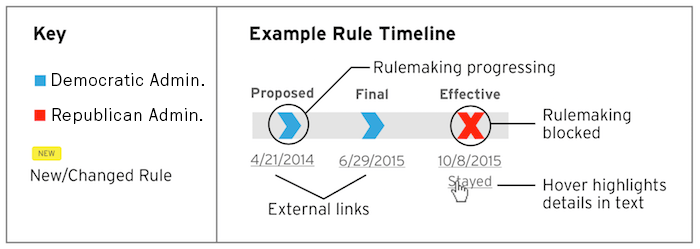
**Rescinded:** the rule has been repealed and rescinded, or withdrawn.
**Delayed:** the rule has been delayed and is not in other stages of rulemaking.
**In Rulemaking:** the rule is currently progressing in some stage of the rulemaking process.
**In Effect:** the rule is in effect and in practice.
**Unchanged:** the original regulatory rule remains unchanged.
**Partially Effective:** only part of the original rule is in effect, or some provisions are delayed.
[https://www.brookings.edu/wp-content/uploads/2026/03/Reg-Tracker-Spreadsheet-3.30.2026-v2.csv]()
*This tracker monitors a curated selection of regulatory activity developed by experts in the [Center on Regulation and Markets](https://www.brookings.edu/center/center-on-regulation-and-markets/) at Brookings. If you have questions or suggestions related to what regulatory activity is or isn’t included, or feedback on the usability of the tracker itself, we’d love to hear from you! Email [RegCenter@brookings.edu](mailto:RegCenter@brookings.edu).*
**The Brookings Institution is committed to quality, independence, and impact.** We are supported by a [diverse array of funders](https://www.brookings.edu/about-us/annual-report/). In line with our [values and policies](https://www.brookings.edu/about-us/research-independence-and-integrity-policies/), each Brookings publication represents the sole views of its author(s).
More On
- [U.S. Economy](https://www.brookings.edu/articles/tracking-regulatory-changes-in-the-second-trump-administration/)
Sub-Topics
[Regulatory Policy](https://www.brookings.edu/topics/regulatory-policy/)
Program
[Economic Studies](https://www.brookings.edu/programs/economic-studies/)
Center
[Center on Regulation and Markets](https://www.brookings.edu/centers/center-on-regulation-and-markets/)
[What are the differences between payment stablecoins and tokenized bank deposits?](https://www.brookings.edu/articles/what-are-the-differences-between-payment-stablecoins-and-tokenized-bank-deposits/)

[Cryptocurrency](https://www.brookings.edu/topics/cryptocurrency/)
What are the differences between payment stablecoins and tokenized bank deposits?
Nellie Liang
April 14, 2026
[What got lost in the global AI summit circuit?](https://www.brookings.edu/articles/what-got-lost-in-the-global-ai-summit-circuit/)

[Artificial Intelligence](https://www.brookings.edu/topics/artificial-intelligence/)
What got lost in the global AI summit circuit?
Sacha Alanoca, Chinasa T. Okolo
April 2, 2026
[Carbon pricing and inflation expectations](https://www.brookings.edu/articles/carbon-pricing-and-inflation-expectations/)

[Climate Policy](https://www.brookings.edu/topics/climate-policy/)
Carbon pricing and inflation expectations
Michael D. Bauer, Diego R. Känzig, Glenn D. Rudebusch
March 30, 2026
Get the latest from Brookings
- [twitter](https://twitter.com/BrookingsInst)
- [facebook](https://www.facebook.com/brookings)
- [linkedin](https://www.linkedin.com/company/the-brookings-institution)
- [youtube](https://www.youtube.com/user/BrookingsInstitution)
- [instagram](https://www.instagram.com/brookingsinst/)
Brookings equips decisionmakers with nonpartisan research and policy strategies to create a more prosperous and secure country and world.
[Donate](https://www.brookings.edu/support-brookings/)
- [Research Programs](https://www.brookings.edu/research-programs/)
- [Governance Studies](https://www.brookings.edu/programs/governance-studies/)
- [Economic Studies](https://www.brookings.edu/programs/economic-studies/)
- [Foreign Policy](https://www.brookings.edu/programs/foreign-policy/)
- [Global Economy and Development](https://www.brookings.edu/programs/global-economy-and-development/)
- [Brookings Metro](https://www.brookings.edu/programs/brookings-metro/)
- [About Us](https://www.brookings.edu/about-us/)
- [Leadership](https://www.brookings.edu/about-us/leadership/)
- [Careers](https://www.brookings.edu/careers/)
- [Brookings Institution Press](https://www.brookings.edu/all-books/brookings-institution-press/)
- [Contact Brookings](https://www.brookings.edu/contact-brookings/)
- [Cookie Preferences]()
- [Research & Commentary](https://www.brookings.edu/research-commentary/)
- [Experts](https://www.brookings.edu/experts/)
- [Events](https://www.brookings.edu/events/)
- [Books](https://www.brookings.edu/all-books/)
- [Podcasts](https://www.brookings.edu/podcasts/)
- [Newsletters](https://www.brookings.edu/newsletters/)
- [Privacy Policy, Updated August 2024](https://www.brookings.edu/brookings-institution-privacy-policy/)
- [Terms of Use, Updated August 2024](https://www.brookings.edu/terms-of-use/)
Copyright 2026 The Brookings Institution
 | |||||||||
| Readable Markdown | Research
March 31, 2026

U.S. President Donald Trump signs an executive order, in the Oval Office, at the White House in Washington, D.C., U.S. February 14, 2025. REUTERS/Nathan Howard
- 3 min read
**Editor's note:**
*The regulatory tracker was last updated on March 31, 2026. Rules are up to date as of March 30, 2026.*
As the Trump administration returns to office for a second term with renewed deregulatory ambitions, the executive branch and its agencies are implementing significant policy changes. The Brookings Center on Regulation and Markets Regulatory Tracker (“Reg Tracker”) provides background information and status updates on a curated selection of significant regulatory and deregulatory changes made by the Trump administration. This tracker allows you to monitor a curated selection of new, delayed, and repealed rules, notable guidance and policy revocations, executive actions, and important court battles across key policy areas such as environmental, health, labor, and more.
The Reg Tracker focuses on major regulatory changes implemented under the current Trump administration. Entries we tracked during the Biden administration and during President Trump’s first term can be accessed through the “Biden” or “Trump Term 1” archive checkboxes, respectively.
**For a more thorough explanation of the Reg Tracker, including an explanation of how entries are selected, an overview of the rulemaking process, and guidance on how to use the Reg Tracker’s interactive features,** [**click here**](https://www.brookings.edu/articles/explaining-the-brookings-regulatory-tracker/)**.** For regular updates from the Reg Tracker and new research from the Center on Regulation and Markets, subscribe to our newsletter.
[Subscribe to the Reg Tracker newsletter](https://connect.brookings.edu/regulatory-changes-in-the-biden-era)
*This tracker monitors a curated selection of regulatory activity developed by experts in the [Center on Regulation and Markets](https://www.brookings.edu/center/center-on-regulation-and-markets/) at Brookings. If you have questions or suggestions related to what regulatory activity is or isn’t included, or feedback on the usability of the tracker itself, we’d love to hear from you! Email [RegCenter@brookings.edu](mailto:RegCenter@brookings.edu).*
**The Brookings Institution is committed to quality, independence, and impact.** We are supported by a [diverse array of funders](https://www.brookings.edu/about-us/annual-report/). In line with our [values and policies](https://www.brookings.edu/about-us/research-independence-and-integrity-policies/), each Brookings publication represents the sole views of its author(s). | |||||||||
| ML Classification | ||||||||||
| ML Categories |
Raw JSON{
"/Law_and_Government": 945,
"/Law_and_Government/Legal": 789,
"/Law_and_Government/Legal/Business_and_Corporate_Law": 553
} | |||||||||
| ML Page Types |
Raw JSON{
"/Article": 667,
"/Article/News_Update": 467
} | |||||||||
| ML Intent Types |
Raw JSON{
"Informational": 997
} | |||||||||
| Content Metadata | ||||||||||
| Language | en-us | |||||||||
| Author | null | |||||||||
| Publish Time | 2026-03-31 13:10:28 (27 days ago) | |||||||||
| Original Publish Time | 2025-01-22 17:05:05 (1 year ago) | |||||||||
| Republished | Yes | |||||||||
| Word Count (Total) | 43,995 | |||||||||
| Word Count (Content) | 345 | |||||||||
| Links | ||||||||||
| External Links | 1,106 | |||||||||
| Internal Links | 101 | |||||||||
| Technical SEO | ||||||||||
| Meta Nofollow | No | |||||||||
| Meta Noarchive | No | |||||||||
| JS Rendered | Yes | |||||||||
| Redirect Target | null | |||||||||
| Performance | ||||||||||
| Download Time (ms) | 59 | |||||||||
| TTFB (ms) | 58 | |||||||||
| Download Size (bytes) | 34,664 | |||||||||
| Shard | 55 (laksa) | |||||||||
| Root Hash | 11646626373533845055 | |||||||||
| Unparsed URL | edu,brookings!www,/articles/tracking-regulatory-changes-in-the-second-trump-administration/ s443 | |||||||||