ℹ️ Skipped - page is already crawled
| Filter | Status | Condition | Details |
|---|---|---|---|
| HTTP status | PASS | download_http_code = 200 | HTTP 200 |
| Age cutoff | PASS | download_stamp > now() - 6 MONTH | 0.1 months ago |
| History drop | PASS | isNull(history_drop_reason) | No drop reason |
| Spam/ban | PASS | fh_dont_index != 1 AND ml_spam_score = 0 | ml_spam_score=0 |
| Canonical | PASS | meta_canonical IS NULL OR = '' OR = src_unparsed | Not set |
| Property | Value | |||||||||
|---|---|---|---|---|---|---|---|---|---|---|
| URL | https://www.betashares.com.au/education/what-is-an-etf/ | |||||||||
| Last Crawled | 2026-04-22 11:02:01 (1 day ago) | |||||||||
| First Indexed | 2021-01-20 14:45:46 (5 years ago) | |||||||||
| HTTP Status Code | 200 | |||||||||
| Content | ||||||||||
| Meta Title | What is an ETF? Explaining Exchange Traded Funds | Betashares | |||||||||
| Meta Description | Learn about ETFs and their benefits in minutes with our comprehensive and easy breakdown of Exchange traded funds. | |||||||||
| Meta Canonical | null | |||||||||
| Boilerpipe Text | ETF meaning: what is an ETF?
An ETF (Exchange Traded Fund) is an open-ended investment fund, similar to a traditional managed fund, but which can be bought or sold like any share on the
ASX
. Most ETFs aim to closely track the performance of an index or underlying asset, and seek to provide the returns of that index or asset – less any fees and costs.
How do ETFs work?
Unlike buying a single asset, such as a stock, an ETF provides access to a portfolio of assets in one trade, which helps to add instant diversification to a portfolio.
Offering access to almost every corner of the market and every major asset class, Exchange Traded Funds are one of the fastest-growing categories of investment products in the world.
Key takeaways
An ETF is an open-ended investment fund, similar to a traditional managed fund, that is traded on the ASX – just like any share
ETFs aim to closely track the performance of a given index or asset class, and provide the returns of that index or asset class – less any fees
ETFs offer simple-to-use, transparent, low-cost and flexible investment options for investors.
How many Australian investors use ETFs?
Exchange Traded Funds are becoming more and more
popular
amongst Australian investors. The 2025 Betashares & Investment Trends ETF Report found there are now 2.69 million investors in Australia holding ETFs in their portfolio, up from 2.2 million last year. There was an estimated 411,000 Australians making their first ETF investment in 2025. Additionally, another 300,000 Australians who expect to start investing in ETFs in the next 12 months.
New investors state “diversification” being one of the top motivators for using ETFs. Other key motivators include “saving time compared to picking individual stocks”, “easy to buy and sell” and “provides a good portfolio core”.
Benefits and risks of ETFs
Benefits
Diversification:
ETFs help investors gain exposure to a range of investment strategies, geographic regions and asset classes.
Access:
Investors can buy and sell ETFs on the ASX like any normal shares through online brokers and investment platforms. With platforms like Betashares Direct, you can buy and sell ETFs with zero brokerage fees.
Liquidity:
ETFs are traded on the Australian Securities Exchange (ASX) and can be bought and sold during the trading day.
Transparency:
Information relating to ETFs, including underlying portfolio holdings and fees, can be accessed at any time via the fund manager’s website.
Cost-effective:
Because ETFs either aim to simply track the performance of an index or asset class or rules-based methodology, there are no in-built ‘active management’ fees to worry about.
SMSF friendly:
Just like shares, ETFs are eligible to be bought inside Self-Managed Super Funds (SMSFs), and the popularity of ETFs has been growing strongly with this client base. Create a
SMSF investment strategy
using ETFs.
Risks
The primary risks of investing in ETFs come from the investment risk associated with investing in the asset class or strategy that the ETF provides access to.
For example, if you invest in an ETF which provides exposure to the broad Australian sharemarket, then movements up or down in the sharemarket will generally lead to positive or negative investment performance in the ETF. For more information on the risks of a particular ETF, please see the relevant Product Disclosure Statement (PDS).
Types of ETFs
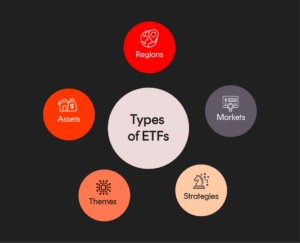
With hundreds of ETFs available on the ASX, investors have a plethora of choice to build a diversified portfolio that suits their needs. Established and emerging categories of ETFs include:
Australian shares and sectors:
Aussie large caps to financials, there is an abundance of
Australian ETFs
providing exposure to the broad Australian market, specific sectors and objectives such as generating a high level of income.
International shares and sectors:
International ETFs
which offer exposure to a range global equities are increasingly being recognized by investors for their growth potential and diversification benefits. There are funds offering exposure to the S&P 500 as well as global healthcare, technology and cybersecurity stocks, sectors which are under-represented on the Australian market.
Bonds (bond ETFs):
These ETFs wrap up bonds across a specific or range of different sectors including government debt (
government bond
) and corporate securities (
corporate bonds
) for investors’ convenience while paying regular distributions.
Cash (cash ETFs):
A cash ETF generally invests in deposit products and aims to track cash market indices. The ETF holds Australian dollars in bank accounts with several major banks in Australia and pays attractive income distributions.
AAA
Australian High Interest Cash ETF
is structured simply and offers the benefits of an investment that is accessible daily (subject to the normal ASX settlement cycle), and regular income from attractive interest rates, paid monthly.
Precious metals and commodities:
For investors seeking exposure to gold, oil or resources stocks,
commodities ETFs
offer the ability to obtain targeted exposure for diversification.
Foreign currencies:
Have a view on where the U.S. Dollar, Pound or Euro is going? Foreign
currency ETFs
can help investors bypass the inconvenience and complexity of trading in FX markets.
Digital assets (crypto ETFs):
The crypto economy has been growing strongly led by the performance of Bitcoin and Ethereum. New digital assets ETFs, such as
Betashares Crypto Innovators ETF,
offer the opportunity to invest in companies building the crypto universe. When investors refer to a ‘
Bitcoin ETF
,’ they are usually referring to a ‘spot Bitcoin ETF’.
Diversified ETFs:
With diversified ETFs, such as
Betashares Diversified All Growth ETF
, investors can gain exposure to several asset classes in one hit at a level of risk that suits their appetite. These products can save investors’ time as the
asset allocation
and investment selection is completed for them by the ETF provider.
Geared investment funds:
Otherwise known as leveraged funds, offer a cost-effective way to leverage your exposure to the sharemarket. These are actually ‘managed funds’, and not ‘ETFs’. These
geared funds
offer opportunity to increase investment exposure but also carry more risk.
Property securities:
Investors seeking income and property diversification opportunities.
ETFs can either be
passively or actively managed
, though the former dominates in Australia in terms of popularity.
Passive ETFs:
These products are designed purely to match a specific index’s performance before fees.
Passive ETFs
don’t use professional stock pickers and research specialists to build portfolios and time markets with a view to outperform the benchmark and thus have considerably lower running costs. They also publish all their holdings on a daily basis.
Active ETFs:
Actively managed ETFs
on the other hand aim to beat the index or achieve a specific return objective by utilizing a significantly higher level of human resources and trading activity. While they can potentially generate higher returns, they also generally charge higher fees for the privilege. Unlike passive ETFs, active funds don’t disclose holdings daily to keep their trades confidential.
See 21 years of data on active vs passive investments in the
SPIVA report
.
How do ETF fees work?
Like all managed funds, Exchange Traded Funds charge fees and incur costs. However, they tend to be a cost-effective managed investment option. Most ETFs are passive investments that do not charge the high active management fees charged by traditional managed funds. Learn more about
ETF fees
.
Creating an ETF portfolio
ETFs offer investors flexibility for a wide range of investment strategies. Some examples include:
Portfolio construction and asset allocation:
When it comes to
asset allocation
, ETFs can be used as core holdings in a portfolio and as building blocks for portfolio construction. For example: A ‘sector’ ETF can be used by an investor in order to simply obtain exposure to a particular industry sector such as healthcare, energy or technology companies.
Core Satellite strategy:
Core-satellite investing
involves an allocation to diversified investments, whether broad domestic or global exposures, which are essentially bought and held for the long term – this is known as the ‘core’ component.
Along with this ‘core’, more tactical positions are added to the portfolio as the more ‘actively managed’ portion – these positions form the ‘satellite’ component and can be, for example, specific regional or sector exposures
Dollar cost averaging:
Otherwise known as
DCA
, involves investing the same amount of money at regular intervals, for example monthly or quarterly – without regard to market movements. This strategy assists in mitigating market timing risk and can help you gradually accumulate wealth.
Betashares has a large selection of ETFs and other exchange tradeable funds that cater to different investor needs.
ETFs vs index funds and managed funds
There are distinct differences between how Exchange Traded Funds operate relative to unlisted index and
managed funds
, and these are important to consider in the context of building a portfolio. See more on
ETFs vs Index Funds
.
Considerations
ETFs
Unlisted index and managed funds
Pricing
A key defining feature of ETFs is that they trade like stocks on the sharemarket and can be bought and sold during ASX trading hours.
Index and managed funds prices are updated once at the end of each trading day, meaning investors have less flexibility around purchasing and selling units at set prices.
Simplicity
Because ETFs trade on the stock exchange, an investor with a brokerage account is free to buy different funds, much like shopping for different items at a supermarket with just a few clicks.
Index and managed funds are generally bought and sold directly from the issuer. The process to “purchase” or “redeem” units in a fund can also be onerous and may require completing paper-based application forms.
Minimum trade size
Like ordinary shares, the minimum initial investment in an ETF begins at $500 for most brokers (however, platforms like
Betashares Direct
allow you to invest from as little as $10), making it affordable to start your investing journey.
Depending on the fund, a minimum investment requirement of $5,000 or more is typical across unlisted index and managed funds, with subsequent minimum incremental investments of $500 or more potentially applying.
Transaction costs
Brokerage commissions and bid-ask spreads apply on each trade. With
Betashares Direct
, there is zero brokerage on ETFs.
No brokerage fees apply, however, entry and exit costs do.
How to invest in an ETF
There are three primary ways of buying and selling ETFs:
Via an online broker:
Buying and selling an ETF is very straightforward. ETFs like ASX:
NDQ
,
A200
,
ETHI
and more trade exactly like shares, so if you are able to buy and sell shares than you are able to buy and sell ETFs! Like shares, ETFs can be bought and sold at any time during the ASX trading day through a stockbroker.
That means there is no need open a separate trading account beyond your existing share brokerage account. Once your brokerage account is established, the ASX ticker of the fund is used to make a purchase or sale, without the need for any additional paperwork. In addition, this also means there is no minimum investment requirement, beyond that stipulated by your broker.
If you don’t have an online brokerage account, simply follow the sign-up procedures and once your account is activated and funded, you can start trading! Invest with
Betashares Direct
today.
Via a traditional broker:
A traditional or full-service broker generally costs more than an online broker but provides a broader array of services beyond just buying and selling ETFs and other securities. They can provide research, financial planning, estate, and superannuation services as well as access to initial public offerings.
Via a financial adviser:
Many financial planning firms are increasingly adopting ETFs as part of their service offering. While using a professional adviser comes at a higher cost, they’ll be able to build a portfolio based on your goals and risk tolerance and manage your portfolio on your behalf.
Betashares Direct
Invest in all ASX ETFs, and 500+ ASX-traded shares brokerage free. Automated investing. Low-cost managed portfolios. Create your account in minutes.
ETF structure explained
Investors should also understand whether an ETF is physical or synthetic as this constitutes part of its risk profile. There are two main types of ETFs:
Physical ETFs:
Physical ETFs own some or all of the underlying securities that make up a particular benchmark. For example, the
Betashares Australia 200 ETF
owns all of the underlying securities of the Solactive Australia 200 Index in order to accurately replicate its performance.
Synthetic ETFs:
Synthetic ETFs on the other hand use derivatives to provide exposure to an asset class that is hard to access and own physically. For example, instead of owning barrels of crude oil, a synthetic ETF tracking oil would hold a series of futures contracts that reflect changes in the price of the commodity. As a result, they generally have a higher risk profile and will face different types of risks than their physical counterparts.
In Australia, synthetic products such as the
Betashares Crude Oil Index ETF – Currency Hedged (synthetic)
must have “synthetic” marked in parentheses to help investors easily identify their structure.
Better investing starts here
Get Betashares Direct
Betashares Direct is the new investing platform designed to help you build wealth, your way.
Scan the code to download.
Learn more
Learn more
What to consider before buying an ETF
Not all ETFs are made equal. The following key factors should be considered when assessing which provider and fund you put your money in.
Reputation of the provider:
It’s important to consider how long the provider has been around, their track record and assets under management.
Betashares
is now trusted by over 1 million Australian investors and their adviser with over $50 billion in funds under management.
Quality of exposure:
What is the methodology of the index used by the ETF? Look for ETF issuers that work with reputable index providers. Some common and well known index providers are
Standard & Poor’s
,
Nasdaq
and
Solactive.
Total cost of ownership:
Compare the complete cost of buying and holding ETFs against similar products – including management fees and the transaction charges it typically incurs.
Tracking error:
Take note of how well the ETF provider has done its job in replicating the performance of the index it’s meant to track. Due to fees, passive ETFs by their nature cannot beat the index, but their returns should be very close to it.
Domicile:
The domicile, or location of the fund you are investing in is important. An
Australian domiciled ETF
can help you avoid administrative headaches like the
W-8 BEN form
that must be filled out when investing in United States domiciled funds.
Capital gains tax (CGT) and ETFs
When you sell or dispose of ETF units, a CGT event occurs. Your capital gain or loss is calculated by comparing your sale proceeds with your cost base, the original purchase price plus adjustments such as brokerage costs.
If you hold your ETF units for at least 12 months, you’re eligible for a 50% CGT discount, meaning only half of your net gain is included in assessable income.
See here for a full guide on
capital gains tax and Exchange Traded Funds
.
Where are my assets held?
ETFs are regulated unit trusts whose units trade on the ASX much like shares. They have the same legal structure as traditional managed funds and are subject to the highest form of investor protection regulation available in Australia.
The assets underlying ETFs do not form part of the assets of the product issuer. Rather, they are held on trust for the benefit of unitholders. As an extra layer of separation, the assets are normally held by an independent third party custodian appointed by the ETF issuer. This essentially means ETF assets are not available to creditors of the issuer in the unlikely event of a default.
ETF liquidity
The open-ended structure of an ETF
means that the liquidity of the ETF goes significantly beyond the ‘on-screen’ volume an investor may see on the trading screen. In fact, the liquidity of an ETF is generally at least as much as the liquidity of the underlying assets held by the ETF.
Examples of Betashares most popular ETFs
FAQs
ETF stands for Exchange-Traded Fund.
An ETF is a type of managed fund. Like traditional managed funds, ETFs can invest into many different underlying assets, offering potential diversification benefits for investment portfolios. Traditional managed funds are usually actively managed to try to outperform a benchmark index. ETFs are mostly passively managed, as they typically aim to track a benchmark index. Traditional managed funds tend to have higher management fees to pay for their active management approach, while ETFs tend to have lower fees, due to their passive, index-tracking approach. Learn more about
ETFs vs Managed Funds
.
Net asset value (NAV) represents the value of the underlying assets or holdings of the ETF, after all fees, costs and other liabilities have been deducted. NAV is not the same as market price. The market price of an ETF is the price at which ETF units are bought and sold in the course of a day’s trade on the exchange. Learn more about
NAV
.
While Betashares cannot control or influence the execution of your ETF trade, we would like to highlight the following considerations, for you to keep in mind:
Before placing your ETF trade order, check with your broker (or look at “market depth” if using an online broker) to make sure you have accurate bid-offer information. If there is an iNAV associated with the Fund, you should check this against the price at which you are planning on buying or selling the ETF to make sure you are getting close to ‘fair value’.
It may be prudent to use limit orders rather than market orders to make sure you get the price you are expecting. Limit orders allow investors to specify a buy or sell price and will only get executed at the stipulated price.
Avoid trading in the first and last 10 minutes of the trading day – at this stage there is generally a lot more volatility in share prices which may lead to wider ‘buy-sell’ spreads.
For more information on trading ETFs, click
here
.
ETFs invest in securities and other assets, and seek to provide distributions based on those underlying securities or assets. Depending on the ETF, distributions may be paid on a monthly, quarterly, half-yearly or annual basis. Depending on the ETF’s investment strategy, the distribution could be made up of dividends, interest, and/or capital gains that are realised by the ETF on the sale of underlying assets. See our guide to
dividend ETFs
or Dividend/
Distribution Reinvestment Plan (DRP)
.
Betashares Senior Investment Strategist. Supporting all Betashares distribution channels, assisting clients with portfolio construction across all asset classes, and working alongside the portfolio management team.
Prior to joining Betashares, Cameron was a portfolio manager at Macquarie Asset Management, Head of Product at Bell Potter Capital,
working on JP Morgan’s Equity Derivatives desk and at Deloitte Consulting.
Read more from Cameron.
keyboard_arrow_down | |||||||||
| Markdown | 
Individual investor
AU
[NZ](https://www.betashares.co.nz/)
**Middle East conflict: Stay up to date on the latest insights and resources**
[Learn more](https://www.betashares.com.au/middle-east-market-update/)
menu
- [Funds](https://www.betashares.com.au/fund/)
- Explore fund categories
- [Australian shares](https://www.betashares.com.au/category/australian-etfs/)
- [Global shares](https://www.betashares.com.au/category/international-etfs/)
- [Fixed income & cash](https://www.betashares.com.au/category/cash-fixed-income-etfs/)
- [Thematic](https://www.betashares.com.au/category/thematic-etfs/)
- [Commodities](https://www.betashares.com.au/category/investing-in-commodity-etfs/)
- [Gold](https://www.betashares.com.au/category/gold-etfs/)
- [Technology](https://www.betashares.com.au/category/technology-etfs/)
- [Wealth builder](https://www.betashares.com.au/category/wealth-builder/)
- [Currency hedged](https://www.betashares.com.au/category/currency-hedged/)
- [Geared funds](https://www.betashares.com.au/category/geared-funds/)
- [Equity income](https://www.betashares.com.au/category/income-equity-investments/)
- [Diversified](https://www.betashares.com.au/category/portfolio-diversification/)
- [Digital assets](https://www.betashares.com.au/fund/?category=digital-assets)
- [Sector & regions](https://www.betashares.com.au/category/global-sectors/)
- [Private assets](https://www.betashares.com.au/private/)NEW
- [New funds](https://www.betashares.com.au/fund/?category=new)
- [Responsible investing](https://www.betashares.com.au/category/ethical-etfs/)
- [Active](https://www.betashares.com.au/category/active-etfs/)
- [Currencies](https://www.betashares.com.au/category/investing-in-currency/)
- [Explore All ETFs Categories](https://www.betashares.com.au/category/)
[All funds and performance](https://www.betashares.com.au/fund/)
[All funds and performance](https://www.betashares.com.au/fund/)
Betashares Direct Portfolios
[Managed portfolios](https://www.betashares.com.au/direct/managed-portfolios)
[Core range  Diversified multi-asset portfolios](https://www.betashares.com.au/direct/managed-portfolios#core-portfolio-internal-bt-direct)
[Focused range  Themed portfolios](https://www.betashares.com.au/direct/managed-portfolios#focused-portfolio-internal-bt-direct)
[Custom portfolios](https://www.betashares.com.au/direct/custom-portfolios)
[Build your own portfolio ](https://www.betashares.com.au/direct/custom-portfolios)
Fund spotlight
[arrow\_left\_alt]()
[arrow\_right\_alt]()
[A200]()
The world’s lowest cost Australian shares index ETF
[BGBL]()
A convenient, cost-effective way to build a core portfolio allocation to global equities
[NDQ]()
Invest in the Nasdaq 100 in a single trade
[DHHF]()
Exposure to a low-cost 'all-growth' assets diversified portfolio
[A200](https://www.betashares.com.au/fund/australia-200-etf/)
Australia 200 ETF
The world’s lowest cost Australian shares index ETF
[Learn more](https://www.betashares.com.au/fund/australia-200-etf/)[Invest with us](https://www.betashares.com.au/direct/get/?symbol=A200)
[BGBL](https://www.betashares.com.au/fund/global-shares-etf/)
Global Shares ETF
A convenient, cost-effective way to build a core portfolio allocation to global equities
[Learn more](https://www.betashares.com.au/fund/global-shares-etf/)[Invest with us](https://www.betashares.com.au/direct/get/?symbol=BGBL)
[NDQ](https://www.betashares.com.au/fund/nasdaq-100-etf/)
Nasdaq 100 ETF
Invest in the Nasdaq 100 in a single trade
[Learn more](https://www.betashares.com.au/fund/nasdaq-100-etf/)[Invest with us](https://www.betashares.com.au/direct/get/?symbol=NDQ)
[DHHF](https://www.betashares.com.au/fund/diversified-all-growth-etf/)
Diversified All Growth ETF
Exposure to a low-cost 'all-growth' assets diversified portfolio
[Learn more](https://www.betashares.com.au/fund/diversified-all-growth-etf/)[Invest with us](https://www.betashares.com.au/direct/get/?symbol=DHHF)
[arrow\_left\_alt](https://www.betashares.com.au/education/what-is-an-etf/)
[arrow\_right\_alt](https://www.betashares.com.au/education/what-is-an-etf/)
- [About us](https://www.betashares.com.au/about-us/)
Betashares is dedicated to helping you build wealth.
With over \$75 billion of assets under management, Betashares currently serves thousands of advisers and more than 1 million investors.
[arrow\_forward](https://www.betashares.com.au/about-us/)
- About Betashares
- [Our approach to ESG and Stewardship](https://www.betashares.com.au/stewardship/)
- [Careers at Betashares](https://www.betashares.com.au/careers/)
- [Contact us](https://www.betashares.com.au/contact/)
- [Latest news](https://www.betashares.com.au/news/)
- Our success
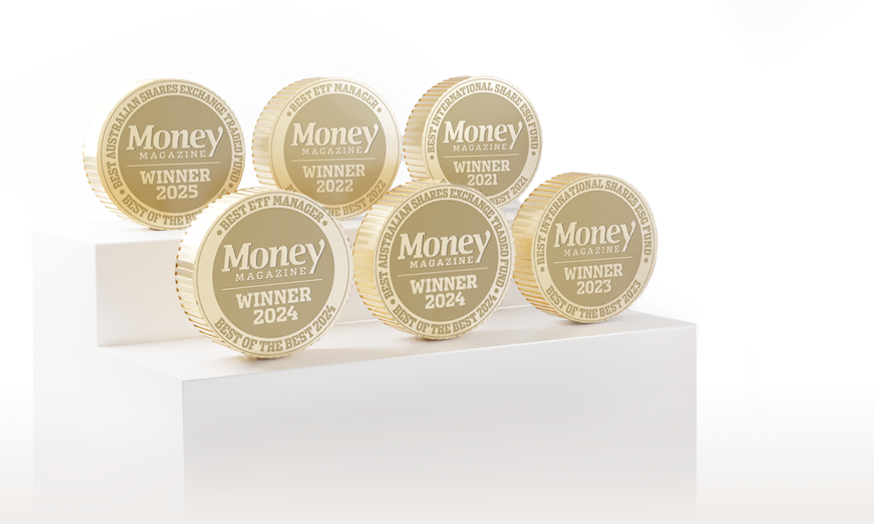
- [Betashares awards](https://www.betashares.com.au/about-us/our-awards/)
- [Resources](https://www.betashares.com.au/education/)
- Education centre
- [Investing essentials](https://www.betashares.com.au/education/#investing_fundamentals)
- [ETF essentials](https://www.betashares.com.au/education/#etf_essentials)
- [Financial literacy](https://www.betashares.com.au/education/#super__retirement)
- [Portfolio construction](https://www.betashares.com.au/education/#portfolio_construction)
- Quick links
- [New to investing](https://www.betashares.com.au/courses/investing/)
- [What is an ETF?](https://www.betashares.com.au/education/what-is-an-etf/)
- [How to buy an ETF](https://www.betashares.com.au/education/how-to-invest/)
- [SMSF Hub](https://www.betashares.com.au/smsf-investors/)
- Popular resources
- [Webinars](https://www.betashares.com.au/webinars/)
- [Betashares education courses](https://www.betashares.com.au/courses/)
- [Understanding ETF asset classes](https://www.betashares.com.au/category/)
- [Hybrids resource hub](https://www.betashares.com.au/beyond-bank-hybrids/)
- [Frequently asked questions](https://www.betashares.com.au/education/frequently-asked-questions/)
- Current investors
- [Distributions & DRP](https://www.betashares.com.au/distributions-drp/)
- [Tax information](https://www.betashares.com.au/tax-resources/)
- [Investor resources](https://www.betashares.com.au/resources/)
- [Have you registered your holdings with MUFG Corporate Markets?](https://www.betashares.com.au/register-mufg/)
Subscribe
[](https://subscriptions.betashares.com.au/)
[Explore our fund categories](https://www.betashares.com.au/category/)
[View all subscriptions](https://subscriptions.betashares.com.au/)
- [Insights](https://www.betashares.com.au/insights/)
Insights
Weekly blogs and videos with the latest investment strategies and ideas, market updates, and educational content. View all insights below:
[arrow\_forward](https://www.betashares.com.au/insights/)
Featured insights
[Your investing calendar for 2026 arrow\_forward](https://www.betashares.com.au/insights/your-investing-calendar-for-2026/)
[Iran ETF Playbook: Portfolio considerations for two potentia... arrow\_forward](https://www.betashares.com.au/insights/iran-etf-playbook/)
[The 26-year-old building financial security between jobs arrow\_forward](https://www.betashares.com.au/insights/abhilash-gupta-story/)
- Latest insights
- [Market Trends: April 2026](https://www.betashares.com.au/insights/market-trends-april-2026/)
- [How to build an income portfolio that works for you](https://www.betashares.com.au/insights/build-an-income-portfolio/)
- [Good cop, bad cop](https://www.betashares.com.au/insights/good-cop-bad-cop/)
- [Revisiting the age-old debate: Shares vs property](https://www.betashares.com.au/insights/revisiting-age-old-debate/)
- [Petrol is up. Markets are down. What usually happens next?](https://www.betashares.com.au/insights/investing-and-geopolitical-shocks/)
[View all insights](https://www.betashares.com.au/insights/)
Subscribe
[](https://subscriptions.betashares.com.au/)
[View all subscriptions](https://subscriptions.betashares.com.au/preferences)
- [Betashares Direct NEW](https://www.betashares.com.au/direct)
A new kind of investing platform
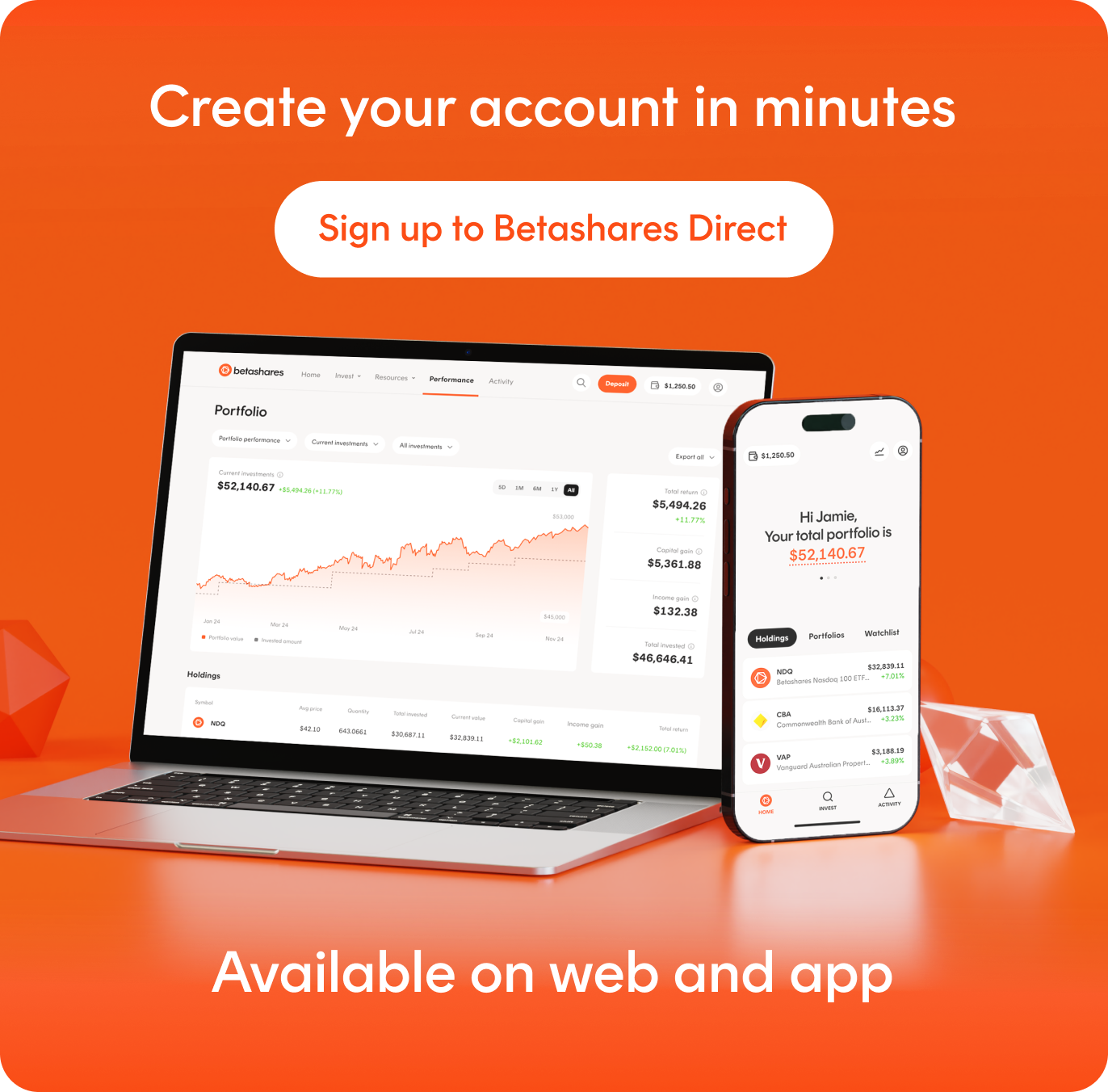
Betashares Direct is designed to help build long term-wealth. Create your account below:
[arrow\_forward](https://www.betashares.com.au/direct)
- Features
- [Zero brokerage](https://www.betashares.com.au/direct/brokerage-free)
- [Auto-invest](https://www.betashares.com.au/direct/auto-invest)
- [Transfer your portfolio](https://www.betashares.com.au/direct/transfer-holdings)
- [Account types](https://www.betashares.com.au/direct/account-types)
- [Tools & reporting](https://www.betashares.com.au/direct/tools-and-reporting)
- [Managed portfolios](https://www.betashares.com.au/direct/managed-portfolios)
- [Custom portfolios](https://www.betashares.com.au/direct/custom-portfolios)
- Help
- [FAQs](https://www.betashares.com.au/direct/faq/)
[](http://links.betashares.com.au/get)
- [Super](https://www.betashares.com.au/super/)
Bendigo Super is now part of Betashares
If you’re not a Bendigo Super member, read about our future in superannuation and what’s to come.
[Learn more →](https://www.betashares.com.au/super/non-member/)
Current Bendigo Super member resources
[Bendigo Super Home](https://www.betashares.com.au/super/)
- [Betashares Story](https://www.betashares.com.au/super/story/)
- [Bendigo SmartStart Super](https://www.betashares.com.au/super/smartstart-super/)
- [Bendigo SmartStart Pension](https://www.betashares.com.au/super/smartstart-pension/)
[Contact us keyboard\_arrow\_down](https://www.betashares.com.au/super/contact-us/)
- [Forms and documents](https://www.betashares.com.au/super/documents/)
- [Educational resources](https://www.betashares.com.au/education/?q=Super#super__retirement)
- [Corporate Governance](https://www.betashares.com.au/super/corporate-governance/)
- [Annual Members Meeting](https://www.betashares.com.au/super/amm/)
- [FAQs](https://www.betashares.com.au/super/faq/)
[ Member login ](https://client.portfolioonline.com.au/bendigosmartstart/)
[ Adviser login ](https://adviser.portfolioonline.com.au/bendigosuper/%20)
[ Employer login ](https://www.employerpay.com.au/bendigosuper)
- Funds
- Explore fund categories
- [Australian shares](https://www.betashares.com.au/category/australian-etfs/)
- [Global shares](https://www.betashares.com.au/category/international-etfs/)
- [Fixed income & cash](https://www.betashares.com.au/category/cash-fixed-income-etfs/)
- [Thematic](https://www.betashares.com.au/category/thematic-etfs/)
- [Commodities](https://www.betashares.com.au/category/investing-in-commodity-etfs/)
- [Gold](https://www.betashares.com.au/category/gold-etfs/)
- [Technology](https://www.betashares.com.au/category/technology-etfs/)
- [Wealth builder](https://www.betashares.com.au/category/wealth-builder/)
- [Currency hedged](https://www.betashares.com.au/category/currency-hedged/)
- [Geared funds](https://www.betashares.com.au/category/geared-funds/)
- [Equity income](https://www.betashares.com.au/category/income-equity-investments/)
- [Diversified](https://www.betashares.com.au/category/portfolio-diversification/)
- [Digital assets](https://www.betashares.com.au/fund/?category=digital-assets)
- [Sector & regions](https://www.betashares.com.au/category/global-sectors/)
- [Private assets](https://www.betashares.com.au/private/)NEW
- [New funds](https://www.betashares.com.au/fund/?category=new)
- [Responsible investing](https://www.betashares.com.au/category/ethical-etfs/)
- [Active](https://www.betashares.com.au/category/active-etfs/)
- [Currencies](https://www.betashares.com.au/category/investing-in-currency/)
- [Explore All ETFs Categories](https://www.betashares.com.au/category/)
[All funds and performance](https://www.betashares.com.au/fund/)
Betashares Direct Portfolios
[Managed portfolios](https://www.betashares.com.au/direct/managed-portfolios)
[Core range  Diversified multi-asset portfolios](https://www.betashares.com.au/direct/managed-portfolios#core-portfolio-internal-bt-direct)
[Focused range  Themed portfolios](https://www.betashares.com.au/direct/managed-portfolios#focused-portfolio-internal-bt-direct)
[Custom portfolios](https://www.betashares.com.au/direct/custom-portfolios)
[Build your own portfolio ](https://www.betashares.com.au/direct/custom-portfolios)
Fund spotlight
[arrow\_left\_alt]()
[arrow\_right\_alt]()
[A200]()
The world’s lowest cost Australian shares index ETF
[BGBL]()
A convenient, cost-effective way to build a core portfolio allocation to global equities
[NDQ]()
Invest in the Nasdaq 100 in a single trade
[DHHF]()
Exposure to a low-cost 'all-growth' assets diversified portfolio
[A200](https://www.betashares.com.au/fund/australia-200-etf/)
Australia 200 ETF
The world’s lowest cost Australian shares index ETF
[Learn more](https://www.betashares.com.au/fund/australia-200-etf/)[Invest with us](https://www.betashares.com.au/direct/get/?symbol=A200)
[BGBL](https://www.betashares.com.au/fund/global-shares-etf/)
Global Shares ETF
A convenient, cost-effective way to build a core portfolio allocation to global equities
[Learn more](https://www.betashares.com.au/fund/global-shares-etf/)[Invest with us](https://www.betashares.com.au/direct/get/?symbol=BGBL)
[NDQ](https://www.betashares.com.au/fund/nasdaq-100-etf/)
Nasdaq 100 ETF
Invest in the Nasdaq 100 in a single trade
[Learn more](https://www.betashares.com.au/fund/nasdaq-100-etf/)[Invest with us](https://www.betashares.com.au/direct/get/?symbol=NDQ)
[DHHF](https://www.betashares.com.au/fund/diversified-all-growth-etf/)
Diversified All Growth ETF
Exposure to a low-cost 'all-growth' assets diversified portfolio
[Learn more](https://www.betashares.com.au/fund/diversified-all-growth-etf/)[Invest with us](https://www.betashares.com.au/direct/get/?symbol=DHHF)
[arrow\_left\_alt](https://www.betashares.com.au/education/what-is-an-etf/)
[arrow\_right\_alt](https://www.betashares.com.au/education/what-is-an-etf/)
- About us
Betashares is dedicated to helping you build wealth.
With over \$75 billion of assets under management, Betashares currently serves thousands of advisers and more than 1 million investors.
[arrow\_forward](https://www.betashares.com.au/about-us/)
- About Betashares
- [Our approach to ESG and Stewardship](https://www.betashares.com.au/stewardship/)
- [Careers at Betashares](https://www.betashares.com.au/careers/)
- [Contact us](https://www.betashares.com.au/contact/)
- [Latest news](https://www.betashares.com.au/news/)
- Our success
- [Betashares awards](https://www.betashares.com.au/about-us/our-awards/)

- Resources
- Education centre
- [Investing essentials](https://www.betashares.com.au/education/#investing_fundamentals)
- [ETF essentials](https://www.betashares.com.au/education/#etf_essentials)
- [Financial literacy](https://www.betashares.com.au/education/#super__retirement)
- [Portfolio construction](https://www.betashares.com.au/education/#portfolio_construction)
- Quick links
- [New to investing](https://www.betashares.com.au/courses/investing/)
- [What is an ETF?](https://www.betashares.com.au/education/what-is-an-etf/)
- [How to buy an ETF](https://www.betashares.com.au/education/how-to-invest/)
- [SMSF Hub](https://www.betashares.com.au/smsf-investors/)
- Popular resources
- [Webinars](https://www.betashares.com.au/webinars/)
- [Betashares education courses](https://www.betashares.com.au/courses/)
- [Understanding ETF asset classes](https://www.betashares.com.au/category/)
- [Hybrids resource hub](https://www.betashares.com.au/beyond-bank-hybrids/)
- [Frequently asked questions](https://www.betashares.com.au/education/frequently-asked-questions/)
- Current investors
- [Distributions & DRP](https://www.betashares.com.au/distributions-drp/)
- [Tax information](https://www.betashares.com.au/tax-resources/)
- [Investor resources](https://www.betashares.com.au/resources/)
- [Have you registered your holdings with MUFG Corporate Markets?](https://www.betashares.com.au/register-mufg/)
Subscribe
[](https://subscriptions.betashares.com.au/)
- Insights
Insights
Weekly blogs and videos with the latest investment strategies and ideas, market updates, and educational content. View all insights below:
[arrow\_forward](https://www.betashares.com.au/insights/)
Featured insights
[Your investing calendar for 2026 arrow\_forward](https://www.betashares.com.au/insights/your-investing-calendar-for-2026/)
[Iran ETF Playbook: Portfolio considerations for two potentia... arrow\_forward](https://www.betashares.com.au/insights/iran-etf-playbook/)
[The 26-year-old building financial security between jobs arrow\_forward](https://www.betashares.com.au/insights/abhilash-gupta-story/)
- Latest insights
- [Market Trends: April 2026](https://www.betashares.com.au/insights/market-trends-april-2026/)
- [How to build an income portfolio that works for you](https://www.betashares.com.au/insights/build-an-income-portfolio/)
- [Good cop, bad cop](https://www.betashares.com.au/insights/good-cop-bad-cop/)
- [Revisiting the age-old debate: Shares vs property](https://www.betashares.com.au/insights/revisiting-age-old-debate/)
- [Petrol is up. Markets are down. What usually happens next?](https://www.betashares.com.au/insights/investing-and-geopolitical-shocks/)
Subscribe
[](https://subscriptions.betashares.com.au/)
- Betashares Direct
A new kind of investing platform
Betashares Direct is designed to help build long term-wealth. Create your account below:
[arrow\_forward](https://www.betashares.com.au/direct)
[](http://links.betashares.com.au/get)
- Features
- [Zero brokerage](https://www.betashares.com.au/direct/brokerage-free)
- [Auto-invest](https://www.betashares.com.au/direct/auto-invest)
- [Transfer your portfolio](https://www.betashares.com.au/direct/transfer-holdings)
- [Account types](https://www.betashares.com.au/direct/account-types)
- [Tools & reporting](https://www.betashares.com.au/direct/tools-and-reporting)
- [Managed portfolios](https://www.betashares.com.au/direct/managed-portfolios)
- [Custom portfolios](https://www.betashares.com.au/direct/custom-portfolios)
- Help
- [FAQs](https://www.betashares.com.au/direct/faq/)
- Super
Bendigo Super is now part of Betashares
If you’re not a Bendigo Super member, read about our future in superannuation and what’s to come.
[Learn more →](https://www.betashares.com.au/super/non-member/)
Current Bendigo Super member resources
[Bendigo Super Home](https://www.betashares.com.au/super/)
- [Betashares Story](https://www.betashares.com.au/super/story/)
- [Bendigo SmartStart Super](https://www.betashares.com.au/super/smartstart-super/)
- [Bendigo SmartStart Pension](https://www.betashares.com.au/super/smartstart-pension/)
[Contact us keyboard\_arrow\_down](https://www.betashares.com.au/super/contact-us/)
- [Forms and documents](https://www.betashares.com.au/super/documents/)
- [Educational resources](https://www.betashares.com.au/education/?q=Super#super__retirement)
- [Corporate Governance](https://www.betashares.com.au/super/corporate-governance/)
- [Annual Members Meeting](https://www.betashares.com.au/super/amm/)
- [FAQs](https://www.betashares.com.au/super/faq/)
[ Member login ](https://client.portfolioonline.com.au/bendigosmartstart/)
[ Adviser login ](https://adviser.portfolioonline.com.au/bendigosuper/%20)
[ Employer login ](https://www.employerpay.com.au/bendigosuper)
[Betashares Direct arrow\_forward](https://www.betashares.com.au/direct)
## Funds
## General results
[Home](https://www.betashares.com.au/) › [Education](https://www.betashares.com.au/education/) › What is an ETF (Exchange Traded Fund)? A Guide for Australian Investors
- [ETF meaning: what is an ETF?](https://www.betashares.com.au/education/what-is-an-etf/#section-1)
- [How do ETFs work?](https://www.betashares.com.au/education/what-is-an-etf/#section-2)
- [Benefits and risks of ETFs](https://www.betashares.com.au/education/what-is-an-etf/#section-5)
- [Types of ETFs](https://www.betashares.com.au/education/what-is-an-etf/#section-6)
- [Creating an ETF portfolio](https://www.betashares.com.au/education/what-is-an-etf/#section-8)
- [ETFs vs index funds and managed funds](https://www.betashares.com.au/education/what-is-an-etf/#section-9)
- [How to invest in an ETF](https://www.betashares.com.au/education/what-is-an-etf/#section-10)
- [ETF structure explained](https://www.betashares.com.au/education/what-is-an-etf/#section-11)
- [What to consider before buying an ETF](https://www.betashares.com.au/education/what-is-an-etf/#section-12)
- [Where are my assets held?](https://www.betashares.com.au/education/what-is-an-etf/#section-14)
- [ETF liquidity](https://www.betashares.com.au/education/what-is-an-etf/#section-15)
- [Examples of Betashares most popular ETFs](https://www.betashares.com.au/education/what-is-an-etf/#section-18)
- [FAQs](https://www.betashares.com.au/education/what-is-an-etf/#section-19)
# What is an ETF (Exchange Traded Fund)? A Guide for Australian Investors

Written By [Cameron Gleeson](https://www.betashares.com.au/author/cam-gleeson/)

### Cameron Gleeson
Betashares Senior Investment Strategist. Supporting all Betashares distribution channels, assisting clients with portfolio construction across all asset classes, and working alongside the portfolio management team. Prior to joining Betashares, Cameron was a portfolio manager at Macquarie Asset Management, Head of Product at Bell Potter Capital, working on JP Morgan’s Equity Derivatives desk and at Deloitte Consulting.
[ETF Essentials](https://www.betashares.com.au/insights/education_category/etf-essentials/)
7 April 2026
- [ETF meaning: what is an ETF?](https://www.betashares.com.au/education/what-is-an-etf/#section-1)
- [How do ETFs work?](https://www.betashares.com.au/education/what-is-an-etf/#section-2)
- [Benefits and risks of ETFs](https://www.betashares.com.au/education/what-is-an-etf/#section-5)
- [Types of ETFs](https://www.betashares.com.au/education/what-is-an-etf/#section-6)
- [Creating an ETF portfolio](https://www.betashares.com.au/education/what-is-an-etf/#section-8)
- [ETFs vs index funds and managed funds](https://www.betashares.com.au/education/what-is-an-etf/#section-9)
- [How to invest in an ETF](https://www.betashares.com.au/education/what-is-an-etf/#section-10)
- [ETF structure explained](https://www.betashares.com.au/education/what-is-an-etf/#section-11)
- [What to consider before buying an ETF](https://www.betashares.com.au/education/what-is-an-etf/#section-12)
- [Where are my assets held?](https://www.betashares.com.au/education/what-is-an-etf/#section-14)
- [ETF liquidity](https://www.betashares.com.au/education/what-is-an-etf/#section-15)
- [Examples of Betashares most popular ETFs](https://www.betashares.com.au/education/what-is-an-etf/#section-18)
- [FAQs](https://www.betashares.com.au/education/what-is-an-etf/#section-19)
### Stay informed with Betashares' weekly insights.
Receive the latest analysis and updates on markets and the economy, plus tips to help you be a better investor.
### Related articles
- [ Super in your 50s (and beyond): what matters now](https://www.betashares.com.au/education/super-in-your-50s/)
- [ Planning for retirement: practical steps to get on track](https://www.betashares.com.au/education/planning-for-retirement/)
- [ FIRE Investing in Australia: Financial Independence, Retire Early](https://www.betashares.com.au/education/fire-investing/)

Better investing starts here
Get Betashares Direct
Betashares Direct is the new investing platform designed to help you build wealth, your way.
Scan the code to download.
[Learn more](https://www.betashares.com.au/direct/)
[Learn more](https://www.betashares.com.au/direct/)
[](https://links.betashares.com.au/ios/?anonymousId=null&utm_medium=direct&utm_source=direct&route_source=https://www.betashares.com.au/education/what-is-an-etf/)
[](https://links.betashares.com.au/android/?anonymousId=null&utm_medium=direct&utm_source=direct&route_source=https://www.betashares.com.au/education/what-is-an-etf/)
## ETF meaning: what is an ETF?
An ETF (Exchange Traded Fund) is an open-ended investment fund, similar to a traditional managed fund, but which can be bought or sold like any share on the [ASX](https://www.asx.com.au/). Most ETFs aim to closely track the performance of an index or underlying asset, and seek to provide the returns of that index or asset – less any fees and costs.
## How do ETFs work?
Unlike buying a single asset, such as a stock, an ETF provides access to a portfolio of assets in one trade, which helps to add instant diversification to a portfolio.
Offering access to almost every corner of the market and every major asset class, Exchange Traded Funds are one of the fastest-growing categories of investment products in the world.
## Key takeaways
- An ETF is an open-ended investment fund, similar to a traditional managed fund, that is traded on the ASX – just like any share
- ETFs aim to closely track the performance of a given index or asset class, and provide the returns of that index or asset class – less any fees
- ETFs offer simple-to-use, transparent, low-cost and flexible investment options for investors.
## How many Australian investors use ETFs?
Exchange Traded Funds are becoming more and more [popular](https://www.afr.com/wealth/investing/what-are-etfs-and-why-are-they-so-popular-20231009-p5eavi) amongst Australian investors. The 2025 Betashares & Investment Trends ETF Report found there are now 2.69 million investors in Australia holding ETFs in their portfolio, up from 2.2 million last year. There was an estimated 411,000 Australians making their first ETF investment in 2025. Additionally, another 300,000 Australians who expect to start investing in ETFs in the next 12 months.
New investors state “diversification” being one of the top motivators for using ETFs. Other key motivators include “saving time compared to picking individual stocks”, “easy to buy and sell” and “provides a good portfolio core”.
## Benefits and risks of ETFs
### Benefits
**Diversification:** ETFs help investors gain exposure to a range of investment strategies, geographic regions and asset classes.
**Access:** Investors can buy and sell ETFs on the ASX like any normal shares through online brokers and investment platforms. With platforms like Betashares Direct, you can buy and sell ETFs with zero brokerage fees.
**Liquidity:** ETFs are traded on the Australian Securities Exchange (ASX) and can be bought and sold during the trading day.
**Transparency:** Information relating to ETFs, including underlying portfolio holdings and fees, can be accessed at any time via the fund manager’s website.
**Cost-effective:** Because ETFs either aim to simply track the performance of an index or asset class or rules-based methodology, there are no in-built ‘active management’ fees to worry about.
**SMSF friendly:** Just like shares, ETFs are eligible to be bought inside Self-Managed Super Funds (SMSFs), and the popularity of ETFs has been growing strongly with this client base. Create a [SMSF investment strategy](https://www.betashares.com.au/education/smsf-investment-strategy/) using ETFs.
### Risks
The primary risks of investing in ETFs come from the investment risk associated with investing in the asset class or strategy that the ETF provides access to.
For example, if you invest in an ETF which provides exposure to the broad Australian sharemarket, then movements up or down in the sharemarket will generally lead to positive or negative investment performance in the ETF. For more information on the risks of a particular ETF, please see the relevant Product Disclosure Statement (PDS).
## Types of ETFs
With hundreds of ETFs available on the ASX, investors have a plethora of choice to build a diversified portfolio that suits their needs. Established and emerging categories of ETFs include:
**Australian shares and sectors:** Aussie large caps to financials, there is an abundance of [Australian ETFs](https://www.betashares.com.au/category/australian-etfs/) providing exposure to the broad Australian market, specific sectors and objectives such as generating a high level of income.
**International shares and sectors:** [International ETFs](https://www.betashares.com.au/category/international-etfs/) which offer exposure to a range global equities are increasingly being recognized by investors for their growth potential and diversification benefits. There are funds offering exposure to the S\&P 500 as well as global healthcare, technology and cybersecurity stocks, sectors which are under-represented on the Australian market.
**Bonds (bond ETFs):** These ETFs wrap up bonds across a specific or range of different sectors including government debt ([government bond](https://www.betashares.com.au/education/government-bonds/)) and corporate securities ([corporate bonds](https://www.betashares.com.au/education/corporate-bonds/)) for investors’ convenience while paying regular distributions.
**Cash (cash ETFs):** A cash ETF generally invests in deposit products and aims to track cash market indices. The ETF holds Australian dollars in bank accounts with several major banks in Australia and pays attractive income distributions. [AAA](https://www.betashares.com.au/fund/high-interest-cash-etf/) [Australian High Interest Cash ETF](https://www.betashares.com.au/fund/high-interest-cash-etf/) is structured simply and offers the benefits of an investment that is accessible daily (subject to the normal ASX settlement cycle), and regular income from attractive interest rates, paid monthly.
**Precious metals and commodities:** For investors seeking exposure to gold, oil or resources stocks, [commodities ETFs](https://www.betashares.com.au/category/investing-in-commodity-etfs/) offer the ability to obtain targeted exposure for diversification.
**Foreign currencies:** Have a view on where the U.S. Dollar, Pound or Euro is going? Foreign [currency ETFs](https://www.betashares.com.au/category/investing-in-currency/) can help investors bypass the inconvenience and complexity of trading in FX markets.
**Digital assets (crypto ETFs):** The crypto economy has been growing strongly led by the performance of Bitcoin and Ethereum. New digital assets ETFs, such as [Betashares Crypto Innovators ETF,](https://www.betashares.com.au/fund/crypto-innovators-etf/) offer the opportunity to invest in companies building the crypto universe. When investors refer to a ‘[Bitcoin ETF](https://www.betashares.com.au/education/bitcoin-etf/),’ they are usually referring to a ‘spot Bitcoin ETF’.
**Diversified ETFs:** With diversified ETFs, such as [Betashares Diversified All Growth ETF](https://www.betashares.com.au/fund/diversified-all-growth-etf/), investors can gain exposure to several asset classes in one hit at a level of risk that suits their appetite. These products can save investors’ time as the [asset allocation](https://www.betashares.com.au/education/portfolio-compatibility-its-not-you-its-my-asset-allocation/) and investment selection is completed for them by the ETF provider.
**Geared investment funds:** Otherwise known as leveraged funds, offer a cost-effective way to leverage your exposure to the sharemarket. These are actually ‘managed funds’, and not ‘ETFs’. These [geared funds](https://www.betashares.com.au/category/geared-funds/) offer opportunity to increase investment exposure but also carry more risk.
**Property securities:** Investors seeking income and property diversification opportunities.
ETFs can either be [passively or actively managed](https://www.betashares.com.au/education/active-vs-passive-investing/), though the former dominates in Australia in terms of popularity.
**Passive ETFs:** These products are designed purely to match a specific index’s performance before fees. [Passive ETFs](https://www.betashares.com.au/category/passive-etfs-passive-investing-betashares/) don’t use professional stock pickers and research specialists to build portfolios and time markets with a view to outperform the benchmark and thus have considerably lower running costs. They also publish all their holdings on a daily basis.
**Active ETFs:** [Actively managed ETFs](https://www.betashares.com.au/category/active-etfs/) on the other hand aim to beat the index or achieve a specific return objective by utilizing a significantly higher level of human resources and trading activity. While they can potentially generate higher returns, they also generally charge higher fees for the privilege. Unlike passive ETFs, active funds don’t disclose holdings daily to keep their trades confidential.
See 21 years of data on active vs passive investments in the [SPIVA report](https://www.betashares.com.au/insights/spiva-report-active-vs-passive/).
## How do ETF fees work?
Like all managed funds, Exchange Traded Funds charge fees and incur costs. However, they tend to be a cost-effective managed investment option. Most ETFs are passive investments that do not charge the high active management fees charged by traditional managed funds. Learn more about [ETF fees](https://www.betashares.com.au/education/how-do-etf-fees-work/).
## Creating an ETF portfolio
ETFs offer investors flexibility for a wide range of investment strategies. Some examples include:
**Portfolio construction and asset allocation:** When it comes to [asset allocation](https://www.betashares.com.au/education/portfolio-compatibility-its-not-you-its-my-asset-allocation/), ETFs can be used as core holdings in a portfolio and as building blocks for portfolio construction. For example: A ‘sector’ ETF can be used by an investor in order to simply obtain exposure to a particular industry sector such as healthcare, energy or technology companies.
**Core Satellite strategy:** [Core-satellite investing](https://www.betashares.com.au/education/core-satellite-investing/) involves an allocation to diversified investments, whether broad domestic or global exposures, which are essentially bought and held for the long term – this is known as the ‘core’ component.
Along with this ‘core’, more tactical positions are added to the portfolio as the more ‘actively managed’ portion – these positions form the ‘satellite’ component and can be, for example, specific regional or sector exposures
**Dollar cost averaging:** Otherwise known as [DCA](https://www.betashares.com.au/education/dollar-cost-averaging-taking-time-out-of-the-investment-equation/), involves investing the same amount of money at regular intervals, for example monthly or quarterly – without regard to market movements. This strategy assists in mitigating market timing risk and can help you gradually accumulate wealth.
Betashares has a large selection of ETFs and other exchange tradeable funds that cater to different investor needs.
## View all our funds
[Explore more](https://www.betashares.com.au/fund/)
## ETFs vs index funds and managed funds
There are distinct differences between how Exchange Traded Funds operate relative to unlisted index and [managed funds](https://www.betashares.com.au/education/etfs-vs-managed-funds/), and these are important to consider in the context of building a portfolio. See more on [ETFs vs Index Funds](https://www.betashares.com.au/education/etf-vs-index-fund/).
| | | |
|---|---|---|
| **Considerations** | **ETFs** | **Unlisted index and managed funds** |
| **Pricing** | A key defining feature of ETFs is that they trade like stocks on the sharemarket and can be bought and sold during ASX trading hours. | Index and managed funds prices are updated once at the end of each trading day, meaning investors have less flexibility around purchasing and selling units at set prices. |
| **Simplicity** | Because ETFs trade on the stock exchange, an investor with a brokerage account is free to buy different funds, much like shopping for different items at a supermarket with just a few clicks. | Index and managed funds are generally bought and sold directly from the issuer. The process to “purchase” or “redeem” units in a fund can also be onerous and may require completing paper-based application forms. |
| **Minimum trade size** | Like ordinary shares, the minimum initial investment in an ETF begins at \$500 for most brokers (however, platforms like [Betashares Direct](https://www.betashares.com.au/direct) allow you to invest from as little as \$10), making it affordable to start your investing journey. | Depending on the fund, a minimum investment requirement of \$5,000 or more is typical across unlisted index and managed funds, with subsequent minimum incremental investments of \$500 or more potentially applying. |
| **Transaction costs** | Brokerage commissions and bid-ask spreads apply on each trade. With [Betashares Direct](https://www.betashares.com.au/direct), there is zero brokerage on ETFs. | No brokerage fees apply, however, entry and exit costs do. |
## How to invest in an ETF
There are three primary ways of buying and selling ETFs:
**Via an online broker:** Buying and selling an ETF is very straightforward. ETFs like ASX: [NDQ](https://www.betashares.com.au/fund/nasdaq-100-etf/), [A200](https://www.betashares.com.au/fund/australia-200-etf/), [ETHI](https://www.betashares.com.au/fund/global-sustainability-leaders-etf/) and more trade exactly like shares, so if you are able to buy and sell shares than you are able to buy and sell ETFs! Like shares, ETFs can be bought and sold at any time during the ASX trading day through a stockbroker.
That means there is no need open a separate trading account beyond your existing share brokerage account. Once your brokerage account is established, the ASX ticker of the fund is used to make a purchase or sale, without the need for any additional paperwork. In addition, this also means there is no minimum investment requirement, beyond that stipulated by your broker.
If you don’t have an online brokerage account, simply follow the sign-up procedures and once your account is activated and funded, you can start trading! Invest with [Betashares Direct](https://www.betashares.com.au/direct) today.
**Via a traditional broker:** A traditional or full-service broker generally costs more than an online broker but provides a broader array of services beyond just buying and selling ETFs and other securities. They can provide research, financial planning, estate, and superannuation services as well as access to initial public offerings.
**Via a financial adviser:** Many financial planning firms are increasingly adopting ETFs as part of their service offering. While using a professional adviser comes at a higher cost, they’ll be able to build a portfolio based on your goals and risk tolerance and manage your portfolio on your behalf.
## Betashares Direct
Invest in all ASX ETFs, and 500+ ASX-traded shares brokerage free. Automated investing. Low-cost managed portfolios. Create your account in minutes.
[Explore now](https://www.betashares.com.au/direct)
## ETF structure explained
Investors should also understand whether an ETF is physical or synthetic as this constitutes part of its risk profile. There are two main types of ETFs:
**Physical ETFs:** Physical ETFs own some or all of the underlying securities that make up a particular benchmark. For example, the [Betashares Australia 200 ETF](https://www.betashares.com.au/fund/australia-200-etf/) owns all of the underlying securities of the Solactive Australia 200 Index in order to accurately replicate its performance.
**Synthetic ETFs:** Synthetic ETFs on the other hand use derivatives to provide exposure to an asset class that is hard to access and own physically. For example, instead of owning barrels of crude oil, a synthetic ETF tracking oil would hold a series of futures contracts that reflect changes in the price of the commodity. As a result, they generally have a higher risk profile and will face different types of risks than their physical counterparts.
In Australia, synthetic products such as the [Betashares Crude Oil Index ETF – Currency Hedged (synthetic)](https://www.betashares.com.au/fund/oil-etf-betashares/) must have “synthetic” marked in parentheses to help investors easily identify their structure.

Better investing starts here
Get Betashares Direct
Betashares Direct is the new investing platform designed to help you build wealth, your way.
Scan the code to download.
[Learn more](https://www.betashares.com.au/direct/)
[Learn more](https://www.betashares.com.au/direct/)
[](https://links.betashares.com.au/ios/?anonymousId=null&utm_medium=direct&utm_source=direct&route_source=https://www.betashares.com.au/education/what-is-an-etf/)
[](https://links.betashares.com.au/android/?anonymousId=null&utm_medium=direct&utm_source=direct&route_source=https://www.betashares.com.au/education/what-is-an-etf/)
## What to consider before buying an ETF
Not all ETFs are made equal. The following key factors should be considered when assessing which provider and fund you put your money in.
**Reputation of the provider:** It’s important to consider how long the provider has been around, their track record and assets under management. [Betashares](https://www.afr.com/chanticleer/story-of-change-in-rise-of-betashares-decline-of-perpetual-and-amp-20240617-p5jmhc) is now trusted by over 1 million Australian investors and their adviser with over \$50 billion in funds under management.
**Quality of exposure:** What is the methodology of the index used by the ETF? Look for ETF issuers that work with reputable index providers. Some common and well known index providers are [Standard & Poor’s](https://www.spglobal.com/en), [Nasdaq](https://www.nasdaq.com/) and [Solactive.](https://www.solactive.com/)
**Total cost of ownership:** Compare the complete cost of buying and holding ETFs against similar products – including management fees and the transaction charges it typically incurs.
**Tracking error:** Take note of how well the ETF provider has done its job in replicating the performance of the index it’s meant to track. Due to fees, passive ETFs by their nature cannot beat the index, but their returns should be very close to it.
**Domicile:** The domicile, or location of the fund you are investing in is important. An [Australian domiciled ETF](https://www.betashares.com.au/insights/is-your-etf-australian-domiciled) can help you avoid administrative headaches like the [W-8 BEN form](https://www.betashares.com.au/education/w8-ben-forms/) that must be filled out when investing in United States domiciled funds.
## Capital gains tax (CGT) and ETFs
When you sell or dispose of ETF units, a CGT event occurs. Your capital gain or loss is calculated by comparing your sale proceeds with your cost base, the original purchase price plus adjustments such as brokerage costs.
If you hold your ETF units for at least 12 months, you’re eligible for a 50% CGT discount, meaning only half of your net gain is included in assessable income.
See here for a full guide on [capital gains tax and Exchange Traded Funds](https://www.betashares.com.au/education/capital-gains-on-etfs/).
## Where are my assets held?
ETFs are regulated unit trusts whose units trade on the ASX much like shares. They have the same legal structure as traditional managed funds and are subject to the highest form of investor protection regulation available in Australia.
The assets underlying ETFs do not form part of the assets of the product issuer. Rather, they are held on trust for the benefit of unitholders. As an extra layer of separation, the assets are normally held by an independent third party custodian appointed by the ETF issuer. This essentially means ETF assets are not available to creditors of the issuer in the unlikely event of a default.
## ETF liquidity
[The open-ended structure of an ETF](https://www.betashares.com.au/education/how-are-etfs-created-and-why-does-it-matter/) means that the liquidity of the ETF goes significantly beyond the ‘on-screen’ volume an investor may see on the trading screen. In fact, the liquidity of an ETF is generally at least as much as the liquidity of the underlying assets held by the ETF.
## Examples of Betashares most popular ETFs
[DHHF](https://www.betashares.com.au/fund/diversified-all-growth-etf/)
[Diversified All Growth ETF keyboard\_arrow\_down](https://www.betashares.com.au/fund/diversified-all-growth-etf/)
Exposure to a low-cost 'all-growth' assets diversified portfolio
[Fund page → keyboard\_arrow\_down](https://www.betashares.com.au/fund/diversified-all-growth-etf/)
[Download factsheet → keyboard\_arrow\_down](https://www.betashares.com.au/files/factsheets/DHHF-Factsheet.pdf)
[A200](https://www.betashares.com.au/fund/australia-200-etf/)
[Australia 200 ETF keyboard\_arrow\_down](https://www.betashares.com.au/fund/australia-200-etf/)
The world’s lowest cost Australian shares index ETF
[Fund page → keyboard\_arrow\_down](https://www.betashares.com.au/fund/australia-200-etf/)
[Download factsheet → keyboard\_arrow\_down](https://www.betashares.com.au/files/factsheets/A200-Factsheet.pdf)
[NDQ](https://www.betashares.com.au/fund/nasdaq-100-etf/)
[Nasdaq 100 ETF keyboard\_arrow\_down](https://www.betashares.com.au/fund/nasdaq-100-etf/)
Invest in the Nasdaq 100 in a single trade
[Fund page → keyboard\_arrow\_down](https://www.betashares.com.au/fund/nasdaq-100-etf/)
[Download factsheet → keyboard\_arrow\_down](https://www.betashares.com.au/files/factsheets/NDQ-Factsheet.pdf)
## FAQs
What does ETF stand for?
expand\_more
ETF stands for Exchange-Traded Fund.
Is an ETF a managed fund?
expand\_more
An ETF is a type of managed fund. Like traditional managed funds, ETFs can invest into many different underlying assets, offering potential diversification benefits for investment portfolios. Traditional managed funds are usually actively managed to try to outperform a benchmark index. ETFs are mostly passively managed, as they typically aim to track a benchmark index. Traditional managed funds tend to have higher management fees to pay for their active management approach, while ETFs tend to have lower fees, due to their passive, index-tracking approach. Learn more about [ETFs vs Managed Funds](https://www.betashares.com.au/education/etfs-vs-managed-funds/).
How is the price of an ETF determined?
expand\_more
Net asset value (NAV) represents the value of the underlying assets or holdings of the ETF, after all fees, costs and other liabilities have been deducted. NAV is not the same as market price. The market price of an ETF is the price at which ETF units are bought and sold in the course of a day’s trade on the exchange. Learn more about [NAV](https://www.betashares.com.au/education/what-is-an-etfs-net-asset-value-and-inav/).
What should I consider before executing an ETF trade?
expand\_more
While Betashares cannot control or influence the execution of your ETF trade, we would like to highlight the following considerations, for you to keep in mind:
Before placing your ETF trade order, check with your broker (or look at “market depth” if using an online broker) to make sure you have accurate bid-offer information. If there is an iNAV associated with the Fund, you should check this against the price at which you are planning on buying or selling the ETF to make sure you are getting close to ‘fair value’.
It may be prudent to use limit orders rather than market orders to make sure you get the price you are expecting. Limit orders allow investors to specify a buy or sell price and will only get executed at the stipulated price.
Avoid trading in the first and last 10 minutes of the trading day – at this stage there is generally a lot more volatility in share prices which may lead to wider ‘buy-sell’ spreads.
For more information on trading ETFs, click [here](https://www.betashares.com.au/education/6-considerations-for-buying-selling-exchange-traded-funds/).
Do ETFs pay dividends?
expand\_more
ETFs invest in securities and other assets, and seek to provide distributions based on those underlying securities or assets. Depending on the ETF, distributions may be paid on a monthly, quarterly, half-yearly or annual basis. Depending on the ETF’s investment strategy, the distribution could be made up of dividends, interest, and/or capital gains that are realised by the ETF on the sale of underlying assets. See our guide to [dividend ETFs](https://www.betashares.com.au/education/dividend-etfs/) or Dividend/[Distribution Reinvestment Plan (DRP)](https://www.betashares.com.au/education/drp-the-ultimate-short-term-pain-long-term-gain-trade-off/).

Written By
[Cameron Gleeson](https://www.betashares.com.au/author/cam-gleeson/)
Senior Investment Strategist
Betashares Senior Investment Strategist. Supporting all Betashares distribution channels, assisting clients with portfolio construction across all asset classes, and working alongside the portfolio management team. Prior to joining Betashares, Cameron was a portfolio manager at Macquarie Asset Management, Head of Product at Bell Potter Capital, working on JP Morgan’s Equity Derivatives desk and at Deloitte Consulting.
[Read more from Cameron. keyboard\_arrow\_down](https://www.betashares.com.au/author/cam-gleeson/)
#### Sign up to our weekly insights newsletter
#### Our funds
- [Compare funds](https://www.betashares.com.au/fund/)
#### Get started
- [Insights](https://www.betashares.com.au/insights/)
- [Betashares explains](https://www.betashares.com.au/courses/)
- [Types of investments and asset classes](https://www.betashares.com.au/category/)
#### About us
- [Our approach to ESG](https://www.betashares.com.au/stewardship/)
- [Careers at Betashares](https://www.betashares.com.au/careers/)
- [Contact us](https://www.betashares.com.au/contact/)
#### Resources
- [Distributions and DRP](https://www.betashares.com.au/distributions-drp/)
- [ETF tax resources](https://www.betashares.com.au/tax-resources/)
- [Regulatory resources](https://www.betashares.com.au/regulatory-resources/)
- [Terms & Conditions](https://www.betashares.com.au/terms-conditions/)
- [Privacy Policy](https://www.betashares.com.au/privacy-policy/)
- [Complaints Handling Policy](https://www.betashares.com.au/complaints-handling-policy/)
- [Authorised Participants](https://www.betashares.com.au/authorised-participants/)
- [Target Market Determinations](https://www.betashares.com.au/target-market-determinations/)
Betashares Capital Ltd (ABN 78 139 566 868 AFSL 341181) (Betashares) is the responsible entity and issuer of the Betashares Funds, as well as Betashares Invest, the IDPS-like scheme available through Betashares Direct. Bendigo Superannuation Pty Ltd (ABN 23 644 620 128 AFSL 534006) (Bendigo Super) is the trustee of the Bendigo Superannuation Plan (ABN 57 526 653 420), which includes the Bendigo SmartStart Super and Bendigo SmartStart Pension (Super Products).
Before making an investment decision, read the relevant Product Disclosure Statement (PDS), available at: (i) [www.betashares.com.au](http://www.betashares.com.au/) or by calling 1300 487 577 for the Betashares Funds, (ii) [www.betashares.com.au/super](http://www.betashares.com.au/super) or by calling 1800 033 426 for the Super Products, and (iii) [www.betashares.com.au/direct](http://www.betashares.com.au/direct) for Betashares Invest. You can also obtain a copy of any Betashares disclosure document by emailing Customer Support at [support@betashares.com.au](mailto:support@betashares.com.au).
You may also wish to consider the relevant Target Market Determination, which sets out the class of consumers that comprise the target market for the relevant Betashares product, available: (i) at [www.betashares.com.au/target-market-determinations](http://www.betashares.com.au/target-market-determinations) for the Betashares Funds, (ii) [here](https://www.betashares.com.au/files/super/BendigoSuper/TMD/tmd-bendigo-smartstart-super-update.pdf) for Bendigo SmartStart Super Target Market Determination and [here](https://www.betashares.com.au/files/super/BendigoSuper/TMD/tmd-bendigo-smartstart-pension-update.pdf) for Bendigo SmartStart Pension, and (iii) at [www.betashares.com.au/direct](http://www.betashares.com.au/direct) for Betashares Invest.
Investments in the Betashares products are subject to investment risk and the value of units may go up and down. The performance of any Betashares product is not guaranteed by Betashares, Bendigo Super or any other person.
This information is general in nature and doesn’t take into account any person’s financial objectives, situation or needs. You should consider its appropriateness taking into account such factors and seek professional financial advice.
[Feedback]()
Close
What type of investor are you?
###

This content is for financial adviser use only.
By clicking on 'Financial professional', you certify that you are an Australian financial services licensee or authorised representative, and are authorised to provide personal advice to retail clients in relation to managed investment schemes.
[Financial professional]()
[Individual investor]()

Feedback
[close]()
[close]()
Notifications | |||||||||
| Readable Markdown | ## ETF meaning: what is an ETF?
An ETF (Exchange Traded Fund) is an open-ended investment fund, similar to a traditional managed fund, but which can be bought or sold like any share on the [ASX](https://www.asx.com.au/). Most ETFs aim to closely track the performance of an index or underlying asset, and seek to provide the returns of that index or asset – less any fees and costs.
## How do ETFs work?
Unlike buying a single asset, such as a stock, an ETF provides access to a portfolio of assets in one trade, which helps to add instant diversification to a portfolio.
Offering access to almost every corner of the market and every major asset class, Exchange Traded Funds are one of the fastest-growing categories of investment products in the world.
## Key takeaways
- An ETF is an open-ended investment fund, similar to a traditional managed fund, that is traded on the ASX – just like any share
- ETFs aim to closely track the performance of a given index or asset class, and provide the returns of that index or asset class – less any fees
- ETFs offer simple-to-use, transparent, low-cost and flexible investment options for investors.
## How many Australian investors use ETFs?
Exchange Traded Funds are becoming more and more [popular](https://www.afr.com/wealth/investing/what-are-etfs-and-why-are-they-so-popular-20231009-p5eavi) amongst Australian investors. The 2025 Betashares & Investment Trends ETF Report found there are now 2.69 million investors in Australia holding ETFs in their portfolio, up from 2.2 million last year. There was an estimated 411,000 Australians making their first ETF investment in 2025. Additionally, another 300,000 Australians who expect to start investing in ETFs in the next 12 months.
New investors state “diversification” being one of the top motivators for using ETFs. Other key motivators include “saving time compared to picking individual stocks”, “easy to buy and sell” and “provides a good portfolio core”.
## Benefits and risks of ETFs
### Benefits
**Diversification:** ETFs help investors gain exposure to a range of investment strategies, geographic regions and asset classes.
**Access:** Investors can buy and sell ETFs on the ASX like any normal shares through online brokers and investment platforms. With platforms like Betashares Direct, you can buy and sell ETFs with zero brokerage fees.
**Liquidity:** ETFs are traded on the Australian Securities Exchange (ASX) and can be bought and sold during the trading day.
**Transparency:** Information relating to ETFs, including underlying portfolio holdings and fees, can be accessed at any time via the fund manager’s website.
**Cost-effective:** Because ETFs either aim to simply track the performance of an index or asset class or rules-based methodology, there are no in-built ‘active management’ fees to worry about.
**SMSF friendly:** Just like shares, ETFs are eligible to be bought inside Self-Managed Super Funds (SMSFs), and the popularity of ETFs has been growing strongly with this client base. Create a [SMSF investment strategy](https://www.betashares.com.au/education/smsf-investment-strategy/) using ETFs.
### Risks
The primary risks of investing in ETFs come from the investment risk associated with investing in the asset class or strategy that the ETF provides access to.
For example, if you invest in an ETF which provides exposure to the broad Australian sharemarket, then movements up or down in the sharemarket will generally lead to positive or negative investment performance in the ETF. For more information on the risks of a particular ETF, please see the relevant Product Disclosure Statement (PDS).
## Types of ETFs
With hundreds of ETFs available on the ASX, investors have a plethora of choice to build a diversified portfolio that suits their needs. Established and emerging categories of ETFs include:
**Australian shares and sectors:** Aussie large caps to financials, there is an abundance of [Australian ETFs](https://www.betashares.com.au/category/australian-etfs/) providing exposure to the broad Australian market, specific sectors and objectives such as generating a high level of income.
**International shares and sectors:** [International ETFs](https://www.betashares.com.au/category/international-etfs/) which offer exposure to a range global equities are increasingly being recognized by investors for their growth potential and diversification benefits. There are funds offering exposure to the S\&P 500 as well as global healthcare, technology and cybersecurity stocks, sectors which are under-represented on the Australian market.
**Bonds (bond ETFs):** These ETFs wrap up bonds across a specific or range of different sectors including government debt ([government bond](https://www.betashares.com.au/education/government-bonds/)) and corporate securities ([corporate bonds](https://www.betashares.com.au/education/corporate-bonds/)) for investors’ convenience while paying regular distributions.
**Cash (cash ETFs):** A cash ETF generally invests in deposit products and aims to track cash market indices. The ETF holds Australian dollars in bank accounts with several major banks in Australia and pays attractive income distributions. [AAA](https://www.betashares.com.au/fund/high-interest-cash-etf/) [Australian High Interest Cash ETF](https://www.betashares.com.au/fund/high-interest-cash-etf/) is structured simply and offers the benefits of an investment that is accessible daily (subject to the normal ASX settlement cycle), and regular income from attractive interest rates, paid monthly.
**Precious metals and commodities:** For investors seeking exposure to gold, oil or resources stocks, [commodities ETFs](https://www.betashares.com.au/category/investing-in-commodity-etfs/) offer the ability to obtain targeted exposure for diversification.
**Foreign currencies:** Have a view on where the U.S. Dollar, Pound or Euro is going? Foreign [currency ETFs](https://www.betashares.com.au/category/investing-in-currency/) can help investors bypass the inconvenience and complexity of trading in FX markets.
**Digital assets (crypto ETFs):** The crypto economy has been growing strongly led by the performance of Bitcoin and Ethereum. New digital assets ETFs, such as [Betashares Crypto Innovators ETF,](https://www.betashares.com.au/fund/crypto-innovators-etf/) offer the opportunity to invest in companies building the crypto universe. When investors refer to a ‘[Bitcoin ETF](https://www.betashares.com.au/education/bitcoin-etf/),’ they are usually referring to a ‘spot Bitcoin ETF’.
**Diversified ETFs:** With diversified ETFs, such as [Betashares Diversified All Growth ETF](https://www.betashares.com.au/fund/diversified-all-growth-etf/), investors can gain exposure to several asset classes in one hit at a level of risk that suits their appetite. These products can save investors’ time as the [asset allocation](https://www.betashares.com.au/education/portfolio-compatibility-its-not-you-its-my-asset-allocation/) and investment selection is completed for them by the ETF provider.
**Geared investment funds:** Otherwise known as leveraged funds, offer a cost-effective way to leverage your exposure to the sharemarket. These are actually ‘managed funds’, and not ‘ETFs’. These [geared funds](https://www.betashares.com.au/category/geared-funds/) offer opportunity to increase investment exposure but also carry more risk.
**Property securities:** Investors seeking income and property diversification opportunities.

ETFs can either be [passively or actively managed](https://www.betashares.com.au/education/active-vs-passive-investing/), though the former dominates in Australia in terms of popularity.
**Passive ETFs:** These products are designed purely to match a specific index’s performance before fees. [Passive ETFs](https://www.betashares.com.au/category/passive-etfs-passive-investing-betashares/) don’t use professional stock pickers and research specialists to build portfolios and time markets with a view to outperform the benchmark and thus have considerably lower running costs. They also publish all their holdings on a daily basis.
**Active ETFs:** [Actively managed ETFs](https://www.betashares.com.au/category/active-etfs/) on the other hand aim to beat the index or achieve a specific return objective by utilizing a significantly higher level of human resources and trading activity. While they can potentially generate higher returns, they also generally charge higher fees for the privilege. Unlike passive ETFs, active funds don’t disclose holdings daily to keep their trades confidential.
See 21 years of data on active vs passive investments in the [SPIVA report](https://www.betashares.com.au/insights/spiva-report-active-vs-passive/).
## How do ETF fees work?
Like all managed funds, Exchange Traded Funds charge fees and incur costs. However, they tend to be a cost-effective managed investment option. Most ETFs are passive investments that do not charge the high active management fees charged by traditional managed funds. Learn more about [ETF fees](https://www.betashares.com.au/education/how-do-etf-fees-work/).
## Creating an ETF portfolio
ETFs offer investors flexibility for a wide range of investment strategies. Some examples include:
**Portfolio construction and asset allocation:** When it comes to [asset allocation](https://www.betashares.com.au/education/portfolio-compatibility-its-not-you-its-my-asset-allocation/), ETFs can be used as core holdings in a portfolio and as building blocks for portfolio construction. For example: A ‘sector’ ETF can be used by an investor in order to simply obtain exposure to a particular industry sector such as healthcare, energy or technology companies.
**Core Satellite strategy:** [Core-satellite investing](https://www.betashares.com.au/education/core-satellite-investing/) involves an allocation to diversified investments, whether broad domestic or global exposures, which are essentially bought and held for the long term – this is known as the ‘core’ component.
Along with this ‘core’, more tactical positions are added to the portfolio as the more ‘actively managed’ portion – these positions form the ‘satellite’ component and can be, for example, specific regional or sector exposures
**Dollar cost averaging:** Otherwise known as [DCA](https://www.betashares.com.au/education/dollar-cost-averaging-taking-time-out-of-the-investment-equation/), involves investing the same amount of money at regular intervals, for example monthly or quarterly – without regard to market movements. This strategy assists in mitigating market timing risk and can help you gradually accumulate wealth.
Betashares has a large selection of ETFs and other exchange tradeable funds that cater to different investor needs.
## ETFs vs index funds and managed funds
There are distinct differences between how Exchange Traded Funds operate relative to unlisted index and [managed funds](https://www.betashares.com.au/education/etfs-vs-managed-funds/), and these are important to consider in the context of building a portfolio. See more on [ETFs vs Index Funds](https://www.betashares.com.au/education/etf-vs-index-fund/).
| | | |
|---|---|---|
| **Considerations** | **ETFs** | **Unlisted index and managed funds** |
| **Pricing** | A key defining feature of ETFs is that they trade like stocks on the sharemarket and can be bought and sold during ASX trading hours. | Index and managed funds prices are updated once at the end of each trading day, meaning investors have less flexibility around purchasing and selling units at set prices. |
| **Simplicity** | Because ETFs trade on the stock exchange, an investor with a brokerage account is free to buy different funds, much like shopping for different items at a supermarket with just a few clicks. | Index and managed funds are generally bought and sold directly from the issuer. The process to “purchase” or “redeem” units in a fund can also be onerous and may require completing paper-based application forms. |
| **Minimum trade size** | Like ordinary shares, the minimum initial investment in an ETF begins at \$500 for most brokers (however, platforms like [Betashares Direct](https://www.betashares.com.au/direct) allow you to invest from as little as \$10), making it affordable to start your investing journey. | Depending on the fund, a minimum investment requirement of \$5,000 or more is typical across unlisted index and managed funds, with subsequent minimum incremental investments of \$500 or more potentially applying. |
| **Transaction costs** | Brokerage commissions and bid-ask spreads apply on each trade. With [Betashares Direct](https://www.betashares.com.au/direct), there is zero brokerage on ETFs. | No brokerage fees apply, however, entry and exit costs do. |
## How to invest in an ETF
There are three primary ways of buying and selling ETFs:
**Via an online broker:** Buying and selling an ETF is very straightforward. ETFs like ASX: [NDQ](https://www.betashares.com.au/fund/nasdaq-100-etf/), [A200](https://www.betashares.com.au/fund/australia-200-etf/), [ETHI](https://www.betashares.com.au/fund/global-sustainability-leaders-etf/) and more trade exactly like shares, so if you are able to buy and sell shares than you are able to buy and sell ETFs! Like shares, ETFs can be bought and sold at any time during the ASX trading day through a stockbroker.
That means there is no need open a separate trading account beyond your existing share brokerage account. Once your brokerage account is established, the ASX ticker of the fund is used to make a purchase or sale, without the need for any additional paperwork. In addition, this also means there is no minimum investment requirement, beyond that stipulated by your broker.
If you don’t have an online brokerage account, simply follow the sign-up procedures and once your account is activated and funded, you can start trading! Invest with [Betashares Direct](https://www.betashares.com.au/direct) today.
**Via a traditional broker:** A traditional or full-service broker generally costs more than an online broker but provides a broader array of services beyond just buying and selling ETFs and other securities. They can provide research, financial planning, estate, and superannuation services as well as access to initial public offerings.
**Via a financial adviser:** Many financial planning firms are increasingly adopting ETFs as part of their service offering. While using a professional adviser comes at a higher cost, they’ll be able to build a portfolio based on your goals and risk tolerance and manage your portfolio on your behalf.
## Betashares Direct
Invest in all ASX ETFs, and 500+ ASX-traded shares brokerage free. Automated investing. Low-cost managed portfolios. Create your account in minutes.
## ETF structure explained
Investors should also understand whether an ETF is physical or synthetic as this constitutes part of its risk profile. There are two main types of ETFs:
**Physical ETFs:** Physical ETFs own some or all of the underlying securities that make up a particular benchmark. For example, the [Betashares Australia 200 ETF](https://www.betashares.com.au/fund/australia-200-etf/) owns all of the underlying securities of the Solactive Australia 200 Index in order to accurately replicate its performance.
**Synthetic ETFs:** Synthetic ETFs on the other hand use derivatives to provide exposure to an asset class that is hard to access and own physically. For example, instead of owning barrels of crude oil, a synthetic ETF tracking oil would hold a series of futures contracts that reflect changes in the price of the commodity. As a result, they generally have a higher risk profile and will face different types of risks than their physical counterparts.
In Australia, synthetic products such as the [Betashares Crude Oil Index ETF – Currency Hedged (synthetic)](https://www.betashares.com.au/fund/oil-etf-betashares/) must have “synthetic” marked in parentheses to help investors easily identify their structure.

Better investing starts here
Get Betashares Direct
Betashares Direct is the new investing platform designed to help you build wealth, your way.
Scan the code to download.
[Learn more](https://www.betashares.com.au/direct/)
[Learn more](https://www.betashares.com.au/direct/)
## What to consider before buying an ETF
Not all ETFs are made equal. The following key factors should be considered when assessing which provider and fund you put your money in.
**Reputation of the provider:** It’s important to consider how long the provider has been around, their track record and assets under management. [Betashares](https://www.afr.com/chanticleer/story-of-change-in-rise-of-betashares-decline-of-perpetual-and-amp-20240617-p5jmhc) is now trusted by over 1 million Australian investors and their adviser with over \$50 billion in funds under management.
**Quality of exposure:** What is the methodology of the index used by the ETF? Look for ETF issuers that work with reputable index providers. Some common and well known index providers are [Standard & Poor’s](https://www.spglobal.com/en), [Nasdaq](https://www.nasdaq.com/) and [Solactive.](https://www.solactive.com/)
**Total cost of ownership:** Compare the complete cost of buying and holding ETFs against similar products – including management fees and the transaction charges it typically incurs.
**Tracking error:** Take note of how well the ETF provider has done its job in replicating the performance of the index it’s meant to track. Due to fees, passive ETFs by their nature cannot beat the index, but their returns should be very close to it.
**Domicile:** The domicile, or location of the fund you are investing in is important. An [Australian domiciled ETF](https://www.betashares.com.au/insights/is-your-etf-australian-domiciled) can help you avoid administrative headaches like the [W-8 BEN form](https://www.betashares.com.au/education/w8-ben-forms/) that must be filled out when investing in United States domiciled funds.
## Capital gains tax (CGT) and ETFs
When you sell or dispose of ETF units, a CGT event occurs. Your capital gain or loss is calculated by comparing your sale proceeds with your cost base, the original purchase price plus adjustments such as brokerage costs.
If you hold your ETF units for at least 12 months, you’re eligible for a 50% CGT discount, meaning only half of your net gain is included in assessable income.
See here for a full guide on [capital gains tax and Exchange Traded Funds](https://www.betashares.com.au/education/capital-gains-on-etfs/).
## Where are my assets held?
ETFs are regulated unit trusts whose units trade on the ASX much like shares. They have the same legal structure as traditional managed funds and are subject to the highest form of investor protection regulation available in Australia.
The assets underlying ETFs do not form part of the assets of the product issuer. Rather, they are held on trust for the benefit of unitholders. As an extra layer of separation, the assets are normally held by an independent third party custodian appointed by the ETF issuer. This essentially means ETF assets are not available to creditors of the issuer in the unlikely event of a default.
## ETF liquidity
[The open-ended structure of an ETF](https://www.betashares.com.au/education/how-are-etfs-created-and-why-does-it-matter/) means that the liquidity of the ETF goes significantly beyond the ‘on-screen’ volume an investor may see on the trading screen. In fact, the liquidity of an ETF is generally at least as much as the liquidity of the underlying assets held by the ETF.
## Examples of Betashares most popular ETFs
## FAQs
ETF stands for Exchange-Traded Fund.
An ETF is a type of managed fund. Like traditional managed funds, ETFs can invest into many different underlying assets, offering potential diversification benefits for investment portfolios. Traditional managed funds are usually actively managed to try to outperform a benchmark index. ETFs are mostly passively managed, as they typically aim to track a benchmark index. Traditional managed funds tend to have higher management fees to pay for their active management approach, while ETFs tend to have lower fees, due to their passive, index-tracking approach. Learn more about [ETFs vs Managed Funds](https://www.betashares.com.au/education/etfs-vs-managed-funds/).
Net asset value (NAV) represents the value of the underlying assets or holdings of the ETF, after all fees, costs and other liabilities have been deducted. NAV is not the same as market price. The market price of an ETF is the price at which ETF units are bought and sold in the course of a day’s trade on the exchange. Learn more about [NAV](https://www.betashares.com.au/education/what-is-an-etfs-net-asset-value-and-inav/).
While Betashares cannot control or influence the execution of your ETF trade, we would like to highlight the following considerations, for you to keep in mind:
Before placing your ETF trade order, check with your broker (or look at “market depth” if using an online broker) to make sure you have accurate bid-offer information. If there is an iNAV associated with the Fund, you should check this against the price at which you are planning on buying or selling the ETF to make sure you are getting close to ‘fair value’.
It may be prudent to use limit orders rather than market orders to make sure you get the price you are expecting. Limit orders allow investors to specify a buy or sell price and will only get executed at the stipulated price.
Avoid trading in the first and last 10 minutes of the trading day – at this stage there is generally a lot more volatility in share prices which may lead to wider ‘buy-sell’ spreads.
For more information on trading ETFs, click [here](https://www.betashares.com.au/education/6-considerations-for-buying-selling-exchange-traded-funds/).
ETFs invest in securities and other assets, and seek to provide distributions based on those underlying securities or assets. Depending on the ETF, distributions may be paid on a monthly, quarterly, half-yearly or annual basis. Depending on the ETF’s investment strategy, the distribution could be made up of dividends, interest, and/or capital gains that are realised by the ETF on the sale of underlying assets. See our guide to [dividend ETFs](https://www.betashares.com.au/education/dividend-etfs/) or Dividend/[Distribution Reinvestment Plan (DRP)](https://www.betashares.com.au/education/drp-the-ultimate-short-term-pain-long-term-gain-trade-off/).

Betashares Senior Investment Strategist. Supporting all Betashares distribution channels, assisting clients with portfolio construction across all asset classes, and working alongside the portfolio management team. Prior to joining Betashares, Cameron was a portfolio manager at Macquarie Asset Management, Head of Product at Bell Potter Capital, working on JP Morgan’s Equity Derivatives desk and at Deloitte Consulting.
[Read more from Cameron. keyboard\_arrow\_down](https://www.betashares.com.au/author/cam-gleeson/) | |||||||||
| ML Classification | ||||||||||
| ML Categories |
Raw JSON{
"/Finance": 997,
"/Finance/Investing": 995,
"/Finance/Investing/Funds": 970
} | |||||||||
| ML Page Types |
Raw JSON{
"/Article": 982,
"/Article/Definitions": 508
} | |||||||||
| ML Intent Types |
Raw JSON{
"Informational": 999
} | |||||||||
| Content Metadata | ||||||||||
| Language | en-au | |||||||||
| Author | Cameron Gleeson | |||||||||
| Publish Time | 2026-04-07 04:59:03 (16 days ago) | |||||||||
| Original Publish Time | 2021-01-20 14:45:46 (5 years ago) | |||||||||
| Republished | Yes | |||||||||
| Word Count (Total) | 5,196 | |||||||||
| Word Count (Content) | 3,157 | |||||||||
| Links | ||||||||||
| External Links | 22 | |||||||||
| Internal Links | 141 | |||||||||
| Technical SEO | ||||||||||
| Meta Nofollow | No | |||||||||
| Meta Noarchive | No | |||||||||
| JS Rendered | Yes | |||||||||
| Redirect Target | null | |||||||||
| Performance | ||||||||||
| Download Time (ms) | 1,110 | |||||||||
| TTFB (ms) | 904 | |||||||||
| Download Size (bytes) | 46,663 | |||||||||
| Shard | 175 (laksa) | |||||||||
| Root Hash | 1828891958986812375 | |||||||||
| Unparsed URL | au,com,betashares!www,/education/what-is-an-etf/ s443 | |||||||||