ℹ️ Skipped - page is already crawled
| Filter | Status | Condition | Details |
|---|---|---|---|
| HTTP status | PASS | download_http_code = 200 | HTTP 200 |
| Age cutoff | PASS | download_stamp > now() - 6 MONTH | 0.9 months ago |
| History drop | PASS | isNull(history_drop_reason) | No drop reason |
| Spam/ban | PASS | fh_dont_index != 1 AND ml_spam_score = 0 | ml_spam_score=0 |
| Canonical | PASS | meta_canonical IS NULL OR = '' OR = src_unparsed | Not set |
| Property | Value |
|---|---|
| URL | https://www.bbc.com/worklife/article/20200421-why-zoom-video-chats-are-so-exhausting |
| Last Crawled | 2026-03-21 10:11:13 (25 days ago) |
| First Indexed | 2020-04-21 20:02:05 (5 years ago) |
| HTTP Status Code | 200 |
| Meta Title | The reason Zoom calls drain your energy |
| Meta Description | Video chat is helping us stay employed and connected. But what makes it so tiring - and how can we reduce ‘Zoom fatigue’? |
| Meta Canonical | null |
| Boilerpipe Text | 22 April 2020
Manyu Jiang
Features correspondent
Getty Images
(Credit: Getty Images)
Video chat is helping us stay employed and connected. But what makes it so tiring - and how can we reduce ‘Zoom fatigue’?
Your screen freezes. There’s a weird echo. A dozen heads stare at you. There are the work huddles, the one-on-one meetings and then, once you’re done for the day, the hangouts with friends and family.
Since the Covid-19 pandemic hit, we’re on video calls more than ever before – and many are finding it exhausting.
But what, exactly, is tiring us out? BBC Worklife spoke to Gianpiero Petriglieri, an associate professor at Insead, who explores sustainable learning and development in the workplace, and Marissa Shuffler, an associate professor at Clemson University, who studies workplace wellbeing and teamwork effectiveness, to hear their views.
Is video chat harder? What’s different compared to face-to-face communication?
Being on a video call requires more focus than a face-to-face chat, says Petriglieri. Video chats mean we need to work harder to process non-verbal cues like facial expressions, the tone and pitch of the voice, and body language; paying more attention to these consumes a lot of energy. “Our minds are together when our bodies feel we're not. That dissonance, which causes people to have conflicting feelings, is exhausting. You cannot relax into the conversation naturally,” he says.
Delays on phone or conferencing systems of 1.2 seconds made people perceive the responder as less friendly or focused
Silence is another challenge, he adds. “Silence creates a natural rhythm in a real-life conversation. However, when it happens in a video call, you became anxious about the technology.” It also makes people uncomfortable.
One 2014 study
by German academics showed that delays on phone or conferencing systems shaped our views of people negatively: even delays of 1.2 seconds made people perceive the responder as less friendly or focused.
You might also like:
•
Why grocery shelves won't be empty for long
•
Coronavirus isolation is creating new couples
•
How to work from home, the right way
An added factor, says Shuffler, is that if we are physically on camera, we are very aware of being watched. “When you're on a video conference, you know everybody's looking at you; you are on stage, so there comes the social pressure and feeling like you need to perform. Being performative is nerve-wracking and more stressful.” It’s also very hard for people not to look at their own face if they can see it on screen, or not to be conscious of how they behave in front of the camera.
How are the current circumstances contributing?
Yet if video chats come with extra stressors, our Zoom fatigue can’t be attributed solely to that. Our current circumstances – whether lockdown, quarantine, working from home or otherwise – are also feeding in.
Getty Images
A 2014 study found that delays on phone or conferencing systems shaped our views of people negatively (Credit: Getty Images)
Petriglieri believes that fact we feel forced into these calls may be a contributory factor. “The video call is our reminder of the people we have lost temporarily. It is the distress that every time you see someone online, such as your colleagues, that reminds you we should really be in the workplace together,” he says. “What I'm finding is, we’re all exhausted; It doesn't matter whether they are introverts or extroverts. We are experiencing the same disruption of the familiar context during the pandemic.”
Then there’s the fact that aspects of our lives that used to be separate – work, friends, family – are all now happening in the same space. The
self-complexity theory
posits that individuals have multiple aspects – context-dependent social roles, relationships, activities and goals – and we find the variety healthy, says Petriglieri. When these aspects are reduced, we become more vulnerable to negative feelings.
Imagine if you go to a bar, and in the same bar you talk with your professors, meet your parents or date someone, isn’t it weird? That’s what we’re doing now – Gianpiero Petriglieri
“Most of our social roles happen in different places, but now the context has collapsed,” says Petriglieri. “Imagine if you go to a bar, and in the same bar you talk with your professors, meet your parents or date someone, isn’t it weird? That's what we're doing now… We are confined in our own space, in the context of a very anxiety-provoking crisis, and our only space for interaction is a computer window.”
Shuffler says a lack of downtime after we’ve fulfilled work and family commitments may be another factor in our tiredness, while some of us may be putting higher expectations on ourselves due to worries over the economy, furloughs and job losses. “There's also that heightened sense of ‘I need to be performing at my top level in a situation’… Some of us are kind of over-performing to secure our jobs.”
But when I’m Zooming my friends, for example, shouldn’t that relax me?
Lots of us are doing big group chats for the first time, whether it’s cooking and eating a virtual Easter dinner, attending a university catch-up or holding a birthday party for a friend. If the call is meant to be fun, why might it feel tiring?
Part of it, says Shuffler, is whether you’re joining in because you want to or because you feel you ought to – like a virtual happy hour with colleagues from work. If you see it as an obligation, that means more time that you’re ‘on’ as opposed to getting a break. A proper chat with friends will feel more social and there will be less ‘Zoom fatigue’ from conversations where you’ve had a chance to be yourself.
It doesn't matter whether you call it a virtual happy hour, it's a meeting, because mostly we are used to using these tools for work – Gianpiero Petriglieri
Big group calls can feel particularly performative, Petriglieri warns. People like watching television because you can allow your mind to wander – but a large video call “is like you're watching television and television is watching you”. Large group chats can also feel depersonalising, he adds, because your power as an individual is diminished. And despite the branding, it may not feel like leisure time. “It doesn't matter whether you call it a virtual happy hour, it's a meeting, because mostly we are used to using these tools for work.”
So how can we alleviate Zoom fatigue?
Both experts suggest limiting video calls to those that are necessary. Turning on the camera should be optional and in general there should be more understanding that cameras do not always have to be on throughout each meeting. Having your screen off to the side, instead of straight ahead, could also help your concentration, particularly in group meetings, says Petriglieri. It makes you feel like you’re in an adjoining room, so may be less tiring.
In some cases it’s worth considering if video chats are really the most efficient option. When it comes to work, Shuffler suggests shared files with clear notes can be a better option that avoids information overload. She also suggests taking time during meetings to catch up before diving into business. “Spend some time to actually check into people's wellbeing,” she urges. “It’s a way to reconnect us with the world, and to maintain trust and reduce fatigue and concern.”
Building transition periods in between video meetings can also help refresh us – try stretching, having a drink or doing a bit of exercise, our experts say. Boundaries and transitions are important; we need to create buffers which allow us to put one identity aside and then go to another as we move between work and private personas.
And maybe, says Petriglieri, if you want to reach out, go old-school. “Write a letter to someone instead of meeting them on Zoom. Tell them you really care about them.” |
| Markdown | [Skip to content](https://www.bbc.com/worklife/article/20200421-why-zoom-video-chats-are-so-exhausting#main-content)
[Register](https://session.bbc.com/session?action=register&userOrigin=BBCS_BBC&ptrt=https%3A%2F%2Fwww.bbc.com%2Fworklife%2Farticle%2F20200421-why-zoom-video-chats-are-so-exhausting)
[Sign In](https://session.bbc.com/session?userOrigin=BBCS_BBC&ptrt=https%3A%2F%2Fwww.bbc.com%2Fworklife%2Farticle%2F20200421-why-zoom-video-chats-are-so-exhausting)
- [Home](https://www.bbc.com/)
- [News](https://www.bbc.com/news)
- [Sport](https://www.bbc.com/sport)
- [Business](https://www.bbc.com/business)
- [Technology](https://www.bbc.com/technology)
- [Health](https://www.bbc.com/health)
- [Culture](https://www.bbc.com/culture)
- [Arts](https://www.bbc.com/arts)
- [Travel](https://www.bbc.com/travel)
- [Earth](https://www.bbc.com/future-planet)
- [Audio](https://www.bbc.com/audio)
- [Video](https://www.bbc.com/video)
- [Live](https://www.bbc.com/live)
- [Home](https://www.bbc.com/home)
- [News](https://www.bbc.com/news)
- [US & Canada](https://www.bbc.com/news/us-canada)
- [UK](https://www.bbc.com/news/uk)
- [UK Politics](https://www.bbc.com/news/politics)
- [England](https://www.bbc.com/news/england)
- [N. Ireland](https://www.bbc.com/news/northern_ireland)
- [N. Ireland Politics](https://www.bbc.com/news/northern_ireland/northern_ireland_politics)
- [Scotland](https://www.bbc.com/news/scotland)
- [Scotland Politics](https://www.bbc.com/news/scotland/scotland_politics)
- [Wales](https://www.bbc.com/news/wales)
- [Wales Politics](https://www.bbc.com/news/wales/wales_politics)
- [Africa](https://www.bbc.com/news/world/africa)
- [Asia](https://www.bbc.com/news/world/asia)
- [China](https://www.bbc.com/news/world/asia/china)
- [India](https://www.bbc.com/news/world/asia/india)
- [Australia](https://www.bbc.com/news/world/australia)
- [Europe](https://www.bbc.com/news/world/europe)
- [Latin America](https://www.bbc.com/news/world/latin_america)
- [Middle East](https://www.bbc.com/news/world/middle_east)
- [In Pictures](https://www.bbc.com/news/in_pictures)
- [BBC InDepth](https://www.bbc.com/news/bbcindepth)
- [BBC Verify](https://www.bbc.com/news/bbcverify)
- [Sport](https://www.bbc.com/sport)
- [Business](https://www.bbc.com/business)
- [World of Business](https://www.bbc.com/business/world-of-business)
- [Technology of Business](https://www.bbc.com/business/technology-of-business)
- [NYSE Opening Bell](https://www.bbc.com/business/opening-bell)
- [Technology](https://www.bbc.com/technology)
- [Artificial Intelligence](https://www.bbc.com/technology/artificial-intelligence)
- [AI v the Mind](https://www.bbc.com/technology/ai-v-the-mind)
- [Health](https://www.bbc.com/health)
- [Culture](https://www.bbc.com/culture)
- [Film & TV](https://www.bbc.com/culture/film-tv)
- [Music](https://www.bbc.com/culture/music)
- [Art & Design](https://www.bbc.com/culture/art)
- [Style](https://www.bbc.com/culture/style)
- [Books](https://www.bbc.com/culture/books)
- [Entertainment News](https://www.bbc.com/culture/entertainment-news)
- [Arts](https://www.bbc.com/arts)
- [Arts in Motion](https://www.bbc.com/arts/arts-in-motion)
- [Travel](https://www.bbc.com/travel)
- [Destinations](https://www.bbc.com/travel/destinations)
- [Africa](https://www.bbc.com/travel/destinations/africa)
- [Antarctica](https://www.bbc.com/travel/destinations/antarctica)
- [Asia](https://www.bbc.com/travel/destinations/asia)
- [Australia and Pacific](https://www.bbc.com/travel/destinations/australia-and-pacific)
- [Caribbean & Bermuda](https://www.bbc.com/travel/destinations/caribbean)
- [Central America](https://www.bbc.com/travel/destinations/central-america)
- [Europe](https://www.bbc.com/travel/destinations/europe)
- [Middle East](https://www.bbc.com/travel/destinations/middle-east)
- [North America](https://www.bbc.com/travel/destinations/north-america)
- [South America](https://www.bbc.com/travel/destinations/south-america)
- [World’s Table](https://www.bbc.com/travel/worlds-table)
- [Culture & Experiences](https://www.bbc.com/travel/cultural-experiences)
- [Adventures](https://www.bbc.com/travel/adventures)
- [The SpeciaList](https://www.bbc.com/travel/specialist)
- [Earth](https://www.bbc.com/future-planet)
- [Science](https://www.bbc.com/innovation/science)
- [Natural Wonders](https://www.bbc.com/future-planet/natural-wonders)
- [Climate Solutions](https://www.bbc.com/future-planet/solutions)
- [Sustainable Business](https://www.bbc.com/future-planet/sustainable-business)
- [Green Living](https://www.bbc.com/future-planet/green-living)
- [Audio](https://www.bbc.com/audio)
- [Podcast Categories](https://www.bbc.com/audio/categories)
- [Radio](https://www.bbc.com/audio/stations)
- [Audio FAQs](https://www.bbc.com/undefined)
- [Video](https://www.bbc.com/video)
- [BBC Maestro](https://www.bbc.com/video/bbc-maestro)
- [Discover the World](https://www.bbc.com/video/discover-the-world)
- [Live](https://www.bbc.com/live)
- [Live News](https://www.bbc.com/live/news)
- [Live Sport](https://www.bbc.com/live/sport)
[Home](https://www.bbc.com/)
News
[Sport](https://www.bbc.com/sport)
Business
Technology
[Health](https://www.bbc.com/health)
Culture
Arts
Travel
Earth
Audio
Video
Live
[Weather](https://www.bbc.com/weather)
[Newsletters](https://www.bbc.com/newsletters)
# The reason Zoom calls drain your energy
22 April 2020
Share
Save
Manyu JiangFeatures correspondent
Share
Save
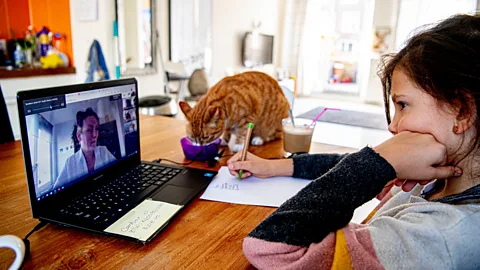Getty Images
(Credit: Getty Images)
**Video chat is helping us stay employed and connected. But what makes it so tiring - and how can we reduce ‘Zoom fatigue’?**
Your screen freezes. There’s a weird echo. A dozen heads stare at you. There are the work huddles, the one-on-one meetings and then, once you’re done for the day, the hangouts with friends and family.
Since the Covid-19 pandemic hit, we’re on video calls more than ever before – and many are finding it exhausting.
But what, exactly, is tiring us out? BBC Worklife spoke to Gianpiero Petriglieri, an associate professor at Insead, who explores sustainable learning and development in the workplace, and Marissa Shuffler, an associate professor at Clemson University, who studies workplace wellbeing and teamwork effectiveness, to hear their views.
**Is video chat harder? What’s different compared to face-to-face communication?**
Being on a video call requires more focus than a face-to-face chat, says Petriglieri. Video chats mean we need to work harder to process non-verbal cues like facial expressions, the tone and pitch of the voice, and body language; paying more attention to these consumes a lot of energy. “Our minds are together when our bodies feel we're not. That dissonance, which causes people to have conflicting feelings, is exhausting. You cannot relax into the conversation naturally,” he says.
Delays on phone or conferencing systems of 1.2 seconds made people perceive the responder as less friendly or focused
Silence is another challenge, he adds. “Silence creates a natural rhythm in a real-life conversation. However, when it happens in a video call, you became anxious about the technology.” It also makes people uncomfortable. [One 2014 study](https://www.sciencedirect.com/science/article/abs/pii/S1071581914000287) by German academics showed that delays on phone or conferencing systems shaped our views of people negatively: even delays of 1.2 seconds made people perceive the responder as less friendly or focused.
*You might also like:*
**•** [**Why grocery shelves won't be empty for long**](https://www.bbc.com/worklife/article/20200401-covid-19-why-we-wont-run-out-of-food-during-coronavirus)
**•** [**Coronavirus isolation is creating new couples**](https://www.bbc.com/worklife/article/20200406-coronavirus-isolation-is-creating-new-love-under-lockdown)
**•** [**How to work from home, the right way**](https://www.bbc.com/worklife/article/20200312-coronavirus-covid-19-update-work-from-home-in-a-pandemic)
An added factor, says Shuffler, is that if we are physically on camera, we are very aware of being watched. “When you're on a video conference, you know everybody's looking at you; you are on stage, so there comes the social pressure and feeling like you need to perform. Being performative is nerve-wracking and more stressful.” It’s also very hard for people not to look at their own face if they can see it on screen, or not to be conscious of how they behave in front of the camera.
**How are the current circumstances contributing?**
Yet if video chats come with extra stressors, our Zoom fatigue can’t be attributed solely to that. Our current circumstances – whether lockdown, quarantine, working from home or otherwise – are also feeding in.
Getty Images
A 2014 study found that delays on phone or conferencing systems shaped our views of people negatively (Credit: Getty Images)
Petriglieri believes that fact we feel forced into these calls may be a contributory factor. “The video call is our reminder of the people we have lost temporarily. It is the distress that every time you see someone online, such as your colleagues, that reminds you we should really be in the workplace together,” he says. “What I'm finding is, we’re all exhausted; It doesn't matter whether they are introverts or extroverts. We are experiencing the same disruption of the familiar context during the pandemic.”
Then there’s the fact that aspects of our lives that used to be separate – work, friends, family – are all now happening in the same space. The [self-complexity theory](https://psycnet.apa.org/record/1986-03748-001) posits that individuals have multiple aspects – context-dependent social roles, relationships, activities and goals – and we find the variety healthy, says Petriglieri. When these aspects are reduced, we become more vulnerable to negative feelings.
Imagine if you go to a bar, and in the same bar you talk with your professors, meet your parents or date someone, isn’t it weird? That’s what we’re doing now – Gianpiero Petriglieri
“Most of our social roles happen in different places, but now the context has collapsed,” says Petriglieri. “Imagine if you go to a bar, and in the same bar you talk with your professors, meet your parents or date someone, isn’t it weird? That's what we're doing now… We are confined in our own space, in the context of a very anxiety-provoking crisis, and our only space for interaction is a computer window.”
Shuffler says a lack of downtime after we’ve fulfilled work and family commitments may be another factor in our tiredness, while some of us may be putting higher expectations on ourselves due to worries over the economy, furloughs and job losses. “There's also that heightened sense of ‘I need to be performing at my top level in a situation’… Some of us are kind of over-performing to secure our jobs.”
**But when I’m Zooming my friends, for example, shouldn’t that relax me?**
Lots of us are doing big group chats for the first time, whether it’s cooking and eating a virtual Easter dinner, attending a university catch-up or holding a birthday party for a friend. If the call is meant to be fun, why might it feel tiring?
Part of it, says Shuffler, is whether you’re joining in because you want to or because you feel you ought to – like a virtual happy hour with colleagues from work. If you see it as an obligation, that means more time that you’re ‘on’ as opposed to getting a break. A proper chat with friends will feel more social and there will be less ‘Zoom fatigue’ from conversations where you’ve had a chance to be yourself.
It doesn't matter whether you call it a virtual happy hour, it's a meeting, because mostly we are used to using these tools for work – Gianpiero Petriglieri
Big group calls can feel particularly performative, Petriglieri warns. People like watching television because you can allow your mind to wander – but a large video call “is like you're watching television and television is watching you”. Large group chats can also feel depersonalising, he adds, because your power as an individual is diminished. And despite the branding, it may not feel like leisure time. “It doesn't matter whether you call it a virtual happy hour, it's a meeting, because mostly we are used to using these tools for work.”
**So how can we alleviate Zoom fatigue?**
Both experts suggest limiting video calls to those that are necessary. Turning on the camera should be optional and in general there should be more understanding that cameras do not always have to be on throughout each meeting. Having your screen off to the side, instead of straight ahead, could also help your concentration, particularly in group meetings, says Petriglieri. It makes you feel like you’re in an adjoining room, so may be less tiring.
In some cases it’s worth considering if video chats are really the most efficient option. When it comes to work, Shuffler suggests shared files with clear notes can be a better option that avoids information overload. She also suggests taking time during meetings to catch up before diving into business. “Spend some time to actually check into people's wellbeing,” she urges. “It’s a way to reconnect us with the world, and to maintain trust and reduce fatigue and concern.”
Building transition periods in between video meetings can also help refresh us – try stretching, having a drink or doing a bit of exercise, our experts say. Boundaries and transitions are important; we need to create buffers which allow us to put one identity aside and then go to another as we move between work and private personas.
And maybe, says Petriglieri, if you want to reach out, go old-school. “Write a letter to someone instead of meeting them on Zoom. Tell them you really care about them.”
[Remote Control](https://www.bbc.com/worklife/worklife/premium-collection/remote-control)
[How we work](https://www.bbc.com/worklife/tags/how-we-work)
[Covid-19](https://www.bbc.com/worklife/tags/covid-19)
***
Watch
[ US stocks open in the red again as energy fears grow Market Intelligence Strategist Ed Moya warns of the risk of stagflation if energy prices are not contained. Opening Bell](https://www.bbc.com/reel/video/p0n7vsz5/watch)
[ OnlyFans, loneliness, and rise of explicit direct messages Katty Kay speaks to writer and podcaster Ed Elson about the adult content industry's pivot to direct messaging. Katty Kay](https://www.bbc.com/reel/video/p0n7k8ct/watch)
[ From vineyards to farms, new tech is transforming crops Tech Now meets the innovators using tech to improve seed, grains and crops for Australia's agricultural industry. Tech Now](https://www.bbc.com/reel/video/p0myzzlv/watch)
[ Investors seem to be relatively calm, expert says Oil prices staying this high could trigger a global recession, warns Main Street Research CIO James Demmert. Opening Bell](https://www.bbc.com/reel/video/p0n7brql/watch)
[ Mass Neanderthal murder discovery in Spanish cave Deep within Spain's El Sidrón Cave, 49,000‑year‑old bones reveal a Neanderthal family's dark fate. Humans](https://www.bbc.com/reel/video/p0n78ryh/watch)
[ Tech stocks, led by Nvidia, providing relief to markets Noah Hamman of AdvisorShares says Nvidia seems to be in a strong position amid tech stock volatility. Opening Bell](https://www.bbc.com/reel/video/p0n74fxs/watch)
[ How the transcontinental railroad changed the US forever In 1869, two companies connected the east to the west with the United States' first transcontinental railroad. History](https://www.bbc.com/reel/video/p0n4kjvh/watch)
[ Markets show mixed signals as Iran war enters third week Some investors are betting on a short-term war, while others expect a longer-term conflict in the region. Opening Bell](https://www.bbc.com/reel/video/p0n6yj1l/watch)
[ Could the US be heading for a period of 'stagflation'? Eddie Ghabour at Key Advisors Wealth Management says investors have to expect ongoing market volatility. Opening Bell](https://www.bbc.com/reel/video/p0n6h6hv/watch)
[ Grandparents are glued to their phones, families are worried Charlie Warzel on rising screen time among some older adults and whether their kids should be worried. Katty Kay](https://www.bbc.com/reel/video/p0n61dg3/watch)
[ Why farm-to-table isn't just a 'trend' in Atlanta Known as the 'city in a forest', Atlanta puts locally grown produce at the heart of its food culture. World's Table](https://www.bbc.com/reel/video/p0n63c5m/watch)
[ The birthplace of the 20th century's brightest ideas A rare tour inside the legendary innovation powerhouse Bell Labs, home to world‑changing 20th century inventions. Tech Now](https://www.bbc.com/reel/video/p0mp3qgp/watch)
[ US markets calmer after IEA considers releasing oil reserves Ellen Fraser, partner at Baringa, says the IEA's proposal to release oil reserves has calmed investors. Opening Bell](https://www.bbc.com/reel/video/p0n5zj67/watch)
[ The forbidden rhythm that served as a secret language Rebelliously danced at night with sensual, no-touch movements, the long-banned Moutya is making a comeback. Discover the World](https://www.bbc.com/reel/video/p0n5r262/watch)
[ The 48,000-year-old weapon that powered early human survival In Sri Lanka's caves, butchered monkey bones reveal a hunting tool that helped our early ancestors survive. Humans](https://www.bbc.com/reel/video/p0n5kqxd/watch)
[ Top Oscars picks chosen by BBC correspondents From Iran's 'achingly beautiful' cinema to a stress‑busting horror hit, this is BBC correspondents' Oscars picks. Film & TV](https://www.bbc.com/reel/video/p0n5kbf9/watch)
[ Wall Street opens lower as Middle East war continues JoAnne Feeney at Advisors Capital Management explains the impact of war on oil prices and the market. Opening Bell](https://www.bbc.com/reel/video/p0n5jfww/watch)
[ Wall Street opens down as oil prices climb Expert says the Middle East conflict and rising oil prices could wreak havoc on the global economy. Opening Bell](https://www.bbc.com/reel/video/p0n52qcl/watch)
[ Who can afford an offline childhood? Katty Kay with Róisín Lanigan discuss why some parents are pulling their kids off technology. Katty Kay](https://www.bbc.com/reel/video/p0n4mjnk/watch)
[ NFTS: Inside one of the world's most elite film schools The NFTS opens its doors to the BBC to share what it takes to shape and train award‑winning filmmakers. Arts in Motion](https://www.bbc.com/reel/video/p0n4jffq/watch)
***
More from the BBC
[20 Dec 2025  Covid 2020: The historic photo of one quick jab In December 2020, Covid vaccines were finally ready to be administered. One British photographer found himself with an historic assignment. 20 Dec 2025](https://www.bbc.com/future/article/20251219-covid-2020-the-historic-photo-of-one-quick-jab)
[11 Dec 2025  The year the sea fell silent During the lockdowns of 2020, global shipping was severely restricted and ocean noise pollution all but ceased. Instead the songs of fish filled the sea. 11 Dec 2025](https://www.bbc.com/future/article/20251210-covid-2020-year-of-the-quiet-ocean)
[29 Nov 2025  The 'hugging room' where Covid couldn't spread In November 2020, one Italian care home created an ingenious solution to Covid's isolation: a "hugging room" where people could safely embrace through a plastic screen. 29 Nov 2025](https://www.bbc.com/future/article/20251128-covid-2020-the-surreal-hugging-room-in-a-care-home)
[28 Oct 2025  Covid 2020: Where cruise ships went to die When Covid-19 took hold, cruise ship operators struggled to stay afloat. One option was to scrap older vessels – giving one photographer a unique perspective. 28 Oct 2025](https://www.bbc.com/future/article/20251027-covid-2020-where-cruise-ships-went-to-die)
[30 Sep 2025  Covid 2020: A lone figure in an eerie emptiness In September 2020, rising Covid-19 cases plunged London into another lockdown. One photographer roamed the city's financial district amid an eerie emptiness. 30 Sep 2025](https://www.bbc.com/future/article/20250929-covid-2020-londons-bustling-city-goes-quiet)
***
- [Home](https://www.bbc.com/)
- [News](https://www.bbc.com/news)
- [Sport](https://www.bbc.com/sport)
- [Business](https://www.bbc.com/business)
- [Technology](https://www.bbc.com/technology)
- [Health](https://www.bbc.com/health)
- [Culture](https://www.bbc.com/culture)
- [Arts](https://www.bbc.com/arts)
- [Travel](https://www.bbc.com/travel)
- [Earth](https://www.bbc.com/future-planet)
- [Audio](https://www.bbc.com/audio)
- [Video](https://www.bbc.com/video)
- [Live](https://www.bbc.com/live)
- [Weather](https://www.bbc.com/weather)
- [BBC Shop](https://shop.bbc.com/)
- [BritBox](https://www.britbox.com/?utm_source=bbc.com&utm_medium=referral&utm_campaign=footer)
BBC in other languages
### The BBC is in multiple languages
#### Read the BBC In your own language
[Oduu Afaan Oromootiin](https://www.bbc.com/afaanoromoo)
[Amharic ዜና በአማርኛ](https://www.bbc.com/amharic)
[Arabic عربي](https://www.bbc.com/arabic)
[Azeri AZƏRBAYCAN](https://www.bbc.com/azeri)
[Bangla বাংলা](https://www.bbc.com/bengali)
[Burmese မြန်မာ](https://www.bbc.com/burmese)
[Chinese 中文网](https://www.bbc.com/zhongwen/simp)
[Dari دری](https://www.bbc.com/dari)
[French AFRIQUE](https://www.bbc.com/afrique)
[Hausa HAUSA](https://www.bbc.com/hausa)
[Hindi हिन्दी](https://www.bbc.com/hindi)
[Gaelic NAIDHEACHDAN](https://www.bbc.com/naidheachdan)
[Gujarati ગુજરાતીમાં સમાચાર](https://www.bbc.com/gujarati)
[Igbo AKỤKỌ N’IGBO](https://www.bbc.com/igbo)
[Indonesian INDONESIA](https://www.bbc.com/indonesia)
[Japanese 日本語](https://www.bbc.com/japanese)
[Kinyarwanda GAHUZA](https://www.bbc.com/gahuza)
[Kirundi KIRUNDI](https://www.bbc.com/gahuza)
[Korean 한국어](https://www.bbc.com/korean)
[Kyrgyz Кыргыз](https://www.bbc.com/kyrgyz)
[Marathi मराठी](https://www.bbc.com/marathi)
[Nepali नेपाली](https://www.bbc.com/nepali)
[Noticias para hispanoparlantes](https://www.bbc.com/mundo)
[Pashto پښتو](https://www.bbc.com/pashto)
[Persian فارسی](https://www.bbc.com/persian)
[Pidgin](https://www.bbc.com/pidgin)
[Polish PO POLSKU](https://www.bbc.com/polska)
[Portuguese BRASIL](https://www.bbc.com/portuguese)
[Punjabi ਪੰਜਾਬੀ ਖ਼ਬਰਾਂ](https://www.bbc.com/punjabi)
[Russian НА РУССКОМ](https://www.bbc.com/russian)
[Serbian NA SRPSKOM](https://www.bbc.com/serbian/lat)
[Sinhala සිංහල](https://www.bbc.com/sinhala)
[Somali SOMALI](https://www.bbc.com/somali)
[Swahili HABARI KWA KISWAHILI](https://www.bbc.com/swahili)
[Tamil தமிழில் செய்திகள்](https://www.bbc.com/tamil)
[Telugu తెలుగు వార్తలు](https://www.bbc.com/telugu)
[Thai ข่าวภาษาไทย](https://www.bbc.com/thai)
[Tigrinya ዜና ብትግርኛ](https://www.bbc.com/tigrinya)
[Turkish TÜRKÇE](https://www.bbc.com/turkce)
[Ukrainian УКРАЇНСЬКA](https://www.bbc.com/ukrainian)
[Urdu اردو](https://www.bbc.com/urdu)
[Uzbek O'ZBEK](https://www.bbc.com/uzbek)
[Vietnamese TIẾNG VIỆT](https://www.bbc.com/vietnamese)
[Welsh NEWYDDION](https://www.bbc.com/cymrufyw)
[Yoruba ÌRÒYÌN NÍ YORÙBÁ](https://www.bbc.com/yoruba)
Follow BBC on:
- [Terms of Use](https://www.bbc.com/pages/terms-of-use)
- [Subscription Terms](https://www.bbc.com/pages/subscription-terms)
- [About the BBC](https://www.bbc.co.uk/aboutthebbc)
- [Privacy Policy](https://www.bbc.com/pages/privacy-policy)
- [Cookies](https://www.bbc.com/usingthebbc/cookies/)
- [Accessibility Help](https://www.bbc.co.uk/accessibility/)
- [Contact the BBC](https://www.bbc.co.uk/contact)
- [Advertise with us](https://advertising.bbcstudios.com/)
- [Do not share or sell my info](https://www.bbc.com/usingthebbc/cookies/how-can-i-change-my-bbc-cookie-settings/)
- [BBC.com Help & FAQs](https://help.bbc.com/hc/)
- [Content Index](https://www.bbc.com/pages/content-index)
- [Set Preferred Source](https://www.bbc.com/future/article/20260128-how-to-make-google-put-trusted-sources-up-top-when-you-search)
Copyright 2026 BBC. All rights reserved. The BBC is not responsible for the content of external sites. [**Read about our approach to external linking.**](https://www.bbc.co.uk/editorialguidelines/guidance/feeds-and-links) |
| Readable Markdown | 22 April 2020
Manyu JiangFeatures correspondent
Getty Images
(Credit: Getty Images)
**Video chat is helping us stay employed and connected. But what makes it so tiring - and how can we reduce ‘Zoom fatigue’?**
Your screen freezes. There’s a weird echo. A dozen heads stare at you. There are the work huddles, the one-on-one meetings and then, once you’re done for the day, the hangouts with friends and family.
Since the Covid-19 pandemic hit, we’re on video calls more than ever before – and many are finding it exhausting.
But what, exactly, is tiring us out? BBC Worklife spoke to Gianpiero Petriglieri, an associate professor at Insead, who explores sustainable learning and development in the workplace, and Marissa Shuffler, an associate professor at Clemson University, who studies workplace wellbeing and teamwork effectiveness, to hear their views.
**Is video chat harder? What’s different compared to face-to-face communication?**
Being on a video call requires more focus than a face-to-face chat, says Petriglieri. Video chats mean we need to work harder to process non-verbal cues like facial expressions, the tone and pitch of the voice, and body language; paying more attention to these consumes a lot of energy. “Our minds are together when our bodies feel we're not. That dissonance, which causes people to have conflicting feelings, is exhausting. You cannot relax into the conversation naturally,” he says.
Delays on phone or conferencing systems of 1.2 seconds made people perceive the responder as less friendly or focused
Silence is another challenge, he adds. “Silence creates a natural rhythm in a real-life conversation. However, when it happens in a video call, you became anxious about the technology.” It also makes people uncomfortable. [One 2014 study](https://www.sciencedirect.com/science/article/abs/pii/S1071581914000287) by German academics showed that delays on phone or conferencing systems shaped our views of people negatively: even delays of 1.2 seconds made people perceive the responder as less friendly or focused.
*You might also like:*
**•** [**Why grocery shelves won't be empty for long**](https://www.bbc.com/worklife/article/20200401-covid-19-why-we-wont-run-out-of-food-during-coronavirus)
**•** [**Coronavirus isolation is creating new couples**](https://www.bbc.com/worklife/article/20200406-coronavirus-isolation-is-creating-new-love-under-lockdown)
**•** [**How to work from home, the right way**](https://www.bbc.com/worklife/article/20200312-coronavirus-covid-19-update-work-from-home-in-a-pandemic)
An added factor, says Shuffler, is that if we are physically on camera, we are very aware of being watched. “When you're on a video conference, you know everybody's looking at you; you are on stage, so there comes the social pressure and feeling like you need to perform. Being performative is nerve-wracking and more stressful.” It’s also very hard for people not to look at their own face if they can see it on screen, or not to be conscious of how they behave in front of the camera.
**How are the current circumstances contributing?**
Yet if video chats come with extra stressors, our Zoom fatigue can’t be attributed solely to that. Our current circumstances – whether lockdown, quarantine, working from home or otherwise – are also feeding in.
Getty Images
A 2014 study found that delays on phone or conferencing systems shaped our views of people negatively (Credit: Getty Images)
Petriglieri believes that fact we feel forced into these calls may be a contributory factor. “The video call is our reminder of the people we have lost temporarily. It is the distress that every time you see someone online, such as your colleagues, that reminds you we should really be in the workplace together,” he says. “What I'm finding is, we’re all exhausted; It doesn't matter whether they are introverts or extroverts. We are experiencing the same disruption of the familiar context during the pandemic.”
Then there’s the fact that aspects of our lives that used to be separate – work, friends, family – are all now happening in the same space. The [self-complexity theory](https://psycnet.apa.org/record/1986-03748-001) posits that individuals have multiple aspects – context-dependent social roles, relationships, activities and goals – and we find the variety healthy, says Petriglieri. When these aspects are reduced, we become more vulnerable to negative feelings.
Imagine if you go to a bar, and in the same bar you talk with your professors, meet your parents or date someone, isn’t it weird? That’s what we’re doing now – Gianpiero Petriglieri
“Most of our social roles happen in different places, but now the context has collapsed,” says Petriglieri. “Imagine if you go to a bar, and in the same bar you talk with your professors, meet your parents or date someone, isn’t it weird? That's what we're doing now… We are confined in our own space, in the context of a very anxiety-provoking crisis, and our only space for interaction is a computer window.”
Shuffler says a lack of downtime after we’ve fulfilled work and family commitments may be another factor in our tiredness, while some of us may be putting higher expectations on ourselves due to worries over the economy, furloughs and job losses. “There's also that heightened sense of ‘I need to be performing at my top level in a situation’… Some of us are kind of over-performing to secure our jobs.”
**But when I’m Zooming my friends, for example, shouldn’t that relax me?**
Lots of us are doing big group chats for the first time, whether it’s cooking and eating a virtual Easter dinner, attending a university catch-up or holding a birthday party for a friend. If the call is meant to be fun, why might it feel tiring?
Part of it, says Shuffler, is whether you’re joining in because you want to or because you feel you ought to – like a virtual happy hour with colleagues from work. If you see it as an obligation, that means more time that you’re ‘on’ as opposed to getting a break. A proper chat with friends will feel more social and there will be less ‘Zoom fatigue’ from conversations where you’ve had a chance to be yourself.
It doesn't matter whether you call it a virtual happy hour, it's a meeting, because mostly we are used to using these tools for work – Gianpiero Petriglieri
Big group calls can feel particularly performative, Petriglieri warns. People like watching television because you can allow your mind to wander – but a large video call “is like you're watching television and television is watching you”. Large group chats can also feel depersonalising, he adds, because your power as an individual is diminished. And despite the branding, it may not feel like leisure time. “It doesn't matter whether you call it a virtual happy hour, it's a meeting, because mostly we are used to using these tools for work.”
**So how can we alleviate Zoom fatigue?**
Both experts suggest limiting video calls to those that are necessary. Turning on the camera should be optional and in general there should be more understanding that cameras do not always have to be on throughout each meeting. Having your screen off to the side, instead of straight ahead, could also help your concentration, particularly in group meetings, says Petriglieri. It makes you feel like you’re in an adjoining room, so may be less tiring.
In some cases it’s worth considering if video chats are really the most efficient option. When it comes to work, Shuffler suggests shared files with clear notes can be a better option that avoids information overload. She also suggests taking time during meetings to catch up before diving into business. “Spend some time to actually check into people's wellbeing,” she urges. “It’s a way to reconnect us with the world, and to maintain trust and reduce fatigue and concern.”
Building transition periods in between video meetings can also help refresh us – try stretching, having a drink or doing a bit of exercise, our experts say. Boundaries and transitions are important; we need to create buffers which allow us to put one identity aside and then go to another as we move between work and private personas.
And maybe, says Petriglieri, if you want to reach out, go old-school. “Write a letter to someone instead of meeting them on Zoom. Tell them you really care about them.” |
| Shard | 16 (laksa) |
| Root Hash | 1643509356818581016 |
| Unparsed URL | com,bbc!www,/worklife/article/20200421-why-zoom-video-chats-are-so-exhausting s443 |