ℹ️ Skipped - page is already crawled
| Filter | Status | Condition | Details |
|---|---|---|---|
| HTTP status | PASS | download_http_code = 200 | HTTP 200 |
| Age cutoff | PASS | download_stamp > now() - 6 MONTH | 0.9 months ago |
| History drop | PASS | isNull(history_drop_reason) | No drop reason |
| Spam/ban | PASS | fh_dont_index != 1 AND ml_spam_score = 0 | ml_spam_score=0 |
| Canonical | PASS | meta_canonical IS NULL OR = '' OR = src_unparsed | Not set |
| Property | Value |
|---|---|
| URL | https://www.bbc.com/news/science-environment-61412463 |
| Last Crawled | 2026-03-13 19:06:14 (27 days ago) |
| First Indexed | 2022-05-12 13:40:03 (3 years ago) |
| HTTP Status Code | 200 |
| Meta Title | Black hole: First picture of Milky Way monster |
| Meta Description | Astronomers reveal the first ever image of the black hole at the core of our galaxy. |
| Meta Canonical | null |
| Boilerpipe Text | 12 May 2022
Jonathan Amos
BBC Science Correspondent
Ziri Younsi: "We affectionately term it a doughnut in the collaboration"
This is the gargantuan black hole that lives at the centre of our galaxy, pictured for the very first time.
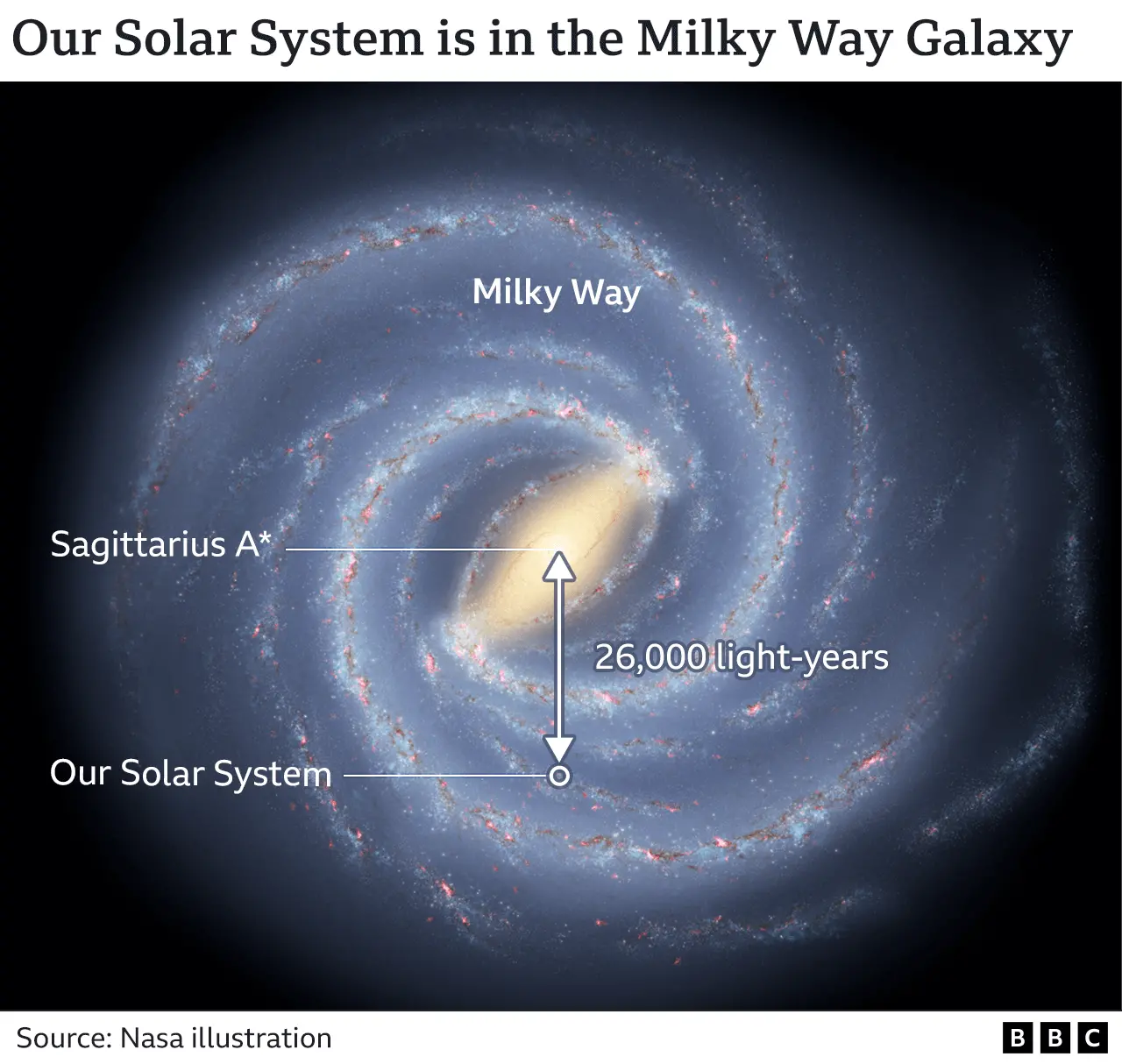
Known as Sagittarius A*, the object is a staggering four million times the mass of our Sun.
What you see is a central dark region where the hole resides, circled by the light coming from super-heated gas accelerated by immense gravitational forces.
For scale, the ring has diameter of about 60 million km (40 million miles).
To put that in context, Mercury, the innermost planet in our Solar System, orbits between roughly 40 million km and 70 million km from the Sun (or between 25 million miles and 45 million miles).
Fortunately, this monster is a long, long way away - some 26,000 light-years in the distance - so there's no possibility of us ever coming to any danger.
It's their second such image after releasing in 2019 a picture of the giant black hole at the heart of another galaxy called
Messier 87, or M87
. That object was more than a thousand times bigger at 6.5 billion times the mass of our Sun.
"But this new image is special because it's
our
supermassive black hole," said Prof Heino Falcke, one of the European pioneers behind the EHT project.
"This is in 'our backyard', and if you want to understand black holes and how they work, this is the one that will tell you because we see it in intricate detail," the German-Dutch scientist from Radboud University Nijmegen told BBC News.
M87: First ever black hole image released
History-making black hole seen to do a shimmy
Twisting jet observed at supermassive black hole
What is a black hole?
A black hole
is a region of space where matter has collapsed in on itself
The gravitational pull is so strong that nothing, not even light, can escape
Black holes will emerge from the explosive demise of certain large stars
But some are truly huge and are billions of times the mass of our Sun
How these monsters - found at galaxy centres - formed is unknown
But it's clear they energise the galaxy and will influence its evolution
The picture is a technical tour de force. It has to be.
At a distance of 26,000 light-years from Earth, Sagittarius A*, or Sgr A* for short, is a tiny pinprick on the sky. To discern such a target requires incredible resolution.
The EHT's trick is a technique called very long baseline array interferometry (VLBI).
Essentially, this combines a network of eight widely spaced radio antennas to mimic a telescope the size of our planet.
The mass of a black hole determines the size of its accretion disc, or
emission ring
. The hole lives in the
central brightness depression
. Its "surface" is called the
event horizon
, the boundary inside which even a light-ray is bent back on itself by the curvature in space-time. Brighter regions in the accretion disc are where light gains energy as it moves towards us, and is said to be
doppler boosted
This arrangement enables the EHT to cut an angle on the sky that is measured in microarcseconds. EHT team members talk about a sharpness of vision akin to being able to see a bagel on the surface of the Moon.
Even then, atomic clocks, smart algorithms and countless hours of supercomputing are needed to construct an image from several petabytes (1 PB equals one million gigabytes) of gathered data.
The way a black hole bends, or lenses, light means there is nothing to see but a "shadow", but the brilliance of the matter screaming around this darkness and spreading out into a circle, known as an accretion disc, betrays where the object is.
If you compare the new image to
the previous one of M87
, you may wonder what's different. But there are key distinctions.
"Because Sagittarius A* is a much smaller black hole - it's around a thousand times smaller - its ring structure changes on timescales that are a thousand times faster," explained team member Dr Ziri Younsi from University College London, UK. "It's very dynamic. The 'hotspots' you see in the ring move around from day to day."
Simulations show what the black hole might look like up close (in radio light)
This is very apparent from the simulations the team has produced of what you would see if you could somehow take yourself to the centre of our galaxy and view the scene with eyes sensitive at radio frequencies.
The super-heated, excited gas - or plasma - in the ring is travelling around the black hole at a significant fraction of light-speed (300,000km/s, or about 190,000 miles per second). The brighter regions are likely places where material is moving towards us and where its light emission is being energised, or "doppler boosted", as a consequence.
These rapid changes in the vicinity of Sgr A* are part of the reason why it has taken so much longer to produce an image than for M87. Interpretation of the data has been a tougher challenge.
The telescope observations for both black holes were actually acquired during the same period in early 2017, but M87, at its greater size and distance of 55 million light-years, looks static by comparison.
Scientists have already begun to deploy the measurements in the new image to test the physics we currently use to describe black holes. So far, what they see is entirely consistent with the equations set out by Einstein in his theory of gravity, of general relativity.
We've suspected for several decades that a supermassive black hole lives at the centre of the galaxy. What else could produce gravitational forces that accelerate nearby stars through space at speeds of up 24,000km/s (for comparison our Sun glides around the galaxy at a sedate 230km/s, or 140 miles per second)?
There can be no doubt now, however.
ESO/S.Gillessen et al
Stars that orbit close to Sgr A* move at jaw-dropping speeds
Come this August, the new super space telescope,
James Webb, will turn its eye on Sgr A*
. The $10bn observatory won't have the resolution to directly image the black hole and its accretion ring, but it will bring new capability to the study of the environment around the black hole with its incredibly sensitive infrared instruments.
Astronomers will be studying in unprecedented detail the behaviour and the physics of hundreds of stars whipping around the black hole. They'll even be looking to see if there are some star-sized black holes in the region, and for evidence of concentrated clumps of invisible, or dark, matter.
"Every time we get a new facility that can take a sharper image of the Universe, we do our best to train it on the galactic centre, and we inevitably learn something fantastic," said Dr Jessica Lu, the assistant professor from the University of California, Berkeley, US, who will lead the Webb campaign.
James Webb Space Telescope in final stretch
A $10bn machine in search of the end of darkness
NASA
Artwork: The James Webb telescope will study the environment around Sgr A* |
| Markdown | [Skip to content](https://www.bbc.com/news/science-environment-61412463#main-content)
[Register](https://session.bbc.com/session?action=register&userOrigin=BBCS_BBC&ptrt=https%3A%2F%2Fwww.bbc.com%2Fnews%2Fscience-environment-61412463)
[Sign In](https://session.bbc.com/session?userOrigin=BBCS_BBC&ptrt=https%3A%2F%2Fwww.bbc.com%2Fnews%2Fscience-environment-61412463)
- [Home](https://www.bbc.com/)
- [News](https://www.bbc.com/news)
- [Sport](https://www.bbc.com/sport)
- [Business](https://www.bbc.com/business)
- [Technology](https://www.bbc.com/technology)
- [Health](https://www.bbc.com/health)
- [Culture](https://www.bbc.com/culture)
- [Arts](https://www.bbc.com/arts)
- [Travel](https://www.bbc.com/travel)
- [Earth](https://www.bbc.com/future-planet)
- [Audio](https://www.bbc.com/audio)
- [Video](https://www.bbc.com/video)
- [Live](https://www.bbc.com/live)
- [Home](https://www.bbc.com/home)
- [News](https://www.bbc.com/news)
- [US & Canada](https://www.bbc.com/news/us-canada)
- [UK](https://www.bbc.com/news/uk)
- [UK Politics](https://www.bbc.com/news/politics)
- [England](https://www.bbc.com/news/england)
- [N. Ireland](https://www.bbc.com/news/northern_ireland)
- [N. Ireland Politics](https://www.bbc.com/news/northern_ireland/northern_ireland_politics)
- [Scotland](https://www.bbc.com/news/scotland)
- [Scotland Politics](https://www.bbc.com/news/scotland/scotland_politics)
- [Wales](https://www.bbc.com/news/wales)
- [Wales Politics](https://www.bbc.com/news/wales/wales_politics)
- [Africa](https://www.bbc.com/news/world/africa)
- [Asia](https://www.bbc.com/news/world/asia)
- [China](https://www.bbc.com/news/world/asia/china)
- [India](https://www.bbc.com/news/world/asia/india)
- [Australia](https://www.bbc.com/news/world/australia)
- [Europe](https://www.bbc.com/news/world/europe)
- [Latin America](https://www.bbc.com/news/world/latin_america)
- [Middle East](https://www.bbc.com/news/world/middle_east)
- [In Pictures](https://www.bbc.com/news/in_pictures)
- [BBC InDepth](https://www.bbc.com/news/bbcindepth)
- [BBC Verify](https://www.bbc.com/news/bbcverify)
- [Sport](https://www.bbc.com/sport)
- [Business](https://www.bbc.com/business)
- [World of Business](https://www.bbc.com/business/world-of-business)
- [Technology of Business](https://www.bbc.com/business/technology-of-business)
- [NYSE Opening Bell](https://www.bbc.com/business/opening-bell)
- [Technology](https://www.bbc.com/technology)
- [Artificial Intelligence](https://www.bbc.com/technology/artificial-intelligence)
- [AI v the Mind](https://www.bbc.com/technology/ai-v-the-mind)
- [Health](https://www.bbc.com/health)
- [Culture](https://www.bbc.com/culture)
- [Film & TV](https://www.bbc.com/culture/film-tv)
- [Music](https://www.bbc.com/culture/music)
- [Art & Design](https://www.bbc.com/culture/art)
- [Style](https://www.bbc.com/culture/style)
- [Books](https://www.bbc.com/culture/books)
- [Entertainment News](https://www.bbc.com/culture/entertainment-news)
- [Arts](https://www.bbc.com/arts)
- [Arts in Motion](https://www.bbc.com/arts/arts-in-motion)
- [Travel](https://www.bbc.com/travel)
- [Destinations](https://www.bbc.com/travel/destinations)
- [Africa](https://www.bbc.com/travel/destinations/africa)
- [Antarctica](https://www.bbc.com/travel/destinations/antarctica)
- [Asia](https://www.bbc.com/travel/destinations/asia)
- [Australia and Pacific](https://www.bbc.com/travel/destinations/australia-and-pacific)
- [Caribbean & Bermuda](https://www.bbc.com/travel/destinations/caribbean)
- [Central America](https://www.bbc.com/travel/destinations/central-america)
- [Europe](https://www.bbc.com/travel/destinations/europe)
- [Middle East](https://www.bbc.com/travel/destinations/middle-east)
- [North America](https://www.bbc.com/travel/destinations/north-america)
- [South America](https://www.bbc.com/travel/destinations/south-america)
- [World’s Table](https://www.bbc.com/travel/worlds-table)
- [Culture & Experiences](https://www.bbc.com/travel/cultural-experiences)
- [Adventures](https://www.bbc.com/travel/adventures)
- [The SpeciaList](https://www.bbc.com/travel/specialist)
- [Earth](https://www.bbc.com/future-planet)
- [Science](https://www.bbc.com/innovation/science)
- [Natural Wonders](https://www.bbc.com/future-planet/natural-wonders)
- [Climate Solutions](https://www.bbc.com/future-planet/solutions)
- [Sustainable Business](https://www.bbc.com/future-planet/sustainable-business)
- [Green Living](https://www.bbc.com/future-planet/green-living)
- [Audio](https://www.bbc.com/audio)
- [Podcast Categories](https://www.bbc.com/audio/categories)
- [Radio](https://www.bbc.com/audio/stations)
- [Audio FAQs](https://www.bbc.com/undefined)
- [Video](https://www.bbc.com/video)
- [BBC Maestro](https://www.bbc.com/video/bbc-maestro)
- [Discover the World](https://www.bbc.com/video/discover-the-world)
- [Live](https://www.bbc.com/live)
- [Live News](https://www.bbc.com/live/news)
- [Live Sport](https://www.bbc.com/live/sport)
[Home](https://www.bbc.com/)
News
[Sport](https://www.bbc.com/sport)
Business
Technology
[Health](https://www.bbc.com/health)
Culture
Arts
Travel
Earth
Audio
Video
Live
[Weather](https://www.bbc.com/weather)
[Newsletters](https://www.bbc.com/newsletters)
# Black hole: First picture of Milky Way monster
12 May 2022
Share
Save

Jonathan AmosBBC Science Correspondent
Share
Save
Ziri Younsi: "We affectionately term it a doughnut in the collaboration"
**This is the gargantuan black hole that lives at the centre of our galaxy, pictured for the very first time.**
Known as Sagittarius A\*, the object is a staggering four million times the mass of our Sun.
What you see is a central dark region where the hole resides, circled by the light coming from super-heated gas accelerated by immense gravitational forces.
For scale, the ring has diameter of about 60 million km (40 million miles).
To put that in context, Mercury, the innermost planet in our Solar System, orbits between roughly 40 million km and 70 million km from the Sun (or between 25 million miles and 45 million miles).
Fortunately, this monster is a long, long way away - some 26,000 light-years in the distance - so there's no possibility of us ever coming to any danger.
The image was produced by an international team called the [Event Horizon Telescope (EHT) collaboration](https://eventhorizontelescope.org/).
It's their second such image after releasing in 2019 a picture of the giant black hole at the heart of another galaxy called [Messier 87, or M87](https://www.bbc.co.uk/news/science-environment-47873592). That object was more than a thousand times bigger at 6.5 billion times the mass of our Sun.
"But this new image is special because it's *our* supermassive black hole," said Prof Heino Falcke, one of the European pioneers behind the EHT project.
"This is in 'our backyard', and if you want to understand black holes and how they work, this is the one that will tell you because we see it in intricate detail," the German-Dutch scientist from Radboud University Nijmegen told BBC News.
- [M87: First ever black hole image released](https://www.bbc.co.uk/news/science-environment-47873592)
- [History-making black hole seen to do a shimmy](https://www.bbc.co.uk/news/science-environment-54268957)
- [Twisting jet observed at supermassive black hole](https://www.bbc.co.uk/news/science-environment-52204614)

## What is a black hole?
- [A black hole](https://www.nasa.gov/vision/universe/starsgalaxies/black_hole_description.html) is a region of space where matter has collapsed in on itself
- The gravitational pull is so strong that nothing, not even light, can escape
- Black holes will emerge from the explosive demise of certain large stars
- But some are truly huge and are billions of times the mass of our Sun
- How these monsters - found at galaxy centres - formed is unknown
- But it's clear they energise the galaxy and will influence its evolution

The picture is a technical tour de force. It has to be.
At a distance of 26,000 light-years from Earth, Sagittarius A\*, or Sgr A\* for short, is a tiny pinprick on the sky. To discern such a target requires incredible resolution.
The EHT's trick is a technique called very long baseline array interferometry (VLBI).
Essentially, this combines a network of eight widely spaced radio antennas to mimic a telescope the size of our planet.

*The mass of a black hole determines the size of its accretion disc, or* ***emission ring****. The hole lives in the* ***central brightness depression****. Its "surface" is called the* ***event horizon****, the boundary inside which even a light-ray is bent back on itself by the curvature in space-time. Brighter regions in the accretion disc are where light gains energy as it moves towards us, and is said to be* ***doppler boosted***

This arrangement enables the EHT to cut an angle on the sky that is measured in microarcseconds. EHT team members talk about a sharpness of vision akin to being able to see a bagel on the surface of the Moon.
Even then, atomic clocks, smart algorithms and countless hours of supercomputing are needed to construct an image from several petabytes (1 PB equals one million gigabytes) of gathered data.
The way a black hole bends, or lenses, light means there is nothing to see but a "shadow", but the brilliance of the matter screaming around this darkness and spreading out into a circle, known as an accretion disc, betrays where the object is.
If you compare the new image to [the previous one of M87](https://www.bbc.co.uk/news/science-environment-47873592), you may wonder what's different. But there are key distinctions.
"Because Sagittarius A\* is a much smaller black hole - it's around a thousand times smaller - its ring structure changes on timescales that are a thousand times faster," explained team member Dr Ziri Younsi from University College London, UK. "It's very dynamic. The 'hotspots' you see in the ring move around from day to day."
Simulations show what the black hole might look like up close (in radio light)
This is very apparent from the simulations the team has produced of what you would see if you could somehow take yourself to the centre of our galaxy and view the scene with eyes sensitive at radio frequencies.
The super-heated, excited gas - or plasma - in the ring is travelling around the black hole at a significant fraction of light-speed (300,000km/s, or about 190,000 miles per second). The brighter regions are likely places where material is moving towards us and where its light emission is being energised, or "doppler boosted", as a consequence.

These rapid changes in the vicinity of Sgr A\* are part of the reason why it has taken so much longer to produce an image than for M87. Interpretation of the data has been a tougher challenge.
The telescope observations for both black holes were actually acquired during the same period in early 2017, but M87, at its greater size and distance of 55 million light-years, looks static by comparison.
Scientists have already begun to deploy the measurements in the new image to test the physics we currently use to describe black holes. So far, what they see is entirely consistent with the equations set out by Einstein in his theory of gravity, of general relativity.
We've suspected for several decades that a supermassive black hole lives at the centre of the galaxy. What else could produce gravitational forces that accelerate nearby stars through space at speeds of up 24,000km/s (for comparison our Sun glides around the galaxy at a sedate 230km/s, or 140 miles per second)?
But, interestingly, when the [Nobel Prize committee honoured astronomers Reinhard Genzel and Andrea Ghez](https://www.bbc.co.uk/news/science-environment-54420240) with its physics award in 2020 for their work on Sgr A\*, the citation spoke only of ["a supermassive compact object"](https://www.nobelprize.org/prizes/physics/2020/summary/). It was wriggle room in case some other exotic phenomenon turned out to be the explanation.
There can be no doubt now, however.
ESO/S.Gillessen et al
Stars that orbit close to Sgr A\* move at jaw-dropping speeds
Come this August, the new super space telescope, [James Webb, will turn its eye on Sgr A\*](https://www.stsci.edu/jwst/phase2-public/1939.pdf). The \$10bn observatory won't have the resolution to directly image the black hole and its accretion ring, but it will bring new capability to the study of the environment around the black hole with its incredibly sensitive infrared instruments.
Astronomers will be studying in unprecedented detail the behaviour and the physics of hundreds of stars whipping around the black hole. They'll even be looking to see if there are some star-sized black holes in the region, and for evidence of concentrated clumps of invisible, or dark, matter.
"Every time we get a new facility that can take a sharper image of the Universe, we do our best to train it on the galactic centre, and we inevitably learn something fantastic," said Dr Jessica Lu, the assistant professor from the University of California, Berkeley, US, who will lead the Webb campaign.
- [James Webb Space Telescope in final stretch](https://www.bbc.co.uk/news/science-environment-61268680)
- [A \$10bn machine in search of the end of darkness](https://www.bbc.co.uk/news/science-environment-59476869)
NASA
Artwork: The James Webb telescope will study the environment around Sgr A\*
The EHT collaboration's results are being published in a special issue of [The Astrophysical Journal Letters](https://iopscience.iop.org/journal/2041-8205/page/Focus_on_First_Sgr_A_Results).
***
- [Home](https://www.bbc.com/)
- [News](https://www.bbc.com/news)
- [Sport](https://www.bbc.com/sport)
- [Business](https://www.bbc.com/business)
- [Technology](https://www.bbc.com/technology)
- [Health](https://www.bbc.com/health)
- [Culture](https://www.bbc.com/culture)
- [Arts](https://www.bbc.com/arts)
- [Travel](https://www.bbc.com/travel)
- [Earth](https://www.bbc.com/future-planet)
- [Audio](https://www.bbc.com/audio)
- [Video](https://www.bbc.com/video)
- [Live](https://www.bbc.com/live)
- [Weather](https://www.bbc.com/weather)
- [BBC Shop](https://shop.bbc.com/)
- [BritBox](https://www.britbox.com/?utm_source=bbc.com&utm_medium=referral&utm_campaign=footer)
BBC in other languages
### The BBC is in multiple languages
#### Read the BBC In your own language
[Oduu Afaan Oromootiin](https://www.bbc.com/afaanoromoo)
[Amharic ዜና በአማርኛ](https://www.bbc.com/amharic)
[Arabic عربي](https://www.bbc.com/arabic)
[Azeri AZƏRBAYCAN](https://www.bbc.com/azeri)
[Bangla বাংলা](https://www.bbc.com/bengali)
[Burmese မြန်မာ](https://www.bbc.com/burmese)
[Chinese 中文网](https://www.bbc.com/zhongwen/simp)
[Dari دری](https://www.bbc.com/dari)
[French AFRIQUE](https://www.bbc.com/afrique)
[Hausa HAUSA](https://www.bbc.com/hausa)
[Hindi हिन्दी](https://www.bbc.com/hindi)
[Gaelic NAIDHEACHDAN](https://www.bbc.com/naidheachdan)
[Gujarati ગુજરાતીમાં સમાચાર](https://www.bbc.com/gujarati)
[Igbo AKỤKỌ N’IGBO](https://www.bbc.com/igbo)
[Indonesian INDONESIA](https://www.bbc.com/indonesia)
[Japanese 日本語](https://www.bbc.com/japanese)
[Kinyarwanda GAHUZA](https://www.bbc.com/gahuza)
[Kirundi KIRUNDI](https://www.bbc.com/gahuza)
[Korean 한국어](https://www.bbc.com/korean)
[Kyrgyz Кыргыз](https://www.bbc.com/kyrgyz)
[Marathi मराठी](https://www.bbc.com/marathi)
[Nepali नेपाली](https://www.bbc.com/nepali)
[Noticias para hispanoparlantes](https://www.bbc.com/mundo)
[Pashto پښتو](https://www.bbc.com/pashto)
[Persian فارسی](https://www.bbc.com/persian)
[Pidgin](https://www.bbc.com/pidgin)
[Polish PO POLSKU](https://www.bbc.com/polska)
[Portuguese BRASIL](https://www.bbc.com/portuguese)
[Punjabi ਪੰਜਾਬੀ ਖ਼ਬਰਾਂ](https://www.bbc.com/punjabi)
[Russian НА РУССКОМ](https://www.bbc.com/russian)
[Serbian NA SRPSKOM](https://www.bbc.com/serbian/lat)
[Sinhala සිංහල](https://www.bbc.com/sinhala)
[Somali SOMALI](https://www.bbc.com/somali)
[Swahili HABARI KWA KISWAHILI](https://www.bbc.com/swahili)
[Tamil தமிழில் செய்திகள்](https://www.bbc.com/tamil)
[Telugu తెలుగు వార్తలు](https://www.bbc.com/telugu)
[Thai ข่าวภาษาไทย](https://www.bbc.com/thai)
[Tigrinya ዜና ብትግርኛ](https://www.bbc.com/tigrinya)
[Turkish TÜRKÇE](https://www.bbc.com/turkce)
[Ukrainian УКРАЇНСЬКA](https://www.bbc.com/ukrainian)
[Urdu اردو](https://www.bbc.com/urdu)
[Uzbek O'ZBEK](https://www.bbc.com/uzbek)
[Vietnamese TIẾNG VIỆT](https://www.bbc.com/vietnamese)
[Welsh NEWYDDION](https://www.bbc.com/cymrufyw)
[Yoruba ÌRÒYÌN NÍ YORÙBÁ](https://www.bbc.com/yoruba)
Follow BBC on:
- [Terms of Use](https://www.bbc.com/pages/terms-of-use)
- [Subscription Terms](https://www.bbc.com/pages/subscription-terms)
- [About the BBC](https://www.bbc.co.uk/aboutthebbc)
- [Privacy Policy](https://www.bbc.com/pages/privacy-policy)
- [Cookies](https://www.bbc.com/usingthebbc/cookies/)
- [Accessibility Help](https://www.bbc.co.uk/accessibility/)
- [Contact the BBC](https://www.bbc.co.uk/contact)
- [Advertise with us](https://advertising.bbcstudios.com/)
- [Do not share or sell my info](https://www.bbc.com/usingthebbc/cookies/how-can-i-change-my-bbc-cookie-settings/)
- [BBC.com Help & FAQs](https://help.bbc.com/hc/)
- [Content Index](https://www.bbc.com/pages/content-index)
- [Set Preferred Source](https://www.bbc.com/future/article/20260128-how-to-make-google-put-trusted-sources-up-top-when-you-search)
Copyright 2026 BBC. All rights reserved. The BBC is not responsible for the content of external sites. [**Read about our approach to external linking.**](https://www.bbc.co.uk/editorialguidelines/guidance/feeds-and-links) |
| Readable Markdown | 12 May 2022
 Jonathan AmosBBC Science Correspondent
Ziri Younsi: "We affectionately term it a doughnut in the collaboration"
**This is the gargantuan black hole that lives at the centre of our galaxy, pictured for the very first time.**
Known as Sagittarius A\*, the object is a staggering four million times the mass of our Sun.
What you see is a central dark region where the hole resides, circled by the light coming from super-heated gas accelerated by immense gravitational forces.
For scale, the ring has diameter of about 60 million km (40 million miles).
To put that in context, Mercury, the innermost planet in our Solar System, orbits between roughly 40 million km and 70 million km from the Sun (or between 25 million miles and 45 million miles).
Fortunately, this monster is a long, long way away - some 26,000 light-years in the distance - so there's no possibility of us ever coming to any danger.

It's their second such image after releasing in 2019 a picture of the giant black hole at the heart of another galaxy called [Messier 87, or M87](https://www.bbc.co.uk/news/science-environment-47873592). That object was more than a thousand times bigger at 6.5 billion times the mass of our Sun.
"But this new image is special because it's *our* supermassive black hole," said Prof Heino Falcke, one of the European pioneers behind the EHT project.
"This is in 'our backyard', and if you want to understand black holes and how they work, this is the one that will tell you because we see it in intricate detail," the German-Dutch scientist from Radboud University Nijmegen told BBC News.
- [M87: First ever black hole image released](https://www.bbc.co.uk/news/science-environment-47873592)
- [History-making black hole seen to do a shimmy](https://www.bbc.co.uk/news/science-environment-54268957)
- [Twisting jet observed at supermassive black hole](https://www.bbc.co.uk/news/science-environment-52204614)

What is a black hole?
- [A black hole](https://www.nasa.gov/vision/universe/starsgalaxies/black_hole_description.html) is a region of space where matter has collapsed in on itself
- The gravitational pull is so strong that nothing, not even light, can escape
- Black holes will emerge from the explosive demise of certain large stars
- But some are truly huge and are billions of times the mass of our Sun
- How these monsters - found at galaxy centres - formed is unknown
- But it's clear they energise the galaxy and will influence its evolution

The picture is a technical tour de force. It has to be.
At a distance of 26,000 light-years from Earth, Sagittarius A\*, or Sgr A\* for short, is a tiny pinprick on the sky. To discern such a target requires incredible resolution.
The EHT's trick is a technique called very long baseline array interferometry (VLBI).
Essentially, this combines a network of eight widely spaced radio antennas to mimic a telescope the size of our planet.

*The mass of a black hole determines the size of its accretion disc, or* ***emission ring****. The hole lives in the* ***central brightness depression****. Its "surface" is called the* ***event horizon****, the boundary inside which even a light-ray is bent back on itself by the curvature in space-time. Brighter regions in the accretion disc are where light gains energy as it moves towards us, and is said to be* ***doppler boosted***

This arrangement enables the EHT to cut an angle on the sky that is measured in microarcseconds. EHT team members talk about a sharpness of vision akin to being able to see a bagel on the surface of the Moon.
Even then, atomic clocks, smart algorithms and countless hours of supercomputing are needed to construct an image from several petabytes (1 PB equals one million gigabytes) of gathered data.
The way a black hole bends, or lenses, light means there is nothing to see but a "shadow", but the brilliance of the matter screaming around this darkness and spreading out into a circle, known as an accretion disc, betrays where the object is.
If you compare the new image to [the previous one of M87](https://www.bbc.co.uk/news/science-environment-47873592), you may wonder what's different. But there are key distinctions.
"Because Sagittarius A\* is a much smaller black hole - it's around a thousand times smaller - its ring structure changes on timescales that are a thousand times faster," explained team member Dr Ziri Younsi from University College London, UK. "It's very dynamic. The 'hotspots' you see in the ring move around from day to day."
Simulations show what the black hole might look like up close (in radio light)
This is very apparent from the simulations the team has produced of what you would see if you could somehow take yourself to the centre of our galaxy and view the scene with eyes sensitive at radio frequencies.
The super-heated, excited gas - or plasma - in the ring is travelling around the black hole at a significant fraction of light-speed (300,000km/s, or about 190,000 miles per second). The brighter regions are likely places where material is moving towards us and where its light emission is being energised, or "doppler boosted", as a consequence.

These rapid changes in the vicinity of Sgr A\* are part of the reason why it has taken so much longer to produce an image than for M87. Interpretation of the data has been a tougher challenge.
The telescope observations for both black holes were actually acquired during the same period in early 2017, but M87, at its greater size and distance of 55 million light-years, looks static by comparison.
Scientists have already begun to deploy the measurements in the new image to test the physics we currently use to describe black holes. So far, what they see is entirely consistent with the equations set out by Einstein in his theory of gravity, of general relativity.
We've suspected for several decades that a supermassive black hole lives at the centre of the galaxy. What else could produce gravitational forces that accelerate nearby stars through space at speeds of up 24,000km/s (for comparison our Sun glides around the galaxy at a sedate 230km/s, or 140 miles per second)?
There can be no doubt now, however.
ESO/S.Gillessen et al
Stars that orbit close to Sgr A\* move at jaw-dropping speeds
Come this August, the new super space telescope, [James Webb, will turn its eye on Sgr A\*](https://www.stsci.edu/jwst/phase2-public/1939.pdf). The \$10bn observatory won't have the resolution to directly image the black hole and its accretion ring, but it will bring new capability to the study of the environment around the black hole with its incredibly sensitive infrared instruments.
Astronomers will be studying in unprecedented detail the behaviour and the physics of hundreds of stars whipping around the black hole. They'll even be looking to see if there are some star-sized black holes in the region, and for evidence of concentrated clumps of invisible, or dark, matter.
"Every time we get a new facility that can take a sharper image of the Universe, we do our best to train it on the galactic centre, and we inevitably learn something fantastic," said Dr Jessica Lu, the assistant professor from the University of California, Berkeley, US, who will lead the Webb campaign.
- [James Webb Space Telescope in final stretch](https://www.bbc.co.uk/news/science-environment-61268680)
- [A \$10bn machine in search of the end of darkness](https://www.bbc.co.uk/news/science-environment-59476869)
NASA
Artwork: The James Webb telescope will study the environment around Sgr A\* |
| Shard | 16 (laksa) |
| Root Hash | 1643509356818581016 |
| Unparsed URL | com,bbc!www,/news/science-environment-61412463 s443 |