ℹ️ Skipped - page is already crawled
| Filter | Status | Condition | Details |
|---|---|---|---|
| HTTP status | PASS | download_http_code = 200 | HTTP 200 |
| Age cutoff | PASS | download_stamp > now() - 6 MONTH | 2 months ago |
| History drop | PASS | isNull(history_drop_reason) | No drop reason |
| Spam/ban | PASS | fh_dont_index != 1 AND ml_spam_score = 0 | ml_spam_score=0 |
| Canonical | PASS | meta_canonical IS NULL OR = '' OR = src_unparsed | Not set |
| Property | Value |
|---|---|
| URL | https://www.asbmb.org/asbmb-today/science/122521/difference-between-pcr-and-antigen-covid-test |
| Last Crawled | 2026-02-21 12:56:52 (1 month ago) |
| First Indexed | 2021-12-25 07:53:58 (4 years ago) |
| HTTP Status Code | 200 |
| Meta Title | What’s the difference between a PCR and antigen COVID-19 test? |
| Meta Description | null |
| Meta Canonical | null |
| Boilerpipe Text | At this point in the pandemic, you or someone you know has probably received at least one COVID-19 test. But do you know which kind of test you got and the strengths and weaknesses of these different tests?
All COVID-19 tests start with a sample, but the scientific process goes differently after that.
I’m a molecular biologist
, and since April 2020 I’ve been part of a team
working on a National Institutes of Health-funded program called RADx
that is helping innovators develop rapid tests to detect when a person is infected with SARS-CoV-2, the virus that causes COVID-19.
Two major types of tests are used to diagnose infection with SARS-CoV-2: molecular tests — better known as
PCR tests
— and
antigen tests
. Each detects a different part of the virus, and how it works influences the test’s speed and relative accuracy. So what are the differences between these types of tests?
Looking for genetic evidence
The first step for either kind of test is to get a sample from the patient. This can be a nasal swab or a bit of saliva.
For PCR tests, the next step is amplification of genetic material so that even a small amount of coronavirus genes in the patient’s sample can be detected. This is done using a technique called a
polymerase chain reaction
. A health care worker takes the sample and treats it with an enzyme that converts RNA into double-stranded DNA. Then, the DNA is mixed with a solution containing an enzyme called a polymerase and heated, causing the DNA to separate into two single-stranded DNA pieces. The temperature is lowered, and polymerase, with the help of a small piece of guide DNA called a primer, binds to the single-stranded DNA and copies it. The primers ensure that only coronavirus DNA is amplified. You’ve now created two copies of coronavirus DNA from the original one piece of RNA.
PCR tests are extremely accurate but require special lab equipment — like the PCR heating machine seen here — and can take hours or days to perform.
Laboratory machines
repeat these heating and cooling cycles 30 to 40 times
, doubling the DNA until there are a
billion copies of the original piece
. The amplified sequence contains fluorescent dye that is read by a machine.
The amplifying property of PCR allows the test to successfully detect even the smallest amount of coronavirus genetic material in a sample. This makes it a
highly sensitive and accurate test
. With
accuracy that approaches 100%
, it is the gold standard for diagnosing SARS–CoV–2.
However, PCR tests have some weaknesses too. They require a skilled laboratory technician and special equipment to run them, and the amplification process can take
an hour or more from start to finish
. Usually only large, centralized testing facilities – like hospital labs – can conduct many PCR tests at a time. Between sample collection, transportation, amplification, detection and reporting, it can take
from 12 hours to five days for a person to get results back
. And finally, they aren’t cheap at
$100 or more per test
.
Antigen tests
Rapid, accurate tests are essential
to contain a highly contagious virus like SARS-CoV-2. PCR tests are accurate but can take a long time to produce results. Antigen tests, the other major type of coronavirus test, while much faster, are less accurate.
Antigens are substances that cause the body to produce an immune response – they trigger the generation of antibodies. These tests use lab-made antibodies to search for antigens from the SARS-CoV-2 virus.
To run an antigen test, you first treat a sample with a liquid containing salt and soap that breaks apart cells and other particles. Then you apply this liquid to a test strip that
has antibodies specific to SARS-CoV-2 painted on it in a thin line
.
Just like antibodies in your body, the ones on the test strip will
bind to any antigen in the sample
. If the antibodies bind to coronavirus antigens, a colored line appears on the test strip indicating the presence of SARS-CoV-2.
Antigen tests have a number of strengths. First, they are so easy to use that people with no special training can perform them and interpret the results –
even at home
. They also produce results quickly,
typically in less than 15 minutes
. Another benefit is that these tests can be relatively inexpensive at
around $10-$15 per test
.
Antigen tests do have some drawbacks. Depending on the situation, they can be
less accurate than PCR tests
. When a person is symptomatic or has a lot of virus in their system,
antigen tests are very accurate
. However, unlike molecular PCR tests, antigen tests don’t amplify the thing they are looking for. This means there needs to be enough viral antigen in the sample for the antibodies on the test strip to generate a signal. When a person is in the early stages of infection, not a lot of virus is in the nose and throat, from which the samples are taken. So, antigen tests can
miss early cases of COVID-19
. It’s also
during this stage that a person has no symptoms
, so they are more likely to be unaware they’re infected.
Rapid antigen tests – like the two seen here showing negative results – are much faster and easier to perform but are less sensitive than PCR tests.
More tests, better knowledge
A few antigen tests are already available over the counter, and on Oct. 4, the Food and Drug Administration
granted emergency use authorization to another at-home antigen test
. The U.S. government is also pushing to
make these tests more available to the public
.
At RADx, the project I am a part of, we are
currently conducting clinical studies
to get a better understanding of how antigen tests perform at various stages of infection. The more data scientists have on how accuracy changes over time, the more effectively these tests can be used.
Understanding the strengths and limitations of both PCR and antigen tests, and when to use them, can help to bring the COVID-19 pandemic under control. So the next time you get a COVID-19 test, choose the one that is right for you.
This article is republished from
The Conversation
under a Creative Commons license. Read the
original article
. |
| Markdown | [ASBMB Home](https://www.asbmb.org/)
[Submit](https://www.asbmb.org/asbmb-today/submissions) [Advertise](https://www.asbmb.org/advertise) [Republishing guidelines](https://www.asbmb.org/asbmb-today/republishing-guidelines) [Archives](https://www.asbmb.org/asbmb-today/archive) [About](https://www.asbmb.org/asbmb-today/about-asbmb-today)
[Join ASBMB](https://www.asbmb.org/membership)
[](https://www.asbmb.org/asbmb-today)
The Member Magazine Of The American society for biochemistry and molecular biology
- [Science]()
- [All Science](https://www.asbmb.org/asbmb-today/science)
- [Animals and other creatures](https://www.asbmb.org/asbmb-today/science/topics/animals-and-other-creatures)
- [Cancer](https://www.asbmb.org/asbmb-today/science/topics/cancer)
- [Cell biology](https://www.asbmb.org/asbmb-today/science/topics/cell-biology)
- [Computational and structural biology](https://www.asbmb.org/asbmb-today/science/topics/computational-and-structural-biology)
- [Disease mechanisms and treatments](https://www.asbmb.org/asbmb-today/science/topics/disease-mechanisms-and-treatments)
- [Environment](https://www.asbmb.org/asbmb-today/science/topics/environment)
- [Food and nutrition](https://www.asbmb.org/asbmb-today/science/topics/food-and-nutrition)
- [From the journals](https://www.asbmb.org/asbmb-today/science/topics/from-the-journals)
- [Genes and genetics](https://www.asbmb.org/asbmb-today/science/topics/genes-and-genetics)
- [Health observances](https://www.asbmb.org/asbmb-today/science/topics/health-observances)
- [Immunology](https://www.asbmb.org/asbmb-today/science/topics/immunology)
- [Infectious disease](https://www.asbmb.org/asbmb-today/science/topics/infectious-disease)
- [JBC News](https://www.asbmb.org/asbmb-today/science/topics/jbc-news)
- [JLR News](https://www.asbmb.org/asbmb-today/science/topics/jlr-news)
- [Lipids and membranes](https://www.asbmb.org/asbmb-today/science/topics/lipids-and-membranes)
- [MCP News](https://www.asbmb.org/asbmb-today/science/topics/mcp-news)
- [Metabolism](https://www.asbmb.org/asbmb-today/science/topics/metabolism)
- [Microbiology](https://www.asbmb.org/asbmb-today/science/topics/microbiology)
- [Neurobiology](https://www.asbmb.org/asbmb-today/science/topics/neurobiology)
- [Nobel-winning research](https://www.asbmb.org/asbmb-today/science/topics/nobel-winning-research)
- [Plant biology](https://www.asbmb.org/asbmb-today/science/topics/plant-biology)
- [Proteins and proteomics](https://www.asbmb.org/asbmb-today/science/topics/proteins-and-proteomics)
- [Rare diseases](https://www.asbmb.org/asbmb-today/science/topics/rare-diseases)
- [Opinions]()
- [All Opinions](https://www.asbmb.org/asbmb-today/opinions)
- [Advice](https://www.asbmb.org/asbmb-today/opinions/topics/advice)
- [DEAI](https://www.asbmb.org/asbmb-today/opinions/topics/deai)
- [Perspectives](https://www.asbmb.org/asbmb-today/opinions/topics/perspectives)
- [President's Message](https://www.asbmb.org/asbmb-today/opinions/topics/president-s-message)
- [Wellness](https://www.asbmb.org/asbmb-today/opinions/topics/wellness)
- [Policy]()
- [All Policy](https://www.asbmb.org/asbmb-today/policy)
- [Advocates in action](https://www.asbmb.org/asbmb-today/policy/topics/advocates-in-action)
- [DEAI](https://www.asbmb.org/asbmb-today/policy/topics/deai)
- [Emerging issues](https://www.asbmb.org/asbmb-today/policy/topics/emerging-issues)
- [Funding and peer review](https://www.asbmb.org/asbmb-today/policy/topics/funding-and-peer-review)
- [STEM workforce](https://www.asbmb.org/asbmb-today/policy/topics/stem-workforce)
- [People]()
- [All People](https://www.asbmb.org/asbmb-today/people)
- [Award winners](https://www.asbmb.org/asbmb-today/people/topics/award-winners)
- [International scientists](https://www.asbmb.org/asbmb-today/people/topics/international-scientists)
- [Interviews](https://www.asbmb.org/asbmb-today/people/topics/interviews)
- [Member news](https://www.asbmb.org/asbmb-today/people/topics/member-news)
- [MOSAIC scholars](https://www.asbmb.org/asbmb-today/people/topics/mosaic-scholars)
- [Obituaries](https://www.asbmb.org/asbmb-today/people/topics/in-memoriam)
- [Profiles](https://www.asbmb.org/asbmb-today/people/topics/profiles)
- [Careers]()
- [All Careers](https://www.asbmb.org/asbmb-today/careers)
- [Annual Meeting](https://www.asbmb.org/asbmb-today/careers/topics/annual-meeting)
- [DEAI](https://www.asbmb.org/asbmb-today/careers/topics/deai)
- [Jobs](https://www.asbmb.org/asbmb-today/careers/topics/jobs)
- [Science communication](https://www.asbmb.org/asbmb-today/careers/topics/science-communication)
- [Upcoming opportunities](https://www.asbmb.org/asbmb-today/careers/topics/upcoming-opportunities)
- [Industry]()
- [All Industry](https://www.asbmb.org/asbmb-today/industry)
- [Education]()
- [All Education](https://www.asbmb.org/asbmb-today/education)
- [Graduate education](https://www.asbmb.org/asbmb-today/education/topics/graduate-education)
- [Student chapters](https://www.asbmb.org/asbmb-today/education/topics/student-chapters)
- [Undergraduate education and research](https://www.asbmb.org/asbmb-today/education/topics/undergraduate-education-and-research)
- [Society news]()
- [All Society news](https://www.asbmb.org/asbmb-today/society-news)
- [President's messages](https://www.asbmb.org/asbmb-today/society-news/topics/president-s-message)
- [Submit](https://www.asbmb.org/asbmb-today/submissions)
- [Advertise](https://www.asbmb.org/advertise)
- [Video](https://www.asbmb.org/asbmb-today/video)
- [Archives](https://www.asbmb.org/asbmb-today/archive)
- [About](https://www.asbmb.org/asbmb-today/about-asbmb-today)
- [ASBMB Home](https://www.asbmb.org/)
- [Contact Us](https://www.asbmb.org/contact)
- [Join ASBMB](https://www.asbmb.org/membership)
- [Science]()
- [All Science](https://www.asbmb.org/asbmb-today/science)
- [Animals and other creatures](https://www.asbmb.org/asbmb-today/science/topics/animals-and-other-creatures)
- [Cancer](https://www.asbmb.org/asbmb-today/science/topics/cancer)
- [Cell biology](https://www.asbmb.org/asbmb-today/science/topics/cell-biology)
- [Computational and structural biology](https://www.asbmb.org/asbmb-today/science/topics/computational-and-structural-biology)
- [Disease mechanisms and treatments](https://www.asbmb.org/asbmb-today/science/topics/disease-mechanisms-and-treatments)
- [Environment](https://www.asbmb.org/asbmb-today/science/topics/environment)
- [Food and nutrition](https://www.asbmb.org/asbmb-today/science/topics/food-and-nutrition)
- [From the journals](https://www.asbmb.org/asbmb-today/science/topics/from-the-journals)
- [Genes and genetics](https://www.asbmb.org/asbmb-today/science/topics/genes-and-genetics)
- [Health observances](https://www.asbmb.org/asbmb-today/science/topics/health-observances)
- [Immunology](https://www.asbmb.org/asbmb-today/science/topics/immunology)
- [Infectious disease](https://www.asbmb.org/asbmb-today/science/topics/infectious-disease)
- [JBC News](https://www.asbmb.org/asbmb-today/science/topics/jbc-news)
- [JLR News](https://www.asbmb.org/asbmb-today/science/topics/jlr-news)
- [Lipids and membranes](https://www.asbmb.org/asbmb-today/science/topics/lipids-and-membranes)
- [MCP News](https://www.asbmb.org/asbmb-today/science/topics/mcp-news)
- [Metabolism](https://www.asbmb.org/asbmb-today/science/topics/metabolism)
- [Microbiology](https://www.asbmb.org/asbmb-today/science/topics/microbiology)
- [Neurobiology](https://www.asbmb.org/asbmb-today/science/topics/neurobiology)
- [Nobel-winning research](https://www.asbmb.org/asbmb-today/science/topics/nobel-winning-research)
- [Plant biology](https://www.asbmb.org/asbmb-today/science/topics/plant-biology)
- [Proteins and proteomics](https://www.asbmb.org/asbmb-today/science/topics/proteins-and-proteomics)
- [Rare diseases](https://www.asbmb.org/asbmb-today/science/topics/rare-diseases)
- [Opinions]()
- [All Opinions](https://www.asbmb.org/asbmb-today/opinions)
- [Advice](https://www.asbmb.org/asbmb-today/opinions/topics/advice)
- [DEAI](https://www.asbmb.org/asbmb-today/opinions/topics/deai)
- [Perspectives](https://www.asbmb.org/asbmb-today/opinions/topics/perspectives)
- [President's Message](https://www.asbmb.org/asbmb-today/opinions/topics/president-s-message)
- [Wellness](https://www.asbmb.org/asbmb-today/opinions/topics/wellness)
- [Policy]()
- [All Policy](https://www.asbmb.org/asbmb-today/policy)
- [Advocates in action](https://www.asbmb.org/asbmb-today/policy/topics/advocates-in-action)
- [DEAI](https://www.asbmb.org/asbmb-today/policy/topics/deai)
- [Emerging issues](https://www.asbmb.org/asbmb-today/policy/topics/emerging-issues)
- [Funding and peer review](https://www.asbmb.org/asbmb-today/policy/topics/funding-and-peer-review)
- [STEM workforce](https://www.asbmb.org/asbmb-today/policy/topics/stem-workforce)
- [People]()
- [All People](https://www.asbmb.org/asbmb-today/people)
- [Award winners](https://www.asbmb.org/asbmb-today/people/topics/award-winners)
- [International scientists](https://www.asbmb.org/asbmb-today/people/topics/international-scientists)
- [Interviews](https://www.asbmb.org/asbmb-today/people/topics/interviews)
- [Member news](https://www.asbmb.org/asbmb-today/people/topics/member-news)
- [MOSAIC scholars](https://www.asbmb.org/asbmb-today/people/topics/mosaic-scholars)
- [Obituaries](https://www.asbmb.org/asbmb-today/people/topics/in-memoriam)
- [Profiles](https://www.asbmb.org/asbmb-today/people/topics/profiles)
- [Careers]()
- [All Careers](https://www.asbmb.org/asbmb-today/careers)
- [Annual Meeting](https://www.asbmb.org/asbmb-today/careers/topics/annual-meeting)
- [DEAI](https://www.asbmb.org/asbmb-today/careers/topics/deai)
- [Jobs](https://www.asbmb.org/asbmb-today/careers/topics/jobs)
- [Science communication](https://www.asbmb.org/asbmb-today/careers/topics/science-communication)
- [Upcoming opportunities](https://www.asbmb.org/asbmb-today/careers/topics/upcoming-opportunities)
- [Industry]()
- [All Industry](https://www.asbmb.org/asbmb-today/industry)
- [Education]()
- [All Education](https://www.asbmb.org/asbmb-today/education)
- [Graduate education](https://www.asbmb.org/asbmb-today/education/topics/graduate-education)
- [Student chapters](https://www.asbmb.org/asbmb-today/education/topics/student-chapters)
- [Undergraduate education and research](https://www.asbmb.org/asbmb-today/education/topics/undergraduate-education-and-research)
- [Society news]()
- [All Society news](https://www.asbmb.org/asbmb-today/society-news)
- [President's messages](https://www.asbmb.org/asbmb-today/society-news/topics/president-s-message)
- [Submit](https://www.asbmb.org/asbmb-today/submissions)
- [Advertise](https://www.asbmb.org/advertise)
- [Video](https://www.asbmb.org/asbmb-today/video)
- [Archives](https://www.asbmb.org/asbmb-today/archive)
- [About](https://www.asbmb.org/asbmb-today/about-asbmb-today)
- [ASBMB Home](https://www.asbmb.org/)
- [Contact Us](https://www.asbmb.org/contact)
- [Join ASBMB](https://www.asbmb.org/membership)
[ASBMB Today](https://www.asbmb.org/asbmb-today) [Science](https://www.asbmb.org/asbmb-today/science) What’s the difference between a PCR and antigen COVID-19 test?
Education
# What’s the difference between a PCR and antigen COVID-19 test?
They work in very different ways, which is why one is fast but less accurate and the other is slow and precise, a molecular biologist explains

By Nathaniel Hafer
Dec. 25, 2021
At this point in the pandemic, you or someone you know has probably received at least one COVID-19 test. But do you know which kind of test you got and the strengths and weaknesses of these different tests?
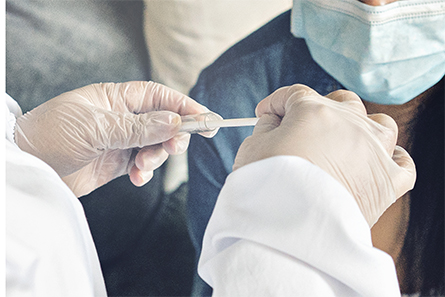
All COVID-19 tests start with a sample, but the scientific process goes differently after that.
[I’m a molecular biologist](https://scholar.google.com/citations?user=OJ3tLoQAAAAJ&hl=en&oi=ao), and since April 2020 I’ve been part of a team [working on a National Institutes of Health-funded program called RADx](https://www.nih.gov/research-training/medical-research-initiatives/radx) that is helping innovators develop rapid tests to detect when a person is infected with SARS-CoV-2, the virus that causes COVID-19.
Two major types of tests are used to diagnose infection with SARS-CoV-2: molecular tests — better known as [PCR tests](https://www.fda.gov/consumers/consumer-updates/coronavirus-disease-2019-testing-basics) — and [antigen tests](https://theconversation.com/antigen-tests-for-covid-19-are-fast-and-easy-and-could-solve-the-coronavirus-testing-problem-despite-being-somewhat-inaccurate-137977). Each detects a different part of the virus, and how it works influences the test’s speed and relative accuracy. So what are the differences between these types of tests?
### Looking for genetic evidence
The first step for either kind of test is to get a sample from the patient. This can be a nasal swab or a bit of saliva.
For PCR tests, the next step is amplification of genetic material so that even a small amount of coronavirus genes in the patient’s sample can be detected. This is done using a technique called a [polymerase chain reaction](https://www.genome.gov/about-genomics/fact-sheets/Polymerase-Chain-Reaction-Fact-Sheet). A health care worker takes the sample and treats it with an enzyme that converts RNA into double-stranded DNA. Then, the DNA is mixed with a solution containing an enzyme called a polymerase and heated, causing the DNA to separate into two single-stranded DNA pieces. The temperature is lowered, and polymerase, with the help of a small piece of guide DNA called a primer, binds to the single-stranded DNA and copies it. The primers ensure that only coronavirus DNA is amplified. You’ve now created two copies of coronavirus DNA from the original one piece of RNA.
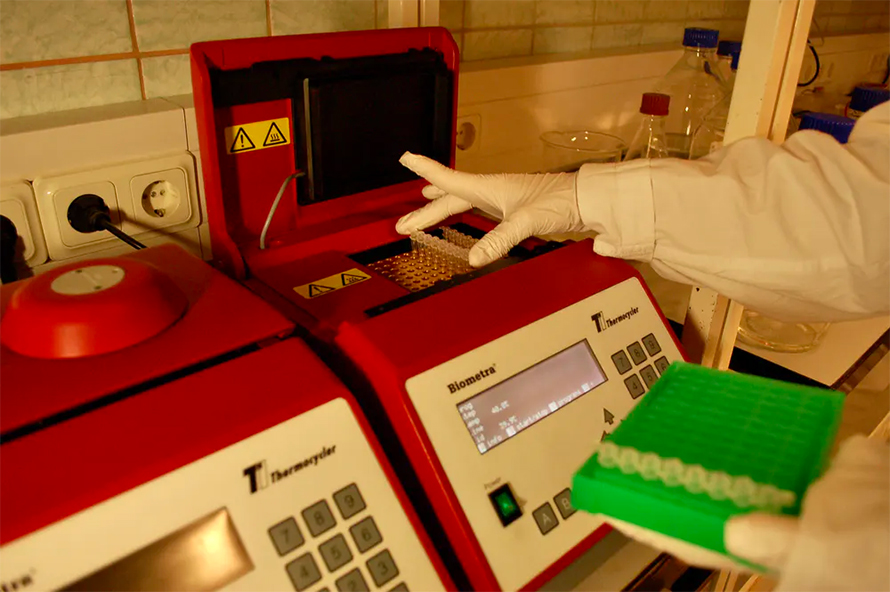
[Karl Mumm via Wikimedia Commons](https://commons.wikimedia.org/wiki/File:PCR_masina_kasutamine.jpg#/media/File:PCR_masina_kasutamine.jpg)
PCR tests are extremely accurate but require special lab equipment — like the PCR heating machine seen here — and can take hours or days to perform.
Laboratory machines [repeat these heating and cooling cycles 30 to 40 times](https://www.jove.com/v/5056/pcr-the-polymerase-chain-reaction), doubling the DNA until there are a [billion copies of the original piece](https://www.thermofisher.com/us/en/home/life-science/cloning/cloning-learning-center/invitrogen-school-of-molecular-biology/pcr-education/pcr-reagents-enzymes/pcr-basics.html). The amplified sequence contains fluorescent dye that is read by a machine.
The amplifying property of PCR allows the test to successfully detect even the smallest amount of coronavirus genetic material in a sample. This makes it a [highly sensitive and accurate test](https://medlineplus.gov/lab-tests/pcr-tests/). With [accuracy that approaches 100%](https://www.finddx.org/covid-19/sarscov2-eval-molecular/), it is the gold standard for diagnosing SARS–CoV–2.
However, PCR tests have some weaknesses too. They require a skilled laboratory technician and special equipment to run them, and the amplification process can take [an hour or more from start to finish](https://dx.doi.org/10.1016%2Fj.bdq.2017.05.002). Usually only large, centralized testing facilities – like hospital labs – can conduct many PCR tests at a time. Between sample collection, transportation, amplification, detection and reporting, it can take [from 12 hours to five days for a person to get results back](https://my.clevelandclinic.org/health/diagnostics/21462-covid-19-and-pcr-testing). And finally, they aren’t cheap at [\$100 or more per test](https://questdirect.questdiagnostics.com/products/covid-19-active-infection/).
### Antigen tests
[Rapid, accurate tests are essential](https://theconversation.com/over-the-counter-rapid-antigen-tests-can-help-slow-the-spread-of-covid-19-heres-how-to-use-them-effectively-166869) to contain a highly contagious virus like SARS-CoV-2. PCR tests are accurate but can take a long time to produce results. Antigen tests, the other major type of coronavirus test, while much faster, are less accurate.
Antigens are substances that cause the body to produce an immune response – they trigger the generation of antibodies. These tests use lab-made antibodies to search for antigens from the SARS-CoV-2 virus.
To run an antigen test, you first treat a sample with a liquid containing salt and soap that breaks apart cells and other particles. Then you apply this liquid to a test strip that [has antibodies specific to SARS-CoV-2 painted on it in a thin line](https://theconversation.com/antigen-tests-for-covid-19-are-fast-and-easy-and-could-solve-the-coronavirus-testing-problem-despite-being-somewhat-inaccurate-137977).
Just like antibodies in your body, the ones on the test strip will [bind to any antigen in the sample](https://labtestsonline.org/tests/covid-19-antigen-test). If the antibodies bind to coronavirus antigens, a colored line appears on the test strip indicating the presence of SARS-CoV-2.
Antigen tests have a number of strengths. First, they are so easy to use that people with no special training can perform them and interpret the results – [even at home](https://theconversation.com/rapid-screening-tests-that-prioritize-speed-over-accuracy-could-be-key-to-ending-the-coronavirus-pandemic-143882). They also produce results quickly, [typically in less than 15 minutes](https://theconversation.com/will-the-new-15-minute-covid-19-test-solve-us-testing-problems-145285). Another benefit is that these tests can be relatively inexpensive at [around \$10-\$15 per test](https://www.cvs.com/shop/home-health-care/home-tests/home-covid-test).
Antigen tests do have some drawbacks. Depending on the situation, they can be [less accurate than PCR tests](https://doi.org/10.1093/infdis/jiab337). When a person is symptomatic or has a lot of virus in their system, [antigen tests are very accurate](https://www.ncbi.nlm.nih.gov/pmc/articles/PMC7799021/). However, unlike molecular PCR tests, antigen tests don’t amplify the thing they are looking for. This means there needs to be enough viral antigen in the sample for the antibodies on the test strip to generate a signal. When a person is in the early stages of infection, not a lot of virus is in the nose and throat, from which the samples are taken. So, antigen tests can [miss early cases of COVID-19](https://doi.org/10.1038/d41586-021-00332-4). It’s also [during this stage that a person has no symptoms](https://www.cdc.gov/coronavirus/2019-ncov/faq.html#Symptoms-&-Emergency-Warning-Signs), so they are more likely to be unaware they’re infected.
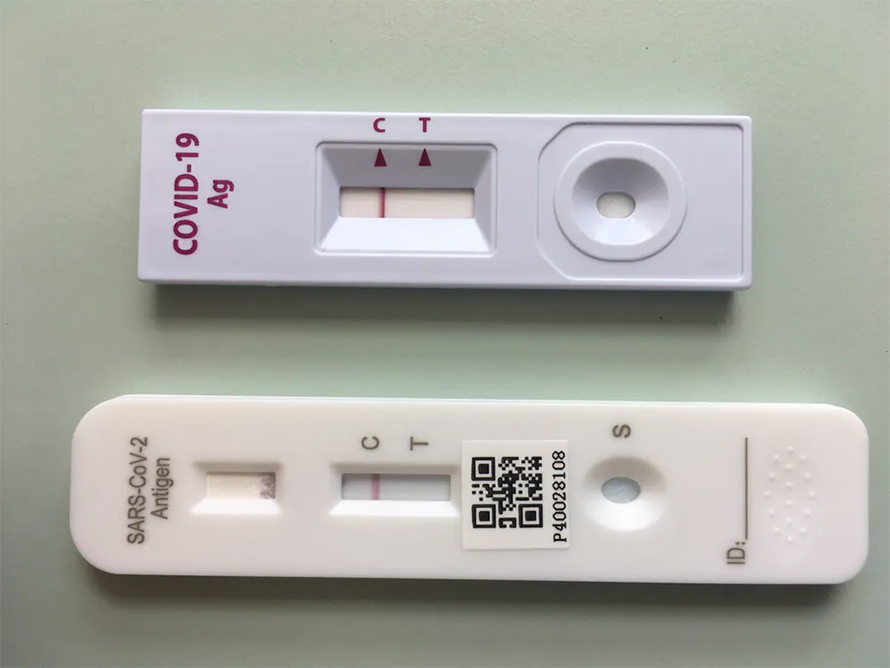
[Lennardywlee via Wikimedia Commons](https://commons.wikimedia.org/wiki/File:COVID-19_rapid_test.jpg#/media/File:COVID-19_rapid_test.jpg)
Rapid antigen tests – like the two seen here showing negative results – are much faster and easier to perform but are less sensitive than PCR tests.
### More tests, better knowledge
A few antigen tests are already available over the counter, and on Oct. 4, the Food and Drug Administration [granted emergency use authorization to another at-home antigen test](https://www.fda.gov/news-events/press-announcements/coronavirus-covid-19-update-fda-authorizes-additional-otc-home-test-increase-access-rapid-testing). The U.S. government is also pushing to [make these tests more available to the public](https://www.hhs.gov/about/news/2021/10/25/new-hhs-actions-add-biden-administration-efforts-increase-access-easy-use-over-counter-covid-19-tests.html).
At RADx, the project I am a part of, we are [currently conducting clinical studies](https://www.covid19testus.org/research-studies/test-us-at-home/) to get a better understanding of how antigen tests perform at various stages of infection. The more data scientists have on how accuracy changes over time, the more effectively these tests can be used.
Understanding the strengths and limitations of both PCR and antigen tests, and when to use them, can help to bring the COVID-19 pandemic under control. So the next time you get a COVID-19 test, choose the one that is right for you.
*This article is republished from [The Conversation](https://theconversation.com/) under a Creative Commons license. Read the [original article](https://theconversation.com/whats-the-difference-between-a-pcr-and-antigen-covid-19-test-a-molecular-biologist-explains-170917).*
#### Enjoy reading ASBMB Today?
Become a member to receive the print edition four times a year and the digital edition monthly.
[Learn more](https://www.asbmb.org/membership)

Nathaniel Hafer
Nathaniel Hafer is an assistant professor in the molecular medicine program at the University of Massachusetts chan Medical School.
[Contribute your story](https://asbmbtoday.submittable.com/submit)
## Related articles
[How to choose a booster shot](https://www.asbmb.org/asbmb-today/opinions/112021/how-to-choose-a-booster-shot)
Tina Hesman Saey, Science News
[Drug companies must update evidence for paxlovid](https://www.asbmb.org/asbmb-today/opinions/012124/drug-companies-must-update-evidence-for-paxlovid)
Lynora Saxinger
[A Nobel for biochemistry underlying COVID-19 vaccines](https://www.asbmb.org/asbmb-today/people/100223/2023-nobel-physiology-mrna)
Marissa Locke Rottinghaus
[Innovative approach opens the door to COVID nanobody therapies](https://www.asbmb.org/asbmb-today/science/041523/innovative-approach-opens-the-door-to-covid-nanobo)
Joshua A. Krisch
[Global analysis of coronavirus protein research](https://www.asbmb.org/asbmb-today/science/032623/global-analysis-of-coronavirus-protein-research)
Nancy D. Lamontagne
[Gain-of-function research: All in the eye of the beholder](https://www.asbmb.org/asbmb-today/policy/112121/gain-of-function-research-all-in-the-eye-of-the-be)
Charles Schmidt
## Get the latest from ASBMB Today
Enter your email address, and we’ll send you a weekly email with recent articles, interviews and more.
### Latest in Science
#### Science highlights or most popular articles
[Show more Science](https://www.asbmb.org/site-search?SourceCategories=asbmb_today&ArticleCategories=26196317-65cf-4f21-a55c-3b630024171e&SortBy=Date)
Award
#### [From humble beginnings to unlocking lysosomal secrets](https://www.asbmb.org/asbmb-today/people/022026/from-humble-beginnings-to-unlocking-lysosome)
Feb. 20, 2026
Monther Abu–Remaileh will receive the ASBMB’s 2026 Walter A. Shaw Young Investigator Award in Lipid Research at the ASBMB Annual Meeting, March 7-10 in Washington, D.C.
[Read More](https://www.asbmb.org/asbmb-today/people/022026/from-humble-beginnings-to-unlocking-lysosome)
Award
#### [Chemistry meets biology to thwart parasites](https://www.asbmb.org/asbmb-today/people/021926/chemistry-meets-biology-to-thwart-parasites)
Feb. 19, 2026
Margaret Phillips will receive the Alice and C. C. Wang Award in Molecular Parasitology at the ASBMB Annual Meeting, March 7-10 in Washington, D.C.
[Read More](https://www.asbmb.org/asbmb-today/people/021926/chemistry-meets-biology-to-thwart-parasites)

Award
#### [ASBMB announces 2026 JBC/Tabor awardees](https://www.asbmb.org/asbmb-today/people/021826/asbmb-announces-2026-jbc-tabor-awardees)
Feb. 18, 2026
The seven awardees are first authors of outstanding papers published in 2025 in the Journal of Biological Chemistry.
[Read More](https://www.asbmb.org/asbmb-today/people/021826/asbmb-announces-2026-jbc-tabor-awardees)
Journal News
#### [Missing lipid shrinks heart and lowers exercise capacity](https://www.asbmb.org/asbmb-today/science/021826/missing-lipid-shrinks-heart-exercise-capacity)
Feb. 18, 2026
Researchers uncovered the essential role of PLAAT1 in maintaining heart cardiolipin, mitochondrial function and energy metabolism, linking this enzyme to exercise capacity and potential cardiovascular disease pathways.
[Read More](https://www.asbmb.org/asbmb-today/science/021826/missing-lipid-shrinks-heart-exercise-capacity)
Award
#### [Decoding how bacteria flip host’s molecular switches](https://www.asbmb.org/asbmb-today/people/021726/decoding-how-bacteria-flip-hosts-molecular-switch)
Feb. 17, 2026
Kim Orth will receive the Earl and Thressa Stadtman Distinguished Scientists Award at the ASBMB Annual Meeting, March 7–10, just outside of Washington, D.C.
[Read More](https://www.asbmb.org/asbmb-today/people/021726/decoding-how-bacteria-flip-hosts-molecular-switch)
Award
#### [Defining JNKs: Targets for drug discovery](https://www.asbmb.org/asbmb-today/careers/021226/defining-jnks-targets-for-drug-discovery)
Feb. 12, 2026
Roger Davis will receive the Bert and Natalie Vallee Award in Biomedical Science at the ASBMB Annual Meeting, March 7–10, just outside of Washington, D.C.
[Read More](https://www.asbmb.org/asbmb-today/careers/021226/defining-jnks-targets-for-drug-discovery)
- [Science](https://www.asbmb.org/asbmb-today/science)
- [Opinions](https://www.asbmb.org/asbmb-today/opinions)
- [Policy](https://www.asbmb.org/asbmb-today/policy)
- [People](https://www.asbmb.org/asbmb-today/people)
- [Careers](https://www.asbmb.org/asbmb-today/careers)
- [Industry](https://www.asbmb.org/asbmb-today/industry)
[](https://www.asbmb.org/)
6120 Executive Blvd, Suite 400, Rockville, MD 20852. Phone (240) 283-6600
© Copyright 2026 American Society for Biochemistry and Molecular Biology
- [Contact Us](https://www.asbmb.org/contact)

 |
| Readable Markdown | At this point in the pandemic, you or someone you know has probably received at least one COVID-19 test. But do you know which kind of test you got and the strengths and weaknesses of these different tests?

All COVID-19 tests start with a sample, but the scientific process goes differently after that.
[I’m a molecular biologist](https://scholar.google.com/citations?user=OJ3tLoQAAAAJ&hl=en&oi=ao), and since April 2020 I’ve been part of a team [working on a National Institutes of Health-funded program called RADx](https://www.nih.gov/research-training/medical-research-initiatives/radx) that is helping innovators develop rapid tests to detect when a person is infected with SARS-CoV-2, the virus that causes COVID-19.
Two major types of tests are used to diagnose infection with SARS-CoV-2: molecular tests — better known as [PCR tests](https://www.fda.gov/consumers/consumer-updates/coronavirus-disease-2019-testing-basics) — and [antigen tests](https://theconversation.com/antigen-tests-for-covid-19-are-fast-and-easy-and-could-solve-the-coronavirus-testing-problem-despite-being-somewhat-inaccurate-137977). Each detects a different part of the virus, and how it works influences the test’s speed and relative accuracy. So what are the differences between these types of tests?
### Looking for genetic evidence
The first step for either kind of test is to get a sample from the patient. This can be a nasal swab or a bit of saliva.
For PCR tests, the next step is amplification of genetic material so that even a small amount of coronavirus genes in the patient’s sample can be detected. This is done using a technique called a [polymerase chain reaction](https://www.genome.gov/about-genomics/fact-sheets/Polymerase-Chain-Reaction-Fact-Sheet). A health care worker takes the sample and treats it with an enzyme that converts RNA into double-stranded DNA. Then, the DNA is mixed with a solution containing an enzyme called a polymerase and heated, causing the DNA to separate into two single-stranded DNA pieces. The temperature is lowered, and polymerase, with the help of a small piece of guide DNA called a primer, binds to the single-stranded DNA and copies it. The primers ensure that only coronavirus DNA is amplified. You’ve now created two copies of coronavirus DNA from the original one piece of RNA.

PCR tests are extremely accurate but require special lab equipment — like the PCR heating machine seen here — and can take hours or days to perform.
Laboratory machines [repeat these heating and cooling cycles 30 to 40 times](https://www.jove.com/v/5056/pcr-the-polymerase-chain-reaction), doubling the DNA until there are a [billion copies of the original piece](https://www.thermofisher.com/us/en/home/life-science/cloning/cloning-learning-center/invitrogen-school-of-molecular-biology/pcr-education/pcr-reagents-enzymes/pcr-basics.html). The amplified sequence contains fluorescent dye that is read by a machine.
The amplifying property of PCR allows the test to successfully detect even the smallest amount of coronavirus genetic material in a sample. This makes it a [highly sensitive and accurate test](https://medlineplus.gov/lab-tests/pcr-tests/). With [accuracy that approaches 100%](https://www.finddx.org/covid-19/sarscov2-eval-molecular/), it is the gold standard for diagnosing SARS–CoV–2.
However, PCR tests have some weaknesses too. They require a skilled laboratory technician and special equipment to run them, and the amplification process can take [an hour or more from start to finish](https://dx.doi.org/10.1016%2Fj.bdq.2017.05.002). Usually only large, centralized testing facilities – like hospital labs – can conduct many PCR tests at a time. Between sample collection, transportation, amplification, detection and reporting, it can take [from 12 hours to five days for a person to get results back](https://my.clevelandclinic.org/health/diagnostics/21462-covid-19-and-pcr-testing). And finally, they aren’t cheap at [\$100 or more per test](https://questdirect.questdiagnostics.com/products/covid-19-active-infection/).
### Antigen tests
[Rapid, accurate tests are essential](https://theconversation.com/over-the-counter-rapid-antigen-tests-can-help-slow-the-spread-of-covid-19-heres-how-to-use-them-effectively-166869) to contain a highly contagious virus like SARS-CoV-2. PCR tests are accurate but can take a long time to produce results. Antigen tests, the other major type of coronavirus test, while much faster, are less accurate.
Antigens are substances that cause the body to produce an immune response – they trigger the generation of antibodies. These tests use lab-made antibodies to search for antigens from the SARS-CoV-2 virus.
To run an antigen test, you first treat a sample with a liquid containing salt and soap that breaks apart cells and other particles. Then you apply this liquid to a test strip that [has antibodies specific to SARS-CoV-2 painted on it in a thin line](https://theconversation.com/antigen-tests-for-covid-19-are-fast-and-easy-and-could-solve-the-coronavirus-testing-problem-despite-being-somewhat-inaccurate-137977).
Just like antibodies in your body, the ones on the test strip will [bind to any antigen in the sample](https://labtestsonline.org/tests/covid-19-antigen-test). If the antibodies bind to coronavirus antigens, a colored line appears on the test strip indicating the presence of SARS-CoV-2.
Antigen tests have a number of strengths. First, they are so easy to use that people with no special training can perform them and interpret the results – [even at home](https://theconversation.com/rapid-screening-tests-that-prioritize-speed-over-accuracy-could-be-key-to-ending-the-coronavirus-pandemic-143882). They also produce results quickly, [typically in less than 15 minutes](https://theconversation.com/will-the-new-15-minute-covid-19-test-solve-us-testing-problems-145285). Another benefit is that these tests can be relatively inexpensive at [around \$10-\$15 per test](https://www.cvs.com/shop/home-health-care/home-tests/home-covid-test).
Antigen tests do have some drawbacks. Depending on the situation, they can be [less accurate than PCR tests](https://doi.org/10.1093/infdis/jiab337). When a person is symptomatic or has a lot of virus in their system, [antigen tests are very accurate](https://www.ncbi.nlm.nih.gov/pmc/articles/PMC7799021/). However, unlike molecular PCR tests, antigen tests don’t amplify the thing they are looking for. This means there needs to be enough viral antigen in the sample for the antibodies on the test strip to generate a signal. When a person is in the early stages of infection, not a lot of virus is in the nose and throat, from which the samples are taken. So, antigen tests can [miss early cases of COVID-19](https://doi.org/10.1038/d41586-021-00332-4). It’s also [during this stage that a person has no symptoms](https://www.cdc.gov/coronavirus/2019-ncov/faq.html#Symptoms-&-Emergency-Warning-Signs), so they are more likely to be unaware they’re infected.

Rapid antigen tests – like the two seen here showing negative results – are much faster and easier to perform but are less sensitive than PCR tests.
### More tests, better knowledge
A few antigen tests are already available over the counter, and on Oct. 4, the Food and Drug Administration [granted emergency use authorization to another at-home antigen test](https://www.fda.gov/news-events/press-announcements/coronavirus-covid-19-update-fda-authorizes-additional-otc-home-test-increase-access-rapid-testing). The U.S. government is also pushing to [make these tests more available to the public](https://www.hhs.gov/about/news/2021/10/25/new-hhs-actions-add-biden-administration-efforts-increase-access-easy-use-over-counter-covid-19-tests.html).
At RADx, the project I am a part of, we are [currently conducting clinical studies](https://www.covid19testus.org/research-studies/test-us-at-home/) to get a better understanding of how antigen tests perform at various stages of infection. The more data scientists have on how accuracy changes over time, the more effectively these tests can be used.
Understanding the strengths and limitations of both PCR and antigen tests, and when to use them, can help to bring the COVID-19 pandemic under control. So the next time you get a COVID-19 test, choose the one that is right for you.
*This article is republished from [The Conversation](https://theconversation.com/) under a Creative Commons license. Read the [original article](https://theconversation.com/whats-the-difference-between-a-pcr-and-antigen-covid-19-test-a-molecular-biologist-explains-170917).* |
| Shard | 2 (laksa) |
| Root Hash | 13718679005245139202 |
| Unparsed URL | org,asbmb!www,/asbmb-today/science/122521/difference-between-pcr-and-antigen-covid-test s443 |