ℹ️ Skipped - page is already crawled
| Filter | Status | Condition | Details |
|---|---|---|---|
| HTTP status | PASS | download_http_code = 200 | HTTP 200 |
| Age cutoff | PASS | download_stamp > now() - 6 MONTH | 0.3 months ago |
| History drop | PASS | isNull(history_drop_reason) | No drop reason |
| Spam/ban | PASS | fh_dont_index != 1 AND ml_spam_score = 0 | ml_spam_score=0 |
| Canonical | PASS | meta_canonical IS NULL OR = '' OR = src_unparsed | Not set |
| Property | Value |
|---|---|
| URL | https://www.adlerplanetarium.org/blog/first-ever-photo-black-hole/ |
| Last Crawled | 2026-04-15 08:48:13 (9 days ago) |
| First Indexed | 2020-01-25 15:45:31 (6 years ago) |
| HTTP Status Code | 200 |
| Content | |
| Meta Title | Scientists release first close-up photo of a black hole - Adler Planetarium |
| Meta Description | We're excited to share that today, Wednesday, April 10, 2019, scientists released the first close-up picture of the region around a black hole! |
| Meta Canonical | null |
| Boilerpipe Text | Black Holes are incredible beasts… Nothing can escape from them and yet they power quasars—the brightest beacons in the Universe. They warp space, bending light, and slow time to a stopping point. In their hearts lurks a singularity where the laws of physics break down. But they are shrouded in mystery. We have lots of evidence that they must exist, from Einstein’s equations of Gravity to the swirling dance of stars around them. But no one had ever
seen
a black hole. Until now…
We’re excited to share that today, Wednesday, April 10,
scientists released the first close-up picture
of the region around a black hole, an incredibly significant scientific result!
The photo came from a project called the
Event Horizon Telescope
(EHT). It is an international collaboration aiming to capture the first image of the region around a black hole by creating a virtual Earth-sized telescope. Radio telescopes used in this project are located in the United States, Mexico, Chile, Spain, and the South Pole.
The science team imaged the supermassive black hole in the center of the galaxy known as
M87
. M87 is an elliptical, or round-shaped, galaxy located about 55 million light years away in the direction of the constellation Virgo. It is a monster galaxy, weighing in at over 10x our own Milky Way (no slacker itself!). M87 sits in the center of the Virgo cluster of galaxies so we think it got so large by swallowing up other galaxies.
Just like its host galaxy, the M87 black hole is also a monster… it contains as much mass as about 6.5 billion of our Suns. It is one of the largest black holes we know about. The two facts are probably related. The rich environment of M87 provided lots of gas, dust, and stars for the black hole to feed on!
Discovered in 1781, Galaxy M87 (Messier 87) is a member of the neighboring Virgo cluster of galaxies, as well as the home of several trillion stars and the black hole imaged by EHT.
Photo Credit: NASA, ESA and the Hubble Heritage Team (STScI/AURA); Acknowledgment: P. Cote (Herzberg Institute of Astrophysics) and E. Baltz (Stanford University)
Wow! How Did they do it?
In short,
radio waves
!
No one sees light directly from the black hole… it is, after all, a place from which nothing, not even light, can escape! What the team imaged are radio waves (light) coming from gas in orbit around the black hole.
The process of combining light from multiple radio telescopes spread over thousands of miles (known as interferometry) made it possible to see finer details than possible with a single telescope. The farther the telescopes are spread the finer the details we can see. That’s why having radio telescopes from all over the world—including the South Pole!—was so important. Someday we might even have radio telescopes in space to make even sharper images.
So, what exactly am I looking at in this image?
Scientists have obtained the first image of a black hole, using Event Horizon Telescope observations of the center of the galaxy M87.
Photo credit: Event Horizon Telescope Collaboration
The image shows the “shadow” of the black hole, the closest we can come to an image of the black hole itself. The black hole’s boundary—the event horizon from which the EHT takes its name—is around 3x smaller than the shadow it casts and measures just under 25 billion miles across. The team calculated that the original estimate of the mass of the black hole, 6.5 billion times the mass of our Sun, appears to be correct. They also determined that the black hole is rotating clockwise.
We can use this image to test Einstein’s Theory of General Relativity. Scientists ask, “Do we see what we were expecting to see?” For example, according to general relativity, black holes are expected to be spherical. The EHT team says that, to within 10 percent, the black hole appears to be spherical.
The ring of light in the image is related to the bending of light near a black hole. Light emitted by the gas swirling into a black hole can stream directly to our telescopes, but it can also wrap around the black hole, its path bent by the tremendous force of gravity. This bending, or “lensing,” of light produces a ring around the black hole at a distance where the photons can orbit just balanced between being captured by the gravity of the black hole and flying out to infinity. At the same time, the black hole’s fierce gravity piles the material orbiting the black hole up into a last stable orbit before it plunges quickly into the black hole. That can also create ring structures… so it’s a bit complicated!
Space is freaking awesome! Where can I learn more?
From April 10-14, 2019, visit us here at the Adler Planetarium and interact with our facilitators as they present fun activities about how we study the Universe using a type of light that our eyes cannot see: ultraviolet light. Or view our small temporary addition (starting 4/12) on black holes in our
Telescopes: Through the Looking Glass
exhibition!
Then check out our
Space Visualization Lab
to interact with Adler astronomers, cutting-edge images, and visualizations about the black holes at the centers of our Milky Way Galaxy and M87!
You can also take part in a
Zooniverse.org
citizen science project to help scientists study images taken using infrared light and gamma rays:
—
Muon Hunters 2.0
—
The Milky Way Project |
| Markdown | JavaScript must be enabled to use this application.
[Skip to Main Content](https://www.adlerplanetarium.org/blog/first-ever-photo-black-hole/#main)
[Buy tickets ](https://www.adlerplanetarium.org/ticketing-options)
- [Visit](https://www.adlerplanetarium.org/visit/your-visit/)
- [Your Visit](https://www.adlerplanetarium.org/visit/your-visit/)
- [Tickets](https://www.adlerplanetarium.org/visit/tickets/)
- [Save with CityPASS](https://www.adlerplanetarium.org/visit/city-pass/)
- [Star Pass Portal](https://www.adlerplanetarium.org/visit/your-visit/pass-portal/)
- [Group Visits](https://www.adlerplanetarium.org/visit/groups/)
- [School Field Trips](https://www.adlerplanetarium.org/visit/school-field-trips/)
- [Climate Change And Me](https://www.adlerplanetarium.org/visit/school-field-trips/climate-change-me/)
- [Explore](https://www.adlerplanetarium.org/explore/exhibits/)
- [Exhibits](https://www.adlerplanetarium.org/explore/exhibits/)
- [Sky Shows](https://www.adlerplanetarium.org/explore/shows/)
- [Digital Series](https://www.adlerplanetarium.org/explore/digital-series/)
- [Events](https://www.adlerplanetarium.org/explore/events/)
- [About Us](https://www.adlerplanetarium.org/explore/about-us/)
- [Collections](https://www.adlerplanetarium.org/explore/collections/)
- [The Adler ‘Scope Blog](https://www.adlerplanetarium.org/blog/)
- [Learn](https://www.adlerplanetarium.org/learn/kids-and-fam/)
- [All Ages](https://www.adlerplanetarium.org/learn/all-ages/)
- [Kids and Family](https://www.adlerplanetarium.org/learn/kids-and-fam/)
- [Teens](https://www.adlerplanetarium.org/learn/teens/)
- [Educator Hub](https://www.adlerplanetarium.org/learn/educators/)
- [Sky Observing](https://www.adlerplanetarium.org/learn/all-ages/sky-observing/)
- [Far Horizons](https://www.adlerplanetarium.org/learn/all-ages/far-horizons/)
- [Research](https://www.adlerplanetarium.org/learn/research/)
- [Zooniverse](https://www.adlerplanetarium.org/learn/all-ages/zooniverse/)
- [Give](https://www.adlerplanetarium.org/?page_id=300978)
- [Donate](https://www.adlerplanetarium.org/support/donate-now/)
- [Board of Trustees](https://www.adlerplanetarium.org/support/board-of-trustees/)
- [Volunteers](https://www.adlerplanetarium.org/support/volunteers/)
- [Community of Stargazers](https://www.adlerplanetarium.org/support/community-of-stargazers/)
- [Tickets](https://www.adlerplanetarium.org/visit/tickets/)
- [Adler Anywhere](https://www.adlerplanetarium.org/adler-anywhere/)
- [Space Shop](https://www.muzemerch.com/partner/adler-planetarium)
- [Venue Rentals](https://www.adlerplanetarium.org/venue-rentals/)
- [Ask Adler Astronomers](https://www.adlerplanetarium.org/learn/all-ages/ask-adler-astronomers/)
- [Donate Now](https://give.adlerplanetarium.org/give/234270/#!/donation/checkout?c_src=FY24_EvergreenClassy-HeaderNav_OrgTraffic_Give&utm_campaign=Evergreen&utm_medium=Web&utm_source=OrgTraffic&utm_content=Classy-HeaderNav&utm_term=Give)
[Go to the home page](https://www.adlerplanetarium.org/ "Go to the home page")
- [Tickets](https://www.adlerplanetarium.org/visit/tickets/)
- [Adler Anywhere](https://www.adlerplanetarium.org/adler-anywhere/)
- [Space Shop](https://www.muzemerch.com/partner/adler-planetarium)
- [Venue Rentals](https://www.adlerplanetarium.org/venue-rentals/)
- [Ask Adler Astronomers](https://www.adlerplanetarium.org/learn/all-ages/ask-adler-astronomers/)
- [Donate Now](https://give.adlerplanetarium.org/give/234270/#!/donation/checkout?c_src=FY24_EvergreenClassy-HeaderNav_OrgTraffic_Give&utm_campaign=Evergreen&utm_medium=Web&utm_source=OrgTraffic&utm_content=Classy-HeaderNav&utm_term=Give)
[Search Site](https://www.adlerplanetarium.org/?s=)
Open Menu
- [Visit](https://www.adlerplanetarium.org/blog/first-ever-photo-black-hole/ "Visit")
- [Your Visit](https://www.adlerplanetarium.org/visit/your-visit/ "Your Visit")
- [Tickets](https://www.adlerplanetarium.org/visit/tickets/ "Tickets")
- [Save with CityPASS](https://www.adlerplanetarium.org/visit/city-pass/ "Save with CityPASS")
- [Star Pass Portal](https://www.adlerplanetarium.org/visit/your-visit/pass-portal/ "Star Pass Portal")
- [Group Visits](https://www.adlerplanetarium.org/visit/groups/ "Group Visits")
- [School Field Trips](https://www.adlerplanetarium.org/visit/school-field-trips/ "School Field Trips")
- [Climate Change And Me](https://www.adlerplanetarium.org/visit/school-field-trips/climate-change-me/ "Climate Change And Me")
- [Explore](https://www.adlerplanetarium.org/blog/first-ever-photo-black-hole/ "Explore")
- [Exhibits](https://www.adlerplanetarium.org/explore/exhibits/ "Exhibits")
- [Sky Shows](https://www.adlerplanetarium.org/explore/shows/ "Sky Shows")
- [Digital Series](https://www.adlerplanetarium.org/explore/digital-series/ "Digital Series")
- [Events](https://www.adlerplanetarium.org/explore/events/ "Events")
- [About Us](https://www.adlerplanetarium.org/explore/about-us/ "About Us")
- [Collections](https://www.adlerplanetarium.org/explore/collections/ "Collections")
- [The Adler ‘Scope Blog](https://www.adlerplanetarium.org/blog/ "The Adler 'Scope Blog")
- [Learn](https://www.adlerplanetarium.org/blog/first-ever-photo-black-hole/ "Learn")
- [All Ages](https://www.adlerplanetarium.org/learn/all-ages/ "All Ages")
- [Kids and Family](https://www.adlerplanetarium.org/learn/kids-and-fam/ "Kids and Family")
- [Teens](https://www.adlerplanetarium.org/learn/teens/ "Teens")
- [Educator Hub](https://www.adlerplanetarium.org/learn/educators/ "Educator Hub")
- [Sky Observing](https://www.adlerplanetarium.org/learn/all-ages/sky-observing/ "Sky Observing")
- [Far Horizons](https://www.adlerplanetarium.org/learn/all-ages/far-horizons/ "Far Horizons")
- [Research](https://www.adlerplanetarium.org/learn/research/ "Research")
- [Zooniverse](https://www.adlerplanetarium.org/learn/all-ages/zooniverse/ "Zooniverse")
- [Give](https://www.adlerplanetarium.org/blog/first-ever-photo-black-hole/ "Give")
- [Donate](https://www.adlerplanetarium.org/support/donate-now/ "Donate")
- [Board of Trustees](https://www.adlerplanetarium.org/support/board-of-trustees/ "Board of Trustees")
- [Volunteers](https://www.adlerplanetarium.org/support/volunteers/ "Volunteers")
- [Community of Stargazers](https://www.adlerplanetarium.org/support/community-of-stargazers/ "Community of Stargazers")
[Home](https://www.adlerplanetarium.org/) » [Blog](https://www.adlerplanetarium.org/blog/) »Scientists release first close-up photo of a black hole
#### FOLLOW US\!
- [](http://facebook.com/adlerplanetarium)
- [](https://www.adlerplanetarium.org/blog/first-ever-photo-black-hole/%20http://twitter.com/AdlerPlanet)
- [](http://youtube.com/adlerplanetarium)
- [](https://www.instagram.com/adlerplanet/%20)
# Scientists release first close-up photo of a black hole
April 10, 2019
[M87](https://www.adlerplanetarium.org/blog/tag/m87/), [supermassive black hole](https://www.adlerplanetarium.org/blog/tag/supermassive-black-hole/), [space science news](https://www.adlerplanetarium.org/blog/tag/space-science-news/), [black hole](https://www.adlerplanetarium.org/blog/tag/black-hole/), [Event Horizon Telescope](https://www.adlerplanetarium.org/blog/tag/event-horizon-telescope/), [radio waves](https://www.adlerplanetarium.org/blog/tag/radio-waves/)
Black Holes are incredible beasts… Nothing can escape from them and yet they power quasars—the brightest beacons in the Universe. They warp space, bending light, and slow time to a stopping point. In their hearts lurks a singularity where the laws of physics break down. But they are shrouded in mystery. We have lots of evidence that they must exist, from Einstein’s equations of Gravity to the swirling dance of stars around them. But no one had ever **seen** a black hole. Until now…
We’re excited to share that today, Wednesday, April 10, [scientists released the first close-up picture](https://chicago.cbslocal.com/2019/04/10/black-hole-image/) of the region around a black hole, an incredibly significant scientific result\!
The photo came from a project called the [Event Horizon Telescope](https://eventhorizontelescope.org/) (EHT). It is an international collaboration aiming to capture the first image of the region around a black hole by creating a virtual Earth-sized telescope. Radio telescopes used in this project are located in the United States, Mexico, Chile, Spain, and the South Pole.
The science team imaged the supermassive black hole in the center of the galaxy known as [M87](https://www.nasa.gov/feature/goddard/2017/messier-87). M87 is an elliptical, or round-shaped, galaxy located about 55 million light years away in the direction of the constellation Virgo. It is a monster galaxy, weighing in at over 10x our own Milky Way (no slacker itself!). M87 sits in the center of the Virgo cluster of galaxies so we think it got so large by swallowing up other galaxies.
Just like its host galaxy, the M87 black hole is also a monster… it contains as much mass as about 6.5 billion of our Suns. It is one of the largest black holes we know about. The two facts are probably related. The rich environment of M87 provided lots of gas, dust, and stars for the black hole to feed on\!
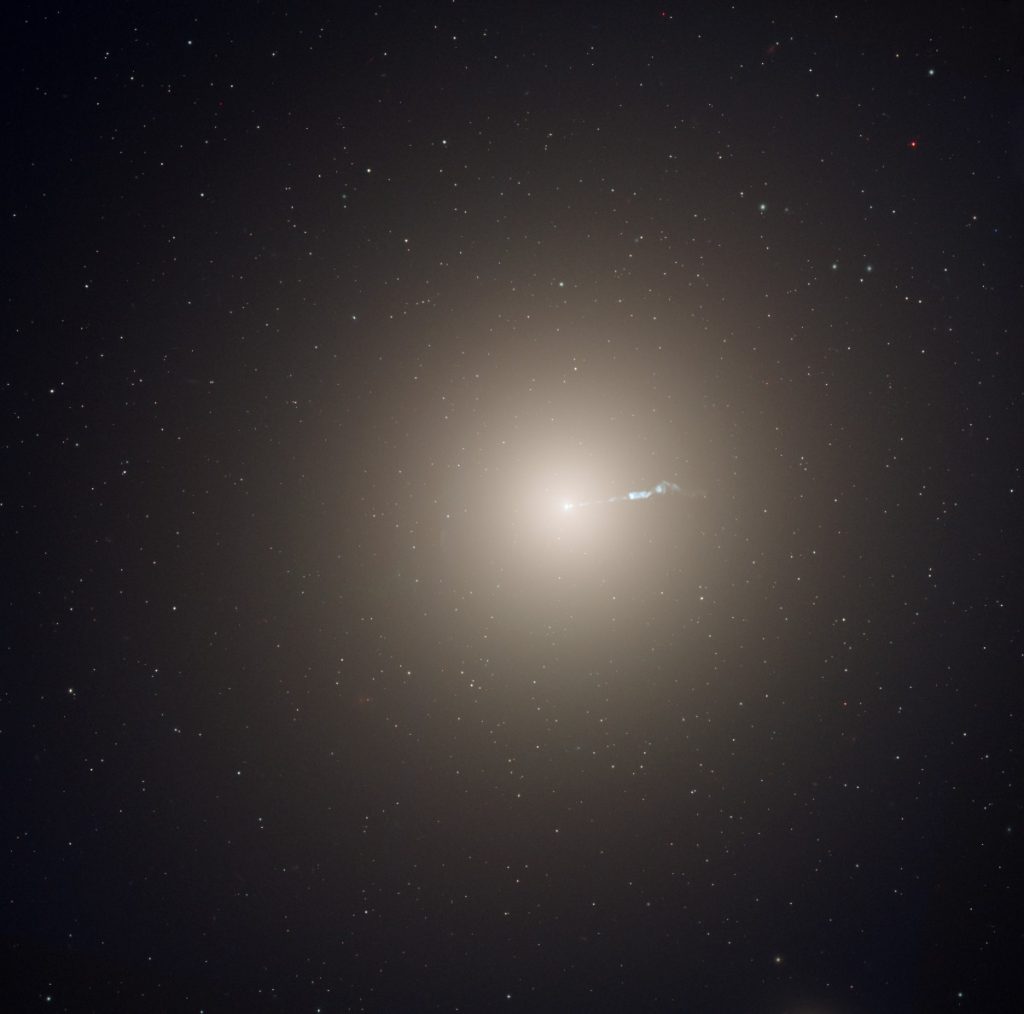
*Discovered in 1781, Galaxy M87 (Messier 87) is a member of the neighboring Virgo cluster of galaxies, as well as the home of several trillion stars and the black hole imaged by EHT.* ***Photo Credit: NASA, ESA and the Hubble Heritage Team (STScI/AURA); Acknowledgment: P. Cote (Herzberg Institute of Astrophysics) and E. Baltz (Stanford University)***
### Wow! How Did they do it?
In short, [radio waves](https://iopscience.iop.org/journal/2041-8205/page/Focus_on_EHT)\!
No one sees light directly from the black hole… it is, after all, a place from which nothing, not even light, can escape! What the team imaged are radio waves (light) coming from gas in orbit around the black hole.
The process of combining light from multiple radio telescopes spread over thousands of miles (known as interferometry) made it possible to see finer details than possible with a single telescope. The farther the telescopes are spread the finer the details we can see. That’s why having radio telescopes from all over the world—including the South Pole!—was so important. Someday we might even have radio telescopes in space to make even sharper images.
### So, what exactly am I looking at in this image?

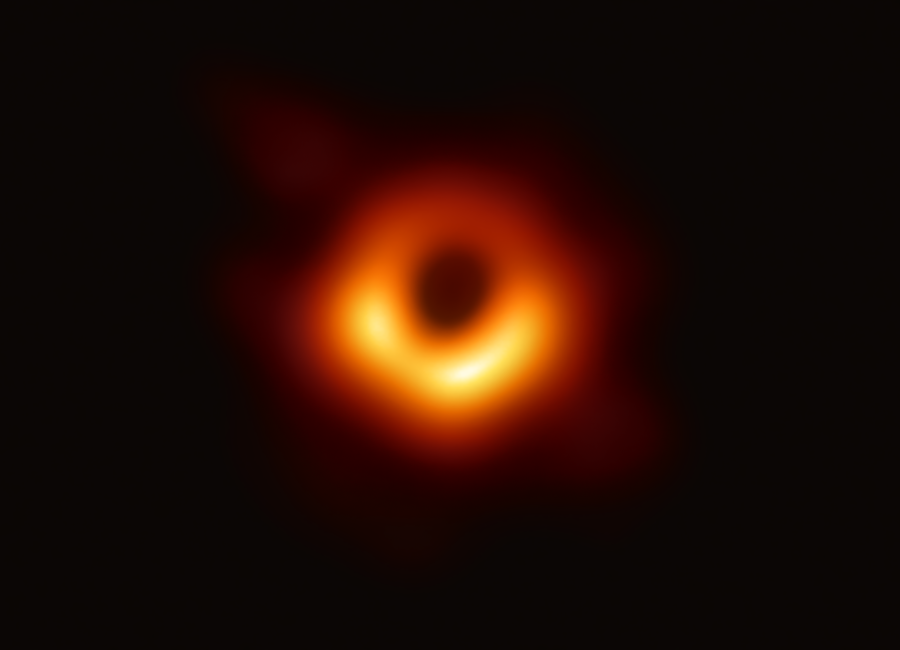
*Scientists have obtained the first image of a black hole, using Event Horizon Telescope observations of the center of the galaxy M87.* ***Photo credit: Event Horizon Telescope Collaboration***
The image shows the “shadow” of the black hole, the closest we can come to an image of the black hole itself. The black hole’s boundary—the event horizon from which the EHT takes its name—is around 3x smaller than the shadow it casts and measures just under 25 billion miles across. The team calculated that the original estimate of the mass of the black hole, 6.5 billion times the mass of our Sun, appears to be correct. They also determined that the black hole is rotating clockwise.
We can use this image to test Einstein’s Theory of General Relativity. Scientists ask, “Do we see what we were expecting to see?” For example, according to general relativity, black holes are expected to be spherical. The EHT team says that, to within 10 percent, the black hole appears to be spherical.
The ring of light in the image is related to the bending of light near a black hole. Light emitted by the gas swirling into a black hole can stream directly to our telescopes, but it can also wrap around the black hole, its path bent by the tremendous force of gravity. This bending, or “lensing,” of light produces a ring around the black hole at a distance where the photons can orbit just balanced between being captured by the gravity of the black hole and flying out to infinity. At the same time, the black hole’s fierce gravity piles the material orbiting the black hole up into a last stable orbit before it plunges quickly into the black hole. That can also create ring structures… so it’s a bit complicated\!
### Space is freaking awesome! Where can I learn more?
From April 10-14, 2019, visit us here at the Adler Planetarium and interact with our facilitators as they present fun activities about how we study the Universe using a type of light that our eyes cannot see: ultraviolet light. Or view our small temporary addition (starting 4/12) on black holes in our [*Telescopes: Through the Looking Glass*](https://www.adlerplanetarium.org/events/telescopes-looking-glass/) exhibition\!
Then check out our [Space Visualization Lab](https://www.adlerplanetarium.org/whats-here/dont-miss/space-visualization-lab/) to interact with Adler astronomers, cutting-edge images, and visualizations about the black holes at the centers of our Milky Way Galaxy and M87\!
You can also take part in a [Zooniverse.org](https://www.zooniverse.org/) citizen science project to help scientists study images taken using infrared light and gamma rays:
—[Muon Hunters 2.0](https://www.zooniverse.org/projects/dwright04/muon-hunters-2-dot-0)
—[The Milky Way Project](https://www.zooniverse.org/projects/povich/milky-way-project)
#### FOLLOW US\!
- [](http://facebook.com/adlerplanetarium)
- [](https://www.adlerplanetarium.org/blog/first-ever-photo-black-hole/%20http://twitter.com/AdlerPlanet)
- [](http://youtube.com/adlerplanetarium)
- [](https://www.instagram.com/adlerplanet/%20)
### DISCOVER MORE POSTS
[ Out of the pocket to outer space: The saga of a portable globe](https://www.adlerplanetarium.org/blog/out-of-the-pocket-to-outer-space-the-sage-of-a-portable-globe/)
[ Behind the Scenes: Kavli Fulldome Lecture Series](https://www.adlerplanetarium.org/blog/behind-the-scenes-kavli-fulldome-lecture-series/)
[ Adler Skywatch: October 2018](https://www.adlerplanetarium.org/blog/adler-skywatch-october-2018/)
- Follow Us\!
- [](http://facebook.com/adlerplanetarium)
- [](https://www.adlerplanetarium.org/blog/first-ever-photo-black-hole/%20http://twitter.com/AdlerPlanet)
- [](http://youtube.com/adlerplanetarium)
- [](https://www.instagram.com/adlerplanet/%20)
#### VISIT
1300 S. DuSable Lake Shore Dr.
Chicago, IL 60605
Open Today From 4pm – 10pm
**\*Last admission one hour before close.\***
- [Plan Your Visit](https://www.adlerplanetarium.org/visit/your-visit/)
- [Tickets](https://www.adlerplanetarium.org/visit/tickets/)
- [Groups](https://www.adlerplanetarium.org/visit/groups/)
#### SUPPORT
We all have the potential to discover something great. Help the Adler unlock the potential in every mind with a tax-deductible gift.
- [Donate Now](https://give.adlerplanetarium.org/give/234270/#!/donation/checkout?c_src=FY24_EvergreenClassy-FooterNav_OrgTraffic_Give&utm_campaign=Evergreen&utm_medium=Web&utm_source=OrgTraffic&utm_content=Classy-FooterNav&utm_term=Give)
- [Volunteer](https://www.adlerplanetarium.org/support/volunteers/)
#### ABOUT US
- [Annual Reports & Financials](https://www.adlerplanetarium.org/annual-reports-and-finanicals/)
- [Career Opportunities](https://www.adlerplanetarium.org/career-opportunities/)
- [Press Room](https://www.adlerplanetarium.org/press-room/)
- [Private Events](https://www.adlerplanetarium.org/private-events/)
- [Productions Licensing](https://www.adlerplanetarium.org/productions/)
- [Sign Up For Our Emails](http://eepurl.com/gX87D1)

© 2026 Adler Planetarium \| [Privacy Policy](https://adlerplanetarium.org/privacy-policy/) \| [Contact Us](https://adlerplanetarium.org/contact-us/)
We will be performing maintenance on the ticketing system between Tuesday, April 14, at 6:00 pm and Wednesday, April 15, at 8:00 am. During this time, tickets cannot be purchased.
 |
| Readable Markdown | Black Holes are incredible beasts… Nothing can escape from them and yet they power quasars—the brightest beacons in the Universe. They warp space, bending light, and slow time to a stopping point. In their hearts lurks a singularity where the laws of physics break down. But they are shrouded in mystery. We have lots of evidence that they must exist, from Einstein’s equations of Gravity to the swirling dance of stars around them. But no one had ever **seen** a black hole. Until now…
We’re excited to share that today, Wednesday, April 10, [scientists released the first close-up picture](https://chicago.cbslocal.com/2019/04/10/black-hole-image/) of the region around a black hole, an incredibly significant scientific result\!
The photo came from a project called the [Event Horizon Telescope](https://eventhorizontelescope.org/) (EHT). It is an international collaboration aiming to capture the first image of the region around a black hole by creating a virtual Earth-sized telescope. Radio telescopes used in this project are located in the United States, Mexico, Chile, Spain, and the South Pole.
The science team imaged the supermassive black hole in the center of the galaxy known as [M87](https://www.nasa.gov/feature/goddard/2017/messier-87). M87 is an elliptical, or round-shaped, galaxy located about 55 million light years away in the direction of the constellation Virgo. It is a monster galaxy, weighing in at over 10x our own Milky Way (no slacker itself!). M87 sits in the center of the Virgo cluster of galaxies so we think it got so large by swallowing up other galaxies.
Just like its host galaxy, the M87 black hole is also a monster… it contains as much mass as about 6.5 billion of our Suns. It is one of the largest black holes we know about. The two facts are probably related. The rich environment of M87 provided lots of gas, dust, and stars for the black hole to feed on\!

*Discovered in 1781, Galaxy M87 (Messier 87) is a member of the neighboring Virgo cluster of galaxies, as well as the home of several trillion stars and the black hole imaged by EHT.* ***Photo Credit: NASA, ESA and the Hubble Heritage Team (STScI/AURA); Acknowledgment: P. Cote (Herzberg Institute of Astrophysics) and E. Baltz (Stanford University)***
### Wow! How Did they do it?
In short, [radio waves](https://iopscience.iop.org/journal/2041-8205/page/Focus_on_EHT)\!
No one sees light directly from the black hole… it is, after all, a place from which nothing, not even light, can escape! What the team imaged are radio waves (light) coming from gas in orbit around the black hole.
The process of combining light from multiple radio telescopes spread over thousands of miles (known as interferometry) made it possible to see finer details than possible with a single telescope. The farther the telescopes are spread the finer the details we can see. That’s why having radio telescopes from all over the world—including the South Pole!—was so important. Someday we might even have radio telescopes in space to make even sharper images.
### So, what exactly am I looking at in this image?

*Scientists have obtained the first image of a black hole, using Event Horizon Telescope observations of the center of the galaxy M87.* ***Photo credit: Event Horizon Telescope Collaboration***
The image shows the “shadow” of the black hole, the closest we can come to an image of the black hole itself. The black hole’s boundary—the event horizon from which the EHT takes its name—is around 3x smaller than the shadow it casts and measures just under 25 billion miles across. The team calculated that the original estimate of the mass of the black hole, 6.5 billion times the mass of our Sun, appears to be correct. They also determined that the black hole is rotating clockwise.
We can use this image to test Einstein’s Theory of General Relativity. Scientists ask, “Do we see what we were expecting to see?” For example, according to general relativity, black holes are expected to be spherical. The EHT team says that, to within 10 percent, the black hole appears to be spherical.
The ring of light in the image is related to the bending of light near a black hole. Light emitted by the gas swirling into a black hole can stream directly to our telescopes, but it can also wrap around the black hole, its path bent by the tremendous force of gravity. This bending, or “lensing,” of light produces a ring around the black hole at a distance where the photons can orbit just balanced between being captured by the gravity of the black hole and flying out to infinity. At the same time, the black hole’s fierce gravity piles the material orbiting the black hole up into a last stable orbit before it plunges quickly into the black hole. That can also create ring structures… so it’s a bit complicated\!
### Space is freaking awesome! Where can I learn more?
From April 10-14, 2019, visit us here at the Adler Planetarium and interact with our facilitators as they present fun activities about how we study the Universe using a type of light that our eyes cannot see: ultraviolet light. Or view our small temporary addition (starting 4/12) on black holes in our [*Telescopes: Through the Looking Glass*](https://www.adlerplanetarium.org/events/telescopes-looking-glass/) exhibition\!
Then check out our [Space Visualization Lab](https://www.adlerplanetarium.org/whats-here/dont-miss/space-visualization-lab/) to interact with Adler astronomers, cutting-edge images, and visualizations about the black holes at the centers of our Milky Way Galaxy and M87\!
You can also take part in a [Zooniverse.org](https://www.zooniverse.org/) citizen science project to help scientists study images taken using infrared light and gamma rays:
—[Muon Hunters 2.0](https://www.zooniverse.org/projects/dwright04/muon-hunters-2-dot-0)
—[The Milky Way Project](https://www.zooniverse.org/projects/povich/milky-way-project) |
| ML Classification | |
| ML Categories | null |
| ML Page Types | null |
| ML Intent Types | null |
| Content Metadata | |
| Language | en-us |
| Author | Megan Lothamer |
| Publish Time | 2019-04-10 20:48:11 (7 years ago) |
| Original Publish Time | 2019-04-10 20:48:11 (7 years ago) |
| Republished | No |
| Word Count (Total) | 1,343 |
| Word Count (Content) | 921 |
| Links | |
| External Links | 20 |
| Internal Links | 62 |
| Technical SEO | |
| Meta Nofollow | No |
| Meta Noarchive | No |
| JS Rendered | No |
| Redirect Target | null |
| Performance | |
| Download Time (ms) | 373 |
| TTFB (ms) | 360 |
| Download Size (bytes) | 30,024 |
| Shard | 29 (laksa) |
| Root Hash | 14372233672609128829 |
| Unparsed URL | org,adlerplanetarium!www,/blog/first-ever-photo-black-hole/ s443 |