ℹ️ Skipped - page is already crawled
| Filter | Status | Condition | Details |
|---|---|---|---|
| HTTP status | PASS | download_http_code = 200 | HTTP 200 |
| Age cutoff | PASS | download_stamp > now() - 6 MONTH | 0.1 months ago |
| History drop | PASS | isNull(history_drop_reason) | No drop reason |
| Spam/ban | PASS | fh_dont_index != 1 AND ml_spam_score = 0 | ml_spam_score=0 |
| Canonical | PASS | meta_canonical IS NULL OR = '' OR = src_unparsed | Not set |
| Property | Value |
|---|---|
| URL | https://www.aap.org/en/patient-care/mental-health-minute/antidepressants/ |
| Last Crawled | 2026-04-19 16:00:56 (1 day ago) |
| First Indexed | 2022-04-11 21:22:46 (4 years ago) |
| HTTP Status Code | 200 |
| Meta Title | Antidepressants: Pediatric Mental Health Minute Series |
| Meta Description | Antidepressants are medications commonly used to treat depressive and anxiety disorders in children and adolescents. These medications are generally divided into selective serotonin reuptake inhibitors (SSRIs) and serotonin-norepinephrine reuptake inhibitors (SNRIs). |
| Meta Canonical | null |
| Boilerpipe Text | Antidepressants are medications commonly used to treat depressive and anxiety disorders in children and adolescents. These medications are generally divided into selective serotonin reuptake inhibitors (SSRIs) and serotonin norepinephrine reuptake inhibitors (SNRIs).
Scope in Pediatrics
SSRIs are the first line of psychopharmacologic treatment for anxiety and depressive disorders.
Antidepressant selection should be evidence-based and currently the strongest evidence exists for SSRIs including escitalopram, fluoxetine, and sertraline. SNRIs may be less effective in children and adolescents.
Dosing and titration should be guided by data from clinical trials which suggests starting low, but actively titrating medication to ensure the highest likelihood of success.
Side effects of SSRIs may occur in 1 of 10 children or adolescents. Some side effects relate to blood levels (eg, exposure) while others are related to pharmacodynamic factors. Frequently, the management strategy is to reduce the dose or discontinue the medication.
SSRIs include a black-box warning with regard to the risk of suicidal ideation in children and adolescents. Although the risk is low, it is very important to monitor for any clue that the patient may be experiencing this side effect.
One challenge in treating anxiety disorders is managing the dose to minimize the side effects without reducing the dose to a point where the benefit of the SSRI is lost. At times, side effects outweigh the medication’s benefit and a change in medication is needed.
Although FDA approved for depression, once a drug is licensed, it can be used “off-label” based on available evidence for safety and efficacy at the discretion of the prescribing clinician.
Teaching Points
SSRIs block serotonin reuptake at the
pre-synaptic neuron, although they vary in the degree to which they block other receptors. Blocking the serotonin transporter, increases the concentrations of serotonin at the synapse. Blocking the norepinephrine transporter—as is the case with SNRIs—increases the concentrations of norepinephrine (as well as causing a slight increase in dopamine).
Side effects are generally mild and dissipate relatively quickly, although some may require dose adjustment or—in some cases—a change in medication.
The
most common and most problematic side effects are abdominal symptoms, activation, and tiredness/insomnia.
Clinicians
selecting antidepressant medications to treat pediatric patients need to understand the cause of side effects as well as management strategies, particularly as antidepressant side effects increase the likelihood of discontinuation, slow the trajectory of improvement and potentially limit titration to effective doses.
Contacts
For COVID related questions, please email
covid-19@aap.org.
For Mental Health related questions, please email
mentalhealth@aap.org.
Brought to you by AAP Education. For more educational content visit
www.pedialink.org.
Special Acknowledgment
The AAP gratefully acknowledges support for the Pediatric Mental Health Minute in the form of an educational grant from SOBI. |
| Markdown | Internet Explorer Alert
It appears you are using Internet Explorer as your web browser. Please note, Internet Explorer is no longer up-to-date and can cause problems in how this website functions
This site functions best using the latest versions of any of the following browsers: **Edge, Firefox, Chrome, Opera, or Safari**.
You can find the latest versions of these browsers at [https://browsehappy.com](https://browsehappy.com/)
[Advertisement Disclaimer](https://www.aap.org/en/pages/ad-disclaimer/)
[Login](https://www.aap.org/en/my-account/login/)
- [Publications](https://publications.aap.org/)
- [shopAAP](https://www.aap.org/en/shopaap/)
- [PediaLink](https://www.aap.org/en/pedialink/)
- [HealthyChildren.org](http://healthychildren.org/English/Pages/default.aspx)
[Donate](https://www.aap.org/en/patient-care/mental-health-minute/antidepressants/?form=donate)
### Shopping cart
[Go to Cart](https://www.aap.org/en/shopaap/cart/)
[Checkout](https://www.aap.org/en/shopaap/cart/shipping/)
Clear Cart
[Print Items in Cart](https://www.aap.org/en/shopaap/cart/print-items-in-cart/)
Order Subtotal
Your cart is empty.
Looks like you haven't added anything to your cart.
[View Saved Items](https://www.aap.org/en/shopaap/cart/) [Go Shopping](https://www.aap.org/en/shopaap)
Loading
[Search All AAP]()
[Search]()
- [AAP Home](https://www.aap.org/en/)
- [News](https://www.aap.org/en/news-room/)
- [Membership](https://www.aap.org/en/membership-application/join-aap/)
- [Career Resources](https://www.aap.org/en/career-resources/)
- [Research](https://www.aap.org/en/research/)
- [Ways to Give](https://www.aap.org/en/ways-to-give/)
- [About the AAP](https://www.aap.org/en/about-the-aap/)
- [Policy](https://www.aap.org/en/policy/)
- [News Releases](https://www.aap.org/en/news-room/news-releases-from-the-aap/)
- [Policy Collections](https://pediatrics.aappublications.org/collection)
- [Advocacy](https://www.aap.org/en/advocacy/)
- [The State of Children in 2020](https://www.aap.org/en/advocacy/blueprint-for-children/the-state-of-children-in-2020/)
- [Healthy Children](https://www.aap.org/en/advocacy/blueprint-for-children/healthy-children/)
- [Secure Families](https://www.aap.org/en/advocacy/blueprint-for-children/secure-families/)
- [Strong Communities](https://www.aap.org/en/advocacy/blueprint-for-children/strong-communities/)
- [A Leading Nation for Youth](https://www.aap.org/en/advocacy/blueprint-for-children/a-leading-nation-for-youth/)
- [Transition Plan: Advancing Child Health in the Biden-Harris Administration](https://www.aap.org/en/advocacy/transition-plan-2020/)
- [Health Care Access & Coverage](https://www.aap.org/en/advocacy/health-care-access-coverage/)
- [Immigrant Child Health](https://www.aap.org/en/advocacy/immigrant-child-health/)
- [Gun Violence Prevention](https://www.aap.org/en/advocacy/gun-violence-prevention/)
- [Tobacco & E-Cigarettes](https://www.aap.org/en/advocacy/tobacco-e-cigarettes/)
- [Vaccines](https://www.aap.org/en/advocacy/vaccines/)
- [Child Nutrition](https://www.aap.org/en/advocacy/child-nutrition/)
- [Assault Weapons Bans](https://www.aap.org/en/advocacy/state-advocacy/assault-weapons-bans/)
- [Childhood Immunizations](https://www.aap.org/en/advocacy/state-advocacy/childhood-immunizations/)
- [E-Cigarette and Tobacco Products](https://www.aap.org/en/advocacy/state-advocacy/flavored-e-cigarette-and-tobacco-products/)
- [Children’s Health Care Coverage Fact Sheets](https://www.aap.org/en/advocacy/childrens-health-care-coverage-fact-sheets/)
- [Opioid Fact Sheets](https://www.aap.org/en/advocacy/opioid-fact-sheets/)
- [Advocacy Training Modules](https://www.aap.org/en/advocacy/advocacy-training-modules/)
- [Subspecialty Advocacy Report](https://www.aap.org/en/my-account/login/Authenticate?returnurl=/globalassets/documents/academic-and-subspecialty-advocacy-washington-report_march-2020.pdf)
- [AAP Washington Office Internship](https://www.aap.org/en/advocacy/aap-advocacy-internship-program/)
- [PediaLink](https://www.aap.org/en/pedialink/)
- [Online Courses](https://shop.aap.org/professional-education/online-courses/)
- [Live and Virtual Activities](https://shop.aap.org/professional-education/live-activities/)
- [National Conference and Exhibition](https://aapexperience.org/)
- [Prep®- Pediatric Review and Education Programs](https://shop.aap.org/professional-education/self-assessments/)
- [Journals and Publications](https://shop.aap.org/publications/journals/)
- [NRP](https://www.aap.org/en/pedialink/neonatal-resuscitation-program/)
- [NRP LMS Login](https://login.healthstream.com/hstmsts/login.aspx)
- [Patient Care](https://www.aap.org/en/patient-care/)
- [Practice Management](https://www.aap.org/en/practice-management/)
- [Get Involved](https://www.aap.org/en/get-involved/)
- [AAP Committees](https://www.aap.org/en/get-involved/aap-committees/)
- [AAP Councils](https://www.aap.org/en/get-involved/aap-sections/radiology/)
- [AAP Section and Councils](https://www.aap.org/en/get-involved/aap-sections-and-councils/?page=1&sortDirection=0&sortField=Topic)
- [Volunteer Network](https://collaborate.aap.org/AAP-Volunteer-Network/Pages/Volunteer-Board-National.aspx)
- [Join a Chapter](https://www.aap.org/en/get-involved/join-your-chapter/)
- [Chapter Websites](https://www.aap.org/en/get-involved/chapter-websites/)
- [Chapter Executive Directors](https://www.aap.org/en/members/home/directories-and-rosters/chapter-district-leadership-rosters/chapter-and-district-executive-directors/)
- [District Map](https://www.aap.org/en/get-involved/district-map/)
- [Healthy Children](http://healthychildren.org/English/Pages/default.aspx)
- [shopAAP](https://www.aap.org/en/shopaap/)
- [AAP Home](https://www.aap.org/en/)
- [News](https://www.aap.org/en/news-room/)
- [Membership](https://www.aap.org/en/membership-application/join-aap/)
- [Career Resources](https://www.aap.org/en/career-resources/)
- [Research](https://www.aap.org/en/research/)
- [Ways to Give](https://www.aap.org/en/ways-to-give/)
- [About the AAP](https://www.aap.org/en/about-the-aap/)
- [Policy](https://www.aap.org/en/policy/)
- [News Releases](https://www.aap.org/en/news-room/news-releases-from-the-aap/)
- [Policy Collections](https://pediatrics.aappublications.org/collection)
- [Advocacy](https://www.aap.org/en/advocacy/)
- [The State of Children in 2020](https://www.aap.org/en/advocacy/blueprint-for-children/the-state-of-children-in-2020/)
- [Healthy Children](https://www.aap.org/en/advocacy/blueprint-for-children/healthy-children/)
- [Secure Families](https://www.aap.org/en/advocacy/blueprint-for-children/secure-families/)
- [Strong Communities](https://www.aap.org/en/advocacy/blueprint-for-children/strong-communities/)
- [A Leading Nation for Youth](https://www.aap.org/en/advocacy/blueprint-for-children/a-leading-nation-for-youth/)
- [Transition Plan: Advancing Child Health in the Biden-Harris Administration](https://www.aap.org/en/advocacy/transition-plan-2020/)
- [Health Care Access & Coverage](https://www.aap.org/en/advocacy/health-care-access-coverage/)
- [Immigrant Child Health](https://www.aap.org/en/advocacy/immigrant-child-health/)
- [Gun Violence Prevention](https://www.aap.org/en/advocacy/gun-violence-prevention/)
- [Tobacco & E-Cigarettes](https://www.aap.org/en/advocacy/tobacco-e-cigarettes/)
- [Vaccines](https://www.aap.org/en/advocacy/vaccines/)
- [Child Nutrition](https://www.aap.org/en/advocacy/child-nutrition/)
- [Assault Weapons Bans](https://www.aap.org/en/advocacy/state-advocacy/assault-weapons-bans/)
- [Childhood Immunizations](https://www.aap.org/en/advocacy/state-advocacy/childhood-immunizations/)
- [E-Cigarette and Tobacco Products](https://www.aap.org/en/advocacy/state-advocacy/flavored-e-cigarette-and-tobacco-products/)
- [Children’s Health Care Coverage Fact Sheets](https://www.aap.org/en/advocacy/childrens-health-care-coverage-fact-sheets/)
- [Opioid Fact Sheets](https://www.aap.org/en/advocacy/opioid-fact-sheets/)
- [Advocacy Training Modules](https://www.aap.org/en/advocacy/advocacy-training-modules/)
- [Subspecialty Advocacy Report](https://www.aap.org/en/my-account/login/Authenticate?returnurl=/globalassets/documents/academic-and-subspecialty-advocacy-washington-report_march-2020.pdf)
- [AAP Washington Office Internship](https://www.aap.org/en/advocacy/aap-advocacy-internship-program/)
- [PediaLink](https://www.aap.org/en/pedialink/)
- [Online Courses](https://shop.aap.org/professional-education/online-courses/)
- [Live and Virtual Activities](https://shop.aap.org/professional-education/live-activities/)
- [National Conference and Exhibition](https://aapexperience.org/)
- [Prep®- Pediatric Review and Education Programs](https://shop.aap.org/professional-education/self-assessments/)
- [Journals and Publications](https://shop.aap.org/publications/journals/)
- [NRP](https://www.aap.org/en/pedialink/neonatal-resuscitation-program/)
- [NRP LMS Login](https://login.healthstream.com/hstmsts/login.aspx)
- [Patient Care](https://www.aap.org/en/patient-care/)
- [Practice Management](https://www.aap.org/en/practice-management/)
- [Get Involved](https://www.aap.org/en/get-involved/)
- [AAP Committees](https://www.aap.org/en/get-involved/aap-committees/)
- [AAP Councils](https://www.aap.org/en/get-involved/aap-sections/radiology/)
- [AAP Section and Councils](https://www.aap.org/en/get-involved/aap-sections-and-councils/?page=1&sortDirection=0&sortField=Topic)
- [Volunteer Network](https://collaborate.aap.org/AAP-Volunteer-Network/Pages/Volunteer-Board-National.aspx)
- [Join a Chapter](https://www.aap.org/en/get-involved/join-your-chapter/)
- [Chapter Websites](https://www.aap.org/en/get-involved/chapter-websites/)
- [Chapter Executive Directors](https://www.aap.org/en/members/home/directories-and-rosters/chapter-district-leadership-rosters/chapter-and-district-executive-directors/)
- [District Map](https://www.aap.org/en/get-involved/district-map/)
- [Healthy Children](http://healthychildren.org/English/Pages/default.aspx)
- [shopAAP](https://www.aap.org/en/shopaap/)
More
- [Patient Care](https://www.aap.org/en/patient-care/)
- [Practice Management](https://www.aap.org/en/practice-management/)
- [Get Involved](https://www.aap.org/en/get-involved/)
- [Healthy Children](http://healthychildren.org/English/Pages/default.aspx)
- [shopAAP](https://www.aap.org/en/shopaap)
- ### Shopping cart
[Go to Cart](https://www.aap.org/en/shopaap/cart/)
[Checkout](https://www.aap.org/en/shopaap/cart/shipping/)
Clear Cart
[Print Items in Cart](https://www.aap.org/en/shopaap/cart/print-items-in-cart/)
Order Subtotal
Your cart is empty.
Looks like you haven't added anything to your cart.
[View Saved Items](https://www.aap.org/en/shopaap/cart/) [Go Shopping](https://www.aap.org/en/shopaap)
Loading
- [Create Account](https://www.aap.org/en/my-account/create-account-landing-page/)
- [Login](https://www.aap.org/en/my-account/login/?ReturnUrl=https://www.aap.org/en/patient-care/mental-health-minute/antidepressants/)
[Search All AAP]()
[Search]()
[Donate](https://www.aap.org/en/patient-care/mental-health-minute/antidepressants/?form=donate)
[Patient Care](https://www.aap.org/link/07d2b6db9df54bbdbe0ccbe2cdbadbe6.aspx)
- [Early Childhood](https://www.aap.org/en/patient-care/mental-health-minute/antidepressants/)
Early Childhood
Early childhood is a pivotal period of child development that begins before birth through age 8. The experiences and opportunities offered in early childhood lay the foundation for how children grow, learn, build relationships, and prepare for school.
[Early Childhood](https://www.aap.org/en/patient-care/early-childhood/)
- [Early Relational Health](https://www.aap.org/en/patient-care/early-childhood/early-relational-health/ "Early Relational Health")
- [Early Childhood Health & Development](https://www.aap.org/en/patient-care/early-childhood/ "Early Childhood Health & Development")
- [Gun Safety & Injury Prevention](https://www.aap.org/en/patient-care/mental-health-minute/antidepressants/)
Gun Safety & Injury Prevention
The AAP has developed and published position statements with recommended public policy and clinical approaches to reduce the incidence of firearm injuries in children and adolescents and to reduce the effects of gun violence.
[Gun Safety](https://www.aap.org/en/patient-care/gun-safety-and-injury-prevention/)
- [Safe Storage of Firearms](https://www.aap.org/en/patient-care/gun-safety-and-injury-prevention/safe-storage-of-firearms/ "Safe Storage of Firearms")
- [Promoting Firearm Injury Prevention](https://www.aap.org/en/patient-care/gun-safety-and-injury-prevention/promoting-firearm-injury-prevention--patient-safety-in-the-emergency-department/ "Promoting Firearm Injury Prevention")
- [Mental Health Initiatives](https://www.aap.org/en/patient-care/mental-health-minute/antidepressants/)
Mental Health Initiatives
Mental health is an essential component of overall health. Pediatricians are an important first resource for parents and caregivers who are worried about their child's emotional and behavioral health or who want to promote healthy mental development.
[Mental Health](https://www.aap.org/en/patient-care/mental-health-initiatives/)
- [Mental Health Education & Training](https://www.aap.org/en/patient-care/mental-health-initiatives/mental-health-resources-for-families/)
- [Practice Tools & Resources](https://www.aap.org/en/patient-care/mental-health-initiatives/mental-health-practice-tools-and-resources/ "Practice Tools & Resources")
- [Policies on Mental Health](https://www.aap.org/en/patient-care/mental-health-initiatives/mental-health-policies/ "Policies on Mental Health")
- [Mental Health Resources for Families](https://www.aap.org/en/patient-care/mental-health-initiatives/mental-health-resources-for-families/ "Mental Health Resources for Families")
- [Quality Improvement](https://www.aap.org/en/quality-improvement/)
- [Early Childhood](https://www.aap.org/en/patient-care/early-childhood/)
- [Gun Safety & Injury Prevention](https://www.aap.org/en/patient-care/gun-safety-and-injury-prevention/)
- [Mental Health Initiatives](https://www.aap.org/en/patient-care/mental-health-initiatives/)
- [Quality Improvement](https://www.aap.org/en/quality-improvement/)
# Antidepressants: Pediatric Mental Health Minute Series
[Home](https://www.aap.org/en/) / [Patient Care](https://www.aap.org/en/patient-care/) / [Pediatric Mental Health Minute Series](https://www.aap.org/en/patient-care/mental-health-minute/) / Antidepressants: Pediatric Mental Health Minute Series
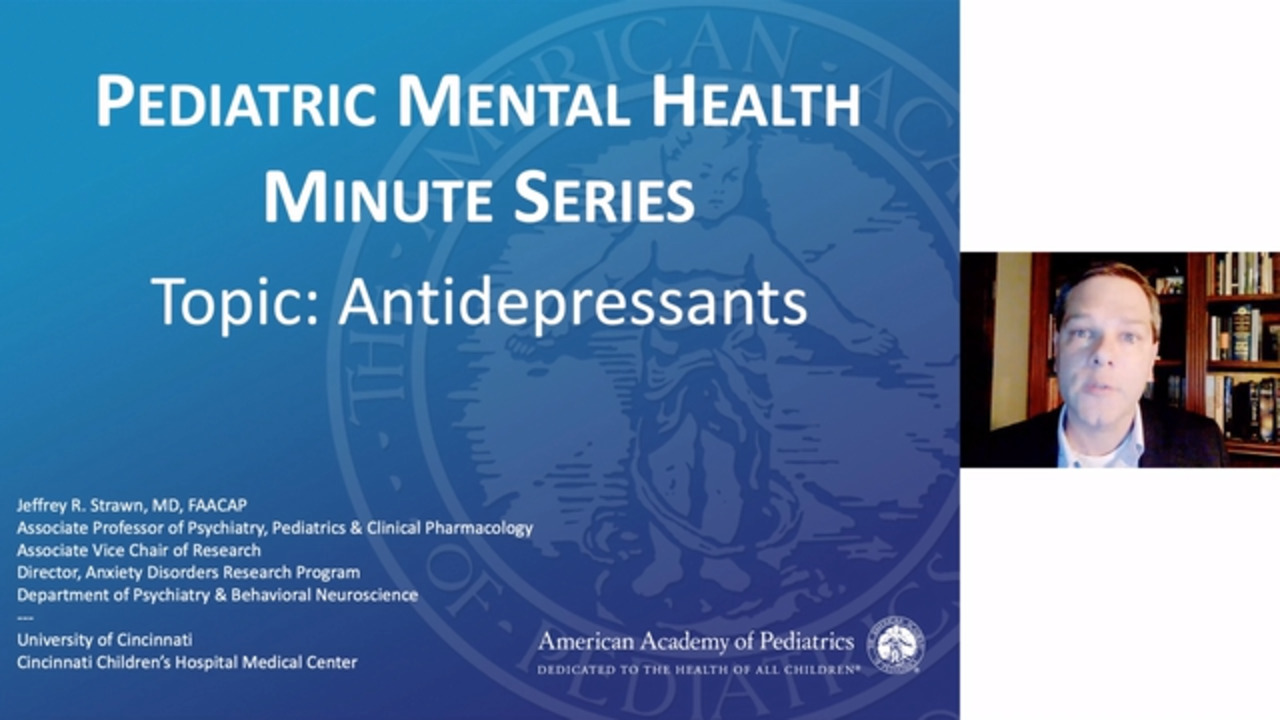

Antidepressant: Pediatric Mental Health Minute
Video Player is loading.
Play Video
Play
Skip Backward
Skip Forward
Mute
Current Time 0:00
/
Duration 10:44
Loaded: 1\.54%
00:00
Stream Type LIVE
Seek to live, currently behind liveLIVE
Remaining Time \-10:44
1x
Playback Rate
Chapters
- Chapters
Descriptions
- descriptions off, selected
Captions
- captions settings, opens captions settings dialog
- captions off, selected
Audio Track
- en (Main), selected
Picture-in-Picture
Fullscreen
This is a modal window.
Beginning of dialog window. Escape will cancel and close the window.
Text
Color
Opacity
Text Background
Color
Opacity
Caption Area Background
Color
Opacity
Font Size
Text Edge Style
Font Family
Reset
Done
Close Modal Dialog
End of dialog window.
Close Modal Dialog
This is a modal window. This modal can be closed by pressing the Escape key or activating the close button.
Antidepressants are medications commonly used to treat depressive and anxiety disorders in children and adolescents. These medications are generally divided into selective serotonin reuptake inhibitors (SSRIs) and serotonin norepinephrine reuptake inhibitors (SNRIs).
### Scope in Pediatrics
- SSRIs are the first line of psychopharmacologic treatment for anxiety and depressive disorders.
- Antidepressant selection should be evidence-based and currently the strongest evidence exists for SSRIs including escitalopram, fluoxetine, and sertraline. SNRIs may be less effective in children and adolescents.
- Dosing and titration should be guided by data from clinical trials which suggests starting low, but actively titrating medication to ensure the highest likelihood of success.
- Side effects of SSRIs may occur in 1 of 10 children or adolescents. Some side effects relate to blood levels (eg, exposure) while others are related to pharmacodynamic factors. Frequently, the management strategy is to reduce the dose or discontinue the medication.
- SSRIs include a black-box warning with regard to the risk of suicidal ideation in children and adolescents. Although the risk is low, it is very important to monitor for any clue that the patient may be experiencing this side effect.
- One challenge in treating anxiety disorders is managing the dose to minimize the side effects without reducing the dose to a point where the benefit of the SSRI is lost. At times, side effects outweigh the medication’s benefit and a change in medication is needed.
- Although FDA approved for depression, once a drug is licensed, it can be used “off-label” based on available evidence for safety and efficacy at the discretion of the prescribing clinician.
### Teaching Points
- SSRIs block serotonin reuptake at the pre-synaptic neuron, although they vary in the degree to which they block other receptors. Blocking the serotonin transporter, increases the concentrations of serotonin at the synapse. Blocking the norepinephrine transporter—as is the case with SNRIs—increases the concentrations of norepinephrine (as well as causing a slight increase in dopamine).
- Side effects are generally mild and dissipate relatively quickly, although some may require dose adjustment or—in some cases—a change in medication.
- The most common and most problematic side effects are abdominal symptoms, activation, and tiredness/insomnia.
- Clinicians selecting antidepressant medications to treat pediatric patients need to understand the cause of side effects as well as management strategies, particularly as antidepressant side effects increase the likelihood of discontinuation, slow the trajectory of improvement and potentially limit titration to effective doses.
## Resources
## For Physicians
[Anxiety. Pediatric Mental Health Minute Series. American Academy of Pediatrics.](https://www.aap.org/en/patient-care/mental-health-minute/anxiety/)
[Adolescent Depression. Pediatric Mental Health Minute Series. American Academy of Pediatrics.](https://www.aap.org/en/patient-care/mental-health-minute/adolescent-depression/)
[Reid *et al.* Side-effects of SSRIs disrupt multimodal treatment for pediatric OCD in a randomized-controlled trial. *J. Psychiatr. Res.*](https://www.sciencedirect.com/science/article/abs/pii/S0022395615002952?via%3Dihub) [71, 140–147 (2015)](https://www.sciencedirect.com/science/article/abs/pii/S0022395615002952?via%3Dihub).
[Hathaway *et al***.** Antidepressant treatment duration in pediatric depressive and anxiety disorders: how long is long enough? *Current Problems in Pediatrics and Adolescent Health Care.* 2018;48(2):31-39. PMID: 29337001](https://doi.org/10.1016/j.cppeds.2017.12.002)
[Mills and Strawn. Antidepressant tolerability in pediatric anxiety and obsessive compulsive disorders: a Bayesian hierarchical modeling meta-analysis. *Journal of the American Academy of Child & Adolescent Psychiatry.* 2020 (in press).](https://jaacap.org/article/S0890-8567\(19\)32113-6/fulltext)
### Related AAP Policy
[Guidelines for Adolescent Depression in Primary Care (GLAD-PC): Part I. Practice Preparation, Identification, Assessment, and Initial Management](https://pediatrics.aappublications.org/content/141/3/e20174081)
[Guidelines for Adolescent Depression in Primary Care (GLAD-PC): Part II. Treatment and Ongoing Management](https://pediatrics.aappublications.org/content/141/3/e20174082)
### Related AAP Resources
[AAP Developmental and Behavioral Pediatrics, 2nd Edition](https://shop.aap.org/aap-developmental-and-behavioral-pediatrics-2nd-edition-paperback/)
[Mental Health Care of Children and Adolescents: A Guide for Primary Care Clinicians \[Paperback\]](https://shop.aap.org/mental-health-care-of-children-and-adolescents-a-guide-for-primary-care-clinicians-paperback/)
[Pediatric Psychopharmacology for Primary Care, 2nd Edition](https://shop.aap.org/pediatric-psychopharmacology-for-primary-care-2nd-edition-paperback/)
## For Families
[Anxiety Disorders: Parents’ Medication Guide](https://www.aacap.org/App_Themes/AACAP/docs/resource_centers/resources/med_guides/anxiety-parents-medication-guide.pdf)
### Additional Information
- [Luft et al. Antidepressant-Induced Activation in Children and Adolescents: Risk, Recognition and Management. *Curr. Probl. Pediatr. Adolesc. Health Care* 48, 50–62 (2018).](https://doi.org/10.1016/j.cppeds.2017.12.001)
- [American Academy of Child & Adolescent Psychiatry Resources for Primary Care](https://www.aacap.org/)
- [Depression Medicines. FDA Website.](https://www.fda.gov/consumers/free-publications-women/depression-medicines)
#### **Contacts**
For COVID related questions, please email [covid-19@aap.org.](https://form.jotform.com/Subspecialty/COVID19InquiryForm)
For Mental Health related questions, please email [mentalhealth@aap.org.](mailto:mentalhealth@aap.org)
Brought to you by AAP Education. For more educational content visit [www.pedialink.org.](http://www.pedialink.org/)
#### **Special Acknowledgment**
The AAP gratefully acknowledges support for the Pediatric Mental Health Minute in the form of an educational grant from SOBI.
We're 67,000 pediatricians committed to the optimal physical, mental, and social health and well-being for all infants, children, adolescents, and young adults.
- [AAP Home](https://www.aap.org/en/)
- [Policy](https://www.aap.org/en/policy/)
- [Advocacy](https://www.aap.org/en/advocacy/)
- [PediaLink](https://www.aap.org/en/pedialink/)
- [Practice Management](https://www.aap.org/en/practice-management/)
- [Patient Care](https://www.aap.org/en/patient-care/)
- [Get Involved](https://www.aap.org/en/get-involved/)
- [Healthy Children](http://healthychildren.org/English/Pages/default.aspx)
- [shopAAP](https://www.aap.org/en/shopaap/)
- [Privacy Statement](https://www.aap.org/en/pages/privacy-statement/)
- [Terms of Use](https://www.aap.org/en/pages/terms-of-use/)
- [Auto-Renew Terms](https://www.aap.org/en/my-account/settings-preferences/auto-renew/aap-subscription-auto-renewal-terms-and-conditions/)
- [Support Center](https://www.aap.org/en/support-center/)
- [Contact Us](https://www.aap.org/en/pages/contact-us/)
- [Code of Conduct](https://www.aap.org/en/about-the-aap/american-academy-of-pediatrics-equity-and-inclusion-efforts/code-of-conduct/)
© Copyright 2026 American Academy of Pediatrics. All rights reserved.
[Feedback Form](https://www.aap.org/en/forms/feedback-form/)
Please ensure Javascript is enabled for purposes of [website accessibility](https://userway.org/)
[Provide feedback](https://www.aap.org/en/patient-care/mental-health-minute/antidepressants/) |
| Readable Markdown | Antidepressants are medications commonly used to treat depressive and anxiety disorders in children and adolescents. These medications are generally divided into selective serotonin reuptake inhibitors (SSRIs) and serotonin norepinephrine reuptake inhibitors (SNRIs).
### Scope in Pediatrics
- SSRIs are the first line of psychopharmacologic treatment for anxiety and depressive disorders.
- Antidepressant selection should be evidence-based and currently the strongest evidence exists for SSRIs including escitalopram, fluoxetine, and sertraline. SNRIs may be less effective in children and adolescents.
- Dosing and titration should be guided by data from clinical trials which suggests starting low, but actively titrating medication to ensure the highest likelihood of success.
- Side effects of SSRIs may occur in 1 of 10 children or adolescents. Some side effects relate to blood levels (eg, exposure) while others are related to pharmacodynamic factors. Frequently, the management strategy is to reduce the dose or discontinue the medication.
- SSRIs include a black-box warning with regard to the risk of suicidal ideation in children and adolescents. Although the risk is low, it is very important to monitor for any clue that the patient may be experiencing this side effect.
- One challenge in treating anxiety disorders is managing the dose to minimize the side effects without reducing the dose to a point where the benefit of the SSRI is lost. At times, side effects outweigh the medication’s benefit and a change in medication is needed.
- Although FDA approved for depression, once a drug is licensed, it can be used “off-label” based on available evidence for safety and efficacy at the discretion of the prescribing clinician.
### Teaching Points
- SSRIs block serotonin reuptake at the pre-synaptic neuron, although they vary in the degree to which they block other receptors. Blocking the serotonin transporter, increases the concentrations of serotonin at the synapse. Blocking the norepinephrine transporter—as is the case with SNRIs—increases the concentrations of norepinephrine (as well as causing a slight increase in dopamine).
- Side effects are generally mild and dissipate relatively quickly, although some may require dose adjustment or—in some cases—a change in medication.
- The most common and most problematic side effects are abdominal symptoms, activation, and tiredness/insomnia.
- Clinicians selecting antidepressant medications to treat pediatric patients need to understand the cause of side effects as well as management strategies, particularly as antidepressant side effects increase the likelihood of discontinuation, slow the trajectory of improvement and potentially limit titration to effective doses.
#### **Contacts**
For COVID related questions, please email [covid-19@aap.org.](https://form.jotform.com/Subspecialty/COVID19InquiryForm)
For Mental Health related questions, please email [mentalhealth@aap.org.](mailto:mentalhealth@aap.org)
Brought to you by AAP Education. For more educational content visit [www.pedialink.org.](http://www.pedialink.org/)
#### **Special Acknowledgment**
The AAP gratefully acknowledges support for the Pediatric Mental Health Minute in the form of an educational grant from SOBI. |
| Shard | 99 (laksa) |
| Root Hash | 6712292359742421299 |
| Unparsed URL | org,aap!www,/en/patient-care/mental-health-minute/antidepressants/ s443 |