ℹ️ Skipped - page is already crawled
| Filter | Status | Condition | Details |
|---|---|---|---|
| HTTP status | PASS | download_http_code = 200 | HTTP 200 |
| Age cutoff | PASS | download_stamp > now() - 6 MONTH | 0 months ago |
| History drop | PASS | isNull(history_drop_reason) | No drop reason |
| Spam/ban | PASS | fh_dont_index != 1 AND ml_spam_score = 0 | ml_spam_score=0 |
| Canonical | PASS | meta_canonical IS NULL OR = '' OR = src_unparsed | Not set |
| Property | Value | |||||||||||||||
|---|---|---|---|---|---|---|---|---|---|---|---|---|---|---|---|---|
| URL | https://www.38north.org/2025/09/kim-jong-uns-beijing-visit-a-view-from-north-korea/ | |||||||||||||||
| Last Crawled | 2026-04-23 00:21:53 (1 hour ago) | |||||||||||||||
| First Indexed | 2025-09-08 22:55:45 (7 months ago) | |||||||||||||||
| HTTP Status Code | 200 | |||||||||||||||
| Content | ||||||||||||||||
| Meta Title | Kim Jong Un’s Beijing Visit: A View From North Korea - 38 North: Informed Analysis of North Korea | |||||||||||||||
| Meta Description | null | |||||||||||||||
| Meta Canonical | null | |||||||||||||||
| Boilerpipe Text | By:
Rachel Minyoung Lee
September 8, 2025
Foreign Affairs
,
Media Analysis
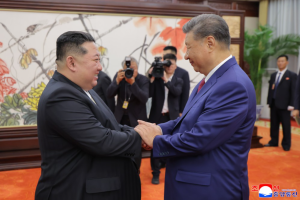
(Source: Korean Central News Agency)
Kim Jong Un’s participation in China’s recent “Victory Day” celebrations, widely viewed as a gathering of anti-US or anti-West nations, was significant in multiple ways. Kim’s debut on a multilateral diplomatic stage, where he stood next to the Chinese and Russian leaders, sent a powerful and clear message at home and abroad that North Korea was a key player, perhaps even a leader, of an anti-US and anti-West movement alongside its two great power neighbors. This message aligns with shifts in North Korea’s worldview and foreign policy strategy in recent years. The summit also provided an opportunity for Kim to reaffirm his strong relations with Russia and start rebuilding his country’s ties with China, which have remained
strained
for two years.
North Korean media coverage of Kim’s talks with Putin shows Pyongyang’s relations with Moscow remain strong and long-term-oriented. However, its handling of the Kim-Xi talks, while it contained some positive language, did not rise to the level of past Kim-Xi summit reports, suggesting Pyongyang and Beijing have yet to completely restore ties.
Stepping Into a “Multipolar World”
Kim Jong Un’s appearance at a multilateral diplomatic event alongside his Chinese and Russian peers, the first such occurrence in 66 years, may seem surprising. However, it builds on his decision to dispatch troops to fight side-by-side Russia against Ukraine and, more broadly, the West, which made North Korea a player in a larger effort to create an alternative global order.
Kim’s actions are consistent with his shifting worldview and foreign policy trends in recent years. By September 2021, Pyongyang saw weakened US leadership on the global stage amid geopolitical shifts, and seemed to be working that notion into its foreign policy.
[1]
In his speeches to the Supreme People’s Assembly (SPA) in September
2021
and
2022
, respectively, Kim for the first time noted that the international order had been “reduced to the structure of ‘neo-Cold War’” and that a US-led “unipolar” world was transitioning to a “multipolar world.” This public recognition of a changing geopolitical landscape became action-oriented as North Korea drew closer to Russia. Since
October 2023
, shortly after Kim’s summit with Putin in the Russian Far East, North Korea’s
official statements
have used various formulations that pointed to the same idea: that North Korea would work with Russia to build a new international order, an idea that was also captured in Article 2 of the North Korea-Russia
Treaty
on Comprehensive Strategic Partnership.
[2]
Kim’s latest Beijing visit also reflects the North’s long-term anti-US strategy and its pledge to continue nuclear development. In a year-end Party
plenary meeting
in 2024, for example, he called for “the toughest anti-U.S. counteraction to be launched aggressively by the DPRK for its long-term national interests and security.” Kim’s
ratification
of “new long-term plans related to missile production capacity” and
reference
to the development of a new-generation intercontinental ballistic missile on the eve of his departure for China—exclusively targeted at external audiences as these reports were not carried domestically—only reinforced its anti-US message. The United States almost certainly was the primary target audience, but it also may have been a reminder to China that denuclearization was off the table.
[3]
Reaffirming Longer-Term Ties With Russia
North Korea’s coverage of the Kim-Putin talks remained positive, with the
official readout
citing Kim’s “affirmative [positive] appreciation” of the bilateral relationship. Kim’s continued support for Russia and commitment to the North Korea-Russia treaty, as well as the two leaders’ pledge to keep advancing bilateral relations, are in line with past North Korean media reports on Kim’s talks with Putin or his confidant, Sergei Shoigu, secretary of the Russian Security Council.
North Korean state television’s documentary of Kim’s trip to Beijing went a step further by highlighting the personal rapport between the two leaders and providing additional context that was omitted from the official report. Showing Kim Jong Un in various settings with Putin, smiling and laughing, the documentary said the two leaders’ “deep comradely trust and special personal relations” formed the backbone of their bilateral ties.
[4]
The documentary added that Kim and Putin “expressed satisfaction that they exchanged constructive views on many issues of mutual interest and further strengthened mutual understanding, trust, and close ties.”
Notably, North Korean media
said
Kim and Putin “discussed in detail the long-term plans for cooperation between the two countries.” This echoes Kim’s
discussion
with Shoigu in June on “long-term plans arising in implementing the important matters” that he and Putin had agreed to “through the exchanges of personal letters for several weeks.” While North Korean media did not report on the content of such plans or the personal letters, the two sides appear to be discussing some concrete plans for cooperation beyond the ongoing war in Ukraine. North Korea’s burgeoning relations with Russia almost certainly have
contributed
to the rejuvenation of its munitions and defense industries. In that vein, perhaps it was not a coincidence that, shortly before Kim’s scheduled talks with Putin, North Korean media
unveiled
the existence of a “non-permanent committee for modernizing the defence industry,” which suggests a dedicated national effort.
Seemingly Positive but Outcome Uncertain
North Korea’s shorter and unusually vague readout of the Kim-Xi meeting makes it challenging to gauge how Pyongyang really views this summit’s outcome. Unlike its segment on the Kim-Putin summit, the television documentary offered little additional insight into the talks or their atmosphere.
[5]
This limited coverage included some positive references to the bilateral relationship. It
said
Kim’s Beijing visit “further strengthened the political trust and strategic cooperation” between the two countries. Media
cited
Kim’s and Xi’s commitment to developing relations “no matter how the international situation may change,” and mentioned their discussion of stepping up “high-level visits and strategic communication” and “strengthening strategic cooperation and defending common interests in international and regional affairs.” In a break from precedent, the summit report even cited Kim’s “support” for China’s “sovereignty, territorial integrity … ,” a veiled
reference
to Taiwan, among others.
These positive depictions, however, are largely platitudes in the context of past North Korean media coverage of North Korea-China summits. In fact, they lacked some formulations indicating alignment, suggesting Pyongyang and Beijing have yet to completely restore the frayed relationship. According to North Korean media, the two leaders had an “exchange of views on,” “informed each other of,” or “referred to” issues of mutual interest. However, there was no language indicating agreement, suggesting their overall positions may not have aligned. North Korean media reports on some of Kim Jong Un’s past summits with Xi indicated a greater level of alignment, using formulations such as
“[achieved] a shared understanding,”
“unanimously agreed,”
and
“reached a consensus.”
Moreover, during some of his past talks with Xi, Kim said he
“highly appreciated”
or was
“much pleased”
with the two countries’ exchange and cooperation. This latest summit report made no mention of Kim’s satisfaction with the current state of relations.
Looking back at North Korean media
coverage
of Kim’s first summit with Xi in March 2018, which took place after some years of strained relations, it also did not contain any language indicating agreement or satisfaction. Media handling of subsequent summits became decidedly more positive over time. Likewise, the bilateral relationship could build on the latest summit and improve further going forward.
Conclusion
The full implications of Kim’s Beijing visit are yet to be seen, but we may expect a more confident—and perhaps more emboldened—Kim Jong Un as he and his leadership team craft the country’s next five-year domestic and foreign policy to present at the upcoming Ninth Party Congress. Some other key points to watch for are the “long-term plans” North Korea and Russia have been discussing; where North Korea-China relations go from here; and whether North Korea takes steps to improve relations with any other countries that participated in the Chinese Victory Day celebrations or joins multilateral forums. Kim Jong Un, for example,
reportedly
invited the Belarusian president to visit Pyongyang. On North Korea-China relations, Kim’s letter to Xi on China’s founding day on October 1 would be one of the first indicators of North Korea’s intentions toward China. In the meantime, we may expect some (or a lot of) North Korean propaganda playing up Kim’s diplomatic achievements in Beijing.
[1]
This coincided with North Korea’s pivot to China and Russia in the summer of 2021, in the wake of the tumultuous US troop pullout from Afghanistan. See Robert Carlin and Rachel Minyoung Lee, “North Korean Foreign Ministry Website: Overview,”
38 North,
March 29, 2024,
https://www.38north.org/2024/03/north-korean-foreign-ministry-website-overview/
.
[2]
Article 2 of the treaty stipulates: “The two sides shall aspire to global strategic stability and establishment of a new fair and equal international order, maintain close mutual communication and strengthen strategic and tactical cooperation.”
[3]
While Russia has not officially recognized North Korea as a nuclear state,
Putin
and Russian Foreign Minister
Lavrov
have made remarks that seemed to suggest a reversal of Russia’s position on denuclearization. In May 2024, North Korea
implicitly criticized
China for the inclusion of “denuclearization” in a ROK-Japan-China Trilateral Summit joint statement. Chinese
readout
of Xi Jinping’s latest meeting with Kim in Beijing omitted any reference to denuclearization, marking a major departure from the past summits.
[4]
“경애하는 김정은동지께서 중국인민항일전쟁 및 세계반파쑈전쟁승리 80돐 기념행사에 참석하시기위하여 중화인민공화국을 방문 2025년 9월 2일-4일 [Respected and Beloved Comrade Kim Jong Un Visits the People’s Republic of China to Attend Celebrations Marking 80th Anniversary of the Victory in the Chinese People’s War of Resistance Against Japanese Aggression and the World Anti-Fascist War – September 2 to 4, 2025],” Korean Central Television, September 6, 2025.
[5]
North Korea’s readout of the latest Kim-Xi talks is the shortest of all North Korean media reports on the six Kim-Xi meetings. It is also vaguer on the topics discussed, merely referring to “international and regional affairs.” North Korea’s coverage of past Kim-Xi summits typically included some more detail, such as “the situation on” or “the nuclear issue of” the Korean Peninsula. | |||||||||||||||
| Markdown | [Skip to Main Content](https://www.38north.org/2025/09/kim-jong-uns-beijing-visit-a-view-from-north-korea/#main-content "Skip Navigation")
[](https://www.stimson.org/?utm_medium=38N+Top+Banner "Visit - The Henry L. Stimson Center - Website")
[A Publication of the Stimson Center](https://www.stimson.org/?utm_medium=38N+Top+Banner)
[ 38 North](https://www.38north.org/ "38 North")
Search
Menu
Informed analysis of events in and around North Korea
- [About 38 North](https://www.38north.org/about/ "About 38 North")
- [Topics](https://www.38north.org/articles/ "All Topics")
- [Book Reviews](https://www.38north.org/topics/book-reviews/ "Book Reviews Related to North Korea")
- [Commentary](https://www.38north.org/topics/commentary/ "North Korea Commentary")
- [Domestic Affairs](https://www.38north.org/topics/domestic-affairs/ "North Korea Domestic Affairs")
- [Economy](https://www.38north.org/topics/economy/)
- [Editor’s Column](https://www.38north.org/topics/editors-column/)
- [Foreign Affairs](https://www.38north.org/topics/foreign-affairs/ "North Korea Foreign Affairs")
- [Human Security](https://www.38north.org/topics/human-security/ "North Korea Human Security")
- [James Church](https://www.38north.org/topics/james-church/ "Articles by James Church")
- [Media Analysis](https://www.38north.org/topics/nk-media-analysis/ "North Korea Media Analysis")
- [Military Affairs](https://www.38north.org/topics/military-affairs/ "North Korea Military Affairs")
- [NK Briefing](https://www.38north.org/topics/nk-briefing/)
- [NK Economy Column](https://www.38north.org/topics/nk-economy-column/)
- [NK Instability Project](https://www.38north.org/topics/nk-instability-project/)
- [NK Nuclear Futures](https://www.38north.org/topics/nk-nuclear-futures/ "North Korea Nuclear Futures")
- [Satellite Imagery](https://www.38north.org/topics/satellite-analysis/ "North Korea Satellite Imagery & Analysis")
- [Special Reports](https://www.38north.org/topics/special-reports/)
- [WMD](https://www.38north.org/topics/wmd/ "Articles about WMD")
- [Authors](https://www.38north.org/authors/ "38 North Authors & Contributors")
- [Atlas](http://38northdigitalatlas.org/ "38 North Digital Atlas")
- [Resources](https://www.38north.org/resources/)
- [Events](https://www.38north.org/events/)
- [Past Events](https://www.38north.org/events/status/past/)
- [North Korea Briefing](https://www.38north.org/nk-briefing/)
- [Donate](https://www.paypal.com/donate/?hosted_button_id=3V5XEY5YSD9PS&utm_source=Stimson+Center&utm_campaign=b37ad3abab-38N-Digest%2F38N%2F38NorthDigest_23+1104&utm_medium=email&utm_term=0_-b37ad3abab-%5BLIST_EMAIL_ID%5D)
- [Search](https://www.38north.org/?s= "Search")
# Kim Jong Un’s Beijing Visit: A View From North Korea
- By: [Rachel Minyoung Lee](https://www.38north.org/author/rachel-minyoung-lee/ "Posts by Rachel Minyoung Lee")
- September 8, 2025
- [Foreign Affairs](https://www.38north.org/topics/foreign-affairs/), [Media Analysis](https://www.38north.org/topics/nk-media-analysis/)
- [Facebook](https://www.facebook.com/sharer/sharer.php?u=https%3A%2F%2Fwww.38north.org%2F2025%2F09%2Fkim-jong-uns-beijing-visit-a-view-from-north-korea%2F "Share on Facebook")
- [Twitter](https://twitter.com/intent/tweet?text=&url=https%3A%2F%2Fwww.38north.org%2F2025%2F09%2Fkim-jong-uns-beijing-visit-a-view-from-north-korea%2F "Share on Twitter")
- [Email](https://www.38north.org/cdn-cgi/l/email-protection#56692523343c3335226b0f39237d3b3f313e227d3a3f3d337d223e3f257d3724223f353a337d342f7d656e7d183924223e703439322f6b3e222226256c797921212178656e383924223e78392431796466646379666f793d3f3b7b3c3938317b2338257b34333f3c3f38317b203f253f227b377b203f33217b3024393b7b383924223e7b3d3924333779 "Share via Email")
- [Print](https://www.38north.org/2025/09/kim-jong-uns-beijing-visit-a-view-from-north-korea/ "Print this Page")
(Source: Korean Central News Agency)
Kim Jong Un’s participation in China’s recent “Victory Day” celebrations, widely viewed as a gathering of anti-US or anti-West nations, was significant in multiple ways. Kim’s debut on a multilateral diplomatic stage, where he stood next to the Chinese and Russian leaders, sent a powerful and clear message at home and abroad that North Korea was a key player, perhaps even a leader, of an anti-US and anti-West movement alongside its two great power neighbors. This message aligns with shifts in North Korea’s worldview and foreign policy strategy in recent years. The summit also provided an opportunity for Kim to reaffirm his strong relations with Russia and start rebuilding his country’s ties with China, which have remained [strained](https://warontherocks.com/2025/02/chinas-ties-with-north-korea-are-in-a-ditch-and-therin-lies-opportunity/) for two years.
North Korean media coverage of Kim’s talks with Putin shows Pyongyang’s relations with Moscow remain strong and long-term-oriented. However, its handling of the Kim-Xi talks, while it contained some positive language, did not rise to the level of past Kim-Xi summit reports, suggesting Pyongyang and Beijing have yet to completely restore ties.
**Stepping Into a “Multipolar World”**
Kim Jong Un’s appearance at a multilateral diplomatic event alongside his Chinese and Russian peers, the first such occurrence in 66 years, may seem surprising. However, it builds on his decision to dispatch troops to fight side-by-side Russia against Ukraine and, more broadly, the West, which made North Korea a player in a larger effort to create an alternative global order.
Kim’s actions are consistent with his shifting worldview and foreign policy trends in recent years. By September 2021, Pyongyang saw weakened US leadership on the global stage amid geopolitical shifts, and seemed to be working that notion into its foreign policy.[\[1\]](https://www.38north.org/2025/09/kim-jong-uns-beijing-visit-a-view-from-north-korea/#_ftn1) In his speeches to the Supreme People’s Assembly (SPA) in September [2021](http://kcna.co.jp/item/2021/202109/news30/20210930-01ee.html) and [2022](http://kcna.co.jp/item/2022/202209/news10/20220910-23ee.html), respectively, Kim for the first time noted that the international order had been “reduced to the structure of ‘neo-Cold War’” and that a US-led “unipolar” world was transitioning to a “multipolar world.” This public recognition of a changing geopolitical landscape became action-oriented as North Korea drew closer to Russia. Since [October 2023](http://kcna.co.jp/item/2023/202310/news01/20231001-08ee.html), shortly after Kim’s summit with Putin in the Russian Far East, North Korea’s [official statements](http://kcna.co.jp/item/2024/202401/news21/20240121-06ee.html) have used various formulations that pointed to the same idea: that North Korea would work with Russia to build a new international order, an idea that was also captured in Article 2 of the North Korea-Russia [Treaty](http://kcna.co.jp/item/2024/202406/news20/20240620-04ee.html) on Comprehensive Strategic Partnership.[\[2\]](https://www.38north.org/2025/09/kim-jong-uns-beijing-visit-a-view-from-north-korea/#_ftn2)
Kim’s latest Beijing visit also reflects the North’s long-term anti-US strategy and its pledge to continue nuclear development. In a year-end Party [plenary meeting](http://kcna.co.jp/item/2024/202412/news29/20241229-01ee.html) in 2024, for example, he called for “the toughest anti-U.S. counteraction to be launched aggressively by the DPRK for its long-term national interests and security.” Kim’s [ratification](http://kcna.co.jp/item/2025/202509/news01/20250901-01ee.html) of “new long-term plans related to missile production capacity” and [reference](http://kcna.co.jp/item/2025/202509/news02/20250902-02ee.html) to the development of a new-generation intercontinental ballistic missile on the eve of his departure for China—exclusively targeted at external audiences as these reports were not carried domestically—only reinforced its anti-US message. The United States almost certainly was the primary target audience, but it also may have been a reminder to China that denuclearization was off the table.[\[3\]](https://www.38north.org/2025/09/kim-jong-uns-beijing-visit-a-view-from-north-korea/#_ftn3)
**Reaffirming Longer-Term Ties With Russia**
North Korea’s coverage of the Kim-Putin talks remained positive, with the [official readout](http://kcna.co.jp/item/2025/202509/news04/20250904-02ee.html) citing Kim’s “affirmative \[positive\] appreciation” of the bilateral relationship. Kim’s continued support for Russia and commitment to the North Korea-Russia treaty, as well as the two leaders’ pledge to keep advancing bilateral relations, are in line with past North Korean media reports on Kim’s talks with Putin or his confidant, Sergei Shoigu, secretary of the Russian Security Council.
North Korean state television’s documentary of Kim’s trip to Beijing went a step further by highlighting the personal rapport between the two leaders and providing additional context that was omitted from the official report. Showing Kim Jong Un in various settings with Putin, smiling and laughing, the documentary said the two leaders’ “deep comradely trust and special personal relations” formed the backbone of their bilateral ties.[\[4\]](https://www.38north.org/2025/09/kim-jong-uns-beijing-visit-a-view-from-north-korea/#_ftn4) The documentary added that Kim and Putin “expressed satisfaction that they exchanged constructive views on many issues of mutual interest and further strengthened mutual understanding, trust, and close ties.”
Notably, North Korean media [said](http://kcna.co.jp/item/2025/202509/news04/20250904-02ee.html) Kim and Putin “discussed in detail the long-term plans for cooperation between the two countries.” This echoes Kim’s [discussion](http://kcna.co.jp/item/2025/202506/news18/20250618-01ee.html) with Shoigu in June on “long-term plans arising in implementing the important matters” that he and Putin had agreed to “through the exchanges of personal letters for several weeks.” While North Korean media did not report on the content of such plans or the personal letters, the two sides appear to be discussing some concrete plans for cooperation beyond the ongoing war in Ukraine. North Korea’s burgeoning relations with Russia almost certainly have [contributed](https://www.38north.org/2025/07/one-year-in-contextualizing-20x10-policy-for-regional-development/) to the rejuvenation of its munitions and defense industries. In that vein, perhaps it was not a coincidence that, shortly before Kim’s scheduled talks with Putin, North Korean media [unveiled](http://kcna.co.jp/item/2025/202509/news01/20250901-01ee.html) the existence of a “non-permanent committee for modernizing the defence industry,” which suggests a dedicated national effort.
**Seemingly Positive but Outcome Uncertain**
North Korea’s shorter and unusually vague readout of the Kim-Xi meeting makes it challenging to gauge how Pyongyang really views this summit’s outcome. Unlike its segment on the Kim-Putin summit, the television documentary offered little additional insight into the talks or their atmosphere.[\[5\]](https://www.38north.org/2025/09/kim-jong-uns-beijing-visit-a-view-from-north-korea/#_ftn5)
This limited coverage included some positive references to the bilateral relationship. It [said](http://www.kcna.kp/en/article/q/acb570311fcbd38af1fe2e6b6e20ec91.kcmsf) Kim’s Beijing visit “further strengthened the political trust and strategic cooperation” between the two countries. Media [cited](http://www.kcna.kp/en/article/q/ea275a7d6ed05fd0efd59fb1de83389b.kcmsf) Kim’s and Xi’s commitment to developing relations “no matter how the international situation may change,” and mentioned their discussion of stepping up “high-level visits and strategic communication” and “strengthening strategic cooperation and defending common interests in international and regional affairs.” In a break from precedent, the summit report even cited Kim’s “support” for China’s “sovereignty, territorial integrity … ,” a veiled [reference](https://www.fmprc.gov.cn/eng/xw/zyxw/202509/t20250905_11702689.html) to Taiwan, among others.
These positive depictions, however, are largely platitudes in the context of past North Korean media coverage of North Korea-China summits. In fact, they lacked some formulations indicating alignment, suggesting Pyongyang and Beijing have yet to completely restore the frayed relationship. According to North Korean media, the two leaders had an “exchange of views on,” “informed each other of,” or “referred to” issues of mutual interest. However, there was no language indicating agreement, suggesting their overall positions may not have aligned. North Korean media reports on some of Kim Jong Un’s past summits with Xi indicated a greater level of alignment, using formulations such as [“\[achieved\] a shared understanding,”](http://kcna.co.jp/item/2018/201806/news20/20180620-04ee.html) [“unanimously agreed,”](https://kcnawatch.org/newstream/1547097746-610254996/supreme-leader-kim-jong-un-visits-china/) and [“reached a consensus.”](http://kcna.co.jp/item/2019/201906/news22/20190622-01ee.html) Moreover, during some of his past talks with Xi, Kim said he [“highly appreciated”](http://kcna.co.jp/item/2018/201805/news08/20180508-17ee.html) or was [“much pleased”](http://kcna.co.jp/item/2018/201806/news20/20180620-04ee.html) with the two countries’ exchange and cooperation. This latest summit report made no mention of Kim’s satisfaction with the current state of relations.
Looking back at North Korean media [coverage](http://kcna.co.jp/item/2018/201803/news28/20180328-07ee.html) of Kim’s first summit with Xi in March 2018, which took place after some years of strained relations, it also did not contain any language indicating agreement or satisfaction. Media handling of subsequent summits became decidedly more positive over time. Likewise, the bilateral relationship could build on the latest summit and improve further going forward.
**Conclusion**
The full implications of Kim’s Beijing visit are yet to be seen, but we may expect a more confident—and perhaps more emboldened—Kim Jong Un as he and his leadership team craft the country’s next five-year domestic and foreign policy to present at the upcoming Ninth Party Congress. Some other key points to watch for are the “long-term plans” North Korea and Russia have been discussing; where North Korea-China relations go from here; and whether North Korea takes steps to improve relations with any other countries that participated in the Chinese Victory Day celebrations or joins multilateral forums. Kim Jong Un, for example, [reportedly](https://tass.com/world/2011231) invited the Belarusian president to visit Pyongyang. On North Korea-China relations, Kim’s letter to Xi on China’s founding day on October 1 would be one of the first indicators of North Korea’s intentions toward China. In the meantime, we may expect some (or a lot of) North Korean propaganda playing up Kim’s diplomatic achievements in Beijing.
***
1. [\[1\]](https://www.38north.org/2025/09/kim-jong-uns-beijing-visit-a-view-from-north-korea/#_ftnref1 "Footnote # 1")
This coincided with North Korea’s pivot to China and Russia in the summer of 2021, in the wake of the tumultuous US troop pullout from Afghanistan. See Robert Carlin and Rachel Minyoung Lee, “North Korean Foreign Ministry Website: Overview,” *38 North,* March 29, 2024, <https://www.38north.org/2024/03/north-korean-foreign-ministry-website-overview/>.
2. [\[2\]](https://www.38north.org/2025/09/kim-jong-uns-beijing-visit-a-view-from-north-korea/#_ftnref2 "Footnote # 2")
Article 2 of the treaty stipulates: “The two sides shall aspire to global strategic stability and establishment of a new fair and equal international order, maintain close mutual communication and strengthen strategic and tactical cooperation.”
3. [\[3\]](https://www.38north.org/2025/09/kim-jong-uns-beijing-visit-a-view-from-north-korea/#_ftnref3 "Footnote # 3")
While Russia has not officially recognized North Korea as a nuclear state, [Putin](https://koreajoongangdaily.joins.com/news/2024-03-13/national/northKorea/Putin-says-North-Korea-has-its-own-nuclear-umbrella/2001395) and Russian Foreign Minister [Lavrov](https://www.reuters.com/world/russias-lavrov-says-north-koreas-nuclear-status-is-closed-issue-2024-09-26/) have made remarks that seemed to suggest a reversal of Russia’s position on denuclearization. In May 2024, North Korea [implicitly criticized](https://www.38north.org/2024/05/quick-take-north-korea-jabs-at-china-in-reaction-to-trilateral-summit/) China for the inclusion of “denuclearization” in a ROK-Japan-China Trilateral Summit joint statement. Chinese [readout](https://www.fmprc.gov.cn/eng/xw/zyxw/202509/t20250905_11702689.html) of Xi Jinping’s latest meeting with Kim in Beijing omitted any reference to denuclearization, marking a major departure from the past summits.
4. [\[4\]](https://www.38north.org/2025/09/kim-jong-uns-beijing-visit-a-view-from-north-korea/#_ftnref4 "Footnote # 4")
“경애하는 김정은동지께서 중국인민항일전쟁 및 세계반파쑈전쟁승리 80돐 기념행사에 참석하시기위하여 중화인민공화국을 방문 2025년 9월 2일-4일 \[Respected and Beloved Comrade Kim Jong Un Visits the People’s Republic of China to Attend Celebrations Marking 80th Anniversary of the Victory in the Chinese People’s War of Resistance Against Japanese Aggression and the World Anti-Fascist War – September 2 to 4, 2025\],” Korean Central Television, September 6, 2025.
5. [\[5\]](https://www.38north.org/2025/09/kim-jong-uns-beijing-visit-a-view-from-north-korea/#_ftnref5 "Footnote # 5")
North Korea’s readout of the latest Kim-Xi talks is the shortest of all North Korean media reports on the six Kim-Xi meetings. It is also vaguer on the topics discussed, merely referring to “international and regional affairs.” North Korea’s coverage of past Kim-Xi summits typically included some more detail, such as “the situation on” or “the nuclear issue of” the Korean Peninsula.
***
- [dprk-china relations](https://www.38north.org/tag/dprk-china-relations/)
- [foreign affairs](https://www.38north.org/tag/foreign-affairs/)
- [media analysis](https://www.38north.org/tag/media-analysis/)
- [rachel minyoung lee](https://www.38north.org/tag/rachel-minyoung-lee/)
- [russia-china-dprk relations](https://www.38north.org/tag/russia-china-dprk-relations/)
## Related Articles
Apr 15
### [With Little Incentive to Engage the US, North Korea Deepens Russia and China Ties](https://www.38north.org/2026/04/with-little-incentive-to-engage-the-us-north-korea-deepens-russia-and-china-ties/ "Article: With Little Incentive to Engage the US, North Korea Deepens Russia and China Ties")
[Kibum Han](https://www.38north.org/author/kibum-han/ "Posts by Kibum Han")
[Foreign Affairs](https://www.38north.org/topics/foreign-affairs/), [NK Briefing](https://www.38north.org/topics/nk-briefing/)
Apr 13
### [Call for Applications: 38 North Emerging Scholars Fellowship Program 2026-2027](https://www.38north.org/2026/04/call-for-applications-38-north-emerging-scholars-fellowship-program-2026-2027/ "Article: Call for Applications: 38 North Emerging Scholars Fellowship Program 2026-2027")
[38 North](https://www.38north.org/author/38-north/ "Posts by 38 North")
[Domestic Affairs](https://www.38north.org/topics/domestic-affairs/), [Foreign Affairs](https://www.38north.org/topics/foreign-affairs/)
Apr 13
### [Wang Yi’s Pyongyang Visit: Kim Jong Un Signals Renewed Efforts to Improve Ties but Alignment Still Lacking](https://www.38north.org/2026/04/wang-yis-pyongyang-visit-kim-jong-un-signals-renewed-efforts-to-improve-ties-but-alignment-still-lacking/ "Article: Wang Yi’s Pyongyang Visit: Kim Jong Un Signals Renewed Efforts to Improve Ties but Alignment Still Lacking")
[Rachel Minyoung Lee](https://www.38north.org/author/rachel-minyoung-lee/ "Posts by Rachel Minyoung Lee")
[Foreign Affairs](https://www.38north.org/topics/foreign-affairs/), [Media Analysis](https://www.38north.org/topics/nk-media-analysis/)
Stay informed about our latest
news, publications, & uploads:
[](https://www.38north.org/ "38 North")
- [Facebook](https://www.facebook.com/38NorthNK "Follow 38 North on Facebook")
- [Instagram](https://www.instagram.com/38northnk/ "Instagram")
- [Twitter](https://twitter.com/38NorthNK "Follow 38 North on Twitter")
- [Linkedin](https://www.linkedin.com/company/11796195/admin/feed/posts/ "LinkedIn")
- [RSS Feed](https://www.38north.org/feed/ "RSS Feed")
- [Subscribe](https://www.38north.org/subscribe/ "Subscribe for Updates")
38 North is a project of **[The Henry L. Stimson Center](https://www.stimson.org/ "The Henry L. Stimson Center")**.
Copyright © 2009-2026.
All rights reserved. [Privacy Policy.](https://www.stimson.org/privacy-policy/) | |||||||||||||||
| Readable Markdown | - By: [Rachel Minyoung Lee](https://www.38north.org/author/rachel-minyoung-lee/ "Posts by Rachel Minyoung Lee")
- September 8, 2025
- [Foreign Affairs](https://www.38north.org/topics/foreign-affairs/), [Media Analysis](https://www.38north.org/topics/nk-media-analysis/)

(Source: Korean Central News Agency)
Kim Jong Un’s participation in China’s recent “Victory Day” celebrations, widely viewed as a gathering of anti-US or anti-West nations, was significant in multiple ways. Kim’s debut on a multilateral diplomatic stage, where he stood next to the Chinese and Russian leaders, sent a powerful and clear message at home and abroad that North Korea was a key player, perhaps even a leader, of an anti-US and anti-West movement alongside its two great power neighbors. This message aligns with shifts in North Korea’s worldview and foreign policy strategy in recent years. The summit also provided an opportunity for Kim to reaffirm his strong relations with Russia and start rebuilding his country’s ties with China, which have remained [strained](https://warontherocks.com/2025/02/chinas-ties-with-north-korea-are-in-a-ditch-and-therin-lies-opportunity/) for two years.
North Korean media coverage of Kim’s talks with Putin shows Pyongyang’s relations with Moscow remain strong and long-term-oriented. However, its handling of the Kim-Xi talks, while it contained some positive language, did not rise to the level of past Kim-Xi summit reports, suggesting Pyongyang and Beijing have yet to completely restore ties.
**Stepping Into a “Multipolar World”**
Kim Jong Un’s appearance at a multilateral diplomatic event alongside his Chinese and Russian peers, the first such occurrence in 66 years, may seem surprising. However, it builds on his decision to dispatch troops to fight side-by-side Russia against Ukraine and, more broadly, the West, which made North Korea a player in a larger effort to create an alternative global order.
Kim’s actions are consistent with his shifting worldview and foreign policy trends in recent years. By September 2021, Pyongyang saw weakened US leadership on the global stage amid geopolitical shifts, and seemed to be working that notion into its foreign policy.[\[1\]](https://www.38north.org/2025/09/kim-jong-uns-beijing-visit-a-view-from-north-korea/#_ftn1) In his speeches to the Supreme People’s Assembly (SPA) in September [2021](http://kcna.co.jp/item/2021/202109/news30/20210930-01ee.html) and [2022](http://kcna.co.jp/item/2022/202209/news10/20220910-23ee.html), respectively, Kim for the first time noted that the international order had been “reduced to the structure of ‘neo-Cold War’” and that a US-led “unipolar” world was transitioning to a “multipolar world.” This public recognition of a changing geopolitical landscape became action-oriented as North Korea drew closer to Russia. Since [October 2023](http://kcna.co.jp/item/2023/202310/news01/20231001-08ee.html), shortly after Kim’s summit with Putin in the Russian Far East, North Korea’s [official statements](http://kcna.co.jp/item/2024/202401/news21/20240121-06ee.html) have used various formulations that pointed to the same idea: that North Korea would work with Russia to build a new international order, an idea that was also captured in Article 2 of the North Korea-Russia [Treaty](http://kcna.co.jp/item/2024/202406/news20/20240620-04ee.html) on Comprehensive Strategic Partnership.[\[2\]](https://www.38north.org/2025/09/kim-jong-uns-beijing-visit-a-view-from-north-korea/#_ftn2)
Kim’s latest Beijing visit also reflects the North’s long-term anti-US strategy and its pledge to continue nuclear development. In a year-end Party [plenary meeting](http://kcna.co.jp/item/2024/202412/news29/20241229-01ee.html) in 2024, for example, he called for “the toughest anti-U.S. counteraction to be launched aggressively by the DPRK for its long-term national interests and security.” Kim’s [ratification](http://kcna.co.jp/item/2025/202509/news01/20250901-01ee.html) of “new long-term plans related to missile production capacity” and [reference](http://kcna.co.jp/item/2025/202509/news02/20250902-02ee.html) to the development of a new-generation intercontinental ballistic missile on the eve of his departure for China—exclusively targeted at external audiences as these reports were not carried domestically—only reinforced its anti-US message. The United States almost certainly was the primary target audience, but it also may have been a reminder to China that denuclearization was off the table.[\[3\]](https://www.38north.org/2025/09/kim-jong-uns-beijing-visit-a-view-from-north-korea/#_ftn3)
**Reaffirming Longer-Term Ties With Russia**
North Korea’s coverage of the Kim-Putin talks remained positive, with the [official readout](http://kcna.co.jp/item/2025/202509/news04/20250904-02ee.html) citing Kim’s “affirmative \[positive\] appreciation” of the bilateral relationship. Kim’s continued support for Russia and commitment to the North Korea-Russia treaty, as well as the two leaders’ pledge to keep advancing bilateral relations, are in line with past North Korean media reports on Kim’s talks with Putin or his confidant, Sergei Shoigu, secretary of the Russian Security Council.
North Korean state television’s documentary of Kim’s trip to Beijing went a step further by highlighting the personal rapport between the two leaders and providing additional context that was omitted from the official report. Showing Kim Jong Un in various settings with Putin, smiling and laughing, the documentary said the two leaders’ “deep comradely trust and special personal relations” formed the backbone of their bilateral ties.[\[4\]](https://www.38north.org/2025/09/kim-jong-uns-beijing-visit-a-view-from-north-korea/#_ftn4) The documentary added that Kim and Putin “expressed satisfaction that they exchanged constructive views on many issues of mutual interest and further strengthened mutual understanding, trust, and close ties.”
Notably, North Korean media [said](http://kcna.co.jp/item/2025/202509/news04/20250904-02ee.html) Kim and Putin “discussed in detail the long-term plans for cooperation between the two countries.” This echoes Kim’s [discussion](http://kcna.co.jp/item/2025/202506/news18/20250618-01ee.html) with Shoigu in June on “long-term plans arising in implementing the important matters” that he and Putin had agreed to “through the exchanges of personal letters for several weeks.” While North Korean media did not report on the content of such plans or the personal letters, the two sides appear to be discussing some concrete plans for cooperation beyond the ongoing war in Ukraine. North Korea’s burgeoning relations with Russia almost certainly have [contributed](https://www.38north.org/2025/07/one-year-in-contextualizing-20x10-policy-for-regional-development/) to the rejuvenation of its munitions and defense industries. In that vein, perhaps it was not a coincidence that, shortly before Kim’s scheduled talks with Putin, North Korean media [unveiled](http://kcna.co.jp/item/2025/202509/news01/20250901-01ee.html) the existence of a “non-permanent committee for modernizing the defence industry,” which suggests a dedicated national effort.
**Seemingly Positive but Outcome Uncertain**
North Korea’s shorter and unusually vague readout of the Kim-Xi meeting makes it challenging to gauge how Pyongyang really views this summit’s outcome. Unlike its segment on the Kim-Putin summit, the television documentary offered little additional insight into the talks or their atmosphere.[\[5\]](https://www.38north.org/2025/09/kim-jong-uns-beijing-visit-a-view-from-north-korea/#_ftn5)
This limited coverage included some positive references to the bilateral relationship. It [said](http://www.kcna.kp/en/article/q/acb570311fcbd38af1fe2e6b6e20ec91.kcmsf) Kim’s Beijing visit “further strengthened the political trust and strategic cooperation” between the two countries. Media [cited](http://www.kcna.kp/en/article/q/ea275a7d6ed05fd0efd59fb1de83389b.kcmsf) Kim’s and Xi’s commitment to developing relations “no matter how the international situation may change,” and mentioned their discussion of stepping up “high-level visits and strategic communication” and “strengthening strategic cooperation and defending common interests in international and regional affairs.” In a break from precedent, the summit report even cited Kim’s “support” for China’s “sovereignty, territorial integrity … ,” a veiled [reference](https://www.fmprc.gov.cn/eng/xw/zyxw/202509/t20250905_11702689.html) to Taiwan, among others.
These positive depictions, however, are largely platitudes in the context of past North Korean media coverage of North Korea-China summits. In fact, they lacked some formulations indicating alignment, suggesting Pyongyang and Beijing have yet to completely restore the frayed relationship. According to North Korean media, the two leaders had an “exchange of views on,” “informed each other of,” or “referred to” issues of mutual interest. However, there was no language indicating agreement, suggesting their overall positions may not have aligned. North Korean media reports on some of Kim Jong Un’s past summits with Xi indicated a greater level of alignment, using formulations such as [“\[achieved\] a shared understanding,”](http://kcna.co.jp/item/2018/201806/news20/20180620-04ee.html) [“unanimously agreed,”](https://kcnawatch.org/newstream/1547097746-610254996/supreme-leader-kim-jong-un-visits-china/) and [“reached a consensus.”](http://kcna.co.jp/item/2019/201906/news22/20190622-01ee.html) Moreover, during some of his past talks with Xi, Kim said he [“highly appreciated”](http://kcna.co.jp/item/2018/201805/news08/20180508-17ee.html) or was [“much pleased”](http://kcna.co.jp/item/2018/201806/news20/20180620-04ee.html) with the two countries’ exchange and cooperation. This latest summit report made no mention of Kim’s satisfaction with the current state of relations.
Looking back at North Korean media [coverage](http://kcna.co.jp/item/2018/201803/news28/20180328-07ee.html) of Kim’s first summit with Xi in March 2018, which took place after some years of strained relations, it also did not contain any language indicating agreement or satisfaction. Media handling of subsequent summits became decidedly more positive over time. Likewise, the bilateral relationship could build on the latest summit and improve further going forward.
**Conclusion**
The full implications of Kim’s Beijing visit are yet to be seen, but we may expect a more confident—and perhaps more emboldened—Kim Jong Un as he and his leadership team craft the country’s next five-year domestic and foreign policy to present at the upcoming Ninth Party Congress. Some other key points to watch for are the “long-term plans” North Korea and Russia have been discussing; where North Korea-China relations go from here; and whether North Korea takes steps to improve relations with any other countries that participated in the Chinese Victory Day celebrations or joins multilateral forums. Kim Jong Un, for example, [reportedly](https://tass.com/world/2011231) invited the Belarusian president to visit Pyongyang. On North Korea-China relations, Kim’s letter to Xi on China’s founding day on October 1 would be one of the first indicators of North Korea’s intentions toward China. In the meantime, we may expect some (or a lot of) North Korean propaganda playing up Kim’s diplomatic achievements in Beijing.
***
1. [\[1\]](https://www.38north.org/2025/09/kim-jong-uns-beijing-visit-a-view-from-north-korea/#_ftnref1 "Footnote # 1")
This coincided with North Korea’s pivot to China and Russia in the summer of 2021, in the wake of the tumultuous US troop pullout from Afghanistan. See Robert Carlin and Rachel Minyoung Lee, “North Korean Foreign Ministry Website: Overview,” *38 North,* March 29, 2024, <https://www.38north.org/2024/03/north-korean-foreign-ministry-website-overview/>.
2. [\[2\]](https://www.38north.org/2025/09/kim-jong-uns-beijing-visit-a-view-from-north-korea/#_ftnref2 "Footnote # 2")
Article 2 of the treaty stipulates: “The two sides shall aspire to global strategic stability and establishment of a new fair and equal international order, maintain close mutual communication and strengthen strategic and tactical cooperation.”
3. [\[3\]](https://www.38north.org/2025/09/kim-jong-uns-beijing-visit-a-view-from-north-korea/#_ftnref3 "Footnote # 3")
While Russia has not officially recognized North Korea as a nuclear state, [Putin](https://koreajoongangdaily.joins.com/news/2024-03-13/national/northKorea/Putin-says-North-Korea-has-its-own-nuclear-umbrella/2001395) and Russian Foreign Minister [Lavrov](https://www.reuters.com/world/russias-lavrov-says-north-koreas-nuclear-status-is-closed-issue-2024-09-26/) have made remarks that seemed to suggest a reversal of Russia’s position on denuclearization. In May 2024, North Korea [implicitly criticized](https://www.38north.org/2024/05/quick-take-north-korea-jabs-at-china-in-reaction-to-trilateral-summit/) China for the inclusion of “denuclearization” in a ROK-Japan-China Trilateral Summit joint statement. Chinese [readout](https://www.fmprc.gov.cn/eng/xw/zyxw/202509/t20250905_11702689.html) of Xi Jinping’s latest meeting with Kim in Beijing omitted any reference to denuclearization, marking a major departure from the past summits.
4. [\[4\]](https://www.38north.org/2025/09/kim-jong-uns-beijing-visit-a-view-from-north-korea/#_ftnref4 "Footnote # 4")
“경애하는 김정은동지께서 중국인민항일전쟁 및 세계반파쑈전쟁승리 80돐 기념행사에 참석하시기위하여 중화인민공화국을 방문 2025년 9월 2일-4일 \[Respected and Beloved Comrade Kim Jong Un Visits the People’s Republic of China to Attend Celebrations Marking 80th Anniversary of the Victory in the Chinese People’s War of Resistance Against Japanese Aggression and the World Anti-Fascist War – September 2 to 4, 2025\],” Korean Central Television, September 6, 2025.
5. [\[5\]](https://www.38north.org/2025/09/kim-jong-uns-beijing-visit-a-view-from-north-korea/#_ftnref5 "Footnote # 5")
North Korea’s readout of the latest Kim-Xi talks is the shortest of all North Korean media reports on the six Kim-Xi meetings. It is also vaguer on the topics discussed, merely referring to “international and regional affairs.” North Korea’s coverage of past Kim-Xi summits typically included some more detail, such as “the situation on” or “the nuclear issue of” the Korean Peninsula.
*** | |||||||||||||||
| ML Classification | ||||||||||||||||
| ML Categories |
Raw JSON{
"/News": 644,
"/Law_and_Government": 426,
"/News/World_News": 347,
"/Law_and_Government/Government": 295,
"/Law_and_Government/Government/Executive_Branch": 181
} | |||||||||||||||
| ML Page Types |
Raw JSON{
"/Article": 998,
"/Article/News_Update": 482
} | |||||||||||||||
| ML Intent Types |
Raw JSON{
"Informational": 999
} | |||||||||||||||
| Content Metadata | ||||||||||||||||
| Language | en | |||||||||||||||
| Author | Rachel Minyoung Lee | |||||||||||||||
| Publish Time | 2025-09-08 21:23:14 (7 months ago) | |||||||||||||||
| Original Publish Time | 2025-09-01 00:00:00 (7 months ago) | |||||||||||||||
| Republished | No | |||||||||||||||
| Word Count (Total) | 1,932 | |||||||||||||||
| Word Count (Content) | 1,669 | |||||||||||||||
| Links | ||||||||||||||||
| External Links | 33 | |||||||||||||||
| Internal Links | 44 | |||||||||||||||
| Technical SEO | ||||||||||||||||
| Meta Nofollow | No | |||||||||||||||
| Meta Noarchive | No | |||||||||||||||
| JS Rendered | No | |||||||||||||||
| Redirect Target | null | |||||||||||||||
| Performance | ||||||||||||||||
| Download Time (ms) | 250 | |||||||||||||||
| TTFB (ms) | 249 | |||||||||||||||
| Download Size (bytes) | 19,211 | |||||||||||||||
| Shard | 158 (laksa) | |||||||||||||||
| Root Hash | 17321114342134649158 | |||||||||||||||
| Unparsed URL | org,38north!www,/2025/09/kim-jong-uns-beijing-visit-a-view-from-north-korea/ s443 | |||||||||||||||