ℹ️ Skipped - page is already crawled
| Filter | Status | Condition | Details |
|---|---|---|---|
| HTTP status | PASS | download_http_code = 200 | HTTP 200 |
| Age cutoff | PASS | download_stamp > now() - 6 MONTH | 0.2 months ago |
| History drop | PASS | isNull(history_drop_reason) | No drop reason |
| Spam/ban | PASS | fh_dont_index != 1 AND ml_spam_score = 0 | ml_spam_score=0 |
| Canonical | PASS | meta_canonical IS NULL OR = '' OR = src_unparsed | Not set |
| Property | Value |
|---|---|
| URL | https://vitalfirstaid.com.au/news/first-aid-for-hypothermia-treatment-and-prevention/ |
| Last Crawled | 2026-04-22 09:22:36 (4 days ago) |
| First Indexed | 2022-05-23 13:09:47 (3 years ago) |
| HTTP Status Code | 200 |
| Content | |
| Meta Title | First Aid for Hypothermia: Treatment and Prevention | Vital First Aid Training Services |
| Meta Description | Many people find themselves becoming hypothermic because of a lack of awareness. Read on to learn how to treat and prevent hypothermia. |
| Meta Canonical | null |
| Boilerpipe Text | Quick facts:
Hypothermia occurs when
the
body temperature falls below 35°C
, which is lower than the normal human body temperature of approximately 37°C.
If the temperature d
rops below 32°C, hypothermia becomes extremely dangerous and life-threatening
.
Hypothermia can result from extended exposure to temperatures under 10°C
or prolonged immersion in water below 20°C. In colder or windier conditions, it can occur more quickly. Certain medical conditions can increase the risk of hypothermia.
For immediate first aid treatment for Hypothermia, follow these steps:
Relocate the individual to a warm, dry place.
Shield them from the cold if they can’t move.
Use blankets or insulated materials to warm them.
Elevate them if the ground is cold or wet.
Offer warm, non-alcoholic beverages if they’re conscious.
Apply dry, warm compresses (e.g., a heated water bottle or towels).
Share body heat by huddling together. (If appropriate)
Read on to learn more about Hypothermia, and how to prevent and manage it.
Explore this blog:
What is Hypothermia?
What are the Symptoms of Hypothermia?
Common Situations Where People Become Hypothermic
Who is Susceptible to Hypothermia?
How to Prevent Hypothermia
How to Treat Hypothermia
Common Mistakes
When you think of hypothermia, you probably envision mountain climbers trapped on an icy slope, or Jack clinging to a piece of wood in the
Titanic.
Unfortunately, the conditions that lead to hypothermia don’t have to be so dramatic.
Even during relatively mild Australian winters, many people find themselves becoming hypothermic because of a lack of awareness. Read on to learn how to treat and prevent hypothermia.
What is Hypothermia?
Hypothermia is a condition caused by a person’s body losing heat faster than it can replenish it. A person’s optimal body temperature is 37°C. When it drops below 35°C, the onset of hypothermia begins.
If their temperature falls below 32°C hypothermia can be lethal.
What are the Symptoms of Hypothermia?
One of the main reasons hypothermia is so dangerous is because its symptoms develop slowly. Sufferers may experience some or all of the symptoms, and in varying severities. This makes it difficult for affected people to recognise the symptoms together as part of a worsening condition.
The following symptoms are listed approximately in order of progression:
Excessive shivering and teeth chattering
Loss of coordination and fine motor functions
Slurred speech
Lethargy
Confused, incoherent thought processing and decision making
Difficulty taking deep breaths
Loss of consciousness
Weak pulse
If untreated, a strong possibility of death
*Even if a sufferer of severe hypothermia survives, complications like frostbite and gangrene can occur, and symptoms can begin to present during the hypothermic stage
Due to the disorientating effects of hypothermia, it is important to note that even though these symptoms are severe, the sufferer may not be aware that they are experiencing them. Even if they are, they may be incapable of understanding the gravity of the situation.
Paradoxical Undressing
Hypothermia is infamous for an unusual phenomenon called paradoxical undressing. In many advanced hypothermia cases, affected people will remove their clothes. This makes them colder and worsens their condition – hence the paradox.
This is because the body uses muscle contraction to draw blood away from the extremities towards the core, but eventually these muscles fail and the blood suddenly flows back to the extremities, making the sufferer feel a hot flush.
In their disorientated state, this can make them strip their clothing to ‘cool down’ and exacerbate their bodily temperature loss.
Common Situations Where People Become Hypothermic
You’d be forgiven for thinking that hypothermia is only a threat in snowy conditions. But the temperatures that can cause hypothermia aren’t as low as you might expect.
A person with prolonged exposure to just 10°C or less on land, or just 20°C or less in water, can suffer hypothermia. For context, even in Australia, night-time winter temperatures will routinely drop below 10°C. During the day water temperatures also commonly drop below 20°C.
Contributing factors are people being underdressed for the conditions, or weather conditions like rain or wind. This is why hypothermia can be so deadly – people don’t associate it with an Australian climate, and therefore find themselves unprepared and at risk.
Who is Susceptible to Hypothermia?
In short, no matter how fit, healthy or young they are, anybody can be affected by hypothermia. With that said, some people are more at risk than others. People with a heightened susceptibility include:
Anyone
who is wet in cold conditions
Elderly people
Infants
Homeless people – or anyone who spends extended periods of time outdoors without shelter
Mentally or physically impaired people who may not recognise, or be able to avoid, situations where they are at risk
People with reduced circulation
Diabetics
People with underlying infections
People with a low body mass
Exhausted or fatigued people
Alcohol
Alcohol makes blood vessels expand. This is why people often feel warm when they drink. The issue is, while the increased blood flow to their extremities makes them feel warm, it also makes them more susceptible to the cold because heat loss is most prevalent in the extremities.
Alcohol also causes mental and physical impairment. Combined with the disorientating effects of hypothermia itself, alcohol is one of the single greatest risk factors for hypothermia.
How to Prevent Hypothermia
While treating hypothermia is important, prevention is even better. You can prevent hypothermia by ensuring that you:
Wear suitable clothes for the conditions
Get dry as soon as possible if your clothes become wet
Avoid becoming exhausted in cold conditions
Don’t stay immersed in cold water for long periods
Avoid using substances like alcohol that can impair you if you are in cold conditions
If you are going to a remote area, tell people where you are in case you become stranded
Always remember, hypothermia is brought on by body temperature loss, not just the weather. A snowboarder wearing appropriate thermal protective gear could be less at risk than a surfer who goes out on a winter day without a wetsuit.
Hypothermia is situational and can happen to anyone. If you are shivering excessively, no matter where you are or how healthy you feel, warm yourself up.
How to Treat Hypothermia
To download this resource, click here.
First and foremost, if someone is displaying symptoms of hypothermia – call 000 and request an ambulance!
If you aren’t in a position to call one, or you need to provide first aid until it arrives, your most important focus should be on providing warmth.
You can do this by:
Moving the person to a warm and dry area
If the person is immobilised, do your best to shelter them from the cold
Use blankets or other thermally resistant items to warm them up
Elevate them if the ground is cold or wet
If the affected person is conscious, offer warm, non-alcoholic drinks
Apply dry, warm compresses, like a water bottle or warmed towels
If appropriate, partially or fully undress and huddle with the affected person to share body heat
CPR
If a person is unconscious with a reduced pulse and body temperature, don’t assume that they are deceased. Perform CPR until emergency services arrive to make an informed, official pronouncement of death.
Read more about how to provide life-saving CPR.
It’s also worth noting that it can be common for people to have suffered an injury that has immobilised them, leading to hypothermia. If this is the case, you may need to treat additional injuries.
Read more about common winter injuries and how to treat them.
Common Mistakes
When providing first aid for hypothermia, there are some common misconceptions that can hurt or even kill the suffering person.
Don’t Apply Extreme Heat
While your first instinct may be to immerse the person in hot water or put them right up against a heater, this is actually a bad idea. Extreme heat will damage the person’s skin, or even burn them.
Furthermore, if their hypothermia is advanced enough, the sudden presence of heat can be such a shock to their system that could cause their heart to stop or beat irregularly.
Don’t Apply Compresses to Extremities
When applying compresses, only focus on the torso, from the neck to the groin. The sufferer may complain that their extremities are cold, and they aren’t wrong. The problem is, if you compress them it will force cold blood to return to the core of the body. This will actually lower their core temperature even further and risk death.
By warming the torso instead, you will increase their core temperature, and therefore their extremities as a result.
Don’t Rub Extremities
A common technique seen in film is someone rubbing the freezing limbs of a person suffering from hypothermia. The problem is these films are leaving out an important detail. In advanced stages of hypothermia, simple movement or contact in the extremities becomes painful, including rubbing.
Also, movement naturally makes the body pump more blood. A cardiac system that has been operating at a reduced capacity while hypothermic can arrest with sudden movements.
Not only could it cause pain or complications, but rubbing as a warming technique just isn’t very effective. You can only rub an area the size of your hands, and it won’t take long for you to become tired. A compress is more effective and requires less energy.
Vital First Aid
Now you are aware of the prevention and treatment measures available to deal with hypothermia. Unfortunately, when confronted with an emergency situation, it’s natural to forget key information.
For a firmer grasp, have you considered a first aid course? Vital First Aid is a Registered Training Organisation dedicated to providing quality, realistic training.
By undertaking a Vital First Aid course, you can feel more confident in your knowledge and capabilities.
Being an accredited first aid provider will also give you the confidence to
deal with a range of medical issues
, not just hypothermia.
For more information about first aid courses, see our website.
To enrol, click here.
Resources
NSW Health page on hypothermia:
https://www.health.nsw.gov.au/environment/factsheets/Pages/hypothermia.aspx |
| Markdown | [Skip to content](https://vitalfirstaid.com.au/news/first-aid-for-hypothermia-treatment-and-prevention/#content "Skip to content")
## Our office is currently without power. We apologise for any inconvenience.
[Facebook-f](https://www.facebook.com/VitalFirstAidTrainingServices)
[Linkedin-in](https://www.linkedin.com/company/vital-first-aid-training-services)
[Instagram](https://instagram.com/vital_first_aid_rto90531)
[Youtube](https://www.youtube.com/@vitalfirstaid)
[Learning Portal](https://vitalfirstaid.app.axcelerate.com/learner/)
[Trainer Area](https://vitalfirstaid.com.au/resources/trainer-resources/)
[](https://vitalfirstaid.com.au/)
- [Courses](https://vitalfirstaid.com.au/courses/)
- [Public First Aid Courses]()
- [HLTAID009 Provide Cardiopulmonary Resuscitation (CPR)](https://vitalfirstaid.com.au/courses/hltaid009-provide-cardiopulmonary-resuscitation-cpr/)
- [HLTAID011 Provide First Aid](https://vitalfirstaid.com.au/courses/hltaid011-provide-first-aid/)
- [HLTAID012 Provide First Aid in an Education and Care Setting](https://vitalfirstaid.com.au/courses/hltaid012-provide-first-aid-in-an-education-and-care-setting/)
- [Sports Courses]()
- [Level 1 Sports Trainer](https://vitalfirstaid.com.au/courses/level-1-sports-trainer/)
- [Level 2 Sports Trainer](https://vitalfirstaid.com.au/courses/level-2-sports-trainer/)
- [Level 3 Sports Trainer](https://vitalfirstaid.com.au/courses/level-3-sports-trainer/)
- [Corporate First Aid Training](https://vitalfirstaid.com.au/corporate-first-aid-training/)
- [Mental Health First Aid Courses](https://vitalfirstaid.com.au/mental-health-first-aid-courses/)
- [Other Courses]()
- [HLTAID010 Provide Basic Emergency Life Support](https://vitalfirstaid.com.au/courses/hltaid010-provide-basic-emergency-life-support/)
- [HLTAID014 Provide Advanced First Aid](https://vitalfirstaid.com.au/courses/hltaid014-provide-advanced-first-aid/)
- [HLTAID015 Provide Advanced Resuscitation And Oxygen Therapy](https://vitalfirstaid.com.au/courses/hltaid015-provide-advanced-resuscitation-and-oxygen-therapy/)
- [PUAEME007 Provide Emergency Care For Suspected Spinal Injury](https://vitalfirstaid.com.au/courses/puaeme007-provide-emergency-care-for-suspected-spinal-injury/)
- [PUAEME008 Provide Pain Management](https://vitalfirstaid.com.au/courses/puaeme008-provide-pain-management/)
- [PUAFER005 Operate As Part Of An Emergency Control Organisation](https://vitalfirstaid.com.au/courses/puafer005-operate-as-part-of-an-emergency-control-organisation/)
- [PUAFER006 Lead An Emergency Control Organisation](https://vitalfirstaid.com.au/courses/puafer006-lead-an-emergency-control-organisation/)
- [PUAFER008 Confine Small Emergencies In A Facility](https://vitalfirstaid.com.au/courses/puafer008-confine-small-emergencies-in-a-facility/)
- [UETDRMP018 Perform Rescue from a Live Low Voltage Panel](https://vitalfirstaid.com.au/courses/uetdrmp018-perform-rescue-from-a-live-low-voltage-panel/)
- [HLTSS00068 Occupational First Aid Skill Set](https://vitalfirstaid.com.au/courses/hltss00068-occupational-first-aid-skill-set/)
- [Course Conditions](https://vitalfirstaid.com.au/resources/course-conditions/)
- [Event Calendar](https://vitalfirstaid.com.au/events/)
- [Become A Partner](https://vitalfirstaid.com.au/first-aid-training-partner/)
- [Locations](https://vitalfirstaid.com.au/locations/)
- [Sydney](https://vitalfirstaid.com.au/locations/sydney/)
- [Sydney CBD](https://vitalfirstaid.com.au/locations/sydney-cbd/)
- [Dee Why](https://vitalfirstaid.com.au/locations/dee-why/)
- [Penshurst](https://vitalfirstaid.com.au/locations/penshurst/)
- [Penrith](https://vitalfirstaid.com.au/locations/penrith/)
- [Parramatta](https://vitalfirstaid.com.au/locations/parramatta/)
- [Liverpool](https://vitalfirstaid.com.au/locations/liverpool/)
- [Hornsby](https://vitalfirstaid.com.au/locations/hornsby/)
- [Gosford](https://vitalfirstaid.com.au/locations/gosford/)
- [Newcastle](https://vitalfirstaid.com.au/locations/cardiff/)
- [Resources](https://vitalfirstaid.com.au/resources/)
- [News](https://vitalfirstaid.com.au/category/news/)
- [Case Studies](https://vitalfirstaid.com.au/category/case-studies/)
- [Concussion in Sport](https://vitalfirstaid.com.au/resources/concussion-in-sport/)
- [Videos & Additional Learning Resources](https://vitalfirstaid.com.au/resources/videos-additional-learning-resources/)
- [Useful External Websites](https://vitalfirstaid.com.au/resources/useful-external-websites/)
- [BOUNCE – Preparing Organisations to Bounce Back](https://vitalfirstaid.com.au/resources/bounce-preparing-organisations-to-bounce-back/)
- [Vital Learner Portal Login & Status](https://vitalfirstaid.com.au/resources/vital-learner-portal-login-and-status/)
- [Shop](https://shop.vitalfirstaid.com.au/shop/)
- [First Aid Survival Kits](https://shop.vitalfirstaid.com.au/product-category/first-aid/)
- [Defibrillators](https://shop.vitalfirstaid.com.au/product-category/defibrillators/)
- [First Aid Book](https://shop.vitalfirstaid.com.au/product-category/first-aid-book/)
- [About](https://vitalfirstaid.com.au/about-us/)
- [About Us](https://vitalfirstaid.com.au/about-us/)
- [Frequently asked questions](https://vitalfirstaid.com.au/about-us/frequently-asked-questions/)
- [Learner Portal FAQ](https://vitalfirstaid.com.au/about-us/learner-portal-faq/)
- [Contact](https://vitalfirstaid.com.au/contact/)
- [Courses](https://vitalfirstaid.com.au/courses/)
- [Public First Aid Courses]()
- [HLTAID009 Provide Cardiopulmonary Resuscitation (CPR)](https://vitalfirstaid.com.au/courses/hltaid009-provide-cardiopulmonary-resuscitation-cpr/)
- [HLTAID011 Provide First Aid](https://vitalfirstaid.com.au/courses/hltaid011-provide-first-aid/)
- [HLTAID012 Provide First Aid in an Education and Care Setting](https://vitalfirstaid.com.au/courses/hltaid012-provide-first-aid-in-an-education-and-care-setting/)
- [Sports Courses]()
- [Level 1 Sports Trainer](https://vitalfirstaid.com.au/courses/level-1-sports-trainer/)
- [Level 2 Sports Trainer](https://vitalfirstaid.com.au/courses/level-2-sports-trainer/)
- [Level 3 Sports Trainer](https://vitalfirstaid.com.au/courses/level-3-sports-trainer/)
- [Corporate First Aid Training](https://vitalfirstaid.com.au/corporate-first-aid-training/)
- [Mental Health First Aid Courses](https://vitalfirstaid.com.au/mental-health-first-aid-courses/)
- [Other Courses]()
- [HLTAID010 Provide Basic Emergency Life Support](https://vitalfirstaid.com.au/courses/hltaid010-provide-basic-emergency-life-support/)
- [HLTAID014 Provide Advanced First Aid](https://vitalfirstaid.com.au/courses/hltaid014-provide-advanced-first-aid/)
- [HLTAID015 Provide Advanced Resuscitation And Oxygen Therapy](https://vitalfirstaid.com.au/courses/hltaid015-provide-advanced-resuscitation-and-oxygen-therapy/)
- [PUAEME007 Provide Emergency Care For Suspected Spinal Injury](https://vitalfirstaid.com.au/courses/puaeme007-provide-emergency-care-for-suspected-spinal-injury/)
- [PUAEME008 Provide Pain Management](https://vitalfirstaid.com.au/courses/puaeme008-provide-pain-management/)
- [PUAFER005 Operate As Part Of An Emergency Control Organisation](https://vitalfirstaid.com.au/courses/puafer005-operate-as-part-of-an-emergency-control-organisation/)
- [PUAFER006 Lead An Emergency Control Organisation](https://vitalfirstaid.com.au/courses/puafer006-lead-an-emergency-control-organisation/)
- [PUAFER008 Confine Small Emergencies In A Facility](https://vitalfirstaid.com.au/courses/puafer008-confine-small-emergencies-in-a-facility/)
- [UETDRMP018 Perform Rescue from a Live Low Voltage Panel](https://vitalfirstaid.com.au/courses/uetdrmp018-perform-rescue-from-a-live-low-voltage-panel/)
- [HLTSS00068 Occupational First Aid Skill Set](https://vitalfirstaid.com.au/courses/hltss00068-occupational-first-aid-skill-set/)
- [Course Conditions](https://vitalfirstaid.com.au/resources/course-conditions/)
- [Event Calendar](https://vitalfirstaid.com.au/events/)
- [Become A Partner](https://vitalfirstaid.com.au/first-aid-training-partner/)
- [Locations](https://vitalfirstaid.com.au/locations/)
- [Sydney](https://vitalfirstaid.com.au/locations/sydney/)
- [Sydney CBD](https://vitalfirstaid.com.au/locations/sydney-cbd/)
- [Dee Why](https://vitalfirstaid.com.au/locations/dee-why/)
- [Penshurst](https://vitalfirstaid.com.au/locations/penshurst/)
- [Penrith](https://vitalfirstaid.com.au/locations/penrith/)
- [Parramatta](https://vitalfirstaid.com.au/locations/parramatta/)
- [Liverpool](https://vitalfirstaid.com.au/locations/liverpool/)
- [Hornsby](https://vitalfirstaid.com.au/locations/hornsby/)
- [Gosford](https://vitalfirstaid.com.au/locations/gosford/)
- [Newcastle](https://vitalfirstaid.com.au/locations/cardiff/)
- [Resources](https://vitalfirstaid.com.au/resources/)
- [News](https://vitalfirstaid.com.au/category/news/)
- [Case Studies](https://vitalfirstaid.com.au/category/case-studies/)
- [Concussion in Sport](https://vitalfirstaid.com.au/resources/concussion-in-sport/)
- [Videos & Additional Learning Resources](https://vitalfirstaid.com.au/resources/videos-additional-learning-resources/)
- [Useful External Websites](https://vitalfirstaid.com.au/resources/useful-external-websites/)
- [BOUNCE – Preparing Organisations to Bounce Back](https://vitalfirstaid.com.au/resources/bounce-preparing-organisations-to-bounce-back/)
- [Vital Learner Portal Login & Status](https://vitalfirstaid.com.au/resources/vital-learner-portal-login-and-status/)
- [Shop](https://shop.vitalfirstaid.com.au/shop/)
- [First Aid Survival Kits](https://shop.vitalfirstaid.com.au/product-category/first-aid/)
- [Defibrillators](https://shop.vitalfirstaid.com.au/product-category/defibrillators/)
- [First Aid Book](https://shop.vitalfirstaid.com.au/product-category/first-aid-book/)
- [About](https://vitalfirstaid.com.au/about-us/)
- [About Us](https://vitalfirstaid.com.au/about-us/)
- [Frequently asked questions](https://vitalfirstaid.com.au/about-us/frequently-asked-questions/)
- [Learner Portal FAQ](https://vitalfirstaid.com.au/about-us/learner-portal-faq/)
- [Contact](https://vitalfirstaid.com.au/contact/)
[Enrol Now](https://vitalfirstaid.com.au/locations/)
- [News](https://vitalfirstaid.com.au/category/news/)
# First Aid for Hypothermia: Treatment and Prevention

**Quick facts:**
- **Hypothermia occurs when** the **body temperature falls below 35°C**, which is lower than the normal human body temperature of approximately 37°C.
- If the temperature d**rops below 32°C, hypothermia becomes extremely dangerous and life-threatening**.
- **Hypothermia can result from extended exposure to temperatures under 10°C** or prolonged immersion in water below 20°C. In colder or windier conditions, it can occur more quickly. Certain medical conditions can increase the risk of hypothermia.
**For immediate first aid treatment for Hypothermia, follow these steps:**
1. Relocate the individual to a warm, dry place.
2. Shield them from the cold if they can’t move.
3. Use blankets or insulated materials to warm them.
4. Elevate them if the ground is cold or wet.
5. Offer warm, non-alcoholic beverages if they’re conscious.
6. Apply dry, warm compresses (e.g., a heated water bottle or towels).
7. Share body heat by huddling together. (If appropriate)
**Read on to learn more about Hypothermia, and how to prevent and manage it.**
Explore this blog:
- [What is Hypothermia?](https://vitalfirstaid.com.au/news/first-aid-for-hypothermia-treatment-and-prevention/#what-is-hypothermia)
- [What are the Symptoms of Hypothermia?](https://vitalfirstaid.com.au/news/first-aid-for-hypothermia-treatment-and-prevention/#Symptoms-of-Hypothermia)
- [Common Situations Where People Become Hypothermic](https://vitalfirstaid.com.au/news/first-aid-for-hypothermia-treatment-and-prevention/#Common-Situations-Hypothermic)
- [Who is Susceptible to Hypothermia?](https://vitalfirstaid.com.au/news/first-aid-for-hypothermia-treatment-and-prevention/#Susceptible-to-Hypothermia)
- [How to Prevent Hypothermia](https://vitalfirstaid.com.au/news/first-aid-for-hypothermia-treatment-and-prevention/#How-to-Prevent-Hypothermia)
- [How to Treat Hypothermia](https://vitalfirstaid.com.au/news/first-aid-for-hypothermia-treatment-and-prevention/#How-to-Treat-Hypothermia)
- [Common Mistakes](https://vitalfirstaid.com.au/news/first-aid-for-hypothermia-treatment-and-prevention/#Common-Mistakes-hypothermia)
When you think of hypothermia, you probably envision mountain climbers trapped on an icy slope, or Jack clinging to a piece of wood in the *Titanic.* Unfortunately, the conditions that lead to hypothermia don’t have to be so dramatic.
Even during relatively mild Australian winters, many people find themselves becoming hypothermic because of a lack of awareness. Read on to learn how to treat and prevent hypothermia.
## **What is Hypothermia?**
Hypothermia is a condition caused by a person’s body losing heat faster than it can replenish it. A person’s optimal body temperature is 37°C. When it drops below 35°C, the onset of hypothermia begins.
If their temperature falls below 32°C hypothermia can be lethal.
## **What are the Symptoms of Hypothermia?**
One of the main reasons hypothermia is so dangerous is because its symptoms develop slowly. Sufferers may experience some or all of the symptoms, and in varying severities. This makes it difficult for affected people to recognise the symptoms together as part of a worsening condition.
The following symptoms are listed approximately in order of progression:
- Excessive shivering and teeth chattering
- Loss of coordination and fine motor functions
- Slurred speech
- Lethargy
- Confused, incoherent thought processing and decision making
- Difficulty taking deep breaths
- Loss of consciousness
- Weak pulse
- If untreated, a strong possibility of death
- \*Even if a sufferer of severe hypothermia survives, complications like frostbite and gangrene can occur, and symptoms can begin to present during the hypothermic stage
Due to the disorientating effects of hypothermia, it is important to note that even though these symptoms are severe, the sufferer may not be aware that they are experiencing them. Even if they are, they may be incapable of understanding the gravity of the situation.
### **Paradoxical Undressing**
Hypothermia is infamous for an unusual phenomenon called paradoxical undressing. In many advanced hypothermia cases, affected people will remove their clothes. This makes them colder and worsens their condition – hence the paradox.
This is because the body uses muscle contraction to draw blood away from the extremities towards the core, but eventually these muscles fail and the blood suddenly flows back to the extremities, making the sufferer feel a hot flush.
In their disorientated state, this can make them strip their clothing to ‘cool down’ and exacerbate their bodily temperature loss.
## **Common Situations Where People Become Hypothermic**
You’d be forgiven for thinking that hypothermia is only a threat in snowy conditions. But the temperatures that can cause hypothermia aren’t as low as you might expect.
A person with prolonged exposure to just 10°C or less on land, or just 20°C or less in water, can suffer hypothermia. For context, even in Australia, night-time winter temperatures will routinely drop below 10°C. During the day water temperatures also commonly drop below 20°C.
Contributing factors are people being underdressed for the conditions, or weather conditions like rain or wind. This is why hypothermia can be so deadly – people don’t associate it with an Australian climate, and therefore find themselves unprepared and at risk.
## **Who is Susceptible to Hypothermia?**
In short, no matter how fit, healthy or young they are, anybody can be affected by hypothermia. With that said, some people are more at risk than others. People with a heightened susceptibility include:
- **Anyone** who is wet in cold conditions
- Elderly people
- Infants
- Homeless people – or anyone who spends extended periods of time outdoors without shelter
- Mentally or physically impaired people who may not recognise, or be able to avoid, situations where they are at risk
- People with reduced circulation
- Diabetics
- People with underlying infections
- People with a low body mass
- Exhausted or fatigued people
### **Alcohol**
Alcohol makes blood vessels expand. This is why people often feel warm when they drink. The issue is, while the increased blood flow to their extremities makes them feel warm, it also makes them more susceptible to the cold because heat loss is most prevalent in the extremities.
Alcohol also causes mental and physical impairment. Combined with the disorientating effects of hypothermia itself, alcohol is one of the single greatest risk factors for hypothermia.
## **How to Prevent Hypothermia**
While treating hypothermia is important, prevention is even better. You can prevent hypothermia by ensuring that you:
- Wear suitable clothes for the conditions
- Get dry as soon as possible if your clothes become wet
- Avoid becoming exhausted in cold conditions
- Don’t stay immersed in cold water for long periods
- Avoid using substances like alcohol that can impair you if you are in cold conditions
- If you are going to a remote area, tell people where you are in case you become stranded
Always remember, hypothermia is brought on by body temperature loss, not just the weather. A snowboarder wearing appropriate thermal protective gear could be less at risk than a surfer who goes out on a winter day without a wetsuit.
Hypothermia is situational and can happen to anyone. If you are shivering excessively, no matter where you are or how healthy you feel, warm yourself up.
## **How to Treat Hypothermia**
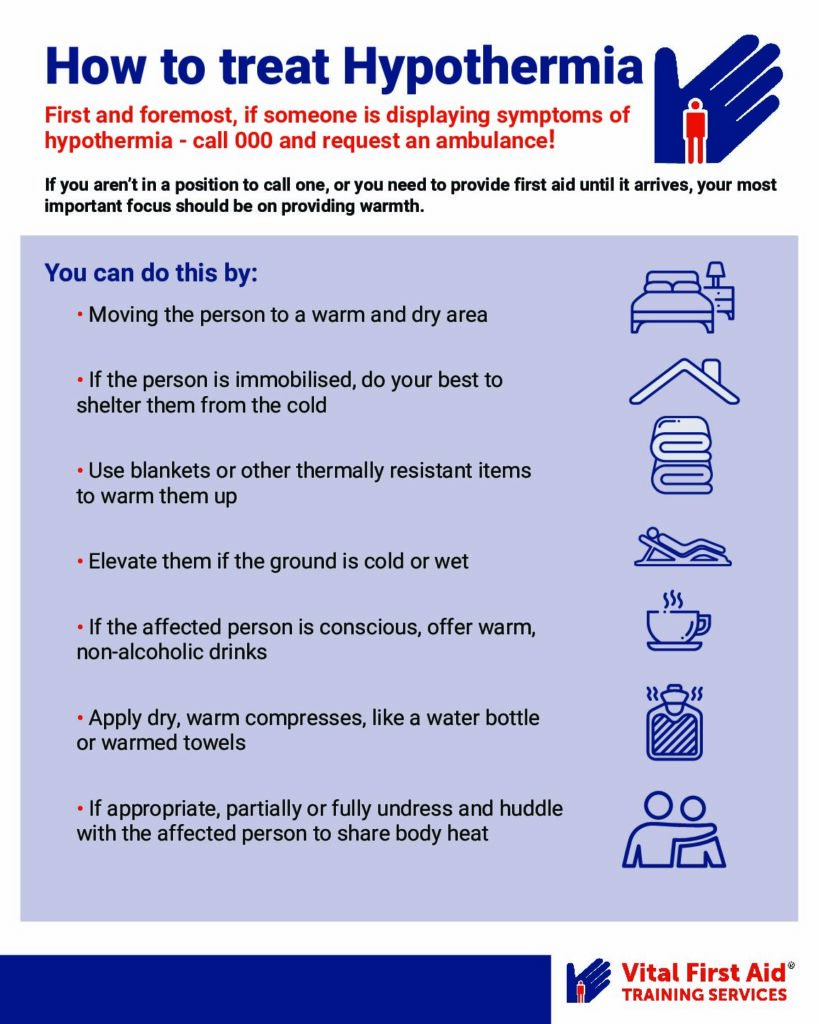
[To download this resource, click here.](https://vitalfirstaid.com.au/wp-content/uploads/Vital-First-Aid-Hypothermia-1-1.pdf)
First and foremost, if someone is displaying symptoms of hypothermia – call 000 and request an ambulance\!
If you aren’t in a position to call one, or you need to provide first aid until it arrives, your most important focus should be on providing warmth.
You can do this by:
- Moving the person to a warm and dry area
- If the person is immobilised, do your best to shelter them from the cold
- Use blankets or other thermally resistant items to warm them up
- Elevate them if the ground is cold or wet
- If the affected person is conscious, offer warm, non-alcoholic drinks
- Apply dry, warm compresses, like a water bottle or warmed towels
- If appropriate, partially or fully undress and huddle with the affected person to share body heat
**CPR**
If a person is unconscious with a reduced pulse and body temperature, don’t assume that they are deceased. Perform CPR until emergency services arrive to make an informed, official pronouncement of death.
[Read more about how to provide life-saving CPR.](https://vitalfirstaid.com.au/news/cpr-during-pandemic/)
It’s also worth noting that it can be common for people to have suffered an injury that has immobilised them, leading to hypothermia. If this is the case, you may need to treat additional injuries.
[Read more about common winter injuries and how to treat them.](https://vitalfirstaid.com.au/news/first-aid-during-winter-how-to-handle-8-big-challenges/)
## **Common Mistakes**
When providing first aid for hypothermia, there are some common misconceptions that can hurt or even kill the suffering person.
### **Don’t Apply Extreme Heat**
While your first instinct may be to immerse the person in hot water or put them right up against a heater, this is actually a bad idea. Extreme heat will damage the person’s skin, or even burn them.
Furthermore, if their hypothermia is advanced enough, the sudden presence of heat can be such a shock to their system that could cause their heart to stop or beat irregularly.
### **Don’t Apply Compresses to Extremities**
When applying compresses, only focus on the torso, from the neck to the groin. The sufferer may complain that their extremities are cold, and they aren’t wrong. The problem is, if you compress them it will force cold blood to return to the core of the body. This will actually lower their core temperature even further and risk death.
By warming the torso instead, you will increase their core temperature, and therefore their extremities as a result.
### **Don’t Rub Extremities**
A common technique seen in film is someone rubbing the freezing limbs of a person suffering from hypothermia. The problem is these films are leaving out an important detail. In advanced stages of hypothermia, simple movement or contact in the extremities becomes painful, including rubbing.
Also, movement naturally makes the body pump more blood. A cardiac system that has been operating at a reduced capacity while hypothermic can arrest with sudden movements.
Not only could it cause pain or complications, but rubbing as a warming technique just isn’t very effective. You can only rub an area the size of your hands, and it won’t take long for you to become tired. A compress is more effective and requires less energy.
## **Vital First Aid**
Now you are aware of the prevention and treatment measures available to deal with hypothermia. Unfortunately, when confronted with an emergency situation, it’s natural to forget key information.
For a firmer grasp, have you considered a first aid course? Vital First Aid is a Registered Training Organisation dedicated to providing quality, realistic training.
By undertaking a Vital First Aid course, you can feel more confident in your knowledge and capabilities.
Being an accredited first aid provider will also give you the confidence to [deal with a range of medical issues](https://vitalfirstaid.com.au/news/a-z-injury-illness-guide/), not just hypothermia.
[For more information about first aid courses, see our website.](https://vitalfirstaid.com.au/)
[To enrol, click here.](https://vitalfirstaid.com.au/events/)
## **Resources**
NSW Health page on hypothermia: <https://www.health.nsw.gov.au/environment/factsheets/Pages/hypothermia.aspx>
#### Leave a Reply
#### About Vital First Aid
Vital First Aid is a dynamic Registered Training Organisation specialising in providing accredited practical training in all facets of first aid and pre-hospital care.
[Facebook-f](https://www.facebook.com/VitalFirstAidTrainingServices)
[Instagram](https://instagram.com/vital_first_aid_rto90531)
[Linkedin-in](https://www.linkedin.com/company/vital-first-aid-training-services)
[Youtube](https://www.youtube.com/@vitalfirstaid)
#### Recent Posts
[](https://vitalfirstaid.com.au/news/first-aid-kits-for-construction-sites/)
### [First Aid Kits for Construction Sites: What Every Australian Worksite Must Have](https://vitalfirstaid.com.au/news/first-aid-kits-for-construction-sites/)
[Read More »](https://vitalfirstaid.com.au/news/first-aid-kits-for-construction-sites/)
[](https://vitalfirstaid.com.au/news/understanding-duty-of-care-and-first-aid-in-australian-workplaces/)
### [Understanding Duty of Care and First Aid in Australian Workplaces](https://vitalfirstaid.com.au/news/understanding-duty-of-care-and-first-aid-in-australian-workplaces/)
[Read More »](https://vitalfirstaid.com.au/news/understanding-duty-of-care-and-first-aid-in-australian-workplaces/)
[](https://vitalfirstaid.com.au/news/first-aid-for-head-injuries-at-work-what-to-do/)
### [First Aid for Head Injuries at Work: What to Do](https://vitalfirstaid.com.au/news/first-aid-for-head-injuries-at-work-what-to-do/)
[Read More »](https://vitalfirstaid.com.au/news/first-aid-for-head-injuries-at-work-what-to-do/)
#### Follow Us
## Trust Our Clients' Honest Reviews
```
```

Registered Training Organisation 90531
- [P: 1300 880 343](tel:+1300880343)
- [\[email protected\]](https://vitalfirstaid.com.au/cdn-cgi/l/email-protection#c1a8afa7ae81b7a8b5a0ada7a8b3b2b5a0a8a5efa2aeacefa0b4)
- 30 Glennie St West,
GOSFORD NSW 2250
- [First Aid Course](https://vitalfirstaid.com.au/courses/hltaid011-provide-first-aid/)
- [CPR Course](https://vitalfirstaid.com.au/courses/hltaid009-provide-cardiopulmonary-resuscitation-cpr/)
- [Childcare First Aid](https://vitalfirstaid.com.au/courses/hltaid012-provide-first-aid-in-an-education-and-care-setting/)
- [Certificate Verification](https://admin.axcelerate.com/public/certvalidation/validatecert.cfm)
- [Registered Training](https://training.gov.au/Organisation/Details/90531)
- [Privacy & Terms](https://vitalfirstaid.com.au/wp-content/uploads/Vital-6.1-Privacy-Policy-update.pdf)
© 2026 Vital First Aid \| All Rights Reserved \| Website by [Oddball Marketing](https://oddballmarketing.com.au/)
[Facebook-f](https://www.facebook.com/VitalFirstAidTrainingServices)
[Linkedin-in](https://www.linkedin.com/company/vital-first-aid-training-services)
[Instagram](https://instagram.com/vital_first_aid_rto90531)
[Youtube](https://www.youtube.com/@vitalfirstaid) |
| Readable Markdown | **Quick facts:**
- **Hypothermia occurs when** the **body temperature falls below 35°C**, which is lower than the normal human body temperature of approximately 37°C.
- If the temperature d**rops below 32°C, hypothermia becomes extremely dangerous and life-threatening**.
- **Hypothermia can result from extended exposure to temperatures under 10°C** or prolonged immersion in water below 20°C. In colder or windier conditions, it can occur more quickly. Certain medical conditions can increase the risk of hypothermia.
**For immediate first aid treatment for Hypothermia, follow these steps:**
1. Relocate the individual to a warm, dry place.
2. Shield them from the cold if they can’t move.
3. Use blankets or insulated materials to warm them.
4. Elevate them if the ground is cold or wet.
5. Offer warm, non-alcoholic beverages if they’re conscious.
6. Apply dry, warm compresses (e.g., a heated water bottle or towels).
7. Share body heat by huddling together. (If appropriate)
**Read on to learn more about Hypothermia, and how to prevent and manage it.**
Explore this blog:
- [What is Hypothermia?](https://vitalfirstaid.com.au/news/first-aid-for-hypothermia-treatment-and-prevention/#what-is-hypothermia)
- [What are the Symptoms of Hypothermia?](https://vitalfirstaid.com.au/news/first-aid-for-hypothermia-treatment-and-prevention/#Symptoms-of-Hypothermia)
- [Common Situations Where People Become Hypothermic](https://vitalfirstaid.com.au/news/first-aid-for-hypothermia-treatment-and-prevention/#Common-Situations-Hypothermic)
- [Who is Susceptible to Hypothermia?](https://vitalfirstaid.com.au/news/first-aid-for-hypothermia-treatment-and-prevention/#Susceptible-to-Hypothermia)
- [How to Prevent Hypothermia](https://vitalfirstaid.com.au/news/first-aid-for-hypothermia-treatment-and-prevention/#How-to-Prevent-Hypothermia)
- [How to Treat Hypothermia](https://vitalfirstaid.com.au/news/first-aid-for-hypothermia-treatment-and-prevention/#How-to-Treat-Hypothermia)
- [Common Mistakes](https://vitalfirstaid.com.au/news/first-aid-for-hypothermia-treatment-and-prevention/#Common-Mistakes-hypothermia)
When you think of hypothermia, you probably envision mountain climbers trapped on an icy slope, or Jack clinging to a piece of wood in the *Titanic.* Unfortunately, the conditions that lead to hypothermia don’t have to be so dramatic.
Even during relatively mild Australian winters, many people find themselves becoming hypothermic because of a lack of awareness. Read on to learn how to treat and prevent hypothermia.
## **What is Hypothermia?**
Hypothermia is a condition caused by a person’s body losing heat faster than it can replenish it. A person’s optimal body temperature is 37°C. When it drops below 35°C, the onset of hypothermia begins.
If their temperature falls below 32°C hypothermia can be lethal.
## **What are the Symptoms of Hypothermia?**
One of the main reasons hypothermia is so dangerous is because its symptoms develop slowly. Sufferers may experience some or all of the symptoms, and in varying severities. This makes it difficult for affected people to recognise the symptoms together as part of a worsening condition.
The following symptoms are listed approximately in order of progression:
- Excessive shivering and teeth chattering
- Loss of coordination and fine motor functions
- Slurred speech
- Lethargy
- Confused, incoherent thought processing and decision making
- Difficulty taking deep breaths
- Loss of consciousness
- Weak pulse
- If untreated, a strong possibility of death
- \*Even if a sufferer of severe hypothermia survives, complications like frostbite and gangrene can occur, and symptoms can begin to present during the hypothermic stage
Due to the disorientating effects of hypothermia, it is important to note that even though these symptoms are severe, the sufferer may not be aware that they are experiencing them. Even if they are, they may be incapable of understanding the gravity of the situation.
### **Paradoxical Undressing**
Hypothermia is infamous for an unusual phenomenon called paradoxical undressing. In many advanced hypothermia cases, affected people will remove their clothes. This makes them colder and worsens their condition – hence the paradox.
This is because the body uses muscle contraction to draw blood away from the extremities towards the core, but eventually these muscles fail and the blood suddenly flows back to the extremities, making the sufferer feel a hot flush.
In their disorientated state, this can make them strip their clothing to ‘cool down’ and exacerbate their bodily temperature loss.
## **Common Situations Where People Become Hypothermic**
You’d be forgiven for thinking that hypothermia is only a threat in snowy conditions. But the temperatures that can cause hypothermia aren’t as low as you might expect.
A person with prolonged exposure to just 10°C or less on land, or just 20°C or less in water, can suffer hypothermia. For context, even in Australia, night-time winter temperatures will routinely drop below 10°C. During the day water temperatures also commonly drop below 20°C.
Contributing factors are people being underdressed for the conditions, or weather conditions like rain or wind. This is why hypothermia can be so deadly – people don’t associate it with an Australian climate, and therefore find themselves unprepared and at risk.
## **Who is Susceptible to Hypothermia?**
In short, no matter how fit, healthy or young they are, anybody can be affected by hypothermia. With that said, some people are more at risk than others. People with a heightened susceptibility include:
- **Anyone** who is wet in cold conditions
- Elderly people
- Infants
- Homeless people – or anyone who spends extended periods of time outdoors without shelter
- Mentally or physically impaired people who may not recognise, or be able to avoid, situations where they are at risk
- People with reduced circulation
- Diabetics
- People with underlying infections
- People with a low body mass
- Exhausted or fatigued people
### **Alcohol**
Alcohol makes blood vessels expand. This is why people often feel warm when they drink. The issue is, while the increased blood flow to their extremities makes them feel warm, it also makes them more susceptible to the cold because heat loss is most prevalent in the extremities.
Alcohol also causes mental and physical impairment. Combined with the disorientating effects of hypothermia itself, alcohol is one of the single greatest risk factors for hypothermia.
## **How to Prevent Hypothermia**
While treating hypothermia is important, prevention is even better. You can prevent hypothermia by ensuring that you:
- Wear suitable clothes for the conditions
- Get dry as soon as possible if your clothes become wet
- Avoid becoming exhausted in cold conditions
- Don’t stay immersed in cold water for long periods
- Avoid using substances like alcohol that can impair you if you are in cold conditions
- If you are going to a remote area, tell people where you are in case you become stranded
Always remember, hypothermia is brought on by body temperature loss, not just the weather. A snowboarder wearing appropriate thermal protective gear could be less at risk than a surfer who goes out on a winter day without a wetsuit.
Hypothermia is situational and can happen to anyone. If you are shivering excessively, no matter where you are or how healthy you feel, warm yourself up.
## **How to Treat Hypothermia**

[To download this resource, click here.](https://vitalfirstaid.com.au/wp-content/uploads/Vital-First-Aid-Hypothermia-1-1.pdf)
First and foremost, if someone is displaying symptoms of hypothermia – call 000 and request an ambulance\!
If you aren’t in a position to call one, or you need to provide first aid until it arrives, your most important focus should be on providing warmth.
You can do this by:
- Moving the person to a warm and dry area
- If the person is immobilised, do your best to shelter them from the cold
- Use blankets or other thermally resistant items to warm them up
- Elevate them if the ground is cold or wet
- If the affected person is conscious, offer warm, non-alcoholic drinks
- Apply dry, warm compresses, like a water bottle or warmed towels
- If appropriate, partially or fully undress and huddle with the affected person to share body heat
**CPR**
If a person is unconscious with a reduced pulse and body temperature, don’t assume that they are deceased. Perform CPR until emergency services arrive to make an informed, official pronouncement of death.
[Read more about how to provide life-saving CPR.](https://vitalfirstaid.com.au/news/cpr-during-pandemic/)
It’s also worth noting that it can be common for people to have suffered an injury that has immobilised them, leading to hypothermia. If this is the case, you may need to treat additional injuries.
[Read more about common winter injuries and how to treat them.](https://vitalfirstaid.com.au/news/first-aid-during-winter-how-to-handle-8-big-challenges/)
## **Common Mistakes**
When providing first aid for hypothermia, there are some common misconceptions that can hurt or even kill the suffering person.
### **Don’t Apply Extreme Heat**
While your first instinct may be to immerse the person in hot water or put them right up against a heater, this is actually a bad idea. Extreme heat will damage the person’s skin, or even burn them.
Furthermore, if their hypothermia is advanced enough, the sudden presence of heat can be such a shock to their system that could cause their heart to stop or beat irregularly.
### **Don’t Apply Compresses to Extremities**
When applying compresses, only focus on the torso, from the neck to the groin. The sufferer may complain that their extremities are cold, and they aren’t wrong. The problem is, if you compress them it will force cold blood to return to the core of the body. This will actually lower their core temperature even further and risk death.
By warming the torso instead, you will increase their core temperature, and therefore their extremities as a result.
### **Don’t Rub Extremities**
A common technique seen in film is someone rubbing the freezing limbs of a person suffering from hypothermia. The problem is these films are leaving out an important detail. In advanced stages of hypothermia, simple movement or contact in the extremities becomes painful, including rubbing.
Also, movement naturally makes the body pump more blood. A cardiac system that has been operating at a reduced capacity while hypothermic can arrest with sudden movements.
Not only could it cause pain or complications, but rubbing as a warming technique just isn’t very effective. You can only rub an area the size of your hands, and it won’t take long for you to become tired. A compress is more effective and requires less energy.
## **Vital First Aid**
Now you are aware of the prevention and treatment measures available to deal with hypothermia. Unfortunately, when confronted with an emergency situation, it’s natural to forget key information.
For a firmer grasp, have you considered a first aid course? Vital First Aid is a Registered Training Organisation dedicated to providing quality, realistic training.
By undertaking a Vital First Aid course, you can feel more confident in your knowledge and capabilities.
Being an accredited first aid provider will also give you the confidence to [deal with a range of medical issues](https://vitalfirstaid.com.au/news/a-z-injury-illness-guide/), not just hypothermia.
[For more information about first aid courses, see our website.](https://vitalfirstaid.com.au/)
[To enrol, click here.](https://vitalfirstaid.com.au/events/)
## **Resources**
NSW Health page on hypothermia: <https://www.health.nsw.gov.au/environment/factsheets/Pages/hypothermia.aspx> |
| ML Classification | |
| ML Categories | null |
| ML Page Types | null |
| ML Intent Types | null |
| Content Metadata | |
| Language | en-au |
| Author | David Aboud |
| Publish Time | 2022-05-22 23:39:59 (3 years ago) |
| Original Publish Time | 2022-05-22 23:39:59 (3 years ago) |
| Republished | No |
| Word Count (Total) | 2,478 |
| Word Count (Content) | 1,673 |
| Links | |
| External Links | 10 |
| Internal Links | 62 |
| Technical SEO | |
| Meta Nofollow | No |
| Meta Noarchive | No |
| JS Rendered | No |
| Redirect Target | null |
| Performance | |
| Download Time (ms) | 2,456 |
| TTFB (ms) | 2,455 |
| Download Size (bytes) | 33,023 |
| Shard | 176 (laksa) |
| Root Hash | 5977132603554131176 |
| Unparsed URL | au,com,vitalfirstaid!/news/first-aid-for-hypothermia-treatment-and-prevention/ s443 |