ℹ️ Skipped - page is already crawled
| Filter | Status | Condition | Details |
|---|---|---|---|
| HTTP status | PASS | download_http_code = 200 | HTTP 200 |
| Age cutoff | PASS | download_stamp > now() - 6 MONTH | 0.2 months ago |
| History drop | PASS | isNull(history_drop_reason) | No drop reason |
| Spam/ban | PASS | fh_dont_index != 1 AND ml_spam_score = 0 | ml_spam_score=0 |
| Canonical | PASS | meta_canonical IS NULL OR = '' OR = src_unparsed | Not set |
| Property | Value |
|---|---|
| URL | https://us.norton.com/blog/privacy/what-is-an-ip-address |
| Last Crawled | 2026-04-06 04:18:42 (6 days ago) |
| First Indexed | 2022-09-22 00:39:48 (3 years ago) |
| HTTP Status Code | 200 |
| Meta Title | What is an IP address and how does it work? |
| Meta Description | Learn what IP addresses are, and how different IP types work, in our guide. |
| Meta Canonical | null |
| Boilerpipe Text | IP address definition
An IP address is a unique identifier assigned to a device on the internet or a local network. Short for "Internet Protocol," IP refers to the rules that dictate how data is formatted and transmitted across networks.
IP addresses are essential for the internet’s functionality, facilitating communication by directing data between devices, and ensuring it reaches the intended destination. Each IP address includes location details that make devices identifiable within a network, allowing the internet to differentiate between computers, routers, and websites.
The definition of IP address.
How do IP addresses work?
IP addresses work by providing a unique label to each device on a network, allowing them to send and receive data packets according to
TCP/IP
protocols.
Routers
and other network devices use these addresses to route packets to their correct destination, ensuring efficient and accurate communication between devices.
Here’s a closer look at how IP addresses help facilitate network data transfers:
Device initialization:
Your device connects to a network and prepares to communicate.
IP address assignment:
The network router assigns separate IP addresses to each network device, after receiving its own IP address allocation from an organization like ICANN (Internet Corporation for Assigned Names and Numbers) via the
ISP
(internet service provider).
Domain Name System (DNS) resolution:
When you enter a domain name (like google.com), the
DNS
translates it into a machine-readable IP address. This process allows your device to locate and communicate with the correct server on the internet.
Data packet transmission:
Data is broken into packets, each containing the source and destination IP addresses. These data packets are then sent by the transmitting device and forwarded across the network.
Network address translation (NAT):
NAT modifies IP address information in packet headers as data passes through a router, replacing the private IP address with the router’s public IP address. This allows multiple devices on a private network to share a single public IP.
Routing and switching:
Routing uses IP addresses to direct data packets between different networks, while switching handles traffic within a single network, using MAC addresses to route packets to specific devices.
Delivery and response:
Data packets arrive at the destination device or server, identified by its IP address. The destination may send a response or acknowledgment back to the source device, using IP addresses to ensure the correct return path.
Renewal and reassignment:
Dynamic IP addresses are periodically renewed and reassigned as devices connect and disconnect from networks. This process ensures each device has a valid, unique IP address, preventing conflicts and maintaining efficient network organization.
Types of IP addresses
Different types of IP addresses are used to manage the limited pool of available addresses, improve security, and meet specific networking needs. These include IPv4 and IPv6 IP addresses, public and private IP addresses, and static and dynamic IP addresses.
A comparison of different types of IP addresses.
IPv4
IPv4 is a legacy generation of IP that’s still widely used. They use a 32-bit address format, represented in dotted decimal notation, with a maximum of 15 characters. Its main drawback is limited address space, with only around 4 billion possible unique addresses. To help cope with address exhaustion, ISPs use techniques like NAT, enabling multiple devices to share a single public IP.
An example of an IPv4 address is:
192.168.1.1
.
IPv6
IPv6 addresses are the newest IP address iteration. These types of IPs offer a greatly expanded address space, by using 128-bit addresses written as eight groups of four hexadecimal digits. This allows for more than 340 undecillion unique addresses — a limit we’ll likely never hit. IPv6 also improves routing efficiency and network security by incorporating
IPsec
authentication and encryption protocols.
An example of an IPv6 address is:
2401:0fc8:85b3:0000:0000:8b6e:0730:7314
.
Public IP address
A public IP address is assigned to devices like routers, which are directly accessible over the internet. Public IPs are globally unique and traceable, which allows external devices to communicate with your network — but it also makes them visible and traceable to a specific location. To enhance privacy and security, devices within a local network typically share one public IP address.
Private IP address
A
private IP address
, or local IP address, is assigned by your router to devices within your local network. Each device gets a unique private IP to help the router direct traffic correctly. Unlike
public IP addresses
, which are visible on the internet, private IPs remain confined to your local network, which means they don’t need to be universally unique and can be reused across multiple networks.
Static IP address
Static IP addresses, also known as dedicated or fixed IP addresses, don’t change. Once a device is assigned an IP address, that address remains the same. Static IP addresses are common for web servers, email servers, or other devices that need to be consistently accessible at the same address.
Dynamic IP address
Dynamic IP addresses are temporary addresses assigned to devices by a network’s DHCP server each time a device connects to the network. This allows efficient use of available addresses, making it ideal for networks with many users. Dynamic IPs also offer security benefits, since their changing nature makes it harder for hackers to target.
How to find your IP address
You can find your public IP address by Googling “What is my IP?” Google and other web services know your IP address because it’s assigned to your device and is required to connect to the internet in the first place. When you search, Google usually displays your public IP address in an info box, but you might need to scroll down a bit to see it.
An example of where you can find your IP address on Google.
But if you want to see your computer or phone’s network-provided IP address — known as your private IP address — you’ll need to look up the local IP directly on your device.
Find your IP address on Windows
Here’s how to look up your IP address on a PC:
Go to
Start
>
Settings
>
Network & internet
.
Select
Wi-Fi
(for wireless connections) or
Ethernet
(for wired connections).
A screenshot showing how to find your IP address on a wireless network through Windows settings.
3. Click your network’s
Properties
icon, then scroll until you see your IP address.
A screenshot showing the IP address on a Windows computer.
Find your IP address on Mac
To find your Mac’s IP address, follow these steps:
Open
System Settings
>
Wi-Fi
>
Details
.
Scroll until you see your IP address.
A screenshot showing the IP address through Mac settings.
Find your IP address on Android
You can also check your phone’s IP address by following these steps:
Go to
Settings
>
About phone
.
Scroll down until you see your IP address.
Screenshots showing how to see the IP address on an Android.
Find your IP address on iPhone
To see your iPhone’s IP address:
Go to
Settings
>
Wi-Fi
.
Tap the blue info icon next to your network.
Screenshots showing how to see the IP address on an Android.
3. Scroll down to see your IPv4 and (if applicable) IPv6 IP addresses.
A screenshot showing the IP address from an iPhone’s settings.
You may see multiple IP addresses listed if you’re assigned a public IP address from your cellular carrier and a private IP address from your Wi-Fi network.
What can someone do with your IP address?
If
someone has your IP address
, they can approximate your location, track your online activity, and potentially target you with ads or cyber attacks. While an IP alone won’t typically lead to hacking, it can be a starting point for identifying and exploiting vulnerabilities in your network.
Here’s a closer look at ways a cybercriminal may use your IP address:
Monitor your online activity:
A criminal could monitor your online activity using your IP address by intercepting network traffic or exploiting vulnerabilities to access your devices or data.
Launch cyberattacks:
Your IP address could be used to launch attacks like
DDoS attacks
, overwhelming your network with traffic to disrupt your connection. They may also target you with
spyware
or
malware
, potentially gaining access to your device and personal data.
Personalize spam and scams:
Cybercriminals can use your IP address to find your general location. Later, they can leverage this information to personalize scams and
spam messages
, making them seem more relevant to you.
Impersonate you:
If a hacker has your IP address, they could attempt to impersonate you by
spoofing your IP
to make it seem like their activity originates from your device.
How to hide your IP address
Common methods for
hiding an IP address
include using a VPN, proxy server, NAT firewall, or anonymizing browser. You can also try connecting to a non-static IP address or resetting your router.
Here’s a closer look at different ways to hide your IP address:
VPNs:
A
VPN
hides your IP address by encrypting and routing your internet traffic through a VPN server, which assigns you a new IP address and masks your original one.
Proxy servers:
Although they typically lack encryption,
proxies
can help hide your IP address by displaying their server IP address to the sites you visit.
Dynamic IP addresses:
Your IP address won’t exactly be obscured, but by changing periodically, dynamic IP addresses assigned by a
public Wi-Fi network
or your mobile carrier make it harder for you to be tracked or targeted.
NAT firewalls:
A NAT
firewall
on your router helps hide your IP address by using a shared public IP for multiple devices, preventing incoming traffic from accessing your devices directly without
port forwarding
.
Reset your modem:
Resetting your modem can assign a new dynamic IP address, replacing your previous IP and disrupting any ongoing tracking or attacks aimed at your old IP address.
Browse with Tor:
By routing your internet traffic through an encrypted network of server “nodes,”
Tor
helps mask your original IP address — although it is still exposed to the first node in the network.
Reset your router:
Performing a router reset may assign a new local IP to devices, but it won’t necessarily change your public IP unless your ISP provides a dynamic IP.
Mask your IP address
Don’t want hackers turning up on your digital doorstep? Hiding your IP address with a VPN from a trusted brand is the most effective and reliable way to boost your internet privacy and security.
Norton VPN
helps shield your IP address from prying eyes looking to track your online activity, uncover your location, or steal sensitive personal or financial data. Thanks to bank-grade encryption, your IP is masked, and your data is routed through a secure tunnel, helping to ensure a private and secure online experience every time you connect.
FAQs
Can I change my IP address?
Yes, you can
change your IP address
. An easy and secure way to do so is to use a VPN to assign your device a virtual IP address whenever you connect, keeping your real IP address private.
What's the difference between a MAC address and IP address?
A Media Access Control (MAC) address is a permanent and unique hardware identifier for a device’s network interface controller (NIC), used for communication within a local network. In contrast, an IP address identifies a device’s connection to a network and can change depending on location and connection type.
Does your IP address change with location?
Yes, an IP address can change with location. When you connect to the internet from different places, such as different Wi-Fi networks or using mobile data, your device is assigned a new IP address based on the network's location. This helps identify your approximate geographical location.
What is a loopback IP address?
A loopback IP address routes data packets from the original device back to itself so it doesn’t travel over the internet. Developers and network administrators typically use loopback IPs to perform tests or debugging.
What is the 192.168 IP address?
192.168.x.x is a private default address commonly used for routers in home networks and other small private networks. Each device connected to the same local network shares the same number sequence at the beginning but has a unique identifier at the end. |
| Markdown | Protect your IP address
Download Norton VPN to mask your IP address and help keep your browsing activity private.
[Get it now](https://us.norton.com/products/norton-vpn)
Protect your IP address
Install Norton VPN to mask your IP address and help keep your browsing activity private.

Norton VPN
[Get it now](https://us.norton.com/products/norton-vpn)
Protect your IP address
Install Norton VPN to mask your IP address and help keep your browsing activity private.

Norton VPN
[Get it now](https://us.norton.com/products/norton-vpn)
[](https://us.norton.com/)
[](https://us.norton.com/)
Search
Start typing to see suggestions.
Start typing to see suggestions.
- Personal
- [ALL-IN-ONE-PLAN](https://us.norton.com/products/norton-360)
- [Norton 360 Deluxe](https://us.norton.com/products/norton-360-deluxe)
- [Norton 360 with LifeLock Select](https://us.norton.com/products/norton-360-lifelock-select)
- [Norton 360 with LifeLock Advantage](https://us.norton.com/products/norton-360-lifelock-advantage)
- [Norton 360 with LifeLock Ultimate Plus](https://us.norton.com/products/norton-360-lifelock-ultimate-plus)
- [ANTIVIRUS](https://us.norton.com/products/norton-360-protection)
- [Norton AntiVirus Plus](https://us.norton.com/products/norton-360-antivirus-plus)
- [Norton 360 Standard](https://us.norton.com/products/norton-360-standard)
- [Norton 360 for Gamers](https://us.norton.com/products/norton-360-for-gamers)
- [Norton Mobile Security for Android](https://us.norton.com/products/mobile-security-for-android)
- [Norton Mobile Security for iOS](https://us.norton.com/products/mobile-security-for-ios)
- [Privacy](https://us.norton.com/products/privacy)
- [Norton VPN NEW](https://us.norton.com/products/norton-vpn)
- [Norton AntiTrack](https://us.norton.com/products/norton-antitrack)
- [Privacy Monitor Assistant NEW](https://us.norton.com/products/privacy-monitor-assistant)
[All products and services](https://us.norton.com/products)
[Partner with us](https://www.gendigital.com/us/en/partner?inid=nortoncom_nav_gendigital:partner:home_blog:privacy:what-is-an-ip-address)
[LifeLock identity protection](https://lifelock.norton.com/?inid=nortoncom_nav_lifelock.norton.com_blog:privacy:what-is-an-ip-address)
- [Small Business](https://us.norton.com/products/small-business)
- Resources
- [NORTON BLOG](https://us.norton.com/blog)
- [Security resources](https://us.norton.com/blog/security)
- [Privacy resources](https://us.norton.com/blog/online-privacy)
- [Performance resources](https://us.norton.com/blog/performance)
- [Scam resources](https://us.norton.com/blog/online-scams)
- [EXPLORE TOPICS](https://us.norton.com/blog)
- [Data breaches](https://us.norton.com/blog/collections/data-breaches)
- [Shopping scams](https://us.norton.com/blog/collections/online-shopping-scams)
- [AI safety](https://us.norton.com/blog/collections/ai)
- [VPNs](https://us.norton.com/blog/collections/vpn)
- [ Norton 360 comparison](https://us.norton.com/feature/norton-360-features-comparison)
- [ Virus scanner and removal tool](https://us.norton.com/blog/malware/virus-removal-tool)
- [ Free tools](https://us.norton.com/products/free-tools)
- [ Free trials](https://us.norton.com/downloads)
- [ Help Me Choose Quiz](https://us.norton.com/blog/privacy/what-is-an-ip-address#openQuiz)
- Support
- [GET HELP]()
- [Customer support](https://support.norton.com/?inid=nortoncom_nav_support_blog:privacy:what-is-an-ip-address)
- [Community](https://community.norton.com/?inid=nortoncom_nav_community_blog:privacy:what-is-an-ip-address)
- [Update Center](https://updatecenter.norton.com/?inid=nortoncom_nav_updatecenter.norton.com_blog:privacy:what-is-an-ip-address)
- [Reviews](https://us.norton.com/reviews)
- [LEARN]()
- [How to renew](https://us.norton.com/renewal)
- [Premium Services](https://us.norton.com/nortonservices)
- [Spyware & Virus Removal](https://us.norton.com/products/spyware-virus-removal)
- Try Free
- [TRY FREE]()
- [Free tools](https://us.norton.com/products/free-tools)
- [Free trials NEW](https://us.norton.com/downloads)
- Search
Start typing to see suggestions.
Start typing to see suggestions.
-  US
- Sign In
[Sign in](https://my.norton.com/extspa/dashboard/Home?inid=nortoncom_nav_mynorton_home_blog:privacy:what-is-an-ip-address) [Sign in](https://my.norton.com/extspa/dashboard/Home?inid=nortoncom_nav_mynorton_home2_blog:privacy:what-is-an-ip-address)
Download services by signing in to your account.
- [Account info](https://my.norton.com/account/home?inid=nortoncom_nav_mynorton_home_blog:privacy:what-is-an-ip-address)
- [Billing info](https://my.norton.com/Account/billinginformation?inid=nortoncom_nav_mynorton_billinginformation_blog:privacy:what-is-an-ip-address)
- [Renew](https://my.norton.com/account/home?inid=nortoncom_nav_mynorton_home2_blog:privacy:what-is-an-ip-address)
- [Order history](https://my.norton.com/Account/orders?inid=nortoncom_nav_mynorton_orders_blog:privacy:what-is-an-ip-address)
- [Enter your Product Key](https://my.norton.com/onboard/home/setup?inid=nortoncom_nav_mynorton_setup_blog:privacy:what-is-an-ip-address)
[](https://us.norton.com/)
Please select your country/region

Americas
[ Argentina](https://ar.norton.com/) [ Brasil](https://br.norton.com/) [ Canada (English)](https://ca.norton.com/blog/privacy/what-is-an-ip-address) [ Canada (Français)](https://ca-fr.norton.com/blog/privacy/what-is-an-ip-address) [ Caribbean (English)](https://pr.norton.com/) [ Caribe (Español)](https://lam.norton.com/) [ Chile](https://cl.norton.com/) [ Colombia](https://co.norton.com/) [ Costa Rica](https://lam.norton.com/) [ Ecuador](https://lam.norton.com/) [ El Salvador](https://lam.norton.com/) [ Guatemala](https://lam.norton.com/) [ Hispanoamérica](https://lam.norton.com/) [ México](https://mx.norton.com/) [ Panamá](https://lam.norton.com/) [ Perú](https://lam.norton.com/) [ Puerto Rico (English)](https://pr.norton.com/) [ United States](https://us.norton.com/blog/privacy/what-is-an-ip-address) [ Uruguay](https://lam.norton.com/) [ Venezuela](https://lam.norton.com/)
Europe, Middle East & Africa
[ België (Nederlands)](https://be-nl.norton.com/) [ Belgique (Français)](https://be.norton.com/) [ Česko](https://cz.norton.com/) [ Danmark](https://dk.norton.com/) [ Deutschland](https://de.norton.com/blog/wifi/what-is-an-ip-address) [ España](https://es.norton.com/) [ Estonia (English)](https://ie.norton.com/) [ France](https://fr.norton.com/blog/wifi/what-is-an-ip-address) [ Iceland (English)](https://ie.norton.com/) [ Ireland (English)](https://ie.norton.com/) [ Israel (English)](https://il.norton.com/) [ Italia](https://it.norton.com/) [ Latvia (English)](https://ie.norton.com/) [ Lithuania (English)](https://ie.norton.com/) [ Luxembourg (Français)](https://fr.norton.com/blog/wifi/what-is-an-ip-address) [ Magyarország](https://hu.norton.com/) [ Nederland](https://nl.norton.com/)
[ Norge](https://no.norton.com/) [ Österreich](https://at.norton.com/) [ Polska](https://pl.norton.com/) [ Portugal](https://pt.norton.com/) [ România](https://ro.norton.com/) [ Schweiz (Deutsch)](https://ch.norton.com/) [ Suisse (Français)](https://ch-fr.norton.com/) [ Svizzera (Italiano)](https://ch-it.norton.com/) [ South Africa](https://za.norton.com/) [ Suomi](https://fi.norton.com/) [ Sverige](https://se.norton.com/) [ Türkiye](https://tr.norton.com/) [ United Arab Emirates (English)](https://ae.norton.com/) [ United Kingdom](https://uk.norton.com/blog/wifi/what-is-an-ip-address) [ Ελλάδα](https://gr.norton.com/) [ Россия](https://ru.norton.com/)
Asia & Pacific
[ Australia](https://au.norton.com/blog/wifi/what-is-an-ip-address) [ Cambodia (English)](https://asia.norton.com/) [ Hong Kong (English)](https://hk-en.norton.com/) [ 香港](https://hk.norton.com/) [ India (English)](https://in.norton.com/blog/privacy/what-is-an-ip-address) [ Indonesia (English)](https://asia.norton.com/) [ Malaysia (English)](https://malaysia.norton.com/) [ New Zealand](https://nz.norton.com/) [ Philippines (English)](https://asia.norton.com/) [ Singapore (English)](https://sg.norton.com/) [ Thailand (English)](https://asia.norton.com/) [ Vietnam (English)](https://asia.norton.com/) [ 대한민국](https://kr.norton.com/) [ 中国](https://cn.norton.com/) [ 台灣](https://tw.norton.com/) [ 日本](https://jp.norton.com/)
- [Blog Home](https://us.norton.com/blog)
- [Scams](https://us.norton.com/blog/online-scams)
- Security
- [Account Security](https://us.norton.com/blog/account-safety)
- [Artificial Intelligence](https://us.norton.com/blog/ai)
- [Family Safety](https://us.norton.com/blog/family-safety)
- [Hacking](https://us.norton.com/blog/hacking)
- [Malware](https://us.norton.com/blog/malware)
- [Phishing](https://us.norton.com/blog/phishing)
- [Scams](https://us.norton.com/blog/online-scams)
- [Security Tips](https://us.norton.com/blog/security-tips)
- [View all Security](https://us.norton.com/blog/security)
- Privacy
- [Digital Life](https://us.norton.com/blog/digital-life)
- [Identity Protection](https://us.norton.com/blog/id-theft)
- [Wi-Fi & Networking](https://us.norton.com/blog/wifi)
- [VPN](https://us.norton.com/blog/vpn)
- [Privacy Tips](https://us.norton.com/blog/privacy-tips)
- [View all Privacy](https://us.norton.com/blog/online-privacy)
- Performance
- [Cleaning](https://us.norton.com/blog/cleaning)
- [Gaming](https://us.norton.com/blog/gaming)
- [Hardware](https://us.norton.com/blog/hardware)
- [Software](https://us.norton.com/blog/software)
- [Performance Tips](https://us.norton.com/blog/performance-tips)
- [View all Performance](https://us.norton.com/blog/performance)
- Featured Topics
- [Data Breach Knowledge Center](https://us.norton.com/blog/collections/data-breaches)
- [Shopping Scams](https://us.norton.com/blog/collections/online-shopping-scams)
- [AI Safety](https://us.norton.com/blog/collections/ai)
- [Scams Explained](https://us.norton.com/blog/collections/scams)
- [VPN Knowledge Center](https://us.norton.com/blog/collections/vpn)
- [Financial Wellness](https://us.norton.com/blog/collections/financial-wellness)
- [Research](https://us.norton.com/blog/research)
Blog
- [Blog Home](https://us.norton.com/blog)
- [Scams](https://us.norton.com/blog/online-scams)
- Security
- [Account Security](https://us.norton.com/blog/account-safety)
- [Artificial Intelligence](https://us.norton.com/blog/ai)
- [Family Safety](https://us.norton.com/blog/family-safety)
- [Hacking](https://us.norton.com/blog/hacking)
- [Malware](https://us.norton.com/blog/malware)
- [Phishing](https://us.norton.com/blog/phishing)
- [Scams](https://us.norton.com/blog/online-scams)
- [Security Tips](https://us.norton.com/blog/security-tips)
- [View all Security](https://us.norton.com/blog/security)
- Privacy
- [Digital Life](https://us.norton.com/blog/digital-life)
- [Identity Protection](https://us.norton.com/blog/id-theft)
- [Wi-Fi & Networking](https://us.norton.com/blog/wifi)
- [VPN](https://us.norton.com/blog/vpn)
- [Privacy Tips](https://us.norton.com/blog/privacy-tips)
- [View all Privacy](https://us.norton.com/blog/online-privacy)
- Performance
- [Cleaning](https://us.norton.com/blog/cleaning)
- [Gaming](https://us.norton.com/blog/gaming)
- [Hardware](https://us.norton.com/blog/hardware)
- [Software](https://us.norton.com/blog/software)
- [Performance Tips](https://us.norton.com/blog/performance-tips)
- [View all Performance](https://us.norton.com/blog/performance)
- Featured Topics
- [Data Breach Knowledge Center](https://us.norton.com/blog/collections/data-breaches)
- [Shopping Scams](https://us.norton.com/blog/collections/online-shopping-scams)
- [AI Safety](https://us.norton.com/blog/collections/ai)
- [Scams Explained](https://us.norton.com/blog/collections/scams)
- [VPN Knowledge Center](https://us.norton.com/blog/collections/vpn)
- [Financial Wellness](https://us.norton.com/blog/collections/financial-wellness)
- [Research](https://us.norton.com/blog/research)
1. [Blog Home](https://us.norton.com/blog)
2. [Privacy](https://us.norton.com/blog/privacy)
3. What is an IP address and how does it work?
# What is an IP address?
Your IP address is like your digital home address. It lets your devices, like your computer or phone, connect online for things like browsing, shopping, and messaging. Learn how IP addresses work, the different types, and how Norton VPN can help shield your IP from tracking, surveillance, and online threats.
[Get Norton VPN](https://us.norton.com/products/norton-vpn)

2025
**PCMag**
**60X Winner**

[Excellent  68953 reviews on ](https://trustpilot.com/review/norton.com)

- Written by [Oliver Buxton](https://us.norton.com/blog/authors/oliver-buxton)
- Published July 25, 2022 11 min read
- Updated April 15, 2025
###### Contents
- [IP address definition](https://us.norton.com/blog/privacy/what-is-an-ip-address#id-toc-ip-address-definition-0)
- [How do IP addresses work?](https://us.norton.com/blog/privacy/what-is-an-ip-address#id-toc-how-do-ip-addresses-work--1)
- [Types of IP addresses](https://us.norton.com/blog/privacy/what-is-an-ip-address#id-toc-types-of-ip-addresses-2)
- [How to find your IP address](https://us.norton.com/blog/privacy/what-is-an-ip-address#id-toc-how-to-find-your-ip-address-3)
- [What can someone do with your IP address?](https://us.norton.com/blog/privacy/what-is-an-ip-address#id-toc-what-can-someone-do-with-your-ip-address--4)
- [How to hide your IP address](https://us.norton.com/blog/privacy/what-is-an-ip-address#id-toc-how-to-hide-your-ip-address-5)
- [Mask your IP address](https://us.norton.com/blog/privacy/what-is-an-ip-address#id-toc-mask-your-ip-address-6)
- [FAQs](https://us.norton.com/blog/privacy/what-is-an-ip-address#id-toc-faqs-7)
## IP address definition
An IP address is a unique identifier assigned to a device on the internet or a local network. Short for "Internet Protocol," IP refers to the rules that dictate how data is formatted and transmitted across networks.
IP addresses are essential for the internet’s functionality, facilitating communication by directing data between devices, and ensuring it reaches the intended destination. Each IP address includes location details that make devices identifiable within a network, allowing the internet to differentiate between computers, routers, and websites.
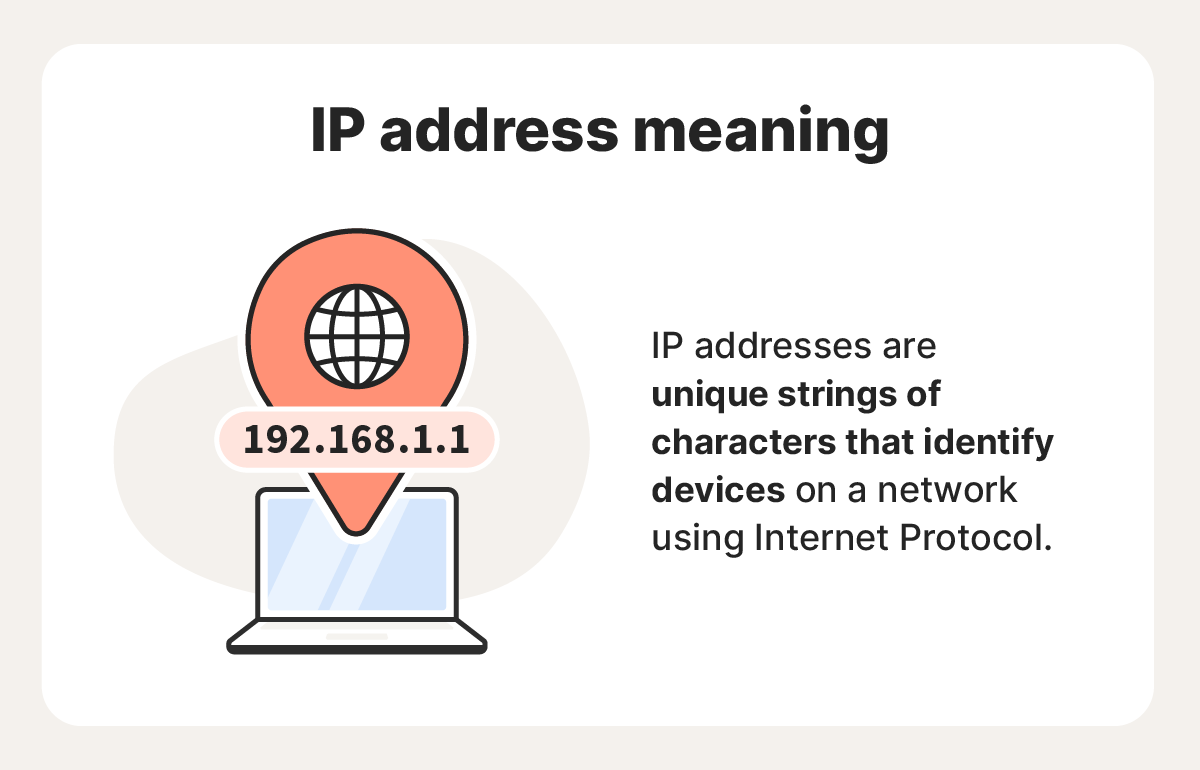

The definition of IP address.
## How do IP addresses work?
IP addresses work by providing a unique label to each device on a network, allowing them to send and receive data packets according to [TCP/IP](https://us.norton.com/blog/privacy/tcp-ip) protocols. [Routers](https://us.norton.com/blog/iot/smarter-home-what-is-router) and other network devices use these addresses to route packets to their correct destination, ensuring efficient and accurate communication between devices.
Here’s a closer look at how IP addresses help facilitate network data transfers:
1. **Device initialization:** Your device connects to a network and prepares to communicate.
2. **IP address assignment:** The network router assigns separate IP addresses to each network device, after receiving its own IP address allocation from an organization like ICANN (Internet Corporation for Assigned Names and Numbers) via the [ISP](https://us.norton.com/blog/wifi/what-is-an-isp) (internet service provider).
3. **Domain Name System (DNS) resolution:** When you enter a domain name (like google.com), the [DNS](https://us.norton.com/blog/how-to/what-is-my-dns) translates it into a machine-readable IP address. This process allows your device to locate and communicate with the correct server on the internet.
4. **Data packet transmission:** Data is broken into packets, each containing the source and destination IP addresses. These data packets are then sent by the transmitting device and forwarded across the network.
5. **Network address translation (NAT):** NAT modifies IP address information in packet headers as data passes through a router, replacing the private IP address with the router’s public IP address. This allows multiple devices on a private network to share a single public IP.
6. **Routing and switching:** Routing uses IP addresses to direct data packets between different networks, while switching handles traffic within a single network, using MAC addresses to route packets to specific devices.
7. **Delivery and response:** Data packets arrive at the destination device or server, identified by its IP address. The destination may send a response or acknowledgment back to the source device, using IP addresses to ensure the correct return path.
8. **Renewal and reassignment:** Dynamic IP addresses are periodically renewed and reassigned as devices connect and disconnect from networks. This process ensures each device has a valid, unique IP address, preventing conflicts and maintaining efficient network organization.
## Types of IP addresses
Different types of IP addresses are used to manage the limited pool of available addresses, improve security, and meet specific networking needs. These include IPv4 and IPv6 IP addresses, public and private IP addresses, and static and dynamic IP addresses.
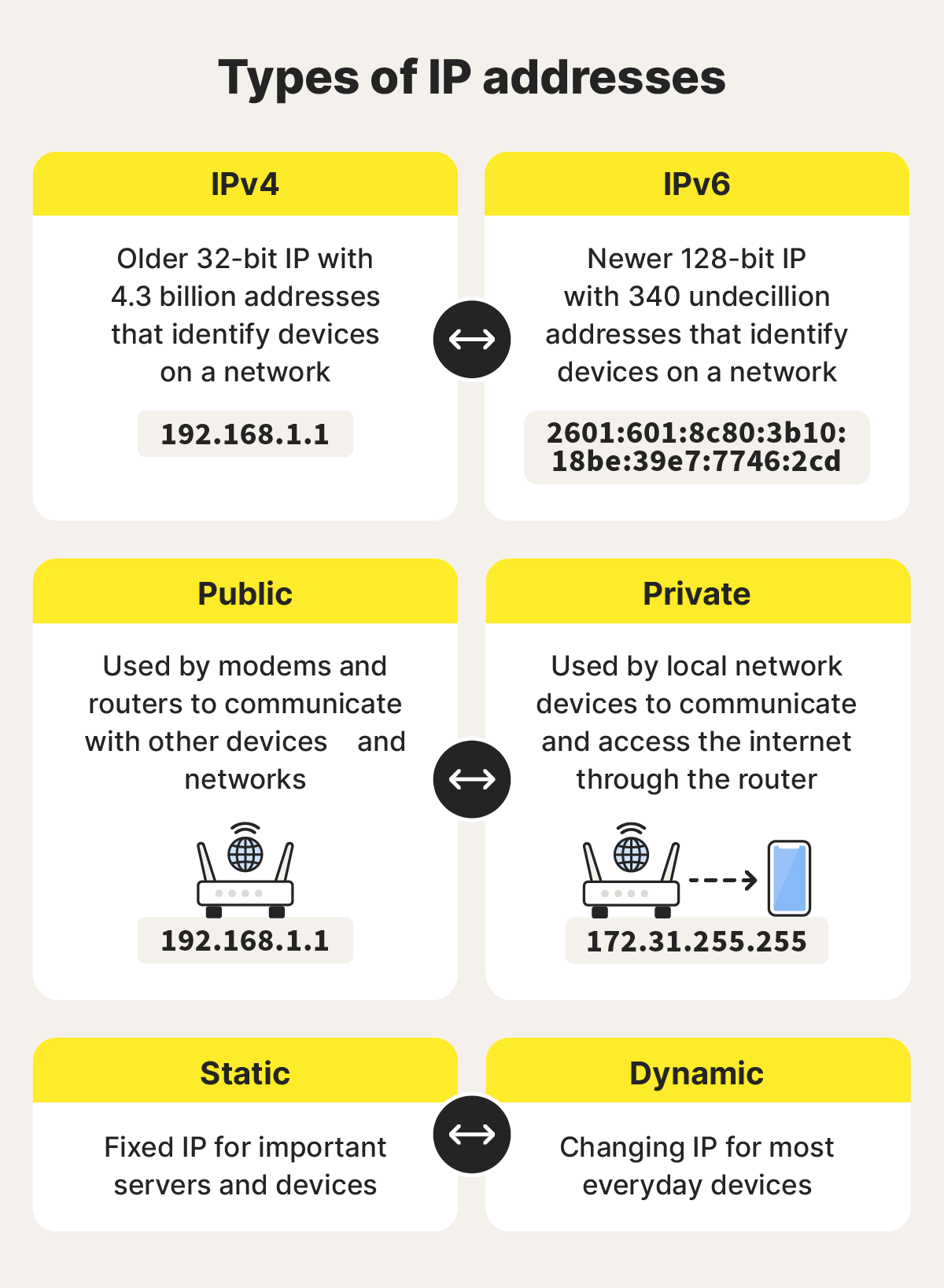

A comparison of different types of IP addresses.
### IPv4
IPv4 is a legacy generation of IP that’s still widely used. They use a 32-bit address format, represented in dotted decimal notation, with a maximum of 15 characters. Its main drawback is limited address space, with only around 4 billion possible unique addresses. To help cope with address exhaustion, ISPs use techniques like NAT, enabling multiple devices to share a single public IP.
An example of an IPv4 address is: **192\.168.1.1**.
### IPv6
IPv6 addresses are the newest IP address iteration. These types of IPs offer a greatly expanded address space, by using 128-bit addresses written as eight groups of four hexadecimal digits. This allows for more than 340 undecillion unique addresses — a limit we’ll likely never hit. IPv6 also improves routing efficiency and network security by incorporating [IPsec](https://us.norton.com/blog/privacy/what-is-ipsec) authentication and encryption protocols.
An example of an IPv6 address is: **2401:0fc8:85b3:0000:0000:8b6e:0730:7314**.
### Public IP address
A public IP address is assigned to devices like routers, which are directly accessible over the internet. Public IPs are globally unique and traceable, which allows external devices to communicate with your network — but it also makes them visible and traceable to a specific location. To enhance privacy and security, devices within a local network typically share one public IP address.
### Private IP address
A [private IP address](https://us.norton.com/blog/privacy/private-ip-address), or local IP address, is assigned by your router to devices within your local network. Each device gets a unique private IP to help the router direct traffic correctly. Unlike [public IP addresses](https://us.norton.com/blog/privacy/public-vs-private-ip-address), which are visible on the internet, private IPs remain confined to your local network, which means they don’t need to be universally unique and can be reused across multiple networks.
### Static IP address
Static IP addresses, also known as dedicated or fixed IP addresses, don’t change. Once a device is assigned an IP address, that address remains the same. Static IP addresses are common for web servers, email servers, or other devices that need to be consistently accessible at the same address.
### Dynamic IP address
Dynamic IP addresses are temporary addresses assigned to devices by a network’s DHCP server each time a device connects to the network. This allows efficient use of available addresses, making it ideal for networks with many users. Dynamic IPs also offer security benefits, since their changing nature makes it harder for hackers to target.
## How to find your IP address
You can find your public IP address by Googling “What is my IP?” Google and other web services know your IP address because it’s assigned to your device and is required to connect to the internet in the first place. When you search, Google usually displays your public IP address in an info box, but you might need to scroll down a bit to see it.
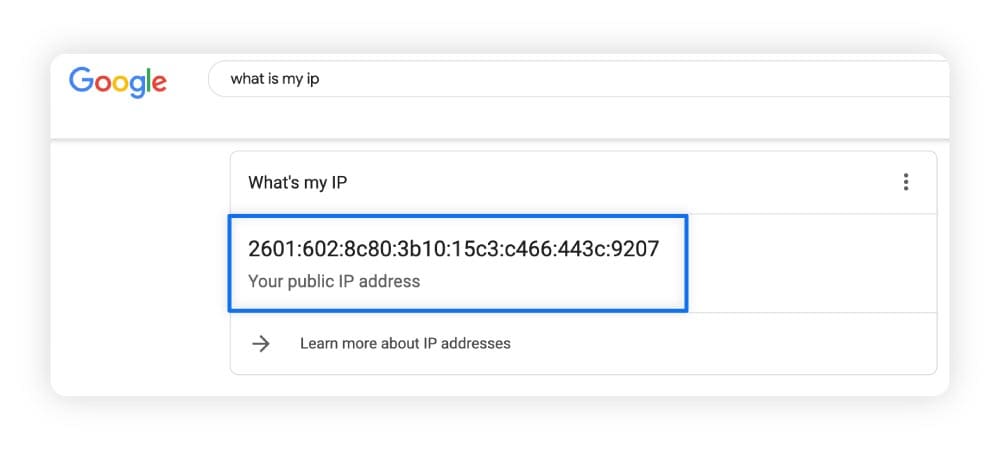

An example of where you can find your IP address on Google.
But if you want to see your computer or phone’s network-provided IP address — known as your private IP address — you’ll need to look up the local IP directly on your device.
### Find your IP address on Windows
Here’s how to look up your IP address on a PC:
1. Go to **Start** \> **Settings** \> **Network & internet**.
2. Select **Wi-Fi** (for wireless connections) or **Ethernet** (for wired connections).
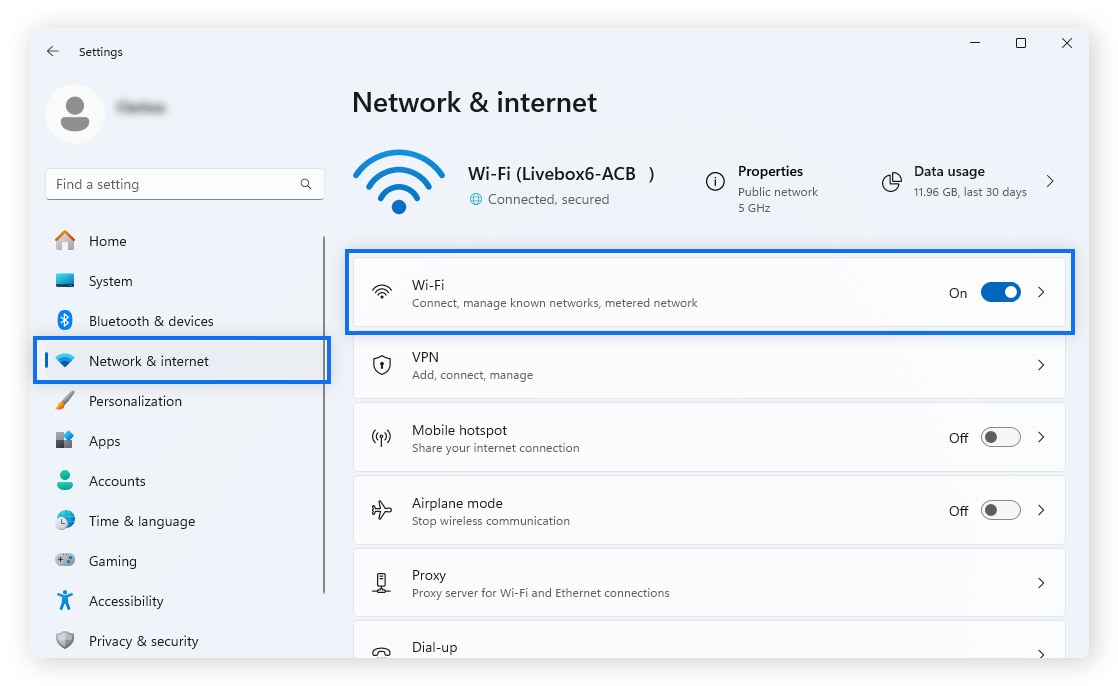

A screenshot showing how to find your IP address on a wireless network through Windows settings.
3\. Click your network’s **Properties** icon, then scroll until you see your IP address.
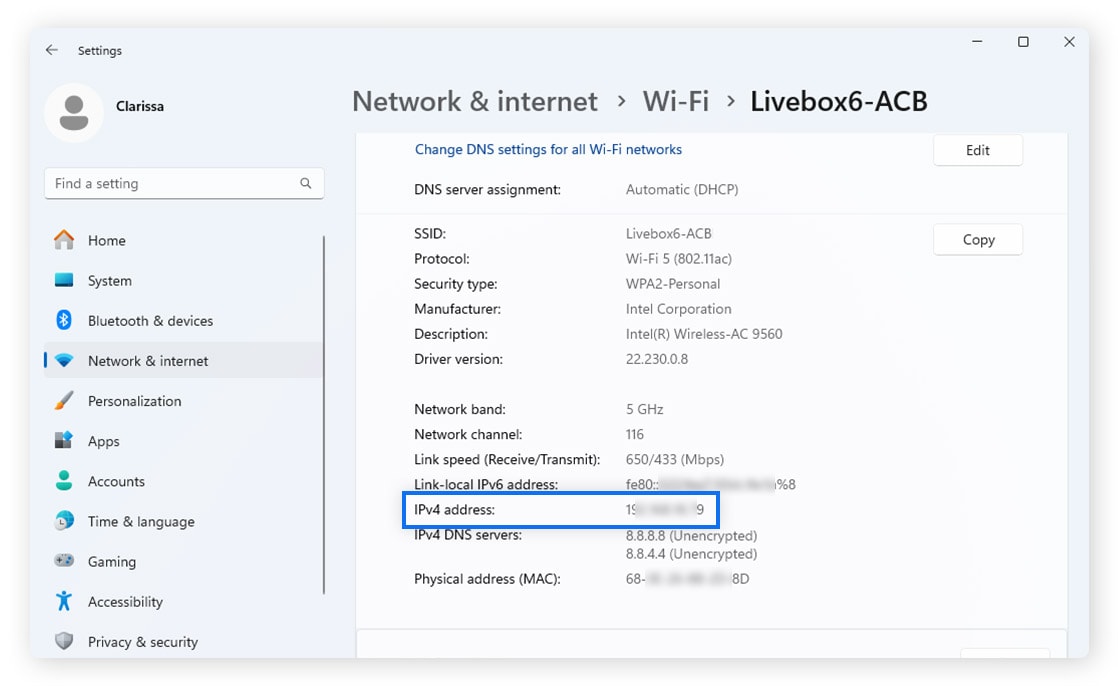

A screenshot showing the IP address on a Windows computer.
### Find your IP address on Mac
To find your Mac’s IP address, follow these steps:
1. Open **System Settings** \> **Wi-Fi** \> **Details**.
2. Scroll until you see your IP address.
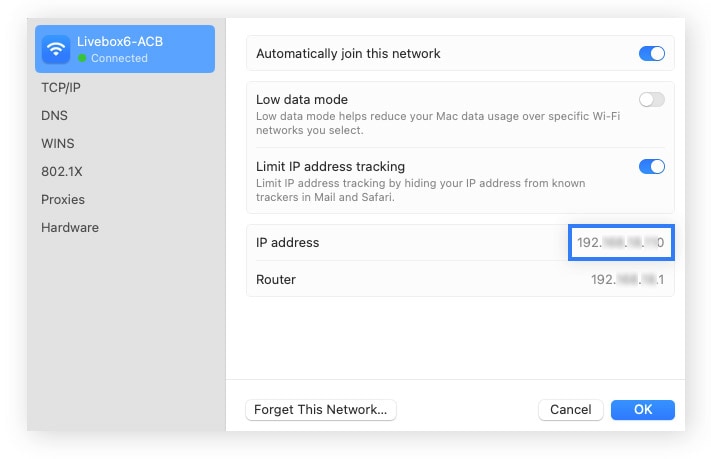

A screenshot showing the IP address through Mac settings.
### Find your IP address on Android
You can also check your phone’s IP address by following these steps:
1. Go to **Settings** \> **About phone**.
2. Scroll down until you see your IP address.
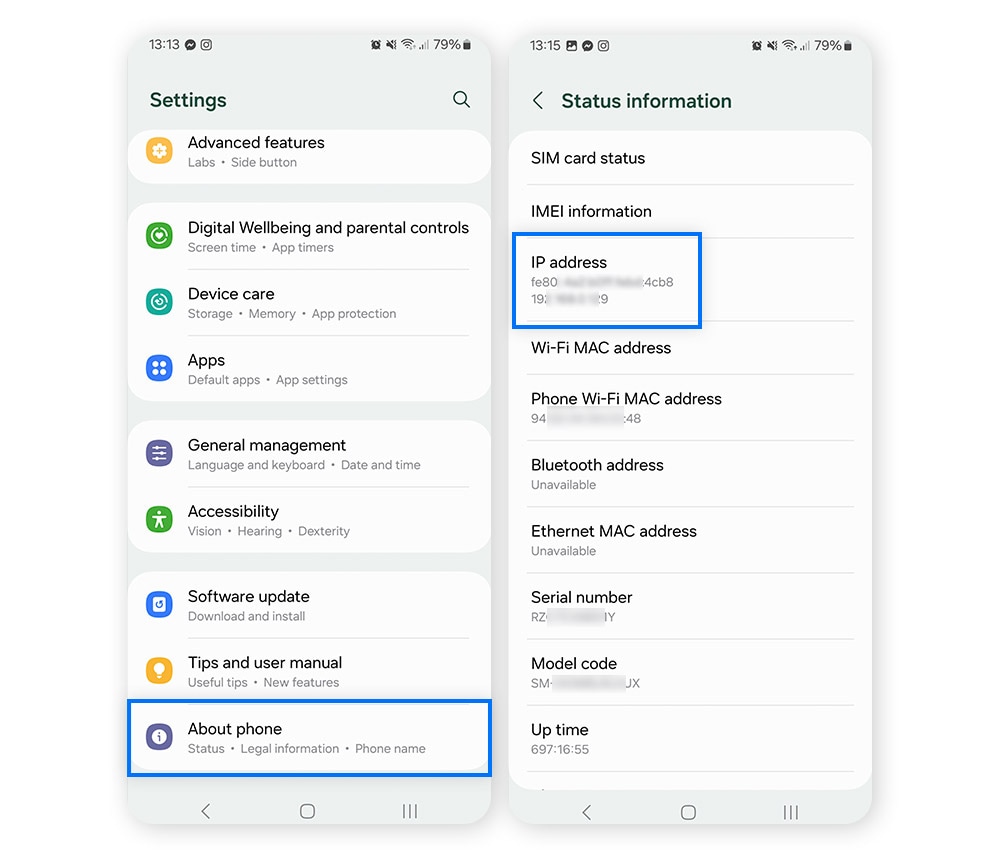

Screenshots showing how to see the IP address on an Android.
### Find your IP address on iPhone
To see your iPhone’s IP address:
1. Go to **Settings** \> **Wi-Fi**.
2. Tap the blue info icon next to your network.
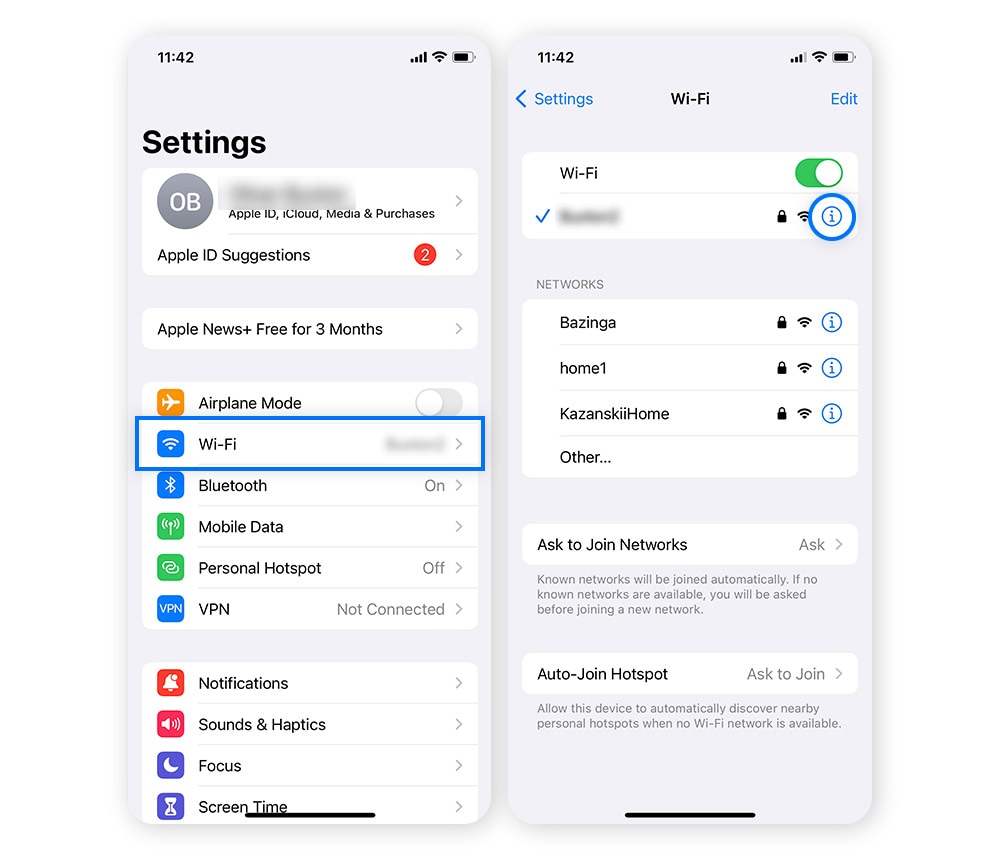

Screenshots showing how to see the IP address on an Android.
3\. Scroll down to see your IPv4 and (if applicable) IPv6 IP addresses.
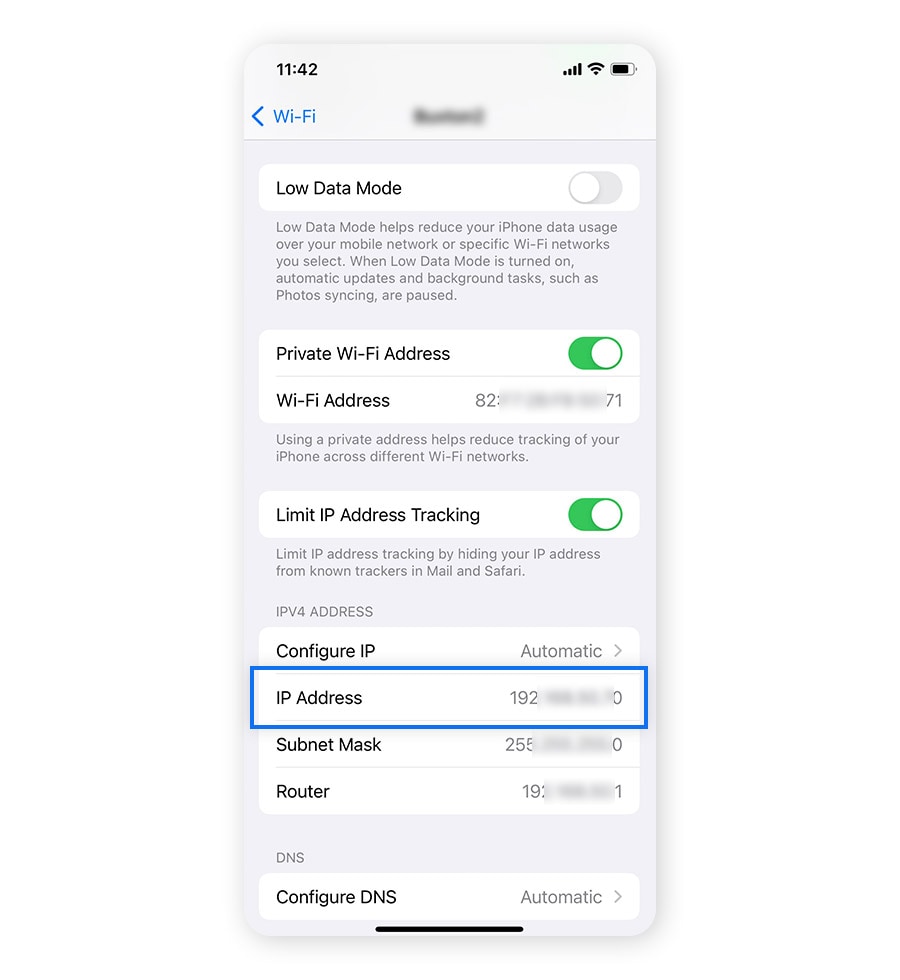

A screenshot showing the IP address from an iPhone’s settings.
You may see multiple IP addresses listed if you’re assigned a public IP address from your cellular carrier and a private IP address from your Wi-Fi network.
## What can someone do with your IP address?
If [someone has your IP address](https://us.norton.com/blog/privacy/what-can-someone-do-with-ip-address), they can approximate your location, track your online activity, and potentially target you with ads or cyber attacks. While an IP alone won’t typically lead to hacking, it can be a starting point for identifying and exploiting vulnerabilities in your network.
Here’s a closer look at ways a cybercriminal may use your IP address:
- **Monitor your online activity:** A criminal could monitor your online activity using your IP address by intercepting network traffic or exploiting vulnerabilities to access your devices or data.
- **Launch cyberattacks:** Your IP address could be used to launch attacks like [DDoS attacks](https://us.norton.com/blog/emerging-threats/ddos-attacks), overwhelming your network with traffic to disrupt your connection. They may also target you with [spyware](https://us.norton.com/blog/malware/spyware) or [malware](https://us.norton.com/blog/emerging-threats/malware), potentially gaining access to your device and personal data.
- **Personalize spam and scams:** Cybercriminals can use your IP address to find your general location. Later, they can leverage this information to personalize scams and [spam messages](https://us.norton.com/blog/online-scams/what-is-spam), making them seem more relevant to you.
- **Impersonate you:** If a hacker has your IP address, they could attempt to impersonate you by [spoofing your IP](https://us.norton.com/blog/malware/what-is-ip-spoofing) to make it seem like their activity originates from your device.
## How to hide your IP address
Common methods for [hiding an IP address](https://us.norton.com/blog/privacy/how-to-hide-your-ip-address) include using a VPN, proxy server, NAT firewall, or anonymizing browser. You can also try connecting to a non-static IP address or resetting your router.
Here’s a closer look at different ways to hide your IP address:
- **VPNs:** A [VPN](https://us.norton.com/blog/privacy/what-is-a-vpn) hides your IP address by encrypting and routing your internet traffic through a VPN server, which assigns you a new IP address and masks your original one.
- **Proxy servers:** Although they typically lack encryption, [proxies](https://us.norton.com/blog/privacy/proxy-vs-vpn) can help hide your IP address by displaying their server IP address to the sites you visit.
- **Dynamic IP addresses:** Your IP address won’t exactly be obscured, but by changing periodically, dynamic IP addresses assigned by a [public Wi-Fi network](https://us.norton.com/blog/privacy/public-wifi) or your mobile carrier make it harder for you to be tracked or targeted.
- **NAT firewalls:** A NAT [firewall](https://us.norton.com/blog/privacy/firewall) on your router helps hide your IP address by using a shared public IP for multiple devices, preventing incoming traffic from accessing your devices directly without [port forwarding](https://us.norton.com/blog/how-to/how-to-port-forward).
- **Reset your modem:** Resetting your modem can assign a new dynamic IP address, replacing your previous IP and disrupting any ongoing tracking or attacks aimed at your old IP address.
- **Browse with Tor:** By routing your internet traffic through an encrypted network of server “nodes,” [Tor](https://us.norton.com/blog/vpn/tor-vs-vpn) helps mask your original IP address — although it is still exposed to the first node in the network.
- **Reset your router:** Performing a router reset may assign a new local IP to devices, but it won’t necessarily change your public IP unless your ISP provides a dynamic IP.
## Mask your IP address
Don’t want hackers turning up on your digital doorstep? Hiding your IP address with a VPN from a trusted brand is the most effective and reliable way to boost your internet privacy and security.
[Norton VPN](https://us.norton.com/products/norton-vpn) helps shield your IP address from prying eyes looking to track your online activity, uncover your location, or steal sensitive personal or financial data. Thanks to bank-grade encryption, your IP is masked, and your data is routed through a secure tunnel, helping to ensure a private and secure online experience every time you connect.
[Get Norton VPN](https://us.norton.com/products/norton-vpn)
## FAQs
### Can I change my IP address?
Yes, you can [change your IP address](https://us.norton.com/blog/how-to/change-ip-address). An easy and secure way to do so is to use a VPN to assign your device a virtual IP address whenever you connect, keeping your real IP address private.
### What's the difference between a MAC address and IP address?
A Media Access Control (MAC) address is a permanent and unique hardware identifier for a device’s network interface controller (NIC), used for communication within a local network. In contrast, an IP address identifies a device’s connection to a network and can change depending on location and connection type.
### Does your IP address change with location?
Yes, an IP address can change with location. When you connect to the internet from different places, such as different Wi-Fi networks or using mobile data, your device is assigned a new IP address based on the network's location. This helps identify your approximate geographical location.
### What is a loopback IP address?
A loopback IP address routes data packets from the original device back to itself so it doesn’t travel over the internet. Developers and network administrators typically use loopback IPs to perform tests or debugging.
### What is the 192.168 IP address?
192\.168.x.x is a private default address commonly used for routers in home networks and other small private networks. Each device connected to the same local network shares the same number sequence at the beginning but has a unique identifier at the end.

- [Oliver Buxton](https://us.norton.com/blog/authors/oliver-buxton)
- Staff Cybersecurity Editor
Oliver Buxton, a staff editor for Norton, specializes in advanced persistent threats. His work on cyberterrorism has appeared in The Times, and his prior work includes writing digital safeguarding policies.
**Editors' note:** Our articles offer educational information and are written to raise awareness about important topics in Cyber Safety. Norton products and services may not protect against every type of threat, fraud, or crime we write about. *For more details about how we research, write, and review our articles, see our [Editorial Policy](https://us.norton.com/blog/editorial-policy "https://us.norton.com/blog/editorial-policy").*
***
## Related articles


Published ·
Published ·
[](https://us.norton.com/blog/privacy/what-is-a-vpn)
[Privacy](https://us.norton.com/blog/privacy) [What is a VPN and what does it do?](https://us.norton.com/blog/privacy/what-is-a-vpn)
Updated April 09, 2024 · 8 min read
[](https://us.norton.com/blog/privacy/proxy-vs-vpn)
[Privacy](https://us.norton.com/blog/privacy) [Proxy vs. VPN: What’s the difference and which one should you use?](https://us.norton.com/blog/privacy/proxy-vs-vpn)
Updated November 25, 2025 · 14 min read
[](https://us.norton.com/blog/wifi/what-is-upnp)
[Wi-Fi & Networking](https://us.norton.com/blog/wifi) [What is UPnP and is it safe?](https://us.norton.com/blog/wifi/what-is-upnp)
Published March 25, 2026 · 8 min read
[](https://us.norton.com/blog/privacy/what-can-someone-do-with-ip-address)
[Privacy](https://us.norton.com/blog/privacy) [What can someone do with your IP address?](https://us.norton.com/blog/privacy/what-can-someone-do-with-ip-address)
Published September 30, 2024 · 7 min read
[](https://us.norton.com/blog/how-to/change-ip-address)
[How To](https://us.norton.com/blog/how-to) [How to change your IP address on any device](https://us.norton.com/blog/how-to/change-ip-address)
Published September 30, 2024 · 7 min read
[](https://us.norton.com/blog/privacy/how-to-hide-your-ip-address)
[Privacy](https://us.norton.com/blog/privacy) [How to hide your IP address in 4 ways](https://us.norton.com/blog/privacy/how-to-hide-your-ip-address)
Updated March 14, 2025 · 9 min read
Published ·
Published ·
[](https://us.norton.com/blog/privacy/what-is-a-vpn)
[Privacy](https://us.norton.com/blog/privacy) [What is a VPN and what does it do?](https://us.norton.com/blog/privacy/what-is-a-vpn)
Updated April 09, 2024 · 8 min read
[](https://us.norton.com/blog/privacy/proxy-vs-vpn)
[Privacy](https://us.norton.com/blog/privacy) [Proxy vs. VPN: What’s the difference and which one should you use?](https://us.norton.com/blog/privacy/proxy-vs-vpn)
Updated November 25, 2025 · 14 min read
[](https://us.norton.com/blog/wifi/what-is-upnp)
[Wi-Fi & Networking](https://us.norton.com/blog/wifi) [What is UPnP and is it safe?](https://us.norton.com/blog/wifi/what-is-upnp)
Published March 25, 2026 · 8 min read
[](https://us.norton.com/blog/privacy/what-can-someone-do-with-ip-address)
[Privacy](https://us.norton.com/blog/privacy) [What can someone do with your IP address?](https://us.norton.com/blog/privacy/what-can-someone-do-with-ip-address)
Published September 30, 2024 · 7 min read
[](https://us.norton.com/blog/how-to/change-ip-address)
[How To](https://us.norton.com/blog/how-to) [How to change your IP address on any device](https://us.norton.com/blog/how-to/change-ip-address)
Published September 30, 2024 · 7 min read
[](https://us.norton.com/blog/privacy/how-to-hide-your-ip-address)
[Privacy](https://us.norton.com/blog/privacy) [How to hide your IP address in 4 ways](https://us.norton.com/blog/privacy/how-to-hide-your-ip-address)
Updated March 14, 2025 · 9 min read
Published ·
Published ·
#### Want more?
Follow us for all the latest news, tips, and updates.
[](https://twitter.com/norton)
[](https://www.instagram.com/nortonsecurity/)
[](http://www.facebook.com/Norton)
[](https://www.youtube.com/user/norton)
[**Products**](https://us.norton.com/products)
- [Norton AntiVirus Plus](https://us.norton.com/products/norton-360-antivirus-plus)
- [Norton 360 Deluxe](https://us.norton.com/products/norton-360-deluxe)
- [Norton 360 for Gamers](https://us.norton.com/products/norton-360-for-gamers)
- [Norton 360 with LifeLock Select](https://us.norton.com/products/norton-360-lifelock-select)
- [Norton 360 with LifeLock Ultimate Plus](https://us.norton.com/products/norton-360-lifelock-ultimate-plus)
- [Norton VPN](https://us.norton.com/products/norton-vpn)
- [Norton AntiTrack](https://us.norton.com/products/norton-antitrack)
- [Norton Family](https://us.norton.com/products/norton-family)
- [Norton Mobile Security for Android](https://us.norton.com/products/mobile-security-for-android)
- [Norton Mobile Security for iOS](https://us.norton.com/products/mobile-security-for-ios)
- [Norton Utilities Ultimate](https://us.norton.com/products/norton-utilities-ultimate)
- [Norton Driver Updater](https://us.norton.com/products/norton-driver-updater)
- [Norton Small Business](https://us.norton.com/products/small-business)
- [Norton Genie](https://us.norton.com/products/genie-scam-detector "Genie Scam Detector")
- [Norton Private Browser](https://us.norton.com/products/norton-private-browser "Norton Private Browser")
- [Norton Revamp](https://revamp.norton.com/)
**[Product features](https://us.norton.com/features)**
- [Norton 360 Comparison](https://us.norton.com/feature/norton-360-features-comparison)
- [Antivirus](https://us.norton.com/antivirus)
- [AI Scam Protection](https://us.norton.com/feature/ai-scam-protection)
- [Windows 10 Antivirus](https://us.norton.com/feature/antivirus-for-windows-10)
- [Windows 11 Antivirus](https://us.norton.com/feature/antivirus-for-windows-11)
- [Mac Antivirus](https://us.norton.com/feature/antivirus-for-mac)
- [Virus removal](https://us.norton.com/antivirus#virusremoval)
- [Malware protection](https://us.norton.com/antivirus#malwareprotection)
- [Cloud Backup](https://us.norton.com/feature/backup)
- [Safe Web](https://us.norton.com/feature/safe-web)
- [Safe Search](https://us.norton.com/products/safe-search)
- [Windows 10 VPN](https://us.norton.com/feature/vpn-for-windows-10)
- [Smart Firewall](https://us.norton.com/feature/firewall)
- [Password Manager](https://us.norton.com/feature/password-manager)
- [Password Generator](https://us.norton.com/feature/password-generator)
- [Parental Control](https://us.norton.com/feature/parental-control)
- [Privacy Monitor](https://us.norton.com/feature/privacy-monitor)
- [SafeCam](https://us.norton.com/feature/safecam)
- [Dark Web Monitoring](https://us.norton.com/feature/dark-web-monitoring)
- [Identity Lock](https://us.norton.com/feature/identity-lock)
**Services & Support**
- [Norton Premium Services](https://us.norton.com/nortonservices)
- [Norton Computer Tune Up](https://us.norton.com/products/norton-computer-tune-up)
- [Norton Ultimate Help Desk](https://us.norton.com/products/ultimate-help-desk)
- [Spyware & Virus Removal](https://us.norton.com/products/spyware-virus-removal)
- [Norton Support](https://support.norton.com/)
- [Norton Update Center](https://updatecenter.norton.com/)
- [How to renew](https://us.norton.com/renewal)
**About**
- [About Norton](https://us.norton.com/about-norton)
- [Blog](https://us.norton.com/blog)
- [Reviews](https://us.norton.com/reviews "Reviews")
- [Community](https://community.norton.com/)
- [Affiliates](https://us.norton.com/affiliates)
- [Free trials](https://us.norton.com/downloads)
- [Free tools](https://us.norton.com/products/free-tools)
- [Sign in](https://login.norton.com/)
- [LifeLock identity protection](https://lifelock.norton.com/ "LifeLock identity protection")
- [ReputationDefender by Norton](https://www.reputationdefender.com/)
[](https://x.com/norton) [](https://www.instagram.com/nortonsecurity/) [](https://www.facebook.com/Norton/) [](https://www.youtube.com/user/norton)
[](https://us.norton.com/)
Norton is part of Gen – a global company with a family of trusted brands.
Copyright © 2026 Gen Digital Inc. All rights reserved. Gen trademarks or registered trademarks are property of Gen Digital Inc. or its affiliates. Firefox is a trademark of Mozilla Foundation. Android, Google Chrome, Google Play, and the Google Play logo are trademarks of Google, LLC. Mac, iPhone, iPad, Apple, and the Apple logo are trademarks of Apple Inc., registered in the U.S. and other countries. App Store is a service mark of Apple Inc. Alexa and all related logos are trademarks of Amazon.com, Inc. or its affiliates. Microsoft and the Windows logo are trademarks of Microsoft Corporation in the U.S. and other countries. The Android robot is reproduced or modified from work created and shared by Google and used according to terms described in the Creative Commons 3.0 Attribution License. Other names may be trademarks of their respective owners.
[About Gen](https://www.gendigital.com/) [Newsroom](https://newsroom.gendigital.com/norton) [Partner with us](https://www.gendigital.com/us/en/partner/) [Careers](https://www.gendigital.com/us/en/life-gen/) [Legal](https://us.norton.com/legal) [Privacy](https://us.norton.com/privacy/) [Security](https://www.gendigital.com/us/en/contact-us/report-a-potential-security-vulnerability/) [Terms of Use](https://us.norton.com/legal/terms-of-use) [Accessibility](https://www.gendigital.com/us/en/legal/accessibility-policy/) [Services status](https://status.norton.com/) [Your privacy choices](https://www.nortonlifelock.com/us/en/privacy/do-not-sell/) [Privacy Setting]()
[](https://www.nortonlifelock.com/us/en/privacy/cookies-and-analytics/) This site uses cookies.
[Accept]()[Reject]()
Privacy Settings
In order to provide with the best experience possible we might sometimes track information about you. Sometimes this may involve writing a cookie. We use this information for things like experience enrichment, analytics and targeting advertising. We recommend allowing these functions to get the most out of your experience.
***
PERFORMANCE AND FUNCTIONALITY
These technologies are used to enhance the performance and functionality of our websites but are non-essential to their use. However, without these cookies, certain functionality may become unavailable.
Cloudfront
Google Fonts
Cloudfare
Amazon AWS
Akamai
Zuberance
eGain
YouTube Video
***
SOCIAL MEDIA
These technologies are used to enable you to share pages and content that you find interesting on our websites through third party social networking and other websites.
Facebook
Twitter
Pinterest
LinkedIn Widget
Quora
SnapChat
siteintercept.qualtrics.com
Twitter Conversion Tracking
Twitter Conversion
Twitter Ads
***
ANALYTICS
These technologies collect information that is used in aggregate form to help us understand how our websites are being used are being used or to help us continuously improve our websites.
eXelate
Google Tag Manager
Google Analytic
Twitter Analytic
iSpot TV
IO
Natural Intelligence
Tag4arm
Bounce Exchange, Inc
OneSpot
Knotch Pro
Adaptive Analytic
Quantummetric
Cheq
Threat Metrix
***
ADVERTISING
These technologies are used to make advertising messages more relevant to you. They perform functions like preventing the same ad from continuously reappearing, ensuring that ads are properly displayed for advertisers, and in some cases selecting advertisements that are based on your interests.
GWM
Google Doubleclick
MediaMath, Inc.
ArtSai
Soreto
Yahoo Ads
Rimm-Kaufman
Adobe Adlens
eXelate
Outbrain
Appsflyer
Google Ads
Bing Ads
Bounce Ex Events
Reddit
Yahoo Advertising Solutions
Proofpoint
Amobee, Inc.
Bounce Exchange, Inc
Carbon
RKXD
Chartable
Google Optimize
AdMedia
LinkedIn Widget
Havas
AddShopper
LeadsRx, Inc.
Podsight
Simplifi Holdings Inc
TikTok
Zeta Global
Content DSP
w55c
Equifax
Tv Scientific
Barometric
Yelp
Adaptive
CIQ
Amazon Ads
Spotify
Podscribe
Capterra
***
Save
Cancel |
| Readable Markdown | ## IP address definition
An IP address is a unique identifier assigned to a device on the internet or a local network. Short for "Internet Protocol," IP refers to the rules that dictate how data is formatted and transmitted across networks.
IP addresses are essential for the internet’s functionality, facilitating communication by directing data between devices, and ensuring it reaches the intended destination. Each IP address includes location details that make devices identifiable within a network, allowing the internet to differentiate between computers, routers, and websites.


The definition of IP address.
## How do IP addresses work?
IP addresses work by providing a unique label to each device on a network, allowing them to send and receive data packets according to [TCP/IP](https://us.norton.com/blog/privacy/tcp-ip) protocols. [Routers](https://us.norton.com/blog/iot/smarter-home-what-is-router) and other network devices use these addresses to route packets to their correct destination, ensuring efficient and accurate communication between devices.
Here’s a closer look at how IP addresses help facilitate network data transfers:
1. **Device initialization:** Your device connects to a network and prepares to communicate.
2. **IP address assignment:** The network router assigns separate IP addresses to each network device, after receiving its own IP address allocation from an organization like ICANN (Internet Corporation for Assigned Names and Numbers) via the [ISP](https://us.norton.com/blog/wifi/what-is-an-isp) (internet service provider).
3. **Domain Name System (DNS) resolution:** When you enter a domain name (like google.com), the [DNS](https://us.norton.com/blog/how-to/what-is-my-dns) translates it into a machine-readable IP address. This process allows your device to locate and communicate with the correct server on the internet.
4. **Data packet transmission:** Data is broken into packets, each containing the source and destination IP addresses. These data packets are then sent by the transmitting device and forwarded across the network.
5. **Network address translation (NAT):** NAT modifies IP address information in packet headers as data passes through a router, replacing the private IP address with the router’s public IP address. This allows multiple devices on a private network to share a single public IP.
6. **Routing and switching:** Routing uses IP addresses to direct data packets between different networks, while switching handles traffic within a single network, using MAC addresses to route packets to specific devices.
7. **Delivery and response:** Data packets arrive at the destination device or server, identified by its IP address. The destination may send a response or acknowledgment back to the source device, using IP addresses to ensure the correct return path.
8. **Renewal and reassignment:** Dynamic IP addresses are periodically renewed and reassigned as devices connect and disconnect from networks. This process ensures each device has a valid, unique IP address, preventing conflicts and maintaining efficient network organization.
## Types of IP addresses
Different types of IP addresses are used to manage the limited pool of available addresses, improve security, and meet specific networking needs. These include IPv4 and IPv6 IP addresses, public and private IP addresses, and static and dynamic IP addresses.


A comparison of different types of IP addresses.
### IPv4
IPv4 is a legacy generation of IP that’s still widely used. They use a 32-bit address format, represented in dotted decimal notation, with a maximum of 15 characters. Its main drawback is limited address space, with only around 4 billion possible unique addresses. To help cope with address exhaustion, ISPs use techniques like NAT, enabling multiple devices to share a single public IP.
An example of an IPv4 address is: **192\.168.1.1**.
### IPv6
IPv6 addresses are the newest IP address iteration. These types of IPs offer a greatly expanded address space, by using 128-bit addresses written as eight groups of four hexadecimal digits. This allows for more than 340 undecillion unique addresses — a limit we’ll likely never hit. IPv6 also improves routing efficiency and network security by incorporating [IPsec](https://us.norton.com/blog/privacy/what-is-ipsec) authentication and encryption protocols.
An example of an IPv6 address is: **2401:0fc8:85b3:0000:0000:8b6e:0730:7314**.
### Public IP address
A public IP address is assigned to devices like routers, which are directly accessible over the internet. Public IPs are globally unique and traceable, which allows external devices to communicate with your network — but it also makes them visible and traceable to a specific location. To enhance privacy and security, devices within a local network typically share one public IP address.
### Private IP address
A [private IP address](https://us.norton.com/blog/privacy/private-ip-address), or local IP address, is assigned by your router to devices within your local network. Each device gets a unique private IP to help the router direct traffic correctly. Unlike [public IP addresses](https://us.norton.com/blog/privacy/public-vs-private-ip-address), which are visible on the internet, private IPs remain confined to your local network, which means they don’t need to be universally unique and can be reused across multiple networks.
### Static IP address
Static IP addresses, also known as dedicated or fixed IP addresses, don’t change. Once a device is assigned an IP address, that address remains the same. Static IP addresses are common for web servers, email servers, or other devices that need to be consistently accessible at the same address.
### Dynamic IP address
Dynamic IP addresses are temporary addresses assigned to devices by a network’s DHCP server each time a device connects to the network. This allows efficient use of available addresses, making it ideal for networks with many users. Dynamic IPs also offer security benefits, since their changing nature makes it harder for hackers to target.
## How to find your IP address
You can find your public IP address by Googling “What is my IP?” Google and other web services know your IP address because it’s assigned to your device and is required to connect to the internet in the first place. When you search, Google usually displays your public IP address in an info box, but you might need to scroll down a bit to see it.


An example of where you can find your IP address on Google.
But if you want to see your computer or phone’s network-provided IP address — known as your private IP address — you’ll need to look up the local IP directly on your device.
### Find your IP address on Windows
Here’s how to look up your IP address on a PC:
1. Go to **Start** \> **Settings** \> **Network & internet**.
2. Select **Wi-Fi** (for wireless connections) or **Ethernet** (for wired connections).


A screenshot showing how to find your IP address on a wireless network through Windows settings.
3\. Click your network’s **Properties** icon, then scroll until you see your IP address.


A screenshot showing the IP address on a Windows computer.
### Find your IP address on Mac
To find your Mac’s IP address, follow these steps:
1. Open **System Settings** \> **Wi-Fi** \> **Details**.
2. Scroll until you see your IP address.


A screenshot showing the IP address through Mac settings.
### Find your IP address on Android
You can also check your phone’s IP address by following these steps:
1. Go to **Settings** \> **About phone**.
2. Scroll down until you see your IP address.


Screenshots showing how to see the IP address on an Android.
### Find your IP address on iPhone
To see your iPhone’s IP address:
1. Go to **Settings** \> **Wi-Fi**.
2. Tap the blue info icon next to your network.


Screenshots showing how to see the IP address on an Android.
3\. Scroll down to see your IPv4 and (if applicable) IPv6 IP addresses.


A screenshot showing the IP address from an iPhone’s settings.
You may see multiple IP addresses listed if you’re assigned a public IP address from your cellular carrier and a private IP address from your Wi-Fi network.
## What can someone do with your IP address?
If [someone has your IP address](https://us.norton.com/blog/privacy/what-can-someone-do-with-ip-address), they can approximate your location, track your online activity, and potentially target you with ads or cyber attacks. While an IP alone won’t typically lead to hacking, it can be a starting point for identifying and exploiting vulnerabilities in your network.
Here’s a closer look at ways a cybercriminal may use your IP address:
- **Monitor your online activity:** A criminal could monitor your online activity using your IP address by intercepting network traffic or exploiting vulnerabilities to access your devices or data.
- **Launch cyberattacks:** Your IP address could be used to launch attacks like [DDoS attacks](https://us.norton.com/blog/emerging-threats/ddos-attacks), overwhelming your network with traffic to disrupt your connection. They may also target you with [spyware](https://us.norton.com/blog/malware/spyware) or [malware](https://us.norton.com/blog/emerging-threats/malware), potentially gaining access to your device and personal data.
- **Personalize spam and scams:** Cybercriminals can use your IP address to find your general location. Later, they can leverage this information to personalize scams and [spam messages](https://us.norton.com/blog/online-scams/what-is-spam), making them seem more relevant to you.
- **Impersonate you:** If a hacker has your IP address, they could attempt to impersonate you by [spoofing your IP](https://us.norton.com/blog/malware/what-is-ip-spoofing) to make it seem like their activity originates from your device.
## How to hide your IP address
Common methods for [hiding an IP address](https://us.norton.com/blog/privacy/how-to-hide-your-ip-address) include using a VPN, proxy server, NAT firewall, or anonymizing browser. You can also try connecting to a non-static IP address or resetting your router.
Here’s a closer look at different ways to hide your IP address:
- **VPNs:** A [VPN](https://us.norton.com/blog/privacy/what-is-a-vpn) hides your IP address by encrypting and routing your internet traffic through a VPN server, which assigns you a new IP address and masks your original one.
- **Proxy servers:** Although they typically lack encryption, [proxies](https://us.norton.com/blog/privacy/proxy-vs-vpn) can help hide your IP address by displaying their server IP address to the sites you visit.
- **Dynamic IP addresses:** Your IP address won’t exactly be obscured, but by changing periodically, dynamic IP addresses assigned by a [public Wi-Fi network](https://us.norton.com/blog/privacy/public-wifi) or your mobile carrier make it harder for you to be tracked or targeted.
- **NAT firewalls:** A NAT [firewall](https://us.norton.com/blog/privacy/firewall) on your router helps hide your IP address by using a shared public IP for multiple devices, preventing incoming traffic from accessing your devices directly without [port forwarding](https://us.norton.com/blog/how-to/how-to-port-forward).
- **Reset your modem:** Resetting your modem can assign a new dynamic IP address, replacing your previous IP and disrupting any ongoing tracking or attacks aimed at your old IP address.
- **Browse with Tor:** By routing your internet traffic through an encrypted network of server “nodes,” [Tor](https://us.norton.com/blog/vpn/tor-vs-vpn) helps mask your original IP address — although it is still exposed to the first node in the network.
- **Reset your router:** Performing a router reset may assign a new local IP to devices, but it won’t necessarily change your public IP unless your ISP provides a dynamic IP.
## Mask your IP address
Don’t want hackers turning up on your digital doorstep? Hiding your IP address with a VPN from a trusted brand is the most effective and reliable way to boost your internet privacy and security.
[Norton VPN](https://us.norton.com/products/norton-vpn) helps shield your IP address from prying eyes looking to track your online activity, uncover your location, or steal sensitive personal or financial data. Thanks to bank-grade encryption, your IP is masked, and your data is routed through a secure tunnel, helping to ensure a private and secure online experience every time you connect.
## FAQs
### Can I change my IP address?
Yes, you can [change your IP address](https://us.norton.com/blog/how-to/change-ip-address). An easy and secure way to do so is to use a VPN to assign your device a virtual IP address whenever you connect, keeping your real IP address private.
### What's the difference between a MAC address and IP address?
A Media Access Control (MAC) address is a permanent and unique hardware identifier for a device’s network interface controller (NIC), used for communication within a local network. In contrast, an IP address identifies a device’s connection to a network and can change depending on location and connection type.
### Does your IP address change with location?
Yes, an IP address can change with location. When you connect to the internet from different places, such as different Wi-Fi networks or using mobile data, your device is assigned a new IP address based on the network's location. This helps identify your approximate geographical location.
### What is a loopback IP address?
A loopback IP address routes data packets from the original device back to itself so it doesn’t travel over the internet. Developers and network administrators typically use loopback IPs to perform tests or debugging.
### What is the 192.168 IP address?
192\.168.x.x is a private default address commonly used for routers in home networks and other small private networks. Each device connected to the same local network shares the same number sequence at the beginning but has a unique identifier at the end. |
| Shard | 192 (laksa) |
| Root Hash | 8619398741630905392 |
| Unparsed URL | com,norton!us,/blog/privacy/what-is-an-ip-address s443 |