ℹ️ Skipped - page is already crawled
| Filter | Status | Condition | Details |
|---|---|---|---|
| HTTP status | PASS | download_http_code = 200 | HTTP 200 |
| Age cutoff | PASS | download_stamp > now() - 6 MONTH | 0.2 months ago |
| History drop | PASS | isNull(history_drop_reason) | No drop reason |
| Spam/ban | PASS | fh_dont_index != 1 AND ml_spam_score = 0 | ml_spam_score=0 |
| Canonical | PASS | meta_canonical IS NULL OR = '' OR = src_unparsed | Not set |
| Property | Value | |||||||||||||||||||||||||||
|---|---|---|---|---|---|---|---|---|---|---|---|---|---|---|---|---|---|---|---|---|---|---|---|---|---|---|---|---|
| URL | https://theloop.ecpr.eu/trump-derangement-syndrome-a-genuine-mental-illness/ | |||||||||||||||||||||||||||
| Last Crawled | 2026-04-16 12:11:22 (7 days ago) | |||||||||||||||||||||||||||
| First Indexed | 2025-10-13 08:01:01 (6 months ago) | |||||||||||||||||||||||||||
| HTTP Status Code | 200 | |||||||||||||||||||||||||||
| Content | ||||||||||||||||||||||||||||
| Meta Title | Trump Derangement Syndrome | |||||||||||||||||||||||||||
| Meta Description | Trump Derangement Syndrome: What happens when political elites claim their opponents are simply mad? When politics becomes psychiatry | |||||||||||||||||||||||||||
| Meta Canonical | null | |||||||||||||||||||||||||||
| Boilerpipe Text | What happens when political elites claim their opponents are simply mad? A proposed Bill on 'Trump Derangement Syndrome' shows how politics can spill into psychiatry. This, argues
Ela Serpil Evliyaoğlu
, threatens to turn dissent into pathology
On 25 March 2025, five Republican senators introduced a
Bill to the State of Minnesota
proposing to add Trump Derangement Syndrome (TDS) to the state's list of recognised mental illnesses. Their Bill defines TDS as a condition of paranoia, hysteria, intense hostility towards Donald Trump, and aggression towards his supporters.
This is not the first diagnosis of a 'presidential syndrome'. It is, however, the first time a president has pathologised his opponents. In 2003, conservative columnist and psychiatrist
Charles Krauthammer
, who helped create the
Diagnostic and Statistical Manual of Mental Disorders
(DSM),
judged that the people who claimed George W. Bush had hidden secrets about 9/11 were suffering from '
Bush Derangement Syndrome
'.
During Barack Obama’s presidency, the term '
Obama Derangement Syndrome
' briefly circulated, based on the mistaken belief that Obama was not born in the USA. Some even suggested that Obama's cheeseburger condiment choice –
Dijon mustard, not ketchup
– was another sign of 'foreignness'.
Trump Derangement Syndrome is not the first diagnosis of a 'presidential syndrome'. But what differentiates Trump is that he has embraced it – and weaponised it to his advantage
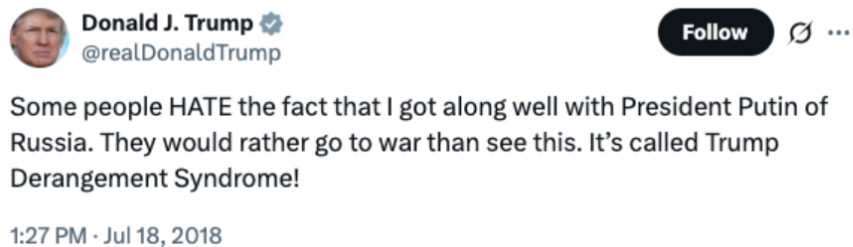
What differentiates Trump is that he and his allies have embraced the TDS label, weaponising it to their advantage. Trump claimed that those who criticised his relationship with Vladimir Putin were suffering from TDS:
Elon Musk then declared that heated Trump-related arguments with his friends
revealed they too suffered with the syndrome
. Trump 'diagnosed' actor
Robert De Niro
, Supreme Court Justice
Sonia Sotomayor
, and
several TV hosts
with the condition. After calling Trump a fascist, even John Kelly, Trump's former chief of staff, was judged (by Trump) to be suffering from TDS.
And after their
dramatic falling-out
in June 2025, Trump declared that
Musk, too, had fallen prey to TDS
.
Political polarisation and elite narrative
The
Musk-Trump spat
shows how quickly partisan attachments can shift when elites portray former allies as deranged.
Between April and June 2025
, partisan views of Musk remained largely unchanged. Yet Republicans’ favourable opinions of him dropped sharply after his disagreement with Trump. Clearly, elite conflict quickly reshapes affective attachments.
Scholarship has not yet examined the effects of psychiatric labelling in politics. Decades of work on polarisation, however, point to worrying parallels. We know, for example, that:
Ideological and affective polarisation is
rising dramatically
– in the US and elsewhere
Ingroups are
increasingly judging outgroups
as irrational, selfish, and less intelligent
Partisans
avoid opponents
in social spaces, workplaces and personal relationships
Partisan rhetoric among elites
has increased sharply since the 1990s
Polarisation among elites
drives populist radical right supporters to form hostile judgements of opposition parties
Political elites often portray opposition supporters as dangerous
The resulting political polarisation
erodes trust in political institutions, and risks inciting violence
In the past, to delegitimise dissent, political actors have applied psychiatric labels to their rivals. And even in established democracies, politicians use pathological language to portray opponents not merely as wrong, but as irrational and dangerous. Moreover, labelling opponents with a mental illness can serve as a way to detain or silence them without formal arrest, effectively stripping them of their political and legal rights.
Politicians use pathological language to portray opponents not merely as wrong, but as irrational and dangerous
A cautionary tale
It is the job of mental health experts to diagnose who is sane, who to lock up, and who to absolve from legal responsibility. When the target of such experts' diagnoses is politicians, the consequences are, of course, political.
During the nomination process for Republican politician
Barry Goldwater
in 1964,
Fact
magazine surveyed 12,356 psychiatrists on his fitness for office. Of the 2,417 who responded, 1,189 deemed Goldwater unfit. They
described him, variously
, as 'emotionally unstable', 'immature', 'cowardly', 'grossly psychotic', 'paranoid', a 'mass murderer', 'amoral and immoral', a 'chronic schizophrenic' and a 'dangerous lunatic'.
Goldwater sued the magazine and won, though the claims still damaged his campaign. In response to the scandal, the American Psychiatric Association introduced the
Goldwater rule
, which banned mental health experts from evaluating public figures without personal examination.
Yet the rule has not prevented experts publicly speculating about politicians’ mental health; most notably, Donald Trump's. At the same time, no comparable ethical boundary exists to prevent politicians from deploying psychiatric labels to advance their political narratives.
When mental disorders become political weapons
The US is not alone in politicising psychiatry. To silence dissent, authoritarian regimes have long dismissed opponents as mentally deficient:
In nineteenth-century America, enslaved people who tried to escape were diagnosed with the
pseudoscientific conditions 'drapetomania' and 'dysesthesia aethiopica'.
During the Cold War, the Kremlin locked up Soviet dissidents in psychiatric hospitals claiming it was '
sluggish schizophrenia
' causing them to believe communism was insane. Between the 1970s and 1980s,
about a third of political prisoners in the USSR were held under this diagnosis
.
For more than 25 years, the Chinese government has condemned protesters from the ultra-conservative Falun Gong religious movement as being 'insane' for opposing communism. Beijing has
forcibly committed hundreds
of the movement's adherents to mental asylums.
In 2022, Iranian students rose up to protest the killing of activist Mahsa Amini.
Iran's Minister of Education claimed
protesters were suffering from what the
DSM
describes as 'antisocial personality disorder'.
And in contemporary Russia,
scholars report at least 50 cases
of forced psychiatric treatment on people protesting against war in Ukraine.
At the time of writing, nobody has yet been institutionalised for TDS, because it isn't a recognised disorder. But, worryingly, as the Minnesota Bill demonstrates, elites in the US continue to exploit the language of psychiatry for political gain. The US leads global psychiatric norms and political trends. Its politicised diagnoses thus carry serious implications.
Why Trump Derangement Syndrome legitimises hostility and aggression
Weaponising psychiatric language to polarise public opinion doesn't merely deepen disagreement; it signals that opponents are irrational, dangerous, or socially and politically defective. It legitimises hostility, dehumanisation and even aggression. When a political leader with enormous influence uses such language, it can normalise the same among citizens, encouraging people to pathologise one another in everyday interactions.
Weaponising psychiatric language to polarise public opinion doesn't merely deepen disagreement; it legitimises dehumanisation
It is essential that people in political life distinguish between pathology and moral or political opposition. Political actors should never respond to dissent as they would to a genuine security threat. And normalising the language of psychiatry has damaging consequences for people genuinely suffering from psychiatric disorders.
If politicians continue – with little evidence – to dismiss their opponents as mentally deficient, this exacerbates division in already polarised societies, and even risks triggering violent conflict.
This article presents the views of the author(s) and not necessarily those of the ECPR or the Editors of
The Loop
. | |||||||||||||||||||||||||||
| Markdown | [](https://theloop.ecpr.eu/)
- [About Us](https://theloop.ecpr.eu/about-us/)
- [The Loop Annual Reports](https://ecpr.eu/the-loop-annual-reports)
- [Write for The Loop](https://theloop.ecpr.eu/write-for-the-loop/)
- [Contribute](https://theloop.ecpr.eu/write-for-the-loop/)
- [Author Guidelines](https://theloop.ecpr.eu/write-for-the-loop/author-guidelines/)
- [Our Series](https://theloop.ecpr.eu/trump-derangement-syndrome-a-genuine-mental-illness/)
- [Autocracies with Adjectives](https://theloop.ecpr.eu/?s=%E2%99%9F)
- [Constraints on Academic Freedom](https://theloop.ecpr.eu/?s=%E2%9B%93)
- [Democratic Transformations](https://theloop.ecpr.eu/?s=%F0%9F%8E%AD)
- [EU Enlargement Dilemmas](https://theloop.ecpr.eu/?s=%F0%9F%A7%AD)
- [Future of Populism](https://theloop.ecpr.eu/?s=%F0%9F%94%AE)
- [Gendering Democracy](https://theloop.ecpr.eu/?s=%F0%9F%8C%88)
- [Illiberal Wave](https://theloop.ecpr.eu/?s=%F0%9F%8C%8A)
- [Measuring Human Rights](https://theloop.ecpr.eu/?s=%F0%9F%93%90)
- [Nuclear Politics Paradox](https://theloop.ecpr.eu/?s=%E2%98%A2%EF%B8%8F)
- [Representative Disconnect](https://theloop.ecpr.eu/?s=+%F0%9F%8E%88)
- [Rescuing Democracy](https://theloop.ecpr.eu/?s=%F0%9F%92%8A)
- [Science of Democracy](https://theloop.ecpr.eu/?s=%F0%9F%A6%8B)
[All Articles](https://theloop.ecpr.eu/category/articles/), [American Politics](https://theloop.ecpr.eu/category/american-politics/), [Featured](https://theloop.ecpr.eu/category/articles/featured/)
# Is 'Trump Derangement Syndrome' a genuine mental illness?
What happens when political elites claim their opponents are simply mad? A proposed Bill on 'Trump Derangement Syndrome' shows how politics can spill into psychiatry. This, argues **Ela Serpil Evliyaoğlu**, threatens to turn dissent into pathology
On 25 March 2025, five Republican senators introduced a [Bill to the State of Minnesota](https://www.revisor.mn.gov/bills/text.php?number=SF2589&version=0&session_year=2025&session_number=0) proposing to add Trump Derangement Syndrome (TDS) to the state's list of recognised mental illnesses. Their Bill defines TDS as a condition of paranoia, hysteria, intense hostility towards Donald Trump, and aggression towards his supporters.
This is not the first diagnosis of a 'presidential syndrome'. It is, however, the first time a president has pathologised his opponents. In 2003, conservative columnist and psychiatrist [Charles Krauthammer](https://www.charleskrauthammer.com/), who helped create the *[Diagnostic and Statistical Manual of Mental Disorders](https://en.wikipedia.org/wiki/Diagnostic_and_Statistical_Manual_of_Mental_Disorders) (DSM),* judged that the people who claimed George W. Bush had hidden secrets about 9/11 were suffering from '[Bush Derangement Syndrome](https://www.deseret.com/2003/12/7/19799473/charles-krauthammer-bush-derangement-syndrome-is-spreading/)'.
During Barack Obama’s presidency, the term '[Obama Derangement Syndrome](https://www.vox.com/2015/2/23/8089639/obama-derangement-syndrome)' briefly circulated, based on the mistaken belief that Obama was not born in the USA. Some even suggested that Obama's cheeseburger condiment choice – [Dijon mustard, not ketchup](https://www.mediamatters.org/sean-hannity/dijon-derangement-syndrome-conservative-media-attack-obama-burger-order) – was another sign of 'foreignness'.
> Trump Derangement Syndrome is not the first diagnosis of a 'presidential syndrome'. But what differentiates Trump is that he has embraced it – and weaponised it to his advantage
What differentiates Trump is that he and his allies have embraced the TDS label, weaponising it to their advantage. Trump claimed that those who criticised his relationship with Vladimir Putin were suffering from TDS:
Elon Musk then declared that heated Trump-related arguments with his friends [revealed they too suffered with the syndrome](https://www.foxnews.com/video/6368978790112). Trump 'diagnosed' actor [Robert De Niro](https://nypost.com/2024/05/29/us-news/trump-mocks-wacko-robert-de-niro-on-truth-social-after-actors-biden-campaign-press-conference-in-nyc/), Supreme Court Justice [Sonia Sotomayor](https://www.foxnews.com/media/justices-sotomayor-and-ginsburg-suffering-trump-derangement?utm), and [several TV hosts](https://decider.com/2024/09/21/donald-trump-rants-about-bill-maher-and-dumb-as-a-rock-bimbo-stephanie-ruhle-after-latest-real-time/?utm) with the condition. After calling Trump a fascist, even John Kelly, Trump's former chief of staff, was judged (by Trump) to be suffering from TDS.
And after their [dramatic falling-out](https://www.theguardian.com/us-news/2025/jul/01/trump-musk-feud-doge-deportation) in June 2025, Trump declared that [Musk, too, had fallen prey to TDS](https://www.nbcnews.com/video/trump-suggests-derangement-syndrome-is-to-blame-for-hostile-former-staff-241002565733).
## Political polarisation and elite narrative
The [Musk-Trump spat](https://theloop.ecpr.eu/the-reality-show-republic-the-trump-musk-ego-war/) shows how quickly partisan attachments can shift when elites portray former allies as deranged. [Between April and June 2025](https://apnews.com/article/musk-poll-trump-tesla-doge-tax-bill-e95e9b4d26f66838e13d0d5169e402b8), partisan views of Musk remained largely unchanged. Yet Republicans’ favourable opinions of him dropped sharply after his disagreement with Trump. Clearly, elite conflict quickly reshapes affective attachments.
Scholarship has not yet examined the effects of psychiatric labelling in politics. Decades of work on polarisation, however, point to worrying parallels. We know, for example, that:
- Ideological and affective polarisation is [rising dramatically](https://www.annualreviews.org/content/journals/10.1146/annurev-polisci-051117-073034) – in the US and elsewhere
- Ingroups are [increasingly judging outgroups](https://academic.oup.com/poq/article-abstract/76/3/405/1894274) as irrational, selfish, and less intelligent
- Partisans [avoid opponents](https://www.science.org/doi/10.1126/science.aaq1433) in social spaces, workplaces and personal relationships
- [Partisan rhetoric among elites](https://scholar.harvard.edu/files/shapiro/files/politext.pdf) has increased sharply since the 1990s
- [Polarisation among elites](https://www.sciencedirect.com/science/article/pii/S0261379421000573) drives populist radical right supporters to form hostile judgements of opposition parties
- Political elites often portray opposition supporters as dangerous
- The resulting political polarisation [erodes trust in political institutions, and risks inciting violence](https://www.jstor.org/stable/41684577)
In the past, to delegitimise dissent, political actors have applied psychiatric labels to their rivals. And even in established democracies, politicians use pathological language to portray opponents not merely as wrong, but as irrational and dangerous. Moreover, labelling opponents with a mental illness can serve as a way to detain or silence them without formal arrest, effectively stripping them of their political and legal rights.
> Politicians use pathological language to portray opponents not merely as wrong, but as irrational and dangerous
## A cautionary tale
It is the job of mental health experts to diagnose who is sane, who to lock up, and who to absolve from legal responsibility. When the target of such experts' diagnoses is politicians, the consequences are, of course, political.
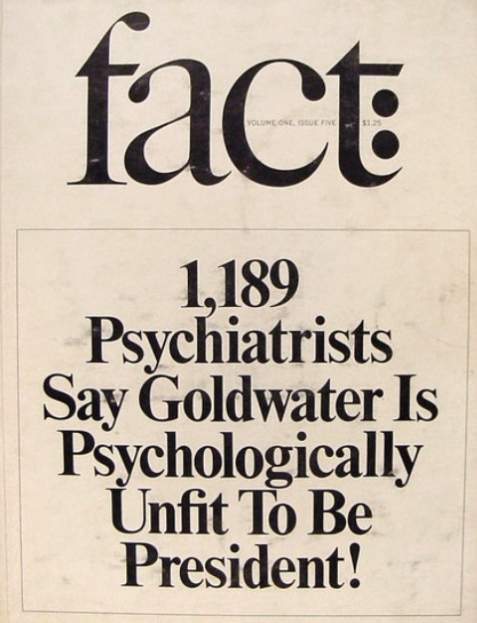
During the nomination process for Republican politician [Barry Goldwater](https://journals.sagepub.com/doi/10.1177/0957154X211062513) in 1964, *Fact* magazine surveyed 12,356 psychiatrists on his fitness for office. Of the 2,417 who responded, 1,189 deemed Goldwater unfit. They [described him, variously](https://content.time.com/time/subscriber/article/0%2C33009%2C838361-1%2C00.html?utm), as 'emotionally unstable', 'immature', 'cowardly', 'grossly psychotic', 'paranoid', a 'mass murderer', 'amoral and immoral', a 'chronic schizophrenic' and a 'dangerous lunatic'.
Goldwater sued the magazine and won, though the claims still damaged his campaign. In response to the scandal, the American Psychiatric Association introduced the [Goldwater rule](https://en.wikipedia.org/wiki/Goldwater_rule), which banned mental health experts from evaluating public figures without personal examination.
Yet the rule has not prevented experts publicly speculating about politicians’ mental health; most notably, Donald Trump's. At the same time, no comparable ethical boundary exists to prevent politicians from deploying psychiatric labels to advance their political narratives.
## When mental disorders become political weapons
The US is not alone in politicising psychiatry. To silence dissent, authoritarian regimes have long dismissed opponents as mentally deficient:
- In nineteenth-century America, enslaved people who tried to escape were diagnosed with the [pseudoscientific conditions 'drapetomania' and 'dysesthesia aethiopica'.](https://psycnet.apa.org/record/2010-02544-000)
- During the Cold War, the Kremlin locked up Soviet dissidents in psychiatric hospitals claiming it was '[sluggish schizophrenia](https://journals.library.columbia.edu/index.php/cjal/article/view/13664)' causing them to believe communism was insane. Between the 1970s and 1980s, [about a third of political prisoners in the USSR were held under this diagnosis](https://pubmed.ncbi.nlm.nih.gov/19892821/).
- For more than 25 years, the Chinese government has condemned protesters from the ultra-conservative Falun Gong religious movement as being 'insane' for opposing communism. Beijing has [forcibly committed hundreds](https://journals.library.columbia.edu/index.php/cjal/article/view/13664) of the movement's adherents to mental asylums.
- In 2022, Iranian students rose up to protest the killing of activist Mahsa Amini. [Iran's Minister of Education claimed](https://www.thelancet.com/action/showPdf?pii=S0140-6736%2822%2902183-3&__cf_chl_tk=g_DlV8P03WxVbWg51SlODipxt7jIjZtgOwlu1Q_wKGE-1759498265-1.0.1.1-cCGmzzgNcCcFiYp3Jbo4wJLwiwB_tTJGc89TOGHe6Es) protesters were suffering from what the *DSM* describes as 'antisocial personality disorder'.
- And in contemporary Russia, [scholars report at least 50 cases](https://www.reuters.com/world/europe/russia-dozens-dissenters-are-held-psychiatric-patients-2025-02-20/) of forced psychiatric treatment on people protesting against war in Ukraine.
At the time of writing, nobody has yet been institutionalised for TDS, because it isn't a recognised disorder. But, worryingly, as the Minnesota Bill demonstrates, elites in the US continue to exploit the language of psychiatry for political gain. The US leads global psychiatric norms and political trends. Its politicised diagnoses thus carry serious implications.
## Why Trump Derangement Syndrome legitimises hostility and aggression
Weaponising psychiatric language to polarise public opinion doesn't merely deepen disagreement; it signals that opponents are irrational, dangerous, or socially and politically defective. It legitimises hostility, dehumanisation and even aggression. When a political leader with enormous influence uses such language, it can normalise the same among citizens, encouraging people to pathologise one another in everyday interactions.
> Weaponising psychiatric language to polarise public opinion doesn't merely deepen disagreement; it legitimises dehumanisation
It is essential that people in political life distinguish between pathology and moral or political opposition. Political actors should never respond to dissent as they would to a genuine security threat. And normalising the language of psychiatry has damaging consequences for people genuinely suffering from psychiatric disorders.
If politicians continue – with little evidence – to dismiss their opponents as mentally deficient, this exacerbates division in already polarised societies, and even risks triggering violent conflict.
This article presents the views of the author(s) and not necessarily those of the ECPR or the Editors of *The Loop*.

[polarisation](https://theloop.ecpr.eu/tag/polarisation/)[political psychology](https://theloop.ecpr.eu/tag/political-psychology/)[Trump Derangement Syndrome](https://theloop.ecpr.eu/tag/trump-derangement-syndrome/)
## Author

Ela Serpil Evliyaoğlu
Visiting Fellow, European University Institute (EUI)
Ela is a clinical psychologist, youth policy expert and researcher studying the interplay between psychological factors and political attitudes and behaviour.
Her previous academic work includes social distance and tolerance, electoral violence, and mental contamination.
Ela also works on policy and advocacy related to youth representation, mental health, and community engagement.
She is particularly interested in how political contexts shape psychological wellbeing and how psychological processes influence political engagement.
[LinkedIn](https://www.linkedin.com/in/elaevliyaoglu/)
[ORCiD](https://orcid.org/0000-0003-0667-8317)
[Read more articles by this author](https://theloop.ecpr.eu/author/e_evliyaoglu/)
## Share Article
## Republish Article
We believe in the free flow of information Republish our articles for free, online or in print, under a Creative Commons license.
Republish Article
[](http://creativecommons.org/licenses/by-nd/4.0/)
## Comments
### 17 comments on “Is 'Trump Derangement Syndrome' a genuine mental illness?”
1.  **John Shega** says:
[October 20, 2025 at 3:32 pm](https://theloop.ecpr.eu/trump-derangement-syndrome-a-genuine-mental-illness/#comment-52982)
TDS is an active stimulation of the amygdala resulting in triggering of the flight or fright system blocking the normal frontal lobe rational thinking process leading to a mob reaction in the political mindset promoted by nazi like zealots who fund a national campaign campaign to undermine Tump and MAGA and the constitution/ justice system
[Reply](https://theloop.ecpr.eu/trump-derangement-syndrome-a-genuine-mental-illness/#comment-52982)
2.  **Bill Attwood** says:
[October 27, 2025 at 2:06 pm](https://theloop.ecpr.eu/trump-derangement-syndrome-a-genuine-mental-illness/#comment-53110)
Please explain the difference between criticism of Trump (for his policies, personality…) and TDS. Or is any criticism of Trump TDS?
[Reply](https://theloop.ecpr.eu/trump-derangement-syndrome-a-genuine-mental-illness/#comment-53110)
1.  **Ela** says:
[November 1, 2025 at 12:23 pm](https://theloop.ecpr.eu/trump-derangement-syndrome-a-genuine-mental-illness/#comment-53182)
Because it is not an actual disorder, there are no diagnostic criteria, unlike those established for recognized mental health disorders. Recognized disorders are supported by an established body of research covering prevalence, symptomatology, effects, and progression. Since it is a mock disorder, in Trump's case for example, any criticism against him might mean TDS as he declared in some examples shared in the piece.
[Reply](https://theloop.ecpr.eu/trump-derangement-syndrome-a-genuine-mental-illness/#comment-53182)
3.  **[Arthur H Nimz](https://bucknimz.substack.com/publish/posts/published)** says:
[November 3, 2025 at 8:04 pm](https://theloop.ecpr.eu/trump-derangement-syndrome-a-genuine-mental-illness/#comment-53211)
Trump Derangement Syndrome (TDS) began June 15, 2015 when Donald Trump announced his candidacy for president in 2016 at Trump Tower in New York City. In that moment in history, a switch was flipped in the Obama Oval Office in Washington and almost overnight TDS emerged with a viciousness rarely seen in any population in history and millions of people began exhibiting a pathological hatred of Donald Trump. Why? Because they were told to be afraid of him and what he would do as president...again.
The most amazing symptom of TDS is that it invokes a pure Pavlovian response in millions. I know many people who are Democrats. When I mention Trump, their faces instantly contort with anger, their voices drop an octave into an animal like guttural growl as they spew the foulest curse words followed by labels like fascist, racist, dictator. I love mentioning Trump to these afflicted Democrats. All I have to do is say TRUMP and they instantly go off into their madness. Pavlov would recognize that involuntary response. It would be funny if it wasn’t so tragic to see otherwise normal Americans so consumed with hate for one person and those who support him. How did they become so conditioned to act with such hatred?
Thomas Paine wrote "The slavery of fear had made men afraid to think". Fear manifests itself in hateful behaviors. Fear has been be used throughout history to control people and stifle freedom and reason? COVID anyone....anyone?
Paine believed that fear can be a form of mental slavery that prevents independent thought and critical inquiry. Those that do think and reason become a threat to those that need to control large populations with fear.
TDS may have worked backed in 2020 but it’s not working anymore and the Democrats persecution of Trump has backfired magnificently. Millions of Americans saw what they'd done and the Democrats worst nightmare came true and Trump is back in the White House despite all their best criminal efforts.
Their party's approval rating is at a historical low and they have fractured as a party with no clear leader. They have descended in chaos. We haven't seen this level of hatred since the Democrats ramped up the hatred of the first Republican president to the point where a delusional actor assassinated him. Know any delusional actors today that have TDS?
[Reply](https://theloop.ecpr.eu/trump-derangement-syndrome-a-genuine-mental-illness/#comment-53211)
1.  **Anon** says:
[November 26, 2025 at 5:38 am](https://theloop.ecpr.eu/trump-derangement-syndrome-a-genuine-mental-illness/#comment-53538)
Arthur H Nimz: You ignore basics, like Trump provoking an insurrection on Jan 6, 2021. It is not irrational to think that a convicted felon is unfit to be POTUS: it is irrational to argue that TDS is a real diagnosis of anything, other than a flawed justification for your own political viewpoint.
It is perfectly rational to consider Trump's actions as counter to the US Constitution and therefore, to detest (with a passion) his re-election to the presidency (when we all know he is a convicted felon facing additional charges thereafter). It is perfectly rational to oppose (vehemently) a criminal's election to the Presidency. Only a fool would argue otherwise. People who have anger towards a violation of the spirit of our own laws do not have TDS: this is a fool's diagnosis. In fact, arguing that TDS is to blame -- instead of an understandable anger towards Trump's own actions and crimes -- is the only thing irrational in the discussion regarding TDS.
[Reply](https://theloop.ecpr.eu/trump-derangement-syndrome-a-genuine-mental-illness/#comment-53538)
1.  **Guido** says:
[November 30, 2025 at 3:09 am](https://theloop.ecpr.eu/trump-derangement-syndrome-a-genuine-mental-illness/#comment-53635)
When one believes wholeheartedly what the media tells them, despite the nown or researchable facts, they appear to be a sufferer by way of delusion that permits them to persist. Then, they insist that what they have been told is the absolute truth, without any actual discernment in play. The majority of tidbits you cite, are false and proveably so.
THey claim it is a "Mock Diagnosis", which it may well have been, but currently many are showing up in mental health offices seeking therapy for many various afflictions they say are caused by their irrational hatred of Donald Trump. So I ask, Mock Doagnosis for how long?
[Reply](https://theloop.ecpr.eu/trump-derangement-syndrome-a-genuine-mental-illness/#comment-53635)
2.  **[Charles](http://the%20loop)** says:
[February 21, 2026 at 2:21 pm](https://theloop.ecpr.eu/trump-derangement-syndrome-a-genuine-mental-illness/#comment-55772)
You forget to state actual facts not propaganda, he told the crowd to head home peacefully not to Riot, that he asked Pelosi for more capital police,which she refused, that they did not break into the building security open the doors, yes some did act up and enter offices they were not allowed but a small minority, the the cop who died was two streets away and was a heart attack, and a unarmed woman former military was shot and killed by capital police with no consequences.
[Reply](https://theloop.ecpr.eu/trump-derangement-syndrome-a-genuine-mental-illness/#comment-55772)
2.  **Guido** says:
[November 30, 2025 at 3:29 am](https://theloop.ecpr.eu/trump-derangement-syndrome-a-genuine-mental-illness/#comment-53636)
Arthur H Nimz I believe it is a wholly manufactured illness. I am 61 and I never payed any attention to politics whatsoever. After 2017 I noticed an awful lot of hatred spewing forth from my TV, ... and it made me curious. So I engaged in what some seem to call a total waste of time because I am not an "Expert", ... Research.
I watched to the clips taken out of context, I listened to ful speeches. I jotted down claims and looked into them and found them to be false. It all started to make sense to me that these people were merely low information because they trusted the post Smith-Mundt Reformation Act media propaganda and outright lies. Now, of course, there are many showing up on therapists sofa's, comlaining that they can no longer cope with everyday life and they themselves say it is because they cannot stop thinking of how much they despise Donald Trump. What I wonder now is, at what point is it no longer considered a "Mock Diagnosis"? And will retractins be made?
Luckily for me, I do not know nor am I related to any sufferers, so I do not "Trigger" anyone, but I do see it played out from afar, as people flip ot and go into tirades yelling strings of outright falsehoods in defense of the delusion. It is not always weaponization as is claimed so often in these psychoanalytic screeds, ... sometimes it is purely observation.
[Reply](https://theloop.ecpr.eu/trump-derangement-syndrome-a-genuine-mental-illness/#comment-53636)
3.  **george evans** says:
[January 27, 2026 at 1:29 am](https://theloop.ecpr.eu/trump-derangement-syndrome-a-genuine-mental-illness/#comment-54722)
What about Deranged Trump Syndrome? Is he deranged?
[Reply](https://theloop.ecpr.eu/trump-derangement-syndrome-a-genuine-mental-illness/#comment-54722)
4.  **Joe** says:
[February 9, 2026 at 5:13 pm](https://theloop.ecpr.eu/trump-derangement-syndrome-a-genuine-mental-illness/#comment-55443)
Any idea about treaties? How about the slave promises? Any idea how much money Trump still owes for fines and non payment of services? It’s not angry truth.
[Reply](https://theloop.ecpr.eu/trump-derangement-syndrome-a-genuine-mental-illness/#comment-55443)
4.  **Phil Hawkinson** says:
[November 26, 2025 at 5:56 am](https://theloop.ecpr.eu/trump-derangement-syndrome-a-genuine-mental-illness/#comment-53539)
I just finished a lengthy comment on Facebook on this same subject. I hadn't read this article until after I made my comments and it's fascinating to me to see how extremely similar my comments are to the person that wrote this article. TDS might not be an official psychological diagnosis but it sure describes the craziness of those consumed by it.
[Reply](https://theloop.ecpr.eu/trump-derangement-syndrome-a-genuine-mental-illness/#comment-53539)
5.  **Guido** says:
[November 30, 2025 at 2:46 am](https://theloop.ecpr.eu/trump-derangement-syndrome-a-genuine-mental-illness/#comment-53634)
I have read several articles by (alleged) psychiatrists, most of them liberals themselves who are biased, while trying to teach COPE. One thing they all have in common is claiming it is always a slur and that it has been weaponised by Trump himself, or his supporters. What all these articles mindlessly overlook, is Pure Observation. People who are not engaging whatsoever with anyone afflicted as such, but merely observing their actions, attitudes, words and reactions. It is not weaponization, it is observation of irrational behavior.
[Reply](https://theloop.ecpr.eu/trump-derangement-syndrome-a-genuine-mental-illness/#comment-53634)
6.  **ian** says:
[December 8, 2025 at 6:13 am](https://theloop.ecpr.eu/trump-derangement-syndrome-a-genuine-mental-illness/#comment-53772)
surely it is Trump's Derangement Syndrome, where the subject believes any negative reporting is Fake news, where anybody who isn't in his control is a dangerous liability requiring social ridicule and replacement with a sycophant, where media decay provides the necessary nutrients to thrive.
[Reply](https://theloop.ecpr.eu/trump-derangement-syndrome-a-genuine-mental-illness/#comment-53772)
7.  **aldo picek** says:
[December 16, 2025 at 7:38 am](https://theloop.ecpr.eu/trump-derangement-syndrome-a-genuine-mental-illness/#comment-53916)
Perhaps, in the future, when Mr Trump is gone, so will the syndrome? Will it morph into JDDS or EMDS?
[Reply](https://theloop.ecpr.eu/trump-derangement-syndrome-a-genuine-mental-illness/#comment-53916)
8.  **Mark Belden Ferree** says:
[January 21, 2026 at 4:05 pm](https://theloop.ecpr.eu/trump-derangement-syndrome-a-genuine-mental-illness/#comment-54645)
TDS is already covered under DSM-5-TR code 300.29 as Cacophobia. It affects many who just look at him.
[Reply](https://theloop.ecpr.eu/trump-derangement-syndrome-a-genuine-mental-illness/#comment-54645)
9.  **Jim** says:
[January 22, 2026 at 7:05 pm](https://theloop.ecpr.eu/trump-derangement-syndrome-a-genuine-mental-illness/#comment-54660)
People with TDS don't live in reality. They believe the world is much different and more dangerous than it is. TRUMP GETS REALITY and understands how the world actually works. TDS sufferers believe incredible lies, living in a false reality stemming from ignorance leading to paranoia/derangement. Consequently they (incorrectly) think everything he does is WRONG. It's NOT.
[Reply](https://theloop.ecpr.eu/trump-derangement-syndrome-a-genuine-mental-illness/#comment-54660)
10.  **David Aldrich** says:
[April 15, 2026 at 4:12 pm](https://theloop.ecpr.eu/trump-derangement-syndrome-a-genuine-mental-illness/#comment-56177)
The ability for all people to engage each other in civil conversations and discussions is lost. When myself and others like me financially struggle to see “ the light at the end of the tunnel “, and see only the rich get richer, it creates a genuine apathy towards any form of government. The job of the president isn’t easy and you are going to make enemies, regardless of what side of the aisle you stand on. The important lesson is that we should not stop talking, to be careful with our language, and to treat everyone with dignity and respect.
[Reply](https://theloop.ecpr.eu/trump-derangement-syndrome-a-genuine-mental-illness/#comment-56177)
### Leave a Comment
## Recently Published
[Why Europe’s support for war on Iran is backfiring](https://theloop.ecpr.eu/why-europes-support-for-war-on-iran-will-backfire/)
Europe’s support for the US-Israeli war on Iran, in the hope of securing American backing for Ukraine, is a strategic mistake, argues Shamsoddin Shariati. Rather than buying goodwill in Washington, European leaders are undermining their own security, credibility, and strategic autonomy
[Read more](https://theloop.ecpr.eu/why-europes-support-for-war-on-iran-will-backfire/)
April 16, 2026
[🔮 Explaining Tisza’s Hungarian breakthrough](https://theloop.ecpr.eu/explaining-tiszas-hungarian-breakthrough/)
Endre Borbáth argues that Tisza’s breakthrough in Hungary was not simply the product of anti-incumbent anger or Péter Magyar’s personal appeal. It rested on a combination of cross-cutting grievances, participatory organisation, and intensive campaigning that turned a new party into a credible vehicle for regime change
[Read more](https://theloop.ecpr.eu/explaining-tiszas-hungarian-breakthrough/)
April 16, 2026
[Who has scooped the 2025 Best Blog prize?](https://theloop.ecpr.eu/who-has-scooped-the-2025-best-blog-prize/)
Last week we awarded our annual £500 prize for the best Loop blog piece in the previous calendar year, as judged by an independent jury. Here, Managing Editor Kate Hawkins presents the longlisted pieces — and revels who has taken this year's top spot
[Read more](https://theloop.ecpr.eu/who-has-scooped-the-2025-best-blog-prize/)
April 15, 2026
# The Loop
Cutting-edge analysis showcasing the work of the political science discipline at its best.
[Read more](https://theloop.ecpr.eu/about-us/)
THE EUROPEAN CONSORTIUM FOR POLITICAL RESEARCH
Advancing Political Science
[Join our community](https://ecpr.eu/Membership/MembershipBenefits)
The Loop
- [About Us](https://theloop.ecpr.eu/about-us/)
- [Write for The Loop](https://theloop.ecpr.eu/write-for-the-loop/)
- [Privacy Notice](https://ecpr.eu/Privacy)
- [Accessibility](https://ecpr.eu/accessibility)
ECPR
- [Membership Benefits](https://ecpr.eu/Membership/MembershipBenefits)
- [Groups and Networks](https://ecpr.eu/groups)
[](https://ecpr.eu/)
© 2026 European Consortium for Political Research. The ECPR is a charitable incorporated organisation (CIO) number 1167403 ECPR, Harbour House, 6-8 Hythe Quay, Colchester, CO2 8JF, United Kingdom.
We use cookies to ensure that we give you the best experience on our website. If you continue to use this site we will assume that you are happy with it.
Ok
1
X
## Republish this article
[](http://creativecommons.org/licenses/by-nd/4.0/)
This work is licensed under a [Creative Commons Attribution-NoDerivatives 4.0 International License](http://creativecommons.org/licenses/by-nd/4.0/).
# Is 'Trump Derangement Syndrome' a genuine mental illness?
by Ela Serpil Evliyaoğlu, The Loop
October 13, 2025
\<h1\>Is 'Trump Derangement Syndrome' a genuine mental illness?\</h1\> \<p class="byline"\>by Ela Serpil Evliyaoğlu, The Loop \<br\>October 13, 2025\</p\> \<p class="has-medium-font-size"\>What happens when political elites claim their opponents are simply mad? A proposed Bill on 'Trump Derangement Syndrome' shows how politics can spill into psychiatry. This, argues \<strong\>Ela Serpil Evliyaoğlu\</strong\>, threatens to turn dissent into pathology\</p\> \<p\>On 25 March 2025, five Republican senators introduced a \<a href="https://www.revisor.mn.gov/bills/text.php?number=SF2589\&version=0\&session\_year=2025\&session\_number=0"\>Bill to the State of Minnesota\</a\> proposing to add Trump Derangement Syndrome (TDS) to the state's list of recognised mental illnesses. Their Bill defines TDS as a condition of paranoia, hysteria, intense hostility towards Donald Trump, and aggression towards his supporters.\</p\> \<p\>This is not the first diagnosis of a 'presidential syndrome'. It is, however, the first time a president has pathologised his opponents. In 2003, conservative columnist and psychiatrist \<a href="https://www.charleskrauthammer.com/"\>Charles Krauthammer\</a\>, who helped create the \<em\>\<a href="https://en.wikipedia.org/wiki/Diagnostic\_and\_Statistical\_Manual\_of\_Mental\_Disorders"\>Diagnostic and Statistical Manual of Mental Disorders\</a\> (DSM),\</em\> judged that the people who claimed George W. Bush had hidden secrets about 9/11 were suffering from '\<a href="https://www.deseret.com/2003/12/7/19799473/charles-krauthammer-bush-derangement-syndrome-is-spreading/"\>Bush Derangement Syndrome\</a\>'. \</p\> \<p\>During Barack Obama’s presidency, the term '\<a href="https://www.vox.com/2015/2/23/8089639/obama-derangement-syndrome"\>Obama Derangement Syndrome\</a\>' briefly circulated, based on the mistaken belief that Obama was not born in the USA. Some even suggested that Obama's cheeseburger condiment choice – \<a href="https://www.mediamatters.org/sean-hannity/dijon-derangement-syndrome-conservative-media-attack-obama-burger-order"\>Dijon mustard, not ketchup\</a\> – was another sign of 'foreignness'.\</p\> \<blockquote class="wp-block-quote"\> \<p\>Trump Derangement Syndrome is not the first diagnosis of a 'presidential syndrome'. But what differentiates Trump is that he has embraced it – and weaponised it to his advantage\</p\> \</blockquote\> \<p\>What differentiates Trump is that he and his allies have embraced the TDS label, weaponising it to their advantage. Trump claimed that those who criticised his relationship with Vladimir Putin were suffering from TDS:\</p\> \<figure class="wp-block-image size-full"\>\<img src="https://theloop.ecpr.eu/wp-content/uploads/2025/10/Evlioglu-trump.png" alt="Tweet from Donald Trump claiming people are suffering from Trump Derangement Syndrome because they hate the fact that he gets along with Vladimir Putin" class="wp-image-25104"\>\</figure\> \<p\>Elon Musk then declared that heated Trump-related arguments with his friends \<a href="https://www.foxnews.com/video/6368978790112"\>revealed they too suffered with the syndrome\</a\>. Trump 'diagnosed' actor \<a href="https://nypost.com/2024/05/29/us-news/trump-mocks-wacko-robert-de-niro-on-truth-social-after-actors-biden-campaign-press-conference-in-nyc/"\>Robert De Niro\</a\>, Supreme Court Justice \<a href="https://www.foxnews.com/media/justices-sotomayor-and-ginsburg-suffering-trump-derangement?utm"\>Sonia Sotomayor\</a\>, and \<a href="https://decider.com/2024/09/21/donald-trump-rants-about-bill-maher-and-dumb-as-a-rock-bimbo-stephanie-ruhle-after-latest-real-time/?utm"\>several TV hosts\</a\> with the condition. After calling Trump a fascist, even John Kelly, Trump's former chief of staff, was judged (by Trump) to be suffering from TDS.\</p\> \<p\>And after their \<a href="https://www.theguardian.com/us-news/2025/jul/01/trump-musk-feud-doge-deportation"\>dramatic falling-out\</a\> in June 2025, Trump declared that \<a href="https://www.nbcnews.com/video/trump-suggests-derangement-syndrome-is-to-blame-for-hostile-former-staff-241002565733"\>Musk, too, had fallen prey to TDS\</a\>.\</p\> \<h2 class="wp-block-heading" id="h-political-polarisation-and-elite-narrative"\>Political polarisation and elite narrative\</h2\> \<p\>The \<a href="https://theloop.ecpr.eu/the-reality-show-republic-the-trump-musk-ego-war/"\>Musk-Trump spat\</a\> shows how quickly partisan attachments can shift when elites portray former allies as deranged. \<a href="https://apnews.com/article/musk-poll-trump-tesla-doge-tax-bill-e95e9b4d26f66838e13d0d5169e402b8"\>Between April and June 2025\</a\>, partisan views of Musk remained largely unchanged. Yet Republicans’ favourable opinions of him dropped sharply after his disagreement with Trump. Clearly, elite conflict quickly reshapes affective attachments.\</p\> \<p\>Scholarship has not yet examined the effects of psychiatric labelling in politics. Decades of work on polarisation, however, point to worrying parallels. We know, for example, that:\</p\> \<ul class="wp-block-list"\> \<li\>Ideological and affective polarisation is \<a href="https://www.annualreviews.org/content/journals/10.1146/annurev-polisci-051117-073034"\>rising dramatically\</a\> – in the US and elsewhere\</li\> \<li\>Ingroups are \<a href="https://academic.oup.com/poq/article-abstract/76/3/405/1894274"\>increasingly judging outgroups\</a\> as irrational, selfish, and less intelligent\</li\> \<li\>Partisans \<a href="https://www.science.org/doi/10.1126/science.aaq1433"\>avoid opponents\</a\> in social spaces, workplaces and personal relationships\</li\> \<li\>\<a href="https://scholar.harvard.edu/files/shapiro/files/politext.pdf"\>Partisan rhetoric among elites\</a\> has increased sharply since the 1990s\</li\> \<li\>\<a href="https://www.sciencedirect.com/science/article/pii/S0261379421000573"\>Polarisation among elites\</a\> drives populist radical right supporters to form hostile judgements of opposition parties\</li\> \<li\>Political elites often portray opposition supporters as dangerous\</li\> \<li\>The resulting political polarisation \<a href="https://www.jstor.org/stable/41684577"\>erodes trust in political institutions, and risks inciting violence\</a\>\</li\> \</ul\> \<p\>In the past, to delegitimise dissent, political actors have applied psychiatric labels to their rivals. And even in established democracies, politicians use pathological language to portray opponents not merely as wrong, but as irrational and dangerous. Moreover, labelling opponents with a mental illness can serve as a way to detain or silence them without formal arrest, effectively stripping them of their political and legal rights.\</p\> \<blockquote class="wp-block-quote"\> \<p\>Politicians use pathological language to portray opponents not merely as wrong, but as irrational and dangerous\</p\> \</blockquote\> \<h2 class="wp-block-heading" id="h-a-cautionary-tale"\>A cautionary tale\</h2\> \<p\>It is the job of mental health experts to diagnose who is sane, who to lock up, and who to absolve from legal responsibility. When the target of such experts' diagnoses is politicians, the consequences are, of course, political.\</p\> \<div class="wp-block-media-text is-stacked-on-mobile" style="grid-template-columns:17% auto"\> \<figure class="wp-block-media-text\_\_media"\>\<img src="https://theloop.ecpr.eu/wp-content/uploads/2025/10/Evlioglu-Fact-magazine.png" alt="Beige magazine cover with black text which says 'Fact: 1,189 Psychiatrists Say Goldwater Is Psychologically Unfit To Be President!" class="wp-image-25106 size-full"\>\</figure\> \<div class="wp-block-media-text\_\_content"\> \<p\>During the nomination process for Republican politician \<a href="https://journals.sagepub.com/doi/10.1177/0957154X211062513"\>Barry Goldwater\</a\> in 1964, \<em\>Fact\</em\> magazine surveyed 12,356 psychiatrists on his fitness for office. Of the 2,417 who responded, 1,189 deemed Goldwater unfit. They \<a href="https://content.time.com/time/subscriber/article/0%2C33009%2C838361-1%2C00.html?utm"\>described him, variously\</a\>, as 'emotionally unstable', 'immature', 'cowardly', 'grossly psychotic', 'paranoid', a 'mass murderer', 'amoral and immoral', a 'chronic schizophrenic' and a 'dangerous lunatic'.\</p\> \<p\>\</p\>\</div\> \</div\> \<p\>Goldwater sued the magazine and won, though the claims still damaged his campaign. In response to the scandal, the American Psychiatric Association introduced the \<a href="https://en.wikipedia.org/wiki/Goldwater\_rule"\>Goldwater rule\</a\>, which banned mental health experts from evaluating public figures without personal examination.\</p\> \<p\>Yet the rule has not prevented experts publicly speculating about politicians’ mental health; most notably, Donald Trump's. At the same time, no comparable ethical boundary exists to prevent politicians from deploying psychiatric labels to advance their political narratives.\</p\> \<h2 class="wp-block-heading" id="h-when-mental-disorders-become-political-weapons"\>When mental disorders become political weapons\</h2\> \<p\>The US is not alone in politicising psychiatry. To silence dissent, authoritarian regimes have long dismissed opponents as mentally deficient:\</p\> \<ul class="wp-block-list"\> \<li\>In nineteenth-century America, enslaved people who tried to escape were diagnosed with the \<a href="https://psycnet.apa.org/record/2010-02544-000"\>pseudoscientific conditions 'drapetomania' and 'dysesthesia aethiopica'.\</a\>\</li\> \<li\>During the Cold War, the Kremlin locked up Soviet dissidents in psychiatric hospitals claiming it was '\<a href="https://journals.library.columbia.edu/index.php/cjal/article/view/13664"\>sluggish schizophrenia\</a\>' causing them to believe communism was insane. Between the 1970s and 1980s, \<a href="https://pubmed.ncbi.nlm.nih.gov/19892821/"\>about a third of political prisoners in the USSR were held under this diagnosis\</a\>.\</li\> \<li\>For more than 25 years, the Chinese government has condemned protesters from the ultra-conservative Falun Gong religious movement as being 'insane' for opposing communism. Beijing has \<a href="https://journals.library.columbia.edu/index.php/cjal/article/view/13664"\>forcibly committed hundreds\</a\> of the movement's adherents to mental asylums.\</li\> \<li\>In 2022, Iranian students rose up to protest the killing of activist Mahsa Amini. \<a href="https://www.thelancet.com/action/showPdf?pii=S0140-6736%2822%2902183-3&\_\_cf\_chl\_tk=g\_DlV8P03WxVbWg51SlODipxt7jIjZtgOwlu1Q\_wKGE-1759498265-1.0.1.1-cCGmzzgNcCcFiYp3Jbo4wJLwiwB\_tTJGc89TOGHe6Es"\>Iran's Minister of Education claimed\</a\> protesters were suffering from what the \<em\>DSM\</em\> describes as 'antisocial personality disorder'.\</li\> \<li\>And in contemporary Russia, \<a href="https://www.reuters.com/world/europe/russia-dozens-dissenters-are-held-psychiatric-patients-2025-02-20/"\>scholars report at least 50 cases\</a\> of forced psychiatric treatment on people protesting against war in Ukraine.\</li\> \</ul\> \<p\>At the time of writing, nobody has yet been institutionalised for TDS, because it isn't a recognised disorder. But, worryingly, as the Minnesota Bill demonstrates, elites in the US continue to exploit the language of psychiatry for political gain. The US leads global psychiatric norms and political trends. Its politicised diagnoses thus carry serious implications.\</p\> \<h2 class="wp-block-heading" id="h-why-trump-derangement-syndrome-legitimises-hostility-and-aggression"\>Why Trump Derangement Syndrome legitimises hostility and aggression\</h2\> \<p\>Weaponising psychiatric language to polarise public opinion doesn't merely deepen disagreement; it signals that opponents are irrational, dangerous, or socially and politically defective. It legitimises hostility, dehumanisation and even aggression. When a political leader with enormous influence uses such language, it can normalise the same among citizens, encouraging people to pathologise one another in everyday interactions.\</p\> \<blockquote class="wp-block-quote"\> \<p\>Weaponising psychiatric language to polarise public opinion doesn't merely deepen disagreement; it legitimises dehumanisation\</p\> \</blockquote\> \<p\>It is essential that people in political life distinguish between pathology and moral or political opposition. Political actors should never respond to dissent as they would to a genuine security threat. And normalising the language of psychiatry has damaging consequences for people genuinely suffering from psychiatric disorders.\</p\> \<p\>If politicians continue – with little evidence – to dismiss their opponents as mentally deficient, this exacerbates division in already polarised societies, and even risks triggering violent conflict.\</p\> \<p\>This \<a target="\_blank" href="https://theloop.ecpr.eu/trump-derangement-syndrome-a-genuine-mental-illness/"\>article\</a\> was originally published at \<a target="\_blank" href="https://theloop.ecpr.eu"\>The Loop\</a\> and is republished here under a Creative Commons license.\<img id="republication-tracker-tool-source" src="https://theloop.ecpr.eu/?republication-pixel=true\&post=25098\&ga=" style="max-width:200px"\>\</p\>
Copy to Clipboard | |||||||||||||||||||||||||||
| Readable Markdown | What happens when political elites claim their opponents are simply mad? A proposed Bill on 'Trump Derangement Syndrome' shows how politics can spill into psychiatry. This, argues **Ela Serpil Evliyaoğlu**, threatens to turn dissent into pathology On 25 March 2025, five Republican senators introduced a [Bill to the State of Minnesota](https://www.revisor.mn.gov/bills/text.php?number=SF2589&version=0&session_year=2025&session_number=0) proposing to add Trump Derangement Syndrome (TDS) to the state's list of recognised mental illnesses. Their Bill defines TDS as a condition of paranoia, hysteria, intense hostility towards Donald Trump, and aggression towards his supporters. This is not the first diagnosis of a 'presidential syndrome'. It is, however, the first time a president has pathologised his opponents. In 2003, conservative columnist and psychiatrist [Charles Krauthammer](https://www.charleskrauthammer.com/), who helped create the *[Diagnostic and Statistical Manual of Mental Disorders](https://en.wikipedia.org/wiki/Diagnostic_and_Statistical_Manual_of_Mental_Disorders) (DSM),* judged that the people who claimed George W. Bush had hidden secrets about 9/11 were suffering from '[Bush Derangement Syndrome](https://www.deseret.com/2003/12/7/19799473/charles-krauthammer-bush-derangement-syndrome-is-spreading/)'. During Barack Obama’s presidency, the term '[Obama Derangement Syndrome](https://www.vox.com/2015/2/23/8089639/obama-derangement-syndrome)' briefly circulated, based on the mistaken belief that Obama was not born in the USA. Some even suggested that Obama's cheeseburger condiment choice – [Dijon mustard, not ketchup](https://www.mediamatters.org/sean-hannity/dijon-derangement-syndrome-conservative-media-attack-obama-burger-order) – was another sign of 'foreignness'. Trump Derangement Syndrome is not the first diagnosis of a 'presidential syndrome'. But what differentiates Trump is that he has embraced it – and weaponised it to his advantage What differentiates Trump is that he and his allies have embraced the TDS label, weaponising it to their advantage. Trump claimed that those who criticised his relationship with Vladimir Putin were suffering from TDS:  Elon Musk then declared that heated Trump-related arguments with his friends [revealed they too suffered with the syndrome](https://www.foxnews.com/video/6368978790112). Trump 'diagnosed' actor [Robert De Niro](https://nypost.com/2024/05/29/us-news/trump-mocks-wacko-robert-de-niro-on-truth-social-after-actors-biden-campaign-press-conference-in-nyc/), Supreme Court Justice [Sonia Sotomayor](https://www.foxnews.com/media/justices-sotomayor-and-ginsburg-suffering-trump-derangement?utm), and [several TV hosts](https://decider.com/2024/09/21/donald-trump-rants-about-bill-maher-and-dumb-as-a-rock-bimbo-stephanie-ruhle-after-latest-real-time/?utm) with the condition. After calling Trump a fascist, even John Kelly, Trump's former chief of staff, was judged (by Trump) to be suffering from TDS. And after their [dramatic falling-out](https://www.theguardian.com/us-news/2025/jul/01/trump-musk-feud-doge-deportation) in June 2025, Trump declared that [Musk, too, had fallen prey to TDS](https://www.nbcnews.com/video/trump-suggests-derangement-syndrome-is-to-blame-for-hostile-former-staff-241002565733). Political polarisation and elite narrative The [Musk-Trump spat](https://theloop.ecpr.eu/the-reality-show-republic-the-trump-musk-ego-war/) shows how quickly partisan attachments can shift when elites portray former allies as deranged. [Between April and June 2025](https://apnews.com/article/musk-poll-trump-tesla-doge-tax-bill-e95e9b4d26f66838e13d0d5169e402b8), partisan views of Musk remained largely unchanged. Yet Republicans’ favourable opinions of him dropped sharply after his disagreement with Trump. Clearly, elite conflict quickly reshapes affective attachments. Scholarship has not yet examined the effects of psychiatric labelling in politics. Decades of work on polarisation, however, point to worrying parallels. We know, for example, that: Ideological and affective polarisation is [rising dramatically](https://www.annualreviews.org/content/journals/10.1146/annurev-polisci-051117-073034) – in the US and elsewhere Ingroups are [increasingly judging outgroups](https://academic.oup.com/poq/article-abstract/76/3/405/1894274) as irrational, selfish, and less intelligent Partisans [avoid opponents](https://www.science.org/doi/10.1126/science.aaq1433) in social spaces, workplaces and personal relationships [Partisan rhetoric among elites](https://scholar.harvard.edu/files/shapiro/files/politext.pdf) has increased sharply since the 1990s [Polarisation among elites](https://www.sciencedirect.com/science/article/pii/S0261379421000573) drives populist radical right supporters to form hostile judgements of opposition parties Political elites often portray opposition supporters as dangerous The resulting political polarisation [erodes trust in political institutions, and risks inciting violence](https://www.jstor.org/stable/41684577) In the past, to delegitimise dissent, political actors have applied psychiatric labels to their rivals. And even in established democracies, politicians use pathological language to portray opponents not merely as wrong, but as irrational and dangerous. Moreover, labelling opponents with a mental illness can serve as a way to detain or silence them without formal arrest, effectively stripping them of their political and legal rights. Politicians use pathological language to portray opponents not merely as wrong, but as irrational and dangerous A cautionary tale It is the job of mental health experts to diagnose who is sane, who to lock up, and who to absolve from legal responsibility. When the target of such experts' diagnoses is politicians, the consequences are, of course, political.  During the nomination process for Republican politician [Barry Goldwater](https://journals.sagepub.com/doi/10.1177/0957154X211062513) in 1964, *Fact* magazine surveyed 12,356 psychiatrists on his fitness for office. Of the 2,417 who responded, 1,189 deemed Goldwater unfit. They [described him, variously](https://content.time.com/time/subscriber/article/0%2C33009%2C838361-1%2C00.html?utm), as 'emotionally unstable', 'immature', 'cowardly', 'grossly psychotic', 'paranoid', a 'mass murderer', 'amoral and immoral', a 'chronic schizophrenic' and a 'dangerous lunatic'. Goldwater sued the magazine and won, though the claims still damaged his campaign. In response to the scandal, the American Psychiatric Association introduced the [Goldwater rule](https://en.wikipedia.org/wiki/Goldwater_rule), which banned mental health experts from evaluating public figures without personal examination. Yet the rule has not prevented experts publicly speculating about politicians’ mental health; most notably, Donald Trump's. At the same time, no comparable ethical boundary exists to prevent politicians from deploying psychiatric labels to advance their political narratives. When mental disorders become political weapons The US is not alone in politicising psychiatry. To silence dissent, authoritarian regimes have long dismissed opponents as mentally deficient: In nineteenth-century America, enslaved people who tried to escape were diagnosed with the [pseudoscientific conditions 'drapetomania' and 'dysesthesia aethiopica'.](https://psycnet.apa.org/record/2010-02544-000) During the Cold War, the Kremlin locked up Soviet dissidents in psychiatric hospitals claiming it was '[sluggish schizophrenia](https://journals.library.columbia.edu/index.php/cjal/article/view/13664)' causing them to believe communism was insane. Between the 1970s and 1980s, [about a third of political prisoners in the USSR were held under this diagnosis](https://pubmed.ncbi.nlm.nih.gov/19892821/). For more than 25 years, the Chinese government has condemned protesters from the ultra-conservative Falun Gong religious movement as being 'insane' for opposing communism. Beijing has [forcibly committed hundreds](https://journals.library.columbia.edu/index.php/cjal/article/view/13664) of the movement's adherents to mental asylums. In 2022, Iranian students rose up to protest the killing of activist Mahsa Amini. [Iran's Minister of Education claimed](https://www.thelancet.com/action/showPdf?pii=S0140-6736%2822%2902183-3&__cf_chl_tk=g_DlV8P03WxVbWg51SlODipxt7jIjZtgOwlu1Q_wKGE-1759498265-1.0.1.1-cCGmzzgNcCcFiYp3Jbo4wJLwiwB_tTJGc89TOGHe6Es) protesters were suffering from what the *DSM* describes as 'antisocial personality disorder'. And in contemporary Russia, [scholars report at least 50 cases](https://www.reuters.com/world/europe/russia-dozens-dissenters-are-held-psychiatric-patients-2025-02-20/) of forced psychiatric treatment on people protesting against war in Ukraine. At the time of writing, nobody has yet been institutionalised for TDS, because it isn't a recognised disorder. But, worryingly, as the Minnesota Bill demonstrates, elites in the US continue to exploit the language of psychiatry for political gain. The US leads global psychiatric norms and political trends. Its politicised diagnoses thus carry serious implications. Why Trump Derangement Syndrome legitimises hostility and aggression Weaponising psychiatric language to polarise public opinion doesn't merely deepen disagreement; it signals that opponents are irrational, dangerous, or socially and politically defective. It legitimises hostility, dehumanisation and even aggression. When a political leader with enormous influence uses such language, it can normalise the same among citizens, encouraging people to pathologise one another in everyday interactions. Weaponising psychiatric language to polarise public opinion doesn't merely deepen disagreement; it legitimises dehumanisation It is essential that people in political life distinguish between pathology and moral or political opposition. Political actors should never respond to dissent as they would to a genuine security threat. And normalising the language of psychiatry has damaging consequences for people genuinely suffering from psychiatric disorders. If politicians continue – with little evidence – to dismiss their opponents as mentally deficient, this exacerbates division in already polarised societies, and even risks triggering violent conflict.
This article presents the views of the author(s) and not necessarily those of the ECPR or the Editors of *The Loop*.
 | |||||||||||||||||||||||||||
| ML Classification | ||||||||||||||||||||||||||||
| ML Categories |
Raw JSON{
"/Health": 604,
"/Health/Mental_Health": 599,
"/Health/Mental_Health/Other": 416,
"/People_and_Society": 355,
"/Law_and_Government": 276,
"/Law_and_Government/Government": 220,
"/People_and_Society/Social_Sciences": 177,
"/Law_and_Government/Government/Public_Policy": 175,
"/People_and_Society/Social_Sciences/Psychology": 171
} | |||||||||||||||||||||||||||
| ML Page Types |
Raw JSON{
"/Article": 999,
"/Article/Opinion_Piece": 857
} | |||||||||||||||||||||||||||
| ML Intent Types |
Raw JSON{
"Informational": 999
} | |||||||||||||||||||||||||||
| Content Metadata | ||||||||||||||||||||||||||||
| Language | en-gb | |||||||||||||||||||||||||||
| Author | Ela Serpil Evliyaoğlu | |||||||||||||||||||||||||||
| Publish Time | 2025-10-13 07:50:45 (6 months ago) | |||||||||||||||||||||||||||
| Original Publish Time | 2025-10-13 07:50:45 (6 months ago) | |||||||||||||||||||||||||||
| Republished | No | |||||||||||||||||||||||||||
| Word Count (Total) | 4,805 | |||||||||||||||||||||||||||
| Word Count (Content) | 1,168 | |||||||||||||||||||||||||||
| Links | ||||||||||||||||||||||||||||
| External Links | 44 | |||||||||||||||||||||||||||
| Internal Links | 36 | |||||||||||||||||||||||||||
| Technical SEO | ||||||||||||||||||||||||||||
| Meta Nofollow | No | |||||||||||||||||||||||||||
| Meta Noarchive | No | |||||||||||||||||||||||||||
| JS Rendered | Yes | |||||||||||||||||||||||||||
| Redirect Target | null | |||||||||||||||||||||||||||
| Performance | ||||||||||||||||||||||||||||
| Download Time (ms) | 261 | |||||||||||||||||||||||||||
| TTFB (ms) | 251 | |||||||||||||||||||||||||||
| Download Size (bytes) | 57,038 | |||||||||||||||||||||||||||
| Shard | 68 (laksa) | |||||||||||||||||||||||||||
| Root Hash | 3312326549297929468 | |||||||||||||||||||||||||||
| Unparsed URL | eu,ecpr!theloop,/trump-derangement-syndrome-a-genuine-mental-illness/ s443 | |||||||||||||||||||||||||||