ℹ️ Skipped - page is already crawled
| Filter | Status | Condition | Details |
|---|---|---|---|
| HTTP status | PASS | download_http_code = 200 | HTTP 200 |
| Age cutoff | PASS | download_stamp > now() - 6 MONTH | 0.1 months ago |
| History drop | PASS | isNull(history_drop_reason) | No drop reason |
| Spam/ban | PASS | fh_dont_index != 1 AND ml_spam_score = 0 | ml_spam_score=0 |
| Canonical | PASS | meta_canonical IS NULL OR = '' OR = src_unparsed | Not set |
| Property | Value | ||||||||||||||||||||||||
|---|---|---|---|---|---|---|---|---|---|---|---|---|---|---|---|---|---|---|---|---|---|---|---|---|---|
| URL | https://theicct.org/whats-next-for-chinas-phev-market-sept25/ | ||||||||||||||||||||||||
| Last Crawled | 2026-04-24 04:50:30 (4 days ago) | ||||||||||||||||||||||||
| First Indexed | 2025-09-09 04:28:08 (7 months ago) | ||||||||||||||||||||||||
| HTTP Status Code | 200 | ||||||||||||||||||||||||
| Content | |||||||||||||||||||||||||
| Meta Title | What’s next for China’s PHEV market? - International Council on Clean Transportation | ||||||||||||||||||||||||
| Meta Description | China’s electric vehicle market, once dominated by BEVs, has seen a dramatic surge in PHEV sales underpinned by supportive policies—though emerging policy developments raise questions over the market’s long-term outlook. | ||||||||||||||||||||||||
| Meta Canonical | null | ||||||||||||||||||||||||
| Boilerpipe Text | While battery electric vehicles (BEVs) have historically dominated China’s electric vehicle market, a significant shift has emerged in recent years as sales of plug-in hybrid electric vehicles (PHEVs) have surged dramatically. A regulatory and policy framework favoring PHEVs has been critical to this growth, but emerging policy developments raise questions over the segment’s long-term outlook.
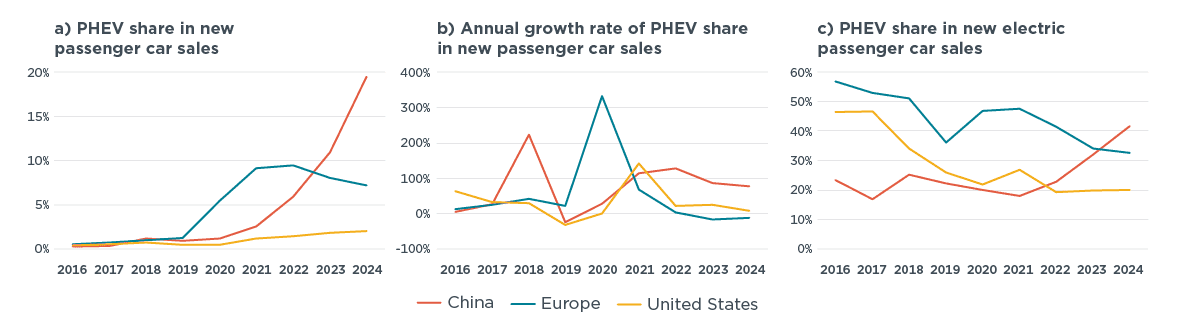
Let’s first take a closer look at the market data. From 2022 to 2024, the share of PHEVs in China’s new passenger car sales soared from 5.9% to 19.5%—a remarkable compound annual growth rate (CAGR) of 82%—and PHEVs’ share of China’s overall EV market jumped from 23% to 42%. Over the same period, in Europe, the PHEV share of new passenger car sales declined from 9.5% to 7.2% (a CAGR of -13%) and the PHEV share of the EV market dropped from 41% to 33%. In the United States, the share of PHEVs in light-duty vehicle sales rose slightly, from 1.4% to 2.0% (a CAGR of 20%), and PHEVs’ share of the EV market remained stable at around 20%.
Figure 1
. PHEV share in new passenger car sales (left), annual growth of PHEV share in new passenger car sales (middle), and PHEV share in new electric passenger car sales (right) in China, Europe, and the United States, 2016–2024
Note
: Data for the United States include all light-duty vehicles, not just passenger cars.
While the sharp rise in PHEV market share in China has been driven by a combination of factors, including vehicle affordability, consumer preference, and automaker strategies, policies favoring PHEVs have been an important enabler of this growth.
A key example is China’s PHEV utility factor (UF) curve
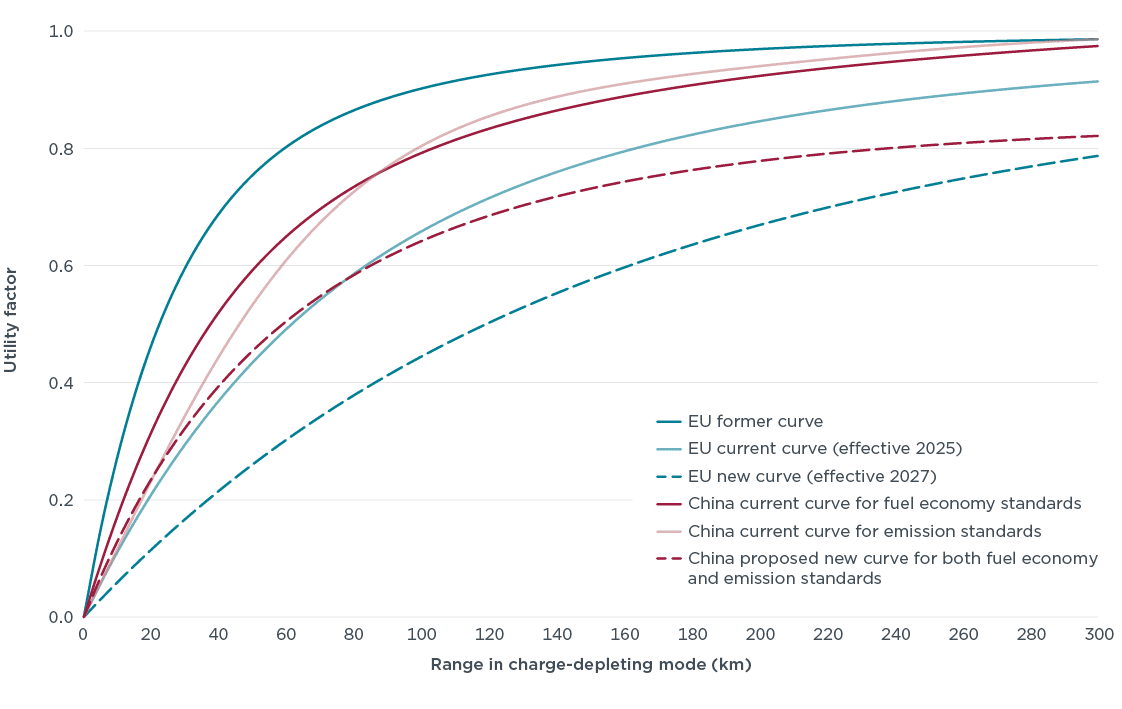
. UF reflects the ratio of mileage driven by PHEVs in pure electric mode to the total mileage driven—in short, it approximates how much drivers actually drive their PHEVs on electric power in real-world conditions. UF curves are used to estimate PHEV emissions to assess compliance with fuel economy and emission standards. As in
Europe
and the
United States
, PHEVs in China are assigned
higher-than-actual
UF values due to limited real-world data, effectively assuming that they drive more on electricity than many users actually do. As a result, PHEVs are calculated to have very low type-approval emissions and fuel consumption values. For automakers, this makes PHEVs an attractive compliance tool. And it’s a key reason behind their substantial investment in PHEVs and the launch of numerous models to the market.
Other policies have supported PHEV uptake in China. The country’s EV mandate, the
Dual Credit Policy
, requires automakers to earn a certain number of EV credits each year, either by producing EVs or purchasing credits from other companies. Under the current policy, most PHEV models with over 43 kilometers
under the Worldwide harmonized Light vehicles Test Procedure (WLTP)
of electric range are assigned one EV credit; meanwhile, a BEV must have a range of at least 137 kilometers (WLTP) and demonstrate outstanding performance in battery density and efficiency to earn one credit. This makes PHEVs a cost-effective compliance option for automakers.
On the demand side, PHEVs benefit from the same purchase tax exemptions as BEVs, valued at roughly 10% of vehicle price. While national EV subsidies have been phased out, recent
trade-in programs
offer equal incentives (of ~$2,000) for switching from an internal combustion engine vehicle (ICEV) to either a BEV or PHEV. Several Chinese cities impose annual license plate quotas or license plate-based road access restrictions on ICEVs, whereas BEVs and PHEVs are
exempted from such restrictions
. Together, these factors have made PHEVs an attractive choice for consumers who may still prefer ICEVs or have reservations about switching to BEVs.
By contrast, other major vehicle markets have reduced policy support for PHEV uptake. The
EU’s CO
2
standards
mandate that all new cars and vans registered from 2035 onward must have zero CO
2
tailpipe emissions. Until 2024, BEVs and PHEVs with CO
2
emissions below 50 g/km received the same super credits toward CO
2
compliance—that is, they counted as more than one vehicle when calculating fleet-average emissions. However, under the zero- and low-emission vehicle (ZLEV) factor mechanism in effect from 2025 to 2029, sales of BEVs and PHEVs are rewarded differently: BEVs are fully counted while PHEVs receive partial values based on their CO
2
emissions.
Moreover, the introduction of a
new UF curve
by the European Commission in 2025 aims to bring official PHEV CO
2
emissions closer to real-world values (Figure 2) and will make PHEVs less attractive for CO
2
compliance. Government incentives in many European countries have also tilted toward BEVs.
Germany
and
France
ended purchase subsidies for PHEVs in 2023 while maintaining them for BEVs;
Poland
introduced BEV-only subsidies in 2021.
In the United States, the Environmental Protection Agency introduced an updated UF curve as part of
new vehicle emission standards
finalized in 2024 to more accurately reflect real-world PHEV emissions. Like Europe, the new curve would reduce the assumed electric drive share of PHEVs. At the state level,
California’s ZEV mandate
gradually tightens technical requirements for PHEVs and lowers the maximum ZEV credit that PHEVs can contribute toward compliance. (Prospects for both the updated UF curve and California’s ZEV mandate are uncertain as the Trump administration rolls back environmental regulations.)
Evolving policy dynamics in China may reshape the trajectory of the country’s PHEV market. In April 2025, China released a
proposal
to revise its UF curve for public consultation. The proposed curve, based on the most recent real-world data from China
,
would sharply reduce the assumed electric drive share of PHEVs (Figure 2). For example, a PHEV with a 100 km electric range was previously assumed to have an approximate 80% electric drive share; under the new curve, it would be around 65%. This revision would significantly diminish the compliance value of PHEVs for meeting emissions and fuel economy targets.
Figure 2
. Current and proposed UF curves in China and former, current, and new UF curves in the EU
Policymakers in China could consider several additional measures to align policy support more closely with real-world emission reduction benefits. Setting sufficiently strict
China 7 multi-pollutant emission standards
would be an important step: such standards could include fleet-average greenhouse gas and air pollutant emission limits achievable only with a steadily increasing share of zero-emission vehicles.
In parallel, credits for PHEVs in the Dual Credit Policy could be tied to their real-world emission reductions, with gradually phased caps on the maximum contribution from PHEVs toward compliance. Similarly, fiscal incentives for PHEVs could either be phased out or limited to those with sufficiently long electric-only driving range, fast-charging capability, and verified low real-world fuel consumption. More broadly, boosting access to charging would not only help address range anxiety—a major concern cited by Chinese consumers regarding BEVs—but also effectively increase the electric drive share of PHEVs in the real world.
The market is showing signs of change. In the first half of 2025, the PHEV share in China’s new electric passenger car sales
dropped
to 38%, down from 41% year-over-year—the first decline in recent years. With a new UF curve, the potential for new policy adjustments, and ongoing advancements in battery technology and charging network optimization, China’s PHEV market is a space to watch.
| ||||||||||||||||||||||||
| Markdown | [Skip to Content](https://theicct.org/whats-next-for-chinas-phev-market-sept25/#main-content) [Skip to navigation](https://theicct.org/whats-next-for-chinas-phev-market-sept25/#mega-menu-primary-menu) [Site map](https://theicct.org/sitemap)
[](https://theicct.org/)
- [Donate](https://theicct.org/about/donate/)
- [Press Room](https://theicct.org/about/press-room/)
- [About](https://theicct.org/about/)
- [About the ICCT](https://theicct.org/about/)
- [Our Approach](https://theicct.org/about/our-approach/)
- [Vision 2050](https://theicct.org/vision-2050/)
- [Board of Directors](https://theicct.org/about/board-of-directors/)
- [Staff](https://theicct.org/about/staff/)
- [Locations](https://theicct.org/locations/)
- [Equity at the ICCT](https://theicct.org/about/equity-at-the-icct/)
- [Financials](https://theicct.org/about/financials/)
- [Careers](https://theicct.org/about/careers/)
- [Donate](https://theicct.org/about/donate/)
- [Press Room](https://theicct.org/about/press-room/)
- [About](https://theicct.org/about/)
- [About the ICCT](https://theicct.org/about/)
- [Our Approach](https://theicct.org/about/our-approach/)
- [Vision 2050](https://theicct.org/vision-2050/)
- [Board of Directors](https://theicct.org/about/board-of-directors/)
- [Staff](https://theicct.org/about/staff/)
- [Locations](https://theicct.org/locations/)
- [Equity at the ICCT](https://theicct.org/about/equity-at-the-icct/)
- [Financials](https://theicct.org/about/financials/)
- [Careers](https://theicct.org/about/careers/)
- [Publications](https://theicct.org/insight-analysis/publications/)
- [Short Reads]()
- [Staff Blog](https://theicct.org/category/blog/)
- [Market Spotlight](https://theicct.org/publication-type/market-spotlight/)
- [Data Explorer](https://theicct.org/publication-type/data-explorer/)
- [Regions & Transport]()
- - - [Regions]()
- [Brazil](https://theicct.org/region/brazil/)
- [China](https://theicct.org/region/china/)
- [Europe](https://theicct.org/region/europe/)
- [India](https://theicct.org/region/india/)
- [Mexico](https://theicct.org/region/mexico/)
- [United States & Canada](https://theicct.org/region/united-states-canada/)
- [Africa & Middle East](https://theicct.org/region/africa-middle-east/)
- [Asia & Pacific](https://theicct.org/region/asia-pacific/)
- [Latin America](https://theicct.org/region/latin-america/)
- [Global](https://theicct.org/region/global/)
- [Cities](https://theicct.org/region/cities/)
- - [Transport]()
- [Light vehicles](https://theicct.org/sector/light-vehicles/)
- [Heavy vehicles](https://theicct.org/sector/heavy-vehicles/)
- [Aviation](https://theicct.org/sector/aviation/)
- [Maritime shipping](https://theicct.org/sector/maritime-shipping/)
- [Fuels](https://theicct.org/sector/fuels/)
- [Freight](https://theicct.org/sector/freight/)
- [Off-road](https://theicct.org/policies/off-road/)
- [Resource Library](https://theicct.org/insight-analysis/)
- [Events](https://theicct.org/events/)
- [Explainers](https://theicct.org/insight-analysis/explainers/)
- [Charts & Visualizations](https://theicct.org/insight-analysis/charts-visualizations/)
- [Videos](https://theicct.org/insight-analysis/videos/)
- [Tools for Policy & Research](https://theicct.org/tools-for-policy-and-research/)
- [Browse by Topic](https://theicct.org/browse-by-topic/)
- [Partnerships](https://theicct.org/partnerships/)
- [Donate](https://theicct.org/about/donate/)
- [Press room](https://theicct.org/about/press-room/)
- [About](https://theicct.org/about/)
- [Our Approach](https://theicct.org/about/our-approach/)
- [Vision 2050](https://theicct.org/vision-2050/)
- [Board of Directors](https://theicct.org/about/board-of-directors/)
- [Staff](https://theicct.org/about/staff/)
- [Locations](https://theicct.org/locations/)
- [Equity at the ICCT](https://theicct.org/about/equity-at-the-icct/)
- [Financials](https://theicct.org/about/financials/)
- [Careers](https://theicct.org/about/careers/)
- [Search](https://theicct.org/search/)
Blog
# What’s next for China’s PHEV market?
September 9, 2025 \| By: Hongyang Cui and Yidan Chu
While battery electric vehicles (BEVs) have historically dominated China’s electric vehicle market, a significant shift has emerged in recent years as sales of plug-in hybrid electric vehicles (PHEVs) have surged dramatically. A regulatory and policy framework favoring PHEVs has been critical to this growth, but emerging policy developments raise questions over the segment’s long-term outlook.
Let’s first take a closer look at the market data. From 2022 to 2024, the share of PHEVs in China’s new passenger car sales soared from 5.9% to 19.5%—a remarkable compound annual growth rate (CAGR) of 82%—and PHEVs’ share of China’s overall EV market jumped from 23% to 42%. Over the same period, in Europe, the PHEV share of new passenger car sales declined from 9.5% to 7.2% (a CAGR of -13%) and the PHEV share of the EV market dropped from 41% to 33%. In the United States, the share of PHEVs in light-duty vehicle sales rose slightly, from 1.4% to 2.0% (a CAGR of 20%), and PHEVs’ share of the EV market remained stable at around 20%.
**Figure 1**. PHEV share in new passenger car sales (left), annual growth of PHEV share in new passenger car sales (middle), and PHEV share in new electric passenger car sales (right) in China, Europe, and the United States, 2016–2024
[](https://theicct.org/wp-content/uploads/2025/09/ID-467-Fig01.png)
*Note*: Data for the United States include all light-duty vehicles, not just passenger cars.
While the sharp rise in PHEV market share in China has been driven by a combination of factors, including vehicle affordability, consumer preference, and automaker strategies, policies favoring PHEVs have been an important enabler of this growth.
A key example is China’s PHEV utility factor (UF) curve. UF reflects the ratio of mileage driven by PHEVs in pure electric mode to the total mileage driven—in short, it approximates how much drivers actually drive their PHEVs on electric power in real-world conditions. UF curves are used to estimate PHEV emissions to assess compliance with fuel economy and emission standards. As in [Europe](https://theicct.org/publication/real-world-phev-use-jun22/) and the [United States](https://theicct.org/publication/real-world-phev-us-dec22/), PHEVs in China are assigned [higher-than-actual](http://zxd.catarc.org.cn/zxd/portal/detail/zqyj/622) UF values due to limited real-world data, effectively assuming that they drive more on electricity than many users actually do. As a result, PHEVs are calculated to have very low type-approval emissions and fuel consumption values. For automakers, this makes PHEVs an attractive compliance tool. And it’s a key reason behind their substantial investment in PHEVs and the launch of numerous models to the market.
Other policies have supported PHEV uptake in China. The country’s EV mandate, the [Dual Credit Policy](https://www.gov.cn/gongbao/2023/issue_10666/202308/content_6900872.html), requires automakers to earn a certain number of EV credits each year, either by producing EVs or purchasing credits from other companies. Under the current policy, most PHEV models with over 43 kilometers under the Worldwide harmonized Light vehicles Test Procedure (WLTP) of electric range are assigned one EV credit; meanwhile, a BEV must have a range of at least 137 kilometers (WLTP) and demonstrate outstanding performance in battery density and efficiency to earn one credit. This makes PHEVs a cost-effective compliance option for automakers.
On the demand side, PHEVs benefit from the same purchase tax exemptions as BEVs, valued at roughly 10% of vehicle price. While national EV subsidies have been phased out, recent [trade-in programs](https://theicct.org/publication/chinas-expanded-incentives-for-scrapping-and-replacing-transportation-equipment-in-2025-may25/) offer equal incentives (of ~\$2,000) for switching from an internal combustion engine vehicle (ICEV) to either a BEV or PHEV. Several Chinese cities impose annual license plate quotas or license plate-based road access restrictions on ICEVs, whereas BEVs and PHEVs are [exempted from such restrictions](https://theicct.org/publication/driving-a-green-future-a-retrospective-review-of-chinas-electric-vehicle-development-and-outlook-for-the-future/). Together, these factors have made PHEVs an attractive choice for consumers who may still prefer ICEVs or have reservations about switching to BEVs.
By contrast, other major vehicle markets have reduced policy support for PHEV uptake. The [EU’s CO2 standards](https://theicct.org/publication/eu-co2-standards-cars-vans-may23/) mandate that all new cars and vans registered from 2035 onward must have zero CO2 tailpipe emissions. Until 2024, BEVs and PHEVs with CO2 emissions below 50 g/km received the same super credits toward CO2 compliance—that is, they counted as more than one vehicle when calculating fleet-average emissions. However, under the zero- and low-emission vehicle (ZLEV) factor mechanism in effect from 2025 to 2029, sales of BEVs and PHEVs are rewarded differently: BEVs are fully counted while PHEVs receive partial values based on their CO2 emissions.
Moreover, the introduction of a [new UF curve](https://climate.ec.europa.eu/document/download/b644dafe-1385-4b56-98d9-21e7e9f3601b_en?filename=report.pdf) by the European Commission in 2025 aims to bring official PHEV CO2 emissions closer to real-world values (Figure 2) and will make PHEVs less attractive for CO2 compliance. Government incentives in many European countries have also tilted toward BEVs. [Germany](https://www.bafa.de/DE/Energie/Energieeffizienz/Elektromobilitaet/Neuen_Antrag_stellen/neuen_antrag_stellen.html) and [France](https://blog.renault.re/bonus-ecologique-hybride?utm) ended purchase subsidies for PHEVs in 2023 while maintaining them for BEVs; [Poland](https://www.dw.com/en/polish-subsidies-make-electric-cars-a-cheaper-alternative/a-61551098) introduced BEV-only subsidies in 2021.
In the United States, the Environmental Protection Agency introduced an updated UF curve as part of [new vehicle emission standards](https://www.epa.gov/system/files/documents/2023-04/420d23003.pdf) finalized in 2024 to more accurately reflect real-world PHEV emissions. Like Europe, the new curve would reduce the assumed electric drive share of PHEVs. At the state level, [California’s ZEV mandate](https://theicct.org/publication/accii-zev-lez-reg-update-nov22/) gradually tightens technical requirements for PHEVs and lowers the maximum ZEV credit that PHEVs can contribute toward compliance. (Prospects for both the updated UF curve and California’s ZEV mandate are uncertain as the Trump administration rolls back environmental regulations.)
Evolving policy dynamics in China may reshape the trajectory of the country’s PHEV market. In April 2025, China released a [proposal](http://zxd.catarc.org.cn/zxd/portal/detail/zqyj/622) to revise its UF curve for public consultation. The proposed curve, based on the most recent real-world data from China, would sharply reduce the assumed electric drive share of PHEVs (Figure 2). For example, a PHEV with a 100 km electric range was previously assumed to have an approximate 80% electric drive share; under the new curve, it would be around 65%. This revision would significantly diminish the compliance value of PHEVs for meeting emissions and fuel economy targets.
**Figure 2**. Current and proposed UF curves in China and former, current, and new UF curves in the EU
[](https://theicct.org/wp-content/uploads/2025/09/ID-467-Fig02.png)
Policymakers in China could consider several additional measures to align policy support more closely with real-world emission reduction benefits. Setting sufficiently strict [China 7 multi-pollutant emission standards](https://www.mee.gov.cn/ywdt/xwfb/202502/t20250224_1102786.shtml) would be an important step: such standards could include fleet-average greenhouse gas and air pollutant emission limits achievable only with a steadily increasing share of zero-emission vehicles.
In parallel, credits for PHEVs in the Dual Credit Policy could be tied to their real-world emission reductions, with gradually phased caps on the maximum contribution from PHEVs toward compliance. Similarly, fiscal incentives for PHEVs could either be phased out or limited to those with sufficiently long electric-only driving range, fast-charging capability, and verified low real-world fuel consumption. More broadly, boosting access to charging would not only help address range anxiety—a major concern cited by Chinese consumers regarding BEVs—but also effectively increase the electric drive share of PHEVs in the real world.
The market is showing signs of change. In the first half of 2025, the PHEV share in China’s new electric passenger car sales [dropped](https://theicct.org/publication/global-ev-market-monitor-for-ldvs-in-key-markets-2025-h1-sept25/) to 38%, down from 41% year-over-year—the first decline in recent years. With a new UF curve, the potential for new policy adjustments, and ongoing advancements in battery technology and charging network optimization, China’s PHEV market is a space to watch.
# Author
[](https://theicct.org/team-member/hongyang-cui/)
**Hongyang Cui**
*Senior Researcher*
[](https://theicct.org/team-member/yidan-chu/)
**Yidan Chu**
*Researcher*
# Related Reading
[](https://theicct.org/publication/real-world-phev-use-jun22/)
[**Real-world usage of plug-in hybrid vehicles in Europe: A 2022 update on fuel consumption, electric driving, and CO2 emissions**](https://theicct.org/publication/real-world-phev-use-jun22/)
This study presents an analysis of the average real-world fuel consumption and electric driving share of about 9,000 private and company car PHEVs in Europe, with an emphasis on Worldwide Harmonized Light Vehicles Test Procedure (WLTP) type-approved vehicle models.
Print
Sector
[Light vehicles](https://theicct.org/sector/light-vehicles)
Policies
[Electrification](https://theicct.org/policies/electrification)
Region
[China](https://theicct.org/region/china)
## Related Content
[White paper](https://theicct.org/publication-type/white-paper/)
[Real-world usage of plug-in hybrid vehicles in Europe: A 2022 update on fuel consumption, electric driving, and CO2 emissions](https://theicct.org/publication/real-world-phev-use-jun22/)
June 8, 2022
[White paper](https://theicct.org/publication-type/white-paper/)
[Real world usage of plug-in hybrid vehicles in the United States](https://theicct.org/publication/real-world-phev-us-dec22/)
December 20, 2022
[Research Brief](https://theicct.org/publication-type/research-brief/)
[Global electric vehicle market monitor for light-duty vehicles in key markets, 2025 H1](https://theicct.org/publication/global-ev-market-monitor-for-ldvs-in-key-markets-2025-h1-sept25/)
September 5, 2025
Join our [mailing list](https://theicct.org/newsletter) to keep up with ICCT’s latest research and analysis.
- [Twitter](https://twitter.com/theicct)
- [YouTube](https://www.youtube.com/user/CleanTransport)
- [LinkedIn](https://www.linkedin.com/company/the-international-council-on-clean-transportation)
- [Bluesky](https://bsky.app/profile/theicct.org)
[Contact Us](https://theicct.org/contact-us)
© 2026 International Council on Clean Transportation. All Rights Reserved. [Privacy Policy](https://theicct.org/privacy) / [Legal](https://theicct.org/legal) / [Sitemap](https://theicct.org/sitemap) / [Web Development by Boxcar Studio](https://boxcarstudio.com/)
We use cookies to improve site functionality and make this website more useful to visitors. [Find out more](https://theicct.org/privacy).
Accept
Reject
Settings
- Privacy Overview
- Essential Cookies
- Analytics
Privacy Overview

This website uses cookies to enable some basic functionality and also to help us understand how visitors use the site, so that we can improve it.
Essential Cookies
Essential cookies provide basic core functionality, such as saving user preferences. You can disable these cookies in your browser settings.
Enable or Disable Cookies
Enabled Disabled
Analytics
We use Google Analytics to collect anonymous information about how visitors interact with this website and the information we provide here, so that we can improve both over the long run. For more on how we use this information please see our privacy policy.
Enable or Disable Cookies
Enabled Disabled
Enable All
Reject All
Accept and Save
[Powered by GDPR Cookie Compliance](https://wordpress.org/plugins/gdpr-cookie-compliance/) | ||||||||||||||||||||||||
| Readable Markdown | While battery electric vehicles (BEVs) have historically dominated China’s electric vehicle market, a significant shift has emerged in recent years as sales of plug-in hybrid electric vehicles (PHEVs) have surged dramatically. A regulatory and policy framework favoring PHEVs has been critical to this growth, but emerging policy developments raise questions over the segment’s long-term outlook.
Let’s first take a closer look at the market data. From 2022 to 2024, the share of PHEVs in China’s new passenger car sales soared from 5.9% to 19.5%—a remarkable compound annual growth rate (CAGR) of 82%—and PHEVs’ share of China’s overall EV market jumped from 23% to 42%. Over the same period, in Europe, the PHEV share of new passenger car sales declined from 9.5% to 7.2% (a CAGR of -13%) and the PHEV share of the EV market dropped from 41% to 33%. In the United States, the share of PHEVs in light-duty vehicle sales rose slightly, from 1.4% to 2.0% (a CAGR of 20%), and PHEVs’ share of the EV market remained stable at around 20%.
**Figure 1**. PHEV share in new passenger car sales (left), annual growth of PHEV share in new passenger car sales (middle), and PHEV share in new electric passenger car sales (right) in China, Europe, and the United States, 2016–2024
*Note*: Data for the United States include all light-duty vehicles, not just passenger cars.
While the sharp rise in PHEV market share in China has been driven by a combination of factors, including vehicle affordability, consumer preference, and automaker strategies, policies favoring PHEVs have been an important enabler of this growth.
A key example is China’s PHEV utility factor (UF) curve. UF reflects the ratio of mileage driven by PHEVs in pure electric mode to the total mileage driven—in short, it approximates how much drivers actually drive their PHEVs on electric power in real-world conditions. UF curves are used to estimate PHEV emissions to assess compliance with fuel economy and emission standards. As in [Europe](https://theicct.org/publication/real-world-phev-use-jun22/) and the [United States](https://theicct.org/publication/real-world-phev-us-dec22/), PHEVs in China are assigned [higher-than-actual](http://zxd.catarc.org.cn/zxd/portal/detail/zqyj/622) UF values due to limited real-world data, effectively assuming that they drive more on electricity than many users actually do. As a result, PHEVs are calculated to have very low type-approval emissions and fuel consumption values. For automakers, this makes PHEVs an attractive compliance tool. And it’s a key reason behind their substantial investment in PHEVs and the launch of numerous models to the market.
Other policies have supported PHEV uptake in China. The country’s EV mandate, the [Dual Credit Policy](https://www.gov.cn/gongbao/2023/issue_10666/202308/content_6900872.html), requires automakers to earn a certain number of EV credits each year, either by producing EVs or purchasing credits from other companies. Under the current policy, most PHEV models with over 43 kilometers under the Worldwide harmonized Light vehicles Test Procedure (WLTP) of electric range are assigned one EV credit; meanwhile, a BEV must have a range of at least 137 kilometers (WLTP) and demonstrate outstanding performance in battery density and efficiency to earn one credit. This makes PHEVs a cost-effective compliance option for automakers.
On the demand side, PHEVs benefit from the same purchase tax exemptions as BEVs, valued at roughly 10% of vehicle price. While national EV subsidies have been phased out, recent [trade-in programs](https://theicct.org/publication/chinas-expanded-incentives-for-scrapping-and-replacing-transportation-equipment-in-2025-may25/) offer equal incentives (of ~\$2,000) for switching from an internal combustion engine vehicle (ICEV) to either a BEV or PHEV. Several Chinese cities impose annual license plate quotas or license plate-based road access restrictions on ICEVs, whereas BEVs and PHEVs are [exempted from such restrictions](https://theicct.org/publication/driving-a-green-future-a-retrospective-review-of-chinas-electric-vehicle-development-and-outlook-for-the-future/). Together, these factors have made PHEVs an attractive choice for consumers who may still prefer ICEVs or have reservations about switching to BEVs.
By contrast, other major vehicle markets have reduced policy support for PHEV uptake. The [EU’s CO2 standards](https://theicct.org/publication/eu-co2-standards-cars-vans-may23/) mandate that all new cars and vans registered from 2035 onward must have zero CO2 tailpipe emissions. Until 2024, BEVs and PHEVs with CO2 emissions below 50 g/km received the same super credits toward CO2 compliance—that is, they counted as more than one vehicle when calculating fleet-average emissions. However, under the zero- and low-emission vehicle (ZLEV) factor mechanism in effect from 2025 to 2029, sales of BEVs and PHEVs are rewarded differently: BEVs are fully counted while PHEVs receive partial values based on their CO2 emissions.
Moreover, the introduction of a [new UF curve](https://climate.ec.europa.eu/document/download/b644dafe-1385-4b56-98d9-21e7e9f3601b_en?filename=report.pdf) by the European Commission in 2025 aims to bring official PHEV CO2 emissions closer to real-world values (Figure 2) and will make PHEVs less attractive for CO2 compliance. Government incentives in many European countries have also tilted toward BEVs. [Germany](https://www.bafa.de/DE/Energie/Energieeffizienz/Elektromobilitaet/Neuen_Antrag_stellen/neuen_antrag_stellen.html) and [France](https://blog.renault.re/bonus-ecologique-hybride?utm) ended purchase subsidies for PHEVs in 2023 while maintaining them for BEVs; [Poland](https://www.dw.com/en/polish-subsidies-make-electric-cars-a-cheaper-alternative/a-61551098) introduced BEV-only subsidies in 2021.
In the United States, the Environmental Protection Agency introduced an updated UF curve as part of [new vehicle emission standards](https://www.epa.gov/system/files/documents/2023-04/420d23003.pdf) finalized in 2024 to more accurately reflect real-world PHEV emissions. Like Europe, the new curve would reduce the assumed electric drive share of PHEVs. At the state level, [California’s ZEV mandate](https://theicct.org/publication/accii-zev-lez-reg-update-nov22/) gradually tightens technical requirements for PHEVs and lowers the maximum ZEV credit that PHEVs can contribute toward compliance. (Prospects for both the updated UF curve and California’s ZEV mandate are uncertain as the Trump administration rolls back environmental regulations.)
Evolving policy dynamics in China may reshape the trajectory of the country’s PHEV market. In April 2025, China released a [proposal](http://zxd.catarc.org.cn/zxd/portal/detail/zqyj/622) to revise its UF curve for public consultation. The proposed curve, based on the most recent real-world data from China, would sharply reduce the assumed electric drive share of PHEVs (Figure 2). For example, a PHEV with a 100 km electric range was previously assumed to have an approximate 80% electric drive share; under the new curve, it would be around 65%. This revision would significantly diminish the compliance value of PHEVs for meeting emissions and fuel economy targets.
**Figure 2**. Current and proposed UF curves in China and former, current, and new UF curves in the EU
Policymakers in China could consider several additional measures to align policy support more closely with real-world emission reduction benefits. Setting sufficiently strict [China 7 multi-pollutant emission standards](https://www.mee.gov.cn/ywdt/xwfb/202502/t20250224_1102786.shtml) would be an important step: such standards could include fleet-average greenhouse gas and air pollutant emission limits achievable only with a steadily increasing share of zero-emission vehicles.
In parallel, credits for PHEVs in the Dual Credit Policy could be tied to their real-world emission reductions, with gradually phased caps on the maximum contribution from PHEVs toward compliance. Similarly, fiscal incentives for PHEVs could either be phased out or limited to those with sufficiently long electric-only driving range, fast-charging capability, and verified low real-world fuel consumption. More broadly, boosting access to charging would not only help address range anxiety—a major concern cited by Chinese consumers regarding BEVs—but also effectively increase the electric drive share of PHEVs in the real world.
The market is showing signs of change. In the first half of 2025, the PHEV share in China’s new electric passenger car sales [dropped](https://theicct.org/publication/global-ev-market-monitor-for-ldvs-in-key-markets-2025-h1-sept25/) to 38%, down from 41% year-over-year—the first decline in recent years. With a new UF curve, the potential for new policy adjustments, and ongoing advancements in battery technology and charging network optimization, China’s PHEV market is a space to watch. | ||||||||||||||||||||||||
| ML Classification | |||||||||||||||||||||||||
| ML Categories |
Raw JSON{
"/Autos_and_Vehicles": 801,
"/Autos_and_Vehicles/Motor_Vehicles_(By_Type)": 735,
"/Autos_and_Vehicles/Motor_Vehicles_(By_Type)/Hybrid_and_Alternative_Vehicles": 718,
"/Science": 261,
"/Science/Engineering_and_Technology": 252,
"/Science/Engineering_and_Technology/Other": 232,
"/Business_and_Industrial": 159,
"/Business_and_Industrial/Automotive_Industry": 150
} | ||||||||||||||||||||||||
| ML Page Types |
Raw JSON{
"/Article": 997,
"/Article/News_Update": 547
} | ||||||||||||||||||||||||
| ML Intent Types |
Raw JSON{
"Informational": 999
} | ||||||||||||||||||||||||
| Content Metadata | |||||||||||||||||||||||||
| Language | en-us | ||||||||||||||||||||||||
| Author | D'Errah Scott | ||||||||||||||||||||||||
| Publish Time | 2025-09-09 04:01:31 (7 months ago) | ||||||||||||||||||||||||
| Original Publish Time | 2025-09-09 04:01:31 (7 months ago) | ||||||||||||||||||||||||
| Republished | No | ||||||||||||||||||||||||
| Word Count (Total) | 1,710 | ||||||||||||||||||||||||
| Word Count (Content) | 1,209 | ||||||||||||||||||||||||
| Links | |||||||||||||||||||||||||
| External Links | 18 | ||||||||||||||||||||||||
| Internal Links | 71 | ||||||||||||||||||||||||
| Technical SEO | |||||||||||||||||||||||||
| Meta Nofollow | No | ||||||||||||||||||||||||
| Meta Noarchive | No | ||||||||||||||||||||||||
| JS Rendered | Yes | ||||||||||||||||||||||||
| Redirect Target | null | ||||||||||||||||||||||||
| Performance | |||||||||||||||||||||||||
| Download Time (ms) | 1,494 | ||||||||||||||||||||||||
| TTFB (ms) | 1,249 | ||||||||||||||||||||||||
| Download Size (bytes) | 33,437 | ||||||||||||||||||||||||
| Shard | 21 (laksa) | ||||||||||||||||||||||||
| Root Hash | 5838097016911049221 | ||||||||||||||||||||||||
| Unparsed URL | org,theicct!/whats-next-for-chinas-phev-market-sept25/ s443 | ||||||||||||||||||||||||