ℹ️ Skipped - page is already crawled
| Filter | Status | Condition | Details |
|---|---|---|---|
| HTTP status | PASS | download_http_code = 200 | HTTP 200 |
| Age cutoff | PASS | download_stamp > now() - 6 MONTH | 0.2 months ago |
| History drop | PASS | isNull(history_drop_reason) | No drop reason |
| Spam/ban | PASS | fh_dont_index != 1 AND ml_spam_score = 0 | ml_spam_score=0 |
| Canonical | PASS | meta_canonical IS NULL OR = '' OR = src_unparsed | Not set |
| Property | Value |
|---|---|
| URL | https://studycorgi.com/inductor-capacitor-resistor-circuit-experiment/ |
| Last Crawled | 2026-04-18 02:37:22 (5 days ago) |
| First Indexed | 2023-03-21 15:51:04 (3 years ago) |
| HTTP Status Code | 200 |
| Content | |
| Meta Title | Inductor-Capacitor-Resistor Circuit Experiment | Free Essay Example |
| Meta Description | The article presents the experiment that will demonstrate the relationship between an inductor, voltmeter, and resistor in an inductor-capacitor-resistor (LCR) circuit. |
| Meta Canonical | null |
| Boilerpipe Text | Table of Contents
Abstract
This experiment aims to discover and demonstrate a connection between the voltages across the resistor, capacitor, and inductor in an LCR circuit. We needed a capacitor, resistor, inductor, voltmeter, and power source. To acquire the voltage across the resistor (VR) and the voltage across the capacitor, we employed a constant capacitance value while changing the resistance in the circuit (VC). To examine and prove the relationship between the voltages, we utilized the formula V=V2c+V2r. The voltage from the power supply was 2.86v for the LCR circuit, and we received 2.84v after plugging in the other voltages into the calculation, giving us a percentage error of 0.70 percent.
Introduction
The primary goal of this experiment is to determine and verify the connection between the voltage all over the resistor, capacitor, and inductor in an LCR circuit. An LCR circuit also called an RLC circuit, is an electronic circuit that hosts a parallel or series connection of a capacitor (C), inductor (L), and resistor (R). In terms of phasors, the LCR circuit analysis may be better understood. A quantity that rotates through the circuit entails a phasor. For instance, if 1 is the reference axis then the voltage will lead by 90 degrees for the inductor while it will lag by 90 degrees for the capacitor (Pitchaimuthu & Kathamuthu, 2020). Conversely, the phasors of voltage, current and resistance always lie in phase. This experiment will demonstrate the relationship between an inductor, voltmeter, and resistor in an LCR circuit.
Materials and Methods
Materials
Power source
Capacitor
BNC connector
Crocodile clip
Resistor
Inductor
Voltmeter
Methods
Voltage across the inductor, resistor and the capacitor were measured using a voltmeter. The value obtained from the three measurements was then compared with that acquired using the formula, (VL-Vc)2+(VR+Vr)2). Comparing the measured value with the calculated values is essential to determine the degree of error that this experiment holds.
Procedure
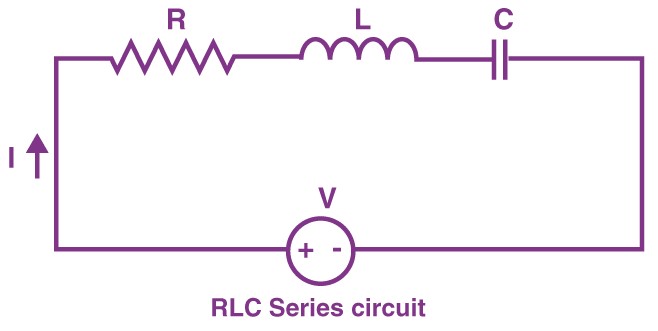
We had to be confident we had all of the essential equipment first, then we built and connected our LCR circuit using the LCR circuit schematic from our lab book. We took sure to measure our inductor first, then used a crocodile clip to attach it to the circuit. We set the frequency in the course to 100Hz and the capacitance to 1F after connecting it. We used the voltmeter to measure the amount of voltage produced by the power source once it was switched on. We next set our resistance box to 300 and measured the voltage in the resistor and capacitor with the voltmeter. The following diagram demonstrates the arrangement we used to determine the relationship between the three components of the LCR.
Source: (Pitchaimuthu & Kathamuthu, 2020)
Results
The type of interaction between the voltages across the resistor, capacitor, and inductor in an LCR circuit is shown in the following tables. With a percentage error of just 0.70 percent, the voltage we obtained from the power supply is nearly identical to the voltage we acquired using this formula (VL-Vc)2+(VR+Vr)2).
f= L=0.0793
1000Hz r= 170 H
R(Ω)
300
500
700
900
V(v)
2.86
2.86
2.86
2.86
Vind(v)
2.92
2.66
2.12
2.41
Vc(v)
1.32
1.91
1.52
1.09
VR(v)
1.34
1.5
1.79
1.66
ω(rad/s)= 5027
VL(v)
2.69
2.31
1.84
2.22
VR(v)
1.15
1.31
1.04
0.945
(VL-Vc) (v)
1.37
0.4
0.32
1.13
(VR+Vr)(V)
2.49
2.82
2.84
2.61
√(〖(VL-
Vc)〗^2+
〖(VR+Vr)〗^2)
2.84
2.85
2.86
2.84
%Error
0.70%
0.40%
0%
0.70%
Conclusion
The relationship between the voltage that passed across the capacitor, inductor, and resistor was obtained by the arrangement of the above experiment. Additionally, this voltage was in-line with that obtained when the standard formula for calculating voltage in an LCR circuit was applied. Notably, the above investigation was conducted when the inductor, capacitor, and resistor were arranged in a series circuit.
Reference
Pitchaimuthu, M. E., & Kathamuthu, T. (2020). Dynamics of the forced negative conductance series LCR circuit.
International Journal of Circuit Theory and Applications
,
48
(2), 214-230. |
| Markdown |  [Free essays](https://studycorgi.com/ "StudyCorgi")
[Sign in](https://service.studycorgi.com/login "Sign in")
Topic Ideas
- [Topic Ideas](https://studycorgi.com/inductor-capacitor-resistor-circuit-experiment/ "Topic Ideas")
[Business](https://studycorgi.com/topic/business/ "Business")
[Commerce](https://studycorgi.com/ideas/commerce-essay-topics/ "Commerce") [Innovation](https://studycorgi.com/ideas/innovation-essay-topics/ "Innovation") [Marketing](https://studycorgi.com/ideas/marketing-essay-topics/ "Marketing") [Negotiation](https://studycorgi.com/ideas/negotiation-essay-topics/ "Negotiation") [Product Marketing](https://studycorgi.com/ideas/product-marketing-essay-topics/ "Product Marketing")
[Education](https://studycorgi.com/topic/education/ "Education")
[Career](https://studycorgi.com/ideas/career-essay-topics/ "Career") [Child Development](https://studycorgi.com/ideas/child-development-essay-topics/ "Child Development") [Plagiarism](https://studycorgi.com/ideas/plagiarism-essay-topics/ "Plagiarism") [Curriculum](https://studycorgi.com/ideas/curriculum-essay-topics/ "Curriculum") [Distance Education](https://studycorgi.com/ideas/distance-education-essay-topics/ "Distance Education")
[Health & Medicine](https://studycorgi.com/topic/health-and-medicine/ "Health & Medicine")
[Cancer](https://studycorgi.com/ideas/cancer-essay-topics/ "Cancer") [Diabetes](https://studycorgi.com/ideas/diabetes-essay-topics/ "Diabetes") [Drugs](https://studycorgi.com/ideas/drugs-essay-topics/ "Drugs") [Alcohol](https://studycorgi.com/ideas/alcohol-essay-topics/ "Alcohol") [Nursing Theory](https://studycorgi.com/ideas/nursing-theory-essay-topics/ "Nursing Theory")
[Law](https://studycorgi.com/topic/law/ "Law")
[Constitution](https://studycorgi.com/ideas/constitution-essay-topics/ "Constitution") [Court](https://studycorgi.com/ideas/court-essay-topics/ "Court") [Crime](https://studycorgi.com/ideas/crime-essay-topics/ "Crime") [Murder](https://studycorgi.com/ideas/murder-essay-topics/ "Murder") [Police](https://studycorgi.com/ideas/police-essay-topics/ "Police")
[Literature](https://studycorgi.com/topic/literature/ "Literature")
[Discrimination](https://studycorgi.com/ideas/discrimination-essay-topics/ "Discrimination") [Edgar Allan Poe](https://studycorgi.com/ideas/edgar-allan-poe-essay-topics/ "Edgar Allan Poe") [Frankenstein](https://studycorgi.com/ideas/frankenstein-essay-topics/ "Frankenstein") [Hamlet](https://studycorgi.com/ideas/hamlet-essay-topics/ "Hamlet") [The Great Gatsby](https://studycorgi.com/ideas/the-great-gatsby-essay-topics/ "The Great Gatsby")
[Sociology](https://studycorgi.com/topic/sociology/ "Sociology")
[Bullying](https://studycorgi.com/ideas/bullying-essay-topics/ "Bullying") [Communication](https://studycorgi.com/ideas/communication-essay-topics/ "Communication") [Gender](https://studycorgi.com/ideas/gender-essay-topics/ "Gender") [Poverty](https://studycorgi.com/ideas/poverty-essay-topics/ "Poverty") [Social Problems](https://studycorgi.com/ideas/social-problems-essay-topics/ "Social Problems")
[Show All Topic Ideas](https://studycorgi.com/ideas/)
- [Study Tools](https://studycorgi.com/inductor-capacitor-resistor-circuit-experiment/ "Study Tools")
Essay Writing Tools
[Paragraph Rewriter](https://studycorgi.com/free-writing-tools/paragraph-rewriter/ "Paragraph Rewriter") [Hook Generator for Essays](https://studycorgi.com/free-writing-tools/essay-hook-generator/ "Hook Generator for Essays") [Argumentative Essay Generator](https://studycorgi.com/free-writing-tools/argumentative-essay-generator/ "Argumentative Essay Generator") [Essay Expander Tool](https://studycorgi.com/free-writing-tools/essay-expander/ "Essay Expander Tool") [Scholarship Essay Generator](https://studycorgi.com/free-writing-tools/scholarship-essay-generator/ "Scholarship Essay Generator") [Summary Generator for Essays](https://studycorgi.com/free-writing-tools/summary-generator/ "Summary Generator for Essays") [Informative Essay Maker](https://studycorgi.com/free-writing-tools/informative-essay-generator/ "Informative Essay Maker")
Creative Writing Tools
[Chat GPT Detector for Essays](https://studycorgi.com/free-writing-tools/chat-gpt-detector/ "Chat GPT Detector for Essays") [Quote Analysis Generator](https://studycorgi.com/free-writing-tools/quote-analysis-generator/ "Quote Analysis Generator") [Poem Analysis Generator](https://studycorgi.com/free-writing-tools/poem-analysis-generator/ "Poem Analysis Generator") [Study Notes Generator](https://studycorgi.com/free-writing-tools/study-notes-generator/ "Study Notes Generator") [Discussion Board Post Generator](https://studycorgi.com/free-writing-tools/discussion-board-post-generator/ "Discussion Board Post Generator") [Discussion Reply Generator](https://studycorgi.com/free-writing-tools/discussion-reply-generator/ "Discussion Reply Generator") [Debate Argument Generator](https://studycorgi.com/free-writing-tools/debate-argument-generator/ "Debate Argument Generator")
Research Tools
[Research Introduction Maker](https://studycorgi.com/free-writing-tools/research-introduction-maker/ "Research Introduction Maker") [Research Objective Generator](https://studycorgi.com/free-writing-tools/research-objectives-generator/ "Research Objective Generator") [Research Hypothesis Generator](https://studycorgi.com/free-writing-tools/research-hypothesis-generator/ "Research Hypothesis Generator") [Research Purpose Statement Generator](https://studycorgi.com/free-writing-tools/research-purpose-statement-generator/ "Research Purpose Statement Generator") [Research Problem Generator](https://studycorgi.com/free-writing-tools/research-problem-generator/ "Research Problem Generator") [Research Question Maker](https://studycorgi.com/free-writing-tools/research-question-maker/ "Research Question Maker")
Business Tools
[PESTEL Analysis Generator](https://studycorgi.com/free-writing-tools/pestel-analysis-template/ "PESTEL Analysis Generator ") [Porter’s Five Forces Template](https://studycorgi.com/free-writing-tools/porters-five-forces-template/ "Porter’s Five Forces Template ") [Vision Statement Generator](https://studycorgi.com/free-writing-tools/vision-statement-generator/ "Vision Statement Generator") [STEEP Analysis Template](https://studycorgi.com/free-writing-tools/steeple-template/ "STEEP Analysis Template ") [Personal Statement Generator](https://studycorgi.com/free-writing-tools/personal-statement-generator/ "Personal Statement Generator") [Mission Statement Generator](https://studycorgi.com/free-writing-tools/mission-statement-generator/ "Mission Statement Generator")
[Show All Study Tools](https://studycorgi.com/free-writing-tools/)
- [Blog](https://studycorgi.com/blog/ "Blog")
- [About Us](https://studycorgi.com/inductor-capacitor-resistor-circuit-experiment/ "About Us")
[Who we are](https://studycorgi.com/about/ "Who we are") [Careers](https://studycorgi.com/careers/ "Careers") [Contacts](https://studycorgi.com/contact/ "Contacts") [FAQ](https://studycorgi.com/faq/ "FAQ") [Our Scholarship](https://studycorgi.com/students-scholarship/ "Our Scholarship")
- [Login](https://service.studycorgi.com/login "Login")
- [Writing Service](https://service.studycorgi.com/ "Writing Service")
Open or close mobile menu
1 hour\!
We'll write a **100% customized paper** this fast
[Learn more](https://service.studycorgi.com/ "Learn more")
Related Free Essays
- [Sampling Methods: Probability, Non-Probability, and Stratified Samplings](https://studycorgi.com/sampling-methods-probability-non-probability-and-stratified-samplings/ "Sampling Methods: Probability, Non-Probability, and Stratified Samplings")
Words: 386
- [Statistics: Hypothesis Testing Article by Form Plus](https://studycorgi.com/statistics-hypothesis-testing-article-by-form-plus/ "Statistics: Hypothesis Testing Article by Form Plus")
Words: 324
- [The Decrease of the Pull of the North and South Poles](https://studycorgi.com/the-decrease-of-the-pull-of-the-north-and-south-poles/ "The Decrease of the Pull of the North and South Poles")
Words: 562
- [Research Process and Methodology](https://studycorgi.com/research-process-and-methodology/ "Research Process and Methodology")
Words: 1119
- [10 Types of Variables in Research and Statistics](https://studycorgi.com/10-types-of-variables-in-research-and-statistics/ "10 Types of Variables in Research and Statistics")
Words: 293
- [Quantitative and Qualitative Research Differences](https://studycorgi.com/quantitative-and-qualitative-research-differences/ "Quantitative and Qualitative Research Differences")
Words: 280
- [The Facts About SpaceX Missions](https://studycorgi.com/the-facts-about-spacex-missions/ "The Facts About SpaceX Missions")
Words: 621
- [Plate Tectonic of the Dominican Republic](https://studycorgi.com/plate-tectonic-of-the-dominican-republic/ "Plate Tectonic of the Dominican Republic")
Words: 1222
- [Simpson’s Paradox as a Statistical Effect](https://studycorgi.com/simpsons-paradox-as-a-statistical-effect/ "Simpson’s Paradox as a Statistical Effect")
Words: 1416
- [Soil Profiles in Australia](https://studycorgi.com/soil-profiles-in-australia/ "Soil Profiles in Australia")
Words: 4548
Paper preview
0
0
Print
Print
[StudyCorgi](https://studycorgi.com/ "StudyCorgi") [Formal Sciences](https://studycorgi.com/topic/formal-sciences/ "Formal Sciences")
[Print](https://studycorgi.com/inductor-capacitor-resistor-circuit-experiment/ "Print")
[Cite this](https://studycorgi.com/inductor-capacitor-resistor-circuit-experiment/#cite-this "Cite this")
# Inductor-Capacitor-Resistor Circuit Experiment
Topic: [Experiment](https://studycorgi.com/ideas/experiment-essay-topics/ "Experiment topics") Words: 620 Pages: 2
Table of Contents
1. [Abstract](https://studycorgi.com/inductor-capacitor-resistor-circuit-experiment/#abstract "Abstract")
2. [Introduction](https://studycorgi.com/inductor-capacitor-resistor-circuit-experiment/#introduction "Introduction")
3. [Materials and Methods](https://studycorgi.com/inductor-capacitor-resistor-circuit-experiment/#materials-and-methods "Materials and Methods")
4. [Procedure](https://studycorgi.com/inductor-capacitor-resistor-circuit-experiment/#procedure "Procedure")
5. [Results](https://studycorgi.com/inductor-capacitor-resistor-circuit-experiment/#results "Results")
6. [Conclusion](https://studycorgi.com/inductor-capacitor-resistor-circuit-experiment/#conclusion "Conclusion")
7. [Reference](https://studycorgi.com/inductor-capacitor-resistor-circuit-experiment/#reference "Reference")
## Abstract
This experiment aims to discover and demonstrate a connection between the voltages across the resistor, capacitor, and inductor in an LCR circuit. We needed a capacitor, resistor, inductor, voltmeter, and power source. To acquire the voltage across the resistor (VR) and the voltage across the capacitor, we employed a constant capacitance value while changing the resistance in the circuit (VC). To examine and prove the relationship between the voltages, we utilized the formula V=V2c+V2r. The voltage from the power supply was 2.86v for the LCR circuit, and we received 2.84v after plugging in the other voltages into the calculation, giving us a percentage error of 0.70 percent.
We will write a **custom essay on your topic** tailored to your instructions\!
**\---**experts online
[Let us help you](https://service.studycorgi.com/ "Let us help you")
## Introduction
The primary goal of this experiment is to determine and verify the connection between the voltage all over the resistor, capacitor, and inductor in an LCR circuit. An LCR circuit also called an RLC circuit, is an electronic circuit that hosts a parallel or series connection of a capacitor (C), inductor (L), and resistor (R). In terms of phasors, the LCR circuit analysis may be better understood. A quantity that rotates through the circuit entails a phasor. For instance, if 1 is the reference axis then the voltage will lead by 90 degrees for the inductor while it will lag by 90 degrees for the capacitor (Pitchaimuthu & Kathamuthu, 2020). Conversely, the phasors of voltage, current and resistance always lie in phase. This experiment will demonstrate the relationship between an inductor, voltmeter, and resistor in an LCR circuit.
## Materials and Methods
### Materials
- Power source
- Capacitor
- BNC connector
- Crocodile clip
- Resistor
- Inductor
- Voltmeter
### Methods
Voltage across the inductor, resistor and the capacitor were measured using a voltmeter. The value obtained from the three measurements was then compared with that acquired using the formula, (VL-Vc)2+(VR+Vr)2). Comparing the measured value with the calculated values is essential to determine the degree of error that this experiment holds.
## Procedure
On-time delivery\!
Get your **100% customized paper** done in as little as **1 hour**
[Let’s start](https://service.studycorgi.com/ "Let’s start")
We had to be confident we had all of the essential equipment first, then we built and connected our LCR circuit using the LCR circuit schematic from our lab book. We took sure to measure our inductor first, then used a crocodile clip to attach it to the circuit. We set the frequency in the course to 100Hz and the capacitance to 1F after connecting it. We used the voltmeter to measure the amount of voltage produced by the power source once it was switched on. We next set our resistance box to 300 and measured the voltage in the resistor and capacitor with the voltmeter. The following diagram demonstrates the arrangement we used to determine the relationship between the three components of the LCR.
Source: (Pitchaimuthu & Kathamuthu, 2020)
## Results
The type of interaction between the voltages across the resistor, capacitor, and inductor in an LCR circuit is shown in the following tables. With a percentage error of just 0.70 percent, the voltage we obtained from the power supply is nearly identical to the voltage we acquired using this formula (VL-Vc)2+(VR+Vr)2).
| | | | | |
|---|---|---|---|---|
| f= L=0.0793 1000Hz r= 170 H | | | | |
| R(Ω) | 300 | 500 | 700 | 900 |
| V(v) | 2\.86 | 2\.86 | 2\.86 | 2\.86 |
| Vind(v) | 2\.92 | 2\.66 | 2\.12 | 2\.41 |
| Vc(v) | 1\.32 | 1\.91 | 1\.52 | 1\.09 |
| VR(v) | 1\.34 | 1\.5 | 1\.79 | 1\.66 |
**Deadline panic?**
We're here to rescue and write a custom academic paper **in just 1 hour\!**
[Explore further](https://service.studycorgi.com/ "Explore further")
| | | | | |
|---|---|---|---|---|
| ω(rad/s)= 5027 | | | | |
| VL(v) | 2\.69 | 2\.31 | 1\.84 | 2\.22 |
| VR(v) | 1\.15 | 1\.31 | 1\.04 | 0\.945 |
| (VL-Vc) (v) | 1\.37 | 0\.4 | 0\.32 | 1\.13 |
| (VR+Vr)(V) | 2\.49 | 2\.82 | 2\.84 | 2\.61 |
| √(〖(VL- Vc)〗^2+ 〖(VR+Vr)〗^2) | 2\.84 | 2\.85 | 2\.86 | 2\.84 |
| %Error | 0\.70% | 0\.40% | 0% | 0\.70% |
## Conclusion
The relationship between the voltage that passed across the capacitor, inductor, and resistor was obtained by the arrangement of the above experiment. Additionally, this voltage was in-line with that obtained when the standard formula for calculating voltage in an LCR circuit was applied. Notably, the above investigation was conducted when the inductor, capacitor, and resistor were arranged in a series circuit.
## Reference
Pitchaimuthu, M. E., & Kathamuthu, T. (2020). Dynamics of the forced negative conductance series LCR circuit. *International Journal of Circuit Theory and Applications*, *48*(2), 214-230.
Need an essay on **Inductor-Capacitor-Resistor Circuit Experiment** written from scratch by an expert specifically for you? ✍️
**\---**experts online
[Get writing help](https://service.studycorgi.com/ "Get writing help")
Cite this paper
Select style
Select citation styles
- [APA-7](https://studycorgi.com/inductor-capacitor-resistor-circuit-experiment/#apa-7)
- [MLA-9](https://studycorgi.com/inductor-capacitor-resistor-circuit-experiment/#mla-9)
- [Harvard](https://studycorgi.com/inductor-capacitor-resistor-circuit-experiment/#harvard)
- [Chicago (N-B)](https://studycorgi.com/inductor-capacitor-resistor-circuit-experiment/#chicagoN-B)
- [Chicago (A-D)](https://studycorgi.com/inductor-capacitor-resistor-circuit-experiment/#chicagoA-D)
Reference
StudyCorgi. (2023, March 21). *Inductor-Capacitor-Resistor Circuit Experiment.* https://studycorgi.com/inductor-capacitor-resistor-circuit-experiment/
Work Cited
"Inductor-Capacitor-Resistor Circuit Experiment." *StudyCorgi*, 21 Mar. 2023, studycorgi.com/inductor-capacitor-resistor-circuit-experiment/.
\* Hyperlink the URL after pasting it to your document
References
*StudyCorgi*. (2023) 'Inductor-Capacitor-Resistor Circuit Experiment'. 21 March.
1\. *StudyCorgi*. "Inductor-Capacitor-Resistor Circuit Experiment." March 21, 2023. https://studycorgi.com/inductor-capacitor-resistor-circuit-experiment/.
Bibliography
*StudyCorgi*. "Inductor-Capacitor-Resistor Circuit Experiment." March 21, 2023. https://studycorgi.com/inductor-capacitor-resistor-circuit-experiment/.
References
*StudyCorgi*. 2023. "Inductor-Capacitor-Resistor Circuit Experiment." March 21, 2023. https://studycorgi.com/inductor-capacitor-resistor-circuit-experiment/.
Powered by StudyCorgi's [free citation machine](https://studycorgi.com/free-writing-tools/citation-machine/ "free citation machine").
**Copy to clipboard**
This paper, “Inductor-Capacitor-Resistor Circuit Experiment”, was written and voluntary submitted to our free essay database by a straight-A student. Please ensure you properly reference the paper if you're using it to write your assignment.
Before publication, the StudyCorgi editorial team proofread and checked the paper to make sure it meets the highest standards in terms of grammar, punctuation, style, fact accuracy, copyright issues, and inclusive language. Last updated: April 17, 2026.
If you are the author of this paper and no longer wish to have it published on StudyCorgi, [request the removal](https://studycorgi.com/dmca/ "Request the removal"). Please use the “[Donate your paper](https://studycorgi.com/donate/ "Donate your paper")” form to submit an essay.
[Get a plagiarism-free paper](https://service.studycorgi.com/ "Get a plagiarism-free paper")

Our site uses cookies. If you keep using the site, you accept our [Cookies Policy](https://studycorgi.com/privacy/#cookies-and-web-beacons "Cookies Policy")
OK
Your Data is Safe
- [DMCA.com Protection Status](https://www.dmca.com/Protection/Status.aspx?ID=e0ed2024-2934-48f8-a90b-bed248ad7ba1 "DMCA Protected")
- [Check SSL Certificate](https://www.geocerts.com/ssl-checker?domain=studycorgi.com "Check SSL Certificate")
- 100% Money Back Guarantee
- GDPR Compliant
Secure Payment
Writing Help
- [Essay Writing Help](https://service.studycorgi.com/ "Essay Writing Help")
- [Discounts](https://studycorgi.com/discounts/ "Discounts")
- [Reviews](https://studycorgi.com/reviews/ "Reviews")
- [Pricing](https://service.studycorgi.com/prices "Pricing")
- [Samples](https://service.studycorgi.com/samples "Samples")
- [FAQ](https://studycorgi.com/faq/ "FAQ")
Free resources
- [Free Writing Tools](https://studycorgi.com/free-writing-tools/ "Free Writing Tools")
- [Research & Citation Course](https://studycorgi.com/research-and-citation-course/ "Research & Citation Course")
- [StudyCorgi Podcast](https://studycorgi.live/ "StudyCorgi Podcast")
- [Academic Blog](https://studycorgi.com/blog/ "Academic Blog")
- [Topic Ideas](https://studycorgi.com/ideas/ "Topic Ideas")
About
- [About Us](https://studycorgi.com/about/ "About Us")
- [Contact](https://studycorgi.com/contact/ "Contact")
- [Career](https://studycorgi.com/careers/ "Career")
- [Merch Shop](https://studycorgi.store/ "Merch Shop")
- [Students Scholarship](https://studycorgi.com/students-scholarship/ "Students Scholarship")
24/7 Support
- [support@studycorgi.com](mailto:support@studycorgi.com "Send email to us")
- [\+1 888 881-3158](tel:18888813158 "Call to us")
US Office
- 8735 Dunwoody Place \#4584 Atlanta, GA 30350
- [StudyCorgi on Pinterest](https://www.pinterest.com/studycorgi/ "StudyCorgi on Pinterest")
- [StudyCorgi on YouTube](https://www.youtube.com/@StudyCorgiTV "StudyCorgi on YouTube")
- [StudyCorgi on X](https://x.com/StudyCorgi "StudyCorgi on X")
Essay Writing Tools (8)
- [Essay Outline Generator](https://studycorgi.com/free-writing-tools/essay-outline-maker/ "Essay Outline Generator")
- [Essay Reworder](https://studycorgi.com/free-writing-tools/reworder/ "Essay Reworder")
- [Compare Essay Generator](https://studycorgi.com/free-writing-tools/compare-and-contrast-essay-generator/ "Compare Essay Generator")
- [Rhetorical Analysis Generator](https://studycorgi.com/free-writing-tools/rhetorical-analysis-essay-generator/ "Rhetorical Analysis Generator")
- [Analytical Essay Generator](https://studycorgi.com/free-writing-tools/analytical-essay-generator/ "Analytical Essay Generator")
- [Thesis Rephraser](https://studycorgi.com/free-writing-tools/thesis-rephraser/ "Thesis Rephraser")
- [Conclusion Generator](https://studycorgi.com/free-writing-tools/conclusion-generator/ "Conclusion Generator")
- [Reworder to Avoid Plagiarism](https://studycorgi.com/free-writing-tools/text-reworder/ "Reworder to Avoid Plagiarism")
Research Tools (8)
- [Research Title Generator](https://studycorgi.com/free-writing-tools/research-title-generator/ "Research Title Generator")
- [Paraphrasing Tool for Research](https://studycorgi.com/free-writing-tools/paper-rewriter/ "Paraphrasing Tool for Research")
- [Thesis Maker for Research Paper](https://studycorgi.com/free-writing-tools/thesis-maker/ "Thesis Maker for Research Paper")
- [Research Paper Rephraser](https://studycorgi.com/free-writing-tools/rephraser/ "Research Paper Rephraser")
- [AI Abstract Generator](https://studycorgi.com/free-writing-tools/ai-abstract-generator/ "AI Abstract Generator")
- [Transition Words Maker](https://studycorgi.com/free-writing-tools/transition-words-maker/ "Transition Words Maker")
- [Transition Phrase Generator](https://studycorgi.com/free-writing-tools/transition-phrase-generator/ "Transition Phrase Generator")
- [Transition Sentence Maker](https://studycorgi.com/free-writing-tools/transition-sentence-maker/ "Transition Sentence Maker")
Creative Writing Tools (8)
- [Read My Paper to Me](https://studycorgi.com/free-writing-tools/read-my-paper/ "Read My Paper to Me")
- [Case Study Answer Generator](https://studycorgi.com/free-writing-tools/case-study-analysis-generator/ "Case Study Answer Generator")
- [Article Review Generator](https://studycorgi.com/free-writing-tools/article-review-generator/ "Article Review Generator")
- [Topic Sentence Generator](https://studycorgi.com/free-writing-tools/topic-sentence-maker/ "Topic Sentence Generator")
- [Key Points Generator](https://studycorgi.com/free-writing-tools/key-points-generator/ "Key Points Generator")
- [Question Maker](https://studycorgi.com/free-writing-tools/question-maker-from-text/ "Question Maker")
- [Poem Generator](https://studycorgi.com/free-writing-tools/poem-generator/ "Poem Generator")
- [Random Speech Generator](https://studycorgi.com/free-writing-tools/speech-generator/ "Random Speech Generator")
Business Tools (8)
- [VRIO Analysis Tool](https://studycorgi.com/free-writing-tools/vrio-analysis-tool/ "VRIO Analysis Tool")
- [SMART Goal Generator](https://studycorgi.com/free-writing-tools/smart-template/ "SMART Goal Generator")
- [VMOST Template](https://studycorgi.com/free-writing-tools/vmost-template/ "VMOST Template")
- [STP Marketing Template](https://studycorgi.com/free-writing-tools/stp-template/ "STP Marketing Template")
- [McKinsey 7S Model Template](https://studycorgi.com/free-writing-tools/7s-mckinsey-template/ "McKinsey 7S Model Template")
- [SWOT Analysis Online Tool](https://studycorgi.com/free-writing-tools/swot-analysis-online/ "SWOT Analysis Online Tool")
- [DESTEP Template](https://studycorgi.com/free-writing-tools/destep-template/ "DESTEP Template")
- [4Ps and 7Ps Template](https://studycorgi.com/free-writing-tools/7ps-template/ "4Ps and 7Ps Template")
Legal
- [Terms and Conditions](https://studycorgi.com/terms/ "Terms and Conditions")
- [Privacy & Cookies Policy](https://studycorgi.com/privacy/ "Privacy & Cookies Policy")
- [Content Removal Request](https://studycorgi.com/dmca/ "Content Removal Request")
- Privacy Settings
Press:
- [Press Releases](https://studycorgi.com/press/ "Press Releases")
- [Brand Assets](https://studycorgi.com/brand/ "Brand Assets")
COSTUDY OU
Company registered in Estonia. Harju maakond, Tallinn, Nõmme linnaosa, Männiku tee 106, 11216. Reg. Number: 16619718. VAT: EE102559815
Services provided by StudyCorgi® are to be used for research purposes only. If you use an assignment from this website, it should be referenced accordingly. Refer to our [Honor Code](https://studycorgi.com/honor-code/ "StudyCorgi Honor Code") for more details.
© 2026 StudyCorgi.com |
| Readable Markdown | Table of Contents
## Abstract
This experiment aims to discover and demonstrate a connection between the voltages across the resistor, capacitor, and inductor in an LCR circuit. We needed a capacitor, resistor, inductor, voltmeter, and power source. To acquire the voltage across the resistor (VR) and the voltage across the capacitor, we employed a constant capacitance value while changing the resistance in the circuit (VC). To examine and prove the relationship between the voltages, we utilized the formula V=V2c+V2r. The voltage from the power supply was 2.86v for the LCR circuit, and we received 2.84v after plugging in the other voltages into the calculation, giving us a percentage error of 0.70 percent.
## Introduction
The primary goal of this experiment is to determine and verify the connection between the voltage all over the resistor, capacitor, and inductor in an LCR circuit. An LCR circuit also called an RLC circuit, is an electronic circuit that hosts a parallel or series connection of a capacitor (C), inductor (L), and resistor (R). In terms of phasors, the LCR circuit analysis may be better understood. A quantity that rotates through the circuit entails a phasor. For instance, if 1 is the reference axis then the voltage will lead by 90 degrees for the inductor while it will lag by 90 degrees for the capacitor (Pitchaimuthu & Kathamuthu, 2020). Conversely, the phasors of voltage, current and resistance always lie in phase. This experiment will demonstrate the relationship between an inductor, voltmeter, and resistor in an LCR circuit.
## Materials and Methods
### Materials
- Power source
- Capacitor
- BNC connector
- Crocodile clip
- Resistor
- Inductor
- Voltmeter
### Methods
Voltage across the inductor, resistor and the capacitor were measured using a voltmeter. The value obtained from the three measurements was then compared with that acquired using the formula, (VL-Vc)2+(VR+Vr)2). Comparing the measured value with the calculated values is essential to determine the degree of error that this experiment holds.
## Procedure
We had to be confident we had all of the essential equipment first, then we built and connected our LCR circuit using the LCR circuit schematic from our lab book. We took sure to measure our inductor first, then used a crocodile clip to attach it to the circuit. We set the frequency in the course to 100Hz and the capacitance to 1F after connecting it. We used the voltmeter to measure the amount of voltage produced by the power source once it was switched on. We next set our resistance box to 300 and measured the voltage in the resistor and capacitor with the voltmeter. The following diagram demonstrates the arrangement we used to determine the relationship between the three components of the LCR.

Source: (Pitchaimuthu & Kathamuthu, 2020)
## Results
The type of interaction between the voltages across the resistor, capacitor, and inductor in an LCR circuit is shown in the following tables. With a percentage error of just 0.70 percent, the voltage we obtained from the power supply is nearly identical to the voltage we acquired using this formula (VL-Vc)2+(VR+Vr)2).
| | | | | |
|---|---|---|---|---|
| f= L=0.0793 1000Hz r= 170 H | | | | |
| R(Ω) | 300 | 500 | 700 | 900 |
| V(v) | 2\.86 | 2\.86 | 2\.86 | 2\.86 |
| Vind(v) | 2\.92 | 2\.66 | 2\.12 | 2\.41 |
| Vc(v) | 1\.32 | 1\.91 | 1\.52 | 1\.09 |
| VR(v) | 1\.34 | 1\.5 | 1\.79 | 1\.66 |
| | | | | |
|---|---|---|---|---|
| ω(rad/s)= 5027 | | | | |
| VL(v) | 2\.69 | 2\.31 | 1\.84 | 2\.22 |
| VR(v) | 1\.15 | 1\.31 | 1\.04 | 0\.945 |
| (VL-Vc) (v) | 1\.37 | 0\.4 | 0\.32 | 1\.13 |
| (VR+Vr)(V) | 2\.49 | 2\.82 | 2\.84 | 2\.61 |
| √(〖(VL- Vc)〗^2+ 〖(VR+Vr)〗^2) | 2\.84 | 2\.85 | 2\.86 | 2\.84 |
| %Error | 0\.70% | 0\.40% | 0% | 0\.70% |
## Conclusion
The relationship between the voltage that passed across the capacitor, inductor, and resistor was obtained by the arrangement of the above experiment. Additionally, this voltage was in-line with that obtained when the standard formula for calculating voltage in an LCR circuit was applied. Notably, the above investigation was conducted when the inductor, capacitor, and resistor were arranged in a series circuit.
## Reference
Pitchaimuthu, M. E., & Kathamuthu, T. (2020). Dynamics of the forced negative conductance series LCR circuit. *International Journal of Circuit Theory and Applications*, *48*(2), 214-230. |
| ML Classification | |
| ML Categories | null |
| ML Page Types | null |
| ML Intent Types | null |
| Content Metadata | |
| Language | en-us |
| Author | null |
| Publish Time | 2026-04-17 00:00:00 (6 days ago) |
| Original Publish Time | 2023-03-21 15:51:04 (3 years ago) |
| Republished | Yes |
| Word Count (Total) | 1,546 |
| Word Count (Content) | 654 |
| Links | |
| External Links | 10 |
| Internal Links | 130 |
| Technical SEO | |
| Meta Nofollow | No |
| Meta Noarchive | No |
| JS Rendered | No |
| Redirect Target | null |
| Performance | |
| Download Time (ms) | 471 |
| TTFB (ms) | 348 |
| Download Size (bytes) | 27,089 |
| Shard | 113 (laksa) |
| Root Hash | 3054151756516696113 |
| Unparsed URL | com,studycorgi!/inductor-capacitor-resistor-circuit-experiment/ s443 |