ℹ️ Skipped - page is already crawled
| Filter | Status | Condition | Details |
|---|---|---|---|
| HTTP status | PASS | download_http_code = 200 | HTTP 200 |
| Age cutoff | FAIL | download_stamp > now() - 6 MONTH | 7.5 months ago |
| History drop | PASS | isNull(history_drop_reason) | No drop reason |
| Spam/ban | PASS | fh_dont_index != 1 AND ml_spam_score = 0 | ml_spam_score=0 |
| Canonical | PASS | meta_canonical IS NULL OR = '' OR = src_unparsed | Not set |
| Property | Value |
|---|---|
| URL | https://stories.tamu.edu/news/2016/02/04/what-you-need-to-know-about-the-zika-virus/ |
| Last Crawled | 2025-09-10 12:14:34 (7 months ago) |
| First Indexed | not set |
| HTTP Status Code | 200 |
| Content | |
| Meta Title | What You Need To Know About The Zika Virus – Texas A&M Stories |
| Meta Description | null |
| Meta Canonical | null |
| Boilerpipe Text | As the Zika virus captures headlines, with its possible link to birth defects, the World Health Organization declaring it a global health emergency and the first cases reported in the United States (all traced back to overseas travel), it’s an opportune time to review the facts associated with this disease. What is the Zika virus? The Zika virus was first isolated in the Zika forest of Uganda in 1947. Until very recently, it was confined to Africa with occasional small outbreaks in Asia. It slowly spread east, with cases on Easter Island off the coast of South America confirmed in 2014 and the first cases in Brazil in May 2015, and it has spread further throughout South and Central America since then. Has anyone contracted Zika in the United States? A patient in Puerto Rico tested positive for the virus in December 2015. As the illness begins two to seven days after infection and the person had not left the island during that time, it was likely contracted in Puerto Rico. No one is known to have been infected on the mainland United States via a mosquito. However, several people in Houston have been reported to have contracted the disease overseas, as did another traveler who recently returned to Hawaii. One person in Dallas contracted the virus after having sexual contact with someone who had recently returned from an affected country. How is the Zika virus transmitted? Like a number of other diseases such as dengue and chikungunya, which are also spread by mosquitoes, the Zika virus is spread through the bite of the Aedes species of mosquito. Mosquitoes become infected when they bite a human who has the virus, and are then capable of spreading the disease to other susceptible humans. Between 20 and 25 percent of those persons who become infected will develop symptoms. As the case in Dallas demonstrates, the virus can be spread through sexual transmission from human to human, but that mode of transmission remains exceedingly rare. What are the symptoms of Zika virus? Common symptoms of Zika include fever, skin rash, red eyes and joint pain. Some patients report muscle pain, general malaise, headache and vomiting. Symptoms typically last between two and seven days. Complications are rare, but some cases require hospitalization for supportive care. As far as we know, deaths have not been reported as a result of Zika virus infection. Is there a treatment? No, other than making the patient more comfortable with symptomatic treatment, there is no specific cure or treatment for Zika fever. How can the virus be prevented? There is no vaccine for the virus yet, so all preventive measures should be focused on preventing mosquito bites. This means eliminating standing water and other mosquito breeding sites, as well as using mosquito screens in windows and using appropriate insect repellants when outdoors. What do pregnant women need to know about the virus? The Ministry of Health of Brazil discovered an association between being infected with Zika virus and an increase in cases of microcephaly in newborns in that county, with the risk greatest when the mother was infected during her first trimester. Microcephaly is a medical condition that results in a small head because the brain has stopped growing or is not developing properly. Because of the potential association between Zika virus infection and microcephaly, pregnant women and those who might be pregnant should be especially careful to avoid mosquito bites, particularly during their first trimester. The United States Centers for Disease Control and Prevention (CDC) has advised pregnant women to avoid travel to endemic countries if possible. What should I do if I think I might be infected with Zika virus? To prevent others from getting sick, it is especially important to keep any mosquitos from biting you and transmitting the disease to other people. Get plenty of rest and drink fluids to prevent dehydration. You should also contact your health care provider, especially if you are pregnant, to discuss your concerns, particularly if you are returning from a region where the disease is being transmitted by mosquitoes. Read more on Vital Record . |
| Markdown | [Skip to content](https://stories.tamu.edu/news/2016/02/04/what-you-need-to-know-about-the-zika-virus/#main-content)
[](https://www.tamu.edu/)
Search this Site
[Texas A\&M Stories](https://stories.tamu.edu/)
- [All Stories](https://stories.tamu.edu/stories/)
- [Explore Topics](https://stories.tamu.edu/explore-topics/)
- [Press Center](https://stories.tamu.edu/press-center/)
[](https://stories.tamu.edu/)
[Texas A\&M Stories](https://stories.tamu.edu/)
Menu & Search
Close
- [All Stories](https://stories.tamu.edu/stories/)
- [Explore Topics](https://stories.tamu.edu/explore-topics/)
- [Press Center](https://stories.tamu.edu/press-center/)
[Health & Environment](https://stories.tamu.edu/category/health-environment/)
# What You Need To Know About The Zika Virus
As mosquitoes venture out of their geographical habitat, so do the viruses they carry.
Feb 4, 2016
4 min. read
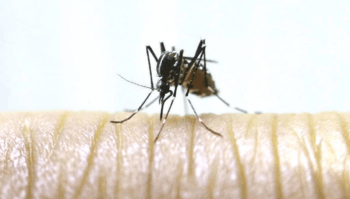As the Zika virus captures headlines, with its possible link to birth defects, the World Health Organization declaring it a global health emergency and the first cases reported in the United States (all traced back to overseas travel), it’s an opportune time to review the facts associated with this disease.
## What is the Zika virus?
The Zika virus was first isolated in the Zika forest of Uganda in 1947. Until very recently, it was confined to Africa with occasional small outbreaks in Asia. It slowly spread east, with cases on Easter Island off the coast of South America confirmed in 2014 and the first cases in Brazil in May 2015, and it has spread further throughout South and Central America since then.
Has anyone contracted Zika in the United States?
A patient in Puerto Rico tested positive for the virus in December 2015. As the illness begins two to seven days after infection and the person had not left the island during that time, it was likely contracted in Puerto Rico. No one is known to have been infected on the mainland United States via a mosquito. However, several people in Houston have been reported to have contracted the disease overseas, as did another traveler who recently returned to Hawaii. One person in Dallas contracted the virus after having sexual contact with someone who had recently returned from an affected country.
## 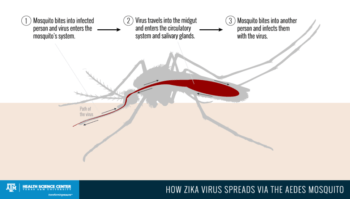How is the Zika virus transmitted?
Like a number of other diseases such as dengue and chikungunya, which are also spread by mosquitoes, the Zika virus is spread through the bite of the Aedes species of mosquito. Mosquitoes become infected when they bite a human who has the virus, and are then capable of spreading the disease to other susceptible humans. Between 20 and 25 percent of those persons who become infected will develop symptoms. As the case in Dallas demonstrates, the virus can be spread through sexual transmission from human to human, but that mode of transmission remains exceedingly rare.
## What are the symptoms of Zika virus?
Common symptoms of Zika include fever, skin rash, red eyes and joint pain. Some patients report muscle pain, general malaise, headache and vomiting. Symptoms typically last between two and seven days. Complications are rare, but some cases require hospitalization for supportive care. As far as we know, deaths have not been reported as a result of Zika virus infection.
## Is there a treatment?
No, other than making the patient more comfortable with symptomatic treatment, there is no specific cure or treatment for Zika fever.
## How can the virus be prevented?
There is no vaccine for the virus yet, so all preventive measures should be focused on preventing mosquito bites. This means eliminating standing water and other mosquito breeding sites, as well as using mosquito screens in windows and using appropriate insect repellants when outdoors.
## What do pregnant women need to know about the virus?
The Ministry of Health of Brazil discovered an association between being infected with Zika virus and an increase in cases of microcephaly in newborns in that county, with the risk greatest when the mother was infected during her first trimester. Microcephaly is a medical condition that results in a small head because the brain has stopped growing or is not developing properly. Because of the potential association between Zika virus infection and microcephaly, pregnant women and those who might be pregnant should be especially careful to avoid mosquito bites, particularly during their first trimester. The United States Centers for Disease Control and Prevention (CDC) has advised pregnant women to avoid travel to endemic countries if possible.
## What should I do if I think I might be infected with Zika virus?
To prevent others from getting sick, it is especially important to keep any mosquitos from biting you and transmitting the disease to other people. Get plenty of rest and drink fluids to prevent dehydration. You should also contact your health care provider, especially if you are pregnant, to discuss your concerns, particularly if you are returning from a region where the disease is being transmitted by mosquitoes.
Read more on [Vital Record](https://vitalrecord.tamhsc.edu/fast-facts-what-you-need-to-know-about-the-zika-virus/?_ga=2.150489462.1309172354.1563209549-1123856947.1557421246).

Tags
- [animal health](https://stories.tamu.edu/tag/animal-health/)
- [healthcare](https://stories.tamu.edu/tag/healthcare/)
- [human health](https://stories.tamu.edu/tag/human-health/)
Media Contact
This article by Christina Sumners originally appeared in [Vital Record](https://vitalrecord.tamhsc.edu/fast-facts-what-you-need-to-know-about-the-zika-virus/?_ga=2.150489462.1309172354.1563209549-1123856947.1557421246).
Share this News
## Related News
[](https://stories.tamu.edu/news/2025/09/09/flipping-the-switch-on-disease-texas-am-scientists-pioneer-light-controlled-genetic-tools/)
### [Flipping the switch on disease: Texas A\&M scientists pioneer light-controlled genetic tools](https://stories.tamu.edu/news/2025/09/09/flipping-the-switch-on-disease-texas-am-scientists-pioneer-light-controlled-genetic-tools/)
Researchers have created tools that respond to blue light with pinpoint accuracy, potentially revolutionizing cell therapy, cancer treatment and precision medicine.
### [Seeing The Bright Side: Helping Pets Adjust To Vision Loss](https://stories.tamu.edu/news/2025/09/05/seeing-the-bright-side-helping-pets-adjust-to-vision-loss/)
Although vision loss can be distressing, most pets adapt quickly with support from their owners, including simple changes in the home environment.
### [Eating animal protein following training can improve recovery, study finds](https://stories.tamu.edu/news/2025/09/04/eating-animal-protein-following-training-can-improve-recovery-study-finds/)
New research from Texas A\&M University shows that pork-based MREs promote better recovery than plant-based options after intense military training.
[View All News](https://stories.tamu.edu/news/)
[](https://www.tamu.edu/)
About this Site
Read articles, watch videos and discover how Texas A\&M University is shaping an innovative, more secure future for the citizens of Texas and the world.
Find More Stories
- [All Stories](https://stories.tamu.edu/stories/)
- [Explore Topics](https://stories.tamu.edu/explore-topics/)
For the Media
- [Press Center](https://stories.tamu.edu/press-center/)
- [Contact the Newsroom](https://stories.tamu.edu/press-center/contact-the-newsroom/)
- [Press Releases](https://stories.tamu.edu/news/2016/02/04/what-you-need-to-know-about-the-zika-virus/)
- [Resources for Journalists](https://stories.tamu.edu/press-center/resources-for-journalists/)
- © 2025 [Texas A\&M University](https://www.tamu.edu/)
- [Site Policies](https://www.tamu.edu/statements/index.html)
- [Accessibility](https://itaccessibility.tamu.edu/) |
| Readable Markdown | null |
| ML Classification | |
| ML Categories | null |
| ML Page Types | null |
| ML Intent Types | null |
| Content Metadata | |
| Language | en-us |
| Author | null |
| Publish Time | 2016-02-04 09:25:29 (10 years ago) |
| Original Publish Time | 2016-02-04 09:25:29 (10 years ago) |
| Republished | No |
| Word Count (Total) | 940 |
| Word Count (Content) | 686 |
| Links | |
| External Links | 4 |
| Internal Links | 19 |
| Technical SEO | |
| Meta Nofollow | No |
| Meta Noarchive | No |
| JS Rendered | No |
| Redirect Target | null |
| Performance | |
| Download Time (ms) | 502 |
| TTFB (ms) | 500 |
| Download Size (bytes) | 13,066 |
| Shard | 97 (laksa) |
| Root Hash | 8130125333590217697 |
| Unparsed URL | edu,tamu!stories,/news/2016/02/04/what-you-need-to-know-about-the-zika-virus/ s443 |