ℹ️ Skipped - page is already crawled
| Filter | Status | Condition | Details |
|---|---|---|---|
| HTTP status | PASS | download_http_code = 200 | HTTP 200 |
| Age cutoff | PASS | download_stamp > now() - 6 MONTH | 1.3 months ago |
| History drop | PASS | isNull(history_drop_reason) | No drop reason |
| Spam/ban | PASS | fh_dont_index != 1 AND ml_spam_score = 0 | ml_spam_score=0 |
| Canonical | PASS | meta_canonical IS NULL OR = '' OR = src_unparsed | Not set |
| Property | Value |
|---|---|
| URL | https://sites.math.duke.edu/education/ccp/materials/engin/laplace/laplace1.html |
| Last Crawled | 2026-03-17 16:25:53 (1 month ago) |
| First Indexed | not set |
| HTTP Status Code | 200 |
| Content | |
| Meta Title | Laplace Transform |
| Meta Description | null |
| Meta Canonical | null |
| Boilerpipe Text | Experiments with the Laplace Transform
Part 1. Introduction
Let
f
be a piecewise smooth function defined for
t
between
0
and infinity and let
s
be positive. Then the Laplace transform
F
of
f
is defined by
for all positive
s
such that the integral converges.
The Laplace transform is a close relative of the
Fourier transform
. However, the fact that the Laplace transform is defined on the semi-infinite interval from
0
to infinity rather than on the whole real line, makes it somewhat more useful for dealing with initial value problems for ordinary differential equations. In addition, the Laplace transform is useful in determining solutions of partial differential equations -- particularly where the time or spatial domains are semi-infinite, e.g., heat flow in an infinite rod where the temperature at one end is known.
Your computer algebra system knows how to calculate Laplace transforms and inverse Laplace transform of most common functions. Use your system to calculate the Laplace transform of each of the following functions. Then calculate the inverse Laplace transform of each result. Note that each of these Laplace transforms is a rational function in the transformed variable
s
, i.e., each transform is a quotient of polynomials. Assume that
a
is positive throughout.
1
t
exp(-at)
cos(at)
sin(at)
H(t-a)
, where
H
is the Heaviside function.
Not only does the Laplace transform convert many transcendental functions into rational ones, but it also converts differentiation into an algebraic operation. Recall that if
f
is continuously differentiable, then the Laplace transform of
df/dt
is just
s F(s) - f(0)
Verify the differentiation rule stated above for the functions below. If you use the results of Step 1, you should not need additional computer algebra calculations for this step.
exp(-at)
cos(at)
Just as with the
Fourier transform
, the convolution of functions plays an important role in calculating Laplace transforms and inverse Laplace transforms. For the Laplace transform, the appropriate convolution
f
*
g
is given by
With this definition of convolution, if
F
is the Laplace transform of
f
and
G
is the Laplace transform of
g
, the Laplace transform of
f
*
g
is just the product of
F
and
G
.
Verify the rule for the Laplace transform of the convolution for the following pairs of functions:
f(t) = t
and
g(t) = exp(-2t)
f(t) = t^2
and
g(t) = cos(3t) |
| Markdown | | | | | | | |
|---|---|---|---|---|---|
| | | | | | |
| [](https://sites.math.duke.edu/education/ccp/) | [](https://sites.math.duke.edu/education/ccp/materials/) | [](https://sites.math.duke.edu/education/ccp/materials/engin/) | [](https://sites.math.duke.edu/education/ccp/materials/engin/laplace/contents.html) | | |
| | | | | | |
| [](https://sites.math.duke.edu/education/ccp/materials/engin/laplace/contents.html) | [](https://sites.math.duke.edu/education/ccp/materials/engin/laplace/laplace2.html) | | | | |
### Experiments with the Laplace Transform
#### Part 1. Introduction
Let **f** be a piecewise smooth function defined for **t** between **0** and infinity and let **s** be positive. Then the Laplace transform **F** of **f** is defined by
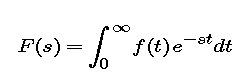
for all positive **s** such that the integral converges.
The Laplace transform is a close relative of the [Fourier transform](https://sites.math.duke.edu/education/ccp/materials/engin/ftrans/index.html). However, the fact that the Laplace transform is defined on the semi-infinite interval from **0** to infinity rather than on the whole real line, makes it somewhat more useful for dealing with initial value problems for ordinary differential equations. In addition, the Laplace transform is useful in determining solutions of partial differential equations -- particularly where the time or spatial domains are semi-infinite, e.g., heat flow in an infinite rod where the temperature at one end is known.
1. Your computer algebra system knows how to calculate Laplace transforms and inverse Laplace transform of most common functions. Use your system to calculate the Laplace transform of each of the following functions. Then calculate the inverse Laplace transform of each result. Note that each of these Laplace transforms is a rational function in the transformed variable **s**, i.e., each transform is a quotient of polynomials. Assume that **a** is positive throughout.
- **1**
- **t**
- **exp(-at)**
- **cos(at)**
- **sin(at)**
- **H(t-a)**, where **H** is the Heaviside function.
Not only does the Laplace transform convert many transcendental functions into rational ones, but it also converts differentiation into an algebraic operation. Recall that if **f** is continuously differentiable, then the Laplace transform of **df/dt** is just
**s F(s) - f(0)**
1. Verify the differentiation rule stated above for the functions below. If you use the results of Step 1, you should not need additional computer algebra calculations for this step.
- **exp(-at)**
- **cos(at)**
Just as with the [Fourier transform](https://sites.math.duke.edu/education/ccp/materials/engin/ftrans/index.html), the convolution of functions plays an important role in calculating Laplace transforms and inverse Laplace transforms. For the Laplace transform, the appropriate convolution **f \* g** is given by

With this definition of convolution, if **F** is the Laplace transform of **f** and **G** is the Laplace transform of **g**, the Laplace transform of **f \* g** is just the product of **F** and **G**.
1. Verify the rule for the Laplace transform of the convolution for the following pairs of functions:
- **f(t) = t** and **g(t) = exp(-2t)**
- **f(t) = t^2** and **g(t) = cos(3t)**
| | | | | | |
|---|---|---|---|---|---|
| | | | | | |
| [](https://sites.math.duke.edu/education/ccp/) | [](https://sites.math.duke.edu/education/ccp/materials/) | [](https://sites.math.duke.edu/education/ccp/materials/engin/) | [](https://sites.math.duke.edu/education/ccp/materials/engin/laplace/contents.html) | | |
| | | | | | |
| [](https://sites.math.duke.edu/education/ccp/materials/engin/laplace/contents.html) | [](https://sites.math.duke.edu/education/ccp/materials/engin/laplace/laplace2.html) | | | | |
***
| | |
|---|---|
| [modules at math.duke.edu](mailto:modules@math.duke.edu) | [Copyright CCP and the author(s), 1998-2001](http://www.math.duke.edu/modules/general/copyright.html) | |
| Readable Markdown | ### Experiments with the Laplace Transform
#### Part 1. Introduction
Let **f** be a piecewise smooth function defined for **t** between **0** and infinity and let **s** be positive. Then the Laplace transform **F** of **f** is defined by

for all positive **s** such that the integral converges.
The Laplace transform is a close relative of the [Fourier transform](https://sites.math.duke.edu/education/ccp/materials/engin/ftrans/index.html). However, the fact that the Laplace transform is defined on the semi-infinite interval from **0** to infinity rather than on the whole real line, makes it somewhat more useful for dealing with initial value problems for ordinary differential equations. In addition, the Laplace transform is useful in determining solutions of partial differential equations -- particularly where the time or spatial domains are semi-infinite, e.g., heat flow in an infinite rod where the temperature at one end is known.
1. Your computer algebra system knows how to calculate Laplace transforms and inverse Laplace transform of most common functions. Use your system to calculate the Laplace transform of each of the following functions. Then calculate the inverse Laplace transform of each result. Note that each of these Laplace transforms is a rational function in the transformed variable **s**, i.e., each transform is a quotient of polynomials. Assume that **a** is positive throughout.
- **1**
- **t**
- **exp(-at)**
- **cos(at)**
- **sin(at)**
- **H(t-a)**, where **H** is the Heaviside function.
Not only does the Laplace transform convert many transcendental functions into rational ones, but it also converts differentiation into an algebraic operation. Recall that if **f** is continuously differentiable, then the Laplace transform of **df/dt** is just
**s F(s) - f(0)**
1. Verify the differentiation rule stated above for the functions below. If you use the results of Step 1, you should not need additional computer algebra calculations for this step.
- **exp(-at)**
- **cos(at)**
Just as with the [Fourier transform](https://sites.math.duke.edu/education/ccp/materials/engin/ftrans/index.html), the convolution of functions plays an important role in calculating Laplace transforms and inverse Laplace transforms. For the Laplace transform, the appropriate convolution **f \* g** is given by

With this definition of convolution, if **F** is the Laplace transform of **f** and **G** is the Laplace transform of **g**, the Laplace transform of **f \* g** is just the product of **F** and **G**.
1. Verify the rule for the Laplace transform of the convolution for the following pairs of functions:
- **f(t) = t** and **g(t) = exp(-2t)**
- **f(t) = t^2** and **g(t) = cos(3t)**
*** |
| ML Classification | |
| ML Categories | null |
| ML Page Types | null |
| ML Intent Types | null |
| Content Metadata | |
| Language | null |
| Author | null |
| Publish Time | not set |
| Original Publish Time | not set |
| Republished | No |
| Word Count (Total) | 412 |
| Word Count (Content) | 397 |
| Links | |
| External Links | 0 |
| Internal Links | 11 |
| Technical SEO | |
| Meta Nofollow | No |
| Meta Noarchive | No |
| JS Rendered | No |
| Redirect Target | null |
| Performance | |
| Download Time (ms) | 88 |
| TTFB (ms) | 88 |
| Download Size (bytes) | 8,407 |
| Shard | 121 (laksa) |
| Root Hash | 7742758453951620321 |
| Unparsed URL | edu,duke!math,sites,/education/ccp/materials/engin/laplace/laplace1.html s443 |