ℹ️ Skipped - page is already crawled
| Filter | Status | Condition | Details |
|---|---|---|---|
| HTTP status | PASS | download_http_code = 200 | HTTP 200 |
| Age cutoff | PASS | download_stamp > now() - 6 MONTH | 1.6 months ago |
| History drop | PASS | isNull(history_drop_reason) | No drop reason |
| Spam/ban | PASS | fh_dont_index != 1 AND ml_spam_score = 0 | ml_spam_score=0 |
| Canonical | PASS | meta_canonical IS NULL OR = '' OR = src_unparsed | Not set |
| Property | Value |
|---|---|
| URL | https://singaporeforeveryone.com/chewing-gum-in-singapore-banned/ |
| Last Crawled | 2026-03-03 22:10:17 (1 month ago) |
| First Indexed | 2024-05-09 05:30:02 (1 year ago) |
| HTTP Status Code | 200 |
| Meta Title | This is why they banned Bubble Gum or Chewing Gum in Singapore - Singapore For Everyone |
| Meta Description | The initiation of to ban chewing gum in Singapore can be traced back to the vision of the country's first Prime Minister, Lee Kuan Yew. |
| Meta Canonical | null |
| Boilerpipe Text | Disclaimer:
Singapore For Everyone is supported by its audience. This blog contains affiliate links and is an Amazon Services LLC Associates Program member. If you make a purchase using one of these Amazon links, We may get a small compensation at no extra cost to you. Please note that we only recommend items we’ve personally used, tried, or can recommend.
See our
Disclosure and Privacy Policy
for more information.
Got any queries about your Singapore travel adventures?
Come on over to the
Singapore For Everyone Facebook group
.
I’ll be hanging out there, ready to help you out with answers!
You can receive Singapore travel updates straight to your inbox, so you don’t miss a thing!
Subscribe here.
History of Chewing Gum Ban in Singapore
Origins and Reasons for the Ban
of Chewing Gum in Singapore
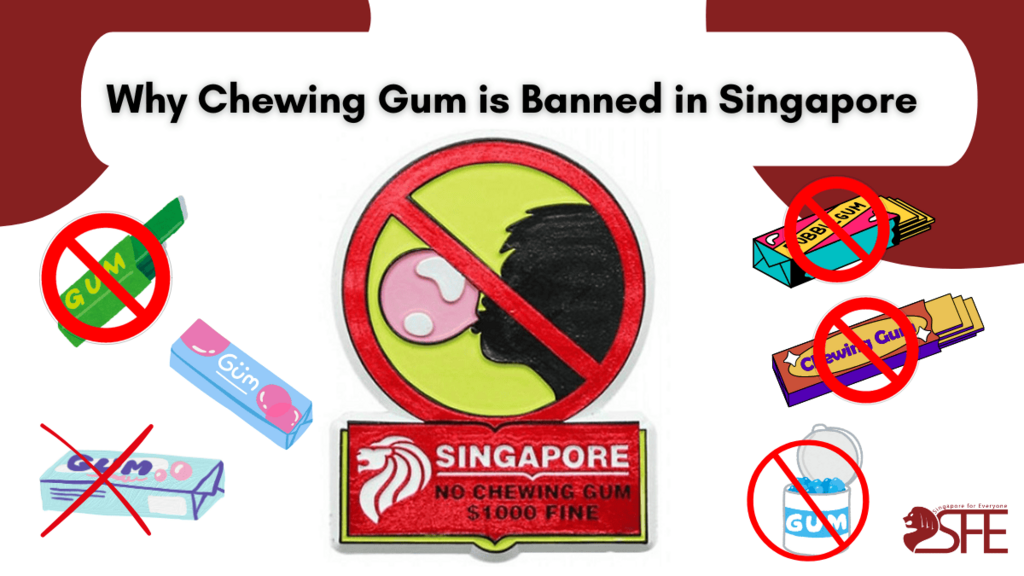
Chewing gum was banned in Singapore 1992 to maintain cleanliness and protect the city’s infrastructure.
The ban was introduced following several issues caused by gum disposal, such as littering and gum stuck on public facilities, which create a nuisance for the city’s maintenance staff and affect the efficiency of public transportation.
Apart from cleanliness, the ban was also aimed at discouraging antisocial behavior and promoting citizen discipline.
As a local travel blogger in Singapore, I must say that the ban has helped maintain the cleanliness of the streets and public spaces.
Singapore’s strict approach to public order has created an environment where visitors and residents can feel safe and proud.
Involvement of First Prime Minister Lee Kuan Yew
The initiation of to ban chewing gum in Singapore can be traced back to the vision of the country’s first Prime Minister,
Lee Kuan Yew
.
Lee Kuan Yew significantly transformed Singapore from a small port into a global trading hub, emphasizing tidiness and cleanliness as critical components of the nation’s public policy.
In the early 1980s, the Ministers of National Development approached Lee Kuan Yew with a proposal to ban chewing gum.
After some initial controls, including a ban on television advertisements promoting the sale or consumption of chewing gum in Singapore, the ban on gum sales, import, and manufacturing was implemented in full effect on January 3, 1992.
In my opinion, including the ban as an essential aspect of the city’s public policy highlights Lee Kuan Yew’s commitment to keeping Singapore clean and orderly.
As a result, Singapore has become one of the best places in the world to live and visit.
Impact on Society and Public Behavior
Cleanliness and Public Order
Singapore takes cleanliness and public order seriously, and the ban on chewing gum in Singapore is a testament to this commitment.
Since 1992, the sale and import of gum have been prohibited, primarily to maintain the city-state’s reputation as a “first-world oasis in a third-world region” –
BBC
.
I can attest to the visible difference in cleanliness in public areas compared to countries without a chewing gum ban.
Many people may not be aware that littering in Singapore carries a hefty fine, which deters people from engaging in socially inappropriate behavior such as spitting or discarding chewing gum on the streets.
To provide some context, here are a few fines related to cleanliness:
Offense
Fine
Littering
Up to SGD 2,000 (1st offense)
Spitting
Up to SGD 1,000
Vandalism with gum
Up to SGD 5,000 + possible caning
Educational Measures and Social Conduct
In addition to the fines, Singapore has implemented public education measures to reinforce good social conduct.
Schools and other institutions emphasize the importance of maintaining a clean environment, promoting the
kampung spirit
(community spirit) that encourages citizens to take pride in their surroundings.
I’ve seen these educational measures firsthand. The campaign slogans and posters around the city remind us to keep our public spaces tidy and be considerate of others.
This combination of education and enforcement has effectively maintained Singapore’s reputation as one of the world’s cleanest and most orderly countries.
While the chewing gum ban might seem extreme to some, it is just one aspect of Singapore’s efforts to promote a cleaner, more orderly society.
In my experience, it has created an environment where social misconduct is frowned upon, and public spaces are well-maintained and pleasant.
It’s something you must see for yourself on your next visit to truly appreciate the impact of these measures on Singapore’s society and public behavior.
Legal Aspects of the Ban
In 1992, Singapore implemented a strict ban on importing, selling, and manufacturing chewing gum, including bubble gum. The main reason behind this decision was to maintain cleanliness and prevent gum-related vandalism in the country.
Enforcement and Penalties
The Singaporean government has
enforced several penalties
to discourage individuals from violating the chewing gum ban. Offenders caught importing, selling, or manufacturing chewing gum in Singapore will face
hefty fines
and
potential jail terms
.
Spitting gum in public places is even prohibited, as spitting is considered a violation of the law. Here’s a brief overview of the penalties related to the ban:
Offense
Fine
Imprisonment
Importing/Selling Chewing Gum
Up to SGD 10,000
Up to 2 years
Manufacturing Chewing Gum
Up to SGD 10,000
Up to 2 years
Spitting Chewing Gum in Singapore’s Public Places
Up to SGD 1,000
–
Exceptions and Legal Sales
While bubble gum and recreational chewing gum are still banned in Singapore, there are some exceptions to the law. In 2004, the
US-Singapore Free Trade Agreement
allowed the sale of chewing gum with health benefits, such as dental gum, nicotine gum, and other sugar-free options.
These types of gum can be purchased from pharmacies in Singapore, but customers must provide their name and identification when purchasing.
A licensed pharmacist or medical practitioner prescription is also necessary to purchase nicotine gum.
I can attest to the effectiveness of this ban in maintaining the cleanliness of our streets and public infrastructure.
The strict enforcement of the prohibition has, in my opinion, instilled a sense of discipline and compliance among the residents.
For travelers visiting Singapore, it is essential to be aware of and adhere to the local laws, including the ban on chewing gum.
If you require gum with health benefits, remember to visit a pharmacy and follow the proper purchasing procedures.
Transportation and Chewing Gum
I want to share my insights on the relationship between chewing gum and public transportation in this beautiful city-state.
One of the significant factors that led to the ban on chewing gum in Singapore relates to incidents in its Mass Rapid Transit (MRT) system.
Mass Rapid Transit (MRT) Incidents
The MRT is essential to Singapore’s public transportation network, which relies heavily on its efficient, clean, and reliable train services.
In the late 1980s and early 1990s, chewing gum caused several issues within
the MRT system
, which significantly influenced the government’s decision to implement a ban.
One of the primary concerns was gum being stuck on the door sensors of the MRT cars. These sensors are crucial for ensuring the safety of passengers, as they prevent the trains from moving unless the doors are properly closed.
When chewing gum was lodged in these sensors, it disrupted the door mechanisms, causing delays in train services and inconveniencing commuters.
Here’s a brief overview of some key MRT facts and figures:
Year
MRT Opened
Length (km)
No. of Stations
1987
Yes
Approx. 28
5
1990
Yes
Over 60
24
2018 (as of Oct)
Yes
Over 230
119
It is evident how seriously the government takes matters related to the upkeep and smooth functioning of the MRT system.
The ban on chewing gum in Singapore has contributed to maintaining the high standards expected in Singapore’s public transportation.
While some may find the ban on chewing gum excessive, it has undoubtedly contributed to ensuring that Singapore’s MRT system remains one of the cleanest and most efficient in the world.
In my experience, this level of cleanliness and efficiency is unmatched, making the MRT a reliable and comfortable option for traveling within the city-state.
Reactions and Adjustments from the Public
Support and Criticism
The public’s reaction to the ban on bubble gum and chewing gum in Singapore has been a mix of support and criticism. Many locals appreciate the clean streets and public spaces that have resulted from this ban.
On the other hand, some people argue that the ban is overly restrictive and may hinder creativity.
The
Consumers Association of Singapore
and other consumer rights groups have praised the ban for keeping the city-state clean. However, critics claim that the government could have chosen alternatives to a ban, such as public service announcements or fines for littering.
It is worth mentioning that influential figures like Lee Kuan Yew played a significant role in implementing this ban, as he wanted to develop Singapore into a “first-world oasis in a third-world region.”
Adjustments in Consumer Behavior
In response to the ban on chewing gum, Singaporeans have made crucial adjustments in their consumer behavior.
Alternatives to chewing gum:
Locals have turned to other refreshments, such as breath mints, candies, and lozenges.
Pharmaceutical gum:
Singaporeans can still obtain certain gum from pharmacies for specific health-related purposes, like nicotine gums for smoking cessation.
Purchasing gum abroad:
Some locals buy and consume chewing gum while traveling to neighboring countries, as long as they do not bring it back to Singapore.
As a Singapore resident, I have witnessed these behavioral changes among my friends and family.
For instance, many carry packs of mints to achieve similar oral stimulation without breaking the law.
In summary, the chewing gum ban in Singapore has garnered both support and criticism among the public.
The government and the Consumers Association have backed the ban, while critics claim that alternate solutions could have been pursued.
Singaporean consumers have ultimately adapted to the change, seeking alternatives to gum and adjusting their consumption habits accordingly
Frequently Asked Questions
What are the consequences of importing chewing gum to Singapore?
Importing chewing gum into Singapore is prohibited, and individuals who attempt to do so may face hefty fines or penalties. The
Prohibition of Imports (Chewing Gum) Order 1992
strictly enforces this rule to maintain cleanliness in Singapore’s public spaces.
What prompted the government to prohibit the sale of chewing gum in Singapore?
The chewing gum ban in Singapore was introduced in 1992 by the former prime minister, Lee Kuan Yew, as part of a series of stringent laws to transform the nation into a
“first-world oasis in a third-world region”
. This policy sought to eradicate litter, vandalism, and other issues arising from discarded gum in public spaces.
Are there specific circumstances under which chewing gum is permitted in Singapore?
Yes, there are limited exceptions to the chewing gum ban. As mentioned earlier, medicinal and therapeutic chewing gums, including nicotine gum for smoking cessation, are permitted. Individuals can obtain these products with a medical professional or pharmacist’s prescription.
How does Singapore enforce the prohibition against chewing gum?
Singapore enforces the prohibition against chewing gum through strict regulations and monitoring. Custom checks at border entry points, including the airport, help prevent individuals from bringing chewing gum into the country. Law enforcement agencies actively enforce the ban, and those found violating the law can face fines or other penalties.
What are the legal ramifications of being caught chewing gum at Singapore’s airport?
Being caught chewing gum at Singapore’s airport can result in fines or other penalties.
Depending on the severity of the offense, violators may face hefty fines or, in extreme cases, even imprisonment.
As a local Singapore resident, it’s essential to abide by these laws and respect their purpose in maintaining cleanliness and order in public spaces. |
| Markdown | [Skip to content](https://singaporeforeveryone.com/chewing-gum-in-singapore-banned/#main)
Search site
- [BEST DEALS\!](https://singaporeforeveryone.com/singapore-deals/)
- [NEWSLETTER](https://singaporeforeveryone.com/newsletter/)
- [Home](https://singaporeforeveryone.com/)
- [About Me](https://singaporeforeveryone.com/about/)
- [Blog](https://singaporeforeveryone.com/blog/)
[Singapore For Everyone From Locals of Singapore to the World](https://singaporeforeveryone.com/)
- [WHAT’S NEW](https://singaporeforeveryone.com/whats-new-news/)
- [QUICK GUIDE](https://singaporeforeveryone.com/travel-tips/)
- [SEE AND DO](https://singaporeforeveryone.com/things-to-do-in-singapore/)
- [STAY](https://singaporeforeveryone.com/where-to-stay/)
- [Food & Drink](https://singaporeforeveryone.com/food-drink/)
- [SHOPPING GUIDE](https://singaporeforeveryone.com/shopping-guide/)
- [Tours](https://singaporeforeveryone.com/singapore-tours/)
- [Packing List](https://singaporeforeveryone.com/packing-list/)
- [Beyond Singapore](https://singaporeforeveryone.com/beyond-singapore/)
- [SOUVENIRS](https://singaporeforeveryone.com/sg-gift-souvenirs/)
[Singapore For Everyone From Locals of Singapore to the World](https://singaporeforeveryone.com/)
***Disclaimer:** Singapore For Everyone is supported by its audience. This blog contains affiliate links and is an Amazon Services LLC Associates Program member. If you make a purchase using one of these Amazon links, We may get a small compensation at no extra cost to you. Please note that we only recommend items we’ve personally used, tried, or can recommend.* See our **[Disclosure and Privacy Policy](https://singaporeforeveryone.com/privacy-policy)** for more information.
[Smart Travel](https://singaporeforeveryone.com/smart-travel/) · [How To Guide](https://singaporeforeveryone.com/how-to-guide/)
# This is why they banned Bubble Gum or Chewing Gum in Singapore
[](http://dirgan.com/)
[Dirgan Fasa](http://dirgan.com/)
***
*Got any queries about your Singapore travel adventures?*
*Come on over to the **[Singapore For Everyone Facebook group](https://www.facebook.com/groups/singaporeforeveryone)**. I’ll be hanging out there, ready to help you out with answers\!*
*You can receive Singapore travel updates straight to your inbox, so you don’t miss a thing\! [**Subscribe here.**](https://singaporeforeveryone.com/newsletter/)*
***
## **History of Chewing Gum Ban in Singapore**
### **Origins and Reasons for the Ban** **of Chewing Gum in Singapore**
Chewing gum was banned in Singapore 1992 to maintain cleanliness and protect the city’s infrastructure.


The ban was introduced following several issues caused by gum disposal, such as littering and gum stuck on public facilities, which create a nuisance for the city’s maintenance staff and affect the efficiency of public transportation.
Apart from cleanliness, the ban was also aimed at discouraging antisocial behavior and promoting citizen discipline.
[](https://singaporeforeveryone.com/singapore-deals/)
As a local travel blogger in Singapore, I must say that the ban has helped maintain the cleanliness of the streets and public spaces.
Singapore’s strict approach to public order has created an environment where visitors and residents can feel safe and proud.
***
### **Involvement of First Prime Minister Lee Kuan Yew**
The initiation of to ban chewing gum in Singapore can be traced back to the vision of the country’s first Prime Minister, [Lee Kuan Yew](https://en.wikipedia.org/wiki/Chewing_gum_sales_ban_in_Singapore).


Lee Kuan Yew significantly transformed Singapore from a small port into a global trading hub, emphasizing tidiness and cleanliness as critical components of the nation’s public policy.
In the early 1980s, the Ministers of National Development approached Lee Kuan Yew with a proposal to ban chewing gum.
After some initial controls, including a ban on television advertisements promoting the sale or consumption of chewing gum in Singapore, the ban on gum sales, import, and manufacturing was implemented in full effect on January 3, 1992.


In my opinion, including the ban as an essential aspect of the city’s public policy highlights Lee Kuan Yew’s commitment to keeping Singapore clean and orderly.
As a result, Singapore has become one of the best places in the world to live and visit.
***
## **Impact on Society and Public Behavior**
### **Cleanliness and Public Order**
Singapore takes cleanliness and public order seriously, and the ban on chewing gum in Singapore is a testament to this commitment.


Since 1992, the sale and import of gum have been prohibited, primarily to maintain the city-state’s reputation as a “first-world oasis in a third-world region” – [BBC](https://www.bbc.com/news/magazine-32090420).
I can attest to the visible difference in cleanliness in public areas compared to countries without a chewing gum ban.
Many people may not be aware that littering in Singapore carries a hefty fine, which deters people from engaging in socially inappropriate behavior such as spitting or discarding chewing gum on the streets.
To provide some context, here are a few fines related to cleanliness:
| | |
|---|---|
| **Offense** | **Fine** |
| Littering | Up to SGD 2,000 (1st offense) |
| Spitting | Up to SGD 1,000 |
| Vandalism with gum | Up to SGD 5,000 + possible caning |
***
### **Educational Measures and Social Conduct**
In addition to the fines, Singapore has implemented public education measures to reinforce good social conduct.
Schools and other institutions emphasize the importance of maintaining a clean environment, promoting the *kampung spirit* (community spirit) that encourages citizens to take pride in their surroundings.
I’ve seen these educational measures firsthand. The campaign slogans and posters around the city remind us to keep our public spaces tidy and be considerate of others.
This combination of education and enforcement has effectively maintained Singapore’s reputation as one of the world’s cleanest and most orderly countries.


Source: **[BBC Capital](https://www.bbc.com/worklife/article/20181025-the-cost-of-keeping-singapore-squeaky-clean)**
While the chewing gum ban might seem extreme to some, it is just one aspect of Singapore’s efforts to promote a cleaner, more orderly society.
In my experience, it has created an environment where social misconduct is frowned upon, and public spaces are well-maintained and pleasant.
It’s something you must see for yourself on your next visit to truly appreciate the impact of these measures on Singapore’s society and public behavior.
***
## **Legal Aspects of the Ban**
In 1992, Singapore implemented a strict ban on importing, selling, and manufacturing chewing gum, including bubble gum. The main reason behind this decision was to maintain cleanliness and prevent gum-related vandalism in the country.
### **Enforcement and Penalties**
The Singaporean government has **[enforced several penalties](https://www.nlb.gov.sg/main/article-detail?cmsuuid=8d4408cb-eb2d-4604-921e-7fa55f51baf3)** to discourage individuals from violating the chewing gum ban. Offenders caught importing, selling, or manufacturing chewing gum in Singapore will face *hefty fines* and *potential jail terms*.
Spitting gum in public places is even prohibited, as spitting is considered a violation of the law. Here’s a brief overview of the penalties related to the ban:
| | | |
|---|---|---|
| **Offense** | **Fine** | **Imprisonment** |
| Importing/Selling Chewing Gum | Up to SGD 10,000 | Up to 2 years |
| Manufacturing Chewing Gum | Up to SGD 10,000 | Up to 2 years |
| Spitting Chewing Gum in Singapore’s Public Places | Up to SGD 1,000 | – |
***
### **Exceptions and Legal Sales**
While bubble gum and recreational chewing gum are still banned in Singapore, there are some exceptions to the law. In 2004, the [US-Singapore Free Trade Agreement](https://theculturetrip.com/asia/singapore/articles/why-singapore-banned-chewing-gum) allowed the sale of chewing gum with health benefits, such as dental gum, nicotine gum, and other sugar-free options.


These types of gum can be purchased from pharmacies in Singapore, but customers must provide their name and identification when purchasing.
A licensed pharmacist or medical practitioner prescription is also necessary to purchase nicotine gum.
I can attest to the effectiveness of this ban in maintaining the cleanliness of our streets and public infrastructure.
The strict enforcement of the prohibition has, in my opinion, instilled a sense of discipline and compliance among the residents.
For travelers visiting Singapore, it is essential to be aware of and adhere to the local laws, including the ban on chewing gum.
If you require gum with health benefits, remember to visit a pharmacy and follow the proper purchasing procedures.
***
## **Transportation and Chewing Gum**
I want to share my insights on the relationship between chewing gum and public transportation in this beautiful city-state.
One of the significant factors that led to the ban on chewing gum in Singapore relates to incidents in its Mass Rapid Transit (MRT) system.
### **Mass Rapid Transit (MRT) Incidents**
The MRT is essential to Singapore’s public transportation network, which relies heavily on its efficient, clean, and reliable train services.
In the late 1980s and early 1990s, chewing gum caused several issues within **[the MRT system](<http://How To Use Singapore MRT: Effortless Guide For A Smooth Transit!>)**, which significantly influenced the government’s decision to implement a ban.


One of the primary concerns was gum being stuck on the door sensors of the MRT cars. These sensors are crucial for ensuring the safety of passengers, as they prevent the trains from moving unless the doors are properly closed.
When chewing gum was lodged in these sensors, it disrupted the door mechanisms, causing delays in train services and inconveniencing commuters.
**Here’s a brief overview of some key MRT facts and figures:**
| | | | |
|---|---|---|---|
| **Year** | **MRT Opened** | **Length (km)** | **No. of Stations** |
| 1987 | Yes | Approx. 28 | 5 |
| 1990 | Yes | Over 60 | 24 |
| 2018 (as of Oct) | Yes | Over 230 | 119 |
It is evident how seriously the government takes matters related to the upkeep and smooth functioning of the MRT system.
The ban on chewing gum in Singapore has contributed to maintaining the high standards expected in Singapore’s public transportation.


While some may find the ban on chewing gum excessive, it has undoubtedly contributed to ensuring that Singapore’s MRT system remains one of the cleanest and most efficient in the world.
In my experience, this level of cleanliness and efficiency is unmatched, making the MRT a reliable and comfortable option for traveling within the city-state.
**READ OTHER ARTICLES BEFORE YOU GO TO SINGAPORE:**
✅ [**Ultimate Guide To Smoking In Singapore For Smoking Travelers: Rules, Regulations, And Tips.**](https://singaporeforeveryone.com/guide-to-smoking-in-singapore/)
✅ [**5 Best Money Changers In Singapore For World Travelers: Unbeatable Rates For Your Currency Swap**](https://singaporeforeveryone.com/5-best-money-changers-in-singapore/)
***
## **Reactions and Adjustments from the Public**
### **Support and Criticism**
The public’s reaction to the ban on bubble gum and chewing gum in Singapore has been a mix of support and criticism. Many locals appreciate the clean streets and public spaces that have resulted from this ban.
On the other hand, some people argue that the ban is overly restrictive and may hinder creativity.
The **Consumers Association of Singapore** and other consumer rights groups have praised the ban for keeping the city-state clean. However, critics claim that the government could have chosen alternatives to a ban, such as public service announcements or fines for littering.
It is worth mentioning that influential figures like Lee Kuan Yew played a significant role in implementing this ban, as he wanted to develop Singapore into a “first-world oasis in a third-world region.”
***
### **Adjustments in Consumer Behavior**
In response to the ban on chewing gum, Singaporeans have made crucial adjustments in their consumer behavior.
1. **Alternatives to chewing gum:** Locals have turned to other refreshments, such as breath mints, candies, and lozenges.
2. **Pharmaceutical gum:** Singaporeans can still obtain certain gum from pharmacies for specific health-related purposes, like nicotine gums for smoking cessation.
3. **Purchasing gum abroad:** Some locals buy and consume chewing gum while traveling to neighboring countries, as long as they do not bring it back to Singapore.
As a Singapore resident, I have witnessed these behavioral changes among my friends and family.
For instance, many carry packs of mints to achieve similar oral stimulation without breaking the law.
In summary, the chewing gum ban in Singapore has garnered both support and criticism among the public.
The government and the Consumers Association have backed the ban, while critics claim that alternate solutions could have been pursued.
Singaporean consumers have ultimately adapted to the change, seeking alternatives to gum and adjusting their consumption habits accordingly
***
## **Frequently Asked Questions**
### **What are the consequences of importing chewing gum to Singapore?**
Importing chewing gum into Singapore is prohibited, and individuals who attempt to do so may face hefty fines or penalties. The [Prohibition of Imports (Chewing Gum) Order 1992](https://www.nlb.gov.sg/main/article-detail?cmsuuid=57a854df-8684-456b-893a-a303e0041891) strictly enforces this rule to maintain cleanliness in Singapore’s public spaces.
### **What prompted the government to prohibit the sale of chewing gum in Singapore?**
The chewing gum ban in Singapore was introduced in 1992 by the former prime minister, Lee Kuan Yew, as part of a series of stringent laws to transform the nation into a [“first-world oasis in a third-world region”](https://www.mashed.com/467293/the-real-reason-chewing-gum-is-banned-in-singapore/). This policy sought to eradicate litter, vandalism, and other issues arising from discarded gum in public spaces.
### **Are there specific circumstances under which chewing gum is permitted in Singapore?**
Yes, there are limited exceptions to the chewing gum ban. As mentioned earlier, medicinal and therapeutic chewing gums, including nicotine gum for smoking cessation, are permitted. Individuals can obtain these products with a medical professional or pharmacist’s prescription.
### **How does Singapore enforce the prohibition against chewing gum?**
Singapore enforces the prohibition against chewing gum through strict regulations and monitoring. Custom checks at border entry points, including the airport, help prevent individuals from bringing chewing gum into the country. Law enforcement agencies actively enforce the ban, and those found violating the law can face fines or other penalties.
### What are the legal ramifications of being caught chewing gum at Singapore’s airport?
Being caught chewing gum at Singapore’s airport can result in fines or other penalties.
Depending on the severity of the offense, violators may face hefty fines or, in extreme cases, even imprisonment.
As a local Singapore resident, it’s essential to abide by these laws and respect their purpose in maintaining cleanliness and order in public spaces.
**Get the best price for your accommodation** **in Singapore** ⤵️


**[Dirgan Fasa](https://singaporeforeveryone.com/author/dirgan-fasa/ "Posts by Dirgan Fasa")**
Traveler and Photographer
Dirgan Fasa is a traveler and photographer based in Singapore. Love to share travel information about Singapore with the world through my community platform, Singapore For Everyone.
### Leave a Reply[Cancel reply](https://singaporeforeveryone.com/chewing-gum-in-singapore-banned/#respond)


### **ABOUT ME**
Hi, I'm Gan, a Singapore photographer and founder of *Singapore For Everyone*. **I created [this website](https://singaporeforeveryone.com/)** as a guide for all of you.
This guide is for everyone coming to Singapore who wants to know the basic and exciting things in Singapore. [**\[ READ MORE** **\]**](https://singaporeforeveryone.com/about-us)
#### **SEARCH SITE**
Categories
[](https://singaporeforeveryone.com/singapore-deals/)
- [Disclosure and Privacy Policy](https://singaporeforeveryone.com/privacy-policy/)
© 2026 Singapore For Everyone
## Connect With Us

- [WHAT’S NEW](https://singaporeforeveryone.com/whats-new-news/)
- [QUICK GUIDE](https://singaporeforeveryone.com/travel-tips/)
- [SEE AND DO](https://singaporeforeveryone.com/things-to-do-in-singapore/)
- [STAY](https://singaporeforeveryone.com/where-to-stay/)
- [Food & Drink](https://singaporeforeveryone.com/food-drink/)
- [SHOPPING GUIDE](https://singaporeforeveryone.com/shopping-guide/)
- [Tours](https://singaporeforeveryone.com/singapore-tours/)
- [Packing List](https://singaporeforeveryone.com/packing-list/)
- [Beyond Singapore](https://singaporeforeveryone.com/beyond-singapore/)
- [SOUVENIRS](https://singaporeforeveryone.com/sg-gift-souvenirs/)
Search site
- [BEST DEALS\!](https://singaporeforeveryone.com/singapore-deals/)
- [NEWSLETTER](https://singaporeforeveryone.com/newsletter/)
- [Home](https://singaporeforeveryone.com/)
- [About Me](https://singaporeforeveryone.com/about/)
- [Blog](https://singaporeforeveryone.com/blog/) |
| Readable Markdown | ***Disclaimer:** Singapore For Everyone is supported by its audience. This blog contains affiliate links and is an Amazon Services LLC Associates Program member. If you make a purchase using one of these Amazon links, We may get a small compensation at no extra cost to you. Please note that we only recommend items we’ve personally used, tried, or can recommend.* See our **[Disclosure and Privacy Policy](https://singaporeforeveryone.com/privacy-policy)** for more information.
*Got any queries about your Singapore travel adventures?*
*Come on over to the **[Singapore For Everyone Facebook group](https://www.facebook.com/groups/singaporeforeveryone)**. I’ll be hanging out there, ready to help you out with answers\!*
*You can receive Singapore travel updates straight to your inbox, so you don’t miss a thing\! [**Subscribe here.**](https://singaporeforeveryone.com/newsletter/)*
## **History of Chewing Gum Ban in Singapore**
### **Origins and Reasons for the Ban** **of Chewing Gum in Singapore**
Chewing gum was banned in Singapore 1992 to maintain cleanliness and protect the city’s infrastructure.

The ban was introduced following several issues caused by gum disposal, such as littering and gum stuck on public facilities, which create a nuisance for the city’s maintenance staff and affect the efficiency of public transportation.
Apart from cleanliness, the ban was also aimed at discouraging antisocial behavior and promoting citizen discipline.
[](https://singaporeforeveryone.com/singapore-deals/)
As a local travel blogger in Singapore, I must say that the ban has helped maintain the cleanliness of the streets and public spaces.
Singapore’s strict approach to public order has created an environment where visitors and residents can feel safe and proud.
***
### **Involvement of First Prime Minister Lee Kuan Yew**
The initiation of to ban chewing gum in Singapore can be traced back to the vision of the country’s first Prime Minister, [Lee Kuan Yew](https://en.wikipedia.org/wiki/Chewing_gum_sales_ban_in_Singapore).

Lee Kuan Yew significantly transformed Singapore from a small port into a global trading hub, emphasizing tidiness and cleanliness as critical components of the nation’s public policy.
In the early 1980s, the Ministers of National Development approached Lee Kuan Yew with a proposal to ban chewing gum.
After some initial controls, including a ban on television advertisements promoting the sale or consumption of chewing gum in Singapore, the ban on gum sales, import, and manufacturing was implemented in full effect on January 3, 1992.

In my opinion, including the ban as an essential aspect of the city’s public policy highlights Lee Kuan Yew’s commitment to keeping Singapore clean and orderly.
As a result, Singapore has become one of the best places in the world to live and visit.
## **Impact on Society and Public Behavior**
### **Cleanliness and Public Order**
Singapore takes cleanliness and public order seriously, and the ban on chewing gum in Singapore is a testament to this commitment.

Since 1992, the sale and import of gum have been prohibited, primarily to maintain the city-state’s reputation as a “first-world oasis in a third-world region” – [BBC](https://www.bbc.com/news/magazine-32090420).
I can attest to the visible difference in cleanliness in public areas compared to countries without a chewing gum ban.
Many people may not be aware that littering in Singapore carries a hefty fine, which deters people from engaging in socially inappropriate behavior such as spitting or discarding chewing gum on the streets.
To provide some context, here are a few fines related to cleanliness:
| | |
|---|---|
| **Offense** | **Fine** |
| Littering | Up to SGD 2,000 (1st offense) |
| Spitting | Up to SGD 1,000 |
| Vandalism with gum | Up to SGD 5,000 + possible caning |
***
### **Educational Measures and Social Conduct**
In addition to the fines, Singapore has implemented public education measures to reinforce good social conduct.
Schools and other institutions emphasize the importance of maintaining a clean environment, promoting the *kampung spirit* (community spirit) that encourages citizens to take pride in their surroundings.
I’ve seen these educational measures firsthand. The campaign slogans and posters around the city remind us to keep our public spaces tidy and be considerate of others.
This combination of education and enforcement has effectively maintained Singapore’s reputation as one of the world’s cleanest and most orderly countries.
While the chewing gum ban might seem extreme to some, it is just one aspect of Singapore’s efforts to promote a cleaner, more orderly society.
In my experience, it has created an environment where social misconduct is frowned upon, and public spaces are well-maintained and pleasant.
It’s something you must see for yourself on your next visit to truly appreciate the impact of these measures on Singapore’s society and public behavior.
## **Legal Aspects of the Ban**
In 1992, Singapore implemented a strict ban on importing, selling, and manufacturing chewing gum, including bubble gum. The main reason behind this decision was to maintain cleanliness and prevent gum-related vandalism in the country.
### **Enforcement and Penalties**
The Singaporean government has **[enforced several penalties](https://www.nlb.gov.sg/main/article-detail?cmsuuid=8d4408cb-eb2d-4604-921e-7fa55f51baf3)** to discourage individuals from violating the chewing gum ban. Offenders caught importing, selling, or manufacturing chewing gum in Singapore will face *hefty fines* and *potential jail terms*.
Spitting gum in public places is even prohibited, as spitting is considered a violation of the law. Here’s a brief overview of the penalties related to the ban:
| | | |
|---|---|---|
| **Offense** | **Fine** | **Imprisonment** |
| Importing/Selling Chewing Gum | Up to SGD 10,000 | Up to 2 years |
| Manufacturing Chewing Gum | Up to SGD 10,000 | Up to 2 years |
| Spitting Chewing Gum in Singapore’s Public Places | Up to SGD 1,000 | – |
***
### **Exceptions and Legal Sales**
While bubble gum and recreational chewing gum are still banned in Singapore, there are some exceptions to the law. In 2004, the [US-Singapore Free Trade Agreement](https://theculturetrip.com/asia/singapore/articles/why-singapore-banned-chewing-gum) allowed the sale of chewing gum with health benefits, such as dental gum, nicotine gum, and other sugar-free options.

These types of gum can be purchased from pharmacies in Singapore, but customers must provide their name and identification when purchasing.
A licensed pharmacist or medical practitioner prescription is also necessary to purchase nicotine gum.
I can attest to the effectiveness of this ban in maintaining the cleanliness of our streets and public infrastructure.
The strict enforcement of the prohibition has, in my opinion, instilled a sense of discipline and compliance among the residents.
For travelers visiting Singapore, it is essential to be aware of and adhere to the local laws, including the ban on chewing gum.
If you require gum with health benefits, remember to visit a pharmacy and follow the proper purchasing procedures.
## **Transportation and Chewing Gum**
I want to share my insights on the relationship between chewing gum and public transportation in this beautiful city-state.
One of the significant factors that led to the ban on chewing gum in Singapore relates to incidents in its Mass Rapid Transit (MRT) system.
### **Mass Rapid Transit (MRT) Incidents**
The MRT is essential to Singapore’s public transportation network, which relies heavily on its efficient, clean, and reliable train services.
In the late 1980s and early 1990s, chewing gum caused several issues within **[the MRT system](<http://How To Use Singapore MRT: Effortless Guide For A Smooth Transit!>)**, which significantly influenced the government’s decision to implement a ban.

One of the primary concerns was gum being stuck on the door sensors of the MRT cars. These sensors are crucial for ensuring the safety of passengers, as they prevent the trains from moving unless the doors are properly closed.
When chewing gum was lodged in these sensors, it disrupted the door mechanisms, causing delays in train services and inconveniencing commuters.
**Here’s a brief overview of some key MRT facts and figures:**
| | | | |
|---|---|---|---|
| **Year** | **MRT Opened** | **Length (km)** | **No. of Stations** |
| 1987 | Yes | Approx. 28 | 5 |
| 1990 | Yes | Over 60 | 24 |
| 2018 (as of Oct) | Yes | Over 230 | 119 |
It is evident how seriously the government takes matters related to the upkeep and smooth functioning of the MRT system.
The ban on chewing gum in Singapore has contributed to maintaining the high standards expected in Singapore’s public transportation.

While some may find the ban on chewing gum excessive, it has undoubtedly contributed to ensuring that Singapore’s MRT system remains one of the cleanest and most efficient in the world.
In my experience, this level of cleanliness and efficiency is unmatched, making the MRT a reliable and comfortable option for traveling within the city-state.
## **Reactions and Adjustments from the Public**
### **Support and Criticism**
The public’s reaction to the ban on bubble gum and chewing gum in Singapore has been a mix of support and criticism. Many locals appreciate the clean streets and public spaces that have resulted from this ban.
On the other hand, some people argue that the ban is overly restrictive and may hinder creativity.
The **Consumers Association of Singapore** and other consumer rights groups have praised the ban for keeping the city-state clean. However, critics claim that the government could have chosen alternatives to a ban, such as public service announcements or fines for littering.
It is worth mentioning that influential figures like Lee Kuan Yew played a significant role in implementing this ban, as he wanted to develop Singapore into a “first-world oasis in a third-world region.”
***
### **Adjustments in Consumer Behavior**
In response to the ban on chewing gum, Singaporeans have made crucial adjustments in their consumer behavior.
1. **Alternatives to chewing gum:** Locals have turned to other refreshments, such as breath mints, candies, and lozenges.
2. **Pharmaceutical gum:** Singaporeans can still obtain certain gum from pharmacies for specific health-related purposes, like nicotine gums for smoking cessation.
3. **Purchasing gum abroad:** Some locals buy and consume chewing gum while traveling to neighboring countries, as long as they do not bring it back to Singapore.
As a Singapore resident, I have witnessed these behavioral changes among my friends and family.
For instance, many carry packs of mints to achieve similar oral stimulation without breaking the law.
In summary, the chewing gum ban in Singapore has garnered both support and criticism among the public.
The government and the Consumers Association have backed the ban, while critics claim that alternate solutions could have been pursued.
Singaporean consumers have ultimately adapted to the change, seeking alternatives to gum and adjusting their consumption habits accordingly
## **Frequently Asked Questions**
### **What are the consequences of importing chewing gum to Singapore?**
Importing chewing gum into Singapore is prohibited, and individuals who attempt to do so may face hefty fines or penalties. The [Prohibition of Imports (Chewing Gum) Order 1992](https://www.nlb.gov.sg/main/article-detail?cmsuuid=57a854df-8684-456b-893a-a303e0041891) strictly enforces this rule to maintain cleanliness in Singapore’s public spaces.
### **What prompted the government to prohibit the sale of chewing gum in Singapore?**
The chewing gum ban in Singapore was introduced in 1992 by the former prime minister, Lee Kuan Yew, as part of a series of stringent laws to transform the nation into a [“first-world oasis in a third-world region”](https://www.mashed.com/467293/the-real-reason-chewing-gum-is-banned-in-singapore/). This policy sought to eradicate litter, vandalism, and other issues arising from discarded gum in public spaces.
### **Are there specific circumstances under which chewing gum is permitted in Singapore?**
Yes, there are limited exceptions to the chewing gum ban. As mentioned earlier, medicinal and therapeutic chewing gums, including nicotine gum for smoking cessation, are permitted. Individuals can obtain these products with a medical professional or pharmacist’s prescription.
### **How does Singapore enforce the prohibition against chewing gum?**
Singapore enforces the prohibition against chewing gum through strict regulations and monitoring. Custom checks at border entry points, including the airport, help prevent individuals from bringing chewing gum into the country. Law enforcement agencies actively enforce the ban, and those found violating the law can face fines or other penalties.
### What are the legal ramifications of being caught chewing gum at Singapore’s airport?
Being caught chewing gum at Singapore’s airport can result in fines or other penalties.
Depending on the severity of the offense, violators may face hefty fines or, in extreme cases, even imprisonment.
As a local Singapore resident, it’s essential to abide by these laws and respect their purpose in maintaining cleanliness and order in public spaces. |
| Shard | 76 (laksa) |
| Root Hash | 12418702536520475676 |
| Unparsed URL | com,singaporeforeveryone!/chewing-gum-in-singapore-banned/ s443 |