ℹ️ Skipped - page is already crawled
| Filter | Status | Condition | Details |
|---|---|---|---|
| HTTP status | PASS | download_http_code = 200 | HTTP 200 |
| Age cutoff | PASS | download_stamp > now() - 6 MONTH | 0 months ago |
| History drop | PASS | isNull(history_drop_reason) | No drop reason |
| Spam/ban | PASS | fh_dont_index != 1 AND ml_spam_score = 0 | ml_spam_score=0 |
| Canonical | PASS | meta_canonical IS NULL OR = '' OR = src_unparsed | Not set |
| Property | Value | ||||||
|---|---|---|---|---|---|---|---|
| URL | https://science.nasa.gov/universe/exoplanets/life-in-the-universe-what-are-the-odds/ | ||||||
| Last Crawled | 2026-04-27 19:00:01 (20 hours ago) | ||||||
| First Indexed | 2024-05-10 06:43:01 (1 year ago) | ||||||
| HTTP Status Code | 200 | ||||||
| Content | |||||||
| Meta Title | Life in the Universe: What are the Odds? - NASA Science | ||||||
| Meta Description | We don't know when, or even if, we'll find life beyond Earth, but NASA scientists continue the hunt among the thousands of exoplanets confirmed in the galaxy so far. | ||||||
| Meta Canonical | null | ||||||
| Boilerpipe Text | As humanity casts an ever-wider net across the cosmos, capturing evidence of thousands of worlds, an ancient question haunts us: Is anybody out there?
The good news: We know vastly more than any previous generation. Our galaxy is
crowded with exoplanets
– planets around other stars. A healthy percentage of them are small, rocky worlds, of a similar size and likely similar composition to our home planet.
The ingredients in the recipe for earthly life – water, elements associated with life, available sources of energy – appear to be almost everywhere we’ve looked.
Now the bad news. We have yet to find another “Earth” with life, intelligent or not. Observing signs of possible microbial life in exoplanet atmospheres is currently just out of reach. No convincing evidence of advanced technology – artificial signals by radio or other means, or the telltale sign of, say, massive extraterrestrial engineering projects – has yet crossed our formidable arrays of telescopes in space or on the ground.
And finding non-intelligent life is far more likely; Earth existed for most of its history, 4.25 billion years, without a whisper of technological life, and human civilization is a very late-breaking development.
Is there life beyond Earth? So far, the silence is deafening.
“I hope it’s there,” said Shawn Domagal-Goldman, a research astronomer at
NASA’s Goddard Space Flight Center
in Greenbelt, Maryland. “I want it to be there. I’ll be planning a party if we find it.”
Domagal-Goldman co-leads a team of exoplanet hunters who, in the years and decades ahead, are planning to do just that. Working with scientists across NASA, as well as academic and international partners, his team and others are helping to design and build the next generation of instruments to sift through light from other worlds, and other suns. The goal: unambiguous evidence of another living, breathing world.
While the chances of finding life elsewhere remain unknown, the odds can be said to be improving. A well-known list of the data needed to determine the likely abundance of life-bearing worlds, though highly conjectural, is known as the “Drake equation.”
Put forward in 1961 by astronomer Frank Drake, the list remains mostly blank. It begins with the rate of star formation in the galaxy and the fraction of stars that have planets, leading step-by-step through the portion of planets that support life and – most speculatively – to the existence and durability of detectable, technological civilizations.
When Drake introduced this roadmap to life beyond Earth, all the terms – the signposts along the way – were blank.
Some of the first few items are now known, including the potential presence of habitable worlds, said researcher Ravi Kopparapu from Goddard, also a co-leader of Domagal-Goldman’s team. He studies the habitability and potential for life on exoplanets.
If we develop and launch a powerful enough space telescope, “we could figure out if we have advanced life or biological life,” he said.
Drake’s list can be a good conversation starter, and a useful way to frame the complex questions around the possibility of other life. But these days, scientists don’t spend a great deal of time discussing it, Domagal-Goldman said.
Instead, they use a narrower yardstick: the habitable zone.
Every star, like every campfire, has a definable zone of radiated warmth. Too close, and your marshmallow – or your planet – might end up as nothing more than a charred cinder. Too far away, and its surface remains cold and unappetizing.
In both cases, “just right” is more likely to be somewhere in between.
For a planet, the
habitable zone
is the distance from a star that allows liquid water to persist on its surface – as long as that planet has a suitable atmosphere.
In our solar system, Earth sits comfortably inside the Sun’s habitable zone. Broiling planet Venus is within the inner edge, while refrigerated Mars is near the outer boundary.
Determine the distance of an exoplanet from the star itself, as well as the star’s size and energy output, and you can estimate whether the planet falls within the habitable zone.
For larger, hotter stars, the zone is farther away; for smaller, cooler stars, it can be very close indeed. Finding these “just right” planets in the habitable zone is one of the keys to finding signs of life.
“If they fit within these parameters, they could potentially support a temperate environment,” said Natasha Batalha, a research scientist at the
NASA Ames Research Center
. “Therefore it would be incredibly interesting to study their atmospheres.”
Batalha’s specialty, in fact, is finding ways to read exoplanet atmospheres – and building computer models to better understand them.
“That is the next step, the next frontier,” she said.
The habitable zone concept is not yet definitive. Small, rocky worlds like ours that orbit other stars are too far away to determine whether they have atmospheres, at least using present-day technology.
That’s where teams like the one co-led by Kopparapu and Domagal-Goldman come in. The space telescopes and instruments now on their drawing boards are meant to be powerful enough to peer into these atmospheres and identify the molecules present. That will tell us which gases dominate.
We could find a small, rocky, watery world around a Sun-like star with an atmosphere of nitrogen, oxygen, and carbon dioxide: a little like looking in a mirror.
“To search for life anywhere, we have this ‘follow the water’ approach,” Domagal-Goldman said. “Anywhere you find water on Earth, you find life. Whether it’s life on Mars, ocean worlds, or exoplanets, water is the first signpost we’re looking for.”
For now, the habitable zone remains a kind of first cut in the search for life-bearing worlds.
“The habitable zone is a very useful tool for mission design,” said Rhonda Morgan of
NASA’s Jet Propulsion Laboratory
in Southern California.
She studies how to use the data gathered so far on exoplanets to refine designs for future space telescopes.
Over the past quarter century, thousands of exoplanets have been confirmed in a Milky Way galaxy that likely holds trillions. Thousands more will come to light in the years ahead. Tools like the habitable zone will help planet hunters sort through these growing ranks to pick the most likely candidates for supporting life.
“We are in a position now where we can propose a potential, future mission that would be capable of directly imaging an Earth-like planet around a nearby, Sun-like star,” she said. “This is the first time in history that the technology has been this close, probably less than 10 years from launch.”
Still, we might need something beyond the habitable-zone concept for more extreme cases. It won’t help much, for instance, with “weird” life – life as we don’t know it. Living things on other worlds might use vastly different chemistry and molecular compounds, or even a solvent other than water.
“This is one of the questions we get from the public often: If there are aliens, how are we going to recognize them if they’re really weird?” Domagal-Goldman said. “How do we find what we would consider to be weird life? And how do we make sure not to be tricked by strange, dead planets that look alive – mirages in the desert?”
Life on planets around other stars also might be hidden in a subsurface ocean encased in ice, invisible even to our most powerful space telescopes. Moons of Jupiter and Saturn are known to
harbor such oceans
, some revealing through remote sensing at least a few of the characteristics we expect for habitable worlds.
Some “exo-moons” also might be habitable worlds, as in the film, “Avatar.” But even proposed, future instruments are unlikely to have sufficient power to detect atmospheres of moons around giant exoplanets.
Still, the habitable zone is a good start, a way to zero in on signs of life made familiar by our fellow organisms here on planet Earth.
A shortcut to finding lifeforms like ourselves, of course, would be to intercept tech-savvy communications. Searches for signs of intelligent life have been underway for decades.
In recent years, among NASA scientists, such potential signs have acquired an intriguing new name: technosignatures.
Evidence of a communicative, technological species somewhere among the endless fields of stars could come in the traditional form: signals by radio or optical light waves, or from some other slice of the electromagnetic spectrum.
But scientists imagine many other forms. An exoplanet atmosphere might show signs of synthetic gases, such as CFCs, revealing an industrial species like us.
Or maybe we’ll see the glimmer of something like a “Dyson sphere,” popularized by physicist Freeman Dyson: an epic-scale structure built around a star to capture the lion’s share of its energy.
Such possibilities remain speculative. For now, we have no real answer to a disturbing question from another 20
th
century physicist, Enrico Fermi.
Where is everybody?
The question has fueled more than 70 years of debate, but boils down to a simple observation. Our Milky Way galaxy has plenty of stars, plenty of planets, and plenty of time to develop intelligent lifeforms – some of whom might well have had billions of years to develop interstellar travel.
Yet so far, we’ve seen no sign of such technology, nor heard a peep of conversation. Why is the cosmos so profoundly silent?
“If life had so much time to evolve, why haven’t we found it?” Batalha asks, to summarize the question. “Why isn’t life just crawling everywhere in the galaxy, or the universe? It could be a combination of a lot of things. Space travel is very difficult for us.”
Vast amounts of energy would be needed just to get us to our nearest neighboring star, Proxima Centauri, she said. “It would just be incredibly expensive, and require a lot of resources.”
And once we – or some other civilization – reached such a distant destination, she said, another problem would be perpetuating the travelers’ existence into future generations.
Experts offer many reasons why somebody, or something, might be out there, yet beyond our detection. On the other hand, the ultra-cautious might remind us that, while a lifeless cosmos seems unlikely, we have exactly zero information one way or the other.
Still, scientists like Kopparapu say they like our chances of finding some form of life, and are hard at work on the telescopes and instruments that could make that future, party-starting epiphany a reality.
“It’s not a question of ‘if,’ it’s a question of ‘when’ we find life on other planets,” he said. “I’m sure in my lifetime, in our lifetime, we will know if there is life on other worlds.” | ||||||
| Markdown | [](https://www.nasa.gov/)
- Explore
[](https://www.nasa.gov/)
- News & Events
- [Recently Published](https://www.nasa.gov/news/recently-published/)
- [Video Series on NASA+](https://www.nasa.gov/plus/)
- [Podcasts & Audio](https://www.nasa.gov/podcasts-and-audio/)
- [Blogs](https://www.nasa.gov/nasa-blogs/)
- [Newsletters](https://www.nasa.gov/newsletters/)
- [Social Media](https://www.nasa.gov/socialmedia/)
- [Media Resources](https://www.nasa.gov/news/nasa-media-contacts/)
- Multimedia
- [Images](https://www.nasa.gov/images/)
- [Videos on NASA+](https://www.nasa.gov/plus/)
- [Interactives](https://www.nasa.gov/nasa-interactive-features/)
- [NASA Apps](https://www.nasa.gov/apps/)
- [Podcasts](https://www.nasa.gov/podcasts/)
- [e-Books](https://www.nasa.gov/ebooks/)
- [STEM Multimedia](https://www.nasa.gov/learning-resources/search/?terms=8058%2C8059%2C8061%2C8062%2C8068)
- [NASA+](https://plus.nasa.gov/)
## Suggested Searches
- [Climate Change](https://science.nasa.gov/?search=Climate%20Change)
- [Artemis](https://science.nasa.gov/?search=Artemis)
- [Expedition 64](https://science.nasa.gov/?search=Expedition%2064)
- [Mars perseverance](https://science.nasa.gov/?search=Mars%20perseverance)
- [SpaceX Crew-2](https://science.nasa.gov/?search=SpaceX%20Crew-2)
- [International Space Station](https://science.nasa.gov/?search=International%20Space%20Station)
- [View All Topics A-Z](https://science.nasa.gov/a-to-z-topics-listing/)
- [Home](https://science.nasa.gov/)
- [Missions](https://science.nasa.gov/nasa-missions/)
- [Humans in Space](https://science.nasa.gov/humans-in-space/)
- [Earth](https://science.nasa.gov/earth/)
- [The Solar System](https://science.nasa.gov/solar-system/)
- [The Universe](https://science.nasa.gov/universe/)
- [Science](https://science.nasa.gov/)
- [Aeronautics](https://science.nasa.gov/aeronautics/)
- [Technology](https://science.nasa.gov/technology/)
- [Learning Resources](https://science.nasa.gov/learning-resources/)
- [About NASA](https://science.nasa.gov/about/)
- [Español](https://science.nasa.gov/es/)
- [News & Events](https://science.nasa.gov/universe/exoplanets/life-in-the-universe-what-are-the-odds/)
- [Multimedia](https://science.nasa.gov/universe/exoplanets/life-in-the-universe-what-are-the-odds/)
- [NASA+](https://plus.nasa.gov/)
### Highlights
[5 min read NASA’s Curiosity Finds Organic Molecules Never Seen Before on Mars article 6 days ago](https://www.nasa.gov/missions/mars-science-laboratory/curiosity-rover/nasas-curiosity-finds-organic-molecules-never-seen-before-on-mars/)
[1 min read New NASA Views of Earth, From (S)PACE article 6 days ago](https://science.nasa.gov/earth/new-nasa-views-of-earth-from-space/)
[5 min read Artemis II Mission Milestones: An Image and Video Recap article 5 days ago](https://www.nasa.gov/centers-and-facilities/johnson/artemis-ii-mission-milestones-an-image-and-video-recap/)
Back
***
[Missions](https://science.nasa.gov/nasa-missions/)
- [Search All NASA Missions](https://www.nasa.gov/missions/)
- [A to Z List of Missions](https://www.nasa.gov/a-to-z-of-nasa-missions/)
- [Upcoming Launches and Landings](https://www.nasa.gov/events/)
- [Spaceships and Rockets](https://www.nasa.gov/humans-in-space/spaceships-and-rockets/)
- [Communicating with Missions](https://www.nasa.gov/communicating-with-missions/)
- [Artemis](https://www.nasa.gov/humans-in-space/artemis/)
- [James Webb Space Telescope](https://science.nasa.gov/mission/webb/)
- [Hubble Space Telescope](https://science.nasa.gov/mission/hubble/)
- [International Space Station](https://www.nasa.gov/international-space-station/)
- [OSIRIS-REx](https://science.nasa.gov/mission/osiris-rex/)
[Humans in Space](https://science.nasa.gov/humans-in-space/)
- [Why Go to Space](https://www.nasa.gov/humans-in-space/why-go-to-space/)
- [Astronauts](https://www.nasa.gov/humans-in-space/astronauts/)
- [Commercial Space](https://www.nasa.gov/humans-in-space/commercial-space/)
- [Destinations](https://www.nasa.gov/humans-in-space/destinations/)
- [Spaceships and Rockets](https://www.nasa.gov/humans-in-space/spaceships-and-rockets/)
- [Living in Space](https://www.nasa.gov/humans-in-space/living-in-space/)
[Earth](https://science.nasa.gov/earth/)
- [Explore Earth Science](https://science.nasa.gov/earth/explore/)
- [Climate Change](https://science.nasa.gov/climate-change/)
- [Earth, Our Planet](https://science.nasa.gov/earth/facts/)
- [Earth Science in Action](https://science.nasa.gov/earth/in-action/)
- [Earth Multimedia](https://science.nasa.gov/earth/multimedia/)
- [Earth Data](https://science.nasa.gov/earth/data/)
- [Earth Science Researchers](https://science.nasa.gov/earth-science/)
[The Solar System](https://science.nasa.gov/solar-system/)
- [The Sun](https://science.nasa.gov/sun/)
- [Mercury](https://science.nasa.gov/mercury/)
- [Venus](https://science.nasa.gov/venus/)
- [Earth](https://science.nasa.gov/earth/)
- [The Moon](https://science.nasa.gov/moon/)
- [Mars](https://science.nasa.gov/mars/)
- [Jupiter](https://science.nasa.gov/jupiter/)
- [Saturn](https://science.nasa.gov/saturn/)
- [Uranus](https://science.nasa.gov/uranus/)
- [Neptune](https://science.nasa.gov/neptune/)
- [Pluto & Dwarf Planets](https://science.nasa.gov/dwarf-planets/)
- [Asteroids, Comets & Meteors](https://science.nasa.gov/asteroids-comets-meteors/)
- [The Kuiper Belt](https://science.nasa.gov/solar-system/kuiper-belt/)
- [The Oort Cloud](https://science.nasa.gov/solar-system/oort-cloud/)
- [Skywatching](https://science.nasa.gov/skywatching/)
[The Universe](https://science.nasa.gov/universe/)
- [Exoplanets](https://science.nasa.gov/exoplanets/)
- [The Search for Life in the Universe](https://science.nasa.gov/universe/search-for-life/)
- [Stars](https://science.nasa.gov/universe/stars/)
- [Galaxies](https://science.nasa.gov/universe/galaxies/)
- [Black Holes](https://science.nasa.gov/universe/black-holes/)
- [The Big Bang](https://science.nasa.gov/universe/the-big-bang/)
- [Dark Matter](https://science.nasa.gov/dark-matter/)
- [Dark Energy](https://science.nasa.gov/dark-energy/)
[Science](https://science.nasa.gov/)
- [Earth Science](https://science.nasa.gov/earth-science/)
- [Planetary Science](https://science.nasa.gov/planetary-science/)
- [Astrophysics & Space Science](https://science.nasa.gov/astrophysics/)
- [The Sun & Heliophysics](https://science.nasa.gov/heliophysics/)
- [Biological & Physical Sciences](https://science.nasa.gov/biological-physical/)
- [Lunar Science](https://science.nasa.gov/lunar-science/)
- [Citizen Science](https://science.nasa.gov/citizen-science/)
- [Astromaterials](https://science.nasa.gov/astromaterials/)
- [Aeronautics Research](https://www.nasa.gov/aeronautics-research/)
- [Human Space Travel Research](https://www.nasa.gov/human-space-travel-research/)
[Aeronautics](https://science.nasa.gov/aeronautics/)
- [Science in the Air](https://www.nasa.gov/aeronautics/science-in-the-air/)
- [NASA Aircraft](https://www.nasa.gov/aeronautics/aircraft/)
- [Flight Innovation](https://www.nasa.gov/aeronautics/flight-innovation/)
- [Supersonic Flight](https://www.nasa.gov/aeronautics/supersonic-flight/)
- [Air Traffic Solutions](https://www.nasa.gov/aeronautics/air-traffic-solutions/)
- [Green Aviation Tech](https://www.nasa.gov/aeronautics/green-aero-tech/)
- [Drones & You](https://www.nasa.gov/aeronautics/drones-and-you/)
[Technology](https://science.nasa.gov/technology/)
- [Technology Transfer & Spinoffs](https://www.nasa.gov/technology-transfer-spinoffs/)
- [Space Travel Technology](https://www.nasa.gov/space-travel-technology/)
- [Technology Living in Space](https://www.nasa.gov/space-living-technology/)
- [Manufacturing and Materials](https://www.nasa.gov/manufacturing-and-materials/)
- [Robotics](https://www.nasa.gov/robotics/)
- [Science Instruments](https://www.nasa.gov/science-instruments/)
- [Computing](https://www.nasa.gov/computing/)
[Learning Resources](https://science.nasa.gov/learning-resources/)
- [For Kids and Students](https://www.nasa.gov/learning-resources/for-kids-and-students/)
- [For Educators](https://www.nasa.gov/learning-resources/for-educators/)
- [For Colleges and Universities](https://www.nasa.gov/learning-resources/colleges-and-universities/)
- [For Professionals](https://www.nasa.gov/learning-resources/for-professionals/)
- [Science for Everyone](https://science.nasa.gov/for-everyone/)
- [Requests for Exhibits, Artifacts, or Speakers](https://www.nasa.gov/learning-resources/requests-for-exhibits-artifacts-or-speakers/)
- [STEM Engagement at NASA](https://www.nasa.gov/learning-resources/stem-engagement-at-nasa/)
[About NASA](https://science.nasa.gov/about/)
- [NASA's Impacts](https://www.nasa.gov/nasa-impacts/)
- [Centers and Facilities](https://www.nasa.gov/nasa-centers-and-facilities/)
- [Directorates](https://www.nasa.gov/nasa-directorates/)
- [Organizations](https://www.nasa.gov/nasa-organization/)
- [People of NASA](https://www.nasa.gov/people-of-nasa/)
- [Careers](https://www.nasa.gov/careers/)
- [Internships](https://www.nasa.gov/learning-resources/nasa-internship-programs/)
- [Our History](https://www.nasa.gov/history/)
- [Doing Business with NASA](https://www.nasa.gov/doing-business-with-nasa/)
- [Get Involved](https://www.nasa.gov/get-involved/)
- [Contact](https://www.nasa.gov/contact-nasa/)
[NASA en Español](https://science.nasa.gov/es/)
- [Ciencia](https://ciencia.nasa.gov/)
- [Aeronáutica](https://www.nasa.gov/espanol/aeronautica-en-espanol/)
- [Ciencias Terrestres](https://ciencia.nasa.gov/tierra)
- [Sistema Solar](https://ciencia.nasa.gov/sistema-solar)
- [Universo](https://ciencia.nasa.gov/universo)
[News & Events](https://science.nasa.gov/news/)
- [Recently Published](https://www.nasa.gov/news/recently-published/)
- [Video Series on NASA+](https://www.nasa.gov/plus/)
- [Podcasts & Audio](https://www.nasa.gov/podcasts-and-audio/)
- [Blogs](https://www.nasa.gov/nasa-blogs/)
- [Newsletters](https://www.nasa.gov/newsletters/)
- [Social Media](https://www.nasa.gov/socialmedia/)
- [Media Resources](https://www.nasa.gov/news/nasa-media-contacts/)
[Multimedia](https://science.nasa.gov/multimedia/)
- [Images](https://www.nasa.gov/images/)
- [Videos on NASA+](https://www.nasa.gov/plus/)
- [Interactives](https://www.nasa.gov/nasa-interactive-features/)
- [NASA Apps](https://www.nasa.gov/apps/)
- [Podcasts](https://www.nasa.gov/podcasts/)
- [e-Books](https://www.nasa.gov/ebooks/)
- [STEM Multimedia](https://www.nasa.gov/learning-resources/search/?terms=8058%2C8059%2C8061%2C8062%2C8068)
### Highlights
[ 5 min read NASA’s Curiosity Finds Organic Molecules Never Seen Before on Mars article 6 days ago](https://www.nasa.gov/missions/mars-science-laboratory/curiosity-rover/nasas-curiosity-finds-organic-molecules-never-seen-before-on-mars/)
[ 6 min read NASA’s Hubble Dazzles With Young Stars in Trifid Nebula article 7 days ago](https://science.nasa.gov/missions/hubble/nasas-hubble-dazzles-with-young-stars-in-trifid-nebula/)
[ 5 min read Artemis II Mission Milestones: An Image and Video Recap article 5 days ago](https://www.nasa.gov/centers-and-facilities/johnson/artemis-ii-mission-milestones-an-image-and-video-recap/)
### Highlights
[ 4 min read Liquid Lifeline: NASA Tech Could Create IV Fluid In Space article 4 days ago](https://www.nasa.gov/general/iv-fluid-in-space/)
[ 5 min read Artemis II Mission Milestones: An Image and Video Recap article 5 days ago](https://www.nasa.gov/centers-and-facilities/johnson/artemis-ii-mission-milestones-an-image-and-video-recap/)
[ 12 min read NASA Answers Your Most Pressing Artemis II Questions article 3 weeks ago](https://www.nasa.gov/missions/nasa-answers-your-most-pressing-artemis-ii-questions/)
### Highlights
[ 4 min read An Agricultural Mosaic in Taiwan article 3 days ago](https://science.nasa.gov/earth/human-dimensions/agriculture/an-agricultural-mosaic-in-taiwan/)
[ 3 min read Smoke Shrouds Northern Thailand article 4 days ago](https://science.nasa.gov/earth/earth-observatory/smoke-shrouds-northern-thailand/)
[ 3 min read NASA’s 777 Aircraft Returns Home with Science Flights on the Horizon article 5 days ago](https://www.nasa.gov/centers-and-facilities/langley/nasas-777-aircraft-returns-home-with-science-flights-on-the-horizon/)
### Highlights
[ 5 min read NASA’s Curiosity Finds Organic Molecules Never Seen Before on Mars article 6 days ago](https://www.nasa.gov/missions/mars-science-laboratory/curiosity-rover/nasas-curiosity-finds-organic-molecules-never-seen-before-on-mars/)
[ 1 min read Amendment 51: C.6 Development and Advancement of Lunar Instrumentation Not Solicited in ROSES-25 article 2 weeks ago](https://science.nasa.gov/researchers/solicitations/roses-2025/amendment-51-c-6-development-and-advancement-of-lunar-instrumentation-not-solicited-in-roses-25/)
[ 3 min read Twin NASA Control Rooms Support Artemis Safety, Success article 3 weeks ago](https://www.nasa.gov/directorates/esdmd/artemis-campaign-development-division/human-landing-system-program/twin-nasa-control-rooms-support-artemis-safety-success/)
### Highlights
[ 6 min read NASA’s Hubble Dazzles With Young Stars in Trifid Nebula article 7 days ago](https://science.nasa.gov/missions/hubble/nasas-hubble-dazzles-with-young-stars-in-trifid-nebula/)
[ 6 min read ‘Interstellar Glaciers’: NASA’s SPHEREx Maps Vast Galactic Ice Regions article 2 weeks ago](https://www.nasa.gov/missions/spherex/interstellar-glaciers-nasas-spherex-maps-vast-galactic-ice-regions/)
[ 5 min read NASA Finds Young Stars Dim in X-rays Surprisingly Quickly article 2 weeks ago](https://science.nasa.gov/missions/chandra/nasa-finds-young-stars-dim-in-x-rays-surprisingly-quickly/)
### Highlights
[ 4 min read Liquid Lifeline: NASA Tech Could Create IV Fluid In Space article 4 days ago](https://www.nasa.gov/general/iv-fluid-in-space/)
[ 2 min read Amendment 55: Step-2 Due Date for B.3 Living With a Star Science article 4 days ago](https://science.nasa.gov/researchers/solicitations/roses-2025/amendment-55-step-2-due-date-for-b-3-living-with-a-star-science/)
[ 1 min read ROSES-25 A.11 Early Career Investigator Program in Earth Science Correction article 4 days ago](https://science.nasa.gov/researchers/solicitations/roses-2025/a-11-early-career-investigator-program-in-earth-science-correction/)
### Highlights
[ 8 min read NASA Celebrates Decade of University Innovation in Aeronautics article 3 days ago](https://www.nasa.gov/aeronautics/university-innovation-uli-at-10/)
[ 4 min read NASA Releases Powerful LAVA Software to US Aerospace Industry article 4 days ago](https://www.nasa.gov/aeronautics/nasa-releases-powerful-lava-software-to-us-aerospace-industry/)
[ 4 min read NASA, Organ Sharing Network UNOS to Study Faster Organ Transport article 6 days ago](https://www.nasa.gov/centers-and-facilities/langley/nasa-organ-sharing-network-unos-to-study-faster-organ-transport/)
### Highlights
[ 3 min read I Am Artemis: Peter Rossoni article 3 days ago](https://www.nasa.gov/missions/artemis/i-am-artemis/i-am-artemis-peter-rossoni/)
[ 4 min read Liquid Lifeline: NASA Tech Could Create IV Fluid In Space article 4 days ago](https://www.nasa.gov/general/iv-fluid-in-space/)
[ 4 min read NASA Releases Powerful LAVA Software to US Aerospace Industry article 4 days ago](https://www.nasa.gov/aeronautics/nasa-releases-powerful-lava-software-to-us-aerospace-industry/)
### Highlights
[ 5 min read NASA Announces 32nd Annual Human Exploration Rover Challenge Winners article 2 weeks ago](https://www.nasa.gov/centers-and-facilities/marshall/nasa-announces-32nd-annual-human-exploration-rover-challenge-winners/)
[ 4 min read Artemis Moon Tree Dedicated in Honor of Mary W. Jackson article 1 month ago](https://science.nasa.gov/learning-resources/science-activation/artemis-moon-tree-dedicated-in-honor-of-mary-w-jackson/)
[ 3 min read Next Gen STEM for Careers article 1 month ago](https://www.nasa.gov/learning-resources/next-gen-stem-for-careers/)
### Highlights
[ 4 min read NASA Releases Powerful LAVA Software to US Aerospace Industry article 4 days ago](https://www.nasa.gov/aeronautics/nasa-releases-powerful-lava-software-to-us-aerospace-industry/)
[ 2 min read NASA Artemis II Human Research Data Methodology Challenge article 1 week ago](https://www.nasa.gov/directorates/stmd/prizes-challenges-crowdsourcing-program/center-of-excellence-for-collaborative-innovation-coeci/nasa-artemis-ii-human-research-data-methodology-challenge/)
[ 6 min read Advancing Earth Observation at NASA Since Release of Earthrise Photo article 5 days ago](https://science.nasa.gov/earth/advancing-earth-observation-at-nasa-since-release-of-earthrise-photo/)
### Highlights
[ 11 min read La NASA anuncia la cobertura de la misión lunar Artemis II article 1 month ago](https://www.nasa.gov/es/la-nasa-anuncia-la-cobertura-de-la-mision-lunar-artemis-ii/)
[ 15 min read Agenda diaria de la misión a la Luna de Artemis II de la NASA article 1 month ago](https://www.nasa.gov/es/agenda-diaria-de-la-mision-a-la-luna-de-artemis-ii-de-la-nasa/)
[ 6 min read La NASA refuerza Artemis: añade una misión y perfecciona su arquitectura general article 2 months ago](https://www.nasa.gov/humans-in-space/astronauts/la-nasa-refuerza-artemis-anade-una-mision-y-perfecciona-su-arquitectura-general/)
9 min read
# Life in the Universe: What are the Odds?

Pat Brennan
Mar 09, 2021
Article
## Contents
- [Finding a planet that's 'just right'](https://science.nasa.gov/universe/exoplanets/life-in-the-universe-what-are-the-odds/#hds-sidebar-nav-1)
- [Cosmic eavesdropping](https://science.nasa.gov/universe/exoplanets/life-in-the-universe-what-are-the-odds/#hds-sidebar-nav-2)
[](https://assets.science.nasa.gov/dynamicimage/assets/science/astro/exo-explore/2023/09/a/AWA_4_illo1280.jpeg?w=1280&h=722&fit=clip&crop=faces%2Cfocalpoint)
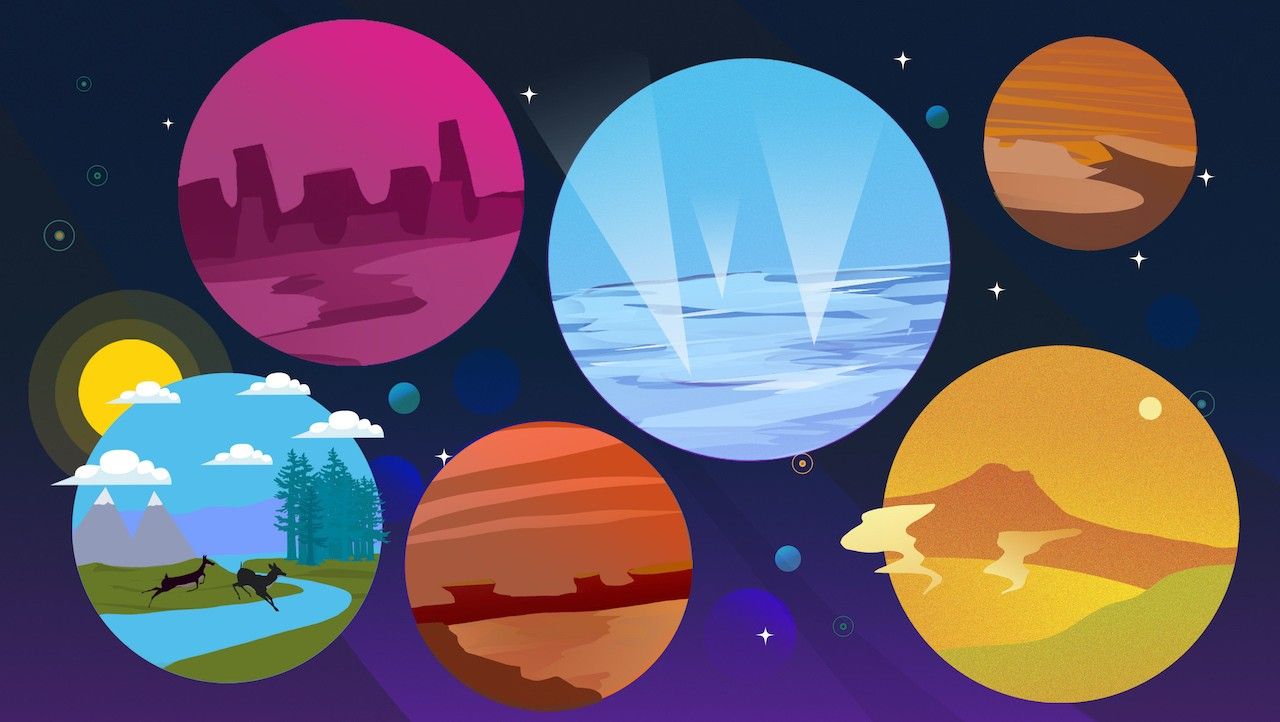
The surfaces of planets around other stars – exoplanets – could take many forms, as in this illustration; Earth's surface is shown at lower left for comparison.
Illustration: NASA/JPL-Caltech/Lizbeth B. De La Torre
As humanity casts an ever-wider net across the cosmos, capturing evidence of thousands of worlds, an ancient question haunts us: Is anybody out there?
The good news: We know vastly more than any previous generation. Our galaxy is [crowded with exoplanets](https://exoplanets.nasa.gov/) – planets around other stars. A healthy percentage of them are small, rocky worlds, of a similar size and likely similar composition to our home planet.
The ingredients in the recipe for earthly life – water, elements associated with life, available sources of energy – appear to be almost everywhere we’ve looked.
Now the bad news. We have yet to find another “Earth” with life, intelligent or not. Observing signs of possible microbial life in exoplanet atmospheres is currently just out of reach. No convincing evidence of advanced technology – artificial signals by radio or other means, or the telltale sign of, say, massive extraterrestrial engineering projects – has yet crossed our formidable arrays of telescopes in space or on the ground.
And finding non-intelligent life is far more likely; Earth existed for most of its history, 4.25 billion years, without a whisper of technological life, and human civilization is a very late-breaking development.
Is there life beyond Earth? So far, the silence is deafening.
“I hope it’s there,” said Shawn Domagal-Goldman, a research astronomer at [NASA’s Goddard Space Flight Center](https://www.nasa.gov/goddard) in Greenbelt, Maryland. “I want it to be there. I’ll be planning a party if we find it.”
Domagal-Goldman co-leads a team of exoplanet hunters who, in the years and decades ahead, are planning to do just that. Working with scientists across NASA, as well as academic and international partners, his team and others are helping to design and build the next generation of instruments to sift through light from other worlds, and other suns. The goal: unambiguous evidence of another living, breathing world.
While the chances of finding life elsewhere remain unknown, the odds can be said to be improving. A well-known list of the data needed to determine the likely abundance of life-bearing worlds, though highly conjectural, is known as the “Drake equation.”
Put forward in 1961 by astronomer Frank Drake, the list remains mostly blank. It begins with the rate of star formation in the galaxy and the fraction of stars that have planets, leading step-by-step through the portion of planets that support life and – most speculatively – to the existence and durability of detectable, technological civilizations.
When Drake introduced this roadmap to life beyond Earth, all the terms – the signposts along the way – were blank.
Some of the first few items are now known, including the potential presence of habitable worlds, said researcher Ravi Kopparapu from Goddard, also a co-leader of Domagal-Goldman’s team. He studies the habitability and potential for life on exoplanets.
If we develop and launch a powerful enough space telescope, “we could figure out if we have advanced life or biological life,” he said.
## Finding a planet that's 'just right'
Drake’s list can be a good conversation starter, and a useful way to frame the complex questions around the possibility of other life. But these days, scientists don’t spend a great deal of time discussing it, Domagal-Goldman said.
Instead, they use a narrower yardstick: the habitable zone.
Every star, like every campfire, has a definable zone of radiated warmth. Too close, and your marshmallow – or your planet – might end up as nothing more than a charred cinder. Too far away, and its surface remains cold and unappetizing.
In both cases, “just right” is more likely to be somewhere in between.
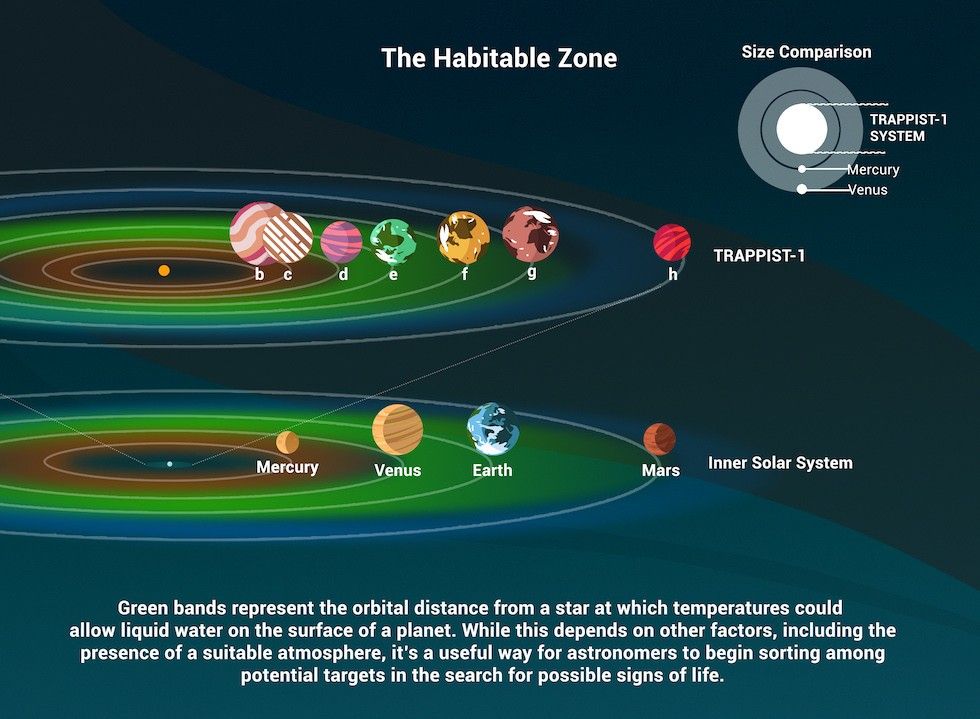
For a planet, the [habitable zone](https://exoplanets.nasa.gov/search-for-life/habitable-zone/) is the distance from a star that allows liquid water to persist on its surface – as long as that planet has a suitable atmosphere.
In our solar system, Earth sits comfortably inside the Sun’s habitable zone. Broiling planet Venus is within the inner edge, while refrigerated Mars is near the outer boundary.
Determine the distance of an exoplanet from the star itself, as well as the star’s size and energy output, and you can estimate whether the planet falls within the habitable zone.
[](https://assets.science.nasa.gov/dynamicimage/assets/science/astro/exo-explore/internal_resources/1887/solar_system_size_comparsion.jpeg?w=980&h=719&fit=clip&crop=faces%2Cfocalpoint)
NASA/JPL-Caltech/Lizbeth B. De La Torre
For larger, hotter stars, the zone is farther away; for smaller, cooler stars, it can be very close indeed. Finding these “just right” planets in the habitable zone is one of the keys to finding signs of life.
“If they fit within these parameters, they could potentially support a temperate environment,” said Natasha Batalha, a research scientist at the [NASA Ames Research Center](https://www.nasa.gov/ames). “Therefore it would be incredibly interesting to study their atmospheres.”
Batalha’s specialty, in fact, is finding ways to read exoplanet atmospheres – and building computer models to better understand them.
“That is the next step, the next frontier,” she said.
The habitable zone concept is not yet definitive. Small, rocky worlds like ours that orbit other stars are too far away to determine whether they have atmospheres, at least using present-day technology.
That’s where teams like the one co-led by Kopparapu and Domagal-Goldman come in. The space telescopes and instruments now on their drawing boards are meant to be powerful enough to peer into these atmospheres and identify the molecules present. That will tell us which gases dominate.
We could find a small, rocky, watery world around a Sun-like star with an atmosphere of nitrogen, oxygen, and carbon dioxide: a little like looking in a mirror.
“To search for life anywhere, we have this ‘follow the water’ approach,” Domagal-Goldman said. “Anywhere you find water on Earth, you find life. Whether it’s life on Mars, ocean worlds, or exoplanets, water is the first signpost we’re looking for.”
For now, the habitable zone remains a kind of first cut in the search for life-bearing worlds.
“The habitable zone is a very useful tool for mission design,” said Rhonda Morgan of [NASA’s Jet Propulsion Laboratory](https://www.jpl.nasa.gov/) in Southern California.
She studies how to use the data gathered so far on exoplanets to refine designs for future space telescopes.
Over the past quarter century, thousands of exoplanets have been confirmed in a Milky Way galaxy that likely holds trillions. Thousands more will come to light in the years ahead. Tools like the habitable zone will help planet hunters sort through these growing ranks to pick the most likely candidates for supporting life.
“We are in a position now where we can propose a potential, future mission that would be capable of directly imaging an Earth-like planet around a nearby, Sun-like star,” she said. “This is the first time in history that the technology has been this close, probably less than 10 years from launch.”
Still, we might need something beyond the habitable-zone concept for more extreme cases. It won’t help much, for instance, with “weird” life – life as we don’t know it. Living things on other worlds might use vastly different chemistry and molecular compounds, or even a solvent other than water.
“This is one of the questions we get from the public often: If there are aliens, how are we going to recognize them if they’re really weird?” Domagal-Goldman said. “How do we find what we would consider to be weird life? And how do we make sure not to be tricked by strange, dead planets that look alive – mirages in the desert?”
Life on planets around other stars also might be hidden in a subsurface ocean encased in ice, invisible even to our most powerful space telescopes. Moons of Jupiter and Saturn are known to [harbor such oceans](https://www.nasa.gov/specials/ocean-worlds/), some revealing through remote sensing at least a few of the characteristics we expect for habitable worlds.
Some “exo-moons” also might be habitable worlds, as in the film, “Avatar.” But even proposed, future instruments are unlikely to have sufficient power to detect atmospheres of moons around giant exoplanets.
Still, the habitable zone is a good start, a way to zero in on signs of life made familiar by our fellow organisms here on planet Earth.
## Cosmic eavesdropping
A shortcut to finding lifeforms like ourselves, of course, would be to intercept tech-savvy communications. Searches for signs of intelligent life have been underway for decades.
In recent years, among NASA scientists, such potential signs have acquired an intriguing new name: technosignatures.
Evidence of a communicative, technological species somewhere among the endless fields of stars could come in the traditional form: signals by radio or optical light waves, or from some other slice of the electromagnetic spectrum.
But scientists imagine many other forms. An exoplanet atmosphere might show signs of synthetic gases, such as CFCs, revealing an industrial species like us.
Or maybe we’ll see the glimmer of something like a “Dyson sphere,” popularized by physicist Freeman Dyson: an epic-scale structure built around a star to capture the lion’s share of its energy.
Such possibilities remain speculative. For now, we have no real answer to a disturbing question from another 20th century physicist, Enrico Fermi.
Where is everybody?
The question has fueled more than 70 years of debate, but boils down to a simple observation. Our Milky Way galaxy has plenty of stars, plenty of planets, and plenty of time to develop intelligent lifeforms – some of whom might well have had billions of years to develop interstellar travel.
Yet so far, we’ve seen no sign of such technology, nor heard a peep of conversation. Why is the cosmos so profoundly silent?
“If life had so much time to evolve, why haven’t we found it?” Batalha asks, to summarize the question. “Why isn’t life just crawling everywhere in the galaxy, or the universe? It could be a combination of a lot of things. Space travel is very difficult for us.”
Vast amounts of energy would be needed just to get us to our nearest neighboring star, Proxima Centauri, she said. “It would just be incredibly expensive, and require a lot of resources.”
And once we – or some other civilization – reached such a distant destination, she said, another problem would be perpetuating the travelers’ existence into future generations.
Experts offer many reasons why somebody, or something, might be out there, yet beyond our detection. On the other hand, the ultra-cautious might remind us that, while a lifeless cosmos seems unlikely, we have exactly zero information one way or the other.
Still, scientists like Kopparapu say they like our chances of finding some form of life, and are hard at work on the telescopes and instruments that could make that future, party-starting epiphany a reality.
“It’s not a question of ‘if,’ it’s a question of ‘when’ we find life on other planets,” he said. “I’m sure in my lifetime, in our lifetime, we will know if there is life on other worlds.”
## Share
## Details
Last Updated
Oct 28, 2024
## Related Terms
- [Exoplanets](https://science.nasa.gov/exoplanets/)
- [The Search for Life](https://science.nasa.gov/universe/search-for-life/)
## Explore More
[ 5 min read NASA Finds Young Stars Dim in X-rays Surprisingly Quickly Article 2 weeks ago](https://science.nasa.gov/missions/chandra/nasa-finds-young-stars-dim-in-x-rays-surprisingly-quickly/)
[ 5 min read NASA’s Webb Redefines Dividing Line Between Planets, Stars Article 2 weeks ago](https://science.nasa.gov/missions/webb/nasas-webb-redefines-dividing-line-between-planets-stars/)
[ 6 min read NASA Webb, Hubble Share Most Comprehensive View of Saturn to Date Article 1 month ago](https://science.nasa.gov/missions/webb/nasa-webb-hubble-share-most-comprehensive-view-of-saturn-to-date/)
Keep Exploring
## Discover More Topics From NASA
[Search for Life ](https://science.nasa.gov/universe/search-for-life/)
[Stars ](https://science.nasa.gov/universe/stars/)
[Universe ](https://science.nasa.gov/universe/)
[Black Holes ](https://science.nasa.gov/universe/black-holes/)

### National Aeronautics and Space Administration
NASA explores the unknown in air and space, innovates for the benefit of humanity, and inspires the world through discovery.
- [About NASA's Mission](https://www.nasa.gov/about/)
[Join Us](https://www.nasa.gov/get-involved/)
- [Home](https://www.nasa.gov/)
- [News & Events](https://www.nasa.gov/news/)
- [Multimedia](https://www.nasa.gov/multimedia/)
- [NASA+](https://plus.nasa.gov/)
- [Missions](https://www.nasa.gov/nasa-missions/)
- [Humans in Space](https://www.nasa.gov/humans-in-space/)
- [Earth](https://science.nasa.gov/earth/)
- [The Solar System](https://science.nasa.gov/solar-system/)
- [The Universe](https://science.nasa.gov/universe/)
- [Science](https://science.nasa.gov/)
- [Aeronautics](https://www.nasa.gov/aeronautics/)
- [Technology](https://www.nasa.gov/technology/)
- [Learning Resources](https://www.nasa.gov/learning-resources/)
- [About NASA](https://www.nasa.gov/about/)
- [NASA en Español](https://www.nasa.gov/es/)
### Follow NASA
- [More NASA Social Accounts](https://www.nasa.gov/social-media/)
- [NASA Newsletters](https://www.nasa.gov/nasa-newsletters/)
- [Sitemap](https://www.nasa.gov/sitemap/)
- [For Media](https://www.nasa.gov/news/nasa-media-contacts/)
- [Privacy Policy](https://www.nasa.gov/nasa-web-privacy-policy-and-important-notices/)
- [FOIA](https://www.nasa.gov/foia/)
- [No FEAR Act](https://www.nasa.gov/no-fear-act/)
- [Office of the IG](http://oig.nasa.gov/)
- [Budget & Annual Reports](https://www.nasa.gov/budgets-plans-and-reports/)
- [Agency Financial Reports](https://www.nasa.gov/organizations/budget-annual-reports/agency-financial-reports/)
- [Contact NASA](https://www.nasa.gov/contact-nasa/)
- [Accessibility](https://www.nasa.gov/accessibility/)
- Page Last Updated:
Oct 28, 2024
- Page Editor:
Stephen Carney
- Responsible NASA Official for Science:
Diana Logreira
× | ||||||
| Readable Markdown | As humanity casts an ever-wider net across the cosmos, capturing evidence of thousands of worlds, an ancient question haunts us: Is anybody out there?
The good news: We know vastly more than any previous generation. Our galaxy is [crowded with exoplanets](https://exoplanets.nasa.gov/) – planets around other stars. A healthy percentage of them are small, rocky worlds, of a similar size and likely similar composition to our home planet.
The ingredients in the recipe for earthly life – water, elements associated with life, available sources of energy – appear to be almost everywhere we’ve looked.
Now the bad news. We have yet to find another “Earth” with life, intelligent or not. Observing signs of possible microbial life in exoplanet atmospheres is currently just out of reach. No convincing evidence of advanced technology – artificial signals by radio or other means, or the telltale sign of, say, massive extraterrestrial engineering projects – has yet crossed our formidable arrays of telescopes in space or on the ground.
And finding non-intelligent life is far more likely; Earth existed for most of its history, 4.25 billion years, without a whisper of technological life, and human civilization is a very late-breaking development.
Is there life beyond Earth? So far, the silence is deafening.
“I hope it’s there,” said Shawn Domagal-Goldman, a research astronomer at [NASA’s Goddard Space Flight Center](https://www.nasa.gov/goddard) in Greenbelt, Maryland. “I want it to be there. I’ll be planning a party if we find it.”
Domagal-Goldman co-leads a team of exoplanet hunters who, in the years and decades ahead, are planning to do just that. Working with scientists across NASA, as well as academic and international partners, his team and others are helping to design and build the next generation of instruments to sift through light from other worlds, and other suns. The goal: unambiguous evidence of another living, breathing world.
While the chances of finding life elsewhere remain unknown, the odds can be said to be improving. A well-known list of the data needed to determine the likely abundance of life-bearing worlds, though highly conjectural, is known as the “Drake equation.”
Put forward in 1961 by astronomer Frank Drake, the list remains mostly blank. It begins with the rate of star formation in the galaxy and the fraction of stars that have planets, leading step-by-step through the portion of planets that support life and – most speculatively – to the existence and durability of detectable, technological civilizations.
When Drake introduced this roadmap to life beyond Earth, all the terms – the signposts along the way – were blank.
Some of the first few items are now known, including the potential presence of habitable worlds, said researcher Ravi Kopparapu from Goddard, also a co-leader of Domagal-Goldman’s team. He studies the habitability and potential for life on exoplanets.
If we develop and launch a powerful enough space telescope, “we could figure out if we have advanced life or biological life,” he said.
Drake’s list can be a good conversation starter, and a useful way to frame the complex questions around the possibility of other life. But these days, scientists don’t spend a great deal of time discussing it, Domagal-Goldman said.
Instead, they use a narrower yardstick: the habitable zone.
Every star, like every campfire, has a definable zone of radiated warmth. Too close, and your marshmallow – or your planet – might end up as nothing more than a charred cinder. Too far away, and its surface remains cold and unappetizing.
In both cases, “just right” is more likely to be somewhere in between.
For a planet, the [habitable zone](https://exoplanets.nasa.gov/search-for-life/habitable-zone/) is the distance from a star that allows liquid water to persist on its surface – as long as that planet has a suitable atmosphere.
In our solar system, Earth sits comfortably inside the Sun’s habitable zone. Broiling planet Venus is within the inner edge, while refrigerated Mars is near the outer boundary.
Determine the distance of an exoplanet from the star itself, as well as the star’s size and energy output, and you can estimate whether the planet falls within the habitable zone.
For larger, hotter stars, the zone is farther away; for smaller, cooler stars, it can be very close indeed. Finding these “just right” planets in the habitable zone is one of the keys to finding signs of life.
“If they fit within these parameters, they could potentially support a temperate environment,” said Natasha Batalha, a research scientist at the [NASA Ames Research Center](https://www.nasa.gov/ames). “Therefore it would be incredibly interesting to study their atmospheres.”
Batalha’s specialty, in fact, is finding ways to read exoplanet atmospheres – and building computer models to better understand them.
“That is the next step, the next frontier,” she said.
The habitable zone concept is not yet definitive. Small, rocky worlds like ours that orbit other stars are too far away to determine whether they have atmospheres, at least using present-day technology.
That’s where teams like the one co-led by Kopparapu and Domagal-Goldman come in. The space telescopes and instruments now on their drawing boards are meant to be powerful enough to peer into these atmospheres and identify the molecules present. That will tell us which gases dominate.
We could find a small, rocky, watery world around a Sun-like star with an atmosphere of nitrogen, oxygen, and carbon dioxide: a little like looking in a mirror.
“To search for life anywhere, we have this ‘follow the water’ approach,” Domagal-Goldman said. “Anywhere you find water on Earth, you find life. Whether it’s life on Mars, ocean worlds, or exoplanets, water is the first signpost we’re looking for.”
For now, the habitable zone remains a kind of first cut in the search for life-bearing worlds.
“The habitable zone is a very useful tool for mission design,” said Rhonda Morgan of [NASA’s Jet Propulsion Laboratory](https://www.jpl.nasa.gov/) in Southern California.
She studies how to use the data gathered so far on exoplanets to refine designs for future space telescopes.
Over the past quarter century, thousands of exoplanets have been confirmed in a Milky Way galaxy that likely holds trillions. Thousands more will come to light in the years ahead. Tools like the habitable zone will help planet hunters sort through these growing ranks to pick the most likely candidates for supporting life.
“We are in a position now where we can propose a potential, future mission that would be capable of directly imaging an Earth-like planet around a nearby, Sun-like star,” she said. “This is the first time in history that the technology has been this close, probably less than 10 years from launch.”
Still, we might need something beyond the habitable-zone concept for more extreme cases. It won’t help much, for instance, with “weird” life – life as we don’t know it. Living things on other worlds might use vastly different chemistry and molecular compounds, or even a solvent other than water.
“This is one of the questions we get from the public often: If there are aliens, how are we going to recognize them if they’re really weird?” Domagal-Goldman said. “How do we find what we would consider to be weird life? And how do we make sure not to be tricked by strange, dead planets that look alive – mirages in the desert?”
Life on planets around other stars also might be hidden in a subsurface ocean encased in ice, invisible even to our most powerful space telescopes. Moons of Jupiter and Saturn are known to [harbor such oceans](https://www.nasa.gov/specials/ocean-worlds/), some revealing through remote sensing at least a few of the characteristics we expect for habitable worlds.
Some “exo-moons” also might be habitable worlds, as in the film, “Avatar.” But even proposed, future instruments are unlikely to have sufficient power to detect atmospheres of moons around giant exoplanets.
Still, the habitable zone is a good start, a way to zero in on signs of life made familiar by our fellow organisms here on planet Earth.
A shortcut to finding lifeforms like ourselves, of course, would be to intercept tech-savvy communications. Searches for signs of intelligent life have been underway for decades.
In recent years, among NASA scientists, such potential signs have acquired an intriguing new name: technosignatures.
Evidence of a communicative, technological species somewhere among the endless fields of stars could come in the traditional form: signals by radio or optical light waves, or from some other slice of the electromagnetic spectrum.
But scientists imagine many other forms. An exoplanet atmosphere might show signs of synthetic gases, such as CFCs, revealing an industrial species like us.
Or maybe we’ll see the glimmer of something like a “Dyson sphere,” popularized by physicist Freeman Dyson: an epic-scale structure built around a star to capture the lion’s share of its energy.
Such possibilities remain speculative. For now, we have no real answer to a disturbing question from another 20th century physicist, Enrico Fermi.
Where is everybody?
The question has fueled more than 70 years of debate, but boils down to a simple observation. Our Milky Way galaxy has plenty of stars, plenty of planets, and plenty of time to develop intelligent lifeforms – some of whom might well have had billions of years to develop interstellar travel.
Yet so far, we’ve seen no sign of such technology, nor heard a peep of conversation. Why is the cosmos so profoundly silent?
“If life had so much time to evolve, why haven’t we found it?” Batalha asks, to summarize the question. “Why isn’t life just crawling everywhere in the galaxy, or the universe? It could be a combination of a lot of things. Space travel is very difficult for us.”
Vast amounts of energy would be needed just to get us to our nearest neighboring star, Proxima Centauri, she said. “It would just be incredibly expensive, and require a lot of resources.”
And once we – or some other civilization – reached such a distant destination, she said, another problem would be perpetuating the travelers’ existence into future generations.
Experts offer many reasons why somebody, or something, might be out there, yet beyond our detection. On the other hand, the ultra-cautious might remind us that, while a lifeless cosmos seems unlikely, we have exactly zero information one way or the other.
Still, scientists like Kopparapu say they like our chances of finding some form of life, and are hard at work on the telescopes and instruments that could make that future, party-starting epiphany a reality.
“It’s not a question of ‘if,’ it’s a question of ‘when’ we find life on other planets,” he said. “I’m sure in my lifetime, in our lifetime, we will know if there is life on other worlds.” | ||||||
| ML Classification | |||||||
| ML Categories |
Raw JSON{
"/Science": 994,
"/Science/Astronomy": 969
} | ||||||
| ML Page Types |
Raw JSON{
"/Article": 994,
"/Article/News_Update": 761
} | ||||||
| ML Intent Types |
Raw JSON{
"Informational": 999
} | ||||||
| Content Metadata | |||||||
| Language | en-us | ||||||
| Author | Pat Brennan | ||||||
| Publish Time | 2021-03-09 13:00:00 (5 years ago) | ||||||
| Original Publish Time | 2021-03-09 13:00:00 (5 years ago) | ||||||
| Republished | No | ||||||
| Word Count (Total) | 3,018 | ||||||
| Word Count (Content) | 1,768 | ||||||
| Links | |||||||
| External Links | 9 | ||||||
| Internal Links | 234 | ||||||
| Technical SEO | |||||||
| Meta Nofollow | No | ||||||
| Meta Noarchive | No | ||||||
| JS Rendered | No | ||||||
| Redirect Target | null | ||||||
| Performance | |||||||
| Download Time (ms) | 18 | ||||||
| TTFB (ms) | 15 | ||||||
| Download Size (bytes) | 40,241 | ||||||
| Shard | 175 (laksa) | ||||||
| Root Hash | 12871711242003294575 | ||||||
| Unparsed URL | gov,nasa!science,/universe/exoplanets/life-in-the-universe-what-are-the-odds/ s443 | ||||||