ℹ️ Skipped - page is already crawled
| Filter | Status | Condition | Details |
|---|---|---|---|
| HTTP status | PASS | download_http_code = 200 | HTTP 200 |
| Age cutoff | PASS | download_stamp > now() - 6 MONTH | 1.4 months ago |
| History drop | PASS | isNull(history_drop_reason) | No drop reason |
| Spam/ban | PASS | fh_dont_index != 1 AND ml_spam_score = 0 | ml_spam_score=0 |
| Canonical | PASS | meta_canonical IS NULL OR = '' OR = src_unparsed | Not set |
| Property | Value |
|---|---|
| URL | https://rightasrain.uwmedicine.org/life/parenthood/exercise-after-baby |
| Last Crawled | 2026-03-11 15:58:58 (1 month ago) |
| First Indexed | 2019-03-26 06:27:55 (7 years ago) |
| HTTP Status Code | 200 |
| Meta Title | Postpartum Exercise | Right as Rain by UW Medicine |
| Meta Description | If you just had a baby, it’s tough to know how much physical activity is too much. Here’s how to safely ease back into exercise after birth. |
| Meta Canonical | null |
| Boilerpipe Text | If you’ve recently had a baby, chances are you’re getting bombarded with messages that go like this:
Lose that post-pregnancy belly! Get your body back! Shed the excess baby weight!
Cue the side-eye.
Real talk? You’re exhausted, stressed and hurting in places you didn’t even know you had. Getting out of bed — let alone attempting some form of physical activity — can feel like someone is asking you to hike up Mount Rainier.
“Postpartum, there’s just so much,” explains
Tina Allen, P.T.
, a physical therapist at the University of Washington Medical Center’s Urology Clinic. “Moms aren’t getting enough sleep, they have this new being that they’re looking after and their bodies and muscles don’t work like they used to.”
On top of that, you’re navigating your new family dynamic with a little one and have a whole ton of hormones to boot. So, yes, while you know that
exercising
after giving birth is good for you, it’s way easier said than done.
“Our bodies change from being pregnant,” adds
Sarah Prager, M.D., M.A.S.
, an obstetrician-gynecologist at the Women’s Health Care Center at University of Washington Medical Center-Roosevelt and a professor in the Department of Obstetrics and Gynecology at the UW School of Medicine. “The pelvic floor is going to be in a slightly different location. Breasts are going to be different. Things might not look or feel exactly the same.”
To help you navigate your new postpartum self and safely get moving again after birth, Allen and Prager share their top tips for getting back into the fitness swing of things.
Listen to your postpartum body
While celebrity moms may be posting pictures of their flat stomachs shortly after delivery — insert another side-eye here — that’s just not realistic.
Frame your physical fitness expectations with long-term goals in mind.
In those first few weeks after giving birth, it’s most important to prioritize your general recovery, well-being and sleep needs over any exercise routine.
And just like your labor and delivery is unique, how quickly you heal after having a baby is highly dependent on your personal birth experience.
Moms who have a smooth delivery with minimal complications may have an easier time resuming physical activity than those who need major interventions like a caesarean.
“Your ability to start activities is largely based on what your body is telling you,” Prager says.
That means paying close attention to how much pain you feel after doing certain movements, your level of bleeding and the amount of extra energy you can muster up between diaper changes and feedings.
Once your doctor clears you for more intense physical activity at your final check-up — usually around 6 to 8 weeks postpartum — you can progress to other types of exercise.
How quickly and intensely you start exercising again also depends on your previous fitness level. If your idea of a good workout before pregnancy was a brisk walk, you won’t have the same starting point as, say, a marathon runner — and that’s totally fine.
The most important thing is to find a level of physical activity that you feel comfortable with and go from there.
“I recommend starting at 75 percent effort of what your baseline had been,” Prager says. “If it feels like too much, back it off a bit more. If it feels OK, increase it a little bit.”
Start easy with short walks
It may not seem like much, but taking a short walk can help tremendously during your postpartum recovery.
“I encourage patients to be getting up and walking around almost immediately after delivery,” Prager says. “Even if it’s a 10-minute walk around the block, it can be extremely helpful for the healing process. It can decrease that risk of blood clots that is even more prominent postpartum if a woman has had surgery.”
Walking not only lets you test out how well your body feels after delivery — looking at you,
vaginal tears
— it also eases you back into physical activity without risking major injury.
“Walking is great,” Allen adds. “In general, movement helps everything.”
A simple stroll — with or without baby — can also provide a huge mood boost, something that’s especially helpful during those first few exhausting weeks.
An
analysis
of 16 different studies found that light exercise during the postpartum period helped reduce the odds of developing mild to moderate depressive symptoms by as much as 54 percent.
From a short walk around the block, you can work your way up to longer distances, faster speeds or steeper inclines.
Don’t push yourself too far too fast
While it’s good to work in some exercise, trying to do too much too quickly is not.
“There’s a difference between a good pain like, ‘Yes, I’ve worked my muscles hard and that feels great,’ versus ‘I’m straining my muscles in a way that they’re not ready for,’” Prager explains.
This is an especially important distinction to make if you’ve had a C-section, which means you shouldn’t lift anything heavier than your baby for the first 6 to 8 weeks.
“If you have increased urine leakage after exercising or any kinds of swelling happening, that’s something you should talk to your doctor about,” Allen notes. “If you’re having shooting pain, ripping, tearing or a sharp feeling, that’s really an indication to stop what you’re doing and back off. You’re being too intense too soon.”
When a red flag pops up, ease back on the physical activity until you feel better. From there, you can slowly build back up the duration or intensity of your exercise.
But if the pain doesn’t go away or get better on its own, talk to your doctor or physical therapist to check on your injury.
Another thing to watch out for? Your hydration and nutrition needs, particularly if you’re breastfeeding.
To keep those sudden hunger pangs at bay, it’s a good idea to tuck a water bottle and some snacks into your purse or stroller, just in case you suddenly feel depleted in the middle of a walk.
Make safe adjustments to postpartum exercises
Once your doctor gives you the green light to get your sweat on, you might be tempted to dive back into your usual workout routine. But remember, your body is different now and still healing in various ways.
To avoid injury, focus on exercises that won’t damage sensitive areas like your core or pelvic floor and adjust them as needed.
Core
Remember that whole celebrity mom comparison thing? This is where those unrealistic expectations can get you into trouble.
Don’t launch right into aggressive core exercises in an effort to lose your post-pregnancy belly as quickly as a Kardashian.
“Ab muscles are like big rubber bands that have been stretched out for 40 weeks,” Prager says. “If you immediately start exercising with dynamic exercises, you can damage them.”
That means avoiding crunches, jumps, twists and leg lifts. Instead, focus on more gentle, static core exercises like
planks
, bridges and pelvic tilts.
“Think about how you hold in your core as you zip up a tight pair of pants and how that keeps your core engaged,” Allen says. “Now try keeping your core engaged like that while breastfeeding, washing dishes or engaging with your little one.”
Pelvic floor
Another common post-pregnancy concern is incontinence, courtesy of your still-healing
pelvic floor
. Gee, thanks.
Incontinence, when you can’t control urine leakages, is an issue that most moms have after giving birth. Usually, this will improve on its own over time.
Basic balance exercises and yoga can help, as well as another tried-and-true favorite:
Kegels
.
Allen says its best to do Kegels in various situations and positions — while lying down, sitting in your car or standing at the sink — to maximize their impact.
But when incontinence doesn’t go away on its own, specialized care like
pelvic floor physical therapy
can make a huge difference. Ask your doctor for a referral if you’re still experiencing issues several weeks postpartum.
Breasts
Another postpartum issue you may need to accommodate? Those extra-tender (and sometimes leaky) breasts.
Make it a point to breastfeed or pump before you exercise to alleviate some of the discomfort. Nursing pads are also helpful to prevent any embarrassing wet spots from appearing mid-yoga pose.
And if your chest still feels a little unsupported, try doubling up on sports bras or opting for ones specifically made for nursing moms.
Alignment
“I frequently have women who say they have
back pain
, neck pain and headaches postpartum,” Prager says. “That’s because the common position they are in is breastfeeding or looking down at their baby.”
When you sit or stand, focus on having a straight alignment, rolling your shoulders back and keeping your rib cage down. Adding props like breastfeeding pillows to support your arms and baby can help ensure you’re not hunched over for long periods of time, too.
Prager also suggests adding in
chest-opening stretches
and gentle neck rolls to your daily routine to help keep the tightness at bay.
“It’s still possible to gaze adoringly at your child and stretch your neck out a bit,” she says.
Finding time for self-care while nurturing your little one? Well, that’s the definition of #momlife. |
| Markdown | [Skip to main content](https://rightasrain.uwmedicine.org/life/parenthood/exercise-after-baby#main-content)
[](https://rightasrain.uwmedicine.org/)
## Main navigation
[About](https://rightasrain.uwmedicine.org/about)
Mind
- [All Mind](https://rightasrain.uwmedicine.org/mind)
- [Stress](https://rightasrain.uwmedicine.org/mind/stress)
- [Mental Health](https://rightasrain.uwmedicine.org/mind/mental-health)
- [Well-being](https://rightasrain.uwmedicine.org/mind/well-being)
Body
- [All Body](https://rightasrain.uwmedicine.org/body)
- [Exercise](https://rightasrain.uwmedicine.org/body/exercise)
- [Food](https://rightasrain.uwmedicine.org/body/food)
- [Healthy Weight](https://rightasrain.uwmedicine.org/body/healthy-weight)
- [Rest](https://rightasrain.uwmedicine.org/body/rest)
Life
- [All Life](https://rightasrain.uwmedicine.org/life)
- [Leisure](https://rightasrain.uwmedicine.org/life/leisure)
- [Parenthood](https://rightasrain.uwmedicine.org/life/parenthood)
- [Relationships](https://rightasrain.uwmedicine.org/life/relationships)
- [Sex](https://rightasrain.uwmedicine.org/life/sex)
- [Work](https://rightasrain.uwmedicine.org/life/work)
Well
- [All Well](https://rightasrain.uwmedicine.org/well)
- [Health](https://rightasrain.uwmedicine.org/well/health)
- [Prevention](https://rightasrain.uwmedicine.org/well/prevention)
- [Stories](https://rightasrain.uwmedicine.org/well/stories)
- [Research](https://rightasrain.uwmedicine.org/well/research)
## Main navigation (mobile)
[About](https://rightasrain.uwmedicine.org/about)
li \> a').focus()" @keydown.arrow-down="document.querySelector('\#mobilemenu-2 \> li \> a').focus()" @keydown.escape="mobileMenuOpen = false; mobileMenuTab = 1" :class="{ 'text-dk-rain border-dk-rain focus:text-dk-rain': mobileMenuTab === 2 }" \> Mind
li \> a').focus()" @keydown.arrow-down="document.querySelector('\#mobilemenu-3 \> li \> a').focus()" @keydown.escape="mobileMenuOpen = false; mobileMenuTab = 1" :class="{ 'text-mtn-green border-mtn-green focus:text-mtn-green': mobileMenuTab === 3 }" \> Body
li \> a').focus()" @keydown.arrow-down="document.querySelector('\#mobilemenu-4 \> li \> a').focus()" @keydown.escape="mobileMenuOpen = false; mobileMenuTab = 1" :class="{ 'text-uw-purple border-uw-purple focus:text-uw-purple': mobileMenuTab === 4 }" \> Life
li \> a').focus()" @keydown.arrow-down="document.querySelector('\#mobilemenu-5 \> li \> a').focus()" @keydown.escape="mobileMenuOpen = false; mobileMenuTab = 1" :class="{ 'text-well-coral border-well-coral focus:text-well-coral': mobileMenuTab === 5 }" \> Well
- [All Mind](https://rightasrain.uwmedicine.org/mind)
- [Stress](https://rightasrain.uwmedicine.org/mind/stress)
- [Mental Health](https://rightasrain.uwmedicine.org/mind/mental-health)
- [Well-being](https://rightasrain.uwmedicine.org/mind/well-being)
- [All Body](https://rightasrain.uwmedicine.org/body)
- [Exercise](https://rightasrain.uwmedicine.org/body/exercise)
- [Food](https://rightasrain.uwmedicine.org/body/food)
- [Healthy Weight](https://rightasrain.uwmedicine.org/body/healthy-weight)
- [Rest](https://rightasrain.uwmedicine.org/body/rest)
- [All Life](https://rightasrain.uwmedicine.org/life)
- [Leisure](https://rightasrain.uwmedicine.org/life/leisure)
- [Parenthood](https://rightasrain.uwmedicine.org/life/parenthood)
- [Relationships](https://rightasrain.uwmedicine.org/life/relationships)
- [Sex](https://rightasrain.uwmedicine.org/life/sex)
- [Work](https://rightasrain.uwmedicine.org/life/work)
- [All Well](https://rightasrain.uwmedicine.org/well)
- [Health](https://rightasrain.uwmedicine.org/well/health)
- [Prevention](https://rightasrain.uwmedicine.org/well/prevention)
- [Stories](https://rightasrain.uwmedicine.org/well/stories)
- [Research](https://rightasrain.uwmedicine.org/well/research)
[ Healthy ideas for your inbox](https://rightasrain.uwmedicine.org/subscribe)

[Life](https://rightasrain.uwmedicine.org/life) [Parenthood](https://rightasrain.uwmedicine.org/life/parenthood)
# What You Should Know About Exercising After Having a Baby
[Angela Cabotaje](https://rightasrain.uwmedicine.org/authors/angela-cabotaje)
March 25, 2019
Fact Checked
© Mosuno / Stocksy United
## Quick Read Ease back into postpartum exercise
- Focus on getting enough rest and nutrition in the first few weeks.
- Start with light physical activities like walking.
- Pay attention to sharp pains and bleeding, which are red flags.
- Adjust exercises to accommodate your healing core and pelvic floor.
If you’ve recently had a baby, chances are you’re getting bombarded with messages that go like this: *Lose that post-pregnancy belly! Get your body back! Shed the excess baby weight\!*
Cue the side-eye.
Real talk? You’re exhausted, stressed and hurting in places you didn’t even know you had. Getting out of bed — let alone attempting some form of physical activity — can feel like someone is asking you to hike up Mount Rainier.
“Postpartum, there’s just so much,” explains [Tina Allen, P.T.](https://www.uwmedicine.org/bios/tina-allen), a physical therapist at the University of Washington Medical Center’s Urology Clinic. “Moms aren’t getting enough sleep, they have this new being that they’re looking after and their bodies and muscles don’t work like they used to.”
On top of that, you’re navigating your new family dynamic with a little one and have a whole ton of hormones to boot. So, yes, while you know that [exercising](https://rightasrain.uwmedicine.org/mind/mental-health/exercise-mental-health) after giving birth is good for you, it’s way easier said than done.
“Our bodies change from being pregnant,” adds [Sarah Prager, M.D., M.A.S.](https://www.uwmedicine.org/bios/sarah-prager), an obstetrician-gynecologist at the Women’s Health Care Center at University of Washington Medical Center-Roosevelt and a professor in the Department of Obstetrics and Gynecology at the UW School of Medicine. “The pelvic floor is going to be in a slightly different location. Breasts are going to be different. Things might not look or feel exactly the same.”
To help you navigate your new postpartum self and safely get moving again after birth, Allen and Prager share their top tips for getting back into the fitness swing of things.
## **Listen to your postpartum body**
While celebrity moms may be posting pictures of their flat stomachs shortly after delivery — insert another side-eye here — that’s just not realistic.
Frame your physical fitness expectations with long-term goals in mind.
In those first few weeks after giving birth, it’s most important to prioritize your general recovery, well-being and sleep needs over any exercise routine.
And just like your labor and delivery is unique, how quickly you heal after having a baby is highly dependent on your personal birth experience.
Moms who have a smooth delivery with minimal complications may have an easier time resuming physical activity than those who need major interventions like a caesarean.
“Your ability to start activities is largely based on what your body is telling you,” Prager says.
That means paying close attention to how much pain you feel after doing certain movements, your level of bleeding and the amount of extra energy you can muster up between diaper changes and feedings.
Once your doctor clears you for more intense physical activity at your final check-up — usually around 6 to 8 weeks postpartum — you can progress to other types of exercise.
How quickly and intensely you start exercising again also depends on your previous fitness level. If your idea of a good workout before pregnancy was a brisk walk, you won’t have the same starting point as, say, a marathon runner — and that’s totally fine.
The most important thing is to find a level of physical activity that you feel comfortable with and go from there.
“I recommend starting at 75 percent effort of what your baseline had been,” Prager says. “If it feels like too much, back it off a bit more. If it feels OK, increase it a little bit.”
## **Start easy with short walks**
It may not seem like much, but taking a short walk can help tremendously during your postpartum recovery.
“I encourage patients to be getting up and walking around almost immediately after delivery,” Prager says. “Even if it’s a 10-minute walk around the block, it can be extremely helpful for the healing process. It can decrease that risk of blood clots that is even more prominent postpartum if a woman has had surgery.”
Walking not only lets you test out how well your body feels after delivery — looking at you, [vaginal tears](https://rightasrain.uwmedicine.org/life/sex/its-not-just-childbirth-can-give-you-vaginal-tear) — it also eases you back into physical activity without risking major injury.
“Walking is great,” Allen adds. “In general, movement helps everything.”
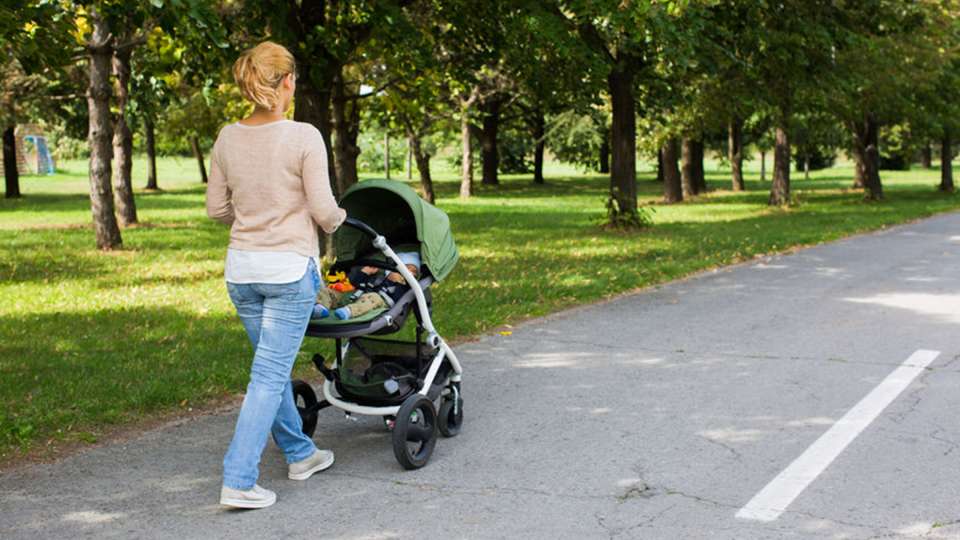
A simple stroll — with or without baby — can also provide a huge mood boost, something that’s especially helpful during those first few exhausting weeks.
An [analysis](https://www.ncbi.nlm.nih.gov/pubmed/28486363) of 16 different studies found that light exercise during the postpartum period helped reduce the odds of developing mild to moderate depressive symptoms by as much as 54 percent.
From a short walk around the block, you can work your way up to longer distances, faster speeds or steeper inclines.
## **Don’t push yourself too far too fast**
While it’s good to work in some exercise, trying to do too much too quickly is not.
“There’s a difference between a good pain like, ‘Yes, I’ve worked my muscles hard and that feels great,’ versus ‘I’m straining my muscles in a way that they’re not ready for,’” Prager explains.
This is an especially important distinction to make if you’ve had a C-section, which means you shouldn’t lift anything heavier than your baby for the first 6 to 8 weeks.
“If you have increased urine leakage after exercising or any kinds of swelling happening, that’s something you should talk to your doctor about,” Allen notes. “If you’re having shooting pain, ripping, tearing or a sharp feeling, that’s really an indication to stop what you’re doing and back off. You’re being too intense too soon.”
When a red flag pops up, ease back on the physical activity until you feel better. From there, you can slowly build back up the duration or intensity of your exercise.
But if the pain doesn’t go away or get better on its own, talk to your doctor or physical therapist to check on your injury.
Another thing to watch out for? Your hydration and nutrition needs, particularly if you’re breastfeeding.
To keep those sudden hunger pangs at bay, it’s a good idea to tuck a water bottle and some snacks into your purse or stroller, just in case you suddenly feel depleted in the middle of a walk.
## **Make safe adjustments to postpartum exercises**
Once your doctor gives you the green light to get your sweat on, you might be tempted to dive back into your usual workout routine. But remember, your body is different now and still healing in various ways.
To avoid injury, focus on exercises that won’t damage sensitive areas like your core or pelvic floor and adjust them as needed.
### **Core**
Remember that whole celebrity mom comparison thing? This is where those unrealistic expectations can get you into trouble.
Don’t launch right into aggressive core exercises in an effort to lose your post-pregnancy belly as quickly as a Kardashian.
“Ab muscles are like big rubber bands that have been stretched out for 40 weeks,” Prager says. “If you immediately start exercising with dynamic exercises, you can damage them.”
That means avoiding crunches, jumps, twists and leg lifts. Instead, focus on more gentle, static core exercises like [planks](https://rightasrain.uwmedicine.org/body/exercise/how-plank-you-mean-it), bridges and pelvic tilts.
“Think about how you hold in your core as you zip up a tight pair of pants and how that keeps your core engaged,” Allen says. “Now try keeping your core engaged like that while breastfeeding, washing dishes or engaging with your little one.”
### **Pelvic floor**
Another common post-pregnancy concern is incontinence, courtesy of your still-healing [pelvic floor](https://rightasrain.uwmedicine.org/well/health/what-your-pelvic-floor-and-why-should-you-care). Gee, thanks.
Incontinence, when you can’t control urine leakages, is an issue that most moms have after giving birth. Usually, this will improve on its own over time.
Basic balance exercises and yoga can help, as well as another tried-and-true favorite: [Kegels](https://stevie.cms.uwmedicine.org/sites/stevie/files/2018-11/Kegel-Exercises.pdf).
Allen says its best to do Kegels in various situations and positions — while lying down, sitting in your car or standing at the sink — to maximize their impact.
But when incontinence doesn’t go away on its own, specialized care like [pelvic floor physical therapy](https://www.washington.edu/urology/patient-care/pelvic-health-center/) can make a huge difference. Ask your doctor for a referral if you’re still experiencing issues several weeks postpartum.
### **Breasts**
Another postpartum issue you may need to accommodate? Those extra-tender (and sometimes leaky) breasts.
Make it a point to breastfeed or pump before you exercise to alleviate some of the discomfort. Nursing pads are also helpful to prevent any embarrassing wet spots from appearing mid-yoga pose.
And if your chest still feels a little unsupported, try doubling up on sports bras or opting for ones specifically made for nursing moms.
### **Alignment**
“I frequently have women who say they have [back pain](https://www.uwmedicine.org/conditions-symptoms/bone-joint-muscle/lower-back-pain?utm_source=rar&utm_medium=article&utm_campaign=medical-conditions), neck pain and headaches postpartum,” Prager says. “That’s because the common position they are in is breastfeeding or looking down at their baby.”
When you sit or stand, focus on having a straight alignment, rolling your shoulders back and keeping your rib cage down. Adding props like breastfeeding pillows to support your arms and baby can help ensure you’re not hunched over for long periods of time, too.
Prager also suggests adding in [chest-opening stretches](https://rightasrain.uwmedicine.org/body/exercise/if-you-have-desk-job-or-cell-phone-do-these-7-stretches) and gentle neck rolls to your daily routine to help keep the tightness at bay.
“It’s still possible to gaze adoringly at your child and stretch your neck out a bit,” she says.
Finding time for self-care while nurturing your little one? Well, that’s the definition of \#momlife.
## Recommended for you

Life Relationships
The 5 Most Important Parts of a Long-term Health Plan
Plus the four key questions to ask yourself as you start preparing.
The 5 Most Important Parts of a Long-term Health Plan in the Relationships subcategory within the Life main category Plus the four key questions to ask yourself as you start preparing.
[](https://rightasrain.uwmedicine.org/life/leisure/heat-therapy-saunas-for-health)
[Life Leisure How Saunas Can Provide Relief (and Heart Benefits) How Saunas Can Provide Relief (and Heart Benefits) in the Leisure subcategory within the Life main category Saunas aren’t just good for relaxation — they can also help the body and heart.](https://rightasrain.uwmedicine.org/life/leisure/heat-therapy-saunas-for-health)
[](https://rightasrain.uwmedicine.org/life/leisure/post-holiday-reset-tips)
[Life Leisure 4 Ways to Reset Your Mind and Body After the Holidays 4 Ways to Reset Your Mind and Body After the Holidays in the Leisure subcategory within the Life main category The holiday season can take a lot out of you, but there are ways to feel refreshed and ready for the new year.](https://rightasrain.uwmedicine.org/life/leisure/post-holiday-reset-tips)
[](https://rightasrain.uwmedicine.org/life/relationships/tips-for-caregivers)
[Life Relationships Top 5 Self‑Care Tips Every Caregiver Should Know Top 5 Self‑Care Tips Every Caregiver Should Know in the Relationships subcategory within the Life main category Setting boundaries and taking time for self-care makes you a better caregiver (and human).](https://rightasrain.uwmedicine.org/life/relationships/tips-for-caregivers)
[](https://rightasrain.uwmedicine.org/life/relationships/passive-aggressive-behavior)
[Life Relationships 6 Ways to (Respectfully) Deal With Passive-Aggressive People 6 Ways to (Respectfully) Deal With Passive-Aggressive People in the Relationships subcategory within the Life main category Plus what to do if you’re the one acting passive-aggressive.](https://rightasrain.uwmedicine.org/life/relationships/passive-aggressive-behavior)
[](https://rightasrain.uwmedicine.org/life/leisure/why-you-should-still-go-outside-when-weather-sucks)
[Life Leisure Why You Should Still Go Outside When the Weather Sucks Why You Should Still Go Outside When the Weather Sucks in the Leisure subcategory within the Life main category Despite the rain and early sunsets, outdoor activities in the fall and winter have many health benefits.](https://rightasrain.uwmedicine.org/life/leisure/why-you-should-still-go-outside-when-weather-sucks)
- [Load more stories](https://rightasrain.uwmedicine.org/life/parenthood/exercise-after-baby?page=1 "Go to next page")
## Healthy tips for your inbox
###### Connect With Us
[](https://www.facebook.com/UWMedicine "Facebook")
[](https://www.instagram.com/uwmedicine "Instagram")
[](https://www.youtube.com/user/UWMedicineHealth "YouTube")
[](https://www.threads.net/@uwmedicine "Threads")
[](https://bsky.app/profile/uwmedicine.bsky.social "Bluesky")
[](https://x.com/uwmedicine "X")
[](https://www.linkedin.com/company/uw-medicine "LinkedIn")
###### UW Medicine The text logo displaying UW Medicine and University of Washington
At UW Medicine, our mission is to improve the health of the public. We created Right as Rain to serve as a resource to connect you with health and wellness information you can trust from researchers, healthcare providers and faculty from UW Medicine and the University of Washington.
[Make an Appointment](http://www.uwmedicine.org/patient-care/making-an-appointment)
Copyright © 2026 University of Washington.All Rights Reserved.
- [Privacy](https://www.washington.edu/online/privacy/)
- [Terms](https://www.washington.edu/online/terms/)
- [Copyright and Disclaimer](https://www.uwmedicine.org/about/compliance/disclaimer)
- [Contact](https://rightasrain.uwmedicine.org/contactus)
 |
| Readable Markdown | If you’ve recently had a baby, chances are you’re getting bombarded with messages that go like this: *Lose that post-pregnancy belly! Get your body back! Shed the excess baby weight\!*
Cue the side-eye.
Real talk? You’re exhausted, stressed and hurting in places you didn’t even know you had. Getting out of bed — let alone attempting some form of physical activity — can feel like someone is asking you to hike up Mount Rainier.
“Postpartum, there’s just so much,” explains [Tina Allen, P.T.](https://www.uwmedicine.org/bios/tina-allen), a physical therapist at the University of Washington Medical Center’s Urology Clinic. “Moms aren’t getting enough sleep, they have this new being that they’re looking after and their bodies and muscles don’t work like they used to.”
On top of that, you’re navigating your new family dynamic with a little one and have a whole ton of hormones to boot. So, yes, while you know that [exercising](https://rightasrain.uwmedicine.org/mind/mental-health/exercise-mental-health) after giving birth is good for you, it’s way easier said than done.
“Our bodies change from being pregnant,” adds [Sarah Prager, M.D., M.A.S.](https://www.uwmedicine.org/bios/sarah-prager), an obstetrician-gynecologist at the Women’s Health Care Center at University of Washington Medical Center-Roosevelt and a professor in the Department of Obstetrics and Gynecology at the UW School of Medicine. “The pelvic floor is going to be in a slightly different location. Breasts are going to be different. Things might not look or feel exactly the same.”
To help you navigate your new postpartum self and safely get moving again after birth, Allen and Prager share their top tips for getting back into the fitness swing of things.
## **Listen to your postpartum body**
While celebrity moms may be posting pictures of their flat stomachs shortly after delivery — insert another side-eye here — that’s just not realistic.
Frame your physical fitness expectations with long-term goals in mind.
In those first few weeks after giving birth, it’s most important to prioritize your general recovery, well-being and sleep needs over any exercise routine.
And just like your labor and delivery is unique, how quickly you heal after having a baby is highly dependent on your personal birth experience.
Moms who have a smooth delivery with minimal complications may have an easier time resuming physical activity than those who need major interventions like a caesarean.
“Your ability to start activities is largely based on what your body is telling you,” Prager says.
That means paying close attention to how much pain you feel after doing certain movements, your level of bleeding and the amount of extra energy you can muster up between diaper changes and feedings.
Once your doctor clears you for more intense physical activity at your final check-up — usually around 6 to 8 weeks postpartum — you can progress to other types of exercise.
How quickly and intensely you start exercising again also depends on your previous fitness level. If your idea of a good workout before pregnancy was a brisk walk, you won’t have the same starting point as, say, a marathon runner — and that’s totally fine.
The most important thing is to find a level of physical activity that you feel comfortable with and go from there.
“I recommend starting at 75 percent effort of what your baseline had been,” Prager says. “If it feels like too much, back it off a bit more. If it feels OK, increase it a little bit.”
## **Start easy with short walks**
It may not seem like much, but taking a short walk can help tremendously during your postpartum recovery.
“I encourage patients to be getting up and walking around almost immediately after delivery,” Prager says. “Even if it’s a 10-minute walk around the block, it can be extremely helpful for the healing process. It can decrease that risk of blood clots that is even more prominent postpartum if a woman has had surgery.”
Walking not only lets you test out how well your body feels after delivery — looking at you, [vaginal tears](https://rightasrain.uwmedicine.org/life/sex/its-not-just-childbirth-can-give-you-vaginal-tear) — it also eases you back into physical activity without risking major injury.
“Walking is great,” Allen adds. “In general, movement helps everything.”
A simple stroll — with or without baby — can also provide a huge mood boost, something that’s especially helpful during those first few exhausting weeks.
An [analysis](https://www.ncbi.nlm.nih.gov/pubmed/28486363) of 16 different studies found that light exercise during the postpartum period helped reduce the odds of developing mild to moderate depressive symptoms by as much as 54 percent.
From a short walk around the block, you can work your way up to longer distances, faster speeds or steeper inclines.
## **Don’t push yourself too far too fast**
While it’s good to work in some exercise, trying to do too much too quickly is not.
“There’s a difference between a good pain like, ‘Yes, I’ve worked my muscles hard and that feels great,’ versus ‘I’m straining my muscles in a way that they’re not ready for,’” Prager explains.
This is an especially important distinction to make if you’ve had a C-section, which means you shouldn’t lift anything heavier than your baby for the first 6 to 8 weeks.
“If you have increased urine leakage after exercising or any kinds of swelling happening, that’s something you should talk to your doctor about,” Allen notes. “If you’re having shooting pain, ripping, tearing or a sharp feeling, that’s really an indication to stop what you’re doing and back off. You’re being too intense too soon.”
When a red flag pops up, ease back on the physical activity until you feel better. From there, you can slowly build back up the duration or intensity of your exercise.
But if the pain doesn’t go away or get better on its own, talk to your doctor or physical therapist to check on your injury.
Another thing to watch out for? Your hydration and nutrition needs, particularly if you’re breastfeeding.
To keep those sudden hunger pangs at bay, it’s a good idea to tuck a water bottle and some snacks into your purse or stroller, just in case you suddenly feel depleted in the middle of a walk.
## **Make safe adjustments to postpartum exercises**
Once your doctor gives you the green light to get your sweat on, you might be tempted to dive back into your usual workout routine. But remember, your body is different now and still healing in various ways.
To avoid injury, focus on exercises that won’t damage sensitive areas like your core or pelvic floor and adjust them as needed.
### **Core**
Remember that whole celebrity mom comparison thing? This is where those unrealistic expectations can get you into trouble.
Don’t launch right into aggressive core exercises in an effort to lose your post-pregnancy belly as quickly as a Kardashian.
“Ab muscles are like big rubber bands that have been stretched out for 40 weeks,” Prager says. “If you immediately start exercising with dynamic exercises, you can damage them.”
That means avoiding crunches, jumps, twists and leg lifts. Instead, focus on more gentle, static core exercises like [planks](https://rightasrain.uwmedicine.org/body/exercise/how-plank-you-mean-it), bridges and pelvic tilts.
“Think about how you hold in your core as you zip up a tight pair of pants and how that keeps your core engaged,” Allen says. “Now try keeping your core engaged like that while breastfeeding, washing dishes or engaging with your little one.”
### **Pelvic floor**
Another common post-pregnancy concern is incontinence, courtesy of your still-healing [pelvic floor](https://rightasrain.uwmedicine.org/well/health/what-your-pelvic-floor-and-why-should-you-care). Gee, thanks.
Incontinence, when you can’t control urine leakages, is an issue that most moms have after giving birth. Usually, this will improve on its own over time.
Basic balance exercises and yoga can help, as well as another tried-and-true favorite: [Kegels](https://stevie.cms.uwmedicine.org/sites/stevie/files/2018-11/Kegel-Exercises.pdf).
Allen says its best to do Kegels in various situations and positions — while lying down, sitting in your car or standing at the sink — to maximize their impact.
But when incontinence doesn’t go away on its own, specialized care like [pelvic floor physical therapy](https://www.washington.edu/urology/patient-care/pelvic-health-center/) can make a huge difference. Ask your doctor for a referral if you’re still experiencing issues several weeks postpartum.
### **Breasts**
Another postpartum issue you may need to accommodate? Those extra-tender (and sometimes leaky) breasts.
Make it a point to breastfeed or pump before you exercise to alleviate some of the discomfort. Nursing pads are also helpful to prevent any embarrassing wet spots from appearing mid-yoga pose.
And if your chest still feels a little unsupported, try doubling up on sports bras or opting for ones specifically made for nursing moms.
### **Alignment**
“I frequently have women who say they have [back pain](https://www.uwmedicine.org/conditions-symptoms/bone-joint-muscle/lower-back-pain?utm_source=rar&utm_medium=article&utm_campaign=medical-conditions), neck pain and headaches postpartum,” Prager says. “That’s because the common position they are in is breastfeeding or looking down at their baby.”
When you sit or stand, focus on having a straight alignment, rolling your shoulders back and keeping your rib cage down. Adding props like breastfeeding pillows to support your arms and baby can help ensure you’re not hunched over for long periods of time, too.
Prager also suggests adding in [chest-opening stretches](https://rightasrain.uwmedicine.org/body/exercise/if-you-have-desk-job-or-cell-phone-do-these-7-stretches) and gentle neck rolls to your daily routine to help keep the tightness at bay.
“It’s still possible to gaze adoringly at your child and stretch your neck out a bit,” she says.
Finding time for self-care while nurturing your little one? Well, that’s the definition of \#momlife. |
| Shard | 84 (laksa) |
| Root Hash | 9529332964554452084 |
| Unparsed URL | org,uwmedicine!rightasrain,/life/parenthood/exercise-after-baby s443 |