ℹ️ Skipped - page is already crawled
| Filter | Status | Condition | Details |
|---|---|---|---|
| HTTP status | PASS | download_http_code = 200 | HTTP 200 |
| Age cutoff | PASS | download_stamp > now() - 6 MONTH | 0 months ago |
| History drop | PASS | isNull(history_drop_reason) | No drop reason |
| Spam/ban | PASS | fh_dont_index != 1 AND ml_spam_score = 0 | ml_spam_score=0 |
| Canonical | PASS | meta_canonical IS NULL OR = '' OR = src_unparsed | Not set |
| Property | Value | |||||||||
|---|---|---|---|---|---|---|---|---|---|---|
| URL | https://potsfoundation.org.au/living-with-pots/ | |||||||||
| Last Crawled | 2026-04-25 13:58:09 (11 hours ago) | |||||||||
| First Indexed | 2022-10-27 06:19:23 (3 years ago) | |||||||||
| HTTP Status Code | 200 | |||||||||
| Content | ||||||||||
| Meta Title | Living with POTS - Australian POTS Foundation » Australian POTS Foundation | |||||||||
| Meta Description | null | |||||||||
| Meta Canonical | null | |||||||||
| Boilerpipe Text | It’s important to know that POTS can affect people in various ways, and symptoms can be very different from one person to another. Some people with POTS might only have mild symptoms that they can manage easily, while others might have more serious symptoms that make everyday life harder. Symptoms might also come and go over time. POTS can bring about symptoms that affect different parts of the body including:
Heart and Circulation Symptoms:
A key symptom of POTS is a fast heartbeat when standing up, called tachycardia. People may feel palpitations, chest pain, or dizziness due to changes in blood flow and the heart rate response to this. They may find it particularly difficult to stand for any period of time. Especially when the weather is warm.
Neurological Symptoms:
Many people with POTS report feeling dizzy, having trouble concentrating which is sometime referred to as ‘brain fog’. Headaches, including migraines, are also common in POTS. Some people also have sensory problems like tingling or numbness.
Stomach and Digestive Symptoms:
POTS can affect digestion, causing symptoms such as feeling sick, tummy pain, bloating, or irregular bowel movements. These symptoms can make it hard to eat well and stay healthy.
Tiredness and Weakness:
Feeling tired all the time is a common feature of POTS. Tiredness might get worse when standing or doing activities because the body is working harder to keep blood flowing properly.
Temperature Problems:
POTS can interfere with how the body controls temperature, making people feel too hot or too cold or have fluctuating temperature changes.
Bladder Issues:
Some individuals with POTS may experience bladder problems, such as increased frequency or urgency to urinate. While others may notice difficulty emptying their bladder fully.
Vision Changes:
POTS can sometimes affect eyesight, causing blurry vision or difficulty focusing eyes. In some cases people may notice their eyes are sensitive to bright lights.
Sweating Abnormalities:
POTS can lead to sweating problems, including excessive sweating or difficulty sweating when needed.
POTS is a condition with complex origins, and its exact causes are not always clear. Sometimes symptoms start suddenly after certain events or conditions:
Infections and Viral Illnesses:
POTS may develop following an infection or viral illness, such as
COVID-19
or glandular fever. It’s thought that the body’s immune response to the infection may trigger changes in the autonomic nervous system, leading to the onset of POTS symptoms.
Surgery and Trauma:
POTS can also be triggered by surgery or traumatic events, including concussions. These events can disrupt the communication between the brain and the autonomic nervous system.
Hormonal Changes:
Hormonal fluctuations during significant life events such as pregnancy, menopause, or puberty can sometimes trigger POTS symptoms. Changes in hormone levels can affect blood volume, circulation, and the functioning of the autonomic nervous and immune system, potentially leading to the onset of POTS.
Connective Tissue Disorders:
Individuals with
hypermobile Ehlers-Danlos syndrome (hEDS)
, a connective tissue disorder, are at an increased risk of developing POTS. | |||||||||
| Markdown | [Become a Member](https://potsfoundation.org.au/become-a-member/) [Donate](https://potsfoundation.org.au/donate/)
[](https://potsfoundation.org.au/)
- [About POTS]()
- [Living with POTS](https://potsfoundation.org.au/living-with-pots/)
- [POTS for Health Practitioners](https://potsfoundation.org.au/living-with-pots/)
- [What is POTS?](https://potsfoundation.org.au/pots-for-practitioners/)
- [Diagnosing POTS](https://potsfoundation.org.au/diagnosing-pots/)
- [Treating POTS](https://potsfoundation.org.au/treating-pots/)
- [Related Conditions](https://potsfoundation.org.au/living-with-pots/)
- [Connective Tissue Disorders](https://potsfoundation.org.au/connective-tissue-disorders/)
- [Fibromyalgia](https://potsfoundation.org.au/fibromyalgia/)
- [Long COVID](https://potsfoundation.org.au/long-covid/)
- [Mast Cell Activation Syndrome](https://potsfoundation.org.au/mast-cell-activation-syndrome/)
- [Sjögren’s Disease](https://potsfoundation.org.au/sjogrens-disease/)
- [About Us]()
- [Our Story](https://potsfoundation.org.au/our-story/)
- [Our Impact](https://potsfoundation.org.au/our-impact/)
- [Our People](https://potsfoundation.org.au/our-people/)
- [Our Partners](https://potsfoundation.org.au/our-partners/)
- [Community Engagement](https://potsfoundation.org.au/community-engagement/)
- [Knowledge Hub]()
- [Clinician Directory](https://potsfoundation.org.au/clinician-directory/)
- [Resource Hub](https://potsfoundation.org.au/the-knowledge-hub/)
- [Helpful Organisations](https://potsfoundation.org.au/helpful-organisations/)
- [Research]()
- [Grants and Scholarships](https://potsfoundation.org.au/grants-and-scholarships/)
- [Participate in Research](https://potsfoundation.org.au/participate-in-research/)
- [Partner in Research](https://potsfoundation.org.au/partner-in-research/)
- [Get Involved]()
- [Advocacy](https://potsfoundation.org.au/advocacy/)
- [Become a Member](https://potsfoundation.org.au/become-a-member/)
- [Donate](https://potsfoundation.org.au/donate/)
- [Fundraise for POTS](https://potsfoundation.org.au/fundraise-for-pots/)
- [Volunteer](https://potsfoundation.org.au/volunteer/)
- [Events](https://potsfoundation.org.au/living-with-pots/)
- [Clinical Excellence Awards](https://potsfoundation.org.au/clinical-excellence-awards/)
- [Conferences](https://potsfoundation.org.au/conferences/)
- [CPD](https://potsfoundation.org.au/cpd/)
- [Webinars](https://potsfoundation.org.au/webinars/)
- [Contact & Connect](https://potsfoundation.org.au/contact-connect/)
### Newly Diagnosed With POTS?
See our New Patient brochure below.
[Learn More](https://potsfoundation.org.au/wp-content/uploads/2025/09/New-Patient-Brochure_DIGITAL-1.pdf)
### What is POTS?
Postural Orthostatic Tachycardia Syndrome (POTS) is a complex and often misunderstood condition that affects the autonomic nervous system—the system responsible for regulating essential functions like heart rate, breathing, and digestion. When this system doesn’t work as it should, it can lead to a wide range of symptoms that may appear unrelated, making diagnosis challenging.
Sometimes POTS is referred to as dysautonomia, which is an umbrella term for multiple conditions that affect the autonomic nervous system (ANS).
The ANS is like your body’s autopilot. It runs all the things you don’t have to think about—like breathing, digesting food, keeping your heart beating, regulating your temperature and sweating, balancing hormone levels, and even managing your bladder. It takes care of the body’s automatic functions so you can focus on everything else.
The ANS has two key branches that work together to keep everything running smoothly:
- The sympathetic nervous system—your body’s “fight or flight” mode, which kicks in when you’re stressed, scared, or need to react quickly.
- The parasympathetic nervous system—often called “rest and digest,” which helps your body calm down, recover, digest and save energy.
When these two systems are balanced, your body stays in harmony. But when that balance is off—like in POTS—it can cause a wide range of symptoms that affect everyday life.
###
### Who Gets POTS?
POTS can affect anyone, but it most often appears in teenagers and young adults—typically between the ages of 15 and 50. It can also occur in children and older adults, though that’s less common.
Like many inflammatory and autoimmune conditions, POTS affects significantly more women than men. In fact, research suggests that females are around five times more likely to be diagnosed with POTS. Scientists are still working to understand exactly why this difference exists, but hormones, immune function, and genetic factors may all play a role.
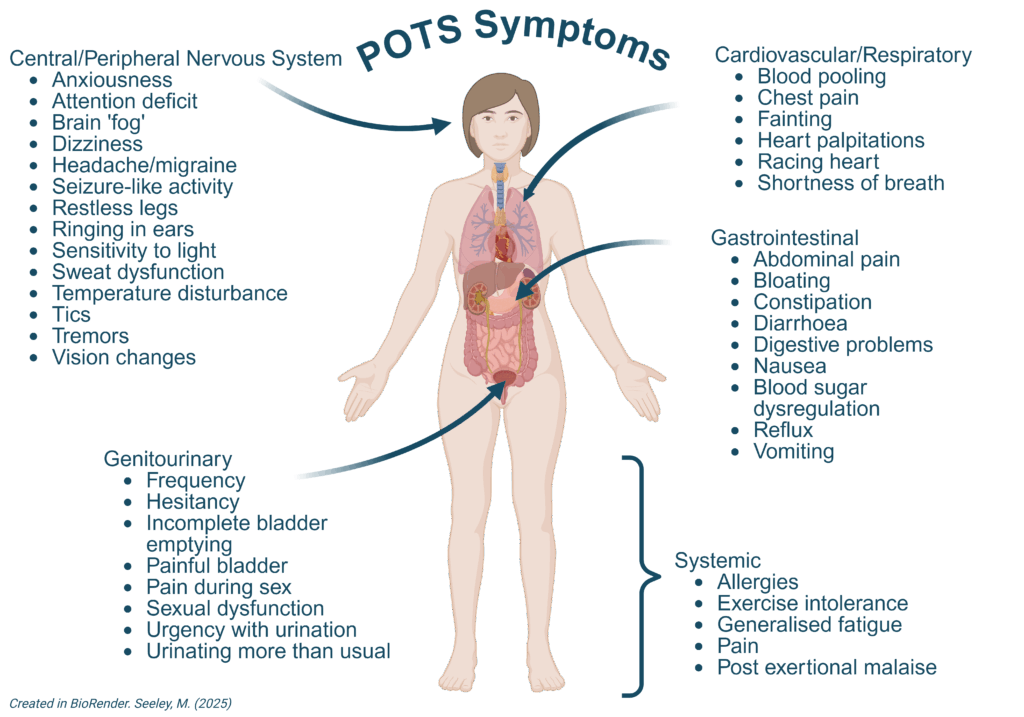
## What are the Symptoms of POTS?
It’s important to know that POTS can affect people in various ways, and symptoms can be very different from one person to another. Some people with POTS might only have mild symptoms that they can manage easily, while others might have more serious symptoms that make everyday life harder. Symptoms might also come and go over time. POTS can bring about symptoms that affect different parts of the body including:
- Heart and Circulation Symptoms:
A key symptom of POTS is a fast heartbeat when standing up, called tachycardia. People may feel palpitations, chest pain, or dizziness due to changes in blood flow and the heart rate response to this. They may find it particularly difficult to stand for any period of time. Especially when the weather is warm.
- Neurological Symptoms:
Many people with POTS report feeling dizzy, having trouble concentrating which is sometime referred to as ‘brain fog’. Headaches, including migraines, are also common in POTS. Some people also have sensory problems like tingling or numbness.
- Stomach and Digestive Symptoms:
POTS can affect digestion, causing symptoms such as feeling sick, tummy pain, bloating, or irregular bowel movements. These symptoms can make it hard to eat well and stay healthy.
- Tiredness and Weakness:
Feeling tired all the time is a common feature of POTS. Tiredness might get worse when standing or doing activities because the body is working harder to keep blood flowing properly.
- Temperature Problems:
POTS can interfere with how the body controls temperature, making people feel too hot or too cold or have fluctuating temperature changes.
- Bladder Issues:
Some individuals with POTS may experience bladder problems, such as increased frequency or urgency to urinate. While others may notice difficulty emptying their bladder fully.
- Vision Changes:
POTS can sometimes affect eyesight, causing blurry vision or difficulty focusing eyes. In some cases people may notice their eyes are sensitive to bright lights.
- Sweating Abnormalities:
POTS can lead to sweating problems, including excessive sweating or difficulty sweating when needed.
## What Causes POTS?
POTS is a condition with complex origins, and its exact causes are not always clear. Sometimes symptoms start suddenly after certain events or conditions:
###### Infections and Viral Illnesses:
POTS may develop following an infection or viral illness, such as [COVID-19](https://potsfoundation.org.au/long-covid/) or glandular fever. It’s thought that the body’s immune response to the infection may trigger changes in the autonomic nervous system, leading to the onset of POTS symptoms.
###### Surgery and Trauma:
POTS can also be triggered by surgery or traumatic events, including concussions. These events can disrupt the communication between the brain and the autonomic nervous system.
###### Hormonal Changes:
Hormonal fluctuations during significant life events such as pregnancy, menopause, or puberty can sometimes trigger POTS symptoms. Changes in hormone levels can affect blood volume, circulation, and the functioning of the autonomic nervous and immune system, potentially leading to the onset of POTS.
###### Connective Tissue Disorders:
Individuals with [hypermobile Ehlers-Danlos syndrome (hEDS)](https://potsfoundation.org.au/connective-tissue-disorders/), a connective tissue disorder, are at an increased risk of developing POTS.
## What is an Active Stand Test?
Sometimes known as the ‘NASA Lean Test’ or the “poor man’s tilt”, this simple test helps doctors check for POTS. Your heart rate and blood pressure are measured while lying down, then again after standing. If your heart rate increases by 30 beats or more within 10 minutes—and you feel dizzy, light-headed, or unwell—it may suggest POTS.
To understand more about how an Active Stand Test is conducted please see the “[How to Undertake and Interpret an Active Stand Test](https://potsfoundation.org.au/wp-content/uploads/2025/09/How-to-Undertake-and-Interpret-an-AST_DIGITAL-1.pdf)” information sheet.
## What is a Tilt Table Test?
If the Active Stand Test doesn’t clearly confirm a POTS diagnosis, your doctor may refer you for a tilt table test. In this specialised assessment, you lie on a motorised table that tilts you upright while your heart rate and blood pressure are continuously monitored. Although it can provide helpful insights, a tilt table test is not essential for diagnosing POTS.
**Diagnostic Criteria:**
To diagnose POTS, doctors look for a few key signs during testing:
1. Your heart rate increases by 30 beats per minute (bpm) or more (or goes over 120 bpm) within 10 minutes of standing.
2. Your blood pressure doesn’t drop significantly when you stand.
3. You have symptoms like dizziness, fainting, or light-headedness that improve when you lie down.
4. These symptoms have been happening for at least three months.
5. There’s no other condition that explains what you’re feeling.
To understand more about Tilt Table Testing please see the “[Tilt Table Test](https://potsfoundation.org.au/wp-content/uploads/2025/09/TTT_DIGITAL-1.pdf)” information sheet.
## Symptom Surveys
The Malmo POTS Survey is a simple questionnaire developed by researchers in Sweden to help screen for POTS. It gives doctors a better understanding of your symptom patterns and can support the diagnostic process.
You can fill it out at home and bring the results to your GP or specialist to guide further discussion.
You’ll find links to both the Malmo POTS Survey and the Active Standing Test in the resources below.
- [Malmo POTS Survey](https://potsfoundation.org.au/wp-content/uploads/2025/09/MALMO-MAPS-09_2025-1.pdf)
- [Active Stand Test Pad](https://potsfoundation.org.au/wp-content/uploads/2025/09/Active-Standing-Test-09_2025-1.pdf)
## Additional Tests
To help rule out other conditions and support a POTS diagnosis, your doctor might suggest the following:
- Holter Monitor
A small, portable device worn for 24–48 hours that continuously records your heart’s electrical activity. It helps detect irregular heart rhythms that may not show up during a short clinic visit.
- Echocardiogram
An ultrasound of the heart that shows its structure and how well it’s working. It can identify issues like valve problems or heart muscle abnormalities.
These tests can be useful in checking for other causes of symptoms, but they are not necessary to diagnose POTS.
### How is POTS Treated and Managed?
While there’s no cure for POTS, there are some treatments which can help to manage symptoms and improve quality of life.
## General Lifestyle Changes
Managing POTS starts with lifestyle changes, which are often the most important part of care. These strategies can help stabilise symptoms and improve daily functioning:
- Avoiding common triggers such as heat, prolonged standing, alcohol, caffeine, and other stimulants
- Maintaining consistent sleep and eating patterns to support your body’s natural rhythms
## Increase Fluid and Salt Intake
Boosting fluid and salt intake helps expand blood volume and improve circulation.
- Aim for 2–3 litres of water per day
- Increase salt intake to 10 grams per day (4000 mg of sodium or 2 heaped teaspoons of salt), under medical supervision
- Electrolyte and salt drinks can be especially helpful. The Australian POTS Foundation members are eligible for discounts on sponsor hydration products ([see our Membership Page)](https://potsfoundation.org.au/become-a-member/)
## Compression Wear
These are specially designed garments—such as tights, stockings, or shorts—that apply gentle pressure to the legs and lower abdomen to support blood flow.
Medical-grade compression garments are classified by their pressure level, usually starting from 15–20 mmHg for mild compression. For POTS, a pressure rating of 20 mmHg or higher is generally recommended, ideally with coverage from ankle to waist. However, any amount of compression is generally better than nothing.
While traditional medical-grade options are available through pharmacies or medical suppliers, there are now a number of brands producing functional, comfortable compression wear designed for daily use—often used by athletes or people with chronic conditions.
Members of the Australian POTS Foundation can access discounts on quality compression garments. [Visit our Membership Page for details.](https://potsfoundation.org.au/become-a-member/)
## Movement and Exercise
Staying active with POTS can be challenging, but keeping your muscles strong is important. When muscles contract, especially in your legs, they help push blood back up to your heart, which can reduce symptoms like light-headedness, fatigue, and brain fog.
Many people with POTS spend a lot of time lying down to manage symptoms, especially before diagnosis. Over time, this can lead to deconditioning, which may make symptoms worse.
The goal isn’t to push through with intense workouts, but to build a gentle, personalised movement plan that focuses on:
- Maintaining muscle strength
- Supporting daily tasks like walking short distances, cooking, or getting dressed
- Managing energy levels to avoid symptom flare-ups
Many people start with seated or lying-down movements like gentle stretching, resistance exercises using bands or light weights, or recumbent cycling. It’s best to work with a physiotherapist or exercise physiologist who understands POTS or chronic illness. They can help you move safely, avoid overexertion, and guide you using tools like heart rate monitors or biofeedback.
Any movement plan should work alongside your daily life—not add extra strain. The focus is on steady, sustainable progress that supports your wellbeing.
## Medications
If lifestyle changes alone do not improve your symptoms, then your doctor may consider some medications. In Australia, all medications for POTS are used ‘off-script’ meaning they are not subsidised by the Pharmaceutical Benefits Scheme.
The following medications are sometimes used by doctors to support people in managing POTS.
[Midodrine:](https://potsfoundation.org.au/wp-content/uploads/2025/09/Midodrine-for-POTS_DIGITAL-1.pdf) This medication helps constrict blood vessels in the legs and abdomen, helping to improve blood flow to the heart and brain.
[Ivabradine:](https://potsfoundation.org.au/wp-content/uploads/2025/09/Ivabradine-for-POTS_DIGITAL-1.pdf) Ivabradine is another medication that can lower heart rate and improve symptoms of POTS.
Fludrocortisone: Fludrocortisone helps increase blood volume by promoting salt and fluid retention in the body.
Propranolol: Propranolol is a beta-blocker that can help control heart rate and reduce symptoms like palpitations and tachycardia.
Other Medications: In some cases, other medications such as antihistamines for allergic reactions or medications for gastrointestinal symptoms may be prescribed to help manage specific symptoms associated with POTS.
## Exploring Complementary Practices
Some health and wellbeing practices have been shown to support overall physical and mental health, and may be helpful for some people living with chronic conditions.
One area of interest is vagus nerve stimulation, as the vagus nerve helps regulate heart rate, digestion, and blood pressure. Techniques that may gently stimulate the vagus nerve include:
- Deep breathing exercises
- Humming or singing
- Mindfulness or relaxation techniques
While these approaches are considered complementary, and not treatments for POTS, some people find them helpful as part of their broader wellbeing plan.
As always, speak with your healthcare team before starting new therapies—especially if you’re unsure how your body may respond.
## Prognosis
More research is needed to fully understand POTS and how it affects people over time. Current understanding suggests that it is often a chronic and fluctuating condition. However, with the right support and management, many people experience improvement in their symptoms and quality of life. Many are able to return to study or work, build families, and enjoy activities that bring them happiness and meaning. Everyone’s journey is different, but there is hope, and you are not alone.
### POTS in Schools and Workplaces
POTS can significantly impact a person’s ability to attend school or work regularly. Symptoms like dizziness, fatigue, brain fog, and pain can lead to frequent absences and make it difficult to concentrate or keep up with daily demands.
For students, it’s important that families work with the school to develop an Individual Learning Plan (ILP) or other flexible arrangements. These may include modified timetables, rest breaks, or exam accommodations. For more information, see our POTS in Schools, TAFE and University [resource.](https://potsfoundation.org.au/wp-content/uploads/2025/10/POTS-in-School-TAFE-University_DIGITAL-1.pdf)
For adults, flexible work arrangements—such as reduced hours, remote work, or adjusted tasks—can help support your capacity to stay engaged at work. You’re encouraged to speak with your employer about adjustments that may help, such as:
- Access to a climate-controlled environment
- The ability to stay well-hydrated throughout the day
- Scheduled rest breaks or use of ergonomic seating
To assist with these conversations, we’ve developed a [Workplace Adjustments](https://potsfoundation.org.au/wp-content/uploads/2025/09/Workplace-Adjustments_DIGITAL-1.pdf) resource.
For more information on other organisations that provide supportive services please visit our [Resources Page.](https://potsfoundation.org.au/helpful-organisations/)
A POTS diagnosis can feel overwhelming, but you’re not alone. By becoming a member of the Australian POTS Foundation, you’ll gain access to support, practical resources, and discounts on essentials like compression wear and hydration products. For a small annual fee, you’ll also join a growing community advocating for better care nationwide. Learn more on our [Membership Page](https://potsfoundation.org.au/become-a-member/).



##### Sign up for our Newsletter
[Donate](https://potsfoundation.org.au/donate/)
- [Advocacy](https://potsfoundation.org.au/advocacy/)
- [Become a Member](https://potsfoundation.org.au/become-a-member/)
- [Clinician Directory](https://potsfoundation.org.au/clinician-directory/)
- [Diagnosing POTS](https://potsfoundation.org.au/diagnosing-pots/)
- [Donate](https://potsfoundation.org.au/donate/)
- [Grants and Scholarships](https://potsfoundation.org.au/grants-and-scholarships/)
- [Resource Hub](https://potsfoundation.org.au/the-knowledge-hub/)
Disclaimer: The information contained on this website is not medical advice and is not intended to serve as professional medical advice, diagnosis or treatment. If you have health related issues you must contact a qualified health professional to get personalised assessment advice and treatment that you need.
*Funding provided by the Independent Gaming Corporation (IGC) facilitated through the Australian Hotels Association SA (AHA\|SA) and ‘Pubs with Heart’, on behalf of the South Australian Hotel Industry.*

Copyright © 2025 Australian POTS Foundation ABN: 98 648 334 374 \| [Privacy Policy](https://potsfoundation.org.au/privacy-policy/)
Site by [EnvyUs Design](https://envyus.com.au/)
[Shop](https://australianpotsfoundation.theprintbar.com/)
[Members](https://potsfoundation.org.au/become-a-member/)
[Clinician Directory](https://potsfoundation.org.au/clinician-directory/) | |||||||||
| Readable Markdown | It’s important to know that POTS can affect people in various ways, and symptoms can be very different from one person to another. Some people with POTS might only have mild symptoms that they can manage easily, while others might have more serious symptoms that make everyday life harder. Symptoms might also come and go over time. POTS can bring about symptoms that affect different parts of the body including:
- Heart and Circulation Symptoms:
A key symptom of POTS is a fast heartbeat when standing up, called tachycardia. People may feel palpitations, chest pain, or dizziness due to changes in blood flow and the heart rate response to this. They may find it particularly difficult to stand for any period of time. Especially when the weather is warm.
- Neurological Symptoms:
Many people with POTS report feeling dizzy, having trouble concentrating which is sometime referred to as ‘brain fog’. Headaches, including migraines, are also common in POTS. Some people also have sensory problems like tingling or numbness.
- Stomach and Digestive Symptoms:
POTS can affect digestion, causing symptoms such as feeling sick, tummy pain, bloating, or irregular bowel movements. These symptoms can make it hard to eat well and stay healthy.
- Tiredness and Weakness:
Feeling tired all the time is a common feature of POTS. Tiredness might get worse when standing or doing activities because the body is working harder to keep blood flowing properly.
- Temperature Problems:
POTS can interfere with how the body controls temperature, making people feel too hot or too cold or have fluctuating temperature changes.
- Bladder Issues:
Some individuals with POTS may experience bladder problems, such as increased frequency or urgency to urinate. While others may notice difficulty emptying their bladder fully.
- Vision Changes:
POTS can sometimes affect eyesight, causing blurry vision or difficulty focusing eyes. In some cases people may notice their eyes are sensitive to bright lights.
- Sweating Abnormalities:
POTS can lead to sweating problems, including excessive sweating or difficulty sweating when needed.
POTS is a condition with complex origins, and its exact causes are not always clear. Sometimes symptoms start suddenly after certain events or conditions:
###### Infections and Viral Illnesses:
POTS may develop following an infection or viral illness, such as [COVID-19](https://potsfoundation.org.au/long-covid/) or glandular fever. It’s thought that the body’s immune response to the infection may trigger changes in the autonomic nervous system, leading to the onset of POTS symptoms.
###### Surgery and Trauma:
POTS can also be triggered by surgery or traumatic events, including concussions. These events can disrupt the communication between the brain and the autonomic nervous system.
###### Hormonal Changes:
Hormonal fluctuations during significant life events such as pregnancy, menopause, or puberty can sometimes trigger POTS symptoms. Changes in hormone levels can affect blood volume, circulation, and the functioning of the autonomic nervous and immune system, potentially leading to the onset of POTS.
###### Connective Tissue Disorders:
Individuals with [hypermobile Ehlers-Danlos syndrome (hEDS)](https://potsfoundation.org.au/connective-tissue-disorders/), a connective tissue disorder, are at an increased risk of developing POTS. | |||||||||
| ML Classification | ||||||||||
| ML Categories |
Raw JSON{
"/Health": 997,
"/Health/Health_Conditions": 978,
"/Health/Health_Conditions/Neurological_Conditions": 264
} | |||||||||
| ML Page Types |
Raw JSON{
"/Article": 978,
"/Article/Tutorial_or_Guide": 532
} | |||||||||
| ML Intent Types |
Raw JSON{
"Informational": 999
} | |||||||||
| Content Metadata | ||||||||||
| Language | en | |||||||||
| Author | null | |||||||||
| Publish Time | 2025-10-16 00:50:23 (6 months ago) | |||||||||
| Original Publish Time | 2022-10-27 06:19:23 (3 years ago) | |||||||||
| Republished | Yes | |||||||||
| Word Count (Total) | 2,520 | |||||||||
| Word Count (Content) | 491 | |||||||||
| Links | ||||||||||
| External Links | 9 | |||||||||
| Internal Links | 43 | |||||||||
| Technical SEO | ||||||||||
| Meta Nofollow | No | |||||||||
| Meta Noarchive | No | |||||||||
| JS Rendered | No | |||||||||
| Redirect Target | null | |||||||||
| Performance | ||||||||||
| Download Time (ms) | 793 | |||||||||
| TTFB (ms) | 593 | |||||||||
| Download Size (bytes) | 23,819 | |||||||||
| Shard | 139 (laksa) | |||||||||
| Root Hash | 1130937649444703539 | |||||||||
| Unparsed URL | au,org,potsfoundation!/living-with-pots/ s443 | |||||||||