ℹ️ Skipped - page is already crawled
| Filter | Status | Condition | Details |
|---|---|---|---|
| HTTP status | PASS | download_http_code = 200 | HTTP 200 |
| Age cutoff | PASS | download_stamp > now() - 6 MONTH | 0.2 months ago |
| History drop | PASS | isNull(history_drop_reason) | No drop reason |
| Spam/ban | PASS | fh_dont_index != 1 AND ml_spam_score = 0 | ml_spam_score=0 |
| Canonical | PASS | meta_canonical IS NULL OR = '' OR = src_unparsed | Not set |
| Property | Value |
|---|---|
| URL | https://phys.org/news/2019-04-astronomers-unveil-photo-black-hole.html |
| Last Crawled | 2026-04-09 05:27:19 (6 days ago) |
| First Indexed | 2019-04-10 13:16:51 (7 years ago) |
| HTTP Status Code | 200 |
| Meta Title | Astronomers deliver first photo of black hole |
| Meta Description | Astronomers on Wednesday unveiled the first photo of a black hole, one of the star-devouring monsters scattered throughout the Universe and obscured by impenetrable shields of gravity. |
| Meta Canonical | null |
| Boilerpipe Text | Credit: NSF
Astronomers on Wednesday unveiled the first photo of a black hole, one of the star-devouring monsters scattered throughout the Universe and obscured by impenetrable shields of gravity.
The image of a dark core encircled by a flame-orange halo of white-hot plasma looks like any number of artists' renderings over the last 30 years.
But this time, it's the real deal.
"The history of science will be divided into the time before the image, and the time after the image," said Michael Kramer, director at the Max Planck Institute for Radio Astronomy.
Carlos Moedas, European Commissioner for Research, Science and Innovation called the feat a "huge breakthrough for humanity."
The supermassive black hole immortalised by a far-flung network of radio telescopes is 50 million lightyears away at the centre of a galaxy known as M87.
"It's a distance that we could have barely imagined," Frederic Gueth, an astronomer at France's National Centre for Scientific Research (CNRS) and co-author of studies detailing the findings, told AFP.
Most speculation had centred on the other candidate targeted by the Event Horizon Telescope: Sagittarius A*, a closer but smaller black hole at the centre of our own galaxy, the Milky Way.
Locking down an image of M87's supermassive black hole at such distance is comparable to photographing a pebble on the Moon, the scientists said.
It was also very much a team effort.
"Instead of constructing a giant telescope that would collapse under its own weight, we combined many observatories," Michael Bremer, an astronomer at the Institute for Millimetric Radio Astronomy (IRAM) in Grenoble, told AFP.
Earth in a thimble
Over several days in April 2017, eight radio telescopes in Hawaii, Arizona, Spain, Mexico, Chile, and the South Pole zeroed in on Sag A* and M87.
Knitted together, they formed a virtual observatory some 12,000 kilometres across—roughly the diameter of Earth.
00:00
00:00
The Event Horizon Telescope (EHT) -- a planet-scale array of eight ground-based radio telescopes forged through international collaboration -- was designed to capture images of a black hole. Today, in coordinated press conferences across the globe, EHT researchers reveal that they have succeeded, unveiling the first direct visual evidence of a supermassive black hole and its shadow.For more multimedia, visit NSF.gov/blackhole, including text-free versions of all images. Credit: NSF
"The data is like an incomplete puzzle set," said team member Monika Moscibrodzka, an astronomer at Radboud University. "We only see pieces of the real true image, and then we have to fill in the gaps of the missing pieces."
In the end, M87 was more photogenic. Like a fidgety child, Sag A* was too "active" to capture a clear picture, the scientists said.
"What we see in the image is the shadow of the black hole's rim—known as the event horizon, or the point of no return—set against the luminous accretion disk," Gueth told AFP.
The unprecedented image—so often imagined in science and science fiction —- has been analysed in six studies co-authored by 200 experts from 60-odd institutions and published Wednesday in
Astrophysical Journal Letters
.
"I never thought that I would see a real one in my lifetime," said CNRS astrophysicist Jean-Pierre Luminet, author in 1979 of the first digital simulation of a black hole.
Coined in the mid-60s by US physicist John Archibald Wheeler, the term "black hole" refers to a point in space where matter is so compressed as to create a gravity field from which even light cannot escape.
00:00
00:00
The Event Horizon Telescope (EHT) -- a planet-scale array of eight ground-based radio telescopes forged through international collaboration -- was designed to capture images of a black hole. For more multimedia, visit NSF.gov/blackhole. Credit: NSF
The more mass, the bigger the hole. At the same scale of compression, Earth would fit inside a thimble.
A successful outcome depended in part on the vagaries of weather during the April 2017 observation period.
"For everything to work, we needed to have clear visibility at every (telescope) location worldwide", said IRAM scientist Pablo Torne, recalling collective tension, fatigue and, finally, relief.
'Hell of a Christmas present'
Torne was at the controls of the Pico Veleta telescope in Spain's Sierra Madre mountains.
After that, is was eight months of nail-biting while scientists at MIT Haystack Observatory in Massachusetts and the Max Planck Institute for Radio Astronomy in Bonn crunched the data.
The Event Horizon Telescope—a network of eight radio telescopes across the globe—gathered data to generate the first image of a black hole some 50 million lightyears from Earth
The Universe is filled with electromagnetic "noise", and there was no guarantee M87's faint signals could be extracted from a mountain of data so voluminous it could not be delivered via the Internet.
There was at least one glitch.
"We were desperately waiting for the data from the South Pole Telescope, which—due to extreme weather conditions during the southern hemisphere winter—didn't arrive until six months later," recalled Helger Rottmann from the Max Planck Institute.
It arrived, to be precise, on December 23, 2017.
"When, a few hours later, we saw that everything was there, it was one hell of a Christmas present," Rottmann said.
It would take another year, however, to piece together the data into an image.
Coined in the mid-60s by American physicist John Archibald Wheeler, the term "black hole" refers to a point in space where matter is so compressed as to create a gravity field from which even light cannot escape
"To be absolutely sure, we did the work four times with four different teams," said Gueth.
Team scientists presenting the findings at a news conference in Brussels were visibly moved.
"We are looking at a region we have never looked at before, that we cannot really imagine being there," said Heino Falcke, chair of the EHT Science Council.
"It feels like looking at the gates of hell, at the end of space and time –- the event horizon, the point of no return."
© 2019 AFP
Citation
:
Astronomers deliver first photo of black hole (2019, April 10)
retrieved 9 April 2026
from https://phys.org/news/2019-04-astronomers-unveil-photo-black-hole.html
This document is subject to copyright. Apart from any fair dealing for the purpose of private study or research, no
part may be reproduced without the written permission. The content is provided for information purposes only. |
| Markdown | [](https://phys.org/)
Topics
- [Week's top](https://phys.org/weekly-news/)
- [Latest news](https://phys.org/latest-news/)
- [Unread news](https://phys.org/unread-news/)
- [Subscribe](https://phys.org/news/2019-04-astronomers-unveil-photo-black-hole.html)
### Science X Account
- [Nanotechnology](https://phys.org/nanotech-news/)
- [Physics](https://phys.org/physics-news/)
- [Earth](https://phys.org/earth-news/)
- [Astronomy & Space](https://phys.org/space-news/)
- [Chemistry](https://phys.org/chemistry-news/)
- [Biology](https://phys.org/biology-news/)
- [Other Sciences](https://phys.org/science-news/)
- [ Medicine](https://medicalxpress.com/)
- [ Technology](https://techxplore.com/)
- share this\!
- [20\.9K]()
- [147](https://phys.org/news/2019-04-astronomers-unveil-photo-black-hole.html)
- [Share](https://phys.org/news/2019-04-astronomers-unveil-photo-black-hole.html)
- [Email](mailto:)
1. [Home](https://phys.org/)
2. [Astronomy & Space](https://phys.org/space-news/)
3. [Astronomy](https://phys.org/space-news/astronomy/)
***
April 10, 2019
# Astronomers deliver first photo of black hole
[Add as preferred source](https://google.com/preferences/source?q=https%3A%2F%2Fphys.org%2F)
***
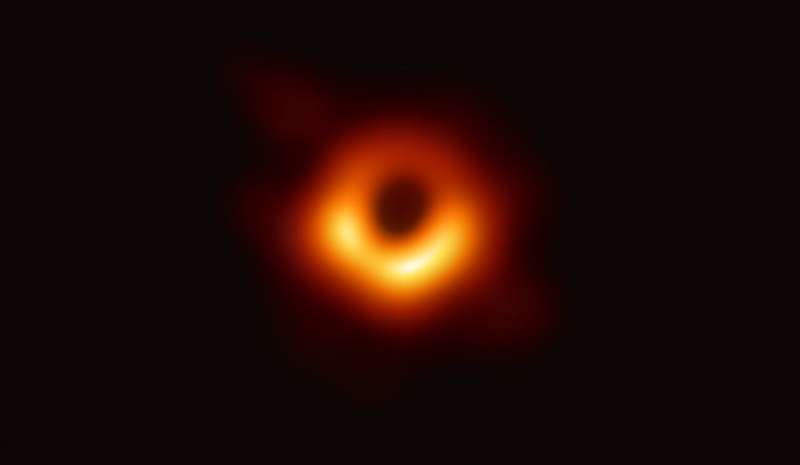
Credit: NSF
Astronomers on Wednesday unveiled the first photo of a black hole, one of the star-devouring monsters scattered throughout the Universe and obscured by impenetrable shields of gravity.
The image of a dark core encircled by a flame-orange halo of white-hot plasma looks like any number of artists' renderings over the last 30 years.
But this time, it's the real deal.
"The history of science will be divided into the time before the image, and the time after the image," said Michael Kramer, director at the Max Planck Institute for Radio Astronomy.
Carlos Moedas, European Commissioner for Research, Science and Innovation called the feat a "huge breakthrough for humanity."
The supermassive black hole immortalised by a far-flung network of radio telescopes is 50 million lightyears away at the centre of a galaxy known as M87.
"It's a distance that we could have barely imagined," Frederic Gueth, an astronomer at France's National Centre for Scientific Research (CNRS) and co-author of studies detailing the findings, told AFP.
Most speculation had centred on the other candidate targeted by the Event Horizon Telescope: Sagittarius A\*, a closer but smaller black hole at the centre of our own galaxy, the Milky Way.
Locking down an image of M87's supermassive black hole at such distance is comparable to photographing a pebble on the Moon, the scientists said.
It was also very much a team effort.
"Instead of constructing a giant telescope that would collapse under its own weight, we combined many observatories," Michael Bremer, an astronomer at the Institute for Millimetric Radio Astronomy (IRAM) in Grenoble, told AFP.
## Earth in a thimble
Over several days in April 2017, eight radio telescopes in Hawaii, Arizona, Spain, Mexico, Chile, and the South Pole zeroed in on Sag A\* and M87.
Knitted together, they formed a virtual observatory some 12,000 kilometres across—roughly the diameter of Earth.
PausePlay
% buffered
00:00
00:00
UnmuteMute
Disable captionsEnable captions
Settings
CaptionsDisabled
Quality0
SpeedNormal
CaptionsGo back to previous menu
QualityGo back to previous menu
SpeedGo back to previous menu
0\.5×
0\.75×
Normal
1\.25×
1\.5×
1\.75×
2×
4×
PIP
Exit fullscreenEnter fullscreen
Play
The Event Horizon Telescope (EHT) -- a planet-scale array of eight ground-based radio telescopes forged through international collaboration -- was designed to capture images of a black hole. Today, in coordinated press conferences across the globe, EHT researchers reveal that they have succeeded, unveiling the first direct visual evidence of a supermassive black hole and its shadow.For more multimedia, visit NSF.gov/blackhole, including text-free versions of all images. Credit: NSF
"The data is like an incomplete puzzle set," said team member Monika Moscibrodzka, an astronomer at Radboud University. "We only see pieces of the real true image, and then we have to fill in the gaps of the missing pieces."
In the end, M87 was more photogenic. Like a fidgety child, Sag A\* was too "active" to capture a clear picture, the scientists said.
"What we see in the image is the shadow of the black hole's rim—known as the event horizon, or the point of no return—set against the luminous accretion disk," Gueth told AFP.
The unprecedented image—so often imagined in science and science fiction —- has been analysed in six studies co-authored by 200 experts from 60-odd institutions and published Wednesday in *Astrophysical Journal Letters*.
"I never thought that I would see a real one in my lifetime," said CNRS astrophysicist Jean-Pierre Luminet, author in 1979 of the first digital simulation of a black hole.
Coined in the mid-60s by US physicist John Archibald Wheeler, the term "black hole" refers to a point in space where matter is so compressed as to create a gravity field from which even light cannot escape.
PausePlay
% buffered
00:00
00:00
UnmuteMute
Disable captionsEnable captions
Settings
CaptionsDisabled
Quality0
SpeedNormal
CaptionsGo back to previous menu
QualityGo back to previous menu
SpeedGo back to previous menu
0\.5×
0\.75×
Normal
1\.25×
1\.5×
1\.75×
2×
4×
PIP
Exit fullscreenEnter fullscreen
Play
The Event Horizon Telescope (EHT) -- a planet-scale array of eight ground-based radio telescopes forged through international collaboration -- was designed to capture images of a black hole. For more multimedia, visit NSF.gov/blackhole. Credit: NSF
The more mass, the bigger the hole. At the same scale of compression, Earth would fit inside a thimble.
A successful outcome depended in part on the vagaries of weather during the April 2017 observation period.
"For everything to work, we needed to have clear visibility at every (telescope) location worldwide", said IRAM scientist Pablo Torne, recalling collective tension, fatigue and, finally, relief.
Discover the latest in science, tech, and space with over **100,000 subscribers** who rely on Phys.org for daily insights. Sign up for our [free newsletter](https://sciencex.com/help/newsletter/) and get updates on breakthroughs, innovations, and research that matter—**daily or weekly**.
## 'Hell of a Christmas present'
Torne was at the controls of the Pico Veleta telescope in Spain's Sierra Madre mountains.
After that, is was eight months of nail-biting while scientists at MIT Haystack Observatory in Massachusetts and the Max Planck Institute for Radio Astronomy in Bonn crunched the data.
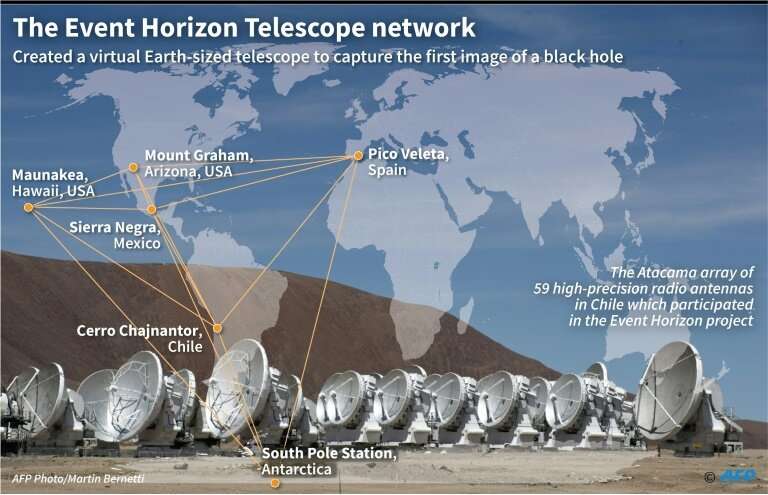
The Event Horizon Telescope—a network of eight radio telescopes across the globe—gathered data to generate the first image of a black hole some 50 million lightyears from Earth
The Universe is filled with electromagnetic "noise", and there was no guarantee M87's faint signals could be extracted from a mountain of data so voluminous it could not be delivered via the Internet.
There was at least one glitch.
"We were desperately waiting for the data from the South Pole Telescope, which—due to extreme weather conditions during the southern hemisphere winter—didn't arrive until six months later," recalled Helger Rottmann from the Max Planck Institute.
It arrived, to be precise, on December 23, 2017.
"When, a few hours later, we saw that everything was there, it was one hell of a Christmas present," Rottmann said.
It would take another year, however, to piece together the data into an image.
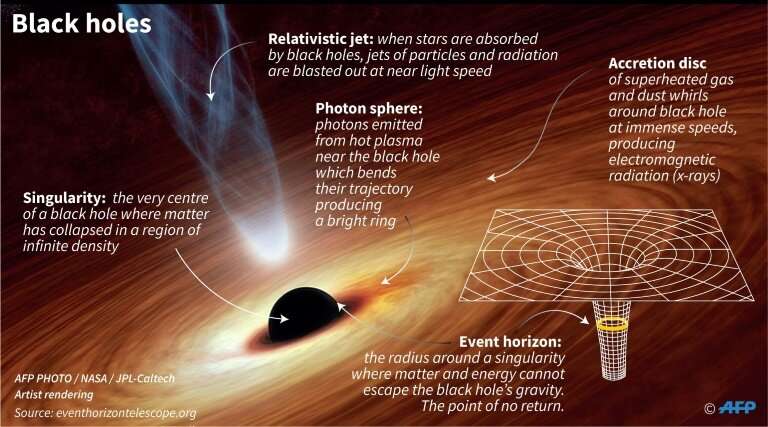
Coined in the mid-60s by American physicist John Archibald Wheeler, the term "black hole" refers to a point in space where matter is so compressed as to create a gravity field from which even light cannot escape
"To be absolutely sure, we did the work four times with four different teams," said Gueth.
Team scientists presenting the findings at a news conference in Brussels were visibly moved.
"We are looking at a region we have never looked at before, that we cannot really imagine being there," said Heino Falcke, chair of the EHT Science Council.
"It feels like looking at the gates of hell, at the end of space and time –- the event horizon, the point of no return."
###### More information
PAPERS:
- [Paper I: The Shadow of the Supermassive Black Hole](https://dx.doi.org/10.3847/2041-8213/ab0ec7)
- [Paper II: Array and Instrumentation](https://dx.doi.org/10.3847/2041-8213/ab0c96)
- [Paper III: Data processing and Calibration](https://dx.doi.org/10.3847/2041-8213/ab0c57)
- [Paper IV: Imaging the Central Supermassive Black Hole](https://dx.doi.org/10.3847/2041-8213/ab0e85)
- [Paper V: Physical Origin of the Asymmetric Ring](https://dx.doi.org/10.3847/2041-8213/ab0f43)
- [Paper VI: The Shadow and Mass of the Central Black Hole](https://dx.doi.org/10.3847/2041-8213/ab1141)
© 2019 AFP
**Citation**: Astronomers deliver first photo of black hole (2019, April 10) retrieved 9 April 2026 from https://phys.org/news/2019-04-astronomers-unveil-photo-black-hole.html
This document is subject to copyright. Apart from any fair dealing for the purpose of private study or research, no part may be reproduced without the written permission. The content is provided for information purposes only.
***
Explore further
[Black holes: picturing the heart of darkness](https://phys.org/news/2019-04-black-holes-picturing-heart-darkness.html)
***
[21030 shares]()
- [Facebook]()
- [Twitter](https://phys.org/news/2019-04-astronomers-unveil-photo-black-hole.html)
- [Email](https://phys.org/news/2019-04-astronomers-unveil-photo-black-hole.html)
[Feedback to editors](https://phys.org/news/2019-04-astronomers-unveil-photo-black-hole.html)
- [Trending](https://phys.org/news/2019-04-astronomers-unveil-photo-black-hole.html#nav-popular)
- [Featured](https://phys.org/news/2019-04-astronomers-unveil-photo-black-hole.html#nav-editorials)
- [Last Comments](https://phys.org/news/2019-04-astronomers-unveil-photo-black-hole.html#nav-commented)
#### [Astronomers thought the early universe was full of hydrogen: Now they've found it](https://phys.org/news/2026-04-astronomers-thought-early-universe-full.html)
Apr 6, 2026
0
#### [A new equation may help baristas produce the perfect espresso shot every time](https://phys.org/news/2026-04-equation-baristas-espresso-shot.html)
Apr 6, 2026
1
#### [Experiments refute dark matter claim](https://phys.org/news/2026-04-refute-dark.html)
Apr 6, 2026
7
#### [Analysis finds geometric thinking may come from wandering, not a human-only math module](https://phys.org/news/2026-04-analysis-geometric-human-math-module.html)
Apr 6, 2026
1
#### [Parasitic tapeworm—a risk to domestic dogs and humans—found in Washington coyotes](https://phys.org/news/2026-04-parasitic-tapeworm-domestic-dogs-humans.html)
Apr 6, 2026
1
***
[ What if dark matter came in two states? 1 hour ago](https://phys.org/news/2026-04-dark-states.html)
[ A 'stemness checkpoint' helps control stem cell identity 5 hours ago](https://phys.org/news/2026-04-stemness-checkpoint-stem-cell-identity.html)
[ AMOC collapse could turn Southern Ocean into carbon source, adding 0.2°C to global warming 5 hours ago](https://phys.org/news/2026-04-amoc-collapse-southern-ocean-carbon.html)
[ Ecuador study finds tropical rainforest biodiversity rebounds over 90% in 30 years 6 hours ago](https://phys.org/news/2026-04-ecuador-tropical-rainforest-biodiversity-rebounds.html)
[ Ancient architecture shows public opinion influenced Maya divine kings 6 hours ago](https://phys.org/news/2026-04-ancient-architecture-opinion-maya-divine.html)
[ Mathematical model predicts fish freshness in real time 6 hours ago](https://phys.org/news/2026-04-mathematical-fish-freshness-real.html)
[ Satellites capture the volatile human–luminescence relationship 6 hours ago](https://phys.org/news/2026-04-satellites-capture-volatile-humanluminescence-relationship.html)
[ Momentum-engineered photonic states make bulk silicon shine 6 hours ago](https://phys.org/news/2026-04-momentum-photonic-states-bulk-silicon.html)
[ The binding sites that guide fungal 'vesicle hitchhiking'—new study maps mRNA transport 7 hours ago](https://phys.org/news/2026-04-sites-fungal-vesicle-hitchhiking-mrna.html)
[ Online review structure, not just sentiment, predicts what readers find helpful 7 hours ago](https://phys.org/news/2026-04-online-sentiment-readers.html)
***
### Relevant PhysicsForums posts
#### [Astronomy: Orbit Terminology](https://www.physicsforums.com/threads/astronomy-orbit-terminology.1084772/)
18 hours ago
#### [Live data from Artemis 2?](https://www.physicsforums.com/threads/live-data-from-artemis-2.1084771/)
Apr 7, 2026
#### [Solar Activity and Space Weather Update thread](https://www.physicsforums.com/threads/solar-activity-and-space-weather-update-thread.923468/)
Apr 3, 2026
#### [Large Synoptic Survey Telescope -\> Vera C. Rubin Observatory](https://www.physicsforums.com/threads/large-synoptic-survey-telescope-vera-c-rubin-observatory.982871/)
Apr 3, 2026
#### [Our Beautiful Universe - Photos and Videos](https://www.physicsforums.com/threads/our-beautiful-universe-photos-and-videos.800540/)
Apr 2, 2026
#### [The James Webb Space Telescope](https://www.physicsforums.com/threads/the-james-webb-space-telescope.1010264/)
Apr 1, 2026
More from [Astronomy and Astrophysics](https://www.physicsforums.com/forums/astronomy-and-astrophysics.71/)
***
- [1](https://phys.org/news/2019-04-astronomers-unveil-photo-black-hole.html)
- [2](https://phys.org/news/2019-04-astronomers-unveil-photo-black-hole.html)
- ### Related Stories
[ Black holes: picturing the heart of darkness Apr 9, 2019](https://phys.org/news/2019-04-black-holes-picturing-heart-darkness.html)
[ Scientists set to reveal first true image of black hole Apr 10, 2019](https://phys.org/news/2019-04-scientists-reveal-true-image-black.html)
[ Scientists set to unveil first picture of a black hole Apr 6, 2019](https://phys.org/news/2019-04-scientists-unveil-picture-black-hole.html)
[ What is a black hole? Searching for what can't be seen Apr 9, 2019](https://phys.org/news/2019-04-black-hole.html)
[ New Greenland telescope is up and running Jun 14, 2018](https://phys.org/news/2018-06-greenland-telescope.html)
[ Image: Computer simulation of a supermassive black hole Apr 7, 2016](https://phys.org/news/2016-04-image-simulation-supermassive-black-hole.html)
- ### Recommended for you
[ What if dark matter came in two states? 1 hour ago](https://phys.org/news/2026-04-dark-states.html)
[ Student research on coronal holes improves space weather forecasting 10 hours ago](https://phys.org/news/2026-04-student-coronal-holes-space-weather.html)
[ How Jupiter cultivated more large moons than Saturn Apr 7, 2026](https://phys.org/news/2026-04-jupiter-cultivated-large-moons-saturn.html)
[ Astronomers discover Andromeda XXXVI, an ultra-faint dwarf satellite galaxy Apr 7, 2026](https://phys.org/news/2026-04-astronomers-andromeda-xxxvi-ultra-faint.html)
[ First close pair of supermassive black holes detected Apr 7, 2026](https://phys.org/news/2026-04-pair-supermassive-black-holes.html)
[ Astronomers thought the early universe was full of hydrogen: Now they've found it Apr 6, 2026](https://phys.org/news/2026-04-astronomers-thought-early-universe-full.html)
[Load comments (607)](Javascript:void\(0\);)
## More news stories
[](https://phys.org/news/2026-04-dark-states.html)
### [What if dark matter came in two states?](https://phys.org/news/2026-04-dark-states.html)
The absence of a signal could itself be a signal. This is the idea behind a new study published in the Journal of Cosmology and Astroparticle Physics, which aims to redefine how we search for dark matter, showing that it ...
Astronomy
1 hour ago
0
5
[](https://phys.org/news/2026-04-lengths-male-octopuses-arm.html)
### [The lengths male octopuses go to protect the arm they need to mate](https://phys.org/news/2026-04-lengths-male-octopuses-arm.html)
For mating male octopuses, one limb is more important than all others. That is the third right arm or hectocotylus, which is used to transfer sperm to the female because the penis cannot do it directly. Losing the limb can ...
Plants & Animals
10 hours ago
0
54
[](https://phys.org/news/2026-04-ecuador-tropical-rainforest-biodiversity-rebounds.html)
### [Ecuador study finds tropical rainforest biodiversity rebounds over 90% in 30 years](https://phys.org/news/2026-04-ecuador-tropical-rainforest-biodiversity-rebounds.html)
Tropical rainforests are home to almost two-thirds of all vertebrate species and three-quarters of all tree species: they are the most species-rich terrestrial ecosystem on Earth. However, over half of these diverse rainforests ...
Plants & Animals
6 hours ago
0
23
[](https://phys.org/news/2026-04-stemness-checkpoint-stem-cell-identity.html)
### [A 'stemness checkpoint' helps control stem cell identity](https://phys.org/news/2026-04-stemness-checkpoint-stem-cell-identity.html)
A study published in Cell Research advances a central idea in stem cell biology by identifying a checkpoint that controls the identity of many different types of stem cells across developmental stages. For nearly two decades, ...
Cell & Microbiology
5 hours ago
0
7
[](https://phys.org/news/2026-04-amoc-collapse-southern-ocean-carbon.html)
### [AMOC collapse could turn Southern Ocean into carbon source, adding 0.2°C to global warming](https://phys.org/news/2026-04-amoc-collapse-southern-ocean-carbon.html)
A shutdown of the Atlantic Meridional Overturning Circulation (AMOC) could trigger a substantial release of stored ocean carbon into the atmosphere over hundreds of years, according to a new study that simulated such a collapse ...
Earth Sciences
5 hours ago
0
8
[](https://phys.org/news/2026-04-physicists-mass-fundamental-boson-particle.html)
### [Physicists zero in on the mass of the fundamental W boson particle](https://phys.org/news/2026-04-physicists-mass-fundamental-boson-particle.html)
When fundamental particles are heavier or lighter than expected, physicists' understanding of the universe can tip into the unknown. A particle that is just beyond its predicted mass can unravel scientists' assumptions about ...
General Physics
13 hours ago
0
61
[](https://phys.org/news/2026-04-satellites-capture-volatile-humanluminescence-relationship.html)
### [Satellites capture the volatile human–luminescence relationship](https://phys.org/news/2026-04-satellites-capture-volatile-humanluminescence-relationship.html)
From space, Earth's populated areas glow on the otherwise "black marble" of the planet at night. For decades, scientists assumed this glow was steadily increasing as the world developed. However, a new study published in ...
Environment
6 hours ago
0
10
[](https://phys.org/news/2026-04-ancient-architecture-opinion-maya-divine.html)
### [Ancient architecture shows public opinion influenced Maya divine kings](https://phys.org/news/2026-04-ancient-architecture-opinion-maya-divine.html)
Excavation of a council house at the major Lowland Maya center of Ucanal, Guatemala, reveals how the public gained some influence over Maya politics more than 1,000 years ago. These colonnaded, open halls were likely council ...
Archaeology
6 hours ago
0
6
[](https://phys.org/news/2026-04-mathematical-fish-freshness-real.html)
### [Mathematical model predicts fish freshness in real time](https://phys.org/news/2026-04-mathematical-fish-freshness-real.html)
Every day, fish caught in oceans and seas around the world pass through a long journey before reaching supermarkets, restaurants, and home kitchens. Along the way, their freshness steadily declines, often in ways that are ...
Molecular & Computational biology
6 hours ago
0
6
[](https://phys.org/news/2026-04-unique-baptistery-mysterious-marble-block.html)
### [Unique double baptistery and mysterious marble block uncovered at Byzantine cathedral in Israel](https://phys.org/news/2026-04-unique-baptistery-mysterious-marble-block.html)
In a new article published in the Palestine Exploration Quarterly, researchers Dr. Michael Eisenberg and Dr. Arleta Kowalewska describe a recently excavated Byzantine-period cathedral at Hippos. Archaeologists revealed a ...
Archaeology
12 hours ago
0
15
[](https://phys.org/news/2026-04-uncharted-island-nautical.html)
### [Uncharted island will soon appear on nautical charts](https://phys.org/news/2026-04-uncharted-island-nautical.html)
A 93-strong international expedition team has been exploring the northwestern Weddell Sea in the Antarctic on board the Alfred Wegener Institute's icebreaker Polarstern since February 8, 2026. In this key region for global ...
Earth Sciences
7 hours ago
0
13
[](https://phys.org/news/2026-04-dna-evidence-reveals-stone-age.html)
### [DNA evidence reveals a Stone Age population collapse in France](https://phys.org/news/2026-04-dna-evidence-reveals-stone-age.html)
By analyzing DNA of ancient skeletons at a Neolithic burial site near Paris, an international team of researchers has uncovered evidence of a dramatic population replacement 5,000 years ago. The findings indicate that the ...
Archaeology
7 hours ago
0
14
[](https://phys.org/news/2026-04-momentum-photonic-states-bulk-silicon.html)
### [Momentum-engineered photonic states make bulk silicon shine](https://phys.org/news/2026-04-momentum-photonic-states-bulk-silicon.html)
An international team of researchers, led by scientists from the University of California, Irvine, has demonstrated a fundamentally new way to make silicon emit light—overcoming one of the most persistent limitations in modern ...
Nanophysics
6 hours ago
0
6
[](https://phys.org/news/2026-04-sites-fungal-vesicle-hitchhiking-mrna.html)
### [The binding sites that guide fungal 'vesicle hitchhiking'—new study maps mRNA transport](https://phys.org/news/2026-04-sites-fungal-vesicle-hitchhiking-mrna.html)
A specific protein controls mRNA transport in fungi and distinguishes important from unimportant binding sites in the transported mRNAs. Researchers from Würzburg and Düsseldorf have discovered this mechanism.
Cell & Microbiology
7 hours ago
0
6
[](https://phys.org/news/2026-04-ai-uncovers-hidden-immune-defenses.html)
### [AI uncovers hidden immune defenses inside bacteria](https://phys.org/news/2026-04-ai-uncovers-hidden-immune-defenses.html)
Researchers at the Massachusetts Institute of Technology (MIT) have discovered thousands of new proteins that protect bacteria from virus attacks using an AI system called DefensePredictor. What would usually take months ...
Cell & Microbiology
13 hours ago
0
24
[](https://phys.org/news/2026-04-hair-bundles-ears-tiny-thermodynamic.html)
### [Sound-sensing hair bundles in our ears act as tiny thermodynamic machines](https://phys.org/news/2026-04-hair-bundles-ears-tiny-thermodynamic.html)
The hair cells lining the inner ear are among the most sophisticated structures in the human body: capable of detecting sounds as faint as a whisper, while helping to maintain our sense of balance. Through new models detailed ...
Bio & Medicine
14 hours ago
0
24
##### Get Instant Summarized Text (Gist)
This summary was automatically generated using LLM. [Full disclaimer](https://sciencex.com/help/ai-disclaimer/)
##### Let us know if there is a problem with our content
###### E-mail the story
##### Astronomers deliver first photo of black hole
#### Donate and enjoy an ad-free experience
We keep our content available to everyone. Consider supporting Science X's mission by getting a premium account.
[Remove ads](https://sciencex.com/donate/?utm_source=phys&utm_medium=desktop&utm_campaign=popup)
[Maybe later](https://phys.org/news/2019-04-astronomers-unveil-photo-black-hole.html)
[ Medical Xpress Medical research advances and health news](https://medicalxpress.com/)
[ Tech Xplore The latest engineering, electronics and technology advances](https://techxplore.com/)
[ Science X The most comprehensive sci-tech news coverage on the web](https://sciencex.com/)
## Newsletters
## Follow us
- [Top](https://phys.org/news/2019-04-astronomers-unveil-photo-black-hole.html)
- [Home](https://phys.org/)
- [Search](https://phys.org/search/)
- [Mobile version](https://phys.org/news/2019-04-astronomers-unveil-photo-black-hole.html?deviceType=mobile)
- [Help](https://sciencex.com/help/)
- [FAQ](https://sciencex.com/help/contactus/)
- [About](https://sciencex.com/help/about-us/)
- [Contact](https://sciencex.com/help/feedback/)
- [Support us](https://sciencex.com/help/donate/)
- [Science X Account](https://sciencex.com/profile/)
- [Archive](https://phys.org/archive/)
- [News wire](https://sciencex.com/wire-news/)
- [Android app](https://play.google.com/store/apps/details?id=com.PhysOrg.RssLite)
- [iOS app](https://itunes.apple.com/us/app/phys-org/id356443503?mt=8)
- [RSS feeds](https://phys.org/feeds/)
- [Push notification]()
© Phys.org 2003 - 2026 powered by [Science X Network](https://sciencex.com/)
[Privacy policy](https://sciencex.com/help/privacy/) [Terms of use](https://sciencex.com/help/terms/)
#### E-mail newsletter
#### Follow us
 |
| Readable Markdown | 
Credit: NSF
Astronomers on Wednesday unveiled the first photo of a black hole, one of the star-devouring monsters scattered throughout the Universe and obscured by impenetrable shields of gravity.
The image of a dark core encircled by a flame-orange halo of white-hot plasma looks like any number of artists' renderings over the last 30 years.
But this time, it's the real deal.
"The history of science will be divided into the time before the image, and the time after the image," said Michael Kramer, director at the Max Planck Institute for Radio Astronomy.
Carlos Moedas, European Commissioner for Research, Science and Innovation called the feat a "huge breakthrough for humanity."
The supermassive black hole immortalised by a far-flung network of radio telescopes is 50 million lightyears away at the centre of a galaxy known as M87.
"It's a distance that we could have barely imagined," Frederic Gueth, an astronomer at France's National Centre for Scientific Research (CNRS) and co-author of studies detailing the findings, told AFP.
Most speculation had centred on the other candidate targeted by the Event Horizon Telescope: Sagittarius A\*, a closer but smaller black hole at the centre of our own galaxy, the Milky Way.
Locking down an image of M87's supermassive black hole at such distance is comparable to photographing a pebble on the Moon, the scientists said.
It was also very much a team effort.
"Instead of constructing a giant telescope that would collapse under its own weight, we combined many observatories," Michael Bremer, an astronomer at the Institute for Millimetric Radio Astronomy (IRAM) in Grenoble, told AFP.
## Earth in a thimble
Over several days in April 2017, eight radio telescopes in Hawaii, Arizona, Spain, Mexico, Chile, and the South Pole zeroed in on Sag A\* and M87.
Knitted together, they formed a virtual observatory some 12,000 kilometres across—roughly the diameter of Earth.
00:00
00:00
The Event Horizon Telescope (EHT) -- a planet-scale array of eight ground-based radio telescopes forged through international collaboration -- was designed to capture images of a black hole. Today, in coordinated press conferences across the globe, EHT researchers reveal that they have succeeded, unveiling the first direct visual evidence of a supermassive black hole and its shadow.For more multimedia, visit NSF.gov/blackhole, including text-free versions of all images. Credit: NSF
"The data is like an incomplete puzzle set," said team member Monika Moscibrodzka, an astronomer at Radboud University. "We only see pieces of the real true image, and then we have to fill in the gaps of the missing pieces."
In the end, M87 was more photogenic. Like a fidgety child, Sag A\* was too "active" to capture a clear picture, the scientists said.
"What we see in the image is the shadow of the black hole's rim—known as the event horizon, or the point of no return—set against the luminous accretion disk," Gueth told AFP.
The unprecedented image—so often imagined in science and science fiction —- has been analysed in six studies co-authored by 200 experts from 60-odd institutions and published Wednesday in *Astrophysical Journal Letters*.
"I never thought that I would see a real one in my lifetime," said CNRS astrophysicist Jean-Pierre Luminet, author in 1979 of the first digital simulation of a black hole.
Coined in the mid-60s by US physicist John Archibald Wheeler, the term "black hole" refers to a point in space where matter is so compressed as to create a gravity field from which even light cannot escape.
00:00
00:00
The Event Horizon Telescope (EHT) -- a planet-scale array of eight ground-based radio telescopes forged through international collaboration -- was designed to capture images of a black hole. For more multimedia, visit NSF.gov/blackhole. Credit: NSF
The more mass, the bigger the hole. At the same scale of compression, Earth would fit inside a thimble.
A successful outcome depended in part on the vagaries of weather during the April 2017 observation period.
"For everything to work, we needed to have clear visibility at every (telescope) location worldwide", said IRAM scientist Pablo Torne, recalling collective tension, fatigue and, finally, relief.
## 'Hell of a Christmas present'
Torne was at the controls of the Pico Veleta telescope in Spain's Sierra Madre mountains.
After that, is was eight months of nail-biting while scientists at MIT Haystack Observatory in Massachusetts and the Max Planck Institute for Radio Astronomy in Bonn crunched the data.

The Event Horizon Telescope—a network of eight radio telescopes across the globe—gathered data to generate the first image of a black hole some 50 million lightyears from Earth
The Universe is filled with electromagnetic "noise", and there was no guarantee M87's faint signals could be extracted from a mountain of data so voluminous it could not be delivered via the Internet.
There was at least one glitch.
"We were desperately waiting for the data from the South Pole Telescope, which—due to extreme weather conditions during the southern hemisphere winter—didn't arrive until six months later," recalled Helger Rottmann from the Max Planck Institute.
It arrived, to be precise, on December 23, 2017.
"When, a few hours later, we saw that everything was there, it was one hell of a Christmas present," Rottmann said.
It would take another year, however, to piece together the data into an image.

Coined in the mid-60s by American physicist John Archibald Wheeler, the term "black hole" refers to a point in space where matter is so compressed as to create a gravity field from which even light cannot escape
"To be absolutely sure, we did the work four times with four different teams," said Gueth.
Team scientists presenting the findings at a news conference in Brussels were visibly moved.
"We are looking at a region we have never looked at before, that we cannot really imagine being there," said Heino Falcke, chair of the EHT Science Council.
"It feels like looking at the gates of hell, at the end of space and time –- the event horizon, the point of no return."
© 2019 AFP
**Citation**: Astronomers deliver first photo of black hole (2019, April 10) retrieved 9 April 2026 from https://phys.org/news/2019-04-astronomers-unveil-photo-black-hole.html
This document is subject to copyright. Apart from any fair dealing for the purpose of private study or research, no part may be reproduced without the written permission. The content is provided for information purposes only. |
| Shard | 12 (laksa) |
| Root Hash | 5200908481159124812 |
| Unparsed URL | org,phys!/news/2019-04-astronomers-unveil-photo-black-hole.html s443 |