ℹ️ Skipped - page is already crawled
| Filter | Status | Condition | Details |
|---|---|---|---|
| HTTP status | PASS | download_http_code = 200 | HTTP 200 |
| Age cutoff | PASS | download_stamp > now() - 6 MONTH | 0.3 months ago |
| History drop | PASS | isNull(history_drop_reason) | No drop reason |
| Spam/ban | PASS | fh_dont_index != 1 AND ml_spam_score = 0 | ml_spam_score=0 |
| Canonical | PASS | meta_canonical IS NULL OR = '' OR = src_unparsed | Not set |
| Property | Value |
|---|---|
| URL | https://paulkrugman.substack.com/p/how-we-lost-the-trade-war |
| Last Crawled | 2026-03-30 01:04:19 (9 days ago) |
| First Indexed | 2025-10-30 13:42:18 (5 months ago) |
| HTTP Status Code | 200 |
| Meta Title | How We Lost the Trade War - Paul Krugman |
| Meta Description | Tariff uncertainty may be waning, but the damage will persist |
| Meta Canonical | null |
| Boilerpipe Text | Source:
Yale Budget Lab
,
Treasury
,
FRED
A little over six months ago Donald Trump shocked the world by announcing a huge jump in tariffs, to levels not seen since the 1930s. Most of these tariffs were clearly illegal and have been so ruled by lower courts — but it’s anyone’s guess how an extremely submissive Supreme Court will rule. Since then he has backed off some tariffs but imposed others, some on bizarre grounds — a Canadian province ran an ad he didn’t like! — creating constant uncertainty.
With his plunging poll numbers at home (Fake News!), Trump seems intent upon making some deals with Japan, Korea and China during his marathon Asia trip. He needs badly to declare some sort of victory so he can move on. And even within the Republican Party, his tariff policies are in trouble, with 52 Senators voting against the Brazil tariffs and farm-state Senators showing anxiety over China’s moratorium on American soybean purchases.
So absent another toddler tantrum, we may be reaching peak Trump tariffs. But don’t celebrate. Trump’s chaotic tariff policies inflicted three types of economic damage: higher prices for American producers and consumers, economic uncertainty, and the global loss of American credibility. Even if the worst in terms of prices and uncertainty is over, it’s clear that Trump’s tariffs have inflicted lasting damage on the US economy as well as the global economic order.
To understand the extent of the damage, let’s begin by taking inventory of the tariffs’ actual effects on prices and the job market.
Higher prices
Inflation has accelerated since Donald Trump went on his tariff rampage. Late last year, before Liberation Day and all that,
professional forecasters
expected “core” consumer prices — which exclude volatile food and energy prices — to rise 2.4 percent over the course of 2025. The latest official reading (and the last we may get for a while) put core inflation at
3 percent
.
More direct evidence comes from the
Pricing Lab
, which relies on retail prices posted online — something we need to do while the shutdown lasts, and maybe afterwards if Trump corrupts the official statistics. I’ve
used their data before
. They show a significant bump in the prices of imported goods, especially compared with their declining trend BT (before Trump). In a
new paper
, the Pricing Lab analyzes its data and estimates that the Trump tariffs have raised overall consumer prices by 0.7 percent.
That’s significant, but it’s less than many models predicted. For example, the Yale Budget Lab’s
most recent run
of its model puts the impact of tariffs on consumer prices at 1.3 percent. What do we know about the sources of that gap?
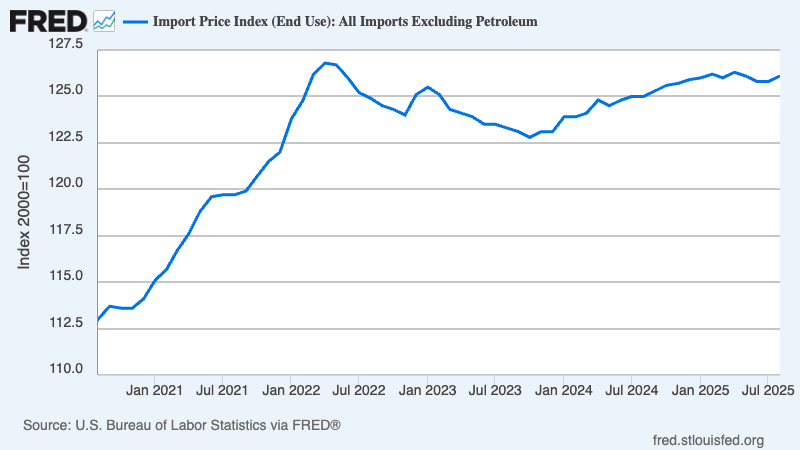
The Trump administration would like you to believe that foreigners are paying the tariffs. But the data clearly show that this isn’t happening. Here are the prices — not including tariffs — that the United States has been paying for imported goods other than oil, which fluctuates a lot for reasons unrelated to tariffs:
The prices at which foreigners have been selling goods to the United States are slightly higher than they were a year ago. To offset the price effect of tariffs, those prices would have had to fall more than 10 percent. So foreigners have not, in fact, absorbed any significant share of the tariffs.
Why, then, haven’t tariffs had a bigger effect on consumer prices? I’ve seen many analysts arguing that U.S. businesses are holding back on raising prices, absorbing the cost rather than passing it on to consumers. Since this can’t go on forever, that would suggest considerably more inflation in the pipeline.
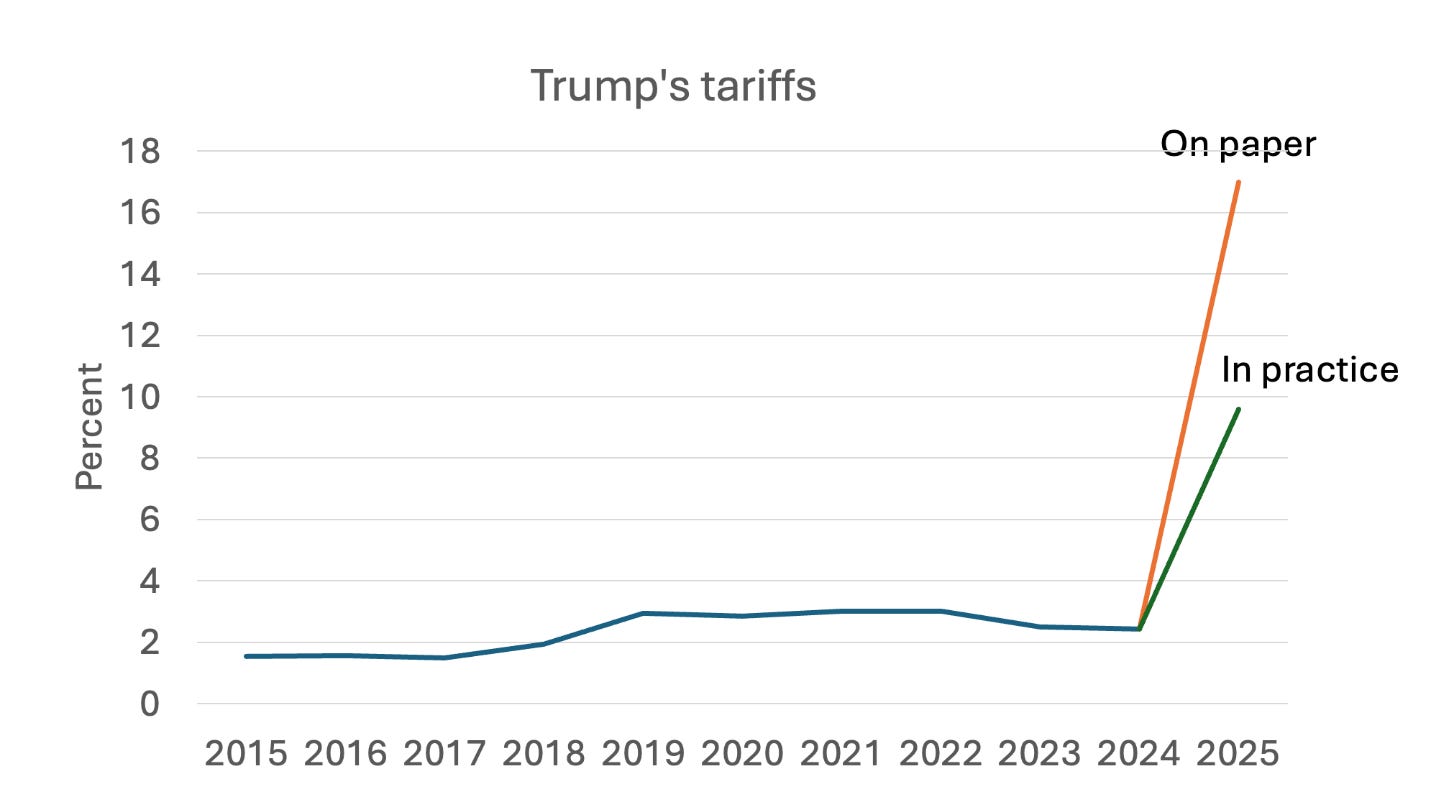
And no doubt businesses have been absorbing some tariff costs. But maybe not as much as widely suggested, because the jump in tariffs has been much smaller in practice than on paper. (Economists have tended to use more formal language — “statutory” versus “effective” tariffs — but I prefer the informal terms.)
By tariffs on paper I mean the average tariff rate you’d predict if you apply the announced tariff rates to what we were importing before the tariffs. You can also, as the Budget Lab does, estimate how the average tariff is affected by people shifting to goods with lower tariffs; that reduces the number slightly, but not by much.
The tariff rate in practice is just the actual amount collected in tariff revenue divided by the value of imports.
What’s immediately clear if you look at these numbers is that tariffs in practice, while up by a lot, haven’t risen nearly as much as tariffs on paper. The chart at the top of this post shows my estimate, where the “in practice” number is based on data for July.
Why have tariffs lagged in practice? Trump’s tariff scheme is wildly complex, with very different rates depending on which good is being imported from which country. This creates a lot of opportunities for importers to hold down what they pay by managing to get their products reclassified.
Some of this reclassification is clearly legal. Imports from Canada are a case in point. Even under the Trump tariffs, most goods from Canada can enter duty-free if they’re “USMCA compliant” — that is, they qualified for zero tariffs under the free-trade agreement formerly known as NAFTA, rebranded but barely changed in practice during Trump’s first term.
In 2024, only
38 percent
of U.S. imports from Canada entered under the USMCA. That’s surprisingly low, but the main reason was probably paperwork: certifying that a good complies with the free trade rules requires a lot of documentation. For smaller exporters, in particular, that paperwork often wasn’t worth doing, because tariffs were low even for goods not certified as USMCA compliant.
Now the tariffs are much higher, and there has been a rush to do the extra paperwork. In June 2025, 81 percent of imports from Canada entered duty free. Not incidentally, this points to a hidden cost of the tariffs: Companies are incurring significant administrative costs to deal with a vastly more complex tariff system.
Other ways of avoiding tariffs may not be legal or may at any rate frustrate the tariffs’ goals. Goods from countries that are the subject of high tariffs may be laundered, transshipped via countries facing lower tariffs. Exporters may find ways to relabel what they sell, to qualify for lower rates. There’s surely some fraud involved — how could there not be, given the incentives? — but in any case the bottom line is that in practice tariffs haven’t gone up as much as you might have thought. And I don’t see any obvious reason to believe that tariff avoidance will go away. It will probably be a quasi-permanent feature of the system.
Believe it or not, this is actually good news. It means that the unwillingness of businesses to pass on tariffs has probably been a smaller factor in holding down prices than widely assumed. This in turn means that there’s less future inflation in the pipeline than widely feared.
Uncertainty and the frozen job market
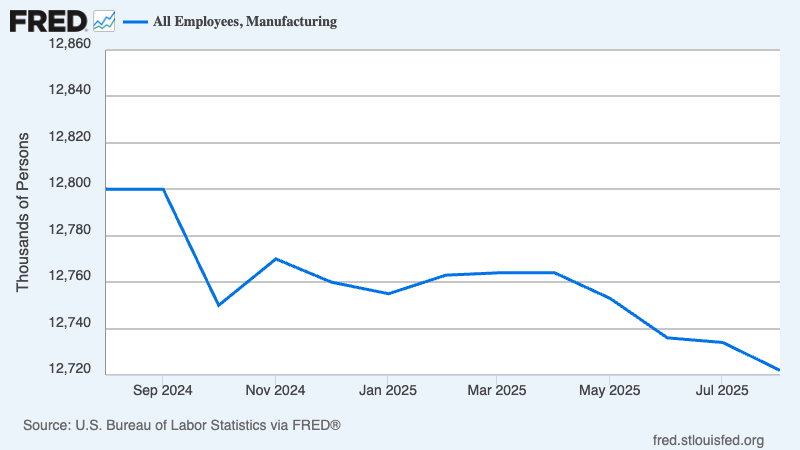
The Trump tariffs were supposed to bring about a revival of U.S. manufacturing. That’s obviously not happening so far: Manufacturing employment is down, partly because some of Trump’s tariffs, notably on steel and aluminum, have substantially raised producers’ costs:
On the other hand, the tariffs haven’t caused large-scale layoffs, although several major employers including Amazon, UPS and Target have announced
big layoff plans
in the past few days.
The most striking thing about the labor market, however, isn’t large-scale job loss. It is, instead, the way the market has frozen, with very low rates of hiring. I wrote about this
last week
. The no-hire economy has made life very difficult for young people just entering the work force as well as for those who have, for whatever reason, lost jobs. It also greatly reduces workers’ bargaining power. A
new report
from the JPMorganChase Institute finds that wage gains have slowed sharply across the board, with young workers seeing the slowest wage growth since 2011. Against the background of accelerating inflation, this is a serious blow to U.S. workers.
And the uncertainty created by temper-tantrum tariff policy is probably the biggest single reason for the frozen job market.
But again, the worst of the uncertainty may be behind us. Trump’s Asia tour appears likely to yield some stability in the tariff picture, with America reducing some of the extremely high tariffs it has imposed or threatened to impose, while Asian nations make vague promises to invest in the United States and buy more U.S. products. The content of these deals will be less important than a potential reduction in uncertainty.
Long-lasting damage to the US and the global world order
Soon, I expect, Trump will be declaring victory after performing a climb-down on tariffs and touting make-believe investment numbers. He will proclaim that he won the trade war. Well, he didn’t.
The main benefit from these deals (assuming they happen and last for a while), is that the United States will stop hitting itself in the face. U.S. consumers, producers and workers have been the main victims of Trump’s tariffs. We could have achieved victory by not hitting ourselves in the face in the first place.
Furthermore, these deals cannot fix the more profound damage that six months of tariff madness has inflicted: the incalculable damage to U.S. credibility and, with it, to the global world economic order.
First, everything — everything — Trump has done on trade has, in addition to its illegality, been a violation of past U.S. agreements with other countries. So we emerge from the trade war as a nation that can no longer be trusted to honor its promises.
Second, if we look at the confrontation with China in particular, the end result looks like a demonstration of U.S. weakness and Chinese strength. China may offer some cosmetic concessions, promising to buy some soybeans or whatever. But the reality — which is obvious to everyone in the world except, possibly, some U.S. voters — is that Trump threatened extremely high tariffs on China but climbed down when China began curtailing exports of rare earths and other industrial inputs. China had the upper hand, and it played it.
In fact, I’d argue that China is now clearly winning its geopolitical conflict with the United States. America used to be able to count on support from its democratic allies. Now it has alienated them, and established a reputation for arbitrarily reneging on agreements. America used to have unmatched economic leverage. Now the world knows that China has more.
I’ll talk more about these concerns in a future post.
MUSICAL CODA |
| Markdown | [](https://paulkrugman.substack.com/)
# [Paul Krugman](https://paulkrugman.substack.com/)
Subscribe
Sign in
# How We Lost the Trade War
### Tariff uncertainty may be waning, but the damage will persist
[](https://substack.com/@paulkrugman)
[Paul Krugman](https://substack.com/@paulkrugman)
Oct 30, 2025
1,799
377
313
Share
[](https://substackcdn.com/image/fetch/$s_!3pk-!,f_auto,q_auto:good,fl_progressive:steep/https%3A%2F%2Fsubstack-post-media.s3.amazonaws.com%2Fpublic%2Fimages%2F3b08d377-fc2f-4ecf-a3fd-ca65619e97ad_1431x802.png)
Source: [Yale Budget Lab](https://budgetlab.yale.edu/research/state-us-tariffs-october-17-2025), [Treasury](https://fiscaldata.treasury.gov/static-data/published-reports/mts/MonthlyTreasuryStatement_202507.pdf), [FRED](https://fred.stlouisfed.org/series/IMPTOTUS)
A little over six months ago Donald Trump shocked the world by announcing a huge jump in tariffs, to levels not seen since the 1930s. Most of these tariffs were clearly illegal and have been so ruled by lower courts — but it’s anyone’s guess how an extremely submissive Supreme Court will rule. Since then he has backed off some tariffs but imposed others, some on bizarre grounds — a Canadian province ran an ad he didn’t like! — creating constant uncertainty.
With his plunging poll numbers at home (Fake News!), Trump seems intent upon making some deals with Japan, Korea and China during his marathon Asia trip. He needs badly to declare some sort of victory so he can move on. And even within the Republican Party, his tariff policies are in trouble, with 52 Senators voting against the Brazil tariffs and farm-state Senators showing anxiety over China’s moratorium on American soybean purchases.
So absent another toddler tantrum, we may be reaching peak Trump tariffs. But don’t celebrate. Trump’s chaotic tariff policies inflicted three types of economic damage: higher prices for American producers and consumers, economic uncertainty, and the global loss of American credibility. Even if the worst in terms of prices and uncertainty is over, it’s clear that Trump’s tariffs have inflicted lasting damage on the US economy as well as the global economic order.
To understand the extent of the damage, let’s begin by taking inventory of the tariffs’ actual effects on prices and the job market.
*Higher prices*
Inflation has accelerated since Donald Trump went on his tariff rampage. Late last year, before Liberation Day and all that, [professional forecasters](https://www.philadelphiafed.org/-/media/FRBP/Assets/Surveys-And-Data/survey-of-professional-forecasters/2024/spfQ424.pdf) expected “core” consumer prices — which exclude volatile food and energy prices — to rise 2.4 percent over the course of 2025. The latest official reading (and the last we may get for a while) put core inflation at [3 percent](https://fred.stlouisfed.org/series/CPILFESL).
More direct evidence comes from the [Pricing Lab](https://www.pricinglab.org/tariff-tracker/?utm_source=substack&utm_medium=email), which relies on retail prices posted online — something we need to do while the shutdown lasts, and maybe afterwards if Trump corrupts the official statistics. I’ve [used their data before](https://paulkrugman.substack.com/p/leprechauns-effective-tariffs-and?utm_source=publication-search). They show a significant bump in the prices of imported goods, especially compared with their declining trend BT (before Trump). In a [new paper](https://www.pricinglab.org/files/TrackingTariffs_Cavallo_Llamas_Vazquez.pdf), the Pricing Lab analyzes its data and estimates that the Trump tariffs have raised overall consumer prices by 0.7 percent.
That’s significant, but it’s less than many models predicted. For example, the Yale Budget Lab’s [most recent run](https://budgetlab.yale.edu/research/state-us-tariffs-october-17-2025) of its model puts the impact of tariffs on consumer prices at 1.3 percent. What do we know about the sources of that gap?
The Trump administration would like you to believe that foreigners are paying the tariffs. But the data clearly show that this isn’t happening. Here are the prices — not including tariffs — that the United States has been paying for imported goods other than oil, which fluctuates a lot for reasons unrelated to tariffs:
[](https://substackcdn.com/image/fetch/$s_!YAhu!,f_auto,q_auto:good,fl_progressive:steep/https%3A%2F%2Fsubstack-post-media.s3.amazonaws.com%2Fpublic%2Fimages%2F765a6c91-191c-442b-a4a8-3d47b4902d90_800x450.png)
The prices at which foreigners have been selling goods to the United States are slightly higher than they were a year ago. To offset the price effect of tariffs, those prices would have had to fall more than 10 percent. So foreigners have not, in fact, absorbed any significant share of the tariffs.
Why, then, haven’t tariffs had a bigger effect on consumer prices? I’ve seen many analysts arguing that U.S. businesses are holding back on raising prices, absorbing the cost rather than passing it on to consumers. Since this can’t go on forever, that would suggest considerably more inflation in the pipeline.
And no doubt businesses have been absorbing some tariff costs. But maybe not as much as widely suggested, because the jump in tariffs has been much smaller in practice than on paper. (Economists have tended to use more formal language — “statutory” versus “effective” tariffs — but I prefer the informal terms.)
By tariffs on paper I mean the average tariff rate you’d predict if you apply the announced tariff rates to what we were importing before the tariffs. You can also, as the Budget Lab does, estimate how the average tariff is affected by people shifting to goods with lower tariffs; that reduces the number slightly, but not by much.
The tariff rate in practice is just the actual amount collected in tariff revenue divided by the value of imports.
What’s immediately clear if you look at these numbers is that tariffs in practice, while up by a lot, haven’t risen nearly as much as tariffs on paper. The chart at the top of this post shows my estimate, where the “in practice” number is based on data for July.
Why have tariffs lagged in practice? Trump’s tariff scheme is wildly complex, with very different rates depending on which good is being imported from which country. This creates a lot of opportunities for importers to hold down what they pay by managing to get their products reclassified.
Some of this reclassification is clearly legal. Imports from Canada are a case in point. Even under the Trump tariffs, most goods from Canada can enter duty-free if they’re “USMCA compliant” — that is, they qualified for zero tariffs under the free-trade agreement formerly known as NAFTA, rebranded but barely changed in practice during Trump’s first term.
In 2024, only [38 percent](https://www.congress.gov/crs_external_products/IF/PDF/IF12595/IF12595.23.pdf) of U.S. imports from Canada entered under the USMCA. That’s surprisingly low, but the main reason was probably paperwork: certifying that a good complies with the free trade rules requires a lot of documentation. For smaller exporters, in particular, that paperwork often wasn’t worth doing, because tariffs were low even for goods not certified as USMCA compliant.
Now the tariffs are much higher, and there has been a rush to do the extra paperwork. In June 2025, 81 percent of imports from Canada entered duty free. Not incidentally, this points to a hidden cost of the tariffs: Companies are incurring significant administrative costs to deal with a vastly more complex tariff system.
Other ways of avoiding tariffs may not be legal or may at any rate frustrate the tariffs’ goals. Goods from countries that are the subject of high tariffs may be laundered, transshipped via countries facing lower tariffs. Exporters may find ways to relabel what they sell, to qualify for lower rates. There’s surely some fraud involved — how could there not be, given the incentives? — but in any case the bottom line is that in practice tariffs haven’t gone up as much as you might have thought. And I don’t see any obvious reason to believe that tariff avoidance will go away. It will probably be a quasi-permanent feature of the system.
Believe it or not, this is actually good news. It means that the unwillingness of businesses to pass on tariffs has probably been a smaller factor in holding down prices than widely assumed. This in turn means that there’s less future inflation in the pipeline than widely feared.
*Uncertainty and the frozen job market*
The Trump tariffs were supposed to bring about a revival of U.S. manufacturing. That’s obviously not happening so far: Manufacturing employment is down, partly because some of Trump’s tariffs, notably on steel and aluminum, have substantially raised producers’ costs:
[](https://substackcdn.com/image/fetch/$s_!hRQ2!,f_auto,q_auto:good,fl_progressive:steep/https%3A%2F%2Fsubstack-post-media.s3.amazonaws.com%2Fpublic%2Fimages%2Ff4ad492b-599b-4506-9d94-c09ed4e4fa85_800x450.png)
On the other hand, the tariffs haven’t caused large-scale layoffs, although several major employers including Amazon, UPS and Target have announced [big layoff plans](https://finance.yahoo.com/news/layoffs-hit-amazon-ups-target-and-more--whats-fueling-the-cuts-165130359.html) in the past few days.
The most striking thing about the labor market, however, isn’t large-scale job loss. It is, instead, the way the market has frozen, with very low rates of hiring. I wrote about this [last week](https://paulkrugman.substack.com/p/the-us-economy-is-in-worse-shape). The no-hire economy has made life very difficult for young people just entering the work force as well as for those who have, for whatever reason, lost jobs. It also greatly reduces workers’ bargaining power. A [new report](https://www.bloomberg.com/news/articles/2025-10-29/young-us-workers-see-downshift-in-pay-gains-amid-job-scarcity?srnd=homepage-americas) from the JPMorganChase Institute finds that wage gains have slowed sharply across the board, with young workers seeing the slowest wage growth since 2011. Against the background of accelerating inflation, this is a serious blow to U.S. workers.
And the uncertainty created by temper-tantrum tariff policy is probably the biggest single reason for the frozen job market.
But again, the worst of the uncertainty may be behind us. Trump’s Asia tour appears likely to yield some stability in the tariff picture, with America reducing some of the extremely high tariffs it has imposed or threatened to impose, while Asian nations make vague promises to invest in the United States and buy more U.S. products. The content of these deals will be less important than a potential reduction in uncertainty.
*Long-lasting damage to the US and the global world order*
Soon, I expect, Trump will be declaring victory after performing a climb-down on tariffs and touting make-believe investment numbers. He will proclaim that he won the trade war. Well, he didn’t.
The main benefit from these deals (assuming they happen and last for a while), is that the United States will stop hitting itself in the face. U.S. consumers, producers and workers have been the main victims of Trump’s tariffs. We could have achieved victory by not hitting ourselves in the face in the first place.
Furthermore, these deals cannot fix the more profound damage that six months of tariff madness has inflicted: the incalculable damage to U.S. credibility and, with it, to the global world economic order.
First, everything — everything — Trump has done on trade has, in addition to its illegality, been a violation of past U.S. agreements with other countries. So we emerge from the trade war as a nation that can no longer be trusted to honor its promises.
Second, if we look at the confrontation with China in particular, the end result looks like a demonstration of U.S. weakness and Chinese strength. China may offer some cosmetic concessions, promising to buy some soybeans or whatever. But the reality — which is obvious to everyone in the world except, possibly, some U.S. voters — is that Trump threatened extremely high tariffs on China but climbed down when China began curtailing exports of rare earths and other industrial inputs. China had the upper hand, and it played it.
In fact, I’d argue that China is now clearly winning its geopolitical conflict with the United States. America used to be able to count on support from its democratic allies. Now it has alienated them, and established a reputation for arbitrarily reneging on agreements. America used to have unmatched economic leverage. Now the world knows that China has more.
I’ll talk more about these concerns in a future post.
MUSICAL CODA
***
#### Subscribe to Paul Krugman
Tens of thousands of paid subscribers
Notes on economics and more
By subscribing, you agree Substack's [Terms of Use](https://substack.com/tos), and acknowledge its [Information Collection Notice](https://substack.com/ccpa#personal-data-collected) and [Privacy Policy](https://substack.com/privacy).
[](https://substack.com/profile/3227889-augusto)
[](https://substack.com/profile/25329903-paul-miller)
[](https://substack.com/profile/6469433-tony-molledo)
[](https://substack.com/profile/24667564-jody-lee)
[](https://substack.com/profile/20372686-steve-collins)
[1,799 Likes]()∙
[313 Restacks](https://substack.com/note/p-177550590/restacks?utm_source=substack&utm_content=facepile-restacks)
1,799
377
313
Share
#### Discussion about this post
Comments
Restacks
[](https://substack.com/profile/301261955-gh?utm_source=comment)
[GH](https://substack.com/profile/301261955-gh?utm_source=substack-feed-item)
[Oct 30](https://paulkrugman.substack.com/p/how-we-lost-the-trade-war/comment/171708747 "Oct 30, 2025, 10:38 AM")
I suppose one benefit is that with the EU now feeling more isolated it is being forced to realise with much greater clarity that it needs to be one entity. Certainly Brexit, which looked foolish at the time, now looks borderline insane.
[Like (255)]()
[Reply]()
[Share]()
[108 replies](https://paulkrugman.substack.com/p/how-we-lost-the-trade-war/comment/171708747)
[](https://substack.com/profile/24517185-robert-manz?utm_source=comment)
[Robert Manz](https://substack.com/profile/24517185-robert-manz?utm_source=substack-feed-item)
[Oct 30](https://paulkrugman.substack.com/p/how-we-lost-the-trade-war/comment/171708916 "Oct 30, 2025, 10:39 AM")
Trump is losing. America needs to dump trump.
[Like (112)]()
[Reply]()
[Share]()
[7 replies](https://paulkrugman.substack.com/p/how-we-lost-the-trade-war/comment/171708916)
[375 more comments...](https://paulkrugman.substack.com/p/how-we-lost-the-trade-war/comments)
Top
Latest
Discussions
[Attack of the Zombie Tariffs](https://paulkrugman.substack.com/p/attack-of-the-zombie-tariffs)
[A brain is a terrible thing to have eaten](https://paulkrugman.substack.com/p/attack-of-the-zombie-tariffs)
Feb 24
• [Paul Krugman](https://substack.com/@paulkrugman)
2,064
359
337
[Monsters](https://paulkrugman.substack.com/p/monsters)
[And their enablers are accessories to murder](https://paulkrugman.substack.com/p/monsters)
Jan 25
• [Paul Krugman](https://substack.com/@paulkrugman)
8,492
1,260
1,616
[It’s Sundowning in America](https://paulkrugman.substack.com/p/its-sundowning-in-america)
[A presidential mind is a dangerous thing to lose](https://paulkrugman.substack.com/p/its-sundowning-in-america)
Jan 20
• [Paul Krugman](https://substack.com/@paulkrugman)
6,683
1,068
1,443
See all
### Ready for more?
© 2026 Paul Krugman · [Privacy](https://substack.com/privacy) ∙ [Terms](https://substack.com/tos) ∙ [Collection notice](https://substack.com/ccpa#personal-data-collected)
[Start your Substack](https://substack.com/signup?utm_source=substack&utm_medium=web&utm_content=footer)
[Get the app](https://substack.com/app/app-store-redirect?utm_campaign=app-marketing&utm_content=web-footer-button)
[Substack](https://substack.com/) is the home for great culture
#### Cookie Policy
We use cookies to improve your experience, for analytics, and for marketing. You can accept, reject, or manage your preferences. See our [privacy policy](https://substack.com/tos).
Manage
Reject
Accept
This site requires JavaScript to run correctly. Please [turn on JavaScript](https://enable-javascript.com/) or unblock scripts |
| Readable Markdown | [](https://substackcdn.com/image/fetch/$s_!3pk-!,f_auto,q_auto:good,fl_progressive:steep/https%3A%2F%2Fsubstack-post-media.s3.amazonaws.com%2Fpublic%2Fimages%2F3b08d377-fc2f-4ecf-a3fd-ca65619e97ad_1431x802.png)
Source: [Yale Budget Lab](https://budgetlab.yale.edu/research/state-us-tariffs-october-17-2025), [Treasury](https://fiscaldata.treasury.gov/static-data/published-reports/mts/MonthlyTreasuryStatement_202507.pdf), [FRED](https://fred.stlouisfed.org/series/IMPTOTUS)
A little over six months ago Donald Trump shocked the world by announcing a huge jump in tariffs, to levels not seen since the 1930s. Most of these tariffs were clearly illegal and have been so ruled by lower courts — but it’s anyone’s guess how an extremely submissive Supreme Court will rule. Since then he has backed off some tariffs but imposed others, some on bizarre grounds — a Canadian province ran an ad he didn’t like! — creating constant uncertainty.
With his plunging poll numbers at home (Fake News!), Trump seems intent upon making some deals with Japan, Korea and China during his marathon Asia trip. He needs badly to declare some sort of victory so he can move on. And even within the Republican Party, his tariff policies are in trouble, with 52 Senators voting against the Brazil tariffs and farm-state Senators showing anxiety over China’s moratorium on American soybean purchases.
So absent another toddler tantrum, we may be reaching peak Trump tariffs. But don’t celebrate. Trump’s chaotic tariff policies inflicted three types of economic damage: higher prices for American producers and consumers, economic uncertainty, and the global loss of American credibility. Even if the worst in terms of prices and uncertainty is over, it’s clear that Trump’s tariffs have inflicted lasting damage on the US economy as well as the global economic order.
To understand the extent of the damage, let’s begin by taking inventory of the tariffs’ actual effects on prices and the job market.
*Higher prices*
Inflation has accelerated since Donald Trump went on his tariff rampage. Late last year, before Liberation Day and all that, [professional forecasters](https://www.philadelphiafed.org/-/media/FRBP/Assets/Surveys-And-Data/survey-of-professional-forecasters/2024/spfQ424.pdf) expected “core” consumer prices — which exclude volatile food and energy prices — to rise 2.4 percent over the course of 2025. The latest official reading (and the last we may get for a while) put core inflation at [3 percent](https://fred.stlouisfed.org/series/CPILFESL).
More direct evidence comes from the [Pricing Lab](https://www.pricinglab.org/tariff-tracker/?utm_source=substack&utm_medium=email), which relies on retail prices posted online — something we need to do while the shutdown lasts, and maybe afterwards if Trump corrupts the official statistics. I’ve [used their data before](https://paulkrugman.substack.com/p/leprechauns-effective-tariffs-and?utm_source=publication-search). They show a significant bump in the prices of imported goods, especially compared with their declining trend BT (before Trump). In a [new paper](https://www.pricinglab.org/files/TrackingTariffs_Cavallo_Llamas_Vazquez.pdf), the Pricing Lab analyzes its data and estimates that the Trump tariffs have raised overall consumer prices by 0.7 percent.
That’s significant, but it’s less than many models predicted. For example, the Yale Budget Lab’s [most recent run](https://budgetlab.yale.edu/research/state-us-tariffs-october-17-2025) of its model puts the impact of tariffs on consumer prices at 1.3 percent. What do we know about the sources of that gap?
The Trump administration would like you to believe that foreigners are paying the tariffs. But the data clearly show that this isn’t happening. Here are the prices — not including tariffs — that the United States has been paying for imported goods other than oil, which fluctuates a lot for reasons unrelated to tariffs:
[](https://substackcdn.com/image/fetch/$s_!YAhu!,f_auto,q_auto:good,fl_progressive:steep/https%3A%2F%2Fsubstack-post-media.s3.amazonaws.com%2Fpublic%2Fimages%2F765a6c91-191c-442b-a4a8-3d47b4902d90_800x450.png)
The prices at which foreigners have been selling goods to the United States are slightly higher than they were a year ago. To offset the price effect of tariffs, those prices would have had to fall more than 10 percent. So foreigners have not, in fact, absorbed any significant share of the tariffs.
Why, then, haven’t tariffs had a bigger effect on consumer prices? I’ve seen many analysts arguing that U.S. businesses are holding back on raising prices, absorbing the cost rather than passing it on to consumers. Since this can’t go on forever, that would suggest considerably more inflation in the pipeline.
And no doubt businesses have been absorbing some tariff costs. But maybe not as much as widely suggested, because the jump in tariffs has been much smaller in practice than on paper. (Economists have tended to use more formal language — “statutory” versus “effective” tariffs — but I prefer the informal terms.)
By tariffs on paper I mean the average tariff rate you’d predict if you apply the announced tariff rates to what we were importing before the tariffs. You can also, as the Budget Lab does, estimate how the average tariff is affected by people shifting to goods with lower tariffs; that reduces the number slightly, but not by much.
The tariff rate in practice is just the actual amount collected in tariff revenue divided by the value of imports.
What’s immediately clear if you look at these numbers is that tariffs in practice, while up by a lot, haven’t risen nearly as much as tariffs on paper. The chart at the top of this post shows my estimate, where the “in practice” number is based on data for July.
Why have tariffs lagged in practice? Trump’s tariff scheme is wildly complex, with very different rates depending on which good is being imported from which country. This creates a lot of opportunities for importers to hold down what they pay by managing to get their products reclassified.
Some of this reclassification is clearly legal. Imports from Canada are a case in point. Even under the Trump tariffs, most goods from Canada can enter duty-free if they’re “USMCA compliant” — that is, they qualified for zero tariffs under the free-trade agreement formerly known as NAFTA, rebranded but barely changed in practice during Trump’s first term.
In 2024, only [38 percent](https://www.congress.gov/crs_external_products/IF/PDF/IF12595/IF12595.23.pdf) of U.S. imports from Canada entered under the USMCA. That’s surprisingly low, but the main reason was probably paperwork: certifying that a good complies with the free trade rules requires a lot of documentation. For smaller exporters, in particular, that paperwork often wasn’t worth doing, because tariffs were low even for goods not certified as USMCA compliant.
Now the tariffs are much higher, and there has been a rush to do the extra paperwork. In June 2025, 81 percent of imports from Canada entered duty free. Not incidentally, this points to a hidden cost of the tariffs: Companies are incurring significant administrative costs to deal with a vastly more complex tariff system.
Other ways of avoiding tariffs may not be legal or may at any rate frustrate the tariffs’ goals. Goods from countries that are the subject of high tariffs may be laundered, transshipped via countries facing lower tariffs. Exporters may find ways to relabel what they sell, to qualify for lower rates. There’s surely some fraud involved — how could there not be, given the incentives? — but in any case the bottom line is that in practice tariffs haven’t gone up as much as you might have thought. And I don’t see any obvious reason to believe that tariff avoidance will go away. It will probably be a quasi-permanent feature of the system.
Believe it or not, this is actually good news. It means that the unwillingness of businesses to pass on tariffs has probably been a smaller factor in holding down prices than widely assumed. This in turn means that there’s less future inflation in the pipeline than widely feared.
*Uncertainty and the frozen job market*
The Trump tariffs were supposed to bring about a revival of U.S. manufacturing. That’s obviously not happening so far: Manufacturing employment is down, partly because some of Trump’s tariffs, notably on steel and aluminum, have substantially raised producers’ costs:
[](https://substackcdn.com/image/fetch/$s_!hRQ2!,f_auto,q_auto:good,fl_progressive:steep/https%3A%2F%2Fsubstack-post-media.s3.amazonaws.com%2Fpublic%2Fimages%2Ff4ad492b-599b-4506-9d94-c09ed4e4fa85_800x450.png)
On the other hand, the tariffs haven’t caused large-scale layoffs, although several major employers including Amazon, UPS and Target have announced [big layoff plans](https://finance.yahoo.com/news/layoffs-hit-amazon-ups-target-and-more--whats-fueling-the-cuts-165130359.html) in the past few days.
The most striking thing about the labor market, however, isn’t large-scale job loss. It is, instead, the way the market has frozen, with very low rates of hiring. I wrote about this [last week](https://paulkrugman.substack.com/p/the-us-economy-is-in-worse-shape). The no-hire economy has made life very difficult for young people just entering the work force as well as for those who have, for whatever reason, lost jobs. It also greatly reduces workers’ bargaining power. A [new report](https://www.bloomberg.com/news/articles/2025-10-29/young-us-workers-see-downshift-in-pay-gains-amid-job-scarcity?srnd=homepage-americas) from the JPMorganChase Institute finds that wage gains have slowed sharply across the board, with young workers seeing the slowest wage growth since 2011. Against the background of accelerating inflation, this is a serious blow to U.S. workers.
And the uncertainty created by temper-tantrum tariff policy is probably the biggest single reason for the frozen job market.
But again, the worst of the uncertainty may be behind us. Trump’s Asia tour appears likely to yield some stability in the tariff picture, with America reducing some of the extremely high tariffs it has imposed or threatened to impose, while Asian nations make vague promises to invest in the United States and buy more U.S. products. The content of these deals will be less important than a potential reduction in uncertainty.
*Long-lasting damage to the US and the global world order*
Soon, I expect, Trump will be declaring victory after performing a climb-down on tariffs and touting make-believe investment numbers. He will proclaim that he won the trade war. Well, he didn’t.
The main benefit from these deals (assuming they happen and last for a while), is that the United States will stop hitting itself in the face. U.S. consumers, producers and workers have been the main victims of Trump’s tariffs. We could have achieved victory by not hitting ourselves in the face in the first place.
Furthermore, these deals cannot fix the more profound damage that six months of tariff madness has inflicted: the incalculable damage to U.S. credibility and, with it, to the global world economic order.
First, everything — everything — Trump has done on trade has, in addition to its illegality, been a violation of past U.S. agreements with other countries. So we emerge from the trade war as a nation that can no longer be trusted to honor its promises.
Second, if we look at the confrontation with China in particular, the end result looks like a demonstration of U.S. weakness and Chinese strength. China may offer some cosmetic concessions, promising to buy some soybeans or whatever. But the reality — which is obvious to everyone in the world except, possibly, some U.S. voters — is that Trump threatened extremely high tariffs on China but climbed down when China began curtailing exports of rare earths and other industrial inputs. China had the upper hand, and it played it.
In fact, I’d argue that China is now clearly winning its geopolitical conflict with the United States. America used to be able to count on support from its democratic allies. Now it has alienated them, and established a reputation for arbitrarily reneging on agreements. America used to have unmatched economic leverage. Now the world knows that China has more.
I’ll talk more about these concerns in a future post.
MUSICAL CODA |
| Shard | 76 (laksa) |
| Root Hash | 14862242593741677076 |
| Unparsed URL | com,substack!paulkrugman,/p/how-we-lost-the-trade-war s443 |