ℹ️ Skipped - page is already crawled
| Filter | Status | Condition | Details |
|---|---|---|---|
| HTTP status | PASS | download_http_code = 200 | HTTP 200 |
| Age cutoff | PASS | download_stamp > now() - 6 MONTH | 0.1 months ago |
| History drop | PASS | isNull(history_drop_reason) | No drop reason |
| Spam/ban | PASS | fh_dont_index != 1 AND ml_spam_score = 0 | ml_spam_score=0 |
| Canonical | PASS | meta_canonical IS NULL OR = '' OR = src_unparsed | Not set |
| Property | Value |
|---|---|
| URL | https://news.artnet.com/art-world/first-ever-photograph-black-hole-1513762 |
| Last Crawled | 2026-04-12 23:07:51 (3 days ago) |
| First Indexed | 2019-04-10 20:33:38 (7 years ago) |
| HTTP Status Code | 200 |
| Meta Title | ‘It’s an Absolute Monster’: See How Astronomers Managed to Snap the First-Ever Photograph of a Black Hole |
| Meta Description | The first-ever image of a black hole has been captured in an image based on observations made by the Event Horizon Telescope project in 2017. |
| Meta Canonical | null |
| Boilerpipe Text | Humankind is one step closer to understanding one of the universe’s most enduring mysteries: the black hole. Once considered unobservable, black holes are dense fields of matter that create gravity fields so powerful that even rays of light cannot escape their grasp. But now, astronomers have taken a mind-blowing picture of the dark circular void surrounded by a ring of fiery light.
“We have seen what we thought was unseeable,” said project director Sheperd Doeleman, of the Harvard-Smithsonian Center for Astrophysics, in a
statement
. “We have seen and taken a picture of a black hole. This is an extraordinary scientific feat accomplished by a team of more than 200 researchers.”
The black hole looks so frightening and malevolent that the
New York Times
couldn’t help comparing it to the eye of Sauron, the demonic villain in J.R.R. Tolkien’s
Lord of the Rings
.
“For decades, we have studied how black holes swallow material and power the hearts of galaxies,” said Harvard University professor Ramesh Narayan, who worked on the project, in a
statement
. “To finally see a black hole in action, bending its nearby light into a bright ring, is a breathtaking confirmation that supermassive black holes exist and match the appearance expected from our simulations.”
This artist’s impression depicts a rapidly spinning supermassive black hole surrounded by an accretion disc. Image courtesy of Center for Astrophysics, Harvard & Smithsonian.
The image was published in a special edition of the
Astrophysical Journal Letters
and was revealed to the public at simultaneous press conferences held this morning in six cities around the world: Washington, Brussels, Santiago, Shanghai, Taipei, and Tokyo. It depicts the supermassive black hole, which is 24 million miles across, or about 6.5 billion times bigger than the sun, in the center of Messier 87, a supergiant elliptical galaxy in the constellation Virgo, a galaxy cluster some 55 million light years away.
“It is one of the heaviest black holes that we think exists,” Heino Falcke, a professor Radboud University in the Netherlands who first proposed the experiment back in 1993, told the
BBC
. “It is an absolute monster, the heavyweight champion of black holes in the universe.”
The Large Millimeter Telescope (LMT) in Mexico, operated jointly by the University of Massachusetts Amherst and Mexico’s Instituto Nacional de Astrofísica, Óptica y Electrónica, was one of the telescopes used by the Event Horizon Telescope project to capture the first image of a black hole. Photo courtesy of UMASS Amherst.
The
Event Horizon Telescope
project, which began more than 10 years ago, has also observed Sagittarius A*, a black hole in our own Milky Way galaxy that is 4.1 million times bigger than the sun and 26,000 lightyears away.
For its groundbreaking observations, the Event Horizon Telescope used eight ground-based radio telescopes, located in sites in Chile, Mexico, Spain, Hawaii, Arizona, and the Antarctic, essentially creating a virtual telescope the size of planet Earth. All observations were conducted simultaneously, synchronized through the use of precise atomic clocks.
The South Pole Telescope is one of eight ground-based radio telescopes that make up the Event Horizon Telescope array. Photo by Jason Gallicchio, courtesy of the University of Chicago.
Altogether, the project collected a mind-boggling 5,000 trillion bytes of data over two weeks. It was too much to send over the internet, so hundreds of hard drives were flown to a central processing center at the Max Planck Institute for Radio Astronomy and MIT Haystack Observatory in Massachusetts, where the data was initially processed by supercomputers. Four independent groups of scientists then used three different imaging methods to interpret it before the historic image was finalized.
A second round of observations was conducted in 2018, with additional telescopes joining the project in Greenland and France, as well as another Arizona site. Scientific researchers are currently analyzing that data.
What is actually captured in the first-of-its-kind image is the so-called event horizon, the point of no return that surrounds a black hole. It shows the light, superheated gases, and even stars being sucked into the hole, as well as the jets of super-charged particles that are being blasted away from the edge of the event horizon, barely escaping its inexorable pull.
“Black holes have sparked imaginations for decades,” said National Science Foundation director France Córdova in a
statement
. “They have exotic properties and are mysterious to us. Yet with more observations like this one they are yielding their secrets.” |
| Markdown | # Price Database
12 April 2026
[Artworks](https://www.artnet.com/artworks)
[Artists](https://www.artnet.com/artists)
Auctions
- [Artnet Auctions](https://www.artnet.com/auctions/)
- [Global Auction Houses](https://www.artnet.com/auction-houses)
[Galleries](https://www.artnet.com/galleries/)
[Events](https://www.artnet.com/events/)
[News](https://news.artnet.com/)
Price Database
- [Use the Artnet Price Database](https://www.artnet.com/price-database)
- [Market Alerts](https://www.artnet.com/market-alerts)
- [Artnet Analytics](https://www.artnet.com/analytics-reports)
Hidden
Buy
- [Browse Artists](https://www.artnet.com/artists/)
- [Artnet Auctions](https://www.artnet.com/auctions/)
- [Browse Galleries](https://www.artnet.com/galleries/)
- [Global Auction Houses](https://www.artnet.com/auction-houses/)
- [Events & Exhibitions](https://www.artnet.com/events/)
- [Speak With a Specialist](https://www.artnet.com/auctions/meet-the-specialists/)
- [Art Financing](https://www.artnet.com#)
- [How to Buy](https://www.artnet.com/auctions/how-to-buy)
Sell
- [Sell With Us](https://www.artnet.com/auctions/sell/)
- [Become a Gallery Partner](https://www.artnet.com/gallery-network/)
- [Become an Auction Partner](https://www.artnet.com/auction-house-partnerships/)
- [Receive a Valuation](https://www.artnet.com/auctions/sell/)
- [How to Sell](https://www.artnet.com/auctions/how-to-sell/)
Search
Hidden
- [Join Artnet PRO](https://news.artnet.com/subscribe)
- [About](https://news.artnet.com/about)
Menu
- [News](https://news.artnet.com/)
- [Art World](https://news.artnet.com/art-world)
- [Art & Exhibitions](https://news.artnet.com/art-world/exhibitions)
- [Artists](https://news.artnet.com/art-world/artists)
- [Archaeology & History](https://news.artnet.com/art-world/archeology-and-history)
- [Art & Tech](https://news.artnet.com/art-world/science-technology)
- [Art Collectors](https://news.artnet.com/art-world/art-collectors)
- [Art History](https://news.artnet.com/art-world/history)
- [Law & Politics](https://news.artnet.com/art-world/art-law-politics)
- [Opinion](https://news.artnet.com/art-world/opinion)
- [Pop Culture](https://news.artnet.com/art-world/contemporary-culture)
- [People](https://news.artnet.com/art-world/people)
- [Museums & Institutions](https://news.artnet.com/art-world/museums-and-institutions)
- [Collectibles](https://news.artnet.com/art-world/collectables)
- [Marketplace](https://news.artnet.com/art-world/marketplace)
- [Artnet Auctions](https://news.artnet.com/art-world/marketplace/artnet-auctions)
- [Gallery Network](https://news.artnet.com/art-world/marketplace/gallery-network)
- [Books](https://news.artnet.com/art-world/books)
- [See All Art World](https://news.artnet.com/art-world)
- [Market](https://news.artnet.com/market)
- [Columns](https://news.artnet.com/market/columns)
- [The Art Detective](https://news.artnet.com/market/columns/the-art-detective)
- [Wet Paint](https://news.artnet.com/market/columns/wet-paint)
- [The Hammer](https://news.artnet.com/market/columns/the-hammer)
- [Kenny Schachter](https://news.artnet.com/market/columns/kenny-schachter)
- [The Gray Market](https://news.artnet.com/market/columns/the-gray-market)
- [Auctions](https://news.artnet.com/market/auctions)
- [Galleries](https://news.artnet.com/market/galleries)
- [Art Fairs](https://news.artnet.com/market/art-fairs)
- [Special Reports](https://news.artnet.com/market/special-reports)
- [The Intelligence Report](https://news.artnet.com/market/special-reports/the-intelligence-report)
- [The Innovators List](https://news.artnet.com/market/special-reports/innovators-list)
- [See All Market](https://news.artnet.com/market)
- [Podcast](https://news.artnet.com/multimedia)
- [Artnet PRO](https://news.artnet.com/topic/news-pro-topic)
- [About](https://news.artnet.com/about)
- [Join Artnet PRO](https://news.artnet.com/subscribe)
- [About](https://news.artnet.com/about)
- [News](https://news.artnet.com/)
- [Art World](https://news.artnet.com/art-world)
- [Art & Exhibitions](https://news.artnet.com/art-world/exhibitions)
- [Artists](https://news.artnet.com/art-world/artists)
- [Archaeology & History](https://news.artnet.com/art-world/archeology-and-history)
- [Art & Tech](https://news.artnet.com/art-world/science-technology)
- [Art Collectors](https://news.artnet.com/art-world/art-collectors)
- [Art History](https://news.artnet.com/art-world/history)
- [Law & Politics](https://news.artnet.com/art-world/art-law-politics)
- [Opinion](https://news.artnet.com/art-world/opinion)
- [Pop Culture](https://news.artnet.com/art-world/contemporary-culture)
- [People](https://news.artnet.com/art-world/people)
- [Museums & Institutions](https://news.artnet.com/art-world/museums-and-institutions)
- [Collectibles](https://news.artnet.com/art-world/collectables)
- [Marketplace](https://news.artnet.com/art-world/marketplace)
- [Artnet Auctions](https://news.artnet.com/art-world/marketplace/artnet-auctions)
- [Gallery Network](https://news.artnet.com/art-world/marketplace/gallery-network)
- [Books](https://news.artnet.com/art-world/books)
- [See All Art World](https://news.artnet.com/art-world)
- [Market](https://news.artnet.com/market)
- [Columns](https://news.artnet.com/market/columns)
- [The Art Detective](https://news.artnet.com/market/columns/the-art-detective)
- [Wet Paint](https://news.artnet.com/market/columns/wet-paint)
- [The Hammer](https://news.artnet.com/market/columns/the-hammer)
- [Kenny Schachter](https://news.artnet.com/market/columns/kenny-schachter)
- [The Gray Market](https://news.artnet.com/market/columns/the-gray-market)
- [Auctions](https://news.artnet.com/market/auctions)
- [Galleries](https://news.artnet.com/market/galleries)
- [Art Fairs](https://news.artnet.com/market/art-fairs)
- [Special Reports](https://news.artnet.com/market/special-reports)
- [The Intelligence Report](https://news.artnet.com/market/special-reports/the-intelligence-report)
- [The Innovators List](https://news.artnet.com/market/special-reports/innovators-list)
- [See All Market](https://news.artnet.com/market)
- [Podcast](https://news.artnet.com/multimedia)
- [Artnet PRO](https://news.artnet.com/topic/news-pro-topic)
- [About](https://news.artnet.com/about)
##### [Art World](https://news.artnet.com/art-world)
# ‘It’s an Absolute Monster’: See How Astronomers Managed to Snap the First-Ever Photograph of a Black Hole
The Event Horizon Telescope project has done the unthinkable.
![The Event Horizon Telescope— a planet-scale array of eight ground-based radio telescopes forged through international collaboration—was designed to capture images of a black hole. In coordinated press conferences across the globe, EHT researchers revealed that they succeeded, unveiling the first direct visual evidence of the supermassive black hole in the centre of Messier 87 and its shadow. The shadow of a black hole seen here is the closest we can come to an image of the black hole itself, a completely dark object from which light cannot escape. The image shows the light aroung black hole’s boundary, the event horizon. Image courtesy of the Event Horizon Telescope.]()
The Event Horizon Telescope was designed to capture images of a black hole. The image shows the light around the black hole’s boundary. Image courtesy of the Event Horizon Telescope.
[Sarah Cascone](https://news.artnet.com/about/sarah-cascone-25) April 10, 2019 [](https://www.addtoany.com/share) ShareShare This Article
Humankind is one step closer to understanding one of the universe’s most enduring mysteries: the black hole. Once considered unobservable, black holes are dense fields of matter that create gravity fields so powerful that even rays of light cannot escape their grasp. But now, astronomers have taken a mind-blowing picture of the dark circular void surrounded by a ring of fiery light.
“We have seen what we thought was unseeable,” said project director Sheperd Doeleman, of the Harvard-Smithsonian Center for Astrophysics, in a [statement](https://eventhorizontelescope.org/). “We have seen and taken a picture of a black hole. This is an extraordinary scientific feat accomplished by a team of more than 200 researchers.”
### The best of Artnet News in your inbox.
[Sign up for our daily newsletter.]()
The black hole looks so frightening and malevolent that the [*New York Times*](https://www.nytimes.com/2019/04/10/science/black-hole-picture.html) couldn’t help comparing it to the eye of Sauron, the demonic villain in J.R.R. Tolkien’s *Lord of the Rings*.
“For decades, we have studied how black holes swallow material and power the hearts of galaxies,” said Harvard University professor Ramesh Narayan, who worked on the project, in a [statement](https://www.cfa.harvard.edu/news/2019-12). “To finally see a black hole in action, bending its nearby light into a bright ring, is a breathtaking confirmation that supermassive black holes exist and match the appearance expected from our simulations.”
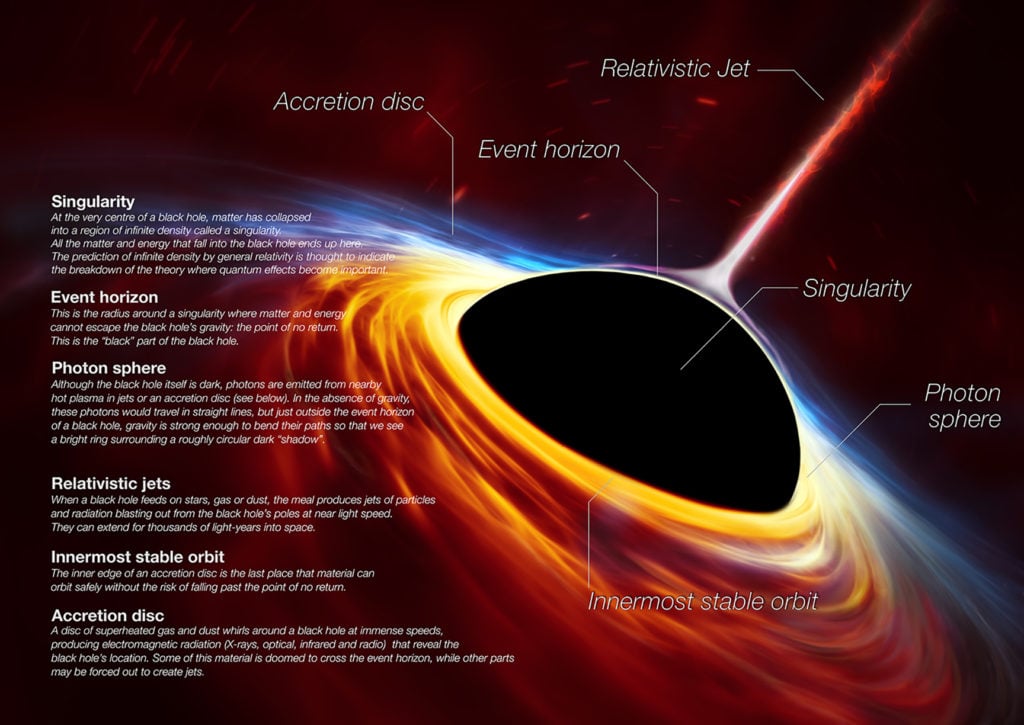
This artist’s impression depicts a rapidly spinning supermassive black hole surrounded by an accretion disc. Image courtesy of Center for Astrophysics, Harvard & Smithsonian.
The image was published in a special edition of the *[Astrophysical Journal Letters](https://iopscience.iop.org/article/10.3847/2041-8213/ab0ec7/meta)* and was revealed to the public at simultaneous press conferences held this morning in six cities around the world: Washington, Brussels, Santiago, Shanghai, Taipei, and Tokyo. It depicts the supermassive black hole, which is 24 million miles across, or about 6.5 billion times bigger than the sun, in the center of Messier 87, a supergiant elliptical galaxy in the constellation Virgo, a galaxy cluster some 55 million light years away.
“It is one of the heaviest black holes that we think exists,” Heino Falcke, a professor Radboud University in the Netherlands who first proposed the experiment back in 1993, told the [BBC](https://www.bbc.com/news/science-environment-47873592?fbclid=IwAR1sPMX3KSCkUlezP1Qrfu8E4Ockl6qEuVI1T5sbg0NRa2dv1tiLjOrIq48). “It is an absolute monster, the heavyweight champion of black holes in the universe.”
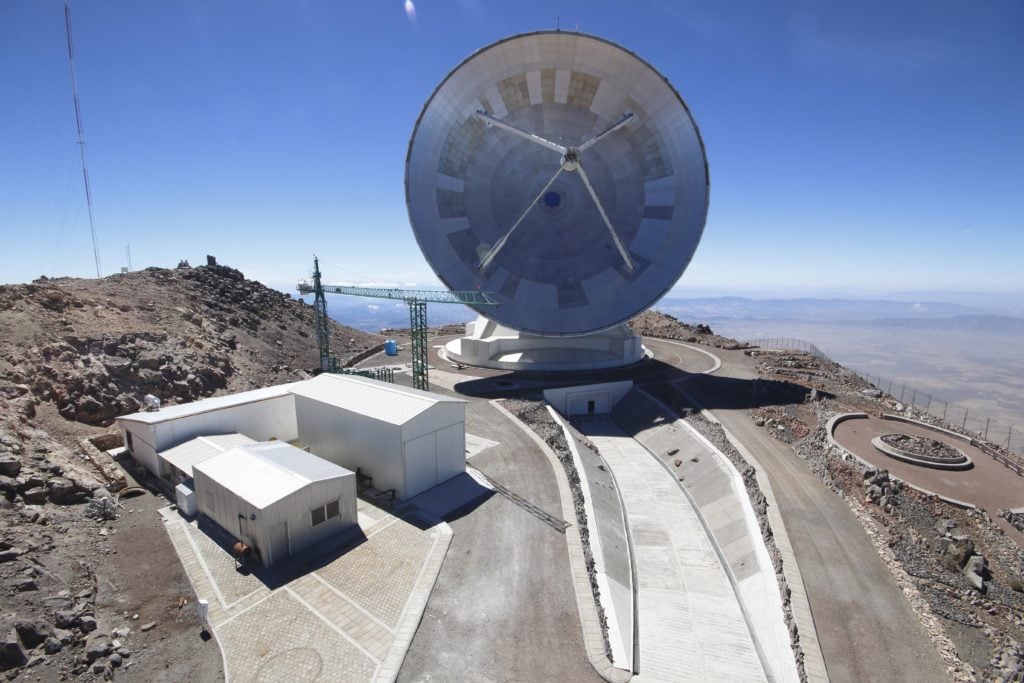
The Large Millimeter Telescope (LMT) in Mexico, operated jointly by the University of Massachusetts Amherst and Mexico’s Instituto Nacional de Astrofísica, Óptica y Electrónica, was one of the telescopes used by the Event Horizon Telescope project to capture the first image of a black hole. Photo courtesy of UMASS Amherst.
The [Event Horizon Telescope](https://eventhorizontelescope.org/) project, which began more than 10 years ago, has also observed Sagittarius A\*, a black hole in our own Milky Way galaxy that is 4.1 million times bigger than the sun and 26,000 lightyears away.
For its groundbreaking observations, the Event Horizon Telescope used eight ground-based radio telescopes, located in sites in Chile, Mexico, Spain, Hawaii, Arizona, and the Antarctic, essentially creating a virtual telescope the size of planet Earth. All observations were conducted simultaneously, synchronized through the use of precise atomic clocks.
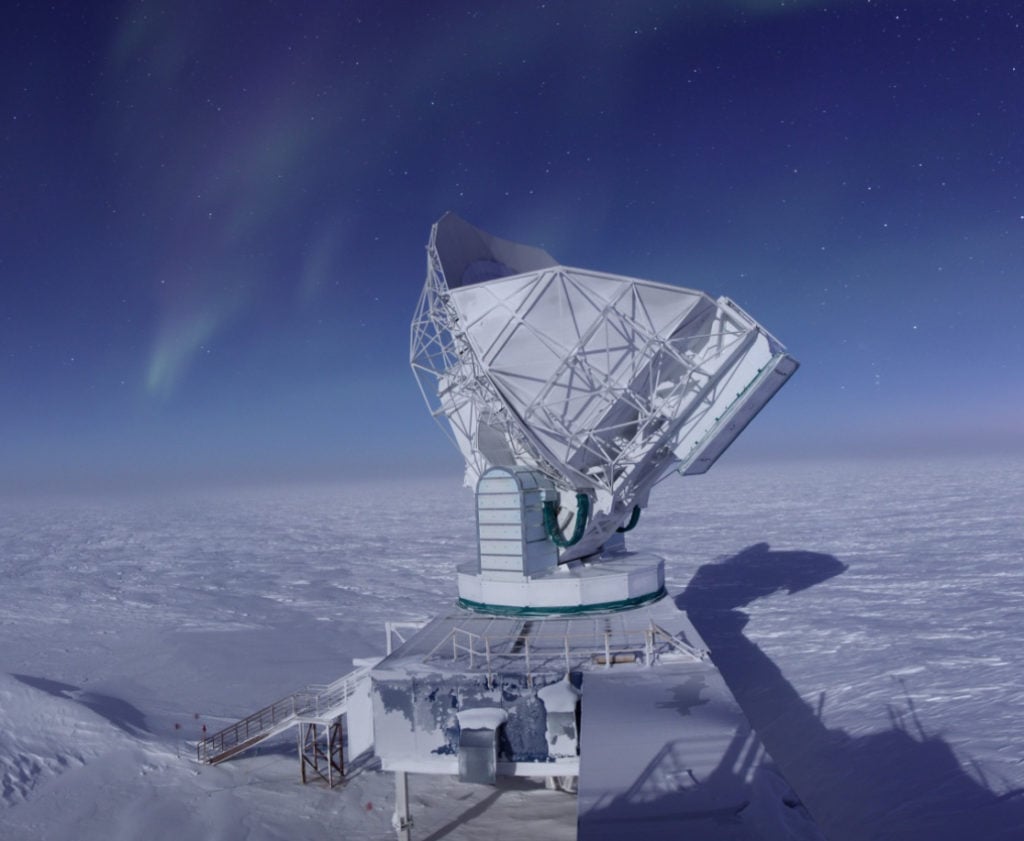
The South Pole Telescope is one of eight ground-based radio telescopes that make up the Event Horizon Telescope array. Photo by Jason Gallicchio, courtesy of the University of Chicago.
Altogether, the project collected a mind-boggling 5,000 trillion bytes of data over two weeks. It was too much to send over the internet, so hundreds of hard drives were flown to a central processing center at the Max Planck Institute for Radio Astronomy and MIT Haystack Observatory in Massachusetts, where the data was initially processed by supercomputers. Four independent groups of scientists then used three different imaging methods to interpret it before the historic image was finalized.
A second round of observations was conducted in 2018, with additional telescopes joining the project in Greenland and France, as well as another Arizona site. Scientific researchers are currently analyzing that data.
What is actually captured in the first-of-its-kind image is the so-called event horizon, the point of no return that surrounds a black hole. It shows the light, superheated gases, and even stars being sucked into the hole, as well as the jets of super-charged particles that are being blasted away from the edge of the event horizon, barely escaping its inexorable pull.
“Black holes have sparked imaginations for decades,” said National Science Foundation director France Córdova in a [statement](https://www.umass.edu/newsoffice/article/international-astronomy-team-reveals-first). “They have exotic properties and are mysterious to us. Yet with more observations like this one they are yielding their secrets.”
[](https://news.artnet.com/about/sarah-cascone-25)
[Sarah Cascone Senior Writer](https://news.artnet.com/about/sarah-cascone-25)
### The best of Artnet News in your inbox.
[Sign up for our daily newsletter.]()
- ## Related Articles
- [](https://news.artnet.com/art-world/most-detailed-black-hole-photograph-1955942)
##### [Art & Tech](https://news.artnet.com/art-world/science-technology)
[Astronomers Have Captured the Most Detailed Photo of a Black Hole Ever—See the Magnetic Fields That Power It Here](https://news.artnet.com/art-world/most-detailed-black-hole-photograph-1955942)
By [Sarah Cascone](https://news.artnet.com/about/sarah-cascone-25), Mar 31, 2021
- [](https://news.artnet.com/art-world/art-industry-news-january-30-stories-1765443)
##### [Art World](https://news.artnet.com/art-world)
[Art Industry News: the Museum of Chinese in America’s Archives, Feared Lost, Are ‘Very Much Salvageable’ + Other Stories](https://news.artnet.com/art-world/art-industry-news-january-30-stories-1765443)
By [Artnet News](https://news.artnet.com/about/artnet-news-39), Jan 30, 2020
- [](https://news.artnet.com/art-world/satellite-images-earth-as-art-series-1376128)
##### [Art World](https://news.artnet.com/art-world)
[Satellites Are Taking Data-Based Images of the Earth and the Colors Are Spectacular—See Them Here](https://news.artnet.com/art-world/satellite-images-earth-as-art-series-1376128)
By [Sarah Cascone](https://news.artnet.com/about/sarah-cascone-25), Oct 21, 2018
- ## Related Articles
- [](https://news.artnet.com/art-world/most-detailed-black-hole-photograph-1955942)
##### [Art & Tech](https://news.artnet.com/art-world/science-technology)
[Astronomers Have Captured the Most Detailed Photo of a Black Hole Ever—See the Magnetic Fields That Power It Here](https://news.artnet.com/art-world/most-detailed-black-hole-photograph-1955942)
By [Sarah Cascone](https://news.artnet.com/about/sarah-cascone-25), Mar 31, 2021
- [](https://news.artnet.com/art-world/art-industry-news-january-30-stories-1765443)
##### [Art World](https://news.artnet.com/art-world)
[Art Industry News: the Museum of Chinese in America’s Archives, Feared Lost, Are ‘Very Much Salvageable’ + Other Stories](https://news.artnet.com/art-world/art-industry-news-january-30-stories-1765443)
By [Artnet News](https://news.artnet.com/about/artnet-news-39), Jan 30, 2020
- [](https://news.artnet.com/art-world/satellite-images-earth-as-art-series-1376128)
##### [Art World](https://news.artnet.com/art-world)
[Satellites Are Taking Data-Based Images of the Earth and the Colors Are Spectacular—See Them Here](https://news.artnet.com/art-world/satellite-images-earth-as-art-series-1376128)
By [Sarah Cascone](https://news.artnet.com/about/sarah-cascone-25), Oct 21, 2018
### More Trending Stories
[Museums & Institutions](https://news.artnet.com/art-world/museums-and-institutions)
[ Guggenheim Taps Hirshhorn Museum’s Melissa Chiu to Be Director](https://news.artnet.com/art-world/guggenheim-taps-hirshhorn-museums-melissa-chiu-to-be-director-2763619)
[People](https://news.artnet.com/art-world/people)
[ Dealer David Schrader’s Case for a More Fluid Art Market: ‘Volume Begets Volume’](https://news.artnet.com/art-world/5-questions-david-schrader-intelligence-report-2756514)
[People](https://news.artnet.com/art-world/people)
[ Veteran Advisor Patti Wong on How the Auction Market Is Recalibrating](https://news.artnet.com/art-world/patti-wong-intelligence-report-2756565)
[Art Market Minute](https://news.artnet.com/multimedia/art-market-minute)
[ The Art Market’s Uneven Recovery, Explained](https://news.artnet.com/multimedia/art-market-minute-apr-6-2759123)
[Museums & Institutions](https://news.artnet.com/art-world/Museums%20&%20Institutions)
[Guggenheim Taps Hirshhorn Museum’s Melissa Chiu to Be Director](https://news.artnet.com/art-world/guggenheim-taps-hirshhorn-museums-melissa-chiu-to-be-director-2763619)
[](https://news.artnet.com/art-world/guggenheim-taps-hirshhorn-museums-melissa-chiu-to-be-director-2763619)
[People](https://news.artnet.com/art-world/People)
[Dealer David Schrader’s Case for a More Fluid Art Market: ‘Volume Begets Volume’](https://news.artnet.com/art-world/5-questions-david-schrader-intelligence-report-2756514)
[](https://news.artnet.com/art-world/5-questions-david-schrader-intelligence-report-2756514)
[People](https://news.artnet.com/art-world/People)
[Veteran Advisor Patti Wong on How the Auction Market Is Recalibrating](https://news.artnet.com/art-world/patti-wong-intelligence-report-2756565)
[](https://news.artnet.com/art-world/patti-wong-intelligence-report-2756565)
[Art Market Minute](https://news.artnet.com/art-world/Art%20Market%20Minute)
[The Art Market’s Uneven Recovery, Explained](https://news.artnet.com/multimedia/art-market-minute-apr-6-2759123)
[](https://news.artnet.com/multimedia/art-market-minute-apr-6-2759123)
[Previous Article](https://news.artnet.com/art-world/mark-bradford-long-museum-shanghai-1513381)
[](https://news.artnet.com/art-world/mark-bradford-long-museum-shanghai-1513381)
##### [Art & Exhibitions](https://news.artnet.com/art-world/exhibitions)
[Artist Mark Bradford Is Shipping His Plywood Noah’s Ark to Shanghai for His Biggest Show in China Yet](https://news.artnet.com/art-world/mark-bradford-long-museum-shanghai-1513381)
By [Sarah Cascone](https://news.artnet.com/about/sarah-cascone-25), Apr 10, 2019
[Next Article](https://news.artnet.com/art-world-archives/vik-muniz-brazil-flood-1513300)
[](https://news.artnet.com/art-world-archives/vik-muniz-brazil-flood-1513300)
##### [Politics](https://news.artnet.com/art-world-archives/politics)
[‘Stupid and Senseless Politicians’: Artist Vik Muniz Blasts Brazilian Leaders After a Deadly Flood Sweeps Through Rio de Janeiro](https://news.artnet.com/art-world-archives/vik-muniz-brazil-flood-1513300)
By [Javier Pes](https://news.artnet.com/about/javier-pes-728), Apr 10, 2019
[Load More](https://news.artnet.com/art-world-archives/vik-muniz-brazil-flood-1513300)
- [Artnet](http://www.artnet.com/)
- [Artnet Auctions](https://www.artnet.com/auctions/)
- [Advertise](http://www.artnet.com/advertising/)
- [Press Releases](http://www.artnet.com/about/press-releases.aspx)
- [Terms](http://www.artnet.com/about/terms-and-conditions-of-use)
- [Privacy](http://www.artnet.com/about/privacy-formal.asp)
- [Cookies](http://www.artnet.com/about/privacy-formal.asp#Cookies)
- [About](https://news.artnet.com/about)
- artnet Magazine Archive:
- [English (US)](http://www.artnet.com/magazineus/frontpage.asp)
- [Deutsch](http://www.artnet.de/magazine/)
- [Francais](http://www.artnet.fr/magazine/frontpage.asp)
- [Facebook](https://www.facebook.com/artnet "Facebook")
- [Instagram](http://instagram.com/artnet "Instagram")
- [Twitter](https://twitter.com/artnet "Twitter")
- [Pinterest](http://www.pinterest.com/artnet/ "Pinterest")
- [LinkedIn](http://www.linkedin.com/company/artnet "LinkedIn")
- [YouTube](https://www.youtube.com/@artnet "YouTube")
- [Weibo](http://weibo.com/artnet "Weibo")
©2026 Artnet Worldwide Corporation. All Rights Reserved. |
| Readable Markdown | Humankind is one step closer to understanding one of the universe’s most enduring mysteries: the black hole. Once considered unobservable, black holes are dense fields of matter that create gravity fields so powerful that even rays of light cannot escape their grasp. But now, astronomers have taken a mind-blowing picture of the dark circular void surrounded by a ring of fiery light.
“We have seen what we thought was unseeable,” said project director Sheperd Doeleman, of the Harvard-Smithsonian Center for Astrophysics, in a [statement](https://eventhorizontelescope.org/). “We have seen and taken a picture of a black hole. This is an extraordinary scientific feat accomplished by a team of more than 200 researchers.”
The black hole looks so frightening and malevolent that the [*New York Times*](https://www.nytimes.com/2019/04/10/science/black-hole-picture.html) couldn’t help comparing it to the eye of Sauron, the demonic villain in J.R.R. Tolkien’s *Lord of the Rings*.
“For decades, we have studied how black holes swallow material and power the hearts of galaxies,” said Harvard University professor Ramesh Narayan, who worked on the project, in a [statement](https://www.cfa.harvard.edu/news/2019-12). “To finally see a black hole in action, bending its nearby light into a bright ring, is a breathtaking confirmation that supermassive black holes exist and match the appearance expected from our simulations.”

This artist’s impression depicts a rapidly spinning supermassive black hole surrounded by an accretion disc. Image courtesy of Center for Astrophysics, Harvard & Smithsonian.
The image was published in a special edition of the *[Astrophysical Journal Letters](https://iopscience.iop.org/article/10.3847/2041-8213/ab0ec7/meta)* and was revealed to the public at simultaneous press conferences held this morning in six cities around the world: Washington, Brussels, Santiago, Shanghai, Taipei, and Tokyo. It depicts the supermassive black hole, which is 24 million miles across, or about 6.5 billion times bigger than the sun, in the center of Messier 87, a supergiant elliptical galaxy in the constellation Virgo, a galaxy cluster some 55 million light years away.
“It is one of the heaviest black holes that we think exists,” Heino Falcke, a professor Radboud University in the Netherlands who first proposed the experiment back in 1993, told the [BBC](https://www.bbc.com/news/science-environment-47873592?fbclid=IwAR1sPMX3KSCkUlezP1Qrfu8E4Ockl6qEuVI1T5sbg0NRa2dv1tiLjOrIq48). “It is an absolute monster, the heavyweight champion of black holes in the universe.”

The Large Millimeter Telescope (LMT) in Mexico, operated jointly by the University of Massachusetts Amherst and Mexico’s Instituto Nacional de Astrofísica, Óptica y Electrónica, was one of the telescopes used by the Event Horizon Telescope project to capture the first image of a black hole. Photo courtesy of UMASS Amherst.
The [Event Horizon Telescope](https://eventhorizontelescope.org/) project, which began more than 10 years ago, has also observed Sagittarius A\*, a black hole in our own Milky Way galaxy that is 4.1 million times bigger than the sun and 26,000 lightyears away.
For its groundbreaking observations, the Event Horizon Telescope used eight ground-based radio telescopes, located in sites in Chile, Mexico, Spain, Hawaii, Arizona, and the Antarctic, essentially creating a virtual telescope the size of planet Earth. All observations were conducted simultaneously, synchronized through the use of precise atomic clocks.

The South Pole Telescope is one of eight ground-based radio telescopes that make up the Event Horizon Telescope array. Photo by Jason Gallicchio, courtesy of the University of Chicago.
Altogether, the project collected a mind-boggling 5,000 trillion bytes of data over two weeks. It was too much to send over the internet, so hundreds of hard drives were flown to a central processing center at the Max Planck Institute for Radio Astronomy and MIT Haystack Observatory in Massachusetts, where the data was initially processed by supercomputers. Four independent groups of scientists then used three different imaging methods to interpret it before the historic image was finalized.
A second round of observations was conducted in 2018, with additional telescopes joining the project in Greenland and France, as well as another Arizona site. Scientific researchers are currently analyzing that data.
What is actually captured in the first-of-its-kind image is the so-called event horizon, the point of no return that surrounds a black hole. It shows the light, superheated gases, and even stars being sucked into the hole, as well as the jets of super-charged particles that are being blasted away from the edge of the event horizon, barely escaping its inexorable pull.
“Black holes have sparked imaginations for decades,” said National Science Foundation director France Córdova in a [statement](https://www.umass.edu/newsoffice/article/international-astronomy-team-reveals-first). “They have exotic properties and are mysterious to us. Yet with more observations like this one they are yielding their secrets.” |
| Shard | 21 (laksa) |
| Root Hash | 3915844116584170621 |
| Unparsed URL | com,artnet!news,/art-world/first-ever-photograph-black-hole-1513762 s443 |