ℹ️ Skipped - page is already crawled
| Filter | Status | Condition | Details |
|---|---|---|---|
| HTTP status | PASS | download_http_code = 200 | HTTP 200 |
| Age cutoff | PASS | download_stamp > now() - 6 MONTH | 0 months ago |
| History drop | PASS | isNull(history_drop_reason) | No drop reason |
| Spam/ban | PASS | fh_dont_index != 1 AND ml_spam_score = 0 | ml_spam_score=0 |
| Canonical | PASS | meta_canonical IS NULL OR = '' OR = src_unparsed | Not set |
| Property | Value | ||||||||||||||||||||||||
|---|---|---|---|---|---|---|---|---|---|---|---|---|---|---|---|---|---|---|---|---|---|---|---|---|---|
| URL | https://newrepublic.com/article/163291/afghanistan-war-founded-lies-people-still-telling-them | ||||||||||||||||||||||||
| Last Crawled | 2026-04-21 14:12:02 (1 day ago) | ||||||||||||||||||||||||
| First Indexed | 2021-08-16 20:45:39 (4 years ago) | ||||||||||||||||||||||||
| HTTP Status Code | 200 | ||||||||||||||||||||||||
| Content | |||||||||||||||||||||||||
| Meta Title | The Afghanistan War Was Founded on Lies. Some People Are Still Telling Them. | The New Republic | ||||||||||||||||||||||||
| Meta Description | As the Taliban takes over the country, hawkish pundits and ex-officials in America are still clinging to the long-broken dream of nation-building. | ||||||||||||||||||||||||
| Meta Canonical | null | ||||||||||||||||||||||||
| Boilerpipe Text | From its inception in 2001 to its ignominious end, the U.S. war in Afghanistan has been defined by lies. It was a lie when, in 2001, President George W. Bush
told
service members that “your mission is defined, your objectives are clear.... We will not fail.” It was a lie when, in 2016, President Barack Obama
proclaimed
that America had successfully “trained Afghan forces to take responsibility for their own security.” And it was a lie every time pundits and officials insisted that victory was around the corner.
Manifold elites are now lying about the fall of Afghanistan “under Biden’s watch.” In
The New York Times
, the American Enterprise Institute’s Frederick Kagan
claims
that “a disastrous Taliban takeover wasn’t inevitable,” though it has been obvious for years that the Taliban was winning and that the Afghan government would eventually fall without overwhelming U.S. support. In
The Wall Street Journal
, former National Security Adviser H.R. McMaster and Bradley Bowman of the Foundation for Defense of Democracies
assert
that “the refusal to provide the Afghan people the support necessary to stem a humanitarian catastrophe emboldens China, Russia and other adversaries eager to proclaim the U.S. an unreliable partner and a declining power,” though the U.S. has proved time and again that it is already those things. And in
The New York Times
, Bret Stephens perplexingly
affirms
that “Disaster in Afghanistan Will Follow Us Home,” as if the militarization of U.S. policing that occurred in the wake of the war on terrorism hasn’t already done significant damage to the country.
These and other comments evince the cynicism that always defined the invasion of Afghanistan. It’s hard to imagine that Kagan, McMaster, Bowman, and Stephens really believe that America’s vital security or economic interests will be adversely affected by the Taliban’s victory. The U.S. remains a very safe, powerful, and rich country that faces no serious security threats. Rather, one gets the impression that the hawks are annoyed and embarrassed that a small paramilitary group was able, like the North Vietnamese army before it, to reveal, beyond the shadow of a doubt, America’s inability to remake foreign nations in its image.
The cynicism, though, is truly something to behold. While the U.S. war in Vietnam was a pointless tragedy that resulted in untold human misery, it was not totally absurd for U.S. decision-makers to believe that communism was an existential threat worth fighting. The same cannot be said for the war in Afghanistan—only paranoiacs could have ever claimed that “terrorism” could seriously harm the United States. As such, for 20 years the U.S. effort in Afghanistan has done little but enrich defense and military contractors and bolster the global heroin trade while harming a country about which Americans knew and understood little. First time as tragedy, second time as farce.
Other writers subscribe to the so-called
Pottery Barn rule
: If you destroy a country, you fix it—no matter how long it takes. As the Manhattan Institute’s Brian Riedl
remarked on Twitter
, “The issue [with the U.S. withdrawal from Afghanistan] is the ‘Pottery Barn Principle’ - you break it you buy it. If we want to overthrow a dangerous government threatening us, do we leave the place in chaos without helping install any new government that’s any different? That’s the challenge.”
But the invocation of the rule in relation to Afghanistan doesn’t make sense. It’s not as if the United States made one fixable mistake and decided to leave. It’s more like Uncle Sam went into a Pottery Barn, strapped bombs to every item, detonated those bombs, and then ran a steamroller over the smoldering remains. The only way that Pottery Barn will be fixed is if some other group decides to rebuild it, likely without the direct aid of Uncle Sam (though the rebuilders of Afghanistan could and should demand money from the U.S.).
Ironically, by trying to force history upon the Afghan people, the U.S. wound up removing them from it, stifling any organic attempts to transform the country. After 20 years of an expensive and terrible war, the Taliban was able to retake the country in a matter of weeks. Afghanistan therefore finds itself where it was on September 10, 2001, with very little to show for it. It’s a tragedy of epic proportions that the U.S.
rejected
a December 2001 Taliban surrender offer, or any of the innumerable opportunities for ending this war on terms more favorable than those that have now taken hold.
Perhaps the best thing about the Taliban advance over the past few weeks was that local officials didn’t resist it, thus sparing the population further violence. Seeing which way the wind was blowing, most of them surrendered their arms and accepted the reality that their military and government didn’t have the capacity to defend themselves. Afghan President Ashraf Ghani has fled the country, apparently
after
looting
the country’s treasury, and will likely live a life of resplendent exile—possibly with a sinecure at one of our nation’s Ivy League universities or prestigious think tanks.
In 2019, the
Afghanistan Papers
proved that the U.S. government had been lying about the war’s progress for years. But in our hyperreal time, no one really seemed to care, least of all American citizens who didn’t directly suffer the consequences of their nation’s imperial adventures. We therefore went back to accepting the lies, until the Taliban’s advance shattered them once and for all.
One hopes that the experience of Afghanistan—and Iraq, Libya, Yemen, and many more places—will destroy the dream, expressed by every American president since Franklin Delano Roosevelt, that the U.S. can use its overwhelming power to reshape foreign nations along American lines. This project has failed time and again, and will do so in the future.
America, in short, can’t do whatever it wants in the world, and shouldn’t try. We are not, as
Madeleine
Albright infamously affirmed in 1998, the “indispensable nation” able to “see further than other countries into the future.” If anything, we’re the opposite, and it’s time for Americans to look themselves in the mirror and ask: What if we’re the bad guys? | ||||||||||||||||||||||||
| Markdown | [Skip Navigation](https://newrepublic.com/article/163291/afghanistan-war-founded-lies-people-still-telling-them#main)
The New Republic
- [LATEST](https://newrepublic.com/latest)
- [BREAKING NEWS](https://newrepublic.com/breaking-news)
- [POLITICS](https://newrepublic.com/politics)
- [CLIMATE](https://newrepublic.com/climate)
- [CULTURE](https://newrepublic.com/culture)
- [MAGAZINE](https://newrepublic.com/magazine)
- [NEWSLETTERS]()
- [PODCASTS](https://newrepublic.com/podcasts)
- [VIDEO](https://newrepublic.com/video)
Politics Homepage
- [Trumpworld](https://newrepublic.com/politics/tags/donald-trump)
- [Congress](https://newrepublic.com/politics/tags/congress)
- [Supreme Court Watch](https://newrepublic.com/politics/tags/supreme-court-watch)
- [Media](https://newrepublic.com/politics/tags/media)
The New Republic
- [LATEST](https://newrepublic.com/latest)
- [BREAKING NEWS](https://newrepublic.com/breaking-news)
- [POLITICS](https://newrepublic.com/politics)
- [CLIMATE](https://newrepublic.com/climate)
- [CULTURE](https://newrepublic.com/culture)
- [MAGAZINE](https://newrepublic.com/magazine)
- [NEWSLETTERS]()
- [PODCASTS](https://newrepublic.com/podcasts)
- [VIDEO](https://newrepublic.com/video)
Politics Homepage
- [Trumpworld](https://newrepublic.com/politics/tags/donald-trump)
- [Congress](https://newrepublic.com/politics/tags/congress)
- [Supreme Court Watch](https://newrepublic.com/politics/tags/supreme-court-watch)
- [Media](https://newrepublic.com/politics/tags/media)
[Daniel Bessner](https://newrepublic.com/authors/daniel-bessner "Daniel Bessner"), [Derek Davison](https://newrepublic.com/authors/derek-davison "Derek Davison")/
August 16, 2021
# The Afghanistan War Was Founded on Lies. Some People Are Still Telling Them.
## As the Taliban takes over the country, hawkish pundits and ex-officials in America are still clinging to the long-broken dream of nation-building.
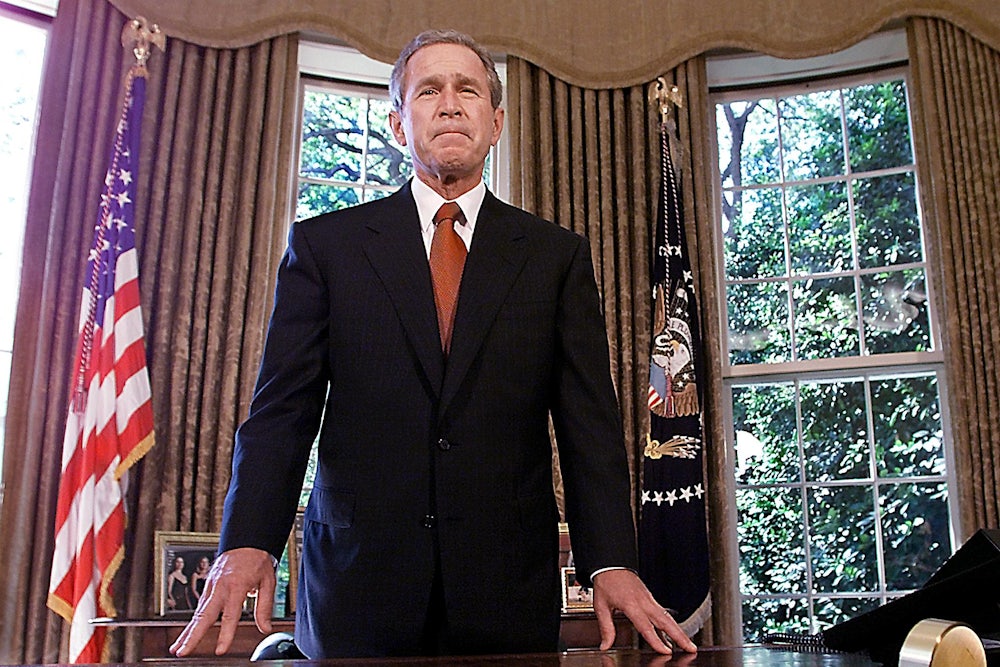
PAUL J. RICHARDS/AFP/Getty Images
President George W. Bush in the Oval Office in September 2001
From its inception in 2001 to its ignominious end, the U.S. war in Afghanistan has been defined by lies. It was a lie when, in 2001, President George W. Bush [told](https://georgewbush-whitehouse.archives.gov/news/releases/2001/10/20011007-8.html) service members that “your mission is defined, your objectives are clear.... We will not fail.” It was a lie when, in 2016, President Barack Obama [proclaimed](https://obamawhitehouse.archives.gov/the-press-office/2016/07/06/statement-president-afghanistan) that America had successfully “trained Afghan forces to take responsibility for their own security.” And it was a lie every time pundits and officials insisted that victory was around the corner.
Manifold elites are now lying about the fall of Afghanistan “under Biden’s watch.” In *The New York Times*, the American Enterprise Institute’s Frederick Kagan [claims](https://www.nytimes.com/2021/08/12/opinion/biden-afghanistan-taliban.html) that “a disastrous Taliban takeover wasn’t inevitable,” though it has been obvious for years that the Taliban was winning and that the Afghan government would eventually fall without overwhelming U.S. support. In *The Wall Street Journal*, former National Security Adviser H.R. McMaster and Bradley Bowman of the Foundation for Defense of Democracies [assert](https://www.wsj.com/articles/afghanistan-withdrawal-biden-human-rights-terrorist-jihadist-islamist-taliban-kabul-11629044191?mod=e2two) that “the refusal to provide the Afghan people the support necessary to stem a humanitarian catastrophe emboldens China, Russia and other adversaries eager to proclaim the U.S. an unreliable partner and a declining power,” though the U.S. has proved time and again that it is already those things. And in *The New York Times*, Bret Stephens perplexingly [affirms](https://www.nytimes.com/2021/08/15/opinion/afghanistan-taliban-biden.html) that “Disaster in Afghanistan Will Follow Us Home,” as if the militarization of U.S. policing that occurred in the wake of the war on terrorism hasn’t already done significant damage to the country.
These and other comments evince the cynicism that always defined the invasion of Afghanistan. It’s hard to imagine that Kagan, McMaster, Bowman, and Stephens really believe that America’s vital security or economic interests will be adversely affected by the Taliban’s victory. The U.S. remains a very safe, powerful, and rich country that faces no serious security threats. Rather, one gets the impression that the hawks are annoyed and embarrassed that a small paramilitary group was able, like the North Vietnamese army before it, to reveal, beyond the shadow of a doubt, America’s inability to remake foreign nations in its image.
The cynicism, though, is truly something to behold. While the U.S. war in Vietnam was a pointless tragedy that resulted in untold human misery, it was not totally absurd for U.S. decision-makers to believe that communism was an existential threat worth fighting. The same cannot be said for the war in Afghanistan—only paranoiacs could have ever claimed that “terrorism” could seriously harm the United States. As such, for 20 years the U.S. effort in Afghanistan has done little but enrich defense and military contractors and bolster the global heroin trade while harming a country about which Americans knew and understood little. First time as tragedy, second time as farce.
Other writers subscribe to the so-called [Pottery Barn rule](https://www.huffpost.com/entry/afghanistan-and-pottery-b_b_374505): If you destroy a country, you fix it—no matter how long it takes. As the Manhattan Institute’s Brian Riedl [remarked on Twitter](https://twitter.com/Brian_Riedl/status/1427073214736474112?s=20), “The issue \[with the U.S. withdrawal from Afghanistan\] is the ‘Pottery Barn Principle’ - you break it you buy it. If we want to overthrow a dangerous government threatening us, do we leave the place in chaos without helping install any new government that’s any different? That’s the challenge.”
But the invocation of the rule in relation to Afghanistan doesn’t make sense. It’s not as if the United States made one fixable mistake and decided to leave. It’s more like Uncle Sam went into a Pottery Barn, strapped bombs to every item, detonated those bombs, and then ran a steamroller over the smoldering remains. The only way that Pottery Barn will be fixed is if some other group decides to rebuild it, likely without the direct aid of Uncle Sam (though the rebuilders of Afghanistan could and should demand money from the U.S.).
Ironically, by trying to force history upon the Afghan people, the U.S. wound up removing them from it, stifling any organic attempts to transform the country. After 20 years of an expensive and terrible war, the Taliban was able to retake the country in a matter of weeks. Afghanistan therefore finds itself where it was on September 10, 2001, with very little to show for it. It’s a tragedy of epic proportions that the U.S. [rejected](https://www.nytimes.com/2001/12/07/news/rumsfeld-rejects-planto-allow-mullah-omar-to-live-in-dignity-taliban.html) a December 2001 Taliban surrender offer, or any of the innumerable opportunities for ending this war on terms more favorable than those that have now taken hold.
Perhaps the best thing about the Taliban advance over the past few weeks was that local officials didn’t resist it, thus sparing the population further violence. Seeing which way the wind was blowing, most of them surrendered their arms and accepted the reality that their military and government didn’t have the capacity to defend themselves. Afghan President Ashraf Ghani has fled the country, apparently after [looting](https://apnews.com/article/europe-russia-8cb3a75e8db4f4e30a011e0e826fc54d) the country’s treasury, and will likely live a life of resplendent exile—possibly with a sinecure at one of our nation’s Ivy League universities or prestigious think tanks.
In 2019, the [Afghanistan Papers](https://www.washingtonpost.com/graphics/2019/investigations/afghanistan-papers/afghanistan-war-confidential-documents/) proved that the U.S. government had been lying about the war’s progress for years. But in our hyperreal time, no one really seemed to care, least of all American citizens who didn’t directly suffer the consequences of their nation’s imperial adventures. We therefore went back to accepting the lies, until the Taliban’s advance shattered them once and for all.
One hopes that the experience of Afghanistan—and Iraq, Libya, Yemen, and many more places—will destroy the dream, expressed by every American president since Franklin Delano Roosevelt, that the U.S. can use its overwhelming power to reshape foreign nations along American lines. This project has failed time and again, and will do so in the future.
America, in short, can’t do whatever it wants in the world, and shouldn’t try. We are not, as Madeleine Albright infamously affirmed in 1998, the “indispensable nation” able to “see further than other countries into the future.” If anything, we’re the opposite, and it’s time for Americans to look themselves in the mirror and ask: What if we’re the bad guys?
[Daniel Bessner](https://newrepublic.com/authors/daniel-bessner)
Daniel Bessner is an Associate Professor in the Henry M. Jackson School of International Studies at the University of Washington. He is the co-host of the podcast *[American Prestige](https://podcasts.apple.com/us/podcast/american-prestige/id1574741668)* and the author of *[Democracy in Exile: Hans Speier and the Rise of the Defense Intellectual](https://www.cornellpress.cornell.edu/book/9780801453038/democracy-in-exile/).*
[Derek Davison](https://newrepublic.com/authors/derek-davison)
Derek Davison is a writer and analyst covering U.S. foreign policy and international affairs. He is the co-host of the podcast *[American Prestige](https://podcasts.apple.com/us/podcast/american-prestige/id1574741668)* and publisher of the [Foreign Exchanges](https://fx.substack.com/)newsletter at Substack.
Read More:
[The Soapbox](https://newrepublic.com/tags/the-soapbox), [Politics](https://newrepublic.com/tags/politics), [Foreign Policy](https://newrepublic.com/tags/foreign-policy), [Afghanistan](https://newrepublic.com/tags/afghanistan), [George W. Bush](https://newrepublic.com/tags/george-w-bush), [Barack Obama](https://newrepublic.com/tags/barack-obama), [Joe Biden](https://newrepublic.com/tags/joe-biden), [War](https://newrepublic.com/tags/war), [The Insecurity Complex](https://newrepublic.com/tags/the-insecurity-complex)
Editor’s Picks
[The Far Right Thinks Wokeness Is Why America Lost in Afghanistan](https://newrepublic.com/article/163283/far-right-wokeness-lost-afghanistan "
The Far Right Thinks Wokeness Is Why America Lost in Afghanistan
")
[Jacob Silverman](https://newrepublic.com/authors/jacob-silverman "Jacob Silverman")
[Jacob Silverman](https://newrepublic.com/authors/jacob-silverman "Jacob Silverman")
[The Far Right Thinks Wokeness Is Why America Lost in Afghanistan](https://newrepublic.com/article/163283/far-right-wokeness-lost-afghanistan "
The Far Right Thinks Wokeness Is Why America Lost in Afghanistan
")
[](https://newrepublic.com/article/163277/end-war-afghanistan-bush-taliban "Afghanistan Is a Disaster. But It Was Always Going to Be.")
[Afghanistan Is a Disaster. But It Was Always Going to Be.](https://newrepublic.com/article/163277/end-war-afghanistan-bush-taliban "Afghanistan Is a Disaster. But It Was Always Going to Be.")
[Michael Tomasky](https://newrepublic.com/authors/michael-tomasky "Michael Tomasky")
[](https://newrepublic.com/article/163277/end-war-afghanistan-bush-taliban "Afghanistan Is a Disaster. But It Was Always Going to Be.")
[Michael Tomasky](https://newrepublic.com/authors/michael-tomasky "Michael Tomasky")
[Afghanistan Is a Disaster. But It Was Always Going to Be.](https://newrepublic.com/article/163277/end-war-afghanistan-bush-taliban "Afghanistan Is a Disaster. But It Was Always Going to Be.")
[The End of the Four-Year Presidency—for Democrats, Anyway](https://newrepublic.com/article/163258/two-year-president-biden-clinton-obama "The End of the Four-Year Presidency—for Democrats, Anyway")
[Timothy Noah](https://newrepublic.com/authors/timothy-noah "Timothy Noah")
[Timothy Noah](https://newrepublic.com/authors/timothy-noah "Timothy Noah")
[The End of the Four-Year Presidency—for Democrats, Anyway](https://newrepublic.com/article/163258/two-year-president-biden-clinton-obama "The End of the Four-Year Presidency—for Democrats, Anyway")
[](https://newrepublic.com/article/163252/afghanistan-troop-withdrawal-taliban-returns "The
Only Thing Worse Than Leaving Afghanistan? Staying.")
[The Only Thing Worse Than Leaving Afghanistan? Staying.](https://newrepublic.com/article/163252/afghanistan-troop-withdrawal-taliban-returns "The
Only Thing Worse Than Leaving Afghanistan? Staying.")
[Walter Shapiro](https://newrepublic.com/authors/walter-shapiro "Walter Shapiro")
[](https://newrepublic.com/article/163252/afghanistan-troop-withdrawal-taliban-returns "The
Only Thing Worse Than Leaving Afghanistan? Staying.")
[Walter Shapiro](https://newrepublic.com/authors/walter-shapiro "Walter Shapiro")
[The Only Thing Worse Than Leaving Afghanistan? Staying.](https://newrepublic.com/article/163252/afghanistan-troop-withdrawal-taliban-returns "The
Only Thing Worse Than Leaving Afghanistan? Staying.")
Latest From Politics
[Memo Mori](https://newrepublic.com/article/209283/supreme-court-shadow-docket-memos-west-virginia-epa)
[The Supreme Court’s Shadow-Docket Secrets Have Been Spilled](https://newrepublic.com/article/209283/supreme-court-shadow-docket-memos-west-virginia-epa "The Supreme Court’s Shadow-Docket Secrets Have Been Spilled")
[Matt Ford](https://newrepublic.com/authors/matt-ford "Matt Ford")
[Memo Mori](https://newrepublic.com/article/209283/supreme-court-shadow-docket-memos-west-virginia-epa)
[Matt Ford](https://newrepublic.com/authors/matt-ford "Matt Ford")
[The Supreme Court’s Shadow-Docket Secrets Have Been Spilled](https://newrepublic.com/article/209283/supreme-court-shadow-docket-memos-west-virginia-epa "The Supreme Court’s Shadow-Docket Secrets Have Been Spilled")
[Doom Loops](https://newrepublic.com/article/209271/trump-netanyahu-iran-war-political-damage)
[](https://newrepublic.com/article/209271/trump-netanyahu-iran-war-political-damage "Trump and Netanyahu Have Royally Screwed Each Other Over")
[Trump and Netanyahu Have Royally Screwed Each Other Over](https://newrepublic.com/article/209271/trump-netanyahu-iran-war-political-damage "Trump and Netanyahu Have Royally Screwed Each Other Over")
[Alon Pinkas](https://newrepublic.com/authors/alon-pinkas "Alon Pinkas")
[](https://newrepublic.com/article/209271/trump-netanyahu-iran-war-political-damage "Trump and Netanyahu Have Royally Screwed Each Other Over")
[Doom Loops](https://newrepublic.com/article/209271/trump-netanyahu-iran-war-political-damage)
[Alon Pinkas](https://newrepublic.com/authors/alon-pinkas "Alon Pinkas")
[Trump and Netanyahu Have Royally Screwed Each Other Over](https://newrepublic.com/article/209271/trump-netanyahu-iran-war-political-damage "Trump and Netanyahu Have Royally Screwed Each Other Over")
[Why-Oh, Why-Oh](https://newrepublic.com/article/208747/ohio-republican-party-laboratory-autocracy)
[The Ohio Republican Party Has Built a Laboratory of Autocracy](https://newrepublic.com/article/208747/ohio-republican-party-laboratory-autocracy "The Ohio Republican Party Has Built a Laboratory of Autocracy")
[Sarah Stankorb](https://newrepublic.com/authors/sarah-stankorb "Sarah Stankorb")
[Why-Oh, Why-Oh](https://newrepublic.com/article/208747/ohio-republican-party-laboratory-autocracy)
[Sarah Stankorb](https://newrepublic.com/authors/sarah-stankorb "Sarah Stankorb")
[The Ohio Republican Party Has Built a Laboratory of Autocracy](https://newrepublic.com/article/208747/ohio-republican-party-laboratory-autocracy "The Ohio Republican Party Has Built a Laboratory of Autocracy")
[CUPIDITY](https://newrepublic.com/article/209247/warren-hegseth-iran-insider-trading)
[](https://newrepublic.com/article/209247/warren-hegseth-iran-insider-trading "Does the SEC Care Whether Hegseth Is Killing Iranians To Get Rich?")
[Does the SEC Care Whether Hegseth Is Killing Iranians To Get Rich?](https://newrepublic.com/article/209247/warren-hegseth-iran-insider-trading "Does the SEC Care Whether Hegseth Is Killing Iranians To Get Rich?")
[Timothy Noah](https://newrepublic.com/authors/timothy-noah "Timothy Noah")
[](https://newrepublic.com/article/209247/warren-hegseth-iran-insider-trading "Does the SEC Care Whether Hegseth Is Killing Iranians To Get Rich?")
[CUPIDITY](https://newrepublic.com/article/209247/warren-hegseth-iran-insider-trading)
[Timothy Noah](https://newrepublic.com/authors/timothy-noah "Timothy Noah")
[Does the SEC Care Whether Hegseth Is Killing Iranians To Get Rich?](https://newrepublic.com/article/209247/warren-hegseth-iran-insider-trading "Does the SEC Care Whether Hegseth Is Killing Iranians To Get Rich?")
- [BREAKING NEWS](https://newrepublic.com/breaking-news)
- [POLITICS](https://newrepublic.com/politics)
- [CLIMATE](https://newrepublic.com/climate)
- [CULTURE](https://newrepublic.com/culture)
- [MAGAZINE](https://newrepublic.com/magazine)
- [PODCASTS](https://newrepublic.com/podcasts)
- [VIDEO](https://newrepublic.com/video)
- [Events](https://newrepublic.com/pages/events)
- [Travel](https://newrepublic.com/travel)
- [Bookstore](https://newrepublic.com/bookstore)
- [Donate]()
- [Advertise](https://advertise.newrepublic.com/)
- [FAQ](https://newrepublic.com/pages/faq)
- [Press](https://newrepublic.com/tags/press-release)
- [Jobs](https://newrepublic.com/pages/jobs)
- [Submissions](https://newrepublic.com/pages/contact#submissionGuidelines)
- [Subscribe to *The New Republic*]()
- [Sign Up for Our Newsletters]()
- [Accessibility Statement](https://newrepublic.com/pages/accessibility-statement)
- [Terms and Conditions](https://newrepublic.com/pages/terms-and-conditions)
- [Privacy Policy](https://newrepublic.com/pages/privacy)
- [Cookie Settings]()
- Copyright 2026 © *The New Republic*. All rights reserved. | ||||||||||||||||||||||||
| Readable Markdown | From its inception in 2001 to its ignominious end, the U.S. war in Afghanistan has been defined by lies. It was a lie when, in 2001, President George W. Bush [told](https://georgewbush-whitehouse.archives.gov/news/releases/2001/10/20011007-8.html) service members that “your mission is defined, your objectives are clear.... We will not fail.” It was a lie when, in 2016, President Barack Obama [proclaimed](https://obamawhitehouse.archives.gov/the-press-office/2016/07/06/statement-president-afghanistan) that America had successfully “trained Afghan forces to take responsibility for their own security.” And it was a lie every time pundits and officials insisted that victory was around the corner.
Manifold elites are now lying about the fall of Afghanistan “under Biden’s watch.” In *The New York Times*, the American Enterprise Institute’s Frederick Kagan [claims](https://www.nytimes.com/2021/08/12/opinion/biden-afghanistan-taliban.html) that “a disastrous Taliban takeover wasn’t inevitable,” though it has been obvious for years that the Taliban was winning and that the Afghan government would eventually fall without overwhelming U.S. support. In *The Wall Street Journal*, former National Security Adviser H.R. McMaster and Bradley Bowman of the Foundation for Defense of Democracies [assert](https://www.wsj.com/articles/afghanistan-withdrawal-biden-human-rights-terrorist-jihadist-islamist-taliban-kabul-11629044191?mod=e2two) that “the refusal to provide the Afghan people the support necessary to stem a humanitarian catastrophe emboldens China, Russia and other adversaries eager to proclaim the U.S. an unreliable partner and a declining power,” though the U.S. has proved time and again that it is already those things. And in *The New York Times*, Bret Stephens perplexingly [affirms](https://www.nytimes.com/2021/08/15/opinion/afghanistan-taliban-biden.html) that “Disaster in Afghanistan Will Follow Us Home,” as if the militarization of U.S. policing that occurred in the wake of the war on terrorism hasn’t already done significant damage to the country.
These and other comments evince the cynicism that always defined the invasion of Afghanistan. It’s hard to imagine that Kagan, McMaster, Bowman, and Stephens really believe that America’s vital security or economic interests will be adversely affected by the Taliban’s victory. The U.S. remains a very safe, powerful, and rich country that faces no serious security threats. Rather, one gets the impression that the hawks are annoyed and embarrassed that a small paramilitary group was able, like the North Vietnamese army before it, to reveal, beyond the shadow of a doubt, America’s inability to remake foreign nations in its image.
The cynicism, though, is truly something to behold. While the U.S. war in Vietnam was a pointless tragedy that resulted in untold human misery, it was not totally absurd for U.S. decision-makers to believe that communism was an existential threat worth fighting. The same cannot be said for the war in Afghanistan—only paranoiacs could have ever claimed that “terrorism” could seriously harm the United States. As such, for 20 years the U.S. effort in Afghanistan has done little but enrich defense and military contractors and bolster the global heroin trade while harming a country about which Americans knew and understood little. First time as tragedy, second time as farce.
Other writers subscribe to the so-called [Pottery Barn rule](https://www.huffpost.com/entry/afghanistan-and-pottery-b_b_374505): If you destroy a country, you fix it—no matter how long it takes. As the Manhattan Institute’s Brian Riedl [remarked on Twitter](https://twitter.com/Brian_Riedl/status/1427073214736474112?s=20), “The issue \[with the U.S. withdrawal from Afghanistan\] is the ‘Pottery Barn Principle’ - you break it you buy it. If we want to overthrow a dangerous government threatening us, do we leave the place in chaos without helping install any new government that’s any different? That’s the challenge.”
But the invocation of the rule in relation to Afghanistan doesn’t make sense. It’s not as if the United States made one fixable mistake and decided to leave. It’s more like Uncle Sam went into a Pottery Barn, strapped bombs to every item, detonated those bombs, and then ran a steamroller over the smoldering remains. The only way that Pottery Barn will be fixed is if some other group decides to rebuild it, likely without the direct aid of Uncle Sam (though the rebuilders of Afghanistan could and should demand money from the U.S.).
Ironically, by trying to force history upon the Afghan people, the U.S. wound up removing them from it, stifling any organic attempts to transform the country. After 20 years of an expensive and terrible war, the Taliban was able to retake the country in a matter of weeks. Afghanistan therefore finds itself where it was on September 10, 2001, with very little to show for it. It’s a tragedy of epic proportions that the U.S. [rejected](https://www.nytimes.com/2001/12/07/news/rumsfeld-rejects-planto-allow-mullah-omar-to-live-in-dignity-taliban.html) a December 2001 Taliban surrender offer, or any of the innumerable opportunities for ending this war on terms more favorable than those that have now taken hold.
Perhaps the best thing about the Taliban advance over the past few weeks was that local officials didn’t resist it, thus sparing the population further violence. Seeing which way the wind was blowing, most of them surrendered their arms and accepted the reality that their military and government didn’t have the capacity to defend themselves. Afghan President Ashraf Ghani has fled the country, apparently after [looting](https://apnews.com/article/europe-russia-8cb3a75e8db4f4e30a011e0e826fc54d) the country’s treasury, and will likely live a life of resplendent exile—possibly with a sinecure at one of our nation’s Ivy League universities or prestigious think tanks.
In 2019, the [Afghanistan Papers](https://www.washingtonpost.com/graphics/2019/investigations/afghanistan-papers/afghanistan-war-confidential-documents/) proved that the U.S. government had been lying about the war’s progress for years. But in our hyperreal time, no one really seemed to care, least of all American citizens who didn’t directly suffer the consequences of their nation’s imperial adventures. We therefore went back to accepting the lies, until the Taliban’s advance shattered them once and for all.
One hopes that the experience of Afghanistan—and Iraq, Libya, Yemen, and many more places—will destroy the dream, expressed by every American president since Franklin Delano Roosevelt, that the U.S. can use its overwhelming power to reshape foreign nations along American lines. This project has failed time and again, and will do so in the future.
America, in short, can’t do whatever it wants in the world, and shouldn’t try. We are not, as Madeleine Albright infamously affirmed in 1998, the “indispensable nation” able to “see further than other countries into the future.” If anything, we’re the opposite, and it’s time for Americans to look themselves in the mirror and ask: What if we’re the bad guys? | ||||||||||||||||||||||||
| ML Classification | |||||||||||||||||||||||||
| ML Categories |
Raw JSON{
"/News": 761,
"/News/Politics": 646,
"/News/Politics/Campaigns_and_Elections": 437,
"/Law_and_Government": 334,
"/Law_and_Government/Military": 272,
"/Law_and_Government/Military/Other": 222,
"/People_and_Society": 132,
"/People_and_Society/Social_Issues_and_Advocacy": 116
} | ||||||||||||||||||||||||
| ML Page Types |
Raw JSON{
"/Article": 999,
"/Article/Opinion_Piece": 633
} | ||||||||||||||||||||||||
| ML Intent Types |
Raw JSON{
"Informational": 999
} | ||||||||||||||||||||||||
| Content Metadata | |||||||||||||||||||||||||
| Language | en-us | ||||||||||||||||||||||||
| Author | Daniel Bessner | ||||||||||||||||||||||||
| Publish Time | 2021-08-16 00:00:00 (4 years ago) | ||||||||||||||||||||||||
| Original Publish Time | 2021-08-16 00:00:00 (4 years ago) | ||||||||||||||||||||||||
| Republished | No | ||||||||||||||||||||||||
| Word Count (Total) | 1,507 | ||||||||||||||||||||||||
| Word Count (Content) | 1,021 | ||||||||||||||||||||||||
| Links | |||||||||||||||||||||||||
| External Links | 30 | ||||||||||||||||||||||||
| Internal Links | 51 | ||||||||||||||||||||||||
| Technical SEO | |||||||||||||||||||||||||
| Meta Nofollow | No | ||||||||||||||||||||||||
| Meta Noarchive | No | ||||||||||||||||||||||||
| JS Rendered | No | ||||||||||||||||||||||||
| Redirect Target | null | ||||||||||||||||||||||||
| Performance | |||||||||||||||||||||||||
| Download Time (ms) | 890 | ||||||||||||||||||||||||
| TTFB (ms) | 887 | ||||||||||||||||||||||||
| Download Size (bytes) | 56,008 | ||||||||||||||||||||||||
| Shard | 198 (laksa) | ||||||||||||||||||||||||
| Root Hash | 11035468536271498598 | ||||||||||||||||||||||||
| Unparsed URL | com,newrepublic!/article/163291/afghanistan-war-founded-lies-people-still-telling-them s443 | ||||||||||||||||||||||||