ℹ️ Skipped - page is already crawled
| Filter | Status | Condition | Details |
|---|---|---|---|
| HTTP status | PASS | download_http_code = 200 | HTTP 200 |
| Age cutoff | PASS | download_stamp > now() - 6 MONTH | 0.1 months ago |
| History drop | PASS | isNull(history_drop_reason) | No drop reason |
| Spam/ban | PASS | fh_dont_index != 1 AND ml_spam_score = 0 | ml_spam_score=0 |
| Canonical | PASS | meta_canonical IS NULL OR = '' OR = src_unparsed | Not set |
| Property | Value |
|---|---|
| URL | https://nationalcprfoundation.com/courses/standard-cpr-aed-first-aid/choking/ |
| Last Crawled | 2026-04-22 13:39:32 (2 days ago) |
| First Indexed | 2024-03-29 08:48:40 (2 years ago) |
| HTTP Status Code | 200 |
| Content | |
| Meta Title | Choking | CPR & First-Aid Training Class |
| Meta Description | Choking is caused when an object is blocking the throat or windpipe. Adults often choke by large pieces of food, however, children often swallow small toys or other objects. Remember, the universal sign for choking is mimicking choking yourself. Make sure to ask the patient if he/she is choking because, many times, the person is |
| Meta Canonical | null |
| Boilerpipe Text | Choking
is caused when an object is blocking the throat or windpipe. Adults often choke by large pieces of food, however, children often swallow small toys or other objects.
Remember,
the universal sign for choking is mimicking choking yourself. Make sure to ask the patient if he/she is choking because, many times, the person is merely coughing. If the patient is unconscious make sure to call 911.
Infants 12 months or younger:
rest the patient on your forearm (face-down), while also resting your forearm, on your thigh. Perform 5 thumps with the heel of your hand upon the infant's back. If the patient is still choking turn the infant over, face up, and with 2 fingers upon the breastplate perform 5 chest compressions. Repeat the process until the object is dislodged.
Children and Adults:
when performing the Heimlich maneuver make sure to stand behind the person. Lean the person slightly forward and wrap your arms around his/her waist. Next, press hard with a closed fist into the abdomen then grab your fist with your other hand. Perform 5 quick thrusts. If the object still hasn’t cleared the patient's throat/windpipe, repeat the cycle.
Unconscious Person:
when performing the Heimlich maneuver on an unconscious person lay the patient on his/her back. Make sure to clear the patient’s airway, if needed, finger swipe the patient's mouth to pick out any foreign objects. If you can’t see or can’t take the object out of the patient’s mouth, make sure to perform CPR. Chest compressions will most likely clear the patient’s airway.
If you're still unable to clear the patient’s airway and/or if the patient still isn't showing signs of life, make sure to call 911 and continue performing chest compressions.
Frostbite
is an injury that occurs when the skin is exposed to freezing temperatures, causing redness, numbness, and paleness. Symptoms include cold skin, white, red, or grayish-yellow skin, clumsiness as a result of muscle and joint stiffness, numbness, hard-looking skin, and blistering after rewarming, usually in severe cases.
Treatment:
you can treat mild frostbite by following these steps:
1. Get out of the cold
2. Protect your skin from further damage – If the affected area has thawed, wrap it to prevent refreezing. However, if you suspect they may freeze again, avoid thawing.
3. Gently rewarm the affected areas by soaking them in warm water (105-110 F) for about 20 minutes.
4. Drink warm liquids such as coffee or tea.
Hypothermia
is when the body temperature is below 95 F. Hypothermia occurs when the body loses heat faster than the body can produce energy. Hypothermia often occurs when the body is immersed in cold water. If the patient is left untreated the nervous system will not be able to work properly which will result in organ damage and possibly death.
Treatment:
Make sure to remove the patient’s wet clothing and replace it with something warm and dry. Make sure to perform rescue breaths if the patient is unconscious. If rescue breaths aren’t accessible make sure to perform chest compressions. If possible, give the patient a warm beverage and a warm, dry compress (hot water in a bag to hold or cover the patient with).
Do NOT
apply direct heat.
Exertional Dehydration
— usually dehydration occurs with vigorous exercise in hot and humid environments. Dehydration occurs when you lose fluids more than you take in. If loss fluids aren't replaced dehydration will occur.
Treatment:
Have patient orally re-hydrate with carbohydrate-electrolyte (CE) drinks. Ingestion of fluids: 5-8% will facilitate hydration. Other drinks: coconut water and 2% milk. Alternatively, if drinks aren't available then potable water may be used.
Severe Dehydration Treatment:
If the patient is severely dehydrated or is in a life-threatening situation activate the EMS. EMS will be able to provide an Intravenous hydration that consists of essential nutrients.
Heat Exhaustion
is a heat-related illness that can occur through exposure to high temperatures, especially when combined with strenuous physical activity and high humidity. However, it’s not as severe as a heatstroke or heat cramp. Symptoms include heavy sweating, faintness, muscle cramps, dizziness, nausea, headache, weakness, and rapid pulse.
Treatment:
First, move the person out of the heat and into an air-conditioned or shady area, then lay them down. Ensure their legs and feet are elevated slightly. Second, remove any heavy or tight clothing and give the person cool water or any nonalcoholic drink.
Lastly, cool them by fanning or spraying cool water.
Heatstroke
is a form of heat injury caused by prolonged exposure to high temperatures or physical exertion. It usually occurs during summer. Symptoms include High body temperature – usually 104 F or higher, nausea and vomiting, headache, confusion, slurred speech, agitation, or irritability, rapid and shallow breathing, flushed skin, and racing heart rate.
Treatment:
If you suspect heatstroke, first move the individual out of the heat and remove any heavy or excess clothing. Second, cool them by spraying cold water, placing them in a cool tub of water, or fanning.
Then, give the person a cool drink to rehydrate. Ensure it’s not alcoholic or caffeinated and avoid cold drinks to prevent stomach cramps. Lastly, perform CPR if they show no signs of breathing.
Asthma
is a long-term disease of the lungs that causes your airways to narrow and swell, making breathing difficult and trigger coughing. Asthma also results in shortness of breath and wheezing (whistling sounds) when you breathe out. Symptoms include chest tightness and pain, trouble sleeping as a result of wheezing, coughing, or shortness of breath, wheezing when exhaling, and wheezing or coughing that gets worse during a respiratory virus such as the flu.
Treatment:
First, help the person sit in a comfortable position and loosen any tight clothing. Then, help them take their asthma medication (inhaler). If they don’t have any medication, call 911 immediately. |
| Markdown | Help Save Lives Today with Your Online CPR Certification Training\!
- [Home](https://nationalcprfoundation.com/)
- [About us](https://nationalcprfoundation.com/online-cpr-certification-2/)
- [Support](https://nationalcprfoundation.com/support/)
[](https://nationalcprfoundation.com/)
- [Courses](https://nationalcprfoundation.com/courses/)
- [Standard – CPR / AED](https://nationalcprfoundation.com/courses/standard-cpr-aed/)
- [Standard – First Aid](https://nationalcprfoundation.com/courses/standard-first-aid-3/)
- [Standard – CPR / AED / First-Aid](https://nationalcprfoundation.com/courses/standard-cpr-aed-first-aid/)
- [Standard – Bloodborne Pathogens](https://nationalcprfoundation.com/courses/standard-bloodborne-pathogens-2/)
- [Healthcare Professional – CPR / AED](https://nationalcprfoundation.com/courses/healthcare-provider-cpr-aed-5/)
- [Healthcare Professional – Basic Life Support](https://nationalcprfoundation.com/courses/healthcare-provider-basic-life-support-2/)
- [Tests](https://nationalcprfoundation.com/courses/standard-cpr-aed-first-aid/choking/)
- [CPR Test](https://nationalcprfoundation.com/courses/standard-cpr-aed/exam/)
- [First Aid Test](https://nationalcprfoundation.com/courses/standard-first-aid-3/exam/)
- [CPR & First Aid Test](https://nationalcprfoundation.com/courses/standard-cpr-aed-first-aid/exam/)
- [BBP Test](https://nationalcprfoundation.com/courses/standard-bloodborne-pathogens-2/exam/)
- [Healthcare CPR Test](https://nationalcprfoundation.com/courses/healthcare-provider-cpr-aed-5/exam/)
- [BLS Test](https://nationalcprfoundation.com/courses/healthcare-provider-basic-life-support-2/exam/)
- [Group Discount](https://nationalcprfoundation.com/groups/)
- [Group Login](https://nationalcprfoundation.com/my-account/)
- [FAQ\`s](https://nationalcprfoundation.com/support/)
- [e-Verify](https://nationalcprfoundation.com/verify/)


- 

[Cert Valid for 2 YearsMaking transparency, our priority](https://nationalcprfoundation.com/#courses)
- 

[Email SupportReady to answer any and all questions](https://nationalcprfoundation.com/#courses)
- 

[Accepted WorldwideFollows AHA® and ECC/ILCOR](https://nationalcprfoundation.com/#courses)
- [Home](https://nationalcprfoundation.com/)
- [About us](https://nationalcprfoundation.com/online-cpr-certification-2/)
- [Contact us](https://nationalcprfoundation.com/contact-us-2/)
- [Courses](https://nationalcprfoundation.com/courses/)
- [Standard – CPR / AED](https://nationalcprfoundation.com/courses/standard-cpr-aed/)
- [Standard – First-Aid](https://nationalcprfoundation.com/courses/standard-first-aid-3/)
- [Standard – CPR / AED / First-Aid](https://nationalcprfoundation.com/courses/standard-cpr-aed-first-aid/)
- [Standard – Bloodborne Pathogens](https://nationalcprfoundation.com/courses/standard-bloodborne-pathogens-2/)
- [Healthcare Professional – CPR / AED](https://nationalcprfoundation.com/courses/healthcare-provider-cpr-aed-5/)
- [Healthcare Professional – Basic Life Support](https://nationalcprfoundation.com/courses/healthcare-provider-basic-life-support-2/)
- [Tests](https://nationalcprfoundation.com/courses/standard-cpr-aed-first-aid/choking/)
- [CPR Test](https://nationalcprfoundation.com/courses/standard-cpr-aed/exam/)
- [First Aid Test](https://nationalcprfoundation.com/courses/standard-first-aid-3/exam/)
- [CPR & First Aid Test](https://nationalcprfoundation.com/courses/standard-cpr-aed-first-aid/exam/)
- [BBP Test](https://nationalcprfoundation.com/courses/standard-bloodborne-pathogens-2/exam/)
- [Healthcare CPR Test](https://nationalcprfoundation.com/courses/healthcare-provider-cpr-aed-5/exam/)
- [BLS Test](https://nationalcprfoundation.com/courses/healthcare-provider-basic-life-support-2/exam/)
- [Group Discount](https://nationalcprfoundation.com/groups/)
- [Group Login](https://nationalcprfoundation.com/my-account/)
- [FAQ\`s](https://nationalcprfoundation.com/faq-3/)
- [e-Verify](https://nationalcprfoundation.com/verify/)
# Choking, Hypothermia & Dehydration
[Home](https://nationalcprfoundation.com/ "Go to Online CPR & First-Aid Certification Courses.")
/
[Courses & CPR Classes](https://nationalcprfoundation.com/courses/ "Go to Courses & CPR Classes.")
/
[CPR & First-Aid Certification Class (AED)](https://nationalcprfoundation.com/courses/standard-cpr-aed-first-aid/ "Go to CPR & First-Aid Certification Class (AED).")
/
Choking, Hypothermia & Dehydration
Share
- [Print This Page]()
**Choking**
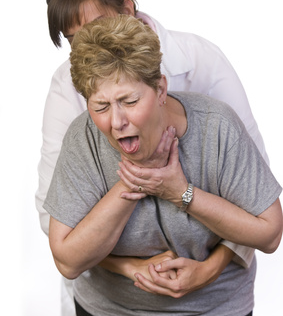
is caused when an object is blocking the throat or windpipe. Adults often choke by large pieces of food, however, children often swallow small toys or other objects.
**Remember,** the universal sign for choking is mimicking choking yourself. Make sure to ask the patient if he/she is choking because, many times, the person is merely coughing. If the patient is unconscious make sure to call 911.
**Infants 12 months or younger:** rest the patient on your forearm (face-down), while also resting your forearm, on your thigh. Perform 5 thumps with the heel of your hand upon the infant's back. If the patient is still choking turn the infant over, face up, and with 2 fingers upon the breastplate perform 5 chest compressions. Repeat the process until the object is dislodged.
**Children and Adults:** when performing the Heimlich maneuver make sure to stand behind the person. Lean the person slightly forward and wrap your arms around his/her waist. Next, press hard with a closed fist into the abdomen then grab your fist with your other hand. Perform 5 quick thrusts. If the object still hasn’t cleared the patient's throat/windpipe, repeat the cycle.
**Unconscious Person:** when performing the Heimlich maneuver on an unconscious person lay the patient on his/her back. Make sure to clear the patient’s airway, if needed, finger swipe the patient's mouth to pick out any foreign objects. If you can’t see or can’t take the object out of the patient’s mouth, make sure to perform CPR. Chest compressions will most likely clear the patient’s airway.
If you're still unable to clear the patient’s airway and/or if the patient still isn't showing signs of life, make sure to call 911 and continue performing chest compressions.
**Frostbite** is an injury that occurs when the skin is exposed to freezing temperatures, causing redness, numbness, and paleness. Symptoms include cold skin, white, red, or grayish-yellow skin, clumsiness as a result of muscle and joint stiffness, numbness, hard-looking skin, and blistering after rewarming, usually in severe cases.
**Treatment:**you can treat mild frostbite by following these steps:
1\. Get out of the cold 2. Protect your skin from further damage – If the affected area has thawed, wrap it to prevent refreezing. However, if you suspect they may freeze again, avoid thawing. 3. Gently rewarm the affected areas by soaking them in warm water (105-110 F) for about 20 minutes. 4. Drink warm liquids such as coffee or tea.
**Hypothermia** is when the body temperature is below 95 F. Hypothermia occurs when the body loses heat faster than the body can produce energy. Hypothermia often occurs when the body is immersed in cold water. If the patient is left untreated the nervous system will not be able to work properly which will result in organ damage and possibly death.
**Treatment:**Make sure to remove the patient’s wet clothing and replace it with something warm and dry. Make sure to perform rescue breaths if the patient is unconscious. If rescue breaths aren’t accessible make sure to perform chest compressions. If possible, give the patient a warm beverage and a warm, dry compress (hot water in a bag to hold or cover the patient with). **Do NOT** apply direct heat.
**Exertional Dehydration**— usually dehydration occurs with vigorous exercise in hot and humid environments. Dehydration occurs when you lose fluids more than you take in. If loss fluids aren't replaced dehydration will occur.
**Treatment:** Have patient orally re-hydrate with carbohydrate-electrolyte (CE) drinks. Ingestion of fluids: 5-8% will facilitate hydration. Other drinks: coconut water and 2% milk. Alternatively, if drinks aren't available then potable water may be used.
**Severe Dehydration Treatment:** If the patient is severely dehydrated or is in a life-threatening situation activate the EMS. EMS will be able to provide an Intravenous hydration that consists of essential nutrients.
**Heat Exhaustion** is a heat-related illness that can occur through exposure to high temperatures, especially when combined with strenuous physical activity and high humidity. However, it’s not as severe as a heatstroke or heat cramp. Symptoms include heavy sweating, faintness, muscle cramps, dizziness, nausea, headache, weakness, and rapid pulse.
**Treatment:** First, move the person out of the heat and into an air-conditioned or shady area, then lay them down. Ensure their legs and feet are elevated slightly. Second, remove any heavy or tight clothing and give the person cool water or any nonalcoholic drink.
Lastly, cool them by fanning or spraying cool water.
**Heatstroke**
is a form of heat injury caused by prolonged exposure to high temperatures or physical exertion. It usually occurs during summer. Symptoms include High body temperature – usually 104 F or higher, nausea and vomiting, headache, confusion, slurred speech, agitation, or irritability, rapid and shallow breathing, flushed skin, and racing heart rate.
**Treatment:**If you suspect heatstroke, first move the individual out of the heat and remove any heavy or excess clothing. Second, cool them by spraying cold water, placing them in a cool tub of water, or fanning.
Then, give the person a cool drink to rehydrate. Ensure it’s not alcoholic or caffeinated and avoid cold drinks to prevent stomach cramps. Lastly, perform CPR if they show no signs of breathing.
**Asthma** is a long-term disease of the lungs that causes your airways to narrow and swell, making breathing difficult and trigger coughing. Asthma also results in shortness of breath and wheezing (whistling sounds) when you breathe out. Symptoms include chest tightness and pain, trouble sleeping as a result of wheezing, coughing, or shortness of breath, wheezing when exhaling, and wheezing or coughing that gets worse during a respiratory virus such as the flu.
**Treatment:**First, help the person sit in a comfortable position and loosen any tight clothing. Then, help them take their asthma medication (inhaler). If they don’t have any medication, call 911 immediately.
**[Next](http://www.nationalcprfoundation.com/courses/standard-cpr-aed-first-aid/injuries/)**

**Example Clip Below**
Modules
**[Introduction](http://www.nationalcprfoundation.com/courses/standard-cpr-aed-first-aid/introduction/) [Good Samaritan](http://www.nationalcprfoundation.com/courses/standard-cpr-aed-first-aid/the-good-samaritan/) [CPR](http://www.nationalcprfoundation.com/courses/standard-cpr-aed-first-aid/adult/) [AED](http://www.nationalcprfoundation.com/courses/standard-cpr-aed-first-aid/aed/) [First-Aid](http://www.nationalcprfoundation.com/courses/standard-cpr-aed-first-aid/first-aid/) [Wounds](http://www.nationalcprfoundation.com/courses/standard-cpr-aed-first-aid/wounds/) [Heart](http://www.nationalcprfoundation.com/courses/standard-cpr-aed-first-aid/heart/) [Fractures](http://www.nationalcprfoundation.com/courses/standard-cpr-aed-first-aid/fractures/) [Burns](http://www.nationalcprfoundation.com/courses/standard-cpr-aed-first-aid/burns/) [Poisoning](http://www.nationalcprfoundation.com/courses/standard-cpr-aed-first-aid/poisoning/) [Hemorrhages](http://www.nationalcprfoundation.com/courses/standard-cpr-aed-first-aid/hemorrhages/) [Choking](http://www.nationalcprfoundation.com/courses/standard-cpr-aed-first-aid/choking/) [Injuries](http://www.nationalcprfoundation.com/courses/standard-cpr-aed-first-aid/injuries/) [Shock](http://www.nationalcprfoundation.com/courses/standard-cpr-aed-first-aid/shock/) [Exam](http://www.nationalcprfoundation.com/courses/standard-cpr-aed-first-aid/exam/)**
### About us
National CPR Foundation is known for providing Life-Skill Techniques for longer more lasting lives. Harness the Power of Our Online Training and Earn Your Certification Today – The Smarter Way™.
- [](http://www.dmca.com/Protection/Status.aspx?ID=25a105e6-a686-4556-92de-8e8941e0ac56 "DMCA.com Protection Status")
### About
- [About Us](https://nationalcprfoundation.com/online-cpr-certification-2/)
- [Courses](https://nationalcprfoundation.com/courses/)
- [Group Discount](https://nationalcprfoundation.com/groups/)
- [Recertification](https://nationalcprfoundation.com/cpr-recertification-renewal/)
- [Reviews](https://nationalcprfoundation.com/reviews/)
- [FAQ's](https://nationalcprfoundation.com/support/)
- [Refer a Friend](https://nationalcprfoundation.com/courses/standard-cpr-aed-first-aid/choking/#modal-refer)
- [Contact Us](https://nationalcprfoundation.com/support/)
### Resources
- [CPR Study Guide](https://nationalcprfoundation.com/free-cpr-study-guide/)
- [How We Donate](https://nationalcprfoundation.com/donation-service/)
- [Blog](https://nationalcprfoundation.com/blog/)
- [Health Links](https://nationalcprfoundation.com/helpful-health-links/)
- [Group Login](https://nationalcprfoundation.com/my-account/)
- [e-Verify & Download](https://nationalcprfoundation.com/verify/)
### Legal
- [Refund Policy](https://nationalcprfoundation.com/refund-policy/)
- [Privacy Policy](https://nationalcprfoundation.com/privacy-policy/)
- [Disclaimer](https://nationalcprfoundation.com/disclaimer)
- [Terms & Conditions](https://nationalcprfoundation.com/terms-conditions/)
©2026 National CPR Foundation™, LLC. All Rights Reserved. Web 2
Save up to **40%** when you certify today\!
*The Smarter Way\!*
[Select Your Course to Get Started](https://nationalcprfoundation.com/#courses)
[](https://nationalcprfoundation.com/courses/standard-cpr-aed-first-aid/choking/)
[](https://nationalcprfoundation.com/courses/standard-cpr-aed-first-aid/choking/)
[](https://nationalcprfoundation.com/courses/standard-cpr-aed-first-aid/choking/)
Share with your friends and help them SAVE 10% when they pass\!
Thank You! Your referral email has been sent.
[Click here to close this window](https://nationalcprfoundation.com/courses/standard-cpr-aed-first-aid/choking/)
[Close Window](https://nationalcprfoundation.com/courses/standard-cpr-aed-first-aid/choking/)
#### We value your privacy
We use cookies to enhance your browsing experience, serve personalized ads or content, and analyze our traffic. By Clicking "Accept All", you consent to our use of cookies.
Reject All
Accept All |
| Readable Markdown | **Choking** is caused when an object is blocking the throat or windpipe. Adults often choke by large pieces of food, however, children often swallow small toys or other objects.
**Remember,** the universal sign for choking is mimicking choking yourself. Make sure to ask the patient if he/she is choking because, many times, the person is merely coughing. If the patient is unconscious make sure to call 911.
**Infants 12 months or younger:** rest the patient on your forearm (face-down), while also resting your forearm, on your thigh. Perform 5 thumps with the heel of your hand upon the infant's back. If the patient is still choking turn the infant over, face up, and with 2 fingers upon the breastplate perform 5 chest compressions. Repeat the process until the object is dislodged.
**Children and Adults:** when performing the Heimlich maneuver make sure to stand behind the person. Lean the person slightly forward and wrap your arms around his/her waist. Next, press hard with a closed fist into the abdomen then grab your fist with your other hand. Perform 5 quick thrusts. If the object still hasn’t cleared the patient's throat/windpipe, repeat the cycle.
**Unconscious Person:** when performing the Heimlich maneuver on an unconscious person lay the patient on his/her back. Make sure to clear the patient’s airway, if needed, finger swipe the patient's mouth to pick out any foreign objects. If you can’t see or can’t take the object out of the patient’s mouth, make sure to perform CPR. Chest compressions will most likely clear the patient’s airway.
If you're still unable to clear the patient’s airway and/or if the patient still isn't showing signs of life, make sure to call 911 and continue performing chest compressions.
**Frostbite** is an injury that occurs when the skin is exposed to freezing temperatures, causing redness, numbness, and paleness. Symptoms include cold skin, white, red, or grayish-yellow skin, clumsiness as a result of muscle and joint stiffness, numbness, hard-looking skin, and blistering after rewarming, usually in severe cases.
**Treatment:** you can treat mild frostbite by following these steps:
1\. Get out of the cold 2. Protect your skin from further damage – If the affected area has thawed, wrap it to prevent refreezing. However, if you suspect they may freeze again, avoid thawing. 3. Gently rewarm the affected areas by soaking them in warm water (105-110 F) for about 20 minutes. 4. Drink warm liquids such as coffee or tea.
**Hypothermia** is when the body temperature is below 95 F. Hypothermia occurs when the body loses heat faster than the body can produce energy. Hypothermia often occurs when the body is immersed in cold water. If the patient is left untreated the nervous system will not be able to work properly which will result in organ damage and possibly death.
**Treatment:** Make sure to remove the patient’s wet clothing and replace it with something warm and dry. Make sure to perform rescue breaths if the patient is unconscious. If rescue breaths aren’t accessible make sure to perform chest compressions. If possible, give the patient a warm beverage and a warm, dry compress (hot water in a bag to hold or cover the patient with). **Do NOT** apply direct heat.
**Exertional Dehydration** — usually dehydration occurs with vigorous exercise in hot and humid environments. Dehydration occurs when you lose fluids more than you take in. If loss fluids aren't replaced dehydration will occur.
**Treatment:** Have patient orally re-hydrate with carbohydrate-electrolyte (CE) drinks. Ingestion of fluids: 5-8% will facilitate hydration. Other drinks: coconut water and 2% milk. Alternatively, if drinks aren't available then potable water may be used.
**Severe Dehydration Treatment:** If the patient is severely dehydrated or is in a life-threatening situation activate the EMS. EMS will be able to provide an Intravenous hydration that consists of essential nutrients.
**Heat Exhaustion** is a heat-related illness that can occur through exposure to high temperatures, especially when combined with strenuous physical activity and high humidity. However, it’s not as severe as a heatstroke or heat cramp. Symptoms include heavy sweating, faintness, muscle cramps, dizziness, nausea, headache, weakness, and rapid pulse.
**Treatment:** First, move the person out of the heat and into an air-conditioned or shady area, then lay them down. Ensure their legs and feet are elevated slightly. Second, remove any heavy or tight clothing and give the person cool water or any nonalcoholic drink.
Lastly, cool them by fanning or spraying cool water.
**Heatstroke** is a form of heat injury caused by prolonged exposure to high temperatures or physical exertion. It usually occurs during summer. Symptoms include High body temperature – usually 104 F or higher, nausea and vomiting, headache, confusion, slurred speech, agitation, or irritability, rapid and shallow breathing, flushed skin, and racing heart rate.
**Treatment:** If you suspect heatstroke, first move the individual out of the heat and remove any heavy or excess clothing. Second, cool them by spraying cold water, placing them in a cool tub of water, or fanning.
Then, give the person a cool drink to rehydrate. Ensure it’s not alcoholic or caffeinated and avoid cold drinks to prevent stomach cramps. Lastly, perform CPR if they show no signs of breathing.
**Asthma** is a long-term disease of the lungs that causes your airways to narrow and swell, making breathing difficult and trigger coughing. Asthma also results in shortness of breath and wheezing (whistling sounds) when you breathe out. Symptoms include chest tightness and pain, trouble sleeping as a result of wheezing, coughing, or shortness of breath, wheezing when exhaling, and wheezing or coughing that gets worse during a respiratory virus such as the flu.
**Treatment:** First, help the person sit in a comfortable position and loosen any tight clothing. Then, help them take their asthma medication (inhaler). If they don’t have any medication, call 911 immediately. |
| ML Classification | |
| ML Categories | null |
| ML Page Types | null |
| ML Intent Types | null |
| Content Metadata | |
| Language | en-us |
| Author | null |
| Publish Time | not set |
| Original Publish Time | 2024-03-29 08:48:40 (2 years ago) |
| Republished | No |
| Word Count (Total) | 1,368 |
| Word Count (Content) | 965 |
| Links | |
| External Links | 8 |
| Internal Links | 79 |
| Technical SEO | |
| Meta Nofollow | No |
| Meta Noarchive | No |
| JS Rendered | No |
| Redirect Target | null |
| Performance | |
| Download Time (ms) | 1,314 |
| TTFB (ms) | 1,308 |
| Download Size (bytes) | 38,233 |
| Shard | 174 (laksa) |
| Root Hash | 5560255273431623574 |
| Unparsed URL | com,nationalcprfoundation!/courses/standard-cpr-aed-first-aid/choking/ s443 |