ℹ️ Skipped - page is already crawled
| Filter | Status | Condition | Details |
|---|---|---|---|
| HTTP status | PASS | download_http_code = 200 | HTTP 200 |
| Age cutoff | PASS | download_stamp > now() - 6 MONTH | 0.1 months ago |
| History drop | PASS | isNull(history_drop_reason) | No drop reason |
| Spam/ban | PASS | fh_dont_index != 1 AND ml_spam_score = 0 | ml_spam_score=0 |
| Canonical | PASS | meta_canonical IS NULL OR = '' OR = src_unparsed | Not set |
| Property | Value | |||||||||
|---|---|---|---|---|---|---|---|---|---|---|
| URL | https://my.clevelandclinic.org/health/treatments/24795-ssri | |||||||||
| Last Crawled | 2026-04-20 01:01:11 (2 days ago) | |||||||||
| First Indexed | 2023-03-08 19:20:04 (3 years ago) | |||||||||
| HTTP Status Code | 200 | |||||||||
| Content | ||||||||||
| Meta Title | Selective Serotonin Reuptake Inhibitors: Uses & Side Effects | |||||||||
| Meta Description | SSRIs (selective serotonin reuptake inhibitors) are a class of antidepressants. They help treat depression and anxiety, among other conditions. | |||||||||
| Meta Canonical | null | |||||||||
| Boilerpipe Text | What are the potential benefits of SSRIs?
These medications help manage symptoms of depression and anxiety, as well as many other conditions. These medications often work well when paired with
talk therapy
, like
cognitive behavioral therapy
(CBT). SSRIs are generally well tolerated, with mild or minimal side effects.
SSRI side effects
Common side effects may include:
Each medication has different side effects. Ask your provider or
pharmacist
for more information.
Risks and complications of SSRIs
While these medications are generally safe, they may cause rare but serious complications in some cases, such as:
Antidepressant discontinuation syndrome
: Stopping your medication suddenly may lead to symptoms like dizziness, flu-like aches or anxiety. Always talk to your provider before making changes to your dose.
QT prolongation
: A problem with your
heart’s
electrical system causes it to take too long to reset between beats. When untreated, a prolonged QT interval could be life-threatening.
Serotonin syndrome
: This is when too much serotonin builds up in your body. Warning signs include confusion, a fast heart rate, fever and/or stiff muscles. Contact your doctor or go to the nearest emergency room if you have these symptoms.
Suicidal thoughts
: People under 25 may be at higher risk of developing or having worsening suicidal thoughts.
If you’re thinking about
suicide
, you can reach out for help. Contact your provider. You can also call or text 988 (U.S.) to reach the Suicide and Crisis Lifeline. Someone is available to talk to you 24/7.
What interacts with SSRIs?
Some medications may interact with SSRIs, including:
Blood clot-preventing medication (low-dose
aspirin
,
clopidogrel
)
Herbal supplements (
St. John’s wort
)
Certain migraine medicines (
triptans
)
NSAIDs
(
ibuprofen
,
diclofenac
,
naproxen
)
Over-the-counter cough suppressants (like
dextromethorphan
)
Other antidepressants
This isn’t a complete list. Talk to your healthcare provider about all the medications and supplements you currently take. They’ll let you know if an SSRI is the safest option to manage your symptoms.
Can I drink alcohol while on an SSRI?
It’s best to avoid alcohol while taking antidepressants, including SSRIs. Alcohol is a depressant and might interfere with how well the medication works. It can sometimes make depression symptoms worse. If you have concerns about drinking, talk to your provider.
Can I take SSRIs if I’m pregnant or thinking of becoming pregnant?
SSRIs have been shown to cause some negative effects in a developing fetus. However, stopping these medications during pregnancy also carries risks. Your depression symptoms may worsen without treatment. If you’re pregnant or planning to become pregnant, talk to your provider. They can explain the risks and benefits in detail and help you decide what’s best.
Stopping treatment with SSRIs
If you need or want to stop taking an SSRI, your provider will help you gradually reduce your dose. Quitting abruptly can lead to a group of symptoms known as antidepressant discontinuation syndrome. These symptoms typically happen if you’ve been on the medication for six weeks or longer.
How long does it take for an SSRI to work?
Selective serotonin reuptake inhibitors take time to work, usually between four and six weeks after reaching a therapeutic dose. But they can take even longer (between nine and 12 weeks) in certain individuals. If you’re not feeling better by then, check in with your provider, who may recommend an adjustment to your treatment plan. | |||||||||
| Markdown | 
Locations:
[Abu Dhabi](https://www.clevelandclinicabudhabi.ae/en)\|[Canada](https://my.clevelandclinic.org/canada)\|[Florida](https://my.clevelandclinic.org/florida)\|[London](https://clevelandcliniclondon.uk/)\|[Nevada](https://my.clevelandclinic.org/locations/nevada)\|[Ohio](https://my.clevelandclinic.org/)\|

[855\.733.3712](tel:8557333712)\|[MyChart](https://my.clevelandclinic.org/online-services/mychart)\|[Need Help?](https://my.clevelandclinic.org/help)\|[Careers](https://jobs.clevelandclinic.org/)\|[Donate Now](https://give.ccf.org/give/187824#!/donation/checkout)\|

[](https://my.clevelandclinic.org/)
[Find a Provider](https://my.clevelandclinic.org/providers)[Locations and Directions](https://my.clevelandclinic.org/locations)[Services](https://my.clevelandclinic.org/services)[Patients and Visitors](https://my.clevelandclinic.org/patients)[Health Library](https://my.clevelandclinic.org/health)
- [Find a Provider](https://my.clevelandclinic.org/providers)
- [Locations and Directions](https://my.clevelandclinic.org/locations)
- [Services](https://my.clevelandclinic.org/services)
- [Patients and Visitors](https://my.clevelandclinic.org/patients)
- [Health Library](https://my.clevelandclinic.org/health)
[](https://my.clevelandclinic.org/search)
Menu
[](https://my.clevelandclinic.org/search)[Appointments](https://my.clevelandclinic.org/patients/information/access)
[Home](https://my.clevelandclinic.org/)/
[Health Library](https://my.clevelandclinic.org/health)/
[Medical Treatments](https://my.clevelandclinic.org/health/treatments)/
SSRIs (Selective Serotonin Reuptake Inhibitors)
Advertisement
Advertisement
# SSRIs (Selective Serotonin Reuptake Inhibitors)
Medically Reviewed.
Last updated on 09/26/2025.
SSRIs (selective serotonin reuptake inhibitors) are FDA-approved antidepressant medications. They help treat several conditions like depression, anxiety and bulimia. They work by keeping a chemical messenger active in your brain. SSRIs are the most commonly prescribed type of antidepressant.
Advertisement
Cleveland Clinic is a non-profit academic medical center. Advertising on our site helps support our mission. We do not endorse non-Cleveland Clinic products or services. [Policy](https://health.clevelandclinic.org/advertising)
Care at Cleveland Clinic
[Anxiety Disorders Treatment](https://my.clevelandclinic.org/services/anxiety-disorders-treatment)
[Find a Doctor and Specialists](https://my.clevelandclinic.org/services/anxiety-disorders-treatment#featured-provider-panel)
[Make an Appointment](https://my.clevelandclinic.org/webappointment/what-to-expect)
Contents
[What Are SSRIs?](https://my.clevelandclinic.org/health/treatments/24795-ssri#what-are-ssris)[Risks / Benefits](https://my.clevelandclinic.org/health/treatments/24795-ssri#risks-benefits)
Contents
[What Are SSRIs?](https://my.clevelandclinic.org/health/treatments/24795-ssri#what-are-ssris)[Risks / Benefits](https://my.clevelandclinic.org/health/treatments/24795-ssri#risks-benefits)
## What Are SSRIs?
SSRIs (selective serotonin reuptake inhibitors) are a common type of antidepressant. They work by changing the activity of serotonin, a chemical that affects your mood, as well as many other bodily and mental functions.
Advertisement
Cleveland Clinic is a non-profit academic medical center. Advertising on our site helps support our mission. We do not endorse non-Cleveland Clinic products or services. [Policy](https://health.clevelandclinic.org/advertising)
These medications are often used to treat [mental health conditions](https://my.clevelandclinic.org/health/diseases/22295-mental-health-disorders), like depression, anxiety, PTSD and OCD. They can also help manage other conditions and symptoms.
There are several types of antidepressants, but SSRIs are usually the first choice by healthcare providers. That’s because they tend to cause fewer and milder side effects compared to other options.
### Types of SSRI drugs
Selective serotonin reuptake inhibitors that providers currently prescribe in the United States include:
- [Citalopram](https://my.clevelandclinic.org/health/drugs/18726-citalopram-tablets) (Celexa®)
- [Escitalopram](https://my.clevelandclinic.org/health/drugs/18917-escitalopram-tablets) (Lexapro®)
- [Fluoxetine](https://my.clevelandclinic.org/health/drugs/20119-fluoxetine-capsules-or-tablets-depressionmood-disorders) (Prozac®, Sarafem™)
- [Fluvoxamine](https://my.clevelandclinic.org/health/drugs/19625-fluvoxamine-tablets) (Luvox®)
- [Paroxetine](https://my.clevelandclinic.org/health/drugs/19762-paroxetine-tablets) (Brisdelle™, Paxil™, Pexeva®)
- [Sertraline](https://my.clevelandclinic.org/health/drugs/20089-sertraline-tablets) (Zoloft®)
- [Vilazodone](https://my.clevelandclinic.org/health/drugs/20831-vilazodone-tablets) (Viibryd®)
- [Vortioxetine](https://my.clevelandclinic.org/health/drugs/19369-vortioxetine-tablets) (Trintillex®)
### What are SSRIs approved for?
The U.S. Food and Drug Administration (FDA) has approved SSRIs to treat the following conditions:
- [Major depressive disorder (MDD)](https://my.clevelandclinic.org/health/diseases/24481-clinical-depression-major-depressive-disorder)
- [Generalized anxiety disorder (GAD)](https://my.clevelandclinic.org/health/diseases/23940-generalized-anxiety-disorder-gad)
- [Bulimia nervosa](https://my.clevelandclinic.org/health/diseases/9795-bulimia-nervosa)
- [Menopause](https://my.clevelandclinic.org/health/diseases/21841-menopause)
- [Obsessive-compulsive disorder (OCD)](https://my.clevelandclinic.org/health/diseases/9490-obsessive-compulsive-disorder)
- [Panic disorder](https://my.clevelandclinic.org/health/diseases/4451-panic-disorder)
- [Premenstrual dysphoric disorder (PMDD)](https://my.clevelandclinic.org/health/articles/9132-premenstrual-dysphoric-disorder-pmdd)
- [Post-traumatic stress disorder (PTSD)](https://my.clevelandclinic.org/health/diseases/9545-post-traumatic-stress-disorder-ptsd)
- [Social anxiety disorder](https://my.clevelandclinic.org/health/diseases/22709-social-anxiety) (social phobia)
Healthcare providers sometimes use SSRIs to help with other conditions, too. This is an off-label use. Examples may include:
- [Binge eating disorder](https://my.clevelandclinic.org/health/diseases/17652-binge-eating-disorder)
- [Body dysmorphic disorder](https://my.clevelandclinic.org/health/diseases/9888-body-dysmorphic-disorder)
- Chronic [pelvic pain](https://my.clevelandclinic.org/health/symptoms/12106-pelvic-pain) syndrome
- [Fibromyalgia](https://my.clevelandclinic.org/health/diseases/4832-fibromyalgia)
- [Premature ejaculation](https://my.clevelandclinic.org/health/diseases/15627-premature-ejaculation)
Advertisement
### How do SSRI antidepressants work?
Serotonin is a type of [neurotransmitter](https://my.clevelandclinic.org/health/articles/22513-neurotransmitters), or chemical messenger. Neurotransmitters are molecules that dictate how different regions of your brain communicate with each other. Normally, after serotonin delivers its message, your brain cells reabsorb it. This is a process called reuptake. SSRIs block this reabsorption, allowing serotonin to remain active in your brain for a longer period of time. Serotonin plays a role in the regulation of:
- Appetite
- [Memory](https://my.clevelandclinic.org/health/articles/memory)
- Mood
- Libido
- Sleep
- Social behavior
## Risks / Benefits
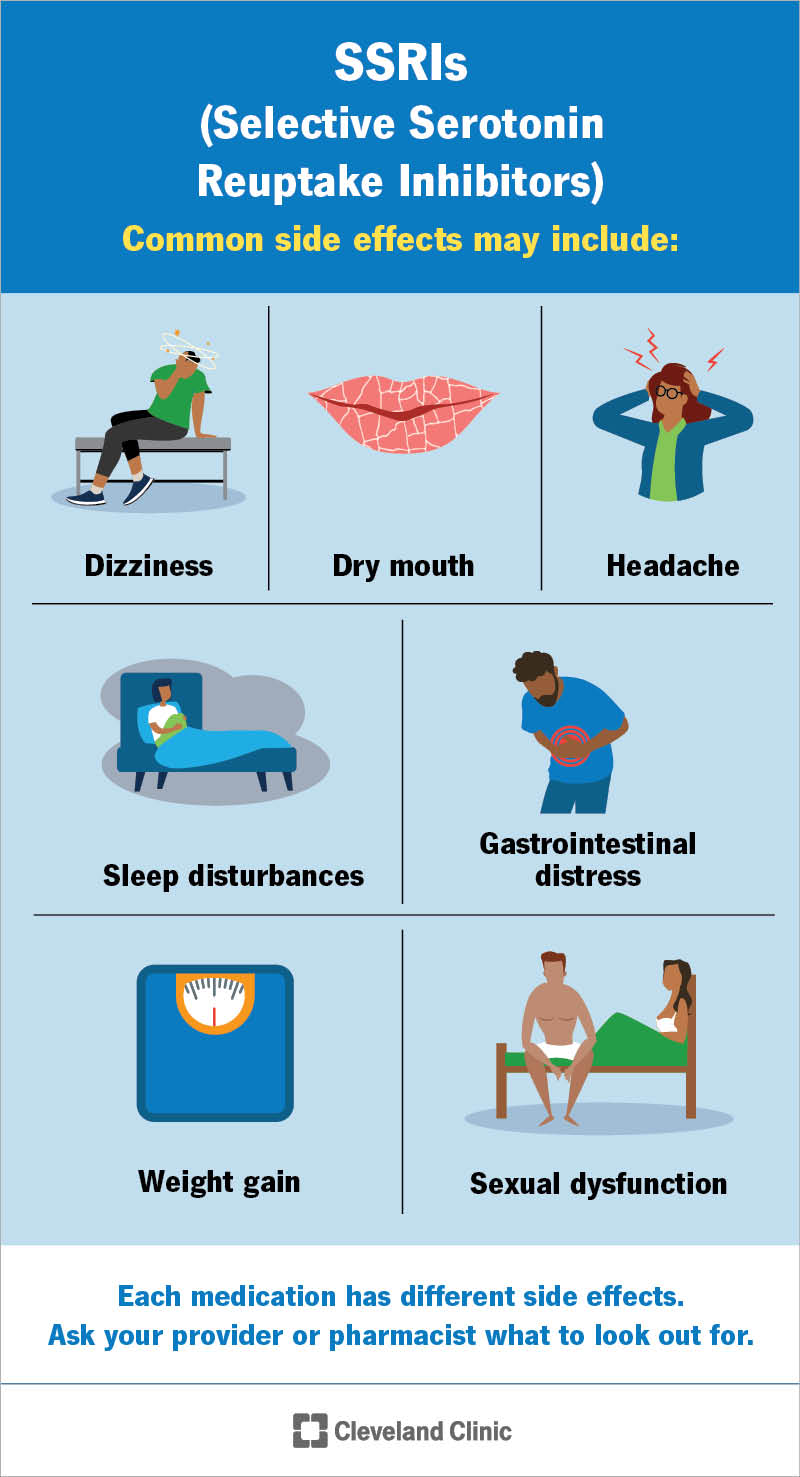
**Image content:** This image is available to view online.
View image online (https://my.clevelandclinic.org/-/scassets/images/org/health/articles/selective-serotonin-reuptake-inhibitors)
Your provider or pharmacist can give you more information about what SSRI side effects to look our for.
### What are the potential benefits of SSRIs?
These medications help manage symptoms of depression and anxiety, as well as many other conditions. These medications often work well when paired with [talk therapy](https://my.clevelandclinic.org/health/treatments/23445-psychotherapy), like [cognitive behavioral therapy](https://my.clevelandclinic.org/health/treatments/21208-cognitive-behavioral-therapy-cbt) (CBT). SSRIs are generally well tolerated, with mild or minimal side effects.
### SSRI side effects
Common side effects may include:
- [Dizziness](https://my.clevelandclinic.org/health/symptoms/6422-dizziness)
- [Dry mouth](https://my.clevelandclinic.org/health/symptoms/10902-dry-mouth-xerostomia)
- Headache
- Gastrointestinal distress
- [Sexual dysfunction](https://my.clevelandclinic.org/health/diseases/9121-sexual-dysfunction)
- [Sleep disturbances](https://my.clevelandclinic.org/health/diseases/11429-sleep-disorders)
- Weight gain
Each medication has different side effects. Ask your provider or [pharmacist](https://my.clevelandclinic.org/health/articles/24786-pharmacist) for more information.
#### Risks and complications of SSRIs
While these medications are generally safe, they may cause rare but serious complications in some cases, such as:
- [**Antidepressant discontinuation syndrome**](https://my.clevelandclinic.org/health/diseases/25218-antidepressant-discontinuation-syndrome): Stopping your medication suddenly may lead to symptoms like dizziness, flu-like aches or anxiety. Always talk to your provider before making changes to your dose.
- **QT prolongation**: A problem with your [heart’s](https://my.clevelandclinic.org/health/body/21704-heart) electrical system causes it to take too long to reset between beats. When untreated, a prolonged QT interval could be life-threatening.
- [**Serotonin syndrome**](https://my.clevelandclinic.org/health/diseases/17687-serotonin-syndrome): This is when too much serotonin builds up in your body. Warning signs include confusion, a fast heart rate, fever and/or stiff muscles. Contact your doctor or go to the nearest emergency room if you have these symptoms.
- [**Suicidal thoughts**](https://my.clevelandclinic.org/health/symptoms/suicidal-ideation): People under 25 may be at higher risk of developing or having worsening suicidal thoughts.
If you’re thinking about [suicide](https://my.clevelandclinic.org/health/articles/suicide), you can reach out for help. Contact your provider. You can also call or text 988 (U.S.) to reach the Suicide and Crisis Lifeline. Someone is available to talk to you 24/7.
#### What interacts with SSRIs?
Some medications may interact with SSRIs, including:
- Blood clot-preventing medication (low-dose [aspirin](https://my.clevelandclinic.org/health/drugs/20592-aspirin-tablets), [clopidogrel](https://my.clevelandclinic.org/health/drugs/20743-clopidogrel-tablets))
- Herbal supplements ([St. John’s wort](https://my.clevelandclinic.org/health/drugs/9304-st--johns-wort))
- Certain migraine medicines ([triptans](https://my.clevelandclinic.org/health/treatments/24998-triptans))
- [NSAIDs](https://my.clevelandclinic.org/health/treatments/11086-non-steroidal-anti-inflammatory-medicines-nsaids) ([ibuprofen](https://my.clevelandclinic.org/health/drugs/20168-ibuprofen-capsules-or-tablets), [diclofenac](https://my.clevelandclinic.org/health/drugs/18737-diclofenac-extended-release-tablets), [naproxen](https://my.clevelandclinic.org/health/drugs/19747-naproxen-immediate-release-tablets))
- Over-the-counter cough suppressants (like [dextromethorphan](https://my.clevelandclinic.org/health/drugs/20631-dextromethorphan-solution))
- Other antidepressants
This isn’t a complete list. Talk to your healthcare provider about all the medications and supplements you currently take. They’ll let you know if an SSRI is the safest option to manage your symptoms.
#### Can I drink alcohol while on an SSRI?
It’s best to avoid alcohol while taking antidepressants, including SSRIs. Alcohol is a depressant and might interfere with how well the medication works. It can sometimes make depression symptoms worse. If you have concerns about drinking, talk to your provider.
#### Can I take SSRIs if I’m pregnant or thinking of becoming pregnant?
SSRIs have been shown to cause some negative effects in a developing fetus. However, stopping these medications during pregnancy also carries risks. Your depression symptoms may worsen without treatment. If you’re pregnant or planning to become pregnant, talk to your provider. They can explain the risks and benefits in detail and help you decide what’s best.
Advertisement
#### Stopping treatment with SSRIs
If you need or want to stop taking an SSRI, your provider will help you gradually reduce your dose. Quitting abruptly can lead to a group of symptoms known as antidepressant discontinuation syndrome. These symptoms typically happen if you’ve been on the medication for six weeks or longer.
### How long does it take for an SSRI to work?
Selective serotonin reuptake inhibitors take time to work, usually between four and six weeks after reaching a therapeutic dose. But they can take even longer (between nine and 12 weeks) in certain individuals. If you’re not feeling better by then, check in with your provider, who may recommend an adjustment to your treatment plan.
### A note from Cleveland Clinic
Taking an antidepressant like an SSRI (selective serotonin reuptake inhibitor) isn’t a sign of personal weakness. These medications are widely used and can make a big difference, both mentally and physically. They can manage conditions beyond depression and anxiety to help you get back to feeling like yourself.
It’s normal to have questions when your provider recommends starting an SSRI. Don’t hesitate to speak up. Your provider can guide you through the process and make sure your treatment plan works well for you.
Advertisement
[](https://my.clevelandclinic.org/)[](https://my.clevelandclinic.org/)
[](https://health.clevelandclinic.org/)

## Better health starts here
Sign up for our Health Essentials emails for expert guidance on nutrition, fitness, sleep, skin care and more.
[Example email](https://assets.clevelandclinic.org/transform/2ff943a2-abb1-4a1c-8ede-f8848703e789/HealthEssentials-SampleEmail-2026)[Sign up](https://my.clevelandclinic.org/health-essentials-sign-up)
[Sign up](https://my.clevelandclinic.org/health-essentials-sign-up)[Example email](https://assets.clevelandclinic.org/transform/2ff943a2-abb1-4a1c-8ede-f8848703e789/HealthEssentials-SampleEmail-2026)
### Experts You Can Trust
Medically Reviewed.
Last updated on 09/26/2025.
Learn more about the [Health Library](https://my.clevelandclinic.org/health/about) and our [editorial process](https://my.clevelandclinic.org/about/website/editorial-policy).
### References
Cleveland Clinic’s health articles are based on evidence-backed information and review by medical professionals to ensure accuracy, reliability and up-to-date clinical standards.
#### View Sources
### Experts You Can Trust
Medically Reviewed.
Last updated on 09/26/2025.
### References
Cleveland Clinic’s health articles are based on evidence-backed information and review by medical professionals to ensure accuracy, reliability and up-to-date clinical standards.
- Chu A, Wadhwa R. Selective Serotonin Reuptake Inhibitors *(https://www.ncbi.nlm.nih.gov/books/NBK554406/)*. 2023 May 1. In: *StatPearls* \[Internet\]. Treasure Island (FL): StatPearls Publishing; 2025 Jan-. Accessed 9/26/2025.
- National Health Service (U.K.). Cautions - Selective serotonin reuptake inhibitors (SSRIs) *(https://www.nhs.uk/mental-health/talking-therapies-medicine-treatments/medicines-and-psychiatry/ssri-antidepressants/considerations/)*. Last reviewed 12/8/2021. Accessed 9/26/2025.
- National Health Service (U.K.). Overview – Selective Serotonin Reuptake Inhibitors (SSRIs) *(https://www.nhs.uk/mental-health/talking-therapies-medicine-treatments/medicines-and-psychiatry/ssri-antidepressants/overview/)*. Last reviewed 12/8/2021. Accessed 9/26/2025.
- Skånland SS, Cieślar-Pobuda A. Off-Label Uses of Drugs for Depression *(https://pubmed.ncbi.nlm.nih.gov/31622593/)*. *Eur J Pharmacol.* 2019 Dec:865;172732. Accessed 9/26/2025.
### Care at Cleveland Clinic
Anxiety disorders can affect your life in many ways. Cleveland Clinic mental health experts can help you manage anxiety so you’re back in control.

[Anxiety Disorders Treatment](https://my.clevelandclinic.org/services/anxiety-disorders-treatment)
[Find a Doctor and Specialists](https://my.clevelandclinic.org/services/anxiety-disorders-treatment#featured-provider-panel)
[Make an Appointment](https://my.clevelandclinic.org/webappointment/what-to-expect)
Advertisement
Advertisement
Ad
Appointments [866\.588.2264](tel:8665882264)
[Appointments & Locations](https://my.clevelandclinic.org/departments/neurological/appointments)
[Request an Appointment](https://my.clevelandclinic.org/webappointment/what-to-expect)
[Find a ProviderNeed a primary care doctor or a specialist? Our Find a Provider tool makes it easy to search Cleveland Clinic’s trusted network.](https://my.clevelandclinic.org/providers)
[LocationsFind any of our 300+ locations.](https://my.clevelandclinic.org/locations)
[AppointmentsGet the in-person or virtual care you need.](https://my.clevelandclinic.org/patients/information/access)
### Subscribe to Cleveland Clinic Health Essentials
[Sign Up Today](https://my.clevelandclinic.org/health-essentials-newsletter?utm_medium=email&utm_source=jotform&utm_campaign=he&utm_content=signuppage)
### Actions
[Appointments & Access](https://my.clevelandclinic.org/patients/information/access)[Accepted Insurance](https://my.clevelandclinic.org/patients/accepted-insurance)[Events Calendar](https://events.clevelandclinic.org/)[Financial Assistance](https://my.clevelandclinic.org/patients/billing-finance/financial-assistance)[Give to Cleveland Clinic](https://my.clevelandclinic.org/giving)[Pay Your Bill Online](https://my.clevelandclinic.org/patients/billing-finance/payment-options)[Price Transparency](https://my.clevelandclinic.org/patients/billing-finance/comprehensive-hospital-charges)[Refer a Patient](https://my.clevelandclinic.org/professionals/referring)[Phone Directory](https://my.clevelandclinic.org/about/contact/phone-directory)[Virtual Second Opinions](https://my.clevelandclinic.org/online-services/virtual-second-opinions)[Virtual Visits](https://my.clevelandclinic.org/online-services/virtual-visits)
### About Cleveland Clinic
[100 Years of Cleveland Clinic](https://my.clevelandclinic.org/about/history)[About Us](https://my.clevelandclinic.org/about)[Locations](https://my.clevelandclinic.org/locations)[Quality & Patient Safety](https://my.clevelandclinic.org/departments/patient-experience/depts/quality-patient-safety)[Patient Experience](https://my.clevelandclinic.org/departments/patient-experience/depts/office-patient-experience)[Research & Innovations](https://my.clevelandclinic.org/research)[Community Commitment](https://my.clevelandclinic.org/about/community)[Careers](https://jobs.clevelandclinic.org/)[For Employees](https://my.clevelandclinic.org/about/for-employees)[Resources for Medical Professionals](https://my.clevelandclinic.org/professionals)
### Subscribe to Cleveland Clinic Health Essentials
[Sign Up Today](https://my.clevelandclinic.org/health-essentials-newsletter?utm_medium=email&utm_source=jotform&utm_campaign=he&utm_content=signuppage)
Follow Cleveland Clinic
[](https://www.facebook.com/ClevelandClinic)
[](https://twitter.com/clevelandclinic)
[](https://www.youtube.com/user/clevelandclinic)
[](https://www.instagram.com/clevelandclinic/)
[](https://www.linkedin.com/company/cleveland-clinic)
Blog, News & Apps
[Consult QD](https://consultqd.clevelandclinic.org/)
[Health Essentials](https://health.clevelandclinic.org/)
[Newsroom](https://newsroom.clevelandclinic.org/)
[MyClevelandClinic](https://my.clevelandclinic.org/mobile-apps/myclevelandclinic)
[MyChart](https://my.clevelandclinic.org/online-services/mychart)
Site Information & Policies
[Send Us Feedback](https://my.clevelandclinic.org/webcontact/webmail)
[About this Website](https://my.clevelandclinic.org/about/website)
[Advertising Policy](https://health.clevelandclinic.org/advertising)
[Social Media Policy](https://my.clevelandclinic.org/about/website/social-media)
[Copyright, Reprint & Licensing](https://my.clevelandclinic.org/about/website/reprints-licensing)
[Website Terms of Use](https://my.clevelandclinic.org/about/website/terms-of-use)
[Privacy Policy](https://my.clevelandclinic.org/about/website/privacy-security)
[Notice of Privacy Practices](https://my.clevelandclinic.org/about/website/privacy-practices)
[Non-Discrimination and Availability](https://my.clevelandclinic.org/about/website/non-discrimination-notice)
[Call: 800\.223.2273](tel:8002232273) \| 9500 Euclid Avenue, Cleveland, Ohio 44195 \| © 2026 Cleveland Clinic. All Rights Reserved. | |||||||||
| Readable Markdown | ### What are the potential benefits of SSRIs?
These medications help manage symptoms of depression and anxiety, as well as many other conditions. These medications often work well when paired with [talk therapy](https://my.clevelandclinic.org/health/treatments/23445-psychotherapy), like [cognitive behavioral therapy](https://my.clevelandclinic.org/health/treatments/21208-cognitive-behavioral-therapy-cbt) (CBT). SSRIs are generally well tolerated, with mild or minimal side effects.
### SSRI side effects
Common side effects may include:
Each medication has different side effects. Ask your provider or [pharmacist](https://my.clevelandclinic.org/health/articles/24786-pharmacist) for more information.
#### Risks and complications of SSRIs
While these medications are generally safe, they may cause rare but serious complications in some cases, such as:
- [**Antidepressant discontinuation syndrome**](https://my.clevelandclinic.org/health/diseases/25218-antidepressant-discontinuation-syndrome): Stopping your medication suddenly may lead to symptoms like dizziness, flu-like aches or anxiety. Always talk to your provider before making changes to your dose.
- **QT prolongation**: A problem with your [heart’s](https://my.clevelandclinic.org/health/body/21704-heart) electrical system causes it to take too long to reset between beats. When untreated, a prolonged QT interval could be life-threatening.
- [**Serotonin syndrome**](https://my.clevelandclinic.org/health/diseases/17687-serotonin-syndrome): This is when too much serotonin builds up in your body. Warning signs include confusion, a fast heart rate, fever and/or stiff muscles. Contact your doctor or go to the nearest emergency room if you have these symptoms.
- [**Suicidal thoughts**](https://my.clevelandclinic.org/health/symptoms/suicidal-ideation): People under 25 may be at higher risk of developing or having worsening suicidal thoughts.
If you’re thinking about [suicide](https://my.clevelandclinic.org/health/articles/suicide), you can reach out for help. Contact your provider. You can also call or text 988 (U.S.) to reach the Suicide and Crisis Lifeline. Someone is available to talk to you 24/7.
#### What interacts with SSRIs?
Some medications may interact with SSRIs, including:
- Blood clot-preventing medication (low-dose [aspirin](https://my.clevelandclinic.org/health/drugs/20592-aspirin-tablets), [clopidogrel](https://my.clevelandclinic.org/health/drugs/20743-clopidogrel-tablets))
- Herbal supplements ([St. John’s wort](https://my.clevelandclinic.org/health/drugs/9304-st--johns-wort))
- Certain migraine medicines ([triptans](https://my.clevelandclinic.org/health/treatments/24998-triptans))
- [NSAIDs](https://my.clevelandclinic.org/health/treatments/11086-non-steroidal-anti-inflammatory-medicines-nsaids) ([ibuprofen](https://my.clevelandclinic.org/health/drugs/20168-ibuprofen-capsules-or-tablets), [diclofenac](https://my.clevelandclinic.org/health/drugs/18737-diclofenac-extended-release-tablets), [naproxen](https://my.clevelandclinic.org/health/drugs/19747-naproxen-immediate-release-tablets))
- Over-the-counter cough suppressants (like [dextromethorphan](https://my.clevelandclinic.org/health/drugs/20631-dextromethorphan-solution))
- Other antidepressants
This isn’t a complete list. Talk to your healthcare provider about all the medications and supplements you currently take. They’ll let you know if an SSRI is the safest option to manage your symptoms.
#### Can I drink alcohol while on an SSRI?
It’s best to avoid alcohol while taking antidepressants, including SSRIs. Alcohol is a depressant and might interfere with how well the medication works. It can sometimes make depression symptoms worse. If you have concerns about drinking, talk to your provider.
#### Can I take SSRIs if I’m pregnant or thinking of becoming pregnant?
SSRIs have been shown to cause some negative effects in a developing fetus. However, stopping these medications during pregnancy also carries risks. Your depression symptoms may worsen without treatment. If you’re pregnant or planning to become pregnant, talk to your provider. They can explain the risks and benefits in detail and help you decide what’s best.
#### Stopping treatment with SSRIs
If you need or want to stop taking an SSRI, your provider will help you gradually reduce your dose. Quitting abruptly can lead to a group of symptoms known as antidepressant discontinuation syndrome. These symptoms typically happen if you’ve been on the medication for six weeks or longer.
### How long does it take for an SSRI to work?
Selective serotonin reuptake inhibitors take time to work, usually between four and six weeks after reaching a therapeutic dose. But they can take even longer (between nine and 12 weeks) in certain individuals. If you’re not feeling better by then, check in with your provider, who may recommend an adjustment to your treatment plan. | |||||||||
| ML Classification | ||||||||||
| ML Categories |
Raw JSON{
"/Health": 998,
"/Health/Mental_Health": 957,
"/Health/Mental_Health/Depression": 951
} | |||||||||
| ML Page Types |
Raw JSON{
"/Article": 998,
"/Article/Definitions": 720
} | |||||||||
| ML Intent Types |
Raw JSON{
"Informational": 999
} | |||||||||
| Content Metadata | ||||||||||
| Language | en | |||||||||
| Author | null | |||||||||
| Publish Time | not set | |||||||||
| Original Publish Time | 2023-03-08 19:20:04 (3 years ago) | |||||||||
| Republished | No | |||||||||
| Word Count (Total) | 1,644 | |||||||||
| Word Count (Content) | 563 | |||||||||
| Links | ||||||||||
| External Links | 9 | |||||||||
| Internal Links | 106 | |||||||||
| Technical SEO | ||||||||||
| Meta Nofollow | No | |||||||||
| Meta Noarchive | No | |||||||||
| JS Rendered | No | |||||||||
| Redirect Target | null | |||||||||
| Performance | ||||||||||
| Download Time (ms) | 341 | |||||||||
| TTFB (ms) | 331 | |||||||||
| Download Size (bytes) | 36,846 | |||||||||
| Shard | 143 (laksa) | |||||||||
| Root Hash | 9889140825964526943 | |||||||||
| Unparsed URL | org,clevelandclinic!my,/health/treatments/24795-ssri s443 | |||||||||