ℹ️ Skipped - page is already crawled
| Filter | Status | Condition | Details |
|---|---|---|---|
| HTTP status | PASS | download_http_code = 200 | HTTP 200 |
| Age cutoff | PASS | download_stamp > now() - 6 MONTH | 0 months ago |
| History drop | PASS | isNull(history_drop_reason) | No drop reason |
| Spam/ban | PASS | fh_dont_index != 1 AND ml_spam_score = 0 | ml_spam_score=0 |
| Canonical | PASS | meta_canonical IS NULL OR = '' OR = src_unparsed | Not set |
| Property | Value |
|---|---|
| URL | https://my.clevelandclinic.org/health/diseases/14788-arrhythmias-in-children |
| Last Crawled | 2026-04-19 07:23:51 (1 day ago) |
| First Indexed | 2018-01-17 10:21:44 (8 years ago) |
| HTTP Status Code | 200 |
| Meta Title | Arrhythmias in Children: Causes, Symptoms & Management |
| Meta Description | Arrhythmia is an irregular heartbeat. Arrhythmia in children is often harmless, but some types can be serious. |
| Meta Canonical | null |
| Boilerpipe Text | What are arrhythmias in children?
An arrhythmia is any change in your heart’s regular, even rhythm. Children can have an
arrhythmia
— an irregular heartbeat — just like adults.
This might mean that your child’s heart beats too quickly, beats too slowly, skips a beat or has extra beats. It often doesn’t require treatment, but some cases can be serious.
How does your heart beat?
Your
heart
has a special electrical system that regulates its rate and rhythm:
Each heartbeat begins with an electrical signal from the sinoatrial (SA) node. Your SA node is a cluster of cells in the right atrium (upper right
chamber
of your heart).
The electrical signal causes both upper chambers (your atria) to pump blood into your two lower chambers (your ventricles).
The signal then moves to another group of cells called the atrioventricular (AV) node. The AV node is a wire that helps conduct electricity from the atria to the ventricles.
The AV node then sends another signal to your ventricles. This makes your ventricles pump blood out of your heart and to the rest of your body.
Finally, the ventricles relax, and a new signal starts a new heartbeat.
Your heart has a predictable rate and rhythm when this process works properly. But arrhythmia occurs if something interrupts the
electrical conduction system
of your heart.
How common is childhood arrhythmia?
Arrhythmias are common in children and usually harmless. In rare cases, the condition can be serious or even life-threatening.
What types of arrhythmias are there in infants and children?
There are many types of irregular heart rhythms in children, as there are in adults.
Many start in their atria (upper chambers of their heart). We refer to these as
supraventricular tachycardia (SVT)
. There are different types of SVT as listed below:
AV nodal reentrant tachycardia
and orthodromic re-entrant tachycardia
cause sudden episodes of an abnormally fast heartbeat originating from the top chamber. These episodes begin and end suddenly, like a “light switch” and constitute the most common cause of SVT in children. (
Wolff-Parkinson-White syndrome
can cause episodes of SVT, as people with this condition typically have an extra electrical connection between the top and bottom chambers of the heart that they were born with.)
Atrial flutter
is a rapid but consistent heartbeat.
Atrial fibrillation
results in a child’s heart beating fast and chaotically. This is extremely rare in children.
Premature atrial contractions
occur when beats begin earlier than they should and give you the sensation of an extra or skipped heartbeat.
Some types of arrhythmias are related to the ventricles (two lower chambers of the heart):
Premature ventricular contractions (PVCs)
cause early extra beats that begin in the ventricles before they receive signals from the atria.
Ventricular tachycardia (V-tach)
is a serious condition involving electrical signals starting from the ventricles that are too fast.
Ventricular fibrillation
is a dangerous condition where the ventricles quiver or twitch instead of completely expanding and squeezing.
Other types of arrhythmia include:
Bradycardia
means your child’s heart is beating slowly. Most of the time, this isn’t a dangerous arrhythmia, especially if the heartbeat is originating from the normal location (SA node) and they have no symptoms.
Heart block
is either a delay or blockage of the electrical impulse from the top chamber to the bottom chamber.
Sick sinus syndrome
happens when the SA node malfunctions. It’s extremely rare in children except in those with congenital (present at birth) heart disease.
Is sinus arrhythmia normal in children?
Sinus arrhythmia
is a misleading phrase. Although it’s a variation in the heartbeat, it’s normal and occurs in all children to some degree. It’s a sign of good heart health.
Sinus arrhythmia in children means they have a faster heartbeat when inhaling and a slower one when exhaling. It doesn’t cause symptoms or require treatment. |
| Markdown | 
Locations:
[Abu Dhabi](https://www.clevelandclinicabudhabi.ae/en)\|[Canada](https://my.clevelandclinic.org/canada)\|[Florida](https://my.clevelandclinic.org/florida)\|[London](https://clevelandcliniclondon.uk/)\|[Nevada](https://my.clevelandclinic.org/locations/nevada)\|[Ohio](https://my.clevelandclinic.org/)\|

[855\.733.3712](tel:8557333712)\|[MyChart](https://my.clevelandclinic.org/online-services/mychart)\|[Need Help?](https://my.clevelandclinic.org/help)\|[Careers](https://jobs.clevelandclinic.org/)\|[Donate Now](https://give.ccf.org/give/187824#!/donation/checkout)\|

[](https://my.clevelandclinic.org/)
[Find a Provider](https://my.clevelandclinic.org/providers)[Locations and Directions](https://my.clevelandclinic.org/locations)[Services](https://my.clevelandclinic.org/services)[Patients and Visitors](https://my.clevelandclinic.org/patients)[Health Library](https://my.clevelandclinic.org/health)
- [Find a Provider](https://my.clevelandclinic.org/providers)
- [Locations and Directions](https://my.clevelandclinic.org/locations)
- [Services](https://my.clevelandclinic.org/services)
- [Patients and Visitors](https://my.clevelandclinic.org/patients)
- [Health Library](https://my.clevelandclinic.org/health)
[](https://my.clevelandclinic.org/search)
Menu
[](https://my.clevelandclinic.org/search)[Appointments](https://my.clevelandclinic.org/patients/information/access)
[Home](https://my.clevelandclinic.org/)/
[Health Library](https://my.clevelandclinic.org/health)/
[Diseases & Conditions](https://my.clevelandclinic.org/health/diseases)/
Arrhythmias in Children
Advertisement
Advertisement
# Arrhythmias in Children
Medically Reviewed.
Last updated on 06/15/2023.
Arrhythmia is an irregular heartbeat. In a child with arrhythmia, the heart may beat too quickly, beat too slowly, skip a beat or have extra beats. Most types of irregular heartbeat in children are harmless. And most go away with treatment of the underlying cause, such as fever or infection. But some types can be serious.
Advertisement
Cleveland Clinic is a non-profit academic medical center. Advertising on our site helps support our mission. We do not endorse non-Cleveland Clinic products or services. [Policy](https://health.clevelandclinic.org/advertising)
Care at Cleveland Clinic
[Get Arrhythmia Treatment for Adults](https://my.clevelandclinic.org/services/arrhythmia-treatment)
[Find a Doctor and Specialists](https://my.clevelandclinic.org/services/arrhythmia-treatment#featured-provider-panel)
[Get Arrhythmia Treatment for Children](https://my.clevelandclinic.org/pediatrics/services/arrhythmia-treatment)
[Find a Pediatric Doctor and Specialists](https://my.clevelandclinic.org/pediatrics/services/arrhythmia-treatment#featured-provider-panel)
[Make an Appointment](https://my.clevelandclinic.org/web-appointments)
Contents
[Overview](https://my.clevelandclinic.org/health/diseases/14788-arrhythmias-in-children#overview)[Symptoms and Causes](https://my.clevelandclinic.org/health/diseases/14788-arrhythmias-in-children#symptoms-and-causes)[Diagnosis and Tests](https://my.clevelandclinic.org/health/diseases/14788-arrhythmias-in-children#diagnosis-and-tests)[Management and Treatment](https://my.clevelandclinic.org/health/diseases/14788-arrhythmias-in-children#management-and-treatment)[Outlook / Prognosis](https://my.clevelandclinic.org/health/diseases/14788-arrhythmias-in-children#outlook-prognosis)[Prevention](https://my.clevelandclinic.org/health/diseases/14788-arrhythmias-in-children#prevention)[Living With](https://my.clevelandclinic.org/health/diseases/14788-arrhythmias-in-children#living-with)
Contents
[Overview](https://my.clevelandclinic.org/health/diseases/14788-arrhythmias-in-children#overview)[Symptoms and Causes](https://my.clevelandclinic.org/health/diseases/14788-arrhythmias-in-children#symptoms-and-causes)[Diagnosis and Tests](https://my.clevelandclinic.org/health/diseases/14788-arrhythmias-in-children#diagnosis-and-tests)[Management and Treatment](https://my.clevelandclinic.org/health/diseases/14788-arrhythmias-in-children#management-and-treatment)[Outlook / Prognosis](https://my.clevelandclinic.org/health/diseases/14788-arrhythmias-in-children#outlook-prognosis)[Prevention](https://my.clevelandclinic.org/health/diseases/14788-arrhythmias-in-children#prevention)[Living With](https://my.clevelandclinic.org/health/diseases/14788-arrhythmias-in-children#living-with)
## Overview
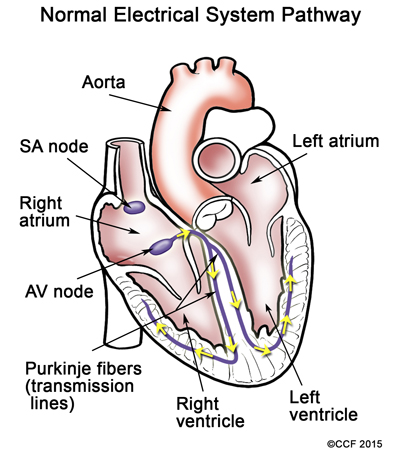
**Image content:** This image is available to view online.
View image online (https://my.clevelandclinic.org/-/scassets/images/org/health/articles/14788-pediatric-arrhythmias.ashx)
A diagram of the normal electrical system pathway inside the heart.
### What are arrhythmias in children?
An arrhythmia is any change in your heart’s regular, even rhythm. Children can have an [arrhythmia](https://my.clevelandclinic.org/health/diseases/16749-arrhythmia) — an irregular heartbeat — just like adults.
Advertisement
Cleveland Clinic is a non-profit academic medical center. Advertising on our site helps support our mission. We do not endorse non-Cleveland Clinic products or services. [Policy](https://health.clevelandclinic.org/advertising)
This might mean that your child’s heart beats too quickly, beats too slowly, skips a beat or has extra beats. It often doesn’t require treatment, but some cases can be serious.
#### How does your heart beat?
Your [heart](https://my.clevelandclinic.org/health/body/21704-heart) has a special electrical system that regulates its rate and rhythm:
1. Each heartbeat begins with an electrical signal from the sinoatrial (SA) node. Your SA node is a cluster of cells in the right atrium (upper right [chamber](https://my.clevelandclinic.org/health/body/23074-heart-chambers) of your heart).
2. The electrical signal causes both upper chambers (your atria) to pump blood into your two lower chambers (your ventricles).
3. The signal then moves to another group of cells called the atrioventricular (AV) node. The AV node is a wire that helps conduct electricity from the atria to the ventricles.
4. The AV node then sends another signal to your ventricles. This makes your ventricles pump blood out of your heart and to the rest of your body.
5. Finally, the ventricles relax, and a new signal starts a new heartbeat.
Your heart has a predictable rate and rhythm when this process works properly. But arrhythmia occurs if something interrupts the [electrical conduction system](https://my.clevelandclinic.org/health/body/22562-electrical-system-of-the-heart) of your heart.
#### How common is childhood arrhythmia?
Arrhythmias are common in children and usually harmless. In rare cases, the condition can be serious or even life-threatening.
Advertisement
#### What types of arrhythmias are there in infants and children?
There are many types of irregular heart rhythms in children, as there are in adults.
Many start in their atria (upper chambers of their heart). We refer to these as [supraventricular tachycardia (SVT)](https://my.clevelandclinic.org/health/diseases/22152-svt-supraventricular-tachycardia). There are different types of SVT as listed below:
- **[AV nodal reentrant tachycardia](https://my.clevelandclinic.org/health/diseases/22923-avnrt) and orthodromic re-entrant tachycardia** cause sudden episodes of an abnormally fast heartbeat originating from the top chamber. These episodes begin and end suddenly, like a “light switch” and constitute the most common cause of SVT in children. ([Wolff-Parkinson-White syndrome](https://my.clevelandclinic.org/health/diseases/17643-wolff-parkinson-white-syndrome-wpw) can cause episodes of SVT, as people with this condition typically have an extra electrical connection between the top and bottom chambers of the heart that they were born with.)
- [**Atrial flutter**](https://my.clevelandclinic.org/health/diseases/22885-atrial-flutter) is a rapid but consistent heartbeat.
- [**Atrial fibrillation**](https://my.clevelandclinic.org/health/diseases/16765-atrial-fibrillation-afib) results in a child’s heart beating fast and chaotically. This is extremely rare in children.
- [**Premature atrial contractions**](https://my.clevelandclinic.org/health/diseases/21700-premature-atrial-contractions) occur when beats begin earlier than they should and give you the sensation of an extra or skipped heartbeat.
Some types of arrhythmias are related to the ventricles (two lower chambers of the heart):
- [**Premature ventricular contractions (PVCs)**](https://my.clevelandclinic.org/health/diseases/17381-premature-ventricular-contractions) cause early extra beats that begin in the ventricles before they receive signals from the atria.
- [**Ventricular tachycardia (V-tach)**](https://my.clevelandclinic.org/health/diseases/17616-ventricular-tachycardia) is a serious condition involving electrical signals starting from the ventricles that are too fast.
- [**Ventricular fibrillation**](https://my.clevelandclinic.org/health/diseases/21878-ventricular-fibrillation) is a dangerous condition where the ventricles quiver or twitch instead of completely expanding and squeezing.
Other types of arrhythmia include:
- [**Bradycardia**](https://my.clevelandclinic.org/health/diseases/17841-bradycardia) means your child’s heart is beating slowly. Most of the time, this isn’t a dangerous arrhythmia, especially if the heartbeat is originating from the normal location (SA node) and they have no symptoms.
- [**Heart block**](https://my.clevelandclinic.org/health/diseases/17056-heart-block) is either a delay or blockage of the electrical impulse from the top chamber to the bottom chamber.
- [**Sick sinus syndrome**](https://my.clevelandclinic.org/health/diseases/21789-sick-sinus-syndrome) happens when the SA node malfunctions. It’s extremely rare in children except in those with congenital (present at birth) heart disease.
### Is sinus arrhythmia normal in children?
[Sinus arrhythmia](https://my.clevelandclinic.org/health/diseases/21666-sinus-arrhythmia) is a misleading phrase. Although it’s a variation in the heartbeat, it’s normal and occurs in all children to some degree. It’s a sign of good heart health.
Sinus arrhythmia in children means they have a faster heartbeat when inhaling and a slower one when exhaling. It doesn’t cause symptoms or require treatment.
## Symptoms and Causes
### What are the symptoms of pediatric arrhythmia?
The symptoms of irregular heartbeat in kids vary widely and depend on what type of arrhythmia they have. Your child may experience:
- [Chest pain](https://my.clevelandclinic.org/health/symptoms/21209-chest-pain).
- Difficulty eating, which may be the only observable symptom in newborn arrhythmia.
- [Dizziness](https://my.clevelandclinic.org/health/symptoms/6422-dizziness), lightheadedness or [fainting (syncope)](https://my.clevelandclinic.org/health/diseases/17536-syncope).
- [Fatigue](https://my.clevelandclinic.org/health/symptoms/21206-fatigue) or weakness.
- [Heart palpitations](https://my.clevelandclinic.org/health/diseases/17084-heart-palpitations), which may feel like fluttering, skipping a beat or having a heightened awareness of your heartbeat.
- Irritability, especially in children who can’t communicate about other symptoms.
- [Shortness of breath (dyspnea)](https://my.clevelandclinic.org/health/symptoms/16942-dyspnea).
Advertisement
In rare cases, the first symptom may be a [seizure](https://my.clevelandclinic.org/health/diseases/22789-seizure), syncope or [sudden cardiac death](https://my.clevelandclinic.org/health/diseases/17522-sudden-cardiac-death-sudden-cardiac-arrest).
### What causes irregular heartbeat in children?
Most children with SVT have no underlying structural heart issues. For other types of arrhythmias, many factors can cause arrhythmia in children, including:
- [**Cardiomyopathy**](https://my.clevelandclinic.org/health/diseases/16841-cardiomyopathy), a condition that makes their heart muscle stiff, enlarged or thick.
- **Inherited conditions** like [long QT syndrome](https://my.clevelandclinic.org/health/diseases/17183-long-q-t-syndrome-lqts) (when your heart’s electrical system takes too long to recharge) or [catecholaminergic polymorphic ventricular tachycardia](https://my.clevelandclinic.org/health/diseases/23006-catecholaminergic-polymorphic-ventricular-tachycardia) (when your ventricles beat too quickly).
- **Certain medications**, particularly drugs given to children who are critically ill.
- [**Congenital heart disease**](https://my.clevelandclinic.org/health/diseases/21674-congenital-heart-disease), a heart abnormality present at birth.
- [**Electrolyte imbalance**](https://my.clevelandclinic.org/health/symptoms/24019-electrolyte-imbalance) or another chemical imbalance in their blood.
- **[Fever](https://my.clevelandclinic.org/health/symptoms/10880-fever), [dehydration](https://my.clevelandclinic.org/health/treatments/9013-dehydration), stress, lack of sleep** or [**inflammation**](https://my.clevelandclinic.org/health/symptoms/21660-inflammation).
- [**Viral infection**](https://my.clevelandclinic.org/health/diseases/24473-viral-infection) or [**bacterial infection**](https://my.clevelandclinic.org/health/diseases/24189-bacterial-infection).
## Diagnosis and Tests
### How is arrhythmia diagnosed in children?
Providers often detect arrhythmia during a routine checkup or during diagnosis or treatment for another health condition. You can also ask your healthcare provider about the symptoms if you suspect your child has an arrhythmia.
Your pediatrician or a pediatric [cardiologist](https://my.clevelandclinic.org/health/articles/21983-cardiologist) will ask about your child’s health history and your family’s medical history. They’ll listen to your child’s heart and determine whether they need any tests. These may include:
Advertisement
- **Blood test:** A [blood test](https://my.clevelandclinic.org/health/diagnostics/24508-blood-tests) can detect whether a medication, infection or chemical imbalance is present**.**
- **Echocardiogram (echo):** This test uses sound waves to take pictures of your child’s heart. An [echocardiogram](https://my.clevelandclinic.org/health/diagnostics/16947-echocardiogram) provides detailed information about their heart’s structure and function.
- **Electrocardiogram (ECG):** An [ECG](https://my.clevelandclinic.org/health/diagnostics/16953-electrocardiogram-ekg) is a simple, painless test. Electrodes attached to your child’s chest measure the electrical activity of their heart. Your provider may ask them to lie down, walk on a treadmill or ride a stationary bike during the ECG.
- **Electrophysiologic study (EPS):** During this test, a doctor threads a small, thin tube through a blood vessel in your child’s arm or leg. The tube travels to your child’s heart and looks for the source of a faulty electrical signal.
- **Holter monitor:** A [Holter monitor](https://my.clevelandclinic.org/health/diagnostics/21491-holter-monitor) measures the electrical activity of your child’s heart over 24 hours to a few days. Your child goes about their regular activities while wearing a small portable monitor.
Rarely, your doctor may recommend a monitor called a [loop recorder](https://my.clevelandclinic.org/health/diagnostics/24543-loop-recorder). Your provider makes a small cut in the skin on your child’s chest and implants the monitor under their skin. This monitor may be helpful when other tests don’t provide clear answers.
Advertisement
## Management and Treatment
### How is arrhythmia treated in children?
Some cases of arrhythmia don’t need treatment. Your provider may recommend monitoring your child’s heart over time.
In other situations, your child’s healthcare provider may treat the underlying cause of their arrhythmia. If your child has an infection, for example, your provider may prescribe antibacterial or antiviral medications. Similarly, if your child has a chemical imbalance, certain medications can help restore balance and resolve arrhythmia.
Your provider may recommend [antiarrhythmic medications](https://my.clevelandclinic.org/health/drugs/22867-what-are-antiarrhythmics) like [beta-blockers](https://my.clevelandclinic.org/health/treatments/22318-beta-blockers) or [calcium channel blockers](https://my.clevelandclinic.org/health/treatments/22316-calcium-channel-blockers). These regulate heartbeats by slowing electrical impulses.
A child with a more serious case of arrhythmia may need a procedure to correct it, like:
- **[Ablation](https://my.clevelandclinic.org/health/treatments/17411-radiofrequency-ablation):** An [ablation](https://my.clevelandclinic.org/health/treatments/24535-atrial-flutter-ablation) procedure applies energy/heat to their heart tissue where arrhythmia begins.
- **[Cardioversion](https://my.clevelandclinic.org/health/treatments/16952-electrical-cardioversion):** There are two types of cardioversion. Traditional [cardioversion](https://my.clevelandclinic.org/health/treatments/16952-electrical-cardioversion) delivers an electrical shock to their heart to correct an irregular heart rhythm. [Chemical cardioversion](https://my.clevelandclinic.org/health/treatments/23133-chemical-cardioversion) uses medication to normalize their heart rate and rhythm.
- **Implanted device:** A device implanted under their skin can deliver electrical pulses or shocks to control or correct abnormal rhythms. Examples include a [pacemaker](https://my.clevelandclinic.org/health/treatments/17360-permanent-pacemaker) and [implantable cardioverter defibrillator](https://my.clevelandclinic.org/health/treatments/17123-implantable-cardioverter-defibrillator-icd).
- **Maze surgery:** A surgeon makes small cuts or burns in your child’s heart tissue to stop faulty electrical signals during [Maze surgery](https://my.clevelandclinic.org/health/treatments/17086-heart-surgery-for-atrial-fibrillation-maze).
Care at Cleveland Clinic
[Get Arrhythmia Treatment for Adults](https://my.clevelandclinic.org/services/arrhythmia-treatment)
[Find a Doctor and Specialists](https://my.clevelandclinic.org/services/arrhythmia-treatment#featured-provider-panel)
[Get Arrhythmia Treatment for Children](https://my.clevelandclinic.org/pediatrics/services/arrhythmia-treatment)
[Find a Pediatric Doctor and Specialists](https://my.clevelandclinic.org/pediatrics/services/arrhythmia-treatment#featured-provider-panel)
[Make an Appointment](https://my.clevelandclinic.org/web-appointments)
## Outlook / Prognosis
### What is the outlook for a child with an arrhythmia?
The outlook for a child with arrhythmia varies widely. Most arrhythmias in kids are harmless and don’t have long-term health effects. Some children outgrow an irregular heartbeat. Others continue to have arrhythmia but can live normal lives without treatment.
Even serious arrhythmias can be treated successfully.
Rarely, untreated cases of serious arrhythmia can cause severe consequences, including:
- [Blood clots](https://my.clevelandclinic.org/health/diseases/17675-blood-clots), which may lead to a [stroke](https://my.clevelandclinic.org/health/diseases/5601-stroke) if they travel to your child’s brain.
- Heart failure.
- Organ damage (for example, brain, kidneys, lungs and liver).
- Sudden cardiac death.
## Prevention
### Can arrhythmia be prevented in children?
Generally, there’s no way to prevent arrhythmia. But if you or your child notice that certain activities trigger arrhythmia, you can avoid doing those things. For example, if certain intense exercises prompt arrhythmia episodes, perhaps you can find other, less intense ways for your child to be active.
## Living With
### Can anything help with the symptoms of arrhythmia?
If your child experiences arrhythmia symptoms, the following strategies may help:
- Forcing a cough or gag.
- Holding an ice pack against their face.
- Trying the [Valsalva maneuver](https://my.clevelandclinic.org/health/treatments/23209-valsalva-maneuver), closing their nose and mouth and having them strain to breathe out.
### What questions should I ask my child’s doctor?
Consider asking your provider the following questions if your child is diagnosed with arrhythmia:
- What type of arrhythmia does my child have? Is it life-threatening?
- Can my child still be active?
- Should we avoid any activities, like sports?
- Should we see a pediatric cardiologist?
- How often should I have my child’s heart checked? Can I check anything at home?
- When should we seek immediate medical attention?
### A note from Cleveland Clinic
Arrhythmia can make your child’s heart race, beat too slowly or feel like it skips a beat. It’s natural to worry if your child has any unusual heart symptoms. But most arrhythmias are harmless in children, and many kids grow out of them. Talk to your pediatrician to learn more about your child’s heart health.
[](https://my.clevelandclinic.org/)[](https://my.clevelandclinic.org/)
[](https://health.clevelandclinic.org/)

## Better health starts here
Sign up for our Health Essentials emails for expert guidance on nutrition, fitness, sleep, skin care and more.
[Example email](https://assets.clevelandclinic.org/transform/2ff943a2-abb1-4a1c-8ede-f8848703e789/HealthEssentials-SampleEmail-2026)[Sign up](https://my.clevelandclinic.org/health-essentials-sign-up)
[Sign up](https://my.clevelandclinic.org/health-essentials-sign-up)[Example email](https://assets.clevelandclinic.org/transform/2ff943a2-abb1-4a1c-8ede-f8848703e789/HealthEssentials-SampleEmail-2026)
### Experts You Can Trust
Medically Reviewed.
Last updated on 06/15/2023.
Learn more about the [Health Library](https://my.clevelandclinic.org/health/about) and our [editorial process](https://my.clevelandclinic.org/about/website/editorial-policy).
### References
Cleveland Clinic’s health articles are based on evidence-backed information and review by medical professionals to ensure accuracy, reliability and up-to-date clinical standards.
#### View Sources
### Experts You Can Trust
Medically Reviewed.
Last updated on 06/15/2023.
### References
Cleveland Clinic’s health articles are based on evidence-backed information and review by medical professionals to ensure accuracy, reliability and up-to-date clinical standards.
- American Academy of Pediatrics. Fast, slow and irregular heartbeats (arrhythmia) *(https://www.healthychildren.org/English/health-issues/conditions/heart/Pages/Irregular-Heartbeat-Arrhythmia.aspx)*. Last updated 2/14/2020. Accessed 6/15/2023.
- American Heart Association. Children and arrhythmia *(https://www.heart.org/en/health-topics/arrhythmia/understand-your-risk-for-arrhythmia/children-and-arrhythmia)*. Last reviewed 11/16/2022. Accessed 6/15/2023.
- American Heart Association. Types of arrhythmia in children *(https://www.heart.org/en/health-topics/arrhythmia/about-arrhythmia/types-of-arrhythmia-in-children)*. Last reviewed 11/15/2022. Accessed 6/15/2023.
### Care at Cleveland Clinic
When your heart rhythm is out of sync, the experts at Cleveland Clinic can find out why. We offer personalized care for all types of arrhythmias.

[Get Arrhythmia Treatment for Adults](https://my.clevelandclinic.org/services/arrhythmia-treatment)
[Find a Doctor and Specialists](https://my.clevelandclinic.org/services/arrhythmia-treatment#featured-provider-panel)
[Get Arrhythmia Treatment for Children](https://my.clevelandclinic.org/pediatrics/services/arrhythmia-treatment)
[Find a Pediatric Doctor and Specialists](https://my.clevelandclinic.org/pediatrics/services/arrhythmia-treatment#featured-provider-panel)
[Make an Appointment](https://my.clevelandclinic.org/web-appointments)
Advertisement
Advertisement
Ad
Call Appointment Center [866\.320.4573](tel:8663204573)
Questions [216\.444.2200](tel:2164442200)
[Request an Appointment](https://my.clevelandclinic.org/webappointment/what-to-expect)
[Contact Us](https://my.clevelandclinic.org/webmail)
[Find a ProviderNeed a primary care doctor or a specialist? Our Find a Provider tool makes it easy to search Cleveland Clinic’s trusted network.](https://my.clevelandclinic.org/providers)
[LocationsFind any of our 300+ locations.](https://my.clevelandclinic.org/locations)
[AppointmentsGet the in-person or virtual care you need.](https://my.clevelandclinic.org/patients/information/access)
### Subscribe to Cleveland Clinic Health Essentials
[Sign Up Today](https://my.clevelandclinic.org/health-essentials-newsletter?utm_medium=email&utm_source=jotform&utm_campaign=he&utm_content=signuppage)
### Actions
[Appointments & Access](https://my.clevelandclinic.org/patients/information/access)[Accepted Insurance](https://my.clevelandclinic.org/patients/accepted-insurance)[Events Calendar](https://events.clevelandclinic.org/)[Financial Assistance](https://my.clevelandclinic.org/patients/billing-finance/financial-assistance)[Give to Cleveland Clinic](https://my.clevelandclinic.org/giving)[Pay Your Bill Online](https://my.clevelandclinic.org/patients/billing-finance/payment-options)[Price Transparency](https://my.clevelandclinic.org/patients/billing-finance/comprehensive-hospital-charges)[Refer a Patient](https://my.clevelandclinic.org/professionals/referring)[Phone Directory](https://my.clevelandclinic.org/about/contact/phone-directory)[Virtual Second Opinions](https://my.clevelandclinic.org/online-services/virtual-second-opinions)[Virtual Visits](https://my.clevelandclinic.org/online-services/virtual-visits)
### About Cleveland Clinic
[100 Years of Cleveland Clinic](https://my.clevelandclinic.org/about/history)[About Us](https://my.clevelandclinic.org/about)[Locations](https://my.clevelandclinic.org/locations)[Quality & Patient Safety](https://my.clevelandclinic.org/departments/patient-experience/depts/quality-patient-safety)[Patient Experience](https://my.clevelandclinic.org/departments/patient-experience/depts/office-patient-experience)[Research & Innovations](https://my.clevelandclinic.org/research)[Community Commitment](https://my.clevelandclinic.org/about/community)[Careers](https://jobs.clevelandclinic.org/)[For Employees](https://my.clevelandclinic.org/about/for-employees)[Resources for Medical Professionals](https://my.clevelandclinic.org/professionals)
### Subscribe to Cleveland Clinic Health Essentials
[Sign Up Today](https://my.clevelandclinic.org/health-essentials-newsletter?utm_medium=email&utm_source=jotform&utm_campaign=he&utm_content=signuppage)
Follow Cleveland Clinic
[](https://www.facebook.com/ClevelandClinic)
[](https://twitter.com/clevelandclinic)
[](https://www.youtube.com/user/clevelandclinic)
[](https://www.instagram.com/clevelandclinic/)
[](https://www.linkedin.com/company/cleveland-clinic)
Blog, News & Apps
[Consult QD](https://consultqd.clevelandclinic.org/)
[Health Essentials](https://health.clevelandclinic.org/)
[Newsroom](https://newsroom.clevelandclinic.org/)
[MyClevelandClinic](https://my.clevelandclinic.org/mobile-apps/myclevelandclinic)
[MyChart](https://my.clevelandclinic.org/online-services/mychart)
Site Information & Policies
[Send Us Feedback](https://my.clevelandclinic.org/webcontact/webmail)
[About this Website](https://my.clevelandclinic.org/about/website)
[Advertising Policy](https://health.clevelandclinic.org/advertising)
[Social Media Policy](https://my.clevelandclinic.org/about/website/social-media)
[Copyright, Reprint & Licensing](https://my.clevelandclinic.org/about/website/reprints-licensing)
[Website Terms of Use](https://my.clevelandclinic.org/about/website/terms-of-use)
[Privacy Policy](https://my.clevelandclinic.org/about/website/privacy-security)
[Notice of Privacy Practices](https://my.clevelandclinic.org/about/website/privacy-practices)
[Non-Discrimination and Availability](https://my.clevelandclinic.org/about/website/non-discrimination-notice)
[Call: 800\.223.2273](tel:8002232273) \| 9500 Euclid Avenue, Cleveland, Ohio 44195 \| © 2026 Cleveland Clinic. All Rights Reserved. |
| Readable Markdown | ### What are arrhythmias in children?
An arrhythmia is any change in your heart’s regular, even rhythm. Children can have an [arrhythmia](https://my.clevelandclinic.org/health/diseases/16749-arrhythmia) — an irregular heartbeat — just like adults.
This might mean that your child’s heart beats too quickly, beats too slowly, skips a beat or has extra beats. It often doesn’t require treatment, but some cases can be serious.
#### How does your heart beat?
Your [heart](https://my.clevelandclinic.org/health/body/21704-heart) has a special electrical system that regulates its rate and rhythm:
1. Each heartbeat begins with an electrical signal from the sinoatrial (SA) node. Your SA node is a cluster of cells in the right atrium (upper right [chamber](https://my.clevelandclinic.org/health/body/23074-heart-chambers) of your heart).
2. The electrical signal causes both upper chambers (your atria) to pump blood into your two lower chambers (your ventricles).
3. The signal then moves to another group of cells called the atrioventricular (AV) node. The AV node is a wire that helps conduct electricity from the atria to the ventricles.
4. The AV node then sends another signal to your ventricles. This makes your ventricles pump blood out of your heart and to the rest of your body.
5. Finally, the ventricles relax, and a new signal starts a new heartbeat.
Your heart has a predictable rate and rhythm when this process works properly. But arrhythmia occurs if something interrupts the [electrical conduction system](https://my.clevelandclinic.org/health/body/22562-electrical-system-of-the-heart) of your heart.
#### How common is childhood arrhythmia?
Arrhythmias are common in children and usually harmless. In rare cases, the condition can be serious or even life-threatening.
#### What types of arrhythmias are there in infants and children?
There are many types of irregular heart rhythms in children, as there are in adults.
Many start in their atria (upper chambers of their heart). We refer to these as [supraventricular tachycardia (SVT)](https://my.clevelandclinic.org/health/diseases/22152-svt-supraventricular-tachycardia). There are different types of SVT as listed below:
- **[AV nodal reentrant tachycardia](https://my.clevelandclinic.org/health/diseases/22923-avnrt) and orthodromic re-entrant tachycardia** cause sudden episodes of an abnormally fast heartbeat originating from the top chamber. These episodes begin and end suddenly, like a “light switch” and constitute the most common cause of SVT in children. ([Wolff-Parkinson-White syndrome](https://my.clevelandclinic.org/health/diseases/17643-wolff-parkinson-white-syndrome-wpw) can cause episodes of SVT, as people with this condition typically have an extra electrical connection between the top and bottom chambers of the heart that they were born with.)
- [**Atrial flutter**](https://my.clevelandclinic.org/health/diseases/22885-atrial-flutter) is a rapid but consistent heartbeat.
- [**Atrial fibrillation**](https://my.clevelandclinic.org/health/diseases/16765-atrial-fibrillation-afib) results in a child’s heart beating fast and chaotically. This is extremely rare in children.
- [**Premature atrial contractions**](https://my.clevelandclinic.org/health/diseases/21700-premature-atrial-contractions) occur when beats begin earlier than they should and give you the sensation of an extra or skipped heartbeat.
Some types of arrhythmias are related to the ventricles (two lower chambers of the heart):
- [**Premature ventricular contractions (PVCs)**](https://my.clevelandclinic.org/health/diseases/17381-premature-ventricular-contractions) cause early extra beats that begin in the ventricles before they receive signals from the atria.
- [**Ventricular tachycardia (V-tach)**](https://my.clevelandclinic.org/health/diseases/17616-ventricular-tachycardia) is a serious condition involving electrical signals starting from the ventricles that are too fast.
- [**Ventricular fibrillation**](https://my.clevelandclinic.org/health/diseases/21878-ventricular-fibrillation) is a dangerous condition where the ventricles quiver or twitch instead of completely expanding and squeezing.
Other types of arrhythmia include:
- [**Bradycardia**](https://my.clevelandclinic.org/health/diseases/17841-bradycardia) means your child’s heart is beating slowly. Most of the time, this isn’t a dangerous arrhythmia, especially if the heartbeat is originating from the normal location (SA node) and they have no symptoms.
- [**Heart block**](https://my.clevelandclinic.org/health/diseases/17056-heart-block) is either a delay or blockage of the electrical impulse from the top chamber to the bottom chamber.
- [**Sick sinus syndrome**](https://my.clevelandclinic.org/health/diseases/21789-sick-sinus-syndrome) happens when the SA node malfunctions. It’s extremely rare in children except in those with congenital (present at birth) heart disease.
### Is sinus arrhythmia normal in children?
[Sinus arrhythmia](https://my.clevelandclinic.org/health/diseases/21666-sinus-arrhythmia) is a misleading phrase. Although it’s a variation in the heartbeat, it’s normal and occurs in all children to some degree. It’s a sign of good heart health.
Sinus arrhythmia in children means they have a faster heartbeat when inhaling and a slower one when exhaling. It doesn’t cause symptoms or require treatment. |
| Shard | 143 (laksa) |
| Root Hash | 9889140825964526943 |
| Unparsed URL | org,clevelandclinic!my,/health/diseases/14788-arrhythmias-in-children s443 |