ℹ️ Skipped - page is already crawled
| Filter | Status | Condition | Details |
|---|---|---|---|
| HTTP status | PASS | download_http_code = 200 | HTTP 200 |
| Age cutoff | PASS | download_stamp > now() - 6 MONTH | 0.1 months ago |
| History drop | PASS | isNull(history_drop_reason) | No drop reason |
| Spam/ban | PASS | fh_dont_index != 1 AND ml_spam_score = 0 | ml_spam_score=0 |
| Canonical | PASS | meta_canonical IS NULL OR = '' OR = src_unparsed | Not set |
| Property | Value | ||||||||||||
|---|---|---|---|---|---|---|---|---|---|---|---|---|---|
| URL | https://mindfulnessbox.com/best-mindfulness-books/ | ||||||||||||
| Last Crawled | 2026-04-20 17:31:23 (1 day ago) | ||||||||||||
| First Indexed | 2022-02-02 16:39:49 (4 years ago) | ||||||||||||
| HTTP Status Code | 200 | ||||||||||||
| Content | |||||||||||||
| Meta Title | The 11 Best Mindfulness Books For Beginners In 2025 | ||||||||||||
| Meta Description | The best mindfulness books and my takeaways from each, from mindfulness experts like Jon Kabat-Zinn to poets, psychologists, journalists and even runners. | ||||||||||||
| Meta Canonical | null | ||||||||||||
| Boilerpipe Text | This is a slightly different kind of Best Mindfulness Books list: I’ve included books from mindfulness experts, but also experts from other wellness fields. My goal with this list of top mindfulness books is to meet you where you are on your mindfulness journey.
It’s got essential books from mindfulness experts like Jon Kabat-Zinn and Matthieu Ricard, which help explain the basic principles of mindfulness and meditation and provide practical steps.
But I’m also including others by psychologists, journalists, poets, and even runners. Each of these books arrived to me at the right time over the years to help with a certain angle of my mindfulness and meditation practice.
Instant Download
We earn a commission if you make a purchase, at no additional cost to you.
Whether you want to sleep better, reduce anxiety with exercise, get inspired to be more mindful, or gift a book to your meditation-skeptic friend, there’s a good book on mindfulness for you here.
1. Wherever You Go, There You Are: Mindfulness Meditation In Everyday Life
by Jon Kabat-Zinn
View at Amazon
Jon Kabat-Zinn has been an authority in mindfulness
and meditation for decades, and it shows. His Mindfulness-Based Stress Reduction program, launched in 1979, was one of the factors that kickstarted the widespread scientific study of meditation and the modern mindfulness movement that followed.
This is perhaps the best Jon Kabat-Zinn book to start with
. I remember the title alone being a revelation to me when I first read it: as much as we want to change relationships, switch jobs, move cities and travel to avoid our discomfort, we’re still “there.” Because of that, we need to focus on building internal peace, wherever we are.
Takeaway:
We spend much of our lives with an unexamined internal tension that arises due to wanting things to be different than they are.
And we make many decisions in life under the assumption that the problem is our external circumstances, assuming that if we change them, things will be better and happier. But this isn’t how our minds work.
Excerpt:
“
To allow ourselves to be truly in touch with where we already are, no matter where that is, we have got to pause our experience long enough to let the present moment sink in
; long enough to actually feel the present moment, to see it in its fullness, to hold it in awareness and thereby come to know and understand it better. Only then can we accept the truth of this moment of our life, learn from it, and move on.”
2. Clarity & Connection
by Yung Pueblo
View at Amazon
Like many people, I first found
Yung Pueblo’s work on Instagram
. He specializes in short, deeply insightful reflections on what it’s like to be human, and how to get better at it. He’s incredibly artful at explaining what’s happening in his own mind.
Get this one for beautiful, relatable inspiration to live more mindfully each day.
Takeaway:
This is one person’s artistic expression of his own experience, but in some ways, it’s more impactful than anything research-based.
I find my own experience in much of what he writes, like “my mind kept jumping into imagining what more i could want which made everything i was given never quite as special as what i had envisioned”
Excerpt:
“if you meet the rough parts of yourself with gentleness, they will melt away, leaving you lighter and giving you more space to act from a place of wisdom.
all you need to do is be okay with not being okay during tense moments of release
. throw away the idea that you need to pause your life until you are fully healed; this is a different way of being attached to perfection. progress happens when you make better decisions in the midst of living.”
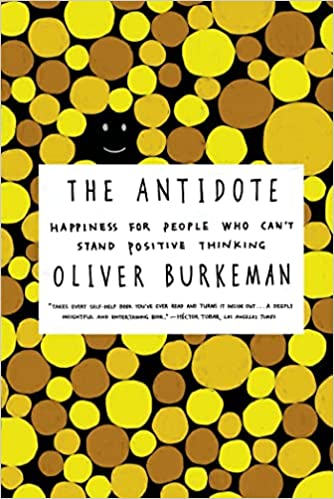
3. The Antidote: Happiness for People Who Can’t Stand Positive Thinking
by Oliver Burkeman
View at Amazon
Oliver Burkeman is who you turn to when you’re feeling cynical after too many positive thinking books
.
The Antidote
is based around philosophies originating in
Stoicism
and Buddhism.
Delivered with tremendous wit and dryness, it’s at its core an encouragement to stop letting outside events dictate your emotions by observing them nonjudgmentally.
Takeaway:
Experiences aren’t in themselves positive or negative. Our mind assesses experiences as positive or negative, and that’s what causes suffering.
Excerpt:
“When you’re irritated by a colleague at the next desk who won’t stop talking, you naturally assume that the colleague is the source of the irritation; when you hear that a beloved relative is ill and feel pained for them, it makes sense to think of the illness as the source of the pain. Look closely at your experience, though, say the Stoics, and you will eventually be forced to conclude that neither of these external events is ‘negative’ in itself.
Indeed, nothing outside your own mind can properly be described as negative or positive at all
. What actually causes suffering are the beliefs you hold about those things.”
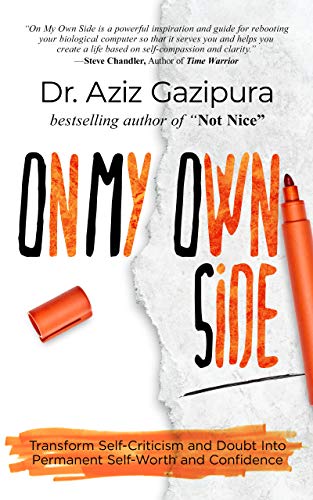
4. On My Own Side: Transform Self-Criticism and Doubt Into Permanent Self-Worth and Confidence
by Aziz Gazipura
View at Amazon
On My Own Side rocked my world in a moment when I didn’t know
self-compassion was sorely missing from my life
.
I keep coming back to one of the central questions presented in this book: are you treating yourself as you would a dear friend, or a child? If not, why?
Developing self-compassion is central to mindfulness, and Dr. Aziz makes a compelling case that you’re probably not treating yourself as well as you ought to—and that by being kinder to yourself, you’ll show up better in the world.
Takeaway:
Our habit of negative self-talk and lack of self-compassion can become so ingrained we don’t know it’s happenin
g, and it can show up in ways we never realized (like the supposed “failure” to be happy and positive all the time, in the below example)
Excerpt:
“One of my favorite tools to teach kids about emotions is the color zones. There are four zones—green, red, yellow, and blue. Green zone is when you are feeling relaxed, calm, at ease, or happy. Blue zone is feeling tired in your body, or sad or down in your heart. Yellow is when you’re energized or agitated inside… And red zone is when you’re feeling angry, enraged, and a strong urge to act out that anger… We used the zones to express how we’re feeling inside, and our boys witnessed how my wife and I shared what zone we were in with each other and them. We also asked them what zone they were in.
As we did this, however, I discovered that my upbringing taught me one message loud and clear: always be in the green zone
.”
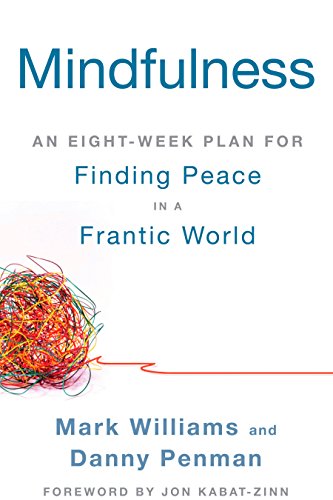
5. Mindfulness: An Eight-Week Plan for Finding Peace in a Frantic World
by Mark Williams & Danny Penman
View at Amazon
An excellent practical guide for beginners
, this book is based on
Mindfulness-Based Cognitive Therapy
and promotes a simple and short form of mindfulness meditation to get you started.
Great step-by-step instructions, and lots of metaphors that are easy to understand.
Takeaway:
Mindfulness is worth practicing because (among other reasons) when your mind is less consumed by self-criticism and wandering thoughts, you have more energy to act generously and compassionately with the world.
Excerpt:
“Opening yourself up to empathy is important because out of this sad-sweet emotion will arise compassion for yourself and for others.
Compassion—particularly for yourself—is of overwhelming importance.
It takes the fuel away from your endless, driving self-criticism. You will eventually be able to see more clearly that some things in life are less important than you had thought, and find it easier to let go of over-caring about them. You will find that the energy that they have been consuming can be used to treat yourself and the world more generously.”
6.
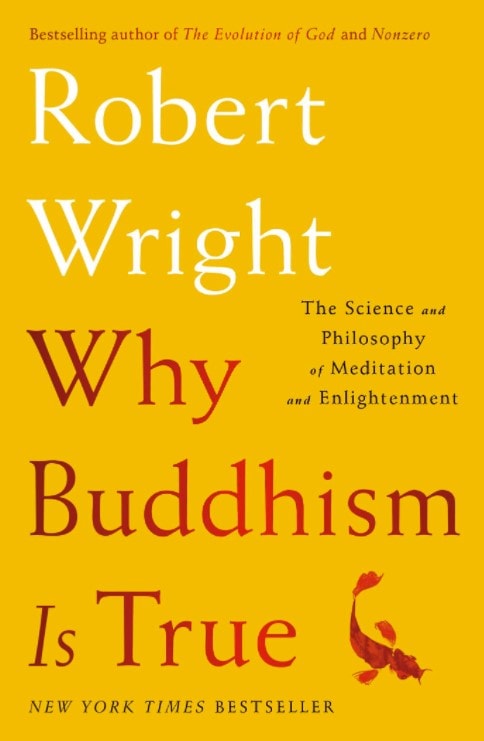
Why Buddhism is True: The Science and Philosophy of Meditation and Enlightenment
by Robert Wright
View at Amazon
Why Buddhism Is True
cross-references some of the practical elements of Buddhism with scientific research and theories around natural selection.
The argument is that natural selection has caused humans to be motivated towards pleasure and away from pain, and that the solutions developed in Buddhism help with this. Meditation and mindfulness can
stop our patterns of overthinking
and lead to peace and a better life.
This book is a strong option for skeptics of meditation as well as anyone interested in the links between Buddhism and modern mindfulness.
Takeaway:
Our brains are the result of a complex process of natural selection. The result is that they are specifically designed to help us pass our genes to the next generation.
That means our perceptions of pain, pleasure, anxiety, fear, worry, and more, are designed to keep us alive (not to keep us happy, or to give us an accurate picture of the world). Meditation and mindfulness are effective tools against our brain’s natural impulses.
Excerpt:
“Evolutionary psychology can be described in various ways, and here’s one way… it is the study of how the human brain was designed—by natural selection—to mislead us, even enslave us… Whether [our] thoughts and feelings and perceptions give us a true view of reality is, strictly speaking, beside the point. As a result, they sometimes don’t.
Our brains are designed to, among other things, delude us
.”
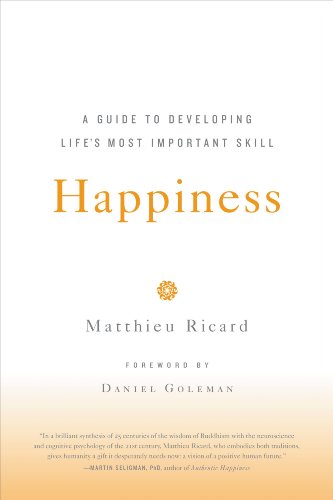
7. Happiness: A Guide to Developing Life’s Most Important Skill
by Matthieu Ricard
View at Amazon
Happiness
is a book by a former scientist, Matthieu Ricard, who’s now spent decades as a Buddhist monk.
He argues that
happiness is a skill
, and
rather than focusing endlessly on goals and activities that we think will lead to happiness, we need to go straight to the source.
Meditation is proven to change the brain and is a scientifically-backed path towards achieve greater peace and happiness.
Takeaway:
We spend endless energy on our careers and hobbies in an attempt to be happy. But we confuse the means with the ends, because happiness itself is a skill.
Why aren’t we spending time learning the skill of how to be happy?
Excerpt:
“If happiness and emotional balance are skills, we cannot underestimate the power of the transformation of the mind and must give due importance to the profound methods that allow us to become better human beings.”
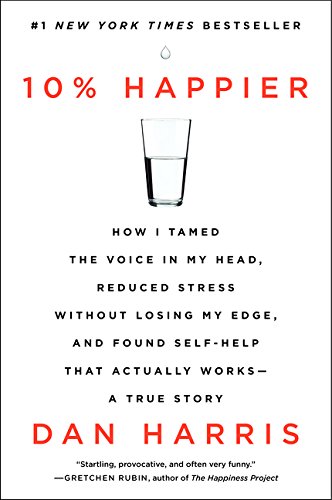
8. 10% Happier: How I Tamed the Voice in My Head, Reduced Stress Without Losing My Edge, and Found Self-Help That Actually Works–A True Story
by Dan Harris
View at Amazon
Dan Harris, a former journalist for ABC, famously had a panic attack on live TV. Meditation helped him reduce his stress and anxiety, and to his unending credit, he turned that experience into an evangelizing mission for mindfulness and meditation.
His pitch: meditation won’t change everything, but it might make you 10% happier. It’s worth a shot.
Takeaway:
When we live in the future or the past, we miss so much of our lives.
Excerpt:
“We wax nostalgic for prior events during which we were doubtless ruminating or projecting.”
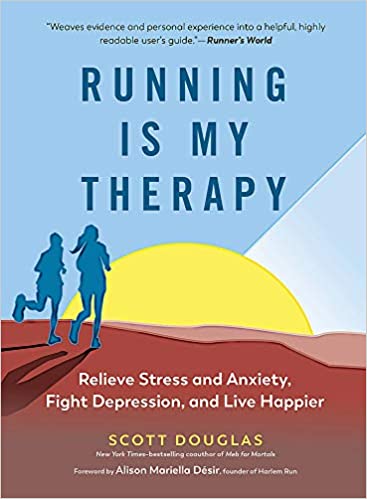
9. Running Is My Therapy: Relieve Stress and Anxiety, Fight Depression, and Live Happier
by Scott Douglas
View at Amazon
When you need a reminder that exercise keeps your brain healthier and happier, this is the book you want to pick up.
Your mind and your body are connected, and sometimes what we feels like purely a “thinking problem” can be, partially, a movement problem.
If you’ve ever gone for a run and found your ruminating thoughts were diminished by the end, you know what I mean.
Takeaway:
Mindfulness is holistic. Sometimes, when we get out of our minds and into our bodies, we find that the endless ruminating and overthinking lessens. Exercise your body as well as your mind.
Excerpt:
“What running has done for me for almost four decades, and what I hope it will do the rest of my life, is to help me more often be my best—interested in rather than dismissive of others, engaged in rather than beaten down by work, hopeful rather than fearful toward the future.
The time I spend running is powerful medicine not just while I’m running but for most of the rest of the day, too.
“
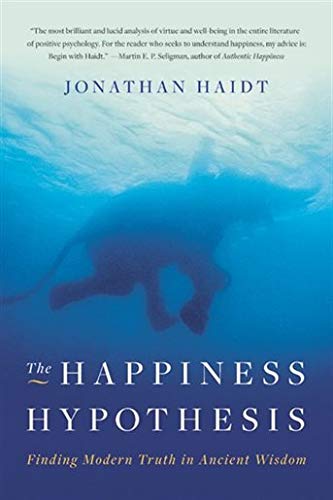
10. The Happiness Hypothesis: Finding Modern Truth in Ancient Wisdom
by Jonathan Haidt
View at Amazon
Psychologist Jonathan Haidt’s book is a synthesis of ideas around happiness from ancient wisdom traditions around the world.
It’s an easy read full of original angles to help you better understand yourself, like this one: “
We assume that there is one person in each body, but in some ways we are each more like a committee whose members have been thrown together to do a job, but who often find themselves working at cross purposes
.”
Takeaway:
Among other nuggets, this book crystalized for me the research-backed concept of baseline levels of happiness.
Our level of happiness is 50% or more genetic;
most of the rest is under our control
, and a small percentage is linked to external factors.
The idea that the large majority of our happiness is either set by genetics
or under our influence helps me feel less at the whims of my environment, and more in control of my own moods.
Excerpt:
“Twin studies generally show that from 50 percent to 80 percent of all the variance among people in their average levels of happiness can be
explained by differences in their genes rather than in their life experiences
.”
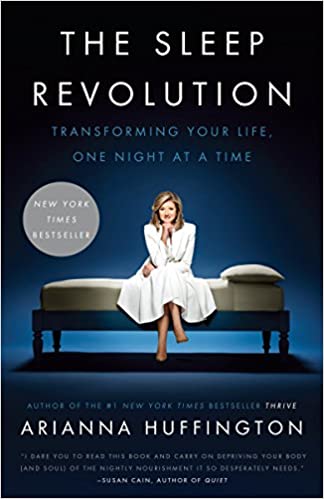
11. The Sleep Revolution: Transforming Your Life, One Night at a Time
by Arianna Huffington
View at Amazon
If you’re attracted to mindfulness primarily for better sleep, you might want to start here.
Ariana Huffington’s book is full of research and recommendations for getting more sleep outside of mindfulness, but also leans on research that mindfulness meditation helps people fall asleep twice as quickly, and has practical recommendations like breathing exercises.
Takeaway:
Mindfulness meditation and breathing exercises are two of the many research-backed tools in your arsenal for better sleep.
Excerpt:
“A 2009 Stanford study found that a six-week mindfulness meditation course helped people who have trouble sleeping fall asleep twice as quickly, in fifteen instead of thirty-three minutes.”
My mindfulness practice kicked off in 2016 with a
ten-day silent retreat
. Since then, I’ve read
dozens of books
about mindfulness and completed hundreds of hours of meditation. Thinking about what makes humans happy, calm, and peaceful is endlessly fascinating to me. | ||||||||||||
| Markdown | [](https://mindfulnessbox.com/)
- [Articles](https://mindfulnessbox.com/blog/)
- [Mindfulness](https://mindfulnessbox.com/mindfulness/)
- [Meditation](https://mindfulnessbox.com/meditation/)
- [Happiness](https://mindfulnessbox.com/happiness/)
- [Reviews](https://mindfulnessbox.com/reviews/)
- [About](https://mindfulnessbox.com/about/)
- [Get Printable Activities](https://mindfulnessbox.gumroad.com/l/mindfulness-activities)
- [Articles](https://mindfulnessbox.com/blog/)
- [Mindfulness](https://mindfulnessbox.com/mindfulness/)
- [Meditation](https://mindfulnessbox.com/meditation/)
- [Happiness](https://mindfulnessbox.com/happiness/)
- [Reviews](https://mindfulnessbox.com/reviews/)
- [About](https://mindfulnessbox.com/about/)
- [Get Printable Activities](https://mindfulnessbox.gumroad.com/l/mindfulness-activities)
# The 11 Best Mindfulness Books for Beginners in 2025
- By: Ryan Kane
- Time to read: 10 min.
**This is a slightly different kind of Best Mindfulness Books list: I’ve included books from mindfulness experts, but also experts from other wellness fields. My goal with this list of top mindfulness books is to meet you where you are on your mindfulness journey.**
It’s got essential books from mindfulness experts like Jon Kabat-Zinn and Matthieu Ricard, which help explain the basic principles of mindfulness and meditation and provide practical steps.
But I’m also including others by psychologists, journalists, poets, and even runners. Each of these books arrived to me at the right time over the years to help with a certain angle of my mindfulness and meditation practice.
Instant Download
[61 Ready-to-Use Mindfulness Activities for Teachers & Counselors](https://mindfulnessbox.com/go/printable-mindfulness-activities-61/ "61 Ready-to-Use Mindfulness Activities for Teachers & Counselors")
\$19.00
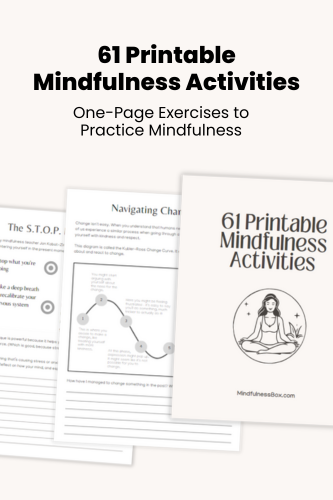
Skip hours of prep time with 61 ready-to-use mindfulness exercises trusted by 600+ teachers, counselors, and facilitators. Build calm, focus, and emotional awareness in your classroom or group. Instant PDF download\!
[](https://mindfulnessbox.com/go/printable-mindfulness-activities-61/ "61 Ready-to-Use Mindfulness Activities for Teachers & Counselors")
[Get Instant Access](https://mindfulnessbox.com/go/printable-mindfulness-activities-61/ "61 Ready-to-Use Mindfulness Activities for Teachers & Counselors")
We earn a commission if you make a purchase, at no additional cost to you.
Whether you want to sleep better, reduce anxiety with exercise, get inspired to be more mindful, or gift a book to your meditation-skeptic friend, there’s a good book on mindfulness for you here.
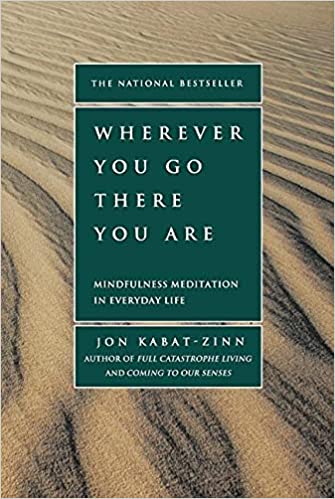
### *1\. Wherever You Go, There You Are: Mindfulness Meditation In Everyday Life* by Jon Kabat-Zinn
[](https://www.amazon.com/dp/1401307787?tag=mindfulnes03f-20)
[View at Amazon](https://www.amazon.com/dp/1401307787?tag=mindfulnes03f-20)
[Jon Kabat-Zinn has been an authority in mindfulness](https://mindfulnessbox.com/the-9-attitudes-of-mindfulness/) and meditation for decades, and it shows. His Mindfulness-Based Stress Reduction program, launched in 1979, was one of the factors that kickstarted the widespread scientific study of meditation and the modern mindfulness movement that followed.
**This is perhaps the best Jon Kabat-Zinn book to start with**. I remember the title alone being a revelation to me when I first read it: as much as we want to change relationships, switch jobs, move cities and travel to avoid our discomfort, we’re still “there.” Because of that, we need to focus on building internal peace, wherever we are.
##### Takeaway:
**We spend much of our lives with an unexamined internal tension that arises due to wanting things to be different than they are.** And we make many decisions in life under the assumption that the problem is our external circumstances, assuming that if we change them, things will be better and happier. But this isn’t how our minds work.
Excerpt:
> “**To allow ourselves to be truly in touch with where we already are, no matter where that is, we have got to pause our experience long enough to let the present moment sink in**; long enough to actually feel the present moment, to see it in its fullness, to hold it in awareness and thereby come to know and understand it better. Only then can we accept the truth of this moment of our life, learn from it, and move on.”
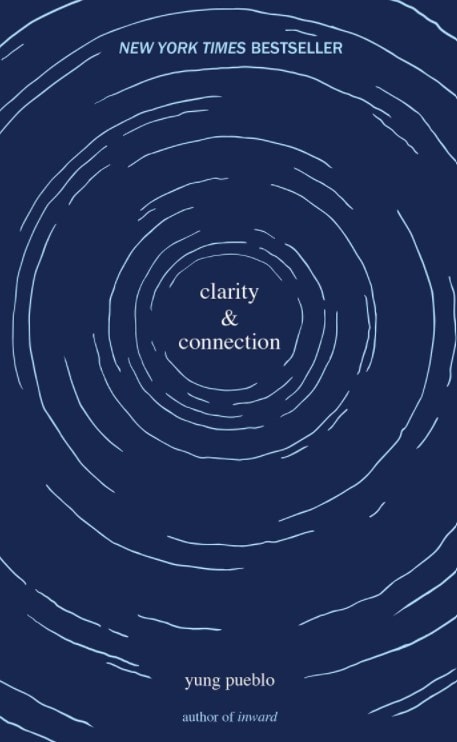
### *2\. Clarity & Connection* by Yung Pueblo
[](https://www.amazon.com/dp/1524860484?tag=mindfulnes03f-20)
[View at Amazon](https://www.amazon.com/dp/1524860484?tag=mindfulnes03f-20)
Like many people, I first found [Yung Pueblo’s work on Instagram](https://www.instagram.com/yung_pueblo/). He specializes in short, deeply insightful reflections on what it’s like to be human, and how to get better at it. He’s incredibly artful at explaining what’s happening in his own mind.
**Get this one for beautiful, relatable inspiration to live more mindfully each day.**
##### Takeaway:
This is one person’s artistic expression of his own experience, but in some ways, it’s more impactful than anything research-based.
I find my own experience in much of what he writes, like “my mind kept jumping into imagining what more i could want which made everything i was given never quite as special as what i had envisioned”
Excerpt:
> “if you meet the rough parts of yourself with gentleness, they will melt away, leaving you lighter and giving you more space to act from a place of wisdom. **all you need to do is be okay with not being okay during tense moments of release**. throw away the idea that you need to pause your life until you are fully healed; this is a different way of being attached to perfection. progress happens when you make better decisions in the midst of living.”
### *3\. The Antidote: Happiness for People Who Can’t Stand Positive Thinking* by Oliver Burkeman
[](https://www.amazon.com/dp/0865478015?tag=mindfulnes03f-20)
[View at Amazon](https://www.amazon.com/dp/0865478015?tag=mindfulnes03f-20)
**Oliver Burkeman is who you turn to when you’re feeling cynical after too many positive thinking books**. *The Antidote* is based around philosophies originating in [Stoicism](https://mindfulnessbox.com/benefits-of-negative-visualization/) and Buddhism.
Delivered with tremendous wit and dryness, it’s at its core an encouragement to stop letting outside events dictate your emotions by observing them nonjudgmentally.
##### Takeaway:
**Experiences aren’t in themselves positive or negative. Our mind assesses experiences as positive or negative, and that’s what causes suffering.**
Excerpt:
> “When you’re irritated by a colleague at the next desk who won’t stop talking, you naturally assume that the colleague is the source of the irritation; when you hear that a beloved relative is ill and feel pained for them, it makes sense to think of the illness as the source of the pain. Look closely at your experience, though, say the Stoics, and you will eventually be forced to conclude that neither of these external events is ‘negative’ in itself. **Indeed, nothing outside your own mind can properly be described as negative or positive at all**. What actually causes suffering are the beliefs you hold about those things.”
### *4\. On My Own Side: Transform Self-Criticism and Doubt Into Permanent Self-Worth and Confidence* by Aziz Gazipura
[](https://www.amazon.com/dp/B08518QZ4S?tag=mindfulnes03f-20)
[View at Amazon](https://www.amazon.com/dp/B08518QZ4S?tag=mindfulnes03f-20)
On My Own Side rocked my world in a moment when I didn’t know [self-compassion was sorely missing from my life](https://mindfulnessbox.com/why-is-self-compassion-so-hard/).
**I keep coming back to one of the central questions presented in this book: are you treating yourself as you would a dear friend, or a child? If not, why?**
Developing self-compassion is central to mindfulness, and Dr. Aziz makes a compelling case that you’re probably not treating yourself as well as you ought to—and that by being kinder to yourself, you’ll show up better in the world.
##### Takeaway:
**Our habit of negative self-talk and lack of self-compassion can become so ingrained we don’t know it’s happenin**g, and it can show up in ways we never realized (like the supposed “failure” to be happy and positive all the time, in the below example)
Excerpt:
> “One of my favorite tools to teach kids about emotions is the color zones. There are four zones—green, red, yellow, and blue. Green zone is when you are feeling relaxed, calm, at ease, or happy. Blue zone is feeling tired in your body, or sad or down in your heart. Yellow is when you’re energized or agitated inside… And red zone is when you’re feeling angry, enraged, and a strong urge to act out that anger… We used the zones to express how we’re feeling inside, and our boys witnessed how my wife and I shared what zone we were in with each other and them. We also asked them what zone they were in. **As we did this, however, I discovered that my upbringing taught me one message loud and clear: always be in the green zone**.”
### *5\. Mindfulness: An Eight-Week Plan for Finding Peace in a Frantic World* by Mark Williams & Danny Penman
[](https://www.amazon.com/dp/B005NJ2T1G?tag=mindfulnes03f-20)
[View at Amazon](https://www.amazon.com/dp/1609618955)
**An excellent practical guide for beginners**, this book is based on [Mindfulness-Based Cognitive Therapy](https://mindfulnessbox.com/mindfulness-vs-cbt-whats-the-difference/) and promotes a simple and short form of mindfulness meditation to get you started.
Great step-by-step instructions, and lots of metaphors that are easy to understand.
##### Takeaway:
Mindfulness is worth practicing because (among other reasons) when your mind is less consumed by self-criticism and wandering thoughts, you have more energy to act generously and compassionately with the world.
Excerpt:
> “Opening yourself up to empathy is important because out of this sad-sweet emotion will arise compassion for yourself and for others. **Compassion—particularly for yourself—is of overwhelming importance.** It takes the fuel away from your endless, driving self-criticism. You will eventually be able to see more clearly that some things in life are less important than you had thought, and find it easier to let go of over-caring about them. You will find that the energy that they have been consuming can be used to treat yourself and the world more generously.”
### 6\. *Why Buddhism is True: The Science and Philosophy of Meditation and Enlightenment* by Robert Wright
[](https://www.amazon.com/dp/1439195455?tag=mindfulnes03f-20)
[View at Amazon](https://www.amazon.com/dp/1439195455?tag=mindfulnes03f-20)
*Why Buddhism Is True* cross-references some of the practical elements of Buddhism with scientific research and theories around natural selection.
The argument is that natural selection has caused humans to be motivated towards pleasure and away from pain, and that the solutions developed in Buddhism help with this. Meditation and mindfulness can [stop our patterns of overthinking](https://mindfulnessbox.com/how-to-stop-overthinking-at-night/) and lead to peace and a better life.
**This book is a strong option for skeptics of meditation as well as anyone interested in the links between Buddhism and modern mindfulness.**
##### Takeaway:
Our brains are the result of a complex process of natural selection. The result is that they are specifically designed to help us pass our genes to the next generation.
That means our perceptions of pain, pleasure, anxiety, fear, worry, and more, are designed to keep us alive (not to keep us happy, or to give us an accurate picture of the world). Meditation and mindfulness are effective tools against our brain’s natural impulses.
Excerpt:
> “Evolutionary psychology can be described in various ways, and here’s one way… it is the study of how the human brain was designed—by natural selection—to mislead us, even enslave us… Whether \[our\] thoughts and feelings and perceptions give us a true view of reality is, strictly speaking, beside the point. As a result, they sometimes don’t. **Our brains are designed to, among other things, delude us**.”
### *7\. Happiness: A Guide to Developing Life’s Most Important Skill* by Matthieu Ricard
[](https://www.amazon.com/dp/B000SEUSXW?tag=mindfulnes03f-20)
[View at Amazon](https://www.amazon.com/dp/0316167258)
*Happiness* is a book by a former scientist, Matthieu Ricard, who’s now spent decades as a Buddhist monk.
He argues that [happiness is a skill](https://mindfulnessbox.com/how-to-find-happiness-within-yourself/), and **rather than focusing endlessly on goals and activities that we think will lead to happiness, we need to go straight to the source.**
Meditation is proven to change the brain and is a scientifically-backed path towards achieve greater peace and happiness.
##### Takeaway:
We spend endless energy on our careers and hobbies in an attempt to be happy. But we confuse the means with the ends, because happiness itself is a skill.
Why aren’t we spending time learning the skill of how to be happy?
Excerpt:
> “If happiness and emotional balance are skills, we cannot underestimate the power of the transformation of the mind and must give due importance to the profound methods that allow us to become better human beings.”
### *8\. 10% Happier: How I Tamed the Voice in My Head, Reduced Stress Without Losing My Edge, and Found Self-Help That Actually Works–A True Story* by Dan Harris
[](https://www.amazon.com/dp/0062265431?tag=mindfulnes03f-20)
[View at Amazon](https://www.amazon.com/dp/0062265431?tag=mindfulnes03f-20)
Dan Harris, a former journalist for ABC, famously had a panic attack on live TV. Meditation helped him reduce his stress and anxiety, and to his unending credit, he turned that experience into an evangelizing mission for mindfulness and meditation.
**His pitch: meditation won’t change everything, but it might make you 10% happier. It’s worth a shot.**
##### Takeaway:
When we live in the future or the past, we miss so much of our lives.
Excerpt:
> “We wax nostalgic for prior events during which we were doubtless ruminating or projecting.”
### *9\. Running Is My Therapy: Relieve Stress and Anxiety, Fight Depression, and Live Happier* by Scott Douglas
[](https://www.amazon.com/Running-My-Therapy-Relieve-Depression-ebook/dp/B0CQKB7VWC?tag=mindfulnes03f-20)
[View at Amazon](https://www.amazon.com/dp/1615194444)
**When you need a reminder that exercise keeps your brain healthier and happier, this is the book you want to pick up.**
Your mind and your body are connected, and sometimes what we feels like purely a “thinking problem” can be, partially, a movement problem.
If you’ve ever gone for a run and found your ruminating thoughts were diminished by the end, you know what I mean.
##### Takeaway:
Mindfulness is holistic. Sometimes, when we get out of our minds and into our bodies, we find that the endless ruminating and overthinking lessens. Exercise your body as well as your mind.
Excerpt:
> “What running has done for me for almost four decades, and what I hope it will do the rest of my life, is to help me more often be my best—interested in rather than dismissive of others, engaged in rather than beaten down by work, hopeful rather than fearful toward the future. **The time I spend running is powerful medicine not just while I’m running but for most of the rest of the day, too.**“
### *10\. The Happiness Hypothesis: Finding Modern Truth in Ancient Wisdom* by Jonathan Haidt
[](https://www.amazon.com/dp/0465028020?tag=mindfulnes03f-20)
[View at Amazon](https://www.amazon.com/dp/0465028020?tag=mindfulnes03f-20)
**Psychologist Jonathan Haidt’s book is a synthesis of ideas around happiness from ancient wisdom traditions around the world.**
It’s an easy read full of original angles to help you better understand yourself, like this one: “*We assume that there is one person in each body, but in some ways we are each more like a committee whose members have been thrown together to do a job, but who often find themselves working at cross purposes*.”
##### Takeaway:
Among other nuggets, this book crystalized for me the research-backed concept of baseline levels of happiness.
Our level of happiness is 50% or more genetic; [most of the rest is under our control](https://mindfulnessbox.com/does-meditation-make-you-happy/), and a small percentage is linked to external factors. [The idea that the large majority of our happiness is either set by genetics](https://mindfulnessbox.com/how-to-change-your-happiness-set-point/) or under our influence helps me feel less at the whims of my environment, and more in control of my own moods.
Excerpt:
> “Twin studies generally show that from 50 percent to 80 percent of all the variance among people in their average levels of happiness can be **explained by differences in their genes rather than in their life experiences**.”
### *11\. The Sleep Revolution: Transforming Your Life, One Night at a Time* by Arianna Huffington
[](https://www.amazon.com/dp/110190402X?tag=mindfulnes03f-20)
[View at Amazon](https://www.amazon.com/dp/110190402X?tag=mindfulnes03f-20)
**If you’re attracted to mindfulness primarily for better sleep, you might want to start here.**
Ariana Huffington’s book is full of research and recommendations for getting more sleep outside of mindfulness, but also leans on research that mindfulness meditation helps people fall asleep twice as quickly, and has practical recommendations like breathing exercises.
##### Takeaway:
Mindfulness meditation and breathing exercises are two of the many research-backed tools in your arsenal for better sleep.
Excerpt:
> “A 2009 Stanford study found that a six-week mindfulness meditation course helped people who have trouble sleeping fall asleep twice as quickly, in fifteen instead of thirty-three minutes.”

[Ryan Kane](https://mindfulnessbox.com/author/ryan/)
My mindfulness practice kicked off in 2016 with a [ten-day silent retreat](https://mindfulnessbox.com/silent-meditation-retreat/). Since then, I’ve read [dozens of books](https://mindfulnessbox.com/best-mindfulness-books/) about mindfulness and completed hundreds of hours of meditation. Thinking about what makes humans happy, calm, and peaceful is endlessly fascinating to me.
#### Affiliate Disclaimer
As an affiliate, we may receive commissions for purchases made through links on this website.
#### About Us
- [About](https://mindfulnessbox.com/about/)
- [Latest Articles](https://mindfulnessbox.com/blog/)
- [Reviews](https://mindfulnessbox.com/reviews/)
- [61 Printable Mindfulness Activities](https://mindfulnessbox.gumroad.com/l/mindfulness-activities)
#### Follow Us
Mindfulness Box's content is for informational and educational purposes only. Our website is not intended to be a substitute for professional medical advice, diagnosis, or treatment. Always seek the advice of your physician.
© 2025 Mindfulness Box
- [Home](https://mindfulnessbox.com/)
- [Privacy Policy](https://mindfulnessbox.com/privacy-policy/)
- [About](https://mindfulnessbox.com/about/)
- [Contact](https://mindfulnessbox.com/contact/) | ||||||||||||
| Readable Markdown | **This is a slightly different kind of Best Mindfulness Books list: I’ve included books from mindfulness experts, but also experts from other wellness fields. My goal with this list of top mindfulness books is to meet you where you are on your mindfulness journey.**
It’s got essential books from mindfulness experts like Jon Kabat-Zinn and Matthieu Ricard, which help explain the basic principles of mindfulness and meditation and provide practical steps.
But I’m also including others by psychologists, journalists, poets, and even runners. Each of these books arrived to me at the right time over the years to help with a certain angle of my mindfulness and meditation practice.
Instant Download
[](https://mindfulnessbox.com/go/printable-mindfulness-activities-61/ "61 Ready-to-Use Mindfulness Activities for Teachers & Counselors")
We earn a commission if you make a purchase, at no additional cost to you.
Whether you want to sleep better, reduce anxiety with exercise, get inspired to be more mindful, or gift a book to your meditation-skeptic friend, there’s a good book on mindfulness for you here.
### *1\. Wherever You Go, There You Are: Mindfulness Meditation In Everyday Life* by Jon Kabat-Zinn
[](https://www.amazon.com/dp/1401307787?tag=mindfulnes03f-20)
[View at Amazon](https://www.amazon.com/dp/1401307787?tag=mindfulnes03f-20)
[Jon Kabat-Zinn has been an authority in mindfulness](https://mindfulnessbox.com/the-9-attitudes-of-mindfulness/) and meditation for decades, and it shows. His Mindfulness-Based Stress Reduction program, launched in 1979, was one of the factors that kickstarted the widespread scientific study of meditation and the modern mindfulness movement that followed.
**This is perhaps the best Jon Kabat-Zinn book to start with**. I remember the title alone being a revelation to me when I first read it: as much as we want to change relationships, switch jobs, move cities and travel to avoid our discomfort, we’re still “there.” Because of that, we need to focus on building internal peace, wherever we are.
##### Takeaway:
**We spend much of our lives with an unexamined internal tension that arises due to wanting things to be different than they are.** And we make many decisions in life under the assumption that the problem is our external circumstances, assuming that if we change them, things will be better and happier. But this isn’t how our minds work.
Excerpt:
> “**To allow ourselves to be truly in touch with where we already are, no matter where that is, we have got to pause our experience long enough to let the present moment sink in**; long enough to actually feel the present moment, to see it in its fullness, to hold it in awareness and thereby come to know and understand it better. Only then can we accept the truth of this moment of our life, learn from it, and move on.”
### *2\. Clarity & Connection* by Yung Pueblo
[](https://www.amazon.com/dp/1524860484?tag=mindfulnes03f-20)
[View at Amazon](https://www.amazon.com/dp/1524860484?tag=mindfulnes03f-20)
Like many people, I first found [Yung Pueblo’s work on Instagram](https://www.instagram.com/yung_pueblo/). He specializes in short, deeply insightful reflections on what it’s like to be human, and how to get better at it. He’s incredibly artful at explaining what’s happening in his own mind.
**Get this one for beautiful, relatable inspiration to live more mindfully each day.**
##### Takeaway:
This is one person’s artistic expression of his own experience, but in some ways, it’s more impactful than anything research-based.
I find my own experience in much of what he writes, like “my mind kept jumping into imagining what more i could want which made everything i was given never quite as special as what i had envisioned”
Excerpt:
> “if you meet the rough parts of yourself with gentleness, they will melt away, leaving you lighter and giving you more space to act from a place of wisdom. **all you need to do is be okay with not being okay during tense moments of release**. throw away the idea that you need to pause your life until you are fully healed; this is a different way of being attached to perfection. progress happens when you make better decisions in the midst of living.”
### *3\. The Antidote: Happiness for People Who Can’t Stand Positive Thinking* by Oliver Burkeman
[](https://www.amazon.com/dp/0865478015?tag=mindfulnes03f-20)
[View at Amazon](https://www.amazon.com/dp/0865478015?tag=mindfulnes03f-20)
**Oliver Burkeman is who you turn to when you’re feeling cynical after too many positive thinking books**. *The Antidote* is based around philosophies originating in [Stoicism](https://mindfulnessbox.com/benefits-of-negative-visualization/) and Buddhism.
Delivered with tremendous wit and dryness, it’s at its core an encouragement to stop letting outside events dictate your emotions by observing them nonjudgmentally.
##### Takeaway:
**Experiences aren’t in themselves positive or negative. Our mind assesses experiences as positive or negative, and that’s what causes suffering.**
Excerpt:
> “When you’re irritated by a colleague at the next desk who won’t stop talking, you naturally assume that the colleague is the source of the irritation; when you hear that a beloved relative is ill and feel pained for them, it makes sense to think of the illness as the source of the pain. Look closely at your experience, though, say the Stoics, and you will eventually be forced to conclude that neither of these external events is ‘negative’ in itself. **Indeed, nothing outside your own mind can properly be described as negative or positive at all**. What actually causes suffering are the beliefs you hold about those things.”
### *4\. On My Own Side: Transform Self-Criticism and Doubt Into Permanent Self-Worth and Confidence* by Aziz Gazipura
[](https://www.amazon.com/dp/B08518QZ4S?tag=mindfulnes03f-20)
[View at Amazon](https://www.amazon.com/dp/B08518QZ4S?tag=mindfulnes03f-20)
On My Own Side rocked my world in a moment when I didn’t know [self-compassion was sorely missing from my life](https://mindfulnessbox.com/why-is-self-compassion-so-hard/).
**I keep coming back to one of the central questions presented in this book: are you treating yourself as you would a dear friend, or a child? If not, why?**
Developing self-compassion is central to mindfulness, and Dr. Aziz makes a compelling case that you’re probably not treating yourself as well as you ought to—and that by being kinder to yourself, you’ll show up better in the world.
##### Takeaway:
**Our habit of negative self-talk and lack of self-compassion can become so ingrained we don’t know it’s happenin**g, and it can show up in ways we never realized (like the supposed “failure” to be happy and positive all the time, in the below example)
Excerpt:
> “One of my favorite tools to teach kids about emotions is the color zones. There are four zones—green, red, yellow, and blue. Green zone is when you are feeling relaxed, calm, at ease, or happy. Blue zone is feeling tired in your body, or sad or down in your heart. Yellow is when you’re energized or agitated inside… And red zone is when you’re feeling angry, enraged, and a strong urge to act out that anger… We used the zones to express how we’re feeling inside, and our boys witnessed how my wife and I shared what zone we were in with each other and them. We also asked them what zone they were in. **As we did this, however, I discovered that my upbringing taught me one message loud and clear: always be in the green zone**.”
### *5\. Mindfulness: An Eight-Week Plan for Finding Peace in a Frantic World* by Mark Williams & Danny Penman
[](https://www.amazon.com/dp/B005NJ2T1G?tag=mindfulnes03f-20)
[View at Amazon](https://www.amazon.com/dp/1609618955)
**An excellent practical guide for beginners**, this book is based on [Mindfulness-Based Cognitive Therapy](https://mindfulnessbox.com/mindfulness-vs-cbt-whats-the-difference/) and promotes a simple and short form of mindfulness meditation to get you started.
Great step-by-step instructions, and lots of metaphors that are easy to understand.
##### Takeaway:
Mindfulness is worth practicing because (among other reasons) when your mind is less consumed by self-criticism and wandering thoughts, you have more energy to act generously and compassionately with the world.
Excerpt:
> “Opening yourself up to empathy is important because out of this sad-sweet emotion will arise compassion for yourself and for others. **Compassion—particularly for yourself—is of overwhelming importance.** It takes the fuel away from your endless, driving self-criticism. You will eventually be able to see more clearly that some things in life are less important than you had thought, and find it easier to let go of over-caring about them. You will find that the energy that they have been consuming can be used to treat yourself and the world more generously.”
### 6\. *Why Buddhism is True: The Science and Philosophy of Meditation and Enlightenment* by Robert Wright
[](https://www.amazon.com/dp/1439195455?tag=mindfulnes03f-20)
[View at Amazon](https://www.amazon.com/dp/1439195455?tag=mindfulnes03f-20)
*Why Buddhism Is True* cross-references some of the practical elements of Buddhism with scientific research and theories around natural selection.
The argument is that natural selection has caused humans to be motivated towards pleasure and away from pain, and that the solutions developed in Buddhism help with this. Meditation and mindfulness can [stop our patterns of overthinking](https://mindfulnessbox.com/how-to-stop-overthinking-at-night/) and lead to peace and a better life.
**This book is a strong option for skeptics of meditation as well as anyone interested in the links between Buddhism and modern mindfulness.**
##### Takeaway:
Our brains are the result of a complex process of natural selection. The result is that they are specifically designed to help us pass our genes to the next generation.
That means our perceptions of pain, pleasure, anxiety, fear, worry, and more, are designed to keep us alive (not to keep us happy, or to give us an accurate picture of the world). Meditation and mindfulness are effective tools against our brain’s natural impulses.
Excerpt:
> “Evolutionary psychology can be described in various ways, and here’s one way… it is the study of how the human brain was designed—by natural selection—to mislead us, even enslave us… Whether \[our\] thoughts and feelings and perceptions give us a true view of reality is, strictly speaking, beside the point. As a result, they sometimes don’t. **Our brains are designed to, among other things, delude us**.”
### *7\. Happiness: A Guide to Developing Life’s Most Important Skill* by Matthieu Ricard
[](https://www.amazon.com/dp/B000SEUSXW?tag=mindfulnes03f-20)
[View at Amazon](https://www.amazon.com/dp/0316167258)
*Happiness* is a book by a former scientist, Matthieu Ricard, who’s now spent decades as a Buddhist monk.
He argues that [happiness is a skill](https://mindfulnessbox.com/how-to-find-happiness-within-yourself/), and **rather than focusing endlessly on goals and activities that we think will lead to happiness, we need to go straight to the source.**
Meditation is proven to change the brain and is a scientifically-backed path towards achieve greater peace and happiness.
##### Takeaway:
We spend endless energy on our careers and hobbies in an attempt to be happy. But we confuse the means with the ends, because happiness itself is a skill.
Why aren’t we spending time learning the skill of how to be happy?
Excerpt:
> “If happiness and emotional balance are skills, we cannot underestimate the power of the transformation of the mind and must give due importance to the profound methods that allow us to become better human beings.”
### *8\. 10% Happier: How I Tamed the Voice in My Head, Reduced Stress Without Losing My Edge, and Found Self-Help That Actually Works–A True Story* by Dan Harris
[](https://www.amazon.com/dp/0062265431?tag=mindfulnes03f-20)
[View at Amazon](https://www.amazon.com/dp/0062265431?tag=mindfulnes03f-20)
Dan Harris, a former journalist for ABC, famously had a panic attack on live TV. Meditation helped him reduce his stress and anxiety, and to his unending credit, he turned that experience into an evangelizing mission for mindfulness and meditation.
**His pitch: meditation won’t change everything, but it might make you 10% happier. It’s worth a shot.**
##### Takeaway:
When we live in the future or the past, we miss so much of our lives.
Excerpt:
> “We wax nostalgic for prior events during which we were doubtless ruminating or projecting.”
### *9\. Running Is My Therapy: Relieve Stress and Anxiety, Fight Depression, and Live Happier* by Scott Douglas
[](https://www.amazon.com/Running-My-Therapy-Relieve-Depression-ebook/dp/B0CQKB7VWC?tag=mindfulnes03f-20)
[View at Amazon](https://www.amazon.com/dp/1615194444)
**When you need a reminder that exercise keeps your brain healthier and happier, this is the book you want to pick up.**
Your mind and your body are connected, and sometimes what we feels like purely a “thinking problem” can be, partially, a movement problem.
If you’ve ever gone for a run and found your ruminating thoughts were diminished by the end, you know what I mean.
##### Takeaway:
Mindfulness is holistic. Sometimes, when we get out of our minds and into our bodies, we find that the endless ruminating and overthinking lessens. Exercise your body as well as your mind.
Excerpt:
> “What running has done for me for almost four decades, and what I hope it will do the rest of my life, is to help me more often be my best—interested in rather than dismissive of others, engaged in rather than beaten down by work, hopeful rather than fearful toward the future. **The time I spend running is powerful medicine not just while I’m running but for most of the rest of the day, too.**“
### *10\. The Happiness Hypothesis: Finding Modern Truth in Ancient Wisdom* by Jonathan Haidt
[](https://www.amazon.com/dp/0465028020?tag=mindfulnes03f-20)
[View at Amazon](https://www.amazon.com/dp/0465028020?tag=mindfulnes03f-20)
**Psychologist Jonathan Haidt’s book is a synthesis of ideas around happiness from ancient wisdom traditions around the world.**
It’s an easy read full of original angles to help you better understand yourself, like this one: “*We assume that there is one person in each body, but in some ways we are each more like a committee whose members have been thrown together to do a job, but who often find themselves working at cross purposes*.”
##### Takeaway:
Among other nuggets, this book crystalized for me the research-backed concept of baseline levels of happiness.
Our level of happiness is 50% or more genetic; [most of the rest is under our control](https://mindfulnessbox.com/does-meditation-make-you-happy/), and a small percentage is linked to external factors. [The idea that the large majority of our happiness is either set by genetics](https://mindfulnessbox.com/how-to-change-your-happiness-set-point/) or under our influence helps me feel less at the whims of my environment, and more in control of my own moods.
Excerpt:
> “Twin studies generally show that from 50 percent to 80 percent of all the variance among people in their average levels of happiness can be **explained by differences in their genes rather than in their life experiences**.”
### *11\. The Sleep Revolution: Transforming Your Life, One Night at a Time* by Arianna Huffington
[](https://www.amazon.com/dp/110190402X?tag=mindfulnes03f-20)
[View at Amazon](https://www.amazon.com/dp/110190402X?tag=mindfulnes03f-20)
**If you’re attracted to mindfulness primarily for better sleep, you might want to start here.**
Ariana Huffington’s book is full of research and recommendations for getting more sleep outside of mindfulness, but also leans on research that mindfulness meditation helps people fall asleep twice as quickly, and has practical recommendations like breathing exercises.
##### Takeaway:
Mindfulness meditation and breathing exercises are two of the many research-backed tools in your arsenal for better sleep.
Excerpt:
> “A 2009 Stanford study found that a six-week mindfulness meditation course helped people who have trouble sleeping fall asleep twice as quickly, in fifteen instead of thirty-three minutes.”

My mindfulness practice kicked off in 2016 with a [ten-day silent retreat](https://mindfulnessbox.com/silent-meditation-retreat/). Since then, I’ve read [dozens of books](https://mindfulnessbox.com/best-mindfulness-books/) about mindfulness and completed hundreds of hours of meditation. Thinking about what makes humans happy, calm, and peaceful is endlessly fascinating to me. | ||||||||||||
| ML Classification | |||||||||||||
| ML Categories |
Raw JSON{
"/Health": 905,
"/Health/Mental_Health": 904,
"/Health/Mental_Health/Anxiety_and_Stress": 855,
"/Books_and_Literature": 282
} | ||||||||||||
| ML Page Types |
Raw JSON{
"/Listing_Collection": 579,
"/Listing_Collection/Product": 555
} | ||||||||||||
| ML Intent Types |
Raw JSON{
"Informational": 989
} | ||||||||||||
| Content Metadata | |||||||||||||
| Language | en-us | ||||||||||||
| Author | Ryan Kane | ||||||||||||
| Publish Time | 2022-02-02 14:18:46 (4 years ago) | ||||||||||||
| Original Publish Time | 2022-02-02 14:18:46 (4 years ago) | ||||||||||||
| Republished | No | ||||||||||||
| Word Count (Total) | 2,586 | ||||||||||||
| Word Count (Content) | 2,426 | ||||||||||||
| Links | |||||||||||||
| External Links | 22 | ||||||||||||
| Internal Links | 23 | ||||||||||||
| Technical SEO | |||||||||||||
| Meta Nofollow | No | ||||||||||||
| Meta Noarchive | No | ||||||||||||
| JS Rendered | No | ||||||||||||
| Redirect Target | null | ||||||||||||
| Performance | |||||||||||||
| Download Time (ms) | 456 | ||||||||||||
| TTFB (ms) | 409 | ||||||||||||
| Download Size (bytes) | 27,974 | ||||||||||||
| Shard | 162 (laksa) | ||||||||||||
| Root Hash | 16820169688055514162 | ||||||||||||
| Unparsed URL | com,mindfulnessbox!/best-mindfulness-books/ s443 | ||||||||||||