ℹ️ Skipped - page is already crawled
| Filter | Status | Condition | Details |
|---|---|---|---|
| HTTP status | PASS | download_http_code = 200 | HTTP 200 |
| Age cutoff | PASS | download_stamp > now() - 6 MONTH | 1.4 months ago |
| History drop | PASS | isNull(history_drop_reason) | No drop reason |
| Spam/ban | PASS | fh_dont_index != 1 AND ml_spam_score = 0 | ml_spam_score=0 |
| Canonical | PASS | meta_canonical IS NULL OR = '' OR = src_unparsed | Not set |
| Property | Value |
|---|---|
| URL | https://mennogazendam.substack.com/p/built-092026 |
| Last Crawled | 2026-03-04 09:55:47 (1 month ago) |
| First Indexed | not set |
| HTTP Status Code | 200 |
| Meta Title | Built (#09/2026) - by Menno Gazendam - Built |
| Meta Description | Short, interesting, engineering & infrastructure posts. One email every Sunday |
| Meta Canonical | null |
| Boilerpipe Text | A tale of two wells. Oil on the top and gas on the bottom. One adds energy to the system, and the other controls existing energy.
Place an oil well and a gas well side by side, and the surface equipment tells you what is going on below. The above-ground infrastructure is a direct translation of the pressure, density, and drive mechanism beneath it.
An onshore oil well often carries a pump jack (which is a thing of simplistic beauty to me)
That nodding beam exists for one reason: artificial lift.
Early in a field’s life, reservoir pressure may be sufficient to push fluids to the surface.
As depletion progresses, the bottom-hole flowing pressure drops below the hydrostatic head of the crude column in the tubing.
Basically, the oil isn't gushing out on its own anymore, like in the movies.
Crude oil typically has a density of around 800-950 kg/m³. Over a vertical lift of 2000 metres (for example), this creates a hydrostatic pressure of 16 to 19 MPa, which must be overcome before a single barrel of oil reaches the surface.
Can't beat gravity.
The pump jack converts rotary motion from a surface motor into reciprocating motion at the polished rod.
Through sucker rods and a downhole pump, it adds mechanical energy to the system, reducing bottom-hole pressure and physically lifting liquid when reservoir energy alone is insufficient.
A gas well looks quieter (although it can be loud!)
Instead of motion, you see a Christmas tree, a vertical assembly of valves, chokes and gauges designed to contain and regulate high-pressure flow.
On land or offshore, the principle is the same: control rather than lift.
Natural gas has a much lower density, often below 200 kg/m³ at reservoir conditions, and it is highly compressible.
Provided the reservoir pressure exceeds the sum of the wellhead pressure, pipeline pressure, and friction losses, the gas will expand and flow to the surface without artificial lift.
In other words, it will flow to the surface on its own.
So, the one system adds energy to overcome the hydrostatic head. The other manages the energy in existing reservoirs and prevents it from escaping uncontrolled.
Both are surface expressions of subsurface physics.
In hydrocarbon engineering, facility design begins with pressure regime and fluid properties, and the equipment tells the story long before a production report does.
Thousands upon thousands of lives must have been saved by the original Catseye. Sitting flush with the tarmac, almost invisible until headlights find it - illuminating the road edge and alignment.
In heavy rain, painted lane markings disappear under a film of water.
Retroreflective road studs were designed to lift the signal above that film and send light straight back to the driver.
The clever part, however, is hidden beneath the surface.
In the classic 1934 design by Percy Shaw, biconvex glass lenses are mounted in a flexible rubber housing within a cast-iron base.
Rainwater collects in the base cavity, serving as a reservoir for the cleaning cycle.
How clever is that?
The mechanism is powered entirely by the "unavoidable load" of passing traffic:
- **Compression:** As a tyre passes over, it depresses the rubber housing. This forces the glass lenses downward past a stationary rubber wiper
- **The Wash:** In this single motion, the lenses are plunged into the trapped rainwater and wiped clean of road grime.
- **Recovery:** As the vehicle moves on, the rubber rebounds, lifting the freshly cleaned reflectors back into the line of sight.
A rare example where vehicle contact (usually a durability nightmare) is transformed into the primary actuator for maintenance.
The cast-iron housing was designed with an internal "muck space" to allow silt to settle away from the moving parts, preventing grit from grinding down the glass over millions of cycles.
Optical performance relies on retroreflection, returning the incident light back toward the source within a few degrees.
At motorway speeds, this precise guidance provides the driver with vital seconds of situational awareness, directly impacting braking distances and lane discipline.
They are remarkably robust. When properly installed, a unit can withstand vertical loads exceeding 100 kN and endure the relentless pounding of heavy freight for years without failure.
No electronics, no maintenance crews, and no external power.
I just love simple, robust engineering like this.
These giant concrete ears on the British coast were once the nation's first line of defence against aerial attacks. Before radar, they listened for the roar of enemy aircraft, capturing sounds from kilometres away across the English Channel.
An unusual mix of civil, structural, acoustic and early electrical engineering.
Britain's sound mirrors, constructed between the World Wars, were an ingenious pre-radar method to detect approaching aircraft.
The mirrors' curved shapes focused sound waves onto a central point where microphones were placed.
While the smaller 6 m and 9 m dishes were parabolic to focus sound to a single spot, the largest of these, a 60 m curved wall at Denge, was spherical. This allowed operators to sweep the focal point along the curve to determine the bearing of an incoming flight.
The 60 m wall could pick up engine noise from as far as 24 km away.
This arrangement allowed the direction of the sound to be determined, much like a satellite dish captures signals from space.
However, increasing aircraft speed, combined with maritime traffic noise and urban development, reduced effectiveness. More capable radio-based detection systems soon overtook them.
By the 1930s, aircraft speed and altitude had exceeded the mirrors' limits. A detection range of roughly 24 km provided only a few minutes of warning.
They were ultimately abandoned with the arrival of radio direction finding, the precursor to radar.
Today, these acoustic structures stand as monuments to early 20th century innovation in military engineering.
They also demonstrate how quickly detection technology evolves, making even advanced systems of one era obsolete in the next.
Nice further progress photo from our project in Mauritania, West Africa. You can see we are at six strakes with this one. A strake refers to each horizontal course of steel plates that forms the tank shell (the visible rings stacked one above another).
The tank shell isn’t fabricated from a single continuous sheet; instead, it’s built up from multiple horizontal layers of rolled steel plates:
Each horizontal layer is called a strake (or “course”).
New shell plates are hoisted into position, tack-welded to the plates below, and then to adjacent plates within the same strake.
The vertical welds are completed first to join individual plates into a ring, followed by the circumferential welds (horizontal seams) to join the completed rings together.
So, when you see those horizontal weld seams circling a storage tank, each band between two seams represents one strake.
-
The total tank farm size will be 100,000 m³, consisting of seven tanks.
Elsewhere, groundwork and foundation prep are completed.
This is a major project to expand our Swiss client's presence in West Africa, aimed at promoting the growth and prosperity of Mauritania and its people.
The work is conducted through our local Muaritanian-registered company, which has enabled us to establish deep relationships with local individuals and companies with whom we have formed partnerships.
No posts |
| Markdown | [](https://mennogazendam.substack.com/)
# [Built](https://mennogazendam.substack.com/)
Subscribe
Sign in
# Built (\#09/2026)
### Short, interesting, engineering & infrastructure posts. One email every Sunday
[](https://substack.com/@mennogazendam)
[Menno Gazendam](https://substack.com/@mennogazendam)
Mar 01, 2026
4
2
Share
### Oil vs Gas Wells
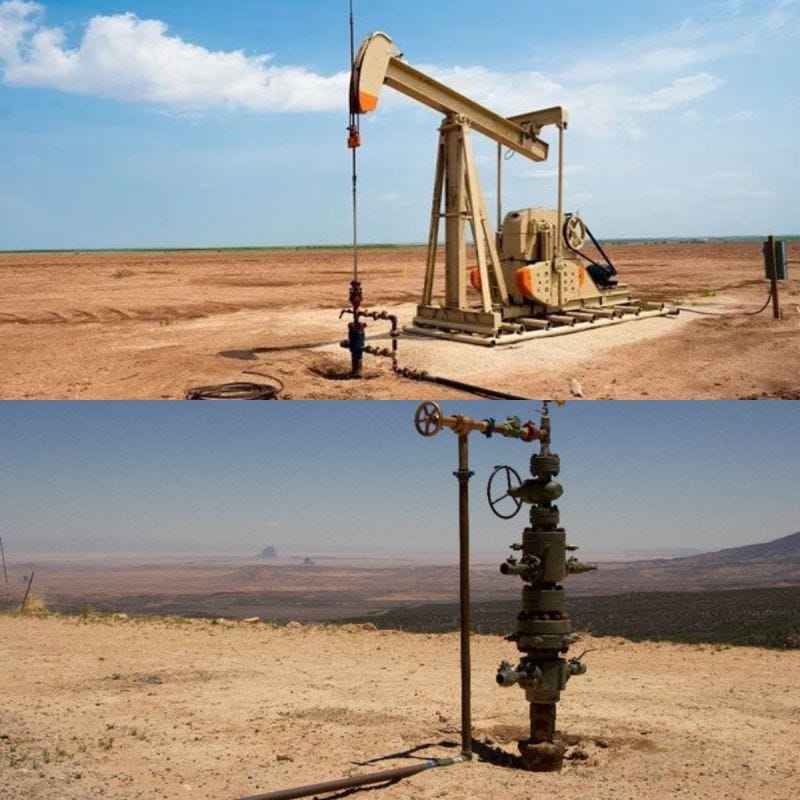
A tale of two wells. Oil on the top and gas on the bottom. One adds energy to the system, and the other controls existing energy.
[](https://substackcdn.com/image/fetch/$s_!wCIi!,f_auto,q_auto:good,fl_progressive:steep/https%3A%2F%2Fsubstack-post-media.s3.amazonaws.com%2Fpublic%2Fimages%2F1f6c4e88-ffdf-4fb2-bcfd-7b65272e1e59_800x800.jpeg)
Place an oil well and a gas well side by side, and the surface equipment tells you what is going on below. The above-ground infrastructure is a direct translation of the pressure, density, and drive mechanism beneath it.
An onshore oil well often carries a pump jack (which is a thing of simplistic beauty to me)
That nodding beam exists for one reason: artificial lift.
Early in a field’s life, reservoir pressure may be sufficient to push fluids to the surface.
As depletion progresses, the bottom-hole flowing pressure drops below the hydrostatic head of the crude column in the tubing.
Basically, the oil isn't gushing out on its own anymore, like in the movies.
Crude oil typically has a density of around 800-950 kg/m³. Over a vertical lift of 2000 metres (for example), this creates a hydrostatic pressure of 16 to 19 MPa, which must be overcome before a single barrel of oil reaches the surface.
Can't beat gravity.
The pump jack converts rotary motion from a surface motor into reciprocating motion at the polished rod.
Through sucker rods and a downhole pump, it adds mechanical energy to the system, reducing bottom-hole pressure and physically lifting liquid when reservoir energy alone is insufficient.
A gas well looks quieter (although it can be loud!)
Instead of motion, you see a Christmas tree, a vertical assembly of valves, chokes and gauges designed to contain and regulate high-pressure flow.
On land or offshore, the principle is the same: control rather than lift.
Natural gas has a much lower density, often below 200 kg/m³ at reservoir conditions, and it is highly compressible.
Provided the reservoir pressure exceeds the sum of the wellhead pressure, pipeline pressure, and friction losses, the gas will expand and flow to the surface without artificial lift.
In other words, it will flow to the surface on its own.
So, the one system adds energy to overcome the hydrostatic head. The other manages the energy in existing reservoirs and prevents it from escaping uncontrolled.
Both are surface expressions of subsurface physics.
In hydrocarbon engineering, facility design begins with pressure regime and fluid properties, and the equipment tells the story long before a production report does.
***
### Road Cats' Eyes
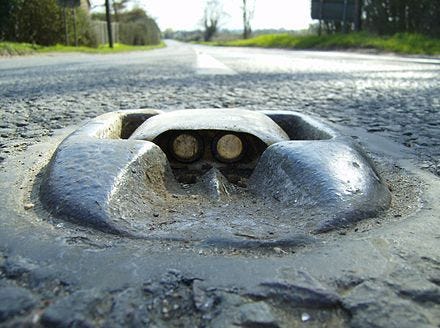
Thousands upon thousands of lives must have been saved by the original Catseye. Sitting flush with the tarmac, almost invisible until headlights find it - illuminating the road edge and alignment.
[](https://substackcdn.com/image/fetch/$s_!ZZ-Z!,f_auto,q_auto:good,fl_progressive:steep/https%3A%2F%2Fsubstack-post-media.s3.amazonaws.com%2Fpublic%2Fimages%2Fa130e6c6-d1c2-4d53-bf7a-7cfc015214b0_440x328.jpeg)
In heavy rain, painted lane markings disappear under a film of water.
Retroreflective road studs were designed to lift the signal above that film and send light straight back to the driver.
The clever part, however, is hidden beneath the surface.
In the classic 1934 design by Percy Shaw, biconvex glass lenses are mounted in a flexible rubber housing within a cast-iron base.
Rainwater collects in the base cavity, serving as a reservoir for the cleaning cycle.
How clever is that?
The mechanism is powered entirely by the "unavoidable load" of passing traffic:
\- \*\*Compression:\*\* As a tyre passes over, it depresses the rubber housing. This forces the glass lenses downward past a stationary rubber wiper
\- \*\*The Wash:\*\* In this single motion, the lenses are plunged into the trapped rainwater and wiped clean of road grime.
\- \*\*Recovery:\*\* As the vehicle moves on, the rubber rebounds, lifting the freshly cleaned reflectors back into the line of sight.
A rare example where vehicle contact (usually a durability nightmare) is transformed into the primary actuator for maintenance.
The cast-iron housing was designed with an internal "muck space" to allow silt to settle away from the moving parts, preventing grit from grinding down the glass over millions of cycles.
Optical performance relies on retroreflection, returning the incident light back toward the source within a few degrees.
At motorway speeds, this precise guidance provides the driver with vital seconds of situational awareness, directly impacting braking distances and lane discipline.
They are remarkably robust. When properly installed, a unit can withstand vertical loads exceeding 100 kN and endure the relentless pounding of heavy freight for years without failure.
No electronics, no maintenance crews, and no external power.
I just love simple, robust engineering like this.
***
### Britain's Sound Mirrors
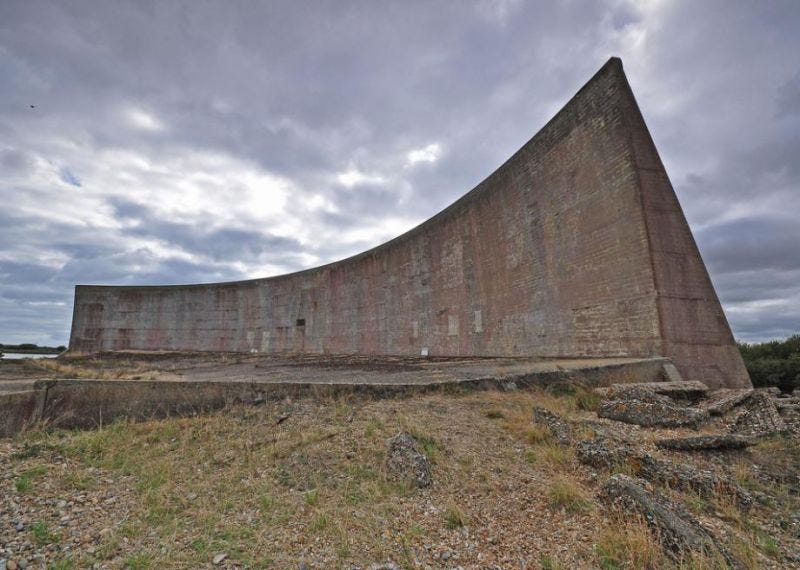
These giant concrete ears on the British coast were once the nation's first line of defence against aerial attacks. Before radar, they listened for the roar of enemy aircraft, capturing sounds from kilometres away across the English Channel.
[](https://substackcdn.com/image/fetch/$s_!zYnl!,f_auto,q_auto:good,fl_progressive:steep/https%3A%2F%2Fsubstack-post-media.s3.amazonaws.com%2Fpublic%2Fimages%2F1e470d19-ea33-426f-a7df-534d522db669_800x570.jpeg)
An unusual mix of civil, structural, acoustic and early electrical engineering.
Britain's sound mirrors, constructed between the World Wars, were an ingenious pre-radar method to detect approaching aircraft.
The mirrors' curved shapes focused sound waves onto a central point where microphones were placed.
While the smaller 6 m and 9 m dishes were parabolic to focus sound to a single spot, the largest of these, a 60 m curved wall at Denge, was spherical. This allowed operators to sweep the focal point along the curve to determine the bearing of an incoming flight.
The 60 m wall could pick up engine noise from as far as 24 km away.
This arrangement allowed the direction of the sound to be determined, much like a satellite dish captures signals from space.
However, increasing aircraft speed, combined with maritime traffic noise and urban development, reduced effectiveness. More capable radio-based detection systems soon overtook them.
By the 1930s, aircraft speed and altitude had exceeded the mirrors' limits. A detection range of roughly 24 km provided only a few minutes of warning.
They were ultimately abandoned with the arrival of radio direction finding, the precursor to radar.
Today, these acoustic structures stand as monuments to early 20th century innovation in military engineering.
They also demonstrate how quickly detection technology evolves, making even advanced systems of one era obsolete in the next.
***
### From My Work
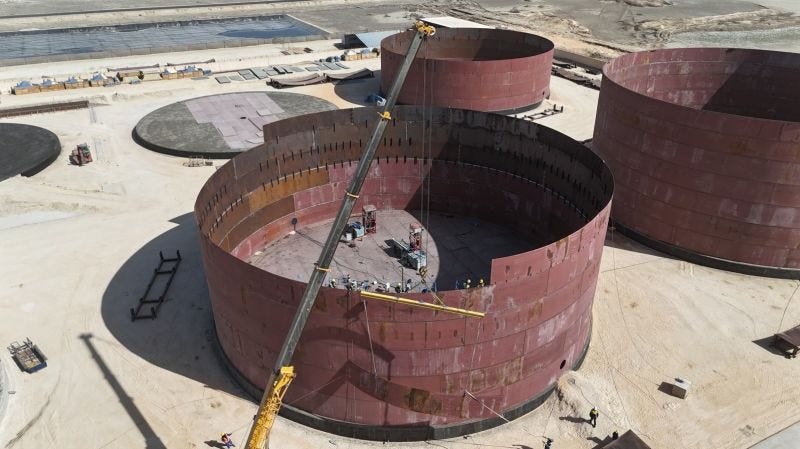
Nice further progress photo from our project in Mauritania, West Africa. You can see we are at six strakes with this one. A strake refers to each horizontal course of steel plates that forms the tank shell (the visible rings stacked one above another).
[](https://substackcdn.com/image/fetch/$s_!XFzp!,f_auto,q_auto:good,fl_progressive:steep/https%3A%2F%2Fsubstack-post-media.s3.amazonaws.com%2Fpublic%2Fimages%2Fdee67882-110c-4c6f-a877-27d38d4e69ed_800x449.jpeg)
The tank shell isn’t fabricated from a single continuous sheet; instead, it’s built up from multiple horizontal layers of rolled steel plates:
Each horizontal layer is called a strake (or “course”).
New shell plates are hoisted into position, tack-welded to the plates below, and then to adjacent plates within the same strake.
The vertical welds are completed first to join individual plates into a ring, followed by the circumferential welds (horizontal seams) to join the completed rings together.
So, when you see those horizontal weld seams circling a storage tank, each band between two seams represents one strake.
\-
The total tank farm size will be 100,000 m³, consisting of seven tanks.
Elsewhere, groundwork and foundation prep are completed.
This is a major project to expand our Swiss client's presence in West Africa, aimed at promoting the growth and prosperity of Mauritania and its people.
The work is conducted through our local Muaritanian-registered company, which has enabled us to establish deep relationships with local individuals and companies with whom we have formed partnerships.
Thanks for reading Built! Subscribe for free to receive new posts and support my work.
4
2
Share
#### Discussion about this post
Comments
Restacks
[](https://substack.com/profile/87771948-lewis-cluett?utm_source=comment)
[Lewis Cluett](https://substack.com/profile/87771948-lewis-cluett?utm_source=substack-feed-item)
[3d](https://mennogazendam.substack.com/p/built-092026/comment/221404376 "Mar 1, 2026, 2:43 PM")
Great post: Love the images\!
[Reply]()
[Share]()
[1 reply by Menno Gazendam](https://mennogazendam.substack.com/p/built-092026/comment/221404376)
[1 more comment...](https://mennogazendam.substack.com/p/built-092026/comments)
Top
Latest
Discussions
No posts
### Ready for more?
© 2026 Menno Gazendam · [Privacy](https://substack.com/privacy) ∙ [Terms](https://substack.com/tos) ∙ [Collection notice](https://substack.com/ccpa#personal-data-collected)
[Start your Substack](https://substack.com/signup?utm_source=substack&utm_medium=web&utm_content=footer)
[Get the app](https://substack.com/app/app-store-redirect?utm_campaign=app-marketing&utm_content=web-footer-button)
[Substack](https://substack.com/) is the home for great culture
This site requires JavaScript to run correctly. Please [turn on JavaScript](https://enable-javascript.com/) or unblock scripts |
| Readable Markdown | A tale of two wells. Oil on the top and gas on the bottom. One adds energy to the system, and the other controls existing energy.
[](https://substackcdn.com/image/fetch/$s_!wCIi!,f_auto,q_auto:good,fl_progressive:steep/https%3A%2F%2Fsubstack-post-media.s3.amazonaws.com%2Fpublic%2Fimages%2F1f6c4e88-ffdf-4fb2-bcfd-7b65272e1e59_800x800.jpeg)
Place an oil well and a gas well side by side, and the surface equipment tells you what is going on below. The above-ground infrastructure is a direct translation of the pressure, density, and drive mechanism beneath it.
An onshore oil well often carries a pump jack (which is a thing of simplistic beauty to me)
That nodding beam exists for one reason: artificial lift.
Early in a field’s life, reservoir pressure may be sufficient to push fluids to the surface.
As depletion progresses, the bottom-hole flowing pressure drops below the hydrostatic head of the crude column in the tubing.
Basically, the oil isn't gushing out on its own anymore, like in the movies.
Crude oil typically has a density of around 800-950 kg/m³. Over a vertical lift of 2000 metres (for example), this creates a hydrostatic pressure of 16 to 19 MPa, which must be overcome before a single barrel of oil reaches the surface.
Can't beat gravity.
The pump jack converts rotary motion from a surface motor into reciprocating motion at the polished rod.
Through sucker rods and a downhole pump, it adds mechanical energy to the system, reducing bottom-hole pressure and physically lifting liquid when reservoir energy alone is insufficient.
A gas well looks quieter (although it can be loud!)
Instead of motion, you see a Christmas tree, a vertical assembly of valves, chokes and gauges designed to contain and regulate high-pressure flow.
On land or offshore, the principle is the same: control rather than lift.
Natural gas has a much lower density, often below 200 kg/m³ at reservoir conditions, and it is highly compressible.
Provided the reservoir pressure exceeds the sum of the wellhead pressure, pipeline pressure, and friction losses, the gas will expand and flow to the surface without artificial lift.
In other words, it will flow to the surface on its own.
So, the one system adds energy to overcome the hydrostatic head. The other manages the energy in existing reservoirs and prevents it from escaping uncontrolled.
Both are surface expressions of subsurface physics.
In hydrocarbon engineering, facility design begins with pressure regime and fluid properties, and the equipment tells the story long before a production report does.
Thousands upon thousands of lives must have been saved by the original Catseye. Sitting flush with the tarmac, almost invisible until headlights find it - illuminating the road edge and alignment.
[](https://substackcdn.com/image/fetch/$s_!ZZ-Z!,f_auto,q_auto:good,fl_progressive:steep/https%3A%2F%2Fsubstack-post-media.s3.amazonaws.com%2Fpublic%2Fimages%2Fa130e6c6-d1c2-4d53-bf7a-7cfc015214b0_440x328.jpeg)
In heavy rain, painted lane markings disappear under a film of water.
Retroreflective road studs were designed to lift the signal above that film and send light straight back to the driver.
The clever part, however, is hidden beneath the surface.
In the classic 1934 design by Percy Shaw, biconvex glass lenses are mounted in a flexible rubber housing within a cast-iron base.
Rainwater collects in the base cavity, serving as a reservoir for the cleaning cycle.
How clever is that?
The mechanism is powered entirely by the "unavoidable load" of passing traffic:
\- \*\*Compression:\*\* As a tyre passes over, it depresses the rubber housing. This forces the glass lenses downward past a stationary rubber wiper
\- \*\*The Wash:\*\* In this single motion, the lenses are plunged into the trapped rainwater and wiped clean of road grime.
\- \*\*Recovery:\*\* As the vehicle moves on, the rubber rebounds, lifting the freshly cleaned reflectors back into the line of sight.
A rare example where vehicle contact (usually a durability nightmare) is transformed into the primary actuator for maintenance.
The cast-iron housing was designed with an internal "muck space" to allow silt to settle away from the moving parts, preventing grit from grinding down the glass over millions of cycles.
Optical performance relies on retroreflection, returning the incident light back toward the source within a few degrees.
At motorway speeds, this precise guidance provides the driver with vital seconds of situational awareness, directly impacting braking distances and lane discipline.
They are remarkably robust. When properly installed, a unit can withstand vertical loads exceeding 100 kN and endure the relentless pounding of heavy freight for years without failure.
No electronics, no maintenance crews, and no external power.
I just love simple, robust engineering like this.
These giant concrete ears on the British coast were once the nation's first line of defence against aerial attacks. Before radar, they listened for the roar of enemy aircraft, capturing sounds from kilometres away across the English Channel.
[](https://substackcdn.com/image/fetch/$s_!zYnl!,f_auto,q_auto:good,fl_progressive:steep/https%3A%2F%2Fsubstack-post-media.s3.amazonaws.com%2Fpublic%2Fimages%2F1e470d19-ea33-426f-a7df-534d522db669_800x570.jpeg)
An unusual mix of civil, structural, acoustic and early electrical engineering.
Britain's sound mirrors, constructed between the World Wars, were an ingenious pre-radar method to detect approaching aircraft.
The mirrors' curved shapes focused sound waves onto a central point where microphones were placed.
While the smaller 6 m and 9 m dishes were parabolic to focus sound to a single spot, the largest of these, a 60 m curved wall at Denge, was spherical. This allowed operators to sweep the focal point along the curve to determine the bearing of an incoming flight.
The 60 m wall could pick up engine noise from as far as 24 km away.
This arrangement allowed the direction of the sound to be determined, much like a satellite dish captures signals from space.
However, increasing aircraft speed, combined with maritime traffic noise and urban development, reduced effectiveness. More capable radio-based detection systems soon overtook them.
By the 1930s, aircraft speed and altitude had exceeded the mirrors' limits. A detection range of roughly 24 km provided only a few minutes of warning.
They were ultimately abandoned with the arrival of radio direction finding, the precursor to radar.
Today, these acoustic structures stand as monuments to early 20th century innovation in military engineering.
They also demonstrate how quickly detection technology evolves, making even advanced systems of one era obsolete in the next.
Nice further progress photo from our project in Mauritania, West Africa. You can see we are at six strakes with this one. A strake refers to each horizontal course of steel plates that forms the tank shell (the visible rings stacked one above another).
[](https://substackcdn.com/image/fetch/$s_!XFzp!,f_auto,q_auto:good,fl_progressive:steep/https%3A%2F%2Fsubstack-post-media.s3.amazonaws.com%2Fpublic%2Fimages%2Fdee67882-110c-4c6f-a877-27d38d4e69ed_800x449.jpeg)
The tank shell isn’t fabricated from a single continuous sheet; instead, it’s built up from multiple horizontal layers of rolled steel plates:
Each horizontal layer is called a strake (or “course”).
New shell plates are hoisted into position, tack-welded to the plates below, and then to adjacent plates within the same strake.
The vertical welds are completed first to join individual plates into a ring, followed by the circumferential welds (horizontal seams) to join the completed rings together.
So, when you see those horizontal weld seams circling a storage tank, each band between two seams represents one strake.
\-
The total tank farm size will be 100,000 m³, consisting of seven tanks.
Elsewhere, groundwork and foundation prep are completed.
This is a major project to expand our Swiss client's presence in West Africa, aimed at promoting the growth and prosperity of Mauritania and its people.
The work is conducted through our local Muaritanian-registered company, which has enabled us to establish deep relationships with local individuals and companies with whom we have formed partnerships.
No posts |
| Shard | 76 (laksa) |
| Root Hash | 14862242593741677076 |
| Unparsed URL | com,substack!mennogazendam,/p/built-092026 s443 |