ℹ️ Skipped - page is already crawled
| Filter | Status | Condition | Details |
|---|---|---|---|
| HTTP status | PASS | download_http_code = 200 | HTTP 200 |
| Age cutoff | PASS | download_stamp > now() - 6 MONTH | 0.4 months ago |
| History drop | PASS | isNull(history_drop_reason) | No drop reason |
| Spam/ban | PASS | fh_dont_index != 1 AND ml_spam_score = 0 | ml_spam_score=0 |
| Canonical | PASS | meta_canonical IS NULL OR = '' OR = src_unparsed | Not set |
| Property | Value |
|---|---|
| URL | https://mathmonks.com/number-system/binary-number-system/binary-multiplication |
| Last Crawled | 2026-04-08 18:01:52 (12 days ago) |
| First Indexed | 2023-10-30 20:27:19 (2 years ago) |
| HTTP Status Code | 200 |
| Meta Title | Binary Multiplication - Rules, Overflow, and Solved Examples |
| Meta Description | How to do multiplication in the binary number system with rules, overflow, and examples. |
| Meta Canonical | null |
| Boilerpipe Text | Binary multiplication is multiplication involving 2 binary numbers. It is similar to decimal multiplication. Here, we have a multiplier and a multiplicand. The result is the product.
It is nothing but repeated addition until all the multiplier is used up and the final addition is done.
Rules
The multiplication involving 2 binary numbers, 0 and 1, follows the 4 rules:
Multiplicand
Multiplier
Product
0
0
0 × 0 = 0
0
1
0 × 1 = 0
1
0
1 × 0 = 0
1
1
1 × 1 = 1
Steps
Multiplying 2 binary numbers involves the following steps:
Step 1
: Aligning the multiplicand and the multiplier one above the other.
Step 2
: Multiplying the multiplier’s rightmost digit or the least significant bit (LSB) with the multiplicand.
Step 3
: Placing X before multiplying the next digit of the multiplier and with the multiplicand.
Step 4
: Repeating the same process for all the multiplier digits until we reach the most significant bit (MSB), the left-most digit of the multiplicand.
Step 5
: The product obtained in each row is called the partial product. Adding all the partial products using the binary addition rules (0 + 0 = 0, 0 + 1 = 1, 1 + 0 = 1, and 1 + 1 = 10) gives the result.
Let us multiply (10101)
2
and (101)
2
The decimal equivalent of:
(10101)
2
→ (21)
10
(101)
2
→ (5)
10
Thus, the product of (10101)
2
and (101)
2
is (1101001)
2
We can verify our answer by finding the decimal equivalent of (1101001)
2
, which is (105)
10
. Learn binary to decimal conversion here.
Also, on multiplying the decimal equivalents of the 2 binary numbers, we get 21 × 5 = 105
This answer proves that the answer to the binary multiplication between (10101)
2
and (101)
2
= 105 is correct.
Solved Example
Find the product of (11001)
2
and (111)
2.
Solution:
The decimal equivalent of:
(11001)
2
→ 25
(111)
2
→ 7
Thus, the product of (11001)
2
and (111)
2
is (10101111)
2
The decimal equivalent of (10101111)
2
is (175)
10
Also, 25 × 5 = 175Thus, the product of (11001)
2
and (111)
2
that is175 is correct. |
| Markdown | [](https://mathmonks.com/)
- [Shapes](https://mathmonks.com/number-system/binary-number-system/binary-multiplication)
- [Rectangle](https://mathmonks.com/rectangle)
- [Square](https://mathmonks.com/square)
- [Circle](https://mathmonks.com/circle)
- [Triangle](https://mathmonks.com/triangle)
- [Rhombus](https://mathmonks.com/rhombus)
- [Squircle](https://mathmonks.com/squircle)
- [Oval](https://mathmonks.com/oval)
- [Hexagon](https://mathmonks.com/hexagon)
- [Pentagon](https://mathmonks.com/pentagon)
- [Trapezoid](https://mathmonks.com/trapezoid)
- [Kite](https://mathmonks.com/kite)
- [Parallelogram](https://mathmonks.com/parallelogram)
- [Quadrilateral](https://mathmonks.com/quadrilateral)
- [Polygon](https://mathmonks.com/polygon)
- [Nonagon](https://mathmonks.com/nonagon)
- [Heptagon](https://mathmonks.com/heptagon)
- [Decagon](https://mathmonks.com/decagon)
- [Octagon](https://mathmonks.com/octagon)
- [Ellipse](https://mathmonks.com/ellipse)
- [Parallelepiped](https://mathmonks.com/parallelepiped)
- [Tetrahedron](https://mathmonks.com/tetrahedron)
- [Cylinder](https://mathmonks.com/cylinder)
- [Prism](https://mathmonks.com/prism)
- [Sphere](https://mathmonks.com/sphere)
- [Pyramid](https://mathmonks.com/pyramid)
- [Frustum](https://mathmonks.com/frustum)
- [Polyhedron](https://mathmonks.com/polyhedron)
- [Dodecagon](https://mathmonks.com/dodecagon)
- [Dodecahedron](https://mathmonks.com/dodecahedron)
- [Octahedron](https://mathmonks.com/octahedron)
- [Torus](https://mathmonks.com/torus)
- [Cube](https://mathmonks.com/cube)
- [Cone](https://mathmonks.com/cone)
- [Hyperbola](https://mathmonks.com/hyperbola)
- [Rectangular Prism](https://mathmonks.com/prism/rectangular-prism)
- [Fibonacci Sequence](https://mathmonks.com/fibonacci-sequence)
- [Golden Ratio](https://mathmonks.com/golden-ratio)
- [Parabola](https://mathmonks.com/parabola)
- [Worksheets](https://mathmonks.com/worksheets)
- [Calculators](https://mathmonks.com/calculators-tools)
- [Fraction Calculator](https://mathmonks.com/calculators-tools/fraction-calculator)
- [Mixed Fraction Calculator](https://mathmonks.com/calculators-tools/mixed-fraction-calculator)
- [Greatest Common Factor Calulator](https://mathmonks.com/calculators-tools/greatest-common-factor-calulator)
- [Decimal to Fraction Calculator](https://mathmonks.com/calculators-tools/decimal-to-fraction-calculator)
- [Angle](https://mathmonks.com/angle)
- [Arithmetic](https://mathmonks.com/arithmetic)
- [Whole Numbers](https://mathmonks.com/whole-numbers)
- [Rational Numbers](https://mathmonks.com/rational-numbers)
- [Place Value](https://mathmonks.com/place-value)
- [Irrational Numbers](https://mathmonks.com/irrational-numbers)
- [Natural Numbers](https://mathmonks.com/natural-numbers)
- [Binary Operation](https://mathmonks.com/binary-operation)
- [Numerator and Denominator](https://mathmonks.com/numerator-and-denominator)
- [Decimal](https://mathmonks.com/decimal)
- [Order of Operations (PEMDAS)](https://mathmonks.com/order-of-operations-pemdas)
- [Scientific Notation](https://mathmonks.com/scientific-notation)
- [Symmetry](https://mathmonks.com/symmetry)
- [Fractions](https://mathmonks.com/fractions)
- [Triangular Number](https://mathmonks.com/triangular-number)
- [Complex Number](https://mathmonks.com/complex-number)
- [Binary Number System](https://mathmonks.com/number-system/binary-number-system)
- [Logarithm](https://mathmonks.com/logarithm)
- [Binomial Theorem](https://mathmonks.com/binomial-theorem)
- [Quartic Function](https://mathmonks.com/quartic-function)
- [Mathematical Induction](https://mathmonks.com/mathematical-induction)
- [Group Theory](https://mathmonks.com/group-theory)
- [Modular Arithmetic](https://mathmonks.com/modular-arithmetic)
- [Euler’s Number](https://mathmonks.com/eulers-number)
- [Inequalities](https://mathmonks.com/inequalities)
- [Sets](https://mathmonks.com/sets)
- [De Morgan’s Laws](https://mathmonks.com/de-morgans-laws)
- [Transcendental Numbers](https://mathmonks.com/transcendental-numbers)
- [About Us](https://mathmonks.com/about-us)
- [Shapes](https://mathmonks.com/number-system/binary-number-system/binary-multiplication)
- [Rectangle](https://mathmonks.com/rectangle)
- [Square](https://mathmonks.com/square)
- [Circle](https://mathmonks.com/circle)
- [Triangle](https://mathmonks.com/triangle)
- [Rhombus](https://mathmonks.com/rhombus)
- [Squircle](https://mathmonks.com/squircle)
- [Oval](https://mathmonks.com/oval)
- [Hexagon](https://mathmonks.com/hexagon)
- [Pentagon](https://mathmonks.com/pentagon)
- [Trapezoid](https://mathmonks.com/trapezoid)
- [Kite](https://mathmonks.com/kite)
- [Parallelogram](https://mathmonks.com/parallelogram)
- [Quadrilateral](https://mathmonks.com/quadrilateral)
- [Polygon](https://mathmonks.com/polygon)
- [Nonagon](https://mathmonks.com/nonagon)
- [Heptagon](https://mathmonks.com/heptagon)
- [Decagon](https://mathmonks.com/decagon)
- [Octagon](https://mathmonks.com/octagon)
- [Ellipse](https://mathmonks.com/ellipse)
- [Parallelepiped](https://mathmonks.com/parallelepiped)
- [Tetrahedron](https://mathmonks.com/tetrahedron)
- [Cylinder](https://mathmonks.com/cylinder)
- [Prism](https://mathmonks.com/prism)
- [Sphere](https://mathmonks.com/sphere)
- [Pyramid](https://mathmonks.com/pyramid)
- [Frustum](https://mathmonks.com/frustum)
- [Polyhedron](https://mathmonks.com/polyhedron)
- [Dodecagon](https://mathmonks.com/dodecagon)
- [Dodecahedron](https://mathmonks.com/dodecahedron)
- [Octahedron](https://mathmonks.com/octahedron)
- [Torus](https://mathmonks.com/torus)
- [Cube](https://mathmonks.com/cube)
- [Cone](https://mathmonks.com/cone)
- [Hyperbola](https://mathmonks.com/hyperbola)
- [Rectangular Prism](https://mathmonks.com/prism/rectangular-prism)
- [Fibonacci Sequence](https://mathmonks.com/fibonacci-sequence)
- [Golden Ratio](https://mathmonks.com/golden-ratio)
- [Parabola](https://mathmonks.com/parabola)
- [Worksheets](https://mathmonks.com/worksheets)
- [Calculators](https://mathmonks.com/calculators-tools)
- [Fraction Calculator](https://mathmonks.com/calculators-tools/fraction-calculator)
- [Mixed Fraction Calculator](https://mathmonks.com/calculators-tools/mixed-fraction-calculator)
- [Greatest Common Factor Calulator](https://mathmonks.com/calculators-tools/greatest-common-factor-calulator)
- [Decimal to Fraction Calculator](https://mathmonks.com/calculators-tools/decimal-to-fraction-calculator)
- [Angle](https://mathmonks.com/angle)
- [Arithmetic](https://mathmonks.com/arithmetic)
- [Whole Numbers](https://mathmonks.com/whole-numbers)
- [Rational Numbers](https://mathmonks.com/rational-numbers)
- [Place Value](https://mathmonks.com/place-value)
- [Irrational Numbers](https://mathmonks.com/irrational-numbers)
- [Natural Numbers](https://mathmonks.com/natural-numbers)
- [Binary Operation](https://mathmonks.com/binary-operation)
- [Numerator and Denominator](https://mathmonks.com/numerator-and-denominator)
- [Decimal](https://mathmonks.com/decimal)
- [Order of Operations (PEMDAS)](https://mathmonks.com/order-of-operations-pemdas)
- [Scientific Notation](https://mathmonks.com/scientific-notation)
- [Symmetry](https://mathmonks.com/symmetry)
- [Fractions](https://mathmonks.com/fractions)
- [Triangular Number](https://mathmonks.com/triangular-number)
- [Complex Number](https://mathmonks.com/complex-number)
- [Binary Number System](https://mathmonks.com/number-system/binary-number-system)
- [Logarithm](https://mathmonks.com/logarithm)
- [Binomial Theorem](https://mathmonks.com/binomial-theorem)
- [Quartic Function](https://mathmonks.com/quartic-function)
- [Mathematical Induction](https://mathmonks.com/mathematical-induction)
- [Group Theory](https://mathmonks.com/group-theory)
- [Modular Arithmetic](https://mathmonks.com/modular-arithmetic)
- [Euler’s Number](https://mathmonks.com/eulers-number)
- [Inequalities](https://mathmonks.com/inequalities)
- [Sets](https://mathmonks.com/sets)
- [De Morgan’s Laws](https://mathmonks.com/de-morgans-laws)
- [Transcendental Numbers](https://mathmonks.com/transcendental-numbers)
- [About Us](https://mathmonks.com/about-us)
Search
Table of Contents
- [Rules](https://mathmonks.com/number-system/binary-number-system/binary-multiplication#Rules)
- [Steps](https://mathmonks.com/number-system/binary-number-system/binary-multiplication#Steps)
- [Solved Example](https://mathmonks.com/number-system/binary-number-system/binary-multiplication#Solved_Example)
Last modified on February 7th, 2024
### chapter outline
- [Rules](https://mathmonks.com/number-system/binary-number-system/binary-multiplication#Rules)
- [Steps](https://mathmonks.com/number-system/binary-number-system/binary-multiplication#Steps)
- [Solved Example](https://mathmonks.com/number-system/binary-number-system/binary-multiplication#Solved_Example)
[Home](https://mathmonks.com/) » [Arithmetic](https://mathmonks.com/arithmetic) » [Number System](https://mathmonks.com/number-system) » [Binary Number System](https://mathmonks.com/number-system/binary-number-system) » Binary Multiplication
# Binary Multiplication
Binary multiplication is multiplication involving 2 binary numbers. It is similar to decimal multiplication. Here, we have a multiplier and a multiplicand. The result is the product.
It is nothing but repeated addition until all the multiplier is used up and the final addition is done.
## Rules
The multiplication involving 2 binary numbers, 0 and 1, follows the 4 rules:
| **Multiplicand** | **Multiplier** | **Product** |
|---|---|---|
| 0 | 0 | 0 × 0 = 0 |
| 0 | 1 | 0 × 1 = 0 |
| 1 | 0 | 1 × 0 = 0 |
| 1 | 1 | 1 × 1 = 1 |
## Steps
Multiplying 2 binary numbers involves the following steps:
**Step 1**: Aligning the multiplicand and the multiplier one above the other.
**Step 2**: Multiplying the multiplier’s rightmost digit or the least significant bit (LSB) with the multiplicand.
**Step 3**: Placing X before multiplying the next digit of the multiplier and with the multiplicand.
**Step 4**: Repeating the same process for all the multiplier digits until we reach the most significant bit (MSB), the left-most digit of the multiplicand.
**Step 5**: The product obtained in each row is called the partial product. Adding all the partial products using the binary addition rules (0 + 0 = 0, 0 + 1 = 1, 1 + 0 = 1, and 1 + 1 = 10) gives the result.
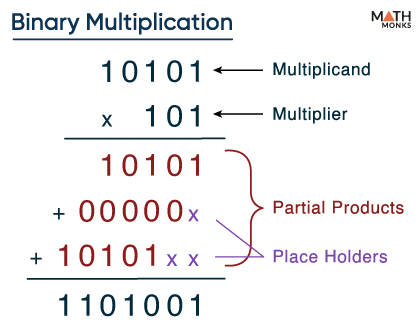
Let us multiply (10101)2 and (101)2
The decimal equivalent of:
(10101)2 → (21)10
(101)2→ (5)10
[](https://mathmonks.com/wp-content/uploads/2024/02/Binary-Multiplication.jpg)
Thus, the product of (10101)2 and (101)2 is (1101001)2
We can verify our answer by finding the decimal equivalent of (1101001)2, which is (105)10. Learn binary to decimal conversion here.
Also, on multiplying the decimal equivalents of the 2 binary numbers, we get 21 × 5 = 105
This answer proves that the answer to the binary multiplication between (10101)2 and (101)2 = 105 is correct.
## Solved Example
![]()**Find the product of (11001)2 and (111)2\.**
Solution:
![]()
The decimal equivalent of:
(11001)2 → 25
(111)2 → 7
Thus, the product of (11001)2 and (111)2 is (10101111)2
The decimal equivalent of (10101111)2 is (175)10
Also, 25 × 5 = 175Thus, the product of (11001)2 and (111)2 that is175 is correct.
Last modified on February 7th, 2024
- - [About us](https://mathmonks.com/about-us)
- [Contact us](https://mathmonks.com/contact-us)
- [Privacy Policy](https://mathmonks.com/privacy-policy)
- [Terms of Use](https://mathmonks.com/terms-of-use)
- - [Algebra](https://mathmonks.com/algebra)
- [Arithmetic](https://mathmonks.com/arithmetic)
- [Geometry](https://mathmonks.com/geometry)
- [Statistics](https://mathmonks.com/statistics)
- [Trigonometry](https://mathmonks.com/trigonometry)
### Join Our Newsletter
© 2026 [Mathmonks.com](https://mathmonks.com/). All rights reserved. Reproduction in whole or in part without permission is prohibited. |
| Readable Markdown | Binary multiplication is multiplication involving 2 binary numbers. It is similar to decimal multiplication. Here, we have a multiplier and a multiplicand. The result is the product.
It is nothing but repeated addition until all the multiplier is used up and the final addition is done.
## Rules
The multiplication involving 2 binary numbers, 0 and 1, follows the 4 rules:
| **Multiplicand** | **Multiplier** | **Product** |
|---|---|---|
| 0 | 0 | 0 × 0 = 0 |
| 0 | 1 | 0 × 1 = 0 |
| 1 | 0 | 1 × 0 = 0 |
| 1 | 1 | 1 × 1 = 1 |
## Steps
Multiplying 2 binary numbers involves the following steps:
**Step 1**: Aligning the multiplicand and the multiplier one above the other.
**Step 2**: Multiplying the multiplier’s rightmost digit or the least significant bit (LSB) with the multiplicand.
**Step 3**: Placing X before multiplying the next digit of the multiplier and with the multiplicand.
**Step 4**: Repeating the same process for all the multiplier digits until we reach the most significant bit (MSB), the left-most digit of the multiplicand.
**Step 5**: The product obtained in each row is called the partial product. Adding all the partial products using the binary addition rules (0 + 0 = 0, 0 + 1 = 1, 1 + 0 = 1, and 1 + 1 = 10) gives the result.
Let us multiply (10101)2 and (101)2
The decimal equivalent of:
(10101)2 → (21)10
(101)2→ (5)10
[](https://mathmonks.com/wp-content/uploads/2024/02/Binary-Multiplication.jpg)
Thus, the product of (10101)2 and (101)2 is (1101001)2
We can verify our answer by finding the decimal equivalent of (1101001)2, which is (105)10. Learn binary to decimal conversion here.
Also, on multiplying the decimal equivalents of the 2 binary numbers, we get 21 × 5 = 105
This answer proves that the answer to the binary multiplication between (10101)2 and (101)2 = 105 is correct.
## Solved Example
**Find the product of (11001)2 and (111)2\.**
Solution:
The decimal equivalent of:
(11001)2 → 25
(111)2 → 7
Thus, the product of (11001)2 and (111)2 is (10101111)2
The decimal equivalent of (10101111)2 is (175)10
Also, 25 × 5 = 175Thus, the product of (11001)2 and (111)2 that is175 is correct. |
| Shard | 14 (laksa) |
| Root Hash | 17897760848772399214 |
| Unparsed URL | com,mathmonks!/number-system/binary-number-system/binary-multiplication s443 |