ℹ️ Skipped - page is already crawled
| Filter | Status | Condition | Details |
|---|---|---|---|
| HTTP status | PASS | download_http_code = 200 | HTTP 200 |
| Age cutoff | PASS | download_stamp > now() - 6 MONTH | 0.3 months ago |
| History drop | PASS | isNull(history_drop_reason) | No drop reason |
| Spam/ban | PASS | fh_dont_index != 1 AND ml_spam_score = 0 | ml_spam_score=0 |
| Canonical | PASS | meta_canonical IS NULL OR = '' OR = src_unparsed | Not set |
| Property | Value |
|---|---|
| URL | https://mathalino.com/reviewer/fluid-mechanics-and-hydraulics/principles-hydrostatic-pressures |
| Last Crawled | 2026-04-04 07:24:00 (9 days ago) |
| First Indexed | 2020-04-28 10:54:53 (5 years ago) |
| HTTP Status Code | 200 |
| Meta Title | Principles of Hydrostatic Pressures | Fluid Mechanics and Hydraulics Review at MATHalino |
| Meta Description | Unit Pressure Unit pressure or simply called pressure is the amount of force exerted by a fluid distributed uniformly over a unit area. $p = \dfrac{Force, \, F}{Area, \, A}$ If the unit pressure is not uniform over the unit area, it can be expressed as the sum of differential pressure. $\displaystyle p = \int \dfrac{dF}{dA}$ Blaise Pascal (1623 – 1662) Since fluid at rest cannot resist shearing stress, pressure is always at right angle to the area where it is acting. It is also worthy to note that the total hydrostatic force F = pA, which can be found by cross multiplication. |
| Meta Canonical | null |
| Boilerpipe Text | Back to top
Unit Pressure
Unit pressure or simply called pressure is the amount of force exerted by a fluid distributed uniformly over a unit area.
$p = \dfrac{Force, \, F}{Area, \, A}$
If the unit pressure is not uniform over the unit area, it can be expressed as the sum of differential pressure.
$\displaystyle p = \int \dfrac{dF}{dA}$
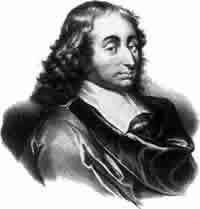
Blaise Pascal (1623 – 1662)
Since fluid at rest cannot resist shearing stress, pressure is always at right angle to the area where it is acting. It is also worthy to note that the total hydrostatic force
F = pA
, which can be found by cross multiplication.
Back to top
Pascal’s Law
The French mathematician Blaise Pascal (1623 – 1662) states that the pressure is the same in all directions at any point in a fluid at rest.
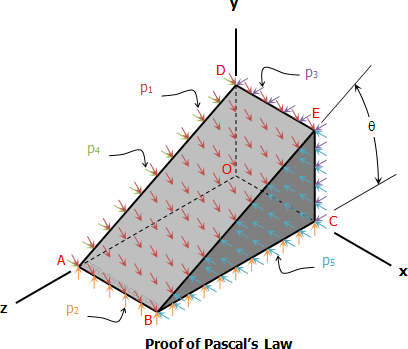
From the figure shown below, summation of forces in
y
-direction:
$\Sigma F_y = 0$
$p_2A_{ABCO} = (p_1 A_{ABED}) \cos \theta $
$p_2A_{ABCO} = p_1 (A_{ABED} \cos \theta)$
Since $A_{ABCO} = A_{ABED} \cos \theta$, $p_2 = p_1$.
Summation of forces in
z
-direction:
$\Sigma F_z = 0$
$p_3A_{OCED} = (p_1 A_{ABED}) \sin \theta$
$p_3A_{OCED} = p_1 (A_{ABED} \sin \theta)$
Since $A_{OCED} = A_{ABED}\sin \theta$, $p_3 = p_1$.
Thus,
$p_1 = p_2 = p_3$ which can be used to conclude Pascal's Law.
Summation of forces in
x
-direction:
$\Sigma F_x = 0$
$p_4A_{AOD} = p_5A_{BCE}$
Since $A_{AOD} = A_{BCE}$, $p_4 = p_5$.
Back to top
Atmospheric, Gauge, and Absolute Pressures
Atmospheric pressure
is the weight of all gasses above the surface in which it comes in contact. Under normal conditions, atmospheric pressure at sea level is equal to 101.325 kPa (14.696 psi), usually rounded off to 100 kPa (14.7 psi) by engineers. With increase in altitude, atmospheric pressure decreases.
Gauge pressure
, measured with the use of pressure gauges, is the pressure above or below atmospheric pressure. Negative gauge pressure indicates a vacuum which cannot go below –101.325 kPa. Positive gauge pressure indicates that the pressure is above atmospheric. Gauge pressure is also called
relative pressure
.
Absolute pressure
is equal to gauge pressure plus atmospheric pressure. There is no such thing as negative absolute pressure. In the absence of all matter (complete vacuum), the absolute pressure is zero.
$p_{absolute} = p_{atmospheric} + p_{gauge}$
Back to top
Pressure Gauges
Just for the purpose of completeness of this page, pressure gauges (or pressure instruments) are listed here. For more detailed discussion about pressure gauges, refer to the links in each type of pressure instrument. Some general types of pressures instruments are as follows.
Barometer - used to measure atmospheric pressure.
Wikipedia article
.
Manometer
- a U-tube that contains liquid of known specific gravity.
Wikipedia article
.
Bourdon gauge - used to measure large pressure difference.
Integrated Publishing article
. |
| Markdown | [Skip to main content](https://mathalino.com/reviewer/fluid-mechanics-and-hydraulics/principles-hydrostatic-pressures#block-mathalino-theme-content)
[](https://mathalino.com/ "Home")**[MATHalino](https://mathalino.com/ "Home")***Engineering Math Review*
## Search form
[**Login**](https://mathalino.com/user/login) • [**Register**](https://mathalino.com/user/register)
- [Home](https://mathalino.com/)
- [Recent](https://mathalino.com/recent)
- [Glossary](https://mathalino.com/glossary)
- [About](https://mathalino.com/about "About")
- [Algebra](https://mathalino.com/reviewer/college-algebra "College Algebra")
- [Derivation of Formulas](https://mathalino.com/reviewer/derivation-of-formulas/derivation-of-formulas)
- [Engineering Economy](https://mathalino.com/reviewer/engineering-economy/engineering-economy)
- [General Engineering](https://mathalino.com/reviewer/general-engineering/general-engineering)
- [Trigo](https://mathalino.com/reviewer/plane-trigonometry "Plane Trigonometry")
- [Spherical Trigonometry](https://mathalino.com/reviewer/spherical-trigonometry/spherical-trigonometry)
- [Geometry](https://mathalino.com/reviewer/plane-geometry/plane-geometry "Plane Geometry")
- [Solid Geometry](https://mathalino.com/reviewer/solid-mensuration/solid-mensuration)
- [Analytic Geometry](https://mathalino.com/reviewer/analytic-geometry/analytic-geometry)
- [Calculus](https://mathalino.com/reviewer/differential-calculus/differential-calculus "Differential Calculus")
- [Integral Calculus](https://mathalino.com/reviewer/integral-calculus/integral-calculus)
- [Differential Equations](https://mathalino.com/reviewer/elementary-differential-equations/elementary-differential-equations)
- [Advance Engineering Mathematics](https://mathalino.com/reviewer/advance-engineering-mathematics/advance-engineering-mathematics)
- [Mechanics](https://mathalino.com/reviewer/engineering-mechanics/engineering-mechanics "Engineering Mechanics")
- [Strength of Materials](https://mathalino.com/reviewer/mechanics-and-strength-of-materials/mechanics-and-strength-of-materials)
- [Structural Analysis](https://mathalino.com/reviewer/structural-analysis)
- [CE](https://mathalino.com/civil-engineering-reference "Civil Engineering")
- [CE Board: Math](https://mathalino.com/ce-board-subject/mathematics-surveying-and-transportation-engineering)
- [CE Board: Hydro Geo](https://mathalino.com/ce-board-subject/hydraulics-and-geotechnical-engineering)
- [CE Board: Design](https://mathalino.com/ce-board-subject/structural-engineering-and-construction)
- [Surveying](https://mathalino.com/reviewer/surveying-and-transportation-engineering)
- [Hydraulics](https://mathalino.com/reviewer/fluid-mechanics-and-hydraulics)
- [Timber Design](https://mathalino.com/reviewer/timber-design)
- [Reinforced Concrete](https://mathalino.com/reviewer/reinforced-concrete-design)
- [Geotechnical Engineering](https://mathalino.com/reviewer/geotechnical-engineering)
- [Courses](https://mathalino.com/online-courses)
- [Exams](https://mathalino.com/online-exams)
- [Old MCQ](https://mathalino.com/old-mcq "Old Multiple Choice Questions")
- [Forums](https://mathalino.com/forums)
- [Basic Engineering Math](https://mathalino.com/forum/7727)
- [Calculus](https://mathalino.com/forum/7728)
- [Mechanics](https://mathalino.com/forum/7729)
- [General Discussions](https://mathalino.com/forum/7730)
- [Blogs](https://mathalino.com/blogs)
## Breadcrumbs
### You are here:
1. [Home](https://mathalino.com/)
2. [Fluid Mechanics and Hydraulics](https://mathalino.com/reviewer/fluid-mechanics-and-hydraulics)
3. Principles of Hydrostatic Pressures
# Principles of Hydrostatic Pressures
### Contents
1. [Unit Pressure](https://mathalino.com/reviewer/fluid-mechanics-and-hydraulics/principles-hydrostatic-pressures#unit-pressure)
2. [Pascal’s Law](https://mathalino.com/reviewer/fluid-mechanics-and-hydraulics/principles-hydrostatic-pressures#pascal-s-law)
3. [Atmospheric, Gauge, and Absolute Pressures](https://mathalino.com/reviewer/fluid-mechanics-and-hydraulics/principles-hydrostatic-pressures#atmospheric-gauge-and-absolute-pressures)
4. [Pressure Gauges](https://mathalino.com/reviewer/fluid-mechanics-and-hydraulics/principles-hydrostatic-pressures#pressure-gauges)
[Back to top](https://mathalino.com/reviewer/fluid-mechanics-and-hydraulics/principles-hydrostatic-pressures#top)
## Unit Pressure
Unit pressure or simply called pressure is the amount of force exerted by a fluid distributed uniformly over a unit area.
\$p = \\dfrac{Force, \\, F}{Area, \\, A}\$
If the unit pressure is not uniform over the unit area, it can be expressed as the sum of differential pressure.
\$\\displaystyle p = \\int \\dfrac{dF}{dA}\$
Blaise Pascal (1623 – 1662)
Since fluid at rest cannot resist shearing stress, pressure is always at right angle to the area where it is acting. It is also worthy to note that the total hydrostatic force *F = pA*, which can be found by cross multiplication.
[Back to top](https://mathalino.com/reviewer/fluid-mechanics-and-hydraulics/principles-hydrostatic-pressures#top)
## Pascal’s Law
The French mathematician Blaise Pascal (1623 – 1662) states that the pressure is the same in all directions at any point in a fluid at rest.
From the figure shown below, summation of forces in *y*\-direction:
\$\\Sigma F\_y = 0\$
\$p\_2A\_{ABCO} = (p\_1 A\_{ABED}) \\cos \\theta \$
\$p\_2A\_{ABCO} = p\_1 (A\_{ABED} \\cos \\theta)\$
Since \$A\_{ABCO} = A\_{ABED} \\cos \\theta\$, \$p\_2 = p\_1\$.
Summation of forces in *z*\-direction:
\$\\Sigma F\_z = 0\$
\$p\_3A\_{OCED} = (p\_1 A\_{ABED}) \\sin \\theta\$
\$p\_3A\_{OCED} = p\_1 (A\_{ABED} \\sin \\theta)\$
Since \$A\_{OCED} = A\_{ABED}\\sin \\theta\$, \$p\_3 = p\_1\$.
Thus,
\$p\_1 = p\_2 = p\_3\$ which can be used to conclude Pascal's Law.
Summation of forces in *x*\-direction:
\$\\Sigma F\_x = 0\$
\$p\_4A\_{AOD} = p\_5A\_{BCE}\$
Since \$A\_{AOD} = A\_{BCE}\$, \$p\_4 = p\_5\$.
[Back to top](https://mathalino.com/reviewer/fluid-mechanics-and-hydraulics/principles-hydrostatic-pressures#top)
## Atmospheric, Gauge, and Absolute Pressures
**Atmospheric pressure** is the weight of all gasses above the surface in which it comes in contact. Under normal conditions, atmospheric pressure at sea level is equal to 101.325 kPa (14.696 psi), usually rounded off to 100 kPa (14.7 psi) by engineers. With increase in altitude, atmospheric pressure decreases.
**Gauge pressure**, measured with the use of pressure gauges, is the pressure above or below atmospheric pressure. Negative gauge pressure indicates a vacuum which cannot go below –101.325 kPa. Positive gauge pressure indicates that the pressure is above atmospheric. Gauge pressure is also called *relative pressure*.
**Absolute pressure** is equal to gauge pressure plus atmospheric pressure. There is no such thing as negative absolute pressure. In the absence of all matter (complete vacuum), the absolute pressure is zero.
\$p\_{absolute} = p\_{atmospheric} + p\_{gauge}\$
[Back to top](https://mathalino.com/reviewer/fluid-mechanics-and-hydraulics/principles-hydrostatic-pressures#top)
## Pressure Gauges
Just for the purpose of completeness of this page, pressure gauges (or pressure instruments) are listed here. For more detailed discussion about pressure gauges, refer to the links in each type of pressure instrument. Some general types of pressures instruments are as follows.
- Barometer - used to measure atmospheric pressure. [*Wikipedia article*](http://en.wikipedia.org/wiki/Barometer).
- [Manometer](https://mathalino.com/book/fluid-mechanics-and-hydraulics/manometers) - a U-tube that contains liquid of known specific gravity. [*Wikipedia article*](http://en.wikipedia.org/wiki/Pressure_measurement).
- Bourdon gauge - used to measure large pressure difference. [*Integrated Publishing article*](http://www.tpub.com/content/engine/14037/css/14037_58.htm).
[Back to top](https://mathalino.com/reviewer/fluid-mechanics-and-hydraulics/principles-hydrostatic-pressures#top)
Tags
[Blaise Pascal](https://mathalino.com/tag/reviewer/blaise-pascal)
[Pascal's Law](https://mathalino.com/tag/reviewer/pascals-law)
[pressure](https://mathalino.com/tag/reviewer/pressure)
[proof of Pascal's Law](https://mathalino.com/tag/reviewer/proof-pascals-law)
[Unit Pressure](https://mathalino.com/tag/reviewer/unit-pressure)
- [Log in](https://mathalino.com/user/login?destination=/comment/reply/node/3347/comment_node_reviewer%23comment-form) or [register](https://mathalino.com/user/register?destination=/comment/reply/node/3347/comment_node_reviewer%23comment-form) to post comments
- [Variation of Pressure with Depth in a Fluid](https://mathalino.com/reviewer/fluid-mechanics-and-hydraulics/variation-pressure-depth-fluid)
- [Manometers](https://mathalino.com/reviewer/fluid-mechanics-and-hydraulics/manometers)
## Book traversal links for Principles of Hydrostatic Pressures
- [Fluid Mechanics and Hydraulics](https://mathalino.com/reviewer/fluid-mechanics-and-hydraulics "Go to previous page")
- [Up](https://mathalino.com/reviewer/fluid-mechanics-and-hydraulics "Go to parent page")
- [Variation of Pressure with Depth in a Fluid](https://mathalino.com/reviewer/fluid-mechanics-and-hydraulics/variation-pressure-depth-fluid "Go to next page")
## Navigation
- [Principles of Hydrostatic Pressures](https://mathalino.com/reviewer/fluid-mechanics-and-hydraulics/principles-hydrostatic-pressures)
- [Variation of Pressure with Depth in a Fluid](https://mathalino.com/reviewer/fluid-mechanics-and-hydraulics/variation-pressure-depth-fluid)
- [Manometers](https://mathalino.com/reviewer/fluid-mechanics-and-hydraulics/manometers)
- [Hydrostatic Pressure on Surfaces](https://mathalino.com/reviewer/fluid-mechanics-and-hydraulics/hydrostatic-pressure-surfaces)
- [Relative Equilibrium of Liquids](https://mathalino.com/reviewer/fluid-mechanics-and-hydraulics/relative-equilibrium-liquids)
- [Fundamentals of Fluid Flow](https://mathalino.com/reviewer/fluid-mechanics-and-hydraulics/fundamentals-fluid-flow)
## Recent comments
- [Solution to Problem 639 \| Deflection of Cantilever Beams](https://mathalino.com/reviewer/mechanics-and-strength-of-materials/solution-to-problem-639-deflection-of-cantilever-beams)
In general, the centroid of …
3 days 2 hours ago
- [Solution to Problem 639 \| Deflection of Cantilever Beams](https://mathalino.com/reviewer/mechanics-and-strength-of-materials/solution-to-problem-639-deflection-of-cantilever-beams)
isn't the centroid of the…
3 days 2 hours ago
- [Solution to Problem 113 Normal Stress](https://mathalino.com/reviewer/mechanics-and-strength-of-materials/solution-to-problem-113-normal-stress)
I get it now, for long I was…
2 weeks 4 days ago
- [Solution to Problem 113 Normal Stress](https://mathalino.com/reviewer/mechanics-and-strength-of-materials/solution-to-problem-113-normal-stress)
Why is BD Tension?
is it not…
2 weeks 4 days ago
- [Problem 879 \| Continuous Beam by Moment Distribution Method](https://mathalino.com/reviewer/strength-materials/problem-879-continuous-beam-moment-distribution-method)
Bakit po nagmultiply ng 3/4…
2 months 1 week ago
- [Hydraulics: Rotating Vessel](https://mathalino.com/forum/general-discussion/hydraulics-rotating-vessel)
Determine the least depth…
1 year ago
- [1005 Finding the depth of well by dropping a stone \| Rectilinear Translation](https://mathalino.com/reviewer/engineering-mechanics/problem-1005-motion-along-straight-line-rectilinear-translation)
Solve mo ang h manually…
2 months 1 week ago
- [1005 Finding the depth of well by dropping a stone \| Rectilinear Translation](https://mathalino.com/reviewer/engineering-mechanics/problem-1005-motion-along-straight-line-rectilinear-translation)
Paano kinuha yung height na…
1 year ago
- [305 Minimum Diameter of Steel Shaft With Allowable Angle of Twist](https://mathalino.com/reviewer/mechanics-and-strength-of-materials/solution-to-problem-305-torsion)
It's the unit conversion…
1 year 1 month ago
- [Inverse Trigo](https://mathalino.com/forum/trigonometry/inverse-trigo)
Refer to the figure below…
1 year ago
[Home](https://mathalino.com/) • [Forums](https://mathalino.com/forum) • [Blogs](https://mathalino.com/blogs) • [Glossary](https://mathalino.com/glossary) • [Recent](https://mathalino.com/recent)
[About](https://mathalino.com/node/208) • [Contact us](https://mathalino.com/contact) • [Terms of Use](https://mathalino.com/node/376) • [Privacy Policy](https://mathalino.com/node/557) • Hosted by [Linode](https://www.linode.com/?r=05f72a78d3ea297b7bb6b4d8b9e9204d14542835) • Powered by [Drupal](http://drupal.org/)
MATHalino - Engineering Mathematics • Copyright 2026 [Jhun Vert](https://mathalino.com/users/jhun-vert) • All rights reserved |
| Readable Markdown | [Back to top](https://mathalino.com/reviewer/fluid-mechanics-and-hydraulics/principles-hydrostatic-pressures#top)
## Unit Pressure
Unit pressure or simply called pressure is the amount of force exerted by a fluid distributed uniformly over a unit area.
\$p = \\dfrac{Force, \\, F}{Area, \\, A}\$
If the unit pressure is not uniform over the unit area, it can be expressed as the sum of differential pressure.
\$\\displaystyle p = \\int \\dfrac{dF}{dA}\$

Blaise Pascal (1623 – 1662)
Since fluid at rest cannot resist shearing stress, pressure is always at right angle to the area where it is acting. It is also worthy to note that the total hydrostatic force *F = pA*, which can be found by cross multiplication.
[Back to top](https://mathalino.com/reviewer/fluid-mechanics-and-hydraulics/principles-hydrostatic-pressures#top)
## Pascal’s Law
The French mathematician Blaise Pascal (1623 – 1662) states that the pressure is the same in all directions at any point in a fluid at rest.
From the figure shown below, summation of forces in *y*\-direction:
\$\\Sigma F\_y = 0\$
\$p\_2A\_{ABCO} = (p\_1 A\_{ABED}) \\cos \\theta \$
\$p\_2A\_{ABCO} = p\_1 (A\_{ABED} \\cos \\theta)\$
Since \$A\_{ABCO} = A\_{ABED} \\cos \\theta\$, \$p\_2 = p\_1\$.

Summation of forces in *z*\-direction:
\$\\Sigma F\_z = 0\$
\$p\_3A\_{OCED} = (p\_1 A\_{ABED}) \\sin \\theta\$
\$p\_3A\_{OCED} = p\_1 (A\_{ABED} \\sin \\theta)\$
Since \$A\_{OCED} = A\_{ABED}\\sin \\theta\$, \$p\_3 = p\_1\$.
Thus,
\$p\_1 = p\_2 = p\_3\$ which can be used to conclude Pascal's Law.
Summation of forces in *x*\-direction:
\$\\Sigma F\_x = 0\$
\$p\_4A\_{AOD} = p\_5A\_{BCE}\$
Since \$A\_{AOD} = A\_{BCE}\$, \$p\_4 = p\_5\$.
[Back to top](https://mathalino.com/reviewer/fluid-mechanics-and-hydraulics/principles-hydrostatic-pressures#top)
## Atmospheric, Gauge, and Absolute Pressures
**Atmospheric pressure** is the weight of all gasses above the surface in which it comes in contact. Under normal conditions, atmospheric pressure at sea level is equal to 101.325 kPa (14.696 psi), usually rounded off to 100 kPa (14.7 psi) by engineers. With increase in altitude, atmospheric pressure decreases.
**Gauge pressure**, measured with the use of pressure gauges, is the pressure above or below atmospheric pressure. Negative gauge pressure indicates a vacuum which cannot go below –101.325 kPa. Positive gauge pressure indicates that the pressure is above atmospheric. Gauge pressure is also called *relative pressure*.
**Absolute pressure** is equal to gauge pressure plus atmospheric pressure. There is no such thing as negative absolute pressure. In the absence of all matter (complete vacuum), the absolute pressure is zero.
\$p\_{absolute} = p\_{atmospheric} + p\_{gauge}\$
[Back to top](https://mathalino.com/reviewer/fluid-mechanics-and-hydraulics/principles-hydrostatic-pressures#top)
## Pressure Gauges
Just for the purpose of completeness of this page, pressure gauges (or pressure instruments) are listed here. For more detailed discussion about pressure gauges, refer to the links in each type of pressure instrument. Some general types of pressures instruments are as follows.
- Barometer - used to measure atmospheric pressure. [*Wikipedia article*](http://en.wikipedia.org/wiki/Barometer).
- [Manometer](https://mathalino.com/book/fluid-mechanics-and-hydraulics/manometers) - a U-tube that contains liquid of known specific gravity. [*Wikipedia article*](http://en.wikipedia.org/wiki/Pressure_measurement).
- Bourdon gauge - used to measure large pressure difference. [*Integrated Publishing article*](http://www.tpub.com/content/engine/14037/css/14037_58.htm). |
| Shard | 42 (laksa) |
| Root Hash | 1710438935283484842 |
| Unparsed URL | com,mathalino!/reviewer/fluid-mechanics-and-hydraulics/principles-hydrostatic-pressures s443 |