ℹ️ Skipped - page is already crawled
| Filter | Status | Condition | Details |
|---|---|---|---|
| HTTP status | PASS | download_http_code = 200 | HTTP 200 |
| Age cutoff | PASS | download_stamp > now() - 6 MONTH | 0 months ago |
| History drop | PASS | isNull(history_drop_reason) | No drop reason |
| Spam/ban | PASS | fh_dont_index != 1 AND ml_spam_score = 0 | ml_spam_score=0 |
| Canonical | PASS | meta_canonical IS NULL OR = '' OR = src_unparsed | Not set |
| Property | Value | ||||||
|---|---|---|---|---|---|---|---|
| URL | https://markmanson.net/how-to-be-confident | ||||||
| Last Crawled | 2026-04-21 17:17:35 (21 hours ago) | ||||||
| First Indexed | 2018-03-22 15:41:20 (8 years ago) | ||||||
| HTTP Status Code | 200 | ||||||
| Content | |||||||
| Meta Title | The Only Way to Be Truly Confident in Yourself | ||||||
| Meta Description | Learning how to be confident presents a conundrum: How are you supposed to be confident when you have nothing to feel confident about? | ||||||
| Meta Canonical | null | ||||||
| Boilerpipe Text | How are you supposed to be confident about something when you have nothing to feel confident about?
Like, how are you supposed to be confident at your new job if you’ve never done this type of work before? Or how are you supposed to be
confident in social situations
when no one has ever liked you before? Or how are you supposed to be confident
in your relationship
when you’ve never been in a
successful relationship
before?
On the surface, confidence appears to be an area where the rich get richer and the poor stay the fucking losers they are. After all, if you’ve never experienced much social acceptance, and you lack confidence around new people, then that lack of confidence will make people think you’re clingy and weird and not accept you.
Same deal goes for relationships. No confidence in intimacy will lead to
bad breakups
and awkward phone calls and emergency Ben and Jerry’s runs at three in the morning.
And seriously, how are you supposed to be confident in your work experience when previous experience is required to even be considered for a job in the first place?
If you’ve always
lost in life
, then how could you ever expect to be a winner? And if you never expect to be a winner, then you’re going to act like a loser. Thus the cycle of suckage continues.
This is the confidence conundrum, where in order to be
happy
or
loved
or
successful
, first you need to be confident… but to be confident, first you need to be happy or loved or successful.
So it seems like you’re stuck in one of two loops: either you’re already in a happy and confident loop, like this.
Or you’re in a loser loop, like this.
And if you’re in the loser loop, well it seems damn near impossible to get out.
It’s like a dog chasing its own tail. Or Domino’s ordering its own pizza. You can spend a lot of time cuticle-gazing trying to mentally sort everything out, but just like with your lack of confidence, you’re likely to end up right back where you started.
But maybe we’re going about this all wrong. Maybe the confidence conundrum isn’t really a conundrum at all.
If we pay close attention, we can learn a few things about
confidence
just by observing people. So before you run off and order that pizza, let’s break this down:
Just because somebody
has something
(tons of friends, a million dollars, a bitchin’ beach body) doesn’t necessarily mean that this person is confident in it. There are business tycoons who totally lack confidence in their
own wealth
, models who lack confidence in their looks, and celebrities who lack confidence in their own popularity. So I think the first thing we can establish is that confidence is not necessarily linked to any external marker. Rather, our confidence is rooted in
our perception of ourselves
regardless of any tangible external reality.
Because our confidence is not necessarily linked to any external, tangible measurement, we can conclude that
improving the external, tangible aspects of our lives won’t necessarily build confidence.
Chances are that if you’ve lived more than a couple of decades, you’ve experienced this in some form or another. Getting a promotion at your job doesn’t necessarily make you more confident in your professional abilities. In fact, it can often make you feel
less
confident. Dating and/or sleeping with more people doesn’t necessarily make you feel more confident about how attractive you are. Moving in with your partner or
getting married
doesn’t necessarily make you feel any more
confident in your relationship
.
Confidence is a feeling. An
emotional state
and a state of mind. It’s the perception that you
lack nothing
. That you are equipped with
everything you need
, both now and for the future. A person confident in their social life will feel as though they lack nothing in their social life. A person with no confidence in their social life believes that they lack the prerequisite coolness to be invited to anyone’s pizza party. It’s this perception of
lacking something
that drives their needy, clingy, and/or bitchy behavior.
Get Your Shit Together — Here’s How
Enter your email address below and I’ll send you a 55-page guide showing you how to develop rock-solid self-discipline and healthy habits that last.
Your information is protected and I never spam, ever. You can view my privacy policy
here
.
The obvious and most common answer to the confidence conundrum is to simply believe that you lack nothing. That you already have, or at least deserve, whatever you feel you would need to make you confident.
But this sort of thinking—believing you’re already beautiful even though you’re a frumpy slob, or believing you’re a raving success even though your only profitable business venture was selling weed in high school—leads to the kind of
insufferable narcissism
that causes people to argue that obesity (something that is more detrimental to your health than smoking cigarettes) should be celebrated as beauty and that it’s, like, totally OK to carve your name
into the Roman Colosseum
, because, you know, selfies.
A lot of people soon realize this doesn’t work and so they take a different approach:
incremental, external improvement
.
They read articles that tell them the top 50 things confident people do, and then they try to do those things.
They start to exercise, dress better, make more
eye contact
, and practice firmer handshakes.
This is admittedly a step above simply believing that you’re already confident and that you don’t belong in the loser loop. After all, at least you’re
doing something
about your lack of confidence. And actually, it
will
work—but only for a little while.
Again, this type of thinking only focuses on external sources of confidence. And remember, deriving your self-confidence from the world around you is short-lived at its best and completely fucking delusional at its worst.
So no, external improvement is not a sustainable solution to the confidence conundrum. And feeling as though you lack nothing and deluding yourself into believing you already possess everything you could ever dream of is far worse.
Read that again.
The big charade with confidence is that it has nothing to do with being comfortable in what we achieve and everything to do with being comfortable in what we
don’t
achieve.
People who are confident in business are confident because they’re comfortable with
failure
. They realize that failure is simply part of learning how their market works. It’s a reflection of their lack of knowledge, not a reflection of who they are as a person.
People who are confident in their social lives are confident because they’re comfortable with rejection. They’re not afraid of rejection because they’re comfortable with people not liking them as long as they’re expressing themselves honestly.
People who are
confident in their relationships
are confident because they’re comfortable with getting hurt. They’re not afraid to
be vulnerable
and tell someone how they feel and then establish
strong boundaries
around those feelings, even if it means being uncomfortable (or leaving a
bad relationship
).
The truth is that the route to the positive runs through the negative. Those among us who are the most comfortable with
negative experiences
are those who reap the most benefits.
It’s counterintuitive, but it’s also true. We often worry that if we become comfortable in our failures—that if we accept failure as an inevitable part of living—that we will
become
failures.
But it doesn’t work that way.
Comfort in our failures allows us to act without fear, to engage without judgment, to love without conditions. It’s the dog that lets the tail go, realizing that it’s already a part of himself. It’s the Domino’s that cancels its own order, realizing it already has the pizza it wanted. Or something.
Now if you’ll excuse me, I’m going to publish this article comfortable with the fact that some people will probably hate it. And eat my pizza. | ||||||
| Markdown | 
[Skip to content](https://markmanson.net/how-to-be-confident#primary)
Meet Purpose, my AI-powered growth mentoring app. [Try It Free →](https://purposeapp.onelink.me/WHy0/qjcqzg0z "Try the Purpose app for free")
[ ](https://markmanson.net/)
##### Menu
- [Articles](https://markmanson.net/articles)
- [Books](https://markmanson.net/books)
- [Newsletter](https://markmanson.net/breakthrough)
- [Podcast](https://solvedpodcast.com/)
- [App](https://purposeapp.onelink.me/WHy0/4ub3y0gk)
- [Log In](https://markmanson.net/log-in?redirect_to=https%3A%2F%2Fmarkmanson.net%2Fhow-to-be-confident)
[My Account](https://markmanson.net/account)
[My Account](https://markmanson.net/account)
[Log In](https://markmanson.net/log-in?redirect_to=https%3A%2F%2Fmarkmanson.net%2Fhow-to-be-confident)
[Sign Up](https://markmanson.net/subscribe?from=main-nav&from-path=how-to-be-confident)
###### Become a member
Get a single membership for just \$6.67 per month
[Sign Up](https://markmanson.net/subscribe?from=main-nav&from-path=how-to-be-confident)
# The Only Way to Be Confident
Written By[Mark Manson](https://markmanson.net/about)
Filed Under [Happiness](https://markmanson.net/how-to-be-happy) [Motivation](https://markmanson.net/how-to-get-motivated)
Listen to this article
00:0000:00
How are you supposed to be confident about something when you have nothing to feel confident about?
Like, how are you supposed to be confident at your new job if you’ve never done this type of work before? Or how are you supposed to be [confident in social situations](https://markmanson.net/courses/social-connection-course) when no one has ever liked you before? Or how are you supposed to be confident [in your relationship](https://markmanson.net/3-core-components-of-a-healthy-relationship) when you’ve never been in a [successful relationship](https://markmanson.net/relationship-advice) before?
On the surface, confidence appears to be an area where the rich get richer and the poor stay the fucking losers they are. After all, if you’ve never experienced much social acceptance, and you lack confidence around new people, then that lack of confidence will make people think you’re clingy and weird and not accept you.
Same deal goes for relationships. No confidence in intimacy will lead to [bad breakups](https://markmanson.net/how-to-break-up-with-someone) and awkward phone calls and emergency Ben and Jerry’s runs at three in the morning.
And seriously, how are you supposed to be confident in your work experience when previous experience is required to even be considered for a job in the first place?
## The Confidence Conundrum
If you’ve always [lost in life](https://markmanson.net/life-purpose), then how could you ever expect to be a winner? And if you never expect to be a winner, then you’re going to act like a loser. Thus the cycle of suckage continues.
This is the confidence conundrum, where in order to be [happy](https://markmanson.net/how-to-be-happy) or [loved](https://markmanson.net/love) or [successful](https://markmanson.net/5-mindsets-that-create-success), first you need to be confident… but to be confident, first you need to be happy or loved or successful.
So it seems like you’re stuck in one of two loops: either you’re already in a happy and confident loop, like this.
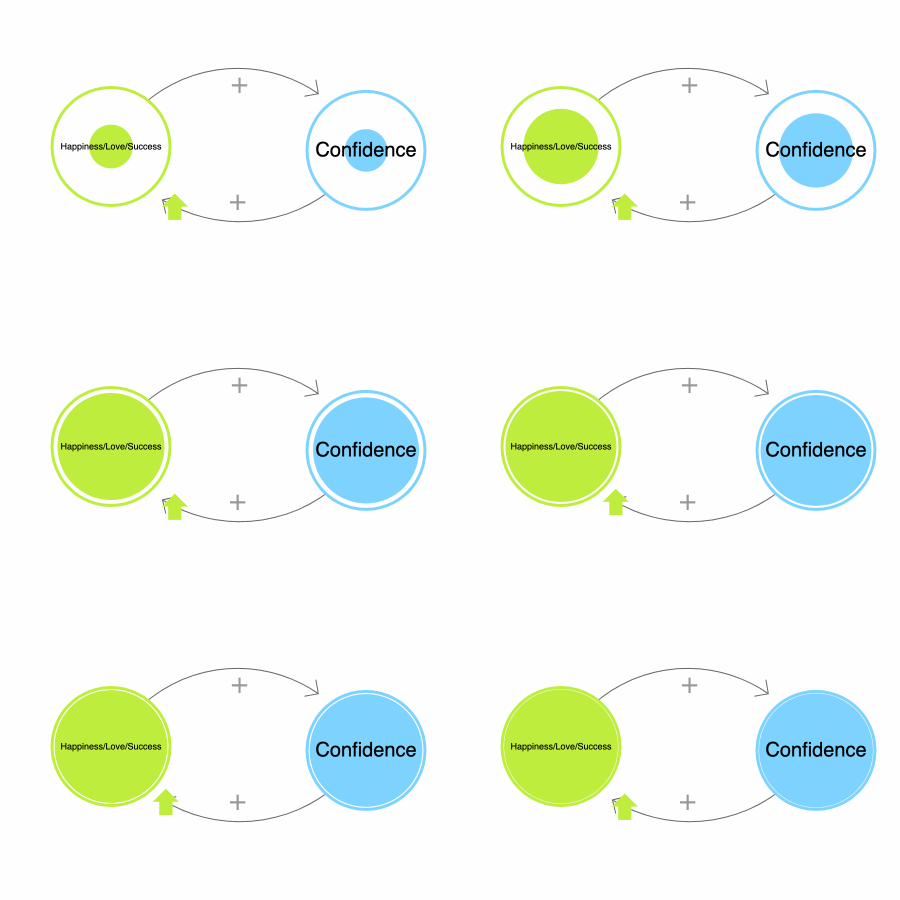
Or you’re in a loser loop, like this.
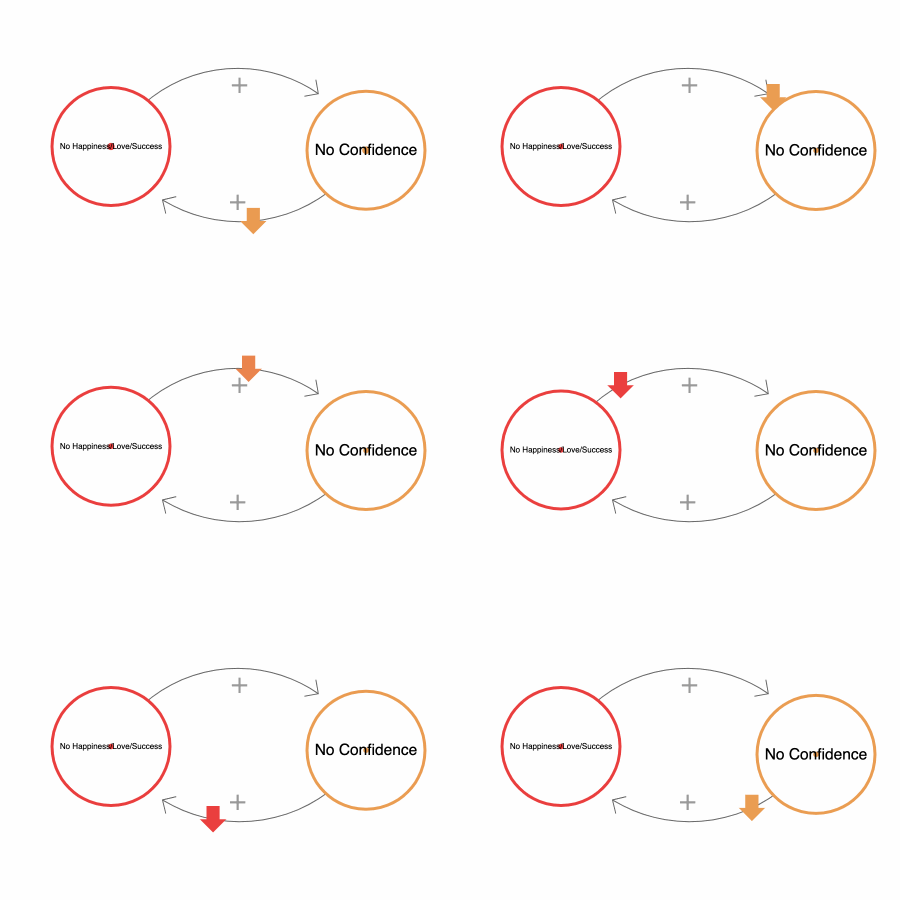
And if you’re in the loser loop, well it seems damn near impossible to get out.
It’s like a dog chasing its own tail. Or Domino’s ordering its own pizza. You can spend a lot of time cuticle-gazing trying to mentally sort everything out, but just like with your lack of confidence, you’re likely to end up right back where you started.
But maybe we’re going about this all wrong. Maybe the confidence conundrum isn’t really a conundrum at all.
If we pay close attention, we can learn a few things about [confidence](https://www.nerdfitness.com/blog/5-ways-to-immediately-appear-more-confident/) just by observing people. So before you run off and order that pizza, let’s break this down:
1. Just because somebody *has something* (tons of friends, a million dollars, a bitchin’ beach body) doesn’t necessarily mean that this person is confident in it. There are business tycoons who totally lack confidence in their [own wealth](https://markmanson.net/the-real-value-of-money), models who lack confidence in their looks, and celebrities who lack confidence in their own popularity. So I think the first thing we can establish is that confidence is not necessarily linked to any external marker. Rather, our confidence is rooted in [*our perception of ourselves*](https://markmanson.net/how-we-judge-others) regardless of any tangible external reality.
2. Because our confidence is not necessarily linked to any external, tangible measurement, we can conclude that **improving the external, tangible aspects of our lives won’t necessarily build confidence.** Chances are that if you’ve lived more than a couple of decades, you’ve experienced this in some form or another. Getting a promotion at your job doesn’t necessarily make you more confident in your professional abilities. In fact, it can often make you feel *less* confident. Dating and/or sleeping with more people doesn’t necessarily make you feel more confident about how attractive you are. Moving in with your partner or [getting married](https://markmanson.net/benefits-of-marriage) doesn’t necessarily make you feel any more [confident in your relationship](https://markmanson.net/fuck-yes).
3. Confidence is a feeling. An [emotional state](https://markmanson.net/understanding-your-emotions) and a state of mind. It’s the perception that you *lack nothing*. That you are equipped with [everything you need](https://markmanson.net/everything-you-need), both now and for the future. A person confident in their social life will feel as though they lack nothing in their social life. A person with no confidence in their social life believes that they lack the prerequisite coolness to be invited to anyone’s pizza party. It’s this perception of *lacking something* that drives their needy, clingy, and/or bitchy behavior.
### Get Your Shit Together — Here’s How
Enter your email address below and I’ll send you a 55-page guide showing you how to develop rock-solid self-discipline and healthy habits that last.
Your information is protected and I never spam, ever. You can view my privacy policy [here](https://markmanson.net/privacy-policy).
## How to Be More Confident
The obvious and most common answer to the confidence conundrum is to simply believe that you lack nothing. That you already have, or at least deserve, whatever you feel you would need to make you confident.
But this sort of thinking—believing you’re already beautiful even though you’re a frumpy slob, or believing you’re a raving success even though your only profitable business venture was selling weed in high school—leads to the kind of [insufferable narcissism](https://markmanson.net/the-secret) that causes people to argue that obesity (something that is more detrimental to your health than smoking cigarettes) should be celebrated as beauty and that it’s, like, totally OK to carve your name [into the Roman Colosseum](http://www.theguardian.com/world/2015/mar/08/us-tourists-caught-carving-names-into-colosseum-rome), because, you know, selfies.
A lot of people soon realize this doesn’t work and so they take a different approach: [incremental, external improvement](https://markmanson.net/self-improvement).
They read articles that tell them the top 50 things confident people do, and then they try to do those things.
They start to exercise, dress better, make more [eye contact](https://markmanson.net/the-levels-of-eye-contact), and practice firmer handshakes.
This is admittedly a step above simply believing that you’re already confident and that you don’t belong in the loser loop. After all, at least you’re *doing something* about your lack of confidence. And actually, it *will* work—but only for a little while.
Again, this type of thinking only focuses on external sources of confidence. And remember, deriving your self-confidence from the world around you is short-lived at its best and completely fucking delusional at its worst.
So no, external improvement is not a sustainable solution to the confidence conundrum. And feeling as though you lack nothing and deluding yourself into believing you already possess everything you could ever dream of is far worse.
> The only way to be truly confident is to simply become comfortable with what you lack.
Read that again.
The big charade with confidence is that it has nothing to do with being comfortable in what we achieve and everything to do with being comfortable in what we *don’t* achieve.
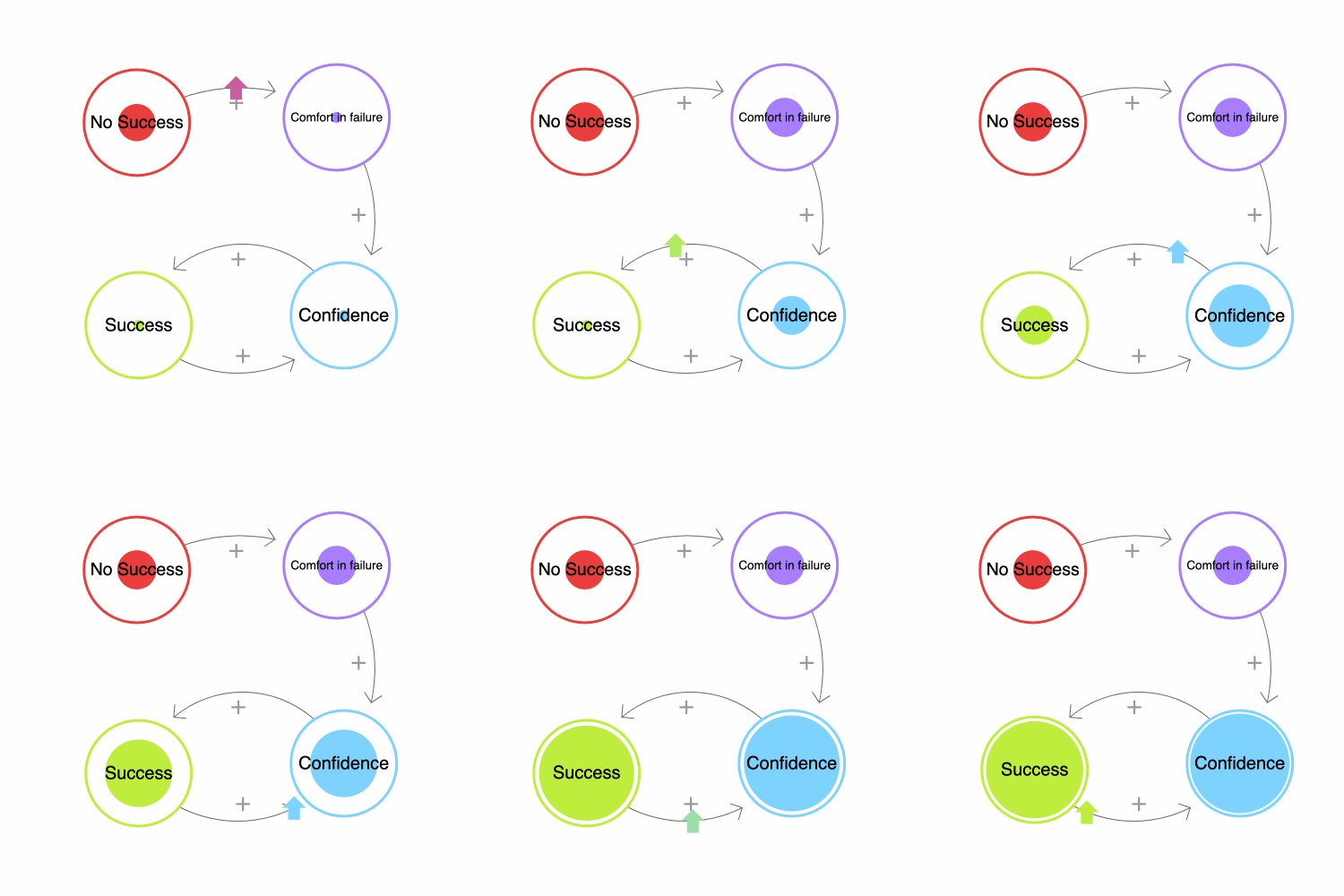
People who are confident in business are confident because they’re comfortable with [failure](https://markmanson.net/why-you-fail). They realize that failure is simply part of learning how their market works. It’s a reflection of their lack of knowledge, not a reflection of who they are as a person.
People who are confident in their social lives are confident because they’re comfortable with rejection. They’re not afraid of rejection because they’re comfortable with people not liking them as long as they’re expressing themselves honestly.
People who are [confident in their relationships](https://markmanson.net/healthy-relationship-habits) are confident because they’re comfortable with getting hurt. They’re not afraid to [be vulnerable](https://markmanson.net/vulnerability-in-relationships) and tell someone how they feel and then establish [strong boundaries](https://markmanson.net/boundaries) around those feelings, even if it means being uncomfortable (or leaving a [bad relationship](https://markmanson.net/toxic-relationship-signs)).
## Building Confidence Through Failure
The truth is that the route to the positive runs through the negative. Those among us who are the most comfortable with [negative experiences](https://markmanson.net/how-to-grow-from-your-pain) are those who reap the most benefits.
It’s counterintuitive, but it’s also true. We often worry that if we become comfortable in our failures—that if we accept failure as an inevitable part of living—that we will *become* failures.
But it doesn’t work that way.
Comfort in our failures allows us to act without fear, to engage without judgment, to love without conditions. It’s the dog that lets the tail go, realizing that it’s already a part of himself. It’s the Domino’s that cancels its own order, realizing it already has the pizza it wanted. Or something.
Now if you’ll excuse me, I’m going to publish this article comfortable with the fact that some people will probably hate it. And eat my pizza.
### Get Your Shit Together — Here’s How
Enter your email address below and I’ll send you a 55-page guide showing you how to develop rock-solid self-discipline and healthy habits that last.
Your information is protected and I never spam, ever. You can view my privacy policy [here](https://markmanson.net/privacy-policy).
### Want 7 Days of Personal Coaching, for Free?
Check out my Purpose App for AI coaching that understands you better in 10 minutes than the average therapist does in a year.
[Try For Free](https://purposeapp.onelink.me/WHy0/amyl0rym "Try Purpose")
##### About the Author
Mark is the three-time \#1 New York Times bestselling author of *The Subtle Art of Not Giving a F\*ck* as well as other titles. His books have sold around 20 million copies, been translated into more than 65 languages, and reached number one in more than a dozen countries. In 2023, a feature film about his life and ideas was released worldwide by Universal Pictures.
[Learn More About Mark](https://markmanson.net/about "Learn more about Mark")
##### MORE ARTICLES
- [How to Find the Perfect Career](https://markmanson.net/how-to-find-the-perfect-career)
- [Vulnerability: The Key to Better Relationships](https://markmanson.net/vulnerability-in-relationships)
- [Why Everyone on the Internet Is Wrong](https://markmanson.net/everyone-on-the-internet-is-wrong)
- [4 Ways I've Changed My Mind in the Past 10 Years](https://markmanson.net/4-ways-my-views-have-changed)
- [Why I'm Wrong About Everything (And So Are You)](https://markmanson.net/wrong-about-everything)
- [How to Deal With Conflict (A Choose-Your-Own-Adventure Guide)](https://markmanson.net/deal-with-conflict)
[VIEW ALL ARTICLES](https://markmanson.net/articles)

Mark is the three-time \#1 New York Times bestselling author of *The Subtle Art of Not Giving a F\*ck*, as well as other titles. His books have sold around 20 million copies, been translated into more than 65 languages, and reached number one in more than a dozen countries. In 2023, a feature film about his life and ideas was released worldwide by Universal Pictures.
[Learn More About Mark](https://markmanson.net/about)
© 2026 Infinity Squared Media LLC
- [Articles](https://markmanson.net/articles)
- [Books](https://markmanson.net/books)
- [Newsletter](https://markmanson.net/breakthrough)
- [Podcast](https://solvedpodcast.com/)
- [About Mark](https://markmanson.net/about)
- [Sign Up](https://markmanson.net/subscribe?from=footer-nav&from-path=how-to-be-confident)
- [Contact](https://markmanson.net/contact)
- [Sponsorships](https://markmanson.net/sponsor)
- [Purpose App](https://purposeapp.onelink.me/WHy0/4ub3y0gk "Try the Purpose App for free")
[Privacy Policy](https://markmanson.net/privacy-policy)
Manage Cookie Settings
[Your Privacy Choices](https://markmanson.net/your-privacy-choices)
[Terms and Conditions](https://markmanson.net/terms-and-conditions)
© 2026 Infinity Squared Media LLC

### Wait! Here Are 3 Ideas That Might Change Your Life
Learn about the idea that transformed a depressed deadbeat into one of the most important philosophers who ever lived. Read about it in my free 19-page ebook.
I'm not interested.

### This article is for everyone. Your mentor shouldn't be.
Take a 3-minute quiz to get a personal action plan and free trial of AI coaching that adapts to your life. Not generic advice. Free.
[Get My Plan](https://purposeapp.onelink.me/WHy0/amyl0rym "Get My Plan") | ||||||
| Readable Markdown | How are you supposed to be confident about something when you have nothing to feel confident about?
Like, how are you supposed to be confident at your new job if you’ve never done this type of work before? Or how are you supposed to be [confident in social situations](https://markmanson.net/courses/social-connection-course) when no one has ever liked you before? Or how are you supposed to be confident [in your relationship](https://markmanson.net/3-core-components-of-a-healthy-relationship) when you’ve never been in a [successful relationship](https://markmanson.net/relationship-advice) before?
On the surface, confidence appears to be an area where the rich get richer and the poor stay the fucking losers they are. After all, if you’ve never experienced much social acceptance, and you lack confidence around new people, then that lack of confidence will make people think you’re clingy and weird and not accept you.
Same deal goes for relationships. No confidence in intimacy will lead to [bad breakups](https://markmanson.net/how-to-break-up-with-someone) and awkward phone calls and emergency Ben and Jerry’s runs at three in the morning.
And seriously, how are you supposed to be confident in your work experience when previous experience is required to even be considered for a job in the first place?
If you’ve always [lost in life](https://markmanson.net/life-purpose), then how could you ever expect to be a winner? And if you never expect to be a winner, then you’re going to act like a loser. Thus the cycle of suckage continues.
This is the confidence conundrum, where in order to be [happy](https://markmanson.net/how-to-be-happy) or [loved](https://markmanson.net/love) or [successful](https://markmanson.net/5-mindsets-that-create-success), first you need to be confident… but to be confident, first you need to be happy or loved or successful.
So it seems like you’re stuck in one of two loops: either you’re already in a happy and confident loop, like this.

Or you’re in a loser loop, like this.

And if you’re in the loser loop, well it seems damn near impossible to get out.
It’s like a dog chasing its own tail. Or Domino’s ordering its own pizza. You can spend a lot of time cuticle-gazing trying to mentally sort everything out, but just like with your lack of confidence, you’re likely to end up right back where you started.
But maybe we’re going about this all wrong. Maybe the confidence conundrum isn’t really a conundrum at all.
If we pay close attention, we can learn a few things about [confidence](https://www.nerdfitness.com/blog/5-ways-to-immediately-appear-more-confident/) just by observing people. So before you run off and order that pizza, let’s break this down:
1. Just because somebody *has something* (tons of friends, a million dollars, a bitchin’ beach body) doesn’t necessarily mean that this person is confident in it. There are business tycoons who totally lack confidence in their [own wealth](https://markmanson.net/the-real-value-of-money), models who lack confidence in their looks, and celebrities who lack confidence in their own popularity. So I think the first thing we can establish is that confidence is not necessarily linked to any external marker. Rather, our confidence is rooted in [*our perception of ourselves*](https://markmanson.net/how-we-judge-others) regardless of any tangible external reality.
2. Because our confidence is not necessarily linked to any external, tangible measurement, we can conclude that **improving the external, tangible aspects of our lives won’t necessarily build confidence.** Chances are that if you’ve lived more than a couple of decades, you’ve experienced this in some form or another. Getting a promotion at your job doesn’t necessarily make you more confident in your professional abilities. In fact, it can often make you feel *less* confident. Dating and/or sleeping with more people doesn’t necessarily make you feel more confident about how attractive you are. Moving in with your partner or [getting married](https://markmanson.net/benefits-of-marriage) doesn’t necessarily make you feel any more [confident in your relationship](https://markmanson.net/fuck-yes).
3. Confidence is a feeling. An [emotional state](https://markmanson.net/understanding-your-emotions) and a state of mind. It’s the perception that you *lack nothing*. That you are equipped with [everything you need](https://markmanson.net/everything-you-need), both now and for the future. A person confident in their social life will feel as though they lack nothing in their social life. A person with no confidence in their social life believes that they lack the prerequisite coolness to be invited to anyone’s pizza party. It’s this perception of *lacking something* that drives their needy, clingy, and/or bitchy behavior.
### Get Your Shit Together — Here’s How
Enter your email address below and I’ll send you a 55-page guide showing you how to develop rock-solid self-discipline and healthy habits that last.
Your information is protected and I never spam, ever. You can view my privacy policy [here](https://markmanson.net/privacy-policy).

The obvious and most common answer to the confidence conundrum is to simply believe that you lack nothing. That you already have, or at least deserve, whatever you feel you would need to make you confident.
But this sort of thinking—believing you’re already beautiful even though you’re a frumpy slob, or believing you’re a raving success even though your only profitable business venture was selling weed in high school—leads to the kind of [insufferable narcissism](https://markmanson.net/the-secret) that causes people to argue that obesity (something that is more detrimental to your health than smoking cigarettes) should be celebrated as beauty and that it’s, like, totally OK to carve your name [into the Roman Colosseum](http://www.theguardian.com/world/2015/mar/08/us-tourists-caught-carving-names-into-colosseum-rome), because, you know, selfies.
A lot of people soon realize this doesn’t work and so they take a different approach: [incremental, external improvement](https://markmanson.net/self-improvement).
They read articles that tell them the top 50 things confident people do, and then they try to do those things.
They start to exercise, dress better, make more [eye contact](https://markmanson.net/the-levels-of-eye-contact), and practice firmer handshakes.
This is admittedly a step above simply believing that you’re already confident and that you don’t belong in the loser loop. After all, at least you’re *doing something* about your lack of confidence. And actually, it *will* work—but only for a little while.
Again, this type of thinking only focuses on external sources of confidence. And remember, deriving your self-confidence from the world around you is short-lived at its best and completely fucking delusional at its worst.
So no, external improvement is not a sustainable solution to the confidence conundrum. And feeling as though you lack nothing and deluding yourself into believing you already possess everything you could ever dream of is far worse.
Read that again.
The big charade with confidence is that it has nothing to do with being comfortable in what we achieve and everything to do with being comfortable in what we *don’t* achieve.

People who are confident in business are confident because they’re comfortable with [failure](https://markmanson.net/why-you-fail). They realize that failure is simply part of learning how their market works. It’s a reflection of their lack of knowledge, not a reflection of who they are as a person.
People who are confident in their social lives are confident because they’re comfortable with rejection. They’re not afraid of rejection because they’re comfortable with people not liking them as long as they’re expressing themselves honestly.
People who are [confident in their relationships](https://markmanson.net/healthy-relationship-habits) are confident because they’re comfortable with getting hurt. They’re not afraid to [be vulnerable](https://markmanson.net/vulnerability-in-relationships) and tell someone how they feel and then establish [strong boundaries](https://markmanson.net/boundaries) around those feelings, even if it means being uncomfortable (or leaving a [bad relationship](https://markmanson.net/toxic-relationship-signs)).
The truth is that the route to the positive runs through the negative. Those among us who are the most comfortable with [negative experiences](https://markmanson.net/how-to-grow-from-your-pain) are those who reap the most benefits.
It’s counterintuitive, but it’s also true. We often worry that if we become comfortable in our failures—that if we accept failure as an inevitable part of living—that we will *become* failures.
But it doesn’t work that way.
Comfort in our failures allows us to act without fear, to engage without judgment, to love without conditions. It’s the dog that lets the tail go, realizing that it’s already a part of himself. It’s the Domino’s that cancels its own order, realizing it already has the pizza it wanted. Or something.
Now if you’ll excuse me, I’m going to publish this article comfortable with the fact that some people will probably hate it. And eat my pizza. | ||||||
| ML Classification | |||||||
| ML Categories |
Raw JSON{
"/People_and_Society": 924,
"/People_and_Society/Self-Help_and_Motivational": 916
} | ||||||
| ML Page Types |
Raw JSON{
"/Article": 997,
"/Article/How_to": 580
} | ||||||
| ML Intent Types |
Raw JSON{
"Informational": 999
} | ||||||
| Content Metadata | |||||||
| Language | en-us | ||||||
| Author | Mark Manson | ||||||
| Publish Time | 2021-02-25 10:00:54 (5 years ago) | ||||||
| Original Publish Time | 2018-03-22 15:41:20 (8 years ago) | ||||||
| Republished | Yes | ||||||
| Word Count (Total) | 1,835 | ||||||
| Word Count (Content) | 1,341 | ||||||
| Links | |||||||
| External Links | 24 | ||||||
| Internal Links | 48 | ||||||
| Technical SEO | |||||||
| Meta Nofollow | No | ||||||
| Meta Noarchive | No | ||||||
| JS Rendered | Yes | ||||||
| Redirect Target | null | ||||||
| Performance | |||||||
| Download Time (ms) | 59 | ||||||
| TTFB (ms) | 54 | ||||||
| Download Size (bytes) | 35,038 | ||||||
| Shard | 199 (laksa) | ||||||
| Root Hash | 8580873671447460999 | ||||||
| Unparsed URL | net,markmanson!/how-to-be-confident s443 | ||||||