ℹ️ Skipped - page is already crawled
| Filter | Status | Condition | Details |
|---|---|---|---|
| HTTP status | PASS | download_http_code = 200 | HTTP 200 |
| Age cutoff | PASS | download_stamp > now() - 6 MONTH | 1 months ago |
| History drop | PASS | isNull(history_drop_reason) | No drop reason |
| Spam/ban | PASS | fh_dont_index != 1 AND ml_spam_score = 0 | ml_spam_score=0 |
| Canonical | PASS | meta_canonical IS NULL OR = '' OR = src_unparsed | Not set |
| Property | Value |
|---|---|
| URL | https://localmoney.co.za/what-is-the-difference-between-an-etf-and-a-unit-trust/ |
| Last Crawled | 2026-03-25 06:46:34 (1 month ago) |
| First Indexed | 2022-01-02 15:22:10 (4 years ago) |
| HTTP Status Code | 200 |
| Content | |
| Meta Title | Is An ETF Better Than A Unit Trust? - // LOCALMONEY |
| Meta Description | Unit trusts and ETFs A friend of mine recently contacted his broker and requested information about investing in ETFs. He received feedback that they don't offer the service. Yet, they do have unit trusts. What is the difference between an ETF and a unit trust? Note: if you have no idea what an ETF is, check |
| Meta Canonical | null |
| Boilerpipe Text | Unit trusts and ETFs
A friend of mine recently contacted his broker and requested information about investing in ETFs. He received feedback that they don’t offer the service. Yet, they do have unit trusts.
What is the difference between an ETF and a unit trust?
Note: if you have no idea what an ETF is, check out my article
here
!
How do indexes work?
To understand the differences between unit trusts and ETFs, we need to look at indexes. In the magical world of finances, the coffee powers that be created indexes. These indexes are nothing more than a set of rules. Think of it as a shopping list that Mrs Frugal often gives me:
Only buy from our local dairy
Buy only for our household
Don’t stock up more than we can use.
Buy milk if it’s not more than R13 a litre
Buy 2 000 000 KG of coffee beans.
Check the price of Yoghurt. If it is on special for under R 22 per kilogram, buy 2.
Indexes work in the same way. For example, the S&P 500 index has many rules that include:
a company should be a U.S. company,
The company should have a market capitalization of at least USD 8.2 billion,
It needs to be highly liquid,
It needs to have a public float of at least 10% of its shares outstanding (whatever that means!)
If this thing (which could be a share, bond, fund or property) applies to the rules, it is eligible to be bought at the ratio that the rules specify. The rules get reapplied from time to time, depending on the rules (i.e. recheck the price of the yoghurt).
In what way are unit trusts and ETFs the same?
Some unit trusts do track an index. For the purpose of the comparison, I will compare the index-tracking unit trusts with ETFs.
Unit trusts and ETFs are the same in the following ways:
ETFs generally track indexes. Many unit trusts can also track indexes. This means your investment is transparent and you know what your money is being invested.
Both unit trusts and ETFs buy the underlying asset that is tracked by the index.
Both are governed by the Collective Investments Scheme Control Act (CISCA) –
source here
.
The fees charged are generally low, as the decisions on where to invest don’t require analysts
How do unit trusts and ETFs differ?
Though these might look the same, there are some small differences that can make a difference in your returns:
ETFs are traded throughout the day, whereas unit trusts are priced once per day. This means depending on how the price goes up and down, you might win/lose a bit of money
ETFs are traded on the stock market. This means that you’ll need to give a buy instruction to your broker (or whoever) to buy. Unit trusts on the other hand are managed like a mutual fund: you pay the money and when they’re ready they will buy the underlying assets that the index is tracking.
When investing in ETFs, you will pay a brokerage fee as you are buying a stake in the fund.
When buying unit trusts, as the investment firm will buy on your behalf, this should be included in the TER. The total expense ratio (TER) should include all costs from the fund, but often does not include FA and platform fees.
Things will need to be bought and sold and fees will need to be paid!
When cashing out your ETF, you might need to wait up to 3 days for the ETF funds to clear. Your unit trust on the other hand can clear a lot faster.
Quick biased fee analysis
I decided to check out the MSCI World (Developed Markets) Index. Both these funds track the same index. I am fully aware that one cannot just use the fund fact sheet, as this does not include the broker charges. It does make for fun calculations to check yourself what the impact of using your chosen broker is going to be.
Satrix MSCI World Feeder Fund Unit Trust
The fund fact sheet can be found
here
.
You’ll see that the TER seems to be quite a lot higher – at 0.89% p.a. The transaction cost of 0.08 has been included.
Sartix MSCI World Feeder ETF
The fund fact sheet can be found
here
.
You’ll see that the TER is only 0.35%, with no transaction cost. We know that this is not true, as we still need to buy the asset. This is charged by the broker, and not by the fund itself.
Choosing a unit trust or ETF
From my research, I have found that unit trusts that track indexes and ETFs have really low-cost differences. Any fees under 2% tend to be generally acceptable in the industry. If you are planning to invest lots of money for a long time (such as over 20-40 years), it would make sense that the annual fees would play a bigger role than the initial buying instruction.
The choice will eventually be up to you.
Conclusion
A nice experiment would be buying both, comparing the transaction fees involved and how the performance is impacted in the long run by fees, initial higher buying costs, etc.
Happy investing! |
| Markdown | [// LOCALMONEY](https://localmoney.co.za/)
- [Home](https://localmoney.co.za/)
- [Property](https://localmoney.co.za/what-is-the-difference-between-an-etf-and-a-unit-trust/)
- - - ##### Get Started On Property
- [Get Started On Property](https://localmoney.co.za/category/property-and-real-estate/property-real-estate-i-want-to-get-into-property/)
- [First-time property investor](https://localmoney.co.za/first-time-property-investor/)
- - ##### Property Tools
- [Should I buy my property in a trust, company or in my own name?](https://localmoney.co.za/should-i-buy-my-property-in-a-trust-company-or-on-my-own-name/)
- [Rental property inspections // Checklists](https://localmoney.co.za/how-to-do-a-rental-property-inspection-with-checklist/)
- [Home Loan Calculator South Africa](https://localmoney.co.za/home-loan-calculator-south-africa/)
- - ##### Property Articles
- [Property And Tax](https://localmoney.co.za/category/tax/investment-property-tax/)
- [Advanced Property Articles](https://localmoney.co.za/category/property-and-real-estate/advanced-investment-property/)
- [All Articles On Property](https://localmoney.co.za/category/property-and-real-estate/)
- [Money](https://localmoney.co.za/what-is-the-difference-between-an-etf-and-a-unit-trust/)
- - - ##### Personal Finance
- [Get started investing in the stock market](https://localmoney.co.za/how-to-start-investing-in-the-stock-market/)
- [How To Build Your Credit Score](https://localmoney.co.za/the-beginners-guide-on-how-to-build-your-credit-score/)
- [All personal finance articles](https://localmoney.co.za/category/personal-finance/)
- - ##### Get It Cheaper
- [Stockbroker Platform Fee Comparison](https://localmoney.co.za/which-investment-platform-is-the-cheapest-a-fee-comparison/)
- [Cryptocurrency Platform Fee Comparison](https://localmoney.co.za/which-cryptocurrency-platform-is-the-cheapest-a-fee-comparison/)
- [Hustles](https://localmoney.co.za/what-is-the-difference-between-an-etf-and-a-unit-trust/)
- - - [I need a hustle](https://localmoney.co.za/category/hustles-and-business/hustles-and-business-i-want-to-start-a-business/)
- [All Hustle Articles](https://localmoney.co.za/category/hustles-and-business/)
- [Blog](https://localmoney.co.za/blog/)
- [Store](https://localmoney.co.za/product-category/uncategorized/)
- [Media // Contact](https://localmoney.co.za/what-is-the-difference-between-an-etf-and-a-unit-trust/)
- - - [FrugalLocal in the Media](https://localmoney.co.za/frugallocal-in-the-media/)
- [Work with Me](https://localmoney.co.za/work-with-me/)
- [Contact Frugal](https://localmoney.co.za/contact-frugal/)
[// LOCALMONEY](https://localmoney.co.za/)
- [Home](https://localmoney.co.za/)
- [Property](https://localmoney.co.za/what-is-the-difference-between-an-etf-and-a-unit-trust/)
- - - ##### Get Started On Property
- [Get Started On Property](https://localmoney.co.za/category/property-and-real-estate/property-real-estate-i-want-to-get-into-property/)
- [First-time property investor](https://localmoney.co.za/first-time-property-investor/)
- - ##### Property Tools
- [Should I buy my property in a trust, company or in my own name?](https://localmoney.co.za/should-i-buy-my-property-in-a-trust-company-or-on-my-own-name/)
- [Rental property inspections // Checklists](https://localmoney.co.za/how-to-do-a-rental-property-inspection-with-checklist/)
- [Home Loan Calculator South Africa](https://localmoney.co.za/home-loan-calculator-south-africa/)
- - ##### Property Articles
- [Property And Tax](https://localmoney.co.za/category/tax/investment-property-tax/)
- [Advanced Property Articles](https://localmoney.co.za/category/property-and-real-estate/advanced-investment-property/)
- [All Articles On Property](https://localmoney.co.za/category/property-and-real-estate/)
- [Money](https://localmoney.co.za/what-is-the-difference-between-an-etf-and-a-unit-trust/)
- - - ##### Personal Finance
- [Get started investing in the stock market](https://localmoney.co.za/how-to-start-investing-in-the-stock-market/)
- [How To Build Your Credit Score](https://localmoney.co.za/the-beginners-guide-on-how-to-build-your-credit-score/)
- [All personal finance articles](https://localmoney.co.za/category/personal-finance/)
- - ##### Get It Cheaper
- [Stockbroker Platform Fee Comparison](https://localmoney.co.za/which-investment-platform-is-the-cheapest-a-fee-comparison/)
- [Cryptocurrency Platform Fee Comparison](https://localmoney.co.za/which-cryptocurrency-platform-is-the-cheapest-a-fee-comparison/)
- [Hustles](https://localmoney.co.za/what-is-the-difference-between-an-etf-and-a-unit-trust/)
- - - [I need a hustle](https://localmoney.co.za/category/hustles-and-business/hustles-and-business-i-want-to-start-a-business/)
- [All Hustle Articles](https://localmoney.co.za/category/hustles-and-business/)
- [Blog](https://localmoney.co.za/blog/)
- [Store](https://localmoney.co.za/product-category/uncategorized/)
- [Media // Contact](https://localmoney.co.za/what-is-the-difference-between-an-etf-and-a-unit-trust/)
- - - [FrugalLocal in the Media](https://localmoney.co.za/frugallocal-in-the-media/)
- [Work with Me](https://localmoney.co.za/work-with-me/)
- [Contact Frugal](https://localmoney.co.za/contact-frugal/)
# Is An ETF Better Than A Unit Trust?
Looking for a specific article?
Categories
# Is An ETF Better Than A Unit Trust?
## With LocalMoney && FrugalLocal

## Unit trusts and ETFs
A friend of mine recently contacted his broker and requested information about investing in ETFs. He received feedback that they don’t offer the service. Yet, they do have unit trusts.
What is the difference between an ETF and a unit trust?
Note: if you have no idea what an ETF is, check out my article [here](https://localmoney.co.za/investment-vehicles-investing-in-etfs/)\!
## How do indexes work?
To understand the differences between unit trusts and ETFs, we need to look at indexes. In the magical world of finances, the coffee powers that be created indexes. These indexes are nothing more than a set of rules. Think of it as a shopping list that Mrs Frugal often gives me:
- Only buy from our local dairy
- Buy only for our household
- Don’t stock up more than we can use.
- Buy milk if it’s not more than R13 a litre
- Buy 2 000 000 KG of coffee beans.
- Check the price of Yoghurt. If it is on special for under R 22 per kilogram, buy 2.

Indexes work in the same way. For example, the S\&P 500 index has many rules that include:
- a company should be a U.S. company,
- The company should have a market capitalization of at least USD 8.2 billion,
- It needs to be highly liquid,
- It needs to have a public float of at least 10% of its shares outstanding (whatever that means!)
If this thing (which could be a share, bond, fund or property) applies to the rules, it is eligible to be bought at the ratio that the rules specify. The rules get reapplied from time to time, depending on the rules (i.e. recheck the price of the yoghurt).
## In what way are unit trusts and ETFs the same?
Some unit trusts do track an index. For the purpose of the comparison, I will compare the index-tracking unit trusts with ETFs.
Unit trusts and ETFs are the same in the following ways:
- ETFs generally track indexes. Many unit trusts can also track indexes. This means your investment is transparent and you know what your money is being invested.
- Both unit trusts and ETFs buy the underlying asset that is tracked by the index.
- Both are governed by the Collective Investments Scheme Control Act (CISCA) – [source here](https://satrix.co.za/news/article?id=83).
- The fees charged are generally low, as the decisions on where to invest don’t require analysts
## How do unit trusts and ETFs differ?
Though these might look the same, there are some small differences that can make a difference in your returns:
- ETFs are traded throughout the day, whereas unit trusts are priced once per day. This means depending on how the price goes up and down, you might win/lose a bit of money
- ETFs are traded on the stock market. This means that you’ll need to give a buy instruction to your broker (or whoever) to buy. Unit trusts on the other hand are managed like a mutual fund: you pay the money and when they’re ready they will buy the underlying assets that the index is tracking.
- When investing in ETFs, you will pay a brokerage fee as you are buying a stake in the fund.
- When buying unit trusts, as the investment firm will buy on your behalf, this should be included in the TER. The total expense ratio (TER) should include all costs from the fund, but often does not include FA and platform fees.
- Things will need to be bought and sold and fees will need to be paid\!
- When cashing out your ETF, you might need to wait up to 3 days for the ETF funds to clear. Your unit trust on the other hand can clear a lot faster.
## Quick biased fee analysis
I decided to check out the MSCI World (Developed Markets) Index. Both these funds track the same index. I am fully aware that one cannot just use the fund fact sheet, as this does not include the broker charges. It does make for fun calculations to check yourself what the impact of using your chosen broker is going to be.
#### Satrix MSCI World Feeder Fund Unit Trust
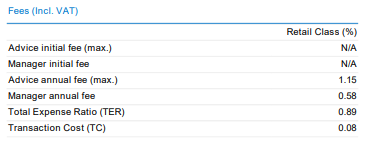
The fund fact sheet can be found [here](https://satrix.co.za/media/45917?inline=true).
You’ll see that the TER seems to be quite a lot higher – at 0.89% p.a. The transaction cost of 0.08 has been included.
#### Sartix MSCI World Feeder ETF
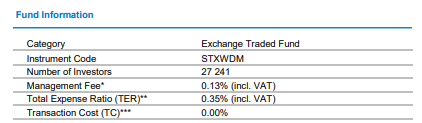
The fund fact sheet can be found [here](https://satrix.co.za/media/46075?inline=true).
You’ll see that the TER is only 0.35%, with no transaction cost. We know that this is not true, as we still need to buy the asset. This is charged by the broker, and not by the fund itself.
## Choosing a unit trust or ETF
From my research, I have found that unit trusts that track indexes and ETFs have really low-cost differences. Any fees under 2% tend to be generally acceptable in the industry. If you are planning to invest lots of money for a long time (such as over 20-40 years), it would make sense that the annual fees would play a bigger role than the initial buying instruction.
The choice will eventually be up to you.
## Conclusion
A nice experiment would be buying both, comparing the transaction fees involved and how the performance is impacted in the long run by fees, initial higher buying costs, etc.
Happy investing\!
←[What I learnt In My First 3 Months Of Being Self Employed](https://localmoney.co.za/self-employment-lessons-the-first-three-months/)
[How to buy property on auction in South Africa](https://localmoney.co.za/buying-property-at-auctions-in-south-africa/)→
- ## [Make Money Using Airbnb in South Africa](https://localmoney.co.za/make-money-using-airbnb-in-south-africa/)
[](https://localmoney.co.za/make-money-using-airbnb-in-south-africa/)
- ## [Rental Property Taxes in South Africa](https://localmoney.co.za/rental-property-taxes-in-south-africa/)
[](https://localmoney.co.za/rental-property-taxes-in-south-africa/)
- ## [How to Fire Your Managing Agent Effectively](https://localmoney.co.za/how-to-fire-your-managing-agent-effectively/)
[](https://localmoney.co.za/how-to-fire-your-managing-agent-effectively/)
- ## [Make Money Using Airbnb in South Africa](https://localmoney.co.za/make-money-using-airbnb-in-south-africa/)

Can You Make Money from Renting Out Your Property on Airbnb, Booking.com, and Lekkeslaap? We…
[Read more](https://localmoney.co.za/make-money-using-airbnb-in-south-africa/)
February 8, 2025
- ## [Rental Property Taxes in South Africa](https://localmoney.co.za/rental-property-taxes-in-south-africa/)

Capital gains tax is paid on the proceeds of a property that is sold. Annual…
[Read more](https://localmoney.co.za/rental-property-taxes-in-south-africa/)
February 1, 2025
- ## [How to Fire Your Managing Agent Effectively](https://localmoney.co.za/how-to-fire-your-managing-agent-effectively/)

I own a unit in a sectional title scheme managed by MidCity. We’ve had one…
[Read more](https://localmoney.co.za/how-to-fire-your-managing-agent-effectively/)
January 18, 2025
THanks for visiting\!
## Why not subscribe to my newsletter? It’s dark, tall and handsomE… |
| Readable Markdown | ## Unit trusts and ETFs
A friend of mine recently contacted his broker and requested information about investing in ETFs. He received feedback that they don’t offer the service. Yet, they do have unit trusts.
What is the difference between an ETF and a unit trust?
Note: if you have no idea what an ETF is, check out my article [here](https://localmoney.co.za/investment-vehicles-investing-in-etfs/)\!
## How do indexes work?
To understand the differences between unit trusts and ETFs, we need to look at indexes. In the magical world of finances, the coffee powers that be created indexes. These indexes are nothing more than a set of rules. Think of it as a shopping list that Mrs Frugal often gives me:
- Only buy from our local dairy
- Buy only for our household
- Don’t stock up more than we can use.
- Buy milk if it’s not more than R13 a litre
- Buy 2 000 000 KG of coffee beans.
- Check the price of Yoghurt. If it is on special for under R 22 per kilogram, buy 2.

Indexes work in the same way. For example, the S\&P 500 index has many rules that include:
- a company should be a U.S. company,
- The company should have a market capitalization of at least USD 8.2 billion,
- It needs to be highly liquid,
- It needs to have a public float of at least 10% of its shares outstanding (whatever that means!)
If this thing (which could be a share, bond, fund or property) applies to the rules, it is eligible to be bought at the ratio that the rules specify. The rules get reapplied from time to time, depending on the rules (i.e. recheck the price of the yoghurt).
## In what way are unit trusts and ETFs the same?
Some unit trusts do track an index. For the purpose of the comparison, I will compare the index-tracking unit trusts with ETFs.
Unit trusts and ETFs are the same in the following ways:
- ETFs generally track indexes. Many unit trusts can also track indexes. This means your investment is transparent and you know what your money is being invested.
- Both unit trusts and ETFs buy the underlying asset that is tracked by the index.
- Both are governed by the Collective Investments Scheme Control Act (CISCA) – [source here](https://satrix.co.za/news/article?id=83).
- The fees charged are generally low, as the decisions on where to invest don’t require analysts
## How do unit trusts and ETFs differ?
Though these might look the same, there are some small differences that can make a difference in your returns:
- ETFs are traded throughout the day, whereas unit trusts are priced once per day. This means depending on how the price goes up and down, you might win/lose a bit of money
- ETFs are traded on the stock market. This means that you’ll need to give a buy instruction to your broker (or whoever) to buy. Unit trusts on the other hand are managed like a mutual fund: you pay the money and when they’re ready they will buy the underlying assets that the index is tracking.
- When investing in ETFs, you will pay a brokerage fee as you are buying a stake in the fund.
- When buying unit trusts, as the investment firm will buy on your behalf, this should be included in the TER. The total expense ratio (TER) should include all costs from the fund, but often does not include FA and platform fees.
- Things will need to be bought and sold and fees will need to be paid\!
- When cashing out your ETF, you might need to wait up to 3 days for the ETF funds to clear. Your unit trust on the other hand can clear a lot faster.
## Quick biased fee analysis
I decided to check out the MSCI World (Developed Markets) Index. Both these funds track the same index. I am fully aware that one cannot just use the fund fact sheet, as this does not include the broker charges. It does make for fun calculations to check yourself what the impact of using your chosen broker is going to be.
#### Satrix MSCI World Feeder Fund Unit Trust

The fund fact sheet can be found [here](https://satrix.co.za/media/45917?inline=true).
You’ll see that the TER seems to be quite a lot higher – at 0.89% p.a. The transaction cost of 0.08 has been included.
#### Sartix MSCI World Feeder ETF

The fund fact sheet can be found [here](https://satrix.co.za/media/46075?inline=true).
You’ll see that the TER is only 0.35%, with no transaction cost. We know that this is not true, as we still need to buy the asset. This is charged by the broker, and not by the fund itself.
## Choosing a unit trust or ETF
From my research, I have found that unit trusts that track indexes and ETFs have really low-cost differences. Any fees under 2% tend to be generally acceptable in the industry. If you are planning to invest lots of money for a long time (such as over 20-40 years), it would make sense that the annual fees would play a bigger role than the initial buying instruction.
The choice will eventually be up to you.
## Conclusion
A nice experiment would be buying both, comparing the transaction fees involved and how the performance is impacted in the long run by fees, initial higher buying costs, etc.
Happy investing\! |
| ML Classification | |
| ML Categories | null |
| ML Page Types | null |
| ML Intent Types | null |
| Content Metadata | |
| Language | en-us |
| Author | null |
| Publish Time | 2021-01-11 04:40:08 (5 years ago) |
| Original Publish Time | 2021-01-11 04:40:08 (5 years ago) |
| Republished | No |
| Word Count (Total) | 1,341 |
| Word Count (Content) | 884 |
| Links | |
| External Links | 5 |
| Internal Links | 33 |
| Technical SEO | |
| Meta Nofollow | No |
| Meta Noarchive | No |
| JS Rendered | No |
| Redirect Target | null |
| Performance | |
| Download Time (ms) | 1,799 |
| TTFB (ms) | 1,798 |
| Download Size (bytes) | 26,234 |
| Shard | 64 (laksa) |
| Root Hash | 15191670108571708064 |
| Unparsed URL | za,co,localmoney!/what-is-the-difference-between-an-etf-and-a-unit-trust/ s443 |