ℹ️ Skipped - page is already crawled
| Filter | Status | Condition | Details |
|---|---|---|---|
| HTTP status | PASS | download_http_code = 200 | HTTP 200 |
| Age cutoff | PASS | download_stamp > now() - 6 MONTH | 1.3 months ago |
| History drop | PASS | isNull(history_drop_reason) | No drop reason |
| Spam/ban | PASS | fh_dont_index != 1 AND ml_spam_score = 0 | ml_spam_score=0 |
| Canonical | PASS | meta_canonical IS NULL OR = '' OR = src_unparsed | Not set |
| Property | Value |
|---|---|
| URL | https://lewindowseat.substack.com/p/i-moved-my-child-to-paris-what-i |
| Last Crawled | 2026-03-04 12:17:32 (1 month ago) |
| First Indexed | not set |
| HTTP Status Code | 200 |
| Meta Title | I Moved My Child to Paris: What I Wish I Knew About Kids and Bilingualism |
| Meta Description | When I moved my child to Paris, I assumed language learning would just happen through immersion. It turns out it is a bit more complicated than that. |
| Meta Canonical | null |
| Boilerpipe Text | Bonjour from Paris where the sun is shining and the city is in full bloom. Like the rest of Paris, we are living outdoors as much as possible right now. I had to take the last couple of weeks to tend to my non-Substack life, but I am excited to be back and sharing about children and bilingualism this week. What happens when you drop a child into a new language and new culture? It’s not as simple as you may think.
Also, don’t miss
the podcast I recorded with Profiles in Franceformation
. Allison was one of the first people I worked with on our move to France and I really enjoyed reflecting on our journey over the last four years. We talked about French parenting, building a French business, making friends as a new arrival, and what I’m looking forward to in the years ahead.
When I moved to Paris with my daughter four years ago, everyone made it sound like bilingualism would just happen for her. It turns out learning a new language is in fact a lot easier for children than adults – but the process of getting there isn’t so simple. It is a story filled with fits and starts and unexpected detours.
If you have read about
my decision to move to Paris
, you know bilingualism isn’t the primary reason we moved here – but it is a big part of it. You could even call it
one of our family values
. Long before my daughter existed, I dreamed of living abroad and raising a child between cultures and with two languages. It’s a skill I wish I grew up with and a gift I wanted to give her.
When we first moved to Paris, I wasn’t sure exactly how language learning would go. My daughter was only two. She knew a few French songs. We had a few French picture books. Everyone told me children are sponges and she would learn fast. I assumed immersion would set off an automatic upward trajectory to a second language. But language fluency is not something that happens to a child; it’s something that has to be cultivated. And I soon realized that as her parent, that cultivation was on me.
Nearly four years after our move, my daughter is essentially fluent in French and English. She operates in her second language with ease, chatting with vendors at the market and negotiating playground games with other children. She spends half her school day learning in French. And perhaps the most exciting development of French CP/1
st
grade is that she now reads and writes in French. Native speakers tell me she has a cute little Parisian accent and are in awe of how easily she flips between the two languages.
To say I am a proud parent is an understatement. All credit is due to my tiny learner who persevered her way to that second language. But in the process, I learned a lot too.
Here is what has surprised me about raising a bilingual child in France:
They’ll be fluent by December is a myth.
When I told people we were moving to Paris, their counsel was near universal: drop her into French public school and she will be bilingual by December. This is smart advice on the surface because it assumes more exposure leads to more speaking French. What it fails to account for is “At what cost?” Imagine being a toddler who just arrived in a new country and a new classroom where everyone speaks a different language. You can’t make friends. You can’t understand what your teacher wants. You can’t speak up. You can barely ask to use the toilet. The end result of our six months in French
maternelle
was a roster of French words and an unhappy kid.
We eventually transitioned to a bilingual
maternelle
and her spark came back immediately. She started making friends, she bonded with her teachers, and she got very curious about using this new language – the kind of safe curiosity where language learning starts to fly. Around this time, I learned that children in a bilingual school without French at home take about three years to become fluent – so we buckled in for the three-year plan. To this day, I am glad that I gave her room to settle every part of herself into France rather than rushing her language learning.
The fastest language learning happens during play with other children.
Bilingual schooling has been a key part of my daughter’s language learning. It has given her long stretches of immersion during the day, safe adults to practice with, and as she’s gotten older, a good understanding of language construction with writing and reading. But I have found the secret ingredient for language acquisition is actually other children. At the playground, the intimidation factor is lower and the stakes are much, much higher. One of the first phrases my daughter mastered in French was “
C’est à moi ! Rends-le-moi !
” or “It’s mine. Give it to me!” You better believe she was going to figure out how to get French-speaking children to give her toy back. Now one of the most delightful aspects of my daughter’s bilingualism is watching her serve as the playground translator, facilitating play with her Anglophone and Francophone friends. It turns out play is a powerful motivator for children learning a second language.
Language learning is exhausting – and you must protect their energy.
Anyone who has learned a new language knows how tiring it is sitting in that classroom or navigating a city in your second language. Children are not exempt from this language exhaustion, especially if they are spending full school days juggling two languages. Just because it is easier for them to learn French does not mean it is easy. As my daughter has gotten older and started extracurricular activities, I’ve had to remind myself that, even today with her strong French skills, the second language is its own project. And so, I perform a delicate balancing act. If she spends one week in French day camp, I sign her up for an English day camp the second week. If she’s had a long school day plus homework, I bake in rest. I don’t just want her to learn French; I want her to love French – and that means respecting the hard work her little brain is doing.
You will think it’s never going to happen – and one day the switch just flips.
“It’s been months and he’s still not speaking French!” Every non-French parent I have met in Paris has had this crisis moment, the one where you think it will never happen. If you aren’t seeing any French output, it is easy to assume that little French input is happening.
Mais au contraire!
Children absorb much more French than they are willing to show at first. There will be early flares that something is clicking in. They will comment on a French conversation they hear or respond to French instruction. You may spot little clues like
le chat
scrawled on their drawing. But still, they will refuse to speak. You will wring your hands and worry you have the wrong plan. And then one day, the switch flips and they are chattering away in French. Children learn French steadily, but they only speak when they are ready.
The right language learning model isn’t static – it’s constant calibration.
Before we moved to France, I didn’t fully understand how many ways there are for children to learn French and get a bilingual education. Some families put their children in French public school but have them spend the Wednesday half-days in an English literacy program. Other families do bilingual school and “one parent, one language” to balance supporting French and English learning at home. Some schools teach reading in French or English first before then moving to the second language; other schools teach reading in both simultaneously. When our language journey first began, I thought it would be as simple as picking a plan and sticking to it, but language learning is dynamic. Instead, you find yourself as a parent regularly calibrating as one language becomes easier or dominant. At the moment, our happy mix is English conversation at home, bilingual school, French extracurriculars, and parent homework engagement in both languages – but I’m humble enough to know that could shift at any time.
There is a good chance your children will start to outpace your language learning.
As my daughter has been learning French, I have been as well – but her skills now outpace mine. If I don’t understand a French speaker, she often chimes in to fill the language gap. She corrects my pronunciation and teases my accent as “so American.” She knows she is the better French speaker in this family. I am delighted that her French language skills are near-native at this point, but I am also very conscious of not depending on her. I never want to be that parent who cannot move through a French environment without her support. And so, in many ways, my daughter’s thriving bilingualism has started to set the pace for my own learning. I need to keep up so I can keep being the parent – in both English and French environments.
The second language will become part of your family identity in beautiful ways.
I have shared the complexities of raising a bilingual child, but now let me tell you about the beauty: Sometimes we switch to French at home and have a delightful chit-chat, almost as if we are playing a verbal game. We are both different people in our second language, and we love trying on those personas with each other. And while my own French skills are not as strong as I’d like them to be, when we travel outside of France, I see how much French words and expressions are part of our family life. The pitter-patter of our family interactions is delightfully
Franglish
and something that is uniquely our own. And more than anything, it feels like we are engaged in our own little family project, much the same way some families take pride in following a sports team or visiting national parks. An educator recently reminded me that bilingual education is hard - we shouldn’t sugarcoat it - but it is also possible and the best gift we can give our children is confidence in the possible. For me, living in that possibility together is part of the shape of who we are as a family. We haven’t just gained a language; we have gained a new family identity.
Our family language learning journey is a good reminder that sometimes when we are in the middle of something, we cannot see how far we have come. I hope you take a moment this week to reflect not just on what is ahead, but the trails you have blazed and the progress you have made. Enjoy the emerging change in season wherever you are. À la semaine prochaine !
Liz
This post is public so if you enjoyed it, feel free to press
Like
❤️
Share
⬆️
Restack
♻️
The more Le Window Seat’s readership grows, the more I can write and share my life in Paris with you. Thank you for being part of this community. |
| Markdown | [](https://lewindowseat.substack.com/)
# [Le Window Seat by Liz Oxhorn](https://lewindowseat.substack.com/)
Subscribe
Sign in
# I Moved My Child to Paris: What I Wish I Knew About Kids and Bilingualism
[](https://substack.com/@lewindowseat)
[Liz Oxhorn](https://substack.com/@lewindowseat)
Mar 03, 2026
18
2
2
Share
*Bonjour from Paris where the sun is shining and the city is in full bloom. Like the rest of Paris, we are living outdoors as much as possible right now. I had to take the last couple of weeks to tend to my non-Substack life, but I am excited to be back and sharing about children and bilingualism this week. What happens when you drop a child into a new language and new culture? It’s not as simple as you may think.*
*Also, don’t miss [the podcast I recorded with Profiles in Franceformation](https://podcasts.apple.com/gb/podcast/episode-90-liz-oxhorn-on-going-from-campaigns-to-croissants/id1545185804?i=1000751560537). Allison was one of the first people I worked with on our move to France and I really enjoyed reflecting on our journey over the last four years. We talked about French parenting, building a French business, making friends as a new arrival, and what I’m looking forward to in the years ahead.*
Thank you for reading Le Window Seat by Liz Oxhorn. Subscribe for free to receive new posts and support my work.
***
### I Moved My Child to Paris: What I Wish I Knew About Kids and Bilingualism
When I moved to Paris with my daughter four years ago, everyone made it sound like bilingualism would just happen for her. It turns out learning a new language is in fact a lot easier for children than adults – but the process of getting there isn’t so simple. It is a story filled with fits and starts and unexpected detours.
If you have read about [my decision to move to Paris](https://lewindowseat.substack.com/p/moving-to-paris-how-i-went-from-someday?r=1vhcv), you know bilingualism isn’t the primary reason we moved here – but it is a big part of it. You could even call it [one of our family values](https://lewindowseat.substack.com/p/dr-becky-meets-dis-bonjour-7-ways?r=1vhcv). Long before my daughter existed, I dreamed of living abroad and raising a child between cultures and with two languages. It’s a skill I wish I grew up with and a gift I wanted to give her.
When we first moved to Paris, I wasn’t sure exactly how language learning would go. My daughter was only two. She knew a few French songs. We had a few French picture books. Everyone told me children are sponges and she would learn fast. I assumed immersion would set off an automatic upward trajectory to a second language. But language fluency is not something that happens to a child; it’s something that has to be cultivated. And I soon realized that as her parent, that cultivation was on me.
Nearly four years after our move, my daughter is essentially fluent in French and English. She operates in her second language with ease, chatting with vendors at the market and negotiating playground games with other children. She spends half her school day learning in French. And perhaps the most exciting development of French CP/1st grade is that she now reads and writes in French. Native speakers tell me she has a cute little Parisian accent and are in awe of how easily she flips between the two languages.
To say I am a proud parent is an understatement. All credit is due to my tiny learner who persevered her way to that second language. But in the process, I learned a lot too.
Here is what has surprised me about raising a bilingual child in France:
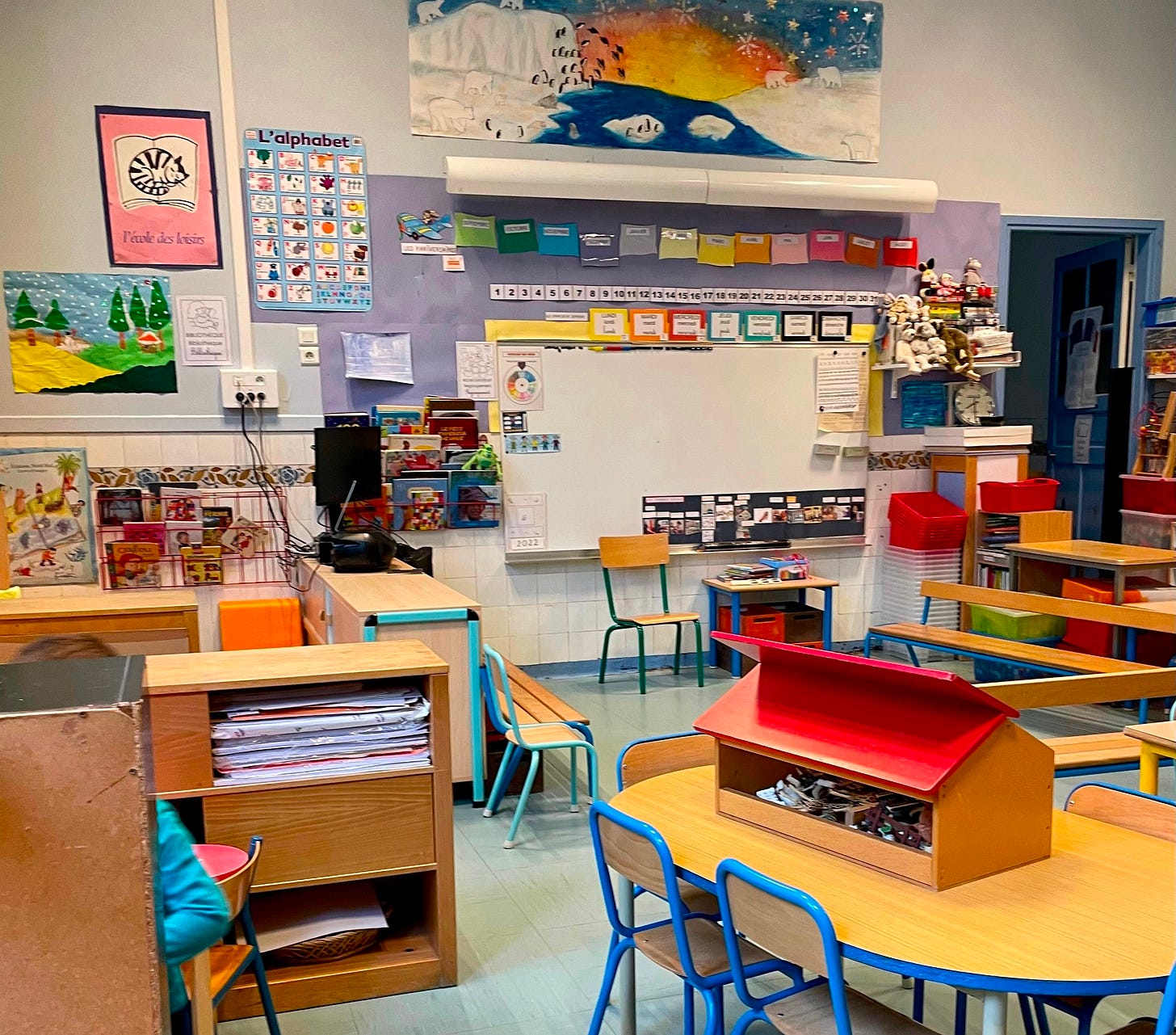
**They’ll be fluent by December is a myth.** When I told people we were moving to Paris, their counsel was near universal: drop her into French public school and she will be bilingual by December. This is smart advice on the surface because it assumes more exposure leads to more speaking French. What it fails to account for is “At what cost?” Imagine being a toddler who just arrived in a new country and a new classroom where everyone speaks a different language. You can’t make friends. You can’t understand what your teacher wants. You can’t speak up. You can barely ask to use the toilet. The end result of our six months in French *maternelle* was a roster of French words and an unhappy kid.
We eventually transitioned to a bilingual *maternelle* and her spark came back immediately. She started making friends, she bonded with her teachers, and she got very curious about using this new language – the kind of safe curiosity where language learning starts to fly. Around this time, I learned that children in a bilingual school without French at home take about three years to become fluent – so we buckled in for the three-year plan. To this day, I am glad that I gave her room to settle every part of herself into France rather than rushing her language learning.
[](https://substackcdn.com/image/fetch/$s_!YLh0!,f_auto,q_auto:good,fl_progressive:steep/https%3A%2F%2Fsubstack-post-media.s3.amazonaws.com%2Fpublic%2Fimages%2Fec731fcc-77b7-4901-b260-08848bbf3bb2_2670x2350.jpeg)
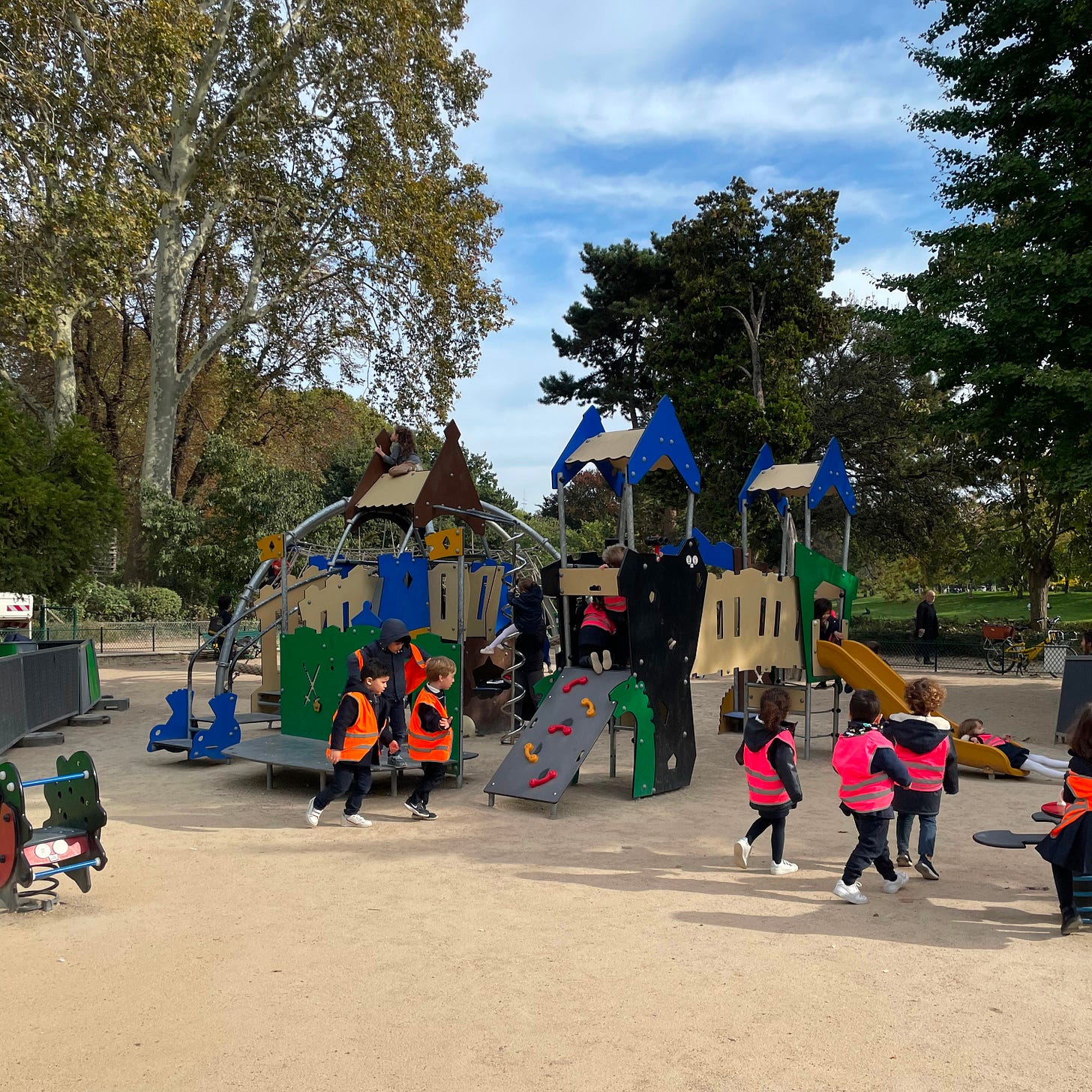
**The fastest language learning happens during play with other children.** Bilingual schooling has been a key part of my daughter’s language learning. It has given her long stretches of immersion during the day, safe adults to practice with, and as she’s gotten older, a good understanding of language construction with writing and reading. But I have found the secret ingredient for language acquisition is actually other children. At the playground, the intimidation factor is lower and the stakes are much, much higher. One of the first phrases my daughter mastered in French was “*C’est à moi ! Rends-le-moi \!*” or “It’s mine. Give it to me!” You better believe she was going to figure out how to get French-speaking children to give her toy back. Now one of the most delightful aspects of my daughter’s bilingualism is watching her serve as the playground translator, facilitating play with her Anglophone and Francophone friends. It turns out play is a powerful motivator for children learning a second language.
**Language learning is exhausting – and you must protect their energy.** Anyone who has learned a new language knows how tiring it is sitting in that classroom or navigating a city in your second language. Children are not exempt from this language exhaustion, especially if they are spending full school days juggling two languages. Just because it is easier for them to learn French does not mean it is easy. As my daughter has gotten older and started extracurricular activities, I’ve had to remind myself that, even today with her strong French skills, the second language is its own project. And so, I perform a delicate balancing act. If she spends one week in French day camp, I sign her up for an English day camp the second week. If she’s had a long school day plus homework, I bake in rest. I don’t just want her to learn French; I want her to love French – and that means respecting the hard work her little brain is doing.
[](https://substackcdn.com/image/fetch/$s_!5Tji!,f_auto,q_auto:good,fl_progressive:steep/https%3A%2F%2Fsubstack-post-media.s3.amazonaws.com%2Fpublic%2Fimages%2F401c8c87-92ed-46de-b574-56e060889f11_3024x3025.jpeg)
**You will think it’s never going to happen – and one day the switch just flips.** “It’s been months and he’s still not speaking French!” Every non-French parent I have met in Paris has had this crisis moment, the one where you think it will never happen. If you aren’t seeing any French output, it is easy to assume that little French input is happening. *Mais au contraire\!* Children absorb much more French than they are willing to show at first. There will be early flares that something is clicking in. They will comment on a French conversation they hear or respond to French instruction. You may spot little clues like *le chat* scrawled on their drawing. But still, they will refuse to speak. You will wring your hands and worry you have the wrong plan. And then one day, the switch flips and they are chattering away in French. Children learn French steadily, but they only speak when they are ready.
**The right language learning model isn’t static – it’s constant calibration.** Before we moved to France, I didn’t fully understand how many ways there are for children to learn French and get a bilingual education. Some families put their children in French public school but have them spend the Wednesday half-days in an English literacy program. Other families do bilingual school and “one parent, one language” to balance supporting French and English learning at home. Some schools teach reading in French or English first before then moving to the second language; other schools teach reading in both simultaneously. When our language journey first began, I thought it would be as simple as picking a plan and sticking to it, but language learning is dynamic. Instead, you find yourself as a parent regularly calibrating as one language becomes easier or dominant. At the moment, our happy mix is English conversation at home, bilingual school, French extracurriculars, and parent homework engagement in both languages – but I’m humble enough to know that could shift at any time.
[](https://substackcdn.com/image/fetch/$s_!UB7E!,f_auto,q_auto:good,fl_progressive:steep/https%3A%2F%2Fsubstack-post-media.s3.amazonaws.com%2Fpublic%2Fimages%2F10a1da62-700c-4e6f-8e53-abc3c171aae1_3024x2653.jpeg)
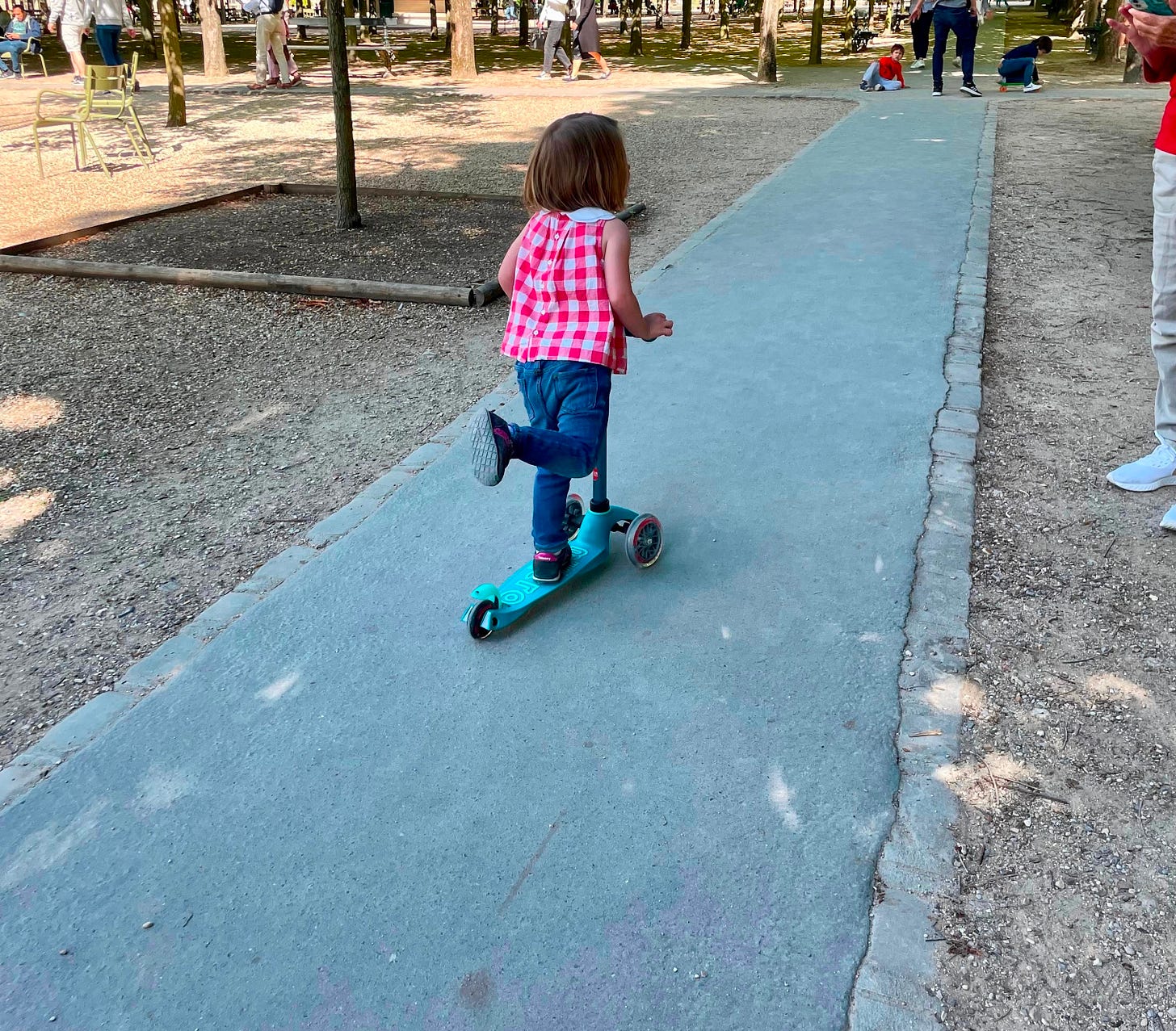
**There is a good chance your children will start to outpace your language learning.** As my daughter has been learning French, I have been as well – but her skills now outpace mine. If I don’t understand a French speaker, she often chimes in to fill the language gap. She corrects my pronunciation and teases my accent as “so American.” She knows she is the better French speaker in this family. I am delighted that her French language skills are near-native at this point, but I am also very conscious of not depending on her. I never want to be that parent who cannot move through a French environment without her support. And so, in many ways, my daughter’s thriving bilingualism has started to set the pace for my own learning. I need to keep up so I can keep being the parent – in both English and French environments.
**The second language will become part of your family identity in beautiful ways.** I have shared the complexities of raising a bilingual child, but now let me tell you about the beauty: Sometimes we switch to French at home and have a delightful chit-chat, almost as if we are playing a verbal game. We are both different people in our second language, and we love trying on those personas with each other. And while my own French skills are not as strong as I’d like them to be, when we travel outside of France, I see how much French words and expressions are part of our family life. The pitter-patter of our family interactions is delightfully *Franglish* and something that is uniquely our own. And more than anything, it feels like we are engaged in our own little family project, much the same way some families take pride in following a sports team or visiting national parks. An educator recently reminded me that bilingual education is hard - we shouldn’t sugarcoat it - but it is also possible and the best gift we can give our children is confidence in the possible. For me, living in that possibility together is part of the shape of who we are as a family. We haven’t just gained a language; we have gained a new family identity.
***
*Our family language learning journey is a good reminder that sometimes when we are in the middle of something, we cannot see how far we have come. I hope you take a moment this week to reflect not just on what is ahead, but the trails you have blazed and the progress you have made. Enjoy the emerging change in season wherever you are. À la semaine prochaine \!*
*Liz*
This post is public so if you enjoyed it, feel free to press
**Like** ❤️
**Share** ⬆️
**Restack** ♻️
The more Le Window Seat’s readership grows, the more I can write and share my life in Paris with you. Thank you for being part of this community.
18
2
2
Share
Previous
#### Discussion about this post
Comments
Restacks
[](https://substack.com/profile/101296238-brendan-boyle?utm_source=comment)
[Brendan Boyle](https://substack.com/profile/101296238-brendan-boyle?utm_source=substack-feed-item)
[2h](https://lewindowseat.substack.com/p/i-moved-my-child-to-paris-what-i/comment/222815626 "Mar 4, 2026, 10:40 AM")
This is lovely. I see my four year old’s Spanish starting to overtake mine already. She doesn’t have to think about word genders like I do. It’s wonderful and fascinating to see.
[Reply]()
[Share]()
[1 reply by Liz Oxhorn](https://lewindowseat.substack.com/p/i-moved-my-child-to-paris-what-i/comment/222815626)
[1 more comment...](https://lewindowseat.substack.com/p/i-moved-my-child-to-paris-what-i/comments)
Top
Latest
Discussions
No posts
### Ready for more?
© 2026 Elizabeth Oxhorn · [Privacy](https://substack.com/privacy) ∙ [Terms](https://substack.com/tos) ∙ [Collection notice](https://substack.com/ccpa#personal-data-collected)
[Start your Substack](https://substack.com/signup?utm_source=substack&utm_medium=web&utm_content=footer)
[Get the app](https://substack.com/app/app-store-redirect?utm_campaign=app-marketing&utm_content=web-footer-button)
[Substack](https://substack.com/) is the home for great culture
This site requires JavaScript to run correctly. Please [turn on JavaScript](https://enable-javascript.com/) or unblock scripts |
| Readable Markdown | *Bonjour from Paris where the sun is shining and the city is in full bloom. Like the rest of Paris, we are living outdoors as much as possible right now. I had to take the last couple of weeks to tend to my non-Substack life, but I am excited to be back and sharing about children and bilingualism this week. What happens when you drop a child into a new language and new culture? It’s not as simple as you may think.*
*Also, don’t miss [the podcast I recorded with Profiles in Franceformation](https://podcasts.apple.com/gb/podcast/episode-90-liz-oxhorn-on-going-from-campaigns-to-croissants/id1545185804?i=1000751560537). Allison was one of the first people I worked with on our move to France and I really enjoyed reflecting on our journey over the last four years. We talked about French parenting, building a French business, making friends as a new arrival, and what I’m looking forward to in the years ahead.*
When I moved to Paris with my daughter four years ago, everyone made it sound like bilingualism would just happen for her. It turns out learning a new language is in fact a lot easier for children than adults – but the process of getting there isn’t so simple. It is a story filled with fits and starts and unexpected detours.
If you have read about [my decision to move to Paris](https://lewindowseat.substack.com/p/moving-to-paris-how-i-went-from-someday?r=1vhcv), you know bilingualism isn’t the primary reason we moved here – but it is a big part of it. You could even call it [one of our family values](https://lewindowseat.substack.com/p/dr-becky-meets-dis-bonjour-7-ways?r=1vhcv). Long before my daughter existed, I dreamed of living abroad and raising a child between cultures and with two languages. It’s a skill I wish I grew up with and a gift I wanted to give her.
When we first moved to Paris, I wasn’t sure exactly how language learning would go. My daughter was only two. She knew a few French songs. We had a few French picture books. Everyone told me children are sponges and she would learn fast. I assumed immersion would set off an automatic upward trajectory to a second language. But language fluency is not something that happens to a child; it’s something that has to be cultivated. And I soon realized that as her parent, that cultivation was on me.
Nearly four years after our move, my daughter is essentially fluent in French and English. She operates in her second language with ease, chatting with vendors at the market and negotiating playground games with other children. She spends half her school day learning in French. And perhaps the most exciting development of French CP/1st grade is that she now reads and writes in French. Native speakers tell me she has a cute little Parisian accent and are in awe of how easily she flips between the two languages.
To say I am a proud parent is an understatement. All credit is due to my tiny learner who persevered her way to that second language. But in the process, I learned a lot too.
Here is what has surprised me about raising a bilingual child in France:
**They’ll be fluent by December is a myth.** When I told people we were moving to Paris, their counsel was near universal: drop her into French public school and she will be bilingual by December. This is smart advice on the surface because it assumes more exposure leads to more speaking French. What it fails to account for is “At what cost?” Imagine being a toddler who just arrived in a new country and a new classroom where everyone speaks a different language. You can’t make friends. You can’t understand what your teacher wants. You can’t speak up. You can barely ask to use the toilet. The end result of our six months in French *maternelle* was a roster of French words and an unhappy kid.
We eventually transitioned to a bilingual *maternelle* and her spark came back immediately. She started making friends, she bonded with her teachers, and she got very curious about using this new language – the kind of safe curiosity where language learning starts to fly. Around this time, I learned that children in a bilingual school without French at home take about three years to become fluent – so we buckled in for the three-year plan. To this day, I am glad that I gave her room to settle every part of herself into France rather than rushing her language learning.
[](https://substackcdn.com/image/fetch/$s_!YLh0!,f_auto,q_auto:good,fl_progressive:steep/https%3A%2F%2Fsubstack-post-media.s3.amazonaws.com%2Fpublic%2Fimages%2Fec731fcc-77b7-4901-b260-08848bbf3bb2_2670x2350.jpeg)
**The fastest language learning happens during play with other children.** Bilingual schooling has been a key part of my daughter’s language learning. It has given her long stretches of immersion during the day, safe adults to practice with, and as she’s gotten older, a good understanding of language construction with writing and reading. But I have found the secret ingredient for language acquisition is actually other children. At the playground, the intimidation factor is lower and the stakes are much, much higher. One of the first phrases my daughter mastered in French was “*C’est à moi ! Rends-le-moi \!*” or “It’s mine. Give it to me!” You better believe she was going to figure out how to get French-speaking children to give her toy back. Now one of the most delightful aspects of my daughter’s bilingualism is watching her serve as the playground translator, facilitating play with her Anglophone and Francophone friends. It turns out play is a powerful motivator for children learning a second language.
**Language learning is exhausting – and you must protect their energy.** Anyone who has learned a new language knows how tiring it is sitting in that classroom or navigating a city in your second language. Children are not exempt from this language exhaustion, especially if they are spending full school days juggling two languages. Just because it is easier for them to learn French does not mean it is easy. As my daughter has gotten older and started extracurricular activities, I’ve had to remind myself that, even today with her strong French skills, the second language is its own project. And so, I perform a delicate balancing act. If she spends one week in French day camp, I sign her up for an English day camp the second week. If she’s had a long school day plus homework, I bake in rest. I don’t just want her to learn French; I want her to love French – and that means respecting the hard work her little brain is doing.
[](https://substackcdn.com/image/fetch/$s_!5Tji!,f_auto,q_auto:good,fl_progressive:steep/https%3A%2F%2Fsubstack-post-media.s3.amazonaws.com%2Fpublic%2Fimages%2F401c8c87-92ed-46de-b574-56e060889f11_3024x3025.jpeg)
**You will think it’s never going to happen – and one day the switch just flips.** “It’s been months and he’s still not speaking French!” Every non-French parent I have met in Paris has had this crisis moment, the one where you think it will never happen. If you aren’t seeing any French output, it is easy to assume that little French input is happening. *Mais au contraire\!* Children absorb much more French than they are willing to show at first. There will be early flares that something is clicking in. They will comment on a French conversation they hear or respond to French instruction. You may spot little clues like *le chat* scrawled on their drawing. But still, they will refuse to speak. You will wring your hands and worry you have the wrong plan. And then one day, the switch flips and they are chattering away in French. Children learn French steadily, but they only speak when they are ready.
**The right language learning model isn’t static – it’s constant calibration.** Before we moved to France, I didn’t fully understand how many ways there are for children to learn French and get a bilingual education. Some families put their children in French public school but have them spend the Wednesday half-days in an English literacy program. Other families do bilingual school and “one parent, one language” to balance supporting French and English learning at home. Some schools teach reading in French or English first before then moving to the second language; other schools teach reading in both simultaneously. When our language journey first began, I thought it would be as simple as picking a plan and sticking to it, but language learning is dynamic. Instead, you find yourself as a parent regularly calibrating as one language becomes easier or dominant. At the moment, our happy mix is English conversation at home, bilingual school, French extracurriculars, and parent homework engagement in both languages – but I’m humble enough to know that could shift at any time.
[](https://substackcdn.com/image/fetch/$s_!UB7E!,f_auto,q_auto:good,fl_progressive:steep/https%3A%2F%2Fsubstack-post-media.s3.amazonaws.com%2Fpublic%2Fimages%2F10a1da62-700c-4e6f-8e53-abc3c171aae1_3024x2653.jpeg)
**There is a good chance your children will start to outpace your language learning.** As my daughter has been learning French, I have been as well – but her skills now outpace mine. If I don’t understand a French speaker, she often chimes in to fill the language gap. She corrects my pronunciation and teases my accent as “so American.” She knows she is the better French speaker in this family. I am delighted that her French language skills are near-native at this point, but I am also very conscious of not depending on her. I never want to be that parent who cannot move through a French environment without her support. And so, in many ways, my daughter’s thriving bilingualism has started to set the pace for my own learning. I need to keep up so I can keep being the parent – in both English and French environments.
**The second language will become part of your family identity in beautiful ways.** I have shared the complexities of raising a bilingual child, but now let me tell you about the beauty: Sometimes we switch to French at home and have a delightful chit-chat, almost as if we are playing a verbal game. We are both different people in our second language, and we love trying on those personas with each other. And while my own French skills are not as strong as I’d like them to be, when we travel outside of France, I see how much French words and expressions are part of our family life. The pitter-patter of our family interactions is delightfully *Franglish* and something that is uniquely our own. And more than anything, it feels like we are engaged in our own little family project, much the same way some families take pride in following a sports team or visiting national parks. An educator recently reminded me that bilingual education is hard - we shouldn’t sugarcoat it - but it is also possible and the best gift we can give our children is confidence in the possible. For me, living in that possibility together is part of the shape of who we are as a family. We haven’t just gained a language; we have gained a new family identity.
*Our family language learning journey is a good reminder that sometimes when we are in the middle of something, we cannot see how far we have come. I hope you take a moment this week to reflect not just on what is ahead, but the trails you have blazed and the progress you have made. Enjoy the emerging change in season wherever you are. À la semaine prochaine \!*
*Liz*
This post is public so if you enjoyed it, feel free to press
**Like** ❤️
**Share** ⬆️
**Restack** ♻️
The more Le Window Seat’s readership grows, the more I can write and share my life in Paris with you. Thank you for being part of this community. |
| Shard | 76 (laksa) |
| Root Hash | 14862242593741677076 |
| Unparsed URL | com,substack!lewindowseat,/p/i-moved-my-child-to-paris-what-i s443 |