ℹ️ Skipped - page is already crawled
| Filter | Status | Condition | Details |
|---|---|---|---|
| HTTP status | PASS | download_http_code = 200 | HTTP 200 |
| Age cutoff | PASS | download_stamp > now() - 6 MONTH | 0.4 months ago |
| History drop | PASS | isNull(history_drop_reason) | No drop reason |
| Spam/ban | PASS | fh_dont_index != 1 AND ml_spam_score = 0 | ml_spam_score=0 |
| Canonical | PASS | meta_canonical IS NULL OR = '' OR = src_unparsed | Not set |
| Property | Value |
|---|---|
| URL | https://lernerweisslaw.com/legal-employment-california/ |
| Last Crawled | 2026-04-09 23:08:36 (10 days ago) |
| First Indexed | 2025-11-11 05:10:16 (5 months ago) |
| HTTP Status Code | 200 |
| Meta Title | Legal Employment California: Protect Your Business 2024 |
| Meta Description | Master legal employment california. Understand employer obligations, prevent claims, and protect your business from litigation risks. |
| Meta Canonical | null |
| Boilerpipe Text | Why California Employment Law Demands Your Attention
Navigating
legal employment California
is a major challenge for business owners. The state’s employee-friendly laws mean employers face unique and strict rules. Understanding these laws is essential to protect your business from costly disputes.
Here are the critical areas California employers must understand for legal compliance:
Wage and Hour Laws:
Strict rules on minimum wage, overtime, meal, and rest breaks.
Employee Classification:
Correctly identifying workers as employees versus independent contractors.
Anti-Discrimination & Harassment:
Laws protecting various characteristics and mandatory training requirements.
Employee Leave:
Complex regulations for family, medical, and pregnancy-related leaves.
Workplace Safety:
Adhering to Cal/OSHA standards and other safety protocols.
New Cannabis Laws:
Understanding evolving rules around employee cannabis use.
California’s employment landscape is constantly changing. Proactive compliance is key to avoiding significant financial and reputational damage.
Michael Weiss of Lerner & Weiss helps clients steer the challenging landscape of
legal employment California
. With experience in the courtroom and at the negotiating table since 1983, he provides strategic advice to protect businesses from disputes.
Core Employer Responsibilities Under Legal Employment California
Running a business in California means following rules that are often tougher than anywhere else in the country. Understanding the fundamentals of
legal employment California
is essential for protecting your business.
The Fair Employment and Housing Act (FEHA) and the California Labor Code are the core legal frameworks. The California Labor Commissioner’s Office actively enforces these laws, meaning employers must be proactive about compliance to avoid problems.
California is an “at-will” employment state, meaning you can generally terminate an employee at any time, with or without cause. However, this freedom has limits. You cannot terminate an employee for an illegal reason, such as discrimination based on protected characteristics (race, age, disability) or retaliation for reporting a safety violation. Implied contracts in handbooks can also limit at-will rights. These exceptions are common pitfalls for employers, highlighting the need for a strong
California Wrongful Termination Defense
strategy.
Day-to-day responsibilities like displaying required workplace postings and meticulous record-keeping (timecards, pay stubs, personnel files) are also crucial. These details serve as critical evidence in a dispute and can prevent significant trouble.
For the latest changes and updates in California employment regulations, stay informed with our
CA Employment Law Updates
.
Key Aspects of Legal Employment in California: The Employee Handbook
Your employee handbook is a critical tool for protecting your business. It’s your company’s playbook, setting clear expectations to prevent misunderstandings that can lead to legal claims. The handbook should clearly outline key policies: workplace conduct, attendance, benefits, leave, anti-discrimination/harassment, and disciplinary procedures.
Crucially, obtain a signed acknowledgment from each employee confirming they have received and read the handbook. This simple step is invaluable for demonstrating that employees were informed of your policies.
A thoughtfully drafted handbook does more than communicate policies—it can prevent many common employment disputes before they start. We’ve seen how
A Well-Drafted Employee Handbook Can Help You Avoid Many Pitfalls
.
Employee Classification: The ABC Test and Beyond
Worker misclassification is a costly mistake for California employers. Classifying an employee as an independent contractor can lead to penalties for unpaid wages, back taxes, and missed benefits.
California’s “ABC test” presumes every worker is an employee. To classify a worker as an independent contractor under
legal employment California
standards, you must prove all three of the following conditions:
A.
The worker is free from your control and direction in how they do their work, both in your contract and in actual practice.
B.
The worker performs work that falls outside the usual course of your business.
C.
The worker is customarily engaged in an independently established trade, occupation, or business of the same nature as the work they’re doing for you.
Failing to prove even one condition means the worker is legally an employee. Prong B is often the most difficult. For example, a bakery cannot classify a baker as an independent contractor because baking is within its usual course of business.
The stakes are high, and we explain them in
Independent Contractor or Employee Classification is as Easy as ABC—or is it?
.
Feature
Employee
Independent Contractor
Control
Employer dictates how, when, and where work is done
Worker controls how, when, and where work is done
Taxes
Employer withholds income, pays FICA, FUTA, SUI
Worker pays self-employment taxes (estimated taxes)
Benefits
Eligible for benefits (health, retirement, etc.)
Generally not eligible for benefits
Wage Laws
Covered by minimum wage, overtime, breaks
Not covered by minimum wage, overtime, breaks
Termination
At-will (with exceptions) or by contract
By contract terms; typically project-based
Liability
Employer generally liable for actions
Worker typically liable for own actions
Business Scope
Work is usually within hiring entity’s core business
Work is typically outside hiring entity’s core business
Tools/Equipment
Employer often provides tools/equipment
Worker typically provides own tools/equipment
Correct classification is vital for avoiding liability. A proactive review of your worker classifications can prevent future legal headaches.
Mastering California’s Wage and Hour Laws
Wage and hour compliance is a major pitfall for California employers. The laws are complex, constantly changing, and vary by location and industry. The Labor Commissioner’s Office enforces these rules strictly, issuing large citations for violations.
California’s statewide minimum wage is
$16.50 per hour
as of January 1, 2025, but many cities and counties have higher rates. Employers must also track industry-specific wages, such as the
$20.00 per hour
minimum for fast food workers (as of April 1, 2024) and separate schedules for some health care workers.
Overtime rules
under
legal employment California
are also complex. Generally, you must pay 1.5x the regular rate for hours over eight in a day or 40 in a week, and for the first eight hours on the seventh consecutive workday. Double-time applies to hours over 12 in a day or over eight on the seventh day.
Employees must receive a
30-minute unpaid meal period
for shifts over five hours and a
10-minute paid rest break
for every four hours worked. Failing to provide these breaks on time results in a penalty of one extra hour of pay for each violation. We explore these requirements in depth in our article,
What are the rules on rest breaks for employees in California?
.
Final pay deadlines
are strict. Terminated employees must receive their final paycheck, including accrued vacation, on their last day. If an employee quits without 72 hours’ notice, you have 72 hours to provide final pay. Missing these deadlines triggers
California Waiting Time Penalties
, which can amount to 30 days of the employee’s wages.
For guidance on pay equity, the state provides helpful
Tools and resources for employers
.
Responding to Wage Claims and PAGA Lawsuits
Even with careful compliance, wage disputes can happen. The
California Labor Commissioner’s Office
handles wage claims filed by employees through its
Department of Industrial Relations (DIR)
website. The process involves an investigation and potentially a hearing. Thorough documentation of your pay practices is your best defense.
Beyond individual claims, the
Private Attorneys General Act (PAGA)
poses a significant risk. PAGA allows a single employee to sue on behalf of all other “aggrieved employees” for Labor Code violations, effectively creating a class action-style lawsuit. PAGA penalties are substantial, as civil penalties are assessed for each violation per employee, per pay period. A minor payroll error can quickly escalate into a massive liability.
PAGA is challenging because employees act as “private attorneys general” for the state, expanding the scope and cost of defense. Defending against these cases requires sophisticated legal strategy. We specialize in
PAGA Defense
and
Class Action Defense
, bringing decades of experience to protect businesses facing these complex claims.
The bottom line is that wage and hour compliance is not optional. Proactive compliance, thorough documentation, and experienced legal counsel are your best defenses in navigating this challenging aspect of
legal employment California
.
Preventing Discrimination, Harassment, and Retaliation Claims
Creating a respectful workplace is a fundamental requirement of
legal employment California
. The state’s Civil Rights Department (CRD) enforces strict anti-discrimination laws with severe penalties for violations.
California’s Fair Employment and Housing Act (FEHA) prohibits discrimination and harassment based on a long list of protected characteristics, including
race, color, ancestry, national origin, religion, age (40 and over), disability, sex, gender, pregnancy, sexual orientation, gender identity, gender expression, medical condition, genetic information, marital status, military or veteran status, and reproductive health decision-making
.
A key point for employers: FEHA’s discrimination rules apply to businesses with five or more employees, but its harassment provisions cover
all
workplaces, regardless of size. Prohibited discrimination isn’t always overt; it can be subtle, appearing in work assignments or neutral policies with a disproportionate impact. Our article on
Workplace Discrimination Examples
provides valuable insight.
Providing reasonable accommodations for employees with disabilities is another common challenge. This involves engaging in an “interactive process” with the employee to find workable solutions without creating an undue hardship for your business. We cover this complex topic in
Making Reasonable Accommodations for Disabled California Workers
.
Since employees have three years to file a complaint with the CRD, maintaining thorough documentation of employment decisions is critical. While false claims can happen, the best defense is proactive: maintain clear policies, document decisions, and conduct prompt investigations. Our guide on
How Can Employers Defend Against False Discrimination Claims?
walks you through the steps to protect your company.
Mandatory Harassment Prevention Training
California requires employers with five or more employees to provide mandatory harassment prevention training. This proactive measure is a cornerstone of
legal employment California
compliance.
The requirements are specific:
supervisors need two hours of training
, and
nonsupervisory employees need one hour
. This must occur within six months of hire and be repeated every two years. Failure to comply increases your liability in a harassment lawsuit.
The training must be interactive and comprehensive. It must cover the legal definitions of sexual and abusive conduct, prevention strategies, complaint procedures, and supervisors’ obligations. It must also include practical examples covering gender identity, gender expression, and sexual orientation.
This training is an investment in your company’s culture and legal defense. Educated employees and supervisors create a stronger, more defensible workplace, a strategy we explore in
Protecting Employers Whose Employees Allege Workplace Harassment
.
Remote work has not eliminated harassment; it has moved it online. Inappropriate messages or unwanted video calls can create a hostile work environment. Our article
Sexual Harassment Doesn’t End With Remote Working, It Just Moves Online
addresses this evolving challenge.
Navigating Employee Leave and Workplace Policies
California’s employee leave laws are among the nation’s most complex and protective. For employers, understanding these overlapping regulations is essential for compliance under
legal employment California
.
Pregnancy Disability Leave (PDL):
For employers with 5+ employees, PDL provides up to four months of job-protected leave for pregnancy-related disabilities. No minimum service is required.
California Family Rights Act (CFRA):
For employers with 5+ employees, CFRA offers up to 12 weeks of job-protected leave for an employee’s serious health condition, to care for a family member, or for new child bonding. Employees need 12 months of service and 1,250 hours worked to qualify.
Family and Medical Leave Act (FMLA):
This federal law applies to employers with 50+ employees. Key differences between FMLA and CFRA can sometimes result in an employee being entitled to more leave under California law.
Paid Sick Leave:
California mandates paid sick leave for all employees, who accrue hours for their own illness, to care for a family member, or for specific safety-related reasons.
Resources like the
Interactive App on Job-Protected Leave
help workers understand their rights, so employers must be prepared.
Workplace safety, governed by
Cal/OSHA
, is another critical compliance area. Your responsibilities include identifying hazards, providing safety training, and maintaining safe facilities. A strong safety program protects both your workers and your business from legal claims, a topic covered in our
California Employer Defense Attorney Insights
.
Navigating Legal Employment in California with New Cannabis Laws
California’s legal cannabis market has created new challenges for employers. As of January 1, 2024, employers generally cannot discriminate against employees for their off-duty cannabis use. This also applies to drug tests that show nonpsychoactive cannabis metabolites, which indicate past use, not current impairment.
However, you can still maintain a drug-free workplace. Employers can prohibit cannabis possession, use, and impairment at work. The focus of your policy should be on current impairment, not off-duty use.
Important exceptions exist. The law does not protect employees in certain safety-sensitive positions or those subject to federal regulations. Employers are also not required to permit medical cannabis use in the workplace. For more details, see this
California Workplace Marijuana Laws Overview
. Your drug testing and workplace conduct policies must be updated to align with these new regulations.
Frequently Asked Questions about California Employment Law for Employers
Navigating
legal employment California
is complex. Here are answers to common questions from employers to help you understand your obligations and protect your business.
What are an employer’s obligations for final pay when an employee leaves?
California’s final pay deadlines are strict. If you terminate an employee, their final wages (including accrued vacation) are due on their last day. If an employee quits without 72 hours’ notice, you have 72 hours to provide their final pay. Missing these deadlines can trigger significant
California Waiting Time Penalties
, which can equal up to 30 days of the employee’s wages. Clear procedures are essential to avoid these costly penalties.
How does “at-will” employment work in California?
While California is an at-will state, this doesn’t mean you can fire an employee for any reason. At-will means you can generally terminate employment at any time, with or without cause. However, you cannot terminate an employee for an illegal reason, such as discrimination or retaliation for protected activities (e.g., reporting safety violations). Employment contracts or even implied promises can also modify at-will status. Understanding these exceptions is crucial for a strong
California Wrongful Termination Defense
.
What are the mandatory sexual harassment training requirements?
If you have five or more employees, California law mandates harassment prevention training. Supervisors need at least two hours of training, and nonsupervisory staff need one hour. This must be completed within six months of hire and repeated every two years. The training must be interactive and cover specific topics, including the legal definitions of sexual harassment and “abusive conduct” under
legal employment California
laws, prevention strategies, and your complaint process. This requirement applies to remote workforces as well.
Conclusion: Protecting Your Business in a Complex Legal Environment
Navigating
legal employment California
is a constant challenge. The rules on wages, classification, leave, and more are always changing. Non-compliance leads to devastating fines, lawsuits, and reputational damage.
At Lerner & Weiss, we understand what’s at stake. We empower employers with the knowledge and defense strategies needed to build resilient businesses in California’s complex legal environment.
Proactive compliance is your best defense. Investing in understanding your obligations and partnering with experienced legal counsel prevents problems before they start. When disputes arise, having a strong defense team is critical.
With almost 70 years of combined experience, our team has seen it all. We’ve defended businesses against wrongful termination claims, PAGA lawsuits, discrimination allegations, and wage and hour disputes. We know how to build powerful defenses, negotiate favorable outcomes, and protect what you’ve worked so hard to build.
Don’t steer this alone. For a wealth of information and resources specifically designed for employers, visit our
California Employer Resources
page. When you’re ready for a comprehensive review of your employment practices and need robust defense strategies custom to your business, explore our
Employer Defense Attorney services in Los Angeles
. Let us help you confidently steer through the complexities of California’s employment law landscape, so you can focus on what you do best—running your business. |
| Markdown | [](https://lernerweisslaw.com/)
- [Home](https://lernerweisslaw.com/)
- [Our Firm](https://lernerweisslaw.com/our-firm/)
- [Leonard Lerner](https://lernerweisslaw.com/leonard-lerner/)
- [Michael Weiss](https://lernerweisslaw.com/michael-weiss/)
- [Practice Areas](https://lernerweisslaw.com/practice-areas/)
- [Employment Law](https://lernerweisslaw.com/practice-areas/los-angeles-employment-law/)
- [Employer Defense](https://lernerweisslaw.com/practice-areas/employer-defense-attorney-los-angeles/)
- [Employment Law in Los Angeles](https://lernerweisslaw.com/practice-areas/los-angeles-employment-law/)
- [Discrimination](https://lernerweisslaw.com/practice-areas/los-angeles-employment-law/discrimination/)
- [Wrongful Termination](https://lernerweisslaw.com/practice-areas/los-angeles-employment-law/wrongful-termination/)
- [Sexual Harassment](https://lernerweisslaw.com/practice-areas/los-angeles-employment-law/sexual-harassment/)
- [Unfair Labor](https://lernerweisslaw.com/practice-areas/los-angeles-employment-law/unfair-labor-practices/)
- [Business Law](https://lernerweisslaw.com/practice-areas/los-angeles-business-law/)
- [Business Litigation](https://lernerweisslaw.com/practice-areas/los-angeles-business-law/business-litigation/)
- [Business Law in Los Angeles](https://lernerweisslaw.com/practice-areas/los-angeles-business-law/)
- [Business Transactions & Dissolutions](https://lernerweisslaw.com/practice-areas/los-angeles-business-law/business-transactions-dissolutions/)
- [Business Formations, Contracts & Operations](https://lernerweisslaw.com/practice-areas/los-angeles-business-law/business-formations-contracts-operations/)
- [Commercial Receivables Management Services](https://lernerweisslaw.com/practice-areas/los-angeles-business-law/commercial-receivables-management-services/)
- [Partnership & Shareholder Disputes](https://lernerweisslaw.com/practice-areas/los-angeles-business-law/partnership-shareholder-disputes/)
- [Breach of Contract](https://lernerweisslaw.com/practice-areas/los-angeles-business-law/breach-of-contract/)
- [Real Estate Law](https://lernerweisslaw.com/practice-areas/los-angeles-real-estate-lawyer/)
- [Insurance Law](https://lernerweisslaw.com/practice-areas/insurance-law/)
- [Case Results](https://lernerweisslaw.com/case-results/)
- [FAQ](https://lernerweisslaw.com/faq/)
- [Blog](https://lernerweisslaw.com/blog/)
- [Contact Us](https://lernerweisslaw.com/contact-us/)
Categories
[Employment Law](https://lernerweisslaw.com/category/employment-law/)
# California Employment Laws: Navigating Your Legal Landscape
November 10, 2025 by Lerner & Weiss
## Why California Employment Law Demands Your Attention
Navigating **legal employment California** is a major challenge for business owners. The state’s employee-friendly laws mean employers face unique and strict rules. Understanding these laws is essential to protect your business from costly disputes.
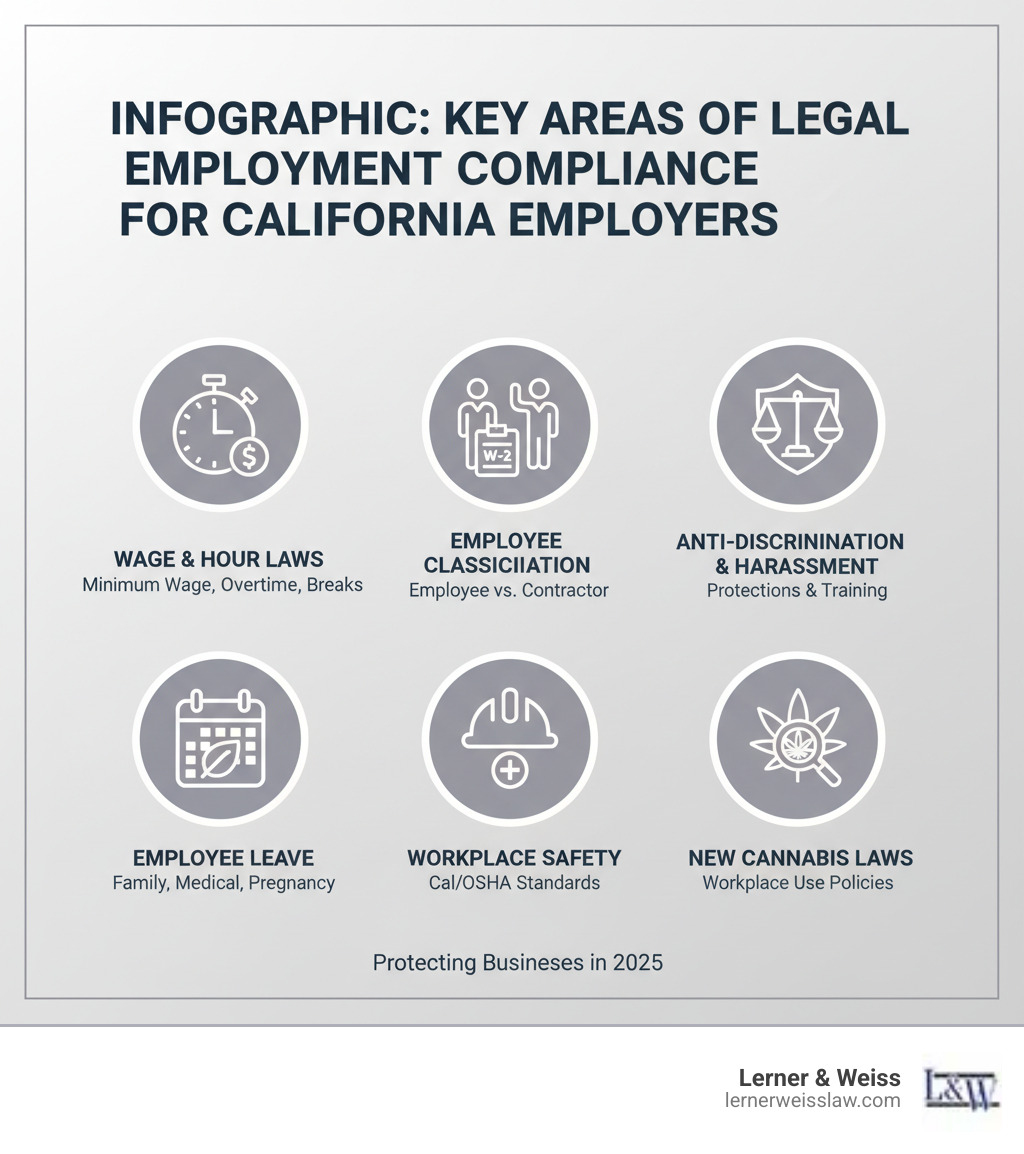
Here are the critical areas California employers must understand for legal compliance:
- **Wage and Hour Laws:** Strict rules on minimum wage, overtime, meal, and rest breaks.
- **Employee Classification:** Correctly identifying workers as employees versus independent contractors.
- **Anti-Discrimination & Harassment:** Laws protecting various characteristics and mandatory training requirements.
- **Employee Leave:** Complex regulations for family, medical, and pregnancy-related leaves.
- **Workplace Safety:** Adhering to Cal/OSHA standards and other safety protocols.
- **New Cannabis Laws:** Understanding evolving rules around employee cannabis use.
California’s employment landscape is constantly changing. Proactive compliance is key to avoiding significant financial and reputational damage.
Michael Weiss of Lerner & Weiss helps clients steer the challenging landscape of **legal employment California**. With experience in the courtroom and at the negotiating table since 1983, he provides strategic advice to protect businesses from disputes.
## Core Employer Responsibilities Under Legal Employment California
Running a business in California means following rules that are often tougher than anywhere else in the country. Understanding the fundamentals of **legal employment California** is essential for protecting your business.
The Fair Employment and Housing Act (FEHA) and the California Labor Code are the core legal frameworks. The California Labor Commissioner’s Office actively enforces these laws, meaning employers must be proactive about compliance to avoid problems.
California is an “at-will” employment state, meaning you can generally terminate an employee at any time, with or without cause. However, this freedom has limits. You cannot terminate an employee for an illegal reason, such as discrimination based on protected characteristics (race, age, disability) or retaliation for reporting a safety violation. Implied contracts in handbooks can also limit at-will rights. These exceptions are common pitfalls for employers, highlighting the need for a strong [California Wrongful Termination Defense](https://lernerweisslaw.com/california-wrongful-termination-defense/) strategy.
Day-to-day responsibilities like displaying required workplace postings and meticulous record-keeping (timecards, pay stubs, personnel files) are also crucial. These details serve as critical evidence in a dispute and can prevent significant trouble.
For the latest changes and updates in California employment regulations, stay informed with our [CA Employment Law Updates](https://lernerweisslaw.com/ca-employment-law-updates/).
### Key Aspects of Legal Employment in California: The Employee Handbook
Your employee handbook is a critical tool for protecting your business. It’s your company’s playbook, setting clear expectations to prevent misunderstandings that can lead to legal claims. The handbook should clearly outline key policies: workplace conduct, attendance, benefits, leave, anti-discrimination/harassment, and disciplinary procedures.
Crucially, obtain a signed acknowledgment from each employee confirming they have received and read the handbook. This simple step is invaluable for demonstrating that employees were informed of your policies.
A thoughtfully drafted handbook does more than communicate policies—it can prevent many common employment disputes before they start. We’ve seen how [A Well-Drafted Employee Handbook Can Help You Avoid Many Pitfalls](https://lernerweisslaw.com/a-well-drafted-employee-handbook-Can-Help-You-Avoid-Many-Pitfalls/).

### Employee Classification: The ABC Test and Beyond
Worker misclassification is a costly mistake for California employers. Classifying an employee as an independent contractor can lead to penalties for unpaid wages, back taxes, and missed benefits.
California’s “ABC test” presumes every worker is an employee. To classify a worker as an independent contractor under **legal employment California** standards, you must prove all three of the following conditions:
**A.** The worker is free from your control and direction in how they do their work, both in your contract and in actual practice.
**B.** The worker performs work that falls outside the usual course of your business.
**C.** The worker is customarily engaged in an independently established trade, occupation, or business of the same nature as the work they’re doing for you.
Failing to prove even one condition means the worker is legally an employee. Prong B is often the most difficult. For example, a bakery cannot classify a baker as an independent contractor because baking is within its usual course of business.
The stakes are high, and we explain them in [Independent Contractor or Employee Classification is as Easy as ABC—or is it?](https://lernerweisslaw.com/independent-contractor-or-employee-classification-is-as-easy-as-abcor-is-it/).
| Feature | Employee | Independent Contractor |
|---|---|---|
| **Control** | Employer dictates how, when, and where work is done | Worker controls how, when, and where work is done |
| **Taxes** | Employer withholds income, pays FICA, FUTA, SUI | Worker pays self-employment taxes (estimated taxes) |
| **Benefits** | Eligible for benefits (health, retirement, etc.) | Generally not eligible for benefits |
| **Wage Laws** | Covered by minimum wage, overtime, breaks | Not covered by minimum wage, overtime, breaks |
| **Termination** | At-will (with exceptions) or by contract | By contract terms; typically project-based |
| **Liability** | Employer generally liable for actions | Worker typically liable for own actions |
| **Business Scope** | Work is usually within hiring entity’s core business | Work is typically outside hiring entity’s core business |
| **Tools/Equipment** | Employer often provides tools/equipment | Worker typically provides own tools/equipment |
Correct classification is vital for avoiding liability. A proactive review of your worker classifications can prevent future legal headaches.
## Mastering California’s Wage and Hour Laws
Wage and hour compliance is a major pitfall for California employers. The laws are complex, constantly changing, and vary by location and industry. The Labor Commissioner’s Office enforces these rules strictly, issuing large citations for violations.

California’s statewide minimum wage is **\$16.50 per hour** as of January 1, 2025, but many cities and counties have higher rates. Employers must also track industry-specific wages, such as the **\$20.00 per hour** minimum for fast food workers (as of April 1, 2024) and separate schedules for some health care workers.
**Overtime rules** under **legal employment California** are also complex. Generally, you must pay 1.5x the regular rate for hours over eight in a day or 40 in a week, and for the first eight hours on the seventh consecutive workday. Double-time applies to hours over 12 in a day or over eight on the seventh day.
Employees must receive a **30-minute unpaid meal period** for shifts over five hours and a **10-minute paid rest break** for every four hours worked. Failing to provide these breaks on time results in a penalty of one extra hour of pay for each violation. We explore these requirements in depth in our article, [What are the rules on rest breaks for employees in California?](https://lernerweisslaw.com/what-are-the-rules-on-rest-breaks-for-employees-in-california/).
**Final pay deadlines** are strict. Terminated employees must receive their final paycheck, including accrued vacation, on their last day. If an employee quits without 72 hours’ notice, you have 72 hours to provide final pay. Missing these deadlines triggers [California Waiting Time Penalties](https://lernerweisslaw.com/california-waiting-time-penalties/), which can amount to 30 days of the employee’s wages.
For guidance on pay equity, the state provides helpful [Tools and resources for employers](https://women.ca.gov/californiapayequity/).
### Responding to Wage Claims and PAGA Lawsuits
Even with careful compliance, wage disputes can happen. The **California Labor Commissioner’s Office** handles wage claims filed by employees through its [Department of Industrial Relations (DIR)](http://www.dir.ca.gov/dlse/dlse.html) website. The process involves an investigation and potentially a hearing. Thorough documentation of your pay practices is your best defense.
Beyond individual claims, the **Private Attorneys General Act (PAGA)** poses a significant risk. PAGA allows a single employee to sue on behalf of all other “aggrieved employees” for Labor Code violations, effectively creating a class action-style lawsuit. PAGA penalties are substantial, as civil penalties are assessed for each violation per employee, per pay period. A minor payroll error can quickly escalate into a massive liability.
PAGA is challenging because employees act as “private attorneys general” for the state, expanding the scope and cost of defense. Defending against these cases requires sophisticated legal strategy. We specialize in [PAGA Defense](https://lernerweisslaw.com/paga-defense/) and [Class Action Defense](https://lernerweisslaw.com/class-action-defense/), bringing decades of experience to protect businesses facing these complex claims.
The bottom line is that wage and hour compliance is not optional. Proactive compliance, thorough documentation, and experienced legal counsel are your best defenses in navigating this challenging aspect of **legal employment California**.
## Preventing Discrimination, Harassment, and Retaliation Claims
Creating a respectful workplace is a fundamental requirement of **legal employment California**. The state’s Civil Rights Department (CRD) enforces strict anti-discrimination laws with severe penalties for violations.

California’s Fair Employment and Housing Act (FEHA) prohibits discrimination and harassment based on a long list of protected characteristics, including **race, color, ancestry, national origin, religion, age (40 and over), disability, sex, gender, pregnancy, sexual orientation, gender identity, gender expression, medical condition, genetic information, marital status, military or veteran status, and reproductive health decision-making**.
A key point for employers: FEHA’s discrimination rules apply to businesses with five or more employees, but its harassment provisions cover *all* workplaces, regardless of size. Prohibited discrimination isn’t always overt; it can be subtle, appearing in work assignments or neutral policies with a disproportionate impact. Our article on [Workplace Discrimination Examples](https://lernerweisslaw.com/workplace-discrimination-examples/) provides valuable insight.
Providing reasonable accommodations for employees with disabilities is another common challenge. This involves engaging in an “interactive process” with the employee to find workable solutions without creating an undue hardship for your business. We cover this complex topic in [Making Reasonable Accommodations for Disabled California Workers](https://lernerweisslaw.com/making-reasonable-accommodations-for-disabled-california-workers/).
Since employees have three years to file a complaint with the CRD, maintaining thorough documentation of employment decisions is critical. While false claims can happen, the best defense is proactive: maintain clear policies, document decisions, and conduct prompt investigations. Our guide on [How Can Employers Defend Against False Discrimination Claims?](https://lernerweisslaw.com/how-can-employers-defend-against-false-discrimination-claims/) walks you through the steps to protect your company.
### Mandatory Harassment Prevention Training
California requires employers with five or more employees to provide mandatory harassment prevention training. This proactive measure is a cornerstone of **legal employment California** compliance.
The requirements are specific: **supervisors need two hours of training**, and **nonsupervisory employees need one hour**. This must occur within six months of hire and be repeated every two years. Failure to comply increases your liability in a harassment lawsuit.
The training must be interactive and comprehensive. It must cover the legal definitions of sexual and abusive conduct, prevention strategies, complaint procedures, and supervisors’ obligations. It must also include practical examples covering gender identity, gender expression, and sexual orientation.
This training is an investment in your company’s culture and legal defense. Educated employees and supervisors create a stronger, more defensible workplace, a strategy we explore in [Protecting Employers Whose Employees Allege Workplace Harassment](https://lernerweisslaw.com/protecting-employers-whose-employees-allege-workplace-harassment/).
Remote work has not eliminated harassment; it has moved it online. Inappropriate messages or unwanted video calls can create a hostile work environment. Our article [Sexual Harassment Doesn’t End With Remote Working, It Just Moves Online](https://lernerweisslaw.com/sexual-harassment-doesnt-end-with-remote-working-it-just-moves-online/) addresses this evolving challenge.
## Navigating Employee Leave and Workplace Policies
California’s employee leave laws are among the nation’s most complex and protective. For employers, understanding these overlapping regulations is essential for compliance under **legal employment California**.
- **Pregnancy Disability Leave (PDL):** For employers with 5+ employees, PDL provides up to four months of job-protected leave for pregnancy-related disabilities. No minimum service is required.
- **California Family Rights Act (CFRA):** For employers with 5+ employees, CFRA offers up to 12 weeks of job-protected leave for an employee’s serious health condition, to care for a family member, or for new child bonding. Employees need 12 months of service and 1,250 hours worked to qualify.
- **Family and Medical Leave Act (FMLA):** This federal law applies to employers with 50+ employees. Key differences between FMLA and CFRA can sometimes result in an employee being entitled to more leave under California law.
- **Paid Sick Leave:** California mandates paid sick leave for all employees, who accrue hours for their own illness, to care for a family member, or for specific safety-related reasons.
Resources like the [Interactive App on Job-Protected Leave](https://ucilaw.neotalogic.com/a/ca-new-parents-rights-advisor) help workers understand their rights, so employers must be prepared.
Workplace safety, governed by **Cal/OSHA**, is another critical compliance area. Your responsibilities include identifying hazards, providing safety training, and maintaining safe facilities. A strong safety program protects both your workers and your business from legal claims, a topic covered in our [California Employer Defense Attorney Insights](https://lernerweisslaw.com/california-employer-defense-attorney-insights/).
### Navigating Legal Employment in California with New Cannabis Laws
California’s legal cannabis market has created new challenges for employers. As of January 1, 2024, employers generally cannot discriminate against employees for their off-duty cannabis use. This also applies to drug tests that show nonpsychoactive cannabis metabolites, which indicate past use, not current impairment.
However, you can still maintain a drug-free workplace. Employers can prohibit cannabis possession, use, and impairment at work. The focus of your policy should be on current impairment, not off-duty use.
Important exceptions exist. The law does not protect employees in certain safety-sensitive positions or those subject to federal regulations. Employers are also not required to permit medical cannabis use in the workplace. For more details, see this [California Workplace Marijuana Laws Overview](https://accurate.com/marijuana-law-state/california). Your drug testing and workplace conduct policies must be updated to align with these new regulations.
## Frequently Asked Questions about California Employment Law for Employers
Navigating **legal employment California** is complex. Here are answers to common questions from employers to help you understand your obligations and protect your business.
### What are an employer’s obligations for final pay when an employee leaves?
California’s final pay deadlines are strict. If you terminate an employee, their final wages (including accrued vacation) are due on their last day. If an employee quits without 72 hours’ notice, you have 72 hours to provide their final pay. Missing these deadlines can trigger significant [California Waiting Time Penalties](https://lernerweisslaw.com/california-waiting-time-penalties/), which can equal up to 30 days of the employee’s wages. Clear procedures are essential to avoid these costly penalties.
### How does “at-will” employment work in California?
While California is an at-will state, this doesn’t mean you can fire an employee for any reason. At-will means you can generally terminate employment at any time, with or without cause. However, you cannot terminate an employee for an illegal reason, such as discrimination or retaliation for protected activities (e.g., reporting safety violations). Employment contracts or even implied promises can also modify at-will status. Understanding these exceptions is crucial for a strong [California Wrongful Termination Defense](https://lernerweisslaw.com/california-wrongful-termination-defense/).
### What are the mandatory sexual harassment training requirements?
If you have five or more employees, California law mandates harassment prevention training. Supervisors need at least two hours of training, and nonsupervisory staff need one hour. This must be completed within six months of hire and repeated every two years. The training must be interactive and cover specific topics, including the legal definitions of sexual harassment and “abusive conduct” under **legal employment California** laws, prevention strategies, and your complaint process. This requirement applies to remote workforces as well.
## Conclusion: Protecting Your Business in a Complex Legal Environment
Navigating **legal employment California** is a constant challenge. The rules on wages, classification, leave, and more are always changing. Non-compliance leads to devastating fines, lawsuits, and reputational damage.
At Lerner & Weiss, we understand what’s at stake. We empower employers with the knowledge and defense strategies needed to build resilient businesses in California’s complex legal environment.
Proactive compliance is your best defense. Investing in understanding your obligations and partnering with experienced legal counsel prevents problems before they start. When disputes arise, having a strong defense team is critical.
With almost 70 years of combined experience, our team has seen it all. We’ve defended businesses against wrongful termination claims, PAGA lawsuits, discrimination allegations, and wage and hour disputes. We know how to build powerful defenses, negotiate favorable outcomes, and protect what you’ve worked so hard to build.
Don’t steer this alone. For a wealth of information and resources specifically designed for employers, visit our [California Employer Resources](https://lernerweisslaw.com/california-employer-resources/) page. When you’re ready for a comprehensive review of your employment practices and need robust defense strategies custom to your business, explore our [Employer Defense Attorney services in Los Angeles](https://lernerweisslaw.com/practice-areas/employer-defense-attorney-los-angeles/). Let us help you confidently steer through the complexities of California’s employment law landscape, so you can focus on what you do best—running your business.
### Start the Conversation
Fill out this form to get in contact with us.
##
Warner Center Towers
[21600 Oxnard St Ste 1130 Woodland Hills, CA 91367](https://www.google.com/maps?cid=3102019067496423287)
[**818-986-0893**](tel:+18189860893)
**Mon**
8:30 AM - 5:00 PM
**Tue**
8:30 AM - 5:00 PM
**Wed**
8:30 AM - 5:00 PM
**Thu**
8:30 AM - 5:00 PM
**Fri**
8:30 AM - 5:00 PM
[Leave a Review](https://search.google.com/local/writereview?placeid=ChIJ4z4sRqqfwoARd9-cHOiVDCs)
[Get Direction](https://www.google.com/maps?cid=3102019067496423287)
One America Plaza
[600 W Broadway Ste 700 San Diego, CA 92101](https://www.google.com/maps?cid=291154660184893360)
[**619-577-4871**](tel:+16195774871)
**Mon**
8:30 AM - 5:00 PM
**Tue**
8:30 AM - 5:00 PM
**Wed**
8:30 AM - 5:00 PM
**Thu**
8:30 AM - 5:00 PM
**Fri**
8:30 AM - 5:00 PM
[Leave a Review](https://search.google.com/local/writereview?placeid=ChIJ1Wix-6tU2YARsCcF755jCgQ)
[Get Direction](https://www.google.com/maps?cid=291154660184893360)
© 2023 Lerner & Weiss \| [DISCLAIMER](https://lernerweisslaw.com/disclaimer/)
The information on this website is for general information purposes only. Nothing on this site should be taken as legal advice for any individual case or situation. This information is not intended to create, and receipt or viewing does not constitute, an attorney-client relationship. |
| Readable Markdown | ## Why California Employment Law Demands Your Attention
Navigating **legal employment California** is a major challenge for business owners. The state’s employee-friendly laws mean employers face unique and strict rules. Understanding these laws is essential to protect your business from costly disputes.
Here are the critical areas California employers must understand for legal compliance:
- **Wage and Hour Laws:** Strict rules on minimum wage, overtime, meal, and rest breaks.
- **Employee Classification:** Correctly identifying workers as employees versus independent contractors.
- **Anti-Discrimination & Harassment:** Laws protecting various characteristics and mandatory training requirements.
- **Employee Leave:** Complex regulations for family, medical, and pregnancy-related leaves.
- **Workplace Safety:** Adhering to Cal/OSHA standards and other safety protocols.
- **New Cannabis Laws:** Understanding evolving rules around employee cannabis use.
California’s employment landscape is constantly changing. Proactive compliance is key to avoiding significant financial and reputational damage.
Michael Weiss of Lerner & Weiss helps clients steer the challenging landscape of **legal employment California**. With experience in the courtroom and at the negotiating table since 1983, he provides strategic advice to protect businesses from disputes.

## Core Employer Responsibilities Under Legal Employment California
Running a business in California means following rules that are often tougher than anywhere else in the country. Understanding the fundamentals of **legal employment California** is essential for protecting your business.
The Fair Employment and Housing Act (FEHA) and the California Labor Code are the core legal frameworks. The California Labor Commissioner’s Office actively enforces these laws, meaning employers must be proactive about compliance to avoid problems.
California is an “at-will” employment state, meaning you can generally terminate an employee at any time, with or without cause. However, this freedom has limits. You cannot terminate an employee for an illegal reason, such as discrimination based on protected characteristics (race, age, disability) or retaliation for reporting a safety violation. Implied contracts in handbooks can also limit at-will rights. These exceptions are common pitfalls for employers, highlighting the need for a strong [California Wrongful Termination Defense](https://lernerweisslaw.com/california-wrongful-termination-defense/) strategy.
Day-to-day responsibilities like displaying required workplace postings and meticulous record-keeping (timecards, pay stubs, personnel files) are also crucial. These details serve as critical evidence in a dispute and can prevent significant trouble.
For the latest changes and updates in California employment regulations, stay informed with our [CA Employment Law Updates](https://lernerweisslaw.com/ca-employment-law-updates/).
### Key Aspects of Legal Employment in California: The Employee Handbook
Your employee handbook is a critical tool for protecting your business. It’s your company’s playbook, setting clear expectations to prevent misunderstandings that can lead to legal claims. The handbook should clearly outline key policies: workplace conduct, attendance, benefits, leave, anti-discrimination/harassment, and disciplinary procedures.
Crucially, obtain a signed acknowledgment from each employee confirming they have received and read the handbook. This simple step is invaluable for demonstrating that employees were informed of your policies.
A thoughtfully drafted handbook does more than communicate policies—it can prevent many common employment disputes before they start. We’ve seen how [A Well-Drafted Employee Handbook Can Help You Avoid Many Pitfalls](https://lernerweisslaw.com/a-well-drafted-employee-handbook-Can-Help-You-Avoid-Many-Pitfalls/).

### Employee Classification: The ABC Test and Beyond
Worker misclassification is a costly mistake for California employers. Classifying an employee as an independent contractor can lead to penalties for unpaid wages, back taxes, and missed benefits.
California’s “ABC test” presumes every worker is an employee. To classify a worker as an independent contractor under **legal employment California** standards, you must prove all three of the following conditions:
**A.** The worker is free from your control and direction in how they do their work, both in your contract and in actual practice.
**B.** The worker performs work that falls outside the usual course of your business.
**C.** The worker is customarily engaged in an independently established trade, occupation, or business of the same nature as the work they’re doing for you.
Failing to prove even one condition means the worker is legally an employee. Prong B is often the most difficult. For example, a bakery cannot classify a baker as an independent contractor because baking is within its usual course of business.
The stakes are high, and we explain them in [Independent Contractor or Employee Classification is as Easy as ABC—or is it?](https://lernerweisslaw.com/independent-contractor-or-employee-classification-is-as-easy-as-abcor-is-it/).
| Feature | Employee | Independent Contractor |
|---|---|---|
| **Control** | Employer dictates how, when, and where work is done | Worker controls how, when, and where work is done |
| **Taxes** | Employer withholds income, pays FICA, FUTA, SUI | Worker pays self-employment taxes (estimated taxes) |
| **Benefits** | Eligible for benefits (health, retirement, etc.) | Generally not eligible for benefits |
| **Wage Laws** | Covered by minimum wage, overtime, breaks | Not covered by minimum wage, overtime, breaks |
| **Termination** | At-will (with exceptions) or by contract | By contract terms; typically project-based |
| **Liability** | Employer generally liable for actions | Worker typically liable for own actions |
| **Business Scope** | Work is usually within hiring entity’s core business | Work is typically outside hiring entity’s core business |
| **Tools/Equipment** | Employer often provides tools/equipment | Worker typically provides own tools/equipment |
Correct classification is vital for avoiding liability. A proactive review of your worker classifications can prevent future legal headaches.
## Mastering California’s Wage and Hour Laws
Wage and hour compliance is a major pitfall for California employers. The laws are complex, constantly changing, and vary by location and industry. The Labor Commissioner’s Office enforces these rules strictly, issuing large citations for violations.

California’s statewide minimum wage is **\$16.50 per hour** as of January 1, 2025, but many cities and counties have higher rates. Employers must also track industry-specific wages, such as the **\$20.00 per hour** minimum for fast food workers (as of April 1, 2024) and separate schedules for some health care workers.
**Overtime rules** under **legal employment California** are also complex. Generally, you must pay 1.5x the regular rate for hours over eight in a day or 40 in a week, and for the first eight hours on the seventh consecutive workday. Double-time applies to hours over 12 in a day or over eight on the seventh day.
Employees must receive a **30-minute unpaid meal period** for shifts over five hours and a **10-minute paid rest break** for every four hours worked. Failing to provide these breaks on time results in a penalty of one extra hour of pay for each violation. We explore these requirements in depth in our article, [What are the rules on rest breaks for employees in California?](https://lernerweisslaw.com/what-are-the-rules-on-rest-breaks-for-employees-in-california/).
**Final pay deadlines** are strict. Terminated employees must receive their final paycheck, including accrued vacation, on their last day. If an employee quits without 72 hours’ notice, you have 72 hours to provide final pay. Missing these deadlines triggers [California Waiting Time Penalties](https://lernerweisslaw.com/california-waiting-time-penalties/), which can amount to 30 days of the employee’s wages.
For guidance on pay equity, the state provides helpful [Tools and resources for employers](https://women.ca.gov/californiapayequity/).
### Responding to Wage Claims and PAGA Lawsuits
Even with careful compliance, wage disputes can happen. The **California Labor Commissioner’s Office** handles wage claims filed by employees through its [Department of Industrial Relations (DIR)](http://www.dir.ca.gov/dlse/dlse.html) website. The process involves an investigation and potentially a hearing. Thorough documentation of your pay practices is your best defense.
Beyond individual claims, the **Private Attorneys General Act (PAGA)** poses a significant risk. PAGA allows a single employee to sue on behalf of all other “aggrieved employees” for Labor Code violations, effectively creating a class action-style lawsuit. PAGA penalties are substantial, as civil penalties are assessed for each violation per employee, per pay period. A minor payroll error can quickly escalate into a massive liability.
PAGA is challenging because employees act as “private attorneys general” for the state, expanding the scope and cost of defense. Defending against these cases requires sophisticated legal strategy. We specialize in [PAGA Defense](https://lernerweisslaw.com/paga-defense/) and [Class Action Defense](https://lernerweisslaw.com/class-action-defense/), bringing decades of experience to protect businesses facing these complex claims.
The bottom line is that wage and hour compliance is not optional. Proactive compliance, thorough documentation, and experienced legal counsel are your best defenses in navigating this challenging aspect of **legal employment California**.
## Preventing Discrimination, Harassment, and Retaliation Claims
Creating a respectful workplace is a fundamental requirement of **legal employment California**. The state’s Civil Rights Department (CRD) enforces strict anti-discrimination laws with severe penalties for violations.

California’s Fair Employment and Housing Act (FEHA) prohibits discrimination and harassment based on a long list of protected characteristics, including **race, color, ancestry, national origin, religion, age (40 and over), disability, sex, gender, pregnancy, sexual orientation, gender identity, gender expression, medical condition, genetic information, marital status, military or veteran status, and reproductive health decision-making**.
A key point for employers: FEHA’s discrimination rules apply to businesses with five or more employees, but its harassment provisions cover *all* workplaces, regardless of size. Prohibited discrimination isn’t always overt; it can be subtle, appearing in work assignments or neutral policies with a disproportionate impact. Our article on [Workplace Discrimination Examples](https://lernerweisslaw.com/workplace-discrimination-examples/) provides valuable insight.
Providing reasonable accommodations for employees with disabilities is another common challenge. This involves engaging in an “interactive process” with the employee to find workable solutions without creating an undue hardship for your business. We cover this complex topic in [Making Reasonable Accommodations for Disabled California Workers](https://lernerweisslaw.com/making-reasonable-accommodations-for-disabled-california-workers/).
Since employees have three years to file a complaint with the CRD, maintaining thorough documentation of employment decisions is critical. While false claims can happen, the best defense is proactive: maintain clear policies, document decisions, and conduct prompt investigations. Our guide on [How Can Employers Defend Against False Discrimination Claims?](https://lernerweisslaw.com/how-can-employers-defend-against-false-discrimination-claims/) walks you through the steps to protect your company.
### Mandatory Harassment Prevention Training
California requires employers with five or more employees to provide mandatory harassment prevention training. This proactive measure is a cornerstone of **legal employment California** compliance.
The requirements are specific: **supervisors need two hours of training**, and **nonsupervisory employees need one hour**. This must occur within six months of hire and be repeated every two years. Failure to comply increases your liability in a harassment lawsuit.
The training must be interactive and comprehensive. It must cover the legal definitions of sexual and abusive conduct, prevention strategies, complaint procedures, and supervisors’ obligations. It must also include practical examples covering gender identity, gender expression, and sexual orientation.
This training is an investment in your company’s culture and legal defense. Educated employees and supervisors create a stronger, more defensible workplace, a strategy we explore in [Protecting Employers Whose Employees Allege Workplace Harassment](https://lernerweisslaw.com/protecting-employers-whose-employees-allege-workplace-harassment/).
Remote work has not eliminated harassment; it has moved it online. Inappropriate messages or unwanted video calls can create a hostile work environment. Our article [Sexual Harassment Doesn’t End With Remote Working, It Just Moves Online](https://lernerweisslaw.com/sexual-harassment-doesnt-end-with-remote-working-it-just-moves-online/) addresses this evolving challenge.
## Navigating Employee Leave and Workplace Policies
California’s employee leave laws are among the nation’s most complex and protective. For employers, understanding these overlapping regulations is essential for compliance under **legal employment California**.
- **Pregnancy Disability Leave (PDL):** For employers with 5+ employees, PDL provides up to four months of job-protected leave for pregnancy-related disabilities. No minimum service is required.
- **California Family Rights Act (CFRA):** For employers with 5+ employees, CFRA offers up to 12 weeks of job-protected leave for an employee’s serious health condition, to care for a family member, or for new child bonding. Employees need 12 months of service and 1,250 hours worked to qualify.
- **Family and Medical Leave Act (FMLA):** This federal law applies to employers with 50+ employees. Key differences between FMLA and CFRA can sometimes result in an employee being entitled to more leave under California law.
- **Paid Sick Leave:** California mandates paid sick leave for all employees, who accrue hours for their own illness, to care for a family member, or for specific safety-related reasons.
Resources like the [Interactive App on Job-Protected Leave](https://ucilaw.neotalogic.com/a/ca-new-parents-rights-advisor) help workers understand their rights, so employers must be prepared.
Workplace safety, governed by **Cal/OSHA**, is another critical compliance area. Your responsibilities include identifying hazards, providing safety training, and maintaining safe facilities. A strong safety program protects both your workers and your business from legal claims, a topic covered in our [California Employer Defense Attorney Insights](https://lernerweisslaw.com/california-employer-defense-attorney-insights/).
### Navigating Legal Employment in California with New Cannabis Laws
California’s legal cannabis market has created new challenges for employers. As of January 1, 2024, employers generally cannot discriminate against employees for their off-duty cannabis use. This also applies to drug tests that show nonpsychoactive cannabis metabolites, which indicate past use, not current impairment.
However, you can still maintain a drug-free workplace. Employers can prohibit cannabis possession, use, and impairment at work. The focus of your policy should be on current impairment, not off-duty use.
Important exceptions exist. The law does not protect employees in certain safety-sensitive positions or those subject to federal regulations. Employers are also not required to permit medical cannabis use in the workplace. For more details, see this [California Workplace Marijuana Laws Overview](https://accurate.com/marijuana-law-state/california). Your drug testing and workplace conduct policies must be updated to align with these new regulations.
## Frequently Asked Questions about California Employment Law for Employers
Navigating **legal employment California** is complex. Here are answers to common questions from employers to help you understand your obligations and protect your business.
### What are an employer’s obligations for final pay when an employee leaves?
California’s final pay deadlines are strict. If you terminate an employee, their final wages (including accrued vacation) are due on their last day. If an employee quits without 72 hours’ notice, you have 72 hours to provide their final pay. Missing these deadlines can trigger significant [California Waiting Time Penalties](https://lernerweisslaw.com/california-waiting-time-penalties/), which can equal up to 30 days of the employee’s wages. Clear procedures are essential to avoid these costly penalties.
### How does “at-will” employment work in California?
While California is an at-will state, this doesn’t mean you can fire an employee for any reason. At-will means you can generally terminate employment at any time, with or without cause. However, you cannot terminate an employee for an illegal reason, such as discrimination or retaliation for protected activities (e.g., reporting safety violations). Employment contracts or even implied promises can also modify at-will status. Understanding these exceptions is crucial for a strong [California Wrongful Termination Defense](https://lernerweisslaw.com/california-wrongful-termination-defense/).
### What are the mandatory sexual harassment training requirements?
If you have five or more employees, California law mandates harassment prevention training. Supervisors need at least two hours of training, and nonsupervisory staff need one hour. This must be completed within six months of hire and repeated every two years. The training must be interactive and cover specific topics, including the legal definitions of sexual harassment and “abusive conduct” under **legal employment California** laws, prevention strategies, and your complaint process. This requirement applies to remote workforces as well.
## Conclusion: Protecting Your Business in a Complex Legal Environment
Navigating **legal employment California** is a constant challenge. The rules on wages, classification, leave, and more are always changing. Non-compliance leads to devastating fines, lawsuits, and reputational damage.
At Lerner & Weiss, we understand what’s at stake. We empower employers with the knowledge and defense strategies needed to build resilient businesses in California’s complex legal environment.
Proactive compliance is your best defense. Investing in understanding your obligations and partnering with experienced legal counsel prevents problems before they start. When disputes arise, having a strong defense team is critical.
With almost 70 years of combined experience, our team has seen it all. We’ve defended businesses against wrongful termination claims, PAGA lawsuits, discrimination allegations, and wage and hour disputes. We know how to build powerful defenses, negotiate favorable outcomes, and protect what you’ve worked so hard to build.
Don’t steer this alone. For a wealth of information and resources specifically designed for employers, visit our [California Employer Resources](https://lernerweisslaw.com/california-employer-resources/) page. When you’re ready for a comprehensive review of your employment practices and need robust defense strategies custom to your business, explore our [Employer Defense Attorney services in Los Angeles](https://lernerweisslaw.com/practice-areas/employer-defense-attorney-los-angeles/). Let us help you confidently steer through the complexities of California’s employment law landscape, so you can focus on what you do best—running your business. |
| Shard | 6 (laksa) |
| Root Hash | 14416260556770761806 |
| Unparsed URL | com,lernerweisslaw!/legal-employment-california/ s443 |